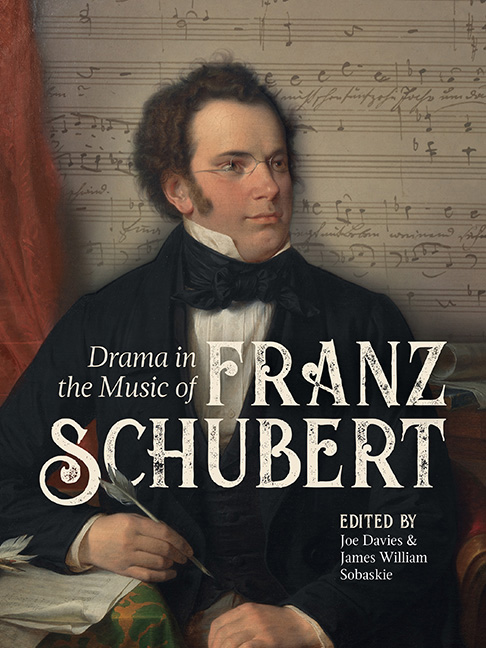
Book contents
- Frontmatter
- Dedication
- Contents
- List of Figures
- List of Tables
- List of Contributors
- Acknowledgements
- Preface
- Introduction: Internal Dramas
- PART I STAGE AND SACRED WORKS
- PART II LIEDER
- PART III INSTRUMENTAL MUSIC
- 9 ‘Zumsteeg Ballads without Words’: Inter-Generic Dialogue and Schubert's Projection of Drama through Form
- 10 Lyricism and the Dramatic Unity of Schubert's Instrumental Music: The Impromptu in C Minor, D. 899/1
- 11 Music as Poetry: An Analysis of the First Movement of Schubert's Piano Sonata in A Major, D. 959
- 12 Virtual Protagonist and Musical Narration in the Slow Movements of Schubert's Piano Sonatas D. 958 and D. 960
- 13 Stylistic Disjuncture as a Source of Drama in Schubert's Late Instrumental Works
- Select Bibliography
- Index
9 - ‘Zumsteeg Ballads without Words’: Inter-Generic Dialogue and Schubert's Projection of Drama through Form
from PART III - INSTRUMENTAL MUSIC
Published online by Cambridge University Press: 25 March 2020

Book contents
- Frontmatter
- Dedication
- Contents
- List of Figures
- List of Tables
- List of Contributors
- Acknowledgements
- Preface
- Introduction: Internal Dramas
- PART I STAGE AND SACRED WORKS
- PART II LIEDER
- PART III INSTRUMENTAL MUSIC
- 9 ‘Zumsteeg Ballads without Words’: Inter-Generic Dialogue and Schubert's Projection of Drama through Form
- 10 Lyricism and the Dramatic Unity of Schubert's Instrumental Music: The Impromptu in C Minor, D. 899/1
- 11 Music as Poetry: An Analysis of the First Movement of Schubert's Piano Sonata in A Major, D. 959
- 12 Virtual Protagonist and Musical Narration in the Slow Movements of Schubert's Piano Sonatas D. 958 and D. 960
- 13 Stylistic Disjuncture as a Source of Drama in Schubert's Late Instrumental Works
- Select Bibliography
- Index
Summary
Form is not exclusively a property of the individual piece.
– James HepokoskiIntroduction
This chapter serves two concomitant ends: to revive engagement with Schubert's earliest chamber music for strings, a body of work which merits greater attention than it has hitherto received, and to explore the methodological implications of this repertoire's particular generic profile, specifically the dramatic potential of what I refer to as ‘inter-generic dialogue’: the merging or interaction of features characteristic of disparate genres within a single form. It does this by analysing Schubert's earliest surviving chamber-music composition, the Overture for String Quintet in C minor, D. 8, written in June 1811 for his brother Ferdinand and reworked for string quartet later that year as D. 8A. This work's formal outline, I argue, is shaped by two discrete contemporary influences: the orchestral overture to Luigi Cherubini's rescue opera Faniska (a connection first proposed by Martin Chusid), and Schubert's first surviving vocal composition, ‘Hagars Klage’ (Hagar's Lament), D. 5, composed on 30 March 1811 and modelled on the ballad of the same title by Johann Rudolf Zumsteeg. In considering the significance of this intertextuality, this chapter explores the idea – mooted by the opening quotation – that the form of Schubert's earliest chamber music is not the sum of its internal parts but a product of its engagement with external forces such as diverse forms of musical drama and lyricism. Ultimately, by reflecting on methodology, the conclusion offers suggestions for how an analytical approach emphasizing dialogue between genres might provide an appropriate lens through which to view this repertoire while encouraging a meaningful interaction between music history and analysis.
Schubert's Lyric-Epic-Dramatic Sonata Style
The sonata has long been upheld as a fundamentally dramatic form which enacts a musical drama through the establishment of a network of generic expectations that are variously deferred, manipulated, or thwarted in individual works; Edward T. Cone memorably referred to this as the form's ‘interplay of the anticipated and the actual’.
Information
- Type
- Chapter
- Information
- Drama in the Music of Franz Schubert , pp. 205 - 232Publisher: Boydell & BrewerPrint publication year: 2019
Accessibility standard: Unknown
Why this information is here
This section outlines the accessibility features of this content - including support for screen readers, full keyboard navigation and high-contrast display options. This may not be relevant for you.Accessibility Information
Accessibility compliance for the PDF of this chapter is currently unknown
and may be updated in the future.
- 1
- Cited by