

It is very easy to come up with a theory about recycling in prehistory - that people utilised raw material to the highest degree, processing abandoned tools, repairing and transforming them, but it is far more difficult to prove such a theory. It is only made possible by studying refittings of flint artefacts obtained from very careful excavation.
We were lucky enough to have this situation at the Wylotne Shelter in the Jura Krakowsko-Czestochowska area of Poland (see map). Wylotne Shelter, with an area of about 95 sq. m and located above the valley of the Saspówka river, is an airy and well insolated place, and was a very amenable location for prehistoric settlement. The cave was first discovered in the nineteenth century, and as early as 1924 it was inscribed on the national list of monuments of art and culture. Regular explorations, led by Waldemar Chmielewski, were carried out between 1962 and 1966.
Map.

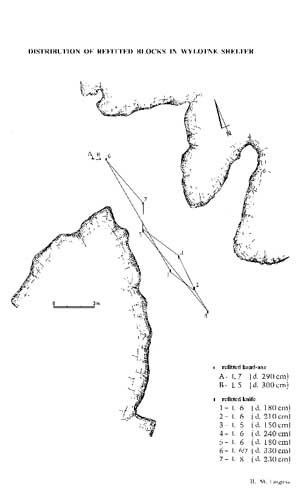
Eight geological levels were distinguished during the excavations, and in three of them artefacts of micoque-prondnician culture were found. As a consequence of post-depositional processes many of them underwent repetitive destructions and translocations. Owing to thorough field documentation it is possible to follow relations between elements of particular blocks (Figure 1).
Distribution of refitted blocks in Wylotne Shelter.

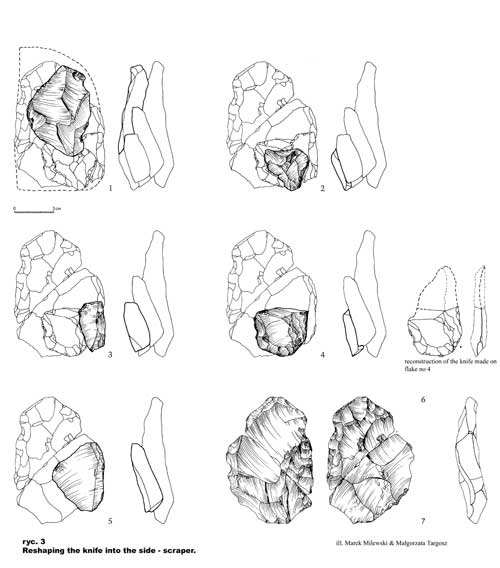
I. Knife - side-scraper (Figure 2)
Reshaping the knife into the side-scraper.

Block composed of two fragments (from levels 8 and 7), broken because of natural reasons, gives a side-scraper. There were some other intentionally knapped flakes (from levels 6 and 5) conjoining the side-scraper. The reconstructed original tool is a knife with bifacial retouch. The knife was reduced right down through repeated repair and was then reshaped into a scraper.
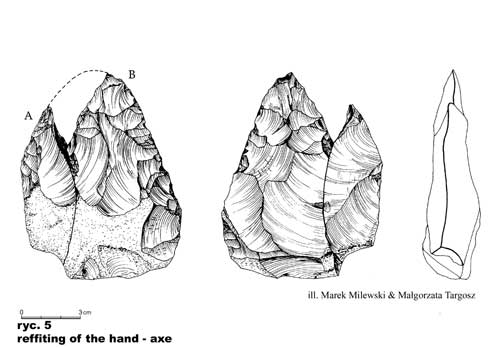
II. Hand-axe - knife (Figure 3)
Refitting of the hand-axe.

The block is composed of two fragments (levels 5 and 7); there are very clear differences in the patina covering the two pieces. Originally a heart-shaped hand-axe was made, plano-convex in section. As a result of low temperatures a fragment of the tool fell off, resulting in a backed edge. A slight retouch of the point and repairing the sharp working edge then produced a knife.
In both these cases, we cannot know who has reshaped the tools. Was it one person, producing and repairing tools, which he or she used? Or, maybe many years later, someone else took the abandoned, destroyed artefact and gave a new function to it?
Acknowledgements
With special thanks to Prof. Dr hab. Waldemar Chmielewski for his help.