

“It is better to have one person working with you than three people working for you.”

1.1 Introduction
There is probably nothing new to you about working on a team. As a PhD student or a postdoc you have seen your supervisor lead a team. With luck, it will have been great fun (e.g., taking in cake for the coffee break or going out for drinks to celebrate a recently accepted article), especially if you worked on a team of people with mixed backgrounds (e.g., celebrating Chinese New Year with all its traditions). You’ll remember such events forever. The team may have achieved amazing scientific results – more than were promised in the original project plan and more than hoped for because the team spirit inspired everyone to work together to a higher level. At the same time, you may wonder what the keys factors were behind all the fun and success.
From time to time, working on a team can also be quite frustrating, and you may have seen this side of things too (e.g., a PhD student bogged down in details or suffering a burnout or a supervisor who was out of office for too long when you urgently needed his or her input). There is a Jewish and Arabic saying, “Wish your enemy a lot of staff.” Disagreements, controversies, and discomfort – you have probably come across some (or maybe too many) such difficulties. Your supervisor may have resolved the issues and created a culture in which problems could be discussed and sorted out. Or not …
Once you start your own team, leading your own people is no longer the responsibility of your boss – but yours. The fun is yours, and the hard part is also yours to deal with. Before this point, work was all about making your career. Now it’s also about the careers of others. You are welcoming team members and raising them as your “scientific offspring.” You are a specialist in your field, and now, more than ever, you need to take care of the human dimensions of your team.
How you deal with the human factor is crucial for making science your successful “business.” The following four sections address the different consecutive phases from identifying the first person you recruit to building an effective team:
Scout. Where and how do you attract talented PhD candidates or postdocs to apply for a post on your team?
Select. What criteria should you use when comparing applicants? How do you value and treat applicants equally who can have quite diverse expertise, experience, and characteristics?
Prepare. What good research practices should you and your team members take on board? How do you make them aware of the need for high standards in their research? Can you pay attention to these standards from the very first moment?
Advance. What makes a group of individuals into an effective team? How do you train members well for taking their next steps? How about yourself? Once some members leave your team, how do you restore the team’s equilibrium and get back to a state of performing well?
1.2 Scout
Team members, such as PhD candidates, postdoctoral researchers, and maybe a research assistant or two, fly in, stay for a time, and fly out again. They are each present for some of the cycle of starting, running, and completing your projects. This requires you to become a skilled talent scout who can attract and select exactly the right people to fit into your team and work plans. You can start looking for candidates when you have a vacancy, and you may often need to fill the vacancy as quickly as possible in order not to lose the funding. It would be just too bad if you needed to recruit your new member in a rush from a rather limited pool of not quite good enough candidates. Why not start looking for candidates a bit earlier? After all, a good project also takes months to develop from the initial idea to the funded proposal. You can use those months to build up a list of PhD and postdoctoral candidates who may be looking for new positions in due course. As soon as you can start recruiting, you can alert the people on your list and then post job ads and use complementary strategies to extend your list. With such a combined medium- and short-term strategy, the chances of recruiting the “best people in the market” for your growing team are a lot higher. If you start scouting late, time may be ticking away, and you may need to appoint a doubtful candidate in order not to lose your grant money – this would be too bad.
How to attract the best candidates
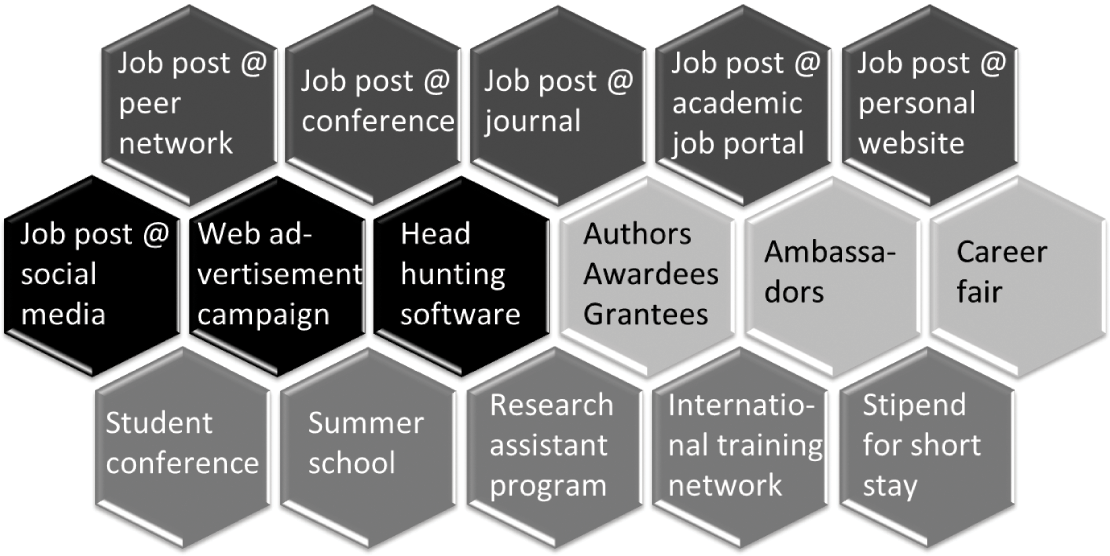
It is worth running that extra mile to attract and recruit the best candidates for your team. Figure 1.1 shows some strategic options you might use to get in touch with high-potential candidates directly or indirectly. See which strategies work for you.
Scouting strategies: traditional job ads (top), job ads, and social media (center, left); building up a list of candidates before you post any job publicly (center, right); building up a list of candidates you have met in person (bottom)
You can share job advertisements in the traditional way:
Job post to your peer network. Develop, cultivate, and exploit relationships with national and international colleagues and project collaborators to mutually share job openings and opportunities for exchange (internship) programs. Become a member of relevant academic societies in your field, and post your positions on their job portals and in their newsletters. Your university may also be associated with other universities offering additional peer networks to which to post your jobs.
Job post at a conference. Try to agree that you and your colleagues will routinely promote each other’s job openings during visits, workshops, conferences, or wherever else you and they go – this is “direct marketing” to well-defined groups. A joint advertisement for your positions with those of your colleagues can demonstrate the ambition and dynamics of your group, institute, and university.
Job post in a scientific journal. Publishers such as Nature Publishing Group allow for online or printed job posts. This is an expensive option unless your vacancy is advertised jointly with a number of other vacancies from your university.
Job post on an academic job portal. Your university will advertise your vacancies on its site. National or international unions of universities, academic medical centers, and research institutes may also post their vacancies on a joint web portal. Funding agencies may want to advertise your positions on their websites and in their newsletters.
Job post on your personal website. All serious candidates will look at your website. They will form an opinion about you and your team and whether they would fit in well. Even better, on your website you can show that you have happy group members with diverse backgrounds and share who has worked with you in the past. Be explicit that everyone (different genders, ethnicities, handicaps, etc.) are really welcome (include a broad welcoming statement in all your recruitment methods).
You can, of course, also share job posts by using social networks:
Job post on social media. Tweet your vacancies, and your followers may retweet them. If you inform an influential player in the field, your tweet may spread even wider. Post your vacancies on Facebook, and others may “like” your post so that their friends see it too. Try posting on well-read forums and other social media platforms such as those of your peer community, academic societies to which you belong, PhD and postdoctoral researcher associations, or any funding agency that is sponsoring your project.
Web advertisement campaign. Seek help from support staff to start an online advertisement campaign; for example, with the right combination of keywords, Google ads may be affordable. Your ads may pop up on the screens of good candidates. Other platforms such as LinkedIn can also email or show ads to the right candidates.
Headhunting software. Commercial platforms such as LinkedIn offer free or paid tools for headhunting. Advanced platforms such as ResearchGate and Elsevier’s Scival mine publication databases and other online information to find and rank candidates. Candidates are analyzed based on text in their publications, citations, altimetry, and more (e.g., demographics, publication time frames). Again, seek help from support staff.
You can start scouting around before you actually have a vacancy. You can become your own headhunter. Every time you run into someone interesting, consider that person from a recruitment perspective. Note his or her name and some details. At a later stage, you can then email them your job ad. You can ask them to circulate it or send it directly to anybody who may be interested and suitable for the job. Of course, it becomes unethical when you try to acquire someone who works (happily) somewhere else. After all, the supervisor of that person is also your peer. But perhaps they may be looking for a new position themselves.
Authors, awardees, and grantees. Analyze the author list and their contributions to a striking and possibly influential paper in your own field or a neighboring field. A Master’s student who coauthored a paper could become your next PhD candidate; a PhD candidate who wrote an article could become your postdoc. If you hear of people who graduate with distinction or who obtain personal grants for internships or awards for their theses, posters, presentations, or articles, add their names to your list. Or perhaps you have served on a grant review or award nomination panel and have seen some excellent candidates. Or you may see a press release about people being elected for membership of prestigious young societies, all more names to add to your list. Be ready when they are looking for new positions.
Ambassadors. Current or former team members also can help to attract several excellent PhD candidates or postdocs from the place where they studied or worked. They can be your best ambassadors, telling others that working with you is great. If some of your alumni now lead their own teams elsewhere, this can generate more candidates for your team when they are looking for new positions. It’s worth keeping in touch with your alumni.
Career fair. Delegates of your university may travel to career fairs to interview candidates for you and your peers. These candidates may be in their final year of their current contract and may be starting to look seriously for their next job opportunity. In the weeks before the career fair, you can prescreen CVs from the fair’s database and select one or more candidates to be interviewed by your university’s delegate during the fair. You can plan further actions for those candidates who pass the interview. For example, you can send them a direct email to inform them that you may have a job opening in a couple of months (or straightaway if the fair is fortuitously held at the time you need to start recruiting).
As a medium- to long-term strategy, you will want to meet some candidates and invest in a personal relationship. They may feel pleasantly surprised and even flattered by your attention and may then seriously consider a job with you rather than with someone else they don’t know so well. Be ahead of your competitors by having direct contact with candidates.
Student conference. Help student or postdoc associations organize international conferences at their level, and offer a topical satellite lecture or workshop or a mentoring session at a satellite career fair. You’ll get to know the talent pool, and they will get to know you (and hear about future job opportunities at your place).
Summer school. Organize an annual summer school together with some colleagues. Invite some well-known lecturers. Allow Master’s students, PhD candidates, and/or postdocs to apply. Possibly you can also offer some support for travel and housing expenses.
Research assistant program. Each year try to offer one or more local Master’s students a paid (part-time) job as a research assistant for a couple of months. It’s a job, so they won’t earn study credit points. Instead, they get a (small) salary that they can use for covering study and living expenses. A job at a bar at night would be much less useful for establishing their career in science. The funding for this might come from your own grant money, or if you’re lucky, your institute may have a budget available. Invite local students to apply, and carry out a genuine selection procedure to recruit the best. This can be seen as useful experience to prepare them for future job applications and a reality check for their suitability for a career in academia. It can also give you practice in seeking out the best candidate.
International training network. Coordinate with international colleagues to design a Master’s student training program and get it funded, for example, by the EU’s Erasmus Program. Master’s students from all over the world will apply to prestigious programs. Selected students stay for six months at the place of one coordinator, before they move on to another coordinator and place. As a lecturer and coordinator, you’ll be able to assess which students are best qualified for your job vacancies.
Short-term stipend. Offer promising external candidates from your scouting list a stipend for a short stay of a few days or perhaps even two weeks in your group. Some institutes or consortia have budgets available for exchange visits between partners. It’s good for thecandidate’s curriculum vitae (CV), and both of you can test whether the match is mutually beneficial. In addition, your team members can tell you how they like interacting with the candidate. See Box 1.1 for an example of an invitation for a short stay with your group.
Dear Mr./Ms. [name, e.g., Johnson],
Thank you for the Skype interview last April 15th for one of my PhD/postdoc vacancies.
It is my pleasure to invite you, along with a few other candidates, for a campus visit on May 10–12th. Please plan your trip to have these days available for your visit.
I would like to invite you to attend the Faculty’s Research Seminar (click here for the speakers) on May 10th at 3 p.m. A week beforehand you will receive details about the prep work required for the seminar. Further program details will be made available in due course, but your visit will end on May 12th by 2 p.m.
After the site visit, we will make a final selection of candidates based on our criteria of academic skills (e.g., potential to work with digital tools and ability to analyze data) and social skills (e.g., ability to work on an international and interdisciplinary team).
We can offer you a travel stipend (which you can add to your CV) to cover your travel costs (economy class) and accommodations. A hotel room will be booked for you once you have confirmed the dates.
Thank you for your interest in the position. I would appreciate it if you could confirm these dates as soon as possible, but by April 25th at the latest. We look forward to hearing from you and to meeting you soon!
Yours sincerely,
[Your name and degree, e.g., Maria Dunn, PhD]
Choosing between a PhD and a postdoc
You may have built up a nice long list of high potentials, some of whom are still Master’s or PhD students, while others may already be postdocs. How great it would be if you could welcome one or more people from your list to your team. However, before you move on from scouting to selection, do note some of the advantages and disadvantages of recruiting a PhD student or a postdoc.
Ideal group composition. Educating PhD candidates is a primary task for any university researcher; you are probably expected to supervise PhD candidates on your team. You have too many ideas to follow up yourself, and one or two PhD candidates can work with you and multiply your research capacity. Because they stay for three or four years with you, it pays to invest plenty of time in training and supervising them. However, you will find that you have limited supervision capacity; if your group is going to grow more, so will your role as supervisor. At some point cosupervision of PhD candidates by a postdoc will be welcome. You will then be able to leave for a longer trip or take a holiday while someone else takes care of the daily supervision and some of the daily group dynamics. There is also a benefit to spreading training over more people because postdocs can help you train junior members and improve the junior/senior staff ratio. Teaching student courses is another activity you can share with a postdoc. The cosupervision of PhD candidates and the gain in teaching experience will strengthen a postdoc’s CV, but you should explicitly credit them for taking on additional responsibilities (and successes). However, for postdocs to succeed, they need to demonstrate their scientific independence, and they will therefore need to work increasingly on their own ideas rather than on your projects.
Skills comparison. A PhD student may start as some sort of research trainee in your group but should develop scientific independence over the course of the project. The “should” in this sentence refers to the risk: not all PhD candidates develop their knowledge and skills fast enough, which is particularly relevant for monodisciplinary-trained PhD candidates starting on an interdisciplinary project. Some may need a lot of supervision for a rather longer time than hoped for. But PhD candidates can be flexible if you have the time to train them and help them develop. In contrast, postdocs – if well screened during hiring – are scientifically quite independent from their first day and will generate results more quickly, for example, increase the number of good group papers published, bring critical diversity into your group’s discussions, or help in supervising undergraduate and graduate students. But some projects need to start producing results right from the start – there is no time for the two-year growth period of a PhD candidate. The tasks, deliverables, and timeline then call for a postdoc with the right background. In the same project, some other tasks may be more suitable for PhD candidates, so if you have enough funding, you could appoint both.
Commitment comparison. A PhD candidate will stay until the end of the research project in order to finish their thesis – it’s their entry ticket to a career, whether in academia or elsewhere, and failing is not an attractive option. In contrast, a postdoc position is usually short term and a stepping stone to a more permanent job in academia (e.g., instructor, lecturer, or assistant professor) or elsewhere (e.g., research group leader in industry). The postdoc needs to search proactively for his or her next job and will ask you for recommendation letters. You must help your postdoc leave, even if this means that his or her contract with you will be terminated earlier than practical for your project work. Another point is that when hiring a postdoc, you also hire their history. Often they need time to finish earlier work. It takes time to get manuscripts on earlier work published, and quite often reviewers of these manuscripts will ask for extra work to be done. This is all time your postdoc cannot spend on your project. Or the postdoc will need to work in the evenings and on weekends so that they have no time to switch off and relax.
One virtual handshake away
I have over 300 followers on Twitter. Many of them I have never met and don’t know personally. So I tweet my vacancies and hope interested followers will apply. Sometimes it works, but I thought I could test a possibly more effective strategy. Curious? Then read on. I follow some 100 influential scientists, academic groups and organizations, publishers, and funding agencies. It shows where my interests lie, and I am actually looking for people with similar interests. I decided to use an internet crawler, software that allowed me to collect information from websites. This enabled me to download the list of followers for each Twitter account on my list of 300 people following me. And then, with some further data crunching, I derived a list of people who showed a good overlap in terms of who they followed and who I followed. After further analysis, I had a list of 10 top candidates, and I sent each of them a private message explaining how I had found them and what job opening I had. I was definitely the first recruiter to contact them for their next step. And my search strategy impressed them. I conclude that so far this strategy has worked amazingly well. Now I’ll have to see whether I can really hire one of them in the next few months once their current jobs finish.

Interview five to 10 experienced researchers about their scouting strategies: what worked well (or badly) and why? Discuss the options in Figure 1.1.
Ask your human resources (HR) recruitment officer for advice, and discuss the options in Figure 1.1. Has the university subscribed to recruitment software for searching for suitable candidates and advertising jobs (e.g., LinkedIn ads or Google AdWords)? Does it attend specific career fairs with access to a database of participants?
Make a list of the five keywords to be used as input for scouting tools:
| Keyword | |
|---|---|
| 1 | |
| 2 | |
| 3 | |
| 4 | |
| 5 |
Use the keywords to mine social network sites, e.g., ResearchGate or LinkedIn or career fair databases for candidates.
Make a list of at least five influential people and communities on social media such as Twitter and Facebook. Alert them when you’re looking for people, and hope for likes, retweets, and more:
| Influencer or community | Social media name | |
|---|---|---|
| 1 | ||
| 2 | ||
| 3 | ||
| 4 | ||
| 5 |
Make a list of at least five important student or other conferences, society meetings, or academic network meetings, and check whether anyone from your organization is attending and can post your job ads:
| Conference | Who’s going | |
|---|---|---|
| 1 | ||
| 2 | ||
| 3 | ||
| 4 | ||
| 5 |
Make a list of at least three top male and three top female candidates you don’t yet know by looking for (1) authors of important scientific articles, (2) awardees of relevant minor and major distinctions, and (3) receivers of relevant minor and major grants:
| Article, grant, award | Name of author, receiver, awardee | |
|---|---|---|
| 1 | ||
| 2 | ||
| 3 | ||
| 4 | ||
| 5 | ||
| 6 |
Check whether your organization offers summer schools (or winter schools) and how it can help you organize one. Who would you like to co-organize it with you, who would you like to give a talk, and how would you advertise it?
Use a fraction of your budget to offer talented Master’s students the experience of working in your group as your assistant. Ask students to apply formally.
On your website, offer a stipend for short stays in your group. You may attract just a few more candidates or evoke an avalanche of applications. See whether good candidates apply. Read the invitation in Box 1.1: what assignments can candidates be asked to complete before their visit, and what activities could be organized for their visit? Which agencies fund peer networks for training PhD candidates or postdocs? Can you join a training network? Or can you team up with some strong partners to propose a training network grant application together?
1.3 Select
Get the right people on board with your team and in the right seats. Making a selection is a very serious business, and the golden rule is: in case of serious doubt about a candidate, don’t hire him or her. Otherwise, your group will never become an effective team. The implications of a mismatch are huge, for the candidate in his or her career progression, for the team because the funding and timing may not allow for a restart with another person, and for you and your career because you need to demonstrate “sound leadership in the training and advancement of young researchers.” A traditional long interview in person or by Skype can be useful in deciding to turn down a candidate you have never seen or spoken to before, but it is still a dangerous basis for making a precipitous positive decision. Although you may feel that you need to start the project as soon as possible, you may be impressed by the candidate, and so on, but a good one-hour session can still lead to a frustrating “marriage in science” for one or more years.
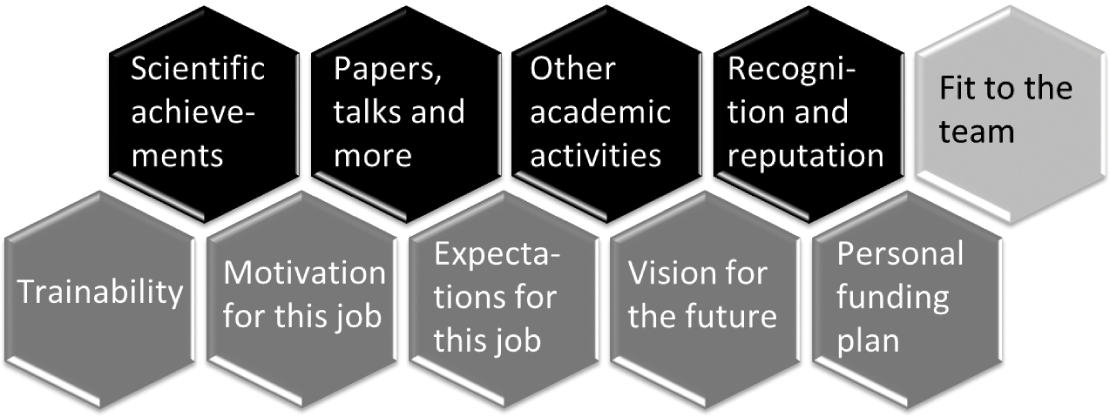
We all tend to evaluate candidates based on their past academic merits and our prediction of their future prospects (Figure 1.2). You will have to work with this person, probably on a daily basis, so don’t forget to evaluate their fit into the team. The hard and soft selection criteria can be specific to your research field, your project, and your current team composition and attuned to the level of the position (PhD or postdoc). In addition, there are several evaluation criteria generic to many fields and projects (again these can be attuned to the level of the position):
Scientific achievements. Your candidates have experienced what it is to do research, as part of their thesis project or a postdoc job. Ask them what they are most proud of. Can they outline in 100 words what their two to three main intellectual contributions were (versus the contributions of the supervisor or coauthors). Ask them explicitly not to focus on what they have done but on what they have created, discovered, invented, developed, or achieved. Also ask them about their failures, disappointments, and frustrations and how they have dealt with these. Are they independent, creative, and persevering?
Papers, talks, and more. It’s great to be independent and creative, but not enough. Only if candidates present and write well can their peers and society benefit from their work. Ask candidates to show their thesis reports and whether these resulted or will result in a paper. What else have they written, submitted, and/or published; how much of the writing did they do themselves; and how independent were they? How do they perceive the writing process, including making revisions based on reviewers’ comments? Let them write a brief piece on the spot as a reality check. Have they ever had experience reviewing a manuscript for a journal editor (perhaps one passed on by their supervisor)? Have you seen or heard them present a poster or paper at a meeting? How convincing and stimulating were they? How lively was their interaction with the audience? Let them give a presentation to your group, and do let them talk with the group and with individuals about their work and your group’s work. The quality of the work is what really matters, not the number of papers. Are they eager and able to communicate effectively at an academic level?
Other academic activities. Have they supervised students or taught any classes? Did they ever help organize or coordinate anything like a journal club, student conference, satellite meeting, or a conference, or have they acted as an editor of a student journal? Have they been a member of a student council or a student member on a faculty board? Have they worked only locally, or nationally or even internationally? What can they say about their academic network? Who do they know, where have they been, and why? Try to find out whether they have hidden talents that may be of use to your group or that, with some extra investment, could position them well for their next career step. For example, do they like sharing results with the public via press releases, media posts and blogs, interviews, or generating newspaper coverage, e.g., by sending a letter to the editor of a local or national newspaper? Are they open to helping academia run well?
Recognition and reputation. Did they get excellent grades for their student exams and, in particular, for their thesis? Was their thesis well received? Did it win an award? Have they ever been given a poster award or a best presentation award? Or a travel stipend to attend a conference, or a personal grant or fellowship? Is their work being picked up quickly by the research community or societal groups, i.e., downloaded, tweeted, highlighted, cited? Have they been invited to give an oral presentation at a workshop or conference? Can they provide you with the names of supervisors and recommendation letters from them? Can you phone the supervisors and discuss their recognition of the candidate’s scientific abilities. Is this a high-potential candidate? Would the supervisor hire this candidate with no reservation if in your place? Does this candidate have a good reputation?
Trainability. Good past performance doesn’t guarantee that candidates will be successful in the future. To successfully contribute to your project, they need to be hungry for new knowledge and ideas, quickly picking up while thinking for themselves, eager to develop the hard and soft skills necessary for the project. A short stay in your group can help you assess their trainability. Can they familiarize themselves with your project’s topic, can they connect it to their earlier experiences, and can they perhaps already suggest new ways for your project to progress? Will they contribute to the deliverables and at the same time negotiate to make it their own project that might deliver more than your original expectations? Is this candidate trainable and taking ownership of self-training?
Motivation for this job. It can be quite informative to start an interview with an open question such as, “Tell me how you prepared for this meeting?” Has the candidate done his or her homework? Did he or she study your group website, look up the information on your research lines, and maybe read some of your recent publications? Why does the candidate want to do this project? Why with you and/or your team? Is this a well-thought-through career step or the only job ad available? Has the candidate ever turned a job offer down, and why? Did the candidate prepare well for the application and interview/meeting?
Expectations of the job. In terms of content, work, career – do the candidate’s expectations match yours. Discuss the work plan, potential risks and opportunities, and how they would start on day one. What sort of interaction with the supervisor and group members are they hoping for. Do they need special working conditions (e.g., a quiet room rather than a shared office space or flexible working hours because of childcare, etc.). Are all the expectations mutually clear, and do they match well?
Vision for the future. This is very important: what is the candidate truly passionate about? What does he or she see as the most exciting challenges in his or her academic life? What makes the candidate tick as an academic? Does the candidate have clear dreams or even any concrete ideas for a future research line of his or her own inside academia (discuss that universities need only a limited number of professors) or for a future career track outside academia (universities educate the next generation workforce for society)? Can the candidate explain how a PhD or postdoctoral position in your group would serve his or her future career goals? What core or general skills does the candidate want to strengthen? Does the candidate have a vision of what he or she wants to learn and where he or she wants to go and the (beginning of a) concrete and realistic plan on how to achieve this?
Funding potential. Does your PhD or postdoc candidate have ambition, ideas, and a wish to bring in some additional funding during the project, or to apply for a grant to cover conference costs, or to fund a small project of his or her own? Any reluctance to discuss such a strategy should make you pause and seriously wonder whether this candidate is the one to hire. You can introduce the candidate into the landscape of available grants (is this a grant for you?), help the candidate benchmark himself or herself (are you ready for this grant?), and help the candidate make a plan to get ready (what can you or we do to be more ready in two to three years?). Perhaps you should consider making the candidate draft a personal funding plan (PFP) as a standard part of the selection procedure. Is the candidate willing to draft and discuss a personal funding plan?
Fitting into the team. You’ll be working long hours together with your team members. Will you get along well with each other? Have a drink, lunch, or dinner with the candidates to learn more about their personalities: you need to see them when they are relaxed and not stressed or hyped. Let your team members meet the candidates to see how they all get along and to hear how the candidates behave when you’re not around. Then discuss with the team their and your views on the fit to the team. People can be quite different, and this can actually be a strong asset: they can complement – or even strengthen – the hard and soft skills and expertise levels already present in the group (more on this later). Are they a team player and complementing the current team well?
Evaluate the candidates at various levels: past performance (black), future perspectives (gray), and how well they fit in the team (light gray)
| Type of grant | |
|---|---|
| “Is this type of grant for you?” | |
| Travel grant | Visit important conference or a famous scientist to learn about the newest developments. |
| Personal research grant | Do you have a bright idea for a project? |
| Collaborative research grant | Join existing collaboration. |
| Training grant | What do you want to learn and where? |
| Other types | Go wild! |
| (National, international, mono- or cross-disciplinary, fundamental or applied, public or private money, anything goes …) | |
| Action plan | ||
|---|---|---|
| “What will you do to be more ready for an application in two to three years’ time?” | ||
| Action 1 | Action 2 | Action 3 |
| (Make an iSMART action plan: inspiring, specific, measurable, acceptable, realistic, timely) | ||
Note: Items to discuss (left column) and questions you can ask the applicant (right column). See also the author’s book, Funding Your Career in Science (Cambridge University Press, 2013).
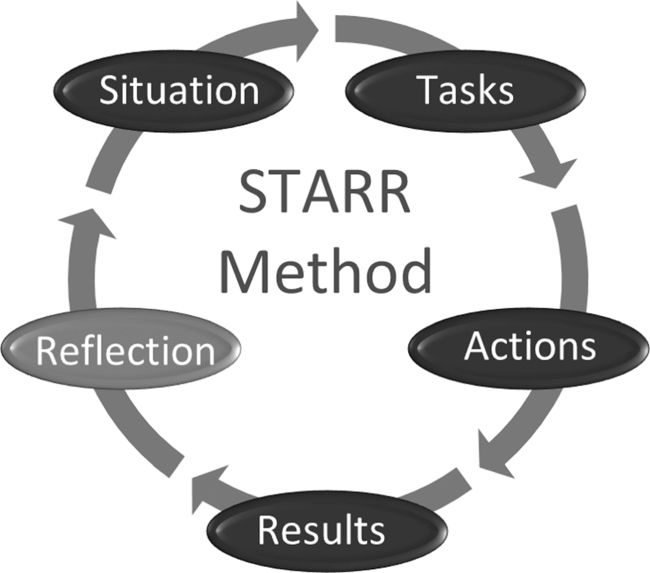
An applicant may write in their application or tell you during the interview that they are creative, independent, and resilient, a good team player who writes fantastic papers in no time. But whether this is true or not, or a little bit true, may be hard to discern from the CV or motivation letter or from a “yes, sure, I’m creative.” The five steps of the STARR method (Figure 1.3) can help you get a more objective picture of the applicant (and to select the true star).
Situation. Ask the applicant to describe a situation in which a particular personal or professional skill (e.g., conflict resolution, critical thinking, perseverance, problem solving, time management) was required. Who else was involved, such as one or more group members or external people?
Tasks. Ask the applicant what their task was, how this fitted in the group’s tasks, and what the supervisor’s and their own success criteria were.
Actions. Here the applicant is asked to describe what they actually did: why, how independently or codependently, and what other skills were needed.
Results. Were the actions successful? The applicant can describe whether the results were as anticipated, fell short, or were beyond all expectations. And how their actions contributed to the team results, hindered them, or helped the team reach a higher goal.
Reflection. Perhaps the most important question in the STARR method is: what went right, what went wrong, what are you uncertain about, what would you do differently the next time you are in a similar situation, and why? Issues will keep recurring until the applicant learns the lesson associated with them. Here the candidates need to show their ability to self-reflect honestly and to learn and improve.
Agree before the interviews with the members of the selection committee on the selection criteria to be used and how to evaluate them (e.g., STARR interview, home work for the candidates, etc.).
The five steps in the STARR method
Pitfalls during selection
You, as a research leader, want to select from as large a pool of candidates as possible. Unfortunately, there has been a substantial and unfortunate brain drain from academia (Box 1.2).
In many countries, student populations have equal numbers of young men and women, whereas the proportions of PhD candidates are slightly less balanced (e.g., 56 percent males versus 44 percent females), and higher up the academic career ladder there is a clear skewing toward men (e.g., in 2018 in the Netherlands, full professors are 80 percent men versus 20 percent women; for university board members, 72 percent are men versus only 28 percent women). If universities recruited the 100 most talented professors, 50 should be men and 50 women, not 80 versus 20. So 30 men became professors, whereas 30 more talented women should have been recruited. Worse, perhaps some of the top 50 women decided not to work in academia, and some of the top 50 men too, not because they have no passion for doing research but because they felt they wouldn’t fit into the current culture and career system maintained at universities today.
Selection criteria that are traditionally used in academia need to be revisited. For example, selecting a candidate:
For following the standard academic career. You may look for candidates who want to follow a standard academia career: a Master’s degree, followed by a PhD, become a postdoc, etc. However, older people who have had alternative careers or a career break can also be top candidates for PhD and postdoc positions. Some may bring in their own funding, a thesis plan, or even a concept thesis spinning off their current work experience. Outsiders with their “outside” expertise and experience could give a major boost to academia and to your research group in particular. What makes this senior candidate tick for your group’s research?
For having published the most papers. Some people can and want to work 60 to 70 hours per week; others can’t or don’t want to. Those who work more hours per week may well publish more papers – but they aren’t necessarily the smartest or most creative researchers. For example, one candidate worked on a conservative project for four years and published eight mediocre articles. Another candidate worked on a risky project for four years and published two striking articles. Who should you select? Ask for the two to three best recent papers (or other output), and evaluate these for (potential) scientific and societal impact.
For having visited the most conferences. Parents who take up maternity or paternity leave and have family responsibilities are necessarily less active at the national level and particularly internationally; for example, they may attend fewer conferences and decline invitations to speak more often. This also applies to people with certain disabilities. They and many other people can participate when conference organizers embrace today’s digital network technologies. This also saves traveling time, funding spent on hotels and (air) travel, and the environment. Discuss during the interview finding (or being helped to find) help to attend important meetings and present their work and help the academic world to embrace the virtual conference technology.
Get the selection panel for a new member thinking along the same lines. Together you should check all the selection criteria for potential bias and adjust them to exclude, or at least reduce, bias. Then agree to consistently apply these criteria throughout the selection process: from advertisement to final negotiations with the top candidate.
Unfortunately, it’s not enough to review and adapt the selection criteria: equal opportunity criteria are great but remain ineffective if certain groups of talented candidates do not apply. For example, women tend to be less tempted to apply for high-level positions than men, for many diverse reasons (e.g., cultural, family). Therefore, you need to actively and deliberately encourage women to apply (check your job advert for gender bias: see TRY THIS). And what holds for gender may hold equally (or sometimes more) for people from different ethnicities and cultures, for those who are disabled, and for minorities in general.
It’s also not enough to improve on the recruitment procedure: candidates may look beyond the nice words and promises and check whether you practice what you preach by talking with your current or former group members. For example, in general, you’ll likely miss quite a few bright people unless your group’s culture is warm and helpful toward young researchers who want to start a family, toward team members needing to care for a disabled child or elderly parents, or toward people who wish to combine their work with other activities outside work.
You may unconsciously select and hire new people who are similar to you: this is a well-recognized “more of me” selection mechanism. But you should consider your own personality and what type of candidate would best complement the group members you already have. The “Big Five personality traits” describe the most important factors:
Extravert/introvert
Collaborative/competitive
Organized/easy-going
Sensitive/confident
Curious/cautious
If you are an extravert, you may believe that introverted people lack initiative, are socially less competent, overly modest and cautious, and indecisive. Similarly, if you are an introvert, you may believe that extraverted people are rather offensive, pushy, and rude. But introverted people may actually prefer to first tune into the needs of their discussion partner. Extraverted people may actually think and speak at the same time and hope that their discussion partner will do the same. In academia, extraverted personalities seem to have become the norm, which can falsely disqualify introverted but highly talented people. Similar biases exist for the other five main personality traits.
Without diversity in personality and more, we would all think and behave alike. People who clearly differ from you may not have an equal opportunity of being recruited, while their different values, fresh ideas, and alternative approaches may shed completely new light on your research questions and methods (see the following anecdote).
“When science is inclusive, everyone wins.”Footnote 1
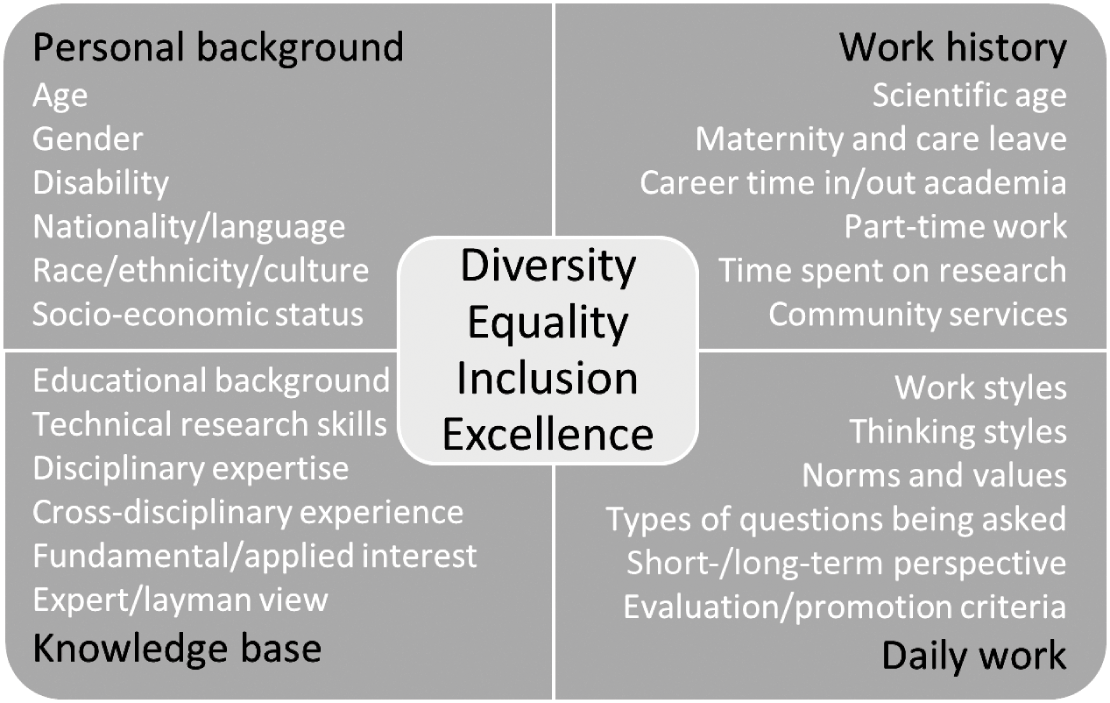
Bring together and truly include members with different abilities and knowledge skills that are relevant to your project (Figure 1.4).
Diversity, equality, and inclusion underpin excellence
Shame on me
A professor emailed me and asked, “Can I do a short sabbatical in your group?” Initially I wasn’t very keen. He was from a country that I considered to be underdeveloped; I feared he would simply highjack my ideas and contribute very little. I didn’t see our research themes as matching particularly well. Okay, maybe, but I felt his request was rather farfetched. My curiosity won, and he stayed with my group for three months. We talked a lot and exchanged ideas; it turned out to be a surprisingly rewarding and pleasant time. He offered me totally different insights and visions on “my” research questions. And the joy was mutual. Together we wrote a perspectives paper on where the field should go, and it was quickly accepted for publication in a highly visible journal. Shame on me, as a woman who is always alert for gender discrimination from male colleagues, not to have noticed how my own prejudice had biased and fooled me.
Prepare for the selection
Make a concrete list of criteria for evaluating the applicants. Rank the criteria for importance.
Prepare STARR questions for the most important criteria (see Figure 1.3).
Agree with the panel on the final list of criteria and method for evaluation.
Decide on the roles during the selection process: who is the chair, who is making notes, who is watching over diversity, equality, and inclusion?
Gender
Some behaviors (and words) are stereotypically masculine, whereas others are feminine.
Label the features in the following table as more masculine, more feminine, or indifferent. Explain your choices.
Short-term successes Collaborative Career promotion Sharing knowledge Listening Winning Standing in the spotlight Willing to take risks Background support Sustainable relationships Visionary Process-oriented Hierarchical status Empathy Task-oriented Check your own job advertisements for the number of words that are stereotypically more male or female. Discuss whether this would put women off applying or encourage men to apply; alternatively, is your advertisement okay?
Run a “gender decode for job ads” tool on your advertisement text (e.g., http://gender-decoder.katmatfield.com/about#masculine).
Daily work
Your top talent candidate happens to have special needs, but could you:
Arrange an adapted workspace for a person with a physical disability who uses a wheelchair?
Set up a quiet work room for a person who is sensitive to noise?
Adapt computer equipment for the work desk and in the lecture room for a person with a visual impairment?
Arrange a room for a mother needing to express breast milk?
Tests for implicit bias
Complete one of the implicit bias tests (e.g., related to age, gender, science, career, etc.) at https://implicit.harvard.edu/implicit/selectatouchtest.html. Challenge your selection committee and your current team members to do the test as well and discuss the experience together.
1.4 Prepare
Primer is an undercoat for paintwork to ensure that the new paint adheres well to the old surface. Your new group member also needs preparation, like an undercoat, to become an effective team member. On the first day you will introduce the new member to the group and attend to the practical details of where to sit, how to log into the computer network, who from administration can help, and so on, all toward a smooth transition into their new job. Preparing the new member for their research tasks is as important, if not more so. From the first day, you have to create an awareness of what is often referred to as the “code of conduct for good research practices.” Without this undercoat (code of conduct), the paintwork (results from the research) may look nice for some time but will not be enduring. To make your research projects and your team really successful, it is essential to help your team members study themselves in the first place and for you to perform self-reflection too. Refine the most important resource in your research – the people.
Humans create science, but they can err, be ignorant or inexperienced, short-sighted, or hesitant or reactive; take risks easily or be conservative; follow the mainstream or prefer new trails; and have false beliefs or limiting prejudices. Humans in science are also subject to fierce job competition, up-or-out promotion stress, peer pressure for short-term results that can be published in Nature or Science with high visibility, or following hypes with a high risk of their results being scooped. Increasing personal interests can make humans opinionated and biased, dominant and arrogant; they can develop strong egos and hold hidden agendas and become selfish and stubborn or even narcissistic and manipulative. Perfectionists and thinkers, achievers, and supervisors who have unhealthy ambitions or who demonstrate unhealthy behaviors can be very harmful to science (Table 1.2).
| Perfectionist | Thinker | |
|---|---|---|
| Healthy state | Objective | Visionary |
| Transition state | Rather rigid | Antagonist |
| Unhealthy state | Stuck in details | Isolated |
| Achiever | Supervisor | |
|---|---|---|
| Healthy state | Goal-oriented | Serving the team |
| Transition state | Prestige-oriented | Self-contented, territorial |
| Unhealthy state | Narcissist, making up fake stories | Self-overestimating, dominant |
Make your team members aware of the many pitfalls in the bumpy road to excellence, and let them stay far away from the illusion of excellence (Figure 1.5, left). Surprisingly, it was found that 60 percent of studies published in fields such as medicine and psychology cannot be replicated.Footnote 2 An incredibly high number of “landmark papers” published in high-impact journals contributed to this “illusion of knowledge” and “illusion of excellence.” What if 60 percent of all the published studies in your field cannot be replicated? If you read uncritically, trust the literature, and base your research on this body of knowledge, your results are more likely to be false than true. If you are uncritical, you may also overlook the known or unknown hidden facts or factors that do not fit your “story” and would have put your findings in a totally different light, even if they had been replicated (see also the anecdote at the end of this section).
Excellence. Science needs excellence (right), not the illusions of successful scientists (left).
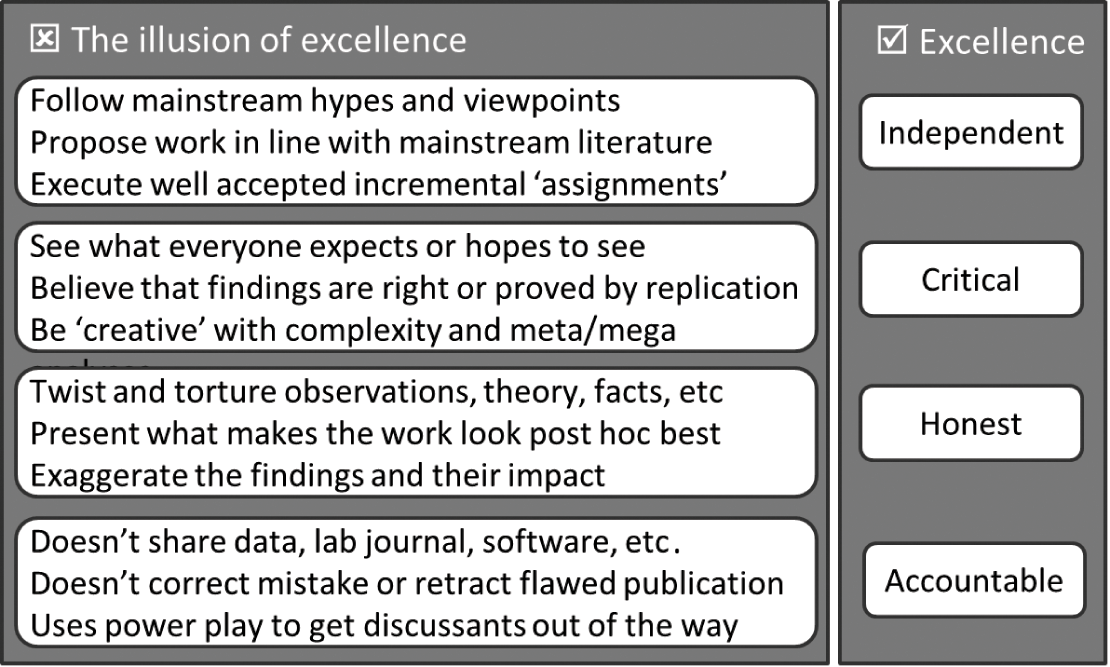
As a team leader, it’s your duty and in your own interests to create an environment where your team members aim for real excellence (Figure 1.5, right). You need to prime your new team members and critically monitor yourself and your team as the project evolves. The last part of this section proposes some options of how you could put this theme firmly on your team’s agenda.
Being independent and critical
For junior people, it may not be easy to become an independent and critical researcher. These people have taken classes for years, studied many textbooks, completed hundreds, if not thousands, of carefully set assignments, have passed exams, and have done thesis projects with experienced researchers who gave them well-defined tasks to complete. Why should they doubt what they were taught, have read in textbooks, or were instructed to do by all these knowledgeable lecturers and researchers? Yet this is just what they do need to do – the opposite of what they may have been trained to do so far and the opposite of what is outlined in the left column of Figure 1.5. Critical and independent thinking is, first, the ability to change your own way of thinking. Three simple examples can help open the discussion with your team members:
Connect the dots in four lines without lifting the pen from the paper (Figure 1.6a). It’s a well-known puzzle, and some people will already know the solution, whereas others will need a few minutes to solve it. Several intriguing things happen: those who know the solution often turn their attention to something else, such as chatting with a neighbor or checking their cell phone. Others complete the assignment and then stop thinking too. This is common practice in education: do what you’re requested to do, and you’ll be ready for the exam. Typically, a few individuals go beyond the assignment. Some explore opportunities by folding the paper or using equipment such as scissors and copiers. Incidentally, someone may prompt the next question: can we connect the dots with three, two, or even only one line? They take the lead (rather than being led by an instructor and the direct assignment) and go beyond your expectations (rather than being satisfied with the initial solution). It is this ability to independently, freely, and creatively “further explore the universe” that will break new ground in research. They don’t think inside the box, nor do they think outside the box: for them, there is no box. Help your team members to understand that research work is no longer a matter of completing assignments.
Peel a banana (Figure 1.6b). Many people open a banana by the stem. They have always done it this way and never questioned it. A few will open it at the other end and argue that it’s generally simpler to open it here than by the stem. It’s the approach used by chimpanzees and other apes, they say. This dichotomy in the audience is striking. Most follow the mainstream approach without ever questioning it. And some who have discovered that their approach wasn’t optimal explain that they were too strongly preconditioned by the past: reprogramming habits and other behavior is not straightforward, not even if you want it to be. Whether to open a banana by the stem may be a question relevant to Westerners, who eat their bananas when they are still unripe. People from other cultures may eat really ripe bananas, and then it is simple to open the banana anyway. The question of where to open the banana is totally irrelevant to them; the research question we ask may also be irrelevant if we change values, norms, or habits. Help your team members to understand that they shouldn’t take other people’s research questions and approaches for granted.
Count windows (Figure 1.6c). Students, PhD candidates, and postdocs typically count between five and nine windows when shown this photograph. Sometimes a smart person sees that each window consists of four smaller panes, so the answer is somewhere between 20 and 36. But generally there is unanimous consensus that the number is large, although there can be debate about counting the panes or subwindows separately. We count and measure a lot in our research, and it can be a surprise that even in this simple case the answers can be so different. But no one takes into account that the windows could be fake. And they are fake for good reasons! This house was built in France, where house owners had to pay taxes proportional to the number of doors and windows in their house (1797–1926 (contribution sur les portes et fenetres). Painted windows, looking like genuine windows, could make you look richer but not cost extra tax. This “you see what you expect to see” is the mechanism adopted by the house owner, and it’s very likely to occur on a large scale in science too. Large groups of people can be convinced that they all see the same; this then becomes the “truth” or state of knowledge despite being incorrect. They all accept the story without further questioning or searching for the hidden factor. Help your team members to understand that they need to be critical of published results and conclusions.
Three simple assignments can help you open a discussion on excellence – or the illusion of it – with your team members; see text for further explanation. (a) Can you connect all the dots with just four straight lines without lifting your pen off the paper? (b) How do you peel a banana? (c) How many windows do you count? Photograph A.K.M. Disler.
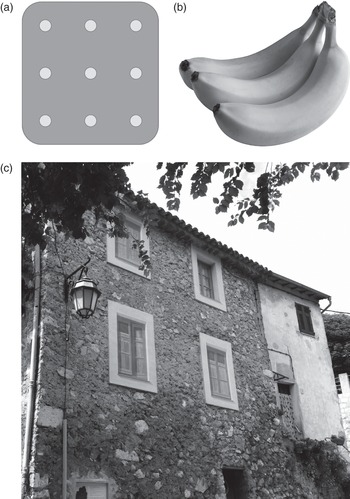
The three assignments can help your team members to “feel” the need for critical and independent thinking. It’s of great importance to develop and use the “philosophy” in the Doctorate of Philosophy (PhD).Footnote 3
As a next step in the discussion, it’s also important to let your new team member see that being independent and critical may actually put their career at risk: if your views are running against the mainstream, it may be hard to get your work published. Therefore, you also need to teach your team members that they should “put themselves in the place” of their most skeptical or threatened peers. Why would these peers be so skeptical? What are their interests? What can you do to avoid having your article or grant application turned down by a skeptical reviewer? Steps to consider include the following:
✔ Determine a likely difference between the mainstream and what you and your team members propose.
✔ Acknowledge the difference without being dismissive.
✔ Suggest that what you’re doing is complementary and might lead to a novel strategy; you’re standing on the shoulders of giants, including mainstream giants.
✔ Invite a scientist from the mainstream to give feedback, or invite him or her to participate in your project and compare the old way with the new way.
✔ Don’t overly use terms such as “groundbreaking,” “revolutionizing,” and “paradigm switch.”
✔ Rather you should let the facts speak for themselves: give preliminary or other evidence that supports the merits of your idea so that the idea becomes plausible in the eyes of the reviewers.
✔ Some (top) journals don’t go by the facts or evidence but just estimate what it will do for their journal impact factor. Submit elsewhere.
If you are at the stage of writing a grant application, give a concrete “plan B” for a risky “plan A.” List your earlier achievements to prove that you have typically gone beyond the state of the art.
Being honest and accountable
For junior people, it may not be easy to understand what it takes to be an honest and accountable researcher. Even senior researchers lack statistical skills and find it hard to report mistakes they discovered in their earlier work or to openly admit they were wrong when someone else found a mistake. But the reputation of you, your group members, and science at large is at stake, so honesty and accountability are musts.
Misconduct. Universities are strongly regulated around misconduct – e.g., manipulating, falsifying, or fabricating data – which can lead to suspension, dismissal, and/or prosecution. Your articles will be retracted and your reputation severely damaged, and you may be featured on retractionwatch.com or gain unwanted attention from the media.
Gray area. Between conscious misconduct and true scientific integrity lies a large gray zone of unconscious and subconscious misconduct and unprofessional behavior. You may be sensitive to status or financial interests and therefore tempted to somewhat oversell the positive aspects of your work and minimize its limitations. Unfortunately, universities cannot make you disclose status interests, nor financial interests that may be paid to you in the future.
Third-party interests. Researchers often work with third parties under the umbrella of a consortium agreement (funded by a public body or a private-public partnership) or a contract agreement (third party pays for the research). A third party may have strong interests in the outcome of your research, which it needs to support its political proposals or ideas or to support its business: your results should prove to customers that the company’s product outperforms that of its competitors. Your relationship with the third party may be discontinued (no more funding) if you report results that conflict with its business interests. Such funding parties often have the right to see your draft articles before they are submitted for publication, and they can pressure you to modify the draft article or not publish it at all.
So you need to discuss with your team the mechanisms that could lead you to the wrong side, and you need to reinforce strict requirements to unambiguously stay on the right side. For example:
✔ Don’t let third parties influence your research: not the questions you want to study, nor the experimental or theoretical approach you decide to take, nor the results you deliver.
✔ All additional or ancillary activities you and your team members have on top of your normal tasks as university employees should be disclosed – activities such as being an editor of a scientific journal, member of an advisory board of a political party, owner or shareholder of a spinoff company, or a company consultant.
✔ Add an up-to-date and complete list of activities to personal pages on the university website. Specify the relationship (e.g., consultancy or collaboration) and the terms (e.g., paid or unpaid).
✔ Also report any indirect conflicts of interest, e.g., if you or any of your family members hold shares or have other financial interests in the company you’re collaborating with. Any appearance of potential conflict of interest should be avoided by everyone on your team.
✔ Promptly and completely disclose all these (potential) conflicts of interest when you submit an article to a scientific journal. These interests will be evaluated by the editor and reviewers and published to inform readers.
Whenever you use data analysis in your research, make sure that other researchers can fully understand and, if they so wish, reproduce your analysis (see more in Section 3.2). Consider these steps:
✔ Define and openly share your data-acquisition and analysis plan before you start the study, and stick to it. Preregister your project and planned paper with a journal if possible.
✔ Create artificial data sets mimicking your real data (e.g., using data simulation or permutation), and analyze them in exactly the same way as you stated in the preregistration for the initial data. Use the same procedures for data cleaning, for finding patterns in the data, and so on. See what the results from these “artificial” data sets turn out to be, and use them for inference in the real data. Are your findings in the real data perhaps not unique because these or more extreme findings also occur in the artificial data sets? State your uncertainty.
✔ Reanalyze your real data by using slightly different approaches for data cleaning, for finding patterns in the data, and so on. See what the results from these alternative analyses turn out to be. Are your initial findings perhaps not so trustworthy because they don’t occur with other analyses?
✔ Search explicitly in all directions for all possible hidden factors and alternative explanations for any unique findings.
✔ Provide all the data (including metadata) and analysis tools (e.g., software), and invite team members (and other peers and perhaps nonacademics) who are not involved in the study to interpret the data (first arrange confidentiality in case of data privacy issues). Challenge them to be your devil’s advocate.
✔ Software may contain bugs, so proper software testing and versioning or an independent and complete reimplementation of the software is needed too.
✔ Clearly describe the limitations of your study.
✔ If you detect a mistake in your published work, publish a corrigendum or erratum to the article or retract it as quickly as possible.
✔ Check other peoples’ articles for corrigenda or errata published by the authors and critical reviews or letters published by their peers: would you still build on the data, methods, and conclusions of the original article?
✔ Actively and independently reanalyze other peoples’ data if your study is based on their data. Check whether you draw the same conclusions.
Obituary for a giant
I am not a regular reader of Nature or Science, but from time to time I browse through some print copies of these journals. And so, by accident, I ran into a full-page obituary of a person whose name I immediately recognized. Several years ago, as a youngster and not knowing about his status, I had contacted this person and a journal editor because I had developed a divergent view on claims made in two of his papers. I agreed that the results in one study were convincingly replicated in a second, but I disagreed about their medical relevance because he had mistaken a replicable technical artifact for a replicable and medically relevant finding. The editor and I got a reply, but to my surprise, it was nothing less than an attempt to create fog and enable the editor to ignore my contribution. My comment was not posted online. Later, when I presented this technical artifact as a side issue in a talk I gave at a major conference, a senior researcher in the audience stood up and stressed that we’d all overlooked this hidden factor and had fooled ourselves by thinking that replication is the “gold standard” for quality. I was grateful to him for his public comment, but even today, while reading the obituary, I feel sad about how the divergent views of young researchers may be handled by giants and editors.
Use the following assignments to discuss good research practices with your team and to stimulate self-reflection by your team members.
Being independent and critical
People look at an object and claim that it’s a square. Others look at the same object and claim it’s a circle. Can both observations be true? Does truth exist?
Are you more a frontrunner than a follower? Provide facts to support your answer.
Are there any schools of thought that are in conflict in your field of research? If you belong to one such school, then step into the shoes of someone in the other school. What would it take for them to bury the hatchet?
If 60 percent of the published literature was nonreplicable in your field, how would you read the next scientific article? Make a list of key points to check.
Being honest and accountable
Do you know your personality weaknesses? For example, to what extent are you prestige oriented, easily jealous of and influenced by other people’s success?
Consider your recent work. Rate on a scale from 0 to 100 percent: to what extent did you turn patterns post hoc into hypotheses, tweak your data, twist your story, exaggerate your findings, hide deviant details, or downplay uncertainties or risks? Explain how you came to your percentage ratings.
What concrete actions do you take to protect against “fooling” yourself in your own daily research (Figure 1.5)?
Codes of conduct
Does your university have a code of conduct, good research practice guide, code of ethics, or scientific integrity documents? Discuss these with your team members.
Consider all your activities and interests: are there any that could or should be considered as “additional” or “ancillary”? Fill out the following table.
| Description of activity or interest | |
| Possible contribution to the academic and business interests of the university | |
| Possible conflict with academic and business interests of the university | |
| Time spent on activity |
|
| If paid, then clarify the payment agreement | |
| Is this activity/interest published on your university webpage? |
Dilemma game for scientific integrity
Do one of the 75 dilemmas tests (e.g., related to collaborating, publishing, reviewing, career, etc.) at www.eur.nl/english/eur/publications/integrity/scientificintegrity/. Challenge your team members to do the test as well, and use it for discussion.
Play “The Lab,” a game with roles in research on how fraud develops at https://ori.hhs.gov/thelab/. You can do this at retreat, and everyone will sit up and start thinking!
1.5 Advance
What makes you a good team leader?
If you are an early-career scientist, you may have started your first independent project. In a couple of years, you may see yourself running several projects in parallel. For sure you will have made (and will still make) mistakes as a leader. Make time for self-education and self-reflection, and hopefully avoid the following pitfalls. You have recruited a PhD candidate, but your prediction about his or her potential growth proved to be wrong (sadly). You have committed yourself to an externally funded work plan, but the postdoc employed on the project complains about your “just do it” directive style and wants to deviate from the plan. You may have collaborated with a colleague, but negotiations about authorship didn’t work out to your satisfaction. You have taken too much work on; it was fun, but alarm bells are hinting that your body and/or mind is out of balance. You believe you deserve early promotion, but your dean sticks to the formal rules to your annoyance. Learn through open-minded reflection on your doing, for example, by taking the following stepsFootnote 4:
Join courses and peer discussion groups on academic leadership.
Find a senior mentor who can serve as a critical sounding board for you and hold a mirror up.
Ask team members for their feedback on your leadership.
Admit you have weaknesses – perhaps your leadership style is not particularly effective – and be prepared to change.
Keep your work-life balance sustainable for the long term.
Develop an antenna for politics and changes in your organization and society.
People can lead in different ways. Figure 1.7 shows four leadership styles, each with two sublevels:
Charismatic style. You are a leader with an inspirational style (you have an appealing vision, can easily persuade others, and are results oriented) or a coaching style (you listen, appreciate, and stimulate others, are people-oriented, and look for win-win situations).
Democratic style. You are a leader with a participative style (you include people in processes, accept their propositions, and are people-oriented) or compliant style (you hesitate to give guidance, prefer to stay in the background, and go along with people’s interests).
Avoiding style. You are a leader with a withdrawn style (you’re absent, don’t take up your responsibility, and keep out of conflicts as long as you can) or distrustful style (you don’t trust others’ motives, think negatively about others, and don’t connect with them).
Autocratic style. You are a leader with an authoritarian style (you’re harsh on your people, force them to obey, you’re not open to criticism, and you go for win-lose situations) or a directive style (you plan, do, evaluate, and act; you go for results; and people have to follow your instructions).
Leadership styles. There are four main styles, each with two sublevels. When looked at from the outside, do you see an orientation on results (“you hear the workers busy with hammering and sawing”), or an orientation on people (“you hear the team having fun”), or do you notice conflicts between the leader and team (“you hear quarreling and banging doors”), or inertia rather than action (“you hear a desolate silence”). Reflect on your own style!.
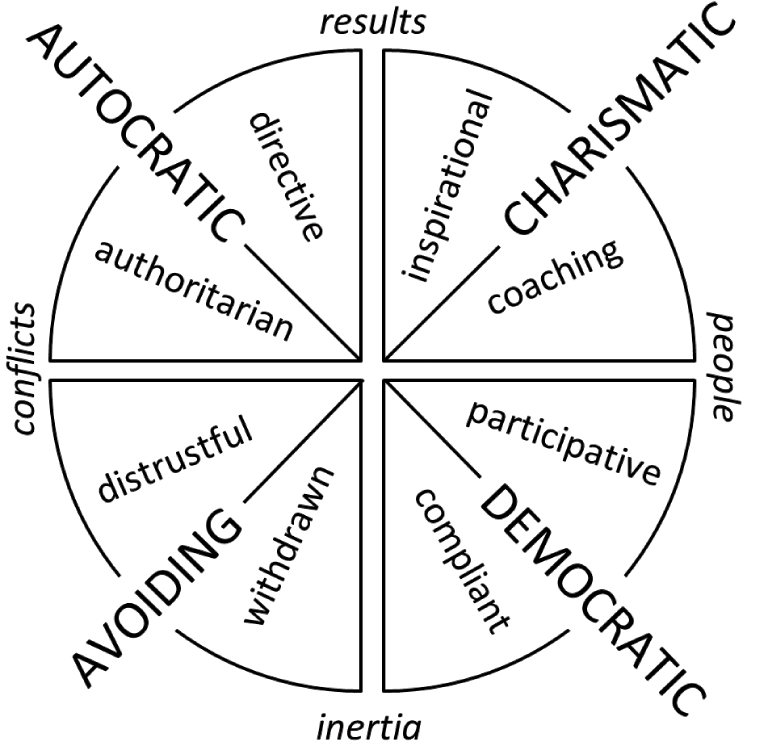
To advance your team and be an effective team leader in academia, you need to be predominantly results and people oriented; i.e., you need to be a charismatic leader and occasionally use a more directive or participative style. The other styles, from compliant to authoritarian, can become counterproductive, if not disastrous, and will not facilitate a group of individuals making an effective research team.
A group is not a team
Two or more people make a research group: Bachelor’s and Master’s students, PhD candidates, and postdocs, they are in your group and can be busy with their next paper, their thesis, or curriculum vitae (CV). They all run, bike, or skate their own race, focusing on their own goals and successes. But two or more individuals can also work as a team, leading to better papers, better theses, stronger CVs, and better project outcomes, even if they are officially working on different projects. Now they run, bike, and skate wearing the same team outfit and aim jointly to raise everyone on the team to a higher level of success. A sports team includes a physical trainer, sports psychologist, masseur, technician, team captain, and many others; on a research team, you’ll have a research assistant, an administrative assistant, and other support staff, with you as the team leader.
Teams typically go through several phases before they perform really well (Figure 1.8).
Forming phase. Everyone is happy with the new job or project; work can start. You as the leader inform, direct, and instruct people about the project aims, tasks, deliverables, and milestones, and you fuel the team spirit and ambition by making the endeavor fun and exciting, something really special (inspirational and/or directive leadership style).
Storming phase. There are different opinions or confusion on how to proceed with the details of the work. You coach the team forward (coaching leadership style).
Norming phase. The members negotiate, compromise, convince, or otherwise organize themselves and (re-)organize the work to be done. You enable a constructive controversy and reflection to happen (coaching and/or participative leadership style).
Performing phase. The team and project are alive and kicking. Results exceed initial expectations. You oversee the team and its work (participative leadership style).
Mourning phase. As a project closes, one or more members leave, successes are celebrated, and failures are acknowledged and transformed into lessons learned. You thank everyone for their commitment (participative leadership style).
The five team phases.
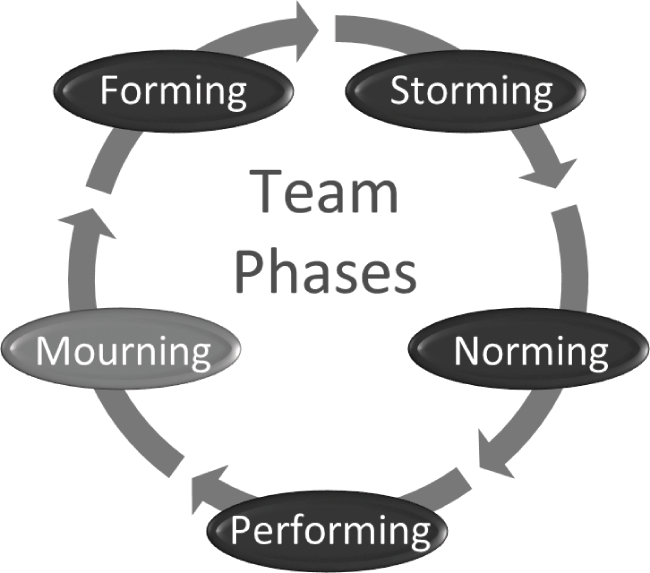
Then you continue with new projects, each with their own cycle of forming-storming-norming-performing-mourning. See also chapter 3 of the author’s book, Developing a Talent for Science (Cambridge University Press, 2011). The entire group may go through the stages at the same time, but things may become tricky when different members are actually at different stages because they entered the group at different times. Achieving or maintaining high performance in the midst of many changes of people can be a challenge that constantly demands your attention.
The storming phase may be particularly alarming for new team leaders (and is still challenging for experienced team leaders). Help! What’s happening? Suddenly members appear to disagree strongly, show disappointment or anger, and disconnect or revolt. Look at it this way. It’s a sign that team members are serious about their work. After all, who would make a buzz about something unimportant, but the storming and norming phases challenge your interpersonal leadership skills even more than the other phases. Some leaders may be tempted to become angry and tell members to obey them (authoritarian style). Others may be tempted to keep out of the conflict as long as they can (avoiding style). Neither style will work well in the long run. Only when you successfully coach the members through the storm will you have established an effective team where the members:
Have trust and confidence in each other
Exchange ideas and contributions
Give and receive constructive feedback
Go the extra mile for each other and the team
Express wants and worries openly
Share fun, enthusiasm, and a high team morale.
The lives of PhD candidates and postdocs can be hectic or problematic for all kinds of professional or personal reasons. They are often in a busy phase of their lives: stormy season. Keep an open ear and eye for their needs and worries, help them to get through difficult times, and arrange a buddy, mentor, health coach, or other internal or external help for them, preferably at an early stage before problems arise or escalate. It’s important that group members feel that they can approach you when a problem is arising.
The final phase in a project’s life cycle is the mourning phase (also called the “adjourning phase”): the project is coming to a close, the work has been done, and team members will have to leave. In the worst case, former team members have no job to move on to and become unemployed, and you have no funding for the next project and lose your position as team leader. However, the mourning phase can have a much happier end if you take the advancement of your team members seriously from day one – and if you take your own advancement seriously too. Table 1.3 provides an overview of more good practices.
| Forming |
|---|
| Establish appropriate work conditions for your team, e.g., silent rooms for those who are easily distracted by noise. |
| Share your vision and work plan for the new project, and invite group members to share their views. |
| Align objectives of members with the team’s objectives. |
| Foster team interaction by having frequent formal and informal meetings. |
| Keep your office door open and walk around. |
| Be a leader who is always prepared to do some of the practical work. |
| Be curious about what members from other cultures think and do. |
| Storming |
|---|
| See conflict as a learning opportunity, and handle it with confidence. |
| Help the team turn mistakes into lessons learned. |
| Be a critical friend; provide constructive feedback and support when necessary. |
| Stay committed even if development is slower or more difficult than expected. |
| Provide training where skills are insufficient. |
| Norming |
|---|
| What you say and write is what you mean. |
| Be honest; have one open agenda and no “hidden” agendas. |
| Treat team members with trust, respect, and pride, even those who prove to have less potential or to fit not so well with the team. |
| Performing |
|---|
| Share all you know; applaud when team members know more than you. |
| Reward good team interaction with celebrations (e.g., coffee and cakes), joint papers, thanks, and more. |
| Make life at work a joyful and exciting experience. |
| Monitor work-life balance, try to prevent burnout or boredom. |
| Monitor time, money and quality of work. Act when needed. |
| Mourning |
|---|
| Help develop team members’ future careers beyond your project. |
| Allow curiosity-driven side activities to become the beginning of a research line of their own. |
| Help them to leave your team well, even if you will miss them greatly. |
| Organize a final event for the project team to celebrate personal and team achievements and to close the project in a good way on the personal level. |
You should also coach team members to work with and support other teams – in the best interest of your team, other teams, and the organization. Recognize the five phases and be particularly alert to team members speaking negatively about another research team or support department; take action to provide a bridge across teams and jointly enter the performing phase.
Advancing your team members and their careers
Although you may think that running a funded project is all about time, money, and quality of results, the funding agencies also value the personal and professional development of PhD candidates and postdoctoral researchers as an important asset of your project. And the funding agencies will evaluate your training success. For example, reviewers for the European Research Council (ERC) are asked:
“To what extent has the principal investigator demonstrated sound leadership in the training and advancement of young scientists?”
This evaluation should be interpreted as your career progression depends on theirs: PhD candidates and postdoctoral researchers are not just a workforce to help you achieve your project’s scientific goals. You are their role model and partner on an important journey: their final educational steps to having a fully professional career within or outside academia with a healthy work-life balance. Help them become aware of their goals in their work and life.
Is doing a PhD project a good investment? Will the next postdoctoral period serve their career goals? Or is it time to leave academia, since further training will not add to their chances of achieving these goals? Might it even reduce them?
Outside academia, where the majority of people will eventually find a career, there are many different opportunities: in industry, government, the public sector, or, still close to academia, university administration, scientific publishing, or being a media and public relations officer for a university or research institute. You empower your team members with up-to-date scientific knowledge, with the core skills for doing research, but also with many general skills that are transferable to other settings (see Table 1.6 in TRY THIS! exercise). By contrast, in academia, their career journey is toward scientific independence, and you help them develop a research line of their own – not a copy of yours, but something where they may be outperforming you and go on to develop their own opportunities in the academic job market. You empower them with cutting-edge scientific knowledge and the core skills to use it well.
Some examples of how you can help your PhD candidates and postdocs advance include the following:
Side projects. Although they’ve been recruited for and paid by a specific project, try to set aside some free time for “playing” – just as Google allows its employees to spend a day per week on curiosity-driven activities. It may turn into a new research line for them, and it may also open new or surprising angles for the project on which they are working.
Other role models. Invite guests from within and outside academia to talk to or even work with your team: for example, your alumni (your former PhD graduates and postdocs), your academic and industrial collaborators, an editor of an influential scientific journal, or an officer of a prominent funding agency. Other people can help your team members to sharpen their vision of the future. You can also encourage team members to spend some time outside your group during the project to broaden their experience; for example, they can seek out and apply for travel and internship scholarships and thereby gain valuable experience for future grant applications.
Job or grant applications. Any job application – inside or outside academia – is a quest for money: your team members need to earn a salary in their next job. They may want even more money if they have ideas and plans for the new job that require financial investment by the employer (e.g., for new equipment or support staff). Job competition can be fierce, so teach your people how to make a strong case – a proposal that the other party can’t refuse. It makes good sense to teach them or send them to a course on how to write a convincing personal research grant application because this is a skill that is also important for those who want to move outside academia. It shows they can create a vision of where they want to go, outline a concrete work plan and impact plan, calculate the budget, and convince others that such a project is feasible and the investment worthwhile. As the group leader, you will need to help your team members with their job or grant applications. Yes, your investment (time and expertise) will indeed go toward benefiting someone else, but a former group member can extend or strengthen your network by making a new or revitalized connection to a top researcher or company elsewhere – and who knows what return you may see later.
Recommendation letters. Once your team members start applying for jobs, you will need to write letters of recommendation for them (Table 1.4). Pay a lot of attention to these letters; selection panels will read them carefully and consider them seriously. What facts or anecdotes can you share to provide sufficient evidence for your recommendation? You may be asked whether the candidate is among the top 20 percent of his or her peers or to state whether he or she is “very good,” “excellent,” or “outstanding.” Be aware that your personal reputation is also at stake if you are not honest and your statements incomplete. If you don’t believe that your team member would be a good candidate for a particular post/job, tell him or her carefully but directly in a positive way and, at the same time, discuss or indicate what kind of job or career track you envision for that person. You don’t want to land a colleague elsewhere with a PhD researcher or postdoc who is not suited for the job vacancy. You may decline to write a letter of recommendation, but you should explain your reasons to the candidate, and if you do write one, you should fully commit your time and effort to enable the person to stand out from the crowd.
| Brief introduction |
|---|
| Name of professor or investigator to whom the letter is addressed. |
| Name of applicant and what job they are applying for. |
| How well and how long have you known the applicant? |
|---|
| A short historical overview, including information on dates and topic of the project the applicant was working on with you. |
| Science |
|---|
| Mention applicant’s main intellectual achievements, publications, presentations, public outreach, other academic activities, recognition, vision, and more (see above). |
| Teaching |
|---|
| Mention any experience gained in teaching and supervision of students. |
| Personality |
|---|
| Mention strong skills – expert and general ones. Don’t hide any serious concerns you have, but do take into account the candidate’s personal privacy (i.e., do not disclose any information you obtained in confidence). |
| Summary and future |
|---|
| Summarize the information provided in a short but complete evaluation. |
| You can convert the summary into how the applicant ranks among his or her peers. |
| Your vision on the match between the applicant and the job vacancy. |
| Your final recommendation. |
Note: Add facts and anecdotes (as proof). Do not show it to the applicant, but submit it directly to the person who requested your opinion.
Your own advancement
Find out what is required for a next step in your career – a tenure-track position or tenure, promotion from assistant to associate professor, or promotion from associate to full professor. Are you expected to take on additional administrative tasks to help your department, faculty, or university prosper? Are you expected to excel not only in research but also in teaching, knowledge transfer, and public engagement, or are you allowed to specialize? What do you actually want? Take time for self-reflection and candor, and perhaps seek help from an experienced mentor. Develop your strategy and action plan, and discuss your future with your supervisor and administration.
If you want to stay in academia, you may have a large number of working hours ahead of you: 2,000 hours times the number of years until retirement. How can you remain successful and happy for so long? Research work follows a cyclic pattern. You start, run, and complete a project; start again, run again, and complete again, possibly with multiple projects running in parallel. If you successfully revitalize from time to time, you can continue your career in science to the age of 65 or older. Here are some pointers to revitalize yourself:
Attend conferences outside your field of specialization to see whether ideas that work in another or related field can be introduced in your own field.
Take a sabbatical of three to six months with another group every six to seven years to get fresh intellectual input or to learn new methods or techniques.
Negotiate a move from one sector to another within your organization to fuel your research line. Stay there for several years, and then perhaps move on to yet another sector or return to the first institute with your enhanced cross-disciplinary experiences. (This would also challenge institutes to be good places to work in, since a poorly managed institute would not flourish, and people would leave and not return.)
Write a perspectives paper to outline your vision of where your field should go and get it published. Some hardliners wouldn’t consider this as a real publication, but they are wrong, of course.
Write the textbook you always really wanted to write, introducing students to the results of recent and past research. Usually this doesn’t help in formal research evaluations or for job promotion, but metrics can and will change.
Serve as a mentor to one or more early-career researchers from another institute or faculty.
As a scientist – almost by definition – you are driven by curiosity and maybe at some point you want more, different, or “bigger” adventures in academia. For example, you could want to:
Combine your current position with a new one elsewhere, e.g., a part-time visiting or honorary professorship at another university.
Gather many more grants, tens of PhD students, hundreds of articles, many prizes, etc., which could give you an academic superstar status. But the mores are changing: the “Matthew effect of cumulative advantage”Footnote 5 is considered to disproportionally concentrate resources and reduce the return on funding.
Take on a limited number of projects only, be there as committed supervisor and collaborator, and let credits for work go to those who really deserve it, which would make you a real academic leader and role model for others. You go without compromise for high quality instead of large quantity and help change the reward system in science.
Become a director, assistant dean, dean, vice chancellor, or president of an institute or university or governor of a scientific society or public funding agency or help in the administration of academia. Beware: In some quickly developing and highly competitive fields, it may be almost impossible to return to active research.
You may also consider leaving academia – at least for a while or part time – to build a new career elsewhere, for example:
Combine your current position in academia with a new one outside academia, e.g., a part-time job at a consultancy firm.
Become a full-time researcher or research and development (R&D) manager in industry, start your own business, join a major consultancy firm, or move into politics, perhaps in the department of education.
Leading your team in your organization
It’s important to realize that as a team leader you are a middle manager: you are formally responsible for the team under you, but you have other managers above you: a head of department or director, a faculty dean, and the university president. They will monitor and evaluate what you and your team are doing. Let’s hope they are content and supportive. But what if they’re dissatisfied and impose measures on you and your team? If you agree, you can comply and execute their measures. If you disagree, though, you will enter another storming phase: now it’s storming in the hierarchy rather than within the team. It will be particularly tough if the leader above you adopts an authoritarian or distrustful style. As in any other storming event, you can see this as someone who is serious about an issue that is important to them. The negotiation steps you need to undertake include:Footnote 6
1. Don’t go into heads-on battle with your adversary. Instead, invest some time in trying to understand what motivates them: pay attention to what they want, need, are concerned about, and their interests. Perhaps they have to cope with political issues or organizational changes you’re not yet aware of. Ask, listen, and check whether you’ve properly understood what they are telling you.
2. Then ask them to listen to your needs and concerns. The other person is above you in the hierarchy, but you don’t have to behave as their subordinate. You can remain positive and assertive and, if necessary, indicate that you’re also a force to be reckoned with.
3. Refer to a common basis, such as shared principles underlying good research practice. Discuss the results you’re supposed to generate, and present the facts to counter any presumptions or misconceptions. Try to work together toward a solution that both of you can accept. This might lead to a compromise or a new solution better than either of you could have developed alone.
You and your team will also be working with people who are not in an academic hierarchy but alongside you, for example, support staff such as human resources (HR) and financial affairs. Chapter 2 is about their organizations’ rules, processes, and procedures with which you also need to comply. Invest some time in getting to know these colleagues and understanding their work, give them credit when it is due and create a culture of working together. If you take coffee or cake to your meetings and invite them to team parties, it will make it more fun for both parties.
Table 1.5 offers some more tips on how to deal with management and support staff.
Being nice to people
During my stay at Harvard Medical School, I learned about the American Association for Women in Science (AWIS). A women-only society, this slightly surprised me, but it also made me curious. It was less than a year until my PhD graduation, and the career stories of these women – most of them at a senior stage in their career – could help me make a decision on my next position, whether it should be in science or not.
The obvious step was to sign up for one of their events. But would I dare to talk to these professors? At this point, a lesson from the past came to my mind. My supervisor had once said, “You’ve all got over 20 years of experience of how to be nice to people, right?,” followed by, “Who would like to welcome our world-famous guest speaker and be her host at today’s program?” I’d offered to be her host for the day, which had proved to be a remarkable experience, a tipping point in my life.
Thinking about this, I convinced myself to join AWIS and walk up to and talk to professors. Looking back, I met many ambitious professors, as well as other postdocs and PhD candidates from a wide range of nationalities. They all enthusiastically elaborated on their scientific track and shared the lessons they had learned. These AWIS conversations contributed to my orientation process and consequently to my current position in the consulting business. Being nice to people can help lead you to new horizons.
The following assignments will help you reflect on your own leadership style, recognize the phases your team is in or has gone through, and allow you to contribute to the training and advancement of current and former team members.
Interpersonal leadership styles
Could a young researcher be(come) a good team leader? Make your reasons explicit.
Could someone with no expert knowledge be a good or better team leader? Make your reasons explicit.
Leaders use different interpersonal leadership styles. Can you give concrete examples from your own experience of each style? How did they feel?
Ask others what they see as your dominant style, and discuss how it feels for them.
In what circumstances would you use other styles and why?
Do you see any reasons to change your leadership style in general or in specific situations?
A green traffic light means “go ahead,” red means “stop,” and orange means “be careful.” Use green, orange, and red to color each of the eight interpersonal leadership styles in Figure 1.7. Explain your choice of color for each leadership style.
Team phases
Do you have a group or a team?
Which phase is your group/team in at the moment?
How did you react to storming phases in the past?
How will you react to the next storming phase?
Have you completed earlier projects in a good manner?
Your current team members
Do your team members have sufficient time and freedom to develop their own niche in science?
PhD candidates and postdocs often discount, underestimate, or overlook the value of core transferable skills and could therefore better sell themselves at job interviews than they actually do. Get your team members to list their most important selling points, and see how many of the attitudes and skills listed in Table 1.6 they include. Set up a laboratory meeting to do this or go on an away-day with your team once or twice a year.
Help your team members prepare for job interviews. Analyze the job advertisement for selection criteria (skills, qualities) and help the team member prepare STARR (situation, tasks, actions, results, and reflect) stories that would inspire and convince the selection committee (see Section 1.3 for more on STARR). For the main criteria, they should develop recent and concrete stories with a positive ending along the lines of the STARR method.
| Think critically and independently. |
| Be honest and accountable. |
| Demonstrate strong passion and drive. |
| Prioritize, decide, do, evaluate, and persevere. |
| Collect, classify, and process relevant information. |
| Ask questions for clarification. |
| Create ideas to solve problems. |
| Analyze qualitative and quantitative data. |
| Use current computer software. |
| Work on a team. |
| Speak and write about a topic to convince peers and the general public. |
| Write project proposals, funding applications, and reports. |
| Educate and inspire students and others. |
| Develop and teach courses. |
Your former team members
Where are your former team members now, and how are they doing? Build up a database of them with the following information: name; current and past affiliations and job titles; prestigious grants, awards, etc. for those who stayed in academia; and other relevant parameters for those who moved outside academia. You can add this information to your team website and even to your own CV.
Are you connected to all of them via LinkedIn or other social media?
Are there any opportunities to benefit from former group members? Who could you build a new academic collaboration with? Who could suggest candidates for your job openings? Who works at a profit or nonprofit organization that could become your sponsor?
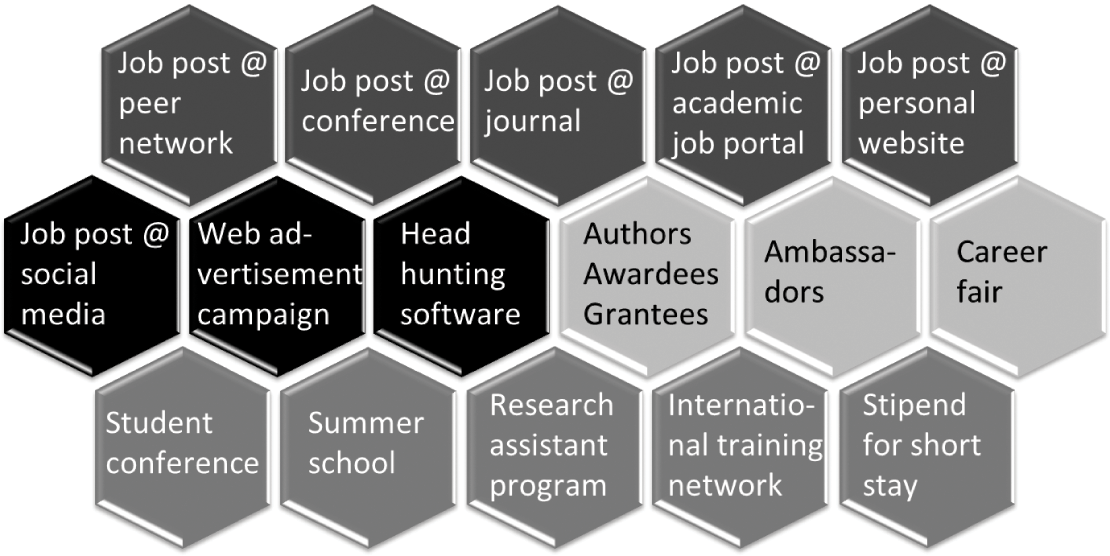


 Open access