


This chapter examines the contents of the policy appeals that parties make to voters during election campaigns. This is the second critical link in the chain of promissory representation identified in Chapter 1 (Figure 1.1). Specifically, this chapter focuses on parties’ ideological positioning, which offers a wide lens for understanding their campaign appeals. Parties’ ideological profiles vary substantially across parties and countries and over time. These profiles are the discursive context in which their more specific campaign promises are embedded. According to one influential definition, ideologies are sets of principles that help individuals interpret how the world is and how it ought to be (North Reference North1990). They inform both empirical assessments of current conditions and normative visions of desired outcomes.
Parties’ ideological positions are a central concern to students of promissory representation for three key reasons. First, there is a well-established empirical relationship between parties’ ideological positions and the specific campaign promises they make. As demonstrated in Chapter 4, parties positioned further to the right of the left–right spectrum are more likely to pledge tax cuts and less likely to promise the expansion of social and welfare programs (Figures 4.9 and 4.10). This aligns with the general tendency of center-right parties to advocate for smaller government and lower taxes, while center-left parties favor larger social programs and higher taxes. As parties shift leftward, they typically make fewer promises to cut taxes and more to expand programs. Globalization appears to influence these dynamics. As countries become more integrated into the international system, mainstream parties (including center-right parties) tend to make more promises associated with program expansion, even though these are policies that are traditionally linked to leftist ideologies (Figures 4.10 and 4.11). This connection between leftist ideologies and program expansion raises an important question: Does globalization drive an ideological shift to the left? And if so, which types of parties are leading this shift? These considerations underscore the need to explore how globalization shapes not just concrete promises but also parties’ ideological foundations.
Second, while researchers often adopt narrow definitions of “promises” for the purpose of systematic analysis, voters tend to interpret promises more broadly. In public discourse, any policy stance articulated during the campaign – whether in manifestos, speeches, debates, or advertisements – can be understood as a promise. From the voter’s perspective, the distinction between a formal promise and a clearly stated ideological commitment often matters less than whether the party signaled an intention to pursue a particular policy direction in office. Studying how globalization affects parties’ ideological profiles therefore sheds light on how the broader content of campaign communication, and thus voters’ expectations, is shaped by structural constraints. In this sense, ideological positioning is not only analytically relevant but also a politically meaningful approach to study parties’ commitments that voters perceive as promises.
Third, ideology also plays a crucial role in how voters process campaign information. One of the main criticisms of promissory representation discussed in Chapter 2 is that many citizens may not hold sufficiently well-defined preferences or detailed policy knowledge to assess parties’ specific promises. While scholars debate the extent of voter sophistication, they agree that ideology is a powerful heuristic. If voters have a general sense of their preferences – such as whether they favor more or less government intervention – and receive reliable cues about where parties stand, they can make meaningful choices. Ideological profiles help voters to align themselves with parties whose concrete policy promises reflect their broader preferences, even when they lack detailed information about parties’ specific promises.
Relatedly, parties’ ideologies serve as guides to what those parties can be expected to do in government beyond the specific campaign promises they make. Even parties that make hundreds of campaign promises do not cover the full range of policy questions that they will need to take decisions on if they enter government office. Some of these policy questions may be too detailed or electorally unimportant to address in the form of campaign promises. Other questions may arise while governing and could not be foreseen at the time of the election campaign. Ideologies provide important information about the principles that parties are likely to follow when taking decisions on policy questions that for whatever reason are not the subject of their campaign promises.
While individual campaign promises can shift from one election cycle to the next, often in response to changing circumstances, ideological positions tend to be more stable, offering a broader framework within which specific promises are made. As such, ideology helps to contextualize situations in which short-term pragmatism leads parties to adopt promises that appear to be at odds with their traditional bases. For instance, a center-right party’s temporary embrace of social spending might still be underpinned by a market-oriented ideology that prioritizes small government and private sector involvement in public services. In such circumstances, parties’ ideologies may be at least as important to voters as their specific campaign promises.
We argue in this chapter that globalization has also profoundly affected the nature of parties’ electoral appeals themselves, in this case the ideological positions that parties present to voters. Globalization places particularly strong pressure on center-right political parties to adapt the policy priorities they present to voters. As economic risks and uncertainties grow in a globalized world, voters increasingly demand policies that protect them from these risks. This creates a challenging dilemma for center-right parties, which have traditionally relied on wealthier constituencies and economic elites who favor open markets and deregulation. Shifting to the left responds to voters’ demands for protection, but shifting too far to the left could alienate their core supporters. To manage this tension, center-right parties are forced to strike a delicate balance. They must continue to advocate for policies that align with the interests of their affluent supporters who benefit from globalization, while also addressing the economic concerns of lower- and middle-income voters who are more exposed to the negative effects of economic integration. Rather than fully overhauling their economic platforms, many center-right parties opt for a more nuanced approach, shifting moderately leftward on economic issues while placing greater emphasis on cultural and value-based issues (a strategy that we take up empirically in Chapter 8). This allows them to appeal to a broader electorate without abandoning their economically liberal principles.
In contrast, left-wing parties do not face the same pressure to shift their positions. Their platforms are already more aligned with the expectations of voters seeking protection from economic risks. Left-wing parties historically advocate for policies such as stronger social safety nets and labor protections, which resonate with those most vulnerable to globalization’s disruptions. As a result, they have less need to adjust their economic stances, maintaining more consistent ideological positions.
A central argument of our analysis is that leftist parties have little electoral incentive to shift rightward, whereas rightist parties face strong electoral incentives to move leftward. We present evidence from our preregistered experiment that supports this claim, showing that voters are more likely to punish politicians for moving rightward than for moving leftward. This sets the stage for our main empirical analyses. Parties’ ideological responses to the constraints of globalization have been complex in nature, and there are important differences across countries and political systems in the forms that these responses have taken. Our primary interest lies in the broad patterns that can be detected only by analyzing large numbers of cases over time as we do here. We examine just over 1,000 observations of the ideological positions of mainstream parties from thirty-one established democracies over the past five decades. One of the headline findings is that on the main ideological left–right dimension, which has structured political discourse in liberal democracies in recent decades, mainstream parties of the center-right – including conservative and Christian democratic parties – have gradually shifted toward the center. Meanwhile, parties of the left – including socialists and social democrats – have remained relatively stable in their overall ideological positions. This finding concerning the relative stability in the ideological positions of parties of the left is consistent with some prominent theories and analyses of partisan shifts in recent decades (Adam and Ftergioti Reference Adam and Ftergioti2019; Adams, Haupt, and Stoll Reference Adams, Haupt and Stoll2009; Sen and Barry Reference Sen and Barry2020). Nonetheless, it is a finding that will be controversial to some, as there are numerous instances in which social democratic parties appear to have moderated their positions in recent decades (Mishra Reference Mishra2000; Nanou and Dorussen Reference Nanou and Dorussen2013; Ward, Ezrow, and Dorussen Reference Ward, Ezrow and Dorussen2011).
We conduct additional analyses to reconcile the apparent discrepancy between our main finding – that left-of-center parties have remained relatively stable in their ideological positions – and the existence of clear examples of social democratic parties adjusting their positions in recent years. These analyses examine how parties respond to globalization by shifting their ideological positions along two distinct axes: the socioeconomic left–right dimension and the nonsocioeconomic left–right dimension. On the socioeconomic dimension, we find results consistent with our main analysis: Center-right parties tend to shift toward the center as economic openness increases, while left-of-center parties largely maintain stable positions. However, the picture is different on the nonsocioeconomic dimension. Here, all mainstream parties exhibit a rightward movement, with left-of-center parties gravitating toward the center and right-of-center parties moving further to the right. These findings underscore that while all mainstream parties adjust their ideological positions in response to globalization, the nature and direction of these adjustments differ significantly depending on the party family and the dimension in question.
Why Parties Change Their Ideological Positions in Response to Globalization
This section sets out our theoretical argument on how citizens’ exposure to the economic risks associated with globalization leads some parties, particularly parties of the right, to adjust their ideological positions. We first identify the main economic risks to which citizens are exposed when their countries are deeply integrated into the international economic system and how they demand protection from these risks from their governments. We then detail why we expect parties of the left and right to respond differently to these demands.
Economic Risks and Citizens’ Expectations
There is broad agreement among analysts that developed countries’ exposure to economic globalization brings risks, as well as unevenly distributed benefits, to broad sections of the general populations in the lower- and middle-income groups. We discuss these risks and related citizens’ demands extensively in Chapter 3, along with the main research findings that provide evidence for their emergence. Here, we briefly summarize the nature of these risks and the great expectations they have instilled in citizens, as these are an essential part of our argument on why (some) parties are shifting their ideological positions as globalization intensifies.
Two related consequences of globalization are particularly important in this context: economic disruption to household incomes and rising income and wealth inequality. Economic disruption affects people who work in industries, particularly manufacturing, that are exposed to competition from international markets. Increased trade with countries that have lower labor costs has led to substantial job losses in manufacturing. These losses tend to be concentrated in regions heavily dependent on industries exposed to global competition, where workers face precarious employment and frequent job changes. Although some argue that technology is the primary cause of job displacement, it is widely acknowledged that globalization contributes to localized job disruptions, particularly in industries that struggle to compete globally. Middle-class voters are not immune to the negative effects of globalization either. Those who own property or financial assets, such as investments in pension funds, can be exposed to dramatic fluctuations in their wealth because of financial crises associated with the integration of international financial markets.
Additionally, globalization has widened economic inequality. Globalization often benefits capital and corporate elites while leaving workers, particularly those in low-skilled jobs, more vulnerable to wage volatility and job insecurity. Globalization has exacerbated income inequality within developed nations, with wealth increasingly concentrated among the top earners. Economic inequality stemming from globalization has also hindered social mobility, making it more difficult for people on low incomes to improve their economic standing. At the same time, many middle-class families have faced increased financial instability, with incomes and wealth becoming more volatile and the risk of downward mobility rising. These economic challenges have been linked to broader social issues, such as declining health outcomes and life expectancy, especially among lower-income groups. The global financial crisis and subsequent austerity measures intensified these risks. While some governments attempted to cushion the blow through redistributive policies, income recovery has been slow, particularly for the middle- and low-income households, which remain vulnerable to the uncertainties of an interconnected global economy.
In response to these economic challenges, voters’ expectations of governing parties have shifted significantly. Voters are increasingly looking to their governments to mitigate the risks associated with open markets while still promoting economic growth and innovation. We identify three sets of related expectations. First, many citizens are demanding stronger social protections. Citizens are seeking more robust safety nets, including welfare provisions, unemployment benefits, and healthcare services, to shield them from the negative effects of international economic integration on household incomes and wealth. These demands reflect growing concerns about job security, wage stagnation, and the threat of downward mobility, particularly among the middle class, which now expects the state to play a more active role in ensuring economic stability. Second, globalization increases voters’ calls for policies that address income and wealth inequality. There is increasing pressure on political parties to implement measures that redistribute wealth more fairly, such as progressive taxation and policies that protect workers’ rights. This shift has expanded beyond traditional left-wing constituencies, as even center-right voters – who might have once prioritized economic liberalization – are now demanding government intervention to curb the excesses of globalization. Third, voters want structural measures to limit economic openness itself. This includes advocating for policies that encourage domestic job creation and protect key industries from the negative effects of global competition. While voters recognize the need for countries to participate in the global economy, they also expect governments to prioritize national interests, particularly when it comes to preserving jobs and maintaining social stability.
How Parties Respond to Citizens’ Expectations
Political parties face pressure to respond to citizens’ new expectations that their governments mitigate the risks of globalization. However, there are important differences between left- and right-wing parties in this respect. Right-wing parties are often forced to reconcile tensions between their support for economic liberalization and their desire to protect citizens who demand stronger protections from economic risks. Meanwhile, left-wing parties face fewer such pressures due to the alignment of their core policy principles with the needs of voters exposed to economic insecurity.
Center-Right Parties
The pressures of globalization have fundamentally reshaped the strategic calculations of center-right political parties, forcing them to adapt their ideological profiles in response to voters’ demands. Right-wing parties, which have traditionally championed free markets and deregulation, now face a dilemma: How can they continue to promote economically liberal policies while addressing the growing insecurities of the electorate? These parties have historically relied on support from affluent voters and economic elites who benefit from globalization and support open markets. However, if right-wing parties do not respond to the growing demands of middle- and low-income voters for protection from the negative effects of globalization, they risk losing crucial electoral support.
Center-right parties respond to this dilemma by making modest adjustments to the ideological principles they express support for, thereby shifting their positions toward the center ground on socioeconomic issues. They express support for modest increases in state intervention to regulate markets and provide social protection. These adjustments do not mean that center-right parties abandon their core ideological commitments. Instead, they adopt centrist stances by endorsing targeted interventions that address market failures and provide selective social welfare benefits. For example, right-wing parties may support regulations to prevent monopolies or endorse public insurance programs that offer limited protections to citizens affected by global economic restructuring. These policies allow right-wing parties to appeal to economically insecure voters while maintaining their broader commitment to market liberalization.
This balancing act is crucial to the electoral success of right-wing parties in a globalized world. By moving toward the center on socioeconomic issues, they can address voters’ concerns without fully aligning with the more expansive welfare policies of left-wing parties. Hays (Reference Hays2009) supports this argument, showing that right-wing parties often offer targeted benefits to middle-income voters, such as tax cuts or selective social protections, without fundamentally shifting their economic agendas. This strategy helps these parties navigate the tensions between their traditional base of affluent voters and the broader electorate that increasingly demands government intervention in the face of economic uncertainty.
Center-Left Parties
In contrast, left-wing parties face fewer pressures to adjust their electoral appeals in response to citizens’ demands for more protection from the economic risks associated with globalization. Their ideological principles, which include support for government regulation of markets and expansive social welfare programs, already align with these demands. As a result, left-wing parties can maintain their traditional positions, and the promises that come with them, which emphasize state intervention to mitigate the economic insecurities faced by citizens in a globalized world. The literature on left exceptionalism helps to explain why left-wing parties have been less likely to shift their policy promises in response to globalization (Adam and Ftergioti Reference Adam and Ftergioti2019; Adams, Haupt, and Stoll Reference Adams, Haupt and Stoll2009; Sen and Barry Reference Sen and Barry2020). This body of work emphasizes that the foundational principles of left-wing parties – support for state intervention, social protection, and welfare redistribution – already address the risks and uncertainties that globalization imposes on citizens (Blyth and Katz Reference Blyth and Katz2005; Boix Reference Boix1998; Chwieroth and Walter Reference Chwieroth and Walter2019; Kriesi et al. Reference Kriesi, Grande, Lachat, Dolezal, Bornschier and Frey2008; Manow Reference Manow2018; Pontusson Reference Pontusson2005; Schwander and Manow Reference Schwander and Manow2017).Footnote 1
Leftist parties’ broad faithfulness to their traditional ideological principles is not without electoral dangers, particularly considering that it is often difficult to fulfill campaign promises that align with these principles due to the constraints of globalization. The analyses in Chapter 4 demonstrate that globalization is associated with a lower likelihood of promise keeping by governing parties, particularly on the left of the ideological spectrum. This implies that while leftist parties do not moderate the contents of their electoral appeals by moving to the center ground ideologically, they are not always able to deliver on leftist promises when they hold executive power after elections. Moreover, we also found that when governing parties fail to fulfill the promises on which they campaigned before the elections, they are punished by voters for this failure. Consequently, leftist parties face an impossible dilemma. Their principles and policies are popular with voters who want governments to mitigate the risks associated with economic openness. However, when in government, these parties often find it difficult to fulfill their campaign promises due to the constraints of globalization and, moreover, are punished electorally for failing to deliver.
Our expectation does not imply that all left-of-center parties always remain true to their socialist or social democratic principles. Clearly, they do not always do so, as there are many examples in which social democratic parties have moderated their positions. There are many instances where leftist parties have adjusted their electoral appeals. For example, many social democratic parties in Europe have adopted market-friendly reforms in response to fiscal pressures, particularly during periods of economic crisis (Schmidt Reference Schmidt2002; Streeck Reference Streeck2017). However, even in these cases, left-wing parties have framed these reforms as temporary measures, maintaining their broader commitment to social protection and state intervention. To the extent that these shifts have been more permanent, they are not primarily due to the constraints of globalization. Instead, the shifts toward the center that we observe by some social democratic parties are consequences of other calculations. They may be due, for instance, to party leaders’ desire to stake out a more electorally popular position in the center ground. These shifts might also be due to those parties’ experience in government, where it proved difficult to implement some of their more ambitious left-wing policies. This, too, could lead some leftist parties to moderate their positions. However, these considerations are not directly related to the constraints of globalization, which are our concern here.
Consequently, we expect that the pressures of globalization push right-wing parties to adopt more centrist socioeconomic policies while allowing left-wing parties to maintain their traditional positions.
Our main argument concerns citizens’ demands for protection against the economic risks brought by globalization and how this affects parties’ expression of their socioeconomic ideological principles. However, globalization may also have affected parties’ expression of ideological principles that are not, or at least not directly, socioeconomic in nature. The following analyses therefore also include models that explore separately how parties have adjusted their emphases of nonsocioeconomic themes associated with left and right. Several of these rightist nonsocioeconomic themes are associated with populism. The themes of Political Authority, National Way of Life, Traditional Morality, and Law and Order are all consistent with the values that accompany the populist backlash against the uncertainties and negative distributive effects of globalization (e.g. Norris and Inglehart Reference Norris and Inglehart2019). We therefore might expect that many parties have devoted more attention to supporting such principles. These exploratory analyses also foreshadow a more extensive analysis of parties’ use of populist rhetoric in Chapter 8.
It Is More Costly for Politicians to Move Right than Left
Before presenting the main analyses of shifts in parties’ ideological position, we present experimental evidence that supports one of the key propositions underlying our argument; that it is more costly for politicians who previously advocated leftist economic positions to move rightward than it is for politicians who previously advocated rightist economic positions to move leftward. The experimental evidence is from the same (pre-registered) survey experiment that we discuss in detail in Chapter 6, which examines how voters respond to the fulfillment or nonfulfillment of campaign promises concerning tax incentives for large companies. Respondents are asked about their political affiliation and their attitudes toward this policy, after which they are presented with a hypothetical political candidate whose stance matched their preferences.Footnote 2 The experiment includes different treatments, where we vary how concretely the promise is stated, but here we focus only on the treatments in which the politician clearly promises to end or increase tax incentives for large companies. The experiment then randomly assigns respondents to scenarios where the political candidate either keeps his promise or breaks it by voting for an alternate policy.
In the following analysis, we assume that there is a sufficient similarity between shifting positions leftward or rightward and breaking a promise in one or the other direction. Specifically, breaking a promise to end tax breaks for large companies by voting in favor of those tax breaks involves a shift rightward. Breaking a promise to expand tax incentives for large companies by voting against those tax incentives is a vote leftward. Comparing the responses of citizens to these rightward and leftward shifts allows us to test whether, as we expect, rightward shifts are punished more severely than leftward shifts because in globalized contexts voters should generally have expectations that governments favor their interests.
The assumption that promise breaking is akin to position shifting is warranted insofar as supporting the scrapping of tax incentives for large companies is a more leftist position than voting in favor of a bill to expand those tax incentives. However, there are important substantive differences between promise breaking and position shifting. People may disapprove of politicians who break their campaign promise in and of itself, regardless of whether they approved of the promise, as it signified untrustworthiness to many. In contrast, there may be less inherent disapproval of position shifting, although this too may be disliked as it evokes connotations of inconsistency. While acknowledging the distinction between promise breaking and position shifting, we contend that they are sufficiently related that we can make informative inferences from the survey experiment. In addition, as we compare position shifting in the form of promise breaking, we hold constant the costs voters would impose on politicians for breaking their promises regardless of what their new position is.
For many voters, the issue of expanding corporate tax breaks is a second-order concern compared with more emotionally charged issues, but the backdrop of globalization may amplify voter sensitivity to such policies. For many citizens, the idea of providing more tax breaks to large corporations, which often can move jobs and resources overseas, triggers concerns about economic insecurity, inequality, and national sovereignty. Failing to expand tax incentives, thereby signaling a shift leftward, may not stir a significant emotional response, as it may be considered a policy that does not affect citizens directly. By contrast, the promise to “end tax breaks” taps into a broader narrative of fairness and accountability in a globalized world where citizens feel left behind by large multinational corporations. Breaking this promise by voting in favor of a bill to expand tax incentives for large companies, thereby shifting rightward, may reinforce anxieties about the unchecked power of corporations in an increasingly precarious global economy. We expect this broken promise to be punished more severely because it strikes at the core of the emotional and economic insecurities that globalization exacerbates.
Figure 7.1 first presents the findings for respondents who did not receive a globalization shock treatment that makes the fulfillment of the politicians’ promise less feasible. The graph shows the means for each sample using a light gray square, including 95 percent confidence intervals (black bars), as well as a histogram with information on sample distribution at various values of the dependent variable along the x-axis, here Politician Likeability.
Citizens’ responses to position shifts (without globalization shocks).
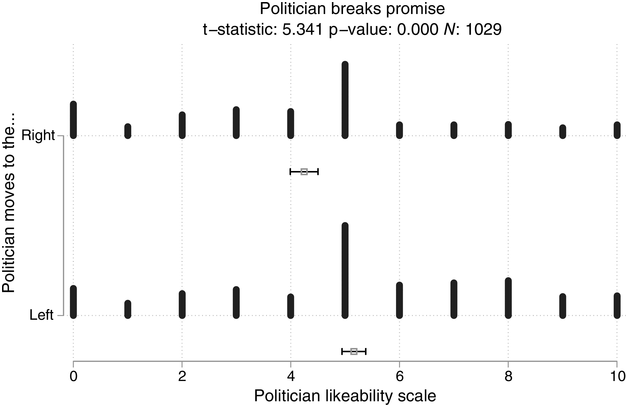
Figure 7.1 Long description
The x-axis shows the likeability scale from 0 to 10 and the y-axis distinguishes between whether position shifts to the right or left. The mean for each sample is represented by a light gray square with black bar confidence intervals. The plot has 1029 observations, a t-statistic of 5.341, and a p-value of 0.000.
The findings support our argument. Respondents like politicians who move rightward (top part of Figure 7.1) significantly less than politicians who move leftward (bottom part of Figure 7.1). The difference between the two groups, one exposed to rightward and the other exposed to leftward-shifting politicians, is the extent to which they like the politicians (a 0.91 difference on the likeability scale, p<0.001).Footnote 3 The findings are similar for respondents who receive an adverse globalization shock (Figure 7.2). Recall that this globalization shock makes the fulfillment of the politicians’ promise less feasible. The key finding from Figure 7.2 is that even in the presence of an adverse globalization shock, politicians are punished more for moving rightward than for moving leftward. Politicians who break their promises and support tax incentives (moving right, top part of Figure 7.2) have a likeability score that is 0.61 points lower on the likeability scale than politicians who break their promises and oppose tax incentives (moving left, bottom part of Figure 7.2). The difference is significant (p<0.001).
Citizens’ responses to position shifts (with globalization shocks).
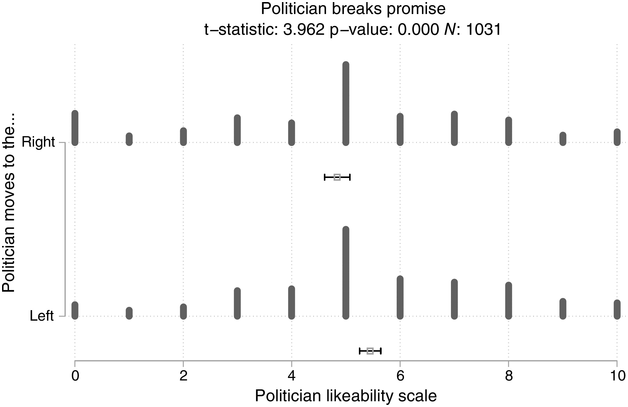
Figure 7.2 Long description
The x-axis shows the likeability scale from 0 to 10 and the y-axis distinguishes between whether position shifts to the right or left. The mean for each sample is represented by a light gray square with black bar confidence intervals. The plot has 1031 observations, a t-statistic of 3.962, and a p-value of 0.000.
Overall, the results indicate that politicians who move rightward (voting for tax incentives for large companies after promising to scrap them) are punished more severely than politicians who move leftward (voting against tax incentives for large companies after promising to expand them), regardless of whether a globalization shock occurs. These findings bolster existing research and provide support for the argument that political parties on the center-right face particularly strong pressure to moderate their positions, a question to which we now turn with a broad international comparative approach.
Data and Variables
We now present a comparative analysis of the effects of globalization on ideological shifts of political parties. As we intend to look for general patterns in the ideological movements of mainstream parties in established democracies, our sample is as inclusive as possible. It consists of 1,042 observations. These observations refer to the ideological positions in election years of 160 parties from thirty-one countries over the period 1970 to 2020. Practical boundaries of our sample are set by the availability of data on economic globalization and parties’ ideological positions. Recall from previous chapters that our main measure of globalization is the Konjunkturforschungsstelle Economic Globalization Index, which is available from 1970 to present, limiting the period we can study systematically. Our sample is also limited to the countries and mainstream parties included in the Manifesto Project, which is our main source of information on parties’ ideological positions based on their election programs. There are thirty-one countries in the Manifesto Project that are established democracies according to a broad definition of this term. We include all countries that were coded as liberal democracies in at least one year between 1970 and 1999 by the authoritative Regimes of the World measure in the Varieties of Democracy dataset. This means that our sample includes parties in countries that were liberal democracies throughout this period, but also countries that became democratic in the 1970s, such as Portugal and Spain, as well as countries that became democracies in the 1990s, such as the Central European countries that joined the European Union in the early 2000s. We limit the analysis to mainstream parties, which we again define broadly, as parties that were coded as belonging to one of the main party families by the Manifesto Project: socialist, social democratic, liberal, conservative, and Christian democratic.
Defining and Measuring Partisan Ideologies
To analyze how parties respond to globalization in their electoral appeals, we focus on shifts in their positions along core ideological dimensions. These movements are the main dependent variables in this chapter. Before introducing the specific indicators used in our analysis, we begin by explaining how we understand and approach the broader concept of partisan ideology and how it can be measured.
Due to their abstract nature, ideological principles have a degree of ambiguity about them. Actors may hold several competing principles without being intellectually inconsistent. Moreover, there is no deterministic relationship between supporting certain principles, making assessments of actual or desired circumstances, and holding specific policy preferences. For instance, actors who support the principle that society should care for the poorest may be most likely to fret about actual inequality and support government interventions to redistribute wealth. Likewise, actors who adhere to the principle that society should promote individual economic freedoms may be most likely to lament policies that inhibit individual enterprise and support the repeal of those policies. But such associations between these principles and policies are probabilistic at best, and it is not inconsistent to support both principles and policies at the same time.
Notwithstanding the malleable nature of ideologies, a remarkable finding from comparative research on party competition is that a large proportion of contestation is highly structured and can be summarized on the left–right dimension (Benoit and Laver Reference Benoit and Laver2006; Klingemann et al. Reference Klingemann, Volkens, Bara, Budge and McDonald2006; Kriesi et al. Reference Kriesi, Grande, Dolezal, Helbling, Höglinger, Hutter and Wüest2012; Steenbergen and Marks Reference Steenbergen and Marks2007). Political parties tend to position themselves quite consistently on this dimension in accordance with their policy preferences, with social democratic parties typically supporting policies further to the left than conservative parties. The extent to which a single left–right dimension adequately summarizes party competition, and its precise content, varies across countries and time periods. In some cases, the left–right dimension is dominated by socioeconomic issues, and in other cases the left–right dimension also summarizes parties’ positions on social and moral issues. There is evidence that in some countries the traditional socioeconomic left–right dimension is complemented by a new dimension, which represents the distinction between parties on environmentalism, nationalism, and the authority of the state (Hooghe, Marks, and Wilson Reference Hooghe, Marks and Wilson2002). Nonetheless, the left–right dimension has given structure to party competition in most representative democracies in recent decades.
The saliency theory of party competition has inspired an enduring and practical way of describing how parties’ ideological positions change over time (Robertson Reference Robertson1976). According to saliency theory, a significant part of party competition consists of parties differentiating themselves by emphasizing and deemphasizing policy themes relative to one another. For instance, some parties devote more emphasis to improving the quality of social services and solidarity. Others may highlight free enterprise and individual freedoms. These themes are not incompatible with each other in the sense of being contradictory. However, they do point to different views on where governments’ priorities should lie. While it certainly happens that one party proposes to, say, cut certain taxes, while other parties oppose the same cuts, such direct confrontation is relatively rare when we consider the entirety of political discourse. Instead, much of party competition consists of parties talking past each other and focusing on their favorite issues. Saliency theory bears some similarities with the idea of issue ownership, according to which certain parties are generally perceived to be most competent in relation to certain policy issues. However, saliency theory does allow for parties to shift their ideological positions over time. By changing the attention they devote to different policy themes over time, parties can shift their ideological positions without repudiating their past stances outright.
Saliency theory is the foundation of one of the largest international research programs in comparative political science, and certainly the largest international research program in the comparative study of political parties. The Manifesto Project and its antecedents have developed a comprehensive coding framework for systematically describing the ideological profiles of parties based on their election manifestos, platforms, or similar documents (Volkens et al. Reference Volkens, Krause, Lehmann, Matthieß, Merz, Tegel and Wessels2019). The coding framework consists of fifty-six thematic categories that collectively cover most of the universe of discourse that has featured in election campaigns in established Western democracies since the post-World War II period. These include themes that have traditionally been associated with parties that belong to all of the mainstream party families: socialists, social democrats, liberals, conservatives, and Christian democrats. For instance, it includes themes of nationalization, privatization, support for welfare expansion, free enterprise, economic orthodoxy, and traditional values. Table 7.1 lists a selection of the fifty-six themes. The framework also includes themes that are associated with nonmainstream parties, including communist parties, nationalist parties, and special interest parties, but these are not our main concern in the present study.
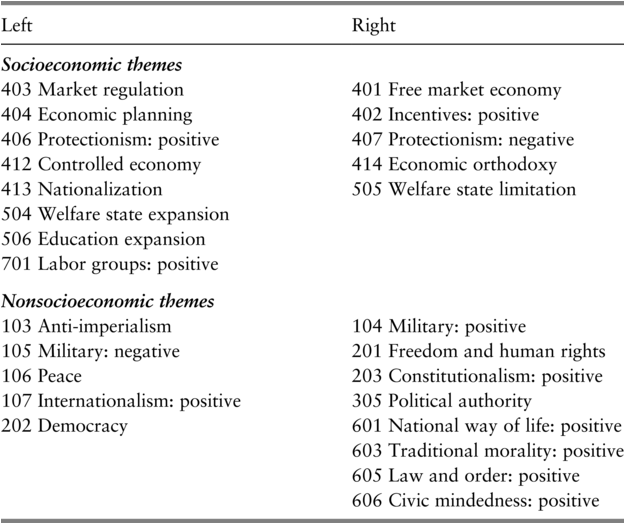
Table 7.1 Long description
Left socioeconomic themes include 403 market regulation, 404 economic planning, 406 protectionism positive, 412 controlled economy, 413 nationalization, 504 welfare state expansion, 506 education expansion, and 701 labor groups positive. Right socioeconomic themes include 401 free market economy, 402 incentives positive, 407 protectionism negative, 414 economic orthodoxy, and 505 welfare state limitation. Left non socioeconomic themes include 103 anti imperialism, 105 military negative, 106 peace, 107 internationalism positive, and 202 democracy. Right non-socioeconomic themes include 104 military positive, 201 freedom and human rights, 203 constitutionalism positive, 305 political authority, 601 national way of life positive, 603 traditional morality positive, 605 law and order positive, and 606 civic mindedness positive.
Note: The table presents a list of themes in party manifestos that were identified as being of particular importance in distinguishing between left-wing and right-wing parties across a broad range of political systems in established democracies. The numbers refer to the codes used in the Manifesto Project coding scheme.
The Manifesto Project’s coding framework has been applied to the election programs of almost all parties in Western democracies since 1945. The decision to focus on election programs (manifestos, platforms, or similar documents) is appropriate given that these are the authoritative statements of parties’ policy stances at election times. The fact that parties’ election programs are not widely read does not detract from their importance as an appropriate source of information on where parties stand at the time of national elections. The application of the coding framework involves country specialists coding each of these documents. Each sentence or quasi-sentence is allocated to one of the fifty-six themes or to a residual theme for text that could not be allocated to any of the fifty-six substantive themes. Analysts usually focus on the percentage of all (quasi)-sentences devoted to each theme to provide indications of where parties’ priorities lie.
The twenty-six themes listed in Table 7.1 are those that were identified in a foundational analysis of the Manifesto Project dataset as being of particular importance in distinguishing between left-wing and right-wing parties across a broad range of political systems in established democracies (Laver and Budge Reference Laver and Budge1992). These are the themes on which we focus in the following analyses. We do not argue that these themes cover the full range of political discourse that may be affected by globalization. Clearly, they do not. Notable omissions include the Manifesto Project theme of Environmental Protection, which many parties have devoted more attention to in recent decades, partly in response to the increased attention to global warming by the international community. There is also no Manifesto Project theme that deals exclusively with immigration, although the theme National Way of Life: Positive, which is included as a rightist nonsocioeconomic theme, captures some of the anti-immigrant discourse used by parties when arguing that their countries’ immigration rules have been too lax.
The great advantage of limiting our analysis to the twenty-six themes identified by Laver and Budge (Reference Laver and Budge1992) is that we avoid any temptation to operationalize ideology, more specifically the left–right dimension, in ways that conform to our preconceptions about how parties have responded to globalization. Instead, our analyses are based on a measure that was developed by other researchers for entirely different research purposes, including investigations of the ideological choices that parties offer to voters.Footnote 4
The simplest way to calculate parties’ left–right positions is to subtract the percentage of all sentences (or quasi-sentences) devoted to rightist themes from the percentage devoted to leftist themes. This commonly used measure of left–right has the advantage of being easy to implement and interpret. Nevertheless, given that parties’ left–right positions are the main dependent variable in the following analyses, we implement a methodological improvement of this measure (Lowe et al. Reference Lowe, Benoit, Mikhaylov and Laver2011). This improvement consists of an adjusted measure of parties’ left–right positions, based on the same themes. The new measure takes the natural log of the proportion of sentences devoted to rightist themes (plus 0.5) divided by the proportion of sentences devoted to leftist themes (plus 0.5). This measure is a significant methodological improvement on the original measure in several respects, notably providing more reasonable estimates of the ideological positions of manifestos that devote unusually large or small proportions of text to particular themes. However, the new measure is very highly correlated with the original measure, such that we obtain substantively the same results with the original measure (the correlation between the two measures is an almost perfect correlation of 0.95 in the cases we examine here).
The following analyses examine parties’ movements on three versions of the left–right dimension. The first is the overall left–right dimension that combines all twenty-six leftist and rightist themes, regardless of whether they are socioeconomic or nonsocioeconomic in nature (Table 7.1). The second is the socioeconomic left–right dimension, which includes only the thirteen themes we identified as socioeconomic, and the third is the nonsocioeconomic left–right dimension that includes the thirteen nonsocioeconomic themes.
Dependent Variables
We examine parties’ movements along the main ideological dimensions from different perspectives, which correspond to the following four steps in the analyses. All of these use the authoritative Manifesto Project’s data on the themes that parties emphasize in their election platforms (Volkens et al. Reference Volkens, Krause, Lehmann, Matthieß, Merz, Tegel and Wessels2019) that we introduced in the previous section. In each of the following variants of the dependent variable, we apply a log transformation of the raw data (Lowe et al. Reference Lowe, Benoit, Mikhaylov and Laver2011).
In the first step, we focus on parties’ extremity on the general left–right ideological dimension as the dependent variable. Extremity is measured as the absolute value of parties’ left–right scores. An important feature of the general left–right dimension is that the zero value indicates the party is a centrist party that devotes equal attention to leftist and rightist themes. It is therefore reasonable to take the absolute value of parties on this scale as an indication of their ideological extremity. Parties with higher values are more extreme (on the left or right), while parties with smaller values are more centrist. This general left–right dimension includes themes that are socioeconomic in nature and themes that are nonsocioeconomic.
Using extremity as the dependent variable is a useful approach from a technical standpoint. We wish to test whether economic globalization has a larger effect on parties further to the right than on parties further to the left. To do so, we simply introduce an interaction between our measure of globalization and parties’ left–right positions (not extremity) at the time of the previous election.
In the second step, we focus on parties’ positions on the general left–right ideological dimension as the dependent variable. This scale, as described earlier, has both positive and negative values. Parties with larger positive values are more extreme on the right, while parties with larger negative values are more extreme on the left. To model the effect of economic globalization on parties’ general left–right positions we split the sample into two. The left-wing sample of parties consists of parties that had leftist positions (left–right scores of less than zero) in the previous election, while the right-wing sample consists of parties that had rightist positions at the time of the previous election. We expect globalization to have a negligible effect on the positions of leftist parties. For rightist parties, however, we expect globalization to have a significant negative effect, as we expect globalization to encourage rightist parties to move to the center.
In the third step, we focus on parties’ positions on the socioeconomic left–right ideological dimension as the dependent variable. This scale is based on the thirteen themes we identified as socioeconomic, eight of which are leftist and five of which are rightist. Again, more right-wing parties have larger positive scores on this dimension, while more left-wing parties have larger negative scores. However, an important difference between the socioeconomic and general left–right scale is that the socioeconomic scale is imbalanced, with more leftist themes than rightist themes. This makes the zero point less intuitively meaningful than in the case of the general left–right dimension. Many center–right parties have small negative values on this scale. This means that we cannot easily divide parties into left and right based on their previous positions on the socioeconomic left–right dimension. Instead, we divide parties into leftist and rightist parties based on their categorization into party families by the Manifesto Project researchers who are experts on the countries and parties included. We define leftist parties as those in the socialist and social democratic party families. Rightist parties are those in the liberal (which mainly refers to economically liberal), Christian democratic, and conservative party families. This division into leftist and rightist parties enables us to examine whether globalization is associated with more marked shifts by rightist parties on the socioeconomic left–right dimension than by leftist parties.
The fourth and final step also focuses on parties’ positions on the nonsocioeconomic left–right ideological dimension. This scale is also based on thirteen themes, but this time five of these are leftist and eight are rightist themes. Again, the zero point of this imbalanced scale has little meaning, and the scale is biased toward larger positive numbers. We again divide the sample into leftist and rightist parties based on party family. This allows us to model the effect of globalization on leftist and rightist parties’ nonsocioeconomic ideological positions separately.
Principal Explanatory Variable and Control Variables
As in previous analyses, our measure of economic Globalization is the Konjunkturforschungsstelle (KOF) Index of economic globalization (Dreher Reference Dreher2006), which we discussed extensively in our empirical analyses in Chapter 4. The analyses also include several control variables. They include:
Party Left–Right Position measures a party’s left–right position in the election year prior to the election year in which we measured their ideological position as the dependent variable. Data are from Volkens et al. (Reference Volkens, Krause, Lehmann, Matthieß, Merz, Tegel and Wessels2019).
For instance, if the observation refers to the ideological position of the UK Conservative Party in 2015, we also include the position of the UK Conservative Party in 2010. In the first step of the analysis, in which Extremity is the dependent variable, this lagged measure of the parties’ positions is part of the theoretical mechanism we want to test. We introduce an interaction term to test whether, as we expect, rightist parties become more moderate with the advance of globalization, while leftist parties’ ideological positions are largely unaffected by globalization. In the subsequent steps, the lagged measures of parties’ positions are simply control variables.
Governing Experience is a dichotomous indicator for whether the party had experience of holding executive office in any of the ten years prior to the election year in which we measured their ideological position.
The reasoning behind including this variable is that parties with recent governing experience may take more moderate positions. This measure was based on information contained in the Manifesto Project dataset and the ParlGov dataset (Döring and Manow Reference Döring and Manow2015, Reference Döring and Manow2024).
Disproportionality, measured by Gallagher’s Index of Disproportionality, assesses the disproportionality of the electoral system based on a comparison of the percentage of popular votes received by a party and the percentage of legislative seats held by the party (Gallagher and Mitchell Reference Gallagher and Mitchell2005).
Majoritarian plurality-based electoral systems, such as the United Kingdom, are more disproportional than electoral systems based on proportional representation, such as the Netherlands. The reasoning behind including this index is that disproportional systems may encourage parties to converge to the center ground of the main ideological dimensions.
Vote share measures the percentage of popular votes received by the party from the Manifesto Project dataset.
Relatedly, we include the percentage of votes received by the party at the previous election, as larger parties may be more centrist.
Gross Domestic Product Growth accounts for gross domestic product growth from the World Development Indicators.
While we have no strong theoretical priors in relation to this or the other control variables, parties may attune their positioning to the prevailing state of the economy.
Finally, we include fixed effects for countries, which means that we focus on the impact of changes in countries’ exposure to economic globalization at different timepoints. The models are ordinary least squares regressions with robust standard errors clustered by political party.
Descriptive statistics for all variables are presented in the online Supplementary Material. We standardized all continuous explanatory variables to a mean of 0 and a standard deviation of 1.
Comparative Analysis of Parties’ Ideological Positioning
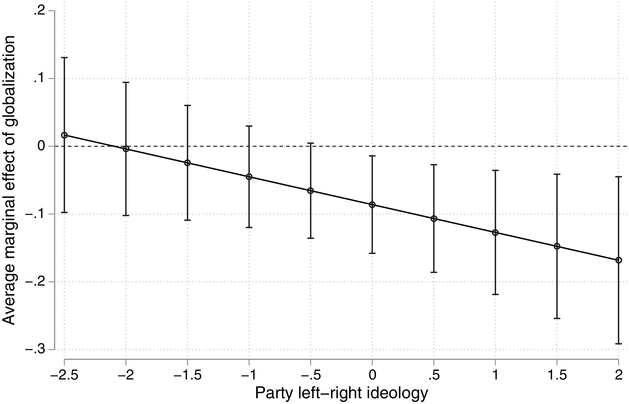
The first step in the analysis is to examine the impact of globalization on parties’ ideological extremity, measured by the absolute value of their positions on the general left–right dimension that incorporates both socioeconomic and nonsocioeconomic themes. The main finding is that economic globalization is associated with parties taking less extreme positions on this general left–right dimension, particularly parties that are on the center-right. The model depicted in Figure 7.3 contains an interaction between the measures of economic globalization and parties’ (previous) left–right position. The full model, as with other full models in this set of analyses, is reported in tabular form in the online Supplementary Material.
Globalization and ideological extremity on the general left–right dimension
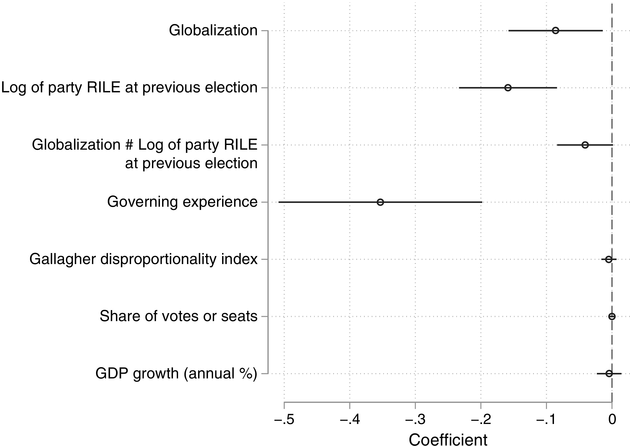
Figure 7.3 Long description
The 7 variables are globalization, log of party rile at previous election, globalization and log of party rile at previous election, governing experience, Gallagher Disproportionality Index, share of votes or seats, and G D P growth as an annual percentage. The variable Governing Experience stands out with the lowest coefficient while the others remain relatively close to 0.
The main effect of economic globalization is negative and significant. This indicates that for parties whose previous left–right positions had a value of zero, higher levels of economic globalization are associated with less extreme positions at the present election. The interaction is negative and marginally significant (p=0.06), which means that for parties whose previous left–right positions were further to the right, the negative effect of globalization on ideological extremity is larger. Figure 7.4 depicts the form of this negative interaction more intuitively. For parties whose previous general left–right positions were more rightist, the negative effect of globalization becomes stronger and more negative.
Globalization has a negative effect on the extremity of center-right parties’ left–right positions
Of the control variables, the only one that is statistically significant is the variable Governing Experience. The direction of the coefficient indicates, as expected, that parties with recent governing experience tend to have more moderate, less extreme ideological positions.
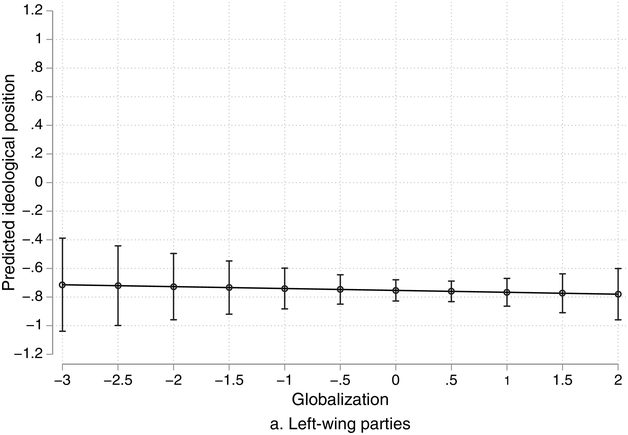
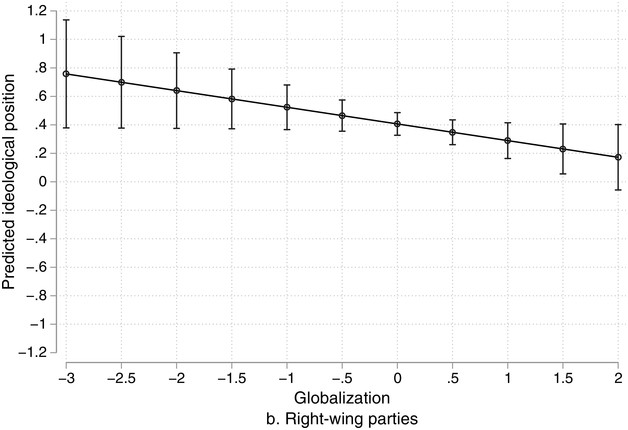
The second step in the analysis illustrates this effect by focusing on parties’ positions on the general left–right dimension, rather than the extremity of their positions as in the previous step. Here, we divide the sample of parties into those that had leftist positions (less than zero on the left–right scale) at the previous election and those that had rightist positions at the previous election. In line with our expectations, economic globalization has no significant effect on the ideological positions of leftist parties. However, it has a significant negative effect on the positions of rightist parties, meaning that rightist parties shift toward the center of that dimension.
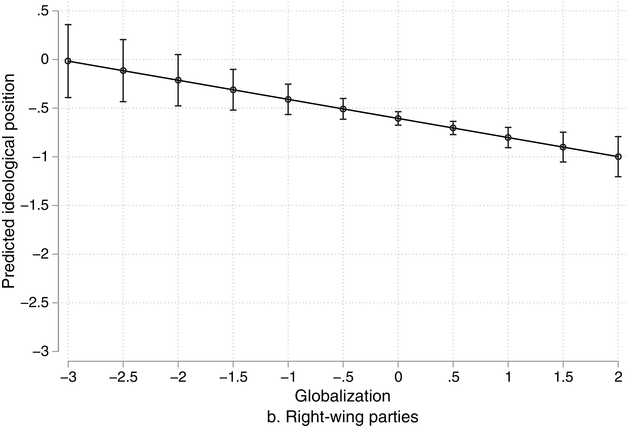
Figure 7.5 illustrates this pattern (the online Supplementary Material contains the full tabular results). Leftist parties’ ideological positions remain relatively stable across levels of globalization (top graph). In contrast, rightist parties exhibit a clear moderating trend as globalization intensifies (bottom graph). Importantly, while rightist parties become more centrist, they do not shift to the left. Even in highly globalized environments, the predicted positions of rightist parties remain significantly greater than zero, indicating that they continue to occupy the right side of the ideological spectrum. This reflects a crucial constraint: while economic globalization may incentivize moderation, right-wing parties remain bound by their ties to wealthy, market-oriented constituents, which limits how far they can shift toward the center. As a result, even the moderated positions of rightist parties continue to differ meaningfully from those of centrist or left-leaning competitors.
Globalization moderates the general left–right positions of rightist parties
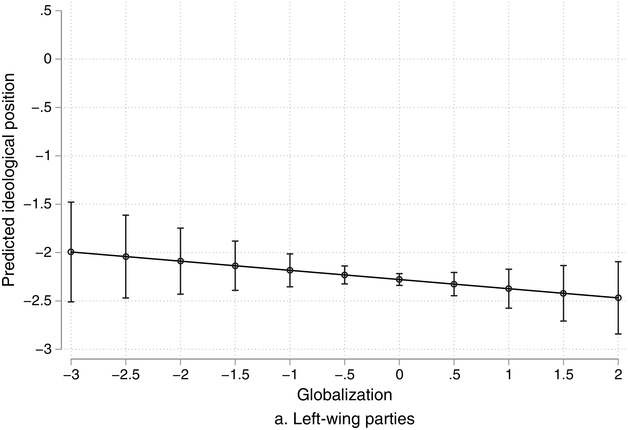
The third step of the analysis shows that the effects of economic globalization that we identified in the previous steps are far sharper and are in fact driven by the socioeconomic left–right dimension (rather than nonsocioeconomic themes). This third step in the analysis focuses on parties’ positions on the socioeconomic left–right dimension. Here, we divide parties into those that belong to mainstream leftist party families (socialists and social democrats) and those that belong to mainstream rightist party families (liberals, meaning economic liberals, Christian democrats, and conservatives). Figure 7.6 shows that leftist parties’ positions on the socioeconomic left–right dimension remain largely unchanged across levels of globalization (top graph). In contrast, rightist parties become markedly more moderate on this dimension in more globalized contexts (bottom graph). Nonetheless, their predicted positions remain well to the right of leftist parties. This is consistent with the enduring influence of their affluent, market-oriented constituencies, which constrains how far they can shift toward the center.
Globalization moderates the socioeconomic left–right positions of rightist parties
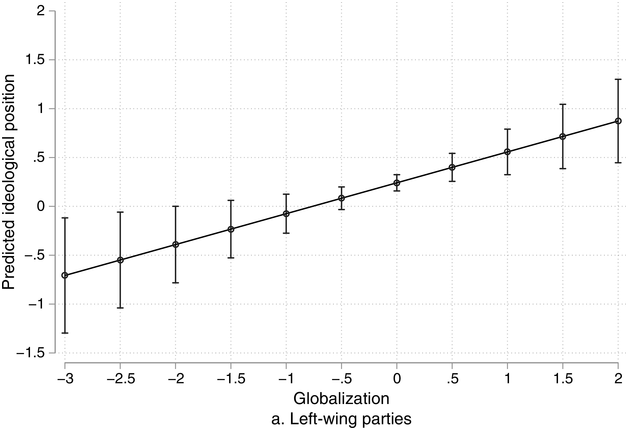
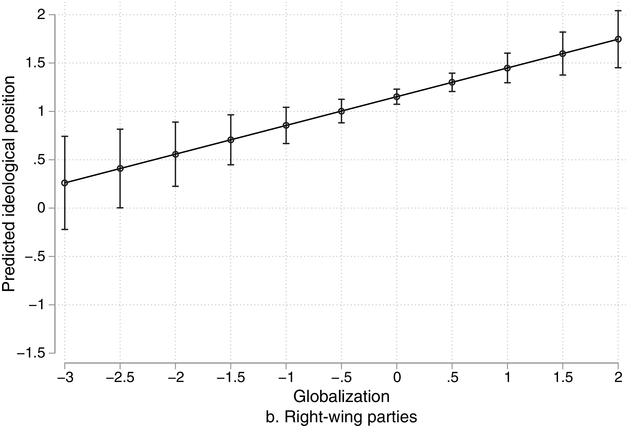
Finally, the fourth step in the analysis examines the nonsocioeconomic left–right dimension, which is defined by themes including political authority, national way of life, and traditional morality. These are themes associated with populism. We observe a marked difference in political parties’ responses to globalization compared with their movements on the socioeconomic left–right dimension. These responses are depicted by predicted values in Figure 7.7. As globalization increases, both leftist and rightist parties shift to the right. The effects are statistically significant. There still appears to be a substantial gap between the positions of leftist and rightist parties on this dimension at different levels of globalization. However, the relative emphasis all parties place on leftist and rightist themes has shifted toward the rightist themes as economic globalization has deepened.
Leftist and rightist parties shift rightward on the nonsocioeconomic left–right dimension as globalization deepens
Discussion
This chapter examines how globalization affects parties’ ideological positions, which form the foundation of their electoral appeals. We focus on how this dynamic plays out for mainstream parties on the center-right and center-left of politics. We discuss the mounting pressures on parties, particularly those of the center-right, to adjust their promises in the face of the economic uncertainties and risks that globalization imposes on voters. These pressures have forced center-right parties to strike a balance between the interests of their traditional supporters – who benefit from open markets and economic liberalization – and the demands of lower- and middle-income voters who seek protection from the risks of globalization.
The evidence shows that center-right parties have moved toward the center on the socioeconomic left–right spectrum. This shift allows them to address voters’ economic insecurities without entirely abandoning their market-oriented principles. On the other hand, left-wing parties have largely maintained their socioeconomic ideological positions, as their traditional principles – focused on social safety nets, labor protections, and state intervention – already align with the expectations of voters seeking to mitigate the risks associated with economic openness. This means that many left-wing parties have not undertaken the same level of ideological recalibration that their center-right counterparts have on socioeconomic policies. Our further analyses, which dissect the ideological shifts on both socioeconomic and nonsocioeconomic dimensions, confirms that all mainstream parties, including those on the left, have shifted rightward on cultural and nonsocioeconomic themes.
While all parties must adapt to the pressures posed by globalization, the paths they take vary significantly depending on their ideological roots and voter bases. Center-right parties are faced with a particularly significant dilemma as they navigate the pressures of globalization. On the one hand, these parties must continue to advocate for economic policies that align with their traditional base of wealthier voters and market elites who benefit from global economic integration. On the other hand, they cannot afford to ignore the growing concerns of lower- and middle-income voters who feel increasingly vulnerable to the economic risks that globalization imposes. This creates a dilemma: how can center-right parties remain true to their economically liberal principles while also addressing citizens’ demands for greater state intervention and protection? The next chapter continues to examine this dilemma by considering how parties attempt to reconcile these conflicting pressures through a strategic shift in emphasis toward cultural and value-based issues.
Globalization has placed immense demands on parties, especially those that traditionally favored free markets and deregulation, to adapt to a political landscape where voters increasingly expect protection from the economic risks posed by global integration. The previous chapter concludes that, in response, many center-right parties have moderated their ideological positions on the main socioeconomic left–right dimension, making promises that are more centrist. However, this strategy creates a dilemma for center-right parties: How can they address voters’ economic anxieties without alienating their traditional support base that favors limited government? Moving too far to the left risks losing the support of their core supporters, who continue to prefer open markets and limited government intervention. We argue that in response to these competing pressures, mainstream center-right parties have increasingly turned to populist rhetoric in their promises – particularly on issues like national identity, immigration, and cultural values – as a means of broadening their electoral appeal without entirely abandoning their economically liberal principles.
This strategic pivot toward cultural populism is a direct consequence of globalization’s effects on voters’ expectations. The chapter examines how center-right parties have responded to these pressures by adopting exclusionary populist rhetoric and focusing on noneconomic issues, such as national sovereignty and immigration. These parties have increasingly embraced a narrative that pits “the people” against “elites,” both at the national and international levels, positioning themselves as the defenders of traditional values against the forces of globalization. While the populist rhetoric of the far right has often been seen as a fringe phenomenon, our findings suggest that mainstream parties are also increasingly using these strategies.
The argument that mainstream center-right parties’ use of populist rhetoric is a direct response to the globalization dilemma differs from most accounts of mainstream party populism. Existing accounts have focused on the imitation hypothesis, according to which mainstream party leaders feel compelled to respond to the success of smaller populist parties by imitating them. This may be part of the story in some countries. However, it is at most indirectly related to the main concern of this study: how globalization directly affects mainstream parties’ electoral appeals. Although we do not discount the imitation hypothesis entirely, we do not find strong evidence that mainstream parties are more populist when populist parties are more successful.
To explore the effects of globalization on populist rhetoric in mainstream parties, we analyze a dataset of mainstream political parties from thirty-one established democracies over five decades, focusing on their ideological positions and use of populist rhetoric. Our findings indicate that globalization has played a significant role in reshaping the ideological landscape, pushing especially right-leaning parties toward populism as they seek to balance economic liberalism with citizens’ demands for greater state protection from economic risks.
Mainstream Parties’ Strategic Dilemmas
The socioeconomic left–right dimension has been the main dimension of party competition in a broad range of established democracies for many decades.Footnote 1 Chapter 7 shows that many mainstream political parties, particularly those on the right, have moderated their traditional market-friendly stances as their countries have become more deeply integrated into the international economy. These ideological shifts respond partly to voters’ concerns about the economic insecurity associated with globalization. Such adaptations are at least partly attempts to remain electorally competitive by building broader coalitions of support (Butler Reference Butler2014; Gibson Reference Gibson1996; Ziblatt Reference Ziblatt2017).
The dilemma for center-right parties is that they must strike a balance between pleasing their traditional constituents, who continue to favor more open economies and deregulation, and middle-class voters, who are less willing to support parties that do not have plans to correct the distributional effects of economic integration. Consequently, while center-right parties have moderated their ideological stances, they have generally not gone as far as to promote serious government regulation and redistribution. Comparative research shows that governments have done little to offset the trends in rising inequality; on the contrary, many government policies appear to have become less redistributive over time, especially in more unequal societies (Iversen and Soskice Reference Iversen and Soskice2009; Lindert Reference Lindert2004; Lupu and Pontusson Reference Lupu and Pontusson2023).Footnote 2
Economic risks associated with globalization, combined with government policies that have failed to adequately address these challenges, have generated a pervasive sense of status anxiety among many citizens. This anxiety is particularly acute among middle- and lower-income voters who fear a decline in their social and economic standing. Growing social and economic insecurity in these groups has contributed to deepening social divisions in many societies (Cramer Reference Cramer2016; Iversen and Soskice Reference Iversen and Soskice2019; Judis Reference Judis2016, Reference Judis2018) and rising feelings of injustice and resentment are increasingly reflected in voting behavior (Noury and Roland Reference Noury and Roland2020). Many voters feel left behind by the combination of rising inequality and the neoliberal economic policies pursued by mainstream parties (Appel and Orenstein Reference Appel and Orenstein2018; Huber and Stephens Reference Huber and Stephens2001). A widespread perception has emerged that mainstream parties no longer offer meaningful alternatives on socioeconomic issues; a perception that is supported by comparative research (Grzymala-Busse Reference Grzymala-Busse2019; Spoon and Klüver Reference Spoon and Klüver2019). As a result, many citizens direct blame toward the wealthy or various outgroups, both domestic and foreign, and express growing resentment toward professional elites and minorities within their own countries (Bonikowski Reference Bonikowski2017). Economic anxiety has also fueled a broader cultural and racial backlash, particularly among citizens who feel threatened or alienated by immigration, the spread of liberal cosmopolitan values, and the growing empowerment of minority groups (Gidron and Hall Reference Gidron and Hall2017; Haughton and Deegan-Krause Reference Haughton and Deegan-Krause2020; Norris and Inglehart Reference Norris and Inglehart2019; Pop-Eleches and Tucker Reference Pop-Eleches and Tucker2017). In this context, the continued support by mainstream parties for immigration, neoliberal economic policies, and international integration is increasingly out of step with the preferences of many voters, particularly those who are less affluent and less educated, and instead appeals only to richer and more educated constituencies (Berman Reference Berman2019).
Widespread resentment among citizens toward economic elites has also targeted international actors, including entire countries. For example, economically disadvantaged citizens in the developed world often blame China for their problems (Milanović Reference Milanović2018). Resentment is also directed toward international institutions, which are seen as elitist, undemocratic, and unaccountable. Institutions, such as the European Union, have been blamed for increased immigration, unemployment, and rising inequality (De Vries Reference De Vries2018; Whitefield and Rohrschneider Reference Whitefield and Rohrschneider2015). Many citizens feel their governments have given up their national autonomy to pursue policies that protect the economically privileged. While scholars continue to debate the extent to which the European Union is democratically accountable (Crombez Reference Crombez2003; Dahl Reference Dahl, Shapiro and Hacker-Cordon1999; Follesdal and Hix Reference Follesdal and Hix2006; Hix Reference Hix2008; Karp, Banducci, and Bowler Reference Karp, Banducci and Bowler2003; Meyer Reference Meyer1999; Moravcsik Reference Moravcsik2002, Reference Moravcsik2008; Nye Reference Nye2001; Olsen, Sbragia, and Scharpf Reference Olsen, Sbragia and Scharpf2002; Rohrschneider Reference Rohrschneider2002; Rohrschneider and Loveless Reference Rohrschneider and Loveless2010; Sánchez-Cuenca Reference Sánchez-Cuenca2017; Scharpf Reference Scharpf1992; Schmidt Reference Schmidt2006, Reference Schmidt2020; Schneider Reference Schneider2019), European integration – for good or bad – has reduced policy autonomy at the national level, particularly in the economic sphere (Meyerrose Reference Meyerrose2020, Reference Meyerrose2024; Nanou and Dorussen Reference Nanou and Dorussen2013; Scicluna and Auer Reference Scicluna and Auer2019). Extensive economic integration of this kind has negative effects on democratic accountability and representation at the national level (Ezrow and Hellwig Reference Ezrow and Hellwig2014; Hafner-Burton and Schneider Reference Hafner-Burton and Schneider2023; Hellwig Reference Hellwig2015; Hellwig and Samuels Reference Hellwig and Samuels2007; Kelemen Reference Kelemen2017, Reference Kelemen2020; Meyerrose Reference Meyerrose2020, Reference Meyerrose2024).
The consequences of these developments have included a hollowing out of mainstream political parties particularly on both the right and left (Greskovits Reference Greskovits2015; Hooghe and Marks Reference Hooghe and Marks2018; Mair Reference Mair2013). Center-right parties have ceded their traditional commitments to free markets, while at the same time failing to formulate policies that would really protect lower- and middle-income citizens from the economic risks associated with globalization. Leftist parties, while often maintaining their long-standing commitments to government intervention, have often failed to deliver on these socioeconomically progressive policies when in government, as Chapter 4 of this book demonstrates. These tensions have set the scene for an increase in support for populist antielite parties in many established democracies. This has entailed a shift in party competition toward identity and cultural values, as distinct from socioeconomic policies. The remainder of this section describes the rise in populist parties and populist sentiment in many established democracies, before explaining why many mainstream parties also use populist rhetoric as a response to the strategic dilemmas posed by globalization.
The Rise of Populist Challenger Parties and the Imitation Hypothesis
Populist parties have gained ground in response to citizens’ growing dissatisfaction with mainstream, established political institutions that appear unwilling or unable to respond to their grievances and demands (Bakker, Jolly, and Polk Reference Bakker, Jolly, Polk, Hobolt and Rodon i Casarramona2021; Berman Reference Berman2016, Reference Berman2017; Broz, Frieden, and Weymouth Reference Broz, Frieden and Weymouth2021; Foa et al. Reference Foa, Klassen, Slade and Rand2020). Support for populist parties is in many ways driven by their promise to end the source of rising inequality: globalization (Pastor and Veronesi Reference Pastor and Veronesi2018, Wiesehomeier, Dupont, and Ruth-Lovell Reference Wiesehomeier, Dupont and Ruth-Lovell2024). Working class citizens have been especially likely to respond to populist appeals (Berman Reference Berman2019; Stanley Reference Stanley, Kaltwasser, Taggart, Espejo and Ostiguy2017). The financial crisis of 2008 alone triggered a wave of populist sentiments across established democracies (Eichengreen Reference Eichengreen2018; Funke, Schularick, and Trebesch Reference Funke, Schularick and Trebesch2016; Rodrik Reference Rodrik2012; Schäfer Reference Schäfer2013).
Populist parties frame political discourse around a stark division between the “corrupt elites” and the “ordinary people” (Mudde Reference Mudde2007; Taggart Reference Taggart2000). By doing so, they portray the political establishment as an elite group that prioritized their own economic and political interests, often at the expense of the wider population. This antielite narrative has resonated deeply with voters who feel abandoned or disenfranchised by the traditional parties that they once trusted to protect their interests. Populists promise to reverse this dynamic, presenting themselves as the true defenders of the people against the entrenched elites, both within the country and in international institutions.
Populist parties have also positioned themselves as more responsive to the issues that mainstream parties had neglected or inadequately addressed. For example, concerns about immigration, globalization, and economic insecurity were frequently dismissed or downplayed by the traditional parties, especially in the face of pressures to maintain proglobalization stances. Mainstream parties often respond to such concerns with technocratic solutions or frame issues in ways that do not resonate with many citizens (De Vries and Hobolt Reference De Vries and Hobolt2020). In contrast, populist parties politicize these concerns directly, addressing them with a sense of urgency and in ways that align more closely with voters’ preferences. On such topics as immigration, populists frequently capitalize on anxieties about national identity, economic competition, and cultural change, offering simple (and often extreme) solutions that draw stark lines between insiders and outsiders (Hobolt and Tilley Reference Hobolt and Tilley2014).
Populists also readily tap into the antiglobalization sentiment, appealing to voters who see globalization as a threat to their economic security and national sovereignty. This gives populists a significant advantage over mainstream parties, which often hesitate to take strong stances against international economic integration. By foregrounding antiglobalization and nationalist rhetoric, populist parties effectively build a political identity that contrasts starkly with the establishment’s perceived complicity in the negative effects of globalization, such as job losses, wage stagnation, and economic inequality (Mudde and Rovira Kaltwasser Reference Mudde and Kaltwasser2018; Norris and Inglehart Reference Norris and Inglehart2019). Politicizing globalization and immigration as causes of citizens’ struggles has allowed populist parties to build a broad base of support, while mainstream parties have struggled to adapt their platforms in ways that effectively address these growing anxieties.
There are noteworthy differences between leftist and rightist populist parties. Both types of populists are antiestablishment parties that claim to be championing the interests of the people against elites. However, leftist populists tend to focus more narrowly on economic issues than the nationalist and xenophobic rhetoric that characterizes right-wing populism (Rydgren Reference Rydgren2014). For example, while parties like Syriza in Greece have campaigned on antiausterity platforms and railed against international financial institutions, they have not embraced the anti-immigration rhetoric that has been central to right-wing populist movements (Kitschelt Reference Kitschelt1996; Mudde and Rovira Kaltwasser Reference Mudde and Kaltwasser2018). Like other populist parties that succeeded in entering government, Syriza found it impossible to fulfill many of its radical promises; having campaigned on a platform of rejecting austerity, it was forced to accept an austere bailout package from the European Union (Ruiz-Rufino Reference Ruiz-Rufino2025; Stavrakakis and Katsambekis Reference Stavrakakis and Katsambekis2014). In contrast, right-wing populist parties combine economic grievances with cultural resentment (Mutz Reference Mutz2018). This offers a more emotionally resonant narrative to voters who fear the erosion of traditional values due to immigration and globalization (Kriesi et al. Reference Kriesi, Grande, Lachat, Dolezal, Bornschier and Frey2008; Mudde Reference Mudde2007). Right-wing populist parties – such as the National Rally (formerly National Front) in France or the Alternative for Germany (AfD) – have capitalized on voters’ frustrations with globalization by adopting exclusionary, nationalist rhetoric.
Mainstream parties have had to consider how best to respond to the growing support for populist parties (Rooduijn Reference Rooduijn2014), and they have adopted various strategies, including dismissive, adversarial, and accommodating stances (Meguid Reference Meguid2005, Reference Meguid2008). The imitation hypothesis posits that the most common response by mainstream parties to the rise of populist parties has been one of imitation.Footnote 3 Simply put, leaders of mainstream parties see the success of populist parties and decide to use similar rhetoric and positions in response to this electoral threat. De Vries and Hobolt (Reference De Vries and Hobolt2020) argue that mainstream parties have adjusted to the political climate created by populist entrepreneurs by tapping into antielite sentiment and populists’ demands for national sovereignty and protectionism. Akkerman, Lange, and Rooduijn (Reference Akkerman, de Lange and Rooduijn2016) demonstrate that the rise of populist radical-right parties pushes mainstream parties to engage with populist themes such as nationalism, anti-immigration sentiments, and skepticism toward globalization. This strategic adaptation is evident across a range of established democracies, where mainstream parties, particularly those on the center-right, have shifted their policy positions and rhetorical strategies to appeal to voters drawn to populist alternatives (Meguid Reference Meguid2005). Van Spanje and Van der Brug (Reference Van Spanje and Van Der Brug2009) further explain that mainstream parties adopt populist stances to neutralize populist parties’ success, especially by co-opting their messages on issues like immigration and national identity (see also Abou-Chadi and Krause Reference Abou-Chadi and Krause2020; Hobolt and Tilley Reference Hobolt and Tilley2014). By framing national identity in more exclusive terms and positioning themselves as defenders of traditional values against the perceived threats of globalization, center-right parties have sought to retain voters who might otherwise be drawn to more extreme populist alternatives (Canovan Reference Canovan1999; Mudde and Rovira Kaltwasser Reference Mudde and Kaltwasser2013).
There are many examples that fit the imitation hypothesis. For instance, in France, the mainstream conservative Republicans adopted tougher stances on immigration to counter the rise of the populist National Rally, emphasizing French identity and national sovereignty. Similarly, in the Netherlands, the mainstream conservative People’s Party for Freedom and Democracy moved toward more restrictive immigration policies in response to the populist Party for Freedom. In both cases, mainstream right-wing parties used populist rhetoric to retain electoral support without fully embracing the extreme economic and nationalist positions of their populist rivals.
Populism as a Mainstream Center-Right Party Response
While mainstream parties may indeed imitate the rhetoric of successful populist parties, this does not capture the full story about how globalization affects center-right parties’ electoral strategies. The kernel of the problem lies in the dilemma faced by center-right parties that we described earlier. Center-right parties respond to citizens’ rising expectations of their governments by moderating their stances on socioeconomic policies. However, they cannot fully embrace the policies that would make a discernible difference in terms of reducing economic risks without alienating their core supporters, who favor free markets and deregulation. Instead, these parties have chosen to address voter concerns by emphasizing cultural issues – such as stricter immigration controls, law and order, and national identity – while maintaining their economically liberal stances. By doing so, they respond to the socioeconomic anxieties of globalization while making only marginal adjustments to their traditional commitments to free-market principles (Häusermann, Picot, and Geering Reference Häusermann, Picot and Geering2013).
This approach allows center-right parties to compete in an increasingly uncertain political landscape. Rather than shifting dramatically leftward on economic issues, they offer selective economic adjustments – such as tax incentives or limited welfare programs – while pivoting to cultural populism to address voters’ concerns. Hays (Reference Hays2009) argues that while globalization has heightened citizens’ demands for social protections, center-right parties have navigated these pressures by offering targeted benefits and emphasizing national sovereignty and cultural conservatism. This strategy, which combines piecemeal measures and avoidance, has enabled them to retain electoral support, particularly among the middle class, which seeks security from globalization’s economic and cultural disruptions without fully embracing left-wing policies. Although this strategy avoids real remedies for the economic risks to which citizens are exposed, shifting the attention toward cultural and identity-based appeals is to an extent responding to voters’ real concerns too. Issues such as immigration, national sovereignty, and cultural liberalization have become central concerns for voters affected by the socioeconomic changes brought about by globalization (De Vries Reference De Vries2018; Polk et al. Reference Polk, Rovny, Bakker, Edwards, Hooghe and Jolly2017).
Our argument is not incompatible with the imitation hypothesis. Center-right parties may have learned to use the populist toolbox by observing populist parties in national and foreign contexts.Footnote 4 However, our argument that mainstream parties’ use of populist rhetoric is a direct response to the globalization dilemma does provide an alternative explanation that is independent of the existence of populist opposition parties at the national level at any particular time. The United States provides an obvious example of a conservative party that has become consumed by populist rhetoric in the absence of a significant populist party. The US electoral system effectively prevents any third party from emerging even if there was underlying social support for one. Since the mid 2010s the Republican Party under Donald Trump exemplified this dynamic. Trump’s three presidential campaigns, in 2016, 2020, and 2024, heavily emphasized themes of national sovereignty, protectionism, and anti-immigration sentiment, tapping into the anxieties of voters who felt economically and culturally marginalized by globalization. While the Republican Party previously focused more clearly on economic conservatism, the party has pivoted toward identity politics, promising to “Make America Great Again” by restoring traditional values and rolling back the influence of globalism. This shift toward cultural populism allowed the Republican Party to maintain its core economic principles while capturing the support of voters who have become disillusioned by both economic and cultural globalization (Brubaker Reference Brubaker2017; Pirro and Van Kessel Reference Pirro and Van Kessel2017; Vachudova Reference Vachudova2020).
Center-right parties have historically used religious and national issues to sustain broad coalitions of support (Riker Reference Riker1986; Shepsle and Bonchek Reference Shepsle and Bonchek1997). After World War II, the expansion of suffrage exposed these parties to a wider array of voters’ concerns, many of which focused on issues like immigration, national identity, and the perceived erosion of traditional values. Many center-right parties had to adapt to broaden their appeal beyond narrow sections of economic elites. This flexibility has given them an advantage in adapting to changing demands, particularly in response to the negative cultural consequences of globalization. While center-right parties may struggle to offer meaningful economic solutions to low- and middle-income voters who are most affected by globalization, they have learned that emphasizing cultural or value-based issues can allow them to attract voters increasingly concerned about these societal changes (Tavits and Potter Reference Tavits and Potter2015).
By contrast, left-wing parties have been notably less likely to embrace full-fledged populist rhetoric in response to globalization. The question here is whether center-left parties respond to globalization by adopting populist rhetoric and policies, not whether they adopt less populist rhetoric and policies than center-right parties. We argue that center-left parties generally do not respond to globalization by adopting populist rhetoric and policies. One key reason for this is that in response to citizens’ rising expectations of their governments, leftist parties have mainly doubled down on a class-based dimension, pledging to implement policies that protect and improve the lives of the working class, the poor, and those who feel disenfranchised by the global economic system (Hobolt and Tilley Reference Hobolt and Tilley2014; Roberts Reference Roberts2019). These policies, often centered around welfare programs, labor protections, and economic redistribution, resonate with the economic concerns of voters who feel left behind by globalization. As a result, left-wing parties are better positioned to address these grievances without needing to dramatically alter their ideological frameworks. Moreover, leftist parties’ progressive social values have made them less likely to fully embrace populist rhetoric in response to globalization. The problem for leftist parties is not that they do not have appealing policies to reduce the economic risks associated with globalization. Rather, as demonstrated in Chapter 4, the problem is that globalization often constrains them from implementing those policies when they are in government. However, populist rhetoric appears less successful at avoiding retrospective sanctioning.
In sum, we argue that globalization has not only pressured center-right parties to shift to the center of the socioeconomic left–right spectrum but also to adopt populist rhetoric and policy promises in an effort to address the dilemma caused by this ideological adjustment. Center-right parties’ use of populist rhetoric allows them to make relatively modest adjustments to their economically liberal positions, while at the same time appealing to a sufficiently large electoral base to sustain themselves through elections.
Data and Variables
The theoretical argument stated herein suggests that as economic globalization deepens, mainstream center-right parties have incentives to use populist rhetoric as a strategy to minimize electoral losses. Using comparative data on the extent to which parties adopt populist rhetoric, we find that this is indeed the case.
Dependent Variable: Mainstream Parties’ Use of Populist Rhetoric
We examine data on the levels of populist rhetoric in the electoral appeals of mainstream political parties across thirty countries between 1970 and 2019.Footnote 5 Mainstream parties are parties that are classified as socialist or left, social democratic, liberal, Christian democratic, or conservative using the Manifesto Project’s classification of parties into families (Lehmann et al. Reference Lehmann, Franzmann, Al-Gaddooa, Burst, Ivanusch and Regel2024). We exclude parties that are classified as ecological, nationalist, agrarian, ethnic, or otherwise special issue parties. We also exclude populist parties such as the AfD in Germany or UK Independence Party in the United Kingdom. Populist parties do enter our analysis, but as an explanatory variable, when we control for the electoral strength of those parties to test the imitation hypothesis. The unit of analysis is the political party–election year.
To measure Political Party Populism, we use the populist index by V-Party (Lindberg et al. Reference Lindberg, Düpont, Higashijima, Kavasoglu, Marquardt and Bernhard2022), which is an expert-coded dataset on political parties worldwide and part of the V-Dem Project (Coppedge et al. Reference Coppedge, Gerring, Glynn, Knutsen, Lindberg and Pemstein2020; Lindberg et al. Reference Lindberg, Düpont, Higashijima, Kavasoglu, Marquardt and Bernhard2022). The index captures the extent to which parties rely on populist rhetoric with a focus on the extent to which parties glorify ordinary people and identify themselves as part of them (people-centrism) and the salience of antielite rhetoric. This approach equates populist rhetoric with support for antielitism, people centrism, and a moralized Manichean worldview. Populists tend to depict the elite as self-serving, unresponsive and corrupt, while the people tend to be glorified as morally superior (Mudde and Rovira Kaltwasser Reference Mudde and Kaltwasser2018).
Figure 8.1 shows that there is significant variation in the use of populist rhetoric by mainstream parties across different liberal democracies, underscoring how this strategy is more prevalent in some countries than others. The sample includes only mainstream parties and excludes extremist or fringe parties. In some countries, such as Belgium, Luxembourg, and Iceland, mainstream political parties have used populist rhetoric sparingly. These countries tend to have stable political environments and high levels of trust in government institutions, allowing mainstream parties to maintain relatively inclusive, technocratic, and consensus-driven approaches.
Populist rhetoric of mainstream political parties, 1970–2019
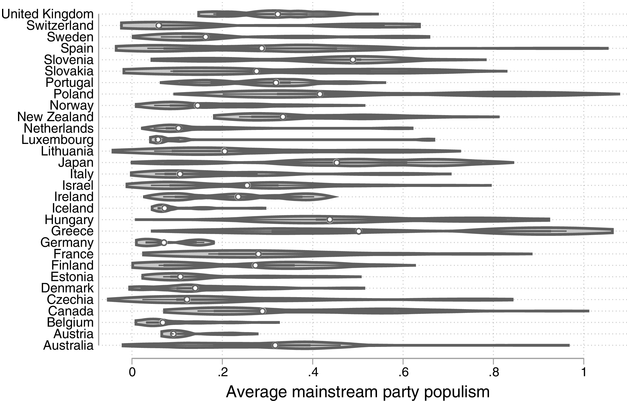
Figure 8.1 Long description
The 30 countries plotted are United Kingdom, Switzerland, Sweden, Spain, Slovenia, Slovakia, Portugal, Poland, Norway, New Zealand, Netherlands, Luxembourg, Lithuania, Japan, Italy, Israel, Ireland, Iceland, Hungary, Greece, Germany, France, Finland, Estonia, Denmark, Czechia, Canada, Belgium, Austria, and Australia.
In contrast, in countries like the United Kingdom, Poland, and Australia, many mainstream parties have high levels of populist rhetoric in recent years. In the United Kingdom, for example, the Conservative Party’s use of populist themes became especially pronounced during and after the Brexit referendum. The party adopted strong antielitist and nationalist rhetoric, framing the European Union as an oppressive foreign power and positioning Brexit as a way to “take back control.” This populist messaging resonated with voters who felt left behind by globalization and distant from political elites in Brussels. The Conservatives emphasized national sovereignty and British exceptionalism, using populist rhetoric to win over voters concerned with immigration, national identity, and economic independence.
Similarly, in Poland, the Law and Justice Party (PiS) effectively leveraged populist rhetoric to consolidate power during its years in government. While in office from 2015 to 2023, PiS consistently framed the political elite, judiciary, and media as detached from ordinary Poles, portraying itself as the defender of traditional Polish values and national sovereignty, especially in opposition to perceived interference from the European Union. The party embraced a nationalist and socially conservative platform, opposing liberal immigration policies and resisting progressive cultural changes. This turn toward populist messaging enabled PiS to maintain mainstream appeal while mobilizing voters anxious about the social and economic consequences of globalization, including job insecurity and cultural displacement.
In Australia, the Liberal Party increasingly adopted populist rhetoric, particularly around issues of immigration and national security. In response to growing concerns over globalization’s effects on the Australian economy and cultural identity, the party adopted tough stances on border protection and immigration control, often framing these issues in populist, nationalist terms. The Liberal Party’s rhetoric around “stopping the boats” and tightening immigration policies resonated with voters who were anxious about the economic and social impacts of globalization.
These examples suggest that populist rhetoric is not confined to fringe movements but is increasingly being incorporated into the platforms of mainstream parties as a strategic response to the pressures and uncertainties posed by globalization. Figure 8.2 further indicates that the trend of populism among political parties is increasing. Whereas mainstream parties in Western liberal democracies used populist rhetoric only sparingly in the 1970s (with an average value of 0.2), the use of populist rhetoric increased to an average of 0.25 in the 1980s and 2000s and then increased more significantly to an average of over 0.3 in 2019.
Average mainstream party populism, 1970–2020
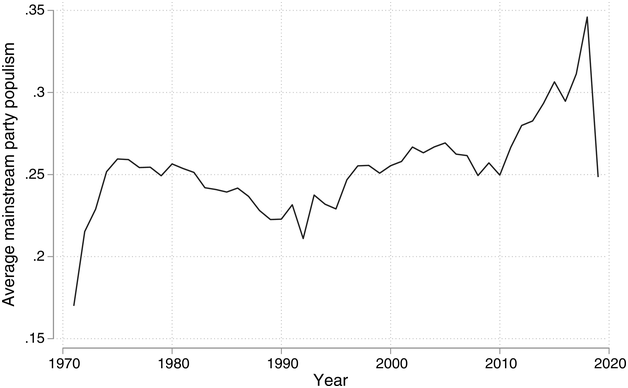
The trend of increasing populism among political parties, as indicated by Figure 8.2, is driven by a combination of long-term structural changes and more recent sociopolitical dynamics that mirror the increasing but varying constraints of globalization. In the early years of the 1970s, mainstream parties in many Western liberal democracies were operating at the tail end of the postwar consensus associated with sustained economic growth. The largest parties generally took centrist positions, and the use of populist rhetoric during this period was relatively rare, as populism was largely associated with fringe movements that capitalized on dissatisfaction with the political establishment. However, several key factors began to shift the political landscape, leading to a gradual rise in the use of populist rhetoric by mainstream parties. First, the economic stagnation of the 1970s and the neoliberal turn of the 1980s – marked by deregulation, privatization, and the weakening of the welfare state – created growing inequality and economic insecurity, particularly among lower- and middle-income voters. This fueled a sense of alienation from the political establishment, which populism could effectively tap into by blaming elites for failing to address these economic grievances. The rise of globalization in the 1990s further intensified this trend, as many citizens felt economically marginalized by the growing integration of global markets, job displacement, and increased competition from foreign labor.
By the 2000s, the populist narrative had found fertile ground in the landscape of increasing concerns over immigration, multiculturalism, and national sovereignty. Mainstream parties, especially on the center-right, began to adopt populist rhetoric to appeal to voters who were anxious about these developments. The 2008 global financial crisis exacerbated these anxieties, leading to widespread disillusionment with the political establishment’s ability to manage the economy and provide security. As a result, the use of populist language surged, with parties across the political spectrum, including center-left parties, increasingly incorporating populist themes such as antielitism, nationalism, and skepticism of international institutions into their platforms.
The marked increase in populist rhetoric by 2019 reflects the culmination of these long-standing trends. In addition to economic and cultural concerns, the growing polarization of political discourse and the rise of social media have contributed to the amplification of populist messaging. Populist rhetoric, which often simplifies complex issues into “us versus them” narratives, is particularly effective in the fast-paced, emotionally charged environment of digital media. Mainstream parties, feeling the pressure of populist challengers and the shifting demands of their electorates, have increasingly resorted to populist rhetoric to remain electorally competitive in a political climate shaped by economic uncertainty, cultural backlash, and distrust of traditional institutions.
Principal Explanatory Variables
As in the previous chapters, the data include cases where parties and governments were exposed to very different levels of globalization, which is our key explanatory variable. As in previous (KOF) chapters, we use the authoritative Konjunkturforschungsstelle Economic Globalization Index, which is an annual weighted aggregation of information on de facto and de jure trade and financial globalization:
Globalization is the extent to which a country is integrated into the international economy, including information on trade in goods and services, trade regulations, tariffs and agreements, foreign direct investment, investment restrictions, and capital account openness. Data are from Dreher (Reference Dreher2006).
Control Variables
To address omitted variable bias, we include several control variables at the levels of countries, election years, and party programs that have been used in previous research. At the level of election years, we control for:
Populist Party Vote Share measures the absolute vote share of populist parties in the country (excluding the vote share of the party under consideration if that party is a populist party). Data are from V-Party. Crucially, this variable allows us to test the imitation hypothesis, as well as to test our main alternative globalization hypothesis while controlling for the effects of populist party vote share.
Organizational Strength measures how strongly a political party is rooted in society. Data are from V-Party.
Intraparty Concentration captures the extent to which power rests in the hand of one leader or a small leadership elite. Data are from V-Party.
Left–Right Position measures partisan ideology on the left–right axis from the Comparative Manifesto Project. We use the so-called Right–Left Scale scores, which are also derived from parties’ election manifestos or platforms. Data are from Volkens et al. (Reference Volkens, Krause, Lehmann, Matthieß, Merz, Tegel and Wessels2019). By modeling an interaction between the variables Globalization and Left–Right Position, we can test our main theoretical expectation that it is parties of the center-right that increase their use of populist rhetoric in response to globalization.
Distinct Party Platform measures the ideological convergence and the existence of a space for contenders to exploit the perceived crisis of representation. Data are from V-Party.
Corruption captures public sector corruption, or the extent to which public sector employees engage in corrupt activities. Data are from V-Party.
Economic Growth measures the average growth rate of the country over the lifetime of the government. Data are from the World Bank Development Indicators, compiled by the Princeton Niehaus Center for Globalization and Governance World Economics and Politics Dataverse.
Per Capita Gross Domestic Product measures the level of economic development. Data are from V-Party.
Incumbency captures whether the party holds executive office or not at the time of their use of populist rhetoric. Data are from country specialists in the Comparative Pledges Project and supplemented with data from the European Journal of Political Research Data Yearbooks.
Government Experience takes the value 1 if the political party has had any experience in executive government and 0 otherwise. Data are from V-Party.
Descriptive statistics for all variables are presented in the online Supplementary Material. We standardized all continuous explanatory variables to a mean of 0 and a standard deviation of 1.
Globalization Increases Mainstream Parties’ Use of Populist Rhetoric
Since the dependent variable varies between 0 and 1, statistical analysis assuming a normal error structure can produce biased and incorrect estimates when data are doubly bounded. We estimate beta regression models with a logit link function, which use an error structure appropriate for our data (Papke and Wooldridge Reference Papke and Wooldridge1996). All estimations include standard errors that are clustered at the country-year level and a time trend. The inclusion of country fixed effects allows us to control for any unobserved factors that are constant within countries over time and further isolate the relationship between Globalization and Political Party Populism.
The coefficients from the model depicted in Figure 8.3 summarize the effects of a range of explanatory variables that have been examined in previous studies of populism (full numerical results in tabular format are presented in the online Supplementary Material). The independent variables are arrayed along the vertical axis, with the reference value omitted. The marginal effects are plotted on the horizontal axis. The estimated coefficients are denoted by a dark-gray circle, and their 95 percent confidence intervals are marked by bars of the same color. The dashed vertical line represents a coefficient of 0.
Globalization and political party populism
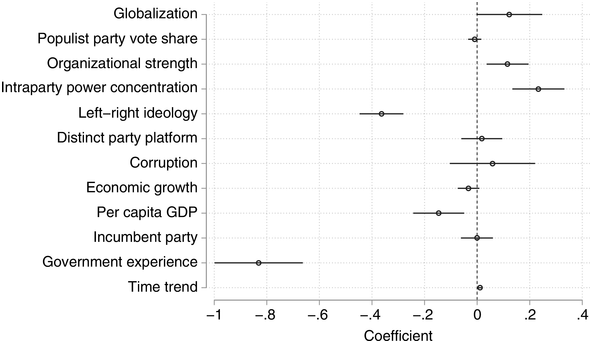
Figure 8.3 Long description
The 12 variables are globalization, populist party vote share, organizational strength, intraparty power concentration, left right ideology, distinct party platform, corruption, economic growth, per capita G D P, incumbent party, government experience, and time trend. The variable Government Experience stands out with the lowest coefficient while the rest remain relatively near x = 0.
In line with our theoretical expectations, the findings indicate a positive and significant association between globalization and mainstream party populism. Mainstream parties’ use of more extensive populist rhetoric increases by 0.12 (on a scale of 0 to 1) when their country’s integration into the global economy increases by 1 standard deviation. The effect is significant at p<0.055. It is remarkable that this strong positive effect of globalization is evident even in a model that controls for a host of other factors, including the populist parties’ total vote share. In contrast to the positive effect of globalization on populist rhetoric, the size of populist parties’ vote share has little to no effect, contrary to what we would expect based on the imitation hypothesis.Footnote 6
Figure 8.4 plots the predicted levels of populist rhetoric used by mainstream parties for different levels of international economic integration. The clear rising slope suggests that the effect is substantively important. Whereas mainstream parties tend to use little populist rhetoric (0.22 on a 0–1 scale) when they are 2 standard deviations below the average level of economic integration, countries that are deeply integrated into the international economy use significantly higher levels of populist rhetoric (0.30). Nonetheless, considering that the scale of populist rhetoric ranges from 0 to 1, mainstream parties are generally still at the lower end of it.Footnote 7
Predicted levels of populist rhetoric at different levels of globalization
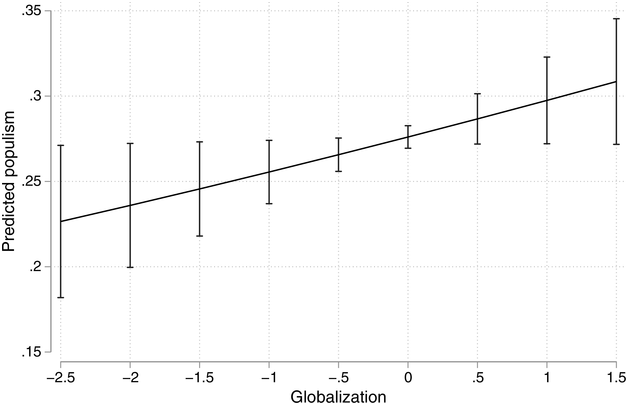
The results for the control variables are largely in line with the existing literature. Political parties become more populist the more strongly the party is rooted in society and the greater the intraparty power concentration or the internal cohesion of the party elites. The main effect of parties’ left–right positioning is negative. This means that controlling for a host of other variables (including globalization), parties further to the right use less populist rhetoric. While this is relevant to note, our main concern is with how parties respond to globalization, and whether leftist and rightist parties respond differently, the main issue to which we turn next. The negative effect of per capita gross domestic product indicates that populism is also more widespread among mainstream parties in lower-income countries.
Right-Wing Parties and the Lure of Populism
So far, the results indicate that globalization is significantly and positively associated with mainstream parties’ use of populist rhetoric. However, our argument indicates that the pressures to use more populist rhetoric are particularly strong for political parties on the right of the ideological spectrum. While leftist parties have few incentives to change their socioeconomic left–right ideological positions in response to globalization, center-right parties are under pressure to move to the center (see the results in Chapter 7). Center-right parties are, however, limited in the extent to which they can support policies that would alleviate the economic risks associated with globalization. Populist rhetoric is a strategy for center-right parties to deflect attention from this, as well as to respond directly to some voters’ concerns relating to cultural and nationalist issues. To explore this possibility, we estimated the main model with an interaction between Party Left–Right Ideology and Globalization. Figure 8.5 depicts the effect of globalization on the use of populist rhetoric for political parties at different points on the left–right ideological dimension (full tabular results in the online Supplementary Material).
Effect of globalization on populist rhetoric for different party ideologies
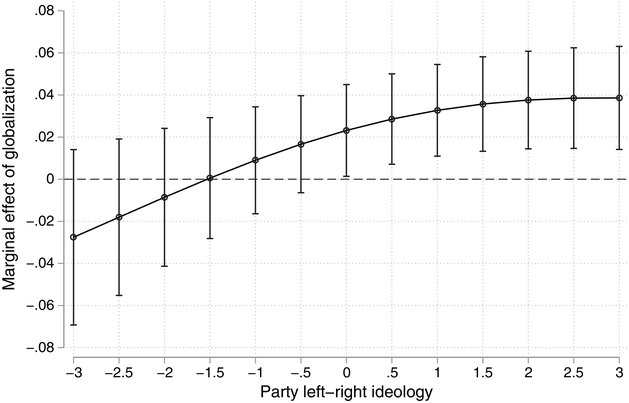
The findings support our argument. Mainstream center-right parties use higher levels of populist rhetoric when their countries are more exposed to economic globalization. The size of the effect of economic globalization on the use of populist rhetoric does not appear to differ markedly between centrist and rightist mainstream parties; both respond significantly to economic globalization by using more populist rhetoric. By contrast, leftist parties do not generally appear to respond to economic globalization by adopting more populist rhetoric. This does not, however, preclude leftist parties from addressing some of the same themes, such as immigration and national traditions, that are addressed by parties using populist rhetoric, a point we touch upon in Chapter 7 and to which we return in the concluding chapter.
Discussion
This chapter establishes that mainstream center-right parties use more populist rhetoric as their countries become more exposed to economic globalization. Based on the findings from Chapter 7, we observe that the growing economic risks and uncertainties brought about by global integration have compelled many center-right parties to moderate their ideological positions, as voters increasingly demand protection from the disruptive forces of globalization. This moderation risks alienating their core supporters, who favor economic openness and deregulation. In response, many center-right parties have turned to populist rhetoric, emphasizing cultural and identity-based issues to maintain their electoral competitiveness. Center-right parties’ strategic pivot toward populism is an attempt to cater to voters’ anxieties without abandoning their traditional economic policies entirely. We also observed that while center-right parties have adopted populist rhetoric to a greater extent, left-wing parties have been more consistent in their ideological positions. Left parties, whose traditional platforms already address the economic risks of globalization, have not faced the same pressures to shift their economic promises. However, the persistent constraints imposed by globalization mean that all mainstream parties – whether on the left or right – are navigating a more complex political landscape when deciding over the types of promises they make, one shaped by the shifting demands of voters.
The findings of this and previous chapters provide a range of insights into the challenges that political parties face in a globalized world. Not only are parties increasingly struggling to fulfill their promises, but they are also acutely aware of the electoral consequences of breaking those promises. Voters, particularly in highly globalized contexts, are more likely to punish parties for failing to deliver on their commitments. This dynamic is particularly challenging for left-wing parties, whose platforms often involve promises that are difficult to uphold in an open world. At the same time, right-wing parties face a distinct dilemma: they cannot move too far leftward to promise policies that would genuinely alleviate the economic risks faced by citizens due to globalization, as doing so would alienate key constituencies. Employing populist rhetoric is one of the strategies used by center-right parties to resolve this dilemma.
This brings us to the central question to be addressed in the next chapters of the book: How do parties, both left and right, seek to avoid electoral sanctioning failing to make promises that address voters’ concerns that are caused by globalization or failing to deliver on promises that do? The answer that we explore in the next part of the book lies in the use of ambiguous language in parties’ electoral appeals. Both left and right parties have strong incentives to make their appeals less specific albeit for different reasons. Leftist parties are constrained by their inability to deliver on redistribution and protectionism, while rightist parties fear losing their electoral base by shifting too much toward the center or even too far to the right on issues relating to culture, nationality, and law and order, typical populist themes. Ambiguity is a response to these electoral and ideological challenges, allowing parties to avoid making promises they cannot keep while maintaining electoral appeal. This shift toward more ambiguous language in response to globalization constraints marks a critical change in the relationship between political parties and voters, one that puts further pressure on the idea of effective promissory representation.
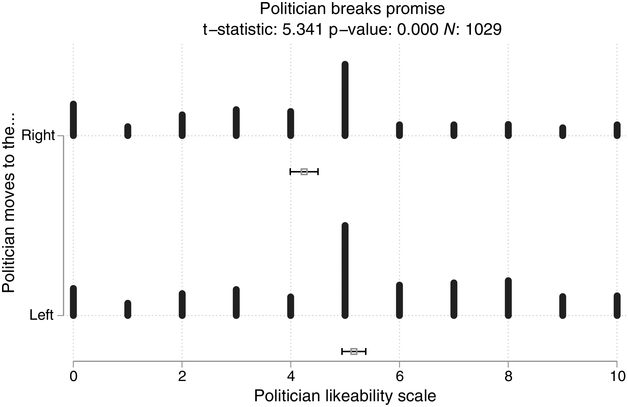
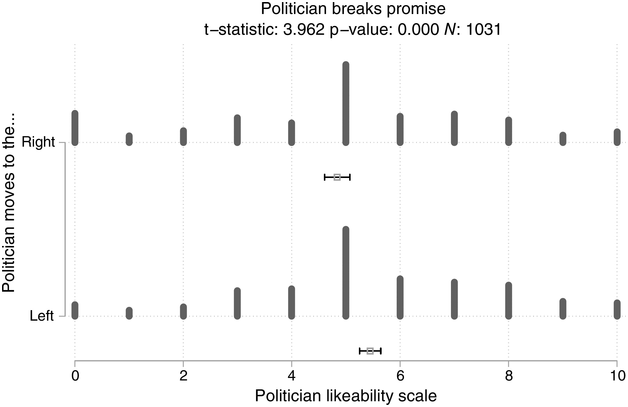
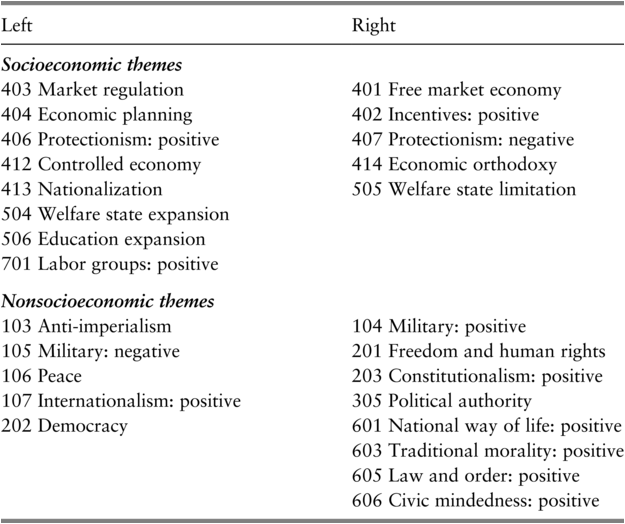
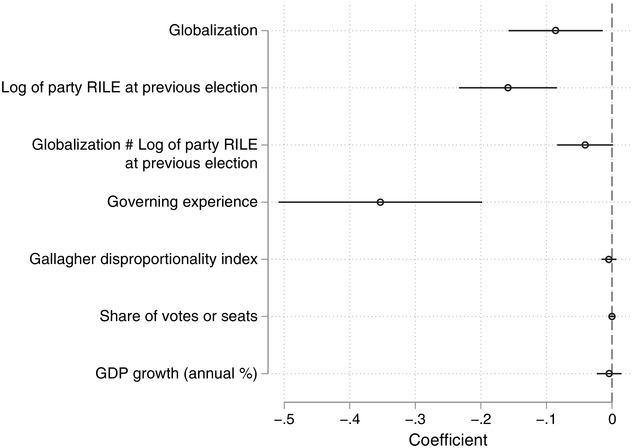
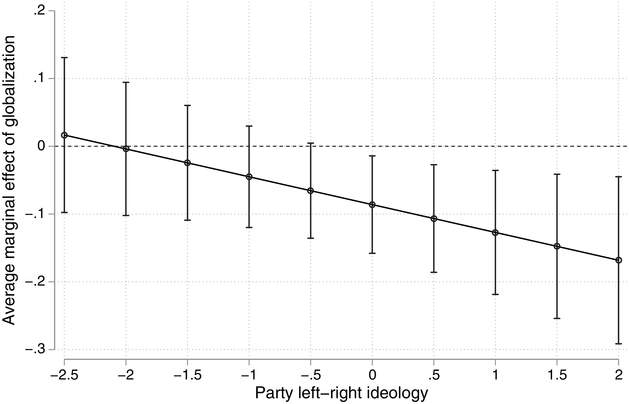
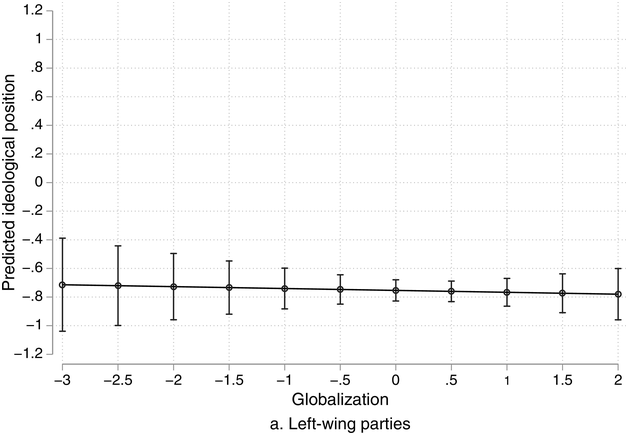
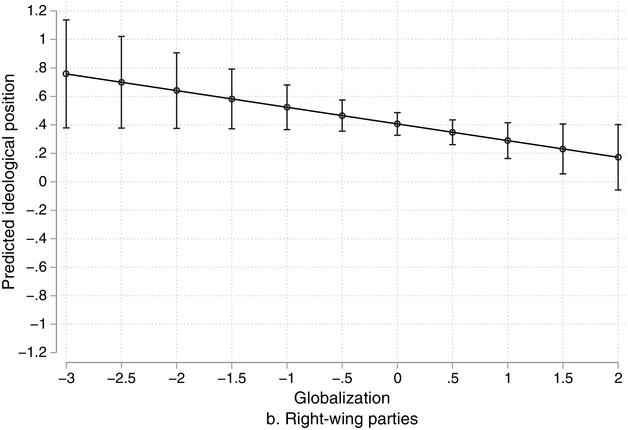
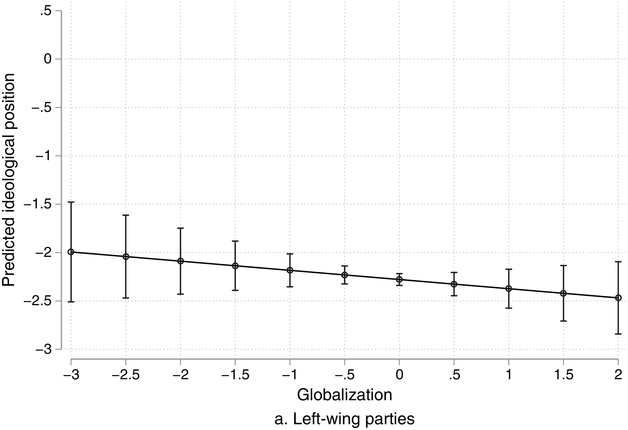
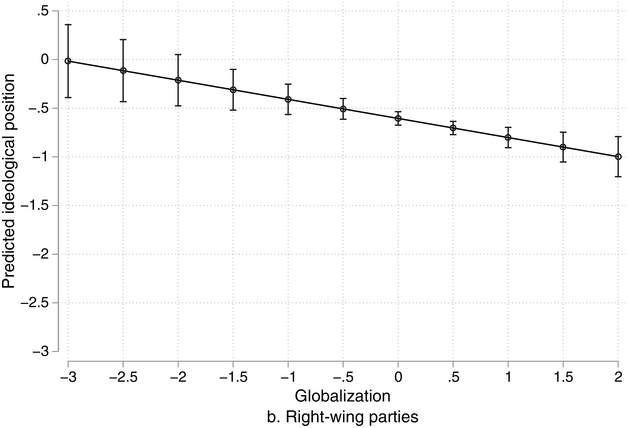
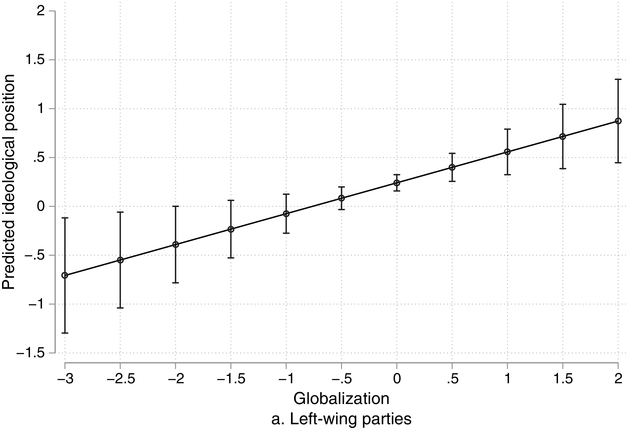
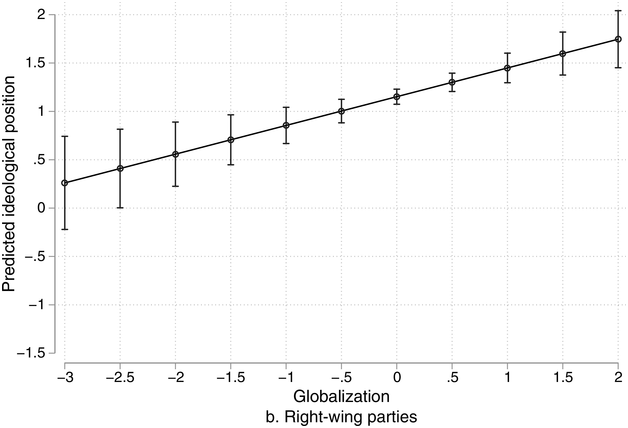
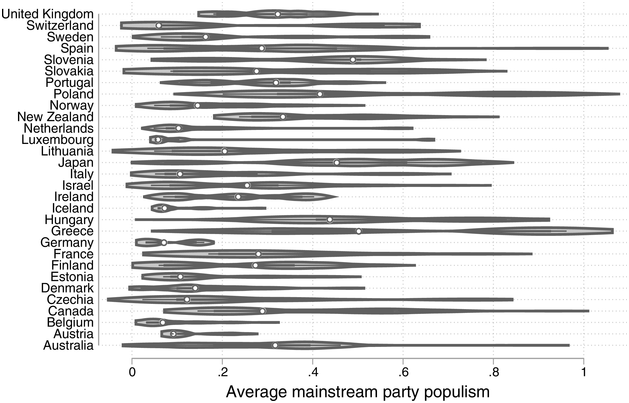
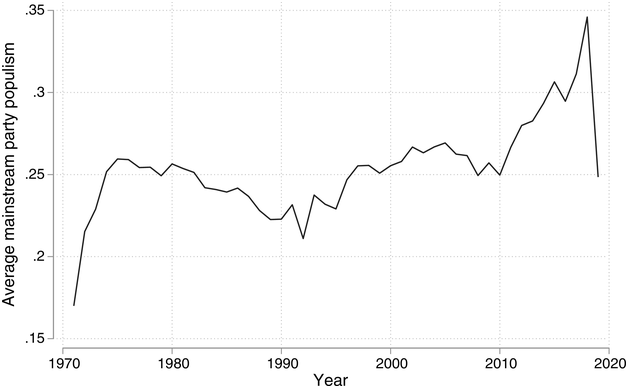
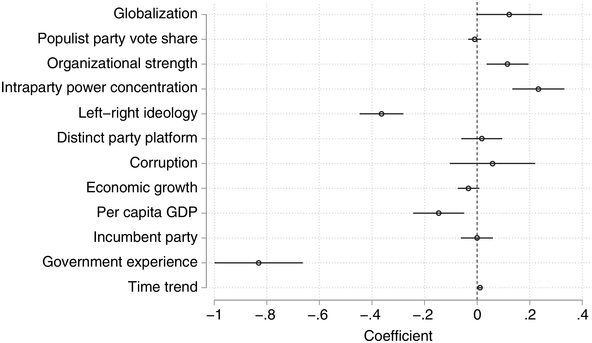
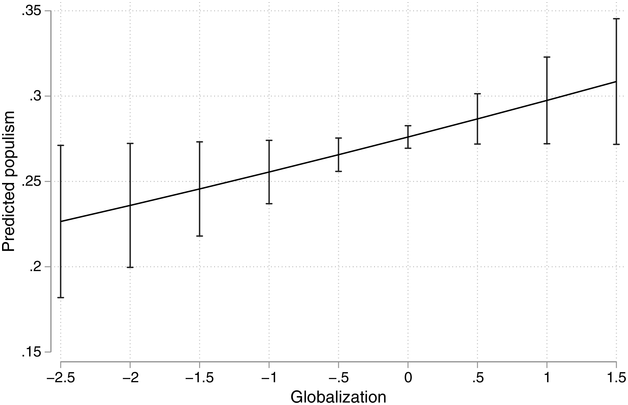
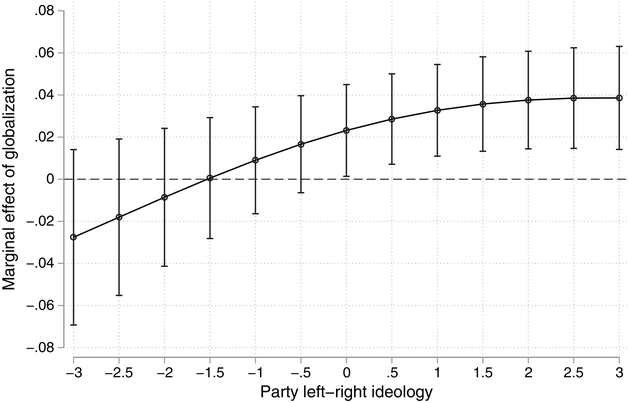

 Open access