





Introduction
Providing palliative care for children required an emotionally demanding experience for both family members and nurses, often resulting in significant emotional strain. These conditions, characterized by the anticipation that a child will not reach adulthood, demand continuous, complex, and often intensive care (Dryden-Palmer et al. Reference Dryden-Palmer, Garros and Meyer2018). Nurses are responsible for conducting a comprehensive assessment of the family members to understand their daily functioning and caring needs for their child. However, this process also involves a burden of shared responsibility of providing care, support for the family with a life-limited child, and a commitment to ensuring accessibility for the family on a continuous basis.
Families face numerous challenges when caring for their critically ill children, including providing support and nurturing (Dryden-Palmer et al. Reference Dryden-Palmer, Garros and Meyer2018). The loss of a child can lead to long-term grief and significantly impact family members’ lives (Lin and Huang Reference Lin and Huang2020). Nurses play a crucial role in addressing the grief of these families by offering palliative care (Lin and Huang Reference Lin and Huang2020). Nurses are expected to facilitate child-centered care through conversations about what matters most to the patient, considering each child’s unique losses and experiences. This approach allows for a more comprehensive understanding of patients’ preferences and priorities (Coombes et al. Reference Coombes, Harðardóttir and Braybrook2023; Bristowe et al. Reference Bristowe, Braybrook and Scott2024). For instance, some families are concerned that palliative care or death issues may bring despair and threaten their child’s and the family’s hope for the child’s recovery (Lin and Huang Reference Lin and Huang2020). Uncertainty in terms of the prognosis and the benefits of treatment, with the goals of care swinging between extending life and alleviating suffering, have also been reported as reasons for nurses to delay raising the palliative care issue (Kaasa et al. Reference Kaasa, Loge and Aapro2018; Lin et al., Reference Lin, Chang and Huang2022). Many cultural minorities seek for more optimistic and hopeful information from spiritual sources when facing end-of-life decision-making (Lin and Huang Reference Lin and Huang2020), which may concern nurses attempting to initiate palliative care (Lin et al. Reference Lin, Chang and Huang2022). Therefore, their needs span a wide spectrum, from emotional support and clear communication from healthcare providers to practical assistance and respite care (Gill et al. Reference Gill, Hashem and Stegmann2021). Addressing these needs is vital for maintaining family stability and ensuring the child’s holistic well-being.
Nurses at the forefront of delivering care often experience significant stress. This stress stems from the emotional burden of providing palliative and end-of-life care (Gill et al. Reference Gill, Hashem and Stegmann2021), the physical demands of the job, and the high-stakes decision-making required in managing complex cases. Despite these challenges, nurses demonstrated their remarkable resilience and ability to provide quality care. Nurses deliver compassionate and skilled medical attention while simultaneously managing their emotional well-being. However, chronic stress among nurses can lead to burnout, compassion fatigue, and decreased job satisfaction, which can significantly impact patient care quality (Xie et al. Reference Xie, Chen and Feng2021).
Previous research has shed light on the barriers for families and professionals to referral to palliative and end-of-life care for children (Lin et al. Reference Lin, Chang and Huang2022). However, there is a pressing need for a deeper understanding of how familial needs intersect with the stress experienced by nurses providing direct care. Nurses’ stress in providing pediatric palliative care is a significant concern as they stand a role to promote patients’ and families’ quality of life and reducing health-related suffering, especially at the end of life. Yet, the intention to meet families’ needs, providing pediatric palliative and end-of-life care context, has an effect on nurses’ stress that is not clearly established. The method pediatric nurses provide professional care for families of children with palliative care needs, especially in the absence of specialist palliative care involvement or when nurses themselves are grappling with moral distress, remains a grey area. This interplay between parental demands and nurses’ emotional burden has profound implications for the quality of care delivered and the overall well-being of all parties involved, making this research critically important to our audience.
In this study, we use a critical realist paradigm to analyze the influence of the intention or pursuit of meeting families’ needs on nurses’ stress. Specifically, we draw from the theory of families’ needs to identify the expectations and preferences of family members for the care of children with palliative care needs, to understand nurses’ efforts or ideal circumstances for meeting these needs, and further to draw from a meta-synthesis to identify related nurses’ stress. By developing a deep understanding of this intricate dynamic, the research seeks to inform strategies that improve support systems and resources available to both families and nurses, providing much-needed relief and support in their challenging journey. This study aims to explore the stress that nurses experience while meeting the needs of families during palliative and end-of-life care for children and young adults. To achieve this, a systematic review and meta-synthesis will be conducted, following the guidelines set out by the Preferred Reporting Items for Systematic Reviews and Meta-Analyses (Page et al. Reference Page, McKenzie and Bossuyt2021).
Methods
Design
A meta-synthesis was conducted using a critical realism approach, and Thomas and Harden’s (Reference Thomas and Harden2008) thematic analysis framework guided the analysis.
Inclusion and exclusion criteria
The review included English or Mandarin-language qualitative studies of any design, mixed-method studies, where qualitative data can be exclusively extracted, or case reports of nursing experiences. Exclusion criteria were studies focusing on patients outside the 0–25 age group; combining care for patients outside the specified age group and could not be separately analyzed; non-palliative care or end-of-life care; and not nursing perspectives. EndNote Version 20 was used for organizing and removing duplicated search results.
Search strategy
Data collection for meta-synthesis involved searching online databases, including MEDLINE, EMBASE, PubMed, Cochrane Library, CINAHL, and Airiti (a Chinese database) from January 1, 2014 to September 15, 2025. The search terms used included the recognized Medical Subject Headings and Embase subject headings (Emtree) with various combinations of the terms nurse, children, palliative care, end-of-life, and stress. The following data from the included studies were extracted by the second author and checked by the first author: primary author, year of publication, the country where the study was conducted; only sections on nurses’ views were included.
Quality assessment
Two researchers (Y.-W.C. and S.-C.L.) independently assessed the study quality using the Joanna Briggs Institute checklist (Lockwood et al. Reference Lockwood, Porrit, Munn, Aromataris and Munn2020). The scoring method (2 for yes, 1 for unclear, and 0 for not applicable) was adapted from Lin et al. (Reference Lin, Huang and Yasmara2021). Quality is interpreted based on the total score: >80% is strong, >70% is good, >50% is adequate, and ≤50% is limited (Lin et al. Reference Lin, Huang and Yasmara2021).
Data analysis
A thematic synthesis technique (Thomas and Harden Reference Thomas and Harden2008) was used to explore the stress experienced by nurses in caring for families’ needs. Our approach is informed by critical realism (Groff Reference Groff2010; Maxwell Reference Maxwell2012), which is characterized by its explanatory goals and reliance on theoretical support (Clark Reference Clark2008; Groff Reference Groff2010). Three research team members engaged in the synthesizing process and resolved any disagreement through discussion. The data were analyzed using NVivo 14 software.
Rigor and reflexivity
The first author (S.-C.L.), who has a background as a pediatric nurse, collaborated with a parent expert who had lost 2 children to life-limiting conditions to ensure a comprehensive interpretation of the findings. Thick descriptions of themes and quotes were provided to increase the transferability of the findings, which allows implementation in other fields, such as patients with chronic conditions, professional-family relationships, and moral distress issues. An audit trail was provided by presenting the research design and process for confirmability (Lincoln and Guba Reference Lincoln and Guba1985).
Results
Characteristics of the included studies
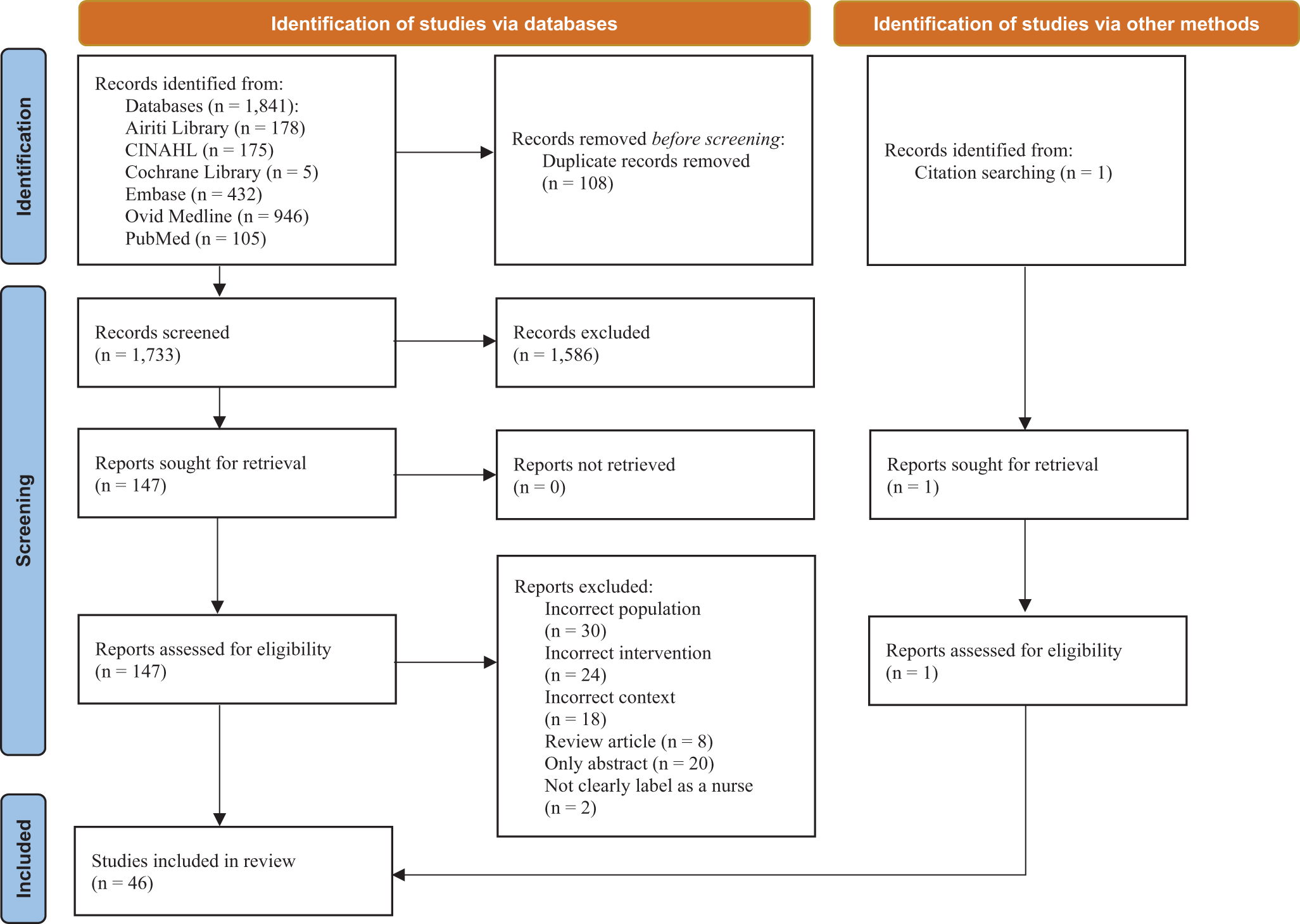
The initial search yielded 1,841 studies. After the exclusion of 108 duplicates, 1,733 titles and abstracts were screened, and 1,586 were excluded due to irrelevance. Then, 147 articles were further assessed for eligibility, and 46 studies were selected and included in the final synthesis. Out of 46 articles, 34 reported a qualitative research method, and 12 were case reports of nursing experiences (Fig. 1).
PRISMA 2020 flow diagram.

Figure 1 Long description
The flowchart illustrates the PRISMA process for selecting studies. It begins with 'Identification' where records are identified from databases totaling 1,841, including Airiti Library (178), CINAHL (175), Cochrane Library (5), Embase (432), Ovid Medline (946) and PubMed (105). Duplicates removed before screening are 108. Additionally, 1 record is identified from citation searching. In 'Screening', 1,733 records are screened, with 1,586 excluded. Reports sought for retrieval are 147, with none not retrieved. Reports assessed for eligibility are 147, with exclusions due to incorrect population (30), incorrect intervention (24), incorrect context (18), review article (8), only abstract (20) and not clearly labeled as a nurse (2). Finally, 46 studies are included in the review.
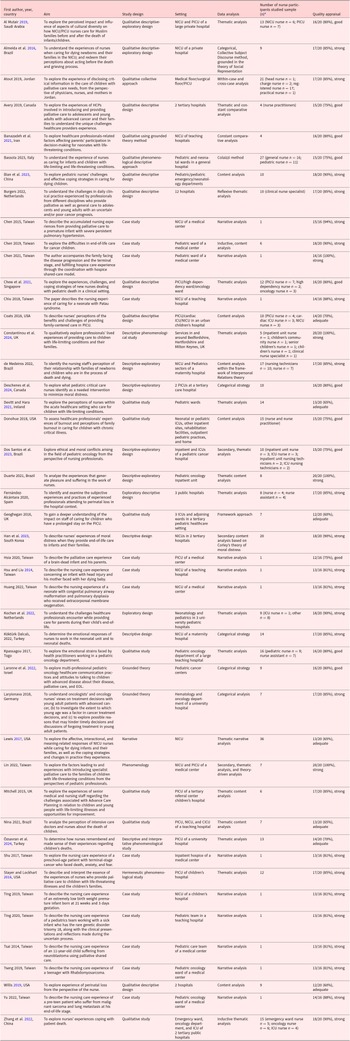
All included studies had adequate to strong methodological quality, with scores ranging from 60 to 100%. Table 1 summarizes the study characteristics and quality of the included studies.
The study characteristics and quality of the included studies

Table 1 Long description
The table summarizes 40 included studies by author, year, country, aim, study design, clinical setting, analysis method, nurse sample size, and quality appraisal score. Most studies are qualitative (descriptive, phenomenology, grounded theory, or exploratory) using thematic or content-based analyses; a smaller set are case studies using narrative analysis. Settings cluster in neonatal and pediatric intensive care, pediatric oncology, and pediatric wards, with some multi-hospital or community-linked services. Nurse participant samples range from single-nurse case reports to 36 nurses, with many studies in the single digits to teens and several around 10 to 20 participants. Quality ratings are predominantly good or strong, with several perfect scores reported and a smaller number rated adequate. Countries represented are diverse, with multiple studies from Taiwan and additional studies from Brazil, the United States, the United Kingdom, and other regions. Because the table compiles heterogeneous aims and methods, quality scores and sample sizes should be compared cautiously across different study designs and appraisal scales.
NICU = neonatal intensive care unit; PICU = pediatric intensive care unit.
a Information on the relevant data source and sample included in the review.
Theme 1: Never seem to feel fully prepared
A child’s complex needs stress both families and nurses. Nurses frequently mentioned frustration about their lack of experience in caring for cases of life-limiting or life-threatening conditions due to the rarity of care guidance and resources for families (Gilleland et al. Reference Gilleland, McGugan and Brooks2014; Donohue et al. Reference Donohue, Williams and Wright-sexton2018), as well as the unpredictability of a patient’s condition (Chew et al. Reference Chew, Ang and Shorey2021). There was vagueness in pediatric palliative care “to define what the exact needs are” (Burgers et al. Reference Burgers, van den Bent and Darlington2022), or “don’t have enough staff to safely deliver the care” (Constantinou et al. Reference Constantinou, Cook and Tolliday2024) may further cause “hesitancy and uncertainty” around how to help patients and families (Avery et al. Reference Avery, Geist and D’agostino2020). Additionally, some nurses find that palliative care's emphasis on private rooms for families conflicts with the traditional nursing culture of having a “backup” system, where “nurses were able to see and hear all of the patients, monitor multiple patients at the same time,” and that “there was always someone who could help you with something” (Coats et al. Reference Coats, Bourget and Starks2018). Some nurses also felt the pressure of being constantly observed by families at bedside (Coats et al. Reference Coats, Bourget and Starks2018).
Some nurses had experience that families’ behavior often changes to the “fighting” stance when families experience resistance in accessing what they need, or even used the phrase “shout the loudest” to describe their behavior to obtain what they need for their children, especially for those children who had been cared for by the families over a long time (Constantinou et al. Reference Constantinou, Cook and Tolliday2024). As a result, these conditions bring nurses a sense of failure and helplessness, especially when the patient experiences anxiety, fear, and pain (Hsu and Liu, Reference Hsu and Liu2014), or when the patient is “critically stress” and the family members “are physically and verbally threatening” (Coats et al. Reference Coats, Bourget and Starks2018; Laronne et al. Reference Laronne, Granek and Wiener2022).
The father came with a camera and shoved it up everybody’s nose and took photos of everybody. They were both screaming “murderers, murderers” at everybody, photographing the equipment, photographing the monitors, none of the nursing staff wanted to work there, the level of stress was enormous…… [The father] physically pushed the nurses. (PICU consultant; Forbat et al. Reference Forbat, Teuten and Barclay2015)
Nurses have a unique role in assisting family members in carrying out caregiving activities by providing the necessary skills and knowledge. When a child is dying, nurses are expected to be well-prepared by knowing “what to do and what to say to the parents and family” (Almeida et al. Reference Almeida, Moraes and Cunha2016; Chew et al. Reference Chew, Ang and Shorey2021), cognitively to be aware of the child’s deteriorating condition (Bassola et al. Reference Bassola, Cilluffo and Ongari2023), and to develop a perception that “there were sacrifices…(for) whatever life expectancy you’re losing” (De Abreu Haickel Nina et al. Reference De Abreu Haickel Nina, Lamy and Garcia2021; Deschenes et al. Reference Deschenes, Scott and Kunyk2024).
However, nurses themselves also expressed their struggles in understanding the situation, feeling disoriented, nervous, scared, anxious, panicked, confused, and blank, “don’t have a guideline,” especially when a child passed away (Pearson Reference Pearson2013; Willis Reference Willis2019; Chew et al. Reference Chew, Ang and Shorey2021; Bassola et al. Reference Bassola, Cilluffo and Ongari2023). Some nurses mentioned that they “don’t know how to start”, “how to do”, and “never seem to feel fully prepared” in the situation of supporting the family or alleviating the child’s symptoms (Pearson Reference Pearson2013; Hsu and Liu, Reference Hsu and Liu2014; Almeida et al., Reference Almeida, Moraes and Cunha2016).
I think the struggle comes when you want to make [the family] feel better, yet at the same time, you… you know, there is a balance between making them feel balanced and not knowing how to make them feel better… (New nurse in a women’s and children’s hospital)
Moreover, when it comes to end-of-life decision making, a lack of advanced care planning with families can also cause nurses to be insecure in their doing and acting (Lotz et al. Reference Lotz, Jox and Borasio2015). When nurses have difficulties in making sense of their role in a dying child, they would often feel stressed when they were committed to be “there to whatever they might need” (Almeida et al. Reference Almeida, Moraes and Cunha2016; Stayer and Lockhart Reference Stayer and Lockhart2016), “try as much as possible to comfort the loss” of the families (Medeiros et al. Reference Medeiros, Almeida Júnior and Oliveira2022), or to “offer the help” even knowing that their “best effort is not enough” (Burgers et al. Reference Burgers, van den Bent and Darlington2022; Özsavran et al. Reference Özsavran, Kurt and Ayyıldız2024). Emphasizing the feeling of discouragement and professional failure that follows poor treatment and palliative care outcomes, nurses often feel that they were “working for nothing” (Kpassagou and Soedje Reference Kpassagou and Soedje2017). This led them to question the care they provided and feel like they failed their task as a nurse (Al Mutair et al. Reference Al Mutair, Al Ammary and Brooks2019).
Theme 2: Sense of unfairness in conflicts of values
Feelings of “unfairness” appear from multiple causes when nurses’ values are at odds with those of patients, families, and other healthcare professionals. Most often, these feelings were related to the delivery of futile care or the inability to help a patient survive (Lewis Reference Lewis2017; Laryionava et al. Reference Laryionava, Heußner and Hiddemann2018). Nurses articulated their concerns when they perceived that seriously ill neonates would have “absolutely no good quality of life” (Bassola et al. Reference Bassola, Cilluffo and Ongari2023) or when caring for chronic patients in the intensive care unit (ICU) who had “no planned or foreseeable exit route” (Geoghegan et al. Reference Geoghegan, Oulton and Bull2016). However, nurses sometimes struggle with overvaluing physicians’ opinions and “undervaluing trusting or expressing their own instincts” (Banazadeh et al. Reference Banazadeh, Khanjari and Naddaf2021; Medeiros et al. Reference Medeiros, Almeida Júnior and Oliveira2022). They often experience mental distress when they are unsatisfied with physicians’ therapeutic plans or parents’ decisions, yet are unable to take effective actions (Pearson Reference Pearson2013; Lewis Reference Lewis2017). For example, nurses frequently consider that the treatment should be withdrawn to minimize distress to the child, yet the physician or families did not understand, accept, and participate in the palliative care program planned, and are continuing to “want all interventions possible” (Pearson Reference Pearson2013).
These conflicts are especially difficult when the patient is experiencing suffering, “who depends on us [nurses] and the machines for everything, who does not react, has no contact with the outside world” (Bassola et al. Reference Bassola, Cilluffo and Ongari2023). Many nurses grappled with feelings of guilt, expressing sentiments such as “we feel like we’re torturing him [the patient]” (Deschenes et al. Reference Deschenes, Scott and Kunyk2024). This generated a challenging environment “where no one feels that they’ve contributed to anybody’s wellbeing” (Geoghegan et al. Reference Geoghegan, Oulton and Bull2016). Ultimately, this dialogue encourages nurses to reflect on the profound impact of their dedication and the critical question of how deeply they should invest in sustaining the patients’ lives.
Nurses described expecting that they could be truthful to family members and “not to generate an expectation that the staff know will not exist” (Medeiros et al. Reference Medeiros, Almeida Júnior and Oliveira2022). However, the phenomenon of “physicians’ loyalty” on the part of families could sometimes make nurses feel ethical conflict and unfairness because it “prevents physicians from telling the truth” to family members (Banazadeh et al. Reference Banazadeh, Khanjari and Naddaf2021; Medeiros et al. Reference Medeiros, Almeida Júnior and Oliveira2022). Additionally, nurses who acted independently of other team members often experienced a feeling of “isolation” and caused emotional discomfort in the rest of the team members (Fernández-Alcántara et al. Reference Fernández-Alcántara, Schul-martin and García Caro2020). If the nurses actively provided information for the families that contradicted the physician, this would make families “furious” (Banazadeh et al. Reference Banazadeh, Khanjari and Naddaf2021).
The SiPAP [Synchronous Inspiratory Positive Airway Pressure] and IV fluids were stopped [as methods of discontinuing life support] … I did not agree that the family had the right to stop the IV fluids…. This baby essentially died of dehydration, and we, as hospital staff, assisted in killing her…. (NICU nurse, Lewis Reference Lewis2017)
Nurses also reported having painful feelings when they are reluctant or don’t feel comfortable when the patient transitions into palliative care, and that they have to discontinue therapeutic intervention (Medeiros et al. Reference Medeiros, Almeida Júnior and Oliveira2022). When nurses’ practices are not based on their ethical norms, they may have moral distress, particularly as their feelings of advocacy are strong but fail to speak for the patients and families (Lewis Reference Lewis2017), or when they have difficulty in taking an active role to change conditions that they perceive as unethical.
Theme 3: Sheathing against traumatic bond attachment
Some nurses described that they end up getting involved, creating a very great bond: family, patient, and staff, until the child died (Almeida et al. Reference Almeida, Moraes and Cunha2016). However, in many cases, nurses establish “emotional boundaries,” “creating defense mechanisms” and “become more selfish” in advance for “keeping the gap” to “protect” themselves, and to “cope,” keeping themselves from building close relationships with patients and family to protect themselves from suffering (Pearson Reference Pearson2013; Almeida et al. Reference Almeida, Moraes and Cunha2016; Atout et al. Reference Atout, Hemingway and Seymour2019; Banazadeh et al. Reference Banazadeh, Khanjari and Naddaf2021; Duarte et al. Reference Duarte, Glanzner and Bagatini2021; Bassola et al. Reference Bassola, Cilluffo and Ongari2023; Özsavran et al. Reference Özsavran, Kurt and Ayyıldız2024).
In some cases, nurses experienced negative feelings when they compared their own lives with those of the patient and families, and found that their life is “good” (Lewis Reference Lewis2017). There “was a sense of relatedness” that occurs when nurses were in or around the young adults’ age, attributed this to the fact that they are in the same life phase and sometimes even can identify with the young adults and their family, “a connection” that increased the burden of care (Kpassagou and Soedje Reference Kpassagou and Soedje2017; Avery et al. Reference Avery, Geist and D’agostino2020; Burgers et al. Reference Burgers, van den Bent and Darlington2022). Some nurses mentioned feelings of grief were associated with having healthy children, less tragedy in their own lives, especially in pregnant NICU nurses. The traumatic grief and loss following such relatedness may be aware or unaware. Some nurses remain unaware of the extent of their efforts while providing care to dying children. After losing these children, they would feel physically “exhausted,” including “stress,” “fatigue,” “headache,” and “not rested” (Willis Reference Willis2019; Özsavran et al. Reference Özsavran, Kurt and Ayyıldız2024). While others who are fully aware of the traumatic experiences stated that these “will never leave” (Lewis Reference Lewis2017).
“… the memory of doing chest compressions on this big baby while carrying my own baby will never leave me ….” (NICU nurse; Lewis Reference Lewis2017)
Nurses’ manner of portraying the emotion included such descriptors as “overwhelming,” “horrendous,” “burnout,” “dropped in to someone else’s nightmare” to “suffer together with the family” in this “shared grief” process (Mitchell and Dale Reference Mitchell and Dale2015; Lewis Reference Lewis2017; Donohue et al. Reference Donohue, Williams and Wright-sexton2018; Al Mutair et al. Reference Al Mutair, Al Ammary and Brooks2019; Chew et al. Reference Chew, Ang and Shorey2021; Devitt and Hara Reference Devitt and Hara2021; Duarte et al. Reference Duarte, Glanzner and Bagatini2021; Kochen et al. Reference Kochen, Teunissen and Boelen2022; Köktürk Dalcali et al. Reference Köktürk Dalcalı, Can and Durgun2022; Özsavran et al. Reference Özsavran, Kurt and Ayyıldız2024). They even did “not want to memorize” previous experiences or “to think about the story of these children” for the sake of creating a detachment (Willis Reference Willis2019; Bassola et al. Reference Bassola, Cilluffo and Ongari2023). One of the reasons described was that nurses felt like “regardless of how hard you try, there’s no way that you can meet the needs of that family” (Chen et al. Reference Chen, Hsu and Tai2015; Donohue et al. Reference Donohue, Williams and Wright-sexton2018). These emotional burdens would negatively affect nurses’ work functioning; therefore, instead of getting deeper into a multidisciplinary need, nurses were convinced to focus only on the “needs in the present,” to become “task focused” (Willis Reference Willis2019; Bassola et al. Reference Bassola, Cilluffo and Ongari2023), and to “push yourself to be strong” (Al Mutair et al. Reference Al Mutair, Al Ammary and Brooks2019; Duarte et al. Reference Duarte, Glanzner and Bagatini2021).
It’s not real life what’s going on in there, it’s just so horrendous what is happening every single day … so ‘No, you’re not doing it today. You’ve done it a couple of times recently, and that is enough.’ Because if you do it too often, you have to leave. You have to protect yourself. (PICU nurse; Mitchell and Dale Reference Mitchell and Dale2015)
In some cases, nurses passively described themselves as “I did what I could, I couldn’t do more,” “we can’t do anything” (Banazadeh et al. Reference Banazadeh, Khanjari and Naddaf2021; Bassola et al. Reference Bassola, Cilluffo and Ongari2023). Others stated that this was due to “the lack of medical supplies and equipment to provide quality care” (Kpassagou and Soedje Reference Kpassagou and Soedje2017). Avoiding a dying patient, at the same time, “normalizing and accepting death as part of life” appears to be a common coping strategy for nurses. ICU nurse stated that it was quite “protective” of staff of the short-term nature of ICU “because then they don’t often get to know children and families very well” (Kpassagou and Soedje Reference Kpassagou and Soedje2017). Some nurses adjust their perceived obligation and appraise the quality outcome of their care based on a lower standard. For example, nurses often preferred to believe that these children did not feel pain, at least when they were dying or after their death, or that they did not hurt the patients; otherwise, it would make the care process more difficult (Medeiros et al. Reference Medeiros, Almeida Júnior and Oliveira2022; Özsavran et al. Reference Özsavran, Kurt and Ayyıldız2024).
In other cases, families refuse the interference of nurses providing palliative care, described as not wanting them to “interfere with anything” or not wanting them “to get in the middle of their world.” This rejection not only makes it difficult for nurses to be “sympathetic” to the families but also causes more avoidance of nurses to build bonds with them (Almeida et al. Reference Almeida, Moraes and Cunha2016; Bassola et al. Reference Bassola, Cilluffo and Ongari2023).
When I see that a child has cancer in an advanced stage… when I expect that the child will die, my relationship with him or her is less close. (Nurse in the pediatric oncology department of a hospital; Kpassagou and Soedje Reference Kpassagou and Soedje2017)
I was grieving along with the parents and came in often, even when not on my shift, to be with them… I had crossed some professional boundaries, but at the time felt compelled to be there for the parents and myself. (NICU nurse; Lewis Reference Lewis2017)
Discussion
This study identified 3 themes that illuminate the emotional stress nurses experience when addressing the needs of families: never seem to feel fully prepared, sense of unfairness in conflicts of values, and sheathing against traumatic bond attachment. Together, these themes reflect the moral, emotional, and relational tensions embedded in pediatric palliative care. As Burkhardt and Nathaniel (Reference Burkhardt and Nathaniel2020) contend, nursing is fundamentally oriented toward fulfilling health-related needs, thereby creating a professional responsibility to enhance pediatric patients’ quality of life while supporting families as they adapt to the profound grief associated with the loss of a child. These societal and professional expectations generate a strong moral imperative for nurses to respond simultaneously to the needs of patients and families, often under conditions of uncertainty and emotional intensity.
Despite this responsibility, ambiguity in the definition and implementation of pediatric palliative care continues to blur professional boundaries within nursing practice. This lack of role clarity may contribute to feelings of being overwhelmed, a diminished sense of control, and ultimately a perception of being unsafe in the workplace (Bamforth et al. Reference Bamforth, Rae and Maben2023). When expectations exceed clearly articulated roles and available support structures, nurses are left to navigate ethically complex situations with insufficient guidance, thereby increasing their vulnerability to moral distress.
Nurses’ experiences of providing potentially futile care in palliative and end-of-life contexts are further shaped by the interaction of culturally mediated meanings and organizational power structures (Choi et al. Reference Choi, Ho and Lin2024; Shhadat et al. Reference Shhadat, Wobst and Meyer2025). For nurses from certain minority or religious communities, continuous support may be understood as an expression of duty, hope, the sanctity of life, or respect for family and community expectations, rather than simply as “non-beneficial care.” Yet not all spiritual traditions endorse unrestricted intervention; recent research on Islamic end-of-life care, for instance, highlights that comfort, dignity, and cessation of futile treatment can be morally acceptable when decisions are made through family-centered and faith-informed approaches (Chamsi-Pasha and Albar Reference Chamsi-Pasha and Albar2017). Concepts such as hope, suffering, parental obligation, and the meaning of a “good death” are interpreted differently by families and physicians, shaping whether continued life-sustaining treatment is viewed as burdensome overtreatment or as morally meaningful preservation of life (Choi et al. Reference Choi, Ho and Lin2024). These tensions are particularly pronounced in pediatric settings, where prognostic uncertainty and intense parental grief complicate goals-of-care discussions and heighten emotional and ethical stakes (Begjani et al. Reference Begjani, Dizaji and Mirlashari2022).
However, nurses’ moral distress should not be attributed solely to cultural differences or framed as a “cultural issue” (Chamsi-Pasha and Albar Reference Chamsi-Pasha and Albar2017). Growing evidence indicates that moral distress is more strongly associated with structural and relational constraints, including poor nurse-physician collaboration, weak nurse autonomy, hierarchical decision-making, and inadequate interprofessional communication (Begjani et al. Reference Begjani, Dizaji and Mirlashari2022; Rezaei et al. Reference Rezaei, Nematollahi and Asadi2023). In hierarchical healthcare cultures, doctors may retain the final authority while nurses remain ethically accountable for patient suffering at the bedside but are structurally powerless to influence treatment objectives. These systemic conditions compel nurses to continue interventions they personally judge to be non-beneficial, contributing to cumulative moral distress and reinforcing feelings of helplessness and moral residue over time.
In addition to organizational and ethical challenges, nurses face significant personal stressors related to the intersection of professional and familial roles. Consistent with previous studies, the simultaneous responsibility of caring for pediatric patients with life-limiting conditions while managing one’s own parental duties constitutes a substantial emotional burden. As Bamforth et al. (Reference Bamforth, Rae and Maben2023) observe, nurses often prioritize patient care over their own needs, resulting in the suppression of their psychological well-being. Over time, this pattern may perpetuate emotional exhaustion, particularly in high-intensity environments characterized by sustained emotional labor. More research is needed to explore how caring for terminally ill pediatric patients influences nurses’ own parenting experiences and decisions related to motherhood.
The emotional attachments nurses form with patients and families represent another significant source of stress. Betan et al. (Reference Betan, Heim and Zittel Conklin2005) noted that negative countertransference reactions, such as feelings of being overwhelmed, disorganized, helpless, or inadequate, often reflect a combination of the nurse’s personal dynamics, responses triggered by patients and their families, and the overall interaction between the patients, families, and the nurse. Prolonged engagement in emotionally intense relationships can lead to cumulative grief and distress, supporting evidence that excessive emotional investment contributes to burnout (Xie et al. Reference Xie, Chen and Feng2021). When nurses feel emotionally overwhelmed and unable to provide the level of care they strive for, they may resort to emotional detachment as a coping mechanism (Bakker and Demerouti Reference Bakker and Demerouti2017; Atout et al. Reference Atout, Hemingway and Seymour2019; Bamforth et al. Reference Bamforth, Rae and Maben2023). Although detachment may provide temporary relief, it can compromise care quality and negatively affect professional functioning, underscoring the importance of institutional mechanisms that support emotional processing and resilience.
To address these challenges more coherently, the cultural dimension of pediatric palliative care is more effectively conceptualized through a shift from cultural competence to cultural humility (Singh et al. Reference Singh, Haghayegh and Shah2023). Unlike cultural competence, which emphasizes the acquisition of discrete knowledge about cultural groups, cultural humility is an ongoing practice grounded in reflexivity, openness, and deliberate efforts to address power imbalances within clinical encounters and healthcare institutions (Foronda et al. Reference Foronda, Baptiste and Reinholdt2016). This approach is particularly relevant in ethically complex palliative and end-of-life decisions, where deeply held family values must be engaged without stereotyping and where clinical authority may inadvertently marginalize nursing perspectives (Salahshurian and Moore Reference Salahshurian and Moore2024).
Furthermore, nurses must cultivate strong collaborative capacities within multidisciplinary teams. Such collaboration begins with an awareness of one’s own values and emotional responses to ethically challenging situations. Recognizing personal values alongside those of colleagues, patients, and families enables nurses to engage in reflective, value-informed decision-making rather than relying on instinctive responses shaped by prior experiences. Bamforth et al. (Reference Bamforth, Rae and Maben2023) further emphasize that nurses often require explicit organizational and cultural permission to prioritize self-care, making the identification and implementation of individualized stress management strategies essential. Meaningful relationships with families, particularly when appreciation and positive feedback are expressed, may further enhance nurses’ sense of professional fulfillment (Almeida et al. Reference Almeida, Moraes and Cunha2016). Building on this foundation, it is important to normalize awareness of countertransference, strengthen access to structured debriefing and reflective supervision, and explicitly provide nurses with protected opportunities for self-care and recovery. Such opportunities may include peer support, mindfulness practices, counseling access, and rotation away from high-intensity cases when feasible. Ultimately, fostering emotional resilience, supportive relational networks, and a culture that values self-care is critical for sustaining nurses’ well-being amid the ethical and emotional demands inherent in pediatric palliative care.
Strengths and limitations
This study broadly included case studies of Asian nurses who had fewer opportunities to voice their experiences in this dominant Western worldview. It would be worthwhile to expand future research to explore nurses’ stress in various settings, socioeconomic status, age, size of their network, and so on. By addressing both families’ needs and nurses’ well-being simultaneously, we can create more sustainable and compassionate pediatric palliative care systems that benefit all stakeholders involved in this challenging but vital area of healthcare.
Conclusions
This meta-synthesis provides a deeper and more integrated understanding of nurses’ experiences in meeting the complex needs of families within pediatric palliative care. By synthesizing nurses’ accounts across studies, this research highlights how emotional strain, coping challenges, and moral tensions are embedded within nurses’ efforts to fulfill professional responsibilities amid profound family suffering. The findings reveal not only the intensity of psychological burden nurses carry, but also the conditions under which coping may fail, contributing to emotional withdrawal and, for some, disengagement from palliative and end-of-life care practice. These experiences underscore how role ambiguity, interpersonal conflicts, and sustained emotional labor intersect to shape nurses’ capacity to remain engaged in this field. Gaining insight into these stressors advances understanding of the relational and ethical complexities inherent in pediatric palliative care and draws attention to the need for greater recognition of nurses’ emotional labor. A clearer appreciation of these dynamics is essential for developing supportive structures that address psychological well-being, sustain professional engagement, and ultimately enhance the quality of care provided to children and their families.
Supplementary material
The supplementary material for this article can be found at https://doi.org/10.1017/S1478951526102880.
Data availability statement
Data will be made available on request.
Acknowledgments
The authors would like to thank Yu Huang for her valuable assistance with article appraisal during the research process.
Author contributions
R.P.P.: Conceptualization, data curation, formal analysis, methodology, writing – original draft, writing – review & editing. A.A.: Writing – review & editing. Y.-W.C.: Data curation. S.-C.L.: conceptualization, methodology, supervision, writing – review & editing.
Funding
This research was supported by funding from the National Science and Technology Council, Taiwan (Grant No. NSTC114-2314-B-037-118-MY3).
Competing interests
None.


 Open access

