

Introduction
“I would rather go to jail and rot in the cell than to betray the confidence of a child,” declared Judge Ben B. Lindsey, the nationally renowned juvenile court judge and child welfare advocate in February 1921 (New York Times 1921a; Topeka Daily State Journal 1921). His statement came nearly six years after the Colorado judge began his fight against a Denver District Court’s conviction of contempt of court. His crime? Refusing to divulge details from his conversations with a twelve-year-old boy whose mother was on trial for murder. Judge Lindsey was called to the witness stand to refute the testimony of Neal Wright at his mother’s trial for shooting and killing her husband in April 1915. The prosecution claimed that Bertha Wright was responsible for the death of John A. Wright. However, her son argued that he was the one who pulled the trigger. At the urging of the district attorney, Judge Lindsey solicited Neal’s account of the incident but refused to share in court what he had told him. If he were to reveal information, the judge insisted, he would have betrayed Neal’s confidence and, in so doing, destroyed the sacred relationship between juvenile court judge and child (Outlook 1915a).
Insisting his conversations with Neal Wright were privileged communication and, thus, legally protected, Judge Lindsey analogized the relationship between a juvenile court judge and a child to other legal and social relations in which an authority figure has been entrusted with sensitive information. To tell the court what Neal disclosed, he explained, would be the same as a lawyer informing on his client, a doctor breaking the confidence of his patient, a minister betraying a penitent, or even a father speaking against his son (Washington Herald 1919; Creede Candle 1921; Pittsburgh Gazette Times 1921). It would compromise the foundation of trust between the two. His hope was that by fighting the case—all the way up to the Supreme Court of the United States if he had to—and winning, he would be able to set the precedent that would fortify this principle.
But the danger he anticipated was not only that the communication would not be recognized as privileged. The Denver judge feared that breaking Neal’s confidence would interfere with the authority and legitimacy of the juvenile court as an institution, damaging it irrevocably. If he were to disclose Neal’s secrets, Judge Lindsey claimed, it would amount to “a crime against the childhood of this State.”Footnote 1 As the judge presiding over a novel court that emerged at the turn of the century to shield children from criminal prosecution and offer them a chance at reform rather than punishment, Judge Lindsey believed that the court’s guiding principles were under attack. Without the promise of confidence, this institution, which was built on trust rather than fear—on reassuring children that they could confess their wrongdoing because the court and the judge had their best interest at heart—could not exist. He urged the district court to consider whether the benefit of his testimony in one murder trial was worth the potential injury not only to his personal reputation as the “Kids’ Judge” but also to the legitimacy of the groundbreaking court that he had helped pioneer: “If word goes out … that confidences of children are no longer safe with me then I might as well give up my work as children’s confidant, protector, and advocate” (Great Falls Tribune 1921).
Judge Lindsey based his fidelity to Neal on the uniqueness of the juvenile court as an emerging legal institution. The structure and ethos of the juvenile court was antithetical to the stringent rules of the existing criminal justice system. Its architects sought to create an institution that was flexible, adaptive, and individualized, its highest value being an emphasis on the welfare of children and society. The extant legal system, juvenile court proponents noted, adhered to legal precedent and the impartial administration of rules. In this case, these visions of justice came head to head.
In the annals of the Progressive Era juvenile court movement, Judge Lindsey’s contempt of court case is now barely a footnote. It is a seemingly negligible case. Perhaps because Judge Lindsey’s vow to spend time behind bars was never tested fully. He appealed to the Colorado Supreme Court and to the US Supreme Court but failed to convince the justices that communication between a juvenile court judge and a child was privileged.Footnote 2 When all the legal avenues closed, however, no one rushed to create a public spectacle by arresting the beloved judge for his failure to pay (Seattle Union Record 1921). In fact, Judge Lindsey was informed in 1921 that he would not be “imprisoned as an alternative for not paying” (Creede Candle 1921). Judge Lindsey finally agreed to settle his five hundred dollar fine—$531.70 including trial costs—which amounted to one-eighth of his annual salary (Haswell Herald 1915; Creede Candle 1921) (see Figure 1).Footnote 3
“Judge Lindsey Pays $500 Fine.” The Arizona Republican, page 11, May 27, 1921.
Source: Arizona Memory Project.

Figure 1 Long description
A black-and-white photograph of three individuals: Judge Ben B. Lindsey on the left, Mrs. Lindsey in the center, and George McLachlan on the right. Judge Lindsey is holding a check, and Mrs. Lindsey is standing beside him. George McLachlan, the clerk of the criminal court in Denver, is on the right. The image is accompanied by a caption that reads: 'Juvenile Judge Ben B. Lindsey of Denver, paid a fine of five hundred dollars for contempt of court rather than betray to a murder jury what a twelve-year-old boy told him in confidence. Mrs. Lindsey accompanied her husband when he handed the check to George McLachlan, clerk of the criminal court in Denver.'
But in the six years between the Wright murder trial and the day the judge handed a personal check to the clerk of the Denver District Court, Judge Lindsey’s crusade gained extensive coverage in newspapers, magazines, and law journals. It garnered wide-ranging messages of encouragement and inspired private citizens, including children, to write letters, sign petitions, and even raise funds to pay his fine or help finance his appeal to the US Supreme Court. His approach lost in legal proceedings but won the court of public opinion with headlines like “Judge Lindsey No ‘Snitcher’” or “A Boy’s Friend” praising his refusal to betray the confidence of a child (Outlook 1915b, 399; Garnett Review 1921). In its attention not only to the discourse among legal actors but also to the response of ordinary Americans, this article examines what acts of support reveal about public perceptions of law and justice and the legitimization of the juvenile court as an institution. It outlines the role of children and youth in cementing the court’s legitimacy, asserting their own idea about what is right, just, and moral and articulating how they envisioned the juvenile court’s authority.Footnote 4
Judge Lindsey’s case represents more than a minor disagreement over the law of evidence. His acclaim as a juvenile court judge and as a social reformer placed the case in the spotlight as a debate over the character and future of the juvenile court as a social and legal institution and the role of its presiding judge. As one newspaper aptly explained, there was a choice to be made here between the interests of “public policy or the strict letter of the law” (The Editorial 1915, 27). At stake was the fate of the juvenile court as a beacon of socialized law and the price the public was willing to pay to ensure its survival. Since this case provoked a clash between the criminal justice system and the juvenile justice system, each side accused the other of endangering its proceedings. Judge Lindsey’s refusal to serve as a witness was criticized for compromising the state’s ability to successfully prosecute an alleged murderer, while the District Court’s insistence that Judge Lindsey testify was denounced as risking his ability to continue the work of the juvenile court.
This debate over privileged communication could be viewed as one in a series of early twentieth-century clashes over what a system of law and justice should look like in a progressive-minded society. Judge Lindsey’s case presented the judiciary and the public with a conflict between the rigid formalism of classical legal thought and the socialized vision of Progressive Era legal reform: between adherence to “strict rules of procedure” and consideration of the social facts that shaped each individual case (Horwitz Reference Horwitz1992; Willrich Reference Willrich2003, 96–115). It was a debate over the question of whether the juvenile justice system would influence the criminal justice system or whether the juvenile court would be isolated as an anomalous, subordinate organ of a legal system that otherwise operated on a wholly different set of principles.
Histories of juvenile justice reform in the early twentieth century often analyze the legal and ideological principles undergirding this nascent legal regime, its fast-paced adoption nationwide, and its evolution as its architects sought to garner legitimacy for their approach (Tanenhaus Reference Tanenhaus2004). Some histories have examined contests over the juvenile court as an institution rooted in ideas about leniency and informality but argue that, in practice, it functioned as a punitive system that regulated children’s daily lives and labelled them and their families as delinquent (Platt Reference Platt1969; Schlossman Reference Schlossman1977; Rothman Reference Rothman1980; Schneider Reference Schneider1993). Critiques of turn-of-the-twentieth-century juvenile courts focus on the implementation of social control methods directed primarily toward working-class families and racialized communities under the guise of a benevolent endeavor (Brenzel Reference Brenzel1985; Odem Reference Odem1995; Trost Reference Trost2005; Chávez-García Reference Chávez-García2012; Ward Reference Ward2012; Agyepong Reference Agyepong2018). Other critical analyses reveal how the court’s intentional departure from criminal procedure was a shift that endangered children’s due process rights (Fox Reference Fox1969; Tanenhaus Reference Tanenhaus2011). But this article examines a conflict that pitted the juvenile justice system or its central proponents against the criminal court system, which is the same system that juvenile courts sought to replace.
Judge Lindsey’s contempt of court case allows us to explore a moment in time in which two legal systems that were founded upon divergent principles—one designed to mitigate the harmful effects of the other on the lives of children—clashed over law, justice, and public interest. But it serves more than a study of these competing visions. It opens a window into the legitimization process of the juvenile court and provides an opportunity to evaluate how ordinary Americans, including children, understood the social function of the court and its role in advancing their own views on the responsibility of the state and its agents toward children.
To explore these aspects, this article examines a diverse set of sources—from newspaper and magazine articles, court records, and legal filings to correspondence between Judge Lindsey and members of the public who wanted to show their support of his actions. The article first outlines the ideas that undergirded the creation and operation of turn-of-the-twentieth-century juvenile courts. It focuses on efforts to shield minors from adults who committed crimes and from criminal processes by designing a hospitable space to foster closeness between juvenile judges and the children who appeared before them. Then, the article turns to the Wright case and illuminates Judge Lindsey’s role in the trial, especially his refusal to cooperate with the prosecution. It follows the judge’s contempt of court case and appeal in the name of the principles of confidence that had guided his interactions with children. As the article outlines the battle over privileged communication and the clash between juvenile justice and criminal law, it analyzes conversations among legal commentators around the case. It then shows that, as legal actors addressed the cases as a conflict between legal formalism and socialized law, members of the public were eager to participate in this debate, asserting their own views on law and justice.
Progressive Era juvenile justice and the “father of the Denver juvenile court”
The idea that children should not be tried alongside adults in criminal court but, rather, appear in front of a noncriminal institution was first implemented at the Cook County Juvenile Court in Chicago, Illinois, in 1899 (Mack Reference Mack1909). Embracing new conceptions of childhood, criminality, and the role of the state in addressing social problems and, specifically, the problems of children, the Progressive Era architects of this legal institution emphasized the need to replace the policeman’s club and prison cell with a parental approach (Tuthill Reference Tuthill and Samuel1904). They formed a court that concerned itself with both crime control and child welfare (Tanenhaus Reference Tanenhaus2004). In theory, if not in practice, it was designed to be a court that would not treat children as criminals but, rather, as young persons who had yet to fully develop the ability to distinguish between right and wrong and as minors who were caught in difficult economic and social conditions and who needed a protective and encouraging hand, not punishment.
Chicago’s pioneering court served as a model nationwide and even internationally.Footnote 5 By 1925, every city with over one hundred thousand denizens in the United States had founded under state law separate juvenile courts to handle the cases of dependent, neglected, or delinquent persons under the ages of sixteen or eighteen, depending on the state (Lundberg and Lenroot Reference Lundberg and Fredrica Lenroot1925). The new courts had designated judges and a newly developed system of probation. Juvenile courts departed from the adversarial process of criminal procedure in favor of a process that resembled the chancery court procedure (Willrich Reference Willrich2003, 79). Cases were not filed against children but, rather, in their interests, and prosecutors and defense attorneys were replaced by probation officers, while jails and prisons as forms of punishment gave way to probation periods or, ostensibly, educational institutions for youth, such as industrial schools (Platt Reference Platt1969; Rothman Reference Rothman1980; Brenzel Reference Brenzel1985; Chávez-García Reference Chávez-García2012; Agyepong Reference Agyepong2018).Footnote 6
Judge Benjamin Barr Lindsey spearheaded the creation of the juvenile justice system in Colorado. He first became involved in children’s entanglements with the law when he assumed the position of public guardian and administrator of the city and county of Denver. In December 1900, when he was appointed to a county judgeship, he asked that all cases involving minors be sent to his courtroom (Lindsey Reference Lindsey1925, 4). Judge Lindsey tried to distance himself from the inflexible process of criminal courts. He considered the individual circumstances that led boys and girls to his courtroom and sought to provide them with fatherly advice and guidance rather than reprimanding or penalizing them. The judge viewed the court as an aid in character building for the sake of children and attempted to shape them into industrious, law-abiding persons for the welfare of society at large (Clapp Reference Clapp1998, 105). In his rhetoric, especially when mentioning the salvation of the children who appeared before him, the Denver judge also incorporated the influences of the Social Gospel movement (Clapp Reference Clapp1998, 118–19; Laugen Reference Laugen2010).
In developing a more personalized approach to law, Judge Lindsey’s approach echoed the ideas of progressive legal and social thinkers, such as Louis Brandeis and Roscoe Pound, as well as child welfare advocates such as Florence Kelley, Julia Lathrop, and Jane Addams (Slater Reference Slater1968; Hornbein Reference Hornbein1973; Clapp Reference Clapp1998, 117). But, unlike many of his peers in Progressive Era reform circles, he was not invested in philosophical debates or in systematically incorporating theories and practices of emerging social scientists. His approach favored learning through experience, through his daily exposure to the vulnerable and suffering members of society. From his position on the bench, he frequently engaged in improvisation and experimentation: trying out a method to see if it worked before codifying it into law.Footnote 7
This was the logic that informed Judge Lindsey when he began acting as a juvenile court judge before one was officially erected in Denver. In 1903, he helped draft the Colorado legislation that established the method of treatment of delinquent children, and, in 1907, he assisted in drafting the law that finally founded the Denver Juvenile Court. All along, he continued to play a central role in the growing national campaign to remove children from the criminal justice system.Footnote 8 Judge Lindsey presided over the court until 1927. During his tenure, he became a prominent speaker of the juvenile justice movement. He delivered lectures and published pamphlets, articles, and books that emphasized society’s moral and social obligation to protect children’s welfare through the creation of specialized children’s courts in every city and county in the United States.Footnote 9
One of the key elements of the juvenile justice system that Judge Lindsey and his fellow reformers envisioned was the parental role of the state through the court. The Denver judge spoke of a “moral awakening” that has “caused a revulsion against that carelessness and indifference” with which young offenders were treated before the establishment of juvenile courts. Now, he emphasized, the state realized that its role “in the care and correction of the child should be as nearly parental as possible” (Lindsey Reference Lindsey and Samuel1904, 51). To develop paternal relations with “his boys,” he did not shy away from interacting with them outside of the courtroom. Judge Lindsey would meet them on the streets around the city, where he felt he could engage in more informal conversations and build a relationship based on trust. Even in his judicial capacity, more than half of the cases brought to his attention were settled in chambers or the clerk’s office. By keeping the conversations informal, he noted, he could secure cooperation from minors who would not otherwise share information with him because of fear of their parents or the public nature of the courtroom (Lindsey Reference Lindsey1913).
Judge Lindsey and other juvenile court judges dedicated thought to designing a courtroom space that was welcoming and would replace the rigidity and strictness of criminal courts. They wanted to create a room where children’s fears would be assuaged and where they could speak truthfully and openly. Judges shared ideas about what physical space would make children feel more relaxed and willing to cooperate. In Indianapolis, Indiana, Judge George W. Stubbs tried to eliminate the physical distance between the judge, who usually sat on “a high platform behind a high desk,” and the boy, who previously occupied “the prisoners’ bench.” Judge Stubbs advocated for a personal touch, noting that he managed to gain a child’s confidence sitting “close enough to him to put my hand on his head or shoulder, or my arm around him” (quoted in Barrows Reference Barrows and Samuel1904, xiii). Similarly, Cook County Juvenile Court Judge Richard H. Tuthill (Reference Tuthill and Samuel1904, 3) wanted the courtroom setting to appear like his “library at home,” where a father conversed with his son, capturing the idea of the judge as a paternal figure.
Somewhat differently but still invoking intimacy, Judge Harvey H. Baker of Boston’s Juvenile Court likened his courtroom to a “physician’s examination room,” an analogy that moves away from the parental framework but speaks to his therapeutic approach as well as to the closeness he tried to facilitate. It also reinforces the analogies employed by some of Judge Lindsey’s supporters in the Wright case who believed in the privileged communication claim. Judge Baker wanted to limit children’s exposure to the threatening company of other authority figures. “The presence of the clerk and stenographer”—two indispensable position holders in a criminal court—was “dispensed with, and the probation officer” was the only one in attendance in the room (Baker Reference Baker1910, 3). While this change was sure to create a more intimate space, one that was shared only by persons who were deemed vital, it also elevated the authority of the judge even further, by assuring that the attention of the child would be directed solely to him.
The approach that Judge Lindsey and other juvenile court judges had developed, which emphasized respect and closeness, is strikingly on display in the silent film The Soul of Youth (1920), in which the Denver judge portrayed himself.Footnote 10 The film, written by Julia Crawford Ivers and directed by William Desmond Taylor (Reference Taylor1920), tells the fictionalized story of an orphan boy who, through several acts of kindness, turns from a delinquent child into an honest member of society. One of the scenes portrays conversations between Judge Lindsey and wayward boys who ended up in his Denver court. Inspired by Ivers’s knowledge of Judge Lindsey’s work with the children of Denver, the courtroom scene provides tender displays between “the little judge,” as he was known for his short stature, and the boys, presenting the judge not as an authority figure but, rather, as a friend who is there to shield the children themselves from danger and from other adults who charge them with unruly behavior. In one moment, for example, the judge remains seated while he comforts the boy, allowing the child to tower over him—in stark contrast to a traditional judge who presides over his courtroom, sitting remotely and looming over the defendants (see Figure 2).
Courtroom scenes in which Judge Lindsey portrays himself from the film The Soul of Youth.
Source: YouTube, https://www.youtube.com/watch?v=_XYv9V3WfKU.(1920)
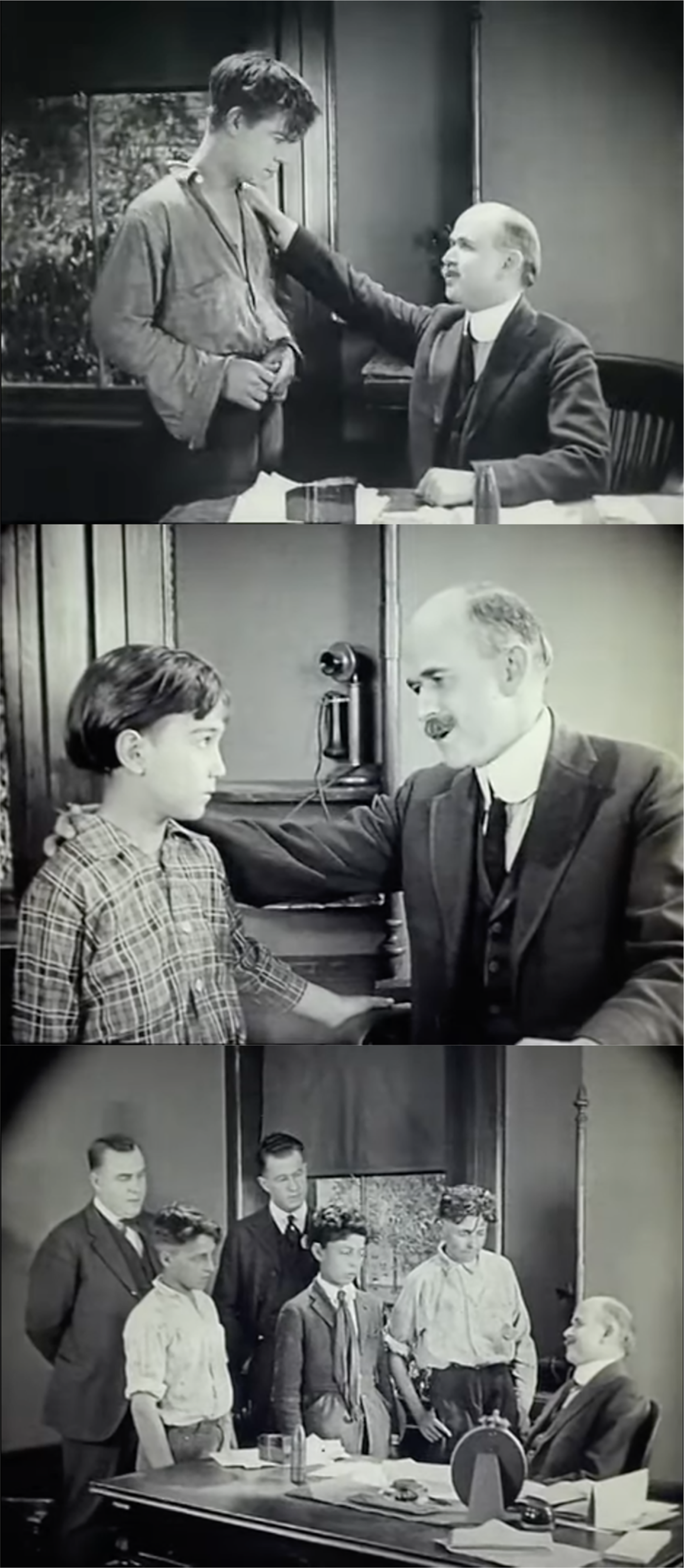
Figure 2 Long description
The first photo shows a young boy standing in front of Judge Lindsey, who is seated at a desk. The judge is gesturing towards the boy with a serious expression. The second photo captures a close-up of the same interaction, highlighting the boy's attentive gaze and the judge's concerned demeanor. The third photo depicts a group of young boys standing in a courtroom, facing Judge Lindsey, who is seated at a desk. The boys appear to be listening intently to the judge, who is engaged in conversation with them. The setting is a formal courtroom with wooden paneling and a desk.
In another scene, Judge Lindsey sits at his desk as a small boy stands by him, their eyes nearly on the same level. The judge places his hand over the young boy’s shoulder as he asks what motivated him to steal twenty-five cents, only to discover the child wanted to buy flowers for his mother, to make her happy, because she had been crying all the time since his father went away. When a group of boys who were accused of breaking and entering into a freight car to steal watermelons appears before him, Judge Lindsey talks to them—still seated—as they stand above him, then shakes their hands and places his hand over them. The film suggests that, by earning their trust, Judge Lindsey was able to elicit their confessions as well as their promise not to commit this act again. After they admitted to their wrongdoing, the judge promises the railroad superintendents who escorted the children to court that they would not go near the cars again and then turns to the boys for their assurance that they will not make “a liar” out of him. Each of these interactions, produced for the screen, eliminated the distance between the judge and the child.
These were the qualities that Judge Lindsey claimed to bring to his interactions with Neal Wright; these were the principles that guided him in assuring Neal that his secrets were safe with him.
The Wright murder trial
Court records, magazines, and daily newspapers detailed different versions of the fatal event in the Wright household on April 18, 1915, and of the preceding family history. News reporters pieced together a story of domestic violence that ended in tragedy. Bertha Wright described a life of fear and pain alongside an abusive and habitually inebriated husband, John A. Wright, who was “in the cinches of drink.” Bertha “worked and toiled and stitched and sewed” all day, yet nearly “every night in fourteen years” together her husband had come home intoxicated and belligerent, “his eyes glazed over … his hands clutching and groping, his mouth cursing.” He routinely threatened her life and the lives of their children and kept a gun under his bed (Oak Creek Times 1915).
According to some reports, Bertha Wright shot her husband with his own revolver. It was not premeditated, she insisted: “I felt a flash of pain cross my brain as the heavy knock sounded on the door.” On that specific day, when her husband returned home intoxicated once again, she had a “momentary vision” of her “sweet little baby, Nadine,” who was merely three months old, and twelve-year-old Neal “lying dead” at her feet. She was “roused … to a frenzy.” She could barely remember holding the gun. Seeing John’s face at the door, she froze: “Then it burned me. I cannot say how or what I did. Oh, God, it was terrible” (Oak Creek Times 1915). John Wright was fatally injured on a Sunday and died three days later in the county hospital. The Rocky Mountain News (1915b) reported that, on his death bed, he forgave his wife and admitted to his son that “it was all his fault.”
District Attorney John Rush believed that the prosecution had all the required information to charge Bertha Wright with murder and secure a conviction. However, on April 26, 1915, he learned of a different version of the tragic events, one that supposedly cleared Bertha from the charges. Her son Neal claimed responsibility for his father’s death. Neal insisted he had “fired the shot.” As the boy explained, “[I] grabbed the gun from my mother, who had threatened to kill herself” when it suddenly exploded. “Police laughed at the lad” in disbelief (Washington Herald 1919). They claimed his story did not match the evidence. Based on a crime scene investigation, the prosecution concluded that John had tried to get into the locked house, but Bertha refused to let him in. As he turned to leave, she shot him in the back, through the glass section of the door. The district attorney insisted that Neal could not have pulled the trigger based on evidence at the scene (Oak Creek Times 1915). Rush treated Neal’s confession as an attempt to sow doubt in the minds of jury members, orchestrated by Bertha’s defense attorney.Footnote 11 At no point did the district attorney consider that the boy’s age should preclude him from testifying in the trial or from providing his version of events. Instead, he was intent on making sure that Neal’s testimony was truthful, which to him meant that it supported the state’s case.Footnote 12
Enter Judge Ben Lindsey. The district attorney sent Neal to Judge Lindsey for the judge to “ascertain the truth” about the shooting. Whether he solicited Judge Lindsey’s help as a juvenile court judge or as an ordinary citizen who had the ability to earn Neal’s trust would become a point of contention. Rush would later explain that he sent Neal to Judge Lindsey because he “has been successful in getting confessions from youthful violators of the law” (Rocky Mountain News 1915a). The judge did not just speak to Neal in his chambers but also went with him to the family house a few days later where Neal walked him through the scene. According to the official court record, Neal stated: “I killed my father. He beat up my mother and I made up my mind that sooner or later I would have to lay him out.”Footnote 13 But it is unknown what version of events Neal recounted in his two conversations with Judge Lindsey.
At trial, Neal maintained that he had been the one to shoot his father. When Judge Lindsey was called to refute the child’s testimony, the famous judge reluctantly took the stand but refused to reveal the content of their conversations. Judge Lindsey announced that he could not answer questions without divulging information that the boy had told him in confidence (New York Times 1915a). The district attorney insisted that Neal himself had consented to the judge testifying but that the judge would not cooperate. He argued that Neal had “no right to weigh” in on this question.Footnote 14 For one, Neal was twelve and therefore could not make this decision. This argument accorded with one of the founding principles of the juvenile court—namely, that children could not be held liable for their actions in the same way as adults. Second, after their two encounters, Judge Lindsey declared Neal a ward of the juvenile court, presumably to shield him from prosecution for his involvement in this incident, which gave the juvenile court judge authority to make decisions in his best interest or so he claimed.Footnote 15 As a Harvard Law Review article noted on the question of who could determine, it stood to reason that children “for whose protection and care the whole juvenile-court system is planned” were “less fitted to be repositories of the power to waive the protecting privilege than” the judge: “It is the very essence of that system to impose upon him a guardianship over them.” While the court “repeatedly called Judge Lindsey’s attention to his duty to testify,” the judge continued to assert that whether he could speak or not was his judgment to make (Harvard Law Review 1919, 91–92).
The prosecution failed to make its case against Bertha, and the jury returned a “not guilty” verdict. A Colorado newspaper viewed this outcome as unsurprising as it “was a prevalent impression … that the clash of contentions over the shooting could result only in a disagreement or acquittal of the defendant.” In other words, the jury could not beyond a reasonable doubt declare that Bertha Wright was the one who had pulled the trigger. After nine hours of deliberations and despite one juror’s hold out for a conviction, the defendant, described as “haggard and worn,” learned that she would be released (Loveland Daily Herald 1915). Judge Lindsey’s refusal to testify, Rush argued, had permitted “a guilty woman to escape punishment” and encouraged her son to commit perjury.Footnote 16 The fact that the verdict was “not guilty” shows that this was “another case of throwing an open season on husbands with assurances to the slayer-wife that she need not fear,” Rush announced (Rocky Mountain News 1915c).
Bertha Wright left the courtroom a free woman, but the case against Judge Lindsey was far from settled. Rush publicly accused him of helping Neal commit perjury by allowing him to take the stand and argue that he was the one responsible for his father’s death. “Rush has indicted me before the people and the community as the protector of a perjurer,” Judge Lindsey responded. He “has thrown down a challenge to me and I am ready to ‘go to the mat’ with him” (New York Times 1915b). However, when the case made it to the District Court, the perjury charge was dropped, and Judge Lindsey was cited for contempt of court and was required to pay a five hundred dollar fine. He appealed to the Colorado Supreme Court with the hope that the state’s highest court would recognize his claim that a juvenile court judge should not betray a child. By the time the justices decided on the case four years later in 1919, Bertha Wright was reportedly “happily remarried,” while her son Neal, now sixteen, had “a splendid record” as an army soldier stationed in France (Monroe City Democrat 1919; Independent 1919). Judge Lindsey, however, was still fighting to convince the courts that he was both legally and morally justified in his refusal.
Visions collide
At the heart of Judge Lindsey’s resolute position that he could not disclose Neal’s account were several assumptions about the nature of the juvenile court and the special relationship between juvenile court judge and child. Key to the success of his court, as Judge Lindsey saw it, was the judge’s ability to establish a relationship built on trust. Children had to feel comfortable to speak about their experiences and behavior so that the court had accurate information. Getting “a plausible story from a child” was easy. The “hardest thing [was] to get the truth” (Literary Digest 1915). He vowed that, “within his own jurisdiction,” there would be no “third-degree” interrogation that produced convincing falsehoods. Instead, he chose “gentler methods.” Rather than instilling fear in children’s minds, which would only elicit a string of lies to get themselves out of trouble, he would attempt to gain their confidence. The juvenile court judge strongly believed that he had perfected his approach so expertly that only one in a thousand children “got away from us with a lie on his soul” (Literary Digest 1915).
Judge Lindsey insisted that he operated with the public interest at heart and maintained that the benefit of his testimony in a single trial did not outweigh the “damage to the State” caused by a juvenile court judge who broke the confidence of his ward. In this, Judge Lindsey echoed a central idea advocated by Progressive proponents of juvenile justice: that judges should provide “help, encouragement, and assistance, and absolute protection” to the children who came before them. The district attorney tried to force a judge to “tell the things which the statute says he shall keep secret, that public policy says that he shall keep secret, and things that the District Attorney himself is enjoyed by law to keep secret.” The effect could not be overstated. He could “wreck the only refuse of a delinquent or a neglected child to forever prevent such child from taking its rightful place in the community” (Outlook 1915a, 847).
Established legal publications provided commentary on the exceptionality of the juvenile court as worthy of consideration. “To attempt to delimit the relationship by lines based on legal forms rather than on de facto existence would seem at variance with the spirit of the institution to be protected,” insisted a Harvard Law Review (1919, 91–92) article on the case. In response to the district attorney’s claim that Judge Lindsey’s communication could not be privileged because Neal was not the defendant, the article pointed out that it was not necessary for Neal to be the subject of a formal complaint for the judge to extend his power over him. Once an offense had been committed by or against a child, it was enough to declare him “under the protecting arm and care of the chancellor” (Outlook 1915a).
But did Judge Lindsey talk to Neal Wright—first in his chambers and then at the Wright family home—in his capacity as a juvenile judge or as a private citizen? Rush insisted that Judge Lindsey operated not in his judicial capacity but, rather, as a private citizen who had no more right to refuse to give evidence bearing on the case than any other person.Footnote 17 In contrast, Judge Lindsey’s proponents such as F. Stuart Chapin, chairman of the Department of Economics and Sociology at Smith College, argued that the judge could not be regarded as a private citizen because he was enlisted by Rush expressly because of his expertise. It was evident, Chapin claimed, that Neal felt he could confide in Judge Lindsey because of his role. Rush asked for his assistance because of the judge’s reputation and ability to get boys to tell him the truth.Footnote 18 Judge Lindsey also acquired through experience an understanding of child psychology and knew that Neal’s agreement to Lindsey’s testimony could stem from fear from the legal proceedings. Chapin implied that Neal was not in a position to agree to Judge Lindsey’s testimony, and so Lindsey’s refusal to testify was justified.Footnote 19
In their arguments before the Colorado Supreme Court, both sides agreed that the case raised the “most important question” the state had ever faced related to privileged communication and the rights of judges.Footnote 20 More broadly, it presented a moment where the nascent juvenile justice system and the criminal justice system collided, compelling legal actors, scholars, and the public to question what philosophy should underly the twentieth-century American legal system. In contrast to Judge Lindsey’s claim of privilege, the Colorado Supreme Court held in April 1919 that no privileged relationship existed between Judge Lindsey and Neal. Determining that the potential benefit from the judge’s testimony outweighed the injury to the relations between juvenile court judge and child, the opinion pulled the rug under the philosophy of the juvenile court. Yet it did so without even addressing the issue directly.
In his summary of the case for the Michigan Law Review, Evans Holbrook wrote: “If the opinion had recognized the propriety of the privilege … and had regretted that the extension of such privilege lay with the legislature and not with the court, its position might be more easily accepted, though still with misgivings.” “But the majority … does not even admit that the privilege ought to extend to such communications; it contends rather that the privilege should not exist” for it tended to prevent the disclosure of facts that the court asserted would be necessary “in this particular instance.” In handing down this opinion, which was “undoubtedly deserving” of criticism for being narrow and highly technical, the court “ignores the considerations of public policy” relating to privileged communication and “the peculiar requirement of confidence in the successful working out of the Juvenile Court Law.” Holbrook (Reference Holbrook1919) had hoped that Colorado legislators would “repair the damage done by this decision.”
First, the four justices in the majority objected to the claim that Neal had become a ward of the court the moment he confided in Judge Lindsey, whether he had been charged or not. The court rejected the notion of “instantaneous jurisdiction or proceedings pending in the breast of the judge,” clarifying that “there was no case pending against Neal Wright, and the Juvenile Court had no jurisdiction over him” when the judge and the boy met to discuss the murder case.Footnote 21 It did not matter that, as a result of these conversations, Judge Lindsey declared him delinquent. Technically, while they spoke, Neal was not a ward of the court. In response to Judge Lindsey’s claim that “the jurisdiction attaches the moment the act is committed,” the justices insisted that a child did not become a ward of the juvenile court automatically upon committing an illegal act.Footnote 22 To contend that “the court or judge may, without complaint or information, take personal charge of the supposed offender,” the opinion noted, “would be a gross violation of the right of childhood, and an outrage upon parenthood.”Footnote 23 In rejecting this claim, the court accepted the respondent’s position that it would be “the height of absurdity” to assume that the juvenile court had jurisdiction over a child in its capacity of parens patriae without any complaint.Footnote 24
Second, the Colorado Supreme Court rejected Judge Lindsey’s claim that Neal could not consent to the judge’s testimony because he was a child and a ward of the juvenile court. The court noted that, even though the juvenile court operated in the “capacity of parens patriae” and the judge’s “assumed position in loco parentis,” it did not create a privileged relationship. Even a child’s natural parents had no right of privileged communication with their child, the court explained. Moreover, if “the privilege existed at all, it existed for the protection of Neal,” and he was the one who had to claim or waive it during the trial, not the judge. Even if they considered that Neal, as a minor, was subject to the decision of his “natural guardian,” that would be his mother who “sat in court with her counsel at the time of the trial” and, in her silence, essentially waived the right.Footnote 25
Accustomed to Colorado Supreme Court decisions that limited his power and the power of the institution he helped build, Judge Lindsey viewed this ruling as another personal attack on himself.Footnote 26 Early on in the process of constructing the state’s juvenile justice regime, the Colorado Supreme Court had struck down several laws that invested juvenile courts with extensive jurisdiction over cases involving children. It did so in Gibson v. People (1908), Colias v. People (1915), and Ex Parte Songer (1918).Footnote 27 The case against Judge Lindsey once again called into question his authority and the jurisdiction of his court. Four justices in the majority “held that technically I should have betrayed the child,” he explained in an essay in The Survey, a New-York magazine dedicated to social and political issues: “But one of the four was one of my bitter enemies—one of whose relatives had figured in The Beast and the Jungle stories. This was the deciding vote.” Judge Lindsey declared the decision biased, unjust, and “a blow to the child welfare work of this state which I shall oppose with all the strength of my soul” (The Survey 1921).
Indeed, Judge Lindsey was no stranger to controversies and public disputes. “The Beast and the Jungle” was a serialized exposé published in Everybody’s Magazine and also in book form as The Beast (Lindsey Reference Lindsey1909; Lindsey and O’Higgins Reference Lindsey and O’Higgins1910). In these publications, Judge Lindsey professed to shine a light on the corrupt political machine in Denver that capitulated to business interests. Over his long career, Judge Lindsey raised the ire of both his enemies—corporations, politicians, the Catholic Church, to name a few—as well as some of his allies, who failed to understand his agenda and mode of operation (Laugen Reference Laugen2010). Former Colorado Governor William E. Sweet referred to him as “one of the most fearless men” he had known, but the governor added that Judge Lindsey had accumulated “enemies in all circles in Denver” because he could not “speak in moderation.” Ultimately, Sweet wrote, those “who believe in him believe in him thoroughly and those who do not completely discount him.”Footnote 28 The reactions to the contempt of court case reflected his contentious nature. “The ‘Beast’ is again seeking the political life of Judge Ben Lindsey,” one newspaper claimed in July 1915, while another’s headline announced in August: “Suppose Ben Lindsey Will Charge This to the ‘Beast’” (Evansville Press 1915; Hutchinson News 1915).
Nevertheless, newspapers amplified Judge Lindsey’s accusations when they published reports, such as the one in the Washington Herald holding that one of the justices “was an open and avowed enemy of Lindsey.” The newspaper did not mention the justice by name, but, based on the judge’s personal correspondence, it is likely that the justice in question was Justice James H. Teller. The report added that the justice harbored animosity toward Judge Lindsey because of “The Beast and the Jungle” (Lindsey and O’Higgins Reference Lindsey and O’Higgins1910). Judge Lindsey made these accusations explicitly in a letter to Justice Teller in 1924, demanding that the justice recuse himself from a case involving the juvenile court. He charged Justice Teller with “bitter prejudice and antipathy” toward him due to an “unfortunate misunderstanding” that grew out of The Beast.Footnote 29
In the face of these criticisms and upon receiving several letters “from education institutions” criticizing the court’s decision, Justice Teller found himself forced to defend his position (Washington Herald 1919). He suspected that the outpouring of criticism did not come his way spontaneously. Still, he took the time to outline his decision and battle any misinformation, asserting that with full knowledge of the facts one could no longer argue that there are moral issues more important “than the application of established law to an offence which tends to cause a miscarriage of justice.”Footnote 30 In other words, the real injustice was the release of an alleged murderer, and Judge Lindsey had contributed to it.
In correspondence with one of his critics, F. Stuart Chapin, Teller restated the majority’s position and retorted: would we condone Judge Lindsey “encouraging the boy to commit perjury and enabling a murderess to go free?” The justice claimed that, by promising not to tell the story, Judge Lindsey “did that which no good citizen, whether a judge of the juvenile court or otherwise, had any moral right to do.” The laws of Colorado clearly stated when a witness “should be compelled to answer a question; and Judge Lindsey, because he happens to be a judge of the juvenile court, has no more right than any other citizen, to stand in defiance of the law.”Footnote 31 But Justice Teller went beyond the court’s decision, attacking Judge Lindsey for setting a terrible example for the children of Colorado. He argued that the judge “presents a pitiful figure as an exemplar of conduct, for the youth to imitate, when he defies the court and puts himself above the law.” Judge Lindsey’s blatant disrespect was a terrible lesson for the youth who followed his words and example: “I cannot believe that you or any other educator, with knowledge of the facts, would say that the court was wrong in affirming the judgement which punished him for his open defiance of the court and the law.”Footnote 32
Once again, Justice Teller, like his colleagues on the bench who were in the majority, focused on the question of whether Judge Lindsey acted in his capacity as a public official and whether, according to state law, the conversations were held in confidence. He made no attempt to answer any of the accusations that this decision had broader implications and that it could affect the workings of the juvenile court, which was a novel legal institution of great social significance. It was this refusal to engage with such arguments that Chapin chose to highlight in the closing lines of his response, as he explained that he may not be able to fully appreciate the legal technicalities of the case but was still convinced that his opinion was shared by many who may lack legal training. Public trust in the courts, he suggested, also rested on knowing that other elements of real consqequence are taken into account and not only the letter of the law.Footnote 33
Within the Colorado Supreme Court, there was no uniformity as well over questions of strict adherence to the law. The dissenting opinion further exposes the tension between legal formalism and the approach of socialized justice. The three justices in the dissent focused their attention on the social context of the case and the importance of the juvenile court’s mission to the public. Justice Morton Shelley Bailey, who penned the dissenting opinion, explained that, in a matter “so highly important and of such wide and general concern,” he had a duty to express his “views for permanent record.”Footnote 34 At stake, according to Justice Bailey, was the future of the juvenile court as a public institution for the correction and protection of children. He criticized his colleagues in the majority for delivering a “highly technical” and narrow opinion and decried the damage to the public that would result from a ruling that was “not in harmony with modern and enlightened jurisprudence.”Footnote 35 Bailey acknowledged that, generally, the law favored a limited understanding of the concept of privileged communication. But in this case, he insisted, the relationship between judge and child was that of “guardian and ward, parent and child … for the purpose of aiding and uplifting delinquent and wayward children in an effort to make them assets to the State rather than liabilities.” The court was meant to “make worthy citizens of those who otherwise probably would become criminals.” Without “the element of confidentiality,” a “field of boundless possibilities for good” would perilously remove a feature that was essential to the court’s success.Footnote 36 He cautioned that “to destroy this relationship would be in effect to nullify and set aside the chief end and purpose of the enactment itself.” In sum, failing to protect the special relations between judge and child would “needlessly hamper and belittle” the juvenile court’s work and stood to defeat its “wise and humane purposes.”Footnote 37
Law journals were divided on whether the Colorado Supreme Court had decided correctly. Legal commentators noted the novelty of the question and tended to distinguish between support of Judge Lindsey’s moral position and doubts over the legal basis of his claims. On the one hand, they admitted, confidential communication was a crucial element for the work of a juvenile court. On the other hand, they endorsed the evidentiary rules of legal formalism, with most concluding that the Colorado Supreme Court had correctly applied the law. The Yale Law Journal’s (1920) summary of the opinion informed its readers that “it is difficult to see how the work of a juvenile court judge can be of enough value to justify his existence, unless he is protected in keeping the children’s confidence.” “Good ethics may demand that his mouth be sealed,” the Minnesota Law Review (1919–20, 231–32) similarly stated, but it concluded that any person who refused to testify, including Judge Lindsey, “should be forced to pay the penalty of his silence.” A summary of the case in Law Notes (1916, 184; 1919, 104) concluded: “[t]hat a communication made in the confidence of that relation should not be privileged … may be law but it certainly is not justice,” while another analysis in the same publication explained that Judge Lindsey violated a court order “which we must consider as lawful” but “for no selfish purpose.” Instead, he did so “in obedience to a principle which he considered essential to the success of his judicial work.”
Attempting to reconcile the exceptional nature of the juvenile court with standard evidentiary rules, legal scholars sympathetic to Judge Lindsey relied on analogies to other protected relationships. Harvard Law professor Zechariah Chafee Jr. (Reference Chafee1922) explained that, for one to recognize the judge-child relationship as privileged, one would have to analogize it to the relationship that exists between counsel and client. The parent-child analogy, which arguably fit the paternalist ethos of the juvenile court more comfortably, was not sufficient: “The administration of the Juvenile Court undoubtedly depends upon the encouragement of complete confidence in its wards. … On the other hand, confidence between children and their parents is equally desirable, and yet the law gives no secrecy.” Chafee directed his readers’ attention to the fact that, although the case was debated in the courts for six years, the state legislature did not make any attempt to positively enshrine the relationship between juvenile court judge and child or to identify their communication as privileged. That no such effort had been made “in spite of the widespread attention which this case has received … indicates that the decision conformed to the local views on the conflicting policies involved in the situation” (693–94). In other words, had the public clamored to recognize this relationship as protected, the legislature would have acted upon it.
By distinguishing the moral dimensions of the case from the legal doctrine, these legal commentators effectively admitted that the existing criminal law did not reflect the emerging values of Progressive Era thinkers. In so doing, they endorsed static legal precedent over judicial cognizance of evolving social norms. They also carved out the juvenile court as an exceptional institution, subordinate to the dominant criminal justice system. In other words, when the two were in conflict, the rules of criminal law overrode the values of juvenile justice. Following the Colorado Supreme Court’s decision in 1919, Judge Lindsey had high hopes that the US Supreme Court would hear his case. However, the court dismissed it for want of jurisdiction in 1921, leaving no more legal avenues for him to plead his case.
“And boys will pay Ben Lindsey’s Fine/With fifty thousand pennies”
The story could have ended there, after the legal case was settled and Judge Lindsey, alongside his wife Henrietta, handed a personal check to the clerk of the Denver District Court. But to end it here would mean to ignore a parallel sphere in which the debate had been taking place during the six years of court appeals and legal discourse. The drama over the “Kids’ Judge” who risked going to jail for a principle had received extensive coverage and had awakened a wave of public support and praise directed at the judge. Judge Lindsey had received hundreds of letters applauding him for standing his ground and refusing to disclose what Neal had told him; they praised the judge for doing what they perceived as moral and just. In addition to fellow children’s welfare advocates, complete strangers put pen to paper to offer a few lines of encouragement. The messages of approval and engagement raise several questions about the people who participated in this discourse and their views, motivations, and understanding of the law. Did they act as juvenile justice proponents? Were they moved to write out of a sense of protectiveness toward children? Was the possibility that a famous juvenile court judge might be imprisoned a central motive for reaching out? How did they understand this conflict between Judge Lindsey and the criminal justice system?
Alongside the support of men and women, children and youth throughout the United States were propelled to show their allegiance to the judge who refused to betray one of them. They wrote letters, signed petitions, and reached out to the judge to ask what they could do to help. A central feature of their effort to demonstrate their support was a nationwide campaign to collect pennies to pay the fine for the beloved judge or to fund the expenses of his appeal to the US Supreme Court. Whether they acted of their own accord or with the encouragement and advice of the adults who surrounded them, the involvement of children in this conflict is noteworthy. At times, it would appear that their activities were guided or mediated by teachers or counselors. But their words still disclose what propelled them to participate and what threats they had identified; their actions reflect not only the growing public legitimacy of the juvenile court but also children’s roles in shaping legal institutions and, consequently, their own future.
First, among the various voices to articulate their support for Judge Lindsey’s actions were writers who wished to commend his moral stand and who argued that obeying the law of the land was no more important than keeping a promise to a child. One letter writer from Wichita, Kansas, asked that, “in the name of the highest and grandest law known to man – moral law,” the judge would remain dedicated to ideals of “honor, right, justice and humanity.” The letter sender praised him for “refusing to betray the confidence of this little defenseless youth to simply satisfy so-called Court dignity” and added that, in choosing between breaking this sacred confidence and going to the “Electric Chair, I would certainly go to the chair.”Footnote 38 A woman from St. Louis, Missouri, described Judge Lindsey’s “willingness to serve a term in jail rather than betray a boy’s confidence” as “the most wonderful thing” she had ever read. Her letter introduced an additional consideration—not only moral questions involved in honoring the judge’s promise but also guaranteeing the continued success of the juvenile court as an institution. She asserted that the judge was not only protecting Neal Wright but ensuring that he would have no problem gaining the confidence of other boys in his courtroom in the future.Footnote 39
In their letters, most writers who were strangers to Judge Lindsey explained that they had been exposed to details of his trial and position in the press. Daily papers and periodicals amplified Judge Lindsey’s statements and his warnings about the danger to the juvenile court. “Utterly unworthy of the confidence of the boys and girls would Judge Lindsey be had he yielded to the demand … to betray his youthful follower, friend and confident,” the Lexington Herald (1915), a Kentucky-based newspaper announced. Here, too, the idea that children’s confidence and well-being were above all is apparent as the paper argued that it was better “that the individual guilty of the murder of a man should go free” than that the person who had earned the faith of “the children of the city” should betray it “and ruin their ideal” (Lexington Herald 1915). A Boston-based newspaper concluded that “[a]ll fair-minded people” expect the Colorado Supreme Court to reverse the contempt conviction (Boston Evening Transcript 1915).
Numerous editorials praised the judge for standing his ground and not betraying the boy’s confidence. The Outlook (1915a), a widely distributed weekly magazine that monitored the contempt of court case closely, alerted its readers of the damage to “the peculiar sanctity attached to the disclosure made in the juvenile court.” An interference with this confidence could “destroy perhaps the most effective instrument” in the hands of judges “who are called upon to settle the cases of delinquent boys and girls.” Children will no longer be assured that their “early frailties” would not be recorded (Decatur Herald 1915). A ruling against Judge Lindsey would prevent him from assuming a parental position, and he may be “forced to assume the attitude of the prosecutor,” the report advised (Outlook 1915a). According to the magazine, “honor, justice, and public interest are all to be found on Judge Lindsey’s side” (Decatur Herald 1915). The Outlook criticized the decision to levy the fine with “little consideration” to the “principles underlying Judge Lindsey’s protest.” Plainly, the court was too focused on “narrow and legalistic” issues to evaluate questions of public policy and reflect on the injury to the “reputation of the juvenile court as a sanctuary for wronged and delinquent children” (Outlook 1915c, 938–99).
Perhaps the extensive media coverage was the result of Judge Lindsey’s penchant for publicity. One Colorado newspaper suggested that this fight earned the Denver judge “five thousand dollars’ worth of publicity” (Elk Mountain Pilot 1921). Judge Lindsey fed newspapers updates on his case, including lengthy statements that he personally authored to detail the events that led to his conviction and the reasons he decided to fight all the way to the US Supreme Court (Kansas City Times 1915; Daily Missoulian 1919; Salt Lake Telegram 1919; Daily Advocate 1921; The Survey 1921). He also disseminated information to other juvenile justice proponents with the hope of enlisting their support. But the sheer volume of coverage, along with its sympathetic tone, suggests at least an openness to the moral justification for his decision even if the legal institutions found fault in his actions and accused him of impeding justice.
Importantly, public support was not limited to letter writing but was translated into calls for action, including petitions and a fundraising campaign led by children and youth. Galvanized by reports that the adored jurist might go to jail for refusing to betray a boy’s confidence, young people across the nation began raising funds to pay Judge Lindsey’s fine (Richmond Palladium and Sun-Telegram 1919). On August 19, 1919, an evening telegram informed Judge Lindsey that members of the Boys’ Brotherhood Republic (BBR) of Chicago had passed a resolution to “START CAMPAIGN FOR FIFTY THOUSAND PENNIES FROM FIFTY THOUSAND CHICAGO BOYS TO PAY YOUR UNJUST FINE.” According to this message, they had already collected 136 pennies.Footnote 40 The BBR’s “citizens,” which amounted to six hundred adolescent boys under the supervision of social reformer Jack Robbins, felt “mighty sore” of the treatment Judge Lindsey received during his contempt of court trial. A BBR letter that arrived shortly after the telegram explained: “We feel the State of Colorado is unjustified in penning out a sentence to one of the most loving judges we know of. The court’s decision seems so ridiculous that at times we boys are wondering whether Colorado understands boys at all” (see Figure 3).Footnote 41
Telegram from the Boys’ Brotherhood Republic informing Lindsey of the fundraising campaign.
Source: Box 147, Folder: September 1919, Ben B. Lindsey Papers, Manuscript Division, Library of Congress, Washington, D.C.
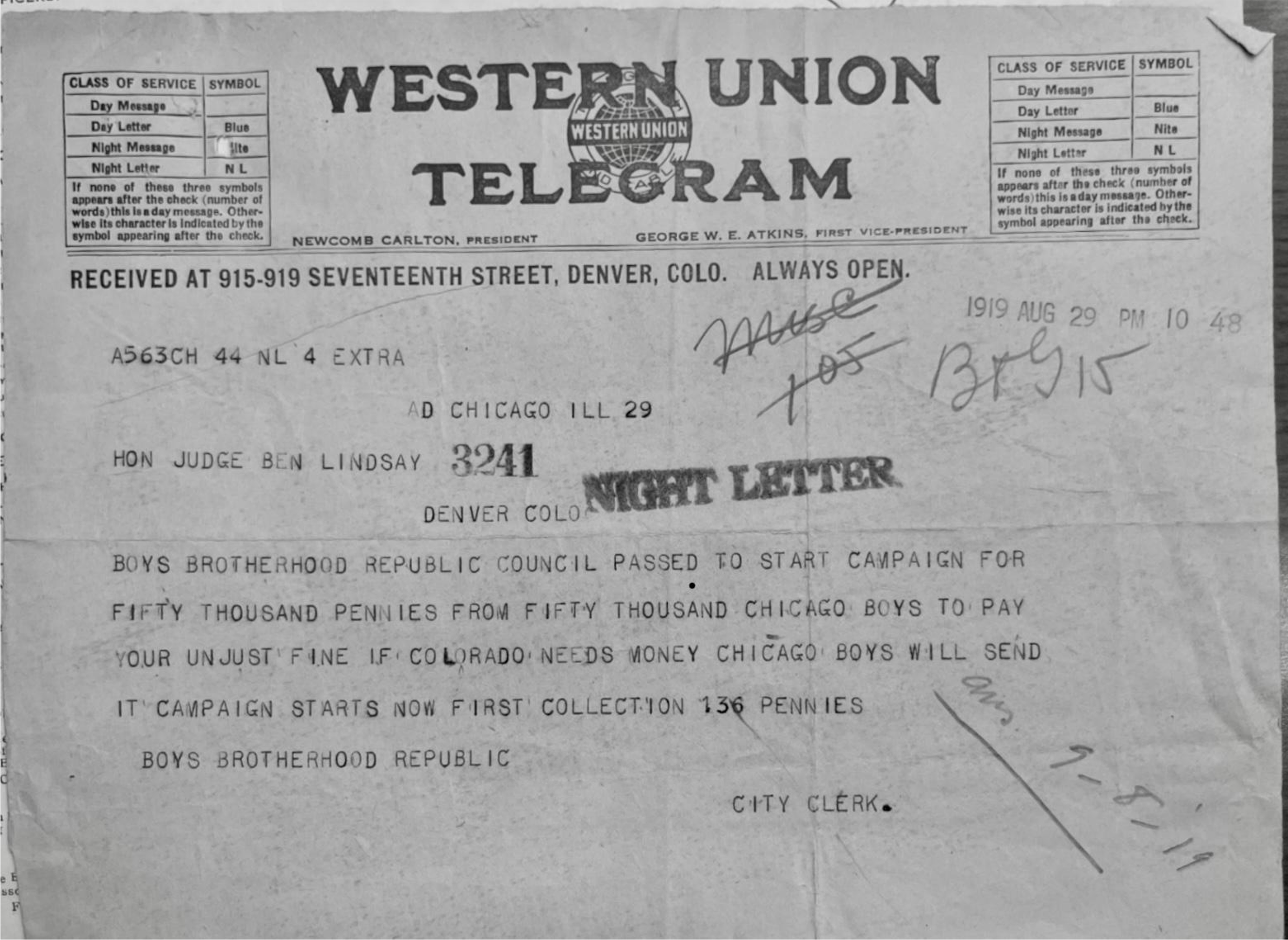
Figure 3 Long description
The image shows a Western Union telegram received at 915-919 Seventeenth Street, Denver, Colorado. The telegram is addressed to Hon Judge Ben Lindsay in Denver, Colorado, and is marked as a night letter. The message is from the Boys Brotherhood Republic in Chicago, Illinois, dated August 29, 1919. It informs Judge Lindsay about a campaign to raise fifty thousand pennies from fifty thousand Chicago boys to pay his fine. The campaign starts immediately with an initial collection of 136 pennies. The telegram includes various stamps and markings indicating its class of service and handling details.
Newspapers reported that Judge Lindsey returned “hundreds of pennies sent him by boys,” attaching a letter to every boy “explaining his action in refusing to accept the money” (Chattanooga News 1919; Herald Democrat 1919; Washington Herald 1919). But the judge’s correspondence with the BBR members suggests that, rather than attempting to stop the campaign, he sought to divert the use of the money to bring the case in front of the US Supreme Court. After thanking them for their kindness, Judge Lindsey explained to the city clerk of the BBR, his fear that the campaign would send the message “the fine should be paid before the fight has ended.” But the judge had his eyes set on getting the highest court of the land to recognize the principle of privileged communication between judge and child. Thus, if the BBR members were so inclined, he advised them to focus their energy on collecting money to fight in Washington and that this would represent “the fine spirit of the boyhood of America for justice and decency and fair play, that after all is above any technical law.” “P.S.,” Judge Lindsey added, “[y]ou boys gained a lot of publicity for your proposal; it has been in the newspapers all over the country, and we are beginning to get letters from other boys in other cities who want to join in the campaign.”Footnote 42
Indeed, Chicago’s boys were not alone in their resolve to help the judge. Fourteen-year-old Eugene of Port Washington, Ohio, shared his admiration for the judge’s decision “not to betray the confidence of a boy” and for “many other things that you have done for boyhood.” A member of the Lone Scouts of America, he wrote an article about the case with the hope to “enlist the aid of the 575,900 members in your behalf,” suggesting that they send their contributions to the BBR.Footnote 43 Little Ellie from Duncan, Oklahoma, read in the paper that the judge was asking for pennies from “50,000 little children. … So I though [sic] I would send you one.” A piece of paper folded into an improvised envelope found alongside her letter contained two pennies. “My little cousin is here to send one with mine,” she added.Footnote 44 This girl, like many others who reached out to the judge, received a short note thanking her and her cousin for their kindness in sending the pennies, signed: “Sincerely your friend” (see Figure 4).Footnote 45
Ellie’s letter, alongside the improvised envelope and two pennies.
Source: Box 141, Folder: Dec 1915, Ben B. Lindsey Papers, Manuscript Division, Library of Congress, Washington, D.C.
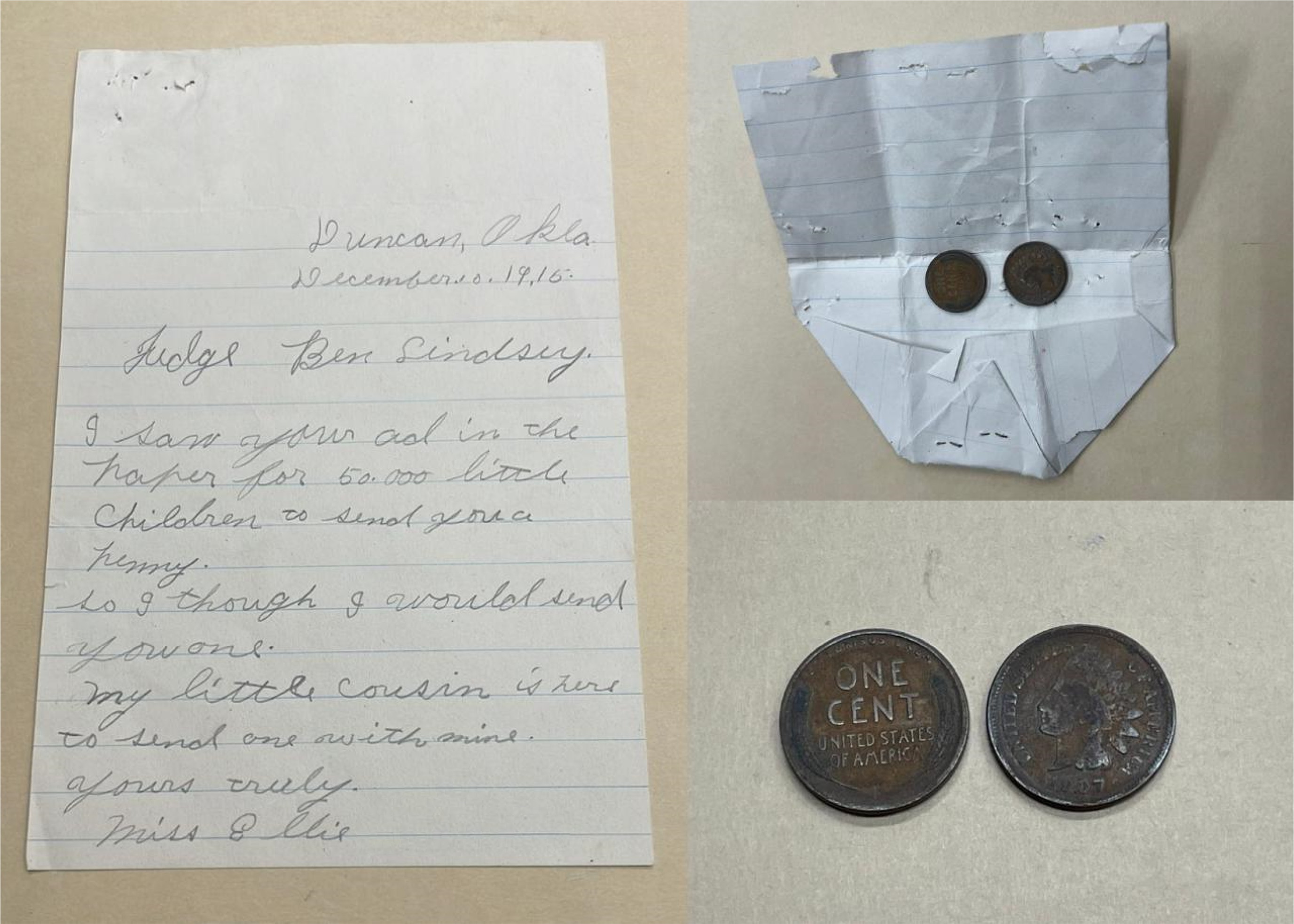
Figure 4 Long description
The image consists of four elements: a handwritten letter, an improvised envelope with two pennies, and two close-up images of the pennies. The letter is dated December 1915 and addressed to Judge Ben Lindsey. It mentions seeing an appeal in the paper for fifty little children to send a penny. The writer, Miss Ellie, expresses her intention to send a penny and encourages her little cousin to send one as well. The improvised envelope, made from a piece of paper, contains two pennies. The close-up images show both sides of the pennies, which are United States one-cent coins.
In addition to the sporadic support of children and youth who read about the BBR initiative and donated by mail, other groups attempted to create their own Lindsey Fund. Identifying as the president of the Lindsey Club, young Nathan wrote the judge, asking for more information on the case, after members of the club in New York had read about Judge Lindsey’s fight in the press and “decided to start an active campaign throughout the city for your cause. Donations will be asked from the young boy, thereby showing that the boy sympathizes with the stand taken by the judge. All contributions will go towards the Lindsey Fund which will be used for the same purpose as that of the Brotherhood,” he clarified. Newspaper reports coming from Denver announced that wards of the court, “including a number of Lindsey’s ‘bad boys,’ have started a movement to collect 50,000 pennies from the children of Denver” to pay his fine (Los Angeles Tribune 1915). The children believed Judge Lindsey to be “a wise, honest and dependable man,” a different report noted (Lexington Herald 1915). A Colorado newspaper alerted its readers to an initiative that originated with the Good Scouts of the Methodist Church of Idaho Springs, who proposed to collect a nickel each from ten thousand Colorado children to fund Judge Lindsey’s fine in “appreciation of his determination not to betray the confidence of a boy.” The Good Scouts explained this was a movement of children keen on supporting the “services of the man who believes in a square deal for all boys” (Idaho Springs Siftings-News 1921).
As the idea to collect money from children spread quickly, schools began to play a role in gathering contributions. Whether the students or their teachers were the ones who took the initiative is difficult to say based on their messages. Two short letters from Muskegon Heights, Michigan, delivered the contributions of students at the South Park School “to help Judge Lindsey pay the expenses of taking his case to the Supreme Court.” The letters were signed by the “Fourth Grade” and “Sixth Grade” and did not include names of students who participated and donated.Footnote 46 A teacher from Idaho sent the BBR a two-line letter, stating: “Ten boys in my room have contributed one cent each to be used for the Judge Lindsey funds. We hope the judge wins out.”Footnote 47 Seventeen-year-old Charles of Livingston, Wisconsin, provided a “money order amounting to twenty eight cents $(.28) which is to go for Mr. Judge Lindsey’s cause.” Attached was “a list of the boys names of our school who gave one cent.”Footnote 48 Among them were boys ages fourteen to seventeen. John of Birmingham, Alabama, took “steps to collect a penny each from the children of our school. The heart of every child is bleeding for you to-day. The little boys shed tears when the story is told them—tears of sympathy and tears of gratitude.”Footnote 49 It is unknown whether John was a teacher, a principal, or a student at the school.
Pupils at the Wilsonville Highschool in Oregon submitted a petition signed by 292 students who applauded him for proving that he valued “the confidence of a boy more highly than the mandates of a perverted court of justice.” The undersigned students wished to commend him “for the stand you have taken and to express our appreciation of your loyalty to the best interest of the youth of our land. You are not only a friend to the boys and girls of Denver, but the boys and girls of the whole United States are proud to call you friend.”Footnote 50 When the idea that children would show their support of the judge with a campaign of this sort was first floating around, a poem published in the Brooklyn Daily Eagle (1915) celebrated the loyalty of kids who “will pay Ben Lindsey’s Fine/With fifty thousand pennies.” Signed J. A., the poem positioned Judge Lindsey as the protector of boys who stood up to “hatred and grudges” and refused to simply pay the fine, even though his conviction of contempt of court had been “backed by higher judges” who failed to understand his refusal to “snitch upon a kid” (see Figure 5).Footnote 51
“Ben B. Lindsey’s Fine,” The Brooklyn Eagle, page 6, November 20, 1915. Source: Brooklyn Public Library, Center for Brooklyn History.
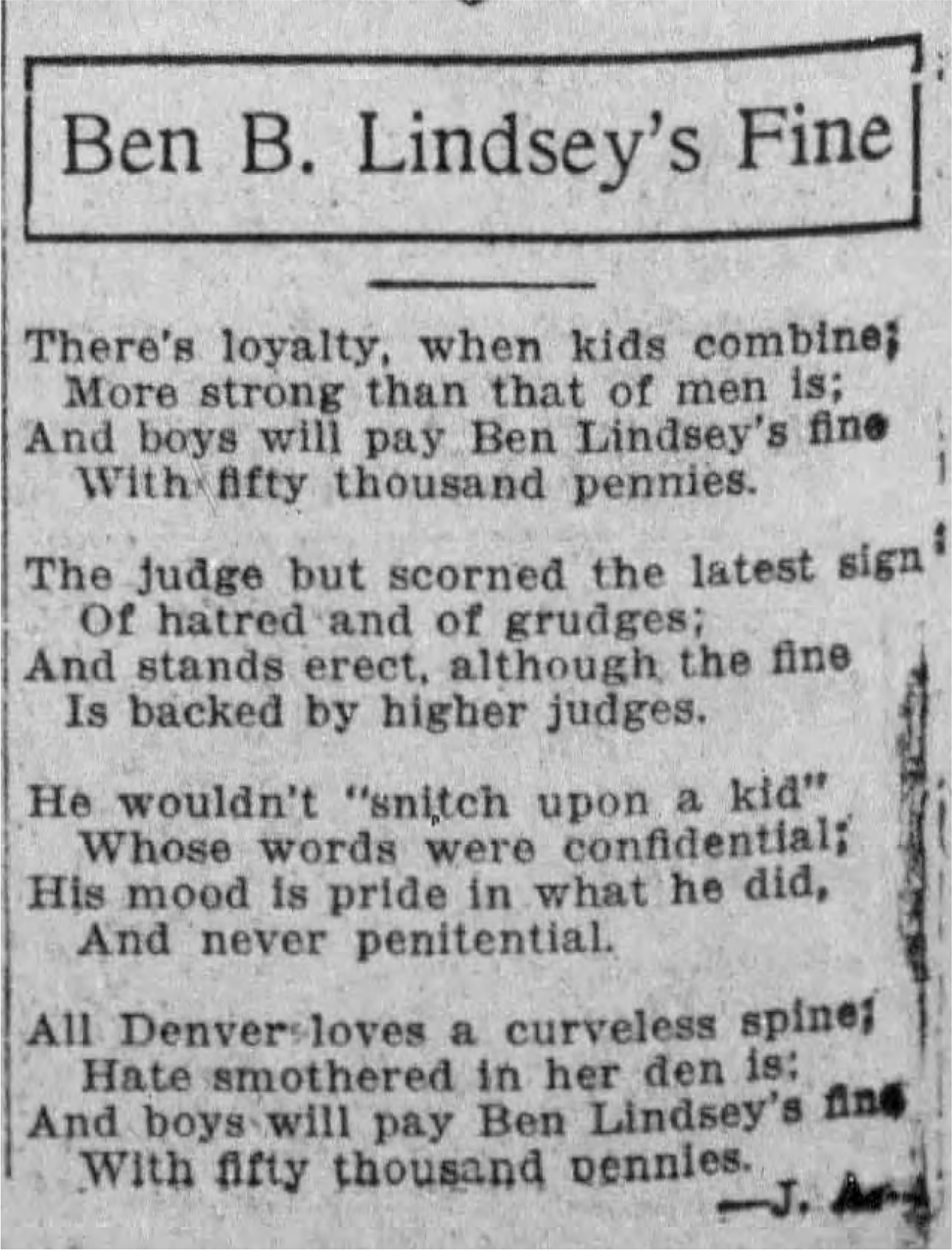
Figure 5 Long description
The newspaper clipping features a poem titled 'Ben B. Lindsey's Fine'. The poem discusses the loyalty of boys who combine to pay Judge Ben Lindsey's fine with fifty thousand pennies. It mentions the judge's stance against hatred and grudges, his pride in his actions, and the support of higher judges. The poem also highlights the judge's refusal to 'snitch upon a kid' and the love of Denver for a curveless spine. The poem ends with the repetition of boys paying the fine with fifty thousand pennies.
The poem’s celebration of Judge Lindsey’s refusal to “snitch upon a kid” epitomizes some of the language that headlines and reports used to criticize the demand of Judge Lindsey to disclose Neal Wright’s version of events and his refusal to cooperate with the prosecution. “Judge Lindsey ‘no snitcher’,” announced one headline, while another informed the readers that “Judge Ben B. Lindsey Wouldn’t ‘Snitch’” (Decatur Herald 1915; Lewisburg Journal 1921). By using this slang term to describe Judge Lindsey’s conduct, his youthful supporters and sympathetic papers endorsed the vision of the juvenile court judge for which he had long advocated—as a friend of children, not an authority figure. “Judge Lindsey Refuses to ‘Snitch’ on His Boy Pals,” exclaimed a Missouri newspaper (Worth County Tribune 1917) (see Figure 6).
“Judge Lindsey Refused to ‘Snitch’ on his Boy Pals.” Worth County Tribune, page 1, July 18, 1917. Source: The State Historical Society of Missouri.
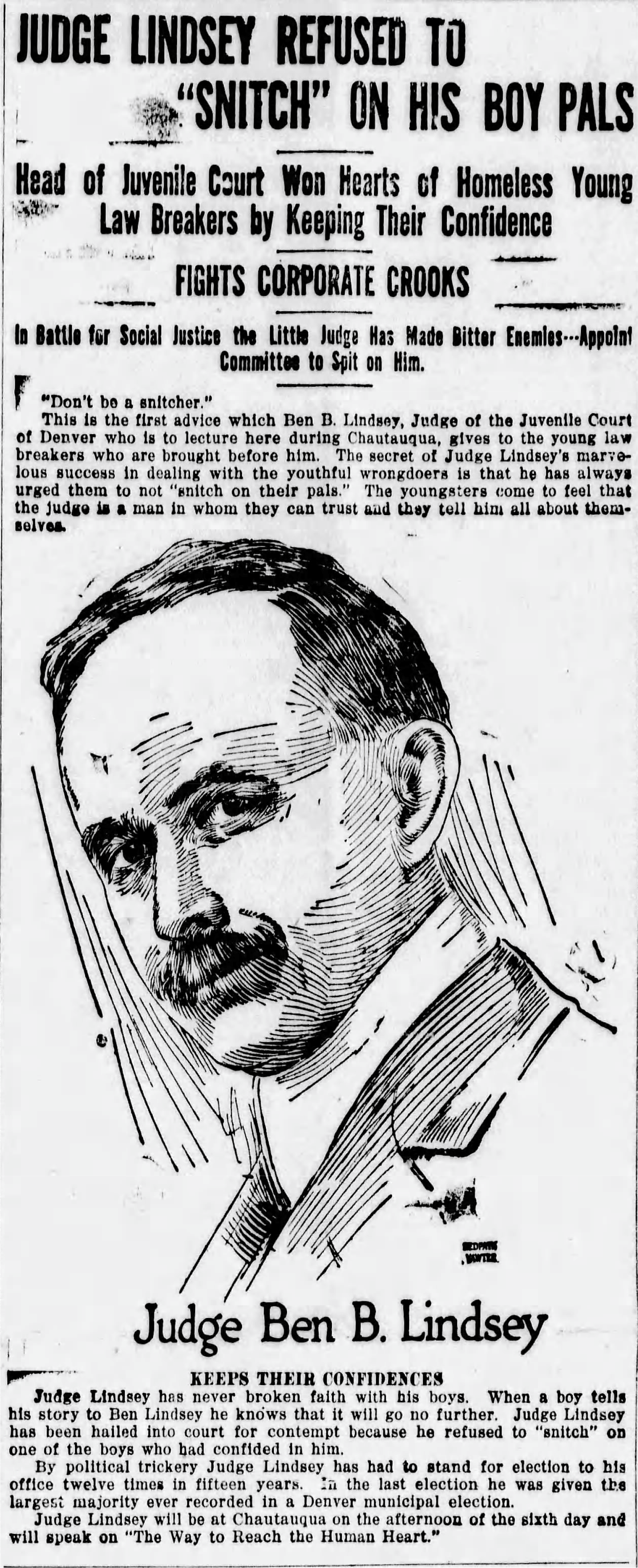
Figure 6 Long description
An illustration of Judge Ben B. Lindsey, featuring a detailed portrait of his face and upper body. The image includes a newspaper headline that reads 'Judge Lindsey Refused to Snitch on his Boy Pals.' The text emphasizes his commitment to keeping the confidences of young lawbreakers and his fight against corporate crooks. The illustration highlights his dedication to social justice and his refusal to betray the trust of children, even under legal pressure.
“The secret of Judge Lindsey’s marvelous success in dealing with the youthful wrongdoers is that he has always urged them to not ‘snitch on their pals’,” one report notes. “The youngsters come to feel that the judge is a man in whom they can trust and they tell him all about themselves” (Worth County Tribune 1917). Under the headline “A Boy’s Friend,” one newspaper explained that Judge Lindsey refused to “snitch on a kid,” adding: “Boys know what that means. … Ben Lindsey has made himself immortal if for nothing else” because of his refusal (Garnett Review 1921). A report out of California highlighted the admiration of the “toughest kid on Folsom street” in San Francisco, Patrick Doon, who gave a glowing endorsement of the judge: “I’m fer da guy dat ain’t goin’ ta snitch,” said the fourteen year old. “I don’t know dis jedge you talk about,” he added, “but if he’ll keep his trap closed he’s de kinda guy I likes. … ‘If dat jedge you talk about’ goes to jail ‘for keepin’ his trap closed’,” Patrick continued, he would invite Judge Lindsey to come out west and join his gang (San Pedro Daily Pilot 1921; Seattle Union Record 1921).
The focus of Judge Lindsey’s supporters on his refusal to “snitch” and the endorsement of “tough kids” like Patrick Doon gave ammo to the judge’s critics.Footnote 52 The term “snitching,” the Pittsburgh Gazette Times (1921) reminded the public, was based on an “honor” code of “wrongdoers” and should not be uttered in this case. The judge was “unworthy to hold office, since he subordinated public duty to an imagined higher obligation to an individual,” it argued. One could imagine that Judge Lindsey’s refusal to comply was intended to be “an example of honor to the youth to whose welfare he is devoted. In truth,” it “did just the opposite of that,” the newspaper announced. Judge Lindsey’s stance will probably “raise him to heroic proportions in the eyes of a certain type of people,” but “he will forfeit the hitherto merited respect” of “the better citizenship of America” (Pittsburgh Gazette Times 1921).
Still, the sentiment expressed in both media coverage and in letters that arrived on Judge Lindsey’s desk was favorable and supported the judge’s fight. Not only were children propelled to donate, whether individually or in an organized fashion. Rachel of Denison, Iowa, identified herself as a “great admirer” of Judge Lindsey, who, in her mind, “was always ready to help others get justice.” In her letter to the BBR asking that they accept her contribution as well, she noted: “I sign myself one of Judge Lindsey’s many friends whom he does not personally know.”Footnote 53 A woman who appreciated the judge’s role in a past family affair that made it to his courtroom sent in a donation as well, explaining: “For his kindness to protect my dear little granddaughter from the brutality of a wicked stepmother in Denver Colo in 1911 I will send what I can.” She was a maid at a Columbus, Ohio, hotel who apologized that she could send no more than one dollar toward the Judge Lindsey Fund and asked that her name be kept a secret.Footnote 54 Colorado businessowners and other professionals enlisted and offered to lend a hand and pay Judge Lindsey’s fine. The Rocky Mountain Screen Club—an organization of theater owners—passed a resolution urging the judge to “permit the moving picture men to pay” his fine (New York Times 1921b).
Within the legal profession, however, such initiatives met significant resistance. A group of Denver lawyers called on their colleagues to contribute to a fund that would help pay the fine. They assumed that it would be more fitting for lawyers to pay the fine than “[n]ewsboys and others” who were “anxious to raise the fund.” Attorneys Wayne C. Williams, Edward Auslander, and Omar E. Garwood wrote to members of the Denver Bar Association (DBA) asking them to realize “the penalty was imposed because of a technical misconception of his duty in a matter involving the very foundation on which juvenile jurisprudence is erected” (Rocky Mountain News 1921a). This initiative was a step too far in the eyes of some members of the DBA. In a response, Denver attorney James J. Sullivan accused them of “advancing the idea that the judge involved is the victim of a persecution” and calling on members of the bar to challenge the law “as laid down by the Supreme Court of Colorado.” The problem, as he saw it, was that “[l]awyers are asked … to choose between showing their respect for the courts on the one hand and their susceptibility to excessively advertised nonsense on the other.” In his view, “‘newsboys and others’ … cannot be blamed for lack of discrimination in this case, Lawyers have no excuse.” In other words, he could understand why children and youth were quickly recruited and sided with the judge, but members of his profession should know better (Rocky Mountain News 1921b).
On February 28, 1921, the Denver Bar Association adopted a resolution “denouncing Judge Ben B. Lindsey for failing to pay the $500 fine assessed against him.” Voted unanimously, the resolution stated that “as a citizen” and a person with a “sacred obligation under his oath as a judge,” he had to pay promptly “out of his own funds” the fine imposed. It called the judge not to “permit any other person to contribute” to the funds, to not “further dishonor Colorado and its people, or further reflect upon the honor and integrity of our courts by going to jail or otherwise advertising himself as a martyr” (Carbonate Weekly Chronicle 1921). In a similar vein, the secretary of the Commercial Law League of America, a personal acquaintance of the judge, questioned the ethics of this campaign and encouraged Judge Lindsey to reject the funds (Sprague Reference Sprague1921, 189). Judge Lindsey was “[m]oved to tears” by all these gestures, but he refused to accept public offers to pay his fine (Washington Herald 1919).
Eventually, public displays of support did not change the outcome of the trial for Judge Lindsey. He paid the five-hundred-dollar fine and went back to work, only to find himself embroiled in additional controversies until he lost the juvenile court judgeship to a Ku Klux Klan-backed candidate in 1927 and was disbarred in Colorado in 1929.Footnote 55 But as he framed the contempt of court case as a battle over the future of his court and the judge’s role, it took hold of the public imagination and galvanized his supporters. First among them were the assumed beneficiaries of his principled position—children. The story of the murder trial and the defendant who got away was pushed to the background in media coverage and in the outpouring of letters that arrived on his desk, replaced by an account of the struggles of a judge whose idea of justice was keeping a promise to a child above all, even at the price of serving time behind bars.
Conclusion
For nearly six years, newspapers and magazine sounded the alarm that the beloved judge from Denver might be going to jail. His principled position was lauded by many as a testament to the personality of Judge Ben Lindsey and the significance of the institution he had helped build. Although the juvenile court as an invention that promised to treat dependent and delinquent minors more humanely gained devotees rather quickly in the early twentieth century, the public support that Judge Lindsey received was not a forgone conclusion. After all, his refusal to cooperate with the prosecution interfered with the criminal process and, one might say, impeded justice. But this conflict of jurisdictions brought to the fore the tension between jurisprudential philosophies, which had been on display during the Progressive Era. Whether Judge Lindsey’s claim to privilege had legal foundation was not so much the point of those who professed that the strict application of formal rules was dangerous for its disregard of the social implications of a decision.
Both sides of the debate over privileged communication were unable to settle on the right analogy for the relationship between a juvenile court judge and a child. Did it resemble the relationship between an attorney and a client and, therefore, more clearly entailed the right to privileged communication? Did it reflect the relationship between a parent and a child, which raised a series of moral questions about placing parents in a position to betray the trust of their own children? Perhaps the relations of a minister and penitent or doctor and a patient were more apt analogies, the first invoking the confessional nature of the dynamic, while the other signified the vulnerable status of a person receiving treatment and care? The confusion emanated from the informality, flexibility, and individualization that had been baked into the juvenile court idea and its rejection of the criminal process as being unsuitable for children.
While contemporaries who engaged in discussion over Judge Lindsey’s case rarely defined it as a jurisprudential dispute, their arguments and justifications symbolized the tension between ideals of justice and public interest in an era of Progressive reform. At stake fundamentally was which vision of justice Americans should endorse—a personalized one that embodied social mores like not snitching, honor, and confidence or a formal institution that applied the same strict rules to everyone regardless of age or circumstances. Indeed, the very existence of the juvenile court embodied a critique of the formalist, punitive criminal law system, but, in this unique case, the potential ramifications of this divergence came into light.
Outside of the courtrooms, however, the questions were not so much whether justice was better served by successfully prosecuting a murder trial or by keeping the confidence of a child. The idea that a child’s trust should not be betrayed and should be protected at all costs resonated with the individuals who chose to write to the judge in support of his moral position. Their words rendered the juvenile court judge as a friend who was concerned for the well-being of children, one whose commitment to the ideals of honor and trustworthiness would prevail, and they confirmed their allegiance to him. They may not have been well versed in the debates over the competing visions of justice that occupied the minds of legal scholars at the time, but they were intent on making their voices heard, making their small contribution, or organizing to show their support and, in so doing, protect a legal institution that they deemed important for American society. Particularly intriguing among these demonstrations of support were the actions taken by children who sporadically wrote letters, signed petitions, and fundraised. Whether they were helped along the way by parents, teachers, or other adult figures in their lives is not clear, but they articulated their dismay and showed their support for the new legal institution that purported to protected them.
Acknowledgments
The author thanks Evelyn Atkinson, Didi Atsmon, Hendrik Hartog, Evelyn Kessler, Hila Shalem Baharad, Barbara Welke, and three anonymous reviewers for their insightful comments, advice, and encouragement. This research was made possible with the support of the Israel Science Foundation (Grant no. 2422/22), the William Nelson Cromwell Foundation, and the University of Chicago.
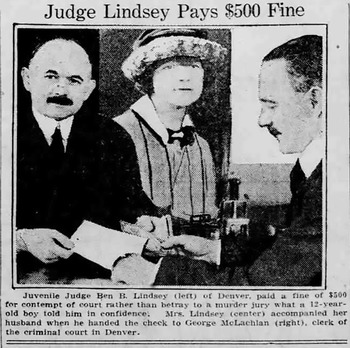
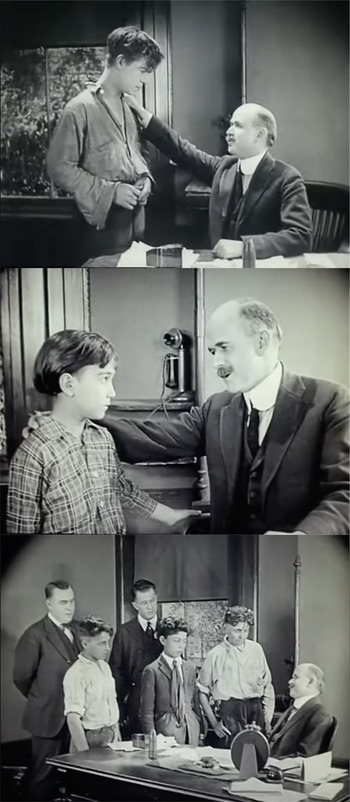
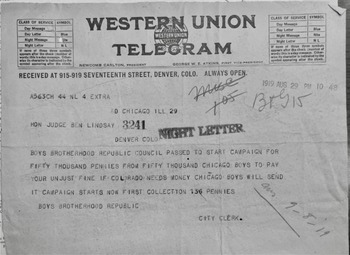
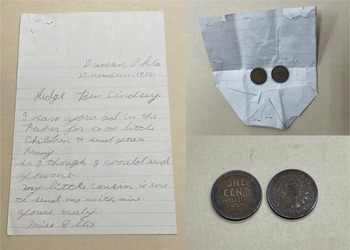
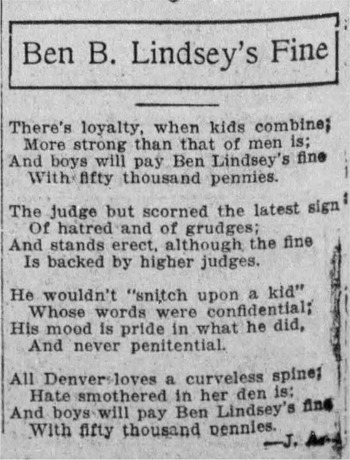
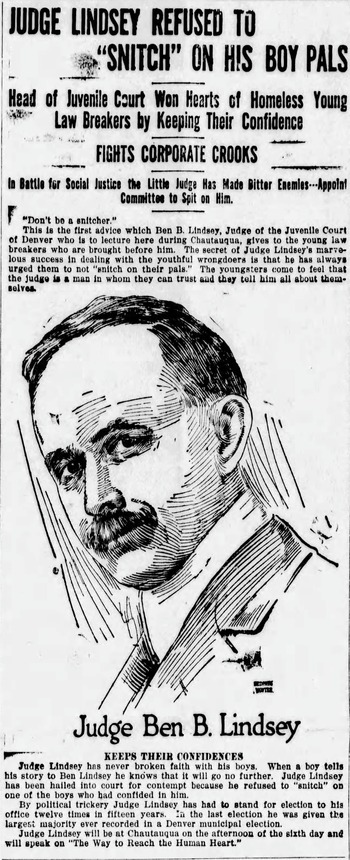

 Open access

