




In May 1921, the Japanese government forcibly deported Vasily Yakovlevich EroshenkoFootnote 1 (Russian: Василий Яковлевич Ерошенко, 1890–1952), a 31-year-old blind Russian poet, accusing him of “propagating dangerous ideas” that threatened social stability. This forced expulsion drew public attention and marked a turning point in East Asian intellectual history. Although Eroshenko had previously published a few fairy tales in Japanese with the help of friends like playwright Akita Ujaku and occasionally delivered public lectures, he remained largely outside the public spotlight until his removal from Japan. It was this political persecution that brought his literature and ideas to wider circulation and attention.Footnote 2
Eroshenko’s arrival in China coincided with the transformative cultural ferment of the May Fourth period – a critical moment when Chinese intellectuals were reassessing both their nation’s future and its relationship to global ideological currents. Domestic disappointments with the newly established republican system, which, as Xu Jilin notes, “lacked the constitutionalism upon which the system depended” and “the public culture essential for institutional practice,”Footnote 3 had already prompted a shift from institutional reform toward more fundamental cultural and social reconstruction. This internal disillusionment intersected with global upheavals, particularly World War I and the 1917 Russian Revolution, which challenged the presumed superiority of Western European political models. The Russian Revolution especially offered what appeared to be a viable alternative path of development, leading May Fourth intellectuals to increasingly associate, in Wang Fansen’s words, “the idea of ‘constructing society’ with social revolution.”Footnote 4 Within this intellectual environment – characterized by the rise of vernacular literature, growing interest in socialist ideas, and fierce debates over China’s relationship with Japan – Chinese thinkers actively absorbed diverse foreign ideologies, including anarchism, populism, Marxism-Leninism, and cooperativism. It was precisely in this climate of ideological exploration and cultural reimagining that Eroshenko’s personal ordeal as a blind Russian writer facing political persecution resonated powerfully with Chinese intellectuals, particularly in Shanghai and Beijing, where his commitment to Esperanto connected with the language movement’s second wave of popularity as a practical embodiment of international solidarity.
This paper examines the construction of Eroshenko’s image through visual media, especially the work of Chu Baoheng (褚保衡), whose photographs of Eroshenko appeared in prominent periodicals like The Eastern Times (Shibao, 時報) and The Republic Daily (Minguo Ribao, 民國日報). While existing scholarship on Eroshenko primarily focuses on his literary reception,Footnote 5 his thoughts,Footnote 6 and his activities in China, his visual representation remains relatively underexplored – Rapley (Reference Rapley2024) explores Eroshenko’s portrayal in Japanese modern art, particularly through Nakamura Tsune’s portraits, using them to examine his social networks and Japan’s early 20th-century cosmopolitanism, while highlighting the symbolic and subversive nature of his image.Footnote 7 However, the visual representation of Eroshenko in China remains largely unstudied, a gap this study seeks to address.
W.J.T. Mitchell’s concept of “metapictures” – “pictures that reflect on the process of pictorial representation itself”Footnote 8 – provides a particularly productive approach for understanding these visual representations beyond documentation. The photographs function as material instantiations of a complex “image” circulating through Chinese intellectual discourse, functioning as sites of cultural negotiation that reveal the interactive experiences between May Fourth intellectuals and Eroshenko as a political exile, Esperantist, and representative of the Russian intelligentsia or non-noble intellectuals (raznochintsy разночинцы). Through this theoretical lens, we can interpret Eroshenko’s portraits across multiple semiotic registers: as documentary evidence of his physical presence in China, as cultural symbols encoding revolutionary ideals, and as reflective surfaces navigating the complex interactions between tradition and modernity.
This study analyzes Chu Baoheng’s photographs through four interconnected analytical dimensions: (1) how prominent Chinese intellectuals strategically framed Eroshenko’s expulsion from Japan through translations and media coverage, constructing him as a political exile and humanitarian symbol; (2) how Chu’s Shanghai photographs, particularly at Stopani’s memorial, encoded revolutionary solidarity as a form of “visual Esperanto”; (3) how Chu’s Beijing photographs, especially the iconic “poet on a donkey” image, transformed Eroshenko into a transcultural icon by merging Eastern scholarly traditions with revolutionary modernity; and (4) how the contradictory narratives of Eroshenko’s “loneliness” (Jimo 寂寞), revealing tensions between photographic evidence of social integration and textual accounts of isolation. This analysis contributes to understanding both Eroshenko’s significance in Chinese intellectual history and how visual media construct cultural memory during periods of social transformation.
The paradoxical nature of Eroshenko’s representation – particularly between visual evidence of integration and textual accounts of isolation – reveals how May Fourth intellectuals projected their own ambivalent position between nationalism and cosmopolitanism onto this transnational figure. This “imagetext” dialectic, or, the inseparable relationship between visual and verbal elements in constructing meaning, illuminates the complex cultural negotiations that characterized China’s engagement with global modernity during this pivotal historical moment.
Visual circulation and strategic translations: the literary construction of the exiled poet
Between 1919 and 1924, five world-renowned scholars were invited to China, marking what contemporaries viewed as a pivotal moment in China’s intellectual engagement with global thought following World War I.Footnote 9 Eroshenko’s journey to China, however, followed a different path. Unlike the established figures who were invited by renowned domestic scholars and engaged primarily through formal lectures at elite institutions,Footnote 10 Eroshenko’s cultural significance emerged through a nuanced interplay of political circumstances and media representation. As Lu Xun candidly noted, Eroshenko was “not a famous poet in the world,”Footnote 11 yet his status as a political exile with visual impairment created a compelling narrative that resonated deeply with May Fourth intellectuals seeking alternatives to Western European paradigms of modernity.
As Japanese scholar Fujii Shōzō notes, carefully orchestrated visual portraiture and public appearances were central to shaping Eroshenko’s public image.Footnote 12 The 1920 portrait (Figure 1) by Nakamura Tsune marked a pivotal moment in gaining Eroshenko’s public visibility. Selected for Japan’s Second Imperial Art Exhibition in the same year of its completion, and later acclaimed at the 1922 Paris Exhibition,Footnote 13 this formal portrait transcended mere physical representation to convey Eroshenko’s intellectual and emotional depth.
Portrait of Eroshenko.

The painting meticulously renders Eroshenko’s distinctive features – his curled golden hair, slightly furrowed brow, and tightly closed lips – creating a visage of pensive melancholy against a deliberately blurred background. The portrait’s somber lighting, frontal composition, and Eroshenko’s contemplative expression conveyed moral seriousness and depth of thought – visual qualities that aligned perfectly with the May Fourth Movement’s idealized vision of the modern intellectual while simultaneously hinting at the solitude that would later become central to Chinese intellectuals’ interpretation of his presence.
The Chinese media’s coverage of Eroshenko intensified following his expulsion from Japan in mid-1921. Publications like Awakening (Juewu 覺悟, supplement of The Republic Daily) strategically framed Eroshenko through three interconnected narratives: first, as a victim of political persecution, reporting his participation in Japan’s May Day parade alongside Socialist League membersFootnote 14 ; second, as a symbol of international solidarity, demonstrated through Tang Bokun (唐伯焜)’s vernacular poem expressing sympathy for the blind poet’s uncertain journeyFootnote 15 ; and third, as an embodiment of humanitarian idealism threatened by imperial oppression,Footnote 16 a framing that resonated with China’s own complex relationship with Japan and growing interest in alternative political ideologies after World War I.
What began as journalistic coverage soon evolved into a deliberate cultural project, orchestrated by prominent Chinese intellectuals. As news of Eroshenko’s persecution spread, Lu Xun (魯迅, 1881–1936), Zhou Zuoren (周作人, 1885–1967), Hu Yuzhi (胡愈之, 1896–Reference Hu1986), and members of the Literary Research Association (Wenxue Yanjiu Hui 文學研究會) systematically introduced his works to Chinese audiences.Footnote 17 Their August 1921 correspondence reveals a strategic framing of Eroshenko’s writing through the Association’s “literature for life” philosophy, positioning him as a voice for small, oppressed nations. Lu Xun’s translations of allegorical works like “The Narrow Cage” (xia de long 狹的籠) positioned Eroshenko as a representative of universal humanist values,Footnote 18 while Zhou’s translations of speeches such as “The Power of Spring” (chuntian yu qi liliang 春天與其力量) and “The Necessity of a Common Language” (gongyongyu zhi biyao 公用語之必要) emphasized themes of international solidarity and spiritual renewal.Footnote 19
The strategic selection and framing of these works reveal how May Fourth intellectuals engaged with Eroshenko at the intersection of literary and political concerns. This integrated approach challenges scholarly interpretations that have characterized the “Eroshenko fever” primarily through literary reception. While some scholarsFootnote 20 have emphasized the literary dimensions of his reception, and others have noted political aspects,Footnote 21 this paper demonstrates that these dimensions were inherently intertwined during the May Fourth period. The apparent distinction between literary and political spheres ultimately reflects differences in analytical emphasis rather than a fundamental separation in how Chinese intellectuals engaged with Eroshenko’s ideas.
This orchestrated introduction culminated in Eroshenko’s arrival in Beijing in February 1922, where – through Zhou and Hu’s recommendations – he secured an Esperanto instructor position at Peking University. Between March 1922 and April 1923, he taught Esperanto four days weekly while delivering ten lectures across various institutions.Footnote 22 This practical engagement with Esperanto distinguished Eroshenko from institutional advocates like Cai Yuanpei (蔡元培). While Cai promoted linguistic internationalism through formal university structures,Footnote 23 Eroshenko engaged at the grassroots level, creating opportunities for visual documentation that would significantly shape his public image.
His activities – particularly organizing the “Grand Esperanto Concert and Dance Festival” featuring performers from four nationsFootnote 24 and establishing free supplementary classes for off-campus learnersFootnote 25 – transformed him from abstract literary figure into a visible presence in Chinese social spaces. These public performances created opportunities for photographers like Chu Baoheng to document his integration into Chinese intellectual and cultural life, generating visual evidence that would both complement and sometimes contradict textual accounts of his experience. Through these public engagements, Eroshenko embodied what Hu Yuzhi described as “a movement of international peoples”Footnote 26 rather than merely theoretical discourse, making his physical presence an essential component of his cultural significance. His influence extended beyond his immediate circle to shape a generation of Chinese writers, including Wang Luyan, Ba Jin, and Ye Junjian,Footnote 27 who would continue to circulate and reinterpret his image long after his departure from China.
For Eroshenko, Esperanto represented not merely a linguistic tool but a tangible manifestation of the struggle for human liberation – a concrete expression of the humanitarian ideals that Chinese intellectuals had recognized in his literary works. This embodied praxis would become central to his visual representation in photographs that documented both his revolutionary commitments and his integration into Chinese cultural life. Through the strategic interplay of journalism, literary translation, visual portraiture, and public performance, Eroshenko evolved from a “banished Russian partisan” into a multifaceted cultural presence in China. This carefully orchestrated introduction positioned him in several key roles: an Esperantist facilitating transnational communication, a Russian non-noble intellectual modeling democratic knowledge production, and a poet who aestheticized daily life while maintaining what Lu Xun called a “childlike, yet beautiful and pure heart”Footnote 28 despite political persecution. His framing as an exiled revolutionary resonated transnationally, connecting parallel intellectual movements across East Asia.
Sho Konishi observes that in Japan, “the blind youth Eroshenko served as the virtuous and poetic messenger of Esperanto and worldism from the Russian heimin [common people],”Footnote 29 directly paralleling Chinese intellectuals’ positioning of him as an exemplar of the Russian raznochinets tradition. In both contexts, Eroshenko’s physical appearance – his blindness, simple clothing, and distinctive mobility practices – functioned as powerful visual signifiers transforming him from foreign visitor into a living embodiment of alternative modernity that photographers like Chu Baoheng would later capture through deliberate aesthetic choices. This carefully constructed image converged with the May Fourth cultural ideal of “the human being” (ren 人), expressing through both textual and visual media a yearning for authentic human connection that transcended national boundaries.
The Zhou brothers’ home, where Eroshenko resided during his Beijing sojourn, became a crucial site where this cultural negotiation materialized in everyday practice and, significantly, became available for visual documentation. The household transformed into a significant nexus where literary translation, pedagogical practice, and intellectual exchange converged in intimate domestic space. It was in this environment that photographer Chu Baoheng would capture a series of images that mediated Eroshenko’s presence for Chinese audiences, providing a visual counterpart to the textual framing established through translations and journalistic accounts. As we will see in the following analysis, Chu’s photographs captured both Eroshenko’s physical presence and the subtle nuances of his position as both insider and outsider in Chinese intellectual circles. As both victim of imperial persecution and embodiment of cross-cultural humanist ideals, Eroshenko offered May Fourth intellectuals a powerful symbol – visually encoded through Chu’s sophisticated photographic practice – for their own complex position between nationalism and cosmopolitanism, between resistance to imperialism and aspiration toward universal human values.
Exiled revolutionaries as visual allegory: Chu Baoheng’s photographic translation of Russian Esperantists
Chu’s photographic practice emerged within the broader transformation of photography in early Republican China. While foreign missionaries, diplomats, and travelers had introduced the medium decades earlier, it wasn’t until the early 1920s that Chinese intellectuals, particularly those with foreign education, began actively engaging with photography as both artistic practice and social documentation. By 1920, university campuses in Shanghai and Beijing had established photography societies, reflecting new approaches to visual representation that merged Western techniques with Chinese aesthetic traditions.Footnote 30 For Chu, photography functioned as a “universal art” (pubian de yishu 普遍的藝術)Footnote 31 that transcended linguistic barriers – a visual counterpart to the Esperanto movement’s ideal of universal communication. This conception resonates profoundly with Mitchell’s theoretical framework, which draws on Wittgenstein’s notion that images constitute a form of communication that bypasses the limitations of verbal language, creating what Mitchell terms “a theoretical object” with its own logic and communicative power. Just as Wittgenstein suggested that certain truths can only be shown rather than said,Footnote 32 Chu’s photographic philosophy embraced the editorial perspective of the Times Illustrated Weekly:
[T]here are things that cannot be described in words, and must be clarified through pictures… Now that the people are fettered and governance has yet to be clarified, this publication will continue where literature falls short, revealing everything one by one, depicting exhaustively, so that the world may observe and be moved.Footnote 33
This philosophical approach directly informed Chu’s representation of Eroshenko, transforming the blind poet from mere subject into a visual embodiment of revolutionary possibility that communicated across cultural and linguistic boundaries in ways text alone could not achieve.
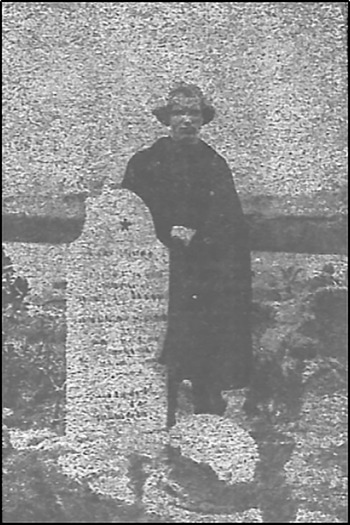
When Chu first encountered Eroshenko at a Shanghai treatment center in October 1921,Footnote 34 he recognized an opportunity to visually document a figure whose narrative was already circulating through Chinese intellectual discourse. The resulting photograph – one of the most significant in Chu’s Eroshenko series – deploys sophisticated visual rhetoric to encode multiple layers of meaning. It shows the poet dressed in dark attire standing beside Stopani’s memorial, his face positioned directly toward the camera in a dignified stance (Figure 2). The stark contrast between Eroshenko’s dark clothing and the white tombstone creates a powerful visual dialectic that dominates the image. Both elements present similar upright forms, creating a compositional solemnity that compels viewers to confront mortality’s stillness. The background – typical Yangtze Delta farmland – appears deliberately blurred, focusing attention on the central figures while creating atmospheric depth that enhances the image’s contemplative quality.
“The Blind Poet,” 1921.

The Esperanto-inscribed tombstone with its five-pointed star positions Esperanto and Russian intellectuals as central image elements, while the visual contrast between Eroshenko’s dark-clad figure and the white tombstone represents a spiritual connection between two Russian commoner intellectuals united by shared ideals of international solidarity. This photograph documents a specific historical encounter: Eroshenko’s visit to the memorial of Vadim A. Stopani, an Italian-Russian Esperantist and anarchist who died by suicide in 1921.Footnote 35 Through their shared commitment to Esperanto and revolutionary politics, Stopani, Eroshenko, and Chinese intellectuals like Hu Yuzhi formed a transnational network offering alternatives to the dominant Western European models of modernity. Chu recounts this solemn visit:
One day, he [Eroshenko] accompanied us to the public burial site on B Road to pay respects to a deceased Russian youth. After lunch at the Y Club… we traveled by tram to the burial site, where we located the grave of the young Russian Esperantist. Mr. Fuquan read aloud the Esperanto inscription on the tombstone. Eroshenko maintained a solemn presence, standing silently for an extended period; his sorrowful sympathy perhaps reflecting contemplation of his own circumstances.Footnote 36
This account gains deeper significance when contextualized within the institutional framework of Eroshenko’s activism. The “Y Club” functioned as the informal hub of the Shanghai Esperanto Association, a space central to his revolutionary work. Japanese intelligence documents noted that Eroshenko’s presence “substantially reinvigorated the Esperanto community, reversing its decline.”Footnote 37 Viewed against this institutional backdrop, Eroshenko’s “sorrowful sympathy” at Stopani’s grave represents not merely personal sentiment but a profound recognition of their shared revolutionary trajectory. Standing before the white tombstone, Eroshenko confronted a reflection of his own exilic condition. Their parallel commitments to transformative praxis – Stopani through his ultimate self-sacrifice, Eroshenko through his persistent advocacy despite political persecution and physical limitations – established a revolutionary dialectic that transcended their individual circumstances.
This documentation of exile consciousness aligned with Chu’s own commitment to social transformation. His active membership in the Peking University Consumer Cooperative (Beida Xiaofei Gongshe 北大消費公社)Footnote 38 reflected an intellectual kinship with the practical activism of Russian Esperantists. Photography became Chu’s vehicle for “going to the people” – a central May Fourth Movement concept, which represented intellectuals’ commitment to engaging directly with ordinary citizens beyond traditional political frameworks.Footnote 39 He directly connected his artistic practice to social activism, noting: “The mass movement in Beijing is quite famous in China, and half of my increased interest in photography came from this.”Footnote 40 Chu believed his images could document “the history of mass movements in China,”Footnote 41 embodying the spirit of self-sacrifice he admired in Eroshenko’s philosophy: “To help guide the people from darkness to freedom, one thing is absolutely indispensable: the great spirit of self-sacrifice.”Footnote 42 This quote represents the philosophical foundation of Chu’s approach to documentary photography as a form of social engagement.
Chu’s strategic publication timing reveals deeper layers of meaning in his visual narrative. By withholding the Stopani memorial photograph until 1923Footnote 43 – coinciding with Eroshenko’s imminent departure from China – Chu created a powerful visual continuity between the two Russian Esperantists that transcended their physical presence, as publications reported on Eroshenko’s departure and intellectuals like Zhou Zuoren and Wu Juenong (吳覺農, 1897–1989) composed farewell pieces. This timing transformed the photograph from mere documentation into what Mitchell terms the distinction between “pictures” and “images.”Footnote 44 As a material “picture,” the photograph was constrained by printing technology and newspaper formats in 1920s, yet as an “image,” it generated meanings that circulated throughout Chinese intellectual discourse, becoming a visual metaphor for revolutionary internationalism. Through this visual transformation, Chu revealed how displacement paradoxically becomes the foundation for transnational solidarity – exile shifts from mere physical condition to a revolutionary posture enabling critique from outside conventional hierarchies. This visual argument illuminates the May Fourth Movement’s complex negotiation between nationalism and cosmopolitanism, offering an alternative model of intellectual engagement grounded in lived experience rather than abstract theory.
The Shanghai photographs thus established Eroshenko’s revolutionary credentials through the symbolic connection to Stopani and the visual encoding of exile consciousness. Building upon this foundation, Chu’s Beijing series would further develop this visual narrative by repositioning the blind poet within the context of Chinese cultural and intellectual life. While the Shanghai images emphasized Eroshenko’s identity as a revolutionary exile, the Beijing photographs – particularly those taken at Zhou Zuoren’s traditional courtyard house – captured his integration into Beijing’s scholarly milieu. This evolution created a visual dialectic between revolutionary outsider and cultural insider that further enriched the complexity of Eroshenko’s representation in Chinese intellectual discourse.
The unseen harmony: Chu’s art photography of Eroshenko in Beijing’s intimate and social settings
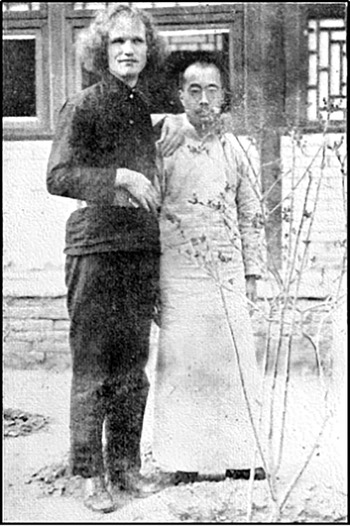
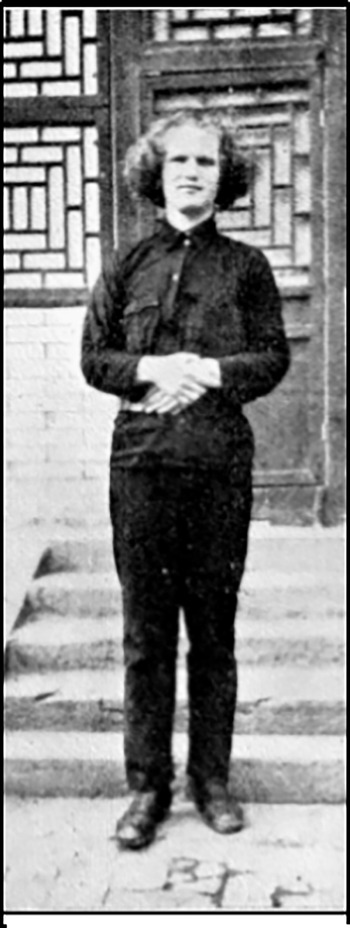
From the corpus of eight known photographs documenting Eroshenko’s Beijing period, five surviving images (Figures 3–7) can be definitively attributed to Chu Baoheng.Footnote 45 These photographs form a cohesive visual narrative that deliberately constructs Eroshenko’s cultural identity through careful aesthetic and compositional choices. The collection can be divided into two distinct settings: three intimate portraits (Figures 3–5) taken within Zhou’s traditional Beijing courtyard house (Siheyuan 四合院), and two outdoor scenes (Figures 6–7) capturing Eroshenko in Beijing’s public spaces.
Eroshenko and Zhou Zuoren, 1922.

Eroshenko, Zhou Zuoren’s son, and Fukuoka Sei’ichi, 1922.

Eroshenko.

Eroshenko and Fukuoka, 1922.

“The Blind Poet on a Donkey,” 1922.

Of the courtyard photographs, two achieved contemporary circulation in The Times Illustrated Weekly – Eroshenko with Zhou Zuoren (Figure 3) and with Fukuoka Sei’ichi (Figure 4) – while a third (Figure 5) remained unpublished until its later inclusion in The Complete Works of Eroshenko.Footnote 46 Collectively, these images employ multiple strategies to position Eroshenko within Chinese cultural space, creating “hypericons” – visual constructs that become “actors on the historical stage”Footnote 47 with autonomous rhetorical force rather than merely illustrating external ideas. As hypericons, these photographs actively shaped public perception of Eroshenko, transforming him from abstract foreign exile into a tangible presence within Chinese cultural space.
Unlike Chu’s Shanghai images that positioned Eroshenko within revolutionary martyrdom narratives, his Beijing photographs represent a significant aesthetic innovation that deliberately subverted conventional Chinese portraiture traditions. These images mark what can be considered “a third evolutionary phase” in Chinese photographic practice, transcending the two earlier stages identified by critic Sun Fuxi (孫福熙, pen name Shou Mingzhai 壽明齋): the “sacred image era” characterized by symbolic props and the period dominated by formal studio portraits with elaborate backdrops.Footnote 48 By rejecting these established conventions – particularly the formal studio settings and rigid poses that typified celebrity portraiture – Chu pioneered a naturalistic approach emphasizing authentic cultural integration rather than exotic otherness.
The courtyard photographs strategically incorporate elements of traditional Chinese domestic architecture, particularly the latticed window with its distinctive “well” (Jing 井) pattern – a visual motif that symbolically grounds the foreign visitor within Chinese cultural space. This inclusion creates what Mitchell describes as a “logical space”Footnote 49 – an interpretive framework that structures viewer engagement beyond mere visual recognition. Through this framework, Chu’s approach reveals an intimate domestic reality that deliberately destabilizes the conventional distinction between Eroshenko’s public persona as revolutionary exile and his private experience within Chinese intellectual circles. The latticed windows function as cultural signifiers that visually articulate Eroshenko’s position within Chinese domestic space, generating what Mitchell characterizes as “interactive experiences”Footnote 50 where meaning is actively negotiated between subject and viewer rather than passively transmitted.
The aesthetic sophistication in these photographs emerges from Chu’s dual identity as both photographer and painter, with membership in Peking University’s Painting Research Society (Beida Huafa Yanjiu Hui 北大畫法研究會) and Shanghai’s Chenguang Art Society (Shanghai Chenguang Meishu Hui 上海晨光美術會). This background positioned him within the “Art Photography Research Society” (Yishu Xiezhen Yanjiu Hui 藝術寫真研究會, later Guangshe 光社), “China’s first amateur photographers’ art alliance,”Footnote 51 where he developed a distinctive visual approach that constructed a compelling narrative of cultural integration. Following what he termed “art photography” (yishu sheying 藝術攝影) principles that merged traditional Chinese visual aesthetics with modern photographic techniques, Chu employed eye-level perspective – resonating with the egalitarian philosophies of the Guangshe photography movement – and used natural light filtering through latticed windows to create a soft, diffused illumination that revealed Eroshenko’s expressions of contentment. This lighting strategy creates a visual rhetoric of revelation that contrasts sharply with the shadowed face in the later “poet on donkey” image, prefiguring the tension between integration and isolation that would define Eroshenko’s representation in Chinese intellectual discourse.
Perhaps most significantly, Eroshenko’s smile in these domestic portraits conveys joy and social belonging that directly contradicts later textual emphasis on his “loneliness.” This visual evidence of contentment is reinforced by Chu’s own written accounts describing Eroshenko’s adaptation to Beijing life in decidedly positive terms, “He was staying at Professor C’s (Zhou Zuoren’s) house and was very happy; because of the Japanese-style lifestyle, he found it quite interesting… We all rode donkeys together to visit gardens… He enjoyed lively settings and readily attended any gathering.”Footnote 52
Both visual and written evidence consistently portray Eroshenko’s Beijing experience as characterized by cultural integration, social participation, and personal contentment. The written accounts by Fukuoka, who appears alongside Eroshenko (Figure 6), reinforce this visual narrative of integration and contentment. He recalled that the blind poet had “shaken off his depression”Footnote 53 from Shanghai and rediscovered happiness through serene donkey rides and companionship in Beijing.
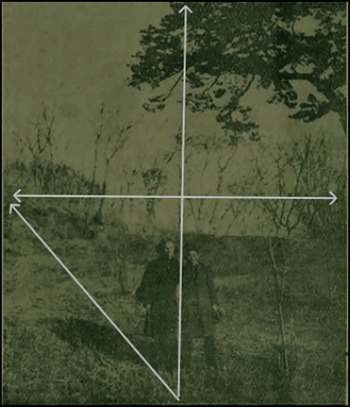
The outdoor photograph titled “Pine Shade”Footnote 54 (Songyin 松陰), upon publication, stands as Chu’s most distinctively Chinese-styled work in the series. Drawing on his training and cultural background, Chu employed traditional Chinese landscape principles to create what Liu Bannong envisioned as photography expressing “the unique emotions and rhythms of Chinese people through the camera.”Footnote 55 The photograph’s spatial arrangement adheres to the “Three Distances” (Sanyuanshuo 三遠說) principle formulated by Northern Song painter Guo Xi (郭熙, ca. 1000–1090), creating a harmonious balance between natural elements and human subjects through high, level, and deep perspective techniques.
As illustrated by the three-dimensional coordinate system overlaid on the image (added by the authors), the composition embodies all three classical perspectives. The “high distance” (gaoyuan 高遠) is represented by the vertical arrow pointing to the towering pine positioned in the upper right corner, photographed from a lower angle that creates an upward-looking perspective, evoking a sense of loftiness. The “level distance” (pingyuan 平遠) is indicated by the horizontal arrow showing the softly rendered distant trees and grounds extending toward the horizon, creating a sense of expansive space. The “deep distance” (shenyuan 深遠) manifests along the diagonal arrow, where layered composition creates distinct spatial planes, with the two figures standing beneath the pine shade while their elongated shadows extend to the left. This diagram helps visualize how Chu has masterfully incorporated the traditional “Three Distances” principle into his photographic composition.
This compositional technique employs what Chinese art tradition terms “scattered-point perspective” (sandian toushi 散點透視), achieved through Chu’s deliberate camera positioning at a slightly lower angle than his subjects. This creates an upward-looking perspective that emphasizes the towering pines while simultaneously maintaining a level viewpoint that highlights the human figures beneath, which aligns with traditional Chinese philosophical view that “humans follow the earth, the earth follows heaven, heaven follows the Dao, and the Dao follows nature” (ren fa di, di fa tian, tian fa dao, dao fa ziran 人法地,地法天,天法道,道法自然). The subjects are integrated into the landscape itself, embodying the “unity between heaven and humanity” (tianren heyi 天人合一) aesthetic central to Chinese artistic tradition.
These Beijing photographs construct an “unseen harmony” through sophisticated visual strategies: the blind Eroshenko’s paradoxical embodiment within careful compositions, the integration of traditional Chinese aesthetic principles with modern photographic techniques, and visual evidence of social integration that challenges textual narratives of isolation. By applying art photography principles to document a blind subject who could not see his own representation, Chu created a profound visual paradox that invites reflection on vision itself. Through Chu’s lens, Eroshenko becomes not simply a documented subject but a living embodiment of cultural synthesis – a harmony that transcends physical sight to suggest deeper possibilities for human connection across cultural and sensory boundaries.
The dialectics of vision and text: loneliness as cultural metaphor in May Fourth intellectual discourse
It is precisely against this backdrop of visual and documentary evidence of social integration that the most provocative aspect of Eroshenko’s representation in China emerges: a striking interpretive paradox in which the Zhou brothers’ textual accounts present a narrative of profound isolation that directly contradicts the photographic evidence. Lu Xun depicted Eroshenko lamenting, “Loneliness, oh, loneliness, like the loneliness in the desert!”Footnote 56 – a sentiment stemming from his dissatisfaction with Beijing’s human clamor rather than nature’s soothing sounds. Zhou similarly observed:
Although Eroshenko had only stayed in Beijing for four months, he had already felt the desolation of the desert. What we lack is indeed emotional nourishment, but it is not something that even this sensitive, unfortunate poet could feel so acutely, for we ourselves have become as accustomed to dryness as cacti.Footnote 57
This desert metaphor – a recurring motif in Zhou’s writing – resurfaced years later when he emphasized that “in this vast desert-like China, a life like the cactus – rough and harsh on the outside, but rich and nourishing on the inside – is our only path.”Footnote 58 Significantly, Zhou’s interpretation of Eroshenko’s “loneliness” underwent its own transformation over time. In his post-1949 essay “Loneliness,” written during a period of acute political marginalization, Zhou reframed his earlier 1920s view that had characterized Eroshenko’s solitude as exemplifying “the art of living.” Instead, he attributed this loneliness to specific external factors: limited impact of Esperanto teaching, language barriers with students, and dismissal by traditional scholars and elite May Fourth intellectuals like Hu Shi, who viewed Eroshenko merely as a foreign vagabond.Footnote 59 This interpretive shift aligned with Zhou’s precarious political position after 1949, when the “art of living” philosophy he had championed was thoroughly rejected by the new political order. The connection between photographer, subject, and interpreter became even more poignant through Zhou’s lifelong attachment to Chu’s photographs, which he carefully preserved and treasured until his final years.Footnote 60 This evolution reveals how visual artifacts accumulate new layers of significance as they travel through changing political landscapes, their meaning constantly renegotiated through different historical contexts.
This contradiction – between photographic evidence of joyful community and written assertions of existential isolation – opens a productive theoretical space for examining how visual and textual representations actively construct cultural meaning rather than merely documenting historical reality. Applying Mitchell’s concept of “imagetext” reveals how these contradictory representations function not as opposing historical accounts but as complementary dimensions of a complex cultural negotiation. Through this dialectical framework, Eroshenko simultaneously inhabits multiple subject positions: socially integrated yet existentially isolated, culturally assimilated yet perpetually foreign. This multivalent positioning aligns with what the Guangshe photographers theorized in their photographic practice, which emphasized the artistic interpretation of reality over literal documentation. As Liu Bannong’s influential photographic philosophy distinguished, “expressive meaning” (xieyi 寫意) should complement “literal representation” (xiezhen 寫真) – arguing that while documentary photography has “great usefulness” and represents photography’s “proper function,” artistic photography requires going “beyond the proper path to open another route” by seeking aesthetic beauty through photographic means. Liu maintained that while “technique,” or “technical skill” (shu 術), is sufficient for documentary photography, artistic photography requires both technique and “artistique,” or “artistic sensibility” (yi 藝), with the latter being an innate quality that “cannot be graded by percentages.”Footnote 61
The “desert-like” loneliness attributed to Eroshenko thus transcends mere psychological observation, functioning instead as a potent cultural-political metaphor operating on multiple levels: First, as a critique of China’s intellectual climate during the early Republican period, with the “desolation” felt by the sensitive foreigner revealing what Chinese intellectuals had become “accustomed to like cacti.” Second, as a mirror reflecting both the emotional aridity Zhou perceived in China’s cultural landscape and the broader alienation experienced by intellectuals caught between resistance to imperialism and aspiration toward universal human values. This tension between nationalism and cosmopolitanism created a profound sense of displacement for May Fourth intellectuals, who were simultaneously committed to China’s national sovereignty and to humanitarian ideals transcending national boundaries. At its most abstract level, the metaphor reflects the fundamental isolation of humanitarian values in an age dominated by national competition and imperial aggression – particularly evident in the Esperanto movement itself, which advocated universal communication while persistently encountering barriers in practice.
When juxtaposed against the visual evidence of Eroshenko’s integration, Zhou’s metaphor of “desert-like” isolation creates what Mitchell describes as a “dialectical image” – one that derives its significance precisely from unresolved tensions rather than reconciliation. Through this interplay of visual and textual representations, Eroshenko’s figure became a screen onto which Chinese intellectuals projected their own ambivalences about modernity, tradition, nationalism, and cosmopolitanism.Footnote 62 This visual-textual dialectic reveals a figure embodying profound contradictions: a blind poet who cannot see yet is seen, visually content yet textually isolated, integrated yet alienated, a universal communicator experiencing disconnection. These paradoxes illuminate the complex position of May Fourth intellectuals caught between resistance to imperialism and aspiration toward universal human values.
Visual dialectics of tradition and modernity: “The Blind Poet on a Donkey” as transcultural metapicture
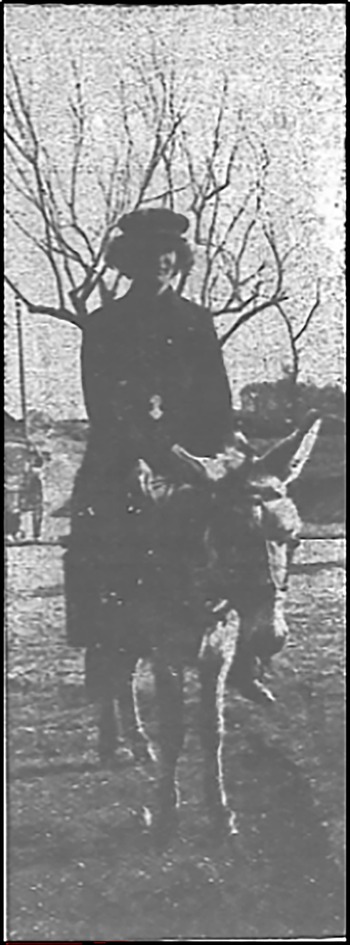
Having examined the dialectical tension between visual evidence of social integration and textual assertions of isolation, we now turn to the photograph that most powerfully embodies this productive contradiction. The tension between insider and outsider status finds its most profound visual expression in Chu’s “The Blind Poet on a Donkey” (lvbei de mang shiren 驢背的盲詩人, Figure 7). This image serves as a visual bridge, connecting the theoretical understanding of Eroshenko’s multivalent positioning with its concrete manifestation in visual form.
Among Chu’s photographic documentation of Eroshenko in China, this photograph achieved the most profound interplay of traditional Chinese aesthetics and modern photographic techniques. By deliberately positioning Eroshenko as a silhouetted figure seated on a donkey against winter trees, Chu evokes the classical Chinese literati motif while employing contemporary photographic methods, transforming Eroshenko from mere historical subject into a transcultural metapicture that reflects on the very nature of vision, representation, and cultural belonging. The image’s formal properties merit detailed analysis: its use of natural light and silver gelatin processes creates a powerful visual dialectic between the solid, dark human-donkey form and the ethereal, textured background of winter branches – a visual argument that both complements and complicates the textual accounts of isolation.
The formal properties of this image reward close visual analysis. First, the dramatic shadow across Eroshenko’s face – contrasting sharply with the clear visibility of his features in the courtyard photographs – creates a visual parallel to his blindness, inviting viewers to experience something of his sensory reality. Second, the vertical tree trunk rising behind him appears to emerge from his shoulders, creating a visual metaphor of growth and connection to nature that echoes traditional Chinese landscape painting techniques. This composition establishes the human-donkey silhouette as what Liu Bannong termed the “subject principal” (huazhu 畫主) while using the winter trees as “subordinate elements” (peicong 陪從) that frame and contextualize the central figure. The vertical alignment of Eroshenko’s body with the tree trunk creates a single dominant visual line that prevents the branching limbs from introducing visual chaos. As Liu noted in his photographic theory, “supporting lines should not be too numerous; too many would make the composition cluttered and destroy its structure.”Footnote 63 Unlike typical portrait photography where the eyes serve as the focal point, Chu deliberately shifts attention away from Eroshenko’s unseeing eyes, instead creating a visual extension through the vertical alignment with the tree trunk that metaphorically transcends the poet’s physical limitations – honoring his blindness while suggesting spiritual elevation.
Third, the photograph’s composition deliberately places Eroshenko off-center in the frame, creating negative space that amplifies the contemplative mood. This asymmetrical balance resonates with Chinese literati aesthetic principles that value suggestiveness and restraint. The compositional choice creates visual tension that would be absent in a more centralized arrangement – where central positioning might convey stability, formality, or monumentality, this off-center placement instead generates a sense of movement, transience, and philosophical inquiry. The winter setting, with bare trees against a minimalist landscape, further enhances the image’s philosophical resonance, evoking the traditional literati value of finding beauty in austerity and simplicity rather than ornamental excess.
This philosophical dimension is further enhanced by Eroshenko’s deliberate choice of donkey transportation – a performative act of cultural positioning with profound sociopolitical implications. Despite his adequate financial means (earning 200 yuan monthly at Peking University) and the availability of modern alternatives like rickshaws that might offer greater convenience for a blind traveler,Footnote 64 Eroshenko deliberately chose the donkey – a mode of transport associated with common people and traditional scholarly practice. This choice carried particular significance in 1920s Beijing, where rickshaws had become increasingly associated with colonial exploitation and social inequality.Footnote 65 By choosing the donkey over the rickshaw, Eroshenko aligned himself with Chinese scholarly traditions – paralleling his earlier adoption of the rubashka (a humble Russian peasant’s cotton blouse) in Japan, which became “a politicized fashion in Taishō Japan.”Footnote 66 Both choices visually embodied his commitment to commoner values beyond mere theoretical advocacy,Footnote 67 creating a consistent visual rhetoric of solidarity with ordinary people across national contexts.
In Chinese cultural tradition, the poet-on-donkey motif carries specific intellectual and spiritual significance that further enriches Eroshenko’s visual representation.Footnote 68 The donkey’s affordability and slowness metaphorically suggested scholarly hardship, while its gentleness aligned with ideals of simple living and contemplative engagement with landscape. From Northern Song paintings like Cold Forest with Scholar on Donkey (Hanlin qilv tu 寒林騎驢圖) to Yuan Dynasty literati works, this imagery embodied contemplative movement and Daoist philosophy of “returning to simplicity” ( fanpu guizhen 返樸歸真). By positioning Eroshenko within Chinese cultural tradition, Chu transforms the blind poet into a multivalent cultural symbol bridging modern photography with literati aesthetics, recalling classical depictions like Snow and Wind Landscape at Ba Bridge (Baqiao fengxue tu 灞橋風雪圖) or Riding a Donkey Back Home (Qilv guisi tu 騎驢歸思圖), and transforming the blind poet into a figure of intellectual grace with distinctly Chinese cultural resonances.
This visual representation carries additional significance when considered alongside the “desert-like loneliness” discussed in the previous section. The donkey itself becomes a dialectical symbol – simultaneously representing traditional scholarly values and physical isolation from modern urban society. Through this mode of transportation, Eroshenko embodies both cultural integration (through adoption of Chinese scholarly traditions) and deliberate rejection of the inhumane exploitation and oppression prevalent in contemporary daily life (through refusing to use rickshaw pullers), which aligns with his humanitarian ideals and his commitment to social justice. This duality perfectly encapsulates the complex position of May Fourth intellectuals who sought to balance cultural tradition with revolutionary modernity, national identity with cosmopolitan ideals.
The metapictorial qualities of “The Blind Poet on a Donkey” thus operate on multiple levels simultaneously: as documentary evidence recording a specific historical moment; as cultural symbol positioning Eroshenko within Chinese scholarly tradition; and as philosophical metaphor exploring the paradoxes of vision and blindness, integration and isolation that characterized his complex position within May Fourth intellectual discourse. Through this single, carefully composed image, Chu creates a visual argument that encapsulates the central tensions defining Eroshenko’s significance in Chinese cultural memory.
Conclusion
The visual construction of Eroshenko in 1920s China reveals a sophisticated interplay between documentary record and cultural imagination that transcends mere historical documentation. Through Chu Baoheng’s photographs, Eroshenko was transformed from political exile to transcultural icon operating across multiple registers: as documentary evidence of transnational intellectual exchange, as cultural artifacts encoding negotiations between tradition and modernity, and as “metapictures” reflecting on the nature of vision itself – particularly significant given their blind subject. The dialectical tensions between photographic evidence of social integration and literary accounts of isolation mirror the broader paradoxes defining the May Fourth era: between cosmopolitanism and nationalism, between revolutionary rupture and cultural continuity. The iconic “(lonely) poet on a donkey” image thus became a powerful metaphor through which Chinese intellectuals articulated their own ambivalent position between resistance to imperialism and aspiration toward universal human values.
This analysis shows how photographs function not as passive records but as active participants in constructing cultural memory and intellectual identity. The evolution of Eroshenko’s “loneliness” in Chinese cultural memory – from literal description to metaphorical construct to retrospective projection – demonstrates how visual artifacts accumulate significance across changing political landscapes, illustrating how “metapictures” operate within specific historical contexts. By tracing how Eroshenko’s visual representation evolved from revolutionary exile in Shanghai to literati scholar in Beijing, this study illuminates the complex processes through which transnational figures become screens onto which local intellectual concerns are projected. Ultimately, this case study offers a methodological model for analyzing the visual construction of cultural memory during periods of intense social transformation, revealing the complex negotiations between vision and blindness, East and West, tradition and modernity that characterized China’s pivotal engagement with global modernity during the May Fourth period – negotiations that continue to inform our understanding of how visual media shape cultural identity in transnational contexts.
Acknowledgements
This research is supported by the Guangzhou Philosophy and Social Sciences Development Project (No. 2025GZGJ10) and the Fundamental Research Funds for the Central Universities (No. QNZD202405). We would also like to express our sincere gratitude to the anonymous reviewers for their valuable comments and suggestions that greatly improved the quality and theoretical depth of this manuscript.
In preparing this article, an AI language tool (ChatGPT) was used for linguistic enhancement, including grammar correction and readability improvements. All research content, ideas, analyses, and interpretations are the authors’ original work, and the authors maintain full responsibility for the accuracy and integrity of this manuscript.
Competing interests
The authors declare no conflicts of interest.



 Open access

