




Introduction
The Arabic phrase shuhūr sanah or ‘months of the year’ is used all over the Islamic world to refer to the lunar Hijri calendar. From the fourteenth century onwards in Deccan India, however, the phrase has been understood to refer to a new solar calendar of the same name, often called the ‘Shuhur era’ in scholarly writing.Footnote 1 Certainly, a calendar with the name shuhūr sanah existed in the Deccan, but the circumstances under which it emerged remain an enigma. Scholars have posited 1344–1345 CE as the inaugural year of the calendar,Footnote 2 but, to date, no evidence from the fourteenth century has been offered to mark the emergence of the Shuhur era. Simply put, the 1344–1345 CE date is not supported by any primary documentation. In this article, I discuss a 1333–1334 CE epigraph from Daulatabad, a fortified city in Deccan India, that uses the phrase shuhūr sanah and argue that it is the earliest recorded usage of the Shuhur era in the Deccan.Footnote 3 I furthermore argue that the calendar was instituted as part of agricultural reforms during the reign of the Delhi Sultan Muhammad bin Tughluq (r. 1326–1351) in the 1330s. By this time, Tughluq had made Daulatabad a capital of his empire and experimented with making copper coins legal tender. The Shuhur era, I suggest, was introduced shortly after these administrative experiments to systematise agricultural tax collection, even as its implementation was hampered in northern India by the onset of a famine. The calendar, nonetheless, was successfully implemented in the Deccan and the Daulatabad epigraph provides a piece of this missing history.
More broadly, I examine the Persianate epigraphic data on the Shuhur era to explore how the calendar was used in pre-modern Deccan (Table 1). The data reveal that, while the calendar might have begun in the 1330s, it gained a broader purchase in the late sixteenth and early seventeenth centuries, when it was used to make a variety of public announcements. This time period coincided with effervescence in the cultural life of the various Deccan sultanates, as has been discussed in much recent scholarship.Footnote 4 After the 1670s, however, the calendar was seldom used in Persianate epigraphical records, indicating that, as Mughal (1456–1857) power rose in the Deccan over the seventeenth century, the Shuhur era was gradually phased out and replaced by the Mughal regnal and Fasli calendars.Footnote 5
Persianate epigraphic corpus utilising the Shuhur era

Note: I have not retained diacritics in the description.
The historiographical discussion on the Shuhur era is closely tied to the study of Persianate epigraphy.Footnote 6 Aside from pithy overviews of the calendar in general studies on Indian timekeeping, the only two detailed articles on the subject have been published in volumes on Persian and Arabic epigraphy, namely M. Nazim’s ‘Note on the Shahūr San’ (1936) and Marie H. Martin’s ‘The Shuhur San’ (1971).Footnote 7 The primacy of ‘Islamic’ epigraphy in discussions of the Shuhur era is not difficult to understand: the calendar consistently used Arabic numerals and the best examples that established the Shuhur era as distinct from the Hijri era came from Persian epigraphs. As texts that face out to various publics, epigraphs also allow us to gauge the broader dissemination of certain ideas—here, the usage of a novel calendrical system. For these reasons, I have chosen to focus on Persianate epigraphs in this article. Many of these epigraphs give two dates—one in Hijri and the other in the Shuhur era—and such information has helped scholars tabulate a concordance between the two calendrical systems. The lunar Hijri calendar has 354 days, on average. The solar Shuhur calendar has 365 days, on average. The annual difference between these two calendars is 11 days, which means that, every 33 years, the calendars diverge by a unit of one. Every century, the two calendars diverge by a little over three years. Martin provides a comprehensive discussion of the mathematical calculations that help compute the concordance of the Shuhur era with the Hijri era and the Common Era.Footnote 8 Here, let me simply note that adding 599/600 to the Shuhur year results in the corresponding Common Era year. Thus, 733 Shuhur = 1332–1333 CE. This calculation holds true for most historical examples that use the Shuhur era, although, as we shall see, some examples are anomalous. In some other cases, what at first glance appears to be the usage of the Shuhur era refers simply to the Hijri calendar.
A survey of the relevant Persianate epigraphs that utilise the Shuhur era has not before been undertaken. To build my dataset, I have relied on three topographical lists of Arabic, Persian, and Urdu inscriptions from southern, western, and central India (Table 1). These lists—compiled by Ziyaud-din Desai and Syed Abdur Rahim—are the most thorough compilations of epigraphical information from the Deccan that we currently have.Footnote 9 Aside from including epigraphs in Arabic, Persian, and Urdu, these lists also include inscriptions in other regional languages that occurred in a Persianate context and utilised the Shuhur era, notably Marathi and Telugu. Indeed, the Shuhur era was commonly used in Marathi sources throughout the nineteenth century. Many Marathi epigraphs that use the Shuhur era come from the modern state of Maharashtra and the northern region of Karnataka that border Maharashtra—areas that evidently had a public literate in Marathi. While I focus on Persianate epigraphs, I also discuss a few other examples, including coins and Marathi texts, to illustrate the broader usage of the Shuhur era. Nonetheless, a fuller survey of Marathi texts, outside the scope of the current study, would shed further light on the continued adaptation and use of the Shuhur era in the western Deccan.
The article is divided into three sections. In the first, I discuss the Daulatabad epigraph and explain why we should view this text as providing evidence that the calendar was inaugurated in the 1330s. In the second section, I examine some representative historical epigraphs that utilise the Shuhur era and discuss the actual usage of this calendar era as well as some of the conundrums posed by the appearance of the phrase shuhūr sanah in primary records. In the final section, I discuss the colonial and the modern historiography of the Shuhur era to reveal some of the assumptions that have been made in the study of this calendar. These assumptions, in turn, have precluded a historically contingent study of the calendar. Aside from re-examining the origin of the Shuhur era, another parallel aim of the article is to offer a broader analysis of the historical contexts in which the calendar was utilised. Table 1 is intended to give the reader a fuller sense of the various epigraphical contexts in which the Shuhur era finds a mention.
The Daulatabad epigraph and the usage of the Shuhur era
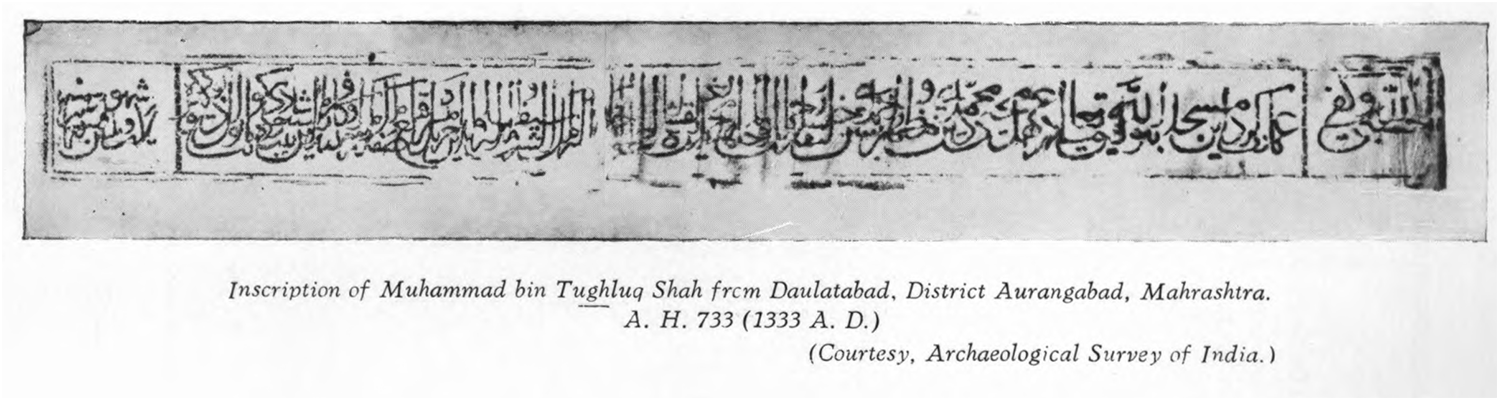
The earliest recorded mention of the phrase shuhūr sanah in the Deccan comes from a now-lost Persian and Arabic epigraph at Daulatabad. The epigraph was first translated and published in 1966 by Ziyaud-din Desai, who worked from a rubbing preserved at the Office of the Superintendent for Persian and Arabic Inscriptions, Archaeological Survey of India, Nagpur.Footnote 10 The epigraph was carved on two slabs of stone, although their exact find spot is unknown. Desai mentions that one of the slabs was ‘discovered while cleaning the debris, etc. inside the fort of Daulatabad’.Footnote 11 The inscription is visually divided into three units (Figure 1). Reading from right to left, we find an Arabic invocation in the rightmost unit, a Persian text with Arabic phrases and titles in the middle unit, and an Arabic date with the phrase shuhūr sanah in the leftmost unit. The entire text is written in prose in the naskh script and measures 21.8 m by 20 cm. Below, I have reproduced the Persian text and Desai’s translation; I have made minor clarificatory changes to both. I have also included a transliteration (Figure 2).
Dot chart showing the temporal span of shuhūr sanah usage from epigraphs listed in Table 1. Source: Courtesy of Allie Scholten.

Text
[Rightmost unit in Arabic]:
حسبي الله و کفي
[Middle unit in Persian with Arabic phrases and titles]:
عمارت کرد این مسجد بتوفیق الله تعالی در عهد محي دین محمدی و مظهر سنن احمدی خلیفه بتائید رحمان ابو المجاهد محمد بن تغلق شاه السلطان خلد ملکه ملک الشرق سیف الدولة و الدین آخربیک میسره قتلغ ملک صفدر مکنه الله و کار فرما این بیت ستوده شادی نائب کوتوال دیوگیر بوده
[Leftmost unit in Arabic]:
شهور سنة ثلاث و ثلثین و سبعمائة
Transliteration
[Rightmost unit]: ḥasbī allah wa kafī
[Middle unit]: ʿimārat kard īn masjid ba-tawfīq allah taʿālā dar ʿahd muḥyin dīn muḥammadī wa maẓhar-i sanan-i aḥmadī khalīfah bi-tāʾīd raḥmān abū al-mujāḥid muḥammad bin tughluq shāh al-sulṭan khallada mulkahu malik al-sharq saif al-dawlat wa al-dīn ākhurbik-i maysara qutlugh malik ṣafdar mukna allah wa kār farmā īn bayt-i sitūdah shādī nāʾib kūtwāl-i dīwgīr būdah.
[Leftmost unit]: shuhūr sanah thalāth wa thuluthīn wa sabʿamāʾiah
Rubbing of the 1333–1334 CE inscription from Daulatabad. Source: Z. A. Desai, ‘Two Tughluq inscriptions from Daulatabad’, in Studies in Indian Culture: Dr. Ghulam Yazdani Commemoration Volume, (ed.) H. K. Sherwani (Hyderabad, 1966), insert between pp. 80 and 81.

Translation
[Rightmost unit]: Allah is sufficient for me and [He alone] is sufficient!
[Middle unit]: This mosque (masjid) was built through the guidance of Allah the Exalted, during the period of the Reviver of the Religion of Muhammad (dar ʿahd muḥyin dīn muḥammadī)Footnote 12 and the Manifester of the Traditions of Ahmad (maẓhar-i sanan-i aḥmadī), the Viceregent (khalīfah) with the support of the Compassionate Lord, the Sultan Abu al-Mujahid Muhammad son of Tughluq Shah, [may God] perpetuate his kingdom (khallada mulkahu), by Malik al-Sharq Saif al-Dawlat wa al-Din, Superintendent of the Royal Stables of the Left Wing (akhūrbik-i maysara), Qutlugh Malik Safdar, may Allah strengthen his position, and the person who ordered (kār farmā) [the making of] this praiseworthy house (bayt-i sitūdah) was Shadi, the Deputy Officer (nāʾib-kūtwāl) of Deogir (dīwgīr).
[Leftmost unit]: shuhūr sanah three and thirty and seven hundred (=733).
As is evident from the translation, the inscription records the construction of a mosque during the reign of Muhammad bin Tughluq, commissioned by a superintendent of the Royal Stables of the Left Wing (akhūrbik-i maysara), Qutlugh Malik Safdar. The person who oversaw the project is an individual named Shadi, who is the deputy officer (nāʾib-kūtwāl) of Deogir (dīwgīr). A person with the rank of akhūrbik-i maysara, Malik Safdar Malik Sultani, is mentioned in the list of nobles of Muhammad Tughluq’s court compiled by the contemporaneous historian Barani (circa 1285–1357) in the Tārīkh-i Firūz Shāhī (History [until the reign of] Firuz Shah, 1355 or 1357).Footnote 13 Unfortunately, no further detail is known about him. Similarly, little is known about the deputy officer, Shadi, although Desai has pointed out that he might be the same person who became the deputy chamberlain of Alauddin Bahmani (r. 1347–1358) after the foundation of the Bahmani Dynasty (1347–1490).Footnote 14
The phrase shuhūr sanah shows up towards the end of the inscription, where it is mentioned that the mosque was constructed in شهور سنة ثلاث و ثلثين و سبعمائة (shuhūr sanah thalāth wa thuluthīn wa sabʿamāʾiah).Footnote 15 Desai translates this phrase as ‘[in] the months of the year three and thirty and seven hundred’, writing that the date mentioned here is 733 AH. He reasons that the date can only be read as belonging to the Hijri era, for the Shuhur era was not introduced until 743 or 744 AH.Footnote 16 To support this statement, Desai cites Nazim’s ‘Note on the Shahūr san’, which I discuss further below.Footnote 17 As will become clear later in the article, however, the date assumed for the inauguration of the Shuhur era—743 or 744 AH—has no basis in any primary documentation. This date was posited by colonial scholars by counting back in time to account for the mathematical divergence between the Shuhur, Hijri, and Gregorian calendars.Footnote 18 Nineteenth-century scholars describing the Shuhur era had assumed that the calendar was inaugurated in a year in which the starting dates of the Shuhur and the Hijri eras coincided. Such an assumption, however, was proven to be baseless by Martin in her pioneering study of the Shuhur calendar.Footnote 19 Martin rectified many mathematical mistakes that earlier scholars had made in tabulating the Shuhur calendar and demonstrated that there was no reason to believe that the starting dates of the Shuhur and the Hijri eras ever coincided. The extensive concordance tables between the Shuhur, Hijri, and Gregorian calendars that accompanied Martin’s article do not have any year in which the starting dates of the Shuhur and Hijri eras are the same.Footnote 20 Nonetheless, Martin did argue that the Shuhur era could only have been introduced between 745 and 766 Hijri.Footnote 21 Martin assumed that, even if there was no year in which the Shuhur and the Hijri calendars began together, it was probably the case that the Shuhur year began after the corresponding Hijri year. In years prior to 745 Hijri, the first date of the Shuhur calendar would have preceded the first date of the Hijri calendar. Martin rules out this latter possibility without offering an explanation, yet there is no reason to reject this idea outright. Even in years prior to 745 Hijri, the Shuhur and the Hijri calendars overlapped significantly and, if the Shuhur era was introduced in any of the months in which the two calendars overlapped, then they would both have the same date. As the Daulatabad epigraph is a piece of primary evidence that could be a part of the Shuhur era, I contend that this latter possibility, dismissed outright by Martin, should be taken seriously.
Let us turn, then, to the date mentioned in the Daulatabad epigraph: 733. What is interesting about this number is that it tabulates to the same year range of the Common Era, 1332–1333 CE, regardless of whether we read the date as belonging to the Shuhur or the Hijri era, although I should also note that the precise dates between these three calendars do not exactly line up: 733 Hijri corresponds to 22 September 1332 until 13 August 1333. If the Shuhur year always began with the sowing season, as has been emphasised by scholars who have described this calendar,Footnote 22 then 733 Shuhur would have corresponded to 21 May 1332 until 20 May 1333. The Hijri and Shuhur calendars are out of synchrony, with the Shuhur preceding the Hijri. Yet, as I mentioned above, there is no compelling reason to believe this could not be the case. More importantly, treating the date on the Daulatabad epigraph as belonging to the Shuhur era corroborates later readings of the calendar, as I discuss in the next section of the article. In other words, the date 733 is internally consistent with what we know about the Shuhur era from other historical sources.
Yet, what led to the introduction of a new calendar in the first place? A number of scholars have indicated that the Shuhur era was introduced to systematise revenue collection in an agrarian economy.Footnote 23 A solar calendar, after all, coincides with the seasons and offers the framework of a systematic tax collection that is linked to the harvest cycle. Such a framework could not be offered by a lunar calendar that progressively goes out of sync with the seasons and returns to its approximate starting point only after about 33 lunar years have passed. In the Islamic world, there are well-known examples in which rulers introduced solar calendars to systematise agricultural tax collection. For example, the Seljuq Sultan Malik Shah (r. 1072–1092) introduced the Jalālī calendar in 1079 CE in part to systematise tax collection.Footnote 24 In India, the Mughal emperor Akbar (r. 1556–1605) similarly introduced the Ilahi or the ‘Divine’ calendar in 1584, also in part to systematise tax collection.Footnote 25 Akbar furthermore pegged the calendar’s start to coincide with his ascension in 1556, making the start of the calendar and his own rule synchronous.Footnote 26 As these examples above indicate, there was a relation between solar calendars and agrarian economy. More importantly, such a relation is attested for the Shuhur era as well. By the time Grant Duff provided the first modern description in English of the Shuhur era in his book A History of the Mahrattas (1826), the calendar was largely in use by pastoral communities in the Maratha country.Footnote 27
Given the association between the Shuhur calendar and agrarian economy, and keeping in mind that nineteenth-century assumptions about the calendar’s inauguration are unsubstantiated, let us turn to examining the political and social context of India at the time the Daulatabad epigraph was composed in 733 Shuhur/733 Hijri/1332–1333 CE. As Agha Mahdi Husain has shown, the 1330s was a time of profound agricultural crisis in India.Footnote 28 The decade of the 1330s was also preceded by a series of startling administrative experiments by Muhammad bin Tughluq that compounded problems with crop production and agricultural taxation. Two administrative experiments stand out. In 1326, Tughluq ordered that Daulatabad be constituted as a capital of his empire.Footnote 29 Although Delhi remained an important urban centre, Tughluq ordered the forcible migration of subjects from all walks of life to the Deccan city. While it is outside the scope of the current article to discuss why Tughluq created Daulatabad as a capital city, I should note that the reasons were geopolitical as well as personal, touching upon the geographical centrality of Daulatabad, the peripatetic nature of the Delhi court, fears about an impending Mongol invasion at Delhi, and the personal inclinations of the sultan. The move, by all accounts, was unprecedented and proved deeply unpopular: Delhi and Daulatabad were, after all, some 1,200 kilometres apart. Immediately after Tughluq compelled the inhabitants of Delhi to move to Daulatabad, rebellion broke out in Multan, preventing the sultan from spending time in his new capital city.Footnote 30 He marched north instead. Indeed, Tughluq spent the next decade and a half constantly on the move, subduing rebellions in various parts of his empire.Footnote 31
The other experiment of Tughluq was the use of copper coins as legal tender, inspired by the knowledge of paper currency in China. There is material evidence for the dates of this fiscal experiment: copper coins survive from 1329 to 1332 CE.Footnote 32 The experiment likely occurred at a time when Tughluq was stationed in Delhi, for, after quelling the rebellion in Multan, he had to contend with rebellions in the Ganga-Yamuna doab region.Footnote 33 Tughluq ordered the minting of copper coins at the same weight as the standard gold and silver taṅkā, weighing 9.2 grams.Footnote 34 In other words, the weight of a copper coin was treated as its equivalent in gold. Barani, who lived through this time, observed that copper counterfeiting became the norm.Footnote 35 The market was flooded with fake copper coins, resulting in inflation. The value of copper itself became so low that ‘it acquired the status of pebbles and shards’.Footnote 36 Barani charges that tax collectors, whom he describes as hawalagān, muqaddams (a type of tax collector), and khuṭs (a Hindu chief subject to a Muslim king), became prosperous during this period, presumably because they had the authority to exchange copper for gold.Footnote 37 Tughluq was ultimately compelled to withdraw his monetary policy. He issued new orders whereby people with the worthless copper coins could replace them with gold coins from the imperial treasury. Such a move led the imperial treasury to be full of copper, causing serious economic damage to the Delhi throne. Another contemporaneous observer, the poet ʿIsami (d. circa 1350), indicates that it was not the king, but the people who suffered the most.Footnote 38 Several people had to part with their gold in return for copper and were never able to recover from their loss. As with any disastrous economic policy, Tughluq’s introduction of copper coins hurt everyone involved: the state and the people.
Tughluq’s experiment with copper coins no doubt prompted efforts to recuperate economic loses through other means and this he did by levying new taxes on farmers in the fertile Ganga-Yamuna doab region. As Barani writes:
During those two years that [Muhammad bin Tughluq] remained at Delhi, the region in between the doab [i.e. the two rivers Ganga and Yamuna] was destroyed due to hardships of (revenue) demands and multiplicity of taxes. The Hindus set [their] grain harvest to fire and drew the cattle out. The Sultan ordered the shiqdārs [an officer appointed to collect revenue from a certain division of land]Footnote 39 and faujdārs [a police officer]Footnote 40 to ransack and plunder the region […] those who were spared got together and sought refuge in the jungles.Footnote 41
When the northern rebellion was subdued, however, disturbances broke out in other parts of the empire. Bengal broke free from the control of Delhi at about this time and, in 1335, Maʿbar in the south threatened to form an independent kingdom as well.Footnote 42 Tughluq set out from Delhi for southern India to fight the insurgents in Maʿbar. He had not marched far from Delhi when news reached him that the price of grain had risen, famine had set in, and highway robberies had begun to take place. Evidently, Tughluq sought to collect grains from the Maratha country and send it to Delhi to control the famine and reduce the price of grains, for, when he reached Daulatabad, he introduced new taxes and appointed tax collectors.Footnote 43
The Daulatabad epigraph appears in this historical context. Chronologically, the Daulatabad epigraph was written in between the creation of two agricultural taxes: one in the Ganga-Yamuna doab and the other in the Daulatabad region. From Barani, we know that the farmer rebellions in the Ganga-Yamuna doab were provoked by higher taxation and that it was curtailed primarily through violent means. A higher rate of tax collection likely called for a more systematised calendrical system to collect taxes: one that aligned with the sowing and harvesting seasons. The shuhūr sanah provided precisely such a system. But high agricultural taxation in the north was met with a guerilla-styled resistance and, soon after, famine set in. At this moment, a similar agricultural taxation scheme—probably not so harsh, as it seems to have provoked no rioting—was implemented in the Maratha country, where it had greater success. By 1335, Tughluq had placed his preceptor, Qutlugh Khan, in the position of the deputy of Daulatabad, ushering a period of political stability in the region for the next decade.Footnote 44 Grain collected from the Maratha country was sent to northern India, to keep prices low and alleviate the suffering caused by the famine. For this reason, perhaps, the Shuhur era had an afterlife in the Deccan in general and the Maratha country in particular in a way that it simply had not in northern India. The success of an administrative reform inaugurated in one region and implemented in another was not unprecedented at the time, as is known, for example, from the history of the office of the muqaddam or tax collector. As recent research has indicated, the position of the muqaddam—the word has etymological origins in Arabic and is a generic term for ‘headman’—was prevalent in Ghurid Khurasan in the twelfth century and gained prominence in the Persianate administration of the Delhi sultanate, especially after the Mongol invasions of Khurasan in the 1220s.Footnote 45 In this case, Khurasani administrative terminologies were successfully introduced into northern India in such a way that their Khurasani origins were all but obscured. In a parallel fashion, the Daulatabad epigraph provides evidence of the reception of a calendrical system that likely had origins in Delhi, even as its north Indian origin remains obscured. Nonetheless, when viewed in a broader historical context, the Daulatabad epigraph provides the earliest evidence of the use of the Shuhur era in the Maratha country.
There was a second phase of agricultural and tax reform that Tughluq undertook, coinciding with the time he had started minting coins in the name of the Abbasid Caliph.Footnote 46 Such Tughluq-era coins are known from 741 to 745 Hijri, or 1340/1341 to 1344/1345 CE.Footnote 47 After the Mongol siege of Baghdad in 1258, the Abbasid caliph was only a figurehead exiled in Fatimid Egypt.Footnote 48 Perhaps because of Mongol threats to India as well, Tughluq developed a fascination with the exiled caliph. Indeed, emissaries of the caliph also visited Tughluq in Delhi sometime during this period.Footnote 49 From Barani, we know that, during this time, Tughluq created a new agricultural department called the Diwān-i Amīr-i Kohī with a staff of about 100 officials (shiqdārs).Footnote 50 The shiqdārs were responsible for sizeable land parcels and were to oversee an increase in crop cultivation, plan for crop rotation, and consequentially collect more taxes. None of these plans, however, was successfully realised.Footnote 51 Towards the end of this four-year period, in 1345, Tughluq also issued an order to recall Qutlugh Khan from Daulatabad, on the suspicion that Qutlugh Khan was not paying him the correct revenue from the Maratha country.Footnote 52 Tughluq then proceeded to install new officers at Daulatabad to increase revenue collection. Unfortunately, Qutlugh Khan’s departure from Daulatabad contributed to political turmoil in the region and Tughluq eventually lost Daulatabad within a year, in 1346, to the politically upstart dynasty of the Bahmanis.Footnote 53
As I mentioned above, scholars have long proposed the year 1344–1345 as the inaugural year for the Shuhur era and these dates overlap with the second set of agricultural and tax reforms undertaken by Tughluq. Curiously, though, no scholarly account thus far has linked this second set of reforms with the inauguration of the Shuhur calendar. While this second set of reforms might also have encouraged the inauguration of the Shuhur era, we are missing any primary documentation to substantiate this point. The Daulatabad epigraph, on the other hand, provides primary documentation that corresponds to the first set of agricultural reforms that were instituted earlier in Tughluq’s reign. Nonetheless, given the broader history of agricultural and tax reforms in Tughluq India, I propose that the Shuhur era was likely reintroduced and re-emphasised during this second set of reforms in circa 741–744 Hijri (1340/1341–1344/1345 CE). Much like conquering a territory was seldom a one-time event,Footnote 54 reforming crop cultivation and tax collection across a vast territory likely required repeated efforts. Yet, if the Shuhur era was introduced only in circa 1344–1345 CE, as earlier scholars have suggested, then it would have had a very short time to take root in the Maratha country before Tughluq lost control of the region in 1346. As such, it seems more plausible that the Shuhur era was part of an earlier series of agricultural reforms undertaken in the 1330s, with the Daulatabad epigraph providing valuable primary evidence of the calendar’s use. At the same time, it is quite likely that the calendar had an important role to play during the second phase of agricultural and tax reforms that Tughluq undertook in the early 1340s.
After Tughluq lost control of Daulatabad, the city fell to the Bahmanis. As scholars have discussed, the Delhi sultanate provided the political and cultural framework for their successive political powers in the Deccan, including the Bahmanis and the Rayas of Vijayanagara (1336–1664).Footnote 55 Some nobility from the Tughluq court found employment in the nascent Bahmani court; the Daulatabad epigraph mentions one Shadi who was employed by Alauddin Bahmani I (r. 1346–1358). More broadly speaking, the Bahmanis adopted some Tughluq-era administrative measures, similarly shifting their capital from Daulatabad to the more centrally located Bidar, by way of Gulbarga.Footnote 56 Aside from routine skirmishes with their neighbours over borderlands, the Bahmanis did not aim to enlarge their territorial control beyond the northern Deccan. Within their territorial domain, Bidar lay in the geographic centre, in much the same way as Daulatabad had functioned as the geographical centre of the Tughluq empire. And, while the Bahmanis did not make copper coins legal tender, by 1429, they too began to mint large copper coins weighing 15–16.5 grams that recalled the Tughluq copper taṅkā.Footnote 57 And, by 1416, the phrase shuhūr sanah appears in Bahmani inscriptions to refer to the Shuhur era (Table 1, no. 1). It is with the rule of the Bahmanis that we start to see greater usage of the Shuhur era. Usage of the Shuhur era also appears in regions of the Maratha country controlled by the sultans of Gujarat, such as at Bharuch (Table 1, no. 2). However, there did appear to be a frontier above which the phrase did not refer to the Shuhur era. For example, there are inscriptions from Veraval at Gujarat, closer to the coastal town of Somnatha, that use the shuhūr sanah phrase but that manifestly do not refer to the Shuhur era.Footnote 58 Nonetheless, reading the Daulatabad epigraph alongside the later historical record of the Bahmanis indicates that the Shuhur era was a Tughluq-period innovation to systematise agricultural tax collection and, as it was more successfully implemented in the Maratha country, it had a lasting history in that region.
The broader historical usage of the Shuhur calendar
The early appearance of the phrase shuhūr sanah in South Asian epigraphy had nothing to do with the calendar. For example, a notable Persian epigraph above the eastern gateway of the Qutb Mosque in Delhi (begun 1192) describes the building as being constructed from the ‘material of twenty-seven temples’ (bīst wa haft alat-i but-khaneh) in ‘shuhūr sanah seven and eighty and five hundred’ (fī shuhūr sanah sabaʿ wa thamanīn wa khamsamāʿih).Footnote 59 The earliest epigraphs of the Delhi sultanate were in Arabic, but the epigraph under discussion was written in Persian. This simple linguistic fact has prompted scholars to place the inscription to a few years after the establishment of the Qutb Mosque in 1192. Finbarr Barry Flood has compellingly argued that the inscription was likely installed at the mosque in the 1220s.Footnote 60 He has also suggested that the destruction of ‘twenty-seven temples’ mentioned in the inscription had more to do with the significance of the number 27 in Indian thought (e.g. 27 nakshatras or sectors of the ecliptic) than with the actual number of temples plundered. While the inscription is in Persian, the numbers that follow the phrase fī shuhūr sanah are given in Arabic. This linguistic switch appears to be a standard choice across other Persian epigraphs as well. Yet, in this case, the number that follows shuhūr sanah (587) could only refer to the Hijri calendar and computes to 1191–1192 CE. If we treat the numbers as belonging to the Shuhur era, then we will compute the date 1186–1187 CE—a time well before the establishment of the Delhi sultanate. In early epigraphic examples, such as that from the thirteenth century, the phrase shuhūr sanah simply means ‘months of the year’.Footnote 61
The Daulatabad epigraph discussed above has a date (733) in which the Shuhur and the Hijri eras overlapped significantly. This is to be expected, for, during the first 33 years of the Shuhur calendar’s usage, there would have been no appreciable difference between the numbers indicated by the Shuhur and Hijri eras. Consequentially, there would also have been no need to distinguish between the Shuhur and Hijri dates in the Daulatabad epigraph—they would both be indicated by the same number. Indeed, any formulation that could have been used to distinguish between the Shuhur and Hijri eras in the epigraph, such as ‘shuhūr sanah 733 sanah 733’, would have appeared redundant.
A few centuries hence in the Deccan, however, a bilingual epigraph in Persian and Kannada (Table 1, no. 3) describes a treaty (qaulnāmah) that is dated to shuhūr sanah 901 (for the Persian section) and śaka 1422 (for the Kannada section). While the origin of the Shaka era is also controversial, it is commonly believed to have started 78 years after the Common Era.Footnote 62 By adding 78 to Shaka 1422, we get the year 1500 CE. This corresponds to reading shuhūr sanah 901 as belonging to the novel Shuhur era, computing to 1500–1501 CE. If we read 901 as a Hijri year, however, then we would get 1485–1496 CE. Evidently, from the time of the earliest Persian epigraphs to the year 1500, the phrase shuhūr sanah acquired a new meaning and referred to a novel calendar of the same name. The Daulatabad epigraph, I suggest, illustrates an intermediate step in which the phrase shuhūr sanah transformed from referring to a Hijri calendar to a solar calendar of the same name.
The Persian–Kannada bilingual epigraph is inscribed on a sizeable block of stone measuring 2′10″ by 10′.Footnote 63 The Persian section is at the top of the inscription and runs to seven lines. It is followed by a blank space of about a foot containing etched images of the Sun and the Moon, a pair of scales, a plough, a bull, a linga, and a hut. Below these figures is the Kannada inscription that runs into 50 lines. Unfortunately, the two publications on this inscription do not reproduce the Kannada text and, to the best of my knowledge, the entirety of the Kannada section remains untranslated.Footnote 64 Nonetheless, it is clear from the general layout of the epigraph that the Persian text is a preface to the lengthier Kannada text. Indeed, the Persian text simply notes that the treaty (qaulnāmah) described in the ‘Hindavi agreement’ (qaul-i hindavī), issued by one Khan-i Azam Ghalib, should be strictly abided by.Footnote 65 It is notable that Kannada is described as ‘hindavī’, perhaps to mark it as a language understood by the local population. Quite importantly, the Persian preface underlines that both Muslims (musalmān) and Hindus (hindū) could read hindavī, as both stood to lose their respective faiths if they did not follow the hindavī treaty. Notably for our purpose, the epigraph offers a concordance between the Shuhur and Shaka calendars, making it clear that the Shuhur era was utilised by sub-imperial Deccan communities by the year 1500.
More often, the epigraphic record offers a concordance between the Hijri and Shuhur eras—this becomes necessary at a time when the Hijri and Shuhur years have appreciably diverged. An interesting example, discussed by Nazim, comes from an inscription at the Golconda Fort (Table 1, no. 11).Footnote 66 This inscription is carved on a polished black sarcophagus and mentions the death of one Sultan Quli, who should not be confused with Sultan Quli Qutb Shah of Golconda (r. 1496–1543). The inscription is a poem of four lines, the first three of which contain sections from the Throne Verse of the Quran. The fourth and final line is in Persian and has the necessary detail about shuhūr sanah. It reads:
The death of the forgiven (al-maghfūr) Sultan Quli, son of Mirza Ali Khawar, occurred on the first of the month of Shawwal 972 [= 2 May 1565 CE], on Wednesday at noon, shuhūr sanah nine hundred and sixty-five.
The inscription was first translated by Ghulam Yazdani in 1931–1932 and he attempted to read both the dates as belonging to the Hijri calendar.Footnote 67 Yazdani posited that the inscription was carved well after the death of Sultan Quli and that the two dates were what people remembered as the possible year of Sultan Quli’s death.Footnote 68 His explanation, however, is unsatisfactory, for it is unlikely that an inscription that took care to mention the day (Wednesday) and the time (noon) of Sultan Quli’s death would leave the year of his demise to chance. As Nazim correctly identified, the inscription used two different calendrical systems in the Hijri and Shuhur eras.Footnote 69 Furthermore, the inscription’s scribe took care to syntactically demarcate the two dates. The Hijri year of 972 is inscribed in Arabic numerals (۹۷۲), while the shuhūr sanah date of 965 is fully spelled out in Arabic (خمس ستین و تسعمایه). According to this inscription, 972 Hijri is 965 Shuhur. These calendars furthermore agree with the Common Era, resulting in the date of 2 May 1565 CE.
In a few Persian–Marathi bilingual inscriptions, the Shuhur date is utilised in the Marathi text, where the calendar and the Arabic numbers are spelled out in the Devanagiri script. A good example of this phenomenon comes from the Persian–Marathi inscription at the Amin Chishti dargah at Bijapur (Table 1, no. 40).Footnote 70 Both the Persian and the Marathi texts record an order (farmān) by Afzal Khan (d. 1659), the Adil Shahi general now largely remembered for the manner in which he was killed by the Maratha leader Shivaji (r. 1674–1680). The Persian and Marathi inscriptions mentioning Afzal Khan’s order, however, conclude with different dates. The Persian inscription ends with a date in the Hijri era—‘the first of the month of Muharram, in the year 1023’ (بتاریخ غرة ماه محرم سنة ۱۰۲۳), corresponding to 22 November 1652. The Marathi inscription, on the other hand, includes a date from the Shuhur era—‘shuhur sana three and fifty and thousand [= 1053 SS] 27th of the month of Shawwal’ (सहूरसन सळस ख़मसेन अलफ़ २७ माहे शौवाळ), corresponding to 20 September 1653.Footnote 71 The difference in the dates likely occurred because the two inscriptions were completed or installed at different times. What is worth emphasising, however, is the use of Arabic numbers, reshaped by Marathi sounds, in the Marathi inscription. For example, the Arabic thalāth (three) becomes salas in Marathi, the word written as though it was pronounced like a Persian word. The Marathi word for three, tīn, however, was not utilised when giving the shuhūr sana dates.
That the Persian inscription at the Amin dargah has a Marathi equivalent suggests the existence of a Marathi-speaking community in Bijapur at the time. Indeed, the details of Afzal Khan’s farmān indicates why the inscription was translated into a vernacular language. In the Persian inscription, Afzal Khan had decreed the following:
In the case of death without issue, the personal property and effects of jewelers and other Hindu inhabitants (jawaharāt wa jamīʿ-i aqwām-i hinduyān) of Shahpur street should not be confiscated to the public treasury, as had previously been done, [but] should be given to the heirs of the deceased. But if there are no heirs, the community of jewelers should dispose of the property in charity so that its memory might be recorded on the page of time.Footnote 72
The Persian farmān makes clear that the property of jewellers and other Hindu inhabitants who had an heir would no longer be seized by the state, as had been done in the past. Presumably, the affected parties wanted a copy of this order in a language with which they were more familiar—in this case, Marathi—which was installed a year after the Persian inscription. Furthermore, whereas the Persian inscription gave the date in the Hijri calendar, the Marathi inscription provided the date in the Shuhur era, indicating that this calendar was preferred by the jewellers and the Hindu inhabitants of Shahpur Street. We thus see in the Marathi inscription an attempt to communicate with a particular section of society by utilising their language and by keeping time in their preferred way.
Indeed, as is well recognised, the Shuhur era was most commonly used in Marathi texts. Evidence of the usage of the Shuhur calendar in Marathi documents survives from the 1520sFootnote 73 and the calendar was used well into the nineteenth century, as attested by documents compiled in the mammoth Selections from Peshwa Daftar.Footnote 74 Even Shivaji, who inaugurated the Raj-Abhishek era when he ascended the throne in 1674, continued to use the Shuhur dates for occasional correspondences.Footnote 75 In many Marathi texts and epigraphs, the Shuhur date is preceded by a ‘su||’ marker. Nonetheless, it appears that, at the turn of the eighteenth century, this very same marker was used to refer to dates in the Fasli era.Footnote 76 Thus, while the Shuhur era was used in Marathi texts until the nineteenth century, its usage declined at the turn of the eighteenth century. In a similar way, in the Persianate epigraphic corpus from the Deccan, the Shuhur era is not used after the eighteenth century.Footnote 77
Nonetheless, the possibility that the Shuhur era was first introduced into the Maratha country might well explain why it inflected the Marathi language more than any other language in the Deccan, prompting, for example, the writing of Arabic words out in Marathi. In this context, too, the Daulatabad inscription provides the first recorded usage of the phrase shuhūr sanah in the Maratha country.
There are some anomalies and oddities in the historical usage of the Shuhur calendar as well. Two epigraphs (Table 1, nos. 8 and 10) include the Shuhur date that simply does not align with the Hijri calendar. One trilingual epigraph (Table 1, no. 35) includes an incorrect Shuhur date for the Persian section but the correct Shuhur date in the Marathi section (the Telugu section is dated in the Shaka era). These anomalies might well be scribal errors and, in these instances, scholars have utilised the Hijri or the Shaka date to arrive at the Common Era date. In a few instances, Barani also uses the formulation fī shuhūr sanah in the Tārīkh-i Firūz Shāhī, but some of Barani’s dates do not agree with what is known from more securely dated contemporary sources.Footnote 78 For example, Barani gives the dates 685 and 688, prefixed by the phrase fī shuhūr sanah, for the ascension of the Delhi sultans Kaiqubad (r. 1287–1290) and Jalaluddin Khalji (r. 1290–1296), respectively.Footnote 79 Yet, Amir Khusraw (1253–1325), the court poet of the Delhi sultans, who witnessed these events firsthand, gave their dates as 686 and 689 Hijri, respectively (i.e. 1287/1288 and 1290 CE).Footnote 80 Nazim tried to explain the discrepancy between Barani’s and Khusraw’s dates by positing that the two writers used different calendrical systems—Barani utilised the Shuhur era and Khusraw the Hijri—but this explanation is not satisfactory. If the numbers Barani gives—685 and 688—are treated as belonging to the Shuhur calendar, then we tabulate 1284/1285 and 1287/1288 CE, respectively. If these dates are treated as belonging to the Hijri calendar, then we tabulate 1286/1287 and 1289 CE, respectively. In neither case do the dates entirely agree with the correct ascension years of Kaiqubad and Jalaluddin Khalji, which are known not only from Khusraw’s account, but also through the coins minted upon their ascensions.Footnote 81 A more obvious explanation is either that Barani got the dates wrong or that he was not interested in recounting the correct date. Ishtiyaq Ahmad Zilli, Barani’s most recent translator into English, has pointed out that Barani wrote his account almost entirely from memory, without having access to any official record, and his account deliberately eschewed a strict chronological framework.Footnote 82 Indeed, readers of Barani are aware that he is parsimonious or inconsistent on the dates of several important events and, on matters of chronology, his information needs to be cross-checked with more securely dated sources, such as those known from other contemporary accounts, epigraphs, coins, or farmāns. Thus, even though Barani uses the phrase fī shuhūr sanah in a few instances in his Tārīkh, the dates offered by him appear inconsistent with those in other sources.
Another perplexing anomaly related to the use of the shuhūr sanah phrase, when the calendar was very much in use, comes from the coins of the Nizam Shahs (1496–1636). Of all the Deccan sultanates, the Nizam Shahs, who ruled over the Maratha country of the western Deccan, were the only ones to use the phrase in their coins. Scholars have pointed out that the early Nizam Shahs did not issue their own coins. Minting became a norm only after the Mughals made territorial incursions into the Deccan in the latter half of the sixteenth century.Footnote 83 The first Nizam Shah to mint coins with his name was Murtaza I (r. 1565–1588).Footnote 84 In discussing these coins, the numismatist Aravind S. Athavale noted: ‘the dates [of Murtaza’s coins] have been assumed to be in Hijri in all published literature, even though the coins clearly bear the inscription fī shuhūr sanah (in the Shuhur year) preceding the date.’Footnote 85 Indeed, Murtaza’s earliest coins mention the phrase fī shuhūr sanah 989, while his last known ones have the date 996 on them.Footnote 86 The problem is that neither date, if we read them as belong to the Shuhur era, coincides within Murtaza’s reign. Shuhur 989 is 1588–1589 CE and Shuhur 996 is 1595–1596 CE, while Murtaza ruled from 1565 to 1588. The more plausible explanation is that the date following the fī shuhūr sanah phrase is in Hijri. Indeed, 989 AH is 1581 CE and 996 AH is 1587–1588 CE; both of these dates are well within the reign of Murtaza. Why the phrase shuhūr sanah in Nizam Shahi coins does not refer to the Shuhur era is unclear.Footnote 87 The matter is all the more perplexing as the Nizam Shahs made use of the Shuhur era in their epigraphs (Table 1, nos. 13, 14, 30).
To summarise, the phrase shuhūr sanah has broad usage in Persianate epigraphs in South Asia, but, by the fourteenth century in the Deccan, the phrase indicated a novel calendrical system. Bilingual and monolingual inscriptions affirm the concordance of the Shuhur era with the Shaka and Hijri eras, indicating that adding 599/600 to the Shuhur year results in the corresponding Common Era year. The Shuhur era was utilised in a variety of Persianate epigraphs and had an extended life in Marathi texts, suggesting that the calendar was first introduced in the Maratha country, to which the Daulatabad epigraph indeed attests. Nonetheless, not all uses of the phrase shuhūr sanah referred to the Shuhur era—a case in point being the coins of the Nizam Shahs. Why this might have been the case remains unclear.
The colonial and modern historiography of the Shuhur era
As some foundational assumptions about the usage of the Shuhur era can be traced to colonial-period scholarship, it is worth discussing these accounts in some detail. In English-language scholarship, the Shuhur era was first described by colonial writes based in the Deccan. As is the case with many such descriptions of ‘native’ customs, the writers likely had local informants, although they are not credited or cited in the works. As I mentioned above, the earliest description of the Shuhur era comes from Duff’s History of the Mahrattas (1826). The description is worth quoting at some length, as it sets the tone for much of the subsequent discussion on the calendar:
There are at present four eras used in the Mahratta country beside the Christian—viz., 1, the Shalivahan; 2, the Soorsun, or Arabic year; 3, the Fusslee year; and 4, the Raj-Abhishik, or the date of Sivajee’s ascending the throne.
The Mirg of cultivator’s year, always commences in the beginning of our month of June, corresponding with the end of the Hindoo month, Veyshak, or beginning of Jesht […] By calculation, it appears that the Soorsun (generally written Shuhoorsun by the Mussulmans) was introduced on the Mirg, in Heejree 745, which corresponds with A.D. 1344–45; and hence it would appear, that it must have originated with Mohummud Tughluq Shah. It was much more like his character, than that of the emperor Akbar, to introduce so useless an innovation; but it was in the reign of Akbar that the Fusslee era commenced to the north of the Nerbuddah [Narmada], and it was introduced in into the Deccan by his grandson, Shah Jahan, in the year of the Heejree 1047, or A.D. 1637–38. The Soorsun and Fusslee eras are merely solar years, setting out with the date of the Heejree when they commenced, but without making allowance in future revoking, for the difference between the solar and lunar years; but which means they differ rather more than three years every century. Both the Soorsun and Fusslee are called Mirg, or the husbandman’s year, from their commencing at the season when the fields begin to be sown.Footnote 88
As this description underlines, Duff was reporting on the calendars in the Marathi-speaking regions at the beginning of the nineteenth century. At this time, the Shuhur era was used alongside the Shalivahan, Fasli, and Raj-Abhishek calendars. Duff glosses the Fasli calendar, but we can note that the Shalivahan is a variant name of the lunisolar Shaka calendar, while the Raj-Abhishek was a calendar inaugurated by Shivaji upon his ascension in 1674 CE.Footnote 89 Notably, in Maratha country, both the Shuhur and the Fasli eras were treated as belonging to one overarching category called the Mirg. This information explains why the Shuhur and Fasli eras are sometimes confused with one another.Footnote 90 Both calendars begin with the sowing season, which Duff mentions happens in around June. As a result, both calendars are closely linked to the local agricultural cycle. Curiously, however, Duff is critical only of the Shuhur calendar, calling it a ‘useless […] innovation’ of Muhammad bin Tughluq. The Fasli calendar, functionally similar to the Shuhur calendar, does not face a similar opprobrium, for it is attributed to the Mughals. ‘By calculation’, Duff notes, the Shuhur era could be dated to Tughluq’s reign. He postulates that the Shuhur era began in a year in which the numbers of both the Shuhur and the Hijri years were the same. His calculations tell him that such a convergence occurred in 745 Hijri, during Tughluq’s reign. He also hypothesises that the first day of the year in which the Shuhur calendar was inaugurated would have been the same as the first day of the corresponding Hijri year.
Why Duff arrived at the date of 745 Hijri, however, remains unclear. He must have known that 745 Hijri began on 15 May 1344, not June. A better guess for his own hypothesis would have been 743 Hijri, which began on 6 June 1342. This date, precisely, is what the next important colonial writer on the Shuhur era, Captain T. B. Jervis, mentions as the start of the Shuhur era. In A Report on the Weights and the Measures of the Konkun Province (1829), Jervis notes that ‘[the Shuhur era] was introduced on Thursday 6th June 1342, in the year of the Hijrae 743’, although he adds that ‘the computation of its agreement with the Hijrae sun, shows it to have begun, when the 745th year of the Hijrae, (A.D. 1344) corresponds with the 745th year of the Shuhoor sun’.Footnote 91 While Jervis does not cite Duff, he evidently agrees with Duff’s calculations. Jervis also provides mathematical formulas for converting a Shuhur year to its equivalent Fasli- or Christian-era year. Relatedly, he includes a detailed table of the Shuhur era and its concordance with other calendars,Footnote 92 postulating a hypothetical Shuhur year 1 that corresponds to 600 CE.
The basic premises set out by Duff and Jervis are repeated in much subsequent scholarship on the subject.Footnote 93 While these writers confidently assert the precise origin date of the Shuhur era, they cite no primary source to support their claims. Indeed, the absence of the discussion of any historical usages of the Shuhur era meant that the phrase shuhūr sanah was often misinterpreted in medieval writing from the Deccan, with some scholars doubting the existence of this calendar altogether.Footnote 94 In this regard, Nazim offered an important corrective in his ‘Note on the Shahūr san’ in Bijapur Inscriptions (1936).Footnote 95 Critiquing earlier misreading of epigraphs that used the Shuhur era, Nazim noted that several dated inscriptions from the Deccan utilised two different calendrical systems: the Hijri and the Shuhur. Nazim offered his own concordance table of the Shuhur era, with each year beginning on 24 or 25 May.Footnote 96 Not doubting the origin story of the Shuhur era in 1344–1345, Nazim conjectured that the calendar was instituted in the Deccan by Tughluq’s governor of Daulatabad, Qutlugh Khan, or Qutlugh’s brother, Nizamuddin. Citing the calendar of Cowasjee Sorabjee Patell,Footnote 97 he also noted that the calendar could have been inaugurated two years later by the Bahmanis. Nazim, however, does not provide any evidence to support his hypotheses about the origins of the Shuhur era.
The most substantial discussion on the Shuhur era, as I mentioned above, is Martin’s,Footnote 98 the aim of which was nothing less than ‘to resolve the problems of the Shuhur era’.Footnote 99 Building substantially on the work of L. D. S. Pillai,Footnote 100 Martin pointed out that the starting date of the Shuhur calendar was dependent on the most commonly used calendar in South Asia: the Hindu lunisolar calendar or the Panchanga. This lunisolar calendar functioned on a system called the Surya Siddhanta (the Arya Siddhanta was used in the South, but the difference between them is 0.06–0.11 of a day).Footnote 101 Coordinating the Shuhur with the Surya Siddhanta, Martin calculated that each Shuhur year began in either late May or early June.Footnote 102 The reason for this has to do with the Sun and the Moon entering particular astronomical configurations during that time of the year.
As I mentioned above, a corollary of Martin’s calculations was that it disproved the colonial-era idea that the first day of the supposed inaugural year of the Shuhur era was the same as that of the corresponding Hijri year. 745 Hijri, long favoured by scholars as the inaugural year of the Shuhur era, began on 15 May 1344, whereas 745 Shuhur, according to Martin’s calculations, began on 21 May 1344.Footnote 103 While Martin makes important contributions to systematising the Shuhur era, she does not discuss any historical usage of the calendar. Indeed, studies of the Shuhur era have thus far largely been restricted to technical and recondite examinations on timekeeping. In this article, I drew upon on Nazim’s and Martin’s important insights into the Shuhur calendar, while also challenging unsubstantiated assumptions made by both scholars. In discussing the Shuhur era by referring to a variety of historical texts, I have aimed to examine the political and social contexts that led to the calendar’s inauguration and continued usage.
Conclusion
Scholars have long assumed that the Shuhur era was inaugurated in the fourteenth century, although none had discussed a primary source that could shed light on the reasons for the calendar’s inauguration. In discussing the inscription from Daulatabad, I have argued that the calendar was instituted by Muhammad bin Tughluq to systematise agricultural tax collection, after a series of administrative experiments in his empire. The taxation system linked to the Shuhur era was successful in the Maratha country, indicating why the Shuhur calendar had an extended life in the Maratha region and the Marathi language. Although the Shuhur era faded from usage in northern India, it was utilised all across the Deccan, particularly during the late sixteenth and early seventeenth centuries. After Mughal hegemony in the Deccan in the latter half of the seventeenth century, usage of the calendar declined and was restricted largely to Marathi corpus. A fuller examination of Marathi texts will shed light on how this medieval solar calendar continued to shape timekeeping in the western Deccan until the last century.
Acknowledgements
I would like to thank Pushkar Sohoni for reading a draft of this article and to the editors and peer-reviewers at the Journal of the Royal Asiatic Society for guiding this article to publication. The errors that remain are all mine.
Conflicts of interest
None.



 Open access

