


Recent studies have suggested that ovarian stimulation and ART may increase the frequency of monozygotic twins (Delrieu et al., Reference Delrieu, Himaya, Phillips and Kadoch2012; Franasiak et al., Reference Franasiak, Dondik, Molinaro, Hong, Forman, Werner and Scott2015; Gee et al., Reference Gee, Dickey, Xiong, Clark and Pridjian2014; Kanter et al., Reference Kanter, Boulet, Kawwass, Jamieson and Kissin2015; Knopman et al., Reference Knopman, Krey, Lee, Fino, Novetsky and Noyes2010; Reference Knopman, Krey, Oh, Lee, McCaffrey and Noyes2014; Luke et al., Reference Luke, Brown, Wantman and Stern2014; Nakasuji et al., Reference Nakasuji, Saito, Araki, Nakaza, Nakashima, Kuwahara and Sakumoto2014; Osianlis et al., Reference Osianlis, Rombauts, Gabbe, Motteram and Vollenhoven2014; Ren et al., Reference Ren, Liu, Chen, Zhu and Zhang2013; Tocino et al., Reference Tocino, Blasco, Prados, Vargas, Requena, Pellicer and -Sanchez2015; Vitthala et al., Reference Vitthala, Gelbaya, Brison, Fitzgerald and Nardo2009).
Published data on this issue are, however, not robust and largely inconsistent (Sobek et al., Reference Sobek, Zborilova, Prochazka, Silhanova, Koutna, Klaskova and Sobek2015). While the rate of monozygotic twins in natural conceptions has been reported to be about 0.4% (Hall, Reference Hall2003; Imaizumi & Nonaka, Reference Imaizumi and Nonaka1997), the rates reported in IVF pregnancies vary between 0.7 and 13% (Delrieu et al., Reference Delrieu, Himaya, Phillips and Kadoch2012; Gee et al., Reference Gee, Dickey, Xiong, Clark and Pridjian2014; Knopman et al., Reference Knopman, Krey, Lee, Fino, Novetsky and Noyes2010; Reference Knopman, Krey, Oh, Lee, McCaffrey and Noyes2014; Nakasuji et al., Reference Nakasuji, Saito, Araki, Nakaza, Nakashima, Kuwahara and Sakumoto2014; Osianlis et al., Reference Osianlis, Rombauts, Gabbe, Motteram and Vollenhoven2014; Ren et al., Reference Ren, Liu, Chen, Zhu and Zhang2013; Tocino et al., Reference Tocino, Blasco, Prados, Vargas, Requena, Pellicer and -Sanchez2015; Vitthala et al., Reference Vitthala, Gelbaya, Brison, Fitzgerald and Nardo2009). Data obtained from case series of monozygotic twins are also heterogeneous. The reported proportions of IVF pregnancies among monozygotic twins ranges from 8% to 32%, thus higher than the background rate of IVF conceptions in the referring populations, but still epidemiologically imprecise (Chow et al., Reference Chow, Benson, Racowsky, Doubilet and Ginsburg2001; Ghalili et al., Reference Ghalili, McLennan, Pedersen, Kesby and Hyett2013; Ortibus et al., Reference Ortibus, Lopriore, Deprest, Vandenbussche, Walther, Diemert and Lewi2009; Sperling et al., Reference Sperling, Kiil, Larsen, Qvist, Schwartz, Jorgensen and Tabor2006).
All published data are based on limited clinical series and no population-based studies have been published on this issue. In this article, we present the analysis of frequency of twin deliveries after IVF in Lombardy during the period 2010–14 for a total of 450,949 pregnancies. The frequency of dizygotic and monozygotic twin is estimated using Weinberg's rule, assuming that sex gender is independently distributed in dichorionic twins. The difference between the total number of twins and two times the number of discordant twins thus provides an estimation of the number of monozygotic twins.
Methods
In Lombardy, a standard form is used to register all births and neonatal discharges from public or private hospitals. All admissions and discharges are codified according to the International Classification of Diseases 9th edition — Clinical Modification (ICD-9-CM), Italian version. For all deliveries, information was available for maternal age, maternal country of birth, and reason for admission. Neonatal information included live birth/stillbirth status and sex. Further, at delivery, a specific form is filled out by midwifes that includes information on the pregnancy (single or multiple), maternal characteristics, type of conception (spontaneous/non-spontaneous (i.e., after ART or medically induced ovulation only), course of pregnancy, delivery, and maternal outcome at birth (provided on the CedAP database). A more detailed description of methodology is reported elsewhere (Parazzini et al., Reference Parazzini, Cipriani, Bulfoni, Bulfoni, Frigerio, Somigliana and Mosca2015).
On the basis of these data, the total number of twin deliveries, including a separate strata of like and unlike sex pregnancies, were obtained and the rate of twin deliveries was computed according to spontaneous and non-spontaneous conception and type of ART. Further, estimates of dizygotic or monozygotic twin births were calculated using Weinberg's methods (Weinberg, Reference Weinberg1901). Briefly, it was assumed that, in contrast to monozygotic pregnancies, sex gender is independently distributed in dichorionic twins. The difference between the total number of twins and two times the number of discordant twins thus provides an estimation of the number of monozygotic twins. At all stages of the analysis the unit of the study was the pregnancy and not the child(ren).
During the period under consideration, a total of 461,424 single or multiple births were registered in Lombardy; 2,882 births were excluded from the analysis because of a lack of information concerning the sex of newborns or type of conception (spontaneous or assisted). Of the remaining 459,142 births, 612 were triplets and 16 were quadruplets, and these births are not considered for the present analysis. The analysis was thus conducted on 458,934 births (450,949 deliveries).
Analysis of an administrative, anonymous database does not require ethics approval in Italy. All data were anonymous.
Results
A total of 10,554 deliveries (2.3%) were reported after ART/medically induced ovulation only. Techniques used were medically induced ovulation only (n = 659, 6.2%), intrauterine insemination (IUI; n = 957, 9.1%), IVF (n = 3,319, 31.5%), ICSI (n = 4,391, 41.6%) and others — unspecified (n = 1,228, 11.6%).
Table 1 shows the distribution of single and twin births after natural and assisted conception observed in Lombardy during the study period, according to selected factors. In comparison with women who conceived naturally, mothers who had assisted conception were older, more educated and were more likely to be an Italian citizen (p < .001). The father of the child was more frequently older and more educated.
Characteristics of Mother and Father According to Mode of Conception and Type of Pregnancy
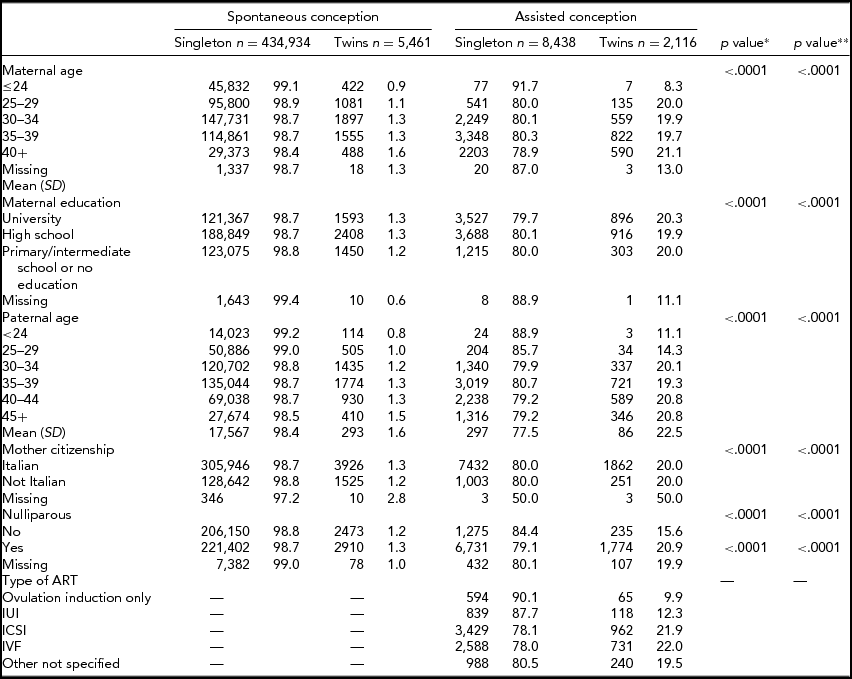
*p value of chi-square association between mode of conception and mother and father characteristics; **p value of chi-square association between type of pregnancy (single/twin) and mother and father characteristics.
Overall, the frequency of twins deliveries was 1.24/100 deliveries after natural conception and 20.05/100 after assisted conception. The estimated rates of monozygotic twins was 0.45/100 (95% CI: 0.42–0.47) and 0.72/100 (95% CI: 0.58–0.91) deliveries after natural and assisted conception, respectively. This difference was statistically significant (p < .05). We have further estimated the monozygotic twins rates according to the type of assisted techniques (ovulation induction and IUI were grouped for sample size reasons; see Table 2). The estimated rate of monozygotic twins in the ovulation induction/ IUI, IVF, and ICSI groups were 0.77 (95% CI: 0.62–0.93), 0.58 (95% CI: 0.52–0.65), and 1.63 (95% CI: 1.27–2.13) respectively. All of these results were significantly higher when compared to natural conceptions (p < .05 for all three comparisons). Intergroup comparisons documented that ICSI was associated with a statistically significant higher risk when compared to both ovulation induction/IUI (p ≤ .05) and to IVF (p ≤ .05). Conversely, the rates observed in these latter two groups did not significantly differ.
Twin Deliveries Rates According to Type of Conception
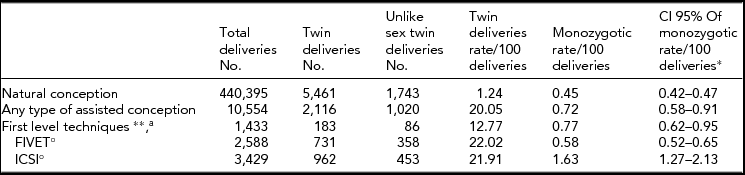
*Based on Poisson's approximation; **IUI and ovulation induction. aThe sum of first level techniques, FIVET, and ICSI does not reach the total of ‘Any type of assisted conception’ due to missing data.
Discussion
Assisted conceptions are associated with a higher rate of monozygotic twins. However, the magnitude of the association is smaller compared to some worrying estimations provided by some case series. The rate is higher and more clinically relevant when focusing on the ICSI group.
A potential main limitation of this analysis is the quality of information reported in routine statistics on type of conception. However, this possible concern is unlikely to affect our results. The information considered in this analysis was included by law in an administrative database that registers all hospital admissions in private and public hospitals. These data should be considered totally representative of newborns admitted to the hospitals in the region, without any bias. Further, the frequency of births after ART reported in the regional database is largely consistent with the data reported in the Italian Registry of ART (http://www.iss.it/rpma/). Moreover, the type of assisted conception is also consistent with the available data on the clinical practice in Lombardy. In any case, any misclassification should tend to reduce the estimate frequency of twin deliveries among assisted conception, and it is unlikely that misreporting may differ in case of delivery of like or unlike sex children. Finally, it is worthwhile noting that the calculated rate of monozygotic twin in natural pregnancies emerging from our analysis (0.45/100 deliveries) is perfectly in line with the previous population-based estimations (Gee et al., Reference Gee, Dickey, Xiong, Clark and Pridjian2014; Hall, Reference Hall2003; Imaizumi & Nonaka, Reference Imaizumi and Nonaka1997), thus indirectly supporting the quality of our data.
The use of Weinberg's method to assess the rate of monozygotic twins may be another matter of concern. The validity of the method has been recently confirmed in the general population (Fellman & Eriksson, Reference Fellman and Eriksson2006; Hardin et al., Reference Hardin, Selvin, Carmichael and Shaw2009) but confirmation in ART children is lacking. Inferences of the validity of the method in the general population to ART children should be made with caution because potential deviation of the sex ratio might exist (Blickstein, Reference Blickstein2005).
Further, in this study, we observed the well-recognized association between older maternal age and frequency of ART. It is conceivable that women conceiving with ART and those conceding naturally may differ in some characteristics that can be related to the risk of monozygotic twin births. In our population, women who did not conceive spontaneously were older, but the risk of spontaneous monozygotic twins is not related to maternal age (Bortolus et al., Reference Bortolus, Parazzini, Chatenoud, Benzi, Bianchi and Marini1999).
Another interesting finding of this study is the analysis of the frequency of monozygotic twins after different ART techniques. Albeit it is debated, there is some evidence suggesting a role for ovarian hyperstimulation, prolonged culture up to the blastocysts stage, culture medium, number of embryos transferred, and breach of the zona pellucida with ICSI or assisted hatching (Chang et al., Reference Chang, Lee, Jee, Suh and Kim2009; Delrieu et al., Reference Delrieu, Himaya, Phillips and Kadoch2012; Franasiak et al., Reference Franasiak, Dondik, Molinaro, Hong, Forman, Werner and Scott2015; Kanter et al., Reference Kanter, Boulet, Kawwass, Jamieson and Kissin2015; Knopman et al., Reference Knopman, Krey, Lee, Fino, Novetsky and Noyes2010; Reference Knopman, Krey, Oh, Lee, McCaffrey and Noyes2014; Luke et al., Reference Luke, Brown, Wantman and Stern2014; Nakasuji et al., Reference Nakasuji, Saito, Araki, Nakaza, Nakashima, Kuwahara and Sakumoto2014; Ren et al., Reference Ren, Liu, Chen, Zhu and Zhang2013; Vitthala et al., Reference Vitthala, Gelbaya, Brison, Fitzgerald and Nardo2009). In other words, differences may be a consequence of the specific ART technique used and of local differences in clinical and laboratory protocols (Vitthala et al., Reference Vitthala, Gelbaya, Brison, Fitzgerald and Nardo2009). Our study tends to concur with the growing literature, albeit it is not homogeneous, supporting a detrimental effect of the ICSI procedure. Unfortunately, since this is a register-based study, there is no possibility of investigating the independent role of specific laboratory procedures, such as, for example, the cultured media used, the prolonged culture, and the assisted hatching. From a clinical perspective, the observation of a possible increased risk of monozygotic twins following ICSI should be taken into consideration in the current debate regarding the worldwide and non-evidence based growth of ICSI use (Kanter et al., Reference Kanter, Boulet, Kawwass, Jamieson and Kissin2015).
In conclusion, the present population-based study suggests that the risk of monozygotic twin is about 60% higher among assisted than after natural conception and that the use of ICSI may play a critical role. Large studies based on clinical diagnosis of monozygotic may confirm this finding on a sound basis.



