


Introduction
To what degree are individual legislators responsive to their constituents, and why? Our study addresses this question by focusing on a European party democracy, where parties traditionally function as key mechanisms to connect citizens and the state, and thus help secure responsive governments. However, in European party democracies, electoral dealignment (Dalton Reference Dalton and Thomspon2016; Dalton & Wattenberg Reference Dalton and Wattenberg2000) and party cartelization (Katz & Mair Reference Katz and Mair1995; Mair Reference Mair2013) resulted in decreasing capacities of political parties to fulfil this function. Fewer citizens identify with established parties and use them to channel their concerns, while established parties show diminished interests in mobilizing and involving citizens in meaningful ways. Hence, responsive governments may increasingly require individual legislators to supplement parties and reinforce the interactions between citizens and the state that is essential to democratic governance (Ohberg & Naurin Reference Ohberg and Naurin2016).
This study advances from a growing body of literature that uses field experiments to study the responsiveness of legislators to constituency requests (for a review, see Grose Reference Grose2014; for a meta‐analysis, see Costa Reference Costa2017). In these experiments, the researcher sends a standardized email to legislators on behalf of one of their constituents and records the answers (or the absence thereof), as well as their content. These responses are considered as accurate measures of responsiveness because they are based on real behaviour. The first studies of this genre were conducted in the United States (e.g., Broockman Reference Broockman2013; Butler & Broockman Reference Butler and Broockman2011; Butler & Nickerson Reference Butler and Nickerson2011; Dropp & Peskowitz Reference Dropp and Peskowitz2012), but were later reproduced in Europe (Alizade et al. Reference Alizade, Dancygier and Ditlmann2018; De Vries et al. Reference De Vries, Dinas and Solaz2016; Giger et al. Reference Giger, Lanz and De Vries2020; Habel & Birch Reference Habel and Birch2019; Hess et al. Reference Hess, von Scheve and Zittlau2018), Canada (Loewen & MacKenzie Reference Loewen and MacKenzie2019) as well as in non‐Western countries (Chen et al. Reference Chen, Pan and Xu2016; Gaikwad & Nellis Reference Gaikwad and Nellis2016; McClendon Reference McClendon2016). In this paper, we report the results of a field experiment conducted with the members of the German Bundestag.
Our contribution to the literature on legislators’ responsiveness is twofold. First, we add new insights to the conditions of responsiveness by using a new experimental paradigm. Most of the literature so far has focused on legislators’ responsiveness to social groups and whether responses are affected by taste‐based or statistical discrimination (e.g., Broockman Reference Broockman2013; Butler & Broockman Reference Butler and Broockman2011; Gell‐Redman et al. Reference Gell‐Redman, Visalvanich, Crabtree and Fariss2018; Habel & Birch Reference Habel and Birch2019; Kalla et al. Reference Kalla, Rosenbluth and Teele2018). Additional studies aimed to explore whether legislators’ responsiveness depends on the content of constituency requests, for example, service or policy requests (Butler et al. Reference Butler, Karpowitz and Pope2012). In our experiment, we propose a new treatment that focuses on voters’ intention, in particular whether they signal an intention to cast a personal or partisan vote. To explore this issue, we randomly divide our population in two groups. Half of the legislators received a demand in which the constituent signals attention to the personal records and qualifications of the legislator, and also the constituent's intention to cast a personal vote for them (personal vote intention).Footnote 1 The other half received a request in which the constituent signals attention to the record of the legislators’ party and also the constituent's intention to cast a party vote (partisan vote intention). We find that those legislators treated with a personal vote intention are more likely to respond (67 per cent) than those treated with a partisan vote intention (59 per cent).
Second, this paper shows how electoral systems condition the effect of a signalled vote intention on legislators’ responsiveness. We thus also contribute to the literature that studies the direct effects of electoral systems on the responsiveness of legislators, where candidate‐centred systems are assumed to facilitate responsiveness (André et al. Reference André, Depauw, Shugart, Martin, Saalfeld and Strøm2014, Reference André, Depauw and Martin2015; Bowler & Farrell Reference Bowler and Farrell2011; Cain et al. Reference Cain, Ferejohn and Fiorina1987; Carey & Shugart Reference Carey and Shugart1995; Heitshusen et al. Reference Heitshusen, Young and Wood2005; Rudolph & Däubler Reference Rudolph and Däubler2016). Given that the German Bundestag is elected under a mixed‐member system, we are able to take advantage of the mandate‐divide argument, which assumes nominally elected legislators to react differently to our treatment than party‐list legislators (Manow Reference Manow2015). To our knowledge, we are the first to test whether constituents’ vote intention affects legislators’ responsiveness, and how this effect is conditioned by candidate‐centred electoral rules. In this vein, we find that a positive treatment effect of receiving a personal vote intention (compared to a partisan vote intention) only for nominally elected legislators. This shows that the effect of signalled vote intention is moderated by the type of electoral rule. In other words, we find that electoral systems’ incentives matter for legislators’ responsiveness only when constituents explicitly mention an intention to cast a personal vote.
Conditions of legislators’ responsiveness
Despite all the differences across countries, legislators in European party democracies share a common characteristic: they face manifold demands and command scarce resources. When do they invest resources to directly respond to citizen‐initiated requests? A common answer to this question stresses their vote‐seeking concerns and resulting efforts to respond to individuals and groups that most affect their re‐election prospects. Along this line, the electoral context is a key factor explaining legislators’ responsiveness, particularly the marginality of their seat and the ‘candidate‐centeredness’ of the electoral rule.
Theories about the roles of marginality argue that tight electoral competitions incentivize legislators to make extra efforts to respond to voters (Griffin Reference Griffin2006; Kuklinski Reference Kuklinski1977). The reason is that those facing strong competition are likely to need, more than others, every single vote to secure their re‐election, and that responding to any constituent request can be a good strategy to achieve this goal. The field experiments with legislators presented above usually aim at estimating whether personal characteristics of the sender, such as their ethnicity, have an effect on the propensity of the legislators to respond to a standardized email from a constituent (e.g., Butler & Broockman Reference Butler and Broockman2011; Habel & Birch Reference Habel and Birch2019). Yet these studies also confirm the importance of marginality: the more uncertain legislators are about their re‐election, the more responsive they are to this email (Butler & Broockman Reference Butler and Broockman2011; Butler & Nickerson Reference Butler and Nickerson2011; De Vries et al. Reference De Vries, Dinas and Solaz2016; Dropp & Peskowitz Reference Dropp and Peskowitz2012; Giger et al. Reference Giger, Lanz and De Vries2020).
Theoretical accounts of the electoral sources of legislators’ responsiveness furthermore highlight the role of electoral systems, and how they moderate the effects of electoral uncertainty. From this perspective, nominal modes of election in single‐member districts render legislators responsive to geographic constituents. The reason is that, under plurality rule, these constituents act as second principals to legislators (i.e., the agents) in addition to parties. In other words, they directly affect their re‐election prospects and hold them accountable (Carey Reference Carey2007). Any positive or negative policy outcome can be directly related to the activities of their district representatives, positively and negatively. In contrast, legislators elected via party lists function as members of teams vis‐à‐vis national coalitions of voters. They share collective responsibilities which renders their re‐election prospects contingent upon voters’ evaluation of their parties (Bowler & Farrell Reference Bowler and Farrell2011; Cain et al. Reference Cain, Ferejohn and Fiorina1987; Mayhew Reference Mayhew1974). This provides fewer incentives to respond individually to constituency requests since parties remain the key principal to legislators.
Independent of conventional accounts about the roles of marginality and electoral rules determining legislators’ responsiveness, some scholars have questioned the direct effects of these factors. Morgenstern and Swindle (Reference Morgenstern and Swindle2005), for instance, show in their comparative analysis that electoral systems’ features hardly matter for the local vote and rather stress the importance of voters. This is where the experimental literature about the responsiveness of legislators can make a contribution. In this literature, the researcher can evaluate the effect of constituents’ characteristics such their identity, and how this resonates with those of the legislator, as well as the broader electoral context. Our study advances from this and explores the role of constituents’ vote intentions, that is whether they aim to vote for candidates or parties.
We consider personal vote intention signals in a constituency request to increase the perceived importance for legislators to respond and thus also to change how they allocate their scarce time, in times of electoral dealignment. The electoral map is increasingly complicated. The times of structured electoral markets populated by homogeneous social groups attached to particular parties are gone (Mair et al. Reference Mair, Müller and Plasser2004; Dalton Reference Dalton and Thomspon2016). While legislators running for office still seek to maximize their votes, they now face a different breed of voter with different vote intentions. Scholars emphasized that due to electoral dealignment increasing portions of voters may rest their vote choices on candidates’ valence and/or more generally on their personal attributes and records (Bol et al. Reference Bol, Harfst, Blais, Golder, Laslier, Stephenson and Van der Straeten2016; Eggers Reference Eggers2014; Kam Reference Kam2009). This also suggests that weaker partisanship among voters might incentivize candidates and legislators to seek personal votes. Advancing from these considerations, we aim to test the following hypothesis.
H1: Legislators receiving a constituency request that includes a personal vote intention are more responsive than those receiving one that includes a partisan vote intention.
Moreover, in line with the literature on electoral sources of legislators’ responsiveness, we expect that legislators are also affected by the incentives that originate from electoral rules. Yet, we also consider that these incentives can be conditioned by citizens’ signalled vote intentions (for a similar approach, see Zittel et al. Reference Zittel, Nyhuis and Baumann2019). Hence, we envision the possibility that electoral systems’ incentives need to get triggered before being translated into a responsive behaviour of legislators. For our experiment, we selected the German case because of the country's mixed‐member system and the variance it provides with regard to different modes of election. It allows voters to simultaneously elect 299 legislators on the basis of a nominal vote in single‐member districts, and an approximately equal number of legislators on the basis of a party list vote in 16 multi‐member districts. Proponents of the mandate‐divide hypothesis argue that both electoral tiers function like pure electoral systems. Consequently, nominal legislators are assumed to function in a pure plurality mode. They face particular incentives to seek personal votes compared to their colleagues elected on the basis of a party vote and assumed to function in a pure proportional mode (Klingemann & Wessels Reference Klingemann, Wessels, Shugart and Wattenberg2001; Lancaster & Patterson Reference Lancaster and Patterson1990; Sieberer Reference Sieberer2010; Stratmann & Baur Reference Stratmann and Baur2002; Zittel & Gschwend Reference Zittel and Gschwend2008). Consequently, our second hypothesis is the following:
H2: The treatment effect of receiving a constituency request that includes a personal vote intention (compared to a partisan vote intention) is greater among nominal legislators than among party‐list legislators.
It must be said that the mandate‐divide hypothesis is not without critics. The large number of dual candidates in the German system (e.g., about 85 per cent of all incumbents in the Bundestag competed in both tiers at the 2013 federal election) provides reasons to question the assumed independence of the two tiers of election and to consider the German mixed‐member system as a unique type of system that results in distinct incentives. Specifically, district losers that nevertheless earned a mandate via their party list continue to keep a close eye on the geographic district they ran in, hoping to win it next time (Ferrara et al. Reference Ferrara, Herron and Nishikawa2005; Manow Reference Manow2015). Following up on this argument, Zittel and Gschwend (Reference Zittel and Gschwend2008) show that it is particularly narrow district losers that adopt strategies that are similar to district winners.Footnote 2 In the final step of the empirical analysis, we consider this possibility. Yet, it is important to note that the existence of a contamination between the two electoral tiers means that our test of the effect of the electoral system on the responsiveness of legislators (H2) is a hard one. Due to the mutual interdependence of the two tiers, we would expect a broad‐based proclivity to be responsive to constituents regardless of the legislator's mode of election.
Research design and experimental setup
To empirically test our hypotheses, we conducted a field experiment with members of the German Bundestag on the eve of the 2013 election campaign (between May and July 2013). Our design involved submitting a randomized stimulus to German legislators on behalf of one of their constituents and observing their (absence of a) response, as well as how long it took them to respond.Footnote 3
The choice of a field experiment provides several advantages compared to traditional modes of research on political representation (Grose Reference Grose2014). First, it allows factual observations in light of counterfactuals, and thus to increase the robustness of the causal inference made. Second, it permits focusing on actual behaviour instead of survey‐based self‐reported behaviour that can suffer from misperceptions and strategic efforts to misrepresent past efforts and success stories (Bailey & Brady Reference Bailey and Brady1998; Gerber & Lewis Reference Gerber and Lewis2004; Wahlke et al. Reference Wahlke, Eulau, Buchanon and Ferguson1962).
Treatment groups
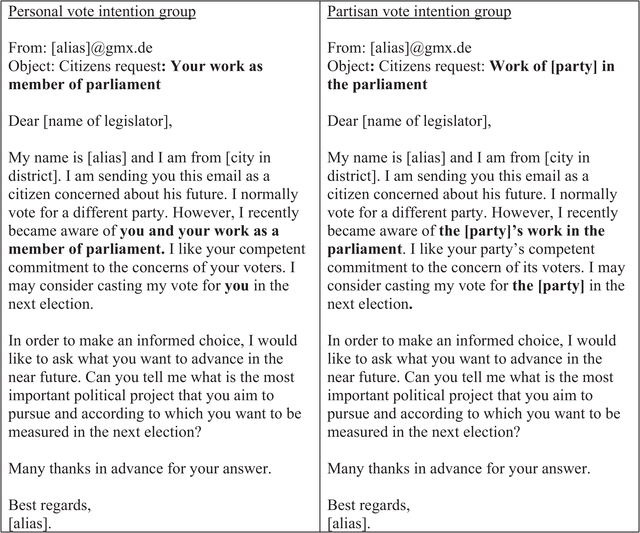
The stimulus that we randomly assigned to legislators consisted of an email sent by a fictitious (male) constituent who explicitly claimed to (1) live in the largest city of the legislator's district, (2) have not voted for them in previous elections, but (3) consider voting for them at the upcoming election. In the ‘personal vote intention’ group, the sender stressed the legislator's personal track record as a reason why the constituent considers voting for the legislator. He thus voiced an explicit personal vote intention, as he promised a nominal vote in return for the specific political activities and records of an individual incumbent (Cain et al. Reference Cain, Ferejohn and Fiorina1987). In the ‘partisan vote intention’ group, the constituent stressed the record of the legislator's party as a reason for his upcoming vote choice and indicated to cast a party‐list vote rather than a nominal vote. Figure 1 documents the literal translation of the entire text of both emails in English.Footnote 4
Emails sent
Note: Randomized parts are in bold.

Randomization procedure
A serious challenge to the internal validity of this kind of field experiment is the possibility of being exposed by the experimental subjects (i.e., the members of the German Bundestag). This might result in selective refusals to answer, in suspicious and defensive responses, and perhaps most importantly, leads to a contamination between randomized groups (i.e., a violation of the Stable Unit Treatment Value Assumption, or SUTVA). To minimize the chances of exposure, we used four different names for the fictitious constituent. We employ four standard German male names (Alexander Müller, Markus Becker, Michael Weber and Thomas Schmidt) to minimize the impact of racial and gender‐related biases that has been found to be recurrent in this type of email correspondence (Butler & Broockman Reference Butler and Broockman2011).
Email addresses were created according to the aforementioned names in two widely used German free email services (web.de and gmx.net). The emails were also sent in four waves (on May 6, 7, 8 and 9, at 2 pm). The time span between these waves was held at a minimum, in order to minimize the effect of unobserved contextual factors. Moreover, we avoided the summer holiday period to minimize the risk of legislators to be out of office. Thus, we implemented a 2 (personal vs. partisan vote intention emails) × 4 (names) × 4 (waves) experimental design. A subsequent analysis (reported in Appendix C of the Supporting Information's document) shows that neither the alias‐ nor the wave‐factor have a systematic impact on the probability of legislators’ responses. Moreover, we show in Appendix D of the Supporting Information's document that our randomization procedure was successful because both the probability to receive one email or the other is similar across pre‐treatment covariates. These tests show that the key treatment is balanced across groups of legislators, and across other treatments.
Validity
As legislators are busy people, it is reasonable to assume that if they take the time to respond, they do so in meaningful ways. To validate this assumption, we conducted a qualitative exploration of the content of the responses. The result of this made us conclude that legislators took the emails seriously and provided meaningful answers. Most of the responses we received appear to be written by the legislators or their staff and to specifically react to the request that they faced; some of their answers are even quite long and very detailed. To illustrate this point, in the following, we provide a verbatim quote of a response written by a legislator who received the personal vote intention email (we removed information that could compromise their anonymity):
As you may know, it is since [year] that I am representing our electoral district […] as your MP […]. Because I come from [district] myself, I know that aircraft noise disturbs the quietness, where traffic puts pressure on residents, and what matters concern the public here. For me as a politician it is the most important thing to keep in touch with citizens, to be rooted and not to have one's head in the clouds – or as we call it ‘to stay close to the people’. Being in touch with the citizen and being reliable, is my guiding principle. It is important to me to know what the concerns of the people are. This is why I would like to work with all the energy I have for you and our district for the next four years here and in Berlin.
With our district in mind, I think the most urgent tasks are securing jobs and vocational training and ensuring equal access to education regardless of one's social status and cultural background. I would like to get involved in improving the quality of life in our district, particularly I think about the reduction of air and rail noise, developing public transport, and ensuring affordable housing.
As the responsible rapporteur of the [party] parliamentary group in the [committee], I will dedicate myself to the strengthening of [specific policy concerns that we removed for reasons of anonymity] and the support of volunteer work. Furthermore, as a [party representative] I support the demands for decent wages and pensions, a better reconciliation of work and family life, especially through providing more and better childcare facilities and I support the expansion of renewable energies. These are the topics I would like to stand and fight for, here in our district, and at the Bundestag in Berlin. (Mail No. 965, own translation)
Similarly, the following example illustrates that legislators that received the partisan vote intention email and that chose to respond also appear to have taken great care to write a fitted response:
Dear Mr. Weber, I am very pleased that the [party] could capture your interest and that you want to get more detailed information about our goals. For more than 150 years the [party] stands for practiced social justice. During the next few years we would like to rebalance our society in order to guarantee fair and decent wages to everyone living in Germany and to allow everyone to freely pursue a promising future. It is also essential to tame the financial markets, which need to accept financial and social responsibility for their actions, not only simply take the profits. We as [party representatives] stick up for a modern society, where the ‘we’ is counting more than the ‘I’. Attached you will find the short and the long version of our current government program. I would be happy, Mr. Weber, to convince you of our concepts and ideas. Should you have any questions or comments, do not hesitate to get in touch with me any time. With best wishes, yours. (Mail No. 1013, own translation)
As a last epistemological issue, we are not concerned with who actually answered the email. We are well aware that a large portion of it probably has been written by staff. However, the behaviour of staff members should reflect the motivations of their superiors that is the members of the Bundestag. Also, it is important to note that, by law, all German legislators, regardless of their mode of election, have the same amount of resources to employ staff. This precludes any biases that might result from unobserved differences in legislators’ resource bases.
Dependent variables and further controls
According to our hypotheses, we are interested in particular conditions under which legislators are more or less responsive to constituency requests. Responsiveness is usually measured as responding or not to such emails. In this paper, we also use another way to operationalize the concept by measuring the time legislators take to respond. Consequently, our analysis is based upon two dependent variables. Our first dependent variable indicates whether legislators responded to our email (coded as ‘1’) or not. Legislators are hard pressed regarding their time and resource commitments. The very fact of responding to our email thus constitutes a valid behavioural indicator on whether legislators are responsive to constituents.
Our second dependent variable focuses on the timing of responses. We count the number of days that it took legislators to respond. In light of scare resources, this is a further and more fine‐grained indicator to explore the relative importance they assign to the task of being responsive to constituents. It is reasonable to think that the more they care about the demand, the quicker they respond to it. Also, from the perspective of the constituents themselves, we can assume that they prefer receiving a response sooner than later. To our knowledge, we are the first to model the time to respond in an analysis of a field experiment with legislators.Footnote 5 Yet, we believe such a dependent variable should also be featured in other field experiments with legislators.
As H1 revolves around the treatment effect, we primarily focus on a difference in means to test it. By virtue of the design, the treatment is indeed exogenous. Yet, we also estimate regression models and add control variables, as to improve the efficiency of the test. Testing H2 requires us to bring in another variable, namely the mode of election of the legislators. Since the mode of election is an observational rather than experimentally manipulated variable, we need to add control variables to account for causal heterogeneity.
The control variables are the following. First, previous studies suggest paying attention to the consequences of party organizational factors. Some parties are more cohesive and more collectivist than others. This might result in fewer individual efforts to be responsive to constituents. We thus include party fixed effects. These fixed effects also capture national trends regarding the popularity of parties. In 2013, for example, the legislators from the Free Democratic Party (FDP) were in a very different situation than those of the Christian Democratic Union (CDU). The FDP was losing support in the polls, while the CDU maintained a more than solid support base of 40 per cent of respondents. This specific electoral context is likely to have dampened the personal vote seeking concerns of legislators representing the CDU since their party label promised to be an effective vote‐getting device in 2013. However, for ethical reasons that we outline in Appendix A (see Supporting Information's document), we do not disclose these effects in the paper.
Second, we include the age of the legislators, as age might be associated with possessing less skills and motivations to use new media and to answer emails. We thirdly control for the gender of the legislator as to avoid same‐sex bias in their responses.
Results
In our experiment, we received 311 responses (63 per cent) to our emails from legislators that were up for re‐election in single‐member districts in the 2013 election.Footnote 6 This response rate is in line with response rates from other field experiments of the genre conducted with elected officials in European party democracies: 62 per cent in Switzerland (Giger el al. Reference Giger, Lanz and De Vries2020) and 79 per cent in Germany (Hess et al. Reference Hess, von Scheve and Zittlau2018).Footnote 7 Legislators’ probability to answer in this last study is unsurprisingly a bit larger because the email entailed a service rather than a policy request (Butler et al. Reference Butler, Karpowitz and Pope2012).
More legislators responded to the personal vote intention email (67 per cent) than to the partisan vote intention one (59 per cent). The difference is thus +8 per cent points (p < 0.1, t‐test difference). Among the emails we received, 5 per cent arrived the very same day of the sending, while 48 per cent arrived within a week. The last response we recorded reached our mailbox 64 days after sending our email. Based on this descriptive evidence, we can conclude that in the aggregate German legislators pay attention to constituency demands, especially when these demands include a personal vote intention.
In the empirical analysis, we first test the two hypotheses with the two dependent variables presented above: responding vs. not responding and the timing of the response. Then, we explore the possibility of a contamination effect between tiers of an election that is often considered as central to understand the functioning of the German mixed‐member system (Ferrara et al. Reference Ferrara, Herron and Nishikawa2005; Manow Reference Manow2015).
Responding vs. not responding
To test whether legislators treated with a personal vote intention were more likely to respond than to those treated with a partisan vote intention (H1), we specify the following logit modelFootnote 8:

We expect β1 to be positive. Then, to test H2, we need to specify a model that includes the treatment group, the mode of election (whether the legislator is elected in a single‐member district or via a party list), and an interaction between the two. We expect a positive interaction effect because legislators elected in a single‐member district that received a personal vote intention email should be particularly likely to respond. We specify the following logit model:

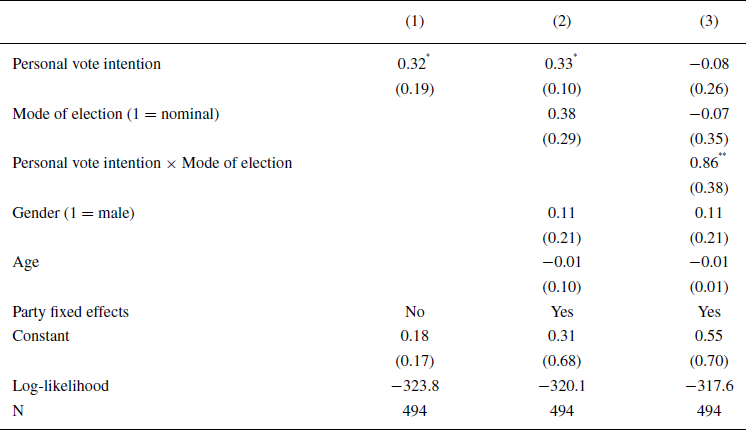
Table 1 reports the results of three logit models. Model 1, without controls, shows the expected treatment effect. Legislatorsvv that received a personal vote intention email were more likely to respond than those who received a partisan vote intention one. This gives support to our first hypothesis. In Model 2, we show that this effect remains robust if we include control variables. In Model 3, we test our second hypothesis. While the interpretation of raw coefficients in non‐linear and non‐additive models is difficult, the significant positive interaction effect corroborates our theoretical expectation (p < 0.05). Model 3 suggests that legislators elected in single‐member districts that received a personal vote intention email were more likely to respond than the rest of their colleagues.
Predicting response to constituency demand (logit)

Note: Entries are coefficients estimated from logit regression models. Standard errors in parentheses. *p < 0.10; **p < 0.05.
To facilitate the interpretation of the estimated coefficients in the model with the interaction term, we calculate the predicted probabilities of respondingFootnote 9 depending on the mode of election and treatment group. The predicted probabilities, together with their 95 per cent confidence intervals,Footnote 10 are represented in Figure 2.
Predicted probabilities of responding to constituency demand (logit)
Note: Predicted probabilities are based on estimates of Model 3, Table 1.

Figure 2 corroborates the expected interaction effect between the personal vote intention email and the mode of election, and most importantly specifies the size of the effect. Nominally elected legislators in the personal vote intention group show a predicted probability to respond of 71 per cent. This is substantially higher than the predicted probabilities of responding of the other types of legislators (by at least 12 per cent points). A set of first‐difference tests shows that these differences are always statistically significant at least at p < 0.05.Footnote 11
Timing of responses
To offer a second independent test of our hypotheses, we focus on the number of days that it took for legislators to respond to our email as a second dependent variable. It is important to note that we stopped data collection after 64 days. However, we kept the non‐responding legislators in the analysis and treated them as right‐censored data points. To estimate to what degree legislators of the personal vote intention group responded faster than others, we rely on a duration analysis using a Cox proportional hazard model.Footnote 12 A key advantage of these models is that they do not exclude legislators that have not responded. In doing so, they address a common issue with field experiments of the genre: a reduction of the sample to those that did respond and the post‐treatment bias that this might generate (Coppock Reference Coppock2019). The hazard function or hazard rate of the ith legislator has the following form:

In our model, the hazard rate represents the probability that individual legislators responded to our email at a particular point in time given that they had not responded yet. It has two components. The first is the baseline hazard function, h 0(t), that indicates how the hazard of an email response changes over time when all the covariates are zero. The second component consists of the same set of covariates as before that are hypothesized to affect the timing of an email response. This model does not make any assumptions about the shape of the hazard. Thus, log {h  / h 0(t)}h = xβ, and, consequently, the hazard ratio of two different legislators h
  / h
/ h  = exp (xiβ)/ exp(xjβ) is independent of t.
Following our first hypothesis, we expect legislators treated with a personal vote intention email to respond faster than those treated with the partisan vote intention email. We estimate the following model:

A positive coefficient indicates that the covariate in question increases the hazard rate, that is, it reduces the time a legislator took to respond. Conversely, a negative coefficient implies that the covariate reduces the hazard rate and therefore increased the response time. Similar to what we have done in the logit analysis above, we interact the mode of election of the legislator and the treatment group to test our second hypothesis. We estimate the following model:

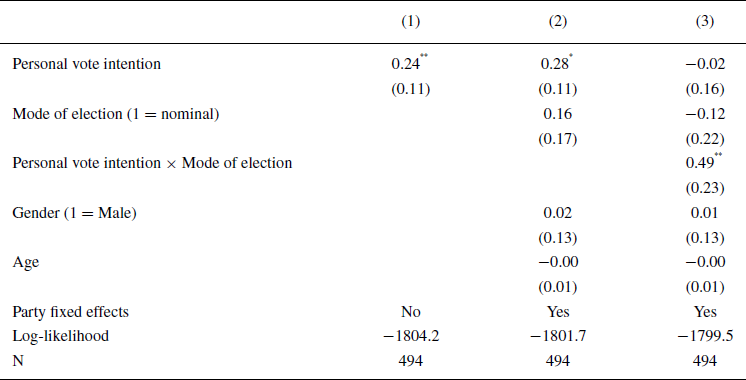
Table 2 corroborates the pattern that we already found regarding our first dependent variable. In Model 1, we see that legislators receiving a personal vote intention email responded faster compared to those receiving a partisan vote intention one (p < 0.05). Model 2 shows that this effect remains robust once we include our controls. In Model 3, we test our second hypothesis that nominally elected legislators who received a personal vote intention email responded faster compared to the rest of their colleagues and again find statistically significant effects pointing into the expected direction.
Predicting the time to response to constituency demand (Cox proportional hazard)

Note: Entries are coefficients estimated by Cox proportional hazard regression models. Standard errors in parentheses. *p < 0.10; **p < 0.05.
To interpret the size of the hypothesized interaction effect, we calculate the hazard ratio of the treatment effect (based on Model 3 in Table 2) for two hypothetical legislators that are from the same party and that are similar on all other observed characteristics that we control for. However, these two hypothetical legislators differ in whether they received a personal vote intention email (xt) or a partisan vote intention one (xc). The ratio of the two hazard rates for nominally elected legislators is

Similarly, the hazard ratio of the treatment effect for two party‐list legislators is

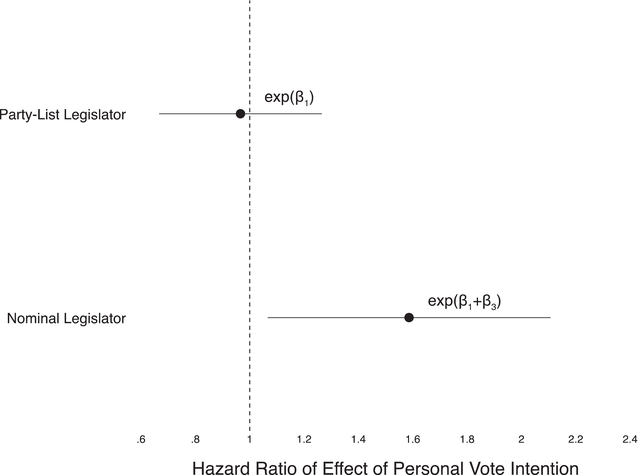
Figure 3 illustrates the estimated hazard ratio of the effect of receiving a personal vote intention email (compared to a partisan vote intention one) for nominal and party‐list legislators. It shows that the hazard ratio for nominal legislators is systematically greater than 1 because the 95 per cent confidence interval does not overlap with the reference line. This implies that legislators that received the personal vote intention email responded on average faster than those that received the partisan vote intention one. Their hazard rate increases by 60 per cent.Footnote 13 This indicates that the treatment did in fact cause nominal legislators to respond faster. In contrast, there is no systematic effect of receiving the personal vote intention email (compared to the partisan vote intention one) for party‐list legislators. These results thus also support our second hypothesis.
Hazard ratios of time to response to personal vote intention (Cox proportional hazard)
Note: Predicted probabilities are based on estimates of Model 3, Table 2.

Probing contamination effect
If contamination theory is correct (Gschwend et al. Reference Gschwend, Johnston and Pattie2003; Ferrara et al. Reference Ferrara, Herron and Nishikawa2005; Manow Reference Manow2015), any dual candidate looking back on a tight electoral race for a single‐member district should be more likely to make an effort and to respond to a constituency demand, independent of their mode of election. Most German legislators prefer being elected in a single‐member district as it gives them more electoral security and prestige within their party (Manow Reference Manow2015; Zittel & Gschwend Reference Zittel and Gschwend2008). Therefore, even legislators who lost the nominal vote in the previous election, and therefore earned their mandate via a party list, should have made an extra effort to cultivate a personal vote and respond to our email. Especially in marginal districts with tight electoral competition, every vote counts and thus extra efforts are needed to secure the few extra votes that might be needed to win next time.
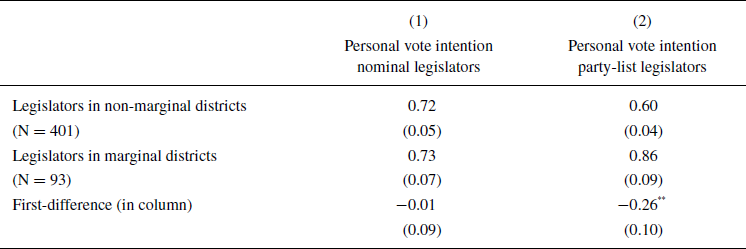
In order to test for the implications of this argument, we divide up our sample into legislators competing in marginal and non‐marginal electoral single‐member districts and test whether the estimated effects (i.e., the effects estimated in Model 3 of Table 1) differ across both samples. We define a district as marginal for a legislator if they either won or lost the district by a margin of less than 5 per cent points in the last election. Using this rule, we identify 93 legislators competing in marginal districts and 401 competing in non‐marginal districts. To test for the impact of marginality (and thus contamination) across the two different groups of legislators, we simultaneously run logit regression models predicting the probability of responding for the samples of legislators in non‐marginal and marginal districts (we use the regression model setup of Model 3, Table 1).Footnote 14 Such a ‘seemingly unrelated’ bivariate logit setup allows us to statistically test the difference in predicted probabilities across the samples of marginal and non‐marginal legislators.
Table 3 presents the results of our bivariate logit regression analysis. The entries represent the predicted probabilities of responding for nominal and party‐list legislators when they received a personal vote intention email depending on whether they were in a marginal or non‐marginal district at the last election. It shows that it is consistent with contamination theory that party‐list legislators competing in non‐marginal districts were the least likely to respond while party‐list legislators competing in marginal districts were those who are most likely to respond. The difference in predicted probability across those two groups is large (26 per cent‐points) and not due to chance (p < 0.05). By contrast, the predicted probabilities for nominal legislators who competed in marginal or non‐marginal districts are almost identical.
Predicted probabilities to respond among legislators in marginal and non‐marginal districts

Note: Entries are predicted probabilities estimated from bivariate logit regression models. Standard errors in parentheses. N = 494. *p < 0.10; **p < 0.05 for the test of whether the difference in predicted probabilities is zero.
These results stress, in most convincing ways, the unique incentives that result from mixed‐member proportional systems. Generally, our analysis demonstrates that nominal legislators were more responsive than party‐list legislators. However, Table 3 shows that party‐list legislators need to be separated into two very different groups. Those that competed in a marginal district previously were very responsive, exceeding even the level of responsiveness of nominal legislators, since they badly wished to win next time. In contrast, party‐list legislators competing in non‐marginal districts were less responsive, since they saw no chance to win their district next time.
Conclusion
In times of political dealignment and weakening parties, individual legislators play a crucial role as agents of political representation. In this paper, we report the results of a field experiment, for which we sent standardized emails to German legislators on behalf of a constituent asking for their future political agenda, if re‐elected. The randomized treatment was the inclusion of a personal vote intention (vs. a partisan vote intention) signal in an actual email. Our evidence shows that legislators responded more often and faster when they were treated with a personal vote intention email. Our analysis further demonstrates the moderating effect of the electoral system on the interactions between constituents and legislators. We find that nominally elected legislators were more responsive than those elected via a party list, but only when they received the personal vote intention email. This effect is strong and robust. Digging deeper into the contamination effect between electoral tiers in the German mixed‐member system, we find that legislators elected via party lists competing in marginal single‐member districts were at least as likely to respond than nominal legislators. Thus, consistent with contamination theory, party‐list legislators behave similarly like their nominal counterparts as long as they seem to have a chance to win in their district next time.
The contribution of the paper to the literature on legislators’ responsiveness is twofold. First, we contribute to the growing literature that use field experiments with legislators to study this topic. Whereas it is a stylized fact that legislators facing tight electoral competition are more likely to respond to constituency requests, we show that constituents themselves can activate electoral considerations in signalling a personal vote intention in their message. Second, we contribute to the literature that studies the effect of electoral system incentives on legislators’ responsiveness. This literature usually focuses on the direct effects of the electoral system. In contrast, we highlight the moderating effect between the type of constituency demand and the electoral context. Only when voters remind legislators explicitly about personal votes, do electoral system incentives seem to matter for the responsiveness of legislators.
Our results also have some interesting implications for the future of representation in European democracies at large. They suggest that electoral engineers might consider more candidate‐centred electoral arrangements in times of dealignment, since they best secure individual‐level responsiveness. Voters who feel that legislators might be responsive to their concerns are also more likely to support the political system rather than falling into the populism trap. Finally, it is important to note that this paper also contributes to opening new avenues for further research on legislators’ responsiveness in Europe. We are among the first ones to conduct a field experiment with legislators in a region where parties play a more important role in linking the citizens and the state than in the United States. Our results demonstrate that individual legislators are particularly responsive to constituents even in the context of a European party democracy.
Acknowledgements
Earlier versions of the paper have been presented at the 2013 ECPR General Conference, the 2014 MPSA Annual Meeting and the 2015 EPSA Annual Meeting, as well as in seminar series in Leiden University, Goethe University Frankfurt, University of Montreal, and the Centre for the Study of Democratic Citizenship in Quebec. We would like to thank all those who attended these events. as well as Christian Stecker, Christian Grose, Guillermo Rosas and the two anonymous referees of the European Journal of Political Research for their helpful comments and feedback.
Online Appendix
Additional supporting information may be found in the Online Appendix section at the end of the article:
Table C1. Randomization checks across aliases
Table C2. Randomization checks across waves
Table D1. Balance test: Waves
Table D2. Balance test: Aliases
Table D3. Balance test: Mode of Election
Table D4. Balance test: Gender
Table D5. Balance test: Age
Table E1. Linear probability models
Table F1. Split‐sample regression models.
Table G1. Hypothetical Treatment Effect Sizes in Retrospective Design Analysis.



 Open access

