

Introduction
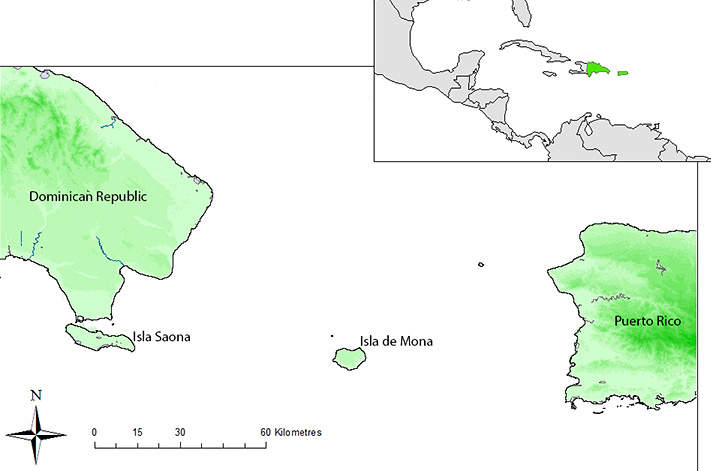
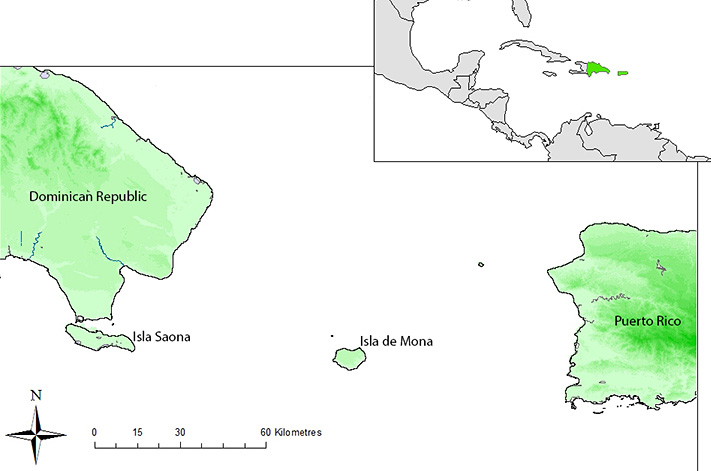
Map of the Mona Passage area showing the location of Isla de Mona, between Puerto Rico and the Dominican Republic. Inset: the Caribbean within the Americas.
Over the last ten years radical developments in the understanding of pre-Columbian island interaction in the Caribbean have taken place. New scientific techniques have revealed the intensity and complexity of human movement, social interaction and ethnic diversity throughout the 6000 years of human occupation in the insular Caribbean (Hofman & van Duijvenbode 2011). Within this context, a new project has been developed focusing on pathways to social complexity in the Greater Antilles, articulated upon the paradigms of past human ecodynamics and creolisation. This project builds on the authors' longstanding research projects in the Dominican Republic, Cuba and Puerto Rico, with a recent focus on Isla Saona and Isla de Mona. During recent work in the uninhabited Isla de Mona, some of the most complex, comprehensive and diverse assemblages of pre-Columbian iconography and cave use—including unique evidence for large-scale mining activities—have been studied.
Isla de Mona
Isla de Mona (indigenous name Amona) measures 47.5 km² and is located almost exactly halfway between Puerto Rico and Hispaniola (Haiti and the Dominican Republic) (Figure 1). From the air, the island appears to be a uniform karstic plain with a maximum height of 90m. It is a porous, carbonate landscape with ancient marine terraces, soil-filled depressions, rock shelters and complex dissolutional caves (Reference BriggsBriggs 1974).
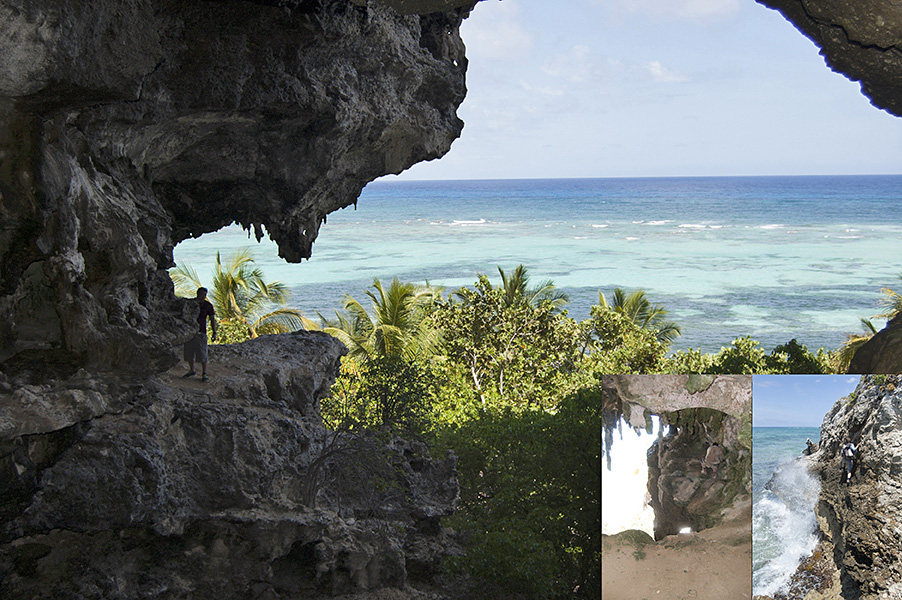
Entrances and access routes to the caves frequently involve climbing along cliff faces or scrambling through small apertures.
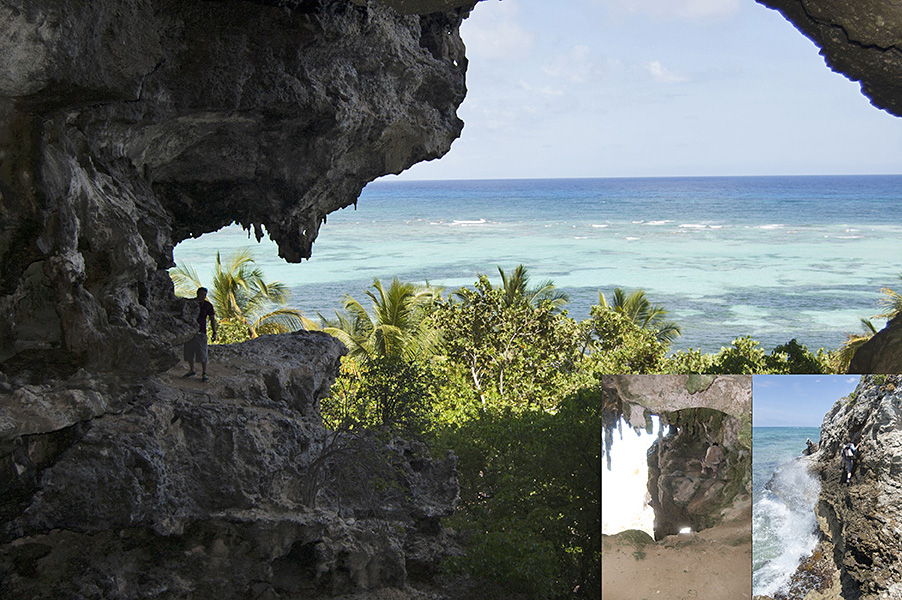
It is, however, the view from underground which fundamentally alters our understanding of the island and the people who lived within it (Figure 2). Mona's extensive cave systems contain vaulted chambers interconnected by small passages and arches replete with calcite formations that extend kilometres in length, with evidence for human activities on the walls, ceilings and surfaces of the caves from all occupation periods, but predominantly from the pre-Columbian era (Reference LaceLace 2012). The indigenous occupation of the island spans over 4000 years, persisting by at least a century into the colonial period (Dávila Dávila 2003). Between AD 1856 and 1924, and most intensively between 1881 and 1889, an active guano extraction industry developed in the island, indelibly altering many of Mona's caves.
Pre-Columbian cave use
Previous work carried out on Mona (Reference RouseRouse 1952; Dávila Dávila 2003; Reference LaceLace 2012) has established that the island was a strategic location within the Greater Antilles with an extensive range of ceremonial, residential and rock art locations. In May 2013, a fieldwork trip by present authors Samson and Cooper reviewed evidence for pre-Columbian archaeology in the cave systems, revealing intensive indigenous use. This fieldwork resulted in the documentation of hitherto unknown evidence for pre-Columbian mining and intensive ritual and artistic practices deep inside the cave chambers.
Cavescape archaeology
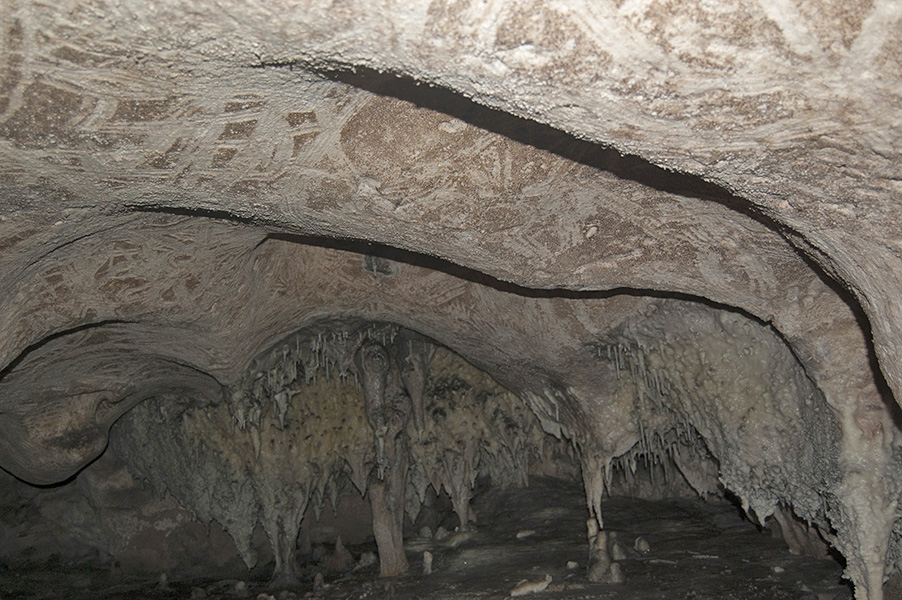
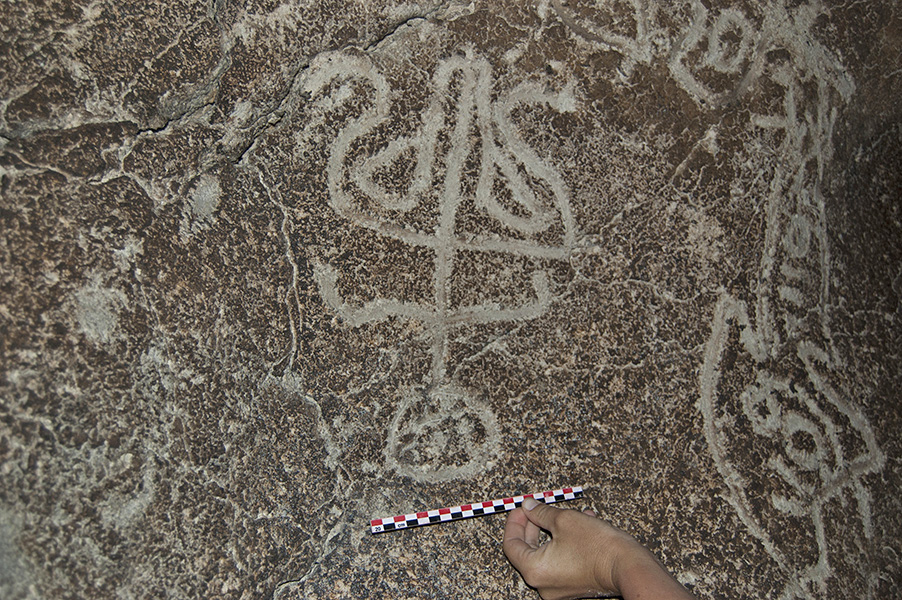
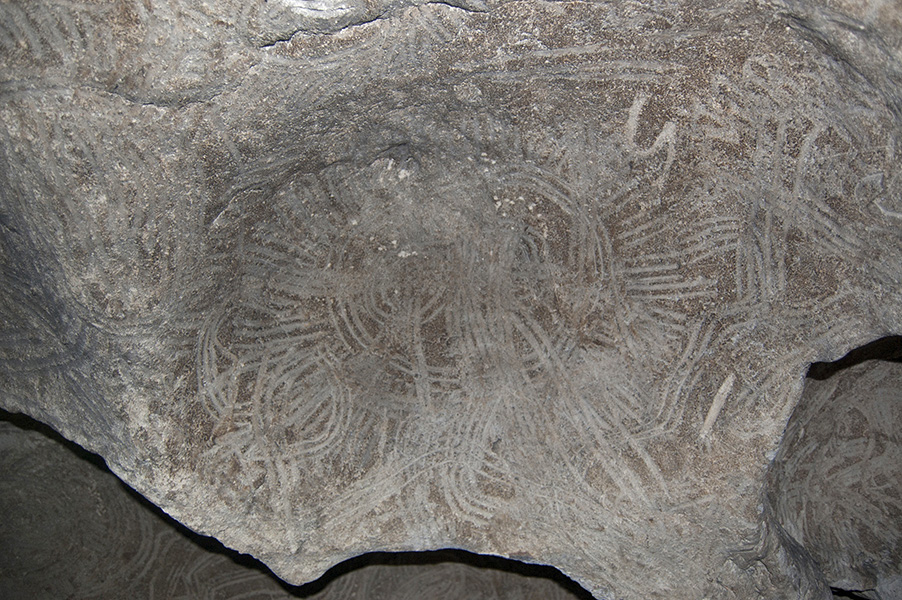
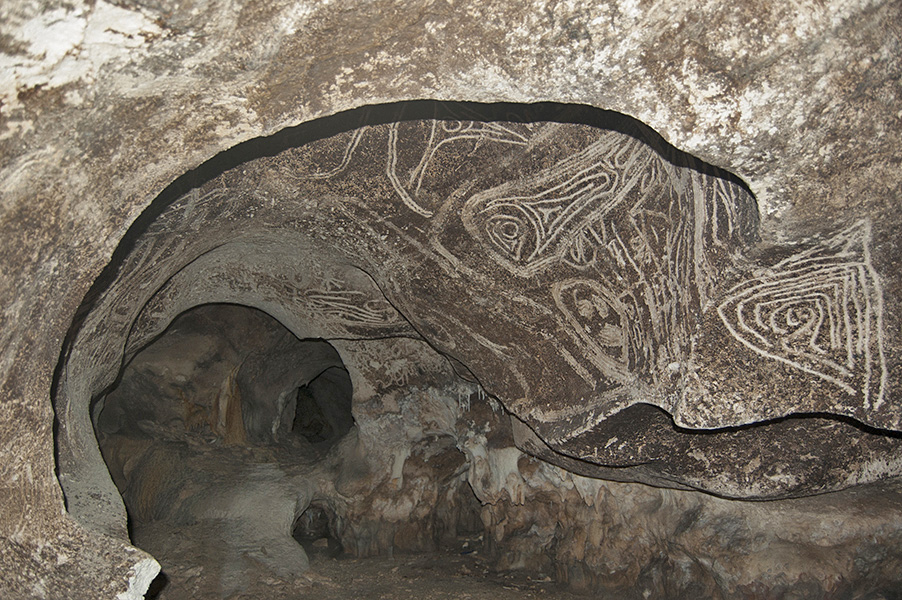
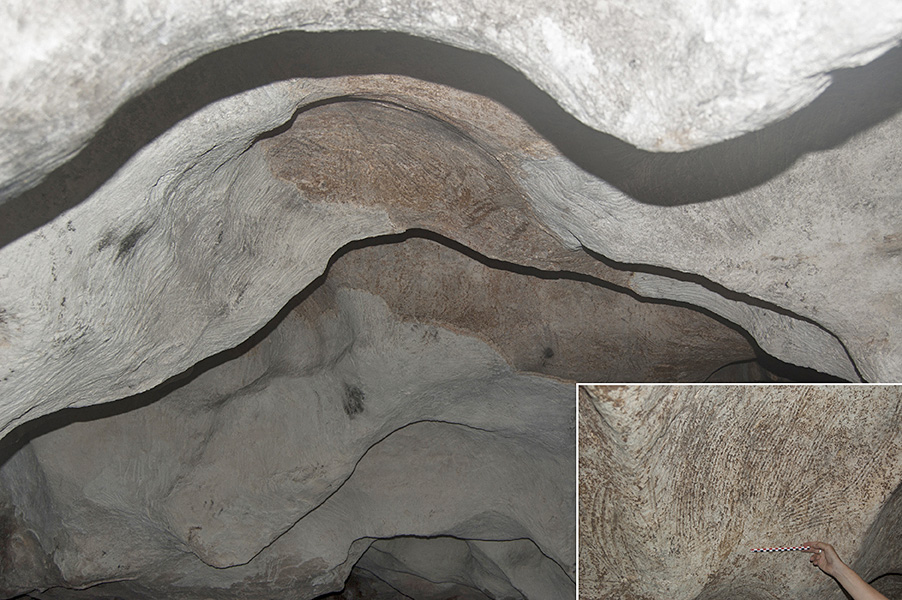
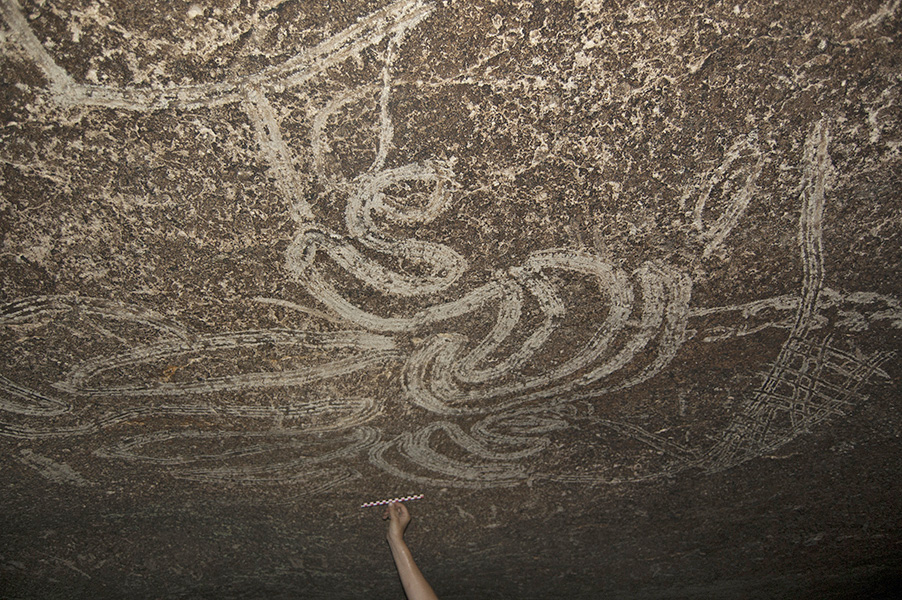
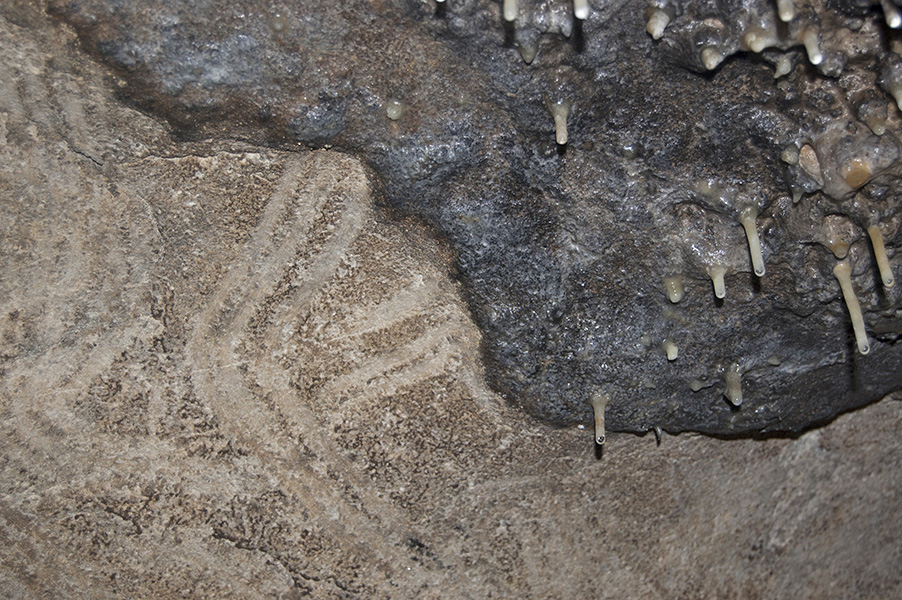
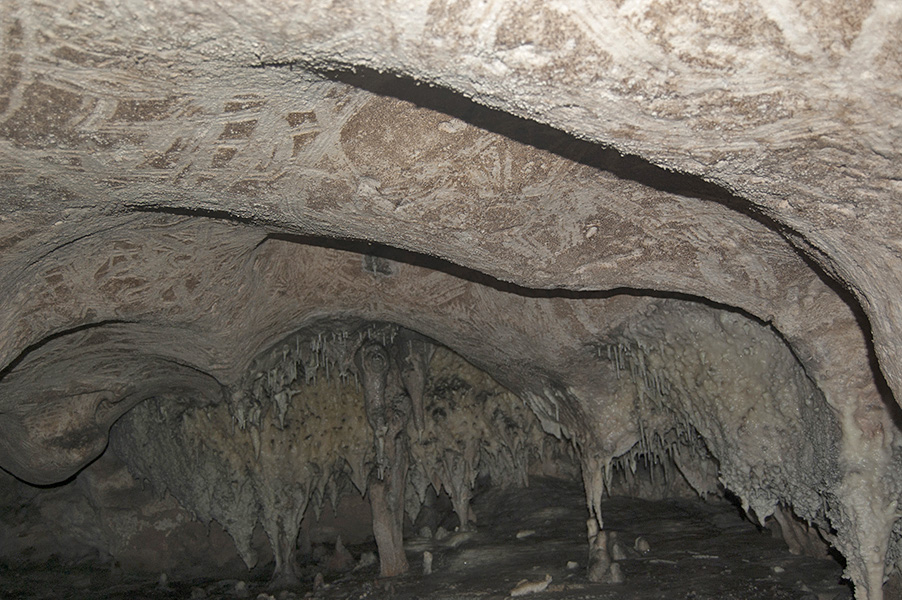
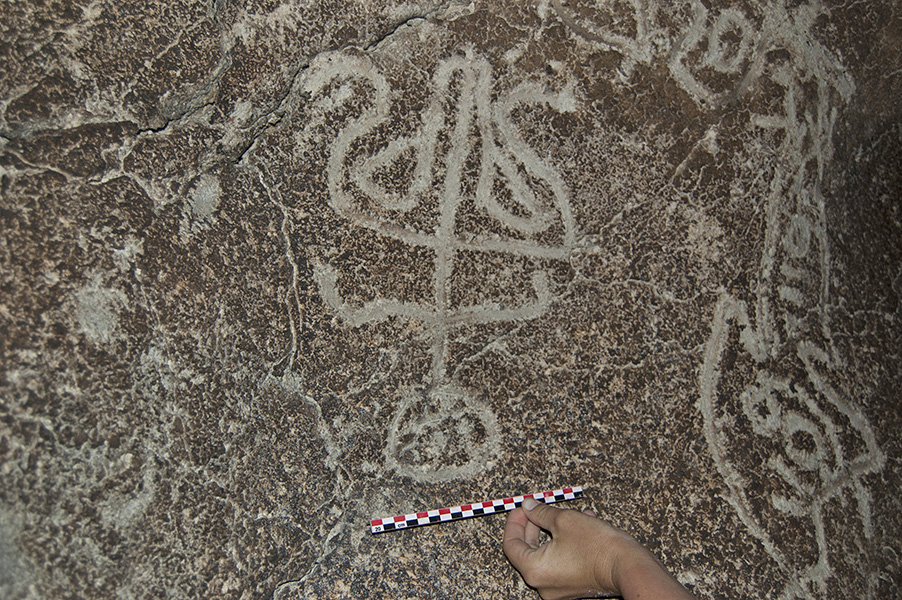
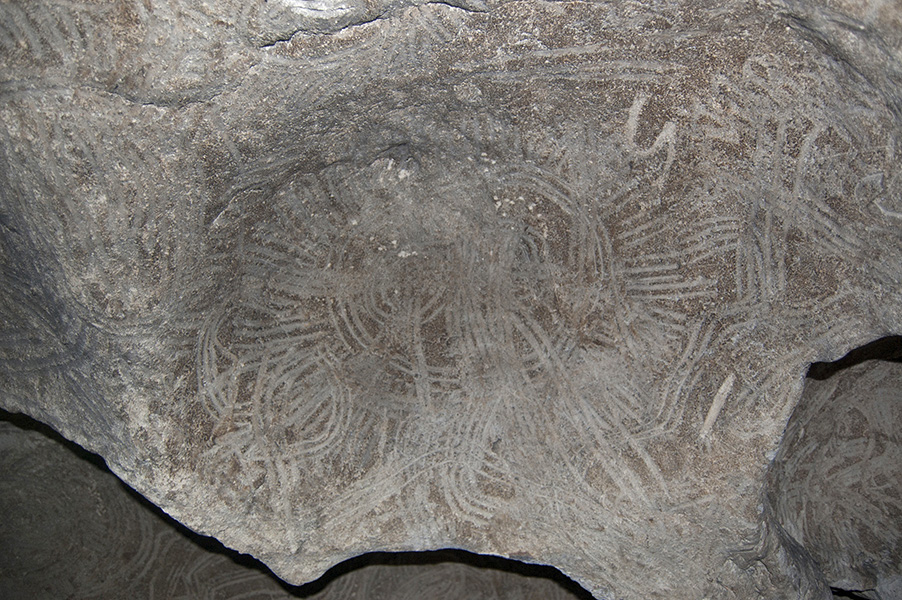
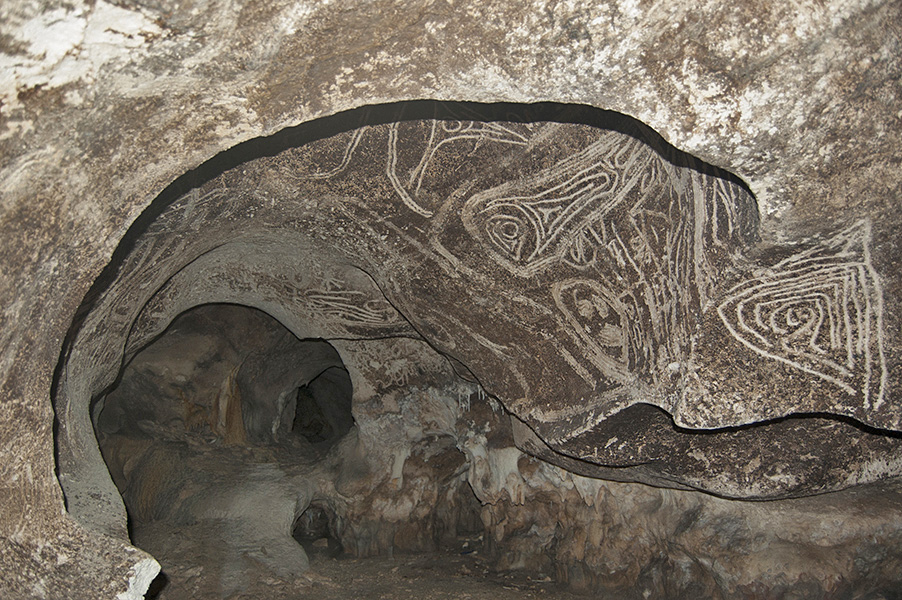
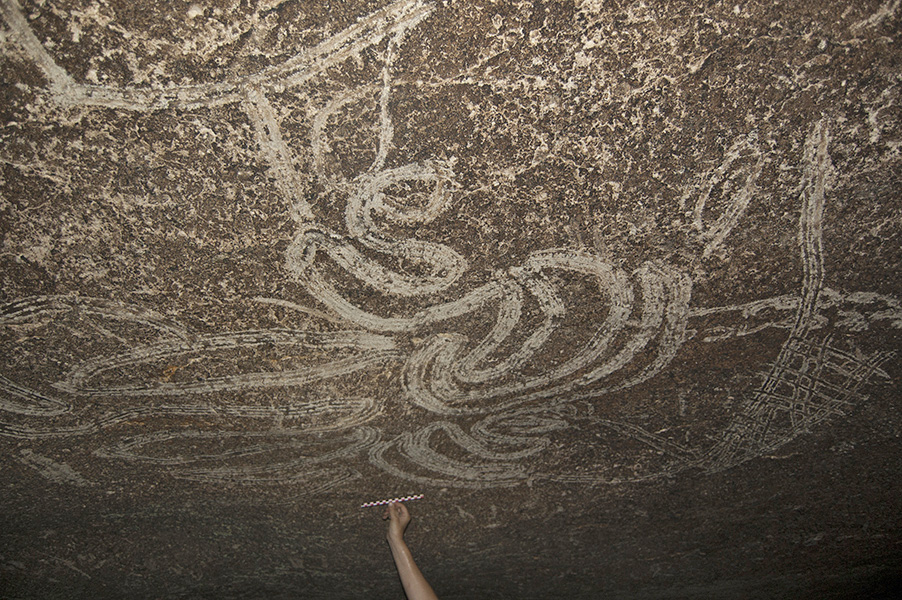
Designs and scratched areas cover the walls and ceilings of hundreds of square metres of the darkest caverns and tunnels on Mona, typically starting more than 100m from their entrances and usually located in hard to access areas with no natural light (Figure 3). A diversity of pre-Columbian activities were witnessed including pictography (or application of various coloured pigments to cave walls) in anthropomorphic and zoomorphic designs; finger incisions through the soft deposits on the cave walls, leaving elaborate, sinuous and complex trails (strikingly, these finger-incised designs cover large surfaces, up to several metres in extent for individual motifs or narrative sequences, and depict human, animal and geometric motifs both familiar and new in pre-Columbian archaeology) (Figures 4–6); and, lastly, large surfaces of the cave walls and ceilings bear the marks of vigorous finger scratching interspersed and in palimpsest with both the pictographs and finger incisions (Figure 7). The finger scratching appears to be related to the harvesting of the soft calcite deposit on the cave walls and occurs in all the caves visited, most closely associated with the finger incised designs. These extractive activities, rather than being indiscriminate movements, were systematic and deliberate actions sometimes merging with the meandering finger incisions and leaving astounding designs imprinted in the walls of the cave (Figure 8).
Cave wall modifications. Note the complete coverage of the cave walls and ceilings with finger incised designs in the soft cave deposits.
Examples of pre-Columbian iconography.
Use of the natural cupolas in the cave ceiling to frame the design, in this case a weeping and rayed face.
Example of the complexity and scale of the finger incised designs.
Cave wall modifications indicative of pre-Columbian mining. Note how all visible cave wall surfaces have been scratched clean with the use of the fingers. Inset: detail of finger scratching.

Where mining and rock-art merge. Note how the sinuous finger tracing is also an extractive activity.
Dating and chronology
Calcite deposit forming over the finger incised motifs.
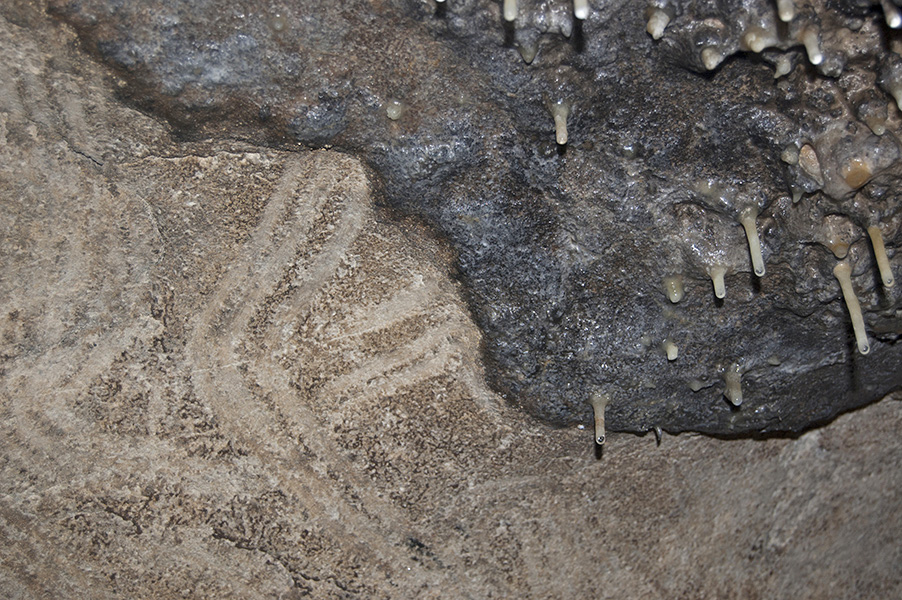
The scale of coverage, design diversity and the palimpsest nature of the cave wall modifications, together with the consistent use of multiple (two to four) fingers across the various media, and the multiple examples of secondary calcite accretions forming on top of examples of all designs interpreted as indigenous (Figure 9), indicate pre-Columbian origins for these rock art manifestations. Future research will concentrate on pigment, mineral and speleothem sampling for dating, as well as on locating caves which were not so heavily disturbed in the guano extraction era.
Discussion
The importance of caves as locations for funerary and ritual practices has long been recognised in the Caribbean, although the scarcity of systematic excavations and the common reliance on early colonial documents to interpret the rock art has hampered integration of cave practices with other terrestrial archaeological contexts (Hayward et al. 2009). This schism in theoretical and methodological approaches between rock art and mainstream archaeology is not peculiar to the Caribbean but is also reflected in other contexts (Reference Roe, Atkinson and CinquinoRoe 2009). The activities documented on Mona not only dramatically expand our knowledge of the repertoire of pre-Columbian iconography in the Caribbean, but also integrate cave use into other fields of indigenous action, with the potential to transform our current understanding of past cave use through the application of functional, aesthetic and textual approaches to rock art.
It is clear that, although preliminary , the documentation of the aforementioned varieties of subterranean human activities showcase what Mona has to reveal of pre-Columbian cave use in the indigenous Caribbean. Future research will not only focus on the analysis and dating of the archaeological contexts of the caves, but will also include the possible uses of the mineral deposits for pigments, body painting, dietary supplements or additives, and establish the role of Mona's cave use within the wider Caribbean region. The incredibly well preserved evidence for pre-Columbian activities is at high risk of future destruction due to the soft texture of the walls and confined spaces for visitors to gain access, so this work will also serve to develop measures for their protection and conservation. It is our hope that future archaeological research will help us interpret this intense and layered fabric of human experience within the unique cavescapes of Isla de Mona.
Acknowledgements
We are greatly indebted to Laura del Olmo Frese, Miguel Rodríguez López, José Rivera Ocasio, and Ovidio Dávila Dávila. El Corazón del Caribe project is supported by the McDonald Institute for Archaeological Research, University of Cambridge; the British Academy; the British Museum; Departamento de Recursos Naturales y Ambientales de Puerto Rico; and Instituto de Cultura Puertorriqueña.