


Over the past 20+ years, there has been a concerted effort on the part of the US Government (USG) to address medical preparedness to respond to chemical, biological, radiological, and nuclear (CBRN) threats so that the nation can respond quickly to diagnose, mitigate, and treat injuries arising from these kinds of natural and/or man-made disasters or terrorist actions. To that end, agencies such as the Department of Health and Human Services (HHS) and the Department of Defense (DoD) have established research programs to advance the study of how the body responds to these insults so that representative animal models of injury can be established, biomarkers of damage can be identified, pathways of injury can be explored to target for protection, and products can be developed to increase survival and quality of life for those in harm’s way. HHS sister agencies, including the National Institute of Allergy and Infectious Diseases (NIAID), within the National Institutes of Health (NIH), the Biomedical Advanced Research and Development Agency (BARDA), part of the Administration for Strategic Preparedness and Response (ASPR), the Centers for Disease Control and Prevention (CDC), and the Food and Drug Administration (FDA) support research to develop approaches to advance products for all CBRN threats. In preparation for public health emergencies, Congress funds this research and development across the USG through an interagency body called the Public Health Emergency Medical Countermeasures Enterprise (PHEMCE). Each collaborating agency possesses unique goals and capabilities for radiation medical countermeasure (MCM) and biodosimetry development, such as the DoD’s prophylactic treatment needs, the NIAID’s Radiation and Nuclear Countermeasures Program focus on early through advanced stage development, and BARDA’s emphasis on late-stage development and procurement. All USG agencies work together in a “one-government” approach, to ensure good stewardship and cooperation in CBRN research investments.
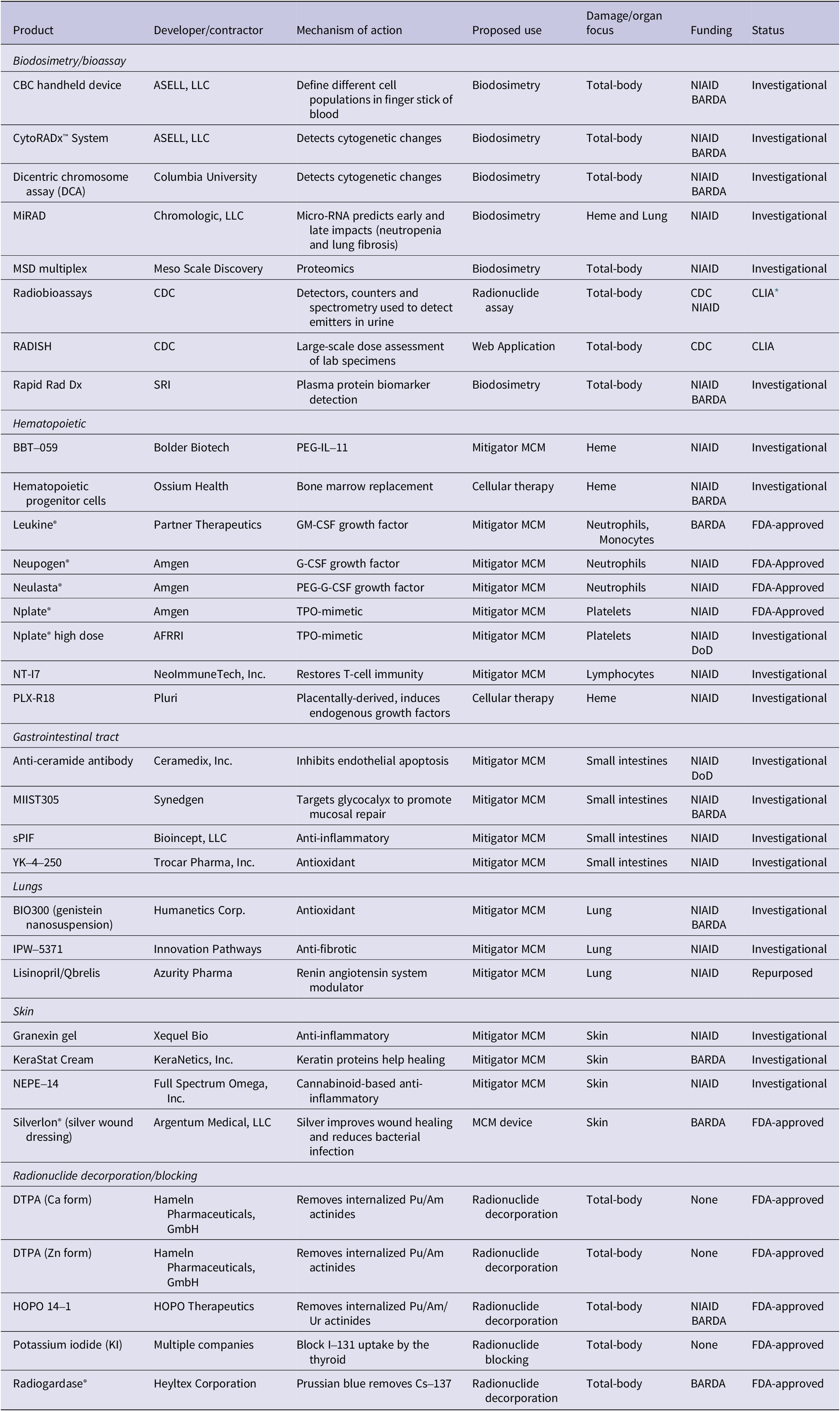
Specific to radiation threats, there are three main areas of research emphasis: 1) identification of biomarkers of injury to assist in triage of potentially-exposed individuals and guide medical management (biodosimetry/bioassay/predictive biodosimetry); 2) development of agents to remove internalized radioactive particles from the body (decorporation; e.g., those that enter through respiration, ingestion, or wound contamination); and 3) advancement of products to address radiation-induced injuries to the body, including those that specifically mitigate or treat damage to specific radiosensitive organs (e.g., bone marrow, gastrointestinal tract, skin, lungs, kidneys, and cardiovascular system) (Figure 1). Underlying all of these needs is the requirement for specific preclinical models (e.g., rodent, dog, minipig, nonhuman primate (NHP), etc.), and irradiation protocols (e.g., total- vs. partial-body; route of administration of radionuclides) to enable biomarker recognition, efficacy testing of MCMs, and regulatory approval via the FDA Animal Rule licensure pathway (discussed in detail in other articles within this special issue). Despite recent setbacks related to availability of large animal research models and manpower during the COVID-19 pandemic, significant gains have been made since 2004, which have left the country better prepared to deal with any radiological or nuclear emergency. In addition, repurposing drugs already approved for use in humans under traditional clinical indications has further accelerated the ability to make products available for use as MCMs. This paper, authored by USG funding agency staff and subject matter experts, describes past successes and ongoing, promising research on MCM mitigators, biodosimetry, and bioassay development (Table 1). The paper also discusses plans to further reinforce US Government procurement and holdings of drugs and devices to save lives during a mass casualty radiation incident.
FDA-approved and products in advanced development with government funding (discussed in paper)
* Clinical Laboratory Improvement Amendments
Advancements under study to address medical countermeasures for organ system injuries, decorporation of internal contamination and estimation of absorbed radiation dose.

Biodosimetry and Bioassays: Triaging and Guiding Medical Management of Patients in the Wake of a Radiological or Nuclear Emergency
The risk of large-scale nuclear or radiological accidents continues to be a serious source of concern for most nations. Repercussions of a nuclear incident will affect not only the hundreds of thousands of individuals directly exposed to life-threatening doses of radiation but also millions of others with insignificant exposures who remain concerned about potential health consequences (“concerned citizens”). Public health interventions rely on the prompt assessment of accident-related injuries, including estimation of absorbed radiation doses, for correct and effective administration of MCMs and both short- and long-term follow-up care. Rapid identification of exposed individuals is critical for proper treatment and timely administration of MCMs to achieve the highest effectiveness of medical treatment. It is also important to identify concerned citizens to avoid overwhelming the medical response system and to prevent inappropriate usage of limited supplies and scarce medical infrastructure.
Biodosimetry
Current methods used to ascertain and quantify exposure rely on: 1) geographical location and shielding at the time of the event; 2) onset and severity of clinical signs and symptoms; and 3) serial measurements of lymphocyte counts. However, none of these approaches are specific to radiation exposure. Biodosimetry utilizes techniques to identify biomarker(s) with expression specifically dependent upon radiation exposure and proportional to the amount of energy absorbed by the body. Biodosimetry devices that can be used to quickly triage patients, confirm exposure, and determine extent of damage will vastly improve the USG response to a large-scale nuclear incident. There can be significant person-to-person variability in early and delayed radiation damage to organs and tissues in response to a given radiation dose, due to factors such as genetic predisposition, age, body size, partial shielding, underlying illnesses, and immune status. Because most FDA-approved interventions to save lives must be administered within 24 hours post-exposure to be effective, it is critical to rapidly differentiate between individuals who have been exposed and concerned citizens who have not received an exposure. Based on the application of these biodosimetry approaches, tests can be classified as: 1) point-of-care (POC) for triage (qualitative assays that can be deployed for field triage or at the bedside, primarily to distinguish between exposed and non-exposed populations); 2) high-throughput (HT) (devices to measure definitive dose refer to those biodosimetry devices intended to quantify the radiation dose in an exposed individual); or 3) predictive biodosimetry (intended to inform the consequences of radiation exposure; for example, predicting life-threatening neutropenia after acute total-body irradiation [TBI], or late lung damage).
In 2009, a PHEMCE working group established desired attributes or target product profiles for both POC and HT biodosimetry tests.Reference Satyamitra, Reyes Turcu and Pantoja-Galicia1 Assays must provide an accurate assessment at the individual level, particularly around clinically relevant cut-off values, and demonstrate clinical utility.2 POC devices should be appropriate for rapid screening (time to result of 15-30 minutes) and suitable for initial triage and identification of individuals who received an acute dose of ionizing radiation less than 2 Gy. An ideal test should be qualitative, operational under scarce resources, easy to use, and with a desired throughput of up to 1 000 000 tests within 7 days. Unlike POC tests used for initial screening, HT can be used as a second-tier confirmatory test to sort patients exposed to >2 Gy for further clinical follow up.Reference Satyamitra, DiCarlo and Hollingsworth3 They should provide accurate, quantitative estimates in the 0-10 Gy range as well as represent confirmatory tests used to support physicians and inform on further care in conjunction with clinical signs, symptoms, and blood cell counts. Ideal HT laboratory instruments would be used in fixed facilities, with a longer time to results and a throughput of up to 400 000 tests per week. HHS has undertaken a large effort to fund research, development, manufacturing, and regulatory clearance of qualitative and quantitative tests that can quickly and accurately identify and sort radiation victims. Discovery, development, and approval of assays and devices for MCM use requires constant interactions between NIAID, ASPR/BARDA, and FDA.
The RNCP biodosimetry mission space encompasses: 1) basic research to elucidate novel approaches for rapid and accurate assessment of radiation exposure; 2) mid- to advanced-stage studies to support development for FDA clearance of promising triage or treatment devices/approaches; 3) characterization of biomarkers and/or assays to determine degree of tissue or organ dose that can predict outcome of radiation injuries (i.e., organ failure, morbidity, and/or mortality); and 4) outreach efforts to facilitate interactions between researchers developing cutting edge biodosimetry approaches and the FDA. Approaches under consideration include assessment of circulating cell changes (e.g., lymphocyte depletion kinetics, neutrophil to lymphocyte ratios), DNA damage assays (cytogenetics), and various “omics” approaches (e.g., proteomics, genomics, metabolomics, lipidomics, and transcriptomics).Reference Satyamitra, DiCarlo and Hollingsworth3 Non-invasive, physically based technologies such as electron paramagnetic resonance (reading biological samples such as tooth enamel, hair, nails, etc.) are also being developed.Reference Satyamitra, Cassatt and Molinar-Inglis4 Some of the challenges in obtaining FDA clearance of these novel techniques include lack of translation in the signature between species, inconsistent response to total-body versus inhomogeneous radiation exposures, lack of reproducible data, influence of confounders such as biological variables of sex, age, weight, and underlying health conditions, and unpredictable bridging to human data.Reference Satyamitra, Reyes Turcu and Pantoja-Galicia1 It is important to note; however, that radiation-induced DNA damage from the gold standard dicentric chromosome assay (DCA) and ring forms are unaffected by these variables.
There are 5 approaches in the recently supported NIAID biodosimetry portfolio that are in later stages of advancement. The first uses miRNA signatures to predict acutely those patients that are likely to develop life-threatening neutropeniaReference Rogers, Kyubwa and Lukaszewicz5 and/or late radiation-induced fibrosis.Reference Rogers, Kyubwa and Lukaszewicz6 Currently, this MiRAD technology is being verified in clinical samples through a contract with Chromologic, LLC. A second contract is with SRI, to develop a triage device (Rapid Rad Dx) using a panel of radiation-sensitive proteins to distinguish individuals exposed to 2 Gy in a large-scale nuclear incident. A third approach targets high-throughput definitive dose determination using a modified dicentric chromosome assay approach and existing off-the shelf instruments (Columbia University), while the fourth use a proteomic panel multiplex approach for definitive dose assessment (MesoScale Diagnostics). A final mid-stage approach using complete blood cell counts on a hand-held device (ASELL, Inc.) was well suited for triage end-use and transitioned to BARDA for advanced development in 2022.
BARDA’s radiation biodosimetry program objective includes the development of rapid, accurate FDA-cleared biodosimetry diagnostic tests to inform patient management, improve health and psychosocial outcomes, and save lives. Since 2009, BARDA has funded the development of POC triage and high throughput laboratory screening tests, many of which were initiated via NIAID-supported efforts in proteomics, gene expression, and cytogenetics. Of the 11 contracts originally supported, 4 were moved to Project BioShield for advanced development, including MRI Global, DxTerity, SRI International, and ASELL.Reference Wathen, Eder and Horwith7 Of these, two were based on gene expression, one on proteomics, and another on cytogenetics. Several pre-submissions and a pre-Emergency Use Authorization package were sent for regulatory feedback and approval. So far, no biodosimetry device has been cleared by the FDA, as none of the biomarker panels have demonstrated the sensitivity and specificity required to reach desired performance and accuracy. One cytogenetic-based, HT test, the CytoRADx™ System (ASELL), is nearing completion of validation studies and regulatory submission. This system provides consistent dose estimations over an extended dose range across laboratories and users, without requiring operator or site-based calibration curves, and is not confounded by diverse demographics, high prevalence comorbidities, or other medical conditions. It is expected that in case of a large-scale nuclear or radiological accident, national biodosimetry networks and high throughput automated assays will be the most appropriate solution to provide sufficient diagnostic capacity to support medical management of radiation victims.
Bioassays
The CDC’s Radiation Laboratory has the capability to identify and quantify radioactive internal contamination in people during radiation emergencies. This specialized program is designed to detect radioactive material in individuals at clinically relevant levels,8 enabling prompt medical decision-making. Unlike common radiobioassays geared towards low-level detection for occupational settings, the CDC’s program addresses higher concentrations of radioactivity that pose significant long-term health risks, such as cancers and tumors. The program employs a range of advanced technologies, including sodium iodide detectors, liquid scintillation counters,Reference Piraner and Jones9 and mass spectrometryReference Xiao and Button10 to rapidly detect alpha, beta, and gamma emitters in urine samples.Reference Button and Jones11, Reference Piraner and Jones12 This allows for timely screening and the prioritization of those at greatest risk. While rapid screening methods are used to rule out individuals without significant exposure, more advanced radiobioassay techniques provide the precision necessary for accurate dose assessments. With its capability to identify and quantify 22 priority radionuclides, the CDC Radiation Laboratory is the only US public health laboratory equipped to provide this comprehensive clinical radiobioassay. Innovations such as data tools for test requests and results reporting, POC screening devices, and optimized laboratory tests are essential to further enhance the program. These efforts will ultimately improve national preparedness, reduce barriers to testing, and ensure effective response during radiation emergencies.
Biokinetic Modeling
To complement the CDC’s radiobioassay activities, the CDC’s Radiation Studies Program developed a web application called Rapid Assessment of Dosage after Incident to Secure Health (RADISH)8, Reference Wiley13 to rapidly perform large-scale dose assessment with the analyzed lab specimens. Depending on the size and type of radiation emergency, hundreds to thousands of individuals could be impacted and potentially need to be screened for internal contamination. The ability to perform rapid assessment for the population will prove vital to allow for prioritization of MCM and other medical care in the immediate aftermath of a radiation emergency to ensure that the most lives are saved.Reference Li, Ansari and Etherington14 RADISH is unique in that it is one of the only internal dose assessment tools that can perform batch calculations, or multiple at once. It can perform calculations for hundreds of specimens at a time in a matter of minutes. RADISH performs internal dose calculations by taking in lab specimen results and individual information - such as time of exposure, age, and sex at birth. Results are then flagged if they are above clinical decision guidance to help triage individuals for the administration of MCMs.8 Final results are sent back to state and local authorities who work with clinicians to determine appropriate care. In addition to the immediate outcomes of performing internal dose assessment, doses from this tool can be used for long-term follow-up in registries to monitor populations for development of cancer or other stochastic effects of radiation dose. Over the last several years, the CDC has been modernizing this tool – an important advancement as many internal dose assessment tools are executables, which can pose issues with access during a radiation emergency.
In addition to the CDC program, the use of clinical decision guidelines (CDGs) that were developed in part at the Radiation Emergency Assistance Center/Training Site (REAC/TS) have also proven useful in modeling of internalized radionuclides.Reference Wiley13 A brief description of routes of radionuclide internalization and today’s approach to rapid assessment of dose magnitude, using not only CDGs but also annual limits on intake (ALIs) for inhalation exposures and derived reference levels (DRLs) for absorption through wounds, is also available.Reference Dainiak and Albanese15 The Yale group has done significant work looking at internal contamination resulting from inhalation, ingestion, or skin absorption, and its reduction through therapies, such as Prussian blue or DTPA. They report that it is possible to calculate the averted radiation dose as a result of therapy for each route of exposure by modeling things such as the main routes of intake and distribution, particle size and the distribution of the radioactivity in the different parts of the respiratory tract (e.g., trachea, bronchiole, alveolus, etc.), and through exploration of available human data from case histories for individuals treated due to contamination.
Medical Countermeasures: Early Successes Repurposing Products from Oncology/Hematology
The first MCMs considered for advanced development were the leukocyte growth factors, in particular, granulocyte colony-stimulating factor (G-CSF) and granulocyte-macrophage colony-stimulating factor (GM-CSF). The advancement of these drugs, which were already approved for clinical use and were widely used in oncology and hematology spaces, was promoted by a NIAID Blue-Ribbon PanelFootnote 1 and the Strategic National Stockpile Radiation Working Group.Reference Waselenko, MacVittie and Blakely16 NIAID began a collaboration with the FDA and Amgen, manufacturer of the 2 G-CSF drugs, filgrastim (Neupogen®) and pegfilgrastim (Neulasta®), to gain label extensions of these drugs based on studies conducted under the US FDA Animal Rule.Reference Ishigure17 Preclinical studies demonstrated efficacy of Neupogen in miceReference Plett, Sampson and Chua18 and NHP at 24 h,Reference Farese, Cohen and Katz19 but not at 48 hReference Farese, Brown and Smith20 post-irradiation. Amgen used these data, along with the extensive patient safety and efficacy data, to gain approval of Neupogen for hematopoietic (H) acute radiation syndrome (ARS) in 2015.Footnote 2 A similar set of studies demonstrated the efficacy of Neulasta in miceReference Chua, Plett and Sampson21 and NHPs,Reference Hankey, Farese and Blaauw22 leading to approval under the FDA Animal Rule in 2015.Footnote 3 In the years following the approval of Neupogen and Neulasta, pivotal study model design underwent some modifications by BARDA to not include blood products (as it could be a confounder to the efficacy of these products) and to include broad-spectrum antibiotics administered prophylactically to all animals, not just for empiric use. In 2018, Leukine® (sargramostim – Partner Therapeutics, inc.) was approvedFootnote 4 by the FDA in the updated model (approved for H-ARS by the European Medicines Agency in 2025).Reference Clayton, Khan-Malek and Dangler23 Studies explored how long after exposure Leukine could be administered and still be efficacious, demonstrating that delayed treatment at 48 h post-irradiation significantly reduced mortality.Reference Zhong, Pouliot and Downey24 Data also indicated that administration at 72, 96, and 120 h post-irradiation enhanced recovery of hemopoietic cell counts and could improve survival.
Another class of cytokines, anti-thrombocytopenics, were also being developed in parallel to the anti-neutropenics. Nplate® (romiplostim – Amgen, Inc.), which stimulates platelet recovery, was approved for use in H-ARS in 2021.Footnote 5 The approval of these products has demonstrated the value of public-private partnerships and shared government efforts in the development of MCMs. Studies for the 3 Amgen products, Neupogen, Neulasta, and Nplate, were supported primarily by NIAID awards, with additional early and late BARDA support, and Leukine was funded through BARDA contracts. The Neupogen and Neulasta FDA rulings have also facilitated approval of several G-CSF and peg-G-CSF biosimilars: Nypozi™ (filgrastim-txid),: Zarxio® (filgrastim-sndz), Releuko® (filgrastim-ayow), Udenyca™ (pegfilgrastim-cbqv), Stimufend™ (pegfilgrastim-fpgk), Ziextenzo™ (pegfilgrastim-bmez):, and Fylnetra® (pegfilgrastim-pbbk). Neupogen, Neulasta, Leukine, and Nplate have all been procured through Project BioShield. Their commercial/market volume has enabled the USG to institute vendor-managed inventories (VMI) as opposed to the traditional, but more costly, buy-and-hold model. The vendor maintains the stockpile of government assets and rotates them back into the commercial market before expiry and replacing the USG portion with newer product.Reference Homer, Raulli and DiCarlo-Cohen25 Through this model, the product does not expire for the life of the contract, and the USG has saved hundreds of millions of dollars utilizing VMI for Neupogen/Neulasta alone.
Promising Approaches in Development Addressing Hematologic Recovery
Although the repurposing of products from the oncology space was successful, there is still a need to continue research and development of products that address other H-ARS complications or offer an advantage to the existing FDA-approved drugs. To that end, a long-acting IL-11 analog (BBT-059; Bolder Biotechnology, Inc.) is being developed. More than a dozen studies have shown that BBT-059 significantly improves survival when administered subcutaneously at several time points, including pre-exposure and as late as 48 hours post-TBI.Footnote 6 Bridging studies with BBT-059 span species including rodent,Reference Plett, Chua and Sampson26 NHP,Reference Carpenter, Li and Wise27 and the Göttingen minipig. Rodent studies using BBT-059, administered pre- or post-irradiation, significantly increased survival and enhanced red blood cell and platelet recovery.Reference Plett, Sampson and Chua18, Reference Plett, Chua and Sampson26, Reference Kumar, Biswas and Sharma28 BBT-059’s strong survival benefit could position this product to have an advantage over other growth factors available for use. The company is currently conducting investigational new drug (IND)-enabling studies through an NIAID/RNCP contract awarded in 2023.
Through an inter-agency agreement (IAA) with the Armed Forces Radiobiology Research Institute (AFRRI), product evaluations are supported by the RNCP in well-established radiation exposure animal models, including TBI in rodents. Recently, researchers at AFRRI focused on determining the benefits of delayed administration of Nplate. Original rodent studies indicated that maximal benefit was achieved at a single dose of 30 μg/kg of the drug given 24 hours post-irradiation;Reference Bunin, Bakke and Green29 however, there was only limited survival when the drug was administered at later time points. In the AFRRI protocol, when the single dose was increased to 250 μg/kg, a significant survival benefit could be seen in the mice when the drug was given at 48- or 72-hours post-irradiation.Footnote 7 Therefore, it is possible that increasing the delivered dose of Nplate could help extend the therapeutic window and expand the utility of this already approved radiation MCM.
Several cellular therapies have also been studied under both NIAID and BARDA support to address myeloablation of the bone marrow following exposure to high doses of irradiation. For example, PLX-R18 (Pluri) is a human placenta-derived stromal cell product that, when injected intramuscularly into mice, has been shown to improve survival in an H-ARS model.Reference Homer, Raulli and DiCarlo-Cohen25 PLX-R18 injection works by stimulating the production of cytokines in the irradiated host, thereby accelerating recovery of the hematopoietic system. In addition, innovative sourcing and cryopreservation of bone marrow from deceased organ donors (alternative hematopoietic progenitor cells [HPC] grafts) by Ossium Health has been explored as a means of obtaining large quantities of banked HPCs for use in myeloablated patients. These cell populations have been well-characterized, and their functionality has been found to be equivalent to live bone marrow donations.Reference Johnstone, Woods and Goebel30 The company is also exploring banking of specifically matched mesenchymal stem cells, which have already been studied for their ability to immunomodulate and promote successful transplantation.Reference Johnstone, Messner and Brandacher31 Small business and cooperative agreement funding from NIAIDFootnote 8 and a recently awarded 2024 contract from BARDAFootnote 9 have accelerated the development of this promising approach.
Current FDA-approved products to treat myelosuppressive ionizing radiation do not support recovery of lymphocyte depletion following radiation exposure, nor do they address skewed myeloid differentiation that has been observed in survivors of H-ARS.Reference Chua, Plett and Fisher32 Radiation-induced lymphopenia and accelerated thymic involution may result in a reduced T cell receptor repertoire, leading to immunological blind spots and reduced capacity to respond to pathogens and other immunological challenges following radiation exposure and recovery from H-ARS.Reference Wu, Plett and Chua33–Reference Hollingsworth, Aldrich and Case36 Incomplete recovery of T cell function after injury can substantially increase the risk of infections, reduce the efficacy of vaccination, and increase morbidity from radiation-induced multiorgan injuries and the manifestation of the delayed effects of acute radiation exposure (DEARE).Reference Hollingsworth, Aldrich and Case36, Reference Micewicz, Iwamoto and Ratikan37 Several strategies to restore T cell immunity and enhance recovery after irradiation have been proposed,Reference Velardi, Tsai and van den Brink38 and the RNCP is currently supporting studies on a clinically advanced approach to promote T cell recovery after radiation injury (NT-I7; NeoImmuneTech, Inc.). The mechanism of action of NT-I7, a long-acting agonist of the IL-7 receptor, is stimulation of the development of T cell progenitors.Reference Shitara, Hara and Liang39, Reference Fry and Mackall40 Studies in irradiated mice have shown that several types of T cells recover to baseline earlier after NT-I7 treatment vs. control.Footnote 10
Products Targeting Non-hematopoietic Organ Systems
Radiation exposure in a mass casualty scenario is expected to cause acute and delayed multi-organ injuries. Because the bone marrow compartment is the most sensitive to radiation exposure, manifesting symptoms with the possibility of mortality and major morbidities at the lowest doses, it represented the first target of funding agencies and researchers hoping to develop therapeutics to increase the probability of survival among affected individuals. However, the bar is elevated to address injuries resulting from higher, and therefore more damaging, doses of radiation. Acute effects of these high-dose irradiations include life-threatening involvement of the gastrointestinal (GI) tract, as well as DEARE, which could include injury to the lungs, kidneys, and heart. Cutaneous radiation injuries (CRI) span both the acute and delayed syndromes, and MCMs to mitigate/treat this damage are also of great interest for stockpiling. Therefore, treatments that address these other organ systems (acknowledging that no organ system is isolated, and that all radiation-induced damage is multi-organ) are discussed tissue-by-tissue below.
GI tract
The RNCP is mobilizing significant resources for the development of MCMs for GI-ARS due to the current lack of FDA-approved options. Several products are in advanced development within the NIAID portfolio, which address different aspects of radiation-induced damage to the GI tract. One product is an antibody approach that interferes with radiation-induced endothelial cell apoptosis by preventing ceramides in the cell membranes from triggering the destruction pathway (Ceramedix, LLC).Reference Ferranti, Cheng and Thompson41 A full-length, anti-ceramide monoclonal antibody that binds ceramide has been shown to enhance survival from GI-ARS in a murine model,Reference Rotolo, Stancevic and Zhang42 and a fragment version of the antibody improved survival and dramatically reduced the incidence of radiation-induced late effects.Reference Nagesh, Monette and Shamu43 The product has also been tested in NHPs with promising results, and IND-enabling studies are being pursued through NIAID small business grant funding and other NIAID and DoD contracts. Another approach, targeting the GI microbiome, is an engineered Limosilactobacillus reuteri that produces interferon-beta (LR-IFN-β; Chromologic, LLC). Oral gavage with the genetically altered microbe results in the release of IFN-β in the small intestine, preserving Lgr5+ intestinal stem cells and thus protecting mice from radiation-induced GI injury.Reference Hamade, Epperly and Fisher44
YK-4-250, developed by Trocar Pharma, Inc. is a synthetic conjugate of telmisartan, an angiotensin receptor blocker, and tempol, a radical scavenger and superoxide dismutase mimetic.Footnote 11 A survival efficacy study in mice exposed to partial-body irradiation (PBI) conducted under the NIAID IAA with AFRRI revealed a 30% increase in survival when the mice were dosed with YK-4-250 orally once daily for 3 days starting 24 hours post-irradiation. A follow-up study looking at GI recovery also demonstrated decreased jejunum mucosal injury scores in the YK-4-250-treated group and an increase in the number of viable crypts (M. Brown; Personal Communication). Another promising MCM for GI-ARS is a synthetic preimplantation factor (sPIF) produced by BioIncept, LLC.Reference Shainer, Almogi-Hazan and Berger45 An analog of a multi-functional peptide secreted during pregnancy, sPIF, given 24 hours after PBI in mice (daily subcutaneous injection), led to a 38% increase in survival. A separate study showed that sPIF increased body weight, with a significant increase in GI barrier function and number of viable crypts, and significantly lowered bacterial load in the liver. Overall, these promising MCMs for GI-ARS supported by NIAID highlight some of the exciting products that are being developed through collaborative efforts between the RNCP and other USG agencies.
An additional product supported by both NIAID and BARDA to treat GI-ARS is Synedgen’s Multivalent Innate Immune Signaling Target (MIIST) 305, a glycopolymer radiomitigator that promotes mucosal and dermal barrier repair and regeneration. Oral delivery of this candidate MCM in mouse efficacy studies has led to striking results. In a PBI 5% bone marrow sparing model, none of the vehicle-treated mice survived past day 10, whereas 85% of the mice dosed with MIIST305 survived to the 30-day study endpoint.Footnote 12 Additionally, these studies revealed that MIIST305 provided a host of beneficial effects to the GI system following radiation including amelioration of enteropathy, reduction in intestinal epithelial barrier permeability, and restoration of a healthier microbiome. Furthermore, MIIST305 has displayed a promising safety profile from studies in two animal models.
Lung
As white blood cells infiltrate the lung post-irradiation, a cytokine storm ensues, leading to vascular injury and pneumonitis, which can develop into fibrosis if persistent.Reference Giuranno, Ient and De Ruysscher46 To understand the natural history of radiation-induced lung injury, several animal models were initially developed.Reference Jackson, Zodda and Gurung47, Reference Williams, Jackson and Shah48 More recently, there has been a shift in MCM efficacy studies for lung toward PBI, bone marrow sparing leg out models in rodents,Reference Gibbs, Gupta and Mali49–Reference Fish, MacVittie and Gao51 and PBI NHP models.Reference Parker, Li and Takayama52 This progression from localized lung irradiation to a PBI model was reached in partnership with the FDA to achieve a better model indicative of the damage expected after a mass casualty radiation exposure.Reference Cassatt, Gorovets and Karimi-Shah53 As the PBI models were being discussed and developed, NIAID had contracts in place with several companies to advance mitigators for delayed lung injuries. Innovation Pathways is developing IPW-5371, an inhibitor of TGFß-RI kinase, as a mitigator of lung DEARE. Originally showing efficacy in mouse studies,Reference Rabender, Mezzaroma and Mauro54 the company continued to develop IPW-5371 in a multi-organ injury rodent model requested by the FDA. A PBI rat model was found to be acceptable, as well, because it would allow the animal to experience acute and delayed effects of radiation exposure, as expected in a mass casualty scenario.Reference Libero55 In this PBI rat model, IPW-5371 showed efficacy against lung and kidney DEARE when started 15 days after PBI.Reference Fish, Hart and Gasperetti56 At the end of the first NIAID contract, Innovation Pathways met with the FDA to discuss future directions currently being executed under a 2024 NIAID contract.
Humanetics Corp. is developing BIO 300, a nanosuspension of genistein, to mitigate pneumonitis and fibrosis after radiation. In 2017, BIO 300 was shown to mitigate radiation-induced lung injury in a mouse model.Reference Jackson, Zodda and Gurung47 Supported by a NIAID contract, mouse and NHP work suggested that subcutaneous and intermuscular routes provided maximum therapeutic benefit post-irradiation.Reference Salem, Jackson and Gibbs57 Humanetics was also awarded funding to pursue a Phase 2 clinical trial to study BIO300 as a therapeutic to mitigate lung injury in discharged COVID-19 patients.Footnote 13 Other areas of interest include an NIH-sponsored Phase 1b/2a clinical trial for patients with non-small cell lung cancer and prophylactic radioprotection use funded by the DoD.Reference Singh, Serebrenik and Fatanmi58
Finally, working together with industry, the NIAID is supporting studies to repurpose lisinopril, a now generic FDA-approved drug for hypertension, as an MCM for radiation-induced lung fibrosis. Extensive early studies in a rat PBI model demonstrated that research-grade lisinopril provided in drinking water mitigates delayed lung and kidney injuries,Reference Sharma, Fish and Frei59–Reference Fish, Gao and Narayanan62 and evidence of its benefit in radiation-induced lung injury in humans has also been demonstrated.Reference Kharofa, Cohen and Tomic63 The product is now being tested under a contract with the Medical College of WisconsinFootnote 14 in conjunction with Azurity Pharmaceuticals, which produces Qbrelis®, an FDA-approved lisinopril oral liquid (1 mg/ml) used to treat hypertension in adult and pediatric patients 6 years of age and older.Footnote 15 Repurposing of this product is being pursued, as it could represent the first approved MCM to treat lung DEARE and would also likely be approved for use in children and the elderly.
Skin
Acutely damaging radiation exposure of the skin is termed CRI.Reference Iddins, DiCarlo and Ervin64 Real-world data exists on CRI in humans caused by several well-documented incidents.Reference DiCarlo, Bandremer and Hollingsworth65 Cutaneous radiation injury has a sizeable impact on those who survive radiation exposure. A recent study performed through the RNCP internal product development program has led to some exciting preliminary findings. It was found that daily oral administration of NEPE-14, a phytocannabinoid elixir (Full Spectrum Omega, Inc.), reduced CRI scores compared to topical silver sulfadiazine and oral vehicle controls over 120 days in male and female Göttingen minipigs. These results demonstrate that NEPE14 could help delay the onset of CRI and improve healing.Footnote 16 The product has also been shown to reduce inflammation and slow the progression of thermal burn injuries in Yorkshire hybrid pigs.Reference Christy, Carlsson and Larson66 Another compound for CRI supported through the NIAID is Granexin gel (Xequel Bio), which contains the αCT1 peptide, a mimetic of connexin 43, which regulates inflammation and improves tissue repair. In clinical trials, topical application of Granexin enhanced skin regeneration and reduced scarring. In a porcine model of CRI, application of Granexin also improved wound closure.Reference DiCarlo, Bandremer and Hollingsworth65
Unlike CRI, there are over 20 products currently cleared by the FDA for the treatment of radiation dermatitis (RD) commonly observed in the clinic following radiotherapy. Building upon the knowledge and preclinical studies demonstrating the similarities of the effects of radiation on the skin for both RD and CRI, BARDA’s public-private partnerships resulted in the first product, Silverlon (Argentum Medical), to receive 510(k) clearance for management of acute CRI. Silverlon is a silver-impregnated wound dressing that is also FDA-cleared for thermal burn and chemical injuries to the skin. This clearance involved creative strategies to accelerate its development and establish sustainable preparedness while bringing value to the public with the product’s routine care indications. To overcome historic obstacles that hindered development, dedicated scientists at NIAID and BARDA in partnership with MCM developers conducted preclinical and clinical studies to model and investigate conditions that mimic CRI. The key to success was compiling available clinical and experimental data to demonstrate the severity of damage across the radiation injury continuum. This connection is the foundation of the FDA approval of Silverlon as the first product indicated for the management of acute CRI.
To ensure different product formulations that offer functional advantages are available to address the same injury, BARDA is supporting another CRI MCM, KeraStat Cream (KeraNetics, Inc). Like Silverlon, this cream is considered to be a device by the FDA and is also already cleared by the FDA for use in radiation dermatitis. KeraStat is currently prescribed to patients for management of RD resulting from radiation therapy. With the convenience of topical application, KeraStat, a product composed of human keratin in a cream base, is already indicated for partial thickness burns. As a prescription, it expands the use for management of pressure (stage I-II) ulcers, venous stasis ulcers, ulcers caused by mixed vascular etiologies, diabetic ulcers, radiation dermatitis, donor sites, and grafts. Emulating a similar strategy used for Silverlon and given that KeraStat is already cleared for similar etiology from radiation-related injuries, KeraStat is an ideal candidate to expand the indication in management of CRI. Pivotal GLP studies are underway based on previously established robust modelsReference Burnett, Gabard and Robinson67 and targeted for FDA clearance by late 2025.
Internal Contamination and Radionuclide Decorporation
Radionuclides released into the environment following an accidental or intentional radiological or nuclear incident can be absorbed and deposited inside the human body resulting in radiation doses to internal organs. This process is called internal contamination or incorporation and will result in ongoing radiation exposure until the radionuclides decay or are excreted. There are 4 FDA-approved medications that can be used to block absorption or increase elimination of radionuclides in the urine or feces. The first, potassium iodide (KI), is an iodine uptake blocker that acts to protect the thyroid gland from damage that can result from uptake and concentration of radioactive iodine isotopes.Reference Aaseth, Nurchi and Andersen68 The remaining agents are metal chelating products that can complex with radionuclides to enhance excretion via either urine or feces. Prussian blue (Radiogardase®, HEYL Chemisch-pharmazeutische Fabrik GmbH) primarily enhances excretion of Cs-137 in the stool.Reference Melo, Lipsztein and de Oliveira69 The other 2 FDA-approved drugs, pentetate calcium trisodium (Ca-DTPA)Footnote 17 and pentetate zinc trisodium (Zn-DTPA),Footnote 18 were approved in 2004 for the treatment of internal contamination with plutonium, americium, or curium. DTPA is given via intravenous injection or inhalation using a nebulizer (in case of inhalational route of exposure). The mode of action of Ca-DTPA and Zn-DTPA is the formation of radioactive chelates in intravascular or interstitial fluid, which are then excreted by glomerular filtration in the urine. Because of this mode of action, Ca-DTPA is most effective if administered within the first 24 hours after internal contamination, and both Ca- and Zn-DTPA are contraindicated for uranium contamination due to nephrotoxicity.8 In case of a mass casualty incident, it will be challenging to administer DTPA to all those who may need it within 24 hours of the event due to the need for medical professionals and facilities capable of supporting IV administration, making an orally administered chelator attractive as a field-deployable asset.
A chelating agent that may be able to fill that role is the investigational drug 3,4,3-LI(1,2-HOPO) (HOPO 14-1; HOPO Therapeutics), which is a hydroxypyridinone-based chelator that can be administered parenterally and orally to enhance excretion of plutonium, americium, and curium (with preclinical efficacy superior to Zn-DTPA or Ca-DTPA), as well as uranium, neptunium, and europium.8 Animal studies show it is well absorbed when given orally and can also be efficacious when given up to several days after internal contamination.Reference Bunin, Chang and Doppalapudi70 In 2023, the first in-human open-label single-ascending-dose phase I clinical trial of HOPO 14-1 was initiated by SRI International with funding from NIAID.Footnote 19 The study is designed to assess safety, tolerability, pharmacokinetics, and excretion in 42 healthy participants. To date, four of the seven planned cohorts of six healthy volunteers have been successfully dosed (100, 200, 500, and 1200 mg); HOPO 14-1 has demonstrated an absorption profile consistent with expectations based on preclinical studies and is well tolerated in all participants with no clinically meaningful findings with respect to serious adverse events.Footnote 20 The trial is expected to be completed sometime in 2025. Recently (2024), BARDA also awarded a contract to HOPO Therapeutics, Inc. to explore commercial uses for the product with other heavy metals to improve sustainability of this product class.
Conclusion
In summary, much progress has been made over the past 20 years in the research, development, licensure, procurement, and stockpiling of products for use in case of a radiological or nuclear public health emergency. Advancements have been made in the development of methods and devices to triage potentially exposed individuals and guide their medical management, MCMs to address the sequelae of early and late bodily injuries induced by exposure to ionizing radiation, and innovations in novel agents to remove damaging internalized radioactive particles from the body. These successes would not have been possible without the critical public/private partnerships between USG funding agencies, academia, and industry.
Author contribution
All authors contributed equally to the work.


 Open access

