




1 Introduction
The best-known semantics of classical normal modal logic is given by Kripke frames. These are pairs $(X, R)$
consisting of a nonempty set X and a binary relation R on X. They form the category
$(X, R)$
consisting of a nonempty set X and a binary relation R on X. They form the category $\mathsf {KF}$
, with bounded morphisms as morphisms [Reference Goldblatt10, Section 11.1]. The algebraic semantics of this logic is given by modal algebras [Reference Goldblatt10, Section 1.2]. These are pairs
$\mathsf {KF}$
, with bounded morphisms as morphisms [Reference Goldblatt10, Section 11.1]. The algebraic semantics of this logic is given by modal algebras [Reference Goldblatt10, Section 1.2]. These are pairs  comprised of a Boolean algebra B and a finite-meet-preserving function
  . Together with
  -preserving homomorphisms they form the category $\mathsf {MA}$
.
$\mathsf {MA}$
.
Inconveniently, the categories $\mathsf {KF}$
and
$\mathsf {KF}$
and $\mathsf {MA}$
are not dually equivalent. Consequently, they give rise to two separate dualities. On the one hand, we can equip Kripke frames with extra structure to obtain descriptive Kripke frames. Jónsson–Tarski duality then states that the category of descriptive Kripke frames is dually equivalent to
$\mathsf {MA}$
are not dually equivalent. Consequently, they give rise to two separate dualities. On the one hand, we can equip Kripke frames with extra structure to obtain descriptive Kripke frames. Jónsson–Tarski duality then states that the category of descriptive Kripke frames is dually equivalent to $\mathsf {MA}$
[Reference Jónsson and Tarski12, Reference Jónsson and Tarski13]. On the other hand, we may consider the subcategory
$\mathsf {MA}$
[Reference Jónsson and Tarski12, Reference Jónsson and Tarski13]. On the other hand, we may consider the subcategory $\mathsf {CAMA}$
of
$\mathsf {CAMA}$
of $\mathsf {MA}$
consisting of modal algebras
$\mathsf {MA}$
consisting of modal algebras  such that B is complete and atomic and
  preserves arbitrary meets, and Thomason duality states that $\mathsf {CAMA}$
is dually equivalent to
$\mathsf {CAMA}$
is dually equivalent to $\mathsf {KF}$
[Reference Jónsson and Tarski12, Theorem 3.9], [Reference Thomason15].
$\mathsf {KF}$
[Reference Jónsson and Tarski12, Theorem 3.9], [Reference Thomason15].
A similar mismatch occurs with many modal logics over a classical base, including instantial neighbourhood logic (INL) [Reference van Benthem, Bezhanishvili, Enqvist and Yu3]. INL is a logic that can be used to reason about neighbourhood frames, where modal operators describe what formulas must be true everywhere in a neighbourhood as well as what instances of formulas hold. More precisely, the formula  is true at a world x in a neighbourhood frame $(X, N)$
if there exists a neighbourhood
$(X, N)$
if there exists a neighbourhood $a \in N(x)$
such that
$a \in N(x)$
such that $\psi $
is true at all worlds in a, and each of the
$\psi $
is true at all worlds in a, and each of the $\varphi _i$
is true at some world (an instance) in a.
$\varphi _i$
is true at some world (an instance) in a.
INL and a dynamic extension can be used to model agents acting in an uncertain environment, with the modal operators not only giving universal information about possible actions of the agent, but also describing possibilities of an action [Reference van Benthem, Bezhanishvili and Enqvist2]. From a computer science point of view, this can be viewed as a logic of computation in open systems. Besides, the natural notion of bisimulation for INL was used as an invariance notion between games [Reference van Benthem, Bezhanishvili and Enqvist1].
Rather than ordinary neighbourhood morphisms, the standard notion of morphism for INL is given by instantial neighbourhood morphisms. Recall that a neighbourhood morphism from $(X, N)$
to
$(X, N)$
to $(X', N')$
is a function
$(X', N')$
is a function $f : X \to X'$
such that
$f : X \to X'$
such that $a' \in N'(f(x))$
iff
$a' \in N'(f(x))$
iff $f^{-1}(a') \in N(x)$
for all
$f^{-1}(a') \in N(x)$
for all $x \in X$
and
$x \in X$
and $a' \subseteq X'$
. An instantial neighbourhood morphism, on the other hand, is a function
$a' \subseteq X'$
. An instantial neighbourhood morphism, on the other hand, is a function $f : X \to X'$
such that
$f : X \to X'$
such that $N'(f(x)) = \{ f[a] \mid a \in N(x) \}$
for all
$N'(f(x)) = \{ f[a] \mid a \in N(x) \}$
for all $x \in X$
. (Here
$x \in X$
. (Here $f[a]$
is the direct image of a under f.) We write
$f[a]$
is the direct image of a under f.) We write $\mathsf {INF}$
for the category of neighbourhood frames and instantial neighbourhood morphisms. To emphasise that we do not work with the category of ordinary neighbourhood frames and morphisms, we usually refer to the objects of
$\mathsf {INF}$
for the category of neighbourhood frames and instantial neighbourhood morphisms. To emphasise that we do not work with the category of ordinary neighbourhood frames and morphisms, we usually refer to the objects of $\mathsf {INF}$
as instantial neighbourhood frames.
$\mathsf {INF}$
as instantial neighbourhood frames.
The algebraic semantics of INL is given by Boolean algebras with instantial operators (BAIOs). A BAIO is a Boolean algebra B together with an $\omega $
-indexed collection of functions
$\omega $
-indexed collection of functions $f_n : B^{n+1} \to B$
satisfying (analogues of) the axioms for INL [Reference van Benthem, Bezhanishvili, Enqvist and Yu3, Section 4]. In [Reference Bezhanishvili, Enqvist, de Groot, Petrişan and Rot6] descriptive instantial neighbourhood frames were defined, and an INL-counterpart of Jónsson–Tarski duality was proved.
$f_n : B^{n+1} \to B$
satisfying (analogues of) the axioms for INL [Reference van Benthem, Bezhanishvili, Enqvist and Yu3, Section 4]. In [Reference Bezhanishvili, Enqvist, de Groot, Petrişan and Rot6] descriptive instantial neighbourhood frames were defined, and an INL-counterpart of Jónsson–Tarski duality was proved.
In this article we define a complete and atomic version of BAIOs (Definition 3.2), and we show that the category of these is dually equivalent to $\mathsf {INF}$
(Theorem 4.3). This can be viewed as the INL-analogue of Thomason duality for Kripke frames. Subsequently, we extend the duality to encompass not-necessarily-complete homomorphisms (Theorem 5.5), use it to define ultrafilter extensions (Definition 6.1) and show that these reflect validity of formulas (Proposition 6.3), and derive Thomason duality for Kripke frames as a restriction (Theorem 7.7).
$\mathsf {INF}$
(Theorem 4.3). This can be viewed as the INL-analogue of Thomason duality for Kripke frames. Subsequently, we extend the duality to encompass not-necessarily-complete homomorphisms (Theorem 5.5), use it to define ultrafilter extensions (Definition 6.1) and show that these reflect validity of formulas (Proposition 6.3), and derive Thomason duality for Kripke frames as a restriction (Theorem 7.7).
Related work. The introduction and study of INL can be found in [Reference van Benthem, Bezhanishvili and Enqvist1–Reference van Benthem, Bezhanishvili, Enqvist and Yu3, Reference Bezhanishvili, Enqvist, de Groot, Petrişan and Rot6, Reference Yu16, Reference Yu17]. Various analogues of Jónsson–Tarski duality and Thomason duality for logics interpreted in neighbourhood frames are given in [Reference Bezhanishvili, Bezhanishvili and de Groot5, Reference Došen7, Reference Hansen11], but these do not cover INL.
2 Tarski duality
Recall that an atom of a Boolean algebra A is an element $a \in A$
such that for all
$a \in A$
such that for all $b \in A$
,
$b \in A$
, $\bot \neq b \leq a$
implies
$\bot \neq b \leq a$
implies $b = a$
. Write
$b = a$
. Write $\operatorname {\mathrm {at}}(b)$
for the set of atoms that lie below
$\operatorname {\mathrm {at}}(b)$
for the set of atoms that lie below $b \in A$
, and
$b \in A$
, and $\mathcal {a\!t}(A)$
for the set of atoms of A. Then A is called atomic if
$\mathcal {a\!t}(A)$
for the set of atoms of A. Then A is called atomic if ${\operatorname {\mathrm {at}}(b) \neq \emptyset }$
for every
${\operatorname {\mathrm {at}}(b) \neq \emptyset }$
for every $b \in A$
such that
$b \in A$
such that $b \neq \bot $
. Let
$b \neq \bot $
. Let $\mathsf {CABA}$
denote the category of complete atomic Boolean algebras and complete homomorphisms, i.e., homomorphisms preserving arbitrary meets and joins. Then
$\mathsf {CABA}$
denote the category of complete atomic Boolean algebras and complete homomorphisms, i.e., homomorphisms preserving arbitrary meets and joins. Then $\mathcal {a\!t}$
extends to a contravariant functor
$\mathcal {a\!t}$
extends to a contravariant functor $\mathcal {a\!t} : \mathsf {CABA} \to \mathsf {Set}$
by defining its action on a homomorphism
$\mathcal {a\!t} : \mathsf {CABA} \to \mathsf {Set}$
by defining its action on a homomorphism $h : A \to A'$
as
$h : A \to A'$
as $\mathcal {a\!t}(h) : \mathcal {a\!t}(A') \to \mathcal {a\!t}(A) : a' \mapsto \bigwedge \{ a \in A \mid a' \leq f(a) \}$
.
$\mathcal {a\!t}(h) : \mathcal {a\!t}(A') \to \mathcal {a\!t}(A) : a' \mapsto \bigwedge \{ a \in A \mid a' \leq f(a) \}$
.
In the converse direction the contravariant powerset functor $\wp : \mathsf {Set} \to \mathsf {CABA}$
sends a set to its powerset, viewed as a complete atomic Boolean algebra, and a function f to
$\wp : \mathsf {Set} \to \mathsf {CABA}$
sends a set to its powerset, viewed as a complete atomic Boolean algebra, and a function f to $f^{-1}$
. The transformations
$f^{-1}$
. The transformations $\varphi : \mathcal {i\!d}_{\mathsf {Set}} \to \mathcal {a\!t} \circ \wp $
and
$\varphi : \mathcal {i\!d}_{\mathsf {Set}} \to \mathcal {a\!t} \circ \wp $
and $\psi : \mathcal {i\!d}_{\mathsf {CABA}} \to \wp \circ \mathcal {a\!t}$
, given on components by
$\psi : \mathcal {i\!d}_{\mathsf {CABA}} \to \wp \circ \mathcal {a\!t}$
, given on components by $\varphi _X : X \to \mathcal {a\!t}(\wp X) : x \mapsto \{ x \}$
and
$\varphi _X : X \to \mathcal {a\!t}(\wp X) : x \mapsto \{ x \}$
and $\psi _A : A \to \wp (\mathcal {a\!t}(A)) : a \mapsto \operatorname {\mathrm {at}}(a)$
, define natural isomorphisms. This yields the following theorem, known as Tarski duality [Reference Tarski14] (see also [Reference Givant and Halmos9, p. 121]).
$\psi _A : A \to \wp (\mathcal {a\!t}(A)) : a \mapsto \operatorname {\mathrm {at}}(a)$
, define natural isomorphisms. This yields the following theorem, known as Tarski duality [Reference Tarski14] (see also [Reference Givant and Halmos9, p. 121]).
Theorem 2.1. The functors $\mathcal {a\!t}$
and
$\mathcal {a\!t}$
and $\wp $
define a dual equivalence
$\wp $
define a dual equivalence
 $$ \begin{align*} \mathsf{CABA} \equiv^{\operatorname{\mathrm{op}}} \mathsf{Set}. \end{align*} $$
This can be extended to a duality for the category $\mathsf {CABA^b}$
of CABAs and (not necessarily complete) Boolean algebra homomorphisms. This is used implicitly in [Reference Thomason15]. We sketch the constructions, providing full proofs in Appendix A.
$\mathsf {CABA^b}$
of CABAs and (not necessarily complete) Boolean algebra homomorphisms. This is used implicitly in [Reference Thomason15]. We sketch the constructions, providing full proofs in Appendix A.
A $\sharp $
-morphism from a set X to a set
$\sharp $
-morphism from a set X to a set $X'$
is a function g that assigns to each
$X'$
is a function g that assigns to each $x \in X$
an ultrafilter
$x \in X$
an ultrafilter $g(x)$
on
$g(x)$
on $X'$
. We denote by
$X'$
. We denote by $\mathsf {Set_{\sharp }}$
be the category of sets and
$\mathsf {Set_{\sharp }}$
be the category of sets and $\sharp $
-morphisms. In this category, the identity morphism on X is given by
$\sharp $
-morphisms. In this category, the identity morphism on X is given by $\eta _X(x) = \{ a \subseteq X \mid x \in a \}$
, and the composition of
$\eta _X(x) = \{ a \subseteq X \mid x \in a \}$
, and the composition of $\sharp $
-morphisms
$\sharp $
-morphisms $f : X \to X'$
and
$f : X \to X'$
and $g : X' \to X"$
is defined via
$g : X' \to X"$
is defined via
 $$ \begin{align} (g \circ f)(x) = \{ a" \subseteq X" \mid \{ y' \in X' \mid a" \in g(y') \} \in f(x) \}. \end{align} $$
We can define contravariant functors $\mathcal {a\!t}_{\sharp } : \mathsf {CABA^b} \to \mathsf {Set_{\sharp }}$
and
$\mathcal {a\!t}_{\sharp } : \mathsf {CABA^b} \to \mathsf {Set_{\sharp }}$
and $\wp _{\sharp } : \mathsf {Set_{\sharp }} \to \mathsf {CABA^b}$
that coincide with
$\wp _{\sharp } : \mathsf {Set_{\sharp }} \to \mathsf {CABA^b}$
that coincide with $\mathcal {a\!t}$
and
$\mathcal {a\!t}$
and $\wp $
on objects, and whose actions on a homomorphism
$\wp $
on objects, and whose actions on a homomorphism $h : A \to A'$
and
$h : A \to A'$
and $\sharp $
-morphism
$\sharp $
-morphism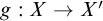 $g : X \to X'$
are given by
$g : X \to X'$
are given by
 $$ \begin{align*} &\mathcal{a\!t}_{\sharp}(h) : \mathcal{a\!t}(A') \to \mathcal{a\!t}(A) : x' \mapsto \{ \alpha \subseteq \mathcal{a\!t}(A) \mid x' \leq h({\textstyle\bigvee} \alpha) \} \\ &\wp_{\sharp}(g): \wp(X') \to \wp(X): a' \mapsto \{ x \in X \mid a' \in g(x) \}. \end{align*} $$
With units $\psi : \mathcal {i\!d}_{\mathsf {CABAb}} \to \wp _{\sharp } \circ \mathcal {a\!t}_{\sharp }$
and
$\psi : \mathcal {i\!d}_{\mathsf {CABAb}} \to \wp _{\sharp } \circ \mathcal {a\!t}_{\sharp }$
and $\xi : \mathcal {i\!d}_{\mathsf {Set_{\sharp }}} \to \mathcal {a\!t}_{\sharp } \circ \wp _{\sharp }$
defined as
$\xi : \mathcal {i\!d}_{\mathsf {Set_{\sharp }}} \to \mathcal {a\!t}_{\sharp } \circ \wp _{\sharp }$
defined as $\psi _A(a) = \operatorname {\mathrm {at}}(a)$
and
$\psi _A(a) = \operatorname {\mathrm {at}}(a)$
and $\xi _X(x) = \{ \alpha \subseteq \mathcal {a\!t}_{\sharp }(\wp _{\sharp } X) \mid \{ x \} \in \alpha \}$
, one can then prove the following theorem.
$\xi _X(x) = \{ \alpha \subseteq \mathcal {a\!t}_{\sharp }(\wp _{\sharp } X) \mid \{ x \} \in \alpha \}$
, one can then prove the following theorem.
Theorem 2.2. The functors $\mathcal {a\!t}_{\sharp }$
and
$\mathcal {a\!t}_{\sharp }$
and $\wp _{\sharp }$
establish a dual equivalence
$\wp _{\sharp }$
establish a dual equivalence
 $$ \begin{align*} \mathsf{CABA^b} \equiv^{\operatorname{\mathrm{op}}} \mathsf{Set_{\sharp}}. \end{align*} $$
3 Complete atomic instantial neighbourhood algebras
We wish to define a notion of a complete atomic algebra for INL that relates to BAIOs in the same way complete atomic modal algebras (CAMAs) relate to modal algebras. Recall the definition of a BAIO.
Definition 3.1. A BAIO is a pair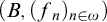 $(B, (f_n)_{n \in \omega })$
consisting of a Boolean algebra B and an
$(B, (f_n)_{n \in \omega })$
consisting of a Boolean algebra B and an $\omega $
-indexed set of functions
$\omega $
-indexed set of functions $f_n : B^{n+1} \to B$
satisfying the following equations:
$f_n : B^{n+1} \to B$
satisfying the following equations:
-
(B1) $f_n(a_1, \ldots , a_i, a_{i+1}, \ldots , a_n; b) = f_n(a_1, \ldots , a_{i+1}, a_i, \ldots , a_n; b)$
-
(B2)
$f_n(a_1, \ldots , a_n; b) \leq f_n(a_1, \ldots , a_n \vee a_n'; b \vee b')$
-
(B3)
$f_n(a_1, \ldots , a_n; b) \leq f_n(a_1, \ldots , a_n \wedge b; b)$
-
(B4)
$f_n(a_1, \ldots , a_{n-1}, \bot; b) = \bot $
-
(B5)
$f_n(a_1, \ldots , a_n; b) \leq f_{n+1}(a_1, \ldots , a_n, c; b) \vee f_n(a_1, \ldots , a_n; b \wedge \neg c)$
-
(B6)
$f_{n+1}(a_1, \ldots , a_{n+1}; b) \leq f_n(a_1, \ldots , a_n; b)$
-
(B7)
$f_n(a_1, \ldots , a_n; b) \leq f_{n+1}(a_1, \ldots , a_n, a_n; b)$







for all $a_i, b \in B$
and
$a_i, b \in B$
and $n \in \omega $
. The collection of BAIOs and BAIO homomorphisms forms a category denoted by
$n \in \omega $
. The collection of BAIOs and BAIO homomorphisms forms a category denoted by $\mathsf {BAIO}$
.
$\mathsf {BAIO}$
.
For a CABA A, denote by $\mathcal {P}A = \{ \gamma \mid \gamma \subseteq A \}$
the powerset of the carrier of A.
$\mathcal {P}A = \{ \gamma \mid \gamma \subseteq A \}$
the powerset of the carrier of A.
Definition 3.2. A complete atomic instantial neighbourhood algebra (CAINA) is a pair  consisting of a CABA A and a function
  that satisfies for any index set I, all $\gamma , \gamma ', \beta \in \mathcal {P}A$
and all
$\gamma , \gamma ', \beta \in \mathcal {P}A$
and all $a, a', c, c_i, c', c_i' \in A$
:
$a, a', c, c_i, c', c_i' \in A$
:
-
(R-Mon)
-
(L-Mon)
-
(Inst)
-
(Norm)
-
(Case)
-
(Weak)






A CAINA-morphism from  to
to  is a complete homomorphism $h : A_1 \to A_2$
such that for all
$h : A_1 \to A_2$
such that for all $\gamma \cup \{ a \} \subseteq A_1$
,
$\gamma \cup \{ a \} \subseteq A_1$
,

We write $\mathsf {CAINA}$
for the category of CAINAs and CAINA-morphisms.
$\mathsf {CAINA}$
for the category of CAINAs and CAINA-morphisms.
Many of the inequalities in Definition 3.2 can be written as equalities. This is obvious for (Norm), equality for (Inst) follows from (L-Mon), and (Case) is an equality because every term on the right-hand side is smaller than the left-hand side by (Weak) and (R-Mon). We have given them as inequalities as that lies closer to a potential axiomatisation of an infinitary version of INL.
Every CAINA has an “underlying” BAIO.
Proposition 3.3. There exists a functor $\mathcal {U} : \mathsf {CAINA} \to \mathsf {BAIO}$
.
$\mathcal {U} : \mathsf {CAINA} \to \mathsf {BAIO}$
.
Proof. For a CAINA  and
and $n \in \omega $
, define
$n \in \omega $
, define $f_n : A^{n+1} \to A$
by
$f_n : A^{n+1} \to A$
by

A routine verification shows that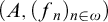 $(A, (f_n)_{n \in \omega })$
satisfies the conditions from Definition 3.1. Define
$(A, (f_n)_{n \in \omega })$
satisfies the conditions from Definition 3.1. Define $\mathcal {U} : \mathsf {CAINA} \to \mathsf {BAIO}$
on objects by
$\mathcal {U} : \mathsf {CAINA} \to \mathsf {BAIO}$
on objects by  . If
. If  is a CAINA-morphism then h is a BAIO-morphism from
  to
to  , so setting $\mathcal {U}h = h$
yields a functor
$\mathcal {U}h = h$
yields a functor $\mathcal {U} : \mathsf {CAINA} \to \mathsf {BAIO}$
.
$\mathcal {U} : \mathsf {CAINA} \to \mathsf {BAIO}$
.
We complete this section with three lemmas about CAINAs. The first is a variation of [Reference van Benthem, Bezhanishvili, Enqvist and Yu3, Lemma 4.2(6)].
Lemma 3.4. Let $\gamma \subseteq A$
and
$\gamma \subseteq A$
and $a \in A$
and suppose
$a \in A$
and suppose $c \leq a$
for all
$c \leq a$
for all $c \in \gamma $
. Then
$c \in \gamma $
. Then

Proof. If $c = \bot $
for any
$c = \bot $
for any $c \in \gamma $
then the left-hand side is
$c \in \gamma $
then the left-hand side is $\bot $
by (Norm) and the right-hand side is an empty join (because
$\bot $
by (Norm) and the right-hand side is an empty join (because $\operatorname {\mathrm {at}}(\bot ) = \emptyset $
), hence also equal to
$\operatorname {\mathrm {at}}(\bot ) = \emptyset $
), hence also equal to $\bot $
.
$\bot $
.
So suppose $c \neq \bot $
for all
$c \neq \bot $
for all $c \in \gamma $
. By (L-Mon) we have
$c \in \gamma $
. By (L-Mon) we have  for any $\chi $
in the right-hand side of (2). This entails the inequality
$\chi $
in the right-hand side of (2). This entails the inequality $\geq $
in (2). For the converse, let
$\geq $
in (2). For the converse, let $\beta = \bigcup \{ \operatorname {\mathrm {at}}(c) \mid c \in \gamma \}$
be the collection of all atoms that lie below some
$\beta = \bigcup \{ \operatorname {\mathrm {at}}(c) \mid c \in \gamma \}$
be the collection of all atoms that lie below some $c \in \gamma $
, and define
$c \in \gamma $
, and define $a' = a \wedge \neg (\bigvee \beta )$
. Then the assumption that
$a' = a \wedge \neg (\bigvee \beta )$
. Then the assumption that $c \leq a$
for all
$c \leq a$
for all $c \in \gamma $
, hence
$c \in \gamma $
, hence $b \leq a$
for all
$b \leq a$
for all $b \in \beta $
, entails
$b \in \beta $
, entails $a = a' \vee \bigvee \beta $
. Applying (Case) gives
$a = a' \vee \bigvee \beta $
. Applying (Case) gives

If $\beta ' \cap \operatorname {\mathrm {at}}(c') = \emptyset $
for some
$\beta ' \cap \operatorname {\mathrm {at}}(c') = \emptyset $
for some $c' \in \gamma $
, then
$c' \in \gamma $
, then $c' \wedge (a' \vee \bigvee \beta ') = \bot $
, whence (Inst) and (Norm) imply
$c' \wedge (a' \vee \bigvee \beta ') = \bot $
, whence (Inst) and (Norm) imply

So we can remove the terms in the right-hand side of (3) for which $\beta ' \cap \operatorname {\mathrm {at}}(c') = \emptyset $
for some
$\beta ' \cap \operatorname {\mathrm {at}}(c') = \emptyset $
for some $c' \in \gamma $
. Now if
$c' \in \gamma $
. Now if $\beta '$
is such that
$\beta '$
is such that $\beta ' \cap \operatorname {\mathrm {at}}(c) \neq \emptyset $
for all
$\beta ' \cap \operatorname {\mathrm {at}}(c) \neq \emptyset $
for all $c \in \gamma $
, then we can choose a map
$c \in \gamma $
, then we can choose a map $\chi : \gamma \to A$
such that
$\chi : \gamma \to A$
such that $\chi (c) \in \beta ' \cap \operatorname {\mathrm {at}}(c)$
for all
$\chi (c) \in \beta ' \cap \operatorname {\mathrm {at}}(c)$
for all $c \in \gamma $
, and by (Weak) and (R-Mon) we then have
$c \in \gamma $
, and by (Weak) and (R-Mon) we then have

Using the inequations from (4) and (5) to eliminate unnecessary terms from (3) gives the inequation $\leq $
in (2).
$\leq $
in (2).
Next, we show that the action of  in a CAINA
  is determined by its action on a select family of pairs in $\mathcal {P}A \times A$
, namely, pairs of the form
$\mathcal {P}A \times A$
, namely, pairs of the form $(\alpha; \bigvee \alpha )$
, where
$(\alpha; \bigvee \alpha )$
, where $\alpha \subseteq \mathcal {a\!t}(A)$
. For such
$\alpha \subseteq \mathcal {a\!t}(A)$
. For such $\alpha $
we abbreviate
$\alpha $
we abbreviate  , and we call $\mathord {\boxdot }\alpha $
an elementary image in
$\mathord {\boxdot }\alpha $
an elementary image in  . Recall that for any $d \in A$
we write
$d \in A$
we write $\operatorname {\mathrm {at}}(d)$
for the set of atoms that lie below d. Atomicity of A implies
$\operatorname {\mathrm {at}}(d)$
for the set of atoms that lie below d. Atomicity of A implies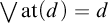 $\bigvee \operatorname {\mathrm {at}}(d) = d$
.
$\bigvee \operatorname {\mathrm {at}}(d) = d$
.
Lemma 3.5. Let  be a CAINA, $\gamma \subseteq A$
and
$\gamma \subseteq A$
and $a \in A$
. Then
$a \in A$
. Then

Proof. Let $\gamma ' = \{ c \wedge a \mid c \in \gamma \}$
. Then by (Inst)
$\gamma ' = \{ c \wedge a \mid c \in \gamma \}$
. Then by (Inst)  and by definition of $\gamma '$
the right-hand side equals
$\gamma '$
the right-hand side equals $\bigvee \{ \mathord {\boxdot } \operatorname {\mathrm {at}}(d) \mid d \in A \text { and } d \leq a \text { and} d \wedge c' \neq \bot \text { for all } c' \in \gamma ' \}$
.
$\bigvee \{ \mathord {\boxdot } \operatorname {\mathrm {at}}(d) \mid d \in A \text { and } d \leq a \text { and} d \wedge c' \neq \bot \text { for all } c' \in \gamma ' \}$
.
So it suffices to assume $c \leq a$
for all
$c \leq a$
for all $c \in \gamma $
and prove
$c \in \gamma $
and prove

First suppose that $\gamma \subseteq \mathcal {a\!t}(A)$
. Let
$\gamma \subseteq \mathcal {a\!t}(A)$
. Let $a' = a \wedge \neg (\bigvee \gamma )$
. Then
$a' = a \wedge \neg (\bigvee \gamma )$
. Then $a = \bigvee \gamma \vee \bigvee \operatorname {\mathrm {at}}(a')$
, so using (Case) we find
$a = \bigvee \gamma \vee \bigvee \operatorname {\mathrm {at}}(a')$
, so using (Case) we find

For arbitrary $\gamma \subseteq A$
, as a consequence of Lemma 3.4 we have
$\gamma \subseteq A$
, as a consequence of Lemma 3.4 we have

Each of the terms can be expressed as a join of elementary images using (8). We show that this gives the expression in (7).
If $\mathord {\boxdot }(\{ \chi (c) \mid c \in \gamma \} \cup \delta )$
is one of the elementary images that arises from one of the terms in (9), then
$\mathord {\boxdot }(\{ \chi (c) \mid c \in \gamma \} \cup \delta )$
is one of the elementary images that arises from one of the terms in (9), then $\bigvee (\{ \chi (c) \mid c \in \gamma \} \cup \delta )$
is smaller than a and has nonempty meet with all
$\bigvee (\{ \chi (c) \mid c \in \gamma \} \cup \delta )$
is smaller than a and has nonempty meet with all $c \in \gamma $
because
$c \in \gamma $
because $\chi (c) \leq c \wedge \bigvee (\{ \chi (c) \mid c \in \gamma \} \cup \delta )$
, so it is one of the d’s from (7). This proves the inequality “
$\chi (c) \leq c \wedge \bigvee (\{ \chi (c) \mid c \in \gamma \} \cup \delta )$
, so it is one of the d’s from (7). This proves the inequality “ $\leq $
” in (7). The converse inequality follows from the fact that each term in the right-hand side of (7) is smaller than
$\leq $
” in (7). The converse inequality follows from the fact that each term in the right-hand side of (7) is smaller than  , as a consequence of (R-Mon), (L-Mon), and (Weak).
Remark 3.6. Lemma 3.5 shows that we may take operators of the form $\mathord {\boxdot } \operatorname {\mathrm {at}}(d)$
as primitive in our definition of CAINAs, viewing all others as defined operators. This drastically shrinks the size of the signature of CAINAs. It may also provide a connection between CAINAs and the complete atomic neighbourhood algebras used in the duality for (non-instantial) neighbourhood frames [Reference Došen7]. However, it is unclear how to describe CAINA-morphisms when referring only to
$\mathord {\boxdot } \operatorname {\mathrm {at}}(d)$
as primitive in our definition of CAINAs, viewing all others as defined operators. This drastically shrinks the size of the signature of CAINAs. It may also provide a connection between CAINAs and the complete atomic neighbourhood algebras used in the duality for (non-instantial) neighbourhood frames [Reference Došen7]. However, it is unclear how to describe CAINA-morphisms when referring only to $\mathord {\boxdot }$
. To emphasise the instantial neighbourhood point of view, we use the “larger” definition of CAINAs.
$\mathord {\boxdot }$
. To emphasise the instantial neighbourhood point of view, we use the “larger” definition of CAINAs.
Another consequence we will use later is as follows.
Lemma 3.7. Let  and
and  be two CAINAs and $h : A \to A'$
a complete Boolean isomorphism such that
$h : A \to A'$
a complete Boolean isomorphism such that $h(\mathord {\boxdot } \alpha ) = \mathord {\boxdot }' h[\alpha ]$
for all
$h(\mathord {\boxdot } \alpha ) = \mathord {\boxdot }' h[\alpha ]$
for all $\alpha \subseteq \mathcal {a\!t}(A)$
. Then h is a CAINA isomorphism.
$\alpha \subseteq \mathcal {a\!t}(A)$
. Then h is a CAINA isomorphism.
Proof. Since h is a complete Boolean isomorphism, it is a bijection. Then if h is a CAINA homomorphism, so is $h^{-1}$
. So, to prove that h is an isomorphism in
$h^{-1}$
. So, to prove that h is an isomorphism in $\mathsf {CAINA}$
, it suffices to prove that it is a CAINA-morphism. To this end, compute
$\mathsf {CAINA}$
, it suffices to prove that it is a CAINA-morphism. To this end, compute

Here the first and last equalities follow from Lemma 3.5, the second from the fact that h is a complete homomorphism, and the third from the assumption that h preserves $\mathord {\boxdot }$
. The remaining equalities follow from the fact that h is an isomorphism between the underlying CABAs.
$\mathord {\boxdot }$
. The remaining equalities follow from the fact that h is an isomorphism between the underlying CABAs.
4 Duality
We now work towards the duality between $\mathsf {INF}$
and
$\mathsf {INF}$
and $\mathsf {CAINA}$
. We begin by extending
$\mathsf {CAINA}$
. We begin by extending $\wp : \mathsf {Set} \to \mathsf {CABA}$
to a contravariant functor
$\wp : \mathsf {Set} \to \mathsf {CABA}$
to a contravariant functor $\widehat {\wp } : \mathsf {INF} \to \mathsf {CAINA}$
. For
$\widehat {\wp } : \mathsf {INF} \to \mathsf {CAINA}$
. For $(X, N) \in \mathsf {INF}$
define
$(X, N) \in \mathsf {INF}$
define  by
by

and let  . If f is a morphism in $\mathsf {INF}$
, define
$\mathsf {INF}$
, define $\widehat {\wp }f = \wp f = f^{-1}$
.
$\widehat {\wp }f = \wp f = f^{-1}$
.
Lemma 4.1. The assignment $\widehat {\wp }$
defines a contravariant functor
$\widehat {\wp }$
defines a contravariant functor $\mathsf {INF} \to \mathsf {CAINA}$
.
$\mathsf {INF} \to \mathsf {CAINA}$
.
Proof. Functoriality of $\widehat {\wp }$
follows from the functoriality of
$\widehat {\wp }$
follows from the functoriality of $\wp $
, so we only need to prove that
$\wp $
, so we only need to prove that $\widehat {\wp }$
is well defined. Let
$\widehat {\wp }$
is well defined. Let $(X, N)$
be an instantial neighbourhood frame. Then in order to prove that
$(X, N)$
be an instantial neighbourhood frame. Then in order to prove that  is a CAINA we need to verify that the clauses from Definition 3.2 hold. They all follow from a straightforward computation; we prove (Case) as an example.
Suppose  . Then there exists $d \in N(x)$
such that
$d \in N(x)$
such that $d \subseteq a \cup \bigcup \beta $
and
$d \subseteq a \cup \bigcup \beta $
and $d \cap c \neq \emptyset $
for all
$d \cap c \neq \emptyset $
for all $c \in \gamma $
. Now let
$c \in \gamma $
. Now let $\beta ' = \{ b \in \beta \mid b \cap d \neq \emptyset \}$
. Then d witnesses the fact that
$\beta ' = \{ b \in \beta \mid b \cap d \neq \emptyset \}$
. Then d witnesses the fact that  , and since this is a term on the right-hand side of (Case) this proves that x is in the right hand side of (Case).
Next we want to show that $\widehat {\wp } f = \wp f = f^{-1}$
is a CAINA-morphism from
$\widehat {\wp } f = \wp f = f^{-1}$
is a CAINA-morphism from  to
to  whenever $f : (X, N) \to (X', N')$
is an instantial neighbourhood morphism. We know from Tarski duality that
$f : (X, N) \to (X', N')$
is an instantial neighbourhood morphism. We know from Tarski duality that $\widehat {\wp }f$
is a complete homomorphism, so we just need to show that for all
$\widehat {\wp }f$
is a complete homomorphism, so we just need to show that for all $\gamma ' \subseteq \wp X'$
and
$\gamma ' \subseteq \wp X'$
and $a' \in \wp X'$
,
$a' \in \wp X'$
,

If  then there exists $d \in N(x)$
such that
$d \in N(x)$
such that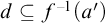 ${d \subseteq f^{-1}(a')}$
and
${d \subseteq f^{-1}(a')}$
and $d \cap f^{-1}(c') \neq \emptyset $
for all
$d \cap f^{-1}(c') \neq \emptyset $
for all $c' \in \gamma '$
. But then
$c' \in \gamma '$
. But then $f[d] \subseteq a'$
and
$f[d] \subseteq a'$
and $f[d] \cap c' \neq \emptyset $
for all
$f[d] \cap c' \neq \emptyset $
for all $c' \in \gamma '$
. Since f is an instantial neighbourhood morphism we have
$c' \in \gamma '$
. Since f is an instantial neighbourhood morphism we have $f[d] \in N'(f(x))$
and therefore
$f[d] \in N'(f(x))$
and therefore $f[d]$
witnesses that
$f[d]$
witnesses that  , i.e.,
  . The converse inclusion follows similarly.
Next, we extend $\mathcal {a\!t} : \mathsf {CABA} \to \mathsf {Set}$
to a contravariant functor
$\mathcal {a\!t} : \mathsf {CABA} \to \mathsf {Set}$
to a contravariant functor $\widehat {\mathcal {a\!t}} : \mathsf {CAINA} \to \mathsf {INF}$
. For a CAINA
$\widehat {\mathcal {a\!t}} : \mathsf {CAINA} \to \mathsf {INF}$
. For a CAINA  , define a neighbourhood structure
  on
on $\mathcal {a\!t}(A)$
via
$\mathcal {a\!t}(A)$
via

and set  . (We have already seen in Lemma 3.5 that elements of the form
  play an important role, so it is not surprising that they determine a suitable neighbourhood structure on $\mathcal {a\!t}(A)$
.)
$\mathcal {a\!t}(A)$
.)
Lemma 4.2. The assignment $\widehat {\mathcal {a\!t}}$
extends to a contravariant functor
$\widehat {\mathcal {a\!t}}$
extends to a contravariant functor $\mathsf {CAINA} \to \mathsf {INF}$
, where the action on a morphism h in
$\mathsf {CAINA} \to \mathsf {INF}$
, where the action on a morphism h in $\mathsf {CAINA}$
is given by
$\mathsf {CAINA}$
is given by $\widehat {\mathcal {a\!t}}(h) = \mathcal {a\!t}(h)$
.
$\widehat {\mathcal {a\!t}}(h) = \mathcal {a\!t}(h)$
.
Proof. Again, functoriality follows from the fact that $\mathcal {a\!t}$
is a functor. Clearly
$\mathcal {a\!t}$
is a functor. Clearly $\widehat {\mathcal {a\!t}}$
is well defined on objects, so it remains to show that it is well defined on morphisms. To this end, let
$\widehat {\mathcal {a\!t}}$
is well defined on objects, so it remains to show that it is well defined on morphisms. To this end, let  be a morphism in $\mathsf {CAINA}$
. We need to prove that for all
$\mathsf {CAINA}$
. We need to prove that for all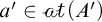 $a' \in \mathcal {a\!t}(A')$
and
$a' \in \mathcal {a\!t}(A')$
and $\alpha \subseteq \mathcal {a\!t}(A)$
we have
$\alpha \subseteq \mathcal {a\!t}(A)$
we have  iff there exists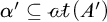 $\alpha ' \subseteq \mathcal {a\!t}(A')$
such that
$\alpha ' \subseteq \mathcal {a\!t}(A')$
such that 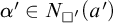 and
and $\widehat {\mathcal {a\!t}}(h)[\alpha '] = \alpha $
. We prove the two directions of the “iff” one by one.
$\widehat {\mathcal {a\!t}}(h)[\alpha '] = \alpha $
. We prove the two directions of the “iff” one by one.
( $\Rightarrow $
) Suppose
$\Rightarrow $
) Suppose  . By definition of $\widehat {\mathcal {a\!t}}(h)$
and
$\widehat {\mathcal {a\!t}}(h)$
and  we have

and hence  . Abbreviate $h[\alpha ] := \{ h(b) \mid b \in \alpha \}$
. Using the fact that h is a CAINA morphism gives
$h[\alpha ] := \{ h(b) \mid b \in \alpha \}$
. Using the fact that h is a CAINA morphism gives

Applying Lemma 3.5 to the rightmost term above yields
 $$ \begin{align*} a' \leq \bigvee \{ \mathord{\boxdot}'(\operatorname{\mathrm{at}}(d')) \mid d' \leq {\textstyle\bigvee} h[\alpha] \text{ and } d' \wedge h(b) \neq \bot \text{ for all } h(b) \in h[\alpha] \}. \end{align*} $$
Since $a'$
is an atom, there must be a particular instance of such a
$a'$
is an atom, there must be a particular instance of such a $d'$
, say,
$d'$
, say, $d"$
, such that
$d"$
, such that $a' \leq \mathord {\boxdot }'(\operatorname {\mathrm {at}}(d"))$
, hence
$a' \leq \mathord {\boxdot }'(\operatorname {\mathrm {at}}(d"))$
, hence  .
.
We claim that $\widehat {\mathcal {a\!t}}(h)[\operatorname {\mathrm {at}}(d")] = \alpha $
. First, if
$\widehat {\mathcal {a\!t}}(h)[\operatorname {\mathrm {at}}(d")] = \alpha $
. First, if $c \in \widehat {\mathcal {a\!t}}(h)[\operatorname {\mathrm {at}}(d")]$
then there exists some
$c \in \widehat {\mathcal {a\!t}}(h)[\operatorname {\mathrm {at}}(d")]$
then there exists some $c' \in \operatorname {\mathrm {at}}(d")$
such that
$c' \in \operatorname {\mathrm {at}}(d")$
such that $c = \bigwedge \{ b \in A \mid c' \leq h(b) \}$
. Since
$c = \bigwedge \{ b \in A \mid c' \leq h(b) \}$
. Since $c'$
is an atom and
$c'$
is an atom and $c' \leq d" \leq \bigvee h[\alpha ]$
, there must be some
$c' \leq d" \leq \bigvee h[\alpha ]$
, there must be some $b \in \alpha $
such that
$b \in \alpha $
such that $c' \leq h(b)$
. This implies
$c' \leq h(b)$
. This implies $c = \widehat {\mathcal {a\!t}}(h)(c') \leq b$
, and since both c and b are atoms,
$c = \widehat {\mathcal {a\!t}}(h)(c') \leq b$
, and since both c and b are atoms, $c = b \in \alpha $
. Conversely, if
$c = b \in \alpha $
. Conversely, if $c \in \alpha $
then
$c \in \alpha $
then $d" \wedge h(c) \neq \bot $
, so there exists some atom
$d" \wedge h(c) \neq \bot $
, so there exists some atom $c' \in \operatorname {\mathrm {at}}(d")$
such that
$c' \in \operatorname {\mathrm {at}}(d")$
such that $c' \leq h(c)$
. This implies
$c' \leq h(c)$
. This implies $\mathcal {a\!t}(h)(c') \leq c$
and since c is an atom we must have
$\mathcal {a\!t}(h)(c') \leq c$
and since c is an atom we must have $\mathcal {a\!t}(h)(c') = c$
, hence
$\mathcal {a\!t}(h)(c') = c$
, hence $c \in \mathcal {a\!t}(h)[\operatorname {\mathrm {at}}(d")]$
. Finally, taking
$c \in \mathcal {a\!t}(h)[\operatorname {\mathrm {at}}(d")]$
. Finally, taking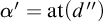 $\alpha ' = \operatorname {\mathrm {at}}(d")$
gives the desired set of atoms such that
$\alpha ' = \operatorname {\mathrm {at}}(d")$
gives the desired set of atoms such that 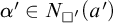 and
and $\widehat {\mathcal {a\!t}}(h)[\alpha '] = \alpha $
.
$\widehat {\mathcal {a\!t}}(h)[\alpha '] = \alpha $
.
( $\Leftarrow $
) Suppose
$\Leftarrow $
) Suppose $\alpha \subseteq \mathcal {a\!t}(A)$
is of the form
$\alpha \subseteq \mathcal {a\!t}(A)$
is of the form $\widehat {\mathcal {a\!t}}(h)[\alpha ']$
for some
$\widehat {\mathcal {a\!t}}(h)[\alpha ']$
for some 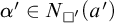 . Then
  . By definition of $\widehat {\mathcal {a\!t}}(h)$
we have
$\widehat {\mathcal {a\!t}}(h)$
we have $b' \leq h(\widehat {\mathcal {a\!t}}(h)(b'))$
for all
$b' \leq h(\widehat {\mathcal {a\!t}}(h)(b'))$
for all $b' \in \alpha '$
, so
$b' \in \alpha '$
, so

This implies  , so that
  , as desired.
Finally, we prove that $\widehat {\wp }$
and
$\widehat {\wp }$
and $\widehat {\mathcal {a\!t}}$
establish a dual equivalence.
$\widehat {\mathcal {a\!t}}$
establish a dual equivalence.
Thomason Theorem for INL 4.3. The contravariant functors $\widehat {\wp } : \mathsf {INF} \to \mathsf {CAINA}$
and
$\widehat {\wp } : \mathsf {INF} \to \mathsf {CAINA}$
and $\widehat {\mathcal {a\!t}} : \mathsf {CAINA} \to \mathsf {INF}$
establish a dual equivalence
$\widehat {\mathcal {a\!t}} : \mathsf {CAINA} \to \mathsf {INF}$
establish a dual equivalence
 $$ \begin{align*} \mathsf{CAINA} \equiv^{\operatorname{\mathrm{op}}} \mathsf{INF}. \end{align*} $$
Proof. First we give natural isomorphisms $\mathcal {i\!d}_{\mathsf {INF}} \cong \widehat {\mathcal {a\!t}} \circ \widehat {\wp }$
and
$\mathcal {i\!d}_{\mathsf {INF}} \cong \widehat {\mathcal {a\!t}} \circ \widehat {\wp }$
and $\mathcal {i\!d}_{\mathsf {CAINA}} \cong \widehat {\wp } \circ \widehat {\mathcal {a\!t}}$
. We already know from Tarski duality that for each instantial neighbourhood frame
$\mathcal {i\!d}_{\mathsf {CAINA}} \cong \widehat {\wp } \circ \widehat {\mathcal {a\!t}}$
. We already know from Tarski duality that for each instantial neighbourhood frame $(X, N)$
there exists a bijection between X and the set underlying
$(X, N)$
there exists a bijection between X and the set underlying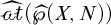 $\widehat {\mathcal {a\!t}}(\widehat {\wp }(X, N))$
, given by
$\widehat {\mathcal {a\!t}}(\widehat {\wp }(X, N))$
, given by $\varphi _X : X \to \mathcal {a\!t}(\wp X) : x \mapsto \{ x \}$
. Furthermore, for all
$\varphi _X : X \to \mathcal {a\!t}(\wp X) : x \mapsto \{ x \}$
. Furthermore, for all $a \subseteq X$
we have
$a \subseteq X$
we have $a \in N(x)$
iff
$a \in N(x)$
iff  iff
iff  . Therefore setting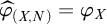 $\widehat {\varphi }_{(X, N)} = \varphi _X$
gives a transformation
$\widehat {\varphi }_{(X, N)} = \varphi _X$
gives a transformation $\mathcal {i\!d}_{\mathsf {INF}} \to \widehat {\mathcal {a\!t}} \circ \widehat {\wp }$
whose components are isomorphisms. Naturality of
$\mathcal {i\!d}_{\mathsf {INF}} \to \widehat {\mathcal {a\!t}} \circ \widehat {\wp }$
whose components are isomorphisms. Naturality of $\widehat {\varphi }$
follows from naturality of
$\widehat {\varphi }$
follows from naturality of $\varphi $
.
$\varphi $
.
Similarly, if  is a CAINA, then $\psi _A : A \to \wp (\mathcal {a\!t}(A)) : a \mapsto \operatorname {\mathrm {at}}(a)$
is an isomorphism in
$\psi _A : A \to \wp (\mathcal {a\!t}(A)) : a \mapsto \operatorname {\mathrm {at}}(a)$
is an isomorphism in $\mathsf {CABA}$
. Let
$\mathsf {CABA}$
. Let $\alpha \subseteq \mathcal {a\!t}(A)$
and
$\alpha \subseteq \mathcal {a\!t}(A)$
and $a \in \mathcal {a\!t}(A)$
. Then
$a \in \mathcal {a\!t}(A)$
. Then

Atomicity of A gives  , so
, so $\psi _A$
preserves elementary images, hence by Lemma 3.7
$\psi _A$
preserves elementary images, hence by Lemma 3.7 $\psi _A$
is a CAINA isomorphism. Therefore setting
$\psi _A$
is a CAINA isomorphism. Therefore setting 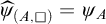 yields a natural isomorphism $\mathcal {i\!d}_{\mathsf {CAINA}} \to \widehat {\wp } \circ \widehat {\mathcal {a\!t}}$
.
$\mathcal {i\!d}_{\mathsf {CAINA}} \to \widehat {\wp } \circ \widehat {\mathcal {a\!t}}$
.
The proof is completed by noting that the triangle identities for $\widehat {\varphi }$
and
$\widehat {\varphi }$
and $\widehat {\psi }$
follow from those for
$\widehat {\psi }$
follow from those for $\varphi $
and
$\varphi $
and $\psi $
.
$\psi $
.
Remark 4.4. One can also prove the duality using a coalgebraic perspective. It is well known that $\mathsf {INF}$
is isomorphic to the category of
$\mathsf {INF}$
is isomorphic to the category of $\mathcal {PP}$
-coalgebras [Reference van Benthem, Bezhanishvili, Enqvist and Yu3, Section 7.5], where
$\mathcal {PP}$
-coalgebras [Reference van Benthem, Bezhanishvili, Enqvist and Yu3, Section 7.5], where $\mathcal {P}$
is the covariant powerset functor on
$\mathcal {P}$
is the covariant powerset functor on $\mathsf {Set}$
. For a suitably defined
$\mathsf {Set}$
. For a suitably defined $\mathcal {I} : \mathsf {CABA} \to \mathsf {CABA}$
we have
$\mathcal {I} : \mathsf {CABA} \to \mathsf {CABA}$
we have $\mathsf {CAINA} \cong \mathsf {Alg}(\mathcal {I})$
. Using similar techniques as in the proofs above, one can then show that
$\mathsf {CAINA} \cong \mathsf {Alg}(\mathcal {I})$
. Using similar techniques as in the proofs above, one can then show that $\mathcal {I}$
and
$\mathcal {I}$
and $\mathcal {PP}$
are dual under Tarski duality, and the theorem follows from this. A proof of Thomason duality for Kripke frames using this approach was given in [Reference Bezhanishvili, Carai and Morandi4].
$\mathcal {PP}$
are dual under Tarski duality, and the theorem follows from this. A proof of Thomason duality for Kripke frames using this approach was given in [Reference Bezhanishvili, Carai and Morandi4].
5 Extension to not-necessarily-complete homomorphisms
We extend the duality derived in Theorem 4.3 to a duality for the category of CAINAs and BAIO homomorphisms, i.e., not-necessarily-complete homomorphisms that only preserve modal operators  for finite sets $\gamma $
. These types of homomorphisms better reflect the (finitary) logic. Let us call these b-homomorphisms (where “b” refers to “Boolean” or “BAIO”) and write
$\gamma $
. These types of homomorphisms better reflect the (finitary) logic. Let us call these b-homomorphisms (where “b” refers to “Boolean” or “BAIO”) and write $\mathsf {CAINA^b}$
for the resulting category. Dually, this results in the following definition.
$\mathsf {CAINA^b}$
for the resulting category. Dually, this results in the following definition.
Definition 5.1. An instantial $\sharp $
-morphism
$\sharp $
-morphism $g : (X, N) \to (X', N')$
is a function that assigns to each
$g : (X, N) \to (X', N')$
is a function that assigns to each $x \in X$
an ultrafilter
$x \in X$
an ultrafilter $g(x)$
on
$g(x)$
on $X'$
, such that for every finite collection
$X'$
, such that for every finite collection $\gamma ' \cup \{ a' \} \subseteq \wp X'$
of (arbitrary) subsets of
$\gamma ' \cup \{ a' \} \subseteq \wp X'$
of (arbitrary) subsets of $X'$
we have
$X'$
we have  if and only if there exists $d \in N(x)$
satisfying:
$d \in N(x)$
satisfying:
-
(♯1) for every
$c' \in \gamma '$
there is some
$y \in d$
such that
$c' \in g(y)$
; -
(♯2) for every
$y \in d$
we have
$a' \in g(y)$
.


Let $\mathsf {INF_{\sharp }}$
be the collection of instantial neighbourhood frames and
$\mathsf {INF_{\sharp }}$
be the collection of instantial neighbourhood frames and $\sharp $
-morphisms.
$\sharp $
-morphisms.
We prove that $\mathsf {INF_{\sharp }}$
forms a category via a detour through CAINAs.
$\mathsf {INF_{\sharp }}$
forms a category via a detour through CAINAs.
Lemma 5.2. If  is a b-homomorphism then

is an instantial $\sharp $
-morphism. Conversely, if
$\sharp $
-morphism. Conversely, if $g : (X, N) \to (X', N')$
is an instantial
$g : (X, N) \to (X', N')$
is an instantial $\sharp $
-morphism then
$\sharp $
-morphism then
 $$ \begin{align*} \widehat{\wp}_{\sharp}(g) : \widehat{\wp}(X', N') \to \widehat{\wp}(X, N) : a' \mapsto \{ x \in X \mid a' \in g(x) \} \end{align*} $$
is a b-homomorphism.
Proof. Both statements can be proven by unpacking the definitions and using Lemma 3.5 above. A detailed proof is given in Appendix B.
Unravelling the definitions of $\mathcal {a\!t}_{\sharp }$
and
$\mathcal {a\!t}_{\sharp }$
and $\wp _{\sharp }$
shows that for any
$\wp _{\sharp }$
shows that for any $\sharp $
-morphism
$\sharp $
-morphism $f : X \to X'$
, the function
$f : X \to X'$
, the function $\mathcal {a\!t}_{\sharp }(\wp _{\sharp } f) : \mathcal {a\!t}_{\sharp }(\wp _{\sharp } X) \to \mathcal {a\!t}_{\sharp }(\wp _{\sharp } X')$
is simply given by replacing every element of
$\mathcal {a\!t}_{\sharp }(\wp _{\sharp } f) : \mathcal {a\!t}_{\sharp }(\wp _{\sharp } X) \to \mathcal {a\!t}_{\sharp }(\wp _{\sharp } X')$
is simply given by replacing every element of $X'$
with its singleton, i.e., by sending
$X'$
with its singleton, i.e., by sending $\{ x \}$
to the collection of sets of the form
$\{ x \}$
to the collection of sets of the form $\{ \{ y \} \in \mathcal {a\!t}_{\sharp }(\wp _{\sharp } X') \mid y \in \alpha \}$
, where
$\{ \{ y \} \in \mathcal {a\!t}_{\sharp }(\wp _{\sharp } X') \mid y \in \alpha \}$
, where $\alpha $
ranges over
$\alpha $
ranges over $f(x)$
. It follows from this observation that
$f(x)$
. It follows from this observation that $f : (X, N) \to (X', N')$
is an instantial
$f : (X, N) \to (X', N')$
is an instantial $\sharp $
-morphism if and only if
$\sharp $
-morphism if and only if $\mathcal {a\!t}_{\sharp }(\wp _{\sharp } f)$
is an instantial
$\mathcal {a\!t}_{\sharp }(\wp _{\sharp } f)$
is an instantial $\sharp $
-morphism. Now Lemma 5.2 entails that
$\sharp $
-morphism. Now Lemma 5.2 entails that $f : (X, N) \to (X', N')$
is an instantial
$f : (X, N) \to (X', N')$
is an instantial $\sharp $
-morphism if and only if
$\sharp $
-morphism if and only if $\wp _{\sharp }(f)$
is a b-homomorphism.
$\wp _{\sharp }(f)$
is a b-homomorphism.
Lemma 5.3. The collection $\mathsf {INF_{\sharp }}$
forms a category with identity morphisms and composition given as in
$\mathsf {INF_{\sharp }}$
forms a category with identity morphisms and composition given as in $\mathsf {Set_{\sharp }}$
.
$\mathsf {Set_{\sharp }}$
.
Proof. Define the identity morphism on $(X, N)$
by
$(X, N)$
by $\eta _{(X,N)} := \eta _X$
. Then by Theorem 2.2 we know that
$\eta _{(X,N)} := \eta _X$
. Then by Theorem 2.2 we know that $\widehat {\wp }_{\sharp }(\eta _{(X,N)}) = \wp _{\sharp }(\eta _X) = \operatorname {\mathrm {id}}_{\widehat {\wp }X}$
is the identity on
$\widehat {\wp }_{\sharp }(\eta _{(X,N)}) = \wp _{\sharp }(\eta _X) = \operatorname {\mathrm {id}}_{\widehat {\wp }X}$
is the identity on $\wp _{\sharp } X$
. Hence
$\wp _{\sharp } X$
. Hence $\widehat {\wp }_{\sharp }(\eta _{(X,N)})$
is the identity on
$\widehat {\wp }_{\sharp }(\eta _{(X,N)})$
is the identity on $\widehat {\wp }(X, N)$
, which is a morphism in
$\widehat {\wp }(X, N)$
, which is a morphism in $\mathsf {CAINA^b}$
. Therefore Lemma 5.2 and the observation above entail that
$\mathsf {CAINA^b}$
. Therefore Lemma 5.2 and the observation above entail that $\eta _{(X,N)}$
is an instantial
$\eta _{(X,N)}$
is an instantial $\sharp $
-morphism. Similarly, we can show that the composition of two instantial
$\sharp $
-morphism. Similarly, we can show that the composition of two instantial $\sharp $
-morphisms is again an instantial
$\sharp $
-morphisms is again an instantial $\sharp $
-morphism by using compositionality of b-homomorphisms in
$\sharp $
-morphism by using compositionality of b-homomorphisms in $\mathsf {CAINA^b}$
. Then
$\mathsf {CAINA^b}$
. Then $\eta _{(X,N)}$
acts as the identity morphism and composition is associative because they are defined as in
$\eta _{(X,N)}$
acts as the identity morphism and composition is associative because they are defined as in $\mathsf {Set_{\sharp }}$
.
$\mathsf {Set_{\sharp }}$
.
Example 5.4. Any instantial neighbourhood morphism $f : (X, N) \to (X', N')$
can be turned into an instantial
$f : (X, N) \to (X', N')$
can be turned into an instantial $\sharp $
-morphism
$\sharp $
-morphism $\bar {f}$
of the same type by defining
$\bar {f}$
of the same type by defining $\bar {f}(x) = \eta _{X'}(f(x))$
. Since
$\bar {f}(x) = \eta _{X'}(f(x))$
. Since $\eta _{X'}$
is an instantial
$\eta _{X'}$
is an instantial $\sharp $
-morphism, for any finite collection
$\sharp $
-morphism, for any finite collection $\gamma ' \cup \{ a' \} \subseteq \wp X'$
of subsets of
$\gamma ' \cup \{ a' \} \subseteq \wp X'$
of subsets of $X'$
we have
$X'$
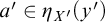
we have  if and only if there exists some $d' \in N'(f(x))$
such that:
$d' \in N'(f(x))$
such that:
-
• for every
$c' \in \gamma '$
there is some
$y' \in d'$
satisfying
$c' \in \eta _{X'}(y')$
, and -
• for every
$y' \in d'$
we have
$a' \in \eta _{X'}(y')$
.


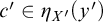

Since f is an instantial neighbourhood morphism, such $d'$
exists if and only if there is some
$d'$
exists if and only if there is some $d \in N(x)$
such that
$d \in N(x)$
such that $f[d] = d'$
. Moreover, any such d satisfies
$f[d] = d'$
. Moreover, any such d satisfies
-
• for every
$c' \in \gamma '$
there is some
$y \in d$
satisfying
$c' \in \eta _{X'}(f(y)) = \bar {f}(y)$
, and -
• for every
$y \in d$
we have
$a' \in \eta _{X'}(f(y)) = \bar {f}(y)$
.





Therefore $\bar {f}$
is an instantial
$\bar {f}$
is an instantial $\sharp $
-morphism.
$\sharp $
-morphism.
Define contravariant functors
 $$ \begin{align*} \widehat{\wp}_{\sharp} : \mathsf{INF_{\sharp}} \to \mathsf{CAINA^b} \quad\text{and}\quad \widehat{\mathcal{a\!t}}_{\sharp} : \mathsf{CAINA^b} \to \mathsf{INF_{\sharp}} \end{align*} $$
on objects by $\widehat {\wp }_{\sharp }(X, N) = \widehat {\wp }(X, N)$
and
$\widehat {\wp }_{\sharp }(X, N) = \widehat {\wp }(X, N)$
and  , and on morphisms as in Lemma 5.2. (Functoriality follows from functoriality of $\wp _{\sharp }$
and
$\wp _{\sharp }$
and $\mathcal {a\!t}_{\sharp }$
.)
$\mathcal {a\!t}_{\sharp }$
.)
Theorem 5.5. $\widehat {\wp }_{\sharp }$
and
$\widehat {\wp }_{\sharp }$
and $\widehat {\mathcal {a\!t}}_{\sharp }$
establish a dual equivalence
$\widehat {\mathcal {a\!t}}_{\sharp }$
establish a dual equivalence $\mathsf {CAINA^b} \equiv ^{\operatorname {\mathrm {op}}} \mathsf {INF_{\sharp }}$
.
$\mathsf {CAINA^b} \equiv ^{\operatorname {\mathrm {op}}} \mathsf {INF_{\sharp }}$
.
Proof. As before, define $\widehat {\psi } : \mathcal {i\!d}_{\mathsf {CAINA^b}} \to \widehat {\wp }_{\sharp } \circ \widehat {\mathcal {a\!t}}_{\sharp }$
by
$\widehat {\psi } : \mathcal {i\!d}_{\mathsf {CAINA^b}} \to \widehat {\wp }_{\sharp } \circ \widehat {\mathcal {a\!t}}_{\sharp }$
by  . It follows from Theorem 4.3 that $\widehat {\psi }$
is an isomorphism on components, and its naturality follows from the naturality of
$\widehat {\psi }$
is an isomorphism on components, and its naturality follows from the naturality of $\psi $
in Theorem 2.2.
$\psi $
in Theorem 2.2.
In the opposite direction, define $\widehat {\xi } : \mathcal {i\!d}_{\mathsf {INF_{\sharp }}} \to \widehat {\mathcal {a\!t}}_{\sharp } \circ \widehat {\wp }_{\sharp }$
by
$\widehat {\xi } : \mathcal {i\!d}_{\mathsf {INF_{\sharp }}} \to \widehat {\mathcal {a\!t}}_{\sharp } \circ \widehat {\wp }_{\sharp }$
by
 $$ \begin{align*} \widehat{\xi}_{(X,N)} : (X, N) \to \widehat{\mathcal{a\!t}}_{\sharp}(\widehat{\wp}_{\sharp}(X, N)) : x \mapsto \{ \alpha \subseteq \widehat{\mathcal{a\!t}}_{\sharp}(\widehat{\wp}_{\sharp}(X, N)) \mid \{ x \} \in \alpha \}. \end{align*} $$
Then $\widehat {\xi }_{(X, N)} = \eta _{X} \circ \operatorname {\mathrm {id}}_{(X,N)}$
, so by Example 5.4 the components are instantial
$\widehat {\xi }_{(X, N)} = \eta _{X} \circ \operatorname {\mathrm {id}}_{(X,N)}$
, so by Example 5.4 the components are instantial $\sharp $
-morphisms. Similarly, it can be shown that
$\sharp $
-morphisms. Similarly, it can be shown that $\xi _{(X, N)}^{-1}$
is an instantial
$\xi _{(X, N)}^{-1}$
is an instantial $\sharp $
-morphism. Moreover,
$\sharp $
-morphism. Moreover,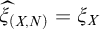 $\widehat {\xi }_{(X, N)} = \xi _X$
, so we can use the fact that
$\widehat {\xi }_{(X, N)} = \xi _X$
, so we can use the fact that $\xi $
is a unit of the duality from Theorem 2.2 to derive that
$\xi $
is a unit of the duality from Theorem 2.2 to derive that $\widehat {\xi }$
is a natural isomorphism. Finally,
$\widehat {\xi }$
is a natural isomorphism. Finally, $\widehat {\psi }$
and
$\widehat {\psi }$
and $\widehat {\xi }$
satisfy the triangle identities because
$\widehat {\xi }$
satisfy the triangle identities because $\psi $
and
$\psi $
and $\xi $
do. This proves the dual equivalence.
$\xi $
do. This proves the dual equivalence.
6 Ultrafilter extensions
Composing Proposition 3.3, Theorem 4.3 and the duality between BAIOs and descriptive instantial neighbourhood frames from [Reference Bezhanishvili, Enqvist, de Groot, Petrişan and Rot6] yields a functor $\mathcal {B}$
as follows:
$\mathcal {B}$
as follows:

Here  denotes the category of descriptive instantial neighbourhood frames, given in [Reference Bezhanishvili, Enqvist, de Groot, Petrişan and Rot6, Definition 3.7], and $\widehat {\mathcal {u\!f}}$
is defined as in [Reference Bezhanishvili, Enqvist, de Groot, Petrişan and Rot6, Example 3.6]. Computing
$\widehat {\mathcal {u\!f}}$
is defined as in [Reference Bezhanishvili, Enqvist, de Groot, Petrişan and Rot6, Example 3.6]. Computing $\mathcal {B}(X, N)$
and forgetting about the descriptive structure yields a notion of ultrafilter extension of an instantial neighbourhood frame
$\mathcal {B}(X, N)$
and forgetting about the descriptive structure yields a notion of ultrafilter extension of an instantial neighbourhood frame $(X, N)$
. Concretely, this can be defined as follows.
$(X, N)$
. Concretely, this can be defined as follows.
Definition 6.1. Let $(X, N)$
be an instantial neighbourhood frame and write
$(X, N)$
be an instantial neighbourhood frame and write $X^{\mathcal {u\!e}}$
for the set of ultrafilters on X. For each ultrafilter
$X^{\mathcal {u\!e}}$
for the set of ultrafilters on X. For each ultrafilter $u \in X^{\mathcal {u\!e}}$
, let
$u \in X^{\mathcal {u\!e}}$
, let $N^{\mathcal {u\!e}}(u)$
be the collection of sets
$N^{\mathcal {u\!e}}(u)$
be the collection of sets $U \subseteq X^{\mathcal {u\!e}}$
that satisfy for any finite collection
$U \subseteq X^{\mathcal {u\!e}}$
that satisfy for any finite collection $\gamma \cup \{ a \} \subseteq \wp X$
of subsets of X: if
$\gamma \cup \{ a \} \subseteq \wp X$
of subsets of X: if
-
• for every
$c \in \gamma $
there exists
$v \in U$
such that
$c \in v$
, and -
• for every
$v \in U$
we have
$a \in v$
,


then  . The ultrafilter extension of $(X, N)$
is
$(X, N)$
is $\mathcal {u\!e}(X, N) := (X^{\mathcal {u\!e}}, N^{\mathcal {u\!e}})$
.
$\mathcal {u\!e}(X, N) := (X^{\mathcal {u\!e}}, N^{\mathcal {u\!e}})$
.
Recall that a class of instantial neighbourhood frames is called axiomatic if it is the class of frames validating some set $\Phi $
of formulas. As an application of instantial
$\Phi $
of formulas. As an application of instantial $\sharp $
-morphisms, we show that axiomatic classes of frames always reflect ultrafilter extensions, i.e., if
$\sharp $
-morphisms, we show that axiomatic classes of frames always reflect ultrafilter extensions, i.e., if $\mathcal {K}$
is an axiomatic class of instantial neighbourhood frames and
$\mathcal {K}$
is an axiomatic class of instantial neighbourhood frames and $(X, N)$
is an instantial neighbourhood frame such that
$(X, N)$
is an instantial neighbourhood frame such that ${\mathcal {u\!e}(X, N) \in \mathcal {K}}$
, then
${\mathcal {u\!e}(X, N) \in \mathcal {K}}$
, then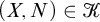 $(X, N) \in \mathcal {K}$
. To this end, let us call an instantial
$(X, N) \in \mathcal {K}$
. To this end, let us call an instantial $\sharp $
-morphism
$\sharp $
-morphism $g : (X, N) \to (X', N')$
principal surjective if all principal ultrafilters on
$g : (X, N) \to (X', N')$
principal surjective if all principal ultrafilters on $X'$
are in the image of g.
$X'$
are in the image of g.
Lemma 6.2. An instantial $\sharp $
-morphism
$\sharp $
-morphism $g : (X, N) \to (X', N')$
is principal surjective if and only if
$g : (X, N) \to (X', N')$
is principal surjective if and only if $\widehat {\wp }_{\sharp }(g)$
is injective.
$\widehat {\wp }_{\sharp }(g)$
is injective.
Proof. Suppose g is principal surjective and let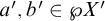 $a', b' \in \wp X'$
be sets such that
$a', b' \in \wp X'$
be sets such that $\widehat {\wp }_{\sharp }(g)(a') = \widehat {\wp }_{\sharp }(g)(b')$
. Let
$\widehat {\wp }_{\sharp }(g)(a') = \widehat {\wp }_{\sharp }(g)(b')$
. Let $x' \in X'$
be arbitrary and
$x' \in X'$
be arbitrary and $\eta _{X'}(x') = \{ c' \subseteq X' \mid x' \in c' \}$
be the principal ultrafilter on
$\eta _{X'}(x') = \{ c' \subseteq X' \mid x' \in c' \}$
be the principal ultrafilter on $X'$
generated by
$X'$
generated by $x'$
. By assumption
$x'$
. By assumption $\eta _{X'}(x') = g(x)$
for some
$\eta _{X'}(x') = g(x)$
for some $x \in X$
because g is principal surjective. Now compute
$x \in X$
because g is principal surjective. Now compute
 $$ \begin{align*} x' \in a' &\quad\text{iff}\quad a' \in \eta_{X'}(x') &&\quad\text{iff}\quad a' \in g(x) &&\quad\text{iff}\quad x \in \widehat{\wp}_{\sharp}(g)(a') \\ &\quad\text{iff}\quad x \in \widehat{\wp}_{\sharp}(g)(b') &&\quad\text{iff}\quad b' \in g(x) &&\quad\text{iff}\quad b' \in \eta_{X'}(x') &&\quad\text{iff}\quad x' \in b'. \end{align*} $$
It follows that $a' = b'$
, so
$a' = b'$
, so $\widehat {\wp }_{\sharp }(g)$
is injective.
$\widehat {\wp }_{\sharp }(g)$
is injective.
For the converse, suppose $\eta _{X'}(x')$
is a principal ultrafilter on
$\eta _{X'}(x')$
is a principal ultrafilter on $X'$
outside the image of g. Then
$X'$
outside the image of g. Then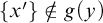 $\{ x' \} \notin g(y)$
for all
$\{ x' \} \notin g(y)$
for all $y \in X$
, as this would imply
$y \in X$
, as this would imply $g(y) = \eta _{X'}(x')$
. Therefore
$g(y) = \eta _{X'}(x')$
. Therefore $\widehat {\wp }_{\sharp }(g)(\{ x' \}) = \widehat {\wp }_{\sharp }(g)(\emptyset )$
, hence
$\widehat {\wp }_{\sharp }(g)(\{ x' \}) = \widehat {\wp }_{\sharp }(g)(\emptyset )$
, hence $\widehat {\wp }_{\sharp }(g)$
is not injective.
$\widehat {\wp }_{\sharp }(g)$
is not injective.
Proposition 6.3. Every axiomatic class of instantial neighbourhood frames reflects ultrafilter extensions.
Proof. Let $\mathcal {K}$
be an axiomatic class of frames and
$\mathcal {K}$
be an axiomatic class of frames and $(X, N)$
an instantial neighbourhood frame such that
$(X, N)$
an instantial neighbourhood frame such that $\mathcal {u\!e}(X, N) \in \mathcal {K}$
. Then
$\mathcal {u\!e}(X, N) \in \mathcal {K}$
. Then $\operatorname {\mathrm {id}}_{X^{\mathcal {u\!e}}} : \mathcal {u\!e}(X, N) \to (X, N)$
is a principal surjective instantial
$\operatorname {\mathrm {id}}_{X^{\mathcal {u\!e}}} : \mathcal {u\!e}(X, N) \to (X, N)$
is a principal surjective instantial $\sharp $
-morphism, so
$\sharp $
-morphism, so $\widehat {\wp }_{\sharp }(g) : \widehat {\wp }(X, N) \to \widehat {\wp }(\mathcal {u\!e}(X, N))$
is an injective homomorphism. Since a formula is valid in a frame if and only if it is valid in the corresponding CAINA, this entails that every formula valid on
$\widehat {\wp }_{\sharp }(g) : \widehat {\wp }(X, N) \to \widehat {\wp }(\mathcal {u\!e}(X, N))$
is an injective homomorphism. Since a formula is valid in a frame if and only if it is valid in the corresponding CAINA, this entails that every formula valid on $\mathcal {u\!e}(X, N)$
is also valid on
$\mathcal {u\!e}(X, N)$
is also valid on $(X, N)$
, hence
$(X, N)$
, hence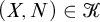 $(X, N) \in \mathcal {K}$
.
$(X, N) \in \mathcal {K}$
.
7 Restriction to Kripke frames
From a Kripke frame $(X, R)$
, we can define an instantial neighbourhood frame
$(X, R)$
, we can define an instantial neighbourhood frame $(X, N)$
in two ways. First, via
$(X, N)$
in two ways. First, via
 $$ \begin{align} N : X \to \mathcal{PP}X : x \mapsto \{ R[x] \}, \end{align} $$
where $R[x] = \{ y \in X \mid xRy \}$
. Second, we may define
$R[x] = \{ y \in X \mid xRy \}$
. Second, we may define
 $$ \begin{align} N : X \to \mathcal{PP}X : x \mapsto \{ \{ y \} \mid xRy \}. \end{align} $$
Observe that both assignments differ from the usual inclusion of Kripke frames into the category of (non-instantial) neighbourhood frames, which is given by setting $N(x) = \{ a \subseteq X \mid R[x] \subseteq a \}$
.
$N(x) = \{ a \subseteq X \mid R[x] \subseteq a \}$
.
In this section we use the assignments in (10) and (11) to obtain Thomason duality for Kripke frames as a restriction of Theorem 4.3. First, guided by these assignments we define singular and atomic instantial neighbourhood frames.
Definition 7.1. An instantial neighbourhood frame $(X, N)$
is called singular if
$(X, N)$
is called singular if $N(x)$
contains a single neighbourhood for each
$N(x)$
contains a single neighbourhood for each $x \in X$
. It is called atomic if
$x \in X$
. It is called atomic if $N(x)$
consists solely of singletons, i.e., neighbourhoods of the form
$N(x)$
consists solely of singletons, i.e., neighbourhoods of the form $\{ y \}$
for some
$\{ y \}$
for some $y \in X$
. We write
$y \in X$
. We write $\mathsf {INF^s}$
and
$\mathsf {INF^s}$
and $\mathsf {INF^a}$
for the full subcategories of
$\mathsf {INF^a}$
for the full subcategories of $\mathsf {INF}$
whose objects are singular and atomic, respectively.
$\mathsf {INF}$
whose objects are singular and atomic, respectively.
Let $\cong $
denote isomorphisms of categories. A straightforward verification shows that the assignments (10) and (11) yield the following.
$\cong $
denote isomorphisms of categories. A straightforward verification shows that the assignments (10) and (11) yield the following.
Proposition 7.2. We have $\mathsf {KF} \cong \mathsf {INF^s}$
and
$\mathsf {KF} \cong \mathsf {INF^s}$
and $\mathsf {KF} \cong \mathsf {INF^a}$
.
$\mathsf {KF} \cong \mathsf {INF^a}$
.
We now define dual notions of singularity and atomicity for CAINAs.
Definition 7.3. A CAINA  is called singular if it satisfies

for all index sets I and $\gamma _i \subseteq A$
and
$\gamma _i \subseteq A$
and $a_i \in A$
. It is called atomic if
$a_i \in A$
. It is called atomic if

for all $\gamma \subseteq A$
and
$\gamma \subseteq A$
and $a \in A$
. We write
$a \in A$
. We write $\mathsf {CAINA^s}$
and
$\mathsf {CAINA^s}$
and $\mathsf {CAINA^a}$
for the full subcategories of
$\mathsf {CAINA^a}$
for the full subcategories of $\mathsf {CAINA}$
whose objects are singular and atomic, respectively.
$\mathsf {CAINA}$
whose objects are singular and atomic, respectively.
Proposition 7.4. The duality between $\mathsf {CAINA}$
and
$\mathsf {CAINA}$
and $\mathsf {INF}$
restricts to
$\mathsf {INF}$
restricts to
 $$ \begin{align*} \mathsf{CAINA^s} \equiv^{\operatorname{\mathrm{op}}} \mathsf{INF^s} \quad\text{and}\quad \mathsf{CAINA^a} \equiv^{\operatorname{\mathrm{op}}} \mathsf{INF^a}. \end{align*} $$
Proof. We first prove the left duality. It is easy to see that the dual of a singular frame is a singular CAINA. Conversely, suppose  is a singular CAINA. If $\alpha , \alpha ' \subseteq \mathcal {a\!t}(A)$
are distinct sets of atoms, then
$\alpha , \alpha ' \subseteq \mathcal {a\!t}(A)$
are distinct sets of atoms, then

The second equality is derived as follows: Since $\alpha $
and
$\alpha $
and $\alpha '$
are distinct there must exist some atom
$\alpha '$
are distinct there must exist some atom $a \in \alpha \cup \alpha '$
such that
$a \in \alpha \cup \alpha '$
such that $a \notin \alpha \cap \alpha '$
. But then
$a \notin \alpha \cap \alpha '$
. But then $a \wedge \bigvee (\alpha \cap \alpha ') = \bot $
and so the equality follows from (Inst) and (Norm). The definition of
$a \wedge \bigvee (\alpha \cap \alpha ') = \bot $
and so the equality follows from (Inst) and (Norm). The definition of  now entails that
  is singular.
For the second duality, suppose that $(X, N)$
is atomic and
$(X, N)$
is atomic and  . Then there is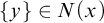 $\{ y \} \in N(x)$
such that
$\{ y \} \in N(x)$
such that $y \in c$
for all
$y \in c$
for all $c \in \gamma $
and
$c \in \gamma $
and $y \in a$
, and hence
$y \in a$
, and hence  . Conversely, if
  then any witness $\{ y \}$
of this also witnesses
$\{ y \}$
of this also witnesses  . So
. So  is atomic.
If $(X, N)$
is not atomic then there exists
$(X, N)$
is not atomic then there exists $x \in X$
such that either
$x \in X$
such that either $\emptyset \in N(x)$
or
$\emptyset \in N(x)$
or $d \in N(x)$
for some
$d \in N(x)$
for some $d \subseteq X$
with two or more elements. If
$d \subseteq X$
with two or more elements. If $\emptyset \in N(x)$
then
$\emptyset \in N(x)$
then  but
but  . If
. If $d \in N(x)$
contains two distinct elements,
$d \in N(x)$
contains two distinct elements, $y_1$
and
$y_1$
and $y_2$
, then
$y_2$
, then  . But
. But $\{ y_1 \} \cap \{ y_2 \} = \emptyset $
and therefore
$\{ y_1 \} \cap \{ y_2 \} = \emptyset $
and therefore  . Therefore in both cases the dual
  of
of $(X, N)$
is not atomic.
$(X, N)$
is not atomic.
Recall that a CAMA is a pair  of a CABA and an arbitrary-meet-preserving function
  . We abbreviate
  . We may equivalently define CAMAs as pairs
  , where
  is an arbitrary-join-preserving function. We write $\mathsf {CAMA}$
for the category of CAMAs and complete
$\mathsf {CAMA}$
for the category of CAMAs and complete  -preserving homomorphisms. The next two propositions prove that $\mathsf {CAMA}$
is isomorphic to both
$\mathsf {CAMA}$
is isomorphic to both $\mathsf {CAINA^s}$
and
$\mathsf {CAINA^s}$
and $\mathsf {CAINA^a}$
.
$\mathsf {CAINA^a}$
.
Proposition 7.5. We have $\mathsf {CAMA} \cong \mathsf {CAINA^s}$
.
$\mathsf {CAMA} \cong \mathsf {CAINA^s}$
.
Proof. If  is a singular CAINA, then we define a CAMA
  via
via  . It follows from singularity of
  that
that  preserves all meets, so
  is a CAMA. Conversely, for a CAMA
  and
and $\gamma \subseteq A$
,
$\gamma \subseteq A$
, $a \in A$
, define
$a \in A$
, define

We claim that  is a singular CAINA. (Sing) and (Weak) follow immediately from the definition of
  . The identity
  implies (Norm), and (Inst) follows from the fact that
  in every CAMA. (R-Mon) and (L-Mon) follow from monotonicity of
  and
and  . Finally, truth of (Case) follows from the fact that every CAMA satisfies

which is proved in Lemma B.3. A routine verification shows that the assignments define a bijection and extend to an isomorphism of categories.
Proposition 7.6. We have $\mathsf {CAMA} \cong \mathsf {CAINA^a}$
.
$\mathsf {CAMA} \cong \mathsf {CAINA^a}$
.
Proof. If  is an atomic CAINA, then we can define a CAMA
  via
via  . It follows from Lemma 3.4 that
  , which implies that
  preserves all joins.
Conversely, a CAMA  yields an atomic CAINA
  via
via  . Clearly this satisfies (At). Monotonicity of
  implies that
  satisfies (R-Mon), (L-Mon), and (Weak). (Norm) follows from the fact that
  , and (Inst) follows from (At). Finally, we show that (Case) holds. Let $\gamma , \beta \subseteq A$
and
$\gamma , \beta \subseteq A$
and $a \in A$
. Then using complete distributivity of A and the fact that
$a \in A$
. Then using complete distributivity of A and the fact that  distributes over all joins we find

Since $(a \vee b) \wedge b \wedge \bigwedge \gamma = b \wedge \bigwedge \gamma $
we have
$(a \vee b) \wedge b \wedge \bigwedge \gamma = b \wedge \bigwedge \gamma $
we have  . Therefore (4) yields

The right-hand side is smaller than  so (Case) holds and
  is an atomic CAINA. It is straightforward to see that these assignments define a bijection between the objects of $\mathsf {CAMA}$
and
$\mathsf {CAMA}$
and $\mathsf {CAINA^a}$
and extend to an isomorphism.
$\mathsf {CAINA^a}$
and extend to an isomorphism.
Thomason Theorem for Kripke Frames 7.7. We have
 $$ \begin{align*} \mathsf{CAMA} \equiv^{\operatorname{\mathrm{op}}} \mathsf{KF}. \end{align*} $$
Proof. Combine Propositions 7.2, 7.4, and 7.5 to obtain
 $$ \begin{align*} \mathsf{CAMA} \cong \mathsf{CAINA^s} \equiv^{\operatorname{\mathrm{op}}} \mathsf{INF^s} \cong \mathsf{KF}. \end{align*} $$
A routine verification shows that the resulting contravariant functors between $\mathsf {CAMA}$
and
$\mathsf {CAMA}$
and $\mathsf {KF}$
are those from [Reference Thomason15]. For instance, to a Kripke frame
$\mathsf {KF}$
are those from [Reference Thomason15]. For instance, to a Kripke frame $(X, R)$
we associate the instantial neighbourhood frame
$(X, R)$
we associate the instantial neighbourhood frame $(X, N)$
given by
$(X, N)$
given by $N(x) = \{ R[x] \}$
. Its dual according to Theorem 4.3 is
$N(x) = \{ R[x] \}$
. Its dual according to Theorem 4.3 is  , and the associated CAMA is given by
  , where
  . Then we can compute

to see that this coincides with the functor from [Reference Thomason15].
The other direction is similar. Alternatively, we can use Propositions 7.2, 7.4, and 7.6 and prove the theorem via $\mathsf {CAMA} \cong \mathsf {CAINA^a} \equiv ^{\operatorname {\mathrm {op}}} \mathsf {INF^a} \cong \mathsf {KF}$
.
$\mathsf {CAMA} \cong \mathsf {CAINA^a} \equiv ^{\operatorname {\mathrm {op}}} \mathsf {INF^a} \cong \mathsf {KF}$
.
8 Conclusion
We have given a Thomason-style duality for instantial neighbourhood frames, extended it to weaker morphisms between the algebras, and used these dualities to define and investigate ultrafilter extensions of instantial neighbourhood frames. Furthermore, we showed that the INL-analogue of Thomason duality implies the original one.
There are several interesting directions for further research. First, one could further study axiomatic classes of frames using instantial $\sharp $
-morphisms: there may be other constructions weaker than the usual generated subframes, bounded morphic images and disjoint unions, that preserve or reflect validity of formulas. Second, the duality may give rise to an infinitary version of INL. Replacing the inequalities in the clauses from Definition 3.2 by implications suggests axioms for this logic. Third, guided by Remark 3.6, one could try to describe CAINAs using only a single unary modal operator. The challenge in this line of research is to define the correct notion of homomorphism using only
$\sharp $
-morphisms: there may be other constructions weaker than the usual generated subframes, bounded morphic images and disjoint unions, that preserve or reflect validity of formulas. Second, the duality may give rise to an infinitary version of INL. Replacing the inequalities in the clauses from Definition 3.2 by implications suggests axioms for this logic. Third, guided by Remark 3.6, one could try to describe CAINAs using only a single unary modal operator. The challenge in this line of research is to define the correct notion of homomorphism using only $\mathord {\boxdot }$
.
$\mathord {\boxdot }$
.
Lastly, mirroring to the definition of ultrafilter extensions, we may obtain a notion of completion $\sigma : \mathsf {BAIO} \to \mathsf {CAINA}$
via
$\sigma : \mathsf {BAIO} \to \mathsf {CAINA}$
via

(Here $\widehat {\mathcal {c\!l\!p}}$
is one of the functors establishing the duality between BAIOs and descriptive instantial neighbourhood frames [Reference Bezhanishvili, Enqvist, de Groot, Petrişan and Rot6].) A routine verification shows that each BAIO can be embedded into its
$\widehat {\mathcal {c\!l\!p}}$
is one of the functors establishing the duality between BAIOs and descriptive instantial neighbourhood frames [Reference Bezhanishvili, Enqvist, de Groot, Petrişan and Rot6].) A routine verification shows that each BAIO can be embedded into its $\sigma $
-completion. It would be interesting to investigate this notion of completion algebraically, analogous to [Reference Gehrke and Jónsson8]. A unique feature is that it not only completes the underlying lattice, but also the collection of modal operators.
$\sigma $
-completion. It would be interesting to investigate this notion of completion algebraically, analogous to [Reference Gehrke and Jónsson8]. A unique feature is that it not only completes the underlying lattice, but also the collection of modal operators.
Appendix A Tarski duality for
$\mathsf {CABA^b}$

Lemma A.1. The collection $\mathsf {Set_{\sharp }}$
of sets and
$\mathsf {Set_{\sharp }}$
of sets and $\sharp $
-morphisms forms a category.
$\sharp $
-morphisms forms a category.
Proof. Define the unit $\eta _X : X \to X$
to by
$\eta _X : X \to X$
to by $\eta _X(x) = \{ a \subseteq X \mid x \in a \}$
. This is well defined because
$\eta _X(x) = \{ a \subseteq X \mid x \in a \}$
. This is well defined because $\eta _X(x)$
is an ultrafilter on X. Define the composition of
$\eta _X(x)$
is an ultrafilter on X. Define the composition of $\sharp $
-morphisms
$\sharp $
-morphisms $f : X \to X'$
and
$f : X \to X'$
and $g : X' \to X"$
by
$g : X' \to X"$
by
 $$ \begin{align*} (g \circ f)(x) = \{ a" \subseteq X" \mid \{ y' \in X' \mid a" \in g(y') \} \in f(x) \}. \end{align*} $$
Using the fact that $g(y')$
and
$g(y')$
and $f(x)$
are ultrafilters, it can be shown that
$f(x)$
are ultrafilters, it can be shown that $(g \circ f)(x)$
is an ultrafilter on
$(g \circ f)(x)$
is an ultrafilter on $X"$
for each
$X"$
for each $x \in X$
, so that the composition is well defined.
$x \in X$
, so that the composition is well defined.
Unfolding the definition of $\eta $
shows that
$\eta $
shows that $f \circ \eta _X = f = \eta _{X'} \circ f$
. For associativity, let
$f \circ \eta _X = f = \eta _{X'} \circ f$
. For associativity, let $f, g$
be as above and let
$f, g$
be as above and let $p : X" \to X"'$
be another
$p : X" \to X"'$
be another $\sharp $
-morphism, and compute
$\sharp $
-morphism, and compute
 $$ \begin{align*} a"' \in (p \circ (g \circ f))(x) &\quad\text{iff}\quad \{ y" \in X" \mid a"' \in p(y") \} \in (g \circ f)(x) \\ &\quad\text{iff}\quad \{ y' \in X' \mid \{ y" \in X" \mid a"' \in p(y") \} \in g(y') \} \in f(x) \\ &\quad\text{iff}\quad \{ y' \in X' \mid a"' \in (p \circ g)(y') \} \in f(x) \\ &\quad\text{iff}\quad a"' \in ((p \circ g) \circ f)(x). \end{align*} $$
This implies $p \circ (g \circ f) = (p \circ g) \circ f$
.
$p \circ (g \circ f) = (p \circ g) \circ f$
.
Lemma A.2. $\mathcal {a\!t}_{\sharp } : \mathsf {CABA^b} \to \mathsf {Set_{\sharp }}$
defines a contravariant functor.
$\mathcal {a\!t}_{\sharp } : \mathsf {CABA^b} \to \mathsf {Set_{\sharp }}$
defines a contravariant functor.
Proof. We need to check that $\mathcal {a\!t}_{\sharp }$
is well defined on morphisms and that it is functorial. Let
$\mathcal {a\!t}_{\sharp }$
is well defined on morphisms and that it is functorial. Let $h : A \to A'$
be a homomorphism and
$h : A \to A'$
be a homomorphism and $x' \in \operatorname {\mathrm {at}}(A')$
. We verify that
$x' \in \operatorname {\mathrm {at}}(A')$
. We verify that $\mathcal {a\!t}_{\sharp }(h)(x')$
is an ultrafilter on
$\mathcal {a\!t}_{\sharp }(h)(x')$
is an ultrafilter on $\operatorname {\mathrm {at}}(A)$
. First, it follows immediately from the definition that
$\operatorname {\mathrm {at}}(A)$
. First, it follows immediately from the definition that $\mathcal {a\!t}_{\sharp }(h)(x')$
is upwards closed under inclusion. Second, if
$\mathcal {a\!t}_{\sharp }(h)(x')$
is upwards closed under inclusion. Second, if $\alpha , \beta \in \mathcal {a\!t}_{\sharp }(h)(x')$
then
$\alpha , \beta \in \mathcal {a\!t}_{\sharp }(h)(x')$
then $x' \leq h({\textstyle \bigvee }\alpha ) \wedge h({\textstyle \bigvee }\beta ) = h({\textstyle \bigvee }\alpha \wedge {\textstyle \bigvee }\beta )$
and using atomicity of A it follows that
$x' \leq h({\textstyle \bigvee }\alpha ) \wedge h({\textstyle \bigvee }\beta ) = h({\textstyle \bigvee }\alpha \wedge {\textstyle \bigvee }\beta )$
and using atomicity of A it follows that $x' \leq h({\textstyle \bigvee } (\alpha \cap \beta ))$
, so that
$x' \leq h({\textstyle \bigvee } (\alpha \cap \beta ))$
, so that $\alpha \cap \beta \in \mathcal {a\!t}_{\sharp }(h)(x')$
and
$\alpha \cap \beta \in \mathcal {a\!t}_{\sharp }(h)(x')$
and $\mathcal {a\!t}_{\sharp }(h)(x')$
is a filter. Finally, to see that
$\mathcal {a\!t}_{\sharp }(h)(x')$
is a filter. Finally, to see that $\operatorname {\mathrm {at}}(h)(x')$
is an ultrafilter, we observe that for any
$\operatorname {\mathrm {at}}(h)(x')$
is an ultrafilter, we observe that for any $\alpha \subseteq \operatorname {\mathrm {at}}(A)$
we have
$\alpha \subseteq \operatorname {\mathrm {at}}(A)$
we have
 $$ \begin{align*} \alpha \notin \mathcal{a\!t}_{\sharp}(h)(x') &\quad\text{iff}\quad x' \not\leq h({\textstyle\bigvee} \alpha) &&\quad\text{iff}\quad x' \leq \neg h({\textstyle\bigvee} \alpha) \\ &\quad\text{iff}\quad x' \leq h(\neg {\textstyle\bigvee}\alpha) &&\quad\text{iff}\quad x' \leq h({\textstyle\bigvee}(\operatorname{\mathrm{at}}(A) \setminus \alpha)) \\ &\quad\text{iff}\quad (\operatorname{\mathrm{at}}(A) \setminus \alpha) \in \mathcal{a\!t}_{\sharp}(h)(x'). \hspace{-2em} \end{align*} $$
For functoriality, let $\operatorname {\mathrm {id}}_A : A \to A$
be the identity on A and note that for any
$\operatorname {\mathrm {id}}_A : A \to A$
be the identity on A and note that for any $x \in \operatorname {\mathrm {at}}(A)$
we have
$x \in \operatorname {\mathrm {at}}(A)$
we have
 $$ \begin{align*} \mathcal{a\!t}_{\sharp}(\operatorname{\mathrm{id}}_A)(x) = \{ \alpha \subseteq \operatorname{\mathrm{at}}(A) \mid x \leq {\textstyle\bigvee} \alpha \} = \eta_{\mathcal{a\!t}(A)}(x) \end{align*} $$
so $\mathcal {a\!t}_{\sharp }$
preserves the identity. Furthermore, if
$\mathcal {a\!t}_{\sharp }$
preserves the identity. Furthermore, if $h : A \to A'$
and
$h : A \to A'$
and $k : A' \to A"$
are homomorphisms, then
$k : A' \to A"$
are homomorphisms, then
 $$ \begin{align*} \mathcal{a\!t}_{\sharp}(k \circ h)(x") &= \{ \alpha \subseteq \operatorname{\mathrm{at}}(A) \mid x" \leq (k \circ h)({\textstyle\bigvee} \alpha) \} \\ &= \{ \alpha \subseteq \operatorname{\mathrm{at}}(A) \mid x" \leq k (h({\textstyle\bigvee} \alpha)) \} \\ &= \{ \alpha \subseteq \operatorname{\mathrm{at}}(A) \mid x" \leq k({\textstyle\bigvee}\{ y' \in \operatorname{\mathrm{at}}(A') \mid y' \leq h({\textstyle\bigvee} \alpha) \}) \} \\ &= \{ \alpha \subseteq \operatorname{\mathrm{at}}(A) \mid x" \leq k({\textstyle\bigvee}\{ y' \in \operatorname{\mathrm{at}}(A') \mid \alpha \in \mathcal{a\!t}_{\sharp}(h)(y') \}) \} \\ &= \{ \alpha \subseteq \operatorname{\mathrm{at}}(A) \mid \{ y' \in \operatorname{\mathrm{at}}(A') \mid \alpha \in \mathcal{a\!t}_{\sharp}(h)(y') \} \in \mathcal{a\!t}_{\sharp}(k)(x") \} \\ &= (\mathcal{a\!t}_{\sharp}(h) \circ \mathcal{a\!t}_{\sharp}(k))(x"). \end{align*} $$
The third equality holds because in an atomic Boolean algebra every element is equal to the join of atoms lying below it, so $h({\textstyle \bigvee } \alpha ) = {\textstyle \bigvee } \{ y' \in \operatorname {\mathrm {at}}(A') \mid y' \leq h({\textstyle \bigvee } \alpha ) \}$
. This proves that
$h({\textstyle \bigvee } \alpha ) = {\textstyle \bigvee } \{ y' \in \operatorname {\mathrm {at}}(A') \mid y' \leq h({\textstyle \bigvee } \alpha ) \}$
. This proves that $\mathcal {a\!t}_{\sharp }$
is a contravariant functor.
$\mathcal {a\!t}_{\sharp }$
is a contravariant functor.
Lemma A.3. $\wp _{\sharp } : \mathsf {Set_{\sharp }} \to \mathsf {CABA^b}$
defines a contravariant functor.
$\wp _{\sharp } : \mathsf {Set_{\sharp }} \to \mathsf {CABA^b}$
defines a contravariant functor.
Proof. Let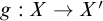 $g : X \to X'$
be a
$g : X \to X'$
be a $\sharp $
-morphism. We prove that
$\sharp $
-morphism. We prove that $\wp _{\sharp }(g)$
is a Boolean homomorphism by showing that it preserves the top element, negations, and binary intersections. In each case, we use the fact that
$\wp _{\sharp }(g)$
is a Boolean homomorphism by showing that it preserves the top element, negations, and binary intersections. In each case, we use the fact that $g(x)$
is an ultrafilter on
$g(x)$
is an ultrafilter on $X'$
for all
$X'$
for all $x \in X$
,
$x \in X$
,
 $$ \begin{align*} \wp_{\sharp}(g)(X') &= \{ x \in X \mid X' \in g(x) \} = X \\ \wp_{\sharp}(g)(X' \setminus a') &= \{ x \in X \mid (X \setminus a') \in g(x) \} = \{ x \in X \mid a' \notin g(x) \} = X \setminus \wp_{\sharp}(g)(a') \\ \wp_{\sharp}(g)(a') \cap \wp_{\sharp}&(g)(b') = \{ x \in X \mid a', b' \in g(x) \} \\ &\hspace{2.78em}= \{ x \in X \mid a' \cap b' \in g(x) \} = \wp_{\sharp}(g)(a' \cap b'). \end{align*} $$
Next we verify that $\wp _{\sharp }$
is functorial. If
$\wp _{\sharp }$
is functorial. If $\eta _X$
is the identity morphism on X, then
$\eta _X$
is the identity morphism on X, then
 $$ \begin{align*} \wp_{\sharp}(\eta_X)(a) = \{ x \in X \mid a \in \eta_X(x) \} = \{ x \in X \mid x \in a \} = a \end{align*} $$
so $\wp _{\sharp }(\eta _X) = \operatorname {\mathrm {id}}_{\wp X}$
. To see that
$\wp _{\sharp }(\eta _X) = \operatorname {\mathrm {id}}_{\wp X}$
. To see that $\wp _{\sharp }$
preserves compositions, let
$\wp _{\sharp }$
preserves compositions, let $f : X \to X'$
and
$f : X \to X'$
and $g : X' \to X"$
be
$g : X' \to X"$
be $\sharp $
-morphisms and compute
$\sharp $
-morphisms and compute
 $$ \begin{align*} \wp_{\sharp}(g \circ f)(a") &= \{ x \in X \mid a" \in (g \circ f)(x) \} \\ &= \{ x \in X \mid \{ y \in X' \mid a" \in g(y') \} \in f(x) \} \\ &= \wp_{\sharp}(f)(\{ y' \in X' \mid a" \in g(y') \}) = (\wp_{\sharp}(f) \circ \wp_{\sharp}(g))(a"). \end{align*} $$
We conclude that $\wp _{\sharp }$
is indeed a contravariant functor.
$\wp _{\sharp }$
is indeed a contravariant functor.
Theorem A.4. $\mathcal {a\!t}_{\sharp }$
and
$\mathcal {a\!t}_{\sharp }$
and $\wp _{\sharp }$
establish a dual equivalence
$\wp _{\sharp }$
establish a dual equivalence $\mathsf {CABA^b} \equiv ^{\operatorname {\mathrm {op}}} \mathsf {Set_{\sharp }}$
.
$\mathsf {CABA^b} \equiv ^{\operatorname {\mathrm {op}}} \mathsf {Set_{\sharp }}$
.
Proof. We give natural isomorphisms $\psi : \mathcal {i\!d}_{\mathsf {CABA^b}} \to \wp _{\sharp } \circ \mathcal {a\!t}_{\sharp }$
and
$\psi : \mathcal {i\!d}_{\mathsf {CABA^b}} \to \wp _{\sharp } \circ \mathcal {a\!t}_{\sharp }$
and $\xi : \mathcal {i\!d}_{\mathsf {Set_{\sharp }}} \to \mathcal {a\!t}_{\sharp } \circ \wp _{\sharp }$
and verify that they satisfy the triangle identities.
$\xi : \mathcal {i\!d}_{\mathsf {Set_{\sharp }}} \to \mathcal {a\!t}_{\sharp } \circ \wp _{\sharp }$
and verify that they satisfy the triangle identities.
First define $\psi $
as in Tarski duality, i.e.,
$\psi $
as in Tarski duality, i.e., $\psi _A : A \to \wp _{\sharp }(\mathcal {a\!t}_{\sharp }(A)) : a \mapsto \operatorname {\mathrm {at}}(a)$
. We know that this is an isomorphism on components. For naturality, let
$\psi _A : A \to \wp _{\sharp }(\mathcal {a\!t}_{\sharp }(A)) : a \mapsto \operatorname {\mathrm {at}}(a)$
. We know that this is an isomorphism on components. For naturality, let $h : A \to B$
be a Boolean homomorphism between CABAs and
$h : A \to B$
be a Boolean homomorphism between CABAs and $y \in \wp _{\sharp }(\mathcal {a\!t}_{\sharp }(B))$
. Then
$y \in \wp _{\sharp }(\mathcal {a\!t}_{\sharp }(B))$
. Then
 $$ \begin{align*} y \in \wp_{\sharp}(\mathcal{a\!t}_{\sharp}(h)) \circ \psi_A(a) &\quad\text{iff}\quad y \in \wp_{\sharp}(\mathcal{a\!t}_{\sharp}(h))(\operatorname{\mathrm{at}}(a)) &(\text{definition } \psi_A) \\ &\quad\text{iff}\quad \operatorname{\mathrm{at}}(a) \in \mathcal{a\!t}_{\sharp}(h)(y) &(\text{definition } \wp_{\sharp})\\ &\quad\text{iff}\quad y \leq h({\textstyle\bigvee} \operatorname{\mathrm{at}}(a)) &(\text{definition } \mathcal{a\!t}_{\sharp})\\ &\quad\text{iff}\quad y \leq h(a) &({\textstyle\bigvee} \operatorname{\mathrm{at}}(a) = a) \\ &\quad\text{iff}\quad y \in \operatorname{\mathrm{at}}(h(a)) &(y \text{ is an atom}) \\ &\quad\text{iff}\quad y \in \psi_B(h(a)) &(\text{definition } \psi_B) \end{align*} $$
so $\wp _{\sharp }(\mathcal {a\!t}_{\sharp }(h)) \circ \psi _A = \psi _B \circ h$
.
$\wp _{\sharp }(\mathcal {a\!t}_{\sharp }(h)) \circ \psi _A = \psi _B \circ h$
.
Next, define $\xi : \mathcal {i\!d}_{\mathsf {Set_{\sharp }}} \to \mathcal {a\!t}_{\sharp } \circ \wp _{\sharp }$
on components by
$\xi : \mathcal {i\!d}_{\mathsf {Set_{\sharp }}} \to \mathcal {a\!t}_{\sharp } \circ \wp _{\sharp }$
on components by
 $$ \begin{align*} \xi_X : X \to \mathcal{a\!t}_{\sharp}(\wp_{\sharp}(X)) : x \mapsto \{ \alpha \subseteq \mathcal{a\!t}_{\sharp}(\wp_{\sharp} X) \mid \{ x \} \in \alpha \}. \end{align*} $$
This is an isomorphism in $\mathsf {Set_{\sharp }}$
with inverse given by
$\mathsf {Set_{\sharp }}$
with inverse given by $\xi _X^{-1}(\{ x \}) = \{ \alpha \subseteq \mathcal {a\!t}(X) \mid x \in \alpha \}$
. To verify this, compute
$\xi _X^{-1}(\{ x \}) = \{ \alpha \subseteq \mathcal {a\!t}(X) \mid x \in \alpha \}$
. To verify this, compute
 $$ \begin{align*} (\xi_X^{-1} \circ \xi_X)(x) &= \{ \alpha \subseteq X \mid \{ \{ y \} \in \mathcal{a\!t}_{\sharp}(\wp_{\sharp} X) \mid \alpha \in \xi_X^{-1}(\{ y \}) \} \in \xi_X(x) \} \\ &= \{\alpha \subseteq X \mid \{ \{ y \} \in \mathcal{a\!t}_{\sharp}(\wp_{\sharp} X) \mid y \in \alpha \} \in \xi_X(x) \} \\ &= \{ \alpha \subseteq X \mid x \in \alpha \} \\ &= \eta_X(x) \end{align*} $$
and
 $$ \begin{align*} (\xi_X \circ \xi^{-1}_X)(\{ x \}) &= \{ \beta \subseteq \mathcal{a\!t}_{\sharp}(\wp_{\sharp} X) \mid \{ y \in X \mid \beta \in \xi_X(y) \} \in \xi^{-1}_X(\{ x \}) \} \\ &= \{ \beta \subseteq \mathcal{a\!t}_{\sharp}(\wp_{\sharp} X) \mid \{ y \in X \mid \{ y \} \in \beta \} \in \xi^{-1}_X(\{ x \}) \} \\ &= \{ \beta \subseteq \mathcal{a\!t}_{\sharp}(\wp_{\sharp} X) \mid \{ x \} \in \beta \} \\ &= \eta_{(\mathcal{a\!t}_{\sharp} \circ \wp_{\sharp})(X)}(\{ x \}). \end{align*} $$
For naturality, let $f : X \to X'$
be a
$f : X \to X'$
be a $\sharp $
-morphism and
$\sharp $
-morphism and $\beta \subseteq \mathcal {a\!t}_{\sharp }(\wp _{\sharp } X')$
, and observe
$\beta \subseteq \mathcal {a\!t}_{\sharp }(\wp _{\sharp } X')$
, and observe
 $$ \begin{align*} \beta &\in (\mathcal{a\!t}_{\sharp}(\wp_{\sharp} f) \circ \xi_X)(x) \\ &\quad\text{iff}\quad \big\{ \{ y \} \in \mathcal{a\!t}_{\sharp}(\wp_{\sharp} X') \mid \beta \in \mathcal{a\!t}_{\sharp}(\wp_{\sharp} f)(\{ y \}) \big\} \in \xi_X(x) &\text{(def.~of composition)} \\ &\quad\text{iff}\quad \big\{ \{ y \} \in \mathcal{a\!t}_{\sharp}(\wp_{\sharp} X') \mid \{ y \} \subseteq (\wp_{\sharp} f)({\textstyle\bigcup} \beta) \big\} \in \xi_X(x) &(\text{definition } \mathcal{a\!t}_{\sharp}) \\ &\quad\text{iff}\quad \big\{ \{ y \} \in \mathcal{a\!t}_{\sharp}(\wp_{\sharp} X') \mid y \in (\wp_{\sharp} f)({\textstyle\bigcup} \beta) \big\} \in \xi_X(x) \\ &\quad\text{iff}\quad \big\{ \{ y \} \in \mathcal{a\!t}_{\sharp}(\wp_{\sharp} X') \mid {\textstyle\bigcup}\beta \in f(y) \big\} \in \xi_X(x) &(\text{definition } \wp_{\sharp}) \\ &\quad\text{iff}\quad {\textstyle\bigcup}\beta \in f(x) &(\text{definition } \xi_X) \\ &\quad\text{iff}\quad \{ y' \in X' \mid \{ y' \} \in \beta \} \in f(x) &(\text{definition } {\textstyle\bigcup}) \\ &\quad\text{iff}\quad \{ y' \in X' \mid \beta \in \xi_{X'}(y') \} \in f(x) &(\text{definition } \xi_{X'}) \\ &\quad\text{iff}\quad \beta \in (\xi_{X'} \circ f)(x) &\text{(def.~of composition).} \end{align*} $$
This shows that $\mathcal {a\!t}_{\sharp }(\wp _{\sharp } f) \circ \xi _X = \xi _{X'} \circ f$
, hence naturality.
$\mathcal {a\!t}_{\sharp }(\wp _{\sharp } f) \circ \xi _X = \xi _{X'} \circ f$
, hence naturality.
Lastly, we show that the following triangle identities hold, i.e., for any set X and CABA A, the following diagrams commute:

For the former, let $a \in \wp _{\sharp } X$
and
$a \in \wp _{\sharp } X$
and $x \in X$
and compute
$x \in X$
and compute
 $$ \begin{align*} x \in \wp_{\sharp}(\xi_X) ( \psi_{\wp_{\sharp} X}(a) ) &\quad\text{iff}\quad \psi_{\wp_{\sharp} X}(a) \in \xi_X(x) &(\text{definition } \wp_{\sharp}) \\ &\quad\text{iff}\quad \{ x \} \in \psi_{\wp_{\sharp} X}(a) &(\text{definition } \xi_X) \\ &\quad\text{iff}\quad \{ x \} \in \operatorname{\mathrm{at}}(a) &(\text{definition } \psi) \\ &\quad\text{iff}\quad x \in a. \end{align*} $$
For the latter, $x \in \mathcal {a\!t}_{\sharp }(A)$
and
$x \in \mathcal {a\!t}_{\sharp }(A)$
and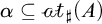 $\alpha \subseteq \mathcal {a\!t}_{\sharp }(A)$
and compute
$\alpha \subseteq \mathcal {a\!t}_{\sharp }(A)$
and compute
 $$ \begin{align*} \alpha &\in (\mathcal{a\!t}_{\sharp}(\psi_A) \circ \xi_{\mathcal{a\!t}_{\sharp} A})(x) \\&\quad\!\!\!\text{iff}\quad \{ \{ y \} \in \mathcal{a\!t}_{\sharp}(\wp_{\sharp}(\mathcal{a\!t}_{\sharp} A)) \mid \alpha \in \mathcal{a\!t}_{\sharp}(\psi_A)(\{ y \}) \} \in \xi_{\mathcal{a\!t}_{\sharp} A}(x) &\text{(composition)} \\&\quad\!\!\!\text{iff}\quad \alpha \in \mathcal{a\!t}_{\sharp}(\psi_A)(\{ x \}) &(\text{definition } \xi_{\mathcal{a\!t}_{\sharp} A}) \\&\quad\!\!\!\text{iff}\quad \{ x \} \subseteq \psi_A({\textstyle\bigcup} \alpha) &(\text{definition } \mathcal{a\!t}_{\sharp}) \\&\quad\!\!\!\text{iff}\quad \{ x \} \subseteq \operatorname{\mathrm{at}}({\textstyle\bigcup} \alpha) &(\text{definition } \psi_A) \\&\quad\!\!\!\text{iff}\quad x \in \alpha &(\operatorname{\mathrm{at}}({\textstyle\bigcup} \alpha) = \alpha) \\&\quad\!\!\!\text{iff}\quad \alpha \in \eta_{\mathcal{a\!t}_{\sharp} A}(x) &(\text{definition } \eta_{\mathcal{a\!t}_{\sharp} A}). \end{align*} $$
This concludes the proof of the duality.
Appendix B Omitted proofs
Lemma B.1. If  is a b-homomorphism then

is an instantial $\sharp $
-morphism.
$\sharp $
-morphism.
Proof. The map $\widehat {\mathcal {a\!t}}_{\sharp }(h)$
is well defined because
$\widehat {\mathcal {a\!t}}_{\sharp }(h)$
is well defined because $\mathcal {a\!t}_{\sharp }$
is well defined on homomorphisms in
$\mathcal {a\!t}_{\sharp }$
is well defined on homomorphisms in $\mathsf {CABA^b}$
. We verify that it satisfies the additional condition from Definition 5.1. Write
$\mathsf {CABA^b}$
. We verify that it satisfies the additional condition from Definition 5.1. Write  and similarly abbreviate
  . Accordingly, we abbreviate
  to
to  . Let
. Let $\gamma \cup \{ a \}$
be a finite collection of subsets of
$\gamma \cup \{ a \}$
be a finite collection of subsets of $X = \operatorname {\mathrm {at}}(A)$
. Note that for any set
$X = \operatorname {\mathrm {at}}(A)$
. Note that for any set $d \subseteq \operatorname {\mathrm {at}}(A)$
we have
$d \subseteq \operatorname {\mathrm {at}}(A)$
we have $\psi _A({\textstyle \bigvee } d) = \operatorname {\mathrm {at}}({\textstyle \bigvee } d) = d$
. Since
$\psi _A({\textstyle \bigvee } d) = \operatorname {\mathrm {at}}({\textstyle \bigvee } d) = d$
. Since $\psi _A$
is a CAINA homomorphism we find
$\psi _A$
is a CAINA homomorphism we find

and hence

Suppose  . Then by definition of $\widehat {\mathcal {a\!t}}_{\sharp }(h)$
, the equation above and the fact that
$\widehat {\mathcal {a\!t}}_{\sharp }(h)$
, the equation above and the fact that $\gamma $
is finite and h is a b-homomorphism we find
$\gamma $
is finite and h is a b-homomorphism we find

Since $x'$
is an atom, Lemma 3.5 then entails the existence of some
$x'$
is an atom, Lemma 3.5 then entails the existence of some $d' \in A'$
such that
$d' \in A'$
such that  ,
, $d' \wedge ({\textstyle \bigvee } c) \wedge a' \neq \bot $
for each
$d' \wedge ({\textstyle \bigvee } c) \wedge a' \neq \bot $
for each $c' \in \gamma '$
, and
$c' \in \gamma '$
, and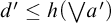 $d' \leq h({\textstyle \bigvee } a')$
. This implies that
$d' \leq h({\textstyle \bigvee } a')$
. This implies that $\operatorname {\mathrm {at}}(d') \in N'(x')$
satisfies the desired conditions.
$\operatorname {\mathrm {at}}(d') \in N'(x')$
satisfies the desired conditions.
For the converse, suppose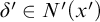 $\delta ' \in N'(x')$
is as described. Then
$\delta ' \in N'(x')$
is as described. Then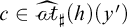 $c \in \widehat {\mathcal {a\!t}}_{\sharp }(h)(y')$
for some
$c \in \widehat {\mathcal {a\!t}}_{\sharp }(h)(y')$
for some $y' \in \delta '$
implies
$y' \in \delta '$
implies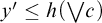 $y' \leq h({\textstyle \bigvee } c)$
and the fact that
$y' \leq h({\textstyle \bigvee } c)$
and the fact that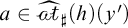 $a \in \widehat {\mathcal {a\!t}}_{\sharp }(h)(y')$
for all
$a \in \widehat {\mathcal {a\!t}}_{\sharp }(h)(y')$
for all $y' \in \delta '$
yields
$y' \in \delta '$
yields ${\textstyle \bigvee } \delta ' \leq h({\textstyle \bigvee } a)$
. The definition of
${\textstyle \bigvee } \delta ' \leq h({\textstyle \bigvee } a)$
. The definition of $N'$
and Lemma 3.5 then entail that
$N'$
and Lemma 3.5 then entail that

so that  .
.
Lemma B.2. If $g : (X, N) \to (X', N')$
is an instantial
$g : (X, N) \to (X', N')$
is an instantial $\sharp $
-morphism then
$\sharp $
-morphism then
 $$ \begin{align*} \widehat{\wp}_{\sharp}(g) : \widehat{\wp}(X', N') \to \widehat{\wp}(X, N) : a' \mapsto \{ x \in X \mid a' \in g(x) \} \end{align*} $$
is a b-homomorphism.
Proof. Let  and
and  (so we abbreviate
  and
and  ). Since $\widehat {\wp }_{\sharp }(g)$
is defined as
$\widehat {\wp }_{\sharp }(g)$
is defined as $\wp _{\sharp }(g)$
, it follows from Lemma A.3 that it is a Boolean homomorphism. This leaves us to prove
$\wp _{\sharp }(g)$
, it follows from Lemma A.3 that it is a Boolean homomorphism. This leaves us to prove

for any finite collection $\gamma ' \cup \{ a' \}$
of subsets of
$\gamma ' \cup \{ a' \}$
of subsets of $X'$
.
$X'$
.
( $\subseteq $
) If
$\subseteq $
) If  then
then  so there exists some $d \in N(x)$
satisfying the two bullet points from Definition 5.1. These imply
$d \in N(x)$
satisfying the two bullet points from Definition 5.1. These imply $d \cap (\widehat {\wp }_{\sharp } g)(c') \neq \emptyset $
for all
$d \cap (\widehat {\wp }_{\sharp } g)(c') \neq \emptyset $
for all $c' \in \gamma '$
, and
$c' \in \gamma '$
, and $d \subseteq (\widehat {\wp }_{\sharp } g)(a')$
. Therefore
$d \subseteq (\widehat {\wp }_{\sharp } g)(a')$
. Therefore  .
.
( $\supseteq $
) Suppose
$\supseteq $
) Suppose  . Then there exists $d \in N(x)$
such that
$d \in N(x)$
such that $d \cap (\widehat {\wp }_{\sharp } g)(c') \neq \emptyset $
for all
$d \cap (\widehat {\wp }_{\sharp } g)(c') \neq \emptyset $
for all $c' \in \gamma '$
, and
$c' \in \gamma '$
, and $d \subseteq (\widehat {\wp }_{\sharp } g)(a')$
. Reasoning in the opposite direction as above, this entails that d satisfies the conditions from Definition 5.1, and hence
$d \subseteq (\widehat {\wp }_{\sharp } g)(a')$
. Reasoning in the opposite direction as above, this entails that d satisfies the conditions from Definition 5.1, and hence  , wherefore
  .
.
Lemma B.3. Let  be a CAMA, $a \in A,$
and
$a \in A,$
and $\beta \subseteq A$
. Then
$\beta \subseteq A$
. Then

Proof. The inequality $\geq $
is obvious, because all terms of the right-hand side join are smaller than the left-hand side. Abbreviate
$\geq $
is obvious, because all terms of the right-hand side join are smaller than the left-hand side. Abbreviate  . For the converse it suffices to prove that

Using complete distributivity, we may rewrite
 $$ \begin{align*} \bigvee_{\beta' \subseteq \beta} C_{\beta'} = \bigwedge \Big\{ \bigvee_{\beta' \subseteq \beta} \chi_{\beta'} \mid \chi_{\beta'} \text{ is a term of } C_{\beta'} \Big\}. \end{align*} $$
For such a choice function $\chi $
, let
$\chi $
, let  . Then we must have
  Therefore
  for each choice function $\chi $
. As a consequence we find
$\chi $
. As a consequence we find

Now rewrite (B.1) as

As a consequence of (B.2) each of the terms in this meet is $\top $
, so the whole meet is
$\top $
, so the whole meet is $\top $
. This completes the proof of the lemma.
$\top $
. This completes the proof of the lemma.
Acknowledgments
I am deeply grateful to the anonymous reviewer for their detailed and constructive review, for pointing out a mistake in the proof of Lemma 3.5, and for listing many typos and unclear proof steps.

 Open access

