




1 Introduction
In [Reference Hall20], Philip Hall proved the existence and the uniqueness, up to isomorphism, of a countable locally finite group $\mathbb {H}$
with the following properties:
$\mathbb {H}$
with the following properties:
-
(i) every finite group can be embedded in $\mathbb {H}$
;
$\mathbb {H}$
; -
(ii) for any finite groups
$F, G$
and embeddings
$\varphi \colon F\to \mathbb {H}$
and
$i\colon F\to G$
, there is an embedding
$\Phi \colon G\to \mathbb {H}$
such that
$\varphi =\Phi \circ i$
.


In modern model theory (see, e.g., [Reference Hodges21]) property (i) is called universality (for finite groups) and property (ii) is called weak homogeneity. It follows from the weak homogeneity that $\mathbb {H}$
is also universal for all countable locally finite groups. For this reason,
$\mathbb {H}$
is also universal for all countable locally finite groups. For this reason, $\mathbb {H}$
is now called Hall’s universal countable locally finite group (see, e.g., [Reference Etedadialiabadi, Gao, Le Maître and Melleray15]). For readers who are familiar with the Fraïseé theory,
$\mathbb {H}$
is now called Hall’s universal countable locally finite group (see, e.g., [Reference Etedadialiabadi, Gao, Le Maître and Melleray15]). For readers who are familiar with the Fraïseé theory, $\mathbb {H}$
can also be regarded as the Fraïseé limit of the Fraïseé class of all finite groups. In any case,
$\mathbb {H}$
can also be regarded as the Fraïseé limit of the Fraïseé class of all finite groups. In any case, $\mathbb {H}$
turns out to be a rather canonical object.
$\mathbb {H}$
turns out to be a rather canonical object.
In [Reference Etedadialiabadi, Gao, Le Maître and Melleray15] the following notion more general than the weak homogeneity was introduced. We call a locally finite group $\Gamma $
omnigenous if for any finite groups
$\Gamma $
omnigenous if for any finite groups $F, G$
and embeddings
$F, G$
and embeddings $\varphi \colon F\to \Gamma $
and
$\varphi \colon F\to \Gamma $
and $i\colon F\to G$
, there is a finite subgroup H of
$i\colon F\to G$
, there is a finite subgroup H of $\Gamma $
and a surjective homomorphism
$\Gamma $
and a surjective homomorphism $\Psi \colon H\to G$
such that
$\Psi \colon H\to G$
such that $\Psi \circ \varphi =i$
. Of course,
$\Psi \circ \varphi =i$
. Of course, $\mathbb {H}$
is omnigenous. It was shown in [Reference Etedadialiabadi, Gao, Le Maître and Melleray15] that, in contrast to the uniqueness of
$\mathbb {H}$
is omnigenous. It was shown in [Reference Etedadialiabadi, Gao, Le Maître and Melleray15] that, in contrast to the uniqueness of $\mathbb {H}$
, there exist continuum many pairwise non-isomorphic countable omnigenous locally finite groups. Furthermore, each of these continuum many groups can be made to contain a copy of
$\mathbb {H}$
, there exist continuum many pairwise non-isomorphic countable omnigenous locally finite groups. Furthermore, each of these continuum many groups can be made to contain a copy of $\mathbb {H}$
as a subgroup, and therefore is universal for all countable locally finite groups.
$\mathbb {H}$
as a subgroup, and therefore is universal for all countable locally finite groups.
In this article, we study the isomorphism relation for all countable omnigenous locally finite groups from the point of view of descriptive set theory. To prove our main result we use the framework of invariant descriptive set theory (see [Reference Gao17]), particularly the notion of Borel reduction between equivalence relations on Polish spaces.
Friedman and Stanley [Reference Friedman and Stanley16] introduced and studied the notion of Borel reducibility between the isomorphism relations of Borel classes of countable structures. They discovered that among all isomorphism relations of Borel classes of countable structures there is a most complex one in terms of Borel reducibility, and they called such Borel classes Borel complete. More precisely, a Borel class of countable structures or the isomorphism relation of such a class is Borel complete if the isomorphism relation of any kind of countable structures is Borel reducible to it. In other words, Borel complete isomorphism relations have the maximum complexity in the Borel reducibility hierarchy among all isomorphism relations of countable structures.
Friedman and Stanley [Reference Friedman and Stanley16] proved the Borel completeness for many Borel classes of countable structures. These include the classes of countable graphs, countable (rooted) trees, countable linear orders, and countably infinite fields of characteristic p (where p is zero or a prime). In particular, using results of Mekler [Reference Mekler24] (or see [Reference Hodges21, Chapter A.3]), they showed that the isomorphism relation of all countable groups is Borel complete (see [Reference Friedman and Stanley16, Subsection 2.3]). In fact, Mekler’s result demonstrates that the isomorphism relation of all countable nilpotent groups of class 2 and of exponent p, where p is any odd prime, is Borel complete. Furthermore, the groups constructed by Mekler are all locally finite, and therefore the isomorphism relation of all countable locally finite groups is Borel complete.
After the work of Friedman and Stanley, more Borel classes of countable structures were studied and found to be Borel complete by various authors. These include the class of all countable Boolean algebras (Camerlo and Gao [Reference Camerlo and Gao4]), certain subclasses of countable graphs and other homogeneous countable structures (Clemens [Reference Clemens6]; Clemens, Coskey, and Potter [Reference Clemens, Coskey and Potter8]), and countable models of set theory (Clemens, Coskey, and Dworetzky [Reference Clemens, Coskey and Dworetzky7]) and arithmetic (Coskey and Kossak [Reference Coskey and Kossak13]). Recently, Paolini and Shelah [Reference Paolini and Shelah26] proved that the class of all countable torsion-free abelian groups is Borel complete. This settles a significant question in this area posed by Friedman and Stanley [Reference Friedman and Stanley16].
Meanwhile, the notion of Borel reducibility has been extended to the context of arbitrary equivalence relations on Polish spaces and of classification problems in mathematics. Becker and Kechris [Reference Becker and Kechris1] showed that Borel complete isomorphism relations are exactly the most complex orbit equivalence relations induced by Borel actions of the infinite permutation group $S_\infty $
(therefore they are also called
$S_\infty $
(therefore they are also called $S_\infty $
-universal in the current literature). Many classification problems in mathematics were found to be Borel complete, meaning that these classification problems, as equivalence relations on Polish spaces, are Borel bireducible to a Borel complete isomorphism relation. These include the classification problems of following mathematical objects:
$S_\infty $
-universal in the current literature). Many classification problems in mathematics were found to be Borel complete, meaning that these classification problems, as equivalence relations on Polish spaces, are Borel bireducible to a Borel complete isomorphism relation. These include the classification problems of following mathematical objects:
-
- zero-dimensional compact metrizable spaces up to homeomorphism (Camerlo and Gao [Reference Camerlo and Gao4]);
-
- zero-dimensional locally compact Polish metric spaces up to isometry (Gao and Kechris [Reference Gao and Kechris18]);
-
- polish ultrametric spaces up to isometry (Gao and Kechris [Reference Gao and Kechris18]);
-
- dimension groups and (commutative) AF
$C^*$
-algebras up to isomorphism, and Bratteli diagrams up to equivalence (Camerlo and Gao [Reference Camerlo and Gao4]); -
- homeomorphisms of the Cantor space (also known as Cantor systems in topological dynamics) up to topogical conjugacy (Camerlo and Gao [Reference Camerlo and Gao4]);
-
- automorphism groups of certain countable structures up to topological conjugacy (Beserra and Coskey [Reference Beserra and Coskey3]; Coskey and Ellis [Reference Coskey and Ellis9–Reference Coskey and Ellis11]; Coskey, Ellis, and Schneider [Reference Coskey, Ellis and Schneider12]);
-
- certain Polish metric spaces with a fixed distance set up to isometry (Camerlo, Marcone, and Motto Ros [Reference Camerlo, Marcone and Motto Ros5]);
-
- locally compact Polish metric spaces up to isometry (Malicki [Reference Malicki23]).

The main theorem of this article is the following.
Theorem 1.1. The isomorphism relation of countable universal, omnigenous locally finite groups is Borel complete.
This result is somewhat surprising since the concepts of weak homogeneity and omnigenousness do not seem drastically different at first sight, but our result put the varieties of these countable locally finite groups at the two extremes of the Borel reducibility hierarchy. In the proof of our main theorem we use Mekler’s construction as a starting point and reduce the class of all countable graphs to the class of groups under our consideration.
The rest of the article is organized as follows. In Section 2 we give the basic definitions and some preliminary results. In Section 3, we present a method of construction for more omnigenous locally finite groups. Finally in Section 4 we use the construction to prove our main theorem.
2 Preliminaries
In this section we review some basic concepts and notation, and give some preliminary results.
2.1 Invariant descriptive set theory
In this section, all the undefined concepts and basic results without reference can be found in [Reference Gao17].
Recall that a topological space is Polish if it is separable and completely metrizable. The collection of all Borel sets in a Polish space is the smallest $\sigma $
-algebra containing all open sets. If
$\sigma $
-algebra containing all open sets. If $X, Y$
are Polish spaces and
$X, Y$
are Polish spaces and $f\colon X\to Y$
is a map, then f is Borel if for any open subset U of Y,
$f\colon X\to Y$
is a map, then f is Borel if for any open subset U of Y, $f^{-1}(U)$
is a Borel subset of X. An equivalence relation E on a Polish space X is Borel if E is a Borel subset of
$f^{-1}(U)$
is a Borel subset of X. An equivalence relation E on a Polish space X is Borel if E is a Borel subset of $X\times X$
.
$X\times X$
.
Given equivalence relations $E, F$
on Polish spaces
$E, F$
on Polish spaces $X, Y$
, respectively, we say that E is Borel reducible to F, denoted
$X, Y$
, respectively, we say that E is Borel reducible to F, denoted $E\leq _B F$
, if there is a Borel map
$E\leq _B F$
, if there is a Borel map $f\colon X\to Y$
such that for any
$f\colon X\to Y$
such that for any $x_1, x_2\in X$
,
$x_1, x_2\in X$
,
 $$ \begin{align*}x_1Ex_2\iff f(x_1)Ff(x_2).\end{align*} $$
We say that E is Borel bireducible with F, denoted $E\sim _B F$
, if both
$E\sim _B F$
, if both $E\leq _B F$
and
$E\leq _B F$
and $F\leq _B E$
. We say that E is strictly Borel reducible to F, denoted
$F\leq _B E$
. We say that E is strictly Borel reducible to F, denoted $E<_B F$
, if
$E<_B F$
, if $E\leq _B F$
but
$E\leq _B F$
but $F\not \leq _B E$
.
$F\not \leq _B E$
.
The quasi order $\leq _B$
gives a measurement of the relative complexity for equivalence relations. We also interpret the Borel reduction
$\leq _B$
gives a measurement of the relative complexity for equivalence relations. We also interpret the Borel reduction $E\leq _B F$
as saying that the Borel cardinality of the quotient space
$E\leq _B F$
as saying that the Borel cardinality of the quotient space $X/E$
is at most that of
$X/E$
is at most that of $Y/F$
.
$Y/F$
.
Invariant descriptive set theory studies the relative complexity of equivalence relations on Polish spaces via the notion of Borel reducibility. But before we can apply the concepts and results of invariant descriptive set theory, we need to gather our objects of interest together and form a Polish space.
Let $\mathcal {L}$
be a countable language. If we denote by
$\mathcal {L}$
be a countable language. If we denote by $\mathcal {C,R,F}$
, respectively, the sets of all constant, relation and function symbols in
$\mathcal {C,R,F}$
, respectively, the sets of all constant, relation and function symbols in $\mathcal {L}$
, then we can view the space
$\mathcal {L}$
, then we can view the space
 $$ \begin{align*} X_{\mathcal{L}}=\prod_{c\in \mathcal{C}} \omega \times \prod_{R\in \mathcal{R}}2^{\omega^{a(R)}}\times \prod_{f\in \mathcal{F}}\omega^{\omega^{a(f)}}, \end{align*} $$
as the coding space of all countable $\mathcal {L}$
-structures with universe
$\mathcal {L}$
-structures with universe $\omega $
, where
$\omega $
, where $a(\cdot )$
denotes the arity of a symbol. The isomorphism relation for all countably infinite
$a(\cdot )$
denotes the arity of a symbol. The isomorphism relation for all countably infinite $\mathcal {L}$
-structures is then an equivalence relation on
$\mathcal {L}$
-structures is then an equivalence relation on $X_{\mathcal {L}}$
. If we equip
$X_{\mathcal {L}}$
. If we equip $\omega $
and
$\omega $
and $2=\{0,1\}$
with discrete topologies and
$2=\{0,1\}$
with discrete topologies and $X_{\mathcal {L}}$
with the product topology, then
$X_{\mathcal {L}}$
with the product topology, then $X_{\mathcal {L}}$
becomes a Polish space.
$X_{\mathcal {L}}$
becomes a Polish space.
In this article we will consider countable graphs and countable groups. For countable graphs the language consists of one binary relation symbol, and the space of all countable graphs with universe $\omega $
is
$\omega $
is
 $$ \begin{align*}\begin{array}{rl} \mathcal{P}=\big\{ x\in 2^{\omega^2}\colon & \forall n, m\in\omega\\ & x(n,n)=0 \text{ and } (x(n,m)=1\rightarrow x(m,n)=1)\big\}, \end{array}\end{align*} $$
which is a closed subspace of $2^{\omega \times \omega }$
, and therefore a Polish space.
$2^{\omega \times \omega }$
, and therefore a Polish space.
In the case of countable groups we use the language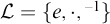 $\mathcal {L}=\{e, \cdot , {}^{-1}\}$
, where e is a constant symbol,
$\mathcal {L}=\{e, \cdot , {}^{-1}\}$
, where e is a constant symbol, $\cdot $
is a binary function symbol, and
$\cdot $
is a binary function symbol, and ${}^{-1}$
is a unary function symbol. For each
${}^{-1}$
is a unary function symbol. For each $x\in X_{\mathcal {L}}$
let
$x\in X_{\mathcal {L}}$
let $\Gamma _x$
be the
$\Gamma _x$
be the $\mathcal {L}$
-structure coded by x. Let
$\mathcal {L}$
-structure coded by x. Let $\mathcal {G}$
be the subset of
$\mathcal {G}$
be the subset of $x\in X_{\mathcal {L}}$
where
$x\in X_{\mathcal {L}}$
where $\Gamma _x$
is a group. Then
$\Gamma _x$
is a group. Then $\mathcal {G}$
is a closed subset of
$\mathcal {G}$
is a closed subset of $X_{\mathcal {L}}$
and therefore is itself a Polish space.
$X_{\mathcal {L}}$
and therefore is itself a Polish space.
Recall that a group is locally finite if every finitely generated subgroup is finite. Consider the subsets
 $$ \begin{align*}\mathcal{G}_{\mathrm{lf}}&=\{ x\in \mathcal{G}\colon \Gamma_x\text{ is locally finite}\},\\\mathcal{G}_{\mathrm{omni}}&=\{ x\in \mathcal{G}\colon \Gamma_x\text{ is omnigenous}\},\end{align*} $$
and
 $$ \begin{align*}\mathcal{G}_{\mathrm{univ}}=\{x\in \mathcal{G}\colon \Gamma_x\text{ is universal for all finite groups}\}.\end{align*} $$
Then each of these sets is a $G_\delta $
subset of
$G_\delta $
subset of $\mathcal {G}$
, and therefore is a Polish space. Moreover, each of them is a set invariant for the isomorphism relation. The primary class of groups we study in this article is
$\mathcal {G}$
, and therefore is a Polish space. Moreover, each of them is a set invariant for the isomorphism relation. The primary class of groups we study in this article is
 $$ \begin{align*}\mathcal{G}_{\mathrm{uolf}}=\mathcal{G}_{\mathrm{lf}}\cap \mathcal{G}_{\mathrm{omni}}\cap \mathcal{G}_{\mathrm{univ}},\end{align*} $$
which is again an invariant Polish subspace of $\mathcal {G}$
. We are interested in the complexity of the isomorphism relation on
$\mathcal {G}$
. We are interested in the complexity of the isomorphism relation on $\mathcal {G}_{\mathrm {uolf}}$
.
$\mathcal {G}_{\mathrm {uolf}}$
.
2.2 Omnigenous locally finite groups
We recall some more detailed properties of Hall’s universal locally finite group $\mathbb {H}$
.
$\mathbb {H}$
.
Hall [Reference Hall20] considered the following strong form of ultrahomogeneity for a group $\Gamma $
: Any two isomorphic finite subgroups of
$\Gamma $
: Any two isomorphic finite subgroups of $\Gamma $
are conjugate by an element of
$\Gamma $
are conjugate by an element of $\Gamma $
. He showed that
$\Gamma $
. He showed that $\mathbb {H}$
is the unique, up to isomorphism, countable locally finite group that is universal for finite groups and is ultrahomogeneous.
$\mathbb {H}$
is the unique, up to isomorphism, countable locally finite group that is universal for finite groups and is ultrahomogeneous.
For any group G we denote the identity element or the trivial element by $e_G$
. An element
$e_G$
. An element $g\in G$
is nontrivial if
$g\in G$
is nontrivial if $g\neq e_G$
. A group G is trivial if
$g\neq e_G$
. A group G is trivial if $G=\{e_G\}$
; a subgroup H of G is trivial if
$G=\{e_G\}$
; a subgroup H of G is trivial if $H=\{e_G\}$
. Recall that a group G is simple if its only normal subgroups are
$H=\{e_G\}$
. Recall that a group G is simple if its only normal subgroups are $\{e_G\}$
and G. Hall [Reference Hall20] showed that
$\{e_G\}$
and G. Hall [Reference Hall20] showed that $\mathbb {H}$
is simple, a fact we will use in our proofs later.
$\mathbb {H}$
is simple, a fact we will use in our proofs later.
Although we will not need it in our proofs, we present a new characterization of omnigenous locally finite groups below. We first recall some basic group-theoretic notions. Recall that the index of a subgroup H of a group G is the number of cosets of H in G, or equivalently, the number of classes of the equivalence relation defined on G by
 $$ \begin{align*}g\sim h \iff g^{-1}h\in H.\end{align*} $$
A group G is residually finite if for any nontrivial $g\in G$
there is a normal subgroup
$g\in G$
there is a normal subgroup $N \unlhd \, G$
of finite index such that
$N \unlhd \, G$
of finite index such that $g\not \in N$
. Finite groups and finitely generated free groups are residually finite (see [Reference Magnus22, Section 2]). We also recall the definition of the free product of groups. Given groups G and H, a word is a finite sequence of nontrivial elements of G and H (the sequence could be empty) and a word w is reduced if either it is an empty word or w is nonempty and there are no adjacent elements in w which are from the same group. If w is a word, the reduction of w, denoted by
$g\not \in N$
. Finite groups and finitely generated free groups are residually finite (see [Reference Magnus22, Section 2]). We also recall the definition of the free product of groups. Given groups G and H, a word is a finite sequence of nontrivial elements of G and H (the sequence could be empty) and a word w is reduced if either it is an empty word or w is nonempty and there are no adjacent elements in w which are from the same group. If w is a word, the reduction of w, denoted by $w^*$
, is the unique reduced word obtained by successively replacing any occurrence of consecutive elements from the same group by their product, if the product is nontrivial, and eliminating them if the product is trivial. The free product of G and H, denoted by
$w^*$
, is the unique reduced word obtained by successively replacing any occurrence of consecutive elements from the same group by their product, if the product is nontrivial, and eliminating them if the product is trivial. The free product of G and H, denoted by $G*H$
, is the group whose elements are the reduced words of G and H, and the identity element is the empty word, with the group operation defined by
$G*H$
, is the group whose elements are the reduced words of G and H, and the identity element is the empty word, with the group operation defined by $w_1\cdot w_2=(w_1w_2)^*$
, where
$w_1\cdot w_2=(w_1w_2)^*$
, where $w_1w_2$
is the concatenation of
$w_1w_2$
is the concatenation of $w_1$
and
$w_1$
and $w_2$
.
$w_2$
.
Lemma 2.1. Let $F, G$
be finite groups and let
$F, G$
be finite groups and let $\psi \colon F\to G$
be a homomorphism from F into G. Then there exist a finite group H, an embedding
$\psi \colon F\to G$
be a homomorphism from F into G. Then there exist a finite group H, an embedding $i\colon F\to H$
, and a surjective homomorphism
$i\colon F\to H$
, and a surjective homomorphism $\Psi \colon H\to G$
such that
$\Psi \colon H\to G$
such that $\psi =\Psi \circ i$
.
$\psi =\Psi \circ i$
.
Proof. Let $g_1, \dots , g_n\in G\setminus \psi (F)$
be such that
$g_1, \dots , g_n\in G\setminus \psi (F)$
be such that $G=\langle \psi (F), g_1, \dots , g_n\rangle $
. Consider the free group
$G=\langle \psi (F), g_1, \dots , g_n\rangle $
. Consider the free group $F_n=\langle x_1, \dots , x_n\rangle $
. Define
$F_n=\langle x_1, \dots , x_n\rangle $
. Define $\phi : F*F_n\to G$
by
$\phi : F*F_n\to G$
by $\phi (f)=\psi (f)$
for
$\phi (f)=\psi (f)$
for $f\in F$
and
$f\in F$
and $\phi (x_i)=g_i$
for
$\phi (x_i)=g_i$
for $1\leq i\leq n$
. Then
$1\leq i\leq n$
. Then $\phi $
can be extended to a surjective group homomorphism from
$\phi $
can be extended to a surjective group homomorphism from $F*F_n$
to G. Note that
$F*F_n$
to G. Note that $\ker \phi $
is of finite index in
$\ker \phi $
is of finite index in $F*F_n$
, since G is finite.
$F*F_n$
, since G is finite.
By a classical theorem of Gruenberg (see [Reference Gruenberg19, Theorem 4.1] or [Reference Berlai2]), the free product of residually finite groups is residually finite. Thus $\Gamma =F*F_n$
is residually finite. Note that we can naturally view F as a subgroup of
$\Gamma =F*F_n$
is residually finite. Note that we can naturally view F as a subgroup of $F*F_n$
. Thus for each nontrivial
$F*F_n$
. Thus for each nontrivial $g\in F$
, there is a normal subgroup
$g\in F$
, there is a normal subgroup $N_g$
of finite index in
$N_g$
of finite index in $F*F_n$
with
$F*F_n$
with $g\notin N_g$
. Let
$g\notin N_g$
. Let $N=\bigcap _{g\in F} N_g \cap \ker \phi $
. Then
$N=\bigcap _{g\in F} N_g \cap \ker \phi $
. Then $N\cap F=\{e_{\Gamma }\}$
and
$N\cap F=\{e_{\Gamma }\}$
and $N\leq \ker \phi $
. Since F is finite, N is of finite index. Let
$N\leq \ker \phi $
. Since F is finite, N is of finite index. Let $H=(F*F_n)/N$
. Define
$H=(F*F_n)/N$
. Define $i: F\to H$
by
$i: F\to H$
by $i(f)=fN$
. Then i is a homomorphism. To see that i is an embedding, suppose
$i(f)=fN$
. Then i is a homomorphism. To see that i is an embedding, suppose $fN=f'N$
with
$fN=f'N$
with $f, f'\in F$
. Then
$f, f'\in F$
. Then $f^{-1}f'\in N\cap F=\{e_\Gamma \}$
, so
$f^{-1}f'\in N\cap F=\{e_\Gamma \}$
, so $f=f'$
.
$f=f'$
.
Define $\Psi \colon H\to G$
by
$\Psi \colon H\to G$
by $\Psi (hN)=\phi (h)$
. We note that
$\Psi (hN)=\phi (h)$
. We note that $\Psi $
is well-defined. For this, suppose
$\Psi $
is well-defined. For this, suppose $hN=h'N$
. Then
$hN=h'N$
. Then $h^{-1}h\in N\leq \ker \phi $
. Thus
$h^{-1}h\in N\leq \ker \phi $
. Thus $\phi (h^{-1}h')=e_G$
, and
$\phi (h^{-1}h')=e_G$
, and $\phi (h)=\phi (h')$
. It is obvious that
$\phi (h)=\phi (h')$
. It is obvious that $\Psi $
is a surjective homomorphism.
$\Psi $
is a surjective homomorphism.
Finally, we verify that $\psi =\Psi \circ i$
. For this, let
$\psi =\Psi \circ i$
. For this, let $f\in F$
, and note
$f\in F$
, and note $\Psi \circ i(f)=\Psi (fN)=\phi (f)=\psi (f)$
.
$\Psi \circ i(f)=\Psi (fN)=\phi (f)=\psi (f)$
.
Proposition 2.2. Let $\Gamma $
be a locally finite group. Then
$\Gamma $
be a locally finite group. Then $\Gamma $
is omnigenous iff for any finite subgroup
$\Gamma $
is omnigenous iff for any finite subgroup $F\leq \Gamma $
, finite group G, and embedding
$F\leq \Gamma $
, finite group G, and embedding $\psi \colon F\to G$
, assuming that there is
$\psi \colon F\to G$
, assuming that there is $g\in G$
such that
$g\in G$
such that $G=\langle \psi (F), g\rangle $
, then there is a finite
$G=\langle \psi (F), g\rangle $
, then there is a finite $H\leq \Gamma $
with
$H\leq \Gamma $
with $F\leq H$
and a surjective homomorphism
$F\leq H$
and a surjective homomorphism $\Psi \colon H\to G$
such that
$\Psi \colon H\to G$
such that $\Psi \upharpoonright F=\psi $
.
$\Psi \upharpoonright F=\psi $
.
Proof. The stated property is obviously necessary for omnigenousness. To show its sufficiency, let $\Gamma $
have the property.
$\Gamma $
have the property.
Suppose $F\leq \Gamma $
is finite, G is a finite group, and
$F\leq \Gamma $
is finite, G is a finite group, and $\psi \colon F\to G$
is an embedding. Suppose
$\psi \colon F\to G$
is an embedding. Suppose $n\geq 1$
is the smallest number such that there are
$n\geq 1$
is the smallest number such that there are $g_1, \dots , g_n\in G$
such that
$g_1, \dots , g_n\in G$
such that $G=\langle \psi (F), g_1, \dots , g_n\rangle $
. We prove by induction on n that there exist a finite
$G=\langle \psi (F), g_1, \dots , g_n\rangle $
. We prove by induction on n that there exist a finite $H\leq \Gamma $
with
$H\leq \Gamma $
with $F\leq H$
and a surjective homomorphism
$F\leq H$
and a surjective homomorphism $\Psi \colon H\to G$
with
$\Psi \colon H\to G$
with $\Psi \upharpoonright F=\psi $
. If
$\Psi \upharpoonright F=\psi $
. If $n=1$
this is given by the assumption on
$n=1$
this is given by the assumption on $\Gamma $
.
$\Gamma $
.
As the inductive hypothesis, suppose there exist a finite $H_0\leq \Gamma $
with
$H_0\leq \Gamma $
with $F\leq H_0$
and a surjective homomorphism
$F\leq H_0$
and a surjective homomorphism $\Psi _0\colon H_0\to \langle \psi (F), g_1, \dots , g_{n-1}\rangle $
with
$\Psi _0\colon H_0\to \langle \psi (F), g_1, \dots , g_{n-1}\rangle $
with $\Psi _0\upharpoonright F=\psi $
. By Lemma 2.1, there exist a finite group K, an embedding
$\Psi _0\upharpoonright F=\psi $
. By Lemma 2.1, there exist a finite group K, an embedding $i\colon H_0\to K$
, and a surjective homomorphism
$i\colon H_0\to K$
, and a surjective homomorphism $\kappa \colon K \to G$
such that
$\kappa \colon K \to G$
such that $\Psi _0=\kappa \circ i$
. Note that, without loss of generality, we may assume
$\Psi _0=\kappa \circ i$
. Note that, without loss of generality, we may assume $K=\langle i(H_0), k\rangle $
for any k with
$K=\langle i(H_0), k\rangle $
for any k with $\kappa (k)=g_n$
. By the assumption on
$\kappa (k)=g_n$
. By the assumption on $\Gamma $
again, there exist
$\Gamma $
again, there exist $H\leq \Gamma $
with
$H\leq \Gamma $
with $H_0\leq H$
and a surjective homomorphism
$H_0\leq H$
and a surjective homomorphism $\Phi \colon H\to K$
such that
$\Phi \colon H\to K$
such that $\Phi \upharpoonright H_0=i$
. Let
$\Phi \upharpoonright H_0=i$
. Let $\Psi =\kappa \circ \Phi $
. Then
$\Psi =\kappa \circ \Phi $
. Then $\Psi \colon H\to G$
is surjective, and
$\Psi \colon H\to G$
is surjective, and $\Psi \upharpoonright F=\Psi _0\upharpoonright F=\psi $
.
$\Psi \upharpoonright F=\Psi _0\upharpoonright F=\psi $
.
3 More omnigenous locally finite groups
In this section, we give a method to construct pairwise non-isomorphic countable omnigenous locally finite groups.
3.1 A general construction
We first consider direct limits of direct systems. By a direct system we mean a sequence $\{G_i, \varphi _i\colon i\in \omega \},$
where for each
$\{G_i, \varphi _i\colon i\in \omega \},$
where for each $i\in \omega $
,
$i\in \omega $
, $G_i$
is a group and
$G_i$
is a group and $\varphi _i\colon G_i\to G_{i+1}$
is an embedding. The direct limit of a direct system is defined as follows. First, define a relation
$\varphi _i\colon G_i\to G_{i+1}$
is an embedding. The direct limit of a direct system is defined as follows. First, define a relation $\sim $
on the disjoint union
$\sim $
on the disjoint union $X=\bigsqcup _{i\in \omega } G_i$
. If
$X=\bigsqcup _{i\in \omega } G_i$
. If $a \in G_i$
,
$a \in G_i$
, $b\in G_j$
, and
$b\in G_j$
, and $i<j$
, then define
$i<j$
, then define
 $$ \begin{align*}a\sim b \iff b\sim a \iff (\varphi_{j-1}\circ \dots\circ\varphi_i)(a)=b.\end{align*} $$
Since each $\varphi _i$
is an embedding,
$\varphi _i$
is an embedding, $\sim $
is an equivalence relation. The direct limit will be a group on the set of all
$\sim $
is an equivalence relation. The direct limit will be a group on the set of all $\sim $
classes, i.e.,
$\sim $
classes, i.e., $\{[a]_\sim \colon a\in X\}$
. To define the group operation, consider
$\{[a]_\sim \colon a\in X\}$
. To define the group operation, consider $a\in G_i$
and
$a\in G_i$
and $b\in G_j$
and suppose
$b\in G_j$
and suppose $i\leq j$
. Define
$i\leq j$
. Define
 $$ \begin{align*}[a]_\sim \cdot [b]_\sim = [(\varphi_{j-1}\circ \dots\circ \varphi_i)(a)\cdot b]_\sim.\end{align*} $$
It is routine to check that $\cdot $
is welldefined and that
$\cdot $
is welldefined and that $[a]_\sim ^{-1}=[a^{-1}]_\sim $
. In the rest of this article, when there is no danger of confusion, we will view each embedding as inclusion. Thus for all i,
$[a]_\sim ^{-1}=[a^{-1}]_\sim $
. In the rest of this article, when there is no danger of confusion, we will view each embedding as inclusion. Thus for all i, $G_i\leq G_{i+1}$
and the direct limit is just the union of all
$G_i\leq G_{i+1}$
and the direct limit is just the union of all $G_i$
. For
$G_i$
. For $a\in G_i$
, we will also simply denote
$a\in G_i$
, we will also simply denote $[a]_\sim $
as a and view it as an element of each
$[a]_\sim $
as a and view it as an element of each $G_j$
when
$G_j$
when $j\geq i$
.
$j\geq i$
.
Now let $A, H$
be groups with H being a non-abelian simple group. Then H has trivial center. Let
$A, H$
be groups with H being a non-abelian simple group. Then H has trivial center. Let $f:A\oplus H \to H$
be a group embedding. Define a group embedding
$f:A\oplus H \to H$
be a group embedding. Define a group embedding $\varphi : A\oplus H \to A\oplus H$
by
$\varphi : A\oplus H \to A\oplus H$
by
 $$ \begin{align*}\varphi(s,t)=(s,f(s,t)),\end{align*} $$
for $s\in A$
and
$s\in A$
and $t\in H$
. Consider a direct system
$t\in H$
. Consider a direct system $\{G_i,\varphi _i\colon i\in \omega \}$
where each
$\{G_i,\varphi _i\colon i\in \omega \}$
where each $G_i$
is an isomorphic copy of
$G_i$
is an isomorphic copy of $A\oplus H$
and
$A\oplus H$
and $\varphi _i$
is the above
$\varphi _i$
is the above $\varphi $
. Let
$\varphi $
. Let $D(A,H,f)$
be the direct limit of this system. We will always use the same H and so will just denote it by
$D(A,H,f)$
be the direct limit of this system. We will always use the same H and so will just denote it by $D(A,f)$
.
$D(A,f)$
.
There is a special subgroup of $D(A,f)$
which we denote by
$D(A,f)$
which we denote by $S(A,f)$
. Consider the direct system
$S(A,f)$
. Consider the direct system $\{H_i, \psi _i\colon i\in \omega \}$
where for each
$\{H_i, \psi _i\colon i\in \omega \}$
where for each $i\in \omega $
,
$i\in \omega $
,
 $$ \begin{align*}H_i= H\leq G_i \text{ and }\psi_i=\varphi_i\upharpoonright H_i.\end{align*} $$
Let $S(A,f)$
be the direct limit of this system. Then
$S(A,f)$
be the direct limit of this system. Then $S(A,f)$
is special in the following sense.
$S(A,f)$
is special in the following sense.
Lemma 3.1. $S(A,f)$
is a simple normal subgroup of
$S(A,f)$
is a simple normal subgroup of $D(A,f)$
. Every nontrivial normal subgroup of
$D(A,f)$
. Every nontrivial normal subgroup of $D(A,f)$
contains
$D(A,f)$
contains $S(A,f)$
as a normal subgroup. Thus
$S(A,f)$
as a normal subgroup. Thus $S(A,f)$
is the only nontrivial simple normal subgroup of
$S(A,f)$
is the only nontrivial simple normal subgroup of $D(A,f)$
.
$D(A,f)$
.
Proof. It is easy to see that $S(A,f)$
is a normal subgroup. To see that it is simple, it suffices to show that the normal subgroup generated by any nontrivial element of
$S(A,f)$
is a normal subgroup. To see that it is simple, it suffices to show that the normal subgroup generated by any nontrivial element of $S(A,f)$
must be the whole group. For this, fix a nontrivial
$S(A,f)$
must be the whole group. For this, fix a nontrivial $t \in H_i$
. Let
$t \in H_i$
. Let $N_t$
be the normal subgroup generated by t in
$N_t$
be the normal subgroup generated by t in $S(A,f)$
. Then
$S(A,f)$
. Then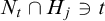 $N_t \cap H_j \ni t$
is a nontrivial normal subgroup of
$N_t \cap H_j \ni t$
is a nontrivial normal subgroup of $H_j$
for all
$H_j$
for all $j\geq i$
. Since we have assumed that
$j\geq i$
. Since we have assumed that $H_j=H$
is simple,
$H_j=H$
is simple, $N_t \cap H_j =H_j$
and thus
$N_t \cap H_j =H_j$
and thus $N_t = S(A,f)$
. This shows that
$N_t = S(A,f)$
. This shows that $S(A,f)$
is simple.
$S(A,f)$
is simple.
Now assume G is a nontrivial normal subgroup of $D(A,f)$
. Let
$D(A,f)$
. Let $(e_A,e_H)\neq (s,t)\in G\cap G_i$
. We may assume that
$(e_A,e_H)\neq (s,t)\in G\cap G_i$
. We may assume that $t\neq e_H$
since otherwise we can do the same argument to
$t\neq e_H$
since otherwise we can do the same argument to $\varphi _i(s,t)=(s,f(s,t)) \in G\cap G_{i+1}$
. The group H has trivial center. Thus we can choose
$\varphi _i(s,t)=(s,f(s,t)) \in G\cap G_{i+1}$
. The group H has trivial center. Thus we can choose $t'\in H_i$
such that t and
$t'\in H_i$
such that t and $t'$
do not commute. Then
$t'$
do not commute. Then $(s,t)\neq (s,t't{t'}^{-1})=(e_A,t')(s,t)(e_A,t^{\prime -1})\in G\cap G_i$
. Let
$(s,t)\neq (s,t't{t'}^{-1})=(e_A,t')(s,t)(e_A,t^{\prime -1})\in G\cap G_i$
. Let $a=t'tt^{\prime -1}t^{-1}$
. Then
$a=t'tt^{\prime -1}t^{-1}$
. Then $a\in H_i$
is nontrivial and
$a\in H_i$
is nontrivial and $(e_A,a)\in G\cap H_i$
(identify
$(e_A,a)\in G\cap H_i$
(identify $H_i$
with
$H_i$
with $\{e_A\}\times H_i$
). What we have shown so far is that if
$\{e_A\}\times H_i$
). What we have shown so far is that if $G\cap G_i$
is nontrivial, then for all
$G\cap G_i$
is nontrivial, then for all $j>i$
,
$j>i$
, $G\cap H_j$
is nontrivial. Now by the argument in the preceding paragraph, the normal subgroup of
$G\cap H_j$
is nontrivial. Now by the argument in the preceding paragraph, the normal subgroup of $D(A, f)$
generated by any nontrivial element of
$D(A, f)$
generated by any nontrivial element of $H_j$
is
$H_j$
is $S(A, f)$
. Since G is normal, it follows that G contains
$S(A, f)$
. Since G is normal, it follows that G contains $S(A, f)$
.
$S(A, f)$
.
The last assertion follows immediately.
We note that it is possible to characterize the isomorphism type of A from that of $D(A,f)$
.
$D(A,f)$
.
Lemma 3.2. For any group A we have $A \cong D(A,f)/S(A, f)$
. Consequently, if
$A \cong D(A,f)/S(A, f)$
. Consequently, if $D(A,f)\cong D(B,g)$
(it is not necessary that the group H used in their constructions are the same), then
$D(A,f)\cong D(B,g)$
(it is not necessary that the group H used in their constructions are the same), then $A\cong B$
.
$A\cong B$
.
Proof. For any $g=(s,t)\in G_i=A\oplus H$
, define
$g=(s,t)\in G_i=A\oplus H$
, define $\pi (g)=s$
. Then
$\pi (g)=s$
. Then $\pi $
is well defined since
$\pi $
is well defined since $\varphi _i$
does not change the first coordinate.
$\varphi _i$
does not change the first coordinate. $\pi $
is obviously a homomorphism from
$\pi $
is obviously a homomorphism from $D(A,f)$
onto A. Note that
$D(A,f)$
onto A. Note that $\pi (g)=e_A$
iff
$\pi (g)=e_A$
iff $ g=(e_A,t)\in G_i=A\oplus H$
for some
$ g=(e_A,t)\in G_i=A\oplus H$
for some $i\in \omega $
and
$i\in \omega $
and $t\in H$
iff
$t\in H$
iff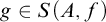 $g\in S(A,f)$
. Thus the kernel of
$g\in S(A,f)$
. Thus the kernel of $\pi $
is
$\pi $
is $S(A,f)$
. By the isomorphism theorem,
$S(A,f)$
. By the isomorphism theorem, $A\cong D(A,f)/S(A,f)$
.
$A\cong D(A,f)/S(A,f)$
.
3.2 Some properties of the construction
In this section we give more details and properties of the groups that will be used in the proof of Theorem 1.1.
Proposition 3.3. Let A be a locally finite group, let $H=\mathbb {H}$
, and let
$H=\mathbb {H}$
, and let $f\colon A\oplus \mathbb {H}\to \mathbb {H}$
be an embedding. Then
$f\colon A\oplus \mathbb {H}\to \mathbb {H}$
be an embedding. Then $D(A,f)=D(A, H, f)$
is omnigenous.
$D(A,f)=D(A, H, f)$
is omnigenous.
Proof. Let $\Gamma _1\leq \Gamma _2$
be finite groups and
$\Gamma _1\leq \Gamma _2$
be finite groups and $g:\Gamma _1\to D(A,f)$
be a group embedding. Since
$g:\Gamma _1\to D(A,f)$
be a group embedding. Since $\Gamma _1$
is finite, there is
$\Gamma _1$
is finite, there is $i\in \omega $
such that
$i\in \omega $
such that $g(\Gamma _1)\subseteq G_i= A\oplus \mathbb {H}$
. We should emphasize here that in
$g(\Gamma _1)\subseteq G_i= A\oplus \mathbb {H}$
. We should emphasize here that in $D(A,f)$
,
$D(A,f)$
, $g\in G_i$
is identified with
$g\in G_i$
is identified with $\varphi _i(g) \in G_{i+1}$
. Then
$\varphi _i(g) \in G_{i+1}$
. Then $f\circ g$
is an embedding from
$f\circ g$
is an embedding from $\Gamma _1$
to
$\Gamma _1$
to $\mathbb {H}$
. By the weak homogeneity of
$\mathbb {H}$
. By the weak homogeneity of $\mathbb {H}$
, there exist a finite subgroup K of
$\mathbb {H}$
, there exist a finite subgroup K of $\mathbb {H}$
and a group isomorphism
$\mathbb {H}$
and a group isomorphism $h\colon K \to \Gamma _2$
so that
$h\colon K \to \Gamma _2$
so that $(f\circ g)(\Gamma _1)\leq K\leq \mathbb {H}$
and for all
$(f\circ g)(\Gamma _1)\leq K\leq \mathbb {H}$
and for all $\gamma \in \Gamma _1$
,
$\gamma \in \Gamma _1$
, $(h\circ f\circ g)(\gamma )=\gamma $
. Let
$(h\circ f\circ g)(\gamma )=\gamma $
. Let $K'$
be the subgroup of
$K'$
be the subgroup of $G_{i+1}$
generated by
$G_{i+1}$
generated by $(\varphi _i\circ g)(\Gamma _1)\cup (\{e_A\}\times K)$
. Then since in
$(\varphi _i\circ g)(\Gamma _1)\cup (\{e_A\}\times K)$
. Then since in $D(A,f)$
,
$D(A,f)$
, $g(\Gamma _1)$
is identified with
$g(\Gamma _1)$
is identified with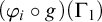 $(\varphi _i\circ g)(\Gamma _1)$
,
$(\varphi _i\circ g)(\Gamma _1)$
, $g(\Gamma _1)$
is a subgroup of
$g(\Gamma _1)$
is a subgroup of $K'$
. Since A is locally finite and
$K'$
. Since A is locally finite and $K'$
is finitely generated,
$K'$
is finitely generated, $K'$
is finite. Let
$K'$
is finite. Let $\Phi $
canonically map
$\Phi $
canonically map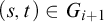 $(s,t)\in G_{i+1}$
to
$(s,t)\in G_{i+1}$
to $t\in \mathbb {H}$
. Then it is easy to verify that
$t\in \mathbb {H}$
. Then it is easy to verify that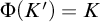 $\Phi (K')=K$
and thus
$\Phi (K')=K$
and thus $h\circ \Phi $
is a homomorphism from
$h\circ \Phi $
is a homomorphism from $K'$
onto
$K'$
onto $\Gamma _2$
. Now for any
$\Gamma _2$
. Now for any $\gamma \in \Gamma _1$
, we have
$\gamma \in \Gamma _1$
, we have
 $$ \begin{align*}(h\circ \Phi\circ g)(\gamma)=(h\circ \Phi\circ \varphi_i\circ g)(\gamma)=(h\circ f\circ g)(\gamma)=\gamma.\end{align*} $$
Thus $D(A,f)$
is omnigenous.
$D(A,f)$
is omnigenous.
From now on, we take all H in our constructions to be Hall’s group $\mathbb {H}$
. We will use the following theorem of Paolini and Shelah [Reference Paolini and Shelah25, Theorem 4] regarding the automorphism group of
$\mathbb {H}$
. We will use the following theorem of Paolini and Shelah [Reference Paolini and Shelah25, Theorem 4] regarding the automorphism group of $\mathbb {H}$
.
$\mathbb {H}$
.
Proposition 3.4 (Paolini–Shelah [Reference Paolini and Shelah25]).
For every countable locally finite group G there exists $G \cong G' \leq \mathbb {H}$
such that every
$G \cong G' \leq \mathbb {H}$
such that every $\phi \in \mathrm {Aut}(G')$
extends to a
$\phi \in \mathrm {Aut}(G')$
extends to a $\hat {\phi } \in \mathrm {Aut}(\mathbb {H})$
in such a way that
$\hat {\phi } \in \mathrm {Aut}(\mathbb {H})$
in such a way that $\phi \mapsto \hat {\phi }$
embeds
$\phi \mapsto \hat {\phi }$
embeds $\mathrm {Aut}(G')$
into
$\mathrm {Aut}(G')$
into $\mathrm {Aut}(\mathbb {H})$
.
$\mathrm {Aut}(\mathbb {H})$
.
What we will do is basically the following. Let G be a locally finite group and let $A\leq G$
be a subgroup. We will choose a group embedding f from
$A\leq G$
be a subgroup. We will choose a group embedding f from $G\oplus \mathbb {H}$
into
$G\oplus \mathbb {H}$
into $\mathbb {H}$
by Proposition 3.4 so that every automorphism of
$\mathbb {H}$
by Proposition 3.4 so that every automorphism of $f(G\oplus \mathbb {H})$
can be extended to an automorphism of
$f(G\oplus \mathbb {H})$
can be extended to an automorphism of $\mathbb {H}$
. With this embedding, we can do the construction to form
$\mathbb {H}$
. With this embedding, we can do the construction to form $D(G,f)$
. Then f will be naturally restricted on
$D(G,f)$
. Then f will be naturally restricted on $A\oplus \mathbb {H}$
to form
$A\oplus \mathbb {H}$
to form $D(A,f)=D(A,f\upharpoonright A\oplus \mathbb {H})$
. Then
$D(A,f)=D(A,f\upharpoonright A\oplus \mathbb {H})$
. Then $D(A,f)$
will be a subgroup of
$D(A,f)$
will be a subgroup of $D(G,f)$
. The special property of f helps us keep the isomorphism type of subgroup of G in the following way.
$D(G,f)$
. The special property of f helps us keep the isomorphism type of subgroup of G in the following way.
Lemma 3.5. Let $G,f$
be as above. Let
$G,f$
be as above. Let $A,B\leq G$
. Suppose there is an automorphism of G mapping A onto B. Then there is an automorphism of
$A,B\leq G$
. Suppose there is an automorphism of G mapping A onto B. Then there is an automorphism of $D(G,f)$
mapping
$D(G,f)$
mapping $D(A,f)$
onto
$D(A,f)$
onto $D(B,f)$
.
$D(B,f)$
.
Proof. Let $\pi $
be an automorphism of G mapping A onto B. First of all,
$\pi $
be an automorphism of G mapping A onto B. First of all, $\pi $
canonically extends to an automorphism of
$\pi $
canonically extends to an automorphism of $G\oplus \mathbb {H}$
which we still denote by
$G\oplus \mathbb {H}$
which we still denote by $\pi $
, that is,
$\pi $
, that is, $\pi (s,t)=(\pi (s),t)$
. By the choice of f which uses Proposition 3.4, there is an automorphism
$\pi (s,t)=(\pi (s),t)$
. By the choice of f which uses Proposition 3.4, there is an automorphism $\pi '$
of
$\pi '$
of $\mathbb {H}$
such that for all
$\mathbb {H}$
such that for all $(s,t)\in G\oplus \mathbb {H}$
,
$(s,t)\in G\oplus \mathbb {H}$
, $(\pi '\circ f)(s,t)=(f\circ \pi )(s,t)$
. Using this, we now define a sequence of automorphisms
$(\pi '\circ f)(s,t)=(f\circ \pi )(s,t)$
. Using this, we now define a sequence of automorphisms $h_i$
of
$h_i$
of $\mathbb {H}$
by induction on
$\mathbb {H}$
by induction on $i\in \omega $
.
$i\in \omega $
.
Let $h_0=\text {id}$
. Suppose
$h_0=\text {id}$
. Suppose $h_i$
has been defined. Then
$h_i$
has been defined. Then $\pi '\circ f\circ (\text {id},h_i)\circ f^{-1}$
is an automorphism of
$\pi '\circ f\circ (\text {id},h_i)\circ f^{-1}$
is an automorphism of $f(G\oplus \mathbb {H})$
and thus extends to an automorphism
$f(G\oplus \mathbb {H})$
and thus extends to an automorphism $h_{i+1}$
of
$h_{i+1}$
of $\mathbb {H}$
. This finishes the definition of
$\mathbb {H}$
. This finishes the definition of $h_i$
,
$h_i$
, $i\in \omega $
.
$i\in \omega $
.
We now define an automorphism $\hat {\pi }$
of
$\hat {\pi }$
of $D(G,f)$
mapping
$D(G,f)$
mapping $D(A,f)$
onto
$D(A,f)$
onto $D(B,f)$
. For
$D(B,f)$
. For $x\in D(G,f)$
, if
$x\in D(G,f)$
, if $x\in G_i=G\oplus \mathbb {H}$
is of the form
$x\in G_i=G\oplus \mathbb {H}$
is of the form $(s,t)$
, we let
$(s,t)$
, we let $\hat {\pi }(x)=(\pi (s),h_i(t))\in G_i$
. We first check that
$\hat {\pi }(x)=(\pi (s),h_i(t))\in G_i$
. We first check that $\hat {\pi }$
is well defined. For this, suppose
$\hat {\pi }$
is well defined. For this, suppose $(s,t)\in G_i$
and
$(s,t)\in G_i$
and $(s',t')\in G_{i+1}$
represent the same element of
$(s',t')\in G_{i+1}$
represent the same element of $D(G,f)$
. Then
$D(G,f)$
. Then $s'=s$
and
$s'=s$
and $t'=f(s,t)$
. Then
$t'=f(s,t)$
. Then
 $$ \begin{align*} h_{i+1}(t')&=(h_{i+1}\circ f)(s,t)=(\pi'\circ f)(s,h_i(t))\\& =(f\circ\pi)(s,h_i(t))=f(\pi(s),h_i(t)). \end{align*} $$
Thus $(\pi (s),h_i(t))$
and
$(\pi (s),h_i(t))$
and $(\pi (s'),h_{i+1}(t'))$
represent the same element.
$(\pi (s'),h_{i+1}(t'))$
represent the same element.
It is easy to check that $\hat {\pi }$
is an automorphism of
$\hat {\pi }$
is an automorphism of $D(G, f)$
. Finally, note that
$D(G, f)$
. Finally, note that
 $$ \begin{align*} x\in D(A,f) &\iff \exists i\in\omega\ \big(\, x=(s,t)\in G_i \text{ and } s \in A\,\big) \\& \iff \exists i\in\omega \ \big(\,\hat{\pi}(x)=(\pi(s),h_i(t))\in G_i \text{ and } \pi(s)\in B\,\big)\\& \iff \hat{\pi}(x)\in D(B,f). \end{align*} $$
Thus $\hat {\pi }(D(A, f))=D(B, f)$
as promised.
$\hat {\pi }(D(A, f))=D(B, f)$
as promised.
4 Proof of the main theorem
In this section, we prove the Borel completeness of the class of universal, omnigenous locally finite groups.
We will use the construction of Mekler [Reference Mekler24]; for a clearer description of Mekler’s construction, see [Reference Hodges21, A.3 and Exercise 9.2.23]. Mekler associates to each countable graph G a countable group $\Gamma (G)$
which is nilpotent of class
$\Gamma (G)$
which is nilpotent of class $2$
and of exponent p, where p is a fixed odd prime. Since every solvable periodic group is locally finite (see, e.g., [Reference Dixon14, Proposition 1.1.5]), each
$2$
and of exponent p, where p is a fixed odd prime. Since every solvable periodic group is locally finite (see, e.g., [Reference Dixon14, Proposition 1.1.5]), each $\Gamma (G)$
is locally finite. The association map
$\Gamma (G)$
is locally finite. The association map $\Gamma $
sends isomorphic graphs to isomorphic groups, and it turns out that
$\Gamma $
sends isomorphic graphs to isomorphic groups, and it turns out that $\Gamma $
is a Borel map from
$\Gamma $
is a Borel map from $\mathcal {P}$
to
$\mathcal {P}$
to $\mathcal {G}_{\textrm {lf}}$
. Moreover, he uses a technical restriction on the graphs so that he can recover the graph G from the group
$\mathcal {G}_{\textrm {lf}}$
. Moreover, he uses a technical restriction on the graphs so that he can recover the graph G from the group $\Gamma (G)$
.
$\Gamma (G)$
.
Definition 4.1. A graph is called nice if it does not contain a triangle or a square, and for any distinct vertices $x,y$
, there is a vertex z adjacent to x but not to y.
$x,y$
, there is a vertex z adjacent to x but not to y.
The class of all countable nice graphs is easily seen to be a $G_\delta $
subspace of
$G_\delta $
subspace of $\mathcal {P}$
. The following theorem paraphrases Mekler’s results in [Reference Mekler24].
$\mathcal {P}$
. The following theorem paraphrases Mekler’s results in [Reference Mekler24].
Theorem 4.2 (Mekler [Reference Mekler24]).
-
(1) The class of all countable nice graphs is Borel complete.
-
(2) If G, H are nice graphs, then
$G\cong H$
iff
$\Gamma (G)\cong \Gamma (H)$
.


Thus it follows from Theorem 4.2 that the class of all countable locally finite groups is Borel complete.
Next, we recall the following equivalent definition of the random graph or the Rado graph (see, e.g., [Reference Hodges21, Theorem 7.4.4]).
Definition 4.3. The random graph $\mathcal {R}$
is the unique countable graph with the following property:
$\mathcal {R}$
is the unique countable graph with the following property:
for any disjoint finite subsets $A,B$
of
$A,B$
of $\mathcal {R}$
, there is a vertex x in
$\mathcal {R}$
, there is a vertex x in $\mathcal {R}$
which is adjacent to every vertex in A but not to any in B.
$\mathcal {R}$
which is adjacent to every vertex in A but not to any in B.
Now let G be a countable graph. We define $G'$
to be an extension of G. The vertex set of
$G'$
to be an extension of G. The vertex set of $G'$
is the disjoint union of G and
$G'$
is the disjoint union of G and $F^G$
, where
$F^G$
, where $F^G$
consists of all finite subsets of G. For
$F^G$
consists of all finite subsets of G. For $x,y\in G'$
, we then define
$x,y\in G'$
, we then define $xG'y$
if both of them are in G and
$xG'y$
if both of them are in G and $xGy$
or exactly one of them, say y, is in
$xGy$
or exactly one of them, say y, is in $F^G$
and
$F^G$
and $x\in y$
. Given a countable graph G, we define
$x\in y$
. Given a countable graph G, we define $G_0=G$
,
$G_0=G$
, $G_{n+1}=G_n'$
and
$G_{n+1}=G_n'$
and $\mathcal {R}(G)=\bigcup _n G_n$
.
$\mathcal {R}(G)=\bigcup _n G_n$
.
Lemma 4.4. For any countable graph G, we have $\mathcal {R}(G)\cong \mathcal {R}$
. Moreover, if H is also a countable graph and
$\mathcal {R}(G)\cong \mathcal {R}$
. Moreover, if H is also a countable graph and $f\colon G\to H$
is a graph isomorphism, then f extends to an isomorphism of
$f\colon G\to H$
is a graph isomorphism, then f extends to an isomorphism of $\mathcal {R}(G)$
to
$\mathcal {R}(G)$
to $\mathcal {R}(H)$
.
$\mathcal {R}(H)$
.
Proof. For the first part, we only need to check that $\mathcal {R}(G)$
satisfies the property in Definition 4.3. For this, let
$\mathcal {R}(G)$
satisfies the property in Definition 4.3. For this, let $A, B$
be disjoint finite subsets of
$A, B$
be disjoint finite subsets of $\mathcal {R}(G)$
. Then there is
$\mathcal {R}(G)$
. Then there is $n\in \omega $
such that
$n\in \omega $
such that $A,B\subseteq G_n$
and thus
$A,B\subseteq G_n$
and thus $A\in F^{G_n}\subseteq G_{n+1}$
. As a vertex in
$A\in F^{G_n}\subseteq G_{n+1}$
. As a vertex in $\mathcal {R}(G)$
, A is adjacent to each element of A but not to any of B. This shows that
$\mathcal {R}(G)$
, A is adjacent to each element of A but not to any of B. This shows that $\mathcal {R}(G)\cong \mathcal {R}$
.
$\mathcal {R}(G)\cong \mathcal {R}$
.
For the second part, note that if we can construct graph isomorphisms $f_n\colon G_n\to H_n$
such that for all
$f_n\colon G_n\to H_n$
such that for all $n\in \omega $
,
$n\in \omega $
, $f_{n+1}$
extends
$f_{n+1}$
extends $f_n$
, then
$f_n$
, then $\bigcup _n f_n$
is an isomorphism of
$\bigcup _n f_n$
is an isomorphism of $\mathcal {R}(G)$
to
$\mathcal {R}(G)$
to $\mathcal {R}(H)$
. So it suffices to show that any isomorphism
$\mathcal {R}(H)$
. So it suffices to show that any isomorphism $f:G\to H$
can be extended to an isomorphism from
$f:G\to H$
can be extended to an isomorphism from $G'$
to
$G'$
to $H'$
. For this, define
$H'$
. For this, define $F\colon G'=G\sqcup F^G\to H'=H\sqcup F^H$
by
$F\colon G'=G\sqcup F^G\to H'=H\sqcup F^H$
by
 $$ \begin{align*}F(x)=\left\{\begin{array}{@{}ll} f(x), & \text{if }x\in G, \\ \{f(y)\colon y\in x\}, & \text{if }x\in F^G. \end{array}\right. \end{align*} $$
It is easy to verify that F is an isomorphism extending f.
Thus we can view each graph G as an induced subgraph of $\mathcal {R}$
. Moreover, by carefully arranging the construction, we can find a copy of every graph G in
$\mathcal {R}$
. Moreover, by carefully arranging the construction, we can find a copy of every graph G in $\mathcal {R}$
as an induced subgraph in a Borel way. Let
$\mathcal {R}$
as an induced subgraph in a Borel way. Let $\text {SG}(\mathcal {R})$
be the space of all subgraphs of
$\text {SG}(\mathcal {R})$
be the space of all subgraphs of $\mathcal {R}$
.
$\mathcal {R}$
. $\text {SG}(\mathcal {R})$
can be viewed as a closed subspace of
$\text {SG}(\mathcal {R})$
can be viewed as a closed subspace of $2^{\mathcal {R}}$
, and is therefore a Polish space. To summarize the above extension procedure, we have the following theorem.
$2^{\mathcal {R}}$
, and is therefore a Polish space. To summarize the above extension procedure, we have the following theorem.
Theorem 4.5. There is a Borel map S from $\mathcal {P}$
to
$\mathcal {P}$
to $\mathrm {SG}(\mathcal {R})$
such that for every graph
$\mathrm {SG}(\mathcal {R})$
such that for every graph $G\in \mathcal {P}$
,
$G\in \mathcal {P}$
, $S(G)\cong G$
, and for any
$S(G)\cong G$
, and for any $G, H\in \mathcal {P}$
and any isomorphism
$G, H\in \mathcal {P}$
and any isomorphism $f\colon S(G)\to S(H)$
, there is an automorphism of
$f\colon S(G)\to S(H)$
, there is an automorphism of $\mathcal {R}$
extending f.
$\mathcal {R}$
extending f.
To continue, we should review the construction of Mekler. Fix an odd prime and a graph G. Define $\Gamma (G)$
as follows. First take the vertices of G as group generators and form the free nilpotent-class-2, exponent-p group, which is denoted by
$\Gamma (G)$
as follows. First take the vertices of G as group generators and form the free nilpotent-class-2, exponent-p group, which is denoted by $\mathbf {2}_{x\in G} C_p$
, where
$\mathbf {2}_{x\in G} C_p$
, where $C_p$
is the cyclic group of order p. More precisely, let
$C_p$
is the cyclic group of order p. More precisely, let $*_{x\in G} C_p$
be the free product of
$*_{x\in G} C_p$
be the free product of $C_p$
’s generated by vetices of G. Then
$C_p$
’s generated by vetices of G. Then $\mathbf {2}_{x\in G}C_p=*_{x\in G}C_p/\langle [x,[y,z]]\colon x,y,z\in G \rangle $
where for group elements
$\mathbf {2}_{x\in G}C_p=*_{x\in G}C_p/\langle [x,[y,z]]\colon x,y,z\in G \rangle $
where for group elements $x,y$
,
$x,y$
, $[x,y]=x^{-1}y^{-1}xy$
is their commutator. Then
$[x,y]=x^{-1}y^{-1}xy$
is their commutator. Then $\Gamma (G)$
will be
$\Gamma (G)$
will be $\mathbf {2}_{x\in G}C_p/\langle [x,y]\colon xGy\rangle $
.
$\mathbf {2}_{x\in G}C_p/\langle [x,y]\colon xGy\rangle $
.
Our construction will use this idea uniformly. We first take the random graph and do the construction to get $\Gamma (\mathcal {R})$
. Then
$\Gamma (\mathcal {R})$
. Then $\Gamma (\mathcal {R})$
is generated by the vertex set of
$\Gamma (\mathcal {R})$
is generated by the vertex set of $\mathcal {R}$
. For each countable graph G, let
$\mathcal {R}$
. For each countable graph G, let $\Gamma '(G)$
be the subgroup of
$\Gamma '(G)$
be the subgroup of $\Gamma (\mathcal {R})$
generated by
$\Gamma (\mathcal {R})$
generated by $S(G)$
. Then
$S(G)$
. Then $\Gamma '$
is clearly Borel.
$\Gamma '$
is clearly Borel.
Lemma 4.6. For each countable graph, $\Gamma (G)$
is isomorphic to
$\Gamma (G)$
is isomorphic to $\Gamma '(G)$
. Moreover, for countable nice graphs G and H,
$\Gamma '(G)$
. Moreover, for countable nice graphs G and H, $G\cong H$
iff there is an automorphism of
$G\cong H$
iff there is an automorphism of $\Gamma (\mathcal {R})$
sending
$\Gamma (\mathcal {R})$
sending $\Gamma '(G)$
onto
$\Gamma '(G)$
onto $\Gamma '(H)$
.
$\Gamma '(H)$
.
Proof. Recall that $\Gamma (G)$
is generated by G. Without loss of generality we can assume
$\Gamma (G)$
is generated by G. Without loss of generality we can assume $G=S(G)\subseteq \mathcal {R}$
. We prove that the embedding of generators of
$G=S(G)\subseteq \mathcal {R}$
. We prove that the embedding of generators of $\Gamma (G)$
to generators of
$\Gamma (G)$
to generators of $\Gamma (\mathcal {R})$
induces an embedding from
$\Gamma (\mathcal {R})$
induces an embedding from $\Gamma (G)$
onto
$\Gamma (G)$
onto $\Gamma '(G)$
. First note that since
$\Gamma '(G)$
. First note that since $\mathbf {2}_{x\in \mathcal {R}}C_p$
and
$\mathbf {2}_{x\in \mathcal {R}}C_p$
and $\mathbf {2}_{x\in G} C_p$
are both free among groups of nilpotent class 2 and exponent p, the embedding of generators naturally induces an embedding from the latter into the former. Thus we may assume that the latter is contained in the former. Now let
$\mathbf {2}_{x\in G} C_p$
are both free among groups of nilpotent class 2 and exponent p, the embedding of generators naturally induces an embedding from the latter into the former. Thus we may assume that the latter is contained in the former. Now let $N_G=\langle [x,y]\colon x,y\in G, xGy \rangle $
and
$N_G=\langle [x,y]\colon x,y\in G, xGy \rangle $
and $N_{\mathcal {R}}=\langle [x,y]\colon x,y\in \mathcal {R}, x\mathcal {R}y \rangle $
. We define
$N_{\mathcal {R}}=\langle [x,y]\colon x,y\in \mathcal {R}, x\mathcal {R}y \rangle $
. We define $f:\Gamma (G) \to \Gamma '(G)$
as follows. For
$f:\Gamma (G) \to \Gamma '(G)$
as follows. For $g\in \mathbf {2}_{x\in G}C_p$
, we set
$g\in \mathbf {2}_{x\in G}C_p$
, we set $f(gN_G)=gN_{\mathcal {R}}$
. Then it suffices to show that f is a well-defined group embedding.
$f(gN_G)=gN_{\mathcal {R}}$
. Then it suffices to show that f is a well-defined group embedding.
For the well-definedness, let $g,h\in \mathbf {2}_{x\in G}C_p$
and suppose that
$g,h\in \mathbf {2}_{x\in G}C_p$
and suppose that $h^{-1}g\in N_G$
. Then since G is a subgraph of
$h^{-1}g\in N_G$
. Then since G is a subgraph of $\mathcal {R}$
,
$\mathcal {R}$
, $h^{-1}g\in N_{\mathcal {R}}$
. Thus f is well-defined. Obviously, f is a homomorphism. Thus we only need to show that f is injective. For this let
$h^{-1}g\in N_{\mathcal {R}}$
. Thus f is well-defined. Obviously, f is a homomorphism. Thus we only need to show that f is injective. For this let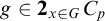 $g\in \mathbf {2}_{x\in G}C_p$
and suppose that
$g\in \mathbf {2}_{x\in G}C_p$
and suppose that $f(gN_G)=gN_{\mathcal {R}}=N_{\mathcal {R}}$
, i.e.,
$f(gN_G)=gN_{\mathcal {R}}=N_{\mathcal {R}}$
, i.e., $g\in N_{\mathcal {R}}$
. We need to show that
$g\in N_{\mathcal {R}}$
. We need to show that $g\in N_G$
. Here we need a property of the free nilpontent-class-2, exponent-p group. As remarked in [Reference Mekler24], the center of
$g\in N_G$
. Here we need a property of the free nilpontent-class-2, exponent-p group. As remarked in [Reference Mekler24], the center of $\mathbf {2}_{x\in G}C_p$
is a free abelian p-group generated by
$\mathbf {2}_{x\in G}C_p$
is a free abelian p-group generated by $\{[x,y]\colon x\neq y \in G\}$
. Similarly for
$\{[x,y]\colon x\neq y \in G\}$
. Similarly for $\mathbf {2}_{x\in \mathcal {R}}C_p$
. Thus if
$\mathbf {2}_{x\in \mathcal {R}}C_p$
. Thus if $g\in N_{\mathcal {R}}$
, then g is in the center of
$g\in N_{\mathcal {R}}$
, then g is in the center of $\mathbf {2}_{x\in \mathcal {R}}C_p$
. Thus it is also in the center of
$\mathbf {2}_{x\in \mathcal {R}}C_p$
. Thus it is also in the center of $\mathbf {2}_{x\in G}C_p$
which means that there are
$\mathbf {2}_{x\in G}C_p$
which means that there are $x_i,y_i\in G$
and
$x_i,y_i\in G$
and $0<k_i<p$
such that
$0<k_i<p$
such that $g=[x_0,y_0]^{k_0}\dots [x_n,y_n]^{k_n}$
. Also since
$g=[x_0,y_0]^{k_0}\dots [x_n,y_n]^{k_n}$
. Also since $g\in N_{\mathcal {R}}$
, there are
$g\in N_{\mathcal {R}}$
, there are $x_i',y_i'\in \mathcal {R}$
such that
$x_i',y_i'\in \mathcal {R}$
such that $x_i'\mathcal {R}y_i'$
and
$x_i'\mathcal {R}y_i'$
and $0<k_i'<p$
such that
$0<k_i'<p$
such that $g=[x_0',y_0']^{k_i'}\dots [x_m',y_m']^{k_i'}$
. But then these two representations must be the same due to the freeness. Thus
$g=[x_0',y_0']^{k_i'}\dots [x_m',y_m']^{k_i'}$
. But then these two representations must be the same due to the freeness. Thus $x_iGy_i$
for all i and
$x_iGy_i$
for all i and $g\in N_G$
.
$g\in N_G$
.
For the moreover part, if $G\cong H$
, then by Theorem 4.5, there is an automorphism of
$G\cong H$
, then by Theorem 4.5, there is an automorphism of $\mathcal {R}$
sending
$\mathcal {R}$
sending $S(G)$
onto
$S(G)$
onto $S(H)$
. Then this automorphism induces an automorphism of
$S(H)$
. Then this automorphism induces an automorphism of $\Gamma (\mathcal {R})$
sending
$\Gamma (\mathcal {R})$
sending $\Gamma '(G)$
onto
$\Gamma '(G)$
onto $\Gamma '(H)$
. Conversely, if there is such an automorphism, then
$\Gamma '(H)$
. Conversely, if there is such an automorphism, then $\Gamma (G)\cong \Gamma '(G)\cong \Gamma '(H)\cong \Gamma (H)$
. Thus by Theorem 4.2 (2),
$\Gamma (G)\cong \Gamma '(G)\cong \Gamma '(H)\cong \Gamma (H)$
. Thus by Theorem 4.2 (2), $G\cong H$
.
$G\cong H$
.
Finally we are ready to prove the Borel completeness of the class of all countable universal, omnigenous locally finite groups. First let $f:\Gamma (\mathcal {R})\oplus \mathbb {H}\to \mathbb {H}$
be an embedding such that every automorphism of the image subgroup extends to an automorphism of
$f:\Gamma (\mathcal {R})\oplus \mathbb {H}\to \mathbb {H}$
be an embedding such that every automorphism of the image subgroup extends to an automorphism of $\mathbb {H}$
. Such an embedding exists by Proposition 3.4. Then let
$\mathbb {H}$
. Such an embedding exists by Proposition 3.4. Then let $L(\mathcal {R})=D(\Gamma (\mathcal {R}),f)$
. For each nice graph G, let
$L(\mathcal {R})=D(\Gamma (\mathcal {R}),f)$
. For each nice graph G, let $L(G)=D(\Gamma '(G),f)\leq L(\mathcal {R})$
. Then for nontrivial element
$L(G)=D(\Gamma '(G),f)\leq L(\mathcal {R})$
. Then for nontrivial element $g\in L(\mathcal {R})$
,
$g\in L(\mathcal {R})$
, $g\in L(G)$
iff
$g\in L(G)$
iff $\pi (g)\in \Gamma '(G)$
, where
$\pi (g)\in \Gamma '(G)$
, where $\pi $
is as in the proof of Lemma 3.2. Thus the map L is Borel. We then have the following.
$\pi $
is as in the proof of Lemma 3.2. Thus the map L is Borel. We then have the following.
Theorem 4.7. If G, H are nice graphs, then the following are equivalent:
-
(1)
$G\cong H$
; -
(2) there is an automorphism of
$L(\mathcal {R})$
mapping
$L(G)$
onto
$L(H)$
; -
(3)
$L(G)\cong L(H)$
.



Proof. (1) $\Rightarrow $
(2) follows from Lemmas 4.6 and 3.5. (2)
$\Rightarrow $
(2) follows from Lemmas 4.6 and 3.5. (2) $\Rightarrow $
(3) is obvious. (3)
$\Rightarrow $
(3) is obvious. (3) $\Rightarrow $
(1) follows from Lemma 3.2 and Theorem 4.2.
$\Rightarrow $
(1) follows from Lemma 3.2 and Theorem 4.2.
By Proposition 3.3, each $L(G)$
is omnigenous. It is also universal for finite groups since it contains a copy of
$L(G)$
is omnigenous. It is also universal for finite groups since it contains a copy of $\mathbb {H}$
. The proof of Theorem 1.1 is thus complete.
$\mathbb {H}$
. The proof of Theorem 1.1 is thus complete.
Acknowledgments
The authors would like to thank Gianluca Paolini, David Schrittesser, and Mahmood Etedadialiabadi for useful discussions on this topic. The authors also thank the anonymous referee for many helpful comments which improved the presentation of the article.
Funding statement
The authors acknowledge the partial support of their research by the Fundamental Research Funds for the Central Universities and by the National Natural Science Foundation of China (NSFC) grant 12271263.

 Open access

