

We all love spending time with our friends and families, and this forms an important part of feeling connected with others and the world around us. Social interaction is a fundamental aspect of our lives and is essential for our cognitive development and mental wellbeing. From casual conversations with friends to engaging in complex group activities, these interactions shape our understanding of our own views and those of others, as well as our perception of the world and our place in it. Research has consistently demonstrated the positive impact of social engagement on cognition and mental health. Engaging in conversations, debates, and collaborations with others not only stimulates our ability to interact successfully, but also enhances our problem-solving skills, creativity, and critical thinking. Social interaction encourages us to see different perspectives, broadening our horizons and increasing empathy and understanding. Moreover, the emotional benefits are profound. Social interaction combats loneliness, reduces stress, and helps manage mental health conditions like anxiety and depression. Meaningful connections provide a support network, boosting self-esteem and providing a sense of belonging. In a world increasingly driven by technology and virtual connections, recognising the significance of face-to-face social interaction is pivotal for our cognitive development and mental wellbeing.
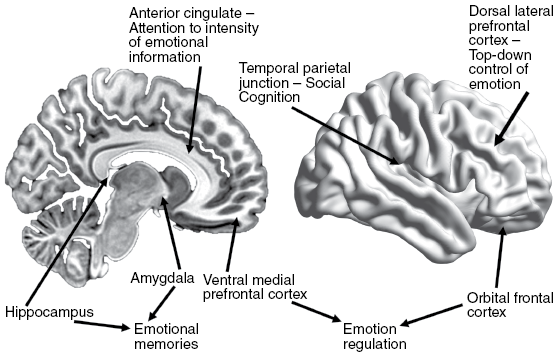
Social support from friends and family is important for resilience in times of stress (Reference Southwick and Charney116). Resilience can be described as successful adaptation to stressful or traumatic circumstances or events (Reference Elliott, Sahakian and Charney3). As humans, we are social animals, and our brains are designed for social interaction. Many studies have shown that various regions of the brain are activated during social interaction. One study by Pascual and colleagues (Reference Pascual, Rodrigues and Gallardo-Pujol117) provides a good overview of the brain regions consistently activated during tasks of social cognition. These include the ventromedial prefrontal cortex, orbital frontal cortex, dorsolateral prefrontal cortex, anterior cingulate gyrus, temporal–parietal junction, amygdala, and hippocampus. The temporal–parietal junction, in particular, is a crucial brain region associated with social cognition. It helps us understand and respond to the thoughts and intentions of others and therefore plays a pivotal role in tasks involving theory of mind, empathy, and moral reasoning. The ventromedial and orbital frontal cortices are involved in emotion regulation and ‘hot’ (emotional) decision-making; the orbital frontal cortex is also important in the evaluation of reward. The dorsolateral pre-frontal cortex is involved in the top-down control over our emotions. The anterior cingulate is involved in attention to the intensity of emotional information; it is also sensitive to social inclusion and involved in pro-social behaviour or helping others. The amygdala is involved in emotion processing and the hippocampus is important for learning and memory. Together, the hippocampus and amygdala play a role in emotional memories (see Figure 4.1).
Brain regions involved in social and emotional cognition. We present here a brief schematic of the brain regions involved in social and emotional cognition. The left image presents a medial view of the brain and shows: the posterior cingulate cortex, which is involved in spatial navigation; the anterior cingulate cortex, involved in attention and regulation of mood and emotion; the ventral medial prefrontal cortex, which is involved in emotion regulation and ‘hot’ (emotional) decision-making; the hippocampus, crucial for learning and memory; and the amygdala, which is critical for emotion processing. The right image presents a lateral view of the brain and shows: the dorsal lateral prefrontal cortex, which is involved in cognitive control; the temporal–parietal junction, which is involved in social cognition; and the orbital frontal cortex, which is involved in emotion regulation and in the evaluation of reward.

The Social Brain
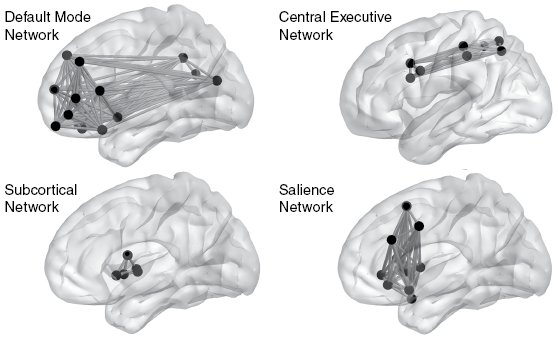
Social interaction is critical for brain development; it allows us to develop skills such as empathy and the ability to understand others. Interacting with others promotes activation in social brain areas as well as wellbeing and enjoyment. Social cognition is developed early in life and continues into adolescence and adulthood (Reference Blakemore118). Additionally, social cognition forms the early ‘building blocks’ for other forms of cognition, including language, flexible thinking, and problem-solving. For example, if children are not able to have creative play with other children, language development and social communication are likely to be affected. Social cognitive skills are important for interacting with family and friends, but also for successful team working. They are also critical for a number of work activities, for example high-level negotiations in businesses or between governments, but also in the service industry for promoting a positive experience for customers. In fact, the social brain hypothesis states that the human brain has specifically evolved to support social interactions (Reference Dunbar119). One large study in 7,000 people showed that many of the brain regions associated with social interaction were strongly linked to brain networks that support cognition (Reference Feng, Eickhoff, Li, Wang, Becker and Camilleri120). These included the default mode network, which is active during mind wandering and creative thinking; the salience network, which involves selective attention; the subcortical network, involved in memory, emotion, and motivation; and the central executive network, involved in emotion regulation (see Figure 4.2).
Some brain networks involved in cognition. The regions in the networks correspond to those used in the study mentioned above (Reference Feng, Eickhoff, Li, Wang, Becker and Camilleri120); images were visualised using BrainNet Viewer (Reference Xia, Wang and He121). The circles represent the regions themselves, with the lines showing the connections between brain regions.

We all enjoy socialising with friends. But, interestingly, studies have shown that this may be particularly important during adolescent years (Reference Blakemore and Mills122). As children, our social interaction and influences are often from parents and relatives; however, during adolescence, the influence from peers and friends becomes more important (Reference Woods, Forbes, Sheeber, Allen, Silk and Jones123). These emotional friendships are of great importance as positive friendships during adolescence seem to protect against a number of emotional and problem behaviours (Reference Nelson, Leibenluft, McClure and Pine124). The exact size of our friend group has been long debated. Early studies by the British anthropologist Robin Dunbar suggested that five close friends, now well known as the ‘Dunbar number’, was ideal, but a greater number of acquaintances was also included (Reference Dunbar125). Previously, there was little rigorous scientific evidence for this number. However, in our recent study, using a cohort of 7,512 9–11-year-olds from the Adolescent Brain Cognitive Development (ABCD) study, we showed that approximately five friends is an optimal number of close friends (Reference Shen, Rolls, Xiang, Langley, Sahakian and Cheng126). This makes sense because too few friends means that you have no one to interact with if some of them are busy or unavailable, and too many friends probably means that they are not very closely connected to you. There is a trade-off between the quantity and quality of friendships, with an increased number of friends potentially leading to less closeness. In addition, spending too much time on social activities may lead to insufficient time for study and thereby may lower academic performance. We also showed that the friendship network improved children’s and adolescents’ brain structure, cognition, and mental health. A large number, 4,290, of those original participants were followed up over two years. We found relationships between the number of close friends and mental health, social and attentional problems, and cognitive measures. Specifically, we discovered that the relationship between mental health and the number of friends was positive until the number five, and then the beneficial association diminished or reversed when increasing the number of close friends beyond this moderate level. In terms of brain health, we found a similar relationship with the size of our friend group and the size of regions within the ‘social brain’ network. Specifically, the size of the regions increased with more friends, but only up to about five (Reference Pascual, Rodrigues and Gallardo-Pujol117). It is important to note that there is a two-way street, in the sense that environment, in this case social interaction between peers, affects the brain and the brain affects the emotional and behavioural responses to peers. One reason that friends may be so crucial is due to the social support offered. Social support is positive interactions with friends and family that can provide resilience when negative events occur, for example bullying in school or the workplace, or bereavement.
The Importance of Social Interaction
The lack of social interaction can also lead to problems of social cognition. For example, during the COVID-19 pandemic, social cognition was related to the connectedness of individuals during the lockdown (Reference Bland, Roiser, Mehta, Sahakian, Robbins and Elliott127). In other words, keeping in touch with others was protective against the negative effects of the pandemic on social cognition. One potential explanation is that if individuals are isolated, for example living alone, they are likely not confiding in others and may be suffering from chronic stress by relying only on themselves and with no one to help or with whom to discuss problems. Chronic stress has a major impact on the brain and also on physical health, including the immune system. Another factor may be ‘use it or lose it’: if people have not been regularly engaging in social discussion, the use of language and other cognitive processes, such as attention and memory, will be diminished (Reference Orrell and Sahakian128). Engaging in social interactions and activating the social brain will strengthen and maintain connections in the neural networks involved. Another study showed that, during the pandemic lockdowns, social thinking and problem-solving were reduced (Reference Mckeown, Poerio, Strawson, Martinon, Riby and Jefferies129). Importantly, this thought pattern was reinstated when individuals engaged in work. Our large study of 462,619 participants showed that social isolation was associated with an increased risk of dementia and loneliness was associated with symptoms of depression in middle- to older-aged adults (Reference Shen, Rolls, Cheng, Kang, Dong and Xie130). However, in younger adults, it has been shown that both social isolation and loneliness were associated with depression, but the relationship between loneliness and depression was stronger (Reference Matthews, Danese, Wertz, Odgers, Ambler and Moffitt131). Our study showed that individuals who were socially isolated had lower grey matter volume in brain regions, which was also associated with cognitive processes. These regions included the hippocampus and the amygdala, which play an important role in social cognition, memory, and emotion regulation.
Social interaction and social relationships play a key role in our mental health. One review article showed that social networks, social support systems, and emotional support were protective against developing depression (Reference Santini, Koyanagi, Tyrovolas, Mason and Haro132). Similarly, another study showed that social relationships were vital to help with the recovery from mental health disorders (Reference Schön, Denhov and Topor133). Although focusing on older adults, a review article also showed that social activity, social support, and social networks were associated with better cognition (Reference Kelly, Duff, Kelly, McHugh Power, Brennan and Lawlor134). Interestingly, it has been suggested that social activities outside of the family may have a bigger impact on cognition (Reference Glei, Landau, Goldman, Chuang, Rodríguez and Weinstein135). In addition, it has been shown that fun experiences are enhanced when they are done with other people (Reference Reis, O’Keefe and Lane136), and it is known that fun and enjoyment can lead to better job satisfaction and productivity (Reference Tews, Michel and Allen137), as well as aid in learning new things (Reference Lucardie138). In fact, both adult learners and teachers report that social engagement and interacting with others plays a vital role in learning (Reference Lucardie138). This may be a result of increased motivation and enjoyment for those teaching as well as those learning. Motivation and enjoyment have a beneficial effect on learning.
Interestingly, studies have shown that when viewing loved ones, be it a romantic partner (Reference Aron, Fisher, Mashek, Strong, Li and Brown139) or your own child (Reference Stoeckel, Palley, Gollub, Niemi and Evins140), the brain activates the reward system. This may lead to a release of feel-good brain chemicals and hormones such as dopamine and oxytocin, which foster a sense of connection, happiness, and emotional support. This not only reduces stress and anxiety, but also bolsters self-esteem and overall mental health. Sharing experiences, achievements, and positive emotions with others creates a feedback loop of mutual reward, strengthening relationships and promoting a sense of belonging. Ultimately, these relationships between social interaction and the reward system are powerful drivers of improved wellbeing. These effects are also not simply transient, but have been shown even to change our brain function. One study looked at people who were in love and found that they had greater communication within the reward, motivation, and emotional networks in the brain, as well as in the ‘social brain’ network (Reference Song, Zou, Kou, Liu, Yang and Zilverstand141). Importantly, another article concluded that these brain networks were related to better social connectedness and wellbeing (Reference Kim and Sul142). This may further explain why interacting with loved ones regularly will promote wellbeing, happiness, and enjoyment in life.
Making the Most of Social Interactions!
In summary, there are often clubs or community groups that enable us to be socially active. Often, exercise groups, for example yoga or tai chi, are a good way to meet new people or foster existing relationships. Pub quizzes, board game cafes, and chess clubs are also good options for keeping socially active. Of course, these should be activities that you are interested in and enjoy. Some people enjoy volunteering as a way of keeping socially active and helping others; this is something we explore in more detail in Chapter 5. A sure-fire way to meet people is to go dog walking in a park or field. You very quickly find that your dog has met another dog and you get to meet and speak to the owner. So, while everyone enjoys some ‘me’ time or quiet time on their own, it is important to keep up your connections with your friends and family, as this will be beneficial to your brain health, cognition, mental health, and wellbeing.
Have frequent positive social interactions with friends, family, and colleagues at work. This will lead to improving your own wellbeing, but also that of others.
Find activities that you can enjoy together, for example board games, pub quizzes, or even taking the dogs for a walk together.
If you don’t know how to start, perhaps take up a new hobby that involves others, such as a book club or a cycling club. This is especially important if you have moved to a new area or work from home.