




Impact statement
This paper critically analyses the Zero Draft and Revised Zero Draft plastics treaty’s structure and content. It will be beneficial to the global plastics community by delving into the intentions and directions stated in the draft that will inform future negotiations. It is the intention of this paper to provide an overview of a point in time during the Intergovernmental Negotiating Committee negotiations that will become a useful basis for comparison for future analyses as the treaty is developed. It will also serve as a guide for nation states and non-state actors outside of the negotiations process to key areas of focus.
Introduction
Plastic pollution is now recognised as one of the greatest environmental crises impacting the planet. However, global governance responses to plastic pollution have been fragmented and uncoordinated (Vince and Hardesty, Reference Vince and Hardesty2017; Tiller et al., Reference Tiller, Booth and Cowan2022). For over a decade, the scientific community has advocated for a Plastics Treaty that takes into account the whole life cycle of plastics and is inclusive of state, non-state actors and the scientific community (Raubenheimer and McIlgorm, Reference Raubenheimer and McIlgorm2017, Reference Raubenheimer and McIlgorm2018; Vince and Hardesty, Reference Vince and Hardesty2017; Xanthos and Walker, Reference Xanthos and Walker2017; Haward, Reference Haward2018; Mendenhall, Reference Mendenhall2018; Schuyler et al., Reference Schuyler, Hardesty, Lawson, Opie and Wilcox2018; Vince and Hardesty, Reference Vince and Hardesty2018; Cowan and Tiller, Reference Cowan and Tiller2021; Walker, Reference Walker2022). The United Nations Environment Assembly (UNEA) heeded this call from scientists, civil society and member states and passed a number of resolutions (including Resolutions 1/6, 2/11, 3/7, 4/6 and 4/9) about plastic waste pollution and marine plastic debris and microplastics since its first session in 2014 (O’Meara, Reference O’Meara2023). During the Fifth meeting of UNEA in March 2022, resolution 5/14 “End plastic pollution: Towards an international legally binding instrument” was adopted. It was based on proposals led by Rwanda/Peru (recognising the transboundary nature of plastic pollution) and Japan (focusing specifically on marine plastics) and was co-sponsored by 53 states which called for regulation across the whole lifecycle of plastics (O’Meara, Reference O’Meara2023; Wang, Reference Wang2023). This resolution requested the Executive Director of the United Nations Environment Programme (UNEP) to convene an Intergovernmental Negotiating Committee (INC) to develop a global instrument on plastic pollution, during the second half of 2022 and was agreed upon by 175 states (Stöfen-O’Brien, Reference Stöfen-O’Brien2022a). It stressed the need for the instrument to address the full life cycle of plastic, including its production, design, disposal, and recovery from the environment. Five INC sessions were scheduled from November 2022 to November 2024, with an aim for the Treaty to be adopted in 2025. The timeline for negotiations has been seen as tight, ambitious (Stokstad, Reference Stokstad2022), but feasible. However, researchers have also argued that implementation following negotiations will take an extensive amount of time (Simon et al., Reference Simon, Raubenheimer, Urho, Unger, Azoulay, Farrelly, Sousa, van Asselt, Carlini and Sekomo2021; Walker, Reference Walker2022).
The first meeting of the Ad-hoc Open-Ended Working Group responsible for preparing INC-1 was held in June 2022. The meeting’s purpose was to establish the rules of procedure governing INC-1, decision-making procedures and the meeting schedule (UNEP, 2022c). However, the Group was only able to decide on the meeting schedule (UNEP, 2022a). The rules of procedure and meeting rights were to be discussed during INC-1 (Kantai et al., Reference Kantai, Hovden, Pinto-Bazurco and Rosentreter2022b), and they remained provisionally adopted as Member States were not able to achieve a consensus on Voting Rights and Adoption of Decisions in the discussions since the time of writing (UNEP, 2023f; UNEP, 2023g).
INC-1 was held in Punta del Este, Uruguay from 28 November to 3 December 2022 where discussions focused on, inter alia, the scope and objectives of the Plastics Treaty, obligations and control measures, implementation, monitoring and evaluation, and stakeholder participation (Kantai et al., Reference Kantai, Hovden, Pinto-Bazurco and Rosentreter2022b). During the intersessional period, the INC Secretariat released the document “Potential options for elements towards an international legally binding instrument, based on a comprehensive approach that addresses the full life cycle of plastics, as called for by United Nations Environment Assembly resolution 5/14” (from here on referred to as the “Potential Options for Elements paper”) (UNEP, 2023e). Member states and observers were invited to lodge submissions on the core areas of discussion from INC-1 and there was a heavy focus on the classification, regulation and use of chemicals (Stöfen-O’Brien, Reference Stöfen-O’Brien2023).
INC-2 convened in Paris, France from 29 May to 2 June 2023, and the Potential Options for Elements Paper became the basis for discussions for two contact groups. One group focused on objectives, obligations, control measures and voluntary approaches while the second group focused on implementation and implementation measures. Following the meeting, member states and observers were called upon to discuss elements not covered in INC-2, such as principles, scope, and areas for intersessional work. The INC Secretariat then released the document “Zero draft text of the international legally binding instrument on plastic pollution, including in the marine environment”, known as and referred to in this paper as the Zero Draft Plastics Treaty (UNEP, 2023h).
INC-3 was held at the United Nations Office in Nairobi, Kenya, from 11–19 November 2023. The Committee members were asked to base their discussions on the Zero Draft and the Synthesis Paper (UNEP, 2023g) which was published by the INC Secretariat a couple of weeks before INC-3. The negotiations followed the structure of the two contact groups proposed for INC-2, with the establishment of an additional contact group focused on the preamble, principles, scope, definitions, and intersessional work.
The Revised Zero Draft, an updated version of the Zero Draft that addressed some of the key issues raised by member states and stakeholders, was released in December 2023 before INC-4 which was held in Ottawa, Canada, from April 23rd to 29th. The negotiations focused on streamlining the Revised Zero Draft, initiating a “line-by-line” negotiation exercise, establishing a mandate for intersessional work, and establishing a legal drafting group. The discussions occurred through two contact groups as it was determined by many smaller states that it was too difficult to follow three contact groups simultaneously. Contact group 1 was divided into three sub-groups and the contact group 2 into two sub-groups (UNEP, 2024a). The Committee agreed on establishing two Open-Ended Working Groups for intersessional work that had the task of identifying and analysing (i) criteria and non-criteria based approaches to plastic pollution and chemicals of concern in plastic products and product design, focusing on recyclability and reusability of plastic products and their uses and applications; and (ii) potential sources and means that could be mobilised, for implementation of the objectives of the instrument, including options for the establishment of a financial mechanism, alignment of financial flows, and catalysing finance (IISD, 2024a). The last INC session is scheduled to occur in Busan, South Korea, from 25 November to 1 December 2024.
Four major coalitions consisting of states as well as non-state actors were created during the INC process and their membership at the time of writing included: (1) the High Ambition Coalition to End Plastic Pollution (co-chaired by Norway and Rwanda) which is composed of 66 states committed to develop an ambitious treaty that could end plastic pollution by 2040; (2) the Like-minded Group which was formed during INC-3 and includes a number of countries, which are not clearly identified, that may not have congruent positions to the High Ambition Coalition; (3) the Business Coalition for Global for a Global Plastics Treaty (led by the Ellen MacArthur Foundation and World Wide Fund for Nature) that includes more than 150 business organisations, financial institutions, and key non-governmental organisations; and (4) the Scientists’ Coalition for an Effective Plastic Treaty (hosted by the International Knowledge Hub Against Plastic Pollution) which is a network of over 350 independent scientists from more than 60 states, from all UN regions, seeking to provide technical and unbiased scientific information to support decision makers and the public in the Plastic Treaty negotiations (Vince et al., Reference Vince, Walker, Willis, Stoett, Komyakova, Hardesty, Schofield, van Leeuwen, Townsend, Baird and Elliott2024). The coalitions and other stakeholders involved in the INC process were able to influence the development of the Zero Draft (UNEP, 2023h) and Revised Zero Draft (UNEP, 2023i) and will continue to influence subsequent versions by partaking in contact group discussions and by submitting statements to the INC. However, the coalitions that are not comprised of states are limited in their participation beyond these activities and are unable to vote or be involved in the actual drafting of the treaty.
In this paper, we analyse the Zero Draft (UNEP, 2023h) and highlight the parts of the document that will contribute positively towards the reduction of plastic pollution. We discuss how the timing and approach to the development of the Zero Draft were unique in comparison with other treaty negotiations. We also identify issues and gaps in the document that needed further attention by all stakeholders during the remaining INC negotiations. We then analyse how these issues were addressed in the subsequent Revised Zero Draft text (UNEP, 2023i) that was discussed during INC-3 in Nairobi, Kenya and INC-4 in Ottawa, Canada. Some of the authors of this paper were present at the INC negotiations as observers and members of the Scientists’ Coalition for an Effective Plastics Treaty as well as other organisations/groups, and the paper ends with some reflections on the process.
The Zero Draft: What worked?
The Zero Draft (UNEP, 2023h) was an achievement that cannot be underestimated. While it is exactly what it claims to be, a zero draft, and the final treaty may end up being quite different, it represents a commitment by member states to address plastic pollution at a global level. It also underlines the importance of regional, national and local actions that need to be undertaken to maximise efforts for effective implementation (Vince and Hardesty, Reference Vince and Hardesty2018; Dauvergne, Reference Dauvergne2023). National Plans (NPs) (part IV, Art. 1) are recognised as essential requirements for states to fulfil their obligations to the treaty. The Zero Draft does not detail the format of the NPs but outlines relevant elements that need to be included to improve monitoring, reporting and transparency of the implementation of the treaty: primary plastic polymers; chemicals and polymers of concern; problematic and avoidable plastic products; product design and performance; reduce, reuse, refill and repair of plastics and plastic products; use of recycled plastic contents; extended producer responsibility; emissions and releases of plastic through its life cycle; waste management; fishing gear; existing plastic pollution, including in the marine environment; and just transition (UNEP, 2023h).
The Zero Draft takes into account the principles of the Rio Declaration on Environment and Development. The options within “underscore the importance of complementarity, coordination and cooperation within the international context, in particular with existing efforts that may cover some aspects related to plastic pollution” and interactions between regimes acknowledged (UNEP, 2023h). It is evident through this acknowledgement that the plastics treaty will become an integral part of numerous regime complexes (Mendenhall, Reference Mendenhall2023; Orsini, Reference Orsini, Guilbaud, Petiteville and Ramel2023). It can also be seen as an opportunity to “complement and extend existing international obligations” (O’Meara, Reference O’Meara2023; SCEPT, 2024a). Upon agreement of the INC process, member states agreed to avoid duplication of existing regional and international conventions, instruments and organisations (Stöfen-O’Brien, Reference Stöfen-O’Brien2022b). As the Treaty further develops, social science, political science, international relations and legal researchers will be closely monitoring how the relationship with other global regimes is addressed. Although other regimes are acknowledged in the Zero Draft, in practice competing interests could impact other treaties. For example, this may occur in the fisheries or waste management areas. MARPOL does partially address the problem of pollution at sea and port waste management, but it does not fully regulate the marine plastics pollution problem (Vince and Hardesty, Reference Vince and Hardesty2018; Vince et al., Reference Vince, Walker, Willis, Stoett, Komyakova, Hardesty, Schofield, van Leeuwen, Townsend, Baird and Elliott2024). The Plastics Treaty can fill this gap.
The Zero Draft highlights the importance of stakeholder involvement in the treaty, by suggesting the creation of a multi-stakeholder action agenda. Multi-stakeholder forums “are interactive processes that bring together a range of stakeholders to participate in dialogue, decision-making and/or implementation in order to address a…resource problem to achieve a common goal” (Larson and Sarmiento Barletti, Reference Larson and Sarmiento Barletti2020). They provide organisational structures that allow collective action beyond national boundaries. They can include actors from civil society, business and governmental institutions. The INC Secretariat has provided opportunities for stakeholder participation since the beginning of the plastics treaty negotiation process. A Multi-Stakeholder Forum (26 November 2022) and a Stakeholder Dialogue Session (29 November 2022) were conducted at INC-1 (UNEP, 2022b). These events brought together stakeholders from civil society, private sector, academia, indigenous people, youth and government to four roundtable discussions on eliminating and designing for circularity, circularity in practice, waste minimization and remediation, and how to initiate a multi-stakeholder action agenda (Kantai et al., Reference Kantai, Hovden, Pinto-Bazurco and Rosentreter2022a). The Multi-Stakeholder Forum was held in a hybrid setting to encourage broad participation. During the Forum, there were discussions on how to initiate a “multi-stakeholder action agenda” and it was suggested that it could be based on either the Basel Convention’s Plastic Waste Partnership, the Plastic Pact, or the World Economic Forum’s the Global Plastics Action Partnership (Kantai et al., Reference Kantai, Hovden, Pinto-Bazurco and Rosentreter2022a). Other suggestions focused on an inclusive structure where participants represented parts of the entire lifecycle of plastic. There were strong views on whether the petrochemical industry should be involved in the INC process. However, some participants argued that the Treaty may be unbalanced without their support (Kantai et al., Reference Kantai, Hovden, Pinto-Bazurco and Rosentreter2022a).
Whereas it was agreed that a Multi-Stakeholder Forum is an important part of the Treaty negotiation process, in practice it was determined to be a costly and time-intensive exercise. A similar Forum was not held during the following INCs, but observers were invited to lodge submissions to UNEP and promote discussions during intersessional work. The Zero Draft points to the multi-stakeholder action agenda as an essential means to increase transparency and representation within the instrument. However, it is still unclear if and how the stakeholder involvement will be formalised in the Plastic Treaty.
A process similar to the Marrakech Partnership for climate (United Nations Climate Change, 2024) was initiated in response to UNEA resolution 5/14, and aims to build on lessons learned from previous multilateral environmental agreements to increase support and involvement by non-member state actors. This group is called “The Friends of the Action Agenda” (FOAA) and was initiated by the governments of Samoa, the United States, Norway and Chile, and meetings were held at the INC-2 meeting in Paris and the INC-3 meeting in Nairobi (Drewell, Reference Drewell2023). The FOAA is intended to build momentum among non-member state actors, providing a mechanism for engagement from public and private actors including businesses, and aims to drive ambitious and progressive actions to support the goals of the Plastics Treaty. The role this group has played in informing drafting of the treaty text is unclear.
The Zero Draft recognises that the impact of plastic pollution on the marine environment needs to be addressed. However, it is an instrument that will address all forms of plastic pollution be that on the land or sea. This is a monumental step forward in the narrative around the plastics problem and it also moves the focus from “end of pipe” solutions to the whole life cycle of plastics. Reduction of problematic and avoidable plastic products and intentionally added microplastics is encouraged and there are a number of options for members ranging from parties “not allowing” production, sale, distribution, import and export of these products to “taking the necessary measures” to regulate and reduce. Phase-out timelines will be suggested in future versions of the Treaty in Part 1, Annex B (which is left blank in the Zero Draft).
Part II of the Zero Draft focuses on the chemical components of plastics. Current documentation reveals a large number of chemicals used in plastics (>16,000 chemicals, >4,200 of which are known to be of concern because they are persistent, bio-accumulative, mobile, and/or toxic, and thousands of which lack data) (Geueke et al., Reference Geueke, Phelps, Parkinson and Muncke2023; Wagner et al., Reference Wagner, Monclús, Arp, Groh, Løseth, Muncke, Wang, Wolf and Zimmermann2024). The intricate chemical composition of plastics, combined with inadequate reporting and regulations, makes it nearly impossible to guarantee their safety. Therefore, further research is needed to understand the impact of plastics on human health. Part 1, Annex A will outline obligations calling for the banning of chemicals and polymers of concern. While there is no text currently in Annex A, there is a call for the obligations to cover all stages from extraction and production, to waste and pollution as these chemicals and polymers can be resealed to humans and the environment during the entire plastics’ life cycle (UNEP, 2023a).
Most importantly the treaty objective refers to the protection of human health and the environment. By doing so, it can be seen as advancing the protection of human rights (O’Meara, Reference O’Meara2023). Adverse impacts on human health are recognised in addressing primary plastic polymers. The adverse impacts on human health are not specified but there is a requirement under Part II, Art. 2c in addition to what is required in Art. II.14 on transparency, tracking, monitoring and labelling, that “complete information about the hazards to human health or the environment associated with the relevant chemical, polymer or product, and related implications for their safe use” be provided to government authorities. However, more can be done in subsequent drafts to protect human health, by minimising the interference of industry in such matters (similarly to the World Health Organisation’s Framework Convention on Tobacco Control) to help further fulfil the treaty’s objective (Ralston et al., Reference Ralston, Carlini, Johns, Lencucha, Radvany, Shah and Collin2023). In this regard, the revised Zero Draft fulfilled this gap by adding a provision on “Health aspects” (8bis of Part IV). However, there is a disagreement on how to approach this measure, once some countries support the deletion of it, arguing that this matter is an attribution of the World Health Organisation, while other countries argue that it should be a standalone provision (UNEP, 2024b).
Timing
Written submissions for INC-3 from observers were due on 15 August 2023, yet the first Zero Draft was published on 4 September 2023. Member states had until 15 September 2023 to finalise their submissions, a mere 11 days following the release of the Zero Draft. This timing is noteworthy because it gave member states time to respond and reflect on the document. This also left observers out of the commenting process. There are several reasons possibly why this strategy was taken including: keeping the focus of the debate on Member’s priorities; ensuring that the Members, who will be potential signatories, are driving the debate at INC-3; and that observers are not overly influential in the decision-making process. Despite the power of certain industries in the plastics space, it is member states that are key drivers in this arena. The Revised Draft was released in December 2023 with ample time for member states and stakeholders to review before INC-4. In contrast, during the process of developing a legally binding instrument under the UN Convention on the Law of the Sea on the Conservation and Sustainable Use of Marine Biological Diversity of Areas Beyond National Jurisdiction (BBNJ), the Intergovernmental Conference President provided an “Aid to Negotiations” at the 2nd Intergovernmental Conference (IGC) that translated main ideas raised during negotiations into text. The President then invited member states to comment on the substantive text based on the BBNJ zero draft during the 3rd IGC (UN, 2022). Both approaches to the BBNJ and Plastics Treaties are relevant and must suit the given context, however, as INC negotiations progress it is important to uphold the given deadlines.
Structure
The structure of the Zero Draft is based on the Potential Options for Elements paper (UNEP, 2023e). It is also the same order that issues were discussed by the working groups during the first two INC meetings. This order of the control measures follows the stages of plastics life cycle, starting from the extraction of polymer production, to the design of products, and then to waste management and legacy pollution. The Zero Draft states that “The order of the headings and sections in the Zero Draft does not indicate the final structure of the instrument and does not imply a particular order of priority in the discussions. It draws on the structure commonly found in multilateral environmental agreements” (UNEP, 2023h). At the same time, the text acknowledges that not all issues are covered in the draft as they are yet to be addressed through detailed submissions from member states. It also states that some sections are place-holders for future text, such as Part I (preamble, definitions, principles, and scope), Part V (institutional arrangements), and Part VI (final provisions). Nevertheless, coherence to the overall structure is missing, and this is likely to be rectified in subsequent versions. The Revised Zero Draft kept the same rationale of structure of the initial document. Most of the placeholders were fulfilled, although some still remain with a general text, such as the item on Subsidiary bodies (Part V). It is important to highlight that many sections remain under brackets, indicating a lack of consensus and can potentially be excluded from the final text.
There are different ways to structure a multilateral environmental agreement. In some instances, such as the Convention on Biological Diversity, the use of terms or definitions is introduced early so as to frame the subsequent obligations. The order established in the Zero Draft is an important opportunity to reflect on the order of elements. It is also important to note that the structure of the Plastics Treaty does not have to be like other treaties, however, it can be questioned whether it is suitable.
One structural element of the Zero Draft that is particularly questionable is the location of fishing gear in Part II, Art. 9 under “Waste Management” rather than in another section of the treaty. This has been subject to substantive consideration during INC-3 and INC-4 negotiations. In the Revised Zero Draft, one of the options is “Alternative placement suggested as Section 8bis” where fishing gear would be placed in the section on existing plastic pollution. It is yet to be determined whether this option will be favoured by the INC Committee. The focus on fishing gear is further complicated by already existing global regulatory measures and regimes steered by the International Maritime Organisation and Food and Agriculture Organisation and while synergy and complementarity with relevant initiatives and organisations is promoted, how this will work in practice needs further discussion.
The Revised Draft Treaty also suggests a dedicated programme of work to support the implementation of the instrument in Art. 4bis. Among the proposed programmes of work are also fisheries and aquaculture. As outlined above, it is not clear whether there will be a mention of fishing gear in the text at all. Also, it is not evident what exactly the programme of work entails exactly at this point. We believe that, depending on the legal status of the reference of the programme of work, the inclusion of fishing gear and aquaculture may enable dedicated measures along the life-cycle. On the other hand, having a standalone fishing gear article in the treaty text, may provide legal certainty and, potentially, an obligation to take substantive measures without having to wait for any subsequent decisions during a potential governing body’s meeting (similar to the conference of the Parties).
However, there were some shortcomings to the Zero Draft.
What was missing in the Zero Draft?
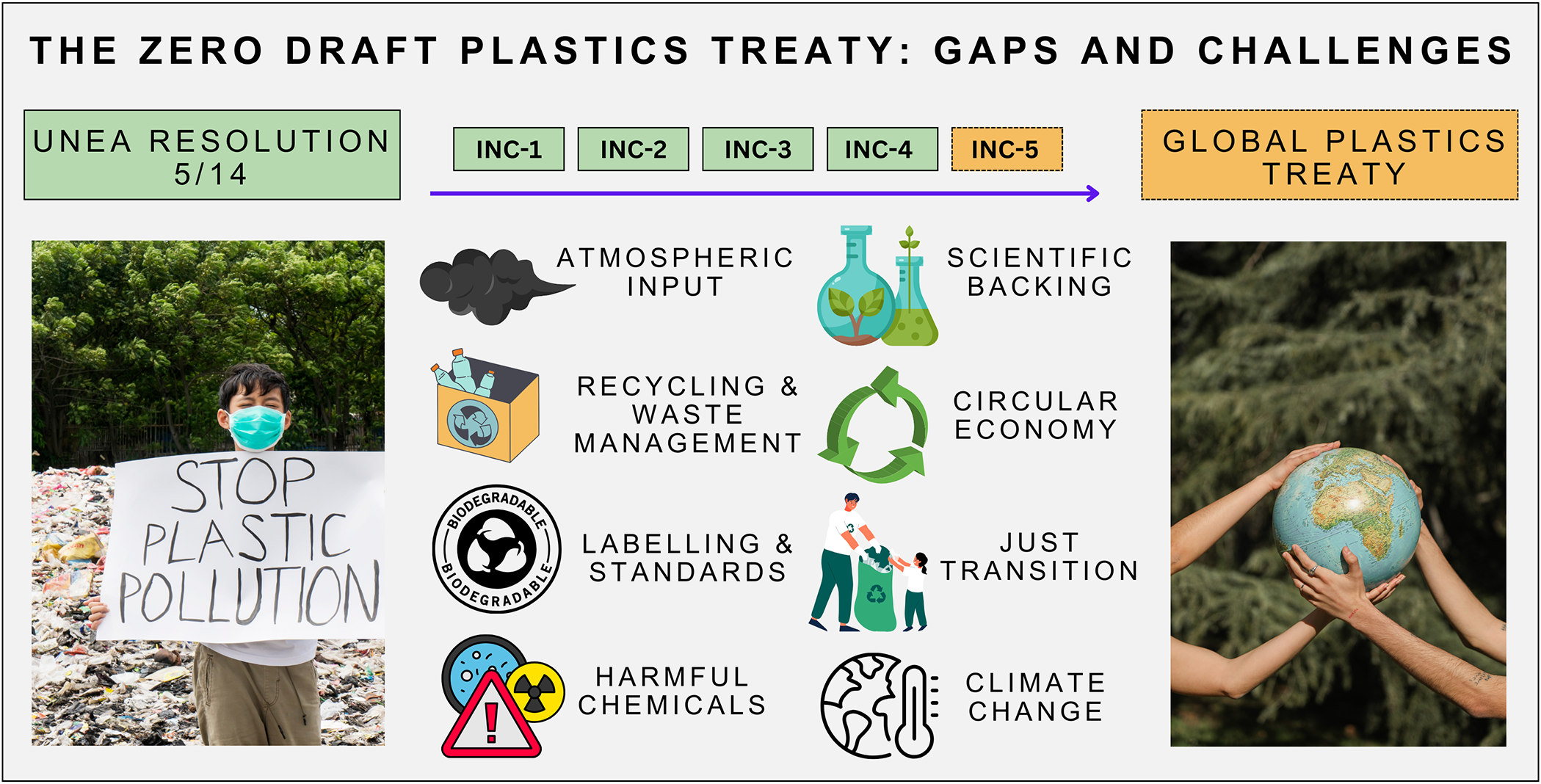
While the Zero Draft can be seen as a major step towards global efforts to address plastic pollution, some aspects are missing or require further specification. In this section, we focus on applicability to different regions; atmospheric input; recycling and waste management; labelling and standards; harmful chemicals; scientific backing; the circular economy; just transition and climate change. We also discuss whether these aspects have been addressed in the Revised Zero Draft.
Applicability to different regions
Provisions that ensure applicability to different regions needed to be further developed. Art. 12 in the Zero Draft, “Just transition”, addresses “a fair, equitable and inclusive transition for affected populations”, and Art. 7 provides approaches to implement Extended Producer Responsibility. However, the Zero Draft does not differentiate between states, although global plastic pollution is a problem characterised by different contributions of the most polluted and most producing states of plastic waste (Stöfen-O’Brien, Reference Stöfen-O’Brien2022b). It must be noted that some communities are more vulnerable to impacts of plastics than others (O’Meara, Reference O’Meara2023) and that different regions have distinct opportunities and conditions to implement measures of, for example, waste management. Therefore, the principle of common but differentiated responsibilities could provide guidance and be streamed into subsequent versions of the treaty to ensure equity and fairness connected to taken implementation measures such as financial support (Tangri, Reference Tangri2023). Additionally, product stewardship should be acknowledged and implemented on a state-specific basis. Although no agreed definition of product stewardship exists, it implies a greater responsibility for the producer/industry or all stakeholders in the plastic’s value chain (shared responsibility) to manage a product’s lifecycle, often focussing on end-of-life or post-consumer stage (Lewis, Reference Lewis2005). To avoid NPs becoming “placebo policies” which are policies that give the impression that governments are addressing an issue but are mostly “for show” and do little to solve the issue in their implementation (McConnell, Reference McConnell2020), state-specific targets that reflect elements of differentiation and commonality should become part of the measures taken for a “just transition”, while emphasising upstream shifted responsibilities. The decision to include NPs in the Zero Draft was justified through the possibility of NPs to include tailor-made measures on the national and local levels. In February 2023, member states demonstrated a strong agreement for including NPs in the treaty with 85% submissions to the Potential Options for Elements Paper expressing support for NPs (March et al., Reference March, Nieminen, Arora, Walker, Shejuti, Tsouza and Winton2023; UNEP, 2023e, 2023g). The Revised Draft partially addresses this by mentioning the Common but Differentiated Responsibility as one of the options in the Objective and Principles, as well as in Part II.11 (Existing plastic pollution, including in the marine environment) and in Part III.1 (Financing).
Atmospheric input
The Zero Draft lacks the inclusion of atmospheric input and transport from micro- and nanoplastics. Micro- and nanoplastics are emitted to the atmosphere and can be transported to remote areas where they affect the environment (Allen et al., Reference Allen, Allen, Phoenix, Le Roux, Durántez Jiménez, Simonneau, Binet and Galop2019; Ryan et al., Reference Ryan, Allen, Allen, Maselli, LeBlanc, Kelleher, Krause, Walker and Cohen2023). Research from Brahney et al. (Reference Brahney, Mahowald, Prank, Cornwell, Klimont, Matsui and Prather2021) demonstrates that roads are the main sources of microplastics in the western United States, followed by the ocean and agricultural soil dust. Similarly, research done by Kole et al. (Reference Kole, Löhr, Van Belleghem and Ragas2017) shows that 3–7% of the particulate matter (PM 2.5) globally consists of tyre wear and tear. This input to the atmosphere leads to distribution of micro- and nano plastic in the Earth’s system and global biogeochemical cycles (Brahney et al., Reference Brahney, Mahowald, Prank, Cornwell, Klimont, Matsui and Prather2021). Additionally, strong winds such as hurricanes have the potential to cause the release of microplastics from the ocean into the atmosphere through bubble burst ejection and wave action (Allen et al., Reference Allen, Allen, Moss, Le Roux, Phoenix and Sonke2020). Ryan et al. (Reference Ryan, Allen, Allen, Maselli, LeBlanc, Kelleher, Krause, Walker and Cohen2023) assessed microplastic deposition before, during and after a hurricane in Newfoundland, Canada, and found that hurricanes can cause large-scale transport and deposition of microplastics to remote regions (Ryan et al., Reference Ryan, Allen, Allen, Maselli, LeBlanc, Kelleher, Krause, Walker and Cohen2023). The transport of micro- and nanoplastics via the ocean and atmosphere highlights the transboundary, global nature of plastic pollution, requiring specific emphasis in INC negotiations.
We suggest that since the treaty aims to target the whole lifecycle of plastics, atmospheric input, as part of the “plastics cycle” (Thomas, Reference Thomas2022), should be specifically addressed. The Revised Draft lacks such a link as well. Yet, this could (partially) be approached through adding “the atmosphere” in the brackets of the Objectives, Option 2: “…including the environment [and other aquatic as well as terrestrial ecosystems]”, as suggested by the Center of International Environmental Law (CIEL, 2024).
Recycling and waste management
Ambitious standards are needed to ensure better regulation of specific waste management techniques and the overall reduction of plastic production. When discussing recycling and circularity, a clear definition of these concepts is essential to prevent distinct understandings. Although the definitions of the treaty are yet to be developed, a clear definition is vital to create a common ground for future INCs, especially due to the central position of circularity in the Zero Draft. Importantly, the waste hierarchy indicates that reduction and reuse/refill systems should be prioritised before recycling and waste management. Though we note here that provisions calling for primary plastics polymer production reduction, while scientifically deemed to be essential to the goals of the treaty, are contentious, and the Like-minded Group have continuously pushed the focus to recycling as a solution (Baztan et al., Reference Baztan, Jorgensen and Carney Almroth2024).
However, the focus should not be just on the recycling process but other aspects such as the recyclability of plastic products. Importantly, as O’Meara (Reference O’Meara2023) argues “The strength of the scientific evidence should not be overshadowed by narratives on false solutions such as chemical recycling, which sustain production and do not effectively mitigate risks from hazardous chemicals. Rules of this nature should be complemented by technical and financial capacity for states that need it, to maximise effective implementation”.
Part II, Art. 5 of the Zero Draft “Product design, composition and performance” speaks to the material design of the products but misses specific targets. The Zero Draft could better emphasise the need for increased recyclability of plastic products through, for example, the substitution of multilayer packaging by mono-material packaging (Ding and Zhu, Reference Ding and Zhu2023), which would increase recycling rates, reduce downcycling, and minimise emissions. This must come along with measures that target “Minimising releases and emissions from plastics and plastic products, including microplastics” (Art. 5, 1. c). Carney Almroth et al. (Reference Carney Almroth, Dey, Karlsson and Wang2023) stress the importance of reducing the numbers of chemicals and polymers, designing plastics products for the end of life, together with increased transparency and reporting to support safer and more efficient recycling. Further differentiation in the Zero Draft could target combining the front-end design with the back-end recycling of plastic products, fostering exchange between manufacturing companies and recycling enterprises. Overall, the focus should be on upstream measures, such as a reduction of production as well as providing incentives for industries to be better engaged.
The Revised Zero Draft presents four options to address waste management, beyond the issue of fishing gear. Waste management seems to be a point of convergence. However, the specific implementation, whether on a global level or within the context of the NPs differs. Also in terms of substantive aspects, the concrete potential measures vary between options, ranging from waste management as a linear approach focusing on end of life – mainly to show that waste is managed in a safe and environmentally sound manner throughout its different stages, including handling, collection, sorting, transportation, storage, recycling, other recovery including energy recovery and final disposal, in line with the waste hierarchy.
Labelling, standards, certifications and ISO
Labelling is specifically covered in Part II, Art. 13 and is grouped together with transparency, tracking and monitoring. This section states that marking and labelling requirements will be based on the guidance from the Treaty’s governing body but in relation to “sound use, recycling and disposal of plastics and plastics products” (UNEP, 2023h). In addition, labelling comes up numerous times throughout the Zero Draft, for example in relation to the classification of hazardous waste. It is also referred to under the section of product design, composition and performance where parties to the treaty will establish and maintain certification and labelling requirements for plastics and plastic products. It is interesting to note that the onus with regards to labelling and certification is placed on member states and not on industry or certification bodies (as in the case of fisheries, for example through the Marine Stewardship Council).
The role of the International Standard Organisation (ISO) in the development of standards for labelling could be pursued in future discussions. This approach would ensure that a globally agreed standard is adopted through an agreed procedure. The inclusion of ISO standards as a reference may result in a harmonised approach to determine generally accepted standards. Standards may help in ensuring coherent implementation as well as compliance procedures. However, it is an important question whether there is a need to develop new corresponding standards or whether the currently available standards are sufficient.
Harmful chemicals and chemical producers
One of the primary objectives listed in the Zero Draft is protecting human health from plastic pollution. This includes minimising human exposure to harmful chemicals, polymers, and products. Annex A in the Zero draft is expected to address thousands of chemicals used in the production of plastics within the “chemicals and polymers of concern” section. A list of such chemicals and polymers will be provided in subsequent drafts along with exclusions and phase-out dates. However, this section does not address chemicals that may absorb plastics during use and waste phases or non-intentionally added substances (NIASes), including contaminants, degradation products, and bi-products. It is unclear if NIASes will be included at a later stage. The Zero Draft also does not mention carcinogenic substances that are a major issue to human health (Baj et al., Reference Baj, Dring, Czeczelewski, Kozyra, Forma, Flieger, Kowalska, Buszewicz and Teresiński2022). To fulfil its objective of protecting people from hazardous health impacts the treaty should include a list of substances proven to be carcinogenic.
Text in the Revised Zero Draft refers to this question to a potential annex, which has not yet been drafted. An official outcome of the INC-4 meeting was a mandate that an ad hoc intersessional open-ended expert group convene “to analyse criteria and non-criteria-based approaches, with regard to plastic products and chemicals of concern in plastic products and product design, focusing on recyclability and reusability of plastic products considering their uses and applications” (IISD, 2024b). This expert group could base its work and recommendations on the results presented in a recent report addressing chemicals in plastics (Wagner et al., Reference Wagner, Monclús, Arp, Groh, Løseth, Muncke, Wang, Wolf and Zimmermann2024) identifying known hazardous properties of chemicals, including many already applied in chemicals regulations. The list of carcinogens identified by the International Agency for Research on Cancer may also be referred to by this expert group (IARC, Vol. 1–135). These classifications include persistent, bio-accumulative and toxic (PBT), persistent, mobile, and toxic (PMT), toxic to the aquatic environment (Aquatic Toxicity), to specific organs (STOT), carcinogenic, mutagenic, or toxic to reproduction (CMR), and endocrine disrupting chemicals (EDCs). The authors of this report, and others (SCEPTt, 2024c), are calling for a hazard-based approach to chemicals regulations under the future plastics treaty (Norway Delegation to INC, 2024).
Scientific backing
The Zero Draft refers to science in relation to cooperation with the future governing body. It states that during its first session, the governing body should adopt “guidance on best available techniques and best environmental practices, developed on the basis of best available science, to address existing plastic pollution, with a view to ensuring the cleanup activities do not have potential for negative impacts on the environment, biodiversity and human health” (UNEP, 2023h). The governing body will also invite input from relevant scientific and technical bodies and from a Science Policy Panel (SPP) which will also be established based on UNEA resolution 5/8. Important to note that this SPP would not be only dedicated to the Plastic Treaty but will also contribute further to the sound management of chemicals and waste and to prevent pollution. Pollution is the only one of the three planetary crises that does not have a dedicated assessment scientific body (such as for example, the Intergovernmental Panel on Climate Change for climate emergency and Intergovernmental Science-Policy Platform on Biodiversity and Ecosystem Services for biodiversity loss) and the SPP would fill this gap for plastic pollution.
Regarding scientific contributions to INC, universities are (most of the time) not allowed as UNEP-accredited organisations, so scientists that want to follow the negotiations on the ground need to partner with accredited civil society organisations (Carney-Almroth et al., Reference Carney-Almroth, Abeynayaka, Diamond, Farrelly, Fernandez, Gündoğdu, Issifu, Rognerud, Schäffer, Scheringer, Villarrubia-Gómez, Varea, Vlahos, Wagner and Ågerstrand2023; Rognerud and Walker, Reference Rognerud and Walker2023). However, given the limited number of participants per organisation, this may hinder the participation of independent researchers in the INCs (Rognerud and Walker, Reference Rognerud and Walker2023). Nevertheless, the Scientists’ Coalition for an Effective Plastic Treaty has been meeting with delegates and key stakeholders and developing policy-driven materials to support the decision-making process. Treaty negotiations should be based on robust science in agreement with the human right to knowledge and science (Türk, Reference Türk2023), free from conflicts of interest (Schäffer et al., Reference Schäffer, Groh, Sigmund, Azoulay, Backhaus, Bertram, Carney Almroth, Cousins, Ford, Grimalt, Guida, Hansson, Jeong, Lohmann, Michaels, Mueller, Muncke, Öberg, Orellana, Sanganyado, Schäfer, Sheriff, Sullivan, Suzuki, Vandenberg, Venier, Vlahos, Wagner, Wang, Wang, Soehl, Ågerstrand, Diamond and Scheringer2023). The Revised Zero Draft mentions scientific inputs 60 times by recognising the importance of a science-policy interface (Part 1. 1), Science, Technology and Economics Panels (Part II.2), and a scientific governing body (Part V.3). However, the terminology regarding scientific input needs more uniformization and specificity. For instance, the science-policy interface body, is yet to be defined in terms of purpose, timing, and implementation (SCEPT, 2024b).
Circular economy
The Zero Draft mentions “circular economy” only once in the Chair’s explanatory note. The structure of the first document reflects the idea of addressing circularity, suggesting provisions throughout the life cycle of plastics, from production and design to waste management and legacy pollution. This is relevant because most plastic circular economy initiatives consider recycling interventions, whilst early-stage ones remain underexplored (King and Locock, Reference King and Locock2022). The Synthesis Paper summarised 61 submissions from member states on sections not considered in the Zero Draft (UNEP, 2023g). Combined, these submissions mention “circular economy” 13 times, and whether it should be included in the preamble, principles, scope, and relevant terms for definition (UNEP, 2023g). Importantly, circularity is a substantial element of the Revised Draft text, as it is explicitly approached in Part II, Art. 5. Yet, questions remain about how circularity will be defined in the final treaty, including where to place the start and end of the plastic’s lifecycle.
Just transition
The plastics treaty is an opportunity to strengthen environmental, distributive and intergenerational justice if taken from a human rights perspective (Stoett and Vince, Reference Stoett, Vince and Harris2019; Stoett, Reference Stoett2022; Dauvergne, Reference Dauvergne2023; O’Meara, Reference O’Meara2023). The principle of a just transition is addressed in Art. 12., however, the use of the term “waste workers” instead of “waste pickers” in the Zero Draft was seen as problematic. Velis (Reference Velis, Willis, Hardesty, Wilcox and Barrett2023) argues that waste pickers are those working in the informal recycling sector and that make their living by “identifying, collecting, sorting and selling the most sought-after recyclable items”. The Revised Zero Draft addressed this by referring to “waste pickers and other workers in the plastic value chain”, recognising the protagonism waste pickers have in dealing with plastic pollution. This is an opportunity for the Plastics Treaty process to recognise and address the inequalities and injustice experienced by waste pickers and other low income, marginalised communities, while providing a coordinated approach to governance (Dauvergne, Reference Dauvergne2023; O’Meara, Reference O’Meara2023). Strong human rights protection within the Plastics treaty will be needed for it to be legitimate and effective (Dauvergne, Reference Dauvergne2023; Türk, Reference Türk2023).
Climate change
Since climate change and plastic pollution are inextricably linked (Stoett and Vince, Reference Stoett, Vince and Harris2019, Reference Stoett, Vince, Siebenhüner and Djalante2021; Shen et al., Reference Shen, Huang, Chen, Song, Zeng and Zhang2020; Ford et al., Reference Ford, Jones, Davies, Godley, Jambeck, Napper, Suckling, Williams, Woodall and Koldewey2022), a reference to greenhouse gas (GHG) emissions is essential to create coherence between regimes and to approach the carbon lock-in (path dependencies of using fossil fuels), inherent to rising plastics demand (Bauer et al., Reference Bauer, Nielsen, Nilsson, Palm, Ericsson, Fråne and Cullen2022). However, this reference is missing in the Zero Draft. Plastics contribute to GHG emissions throughout their lifecycle and they make up 8–9% of global oil and gas production (Nielsen et al., Reference Nielsen, Hasselbalch, Holmberg and Stripple2020). To reach the climate goals of the Paris Agreement, plastic pollution must be understood as a driver of climate change. Especially in the ocean, the relationship between climate change and plastic pollution can be reinforcing: Climate change can aggravate the spread of plastic pollution (Ford et al., Reference Ford, Jones, Davies, Godley, Jambeck, Napper, Suckling, Williams, Woodall and Koldewey2022) while marine litter reduces the climate resilience of marine ecosystems which ultimately intensifies the harmful effects of plastics to the environment. Therefore, climate change and plastic pollution in combination lead to more severe consequences than in isolation (Lincoln et al., Reference Lincoln, Andrews, Birchenough, Chowdhury, Engelhard, Harrod, Pinnegar and Townhill2022). This interconnection needs to be reflected in the subsequent versions of the Treaty through, for example, addressing GHG emissions in the Treaty text or a reference to the climate change regime. The Revised Zero Draft mentions climate change under three separate sections: 1) reporting on progress, 2) effectiveness evaluation, and under 3) international cooperation. Part I, Art. 5 option 5 in the section on “Scope” states that the instrument “recognises the risk of plastic pollution to human health and the environment and the impact on climate change and biodiversity”. Additionally, in the Revised Zero Draft, the United Nations Framework Convention on Climate Change is listed in the Preamble. However, these mentions do not touch upon the impact plastics have on climate change or elaborate on the link between the two and are only referring to the conventions and international agreements to climate change. Therefore, this gap identified in the zero draft remains in the revised version and should be addressed in final version of the treaty.
How the Zero and Revised Zero drafts were received in INC-3 and INC-4
Member state and stakeholder submissions were received before and after the release of the Zero Draft and depicted a range of positions on various elements of the potential instrument. The proposed options varied from supporting circular economy and recycling measures to focusing on upstream and measures which include also to cover chemicals under the instrument. During INC-3, the majority of the member states recognised the Zero Draft as a good starting point for the negotiations in their opening statements. Some states, however, argued that the document had not captured their opinions and called for a new document. Member states revised the Zero Draft, section by section, within the meetings of the specific contact groups and submitted proposals to be included in a revised text (UNEP, 2023b, 2023c, 2023d). Although the basic structure of the Zero Draft was kept, there were specific areas that were disputed, such as the suggestion to have no provisions in the Draft related to: primary plastic polymers, chemicals and polymers of concerns, problematic and avoidable plastic products, including short-lived and single-use plastic products, intentionally added microplastics, micro and nanoplastics, product design and performance, alternative plastics and plastic products, non-plastic substitutes, Extended Producer Responsibility, and trade in listed chemicals, polymers and products, and in plastic waste (UNEP, 2023b). This can be interpreted as an attempt by some states to shift the objectives and scope from the entire life-cycle of plastics, as mandated by UNEA Resolution 5/14, to a focus on downstream measures. Notably, many of these suggestions to reduce the scope of the treaty to the later stages of the plastics lifespan were put forth by states with deep ties to fossil fuel industries, as well as plastics and chemicals producers, further exemplifying the problematic issues of conflicts of interest among actors in this space. This was also reflected by an increase in participation of the private sector at the INCs, in which 143 fossil fuel and chemical industry lobbyists registered for INC-3 and 196 to INC-4 (CIEL, 2023, 2024; Schäffer et al., Reference Schäffer, Groh, Sigmund, Azoulay, Backhaus, Bertram, Carney Almroth, Cousins, Ford, Grimalt, Guida, Hansson, Jeong, Lohmann, Michaels, Mueller, Muncke, Öberg, Orellana, Sanganyado, Schäfer, Sheriff, Sullivan, Suzuki, Vandenberg, Venier, Vlahos, Wagner, Wang, Wang, Soehl, Ågerstrand, Diamond and Scheringer2023).
During INC-3, the Committee agreed that the Revised Zero draft text will be the starting point and basis for textual negotiations at the fourth session. With the very short timeframe with INC-5 being held at the end of November, beginning of December 2024 in Busan, the Republic of Korea, the focus of the Committee was to focus on the development of the text of the instrument and mandating any intersessional work that is necessary between the fourth and fifth sessions. During INC-4, delegates discussed, among other things, emissions and releases, production, product design, waste management, problematic and avoidable plastics, financing and just transition. The members also agreed on two groups which will be engaged in intersessional work in which experts meet to discuss and ideally achieve convergence on certain aspects. In addition to the ad hoc working group working on chemicals of concern (see section above on Harmful Chemicals), the other ad hoc group will consider to develop an analysis of potential sources and means that could be mobilised for implementation of the objectives of the instrument including options for the establishment of a financial mechanism, alignment of financial flows, and catalysing finance (IISD, 2024b). Peru and Rwanda submitted a proposal on intersessional work to include the development of a scientific and technical report on sustainable levels of production and consumption of primary plastics polymers, including information on imports and exports, as well as to create an additional open-ended working group on that matter (UNEP, 2024c). The proposition was supported by many countries, but there was no consensus and therefore it was kept aside of the intersessional work mandate. A declaration on primary plastics polymers, titled “Bridge to Busan” (Members of the Bridge to Busan, 2024) was launched, reaffirming the UNEA 5/14 mandate to address the full life cycle of plastics including production, and garnered 33 signatories from member states, and 39 from stakeholders.
Although welcome, it is still unclear how the formal intersessional work will take place, and how the two open-ended ad hoc working groups will be formed and implemented. It is crucial that these groups are composed by independent experts to ensure contributions that are free from conflict of interests. Additionally, there is uncertainty about how other stakeholders will be included in this process. Enabling the participation of observers in the intersessional work is imperative to maintain the transparency and accountability of the negotiations.
Furthermore, an Open-ended Legal Drafting Group was created during this session, serving in an advisory capacity by reviewing elements of the draft revised text to ensure legal soundness. Substantively, the Members at INC-4 had to explore areas of convergence and to seek clarity on the Revised Zero Draft. It appeared that the means of implementation, such as capacity-building or technical assistance, was met with a certain degree of agreement among members. However, the substantive obligations of the text relating to obligations and rights in relation to managing the life-cycle of plastics was coined by, at times, extreme disagreement among members. The inclusion of achieving sustainable consumption and production for primary plastic polymers and the elimination of certain polymers, chemicals, and products of concern was one of the key aspects discussed in the session and it needs to be addressed in the future.
Conclusion
This paper reviewed some of the key issues raised by the Zero Draft and how the Revised Zero Draft addressed these issues. We identified some areas that need further consideration in the drafting process, many of which were identified by proposals submitted by member states. We acknowledge that the Zero Draft and Revised Zero Draft are not the final version of the Treaty and it will change as INC discussions progress. However, we hope that this analysis, along with others on the versions of the Zero Draft, will provide a baseline to track the changes and progress in treaty negotiations. INC-3 and INC-4 negotiations have highlighted the importance of getting the text right and also the conflicts and concerns that have arisen since the Zero Draft was released. Despite some shortcomings, it is a momentous achievement on a global scale to have progress on such a difficult negotiation process underway.
Open peer review
To view the open peer review materials for this article, please visit http://doi.org/10.1017/plc.2024.31.
Author contributions
Conceptualisation: J.V., A.S.-O.; Formal analysis: J.V., B.C.A., N.M.G., A.S.-O., J.B., V.D.; Methodology: J.V., N.M.G.; Project administration: J.V.; Visualisation: J.V.; Supervision: J.V.; Writing – original draft: J.V., B.C.A., N.M.G., A.S.-O., J.B., V.D.; Writing – review and editing: J.V., B.C.A., N.M.G., A.S.-O., J.B., V.D.
Financial support
J.V., V.D. and N.M.G. received no specific grant from any funding agency, commercial or not-for-profit sectors. A.S.-O. and J.B. have received generous funding from the Nippon Foundation through the support of World Maritime University (WMU)-Sasakawa Global Ocean Institute. B.C.A. is supported by a research grant from the Swedish Research Council for Sustainable Development FORMAS (grant number 2021-00913).
Competing interest
J.V., V.D., and J.B. declare no conflict of interest. A.S.-O. serves as an observer in the delegation of the International Maritime Organisation to the process. B.C.A. and N.M. Gare unpaid steering committee members of the Scientists’ Coalition for an Effective Plastics Treaty.
Ethics statement
Ethical approval was not sought for this paper because the research analysis conducted here relies upon publicly available information on the plastics treaty. Ethics approval was not required for this.

 Open access


Comments
Dear Editor in Chief,
We would like you to consider our paper “The Zero Draft Plastics Treaty: Gaps and challenges” for your consideration in your journal Cambridge Prisms: Plastics. In this paper we analyse the Zero Draft Plastics Treaty and the gaps that will need to be addressed in future negotiations. We conclude with a brief overview of the recent INC3 negotiations. We intend on this paper on being a point of reference for future analyses of the plastics treaty process.
The authors come from diverse, multidisciplinary backgrounds - law, political science, ecotoxicology and marine ecology. We believe that our paper, which has been written in a way that addresses the Zero Draft beyond one disciplinary focus, will be of particular interest to your readers.
We look forward to hearing about your decision on this paper.
Kind regards,
Associate Professor Joanna Vince (on behalf of the authors).