


Introduction
For the past century, historians of late medieval and early modern continental Europe and its colonies have made increasing and creative use of notarial deeds. However, we still lack rigorous and effective tools to employ records as ubiquitous as notarial deeds are for the purpose of drawing comparisons across time and space. Moreover, while an older generation of social historians was aware that types of notarial records differed considerably by location (e.g., Daumard Reference Daumard1962; Garden Reference Garden1967: 173; Vovelle Reference Vovelle1973: 25–27), this common knowledge generated only sporadic systematic comparisons and dissipated as research became more local or biographical in focus.Footnote 1 As a result, today even leading specialists take for granted that notarial collections contain roughly the same kind of information everywhere, principally real estate transactions, certain types of loans, marriage contracts, last wills, and appointments of legal proxies.
The vast number of notarial documents that survives and the frequent use that many people (including illiterate persons) made of them sustain a mistaken, if largely implicit, notion that anything that someone wanted to certify appears in notarial records and that, conversely, everything that was not notarized belonged to the realm of the “informal.”Footnote 2 A widespread assumption regards the existence of a uniform European “notarial culture,” thanks to which in all regions of ius commune (though not those of common law), “the legal and administrative structure involving notaries and their written acts … shaped and facilitated the documentation of the transactions of daily life” (Wray Reference Wray2009: 752).Footnote 3 Does this truism hold up to empirical scrutiny? Was notarial culture local, regional, or European?
Part of the reason why these questions have not been broached before in any systematic way is because of the habits and goals with which various subfields have utilized notarial deeds. Social historians tend to follow the traces left by one or a few individuals in local notarial archives (Levi Reference Levi1988). Most scholars interested in the emergence of the notarial profession as part of the study of state building pay little attention to the content of the records and focus on one city, region, or state (Descimon Reference Descimon and Cassan2004; Salvi Reference Salvi2012). And economic historians who resort to notarial collections to study credit markets only consider a small range of these deeds, irrespective of what else notaries drafted and of other certifying institutions (Corazzol Reference Corazzol1986; Hoffman et al. Reference Hoffman, Postel-Vinay and Rosenthal2000, Reference Hoffman, Postel-Vinay and Rosenthal2019).
In this article, we follow an altogether different logic. Rather than selecting certain names or types of contracts, we ask which documents were prepared and preserved by notaries in different cities, and which ones were not. To this end, we analyze the distribution of all notarial deeds in six European cities of different sizes (Paris, Toulouse, and Mende in France, and Turin, Florence, and Livorno in the Italian peninsula) in the year 1751. We supplement this evidence with smaller datasets from other localities and other dates to explore further spatial and temporal differences in notarial activities.
This descriptive approach, we show, generates valuable results. First, it alerts historians to the fact that the deeds which notaries recorded varied, sometimes considerably, from place to place. We call these local variations, for want of a better word, “styles.”Footnote 4 Even when we are unable to identify definitive explanations for what accounts for each local pattern, we discuss specific hypotheses. Second, our efforts nourish the renewal of comparative history, showing that quantitative methods can advance a perspective in which the heterogeneity of primary sources is incorporated into the analysis rather than expunged from it (Cerutti and Grangaud Reference Cerutti and Grangaud2017).
Our findings are striking. While formulas and terminologies used by notaries were fairly congruous and thus facilitate comparisons, both the propensity of urban dwellers to resort to notaries and the deeds they obtained from them varied greatly. Rather than a pan-European notarial culture, we identify a plurality of local notarial styles—some that traversed state borders, others that coexisted within the same sovereign polity.
By interrogating the reasons accounting for these local notarial styles, this article also contributes to the growing interest in the material history of legal formalization (Briggs Reference Briggs2014; Lydon Reference Lydon2009) and the “cultures of record-keeping” (Walsham Reference Walsham2016). We argue that quantitative methods can provide important tools for investigating the profiles of such “cultures” (or “styles,” in our terminology) and drawing comparisons.
Counting Notarial Records
Notaries emerged as a new professional figure in southern Europe during the twelfth century. Footnote 5 The ruling authorities delegated to them the power of penning records that could withstand the scrutiny of proof in court. By following specific authentication protocols and record-keeping instructions, notaries transformed the will of private individuals into a written document with legal validity. A historian has therefore called them “brokers of public trust” (Nussdorfer Reference Nussdorfer2009: 4). The efficacy of notarial deeds derived from their highly standardized language, which means that one cannot know whether the parties would have made the same agreement, or any agreement, had they not hired a notary. Some notaries were employed by municipal, corporate, feudal or royal magistrates, by convents, tribunals, or guilds, while others had their own offices. Here we analyze the records produced by the latter, who, by the eighteenth century, operated virtually everywhere in continental Europe and issued deeds to clients in exchange for a small fee.Footnote 6
All historians know that notarial records are vast, and some have counted them. But typically, they have considered only one type of deed, notably the phrasing of last wills to trace the evolution of religious attitudes (Vovelle Reference Vovelle1973) or the appearance of new items in probate inventories to study consumption (Beauvalet-Boutouyrie et al. Reference Beauvalet-Boutouyrie, Gourdon and Ruggiu2004). Only one strand of scholarship, originating with Jean-Paul Poisson (Reference Poisson1985–90), considered notarial collections as a whole and used descriptive statistics to assess the role of notaries in economic and family life. While we utilize some of Poisson’s work, we mostly gather new data and expand his comparisons beyond France. We agree with Laurence Fontaine (Reference Fontaine1993), who criticized Poisson for imposing an anachronistic classification system on the data that he collected (he grouped all deeds in two categories, “credit” or “family”) and for ignoring the fact that notaries did not register all transactions. Fontaine insisted on the need to map the institutional environment to which any notarial archive belonged before deciding which quantitative treatment might be suitable but did not suggest how to achieve this goal. We show that quantification helps us to produce this mapping.
Our quantitative approach is geared to rectify two weaknesses in Poisson’s method. First, rather than grouping notarial records according to modern (etic) categories, we stay as close as possible to the terminology used by notaries (emic) to classify each of their acts. Second, we pause on those agreements that are not present in notarial collections or are present in one city but not in another. What people asked from notarial offices varied, depending on the prerogatives that each state assigned to these professionals and on the local presence of additional or alternative institutions, such as feudal courts, guilds, or public magistrates.
A Tale of Six Cities
We chose the year 1751 as our benchmark for both practical and substantive reasons. A study by Philip T. Hoffman, Gilles Postel-Vinay, and Jean-Laurent Rosenthal (Reference Hoffman, Postel-Vinay and Rosenthal2000) inspired us to pursue this research and gave us a leg up in our data collection. Their book uses notarial records to show that sophisticated private credit markets existed in preindustrial France in spite of the absence of banks. It builds on a database called ARNO, which classifies all surviving notarial deeds from Paris in 1751 and which they generously shared with us, together with its additions.Footnote 7 Given the size of the French capital, having access to ARNO gave us an incomparable advantage. Records from the mid-eighteenth century are generally well-preserved and readable and 1751 was one of the few years of peace in eighteenth-century Europe. Of course, in 1751 each of the cities we survey found itself at a different point in their respective historical arc. To curb the arbitrariness associated with this choice, whenever possible, we gathered data for a few additional years.
Naturally, Paris cannot be taken to be representative of the entire kingdom of France, not only because of the size and composition of its population but also because of probable regional differences in notarial traditions. Notaries were used earlier in the South, where the “written law” of Roman origins prevailed, than in the North, which retained its “customary law.” Over time, royal edicts and the work of legal scholars lessened this regional divide and led to the creation of a “general law” (droit commun) (Bastien Reference Bastien2016). Enduring differences, however, are presumed to have persisted.
To test this assumption, we include in our dataset the notarial archives of Toulouse and Mende, two cities in the southwestern province of Languedoc, and those of some towns in northern France drawn from Poisson’s works. In principle, we could have compared French cities with any other place to offer a taste of the heuristics of this exercise. We chose the Italian peninsula because of the expertise of one of the authors and the fact that it has the oldest notarial tradition in Europe and is generally regarded as holding among the richest notarial collections.
We do not claim that our six cities capture the diversity that is likely to exist in the entire universe of European, let alone non-European, notarial records. However, we believe that these six cases, together with their accompanying smaller datasets, prove the diversity of notarial styles and go a long way toward demonstrating both that this diversity was fairly stable over time and that the local scale (rather than the territorial state) is most relevant to analyze it.
Our six cities varied greatly by size and political status. In 1751, Paris was Europe’s second-largest city after London (or the third-largest if we count Istanbul as a European city), and the capital of a powerful monarchy. Paris had a high proportion of aristocrats, state officials, wealthy women, merchants, and bankers, most of whom were in a position to lend money (Hoffman et al. Reference Hoffman, Postel-Vinay and Rosenthal2000: 4–5). Toulouse was the ninth French city in terms of population, and the seat of a royal appellate court (parlement) and a university. An old commercial hub, it was home to a prosperous bourgeoisie (Laffont Reference Laffont1998). Mende was an episcopal see with a small population, probably less than 5,000 inhabitants, and a center of woolen cloth proto-industrial manufacturing (Expilly Reference Expilly1764, 3: 599–601).
Turin, Florence, and Livorno ranked much lower than Paris in the European urban hierarchy (de Vries Reference de Vries1984). The capital of the duchy of Savoy, Turin in the mid-eighteenth century was a bit smaller than Florence but a richer city because of its thriving silk manufacturing; it also had a more ancient feudal aristocracy and a larger court society. Florence was the capital of the grand duchy of Tuscany, formerly ruled by the Medici and in 1751 by Maria Theresa’s husband, the duke of Lorraine. Having lost its late-medieval preeminence, Florence still counted silk manufacturing and banking services among its chief economic activities, but the fortunes of its wealthiest families were now tied to the court and the land more than to international trade. Livorno was Tuscany’s sea gate and the most important port city of Mediterranean Europe alongside Marseille. Most of its population was employed in activities connected to overseas trade (Tazzara Reference Tazzara2017; Trivellato Reference Trivellato2009).
To probe the question of what notaries did in different cities, we begin with the simplest comparison: the ratio of number of deeds drawn by notaries per inhabitant in each of our six cities in 1751. This arguably banal exercise reveals sizable differences. After verifying that these differences do not stem from local systems of registration and preservation, we move on to compare the types of notarial acts across locations. We find that the role played by notaries varied considerably from city to city—a fact that also explains the ratio of deeds per inhabitants. While the typological distribution of notarial deeds varied even within the territory of the same state, it was rather stable over time. These findings call for a closer analysis of the local context, including institutions that replaced or competed with the services offered by notaries.
How Often Were Notaries Used?
The ratio of surviving notarial deeds per 100 inhabitants (table 1) varies enormously from city to city, ranging from 40 in Mende to 15 in Toulouse and 1 in Florence. In 1700, this ratio was 2 in Leiden, 5 in Utrecht and Ghent, 7 in Amsterdam, and 11 in Antwerp.Footnote 8 These variations conform to none of the historians’ grand narratives about socioeconomic and political change in the period—neither the so-called little divergence between northern and southern Europe, nor the opposition between capital cities and provincial towns or between large cities and small towns. They also depart from implicit but common assumptions about the existence of a homogeneous European notarial style or culture, and its depth in the Italian peninsula in particular.
Ratio of deeds per 100 inhabitants in each city, 1751

Source for the column “Inhabitants”: Bairoch et al. Reference Bairoch, Batou and Chèvre1988: 28 (Paris), 30 (Toulouse), 43 (Florence), 44 (Livorno); Laffont Reference Laffont1998 presents the higher estimate for the population of Toulouse (making it the eighth rather than ninth French city). Turin: AST, Sezione Corte, Città e provincia di Torino, mazzo 5, no. 6, Stati delle anime di Torino, 1750. Mende: Expilly Reference Expilly1764, 3: 599–601.
To begin, we must ensure that these variations are not mere reflections of our way of counting. A deed-per-inhabitant ratio requires consistency in the definitions of “deed” and “inhabitant.” To the extent possible, we have ensured that this is the case. By “deed” we mean what notaries called a deed (acte in French, atto in Italian). The same notary could write several deeds for the same parties for the same purpose, sometimes on the same day; the same party could put the same deed to different uses. We count units of notarial activity, not individual events in the life of the transacting parties.
That said, our definition of a “deed” demands further specification. The so-called actes en brevet (documents that notaries handed to clients but for which they did not keep a copy) are excluded from our sources for Paris but included in those for Toulouse and Mende. If we were in a position to count all brevets, we would find an even higher deed-per-inhabitant ratio in Paris. Conversely, our data include a type of deed, called nota in Turin, dépôt in Paris, and collationné d’acte in Toulouse and Mende, which did not exist in Florence and Livorno. In France and Savoy, upon payment of the required fee and tax, clients could deposit with a notary privately written agreements or agreements drawn up by a different notary to obtain an additional safety or certification. These acts account for 10 percent of the deeds registered in Paris, 5 percent in Mende, 4 percent in Toulouse, and 1 percent in Turin. We chose to include them in our statistics because they indicate the fact that the contracting parties wanted them to be part of a notary’s records. Excluding them would not alter the deed-per-inhabitant ratio in Paris, Mende, and Toulouse by much and would leave it virtually unchanged in Turin.
The notion of “inhabitants” also demands some elucidation. In assigning each deed to a city, we relied on the archival classification of surviving records. The notarial collections from across the grand duchy of Tuscany are preserved in the state archives in Florence and are indexed by location.Footnote 9 There is no way of knowing the perimeter of the geographical jurisdiction of the notaries listed under Florence and Livorno in these indexes, but we can assume that they operated within the city walls or that they reached into where the notary of the next town resided. The Turin indexes make a clearer distinction between deeds from the city (tappa di Torino) and those from the areas around it (terra di tappa). We omitted the latter from our counts. If anything, this choice reduced the large gap that we find between ratios in Tuscany and in Turin. For Paris, ARNO only covers the notaries who operated in the city, not in the suburbs. For Toulouse and Mende, we used the archives of an administrative office (bureau de contrôle des actes), where notaries from the area were required to deposit a copy of their deeds. From the offices’ spatial distribution, it seems likely that the one in Toulouse only covered the city and its suburbs (which are included in our population count). In the source for Mende, we find five notaries whom we counted even though they worked in neighboring towns. It is also likely that some clients came from the surrounding countryside. In any case, the population in these towns and the countryside was so small that the inclusion of these additional notaries and clients cannot explain the extremely high ratio of deeds per inhabitant in Mende.
Finally, in all our cities, notarial offices issued deeds between parties who resided anywhere and which could be enforced across the entire state.Footnote 10 For 1751, ARNO notes the residence of every party for roughly half (29,699) of the deeds; of these, two-thirds were sealed between residents of Paris and 14 percent involved only non-Parisians.Footnote 11 Even excluding this 14 percent from our calculations, the deeds-per-100-inhabitants ratio, now 8.9, would still be nearly four times higher than in Livorno and six times higher than in Florence.
Different Sources, Similar Contents
The column “source” in table 1 shows that the number of deeds we counted in each city comes from different systems of registration and preservation of the original documents. The first significant difference is between minutes and protocols. Upon payment of a fee, a notary prepared an original document (minute in French, minuta in Italian) and kept it among his records to be able to produce as many copies as the parties or a tribunal asked.Footnote 12
In many continental European states, notaries were required to enter a copy of all the minutes they produced (with only minor abbreviations) in chronologically ordered registers known as protocols. This is one of several best practices that Parisian notaries did not adopt (Ferrière and Visme Reference Ferrière and de Visme1752: 88–89). As a result, in Paris, only minutes survive. In Turin, minutes are predominant and protocols scarce. By contrast, in the grand duchy of Tuscany, minutes from the period 1569–1797 are lost and only protocols are kept (Barbagli Reference Barbagli2013: 141–43).
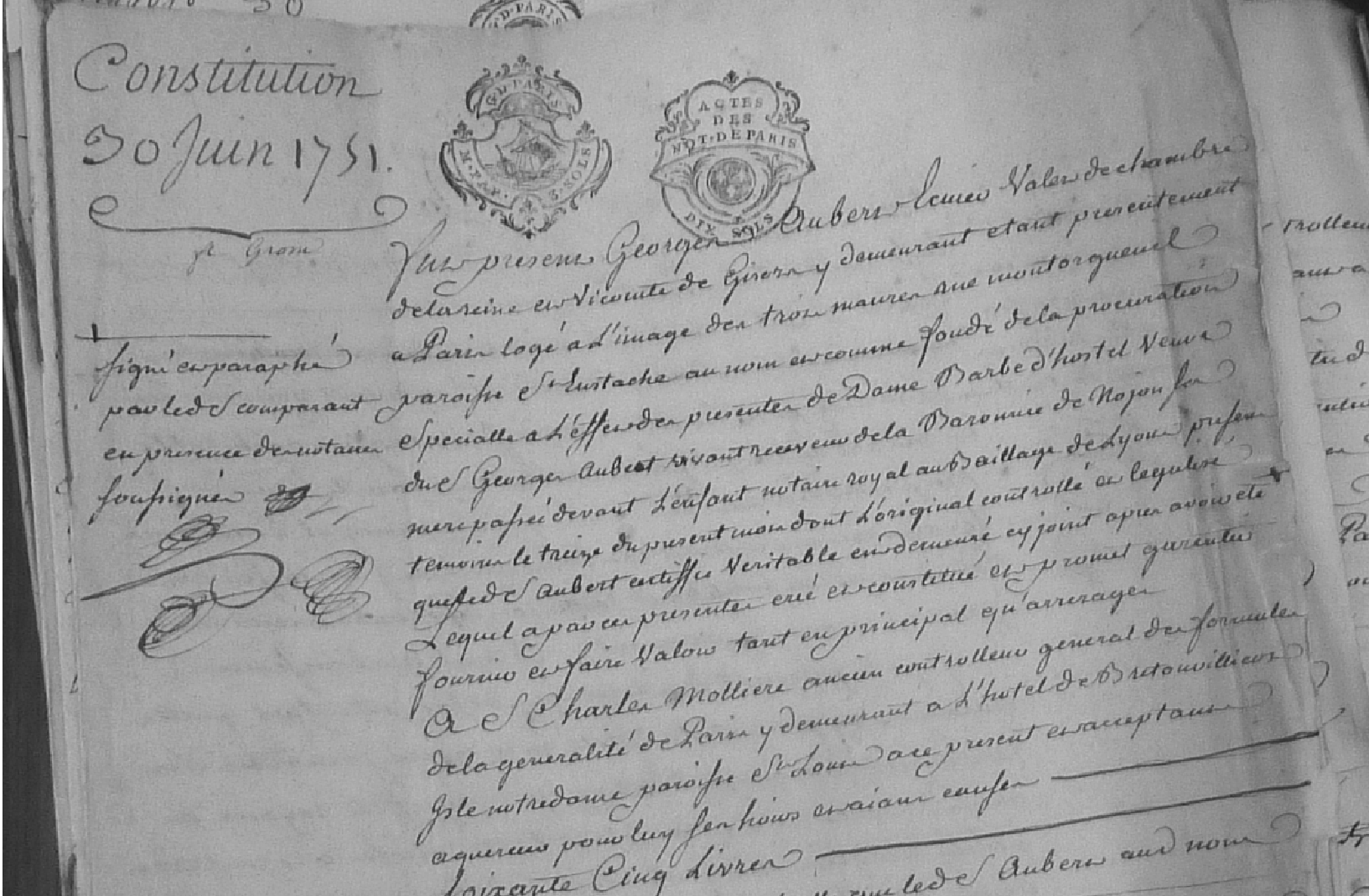
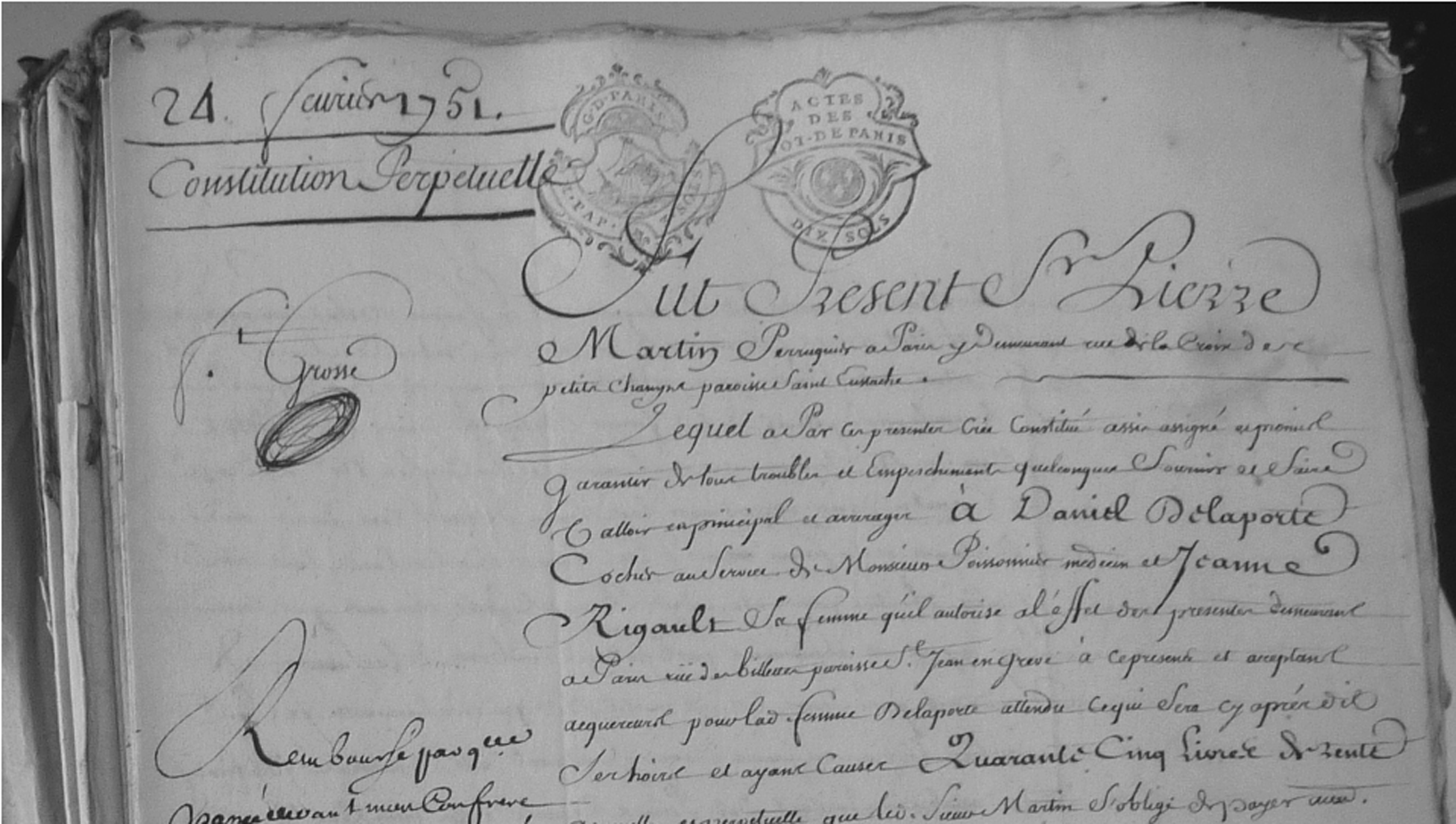
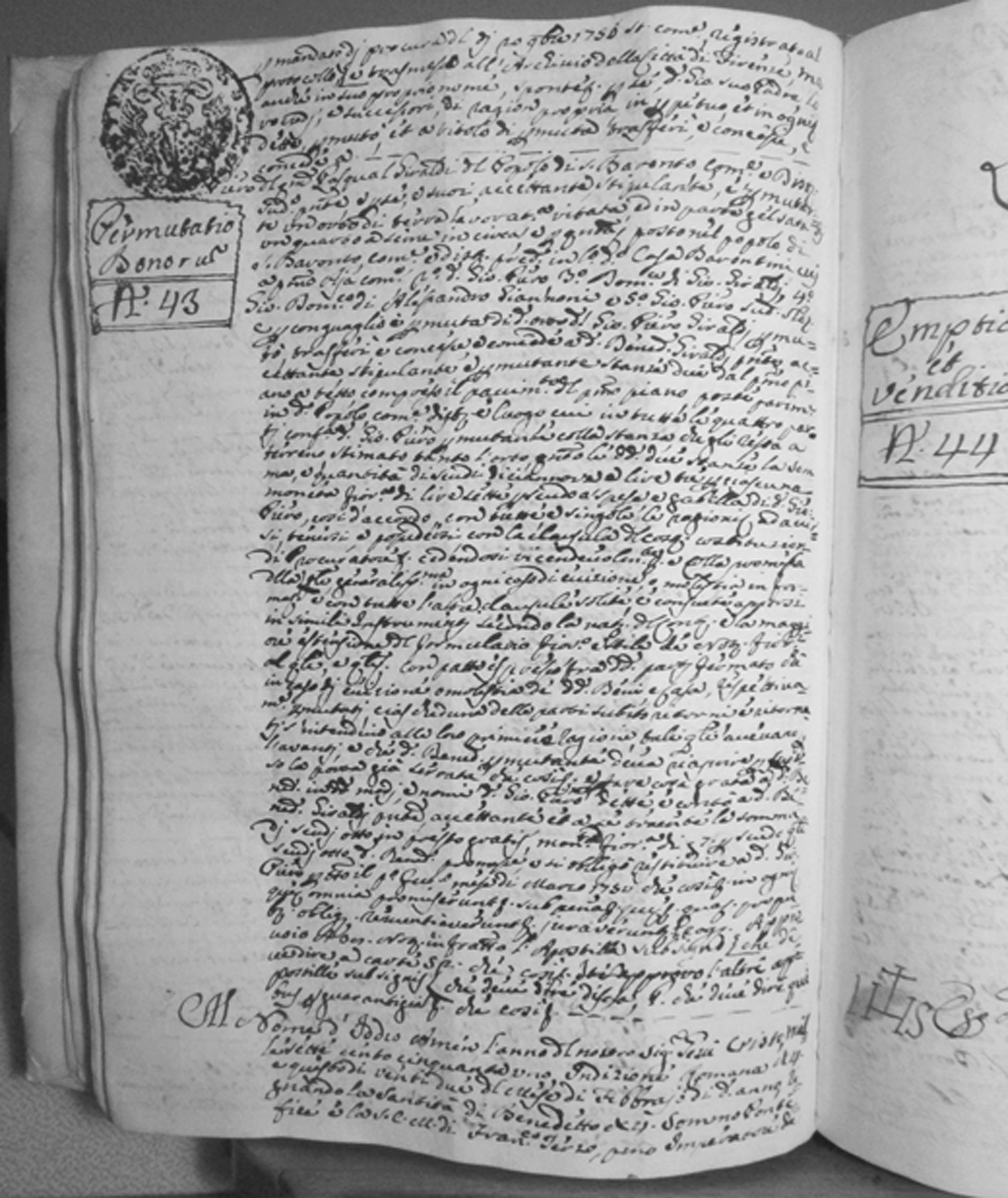
On the margin of each minute or protocol page, a notary or one of his clerks added a label describing the deed: sale, power of attorney, discharge, and so forth. Figures 1–3 show the top part of two original minutes and their respective codification in ARNO. The labels in figure 1 (constitution) and figure 2 (constitution perpétuelle) refer to the purchase of annuities. Figure 4 shows how labels (the words permutatio bonorum, exchange of goods, on the left and emptio et venditio, sale and purchase, on the right) appear in the protocols of Tuscan notaries. As we will explain, we used slightly modified versions of these labels to construct a typological classification.
Top part of a Parisian minute.
Source: Archives Nationales, Paris, MC/ET/XII/518.
Top part of a Parisian minute.
Source: Archives Nationales, Paris, MC/ET/XXXIX/407.
ARNO database for 1751.

Page of protocol registered in Florence in 1751.
Source: Archivio di Stato, Florence, Notarile Moderno: Protocolli, 27548.
There is no reason to believe that counting on the basis of minutes or protocols yields different results. In every place, complaints about the carelessness that led to the loss of some notaries’ archives are frequent, but we have no way of measuring the incidence of such losses; in any case, we did not find any gap in the records of the year 1751. Therefore, we cannot assume that the considerably lower deed-per-inhabitant ratio in Florence, Livorno, and Turin is due to a greater negligence in Italy.
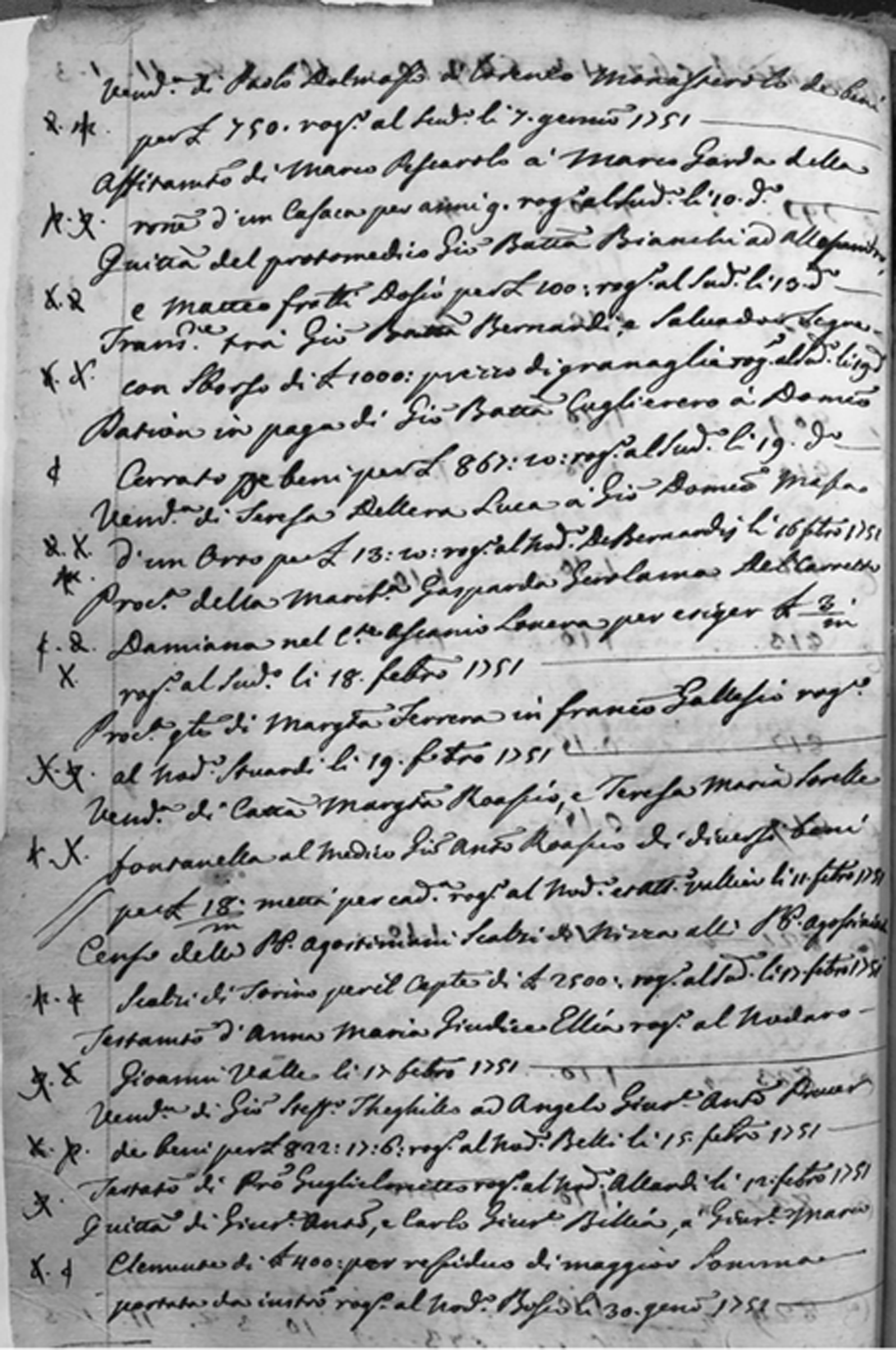
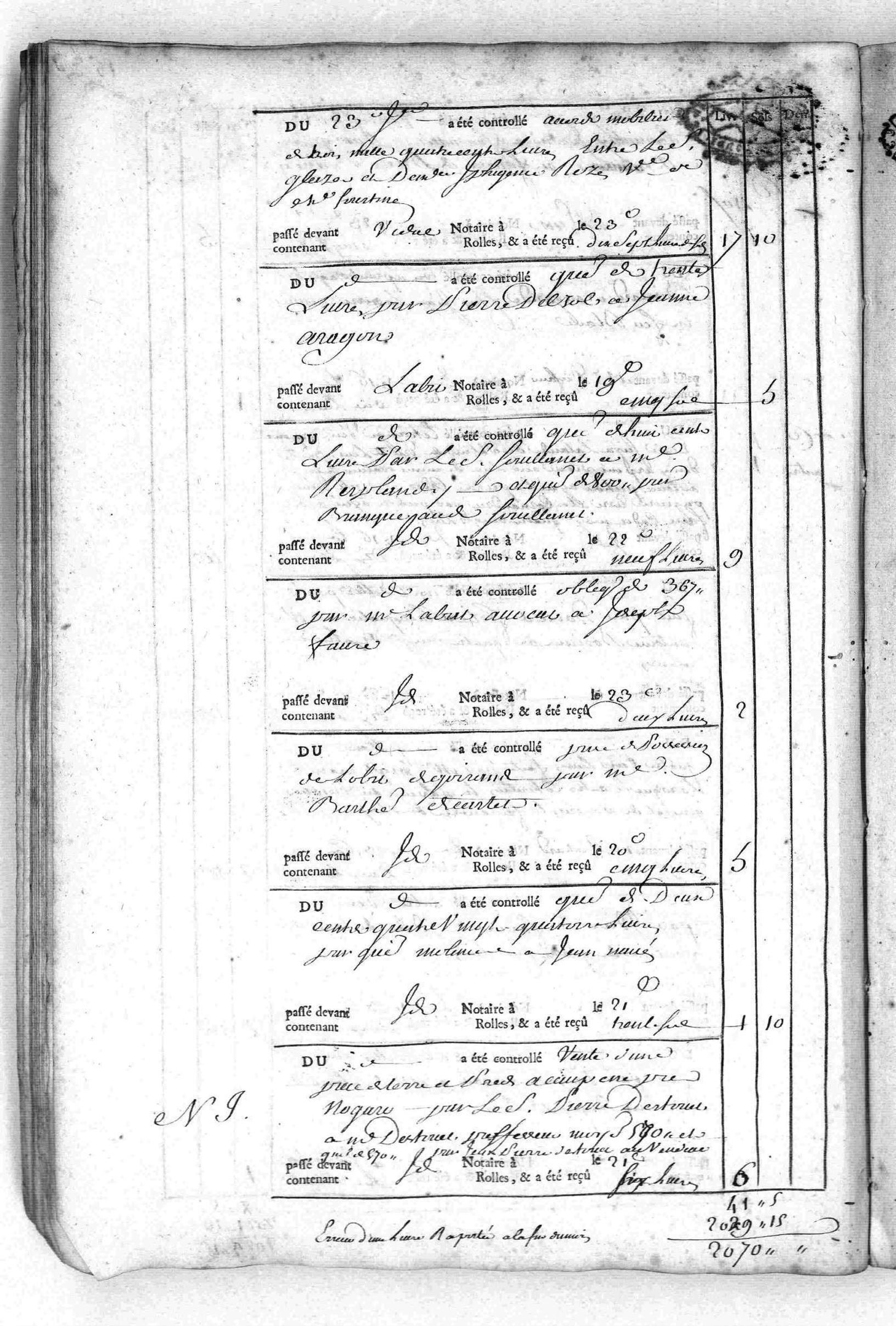
In addition to minutes and protocols, a third type of documentation exists in Turin, Toulouse, and Mende: registers compiled by public authorities to control notaries’ activities. In 1610, Duke Carlo Emanuele I ordered all notaries in Piedmont and Nice to deposit a copy of each minute with a newly created central office (ufficio di insinuazione). There, the deed was added to annual synthetic tables (compendi) listing every minute’s salient information: type of transaction, names of the parties involved, date, and sometimes the amount of money transacted (Regolamento 1770: 14, 21, 28). Footnote 13 Figure 5 shows a page of the 1751 compendio, which we used to assemble our data. In 1693 the king of France adopted a similar administrative procedure. Notaries were obliged to pay a tax on all minutes and brevets to the nearest administrative office (bureau de contrôle des actes), which in turn kept registers with the summary information of all their deeds (Hoffman et al. Reference Hoffman, Postel-Vinay and Rosenthal2019: 17–18; Vovelle Reference Vovelle1961). Parisian notaries obtained an official exemption, but it is this source that we used for Toulouse (figure 6) and Mende. Footnote 14
Page of the synthetic tables filed in Turin, February 1751.
Source: Archivio di Stato, Turin, Sezioni Riunite, Uffici di Insinuazione, Tappa di Torino, Compendi, 5758.
Page of the contrôle des actes of Toulouse, listing seven minutes drawn up between January 19 and 23, 1751, with two different notaries, and registered on January 23, 1751.
Source: Archives départementales de Haute-Garonne, Toulouse, 2C/2726.
All minutes and brevets in Toulouse and Mende had to be registered in the administrative office. The rules in Piedmont led to a slightly less complete coverage. There, last wills, annuities, dowries, sales, transfers of real estate, leases for more than ten years, and general partnerships among nonmerchants (società universali) had to be deposited with the central office, under penalty of a fine. By contrast, powers of attorney for litigation, marriage agreements, partnerships among merchants and bankers (società particolari), ecclesiastical appointments, and other private agreements could remain in the notary’s office (Belmondo Reference Belmondo1777–79, 1: 38–39, 178–82). This explains why in Turin we find few partnership agreements or dissolutions (11) and even fewer marriage agreements (2), although a fair amount of dowry contracts. The Turin compendi also omit all deeds concerning primogenitures and entails, which were kept in separate registers. In Tuscany, too, after 1578, notaries were ordered to keep last wills in separate protocols; therefore, they are not found among the sources we survey (Barbagli Reference Barbagli2013; Biscione Reference Biscione1993).
These absences do not affect our findings. If we subtract all last wills, marriage agreements, dowry contracts, and successions from the data of our cities, their respective ranking remains unchanged. Compared to the numbers in table 1, we would still find the lowest ratios of deeds-per-inhabitants in Tuscany (1.3 in Florence, 2.2 in Livorno), medium levels in Turin (7.9), slightly higher ratios in Paris (9.1), and the most intense notarial activity in Toulouse (12.7 to 14.7) and Mende (36.1). In the end, neither our source bases nor the use of notaries by nonresident city dwellers explain the fact that people used notaries with much higher frequency in Paris, Toulouse, Turin, and even more so in Mende than in Florence and Livorno.
Virtuous and Vicious Circles in Notarial Activity
By early modern standards, the notarial profession was strikingly homogenous in terms of functions and legal status, yet the average size of notaries’ offices and their social standing varied considerably. It was potentially lucrative because only a fixed number of licensed offices could operate in each city. This was particularly true in Paris, where the number remained relatively small for a very long time in spite of the rapid population growth (Descimon Reference Descimon and Cassan2004).
Table 2 shows that in 1751, the potential clientele of each notarial office in Paris (measured as the ratio of inhabitants per number of licensed notaries in the city) was more than seven times larger than in Florence. Each Parisian notary drafted, on average, more than 500 minutes in 1751. By contrast, the maximum number of deeds filed by a single office in Florence was 112, and 11 offices did not file any deed in that year. Because Parisian notaries were also paid for brevets, they could make a living from being full-time notaries and even hire clerks. In Florence, instead, being a notary in the mid-eighteenth century was not necessarily a profitable business, and may have been a part-time activity.Footnote 15
Ratio of notaries and surviving notarial deeds in each city, 1751
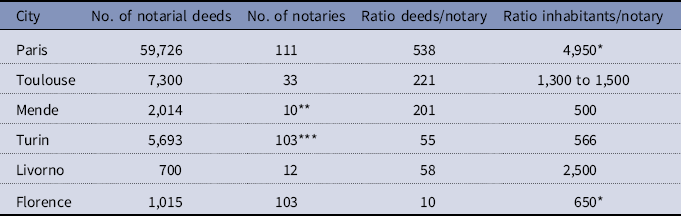
*Including notarial offices for which no deed survives.
**Including the city’s five notaries and five more established in nearby towns who registered their deeds in Mende’s administrative office.
***In 1680, there were as many as 188 licensed notaries in Turin (Duboin Reference Duboin1818–60, 25: 138).
Hoffman et al. (Reference Hoffman, Postel-Vinay and Rosenthal2000) argue that the Parisian notaries’ frequent contacts with clients made them privy to information that allowed them to play a crucial role as brokers in credit transactions concerning real estate and annuities. This role, in turn, increased their business volume. This virtuous circle may explain why people used notaries frequently in Paris, Toulouse, and Mende. In Florence, as we will see, sale transactions made up a high share of deeds, but their absolute number was low. It is reasonable to deduce that the less notaries worked, the less they knew about their clients, and the less attractive they were as credit brokers—a finding that, in turn, raises the interesting question of who, then, was in a position to act as credit brokers in Florence. The answer to this question is clearer for Livorno. There, merchants were notaries’ primary clients but they traded in commercial rather than real estate credit, and information about commercial credit was better obtained from alternative sources such as business letters, coffeehouses, and public squares.
The variations that we observe could therefore reflect, at least in part, a virtuous or vicious circle for notaries. Where the latter were relatively fewer, they drew up more deeds and were in a better position to corner the information market, thus remaining attractive for future clients and becoming more prosperous. This correlation, however, is neither universal nor exhaustive. To put forth more precise hypotheses about local notarial styles, we will compare the typological distribution of all deeds from each city in 1751. But first, we need to explain the procedure that we used to assemble the data that we compare.
A Necessary Detour: Constructed Emic Categories
Categorization involves a balancing act between the effort to recover the views of the subjects of one’s research and the need to develop analytical categories that belong to one’s own scholarly disciplinary landscape: It is part and parcel of the process of interpretation (Lemercier and Zalc Reference Lemercier and Zalc2019: 61–71). The driving principle of our categorization process has been to remain as close as possible to the language of the original documents, but not so close as to hinder comparisons. We entered in our database the labels that notaries or public officials placed next to each deed, although we had to make small adjustments.
Across the six cities we survey, emic categories are most consistent in Turin, Toulouse, and Mende, where clerks from a central office rather than single notaries categorized all deeds. In Florence and Livorno, the emic categories come from long-established Latin formulas (although the deeds are written in vernacular); however, the same notary or clerk occasionally used slightly different labels for the same type of deed, as did two notaries or two clerks. Similarly, in Paris, whereas one used the generic term “lease” or “purchase of annuity,” another noted the specific type of lease or annuity mentioned in the deed (figures 1–2). Sometimes one deed contained more than one type of transaction. Paris is the most problematic case because ARNO was compiled by multiple archivists for a purpose different from our own. To the extent possible, we restored the original labels.Footnote 16
“Constructed emic categories” (a deliberate oxymoron) is how we call the typologies of notarial deeds we devised to compare the data from our six cities. Three criteria inspired the creation of our categories. First, we eliminated scribal errors and spelling or wording variations. Second, we grouped deeds by their dominant label. That is, when the original label specifies not only the object of the contract (e.g., a dowry or a power of attorney) but also the stage in the life of that contract (e.g., the return of a dowry or the revocation of a power of attorney), we classified the deed by the object of the contract.Footnote 17 Our third taxonomical criterion departs the most from the emic labels: We grouped what notaries in France call “marriage” with what notaries in Piedmont and Tuscany label “dowry.”
Keeping our constructed categories even closer to the emic labels would have led us to find even larger differences across cities. Aimed at facilitating comparisons, our choices should have, if anything, increased the degree of convergence between cities. It is all the more striking that our results point in the opposite direction—a conclusion that etic labels such as those adopted by Poisson (“family” vs. “credit”) would have obscured.
All in all, the adjustments we made to the original terminology are minimal because, at least compared to other Old Regime primary sources, notarial deeds display a high level of lexicological standardization, even across locations.Footnote 18 The terminology used in manuals for how to conduct the notarial profession and in tariffs for notarial and fiscal fees generally matches the one in our sources (Belmondo Reference Belmondo1777–79; Ferrière and Visme Reference Ferrière and de Visme1752; Savelli Reference Savelli1692). Labeling customs in notarial practice, handbook writing and rulemaking probably reinforced one another. It is all the more surprising that, in the context of this shared conceptual universe, the actual use of notaries varied considerably from city to city.
Each City, a Notarial Style?
Table 3 lists in alphabetical order the ten most frequent types of deeds (in bold) that figure in at least one of the six cities. For all the similarities in the institutional and professional settings we described and in spite of the efforts we made to ensure the convergence of our terminology, table 3 is above all a portrait of differences. Powers of attorney, purchase/sale contracts, and discharges are the only types of deed that notaries drafted in high numbers in all six cities, although their relative proportion varied.
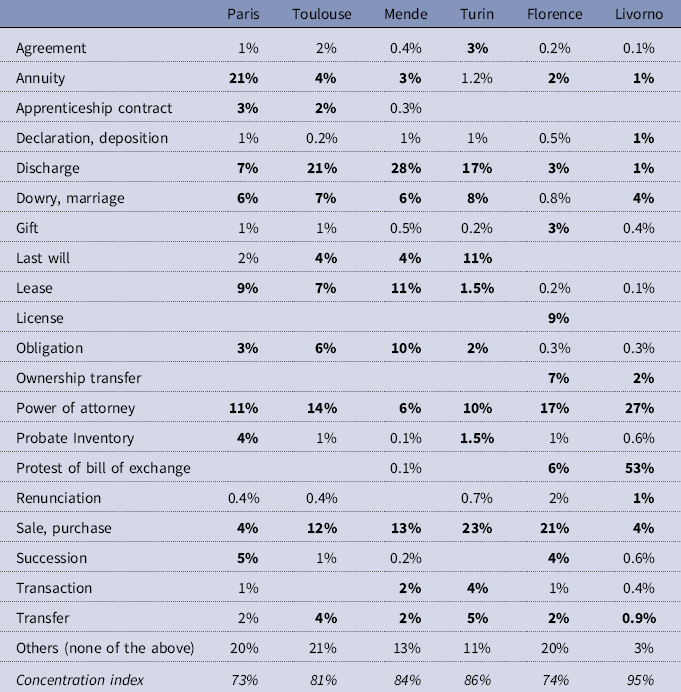
In Livorno, more than half (53 percent) of the notarial deeds were protests of bills of exchange followed by powers of attorney (27 percent), and the city has the highest concentration index (95 percent) that we found (concentration is the percentage of deeds in each city that falls in one of the 10 most frequent categories for that city). In other words, Livorno notaries worked almost full time for the resident merchant communities. By contrast, Paris and Florence had the lowest concentration index, indicating that their notaries processed a greater variety of deeds than those in other cities. But while the most prevalent deeds in Paris were annuities (21 percent), purchases and sales prevailed in Florence (21 percent) and Turin (23 percent). In Toulouse and Mende, discharges were the most frequent category (21 percent and 28 percent, respectively). In spite of their different population size, these two southern French cities are the only ones among our six that exhibit similar patterns.
This level of analysis leads us to four broad conclusions. First, the typological distribution of deeds in each city is so strikingly different that any scholars wishing to utilize notarial records to reconstruct the life events of specific individuals or paint a larger picture of a given locality should begin by understanding what can and cannot be found in each collection.
Second, the typological distribution summarized in table 3 contributes to explain the lower deed-per-inhabitant ratio in Florence and Livorno as compared to France and Savoy. For all their differences, Tuscan notaries had something in common: They recorded very few discharges and annuities, and even fewer obligations and leases. In short, they were not heavily involved in the certification of contracts concerning the routine profits from capital. The minimal role played by Tuscan notaries in the leasing of property corroborates the previously mentioned hypothesis that their modest function as intermediaries in real estate and credit transactions explains the small number of deeds they processed.
Third, in all six cities, the most frequent types of deeds, be they contracts (sales, annuities, powers of attorney) or not (inventories, last wills, licenses), were related to property or credit, but this does not mean that all economic transactions were notarized. Conspicuously absent from table 3 are documents that merchants used on a routine basis: bills of exchange, freight, marine insurance, and IOUs. Around the same time when the notarial profession came into being, authoritative legal scholars accorded public faith to merchants’ signatures appended to contracts. As a result, private business papers did not need to be notarized to stand as proof in court (Fortunati Reference Fortunati1996: 91–168; Kessler Reference Kessler2007: 88, 102). This explains why we find virtually no commercial partnerships and only some kinds of loans (obligations) that were not necessarily backed by real property in notarial registers. Footnote 19
Fourth, several mutually related factors seem to have influenced the local offer and demand for notarized deeds: a city’s socioeconomic composition, the local rules about what had to be notarized, and the existence of institutions other than notaries that fulfilled the same functions. Before discussing these factors, we need to ascertain that the differences we describe were indeed specific to each city, rather than to the whole state or to individual notaries, and that they were stable enough over time to be considered as constituting a local notarial style.
Scales of Differences
The six cities that we consider belonged to larger sovereign states, which were fairly centralized by Old Regime standards—the kingdom of France, the grand duchy of Tuscany, and the duchy of Savoy. To determine whether local notarial styles were uniform across the same territorial state or not, we expanded our analysis to nine provincial French cities and Chambéry, which at the time belonged to the duchy of Savoy, for the year 1749; the French Indian colony of Pondichéry for 1745–46; Bonifacio in the 1770s, a town situated in Corsica, an island that had just become French after having been part of the Republic of Genoa for centuries; and L’Arbresle, near Lyon, which we use as a test case for a town with fewer than 1,000 inhabitants.Footnote 20 To address the issue of change over time, we classified all surviving deeds for Livorno in 1674–75 and 1761 and for Paris in 1761 and 1851 according to the same categories we adopted for 1751. We also examined the deeds drafted by the eight most active notaries in Paris in 1751 so as to assess variations between notarial offices within the same city.
To analyze this larger dataset, we used principal component analysis (PCA) and clustering techniques so as to evaluate the similarities and differences in the shares of deeds between all 19 cities, 5 additional dates, and 8 notaries. Footnote 21
PCA permits us to visualize patterns of similarities and differences between types of deeds (figure 7) and between localities and notarial offices (figure 8). The left-right axis represents the main oppositions in the data. When two types of deeds appear on the same side of the axis, as is the case of last wills and marriages, it means that where one figures in a high proportion, the other does, too. By contrast, when two types of deeds appear on the opposite side of the left-right axis, as is the case for powers of attorney and marriage contracts, it means that in places with high shares of powers of attorney, there were low shares of marriage contracts, and vice versa. The top-bottom axis organizes secondary (i.e., statistically less significant) differences.

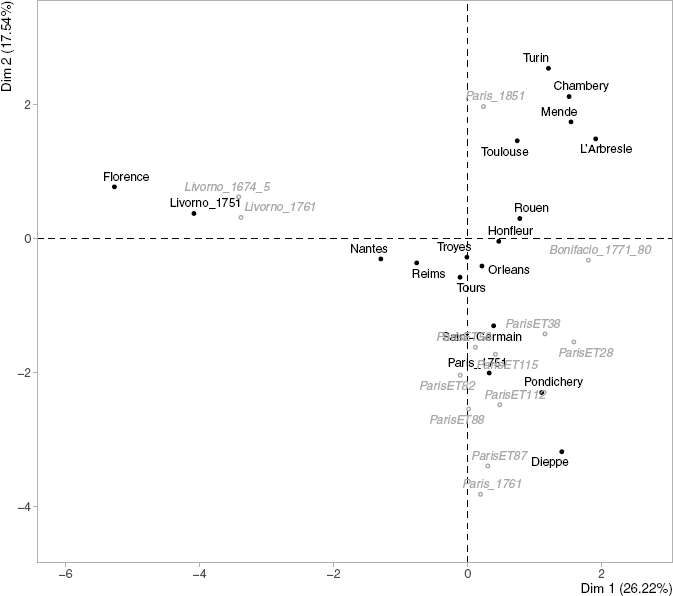
Figure 8 plots cities and notarial offices spatially. The underlying left-right and top-bottom axes are the same as in figure 7 (in figure 8, entities treated as active individuals are in black and illustrative individuals in gray). Cities with a larger share of ownership transfers and licenses (Florence) or protests and powers of attorney (Livorno) appear on the left, while cities with larger shares of marriage contracts and last wills appear on the right.
This visualization confirms that, even if percentage shares varied from year to year, the typological distribution within a certain city remained fairly stable over time. Thus, the distribution of deeds in Livorno in 1674–75 is more similar to the distribution in Livorno in 1761 than to that of any other city. The same is true when we compare Paris in 1751 and 1761. The only notable difference is the massive number of constitutions de tontines (a specific form of life annuity issued by the crown), which account for a quarter of all deeds in 1761 and an increase of 14,777 minutes from 1751 to 1761. The emission of public debt instruments made Parisian notaries busier but did not alter the range of their other activities in any significant way. By contrast, the types of deeds drafted by Parisian notaries in 1851 were quite different from those recorded a century earlier, and more similar to those drawn up in Turin and Toulouse in 1751: all three locations fall in the area of the graph characterized by relatively high shares of transfers, discharges, and obligations and low shares of operations on annuities. This comparison suggests that, during the early modern period, differences in the typological distribution of notarial records were more notable between places than across time and that change occurred slowly. Given these patterns, speaking of notarial styles strikes us as appropriate.
But what was the spatial scale of this notarial style? Figure 8 shows that some of the eight most active notaries in Paris in 1751 had their own specialties. Take, for example, études 28 and 87, which were situated in the same street. Étude 87 had a larger volume of business and its share of annuities was much higher (37 percent) than that of étude 28 (16 percent), which handled a higher proportion of marriages, leases, and sales (see table A.7 in the online supplementary materials). In spite of these differences, figure 8 reveals that, overall, the activities of the eight notaries were similar to the Parisian average: Their dots are relatively close to that of Paris in 1751, and closer to Paris than to any cities in southern France or the Italian peninsula. The Parisian case indicates that the scale of the city is not a mere artifact of our way of aggregating data: There existed such a thing as a city’s notarial style.
What about differences in notarial activities at the scale of the territorial state? Figure 8 uncovers the existence of three clusters of cities: one on the left, one on the bottom right, and one on the top right. To ascertain this tripartite division, we applied a clustering procedure.Footnote 22 Figure 9 presents the results: Each cluster is in a different rectangle on the right; cities in each cluster have a similar share of each type of deeds and the shares of deeds differ as much as possible across clusters; and the lines link cities that are relatively similar to one another. Think of the branches of a tree, with the trunk on the left and lots of small branches (each a locality) on the right. The line connecting L’Arbresle and Mende, the farthest on the right, indicates that those two are the most similar localities in terms of typological distribution of deeds. Toulouse and Chambéry (Savoy) are one step removed from them, followed by a group that includes Turin, Honfleur, and Rouen. By contrast, Florence and Livorno differ the most from all the other places: the first two branches of the tree, starting from the left, are one for Tuscany and another for all the other localities. They also differ from one another: Each is a cluster of its own. Thus figure 9 highlights that Florence and Livorno had little in common with one another, in addition to being most different from all the other cities.Footnote 23
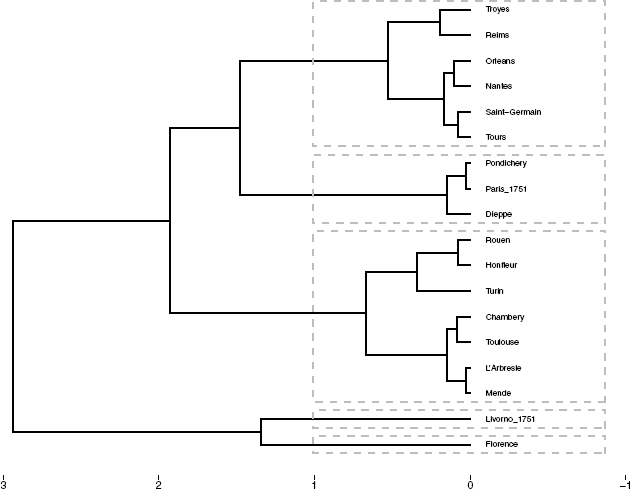
Unlike Florence and Livorno, which belonged to the same territorial state but form two distinct clusters, Turin and Chambéry were both part of the duchy of Savoy and fall into the same cluster, but together with the French towns and cities of L’Arbresle, Mende, Toulouse, Honfleur, and Rouen, which appear more similar to Turin than to Paris. In the five French localities and the two Savoyard cities, we find relatively few annuities and deeds related to successions, many discharges and transfers, and an above-average proportion of dowries and marriage contracts. Conversely, Paris and Pondichéry are remarkably similar in the high number of deeds relating to annuities, the considerable share of successions, and the rare sale contracts. The remaining French cities are more similar to Paris than to the group centered on Turin and Toulouse. Their main peculiarities are a higher share of leases and a lower share of marriage contracts and transfers than average. Finally, Bonifacio, which we did not include in the clustering procedure in figure 9 because its data are from a later period, would be its own cluster. Like Florence and Livorno, it had a low share of credit-related records—associated with low ratios of deeds-per-100-inhabitants per year (2.6) and deeds per notary per year (6)—but its shares of sales, marriage contracts, and last wills were especially high, unlike in Tuscany.
These analytical procedures generate three intriguing results. First, patterns in notarial activity do not depend systematically on the size or political status of cities: Turin and the rural area around L’Arbresle belong to the same cluster. Second, the contrast between the kingdom of France and the duchy of Savoy is less pronounced than the contrast between northern France, with its customary law tradition, on the one hand, and Savoy and southern France, with their Roman law tradition, on the other. Footnote 24 Curiously, two towns in Normandie appear more similar to the cluster formed by Savoy and southern France than to the rest of northern France. Footnote 25 This further confirms that the scale of notarial styles is the city, with seemingly regional trends, rather than the territorial state, although, because of the data we sampled, we are not in a position to say for sure whether these urban styles ended at the city walls or encompassed the surrounding countryside as well. Third, we identify three distinctive patterns of notarial activity: in Tuscany, notaries were rarely involved in credit or leases; in Toulouse, Mende, and Savoy, they drew up credit contracts (obligations rather than annuities), marriages and dowries, and altered existing contracts (with discharges and transfers); and in Paris, they dealt consistently in annuities and successions.
By means of simple quantitative measures, we have thus identified a new object of historical analysis: a differentiated notarial style rooted in local practices. We regard this as a worthy result, which raises new research questions for social, legal, and economic historians.
Accounting for Differences: Demand and Alternative Institutions
Both demand (what clients asked from notaries) and supply (what public authorities offered by way of additional or alternative certifying institutions) shaped these notarial styles. Moreover, notaries charged different fees and paid different taxes depending on the type of deed and the amount of money registered therein, even if we are unable to determine whether this affected the choice of using notaries for certain purposes and not others (but these fees and taxes were generally low; Amiaud Reference Amiaud1875; Duboin Reference Duboin1818–60, 25: 129–30). A more relevant question is whether the demand for notarial services reflected differences in the sources of capital and wealth—investments in land, commerce, or financial activities.
Our clustering techniques did not generate a classification according to urban functions (e.g., capital cities vs. provincial cities, manufacturing cities vs. merchant cities). Only in Livorno does the peculiar typological distribution of notarial deeds ensue from the heavy demands made by merchants on local notaries. Notarial records in Nantes, also a port city, were quite different (see table A.8 in the online supplementary materials). The share of sales and leases, two typologies of deeds usually involving real estate, varied greatly from one city to the other and, in general, was inversely proportional, with more sales where leases were fewer, and vice versa. These trends do not allow us to distinguish, for example, between a “bourgeois” and a “merchant” local notarial style.
However, differences in the level and form of wealth of a city’s population might explain some of these trends. Notarized loans are a case in point. They fell into two broad categories: obligations and annuities. Obligations were IOUs that included a due date; many notarized discharges resulted from obligations. Footnote 26 Mortgage-like annuities (rentes) were normally guaranteed by real estate property and the borrower could be the king, a public entity (be it a monastery or a city council), or a private individual. Like Hoffman et al. (Reference Hoffman, Postel-Vinay and Rosenthal2019: 19–22), we find that annuities made up a higher share of notarial activity in northern than southern France. They add that annuities were more typical of cities than the countryside; we note that Pondichéry was similar to the North and Savoy to the South. In Tuscany (and Bonifacio), notaries were much less involved in credit contracts, and annuities and discharges were drafted in nearly equally low proportion. These findings urge us to qualify the idea that notaries mattered for credit in general and to investigate the meaning of these differences for notaries, lenders, and borrowers.
Finally, it is probably demand, as channeled through local norms, that accounts for Mende’s peculiar notarial style, with its 40 deeds per 100 inhabitants per year. Notaries there certified no less than 2.6 marriage contracts per 100 inhabitants, compared to 1 in Toulouse and 0.6 in Paris—two cities with a higher proportion of wealthy lay families. There were also 1.5 notarized last wills and 11 discharges per 100 inhabitants per year in Mende, as compared to 0.7 and 3 in Toulouse, and 0.2 and 0.7 in Paris, respectively. These peculiarities are likely the result of the inheritance customs specific to the region of Gévaudan, where the principal heir was not necessarily the eldest son, or even a son, while the other siblings received yearly payments that were legally considered as discharges (Claverie Reference Claverie1981). This inheritance system generated great familiarity with notaries among local residents, even in small villages, although it does not explain Mende’s similarities with Toulouse in terms of obligations. Our quantitative approach to notarial styles thus invites in-depth research into local conditions.
The tasks performed by notaries should be understood as part of a “landscape of producers of records, [which was always] shifting and diverse” (Lazzarini Reference Lazzarini, Grévin and Mairey2016: 278). These varied institutional ecologies account, for example, for the presence or absence of guild apprenticeship contracts in notarial collections. In Paris, according to guild statutes, those who did not register such contracts with a public notary could be taken to court. This was not a kingdom-wide rule, however. In 1751, a Parisian judge asked for written proof that in Arras, guilds did not mandate the registration of apprenticeship contracts: He had a hard time believing that was possible.Footnote 27 Poisson found no apprenticeship contracts among his sample of notarial records from Reims and Rouen (see table A.8 in the online supplementary materials), although both cities had guilds and apprentices. Institutional ecologies also varied across the Italian peninsula. Some cities left the registration of apprenticeship contracts to public notaries; others, including Turin, set up central registration services, while in Florence, large guilds like those of wool makers (Arte della Lana) had their own notaries (Marcello Reference Marcello and Niccoli1993; Zucca Micheletto Reference Zucca Micheletto, Prak and Wallis2019: 85–87). Livorno was a complete exception insofar as it banned artisanal guilds altogether.
Similarly, the absence of protests of bills of exchange in Paris, Toulouse, and Turin does not mean that this service was not performed or in high demand in those cities. Throughout Europe one of the signatories of a bill of exchange could refuse to pay it but had to register his refusal with a public authority. In northern France and in some cities in the South, including Toulouse, it fell on bailiffs (huissiers) to register these protests (Ferrière and Visme Reference Ferrière and de Visme1752: 141–45; Hoffman et al. Reference Hoffman, Postel-Vinay and Rosenthal2000: 125). This use of notaries or bailiffs in French cities was a custom rather than a legal monopoly—something that merits further investigation. Had we sampled deeds in Lyon or Marseille rather than Toulouse, we would have found a large share of protests in notarial records. Additional or competing institutions, more generally, altered the demand for notarial services. In Paris, the establishment of a new office charged with the public registration of mortgages ultimately marginalized the role of notaries as credit brokers (Hoffman et al. Reference Hoffman, Postel-Vinay and Rosenthal2000: 230–72). By 1851, mostly as a result of the cumulative effect of this competition, the deeds-per-100-inhabitants ratio fell from 10.5 in 1751 to 5.7.
Protracted jurisdictional conflicts between city magistrates or between some of them and the central administration explain other patterns we identified. Probate inventories described a deceased person’s pieces of furniture, personal belongings, and financial papers, and were used to adjudicate litigation among heirs. When the deceased was wealthy, they could be several pages long. As such, they were an important source of revenue for notaries and other officers and the object of constant jurisdictional disputes. Parisian notaries succeeded in remaining in charge of inventories, whereas their counterparts in Toulouse and Lyon lost this exclusive prerogative in the seventeenth century (Cayron Reference Cayron1665: 326; Ferrière and Visme Reference Ferrière and de Visme1752: 23–26; Garden Reference Garden1967). The same happened in several Italian cities, where, by the mid-eighteenth century, designated magistrates or tribunals oversaw the compilation of estate inventories on behalf of orphans and heirs (Calvi Reference Calvi1994; Sicca Reference Sicca2014: 16–34).
The details of such rules and the role of additional or alternative institutions determined the low share if not the absence of certain typologies of deeds from various cities, and are therefore central to the pursuit of any comparative study. If we want to understand why and when clients used notaries, it is essential (although not always possible or easy) to establish whether they were under a statutory obligation to do so or whether they chose to do so.
Conclusion
Seemingly dry and factual, notarial deeds awaken the historians’ skepticism toward any truth claims embedded in primary sources. Kathryn Burns (Reference Burns2005: 353) thus warns us against accepting “notaries’ words without inquiring into the practices and relationships that shaped the records on which we rely.” But how can we uncover such “practices and relationships,” and discern the structures that hide behind folders and folders of repetitive documents? This article has highlighted the potential of two methodological perspectives that in recent decades, historians have increasingly overlooked: quantitative methods and comparative analysis.
For the period after circa 1500, notarial deeds are preserved virtually everywhere across continental Europe and Latin America. Occasional comments surface here and there in the secondary literature concerning their inadequacy for certain lines of inquiry, the variety of notarial records that survive even in adjacent towns or the rivalry between local institutions tasked with certifying individual’s property rights (Gelderblom et al. Reference Gelderblom, Hup, Jonker, Lorenzini, Lorandini and Coffman2018; Lorenzini Reference Lorenzini, Lorenzini, Lorandini and Coffman2018: 106–9). To date, however, no study has explored the sources and consequences of this heterogeneity.
This neglect stems in part from the vastness of notarial collections and in part from the deceptive sense of uniformity among them created by formal standardization. The typological classification and statistical techniques that we adopted allowed us to move beyond this impasse. By means of constructed emic categories and descriptive statistics, we brought to light local documentary ecologies that would otherwise not be apparent and that are the requisite first step for any further explorations of notarial sources, be they micro or macro in scale. Only by counting, for example, has the low number of notarial deeds in Tuscany come to the surface, prompting new reflections on how notaries made their livelihood and raising the question of how potential lenders found suitable borrowers. Complementary statistical and visualization methods reveal the existence of a plurality of local notarial styles within France, as well as regional patterns that stretched across different states.
In recent decades, comparative history has suffered at the expense of the study of global connections and micro-analytical perspectives (Subrahmanyam Reference Subrahmanyam1997; Trivellato Reference Trivellato2011). Kenneth Pomeranz’s The Great Divergence (Reference Pomeranz2000) remains one of the most ambitious attempts to harmonize local and comparative approaches, but it is based almost exclusively on secondary sources and therefore depends on the questions and categories of analysis that inform the literature from which it borrows. By contrast, we treated archival sources as research objects as much as sources of information.
By counting and comparing archival data, we were able to outline the profile of various local notarial styles. From there, we probed the factors that contributed to generate those profiles. The lack of a type of notarized contract in a certain locality is not evidence that certain transactions did not occur, or that property rights were weak. Rather, the comparisons we conducted show that any conclusion drawn from notarial archives demands a keen awareness of the local institutional landscape and that quantification is essential to produce this awareness. In each city, actors could utilize a larger menu of institutional resources than notaries to put their agreements on paper or make them official, and thus enforceable. This also means that mobile individuals—and in the eighteenth century they were many, both men and women—had to learn what notaries did in each place where they wished to avail themselves of their services. Quantitative comparisons ultimately help us to shed light on the world that these individuals encountered and complement a connected-history approach that rarely see quantification as its twin.
Although our examples are confined to core areas of western Europe, the same methods could easily be extended to Europe’s early modern colonies, particularly Spanish and Portuguese America or Québec (Bouchard Reference Bouchard1995; Burns Reference Burns2010; Wasserman Reference Wasserman2018). Ideally, pertinent comparisons could also include other parts of the world where notary-like institutions existed, such as Morocco (Marglin Reference Marglin2016) or Ethiopia (Wion Reference Wion2019). The same type of analysis could eventually be applied to similar sources, beginning with the vast collections of court records that exist both in Europe and beyond: What did tribunals adjudicate most often? For whom and to what effect?
In the end, we hope to have outlined a road map for how to bring serial archival records to bear on one of the most pressing scholarly debates of our time, namely, how to treat local and comparative perspectives as interdependent rather than to oppose them to one another.
Supplementary material
For supplementary material accompanying this paper visit https://doi.org/10.1017/ssh.2022.8
Acknowledgments
The authors are grateful to Gilles Postel-Vinay for sharing generously both his knowledge and unpublished data; to Marie-Françoise Limon-Bonnet and Aurélia Rostaing of the Archives Nationales in Paris; and to Luciano Allegra, Guillaume Calafat, Simona Cerutti, Jean-François Chauvard, Philip T. Hoffman, Naomi Lamoreaux, Anthony Molho, Jean-Laurent Rosenthal, Emma Rothschild, the participants in the 2021 Caltech Early Modern Group and the Paris School of Economics’ Economic History Seminar, as well as four anonymous referees for their feedback on earlier versions of this article.


 Open access

