

In AD 1428, the Culhua-Mexica people, commonly known as the Aztecs, revolted from their Atzcapotzalco overlords and began their conquests of the Basin of Mexico. Izcoatl, the Mexica huetlatoani, joined with the rulers of Tezcoco and Tlacopan in a political confederacy known today as the Aztec Triple Alliance. Under Mexica leadership, this alliance conquered a large area of Mexico (Figure 1) and forged a tribute empire stretching from the Gulf to the Pacific coasts, southeast into Oaxaca, and into parts of coastal Guatemala (Berdan Reference Berdan2014; Hassig Reference Hassig1988). Although this empire encompassed most of Central Mexico, it did not include the neighboring polities of Tlaxcala, Huexotzinco, and Cholula located in the Puebla-Tlaxcala Valley, which had their own tumultuous history of volatile alliances and interpolity enmities (Ixtlixóchitl Reference Ixtlixóchitl and Chavero1965 [ca. 1600]). Despite friction, these polities managed to remain relatively autonomous and resisted Aztec incursions into the region through a combination of détente, strong military resistance, and economic independence (Cortés Reference Cortés and Pagden2001 [1520s]; Evans Reference Evans2008; Isaac Reference Isaac1983; López et al. Reference López Corral, Fargher and Cano2016). One of the most formidable Aztec adversaries was the Tlaxcala confederacy, an alliance of 17 Nahua and Otomí towns that maintained their independence until the arrival of the Spanish in AD 1519 (Aguilera Reference Aguilera1991:54; Cortés Reference Cortés and Pagden2001 [1520s]:59, 68, 74; Fargher et al. Reference Fargher, Blanton, Heredia Espinoza, Nichols and Rodríguez-Alegría2017; García Cook Reference García Cook, Sabloff and Andrews1981; Isaac Reference Isaac1983; López and Santacruz Reference López Corral and Cano2010; Muñoz Camargo Reference Muñoz Camargo and Chavero1892 [1576–1595]:54, 110–113). The towns within this confederacy supported Hernan Cortés in his campaign against the Aztecs, leading to their defeat in AD 1521.
Mexico, the extent of the Aztec Empire, obsidian sources discussed in the text, and independent regions. (Color online)
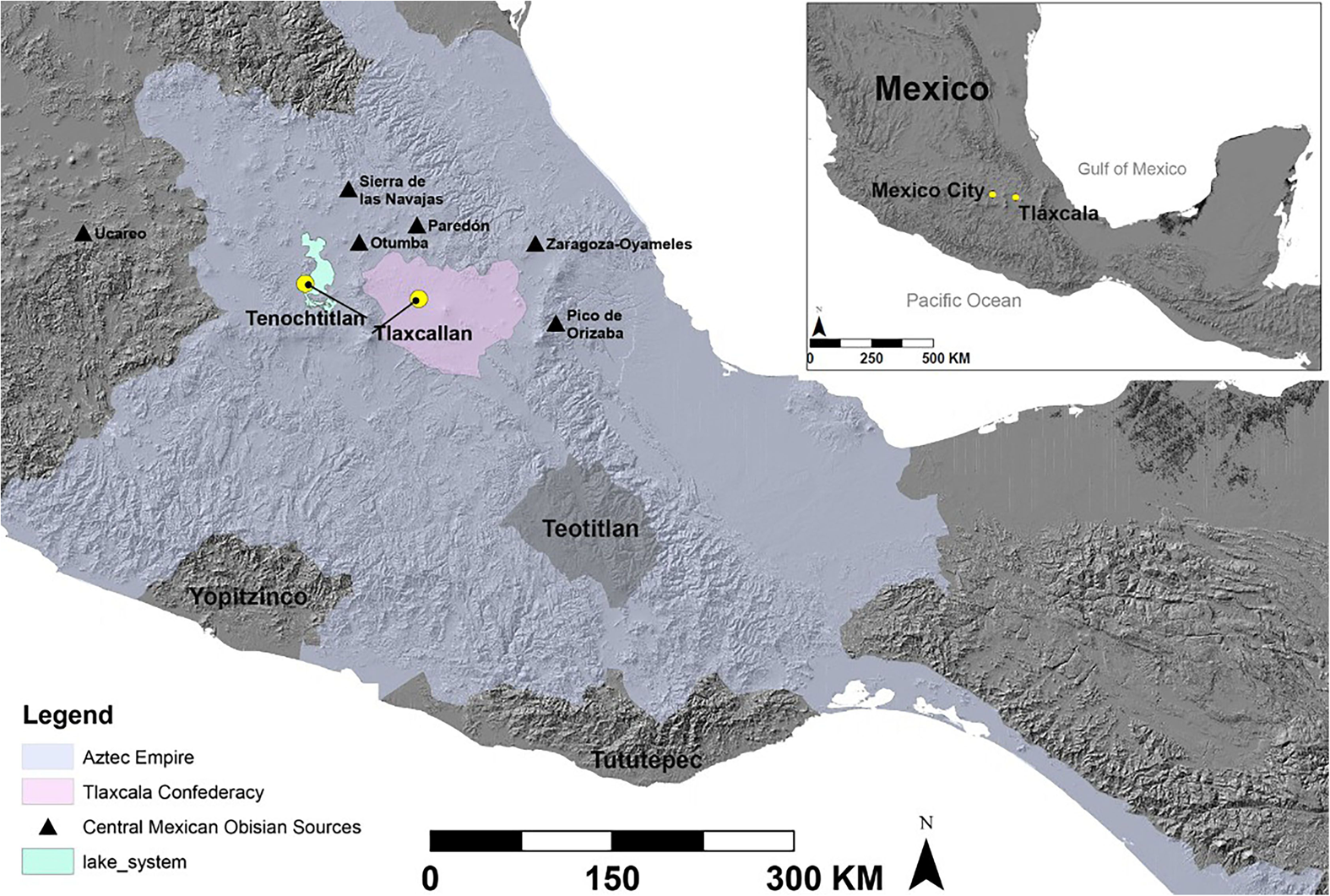
The presence of a dangerous enemy only 100 km east of the Aztec capital of Tenochtitlan was an anomaly within the Aztec Empire (Figure 1). When Motecuhzoma II (the Aztec huetlatoani) and his captains were asked by the Spanish why they did not conquer the Tlaxcala confederacy, they replied, “We could easily do so; but then there would remain nowhere for the young men to train [militarily], except far from here; and, also, we wanted there to always be [nearby] people to sacrifice to our gods” (Andrés de Tapia Reference Tapia and García Icazbalceta1866 [1500s]:752). This reference to military training refers to the scheduled conflicts known as the “Flowery Wars” (Aguilera Reference Aguilera1991:42–44; del Castillo Reference del Castillo1904 [1568]:291; Durán Reference Durán and Heyden1994 [1558?]:402; Ixtlixóchitl Reference Ixtlixóchitl and Chavero1965 [ca. 1600]:206–207; Muñoz Camargo Reference Muñoz Camargo and Chavero1892 [1576–1595]:123; Tezozómoc Reference Tezozómoc and Vigil1878 [1598]:490). The accuracy of Motecuhzoma's characterization of the Aztecs’ relationship with Tlaxcala is certainly questionable. The Tlaxcaltecas were formidable opponents (del Castillo Reference del Castillo1904 [1568]:181; Cortés Reference Cortés and Pagden2001 [1520s]:59–60) and were geographically well positioned for defense (Aguilera Reference Aguilera1991:26; Muñoz Camargo Reference Muñoz Camargo and Chavero1892 [1576–1595]:111–112).
Although tensions between the Puebla-Tlaxcala polities and the Mexica were likely of long standing, it was Motecuhzoma I (AD 1440–1469) who decided to wage “perpetual war” against Huexotzinco, Cholula, and Tlaxcala (Durán Reference Durán and Heyden1994 [1558?]:233). Motecuhzoma I conquered Otomí territories north of Tlaxcala, as well as the area surrounding the Puebla-Tlaxcala Valley (Muñoz Camargo Reference Muñoz Camargo and Chavero1892:109). In addition to military hostilities, ethnohistorical sources indicate that the Aztecs imposed an economic embargo against Tlaxcala (Berdan Reference Berdan2014; Bueno Reference Bueno Bravo2012; Fargher et al. Reference Fargher, Blanton and Heredia Espinoza2010; Millhauser et al. Reference Millhauser, Fargher, Heredia Espinoza and Blanton2015; Muñoz Camargo Reference Muñoz Camargo and Chavero1892 [1576–1595]:111). The challenge for archaeologists, which we undertake here, is to determine if this embargo took place and, if so, whether it was effective. Accomplishing that task requires identifying temporally sensitive archaeological collections of restricted goods that correspond to the period when the embargo was said to have been imposed.
No document states the precise date when economic restrictions began, and some sources discuss occasional “truces” between the Aztecs and Tlaxcala (Durán Reference Durán and Heyden1994 [1558?]:332; Muñoz Camargo Reference Muñoz Camargo and Chavero1892 [1576–1595]:111–112). Given the circumstances of Motecuhzoma I's reign and the known tensions between these two regions, it is possible that economic restrictions were initiated as early as AD 1446. Economic pressure is believed to have increased in the year of 1 Rabbit (AD 1454) following the Great Famine and the start of the Flowery Wars (Aguilera Reference Aguilera1991:39; Durán Reference Durán and Heyden1994 [1558?]:233–238; Isaac Reference Isaac1983; Muñoz Camargo Reference Muñoz Camargo and Chavero1892 [1576–1595]:110–112). Tezozómoc (Reference Tezozómoc and Vigil1878 [1598]:362–363) describes Motecuhzoma I's speech to his adviser Tlacaelel as conveying that he wished to inflict a “cruel war” on the Tlaxcaltecas, sell them as slaves, sacrifice them to the gods, and extract tribute.
Ethnohistorical sources (Cortés Reference Cortés and Pagden2001 [1520s]:66; del Castillo Reference del Castillo1904 [1568]:194, Muñoz Camargo Reference Muñoz Camargo and Chavero1892 [1576–1595]:111) state that Motecuhzoma I imposed an economic blockade or embargo on Tlaxcala to restrict access to a range of necessities and luxury products for 60 years. The list of embargoed resources includes salt, cotton, tropical feathers, pigments, gold, silver, cacao, and other unspecified goods (Muñoz Camargo Reference Muñoz Camargo and Chavero1892 [1576–1595]: 111). Obsidian is not on the list of embargoed items, but we believe it would have been important to include, as discussed later in the article.
How effective this blockade was is unclear, given that Cortés (Reference Cortés and Pagden2001 [1520s]:67–68) reported that the Tlaxcalan center of Ocotelulco had a large marketplace where 30,000 people met daily to trade a range of commodities. Prior to the Aztec embargo, Muñoz Camargo (Reference Muñoz Camargo and Chavero1892 [1576–1595]:105) described the importation of goods, including cacao, gold, parrot feathers, wax, honey, and cotton, into Tlaxcala from across Mesoamerica. Nevertheless, after the Aztecs conquered Tepeaca, which was located at the eastern entrance to the Puebla-Tlaxcala Valley (Figure 2), Motecuhzoma II stipulated that a great marketplace be built there, “so that all the merchants in the land may trade there” (Durán Reference Durán and Heyden1994 [1558?]:159). The goods listed as sold there included a wide range of high-value goods, which probably was a strategic move to draw merchants away from marketplaces in Tlaxcala.
Map highlighting obsidian sources and sites discussed in the text. 1. Cihuatecpan; 2. Chalco; 3. Xaltocan; 4. Chiconautla; 5. Yautepec; 6. Capilco, Xochicalco, and Cuexcomate; 7. Tula and Cerro Magoni; 8. Calixtlahuaca; 9. Santa Cruz Atizapan; 10. Tlaxcallan (Tepeticpac, Tizatlan, Quiahuixtlan, and Ocotelulco); 11. Cinco Santos II and Tlispan; 12. La Laguna; 13. Cholula; 14. Cacaxtla-Xochitecatl; 15. Nealtican and Tetimpa; 16. Cantona; 17. Tenochtitlan; 18. Azcapotzalco; and 19. Tepeaca. (Color online)

Although the existence of the trade embargo has been accepted in discussions of Aztec–Tlaxcala interaction (Berdan Reference Berdan2014; Fargher et al. Reference Fargher, Blanton and Heredia Espinoza2010), it has not been evaluated using archaeological data because of its short duration: the trade blockade probably lasted only 65 years (AD 1449–1519). It is difficult to isolate archaeological assemblages to that short of a period, even when using high-precision AMS dating. Despite this difficulty, we attempted a preliminary evaluation of Aztec–Tlaxcala trade relations. Research at several sites within Tlaxcala provided new information to assess whether the proposed blockade effectively reduced the flow of important resources, such as obsidian, into the region (Gentil Reference Gentil2018; López et al. Reference López Corral, Gentil, Fargher, Alcantara and Cano2020; Vicencio Reference Vicencio Castellanos2015, Reference Vicencio Castellanos2019; Xiuhtecutli Reference Xiuhtecutli, Faulseit, Xiuhtecuhtli and Mehta2018). An economic blockade would have been difficult to enforce without close monitoring by Aztec authorities, given the permeability of political boundaries and the presence of a buffer zone of Otomí communities located between Aztec and Tlaxcala territories (Aguilera Reference Aguilera1991:54; Cortés Reference Cortés and Pagden2001 [1520s]:221, 223: Durán Reference Durán and Heyden1994 [1558?]:273, 344; García Cook Reference García Cook, Sabloff and Andrews1981; Muñoz Camargo Reference Muñoz Camargo and Chavero1892 [1576–1595]:54, 111–113). If it did exist, one would expect obsidian to have been high on the list of restricted goods, because it was vital for military arms and everyday domestic use.
We used geochemical sourcing and technological analysis to evaluate whether obsidian from the Aztec-controlled sources of Sierra de las Navajas (Hidalgo) and Otumba (Mexico) entered Tlaxcala in diminished quantities during the Late Postclassic compared to earlier time periods (Figure 3). These two obsidian sources are located within the Aztec tribute domain, and both ethnohistorical sources and archaeological information indicate they were heavily used by communities under Aztec control (Earle and Smith Reference Earle, Smith and Smith2012; Elam et al. Reference Elam, Glascock, Neff and Hodge2008; Elson Reference Elson1999; Golitko and Feinman Reference Golitko and Feinman2015; Hirth and Nichols Reference Hirth, Nichols, Nichols and Rodríguez-Alegría2017; Huster Reference Huster2016; Millhauser Reference Millhauser and Brumfiel2005; Pastrana Reference Pastrana1998, Reference Pastrana2004; Pastrana and Carballo Reference Pastrana, Carballo, Nichols and Rodríguez-Alegría2017). We begin with a brief discussion of the methods used to identify obsidian sources and production technology explored in this study. We then examine obsidian distribution and consumption patterns across Central Mexico preceding and during the Late Postclassic. Although this comparison lacks precision due to the uneven way that obsidian source determinations have been reported, it provides a framework for evaluating continuity or change in the obsidian sources recovered at sites in Tlaxcala during the Late Postclassic. In many cases, reports do not specify obsidian sources beyond the visual identification of green or gray obsidian. Green obsidian is presumed to originate from the Sierra de las Navajas source near Pachuca, even though there may be other sources of green-tinged obsidian in Central Mexico, such as Tulancingo (Pastrana and Carballo Reference Pastrana, Carballo, Nichols and Rodríguez-Alegría2017:332).
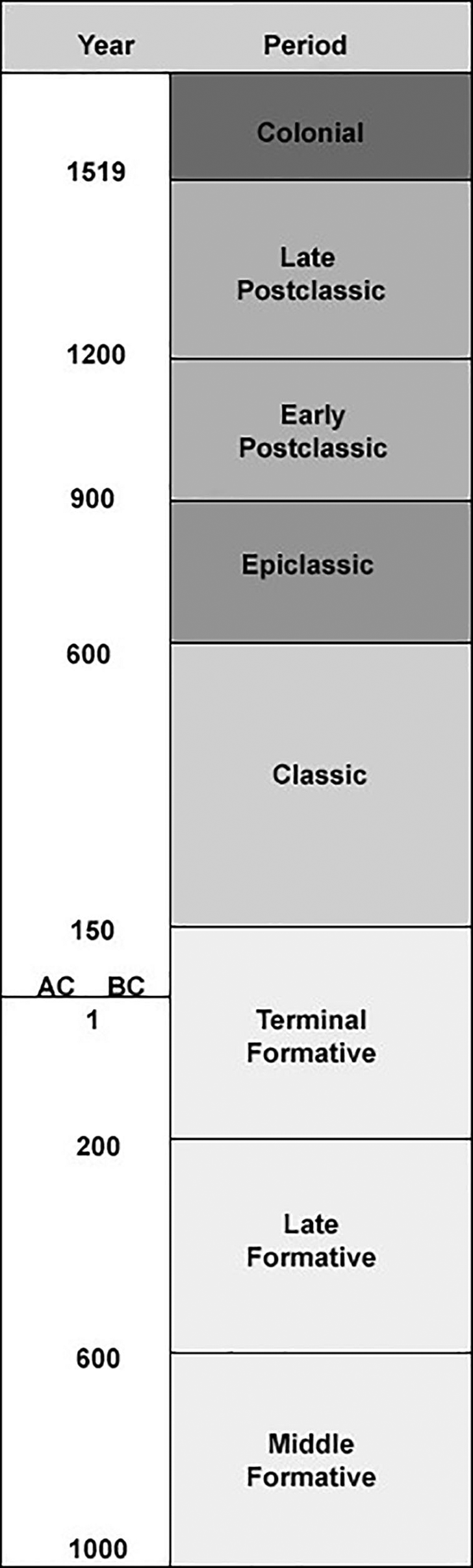
Central Mexico chronology.
We then examined two contact period sites in Tlaxcala: Tepeticpac and Cinco Santos II. Tepeticpac was one of the main altepemeh (centers) of the Tlaxcalan confederacy (Fargher et al. Reference Fargher, Blanton and Heredia Espinoza2010, Reference Fargher, Heredia Espinoza and Blanton2011; López et al. Reference López Corral, Fargher and Cano2016; López and Santacruz Reference López Corral and Cano2010; Muñoz Camargo Reference Muñoz Camargo and Chavero1892 [1576–1595]:99, 103, 112–113), and the data there are derived primarily from domestic consumption contexts. In contrast, the site of Cinco Santos II (CSII) is a small rural obsidian workshop site operating during the Late Postclassic where obsidian was imported and used to produce products that were distributed and consumed within the Tlaxcala region. Together they supply a profile of obsidian use and consumption at two different scales, providing a baseline to evaluate whether the proposed economic blockade affected the flow of obsidian sources under Aztec control into the Tlaxcalan heartland.
Methods
Obsidian geochemical signatures have become a standard way to discuss intra- and interregional relationships between groups and polities (Ebert et al. Reference Ebert, Dennison, Hirth, McClure and Kennett2014; Golitko and Feinman Reference Golitko and Feinman2015; Hirth et al. Reference Hirth, Jeffrey Flenniken, Andrews and Hirth2000; Millhauser et al. Reference Millhauser, Fargher, Heredia Espinoza and Blanton2015; Moholy-Nagy et al. Reference Moholy-Nagy, Meierhoff, Golitko and Kestle2013). Shifts in source utilization often signal changes in access, ideology, or preference for a particular obsidian source; the trade relationships through which they moved; or changes in the centers that dominated their exploitation. Distance to an obsidian source is not the only important factor in resource provisioning; social networks also play a key role. Visualizing the movement of goods across the landscape provides information about linkages between regions, although archaeologists must reconstruct the socioeconomic mechanisms through which obsidian moved. Recent explorations of subsource variability have shed light on past geopolitical frameworks and levels of source exploitation (Millhauser et al. Reference Millhauser, Bloch, Golitko, Fargher, Xiuhtecutli, Espinoza and Glascock2017; Vicencio Reference Vicencio Castellanos2019).
Obsidian sources in this study were identified by combining portable X-ray fluorescence (pXRF) of gray obsidian using a Bruker Tracer III-SD with visual identification of green obsidian assigned to the Sierra de las Navajas source. Obsidian artifacts from the workshop site of CSII were analyzed in the Laboratorio Nacional de Ciencias para la Investigación y la Conservación del Patrimonio Cultural in the Physics Department at the Universidad Nacional Autónoma de México under the supervision of José Luis Ruvalcaba Sil. The Bruker Tracer III-SD was equipped with an X-ray tube with the maximum voltage of 40 kV and a silica detector. The conditions for measurements were processed with a filter of 12 mil AI, 1 mil Ti, 6 mil Cu, 30 μA, and 40 kV. Each sample was run for 60 seconds. The values of parts per million were obtained through calibration of the quantifying coefficient provided by Bruker. Trace elements were interpreted through a reference set provided by Bruker, and the grouping of the elements followed established procedures used by previous studies to enhance reliability (see Supplemental Table 3; Ebert et al. Reference Ebert, Dennison, Hirth, McClure and Kennett2014; Millhauser et al. Reference Millhauser, Fargher, Heredia Espinoza and Blanton2015; Tykot Reference Tykot2017).
Obsidian from Tepeticpac and CSII was analyzed using the lithic technology approach (Clark Reference Clark1982, Reference Clark1985, Reference Clark1986, Reference Clark, Johnson and Morrow1987; Healan Reference Healan, Hirth and Andrews2002, Reference Healan and Hirth2003; Hirth Reference Hirth2006; Hirth and Flenniken Reference Hirth, Flenniken, Hirth and Andrews2002; Hirth et al. Reference Hirth, Andrews, Flenniken and Hirth2006; Hruby et al. Reference Hruby, Braswell and Mazariegos2014; Pastrana Reference Pastrana, Hirth and Andrews2002; Pastrana and Hirth Reference Pastrana, Hirth and Hirth2003; Santley and Barrett Reference Santley, Barrett, Hirth and Andrews2002). Lithic artifacts were analyzed for technological attributes and placed within a reduction sequence beginning with the acquisition of raw material and extending to the production of finished artifacts. Final products include obsidian blades, scrapers, and bifaces, as well as production debitage, associated errors, and general expedient flaking (Hirth and Flenniken Reference Hirth, Flenniken, Hirth and Andrews2002; Inizan et al. Reference Inizan, Reduron-Ballinger, Rochey, Féblot-Augustins and Féblot-Augustins1999). Reduction sequences can reflect social activities within and surrounding the area of production. Here, we compare obsidian remains recovered in production and consumption contexts to evaluate how changes in obsidian procurement networks affected the distribution of raw material and finished obsidian goods recovered in Tlaxcala. The combined use of technological and source analysis provides a more nuanced view of supply networks and exchange dynamics than either of these approaches used alone (Hirth Reference Hirth2008).
Accelerated mass spectrometry (AMS) radiocarbon (14C) dating of charcoal and organic material was conducted at the Human Paleoecology Isotope Geochemistry Laboratory at Penn State. Samples were processed for 14C dating using an acid-base-acid (ABA) procedure described by Kennett and colleagues (Reference Kennett, Plog, George, Culleton, Watson, Skoglund, Rohland, Mallick, Stewardson, Kistler, LeBlanc, Whiteley, Reich and Perry2017). After removing adhering sediment, 20 mg of each sample was subjected to alternating ABA washes in 1 N HCL and 1 N NaOH at 70°C for 20 minutes to dissolve carbonate contamination. The repeated base washes extracted humates accumulated from soil organic matter. A final acid wash removed secondary carbonates formed during the base treatment. After this procedure, samples were returned to neutral pH with two 20-minute baths in deionized (DI) water at 70°C to remove chlorides. Samples were combusted for three hours at 900°C in vacuum-sealed quartz tubes with CuO powder and Ag wire to produce sample CO2. Samples were then reduced to graphite at 550°C using H2 and Fe catalyst, with reaction water drawn off with C-9 Mg (ClO4)2 (Santos et al. Reference Santos, Southon, Druffel-Rodriguez, Griffin and Mazon2004). At the Penn State Radiocarbon Laboratory, graphite samples were pressed into targets in A1 cathodes and loaded on a target wheel with standards and backgrounds for AMS analysis. Results were corrected for isotopic fractionation according to the conventions of Stuiver and Polach (Reference Stuiver and Polach1977). Dates were then calibrated with OxCal v.4.3.2 (Bronk Ramsey Reference Bronk Ramsey2013) using the IntCal13 Northern Hemisphere curve (Reimer et al. Reference Reimer, Bard, Bayliss, Warren Buck, Blackwell, Ramsey and Buck2013).
Obsidian Distribution across Central Mexico
Information about obsidian consumption in Central Mexico comes from excavations at a limited number of sites (Table 1). During the Early Postclassic (AD 900–1200) at Xaltocan, most of the obsidian (68.9%) came from the Sierra de las Navajas source. The use of this green obsidian increased over time, climbing to 93.2% during the Late Postclassic (Millhauser Reference Millhauser and Brumfiel2005). This is not surprising, because Aztec influence facilitated the movement of Sierra de las Navajas obsidian throughout its territories. At Late Postclassic Chalco, obsidian from the Otumba and Sierra de las Navajas sources constitutes between 78% and 94% of the total obsidian assemblage (Elam et al. Reference Elam, Glascock, Neff and Hodge2008). The site of Cihuatecpan, in the Teotihuacan Valley, has the lowest proportion of Aztec-controlled sources of obsidian, but this can be attributed to the fact that only green obsidian is reported, with most of the gray obsidian likely originating from Otumba 3 km to the south (Figure 2). In general, sites in the Basin of Mexico relied heavily on Otumba and Sierra de las Navajas obsidian both before and during Aztec regional influence (Evans Reference Evans1988).
Distribution of Sierra de las Navajas and Otumba Obsidian Reported in Central Mexico Leading up to and during the Late Postclassic.

aOp. 8 midden and surface materials not included.
bContexts sorted through personal communication with David Carballo and Dave Walton.
cData from personal communication with Patricia Plunket at the Universidad de las Americas, Puebla.
dRecalculated by removing non-obsidian lithics from the total.
eSamples come from multiple contexts, with long chronological ranges, thereby making it challenging to determine the time period. Most samples, however, come from the Classic period.
The consumption of green obsidian varies in the regions surrounding the Basin of Mexico (Table 1). During the Classic period, green obsidian from Sierra de las Navajas and gray obsidian from Ucareo, Michoacan, were the two major sources supplying sites in western Morelos. Ucareo became the dominant source provisioning Xochicalco during the Epiclassic (Hirth Reference Hirth2006; Hirth and Angulo Reference Hirth and Villaseñor1981). By the Middle Postclassic to Late Postclassic, the sites of Yautepec (Smith Reference Smith2006), Cuexcomate, and Capilco (Earle and Smith Reference Earle, Smith and Smith2012) steadily consumed green obsidian from Sierra de las Navajas, which constituted more than 90% of any assemblage.
Information on obsidian consumption is limited for the Tula area north of the Basin of Mexico except for the Epiclassic and Early Postclassic periods (Table 1). During the Epiclassic (Prado/Corral phases, AD 600–800), settlements primarily relied on the Ucareo-Zinapecuaro source located 150 km to the west. The distribution of green obsidian from Sierra de las Navajas (70 km to the east) at Tula and smaller sites, such as Cerro Magoni, was relatively low (<10%). By the Early Postclassic (Late Tollan phase, AD 1000–1100), exploitation of Sierra de las Navajas obsidian increased significantly in Tula (60%–85%) but only slightly in Cerro Magoni (18%; Anderson Reference Anderson, Faulseit, Xiuhtecuhtli and Mehta2018; Healan Reference Healan, Kowalski and Kristan-Graham2007, Reference Healan2012). This variation within the region points to complex exchange networks that greatly influenced access to obsidian sources.
In the Toluca Valley, the consumption of obsidian sourced from Sierra de las Navajas and Otumba increased steadily over time (Table 1). During the Classic and Epiclassic, the quantity of obsidian from these sources at Santa Cruz Atizapan was low, ranging between 13% and 15% (Benitez Reference Benitez2006). At Calixtlahuaca, the frequency of these two sources rose from 49.65% during the Middle Postclassic to 56.54% and, eventually, 70.46% by the end of the Late Postclassic (Huster Reference Huster2016). This steady growth of Sierra de las Navajas and Otumba obsidian points to the increase of trade between the Basin of Mexico and the Toluca Valley throughout the Postclassic.
What is important here is that the frequency of green obsidian from Sierra de las Navajas remained relatively steady in the Puebla-Tlaxcala region (Table 1). During the Classic period, information from Cholula and the site of Nealtican indicates that the southern Valley of Puebla was largely provisioned with green obsidian from Sierra de las Navajas, which constituted between 50% and 78% of lithic assemblages (Edelstein Reference Edelstein1995; Hirth Reference Hirth2013). In the northeastern part of the region at Cantona, green obsidian only made up 10% of the overall assemblage (Tellez Nieto Reference Tellez Nieto2013). This is a result, no doubt, of Cantona's location adjacent to the Zaragoza-Oyameles obsidian source that met most of its obsidian needs (Figure 2). The quantity of green obsidian arriving in central Puebla-Tlaxcala declined during the Epiclassic to between 12% and 19% at Xochitecatl-Cacaxtla and Cholula, when the former grew into a powerful regional center and the latter was partially abandoned (Edelstein Reference Edelstein1995; Hirth Reference Hirth2005; Plunket and Uruñuela Reference Plunket Nagoda and Ladrón de Guevara2018). During the Middle to Late Postclassic periods, the Puebla-Tlaxcala Valley was largely under the influence of the three altepemeh of Tlaxcala, Cholula, and Huexotzinco. Throughout the Postclassic, obsidian in the form of macrocores, polyhedral cores, and finished blades entered the region from a variety of sources. During the Late Postclassic it constituted only 5.6% of the obsidian assemblage at La Laguna, Tlaxcala, and 14%–16% of assemblages at Tepeticpac and other sites in the Tlaxcalan confederacy. At Cholula, green obsidian ranged from 18% to 23% for undifferentiated Postclassic deposits (Edelstein Reference Edelstein1995). Consequently, Sierra de las Navajas remained a relatively secondary resource of obsidian in the Puebla-Tlaxcala region.
Obsidian Consumption in Late Postclassic Tepeticpac, Tlaxcala
The altepetl of Tepeticpac is the oldest of the four central señorios within the Tlaxcalan confederacy (López et al Reference López Corral, Fargher and Cano2016). Tepeticpac was first occupied during the Epiclassic when it had a small residential population (López et al. Reference López Corral, Fargher and Cano2016; Muñoz Camargo Reference Muñoz Camargo and Chavero1892 [1576–1595]:53–54). As the first of the four señorios, Tepeticpac is located on a defensible hilltop (Figure 3) and was a major military center within the Tlaxcalan confederacy compared to the other three señorios of Tizatlan, Ocotelulco, and Quiahuiztlan (Aguilera Reference Aguilera1991:32; López and Santacruz Reference López Corral and Cano2010; Muñoz Camargo Reference Muñoz Camargo and Chavero1892 [1576–1595]:103). Tepeticpac's large public spaces, absence of luxurious elite palaces, and lack of iconography elevating a single individual or lineage have been used as evidence for communal or corporate leadership (Fargher et al. Reference Fargher, Blanton and Heredia Espinoza2010, Reference Fargher, Heredia Espinoza and Blanton2011, Reference Fargher, Blanton, Heredia Espinoza, Nichols and Rodríguez-Alegría2017; López et al. Reference López Corral, Fargher and Cano2016, Reference López Corral, Almanza, Ibarra Narváez and Cano2019). Tepeticpac was a large center that exerted considerable influence over the Puebla-Tlaxcala region. Its ceramic assemblage is different from that of neighboring Cholula and reflects a regional tradition shared by other sites within the Tlaxcalan domain. Tepeticpac's regional prominence made it an important center of obsidian consumption during the Late Postclassic (Millhauser et al. Reference Millhauser, Fargher, Heredia Espinoza and Blanton2015; Vicencio Reference Vicencio Castellanos2015; Xiuhtecutli Reference Xiuhtecutli, Faulseit, Xiuhtecuhtli and Mehta2018).
Archaeological excavations conducted in 2012 by Aurelio López and Ramón Santacruz Cano uncovered an elite residence, labeled CA-2 (Figure 3), near the summit of Tepeticpac (López and Santacruz Reference López Corral, Vera Ortiz, Cano, Hirth and Dyrdahl2015). The compound was a multiroom residence with partially intact stucco floors for three rooms connected by a hallway, one platform, and an external patio (Figure 4). The residence was occupied primarily during the Late Postclassic period as Tepeticpac rose to power; it continued to be occupied throughout the period of the supposed Aztec trade embargo and into the early colonial period. It was inhabited during Spanish contact, and its occupants would have been witnesses to and likely participants in the events of the conquest between AD 1519 and 1521.
Map of Tepeticpac and location of CA-2 excavation (López et al. Reference López Corral, Vera Ortiz, Cano, Hirth and Dyrdahl2015:Figure 2).

Two mass spectrometer (AMS) radiocarbon (14C) assays from the Late Postclassic occupation were analyzed from this structure (Figure 5). The first sample dates to 435 ± 15 BP (PSUAMS-2715; charcoal). The 2σ calibrated age range is cal AD 1433–1464. The second sample dates to 330 ± 15 BP (PSUAMS-2717; seed) and has two possible 2σ calibrated age ranges; cal AD 1490–1603 (77.1%) and cal AD 1613–1637 (18.3%). Because the analyzed obsidian comes from a precontact level below the early colonial structure, we believe that the date falls within the former calibrated age range and very likely represents only prehispanic material (López et al. Reference López Corral, Gentil, Fargher, Alcantara and Cano2020).
Late Postclassic / contact period excavation map from CA-2 (Vicencio Reference Vicencio Castellanos2015:Figure 8).

The obsidian from CA-2 consists primarily of finished pressure blades (73.1%). The obsidian debitage recovered from Late Postclassic levels indicates that a small amount of in-residence craft production was practiced at CA-2 consisting of obsidian biface and pressure blade production (Vicencio Reference Vicencio Castellanos2015:Table 19; Supplemental Table 1). Almost 16% of the obsidian assemblage consisted of green obsidian, which geochemical analysis has confirmed originated from Sierra de las Navajas (Supplemental Table 3). All the percentages discussed here and throughout this article are expressed in counts of artifacts.
Geochemical analysis was conducted on a random sample of 178 pieces of gray and black obsidian using pXRF to determine the other sources used to produce finished artifacts within the workshop. The results of these 178 determinations are presented in Supplemental Table 1 with the percentage of assemblage adjusted for the visual identification of Sierra de las Navajas pieces and summarizing all the obsidian sources represented in the collection. Obsidian from Paredón, Puebla, constitutes 59.2% of the collection. Three other gray obsidian sources are represented: Zaragoza-Oyameles, Puebla (12.8%); Otumba, Mexico (9.0%); and Pico de Orizaba, Puebla (3.3%; Vicencio Reference Vicencio Castellanos2015:Table 19). These findings appear comparable to those reported elsewhere in Tlaxcala. All four señorios—Tepeticpac, Ocotelulco, Quiahuiztlan, and Tizatlan—report percentages of obsidian from Sierra de las Navajas at about 14% by count and 12% by weight (Millhauser et al. Reference Millhauser, Fargher, Heredia Espinoza and Blanton2015; Xiuhtecutli Reference Xiuhtecutli, Faulseit, Xiuhtecuhtli and Mehta2018; see Table 1). Overall, Tepeticpac and its surrounding señorios obtained approximately 15% of their obsidian from the Aztec-controlled source of Sierra de las Navajas during the Late Postclassic period. When the Otumba source is included, the quantity of obsidian derived from Aztec-controlled sources rises to approximately one-quarter of all obsidian consumed at Tepeticpac. The 14C date of the CA-2 residence also makes it contemporaneous with the small rural obsidian workshop excavated at the Cinco Santos II site.
Obsidian Consumption and Production at Cinco Santos II
The site of Cinco Santos II (CSII) was located during the Proyecto Regional de Sitios Secundarios in Puebla-Tlaxcala (Gentil Reference Gentil2018). It falls within the Tlaxcalan confederacy and is located on a slope overlooking the valley corridor that connects the Puebla-Tlaxcala Valley with the Basin of Mexico (Figure 1). This corridor was an important communication route between Central Mexico and the Gulf coast (Carballo and Pluckhahn Reference Carballo and Pluckhahn2007; García Cook Reference García Cook, Sabloff and Andrews1981). If an embargo existed, this route would have been closely monitored to prevent the flow of goods into Tlaxcala.
CSII is a domestic site approximately 3 ha in size, located on a hillslope 14 km north of Tepeticpac and 1 km north of the Late Postclassic Tlaxcalan village site of Tlixpa. Obsidian production debitage was widespread, indicating that many of its households were involved in obsidian craft production. If raw materials were moving through commercial exchange networks, CSII's location along the natural transportation corridor into and out of the Basin of Mexico would have provided good access to obsidian from Otumba and Sierra de las Navajas, located 60 km and 95 km to the northwest, respectively. Conversely, we would expect these two sources to yield low percentages at CSII if the Aztec embargo were effective in restricting the flow of Basin of Mexico goods into Tlaxcala, especially because the source of Paredón is only 45 km north of the site.
Two areas were excavated at CSII, a domestic structure associated with an obsidian workshop and a small open platform that may have been a public assembly area. AMS radiocarbon dates were run on charcoal from sealed contexts in each area (Figure 5). This analysis established that CSII was a single-period occupation site that dated to the end of the Late Postclassic. The AMS 14C date from the domestic workshop was 480 ± 20 BP (PSUAMS-6413), which produced a 2σ calibrated age range of cal AD 1416–1446. The AMS 14C date from the open platform was 455 ± 20 BP (PSUAMS-6412) producing a 2σ calibrated age range of cal AD 1420–1455 (Figure 6). The calibrated ranges of both these dates place them prior to or shortly after the implementation of the proposed embargo.
AMS calibrated dates. OxCal v4.3.2 Bronk Ramsey (Reference Bronk Ramsey2017); r5 IntCal13 atmospheric curve (Reimer et al. Reference Reimer, Bard, Bayliss, Warren Buck, Blackwell, Ramsey and Buck2013).

We recognize the difficulty of using radiocarbon methods to date archaeological remains to only a 60- to 70-year period. It should be noted that both CSII dates were from charcoal from posts, which raises the “old wood” issue for consideration; the trees used for the structure were cut 15–20 years before its final occupation (Dean Reference Dean1978; Schiffer Reference Schiffer1986). This implies that CSII closely aligns with the period of Aztec–Tlaxcala conflict. Ceramics recovered at CSII place the occupation of the site to the very end of the Late Postclassic period. Like CA-2, CSII also has a low percentage of early colonial ceramics in its assemblage, suggesting that it was occupied contemporaneously with Aztec–Tlaxcalan aggression and the proposed embargo. Given that obsidian was fundamental to the production of weaponry, we expect that it would have been a prime resource targeted by an economic embargo. Ethnohistorical sources indicate that Tenochtitlan seized control of towns near and leading to the Sierra de las Navajas source from Texcoco, which suggests it wanted to restrict access to the source, even by their allies (Pastrana and Carballo Reference Pastrana, Carballo, Nichols and Rodríguez-Alegría2017:Figure 22.1).
All the obsidian (1,978 pieces) collected from survey and excavations was analyzed using the lithic technology approach and assigned to the respective stage of production (Table 2). The primary production activity was the manufacture of obsidian prismatic blades. A total of 61.7% of the production debris was associated with blade manufacture, which included percussion core shaping (15.2%), pressure core shaping (15.9%), and final blade production (27.9%). The presence of corner blades and half-cylindrical core fragments in the assemblage indicates that craftspeople at CSII used both progressive and sequential core-reduction techniques to produce prismatic blades (Hirth et al. Reference Hirth, Severino, Johnson, Gentil, Cyphers, Hirth and Cyphers2020). General percussion flaking and some bifacial and unifacial production were also practiced (16.7%). Undiagnostic small flakes and flake shatter (21.7%) were recovered as well. The production activities identified reflect general-purpose production where obsidian blades were produced alongside expedient flakes and a few bifaces and unifaces.
Detailed CSII Obsidian Analysis of All Obsidian Organized by Technology and Differentiated between Green and Gray.

Table 2 separates green and gray obsidian into their respective technological categories. Technological analysis indicates that obsidian entered the workshop as both shaped macrocores and unworked nodules. The full range of core-shaping debitage using percussion and pressure techniques was recovered, indicating that macrocores had a small amount of cortex on one or more of their lateral surfaces. Unshaped nodules were used for both general percussion flaking and shaping a few bifaces and unifaces.
Source analysis was conducted as a two-step process. First, the amount of green obsidian, 11.8% of the CSII collection, was identified visually and confirmed as originating from Sierra de las Navajas with geochemical analysis (Supplemental Table 3). Second, geochemical analysis was then conducted on a sample of 148 gray obsidian artifacts using pXRF to determine the geological sources represented in the remaining gray obsidian sample. Four separate sources are represented in the gray obsidian: Paredón, Zaragoza, Otumba, and Pico de Orizaba. As can be seen in Table 3, Paredón is the dominant source. The obsidian from four of these sources, including Sierra de las Navajas, appears to have entered the workshop both as preformed macrocores for blade production and as small unworked nodules for bifacial general percussion reduction (Table 3). The same may also have been true of the Pico de Orizaba obsidian, although the sample is too small to determine whether this was the case.
CSII Obsidian Technological Analysis of 148 Obsidian Pieces Sourced via pXRF.
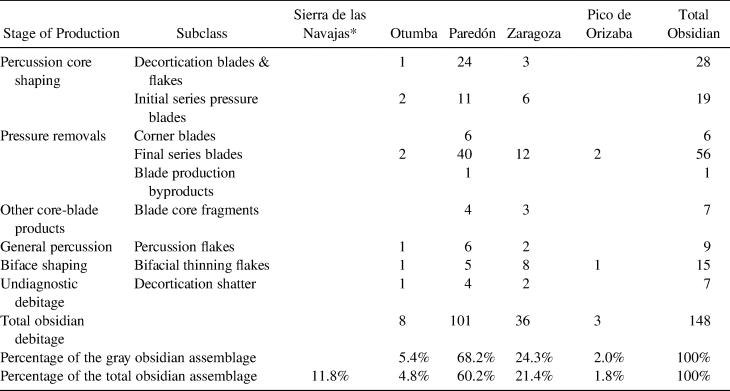
* See Table 2 for technological categories for Sierra de las Navajas.
The proportions of gray obsidian were then applied to the whole obsidian assemblage used in the CSII workshop during the Late Postclassic. These adjusted totals are presented in Table 3. Obsidian from Paredón constitutes 60.2% of the raw material reduced in workshop contexts, followed by obsidian from Zaragoza-Oyameles at 21.4%. The Valley of Mexico sources of Sierra de las Navajas (11.8%) and Otumba (4.8%) together represent 16.2% of the obsidian. Obsidian from the distant Pico de Orizaba occurs as trace amounts at 1.8% of the assemblage. The question that remains is this: What do the obsidian consumption and production data from Tepeticpac and CSII reflect about general economic patterns and the trade embargo believed to have been imposed on Tlaxcala by the Aztec state?
Discussion
The obsidian information recovered from Tepeticpac and CSII provides complementary pictures of obsidian provisioning in Tlaxcala at the very end of the Late Postclassic period. The CA-2 excavation at Tepeticpac uncovered a contact period residence of a high-ranking family that continued to be occupied into the early colonial period. Analysis of the lithic technology from CA-2 reflects a household that consumed large numbers of obsidian blades, produced a few bifaces for military armament and other activities, and used percussion flakes in addition to obsidian blades for cutting activities. The presence of both macroblades and narrow percussion blades in the collection indicates that household residents probably had access to some macrocores or polyhedral cores, although it is unclear how much reduction was carried out within the household.
CSII was a small rural obsidian workshop, and meeting its provisioning needs was fundamental to its operation. Technological evidence indicates that it engaged in the manufacture of obsidian blades alongside a small amount of flake percussion and biface manufacture. Geochemical analysis reveals that this workshop was provisioned with raw material from five obsidian sources. Paredón and Zaragoza-Oyameles were the two primary sources, which together provided 81.6% of the obsidian entering the workshop. Present in lesser amounts was obsidian from Sierra de las Navajas (11.8%), Otumba (4.8%), and Pico de Orizaba (1.8%). What is particularly noteworthy is that the five obsidian sources identified at the CSII workshop are the same sources recovered in the CA-2 residence at Tepeticpac (see Table 2 and Supplemental Table 1). Although we cannot determine whether CSII produced and distributed goods at Tepeticpac, the two sites provide a view of obsidian consumption within Tlaxcala at different ends of the provisioning spectrum: CSII at the level of crafting supply (Hirth Reference Hirth2008) and CA-2 as an example of domestic consumption. In both cases obsidian from Paredón, Puebla, was the dominant material used to fashion obsidian tools.
Archaeological evidence shows that the Otumba and Sierra de las Navajas obsidian sources played an important role in provisioning sites in the Basin of Mexico from the Early Formative onward (Johnson and Hirth Reference Johnson and Hirth2019). Although both were significant sources, obsidian from Sierra de las Navajas became increasingly important from the Classic period onward, eventually dominating lithic assemblages within the Basin of Mexico and Morelos during the Middle and Postclassic periods (Table 1). The Puebla-Tlaxcala region reflects a different story. Although obsidian from Otumba and Sierra de las Navajas entered the region throughout its history, it did so in small to moderate amounts depending on the time period. More important throughout the region's development was obsidian obtained from Paredón (Supplemental Table 2). Beginning during the Middle Formative period, Paredón supplied a good deal, if not most, of the obsidian consumed in sites throughout the Puebla-Tlaxcala Valley. Recent geochemical analysis provides a breakdown of the obsidian sources used in sites during the Formative period (Supplemental Table 2). The predominance of Paredón obsidian at both CA-2 and CSII before Spanish contact reflects the operation of a long-standing obsidian provisioning network that stretched back into the Formative period. Had a trade embargo of obsidian been initiated, it would have been difficult to restrict access to Paredón and Zaragoza-Oyameles obsidian sources, because they were part of traditional commercial networks that extended far back in time. Moreover, the quantity of obsidian arriving at Puebla-Tlaxcala from the Sierra de las Navajas source seems to have remained relatively unchanged from the Epiclassic into the Late Postclassic.
Although this research focused on obsidian as a critical resource that would have been only one element of an embargo, it is also interesting that a few Basin of Mexico ceramics entered the Puebla-Tlaxcala region. At CSII 1.5% of the ceramic assemblage consists of three primary imports from Basin of Mexico: Aztec Black on Orange, Texcoco Black on Red, and Texcoco Black and White on Red. At Tepeticpac these three types represent 7.4% of the ceramic assemblage, although most appear to be local tradeware imitations (Xiuhtecutli Reference Xiuhtecutli, Faulseit, Xiuhtecuhtli and Mehta2018). It is unlikely that local populations in Tlaxcala would want ceramic service ware that reflected contact with the Basin of Mexico if the Aztecs had imposed a crushing economic embargo across the region. It is more probable that these ceramics, like obsidian, were moving through normal commercial networks into and across Puebla-Tlaxcala.
Conclusions
Investigating the possibility of an Aztec trade embargo on Tlaxcala is a fascinating and perplexing endeavor. It is fascinating because, if true, it would imply the use of economic policy to weaken an opponent much like the way that economic sanctions are used against political rivals in our current geopolitical climate. The use of economic sanctions would imply the existence of a highly commercialized landscape where the disruption of economic transactions could have a significant impact on the sociopolitical organization of prehispanic groups. It is perplexing because of the difficulty in isolating a 60- to 70-year interval over which an embargo may have been imposed, even when using high-precision 14C dating. Typically, archaeologists are not fortunate enough to have calibrated dates that fall within a narrow time span of less than 100 years.
Information from recent contact period occupations at Tepeticpac and Cinco Santos II provides a useful basis for comparison. The data suggest that if there was an attempt to restrict access to obsidian and other goods entering the Tlaxcala region during the period of the Triple Alliance, it was ineffective. The quantity of obsidian from the Sierra de las Navajas source recovered at Tepeticpac and Cinco Santos II is virtually the same as found at other sites throughout the Puebla-Tlaxcala region from the Epiclassic period onward (Table 1). This reinforces the study by Millhauser and colleagues (Reference Millhauser, Fargher, Heredia Espinoza and Blanton2015) that identified obsidian from Aztec-controlled sources in surface collections at several Postclassic sites within the Tlaxcalan domain. The embargo may have been a good talking point for Motecuhzoma II, but the type and quantity of obsidian entering the region remained relatively unchanged over the length of the Postclassic period. Obsidian provisioning most likely was the product of long-standing and independently operating commercial networks that provided for regional provisioning needs independent of any political control or influence.
Future work is needed to test the reality of the embargo using other materials. Cotton is one resource that is included in the list of embargo goods and could be examined using changes in spindle whorl frequencies for spinning cotton and maguey textiles (e.g., Ibarra et al. Reference Ibarra, Corral and Cano2018). Nevertheless, the available data suggest that the Aztec embargo on Tlaxcala was more fiction than fact. Muñoz Camargo (Reference Muñoz Camargo and Chavero1892 [1576–1595]:123–124) is the primary sixteenth-century source for Tlaxcala. He ridiculed the idea that the Aztecs kept Tlaxcala as “quails in a cage” for their military exploits and to provide sacrificial victims for Aztec ceremonies. Obsidian was a vital resource, but the information provided here suggests that even if a trade embargo were enacted, it was not effective in isolating Tlaxcala from trade networks that moved obsidian and other daily goods throughout Central Mexico prior to Spanish contact.
Acknowledgments
This research was completed with the involvement of several departments at Penn State: Anthropology, Latin American Studies, Global Studies, and the Liberal Arts Graduate program. We are extremely grateful to the Centro INAH Tlaxcala and Dr. Aurelio López Corral for their continuous collaboration. Geochemical sourcing was supported by grants LN279740, LN293904, LN299076, and CB239609 from CONACYT and IN112018 from PAPIIT UNAM and was carried out in the Laboratorio Nacional de las Ciencias para la Investigación y Conservación del Patrimonio Cultural at the Instituto de Física of the Universidad Nacional Autónoma de México. We thank Drs. José Luis Ruvalcaba Sil, Edgar Casanova González, and Alejandro Mitrani Viggiano for graciously providing access and permission to analyze obsidian from CSII. Finally, we would like to acknowledge Dr. Eric Dyrdahl at Pontificia Universidad Católica del Ecuador for his contributions in developing the standards for identifying the chemical composition of Central Mexican obsidian sources; we also thank Dr. Brendan Culleton and Laurie Eccles at Penn State's AMS Radiocarbon facilities for their support.
Data Availability Statement
All radiocarbon and pXRF data presented in this article can be obtained from ScholarSphere (Penn State): https://doi.org/10.26207/4556-2p42.
Supplemental Materials
Supplemental material for this article is available at https://doi.org/10.1017/laq.2021.31.
Supplemental Table 1. Obsidian Industry and Sourcing at Tepeticpac in the Late Postclassic.
Supplemental Table 2. Obsidian Distribution in Puebla-Tlaxcala during the Formative Period.
Supplemental Table 3. Raw pXRF Data from CSII.
Supplemental Text 1. pXRF Reference and Obsidian Sampling.
Supplemental Text 2. Reference for Supplemental Table 2.


 Open access

