




History GCSE is currently a popular subject across England, Wales, and Northern Ireland, with between 40 and 50 per cent of the year group opting for it, numbers rising steadily since 2016, to around 300,000 in 2024/25.Footnote 1 The new GCSE requirements rolled out by the Conservative government between 2014 and 2016 presented teachers with ‘extensive change’’. One of these changes was an element of medieval history across all GCSE boards. Whilst the introduction of medieval history to GCSE is certainly a ‘Good Thing’’, the content largely serves to reinforce stereotypes of medieval history learnt in Key Stages (KS) 2 and 3.Footnote 2 Curricula and lack of training, time and resources militate against a consistent and rich experience for teachers and students alike. The lost opportunities for innovative content and pedagogical approaches are especially keen considering that the history curriculum of England is a high-autonomy and a high-trust model, where schools make policy decisions at school level.Footnote 3 The current Labour government has recently published its review of the National Curriculum which recommends a new framework on oracy and giving greater prominence to Drama.Footnote 4 This article will firstly review the existing content of medieval history in KS3–4, drawing upon the National Curriculum, GCSE syllabuses and several interviews with early and mid-career History teachers for input from the classroom.Footnote 5 In the second part, it will focus on several specific GCSE topics and propose that the most famous poem from Old English literature can be used as an historical source to enrich student learning experience in line with the recommendations of expanding oracy and Drama in the classroom.
Context and curricula
In disputes over ‘the school history curriculum’, it is easy to overlook that in all four nations of the UK, national curriculum policy does not direct schools about what historical topics should be taught; instead, policy devolves these decisions to schools. The controlling influence usually comes from the subject lead/head of department.Footnote 6 An Ofsted History report of 2021 mentions that the work of some teachers remains limited by narrow repertoires of content and out-of-date scholarship.Footnote 7 Pupils need to study diverse non-textual sources such as music, oral tradition, folksong and photography; archaeological remains can be powerful in teaching pupils that sources need to be interrogated with questions in mind. Pupils should study sources with a rich and detailed knowledge of the context in which they were produced (sometimes referred to as ‘hinterland’) to make sense of, and learn, core knowledge. Hinterland information provides meaningful examples and secure contexts for learning: it can connect and organise information into coherent narrative, develop familiarity or initial schemata for later learning, broaden curriculum content and demonstrate the diversity of past experiences.
In 1990, Professor Jinty Nelson argued the case for medieval history in the curriculum but warned that medieval history ‘does not have to be all Camelot, and the Ladybird books’.Footnote 8 Unfortunately, this warning was not heeded. The comprehensive overhaul of the National Curriculum by the Conservative-led coalition, rolled out for teaching in the years 2013–16, was the most significant change to content delivery for decades and resulted in the return to a narrow anglocentric curriculum (even though it was watered down through consultation).Footnote 9 In the words of Joseph Smith, ‘The decision to include all ancient, medieval and early modern history in the curriculum for 7–11 years makes little sense and will leave young people with a simplistic understanding of past societies. Secondary teachers will, inevitably, be left trying to plug gaping holes in pupils’ understanding’.Footnote 10 The hasty gallop through KS2 History confirms these fears, where pupils ‘should’ be taught about Stone Age to Iron Age, Britain’s settlement by Anglo-Saxons and Scots, Viking and Anglo-Saxon struggle for the Kingdom of England (to 1066), a local history study, an aspect or theme that extends chronological knowledge beyond 1066 (such as the first railways or the Battle of Britain), the achievements of the earliest civilisations (such as the Shang dynasty), Ancient Greece and finally, a non-European society such as the Mayans.
Since the implementation of the National Curriculum in 1988, primary school teachers have been called upon to deliver over ten different subjects. After the introduction of primary league tables in 1996, the three core subjects – Mathematics, English and Science – gained significance, while that of the foundation subjects diminished. As a result, the gap between foundation and core subjects widened, leaving the former with a low and marginal status and a reduced time allocation within pre- and in-service training. This has led to low teacher confidence in the foundation subjects in England and often a reduced teaching space for them on the school timetable.Footnote 11 The situation for pre-service secondary teachers is not helped either by the generic nature of the Department of Education Core Content Framework, which focuses on the well-being, motivation and behaviour of pupils and discourages subject-specific teacher education: a ‘profound problem’ at both primary and secondary level, according to the Historical Association.Footnote 12 An undergraduate degree in History is not a requirement for secondary teaching; nor is a degree related to the subject if A-level History has been gained.Footnote 13 However, this is at the discretion of the provider, who may offer a subject knowledge enhancement course (SKE) for those without degrees in the subject or master classes with Teach First, including Anglo-Saxons and Normans at GCSE.Footnote 14 That said, resources, not subject expertise, make the difference.Footnote 15 There is an assumption, even with medieval history, that ‘you know your stuff’’.Footnote 16
University subject knowledge, schemes of work in the department (which vary in quality), support from Head of Department or mentor, websites, a department library and perhaps membership of the HA are all potential sources of support. So too are enrichment activities, but rising costs limit trips and guest speakers.Footnote 17 Almost of all KS3 History content is non-statutory (apart from the Holocaust), but the guidance topics are the canonical events – the Norman Conquest, Religion and Crusades, Church and Crown, Magna Carta, the Conquest of Wales and Scotland, Feudalism and Black Death, the Peasants’ Revolt, the Hundred Years War, the Wars of the Roses and Henry VII. Teacher A, an experienced subject lead and mentor, sees the National Curriculum as a ‘jumping off point’. Teacher D, an ECT, sees the National Curriculum as being as ‘broad as it wants to be’. Teacher C initially found the KS3 course very ‘1066 and all that’, which was inadequate and frustrating to the children who grappled with disjointed chunks of knowledge despite it being presented as a narrative. The curriculum, he said, feels ‘inherited down the ages’ – a view echoed by Teacher D in their description of it as a rather ‘Whiggish’ narrative.Footnote 18 By contrast, Teacher A taught global medieval topics such as African kingship and the early Mughal empire to place British medieval England into a better context. Another school uses websites which looks at the wider tenth-century world – including Baghdad/African kingdoms as well as Saxon England.Footnote 19 This teacher thought that the problem is not the lack of options or opportunity to teach medieval history at KS3, but rather the uptake. Modern History gets priority and those few trainees who teach medieval history fall back on what they find comfortable, taking their lead from the Head of Department.Footnote 20 Concerningly, some pupils think medieval history is easier and so they muddle through.Footnote 21
To school pupils, and indeed some History teachers, the lasting impression of English history prior to 1066 is that of a land of rather confusing migrations and invasions until the Normans showed up and sorted things out. The echoes of W. C. Sellar and R. J. Yeatman’s 1066 and All That are strong.Footnote 22 The overload of topics in KS2–3 has also been noted in the 2025 government curriculum review, which recommends that History’s inherent diversity is better supported, for example through ‘a wide range of sources’. Teacher interviews all indicate that enrichment is not enough; any school trips are often aligned with assessment, and priority given to modern history. Time and resources are again the issue. This is a problem, since the greatest challenge of teaching medieval history, according to one teacher, is its physicality. To give an example: since we in 2026 live in a cashless world, when we did not in 2006, it is now more difficult to explain to pupils late eleventh-century tax collection, since it required people to collect and move the money physically.Footnote 23 Other examples include the hand ceremony of fealty, the taking of oaths on holy relics (mostly famously, Earl Harold), and the Salisbury Oath in 1086. These were all performances, moments of high drama that cannot be measured by the written page.
Turning now to the GCSE medieval topics, most of them start at c.1000, or later, obliterating the complexities of early England as irrelevant to ‘real’ history and consciously reinforcing the late Victorian/primary school pre-Conquest fields of study. The three main boards used across England are Edexcel (the largest board, owned by publisher Pearson), AQA and OCR. It is fair to speculate that most teachers probably use specific textbooks written for the board precisely for the examination, and these syllabus textbooks can reinforce stereotypes.Footnote 24 Since this is market-driven, the topics as well as the knowledge are generated in ever-decreasing circles with exam boards and publishing houses closely linked.Footnote 25 The limited choice of medieval topics was even discussed in Parliament.Footnote 26 Pressures of time, examination results and lack of confidence consequently lead to variable experiences in the classroom.
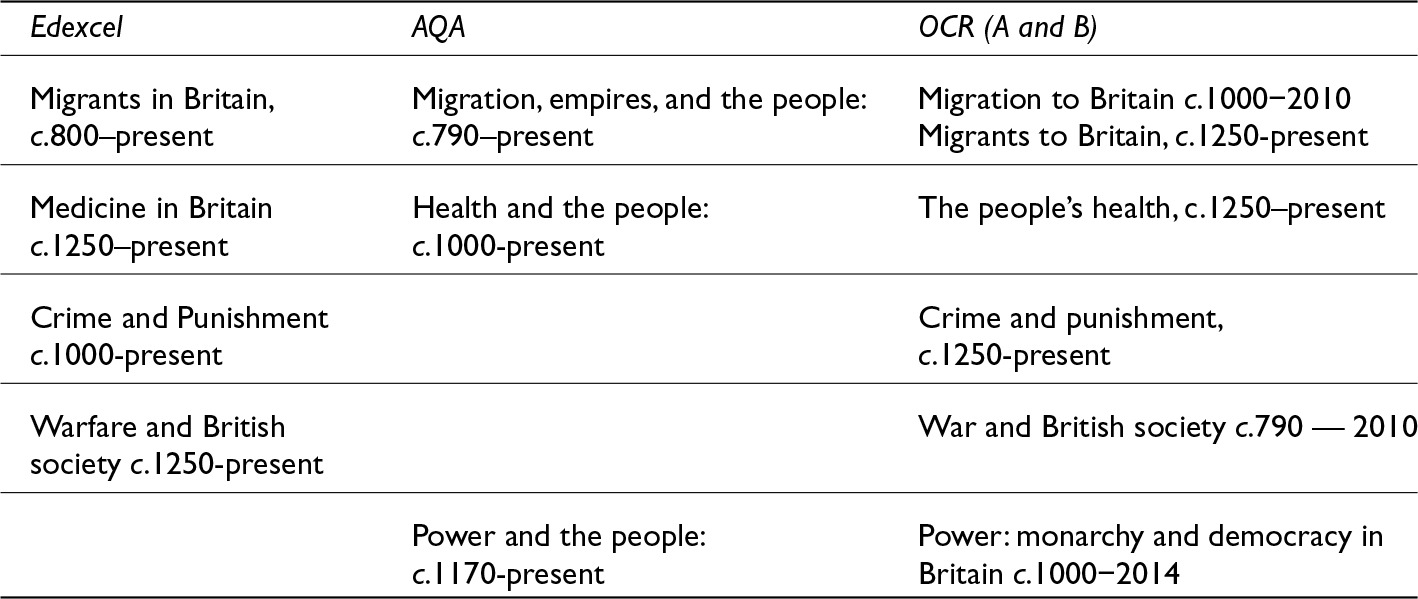
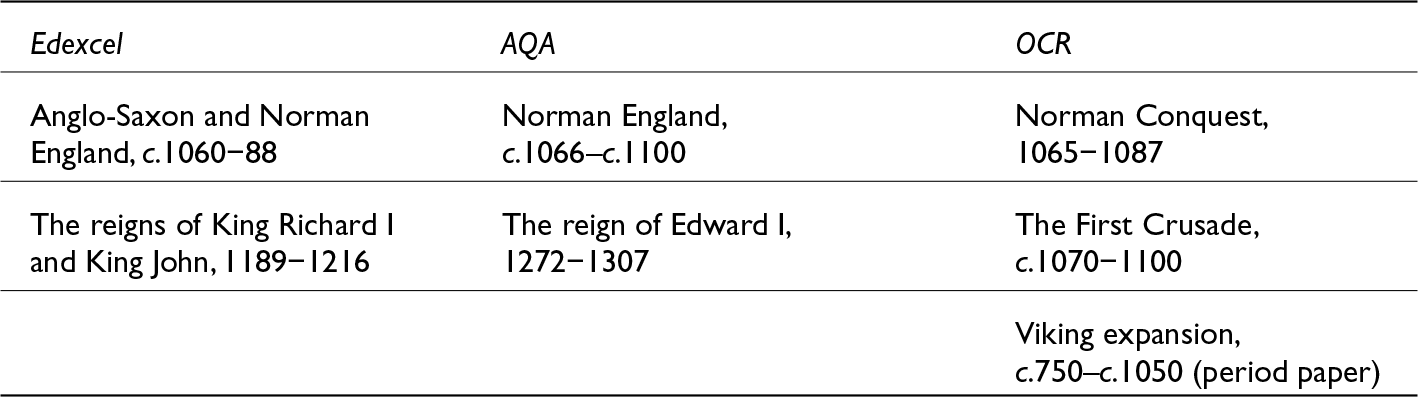
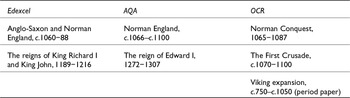
All three boards cover medieval history in the thematic papers (Table 1) but with limited reach prior to c.1000 (discussed in detail below). Only one of the optional depth papers (Table 2), OCR Vikings, looks at anything prior to c.1060. Since the depth papers are chosen from a list of wider period topics, such the ‘Elizabethans, 1580–1603’, the medieval content may not be taught at all in depth. All three boards have a depth paper on the ‘Norman’ England/Norman Conquest’, but begin in 1060 disallowing any context or ‘hinterland’ for the main event. There are no depth studies on pivotal periods including the settlement of the early English and conversion to Christianity, early kingdoms and law codes (c.500–800), nothing on the key reign of Alfred of Wessex (890s) and the unification of all England under Æthelstan in the 930s, a period which many historians have seen as the ‘making of England’. In the words of Professor James Campbell, ‘late Anglo-Saxon England was a nation state. It was an entity with effective central authority, uniformly organised institutions, a national language, a national church, defined borders … and, above all, a strong sense of national identity.’Footnote 27
Edexcel, AQA, OCR GCSE thematic papers
Edexcel, AQA, OCR GCSE depth papers
There is no sense at all of this from the GCSE syllabuses. Unfortunately, A-level topics repeat the same, masculinist, anachronistic periodisation – the Norman Conquest, King John, ‘Crusades’ and ‘Lancastrians and Yorkists’/’Wars of the Roses’ and the ‘Tudors’. AQA has no medieval English history prior to 1154. OCR at least offers ‘Alfred the Great and the Making of England c.871–1066’ and the ‘Viking Age c.790–1066’, although both cannot be taken. For Edexcel, the largest A level board, the ‘medieval world’ starts in c.1053, again, implying that anything before is merely a backdrop of dark age irrelevance. The conclusion one must draw is that canonical stereotypes are transmitted at KS3, repeated with some more details at GCSE to meet examination requirements and then reinforced at A level with the structural framework. Teacher C pointed out that more medieval history at A level (uptake is probably round 5 per cent) requires a stronger KS3 context.Footnote 28
Writers of history have long categorised and labelled the past for their own convenience. Henry of Huntingdon’s influential Historia Anglorum (1140s) divided English history into five periods: the Romans (55 bc), Picts and Scots, the Anglo-Saxons (fifth century), the Danes (ninth century) and the Normans (1066) – periods which almost exactly match the England curriculum across KS2–3. The received history of early medieval England is Bede’s Ecclesiastical History of the English People, written, in Professor David Dumville’s words, ‘in national mode’ which had a profound effect on the developing English church and in turn political development.Footnote 29 Even though it was not a history of early England, Bede’s Ecclesiastical History has been taken to represent the factual, rules-based ‘history’, chiefly because nothing in writing exists of the history of sub-Roman Britain after c.400 to when Bede was writing in c.730.
The implication is that medieval England and its history is infantile in contrast to the ‘adult’ modern age. It is a perspective that stems from the late nineteenth-century teaching of medieval history, which used the pedagogical instruction of children for moral lessons as a form of ‘enlightened patriotism’.Footnote 30 This has led to what I call a ‘Bede or Beowulf’ approach to medieval England, in that the undated, anonymous epic poem Beowulf represents an imagined/charismatic past that has no ‘dates’ or ‘facts’ and so is confined to the discipline of ‘literature’. History, by contrast, is taught on Bedan principles – dates, kings, queens and battles. Here, the past is not imagined, it is measured by Bede’s metrics of progress from pagan to Christian, oral to literate, barbarism to civilisation.
That this is the case is partly because perspectives of early medieval written evidence are so limited. Of the 2,000 or so extant early medieval English charters, more than half are grants by kings.Footnote 31 The story is almost exclusively that of the West Saxons plus Mercia (reinforced by the OCR A level paper ‘Alfred the Great and the Making of England c.871–1066’). Only 30,000 lines of vernacular poetry from the Early English period survive, a mere fraction of what once existed.Footnote 32 No woman is known to have written a chronicle. The written evidence is thus restricted to the upper educated strata of (male) society, surviving in 3 million words, favouring survival of religious texts over secular, heroic poetry over cradle songs and lamentations, privileged upper-clergy or kingly authors over commoners and speakers of English over those of any other vernacular. Indeed, it has been likened to a corpus of Oxbridge theological English being taken to stand for British English as a whole.Footnote 33
Very little academic research seems to filter down to the school syllabuses.Footnote 34 Old phrases perpetuate the problem. The false structural boundaries reinforce teacher–pupil misunderstandings of the past. Teacher C taught Henry VII at A level but saw it as ‘Tudor’ and ‘Early Modern’ history rather than ‘medieval’, so powerful is the ‘1485’ boundary, whereas academics now place the beginning of the ‘Early Modern’ age in 1509, if not the 1530s. Academics are aware that there was no such thing as the ‘Anglo-Saxons’, any more than the ‘Tudors’, ‘Lancastrians/Yorkists’ or the ‘Plantagenets’. ‘Anglo-Saxon’ has become contested recently due to its ethnoracial associations rather than being a silly dynastic label like ‘Plantagenet’. The problem is twofold, however, since before 1066 the English people did not refer to themselves as Anglo-Saxons but most commonly as ‘Englisc’ or the ‘Angelcynn’. The earliest insular use of ‘Anglo-Saxon’ is found in the charters of King Alfred, which refer to him as rex Anglorum et Saxonum and variously as king of the English, king of Wessex and king of the Saxons.Footnote 35 It was not until 1589 that George Puttenham referred to ‘Anglo-Saxon’ in the first English-language use of the phrase. Therefore, it was not a contemporary phrase in common usage. By the later nineteenth century, it had become part of a concerted effort to link white people with an imagined heritage based on indigeneity to Britain; it was associated with the British Empire, colonialism and, in the twentieth century, with white supremacists.Footnote 36 In the twenty-first century these ideas are largely found on the internet, but scholars remain divided over the use of ‘Anglo-Saxon’. The flagship Cambridge University journal Anglo-Saxon England relaunched as Early Medieval England and its Neighbours in 2024 chiefly for reasons of historical accuracy. In doing so, it declared that the term ‘Anglo-Saxon’ is not banned but ‘does not describe the full breadth of the island’s people, politics and influence during the 5th–11th centuries’.Footnote 37 It is surely now time for the National Curriculum to rethink the use of ‘Anglo-Saxon’ – ‘early medieval England’ would suit better – and as well as doing so it might also remove ‘Plantagenets’ ‘Lancastrians/Yorkists’ and ‘Wars of the Roses’.
The case for using Beowulf in the History classroom (KS3–4)
In 2024, the Oracy Education Commission called for oracy to become the fourth ‘R’, alongside reading, writing and arithmetic.Footnote 38 Dimensions of oracy in school curricula include learning to talk, listen and communicate; learning through talk, listening and communication and learning about talk, listening and communication. The 200th edition of Teaching History (Historical Association) focuses on exactly this, with a series of articles on Telling Stories.Footnote 39 The Curriculum and Assessment Review 2025 recommends an oracy framework and greater prominence for Drama, which has strong links to oracy and presenting skills and provides an important introduction to the performing arts.Footnote 40
English Literature academics at King’s College London successfully demonstrated the possibility of teaching primary school children the art of writing Old English words, learning kennings and alliteration, and becoming a scop, storyteller.Footnote 41 In the workshops, children read aloud the Old English, built a word hoard, and used images from the Staffordshire Hoard and other archaeological finds to stimulate the five senses. (The challenge of using kennings is something undergraduate students find difficult, providing a reminder both that Old English and Anglo-Saxon storytelling is anything but ‘infantile’, and of the usefulness of connecting Higher Education academics with KS2 classroom pupils.) The children were then ready to compose their own poem in Anglo-Saxon.
The sole manuscript of the longest epic poem (over 3,000 lines) in Old English, Beowulf, only just survived a catastrophic fire in 1731 at Ashburnham House.Footnote 42 Until its publication in 1815, it was virtually unknown. Whilst the manuscript (composed by two scribes) can be dated to the period 1000 × 1020, the actual poem existed for centuries before this: it was possibly contemporary with the age of Bede.Footnote 43 The narrative arc is one for the ages: a wandering sword-for-hire named Beowulf (who is a prince, naturally), arrives with his band of brothers at King Hrothgar’s Hall to find the land terrorised by a half-human monster, Grendel. Beowulf kills Grendel using almost superhuman powers; there is much rejoicing but Grendel’s mother attacks in the night and slaughters many. Beowulf alone can kill her and does so under the swampy waters with the aid of ancient sword. Beowulf returns home and rules his land for fifty years before a dragon is disturbed by a tomb raider; he kills the dragon, who fatally wounds him, and Beowulf is buried with full military honours on the headland overlooking the sea.
The poem has a twofold purpose: firstly, as a powerful performance packed with dazzling fights and heroic morality on a par with Homer’s Odyssey and secondly, as an historical source for the warrior culture and belief structures of early medieval English settlement. A pedagogic evaluation of the performance and the application of its rich historical material could make Beowulf a vital teaching tool for KS3 and GCSE History teaching, in ways I shall outline below.
Stories provide an organising framework for knowledge and give familiarity to the unfamiliar through features that are grounded in pupils’ lived experience and their knowledge from reading more widely – features such as agents, causation and conflict. Stories exemplify complex and abstract ideas in meaningful, human-scale ways. The poem reminds us that the medium is not the message; primarily it is language itself which forms mentalities, not literacy.Footnote 44 The audience of Beowulf is therefore integral to the performance, as Dorothy Whitelock surmised some time ago in 1951.Footnote 45 And note that it is an ‘audience’; people were there to listen more rather than to spectate. There is such a thing as ‘sonic heritage’ that examines the past as ‘embodied spaces’ using ‘archaeoacoustics’ with a focus on the interrelationship of the senses.Footnote 46 What then was the impact of the sung poem on the audience, its emotional and cognitive reception? Guttural sounds had meaning then: the very first word, ‘Hwæt!’, defies translation but has been rendered variously as ‘listen/lo/behold’. That first word suggests a hybridised narrative situation where written language is used to issue a request for the floor in a manner that hearkens back to traditions of spoken storytelling.
Beowulf is an oral-formulaic poem. Formulas can be used to produce rich poetic effects, using a substitutable phrase that provides the performer with ready-made idiom; formulas and repetition are blurred, something rooted in the nature of Old English verse.Footnote 47 Cognitive scientists have begun to analyse the capacity of literary texts in representing and simulating emotions.Footnote 48 At the centre of the performance was the scop, the early Germanic court singer, who plays an important part in the mental modelling of the Anglo-Saxons’ ancestral past, grounded in the art of ancient Germanic singers of tales.Footnote 49 The oral poet was part of the migration myth-making of the Germanic peoples who had left their ancestral homes to win new kingdoms out of the ruins of Roman Britain, a myth that defined England as a nation.
There was an explosion of interest in Beowulf at the end of the nineteenth century and the heroic-nationalistic ideology of the editions produced for children, with a bibliographic code of specific typefaces, bindings and book design that matched a linguistic code of archaic language all geared to teach early medieval history in a very particular manner.Footnote 50 This set the paradigm for Beowulf being a literary source chiefly for children, rather than an historical source. It is a paradigm that has been difficult to shift. J. R. R. Tolkien’s seminal lecture to the British Academy in 1935 suggested that Beowulf as an historical document is ‘perhaps too little used for the purpose by professed historians’.Footnote 51 Frank Stenton’s magisterial Anglo-Saxon England admitted that Beowulf is ‘an invaluable record of the intellectual outlook of the men under whose protection Christianity was established in England’, where ‘much of the incidental background of Beowulf represents a genuine and accurate tradition’.Footnote 52 Dorothy Whitelock saw Beowulf as ‘first and foremost literature of entertainment’ intended mainly for laymen, but argued that the poet may have been familiar with the works of Gregory of Tours and the Life of St Guthlac, and thus the deeds of the Scandinavian kings in the poem may have a basis in fact.Footnote 53 Patrick Wormald declared that the poem constitutes ‘vital evidence’ for the conversion of the Early English aristocracy.Footnote 54 It is a poem, Wormald argued, that represents cultural memory: a new God had been accepted but the memories of the old ways were not (quite) forgotten and in that sense Beowulf is evidence for the completeness of the early English conversions to Christianity.
The following three sections will demonstrate how the interdisciplinary nature of Beowulf as a remarkable teaching tool tells us much about migration, settlement, apartheid, ethnicities and attitudes towards women, rulership and codes of conduct, while also illuminating the lived experience of the early medieval audience.
Beowulf and migration (AQA, Edexcel, OCR)
All three main boards include Migration as a thematic paper for GCSE. As a topic of current debate, migration must surely be at the very top of the list.Footnote 55 AQA and Edexcel begin their migration thematic paper in c.800 (OCR slightly later in c.1000). The poem Beowulf is first and foremost story of ‘Anglo-Saxon’ migration, set in a previous time and place (Denmark, Sweden in the fifth century), and we have seen that the manuscript dates to 1000 but the poem very likely over 200 years before that, aligning with the AQA and OCR timelines. It brilliantly interlinks past, present and future. The dramatic tale reveals insights into what happened to the native British. Biblical and Early English cultural origin myths were superimposed on the past and their point of contact is migration. Kings promoted the songs about their predecessors and the figures in Beowulf were thought to be real people in a real lineage. The son of Noah is Seth, born in the Ark; and right at the beginning, Beowulf associates the seaborne foundling with Scyld Scefing (Seth), a reference that would not be lost on the audience.Footnote 56 Germanic legend is thus integrated within Christian universal history. Beowulf displays a deeply absorbed sense of the myth of the ancestral migration from the Continent as the founding and defining event which gave the Germanic tribes a shared identity.Footnote 57
A less savoury element of the English migration was its ‘genocidal’ aspect, or at least, the ethnic cleansing it involved. Bede wrote of the ‘exterminum gentis’ of the Britons by the English who – he believed – were God’s new chosen people. Bede preferred to see Christian British slaughtered by pagan Anglo-Saxons.Footnote 58 Bede celebrated King Æthelfrith of Northumbria as ‘having first exterminated or conquered the natives’.Footnote 59 Beowulf makes it clear that not only are Grendel and his mother killed but their entire ‘kin’ – the ‘Grendel-kin’, the whole race, for only then can the feud be ended. The ‘othering’ of the Grendel-kin serves to project the anxieties not only of British natives a couple of generations into the migration, but of those three centuries later, during the Danish invasions of c.1000. These anxieties found bloody expression in the St Brice’s day massacre of 1002, when King Æthelred ordered ‘all the Danish men who were among the English race to be killed’.Footnote 60 The massacre was an attempted genocide, or at the very least an extreme ‘othering’ provoked by decades of intermittent and deadly war without end between the Danes and the English. It cannot be a coincidence that this event, and many similar atrocities, were contemporaneous with the composition of the Beowulf manuscript.
In addition to slaughter in battle and possible mass killings or expulsion of peoples, enslavement was the other reality of the migrations. Slavery was a constant feature of early medieval England. In Beowulf Grendel and his mother are a focus of anxiety for the audience for this reason. The Old English ‘wealh’ defined both native Briton and slave/foreigner. The peoples driven to the west became the Welsh or settled in ‘Cornwall’ (where the slave population in Domesday Book as late as 1086 was 25 per cent, more than twice the national average).Footnote 61 The racial apartheid between English and British was exemplified in the law code of Ine of Wessex (680s) where the ‘wyliscmen’ (that is, native Britons) are identified differently from Ine’s own people, with lower levels of wergild (blood-money, set at 120 shillings) than the Saxons of comparable status, who were called ‘Englisc’ (wergilds commonly 600 or 1,200 shillings).Footnote 62
The ‘Exeter Book’, dated to c.1000, portrays the only drunken woman in Old English poetry and she is a ‘Welsh’ slave, indicated by her dark hair and sexually aggressive behaviour. These were established tropes of ‘evil’ or ‘ugly’ outward appearance representing less moral behaviour, since darker skin and hair colouring were associated with slavery or lower social status in other riddles, whereas upper-class women are fair-haired. Footnote 63 This was part of the narrative of the ‘othering’ of the Britons as inferior people – they were ‘guests’ in the house, as slaves, brides, or servants, to be bought and sold. Beowulf’s fight with Grendel’s mother (she has no name) begins with him seizing her ‘by the hair’ (Tolkien’s translation), a subconscious echo of King Æthelbert’s law code #33 (dated to c.605) which incurs a fine of 50 ‘sceattas’ and suggests that Grendel’s mother was an (unmarried) free-woman and therefore something of a threat in that sense.Footnote 64
Warfare, Vikings and British society (OCR)
OCR begins its thematic paper on warfare and society in c.790 and has another paper on Power beginning c.1000. OCR also have a period paper on Viking expansion c.750–c.1050. Beowulf informs us in multiple ways about the nature of warfare and early English medieval society. It warns and advises rulers of the need for generosity, moderation, and restraint. Beowulf was himself an ‘æthling’, a member of the royal family. He becomes joint ruler of the Geats with Hygelac, who rewards him with a hall, a throne and 7,000 hides of land, exactly the assessment of the South Saxon kingdom in the Tribal Hidage (a seventh/eight-century document listing hides across the populations of ‘southumbria’).Footnote 65 This grant of land cemented Beowulf’s power and authority and when Hygelac is killed in battle, the ‘wide kingdom reverted to Beowulf’. The moral priorities are clear when Beowulf gives thanks to God for having ruled his tribe for fifty years without suffering any attacks from abroad; he swore few false oaths; he never caused the death of his kinsmen.
In the traditional warrior culture, anger played a role in constructing a man’s honour and in Beowulf, anger – ‘grim’, ‘yrre’ (ire) – is found in both good and bad characters – when he fights Grendel in the hall, they are both angry; and when Beowulf fights Grendel’s mother, he is ‘an angry warrior’, ‘battle-angry’ and strikes at the monstruous woman ‘angrily’. Anger is presented as characteristic of warriors, seen also in the Battle of Maldon. Footnote 66 Women in Old English literature are almost never described as angry, not even Grendel’s mother. Anger seems to be typically a male prerogative. (The other woman mentioned in the poem is Onela’s queen, who was apparently ‘a balm in bed for the battle-scarred Swede’.)Footnote 67 The poetry therefore gives us the feel for the system of values that underlies the law codes, where emotions are ‘invisible’ – rarely recorded in detail, in word or image but are present in the performance. This may lead us into an entirely new landscape of historical understanding – emotionology – that is, the attitudes that a society or a group within a society maintain towards basic emotions and their appropriate expression.Footnote 68
Kings granted land and gifts, and their men gave him their plunder and treasure from the battlefield. In Beowulf, friends and kinsmen flocked to Hrothgar’s ranks and he built a mead-hall, a throne-room where he would dispense his ‘God-given goods to young and old’. This ‘hall of halls’ was named Heorot, with gables ‘wide and high’.Footnote 69 After Beowulf kills Grendel, the hall is rebuilt in even greater splendour with gold threaded hangings and the scene is set for feastings, drinking and gift-giving. Beowulf is given a gold standard, breast-mail and helmet, gold arm-bangles, mail shirt and rings – which in turn Beowulf will give to his king Hygelac who dies in battle wearing them.Footnote 70
This is where the poetry, history and the archaeology collide in real time and must surely enrich our teaching of this period. The ‘bling’ described in Beowulf is exactly the sort of treasure that was found at Sutton Hoo (Suffolk), in the Staffordshire hoard and at Prittlewell (Essex). At Benty Grange (Derbyshire) a boar-crested helmet was excavated in 1848, just as described in Beowulf, where Grendel’s mother attacked the hall and her sword razed ‘the sturdy boar-ridge’ off a helmet, and when Beowulf goes into battle with Grendel’s mother with a helmet of beaten gold, ‘princely headgear hooped and hasped’ and embellished ‘with boar-shapes’.Footnote 71 The Benty Grange helmet (c.650) was the first Early English helmet to be discovered and was probably ceremonial. As well as giving added protection, the boar is a pagan symbol, but there is also a Christian cross added to the nasal. The syncretism of a Christian and pagan symbol on the helmet illustrates the ambiguity towards faith in the early to middle seventh century, a feature also reflected in the finds at Sutton Hoo.Footnote 72 Swords were vital symbols of power (even the origin of the word Saxon derives from ‘seax’ a short, stabbing sword) and strength in Beowulf and the warrior society that the poem illustrates. When he sets off to fight Grendel’s mother, Beowulf takes with him a rare and ancient sword named ‘Hrunting’, which had never failed man before (it does this time though since only a magical blade can kill her).
Beowulf describes three pagan kingly ship burials, the third of which is Beowulf’s; the corpse was burnt on a funeral pyre and after which a memorial tomb was built on the ‘seaward slope’ or ‘headland’ and in the mound were laid ‘armlets and jewels’, ‘abandoning the treasure of mighty men to earth to keep’ – at least until the summer of 1939, in the case of Sutton Hoo, at the headland overlooking the Debden.Footnote 73 The alignment of artefacts, art, landscape and literature at Sutton Hoo is surely too good to miss in classroom practice.
On a final note, how might we tackle the fantastical elements of Beowulf as historical evidence in the classroom? The monster Grendel haunts the margins of society; he is a ‘border-walker’, condemned among the kin of Cain, and who bears ‘God’s ire’. He is a cannibal among the ‘giants and elves and orcs’.Footnote 74 Tolkien famously argued that the monsters were ‘essential’ and ‘no idle fancy’ – they were real to those listening to the poem.Footnote 75 And this is the key; monsters were there to advise, warn and teach the audience.Footnote 76 Grendel was real enough to the people of the time of Beowulf. In the boundaries of a charter dated 739, where Æthelheard, king of the West Saxons, grants Bishop Forthhere of Sherborne twenty hides at Crediton, there is a reference to ‘grendeles pyt’, and in half a dozen other charters, too, Grendel is mentioned.Footnote 77 Old English literature abounds with dragons, serpents, giants, demons, dwarfs and elves. Names for tumuli indicate the belief that these were inhabited by dragons in the real world. In Derbyshire there is a Drakelow, there are Drakeholes in Nottinghamshire, and various ‘Drake Hills’ (from the Old English ‘draca’, a loan word from Latin ‘draco’) in other parts of the country. Wormhill near Cambridge derives from ‘wyrm’, the Old English for serpent or dragon. The monsters were thus both a part of the landscape and dramatic devices; their threat was real and perceived, their impact lingering in the shadows long after the performance finishes.
Crime and punishment (Edexcel)
Edexcel’s thematic paper on Crime starts at c.1000. Again, it is the landscape of Beowulf tells us how the audience perceived the criminal underworld. We have already seen how Grendel and his mother were cast out to the borders of civilised life in the marshes. The laws of King Ine of Wessex (688–94) took a great interest in ‘the boundaries of our kingdom’ and breaches of the peace; any ‘foreigners’ (such as Grendel and his mother) ‘in the woods or off the track’ who did not declare themselves, could be killed as thieves.Footnote 78 Most crimes (including killings) committed by freemen could be redeemed by oath-taking, paying compensation (wergild) and the ordeal; but thieves caught in the act were to ‘die the death’ (i.e. hanging) and runaway slaves (including English slaves) would also be hanged. The thirty or so Early English execution sites were located on the boundaries of hundreds and kingdoms from the later seventh century onwards.Footnote 79 Beowulf refers to the gallows (‘… like the misery endured by an old man | who has lived to see his son’s body | swing on the gallows’).Footnote 80 The later excavations at Sutton Hoo revealed that there were actually three cemeteries; a family burial ground of the sixth century, the elite barrows of the early seventh, and two execution sites from the eighth through to the eleventh centuries. The first two sites were linked, those earlier burials progressing towards elite status and international prominence. The executions were mainly of young men, denied burial in the churchyard and interred instead alongside the road alongside the ridge, their graves visible to passers-by.Footnote 81
The priority of any ‘good cyng’ in early medieval England was restitution, not reprisal or retribution. The victim of crime and his family were the enforcers, not the king, so that any feuding was regulated by compensation.Footnote 82 Beowulf gives a powerful account of the disasters that can accompany acts of unprovoked or retaliatory violence. Violence and bloodshed permeate Beowulf – not randomly but as breaches of the peace followed by restitution in money or in blood, vengeance in the form of peace-making, something the early law codes were attempting to assert. Beowulf references more than a dozen ‘feuds’. The one with Grendel is central to the poem and Beowulf is the outsider who joins someone else’s feud to establish his reputation.Footnote 83 Killing for the sake of vengeance was not felt to be incompatible with Christian ethics, either, since one of the functions of the law codes was to distinguish illicit acts of revenge from lawful counterparts, sanctioning vengeance as a recourse to injury.Footnote 84
Conclusion
In his ground-breaking From Memory to Written Record, Michael Clanchy asserted that ‘literacy may liberate, it may confine’.Footnote 85 Untold numbers of English people must have carried in their heads songs both Latin and vernacular, Christian and secular, learned and lay, new and unknowably ancient – and most of those words are lost to us now.Footnote 86 By becoming the audience to Beowulf, with all its sound and fury, we may at least attempt to liberate students in the classroom and instil a sense of the dramatic emotions of the early medieval past beyond that of the traditional fact-based narratives. Using Beowulf may draw students into those embodied spaces of the past and incorporate recent research on emotionology and sonic heritage, as well as aligning with current policy on oracy.
Teaching history (either at school or university) should not be structured around a Bede or Beowulf history/literature dichotomy – rather it should incorporate Bede and Beowulf. Using Beowulf as an historical source also reconfigures our construct of history itself. The key to this is the word remembering. The Old English ‘gumunan’ is also ‘gemunde’ – yearning for the homeland.Footnote 87 The character Beowulf ‘remembers’ everything in his past that is relevant to his behaviour in the present. This is not remembering as we see it today. This is the enactment of the past in the present time, using pledges, exchanging gifts, pursuing vengeance. The function of memory is not to record the past (like Bede) but to create cultural homeostasis, by carrying forward from the past what is critical to the present. Bede relates the dates chronologically but in the non-linear world of Beowulf, the present validates the past; history is only created by what happens in the present, reversing the norms of established facts.
There is clear indication that oracy and Drama should be prioritised in the classroom. Beowulf can play its part towards that in KS3 and specific GCSE papers. Challenging the Bedan orthodoxy of datelines, battles and kings is part and parcel of designing an innovative and creative curriculum. Pre-service History teachers and Early Career Teachers should be supported to do this by their providers and mentors. Root and branch reform at National Curriculum and GCSE board level is essential; periodisation, anachronistic phrases and dynasties need renaming. Textbooks published by and for the major boards should draw from current research and not repeat the stereotypes that were mocked by Sellar and Yeatman as far back as 1930. Early Medieval history is neither infantile nor impenetrably foreign. ‘The past is another country – they do things differently there.’ Yes indeed, but there is no reason why we cannot visit.
Acknowledgements
The author would like to thank Chris Terry and Teach First for supporting interviews of practising History teachers.
Ethical standards
Teacher interviews were completed with approval from the University of Northampton Ethics Committee.
Toby Purser is Senior Lecturer (Education) at the University of Northampton where he teaches on various BA, MA and PGCE programmes. He taught History in secondary schools across England for twelve years following postgraduate research degrees and is the author of four GCSE/A level textbooks, a general reference book on medieval England (The Making of England: From Rome to Reformation, Amberley 2022) and several peer-reviewed articles on Anglo-Norman and Late Medieval England.

 Open access

