




1. Introduction
Parental reports provide an indirect approach to collecting data on the child’s language competence (Dale, Reference Dale1991; Pellegrini & Galda, Reference Pellegrini and Galda1998) and are particularly important in the early stages of language development, when the infant’s or toddler’s speech is largely confined to the social and physical context of the family environment and the use of individual language forms is highly unpredictable and inconsistent (Dale, Bates, Reznick, & Morisset, Reference Dale, Bates, Reznick and Morisset1989; Feldman et al., Reference Feldman, Dale, Campbell, Colborn, Kurs-Lasky, Rockette and Paradise2005). Parents typically engage in verbal interactions with their children during various daily activities, making their assessments of infant and toddler language particularly relevant and valid (Feldman et al., Reference Feldman, Dale, Campbell, Colborn, Kurs-Lasky, Rockette and Paradise2005; Ferjan Ramírez et al., Reference Ferjan Ramírez, Marjanovič-Umek and Fekonja2024; Guiberson, Rodriguez, & Dale, Reference Guiberson, Rodriguez and Dale2011; Perra et al., Reference Perra, Mcgowan, Grunau, Doran, Craig, Johnston, Jenkins, Holmes and Alderdice2015). In fact, significant correlations have been found between parental reports, concurrent spontaneous language measures and direct assessments of children’s language abilities (e.g., Fenson et al., Reference Fenson, Marchman, Thal, Dale, Reznick and Bates2007; Ferjan Ramírez et al., Reference Ferjan Ramírez, Marjanovič-Umek and Fekonja2024; Mayor & Mani, Reference Mayor and Mani2019). Even after the age of three, changes in the child’s language development were noticed by parents, and their reports provided useful information about children’s communicative abilities (e.g., Cadime, Santos, Ribeiro, & Viana, Reference Cadime, Santos, Ribeiro and Viana2021; Kas, Jakab, & Lorik, Reference Kas, Jakab and Lorik2022; Perra et al., Reference Perra, Mcgowan, Grunau, Doran, Craig, Johnston, Jenkins, Holmes and Alderdice2015; Šmit Brleković & Kuvač Kraljević, Reference Šmit Brleković and Kuvač Kraljević2023; Tulviste & Schults, Reference Tulviste and Schults2020). However, ceiling effects often occurred in older children, particularly in vocabulary size, language use and grammatical construction (Fenson et al., Reference Fenson, Marchman, Thal, Dale, Reznick and Bates2007; Holm, Hansen, Romøren, & Garmann, Reference Holm, Hansen, Romøren and Garmann2023; Tulviste & Schults, Reference Tulviste and Schults2020). Although parents can act as valuable sources of information about the child’s language abilities, clinical assessments of early language development should therefore include other formal sources of information in addition to parental reports (Šmit Brleković & Kuvač Kraljević, Reference Šmit Brleković and Kuvač Kraljević2023).
A commonly used tool for assessing early language development from parent reports is the Macarthur-Bates Communicative Development Inventory (CDI; Fenson et al., Reference Fenson, Dale, Reznick, Bates, Thal and Pethick1994, Reference Fenson, Marchman, Thal, Dale, Reznick and Bates2007), which has been developed in various forms for different age groups of infants, toddlers and children. In Slovenia, two versions of the CDI (Words and Gestures; Words and Sentences) have already been adapted and standardized for Slovenian-speaking infants and toddlers. The two versions of the CDI have also been used in several longitudinal and cross-sectional studies examining the developmental characteristics and various factors (such as parental education, frequency of shared reading, child gender) of early language development between 8 and 30 months of age (Marjanovič-Umek, Fekonja, Podlesek, & Kranjc, Reference Marjanovič-Umek, Fekonja, Podlesek and Kranjc2011a; Marjanovič-Umek, Fekonja, Sočan, & Komidar, Reference Marjanovič-Umek, Fekonja, Sočan and Komidar2011b, Reference Marjanovič-Umek, Fekonja and Podlesek2013, Reference Marjanovič-Umek, Fekonja and Sočan2016).
This study presents the Slovenian adaptation of the CDI–III (Marjanovič-Umek, Fekonja, & Hacin Beyazoglu, Reference Marjanovič-Umek, Fekonja and Hacin Beyazoglu2021), an extension of the CDIs which in its original American English version (Fenson et al., Reference Fenson, Marchman, Thal, Dale, Reznick and Bates2007), assesses the vocabulary and grammar of children aged 30–37 months. The CDI–III has already been adapted into several languages other than English (e.g., Cadime et al., Reference Cadime, Santos, Ribeiro and Viana2021; Eriksson, Reference Eriksson2017; Garcia et al., Reference Garcia, Barrena, Ezeizabarrena, Almgren, Arratibel and Barnes2014; Kas et al., Reference Kas, Jakab and Lorik2022; Šmit Brleković & Kuvač Kraljević, Reference Šmit Brleković and Kuvač Kraljević2023; Tulviste & Schults, Reference Tulviste and Schults2020). Due to the ceiling effects found in the CDI–III studies, several adaptations introduced new semantic categories to the vocabulary subscale (e.g., mental and emotional words) as well as a measure of metalinguistic awareness (e.g., Eriksson, Reference Eriksson2017; Šmit Brleković & Kuvač Kraljević, Reference Šmit Brleković and Kuvač Kraljević2023; Tulviste & Schults, Reference Tulviste and Schults2020). In line with these studies, the Slovenian version of the CDI–III contains a new section named Metalanguage, which includes two subscales, namely Metavocabulary and Metalinguistic awareness. Data on the developmental characteristics and relationships between vocabulary, grammar and metalinguistic ability in monolingual Slovenian-speaking children aged 30–48 months will be presented.
1.1. Development of vocabulary, grammar and metalinguistic abilities between 2 and 4 years
Vocabulary development is a crucial aspect of early cognitive and linguistic development, typically occurring most rapidly between the ages of one and four years (Law 2nd, Mahr, Schneeberg, & Edwards, Reference Law, Mahr, Schneeberg and Edwards2017; Marchman et al., Reference Marchman, Ashland, Loi, Adams, Fernald and Feldman2019; Marjanovič-Umek et al., Reference Marjanovič-Umek, Fekonja, Sočan and Komidar2011b). During this period, children transition from producing their first words to constructing complex sentences, reflecting their expanding understanding of the world around them. The process of vocabulary acquisition is not merely the accumulation of words; it encompasses the development of phonological, semantic, and syntactic skills that are foundational for effective communication. Empirical findings from CDI studies suggest several similarities in the development of vocabulary and grammar in infants, toddlers and children across different languages (e.g., Bleses et al., Reference Bleses, Vach, Slott, Wehberg, Thomsen, Madsen and Basbol2008; Devescovi et al., Reference Devescovi, Caselli, Marchione, Pasqualetti, Reilly and Bates2005; Fenson et al., Reference Fenson, Dale, Reznick, Bates, Thal and Pethick1994; Stolt, Haataja, Lapinleimu, & Lehtonen, Reference Stolt, Haataja, Lapinleimu and Lehtonen2009). The results of a cross-sectional study conducted on a Slovenian-speaking sample of infants and toddlers (Marjanovič-Umek, Fekonja, & Podlesek, Reference Marjanovič-Umek, Fekonja and Podlesek2013) showed that vocabulary increased with a quadratic function between 8 and 30 months of age, suggesting that vocabulary growth accelerated over time. Open-class words (nouns, verbs and adjectives) appear first in the early vocabulary, while children begin to acquire the closed-class words (articles, pronouns, interrogatives, prepositions and quantifiers) in the second year of life (Marjanovič-Umek et al, Reference Marjanovič-Umek, Fekonja, Sočan and Komidar2011b; Stolt, Reference Stolt, Bar-On and Ravid2018). While most concrete words appear in children’s vocabulary before the age of two, abstract words that denote mental states and emotions do not appear until the third year of life (Drummond, Paul, Waugh, Hammond, & Brownell, Reference Drummond, Paul, Waugh, Hammond and Brownell2014; Šmit Brleković & Kuvač Kraljević, Reference Šmit Brleković and Kuvač Kraljević2023).
Several longitudinal studies (e.g. Duff, Reen, Plunkett, & Nation, Reference Duff, Reen, Plunkett and Nation2015; Potter & Lew-Williams, 2022) have also demonstrated high stability of vocabulary size over time, however, there are large differences among children of the same age, both in the rate and patterns of early vocabulary growth (Kas et al., Reference Kas, Jakab and Lorik2022; Marjanovič-Umek, Fekonja, & Sočan, Reference Marjanovič-Umek, Fekonja and Sočan2016; Potter & Lew-Williams, 2022). For instance, the vocabulary of Slovenian-speaking infants aged 16–31 months grew by an average of 34 words per month, with individual vocabulary growth ranging from 6–51 words per month (Marjanovič-Umek et al., Reference Marjanovič-Umek, Fekonja, Sočan and Komidar2012). Individual differences in early vocabulary development can be attributed to a variety of sources, including biological and genetic influences as well as environmental factors (Potter & Lew-Williams, 2022). Research suggests that much of the variability in children’s language abilities may be related to differences in their linguistic environment. Parental interaction, the richness of language input and opportunities for social engagement play a central role in shaping a child’s lexical repertoire, with children exposed to a greater quantity and variety of spoken words tending to show more robust vocabulary growth than children with limited language input (e.g., Donnelly & Kidd, Reference Donnelly and Kidd2021; Ferjan Ramírez, Reference Ferjan Ramírez, Marjanovič-Umek and Fekonja2024; Gilkerson et al., Reference Gilkerson, Richards, Warren, Montgomery, Greenwood, Kimbrough Oller, Hansen and Paul2017; Hoff, Reference Hoff2003). In an attempt to explain the individual differences in language development, several studies have investigated the role of gender. For various aspects of early language development, girls have been found to have an advantage over boys (e.g., Bornstein et al., Reference Bornstein, Hahn and Haynes2004; Eriksson et al., Reference Eriksson, Marschik, Tulviste, Almgren, Pereira, Wehberg, Marjanovič-Umek, Gayraud, Kovačevič and Gallego2012; Rinaldi, Pasqualetti, Volterra, & Caselli, Reference Rinaldi, Pasqualetti, Volterra and Caselli2023). However, Rinaldi et al. (Reference Rinaldi, Pasqualetti, Volterra and Caselli2023) point out that the effect of gender is overall small, while the statistical significance of the gender differences seems to depend on the greater individual variability in boys compared to girls, resulting in a greater number of boys being classified as children with poor language skills. The influence of gender on language ability was examined in a meta-analysis of ten Slovenian studies, which included a total of 3,657 infants, children and adolescents aged 8 months to 15 years (Marjanovič-Umek & Fekonja, Reference Marjanovič-Umek and Fekonja2017). The measures of language outcomes included vocabulary, grammar, storytelling and metalinguistic awareness. The results showed that the effect size of gender was overall small and largely dependent on age and the aspect of language measured. However, all significant effects were found to be in favour of girls.
Research shows that vocabulary development is closely related to the acquisition of grammar (e.g., Bleses et al., Reference Bleses, Vach, Slott, Wehberg, Thomsen, Madsen and Basbol2008; Eriksson, Reference Eriksson2017; Marjanovič-Umek et al., Reference Marjanovič-Umek, Fekonja and Podlesek2013; Šmit Brleković & Kuvač Kraljević, Reference Šmit Brleković and Kuvač Kraljević2023; Tulviste & Schults, Reference Tulviste and Schults2020). Indeed, a larger vocabulary enables toddlers to form longer multi-word and more grammatically complex utterances, while the new word types allow them to combine and compose words into utterances in different ways (e.g., D’Odorico & Carubbi, Reference D’Odorico and Carubbi2003; Devescovi et al., Reference Devescovi, Caselli, Marchione, Pasqualetti, Reilly and Bates2005; Tomasello & Bates, Reference Tomasello, Bates, Tomasello and Bates2001). Children around the age of two begin to combine words into sentences. According to parental reports, about one-fifth of Slovenian-speaking toddlers aged 16–17 months combine words into sentences, approximately half of toddlers aged 18–21 months do so, and the majority (over 80%) of toddlers aged 22–29 months (Marjanovič-Umek et al., Reference Marjanovič-Umek, Fekonja, Sočan and Komidar2012). For every one-word increase in the vocabulary of toddlers aged 16–30 months, the likelihood that a toddler will combine words to form sentences increases by 1.4% (Marjanovič-Umek et al., Reference Marjanovič-Umek, Fekonja and Podlesek2013). In fact, vocabulary has been found to predict grammar development better than toddler age (e.g., Devescovi et al., Reference Devescovi, Caselli, Marchione, Pasqualetti, Reilly and Bates2005). The results of a Slovenian longitudinal study (Marjanovič-Umek et al., Reference Marjanovič-Umek, Fekonja and Sočan2016) showed that both toddlers’ vocabulary at 19 months and parental education predicted toddlers‘grammar at 31 months; together, they explained 52% of the variance in sentence complexity. On the other hand, only vocabulary at 19 months, but not parental education, proved to be a significant predictor of toddlers’ M3L at 31 months; together, the two predictors explained 42% of the variance in M3L.
During the toddler period, another important aspect of language begins to develop namely metalinguistic abilities (Eriksson, Reference Eriksson2017; Marjanovic-Umek et al., Reference Marjanovic Umek, Fekonja, Podlesek, Kranjc and Grgic2008; Smith & Tager–Flusberg, Reference Smith and Tager–Flusberg1982). Metalinguistic abilities refer to the understanding and knowledge of individual units of the language system, the understanding of the relationship between form (word) and its meaning, and the understanding that language can be used in different ways (Bialystok, Reference Bialystok1986). Thus, they represent a metacognitive process that enables the child to monitor, control, and reflect on his or her own language use (Ramirez, Walton, & Roberts, Reference Ramirez, Walton and Roberts2014). They encompass several abilities, such as metalinguistic awareness, metacomprehension, and metavocabulary. Metavocabulary represents the part of vocabulary that enables a child to express their mental states, emotions, and intentions when communicating with others (Bartsch & Wellman, Reference Bartsch and Wellman1995; Marjanovič-Umek, Reference Marjanovič-Umek, Fekonja and Podlesek2013). On the other hand, metalinguistic awareness refers to the child’s ability to understand the internal structure or individual units of language, language as a tool for communication and thought, and themselves as a language user (e.g., Brooks & Kempe, Reference Brooks and Kempe2012; Eriksson, Reference Eriksson2017; Gombert, Reference Gombert1992). It encompasses declarative and procedural knowledge about phonological, syntactic, semantic, and pragmatic aspects of language (Tsuji & Doherty, Reference Tsuji and Doherty2014), thus enabling the child to use, analyze, and think about language regardless of the symbolic meaning of a single word or phrase (Roth, Speece, Cooper, & De La Paz, Reference Roth, Speece, Cooper and De La Paz1996). Toddlers and children in early childhood gradually develop metalinguistic awareness, namely the understanding of individual units of the language system (e.g., words, syllables, sounds), the understanding of relationship between the form (word) and its meaning (e.g., a single word is not necessarily long even if the referent it denotes is long), and the understanding of syntax (e.g., the child recognizes grammatical errors in false statements). As single words, children initially understand nouns that denote concrete objects (e.g., house, dog), but later, around age six, they understand that words are also nouns that denote abstract concepts (e.g., joy, desire), prepositions, articles and interjections (Hemphill & Snow, Reference Hemphill, Snow, Olson and Torrance1996). The major developmental change that constitutes understanding language as language occurs at about age four (Doherty & Perner, Reference Doherty and Perner1998).
1.2. Current study
The aim of the present study is to report on the adaptation of the Slovenian version of the CDI–III and to analyze the developmental characteristics of various aspects of language ability in monolingual Slovenian-speaking children aged 30–48 months. Special emphasis is put on the development of metalinguistic abilities, namely metavocabulary and metalinguistic awareness, which have been newly included in the Slovenian CDI–III adaptation. In line with the overall aim, we pose three specific research questions:
-
1. What are the developmental characteristics of various domains of language ability, namely vocabulary, grammar and metalanguage, in Slovenian-speaking children between 30 and 48 months of age?
-
2. What are the relationships between the different measures of child language assessed by the Slovenian version of the CDI–III? Furthermore, can the child’s grammar be predicted by the size of the vocabulary?
-
3. What influence does gender have on children’s linguistic abilities?
2. Method
2.1. Participants
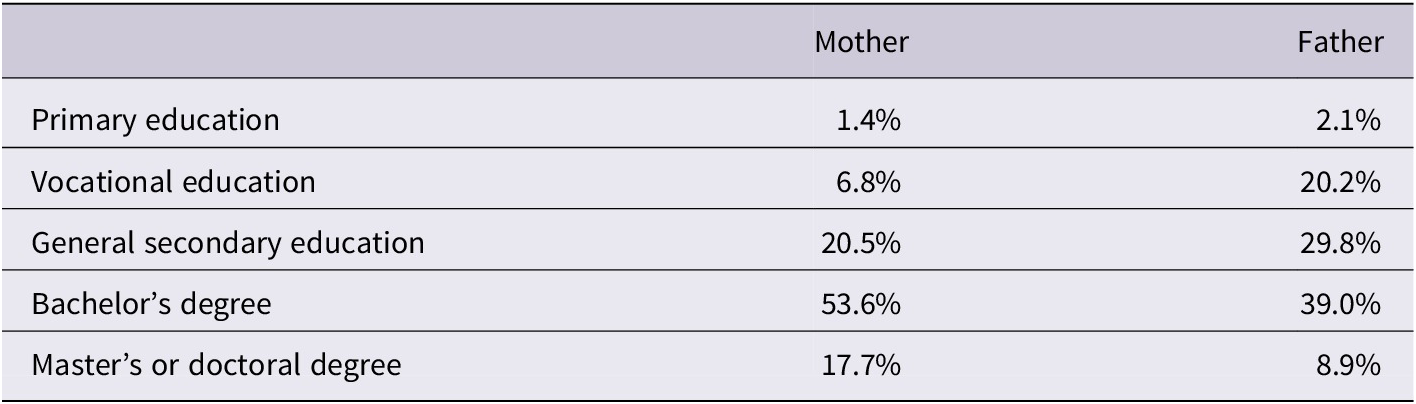
The sample of this cross-sectional study included 301 monolingual Slovenian-speaking children, aged 30–48 months (M = 30.52, SD = 5.47); 50.2% were girls. All the children were born at full term and had no known developmental delays. 99.3% of children were enrolled into preschool, namely between 10 and 47 months of age (M = 16.87, SD = 7.05). Only children from families in which parents indicated that they spoke Slovenian with the child were included. The majority of parents had higher education (see Table 1).
Education levels of parents included in the sample

2.2. Materials and measures
The children’s language was assessed using the Slovenian adaptation of the CDI–III (Marjanovič-Umek et al., Reference Marjanovič-Umek, Fekonja and Hacin Beyazoglu2021), which was developed following the two previous adaptations of the CDI: Words and gestures (Marjanovič-Umek et al., Reference Marjanovič-Umek, Fekonja, Sočan and Komidar2011b) and the CDI: Words and sentences (Marjanovič-Umek et al., Reference Marjanovič-Umek, Fekonja, Sočan and Komidar2011b). The adaptation was carried out considering the findings of numerous studies in which the CDIs were used on the samples of Slovenian-speaking infants and toddlers (Eriksson et al., Reference Eriksson, Marschik, Tulviste, Almgren, Pereira, Wehberg, Marjanovič-Umek, Gayraud, Kovačevič and Gallego2012; Marjanovič-Umek, Fekonja, Podlesek, & Kranjc, Reference Marjanovič-Umek, Fekonja, Podlesek and Kranjc2011a; Marjanovič-Umek et al., Reference Marjanovič-Umek, Fekonja, Sočan and Komidar2011b, Reference Marjanovič-Umek, Fekonja and Podlesek2013, Reference Marjanovič-Umek, Fekonja and Sočan2016). The Slovenian version preserved all the subscales included in the original American English version and the same evaluation method, which is parental reports of children’s language. However, the adaptation included not only a translation but also some individual tasks were changed, and some new tasks were added that refer to specific features of Slovenian language. Moreover, while the original version of the CDI–III (Fenson et al., Reference Fenson, Marchman, Thal, Dale, Reznick and Bates2007) is intended for children aged from 30 to 36 months, the Slovenian version is designed for assessing language of children from 30 to 48 months old. To better reflect the developmental changes in language development in this age period, a subscale was added aimed to assess children’s metalanguage, similarly as was done in the Swedish (Eriksson, Reference Eriksson2017), Croatian (Šmit Brleković & Kuvač Kraljević, Reference Šmit Brleković and Kuvač Kraljević2023) and Estonian (Tulviste & Schults, Reference Tulviste and Schults2020) adaptations of the CDI–III.
Vocabulary. The Vocabulary subscale consists of a list of 100 words, 13 of which were replaced compared to the American English version, namely: peanut, blade, adder, material, tamp, cowboy, nobody, idea, forget/forgot, hate, promise, angry, and about. The new words were selected based on the findings of a previous study in which a Slovenian vocabulary test was developed for children aged 24–84 months (Marjanovič-Umek et al., Reference Marjanovič-Umek, Fekonja and Hacin Beyazoglu2022). The difficulty level of the selected words (same, fireman, clay, beetle, chestnut, racket, soft, summer, scissors, count, high, neck and winter) was deemed appropriate for the targeted age group. For each word, parents indicated whether their child used it or not. The score is the sum of the indicated words and can range from 0 to 100. The reliability of this subscale is high: Cronbach’s α = .977 (95% CI = .971–.981).
The Syntax section includes three subscales, namely Sentence complexity, Using language and Mean length of utterance (M3L). This section begins with a question asking parents if their child has already begun to combine words into sentences, to which parents respond “not yet,” “sometimes,” or “often.” If the child has already begun to combine words, the parents proceed to the next subscales.
The Sentence complexity subscale contains 12 pairs of sentences that differ in syntactic complexity. The number of sentences is the same as in the American English version; they refer to the same content as in the original questionnaire but reflect the most common mistakes children make when combining words into sentences in Slovenian. Within each pair, parents mark the sentence that is typical of their child’s speech. Scores can range from 0 to 12.
The next subscale, Using language, consists of 14 direct questions related to the child’s use of various grammatical structures that typically develop during the preschool years. In addition to the 12 questions included in the American English version, we have added two questions, one related to the child’s use of the plural and one related to the use of the dual, since Slovene is one of the few Indo-European languages that has preserved the dual and continues to use it extensively (e.g., en avto = one car, dva avta = two cars, trije avti = three cars). Parents indicate whether or not a child uses each of the grammatical structures. The score on this subscale can range from 0 to 14.
The Mean length of utterance (M3L) subscale is used to assess the length of a typical sentence spoken by a child. The parents write down the three longest sentences their child speaks and the M3L is calculated as the average number of words in the given sentences.
Metalanguage is the last section of the Slovenian adaptation of the CDI–III. The items included in this section are based on the findings of several other CDI–III studies on the characteristics of metalinguistic development in early childhood (e.g., Šmit Brleković & Kuvač Kraljević, Reference Šmit Brleković and Kuvač Kraljević2023; Eriksson, Reference Eriksson2017; Tulviste & Schults, Reference Tulviste and Schults2020) and its role in the development of language and literacy (e.g., Melby-Lervåg, Lyster, & Hulme, Reference Melby-Lervåg, Lyster and Hulme2012; Roehr-Brackin, Reference Roehr-Brackin2024).
The first subscale, Metavocabulary, contains a list of 16 words (nouns, verbs, and adjectives) that refer to mental states (e.g., to think, to understand, to know, to forget) and emotions (e.g., hate, happy, angry, afraid). Parents indicate which of these words their child already speaks. The score can range from 0 to 16. The reliability of this subscale is high: Cronbach’s α = 863 (95% CI = .833–.885).
The second subscale relates to Metalinguistic awareness and includes 4 questions, namely (1). Whether the child names the first sound in a word; (2). Whether the child understands the concept of a word; (3). Whether the child understands the rules of reading (left to right and top to bottom); and (4). Whether the child can distinguish Slovenian from other languages. Parents indicate whether or not a child expresses each of these skills. The score for this subscale can range from 0 to 4.
A demographic questionnaire was also used to collect information on the parents’ educational level, the languages spoken at home and the child’s age at entry to preschool.
2.3. Procedure
Children for the sample were collected through preschools and parent groups on social media. Only children for whom a signed parental consent form was collected were included in the sample. Parents decided which of them would participate in the study and assess their child’s language (according to the instructions on the CDI–III, the parent who spends more time with the child should complete the inventory); 276 mothers and 21 fathers participated, in 3 cases parents indicated that both parents completed the inventory, and in 1 case the information was missing. The CDI–III and demographic questionnaire were given to parents by preschool teachers; parents returned them to preschool teachers in a sealed envelope. An electronic version of the questionnaire was provided for parents who were surveyed via social media. As the data were collected using two different methods, that is a paper-and-pencil method and an online questionnaire, we compared the two subsamples of children in terms of their age, their scores on the different subscales and the educational level of their parents. The Yuan test was used to compare the two groups (an exception was the difference in the parents’ level of education, for which the Wilcox test was used due to the ordinal variable). There were no significant differences between the two groups in the areas of vocabulary (y = 1.285, p = .200), sentence complexity (y = 0.621, p = .535), metavocabulary (y = 1.932, p = .055), children’s age (y = 1.950, p = .053), mother’s education (W = 9699, p = .181) and father’s education (W = 9872, p = .360). However, there were significant differences between the two groups in language use (y = 2.146, p < .05), MLU (y = 4.057, p < .001) and metalinguistic awareness (y = 2.61, p < .05), with children whose parents had completed the paper version of the questionnaire achieving higher scores. This was also the group with slightly older children (although the age difference was not significant).
3. Statistical methods
Data were analyzed using R Statistical Software (v4.2.3; R Core Team, 2023), RStudio (Posit Team, 2023) and packages car (Fox & Weisberg, Reference Fox and Weisberg2019), Hmisc (Harrell, Reference Harrell2023), psych (Revelle, Reference Revelle2023), rstatix (Kassambara, Reference Kassambara2023) and WRS2 (Mair & Wilcox, Reference Mair and Wilcox2020).
For group comparisons the Yuen test and the Welch test were calculated, with the Games-Howell post hoc test. The reliability of the scales was determined as internal consistency using the Cronbach’s alpha coefficient.
4. Results
First, we calculated descriptive statistics for children’s scores on the different CDI–III subscales (see Table 2). There were no missing data on any of the subscales, except for M3L, where 77 parents had not written down examples of their child’s longest utterances. The range of children’s scores was wide; on the Sentence complexity, Using language, Metavocabulary, and Metalinguistic awareness subscales, children scored between 0 and the maximum score. The vocabulary assessment revealed that some children spoke only one word, while others spoke all the words included in the list. Furthermore, we can observe that the scores on most scales are asymmetrical, except for the Metalinguistic awareness scale. The left asymmetry is most pronounced in the Vocabulary, Using language and Metavocabulary scales. Therefore, we also calculated a trimmed arithmetic mean to limit the influence of the variability in extreme values. As can be seen in Table 2, the average vocabulary size for the entire sample of children was quite high (79 out of 100 words). The three grammar measures show that, on average, the children use grammatically complex sentences (8 out of 12 sentences), that their average score on language use is high (12 out of 14 items) and that they form sentences consisting of about 8 words. In terms of their metalingusitc ability, the children had a large average metavocabulary (12 out of 16 words) and scored 2 out of 4 items on the metalinguistic awareness scale.
Descriptive statistics for children’s scores on different subscales of CDI–III

Note. M3L = mean length of utterance, Metavocab. = Metavocabulary, MA = Metalinguistic awareness, Q1 = first quartile, Q3 = third quartile, W = Shapiro–Wilk test.
a 0.1 trimmed M was calculated to limit the influence of extreme values.
4.1. Developmental characteristics of various domains of language ability in Slovenian-speaking children between 30 and 48 months of age
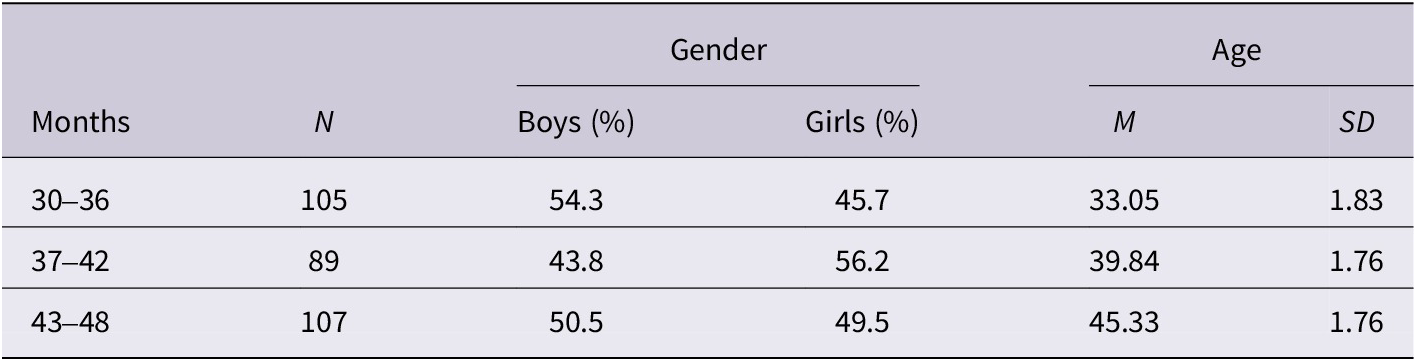
To analyse the age-related differences in children’s scores, we divided the sample into three age groups: 30–36 months, 37–42 months, and 43–48 months. The descriptive statistics for each group are shown in Table 3.
Descriptive statistics for each of the age groups

We used the Welch test to compare the scores of different age groups, which showed significant effects of age for all CDI–III subscales (see Table 4). On all the subscales, children’s scores increased with increasing age. For the post hoc analysis the Games-Howell post hoc test was used, which showed that children aged 30–36 months and 37–42 months differed significantly in their scores on all subscales, indicating a significant increase in language ability in the two age groups. When comparing children aged 37–42 months and 43–48 months, the only significant difference was in the Metalinguistic awareness score, while the differences in sentence complexity and language use were marginally significant.
Age differences in children’s scores on different subscales of the CDI–III. See Table 2 for the description of the measures. t = Welch test, ω2 = effect size, post hoc test: 1 = age 30–36 months; 2 = age 37–42 months; 3 = age 43–48 months

a 0.1 trimmed M was calculated to limit the influence of extreme values.
* p < .05,
*** p < .001.
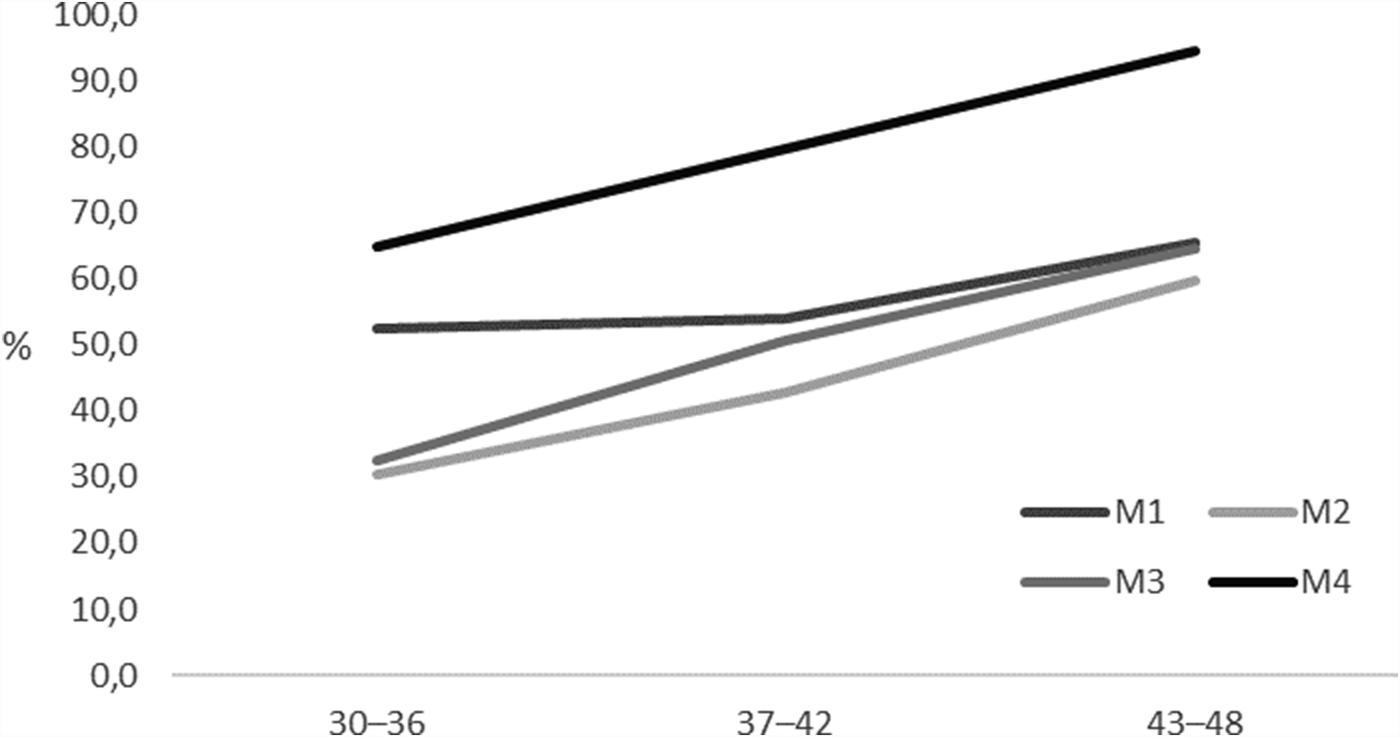
In the next step, we analyzed age differences in each domain of metalinguistic awareness in more detail. More specifically, we were interested in how many children of a given age expressed each of the abilities included in this subscale (see Figure 1). Figure 1 shows that the percentage of children expressing metalinguistic awareness increases with increasing age. The highest percentage of children of all ages already distinguished between Slovene and other languages, and the lowest percentage of children understood the concept of a word.
Percentage of children from each age group expressing different metalinguistic awareness abilities. M1 = Does your child name the first sound of a word? M2 = Does your child understand what a word is? M3 = Does your child understand how the text is read (e.g. does he know that it is read from left to right, from top to bottom)? M4 = Does your child distinguish Slovene from other languages?

4.2. The relationships between different measures of the CDI–III
To analyze the relationships between the different measures of the CDI–III we calculated the correlations between children’s scores on different subscales. Due to the age differences in children’s scores on the individual subscales, we also calculated partial correlations controlling for children’s age (see Table 5). The results obtained showed that the children’s scores correlated significantly with each other on all subscales. The highest correlation was found between metavocabulary and vocabulary and the lowest between vocabulary and metalinguistic awareness. After controlling for children’s age, the correlations were slightly lower but still significant, except for the correlation between vocabulary and metalinguistic awareness.
Pearson’s correlation coefficients and partial correlation coefficients between different CDI–III subscales. Pearson’s correlation coefficients between different subscales are provided in the left part of the table below the diagonal, partial correlation coefficients controlling for children’s age are provided in the right part of the table above the diagonal. See Table 2 for the description of the measures

* p < .05,
*** p < .001.
In the next step, we performed a regression analysis which included vocabulary size as a predictor of sentence complexity and M3L. After controlling for children’s age, the regression models showed that children’s vocabulary was a significant predictor of both, sentence complexity (b = 0.088, SE = 0.008, t = 10.89, p < 0.001) and M3L (b = 0.068, SE = 0.012, t = 5.88, p < 0.001) suggesting that children with a larger vocabulary were more likely to form grammatically more complex and longer sentences.
4.3. The effect of gender on the children’s language ability
To analyze the effect of children’s gender on different measures of children’s language abilities, we compared boys’ and girls’ scores using the Yuen test with a trim value of 0.10. The only significant gender-specific difference was in sentence complexity, where girls performed better than boys. However, the effect size of this difference was small (see Table 6).
Gender differences in children’s scores on different CDI–III subscales. See Table 2 for the description of the measures. y = Yuen-Welch test, ξ = effect size

a 0.1 trimmed M was calculated to limit the influence of extreme values.
5. Discussion
The first goal of our study was to determine the characteristics of language development in Slovenian-speaking children between the ages of 30 and 48 months, as assessed by the Slovenian version of the CDI–III. Similar to language development in infancy and toddlerhood (Bleses et al., Reference Bleses, Vach, Slott, Wehberg, Thomsen, Madsen and Basbol2008; Fenson et al., Reference Fenson, Dale, Reznick, Bates, Thal and Pethick1994; Marjanovič-Umek et al., Reference Marjanovič-Umek, Fekonja and Sočan2016), our results indicate large individual differences between children in this age range in various domains of language competence. Namely, children scored between 0 and the maximum score on all the subscales; according to parental assessment, some children spoke only one word while others already spoke all the words included in the list. Overall, the average vocabulary and metavocabulary of the children in our sample was quite high, with children already using 79 out of 100 words in the vocabulary list and 12 out of 16 words denoting emotions and mental states. In order to analyze the age-related differences in children’s language ability, we divided our sample into three age groups, namely from 30 to 36 months, from 37 to 42 months, and from 43 to 48 months. We found significant differences in both vocabulary, grammar, and metalanguage between the first two age groups, indicating significant developmental changes in language ability between the ages of 30 and 42 months. When comparing the second and third age groups of children, the only significant difference was in metalinguistic awareness, which indicates that this ability develops throughout the period between 30 and 48 months. In contrast, the non-existent differences between the second and third age groups in vocabulary and grammar may be due to a ceiling effect, which has also been found in some previous studies (e.g., Fenson et al., Reference Fenson, Marchman, Thal, Dale, Reznick and Bates2007; Garcia et al., Reference Garcia, Barrena, Ezeizabarrena, Almgren, Arratibel and Barnes2014; Šmit Brleković & Kuvač Kraljević, Reference Šmit Brleković and Kuvač Kraljević2023; Tulviste & Schults, Reference Tulviste and Schults2020). Namely, the majority of older children had already spoken all of the words included in the Vocabulary subscale. These findings suggest that caution should be exercised when using the CDI–III, particularly with older children, and that other formal sources of information should be considered for clinical assessment of early language development in addition to parental reports. To gain a more detailed insight into the development of metalinguistic awareness, we further analyzed age differences in each of the four domains included in the subscale. The results show that most children from all age groups (over 60% in the first age group and over 90% in the third age group) can already distinguish between Slovene and other languages. The second most common metalinguistic ability expressed by children in our sample was the ability to name the first sound of a word (expressed by about 50% of children in the first and 60% in the third age group). Furthermore, about 30% of children in the first age group understood how the text was read (e.g., they knew it was read from left to right and from top to bottom), compared to over 50% of children in the third age group. The least present metalinguistic ability was the ability to understand the concept of a word; it was expressed by less than 30% of children in the first age group and slightly more than 50% of the children in the third age group. Compared to the other three, this ability is perhaps the most difficult for parents to recognize and assess. Our results show that metalinguistic awareness develops gradually between 30 and 48 months, which has also been found in several other studies (Doherty & Perner, Reference Doherty and Perner1998; Eriksson, Reference Eriksson2017; Šmit Brleković & Kuvač Kraljević, Reference Šmit Brleković and Kuvač Kraljević2023). The increase in metalinguistic awareness across age groups also suggests that parents were to some extent able to distinguish between more and less developed metalinguistic abilities in their children. However, it should be noted that the parents in our sample were well educated, so additional studies that include more heterogeneous samples of parents in terms of educational level are needed to further investigate parents’ ability to validly assess their children’s metalinguistic awareness.
The second goal of our study was to investigate the relationships between different language domains as measured by CDI–III, namely vocabulary, grammar, and metalinguistic ability. We found that children’s scores were significantly correlated with each other in all domains, except for the correlation between vocabulary and metalinguistic awareness scores when controlling for children’s age. The highest correlations were found between vocabulary and metavocabulary, sentence complexity and language use, and language use and metavocabulary. The obtained results suggest that different aspects of children’s language ability remain closely related and develop interdependently after the age of 30 months (e.g., Bleses et al., Reference Bleses, Vach, Slott, Wehberg, Thomsen, Madsen and Basbol2008; Cadime, Santos, Ribeiro, & Viana, Reference Cadime, Santos, Ribeiro and Viana2021; Eriksson, Reference Eriksson2017; Kas et al., Reference Kas, Jakab and Lorik2022; Marjanovič-Umek et al., Reference Marjanovič-Umek, Fekonja and Podlesek2013). Similarly, on a Swedish sample of children, Eriksson (Reference Eriksson2017) found that measures of vocabulary and syntax had lower correlations with metalinguistic awareness than with each other, suggesting that metalinguistic awareness encompasses a somewhat different set of knowledge than vocabulary and syntax. This could also be the reason why the metalinguistic awareness of the children in our sample was not related to their vocabulary while the correlations with grammar and metavocabulary were significant but low. In addition, the regression analysis showed that vocabulary was a significant predictor of sentence complexity and M3L in children aged 30–48 months. These results indicate that a larger vocabulary enables children to form longer and more grammatically complex utterances, which is consistent with several previous studies (e.g., D’Odorico & Carubbi, Reference D’Odorico and Carubbi2003; Devescovi et al., Reference Devescovi, Caselli, Marchione, Pasqualetti, Reilly and Bates2005; Marjanovič-Umek et al., Reference Marjanovič-Umek, Fekonja and Sočan2016; Šmit Brleković & Kuvač Kraljević, Reference Šmit Brleković and Kuvač Kraljević2023). On average, the children in our sample exhibited high syntactic complexity and produced sentences consisting of about eight words, with the youngest children producing sentences of 7.5 words and the oldest children producing sentences of 10 words.
Based on the results of several CDI studies that revealed significant gender differences in early language development, we analysed the effects of gender on different domains of language ability assessed with the CDI–III. Previous studies have found consistent advantages for girls in early language development between 8 and 30 months, with girls reported by their parents to use more communicative and symbolic gestures and to express a more extensive receptive and expressive vocabulary than boys (Eriksson et al., Reference Eriksson, Marschik, Tulviste, Almgren, Pereira, Wehberg, Marjanovič-Umek, Gayraud, Kovačevič and Gallego2012; Fenson et al., Reference Fenson, Dale, Reznick, Bates, Thal and Pethick1994; Marjanovič-Umek & Fekonja, Reference Marjanovič-Umek and Fekonja2017), but at the same time, the overall effect of gender was found to be small (Marjanovič-Umek & Fekonja, Reference Marjanovič-Umek and Fekonja2017; Rinaldi et al., Reference Rinaldi, Pasqualetti, Volterra and Caselli2023). However, in our sample of children aged 30–48 months, we found no significant differences between boys and girls in any of the language domains, except for sentence complexity, where girls performed better than boys. These results differ from those reported by Eriksson (Reference Eriksson2017) on a Swedish sample of children of the same age, namely that girls performed better than boys in all three subscales of the SCDI–III (vocabulary, syntax and metalinguistic awareness). A significant effect of gender on CDI–III scores was also found in Hungarian-speaking children aged 24–50 months (Kas et al., Reference Kas, Jakab and Lorik2022), while no gender differences were found in a sample of Portuguese-speaking children, suggesting that boys catch up with girls’ language abilities at preschool age (Cadime, Santos, Ribeiro, & Viana, Reference Cadime, Santos, Ribeiro and Viana2021).
In summary, the results of our study suggest that some of the pre-existing relationships between the different domains of infant and toddler language ability persist into early childhood. For example, the vocabulary of children aged from 30 to 48 months is still an important predictor of their use of grammar, enabling them to produce longer and grammatically more complex sentences. At the same time, language development continues to be relatively rapid during this period, particularly in relation to some aspects such as metalinguistic ability, although there are major individual differences between children of the same age. The findings also indicate that Slovenian-speaking girls and boys in this age group do not differ in most of the language areas examined. However, when interpreting the results of this study, one should be aware of the celling effect that occurred in some subscales of the CDI–III. Consequently, the limited variability in the children’s scores may mask age- and gender-specific differences in their language abilities. Future research should therefore focus on investigating the relationships between the CDI–III and direct, e.g. observational, measures of children’s language thus providing additional data on the validity and reliability of the instrument. A recent study conducted on Slovenian-speaking toddlers showed several significant correlations between the CDI measures and language production estimated at 16–30 months of age in the home environment using LENA (Language ENvironment analysis) technology (Ferjan Ramirez et al., Reference Ferjan Ramírez, Marjanovič-Umek and Fekonja2024).
Acknowledgements
The research described here was supported by the Slovenian Research Agency via funding to the research program Applied Developmental Psychology (no. P5-0062).




 Open access

