


Japan has been free from rabies since 1957, except for one human death reported in 1970 and two human deaths in 2006, all of whom acquired the disease while travelling abroad. In addition to the geographical advantage that Japan has in being surrounded by sea, the compulsory vaccination of dogs and strict import quarantine of dogs under the Rabies Prevention Law has contributed to Japan's freedom from rabies. The regimen that applied to dogs and cats imported from infected countries and territories until October 2004 consisted of vaccination against rabies, a waiting period of 30–180 or 30–365 days depending on the type of vaccine in the country of origin and 14 days quarantine upon arrival in Japan.
With the increase of young dogs imported from Thailand, the Philippines and other infected areas in the early 2000s, many young dogs were found to be imported into Japan without having aquired sufficient level of antibody against rabies [1]. This raised concerns over the risk of imported dogs being infected with rabies and led the Japanese government to call for the voluntary import suspension of young dogs and cats from these countries. In response to these concerns, a new regimen for dogs and cats was developed which came into force in November 2004. The new regimen consists of identification of the animals using a microchip; vaccination against rabies twice (first time after >91 days from birth; and a second time >30 days and within 1 year from the day of the first vaccination), titration of neutralizing antibody level after the second vaccination; and a waiting period of >180 days after bleeding for titration of antibody level.
A quantitative risk assessment was undertaken to compare the annual risk of rabies entering Japan from the USA under two scenarios: animals imported under the old quarantine regimen and animals imported under the new regimen.
The model used to assess the risk of rabies entering Japan from the USA under the new regimen assumed that imported dogs and cats incubating the disease enter Japan when the following events occur:
• an infected animal is selected;
• the animal is vaccinated, and the antibody level rises;
• the animal does not display clinical signs of rabies until arrival in Japan,
or
• an infected animal is selected;
• the animal is vaccinated, but the antibody level does not rise;
• the animal is bled for antibody level titration with a false-positive result;
• the animal does not display clinical signs of rabies until arrival in Japan;
or
• a healthy animal is selected;
• the animal is vaccinated, but is not protected;
• the animal is bled for antibody level titration with a false-positive result;
• the animal is infected during the waiting period;
• the animal does not display clinical signs of rabies until arrival in Japan.
The first pathway assumed that the vaccination has no protective effect on animals incubating the disease [Reference Hanlon, Niezgoda and Rupprecht2, Reference Aubert3], but induces immune response in them in the same way as in healthy animals. The second pathway assumed that the vaccination has no protective effect on animals incubating the disease, with no immune response. These two pathways are represented by the formulae Ip×Rp new×S new1 and Ip×(1−Rp new)×(1−Sp)×S new2, respectively, where Ip is the probability that the selected animal is infected, Rp new is the probability that the animal vaccinated twice has an elevated level of antibody, and Sp is the probability that the animal without elevated antibody level is titrated negative and S new1 and S new2 are the probabilities that the dog does not display clinical signs of rabies until arrival in Japan under the respective pathways.
The third pathway is represented by the formula (1−Ip)×(1−Rp new)×(1−Sp)×Bp×S new3, where Rp is the probability that a dog is protected against rabies when vaccinated; Bp is the probability that an dog is infected during the waiting period; and S new3 is the probability that the dog does not show clinical signs of rabies until arrival in Japan.
By combining these three pathways, the probability that a dog or cat imported from the USA under the new regimen is infected (α) can be calculated:

The model used to assess the risk of rabies entering Japan from the USA under the old regimen assumed that imported animals incubating the disease enter Japan when the following events occur:
• an infected animal is selected;
• the animal does not display clinical signs of rabies until completion of quarantine in Japan.
or
• a healthy animal is selected;
• the animal is vaccinated, but antibody does not rise;
• the animal is infected during the waiting period;
• the animal does not display clinical signs of rabies until completion of quarantine in Japan.
The first pathway assumed that the vaccination has no protective effect on animals incubating the disease, and is represented by the formula Ip×S old1, where Ip is the probability that the selected animal is infected, and S old1 is the probability that the dog does not display clinical signs of rabies until completion of quarantine in Japan.
The second pathway is represented by the formula (1−Ip)×(1−Rp old)×Bp×S old2, where Rp old is the probability that a dog has an elevated level of antibody when vaccinated; Bp is the probability that a dog or cat is infected during the waiting period; and S old2 is the probability that the dog does not show clinical signs of rabies until completion of quarantine in Japan.
By combining these two pathways, the probability that a dog imported from the USA under the old quarantine regimen is infected (α) can be calculated:

In both models, the annual probability of importing at least one infected dog or cat (η) was calculated by:

where β is the mean number of dogs imported from the USA per year.
The number of years between rabies entries was calculated by:

The values for the input variables used in the models were estimated based on data currently available or based on the results or surveys conducted during the early 2000s.
The probability that the selected dog is infected (Ip) was estimated using the data of the number of dogs and cats with rabies in the USA. There were 377 infected dogs or cats in 1999 and 347 in 2000 in the USA [Reference Krebs4, Reference Krebs, Rupprecht and Childs5]. Assuming that all cases are reported, the annual incidence of rabies in the USA was 362 for this 2-year period. This figure was multiplied by the estimated mean incubation period (38·12 days) and divided by 365 days to give an estimate for the number of infected dogs or cats at a random time (362×38·12/365=37·8). This incubation period is the mean of a lognormal distribution that was fitted to data describing both experimental and natural infection [Reference Jones6]. It was assumed that the number of dogs and cats incubating rabies follows a Poisson process with rate λ, the mean of the Poison distribution. The distribution for λ taking account of the uncertainty associated with it was estimated using Bayesian inference [Reference Vose7]:

The probability that a dog or cat is incubating disease at a random time (the probability that a randomly selected dog or cat is infected) (Ip) was then estimated by dividing λ by the estimated dog and cat population:

where N is the dog and cat population in the USA. Assuming that one American household owns an average of 0·534 dogs and 0·598 cats, and given that there were 115 444 101 households in the USA (excluding Hawaii) [8, 9], N was estimated to be (0·534+0·598)×115 444 101=130 682 722.
The probability that a dog or cat has an elevated level of antibody when vaccinated under the new regimen (Rp new) was estimated using data obtained from an unpublished study undertaken by the Veterinary Laboratory Agency, Weybridge (VLA) on Rabisin and Nobivac vaccines [Reference Hanlon, Niezgoda and Rupprecht2] and a study by Sihvonen [Reference Sihvonen10] on Rabisin and Madivak vaccines. These studies provided the number of dogs and cats vaccinated and the number of dogs and cats serologically tested for the presence of antibody levels at 30–40 days post-vaccination. A total of 2714, 2856 and 47 dogs and cats were vaccinated and serologically tested in these studies. The vaccine was considered effective and the animal deemed to be protected against rabies, if a neutralizing antibody level ⩾0·5 international units (IU) was observed [11]. Taking account of the blood test specificity and sensitivity, the number truly protected was estimated to be 2672, 2820 and 46 for Rabisin, Nobivac and Madivak, respectively. Therefore, Rp new was modelled by the average of three beta distributions:

Under the old regimen, dogs and cats were allowed to be imported into Japan having been vaccinated 30 days before arrival in Japan without antibody titration. Consequently, many young dogs and cats were imported without having acquired sufficient level of antibody against rabies. Therefore, the probability that a dog or cat has an elevated level of antibody when vaccinated under the old regimen (Rp old) was estimated using the results from an unpublished study conducted by the Animal Quarantine Service on 208 dogs imported from the USA during the period from July to October 2003. The study revealed that vaccines manufactured by two companies were used and that 142/159 animals were observed to be protected with the vaccine manufactured by one company and 34/49 animals were observed to be protected with the vaccine manufactured by the other company. In this study, rapid fluorescent focus inhibition test (RFFIT), which gives results equivalent to fluorescent antibody virus neutralization (FAVN) test [Reference Cliquet, Aubert and Sagne12], was performed to detect the levels of neutralizing antibodies. The vaccine was considered effective, if a neutralizing antibody level ⩾0·5 IU was observed [11]. The observed number of animals protected was corrected to account for the blood test specificity and sensitivity. As a result, of the 159 and 49 animals vaccinated by the two vaccines, 139 and 32 were actually protected, respectively. Another unpublished study conducted by the Animal Quarantine Service from October 2002 to May 2003 on 93 dogs imported from the USA showed that 27 and 36 of them had been administered with vaccines manufactured by these two companies, respectively. Taking account of the share of the two vaccines, Rp old was modelled as a weighted average of two beta distributions:

The probability that the animal without elevated antibody level is titrated negative (Sp) was estimated based on a result of a study conducted on 50 dog serum samples using mouse inoculation test and FAVN test. Sixteen samples diagnosed positive by mouse inoculation test were all diagnosed positive by FAVN test, while of the 34 samples diagnosed negative by mouse inoculation test, 30 were diagnosed negative and four positive by FAVN test [Reference Cliquet, Aubert and Sagne12]. Assuming that the sensitivity and specificity of mouse inoculation test is both 100%, the specificity of FAVN test was estimated using a beta distribution: Sp=beta(30+1, 34−30+1).
The probability that a dog is infected during the waiting period (Bp) depends on the prevalence of rabies infective animals in the country of origin; the number of contacts with animals per day; and the length of the waiting period. Assuming that infection follows a binomial process and that a contact with an infected animal results in infection, Bp was given by:

where p is the prevalence of infection in the USA, k is the number of contacts with wild or domestic animals per day, and d is the duration of the waiting period in days.
The prevalence of infective animals (p) was estimated as follows. The number of rabies cases in wild animals and companion animals in the USA was 11 498 for the 2 years 1999 and 2000 [Reference Krebs4, Reference Krebs, Rupprecht and Childs5]. Therefore, the number of infected wild and companion animals per day was calculated as being 11 498/730=15·75. Because no data were available on the number of rabies- susceptible wild animals but information was available on raccoon densities in both urban and rural areas in the USA (there were between 0·9 and 250 animals uniformly distributed per km2) [Reference Riley, Hadidian and Manski13], we assumed that there is one susceptible wildlife/1 km2 and estimated the total number of rabies-susceptible wildlife to be 9 373 000 km2×1 animal/km2=9 373 000. By adding the number of dogs and cats, the total number of rabies-susceptible wild and domestic animals was estimated to be 140 055 722. The average number of days when infected animals are infective during the incubation period was assumed to be 5 days [14]. By multiplying the number of infected wild and domestic animals by the number of days when they are infective and dividing the product by the number of rabies-susceptible animals, p was estimated to be 15·75×5/140 055 722=5·60 ×10−7.
The number of contacts with wild or domestic animals per day (k) was modelled as triangle (0, 1, 2), assuming that the selected animal made a contact with a wild or domestic animal with a minimum of 0 time and a maximum of 2 times and most likely 1 time. The duration of the waiting period (d) was assumed to be 180 days for the new regimen, according to the conditions that apply in that regimen. Under the old regimen, dogs and cats imported from the USA were eligible to enter 14 days of quarantine on the condition that the animal was vaccinated with inactivated vaccine 30–180 days before entry into import quarantine or with live vaccine 30–365 days before entry into import quarantine. Therefore, the duration of the waiting period (d) was assumed to be 30 days, 180 days and 365 days for the old regimen.
The probability that the animal does not display clinical signs of rabies until arrival in Japan (S newn and S oldn) was calculated as the probability that the incubation period of the infected animal is longer than the waiting period. The incubation period was modelled as a probability distribution lognormal (38·12, 45·59), as estimated by Jones et al. based on the result for naturally and experimentally infected animals [Reference Jones6]. The waiting period was assumed to be 181 [1 (infection 1 day before vaccination)+180 (minimum waiting period from vaccination to departure)] days for the first and second pathways of the new regimen; 89·5 [180–90·5 (the mean value of uniform(1, 180))] days for the third pathway of the new regimen; d+16 [1 (infection 1 day before vaccination)+d+1 (application 1 day before quarantine) +14 (detention for quarantine)] days for the first pathway of the old regimen; and d/2+15·5 [d − the mean value of uniform(1, d)+1+14] days for the second pathway of the old regimen. By calculating the integral of the lognormal function for the domain over these waiting periods, S new1, S new2 and S new3, were estimated to be 0·017, 0·017 and 0·085, respectively. Similarly, S old1 and S old2 were calculated to be 0·251 and 0·428, respectively, when d=30; 0·014 and 0·062, respectively, when d=180; and 0·002 and 0·013, respectively, when d=365.
The mean number of dogs and cats imported from the USA per year (β) was estimated based on the number of dogs and cats imported from the USA from 2001 to 2003. A total of 6366, 5867 and 6419 dogs and 1214, 1257 and 1296 cats were imported from the USA in 2001, 2002 and 2003, respectively [15]. By averaging these figures, β was calculated to be 7473.
Using these models and values for input variables, a Monte Carlo simulation with 50 000 iterations was undertaken with @Risk4.5 software (Palisade, USA), an add-in for the spreadsheet software Excel 2007 (Microsoft Corporation, USA). The result of the simulation is shown in Table 1, in terms of the number of years between rabies entries under the old and new regimens. By changing from the old regimen to the new, the risk of rabies entering Japan through the importation of dogs and cats from the USA would reduce by a factor of 1/25, 1/60 or 1/70, assuming that the animal departs the country of origin 30, 180 or 365 days after vaccination under the old regimen, respectively.
Number of years between rabies entries through the importation of dogs and cats from the USA
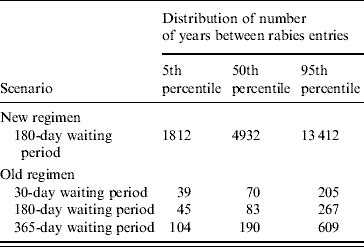
The introduction of an antibody level titration in the new regimen contributed most to the reduction of risk (data of a sensitivity analysis not shown). The new regimen effectively prevents young dogs and cats from being imported into Japan without having acquired sufficient level of antibody against rabies. A recent study by Kennedy et al. [Reference Kennedy16] indicating that the antibody response of dogs vaccinated against rabies is influenced by animal size, age, breed, sampling time and vaccines, underlines the importance of an antibody level titration as a risk mitigation measure. In addition, the introduction of an identification system using a microchip, although its effect was not considered in this study, would doubtless contribute to the reduction of risk, by reducing illegally imported animals entering Japan. Despite the additional cost for microchip attachment and antibody level titration, the number of dogs and cats imported into Japan has neither increased nor decreased since the introduction of the new regimen, suggesting that the new regimen is well accepted by pet owners because it does not require detention of animals at ports and airports.
We chose the USA as the exporting country of dogs and cats in our models, because it is a major exporter of these animals to Japan and data were available for the input variables Ip, Bp and β, which were intrinsic to an exporting country. The models are applicable to any infected country or territory as long as values for these input variables are available. While the absolute risk that these models would return varies depending on the values used for these variables, the risk reduction factors would be more or less the same regardless of the values for Ip, Bp and β, because these variables are commonly used in the models for both the old and new regimens. Therefore, although we did not calculate the risk of rabies entering Japan from infected countries other than the USA, the risk of rabies entering Japan from all infected countries would reduce greatly by replacing the old regimen with the new regimen.
Due to the serious implications that rabies has for public health, countries free from rabies are making strenuous efforts to maintain their current status. The UK, which has been free from rabies since 1922, also made a policy change from a 6-month quarantine regimen to the PETS (Pet Travel Scheme) in December 2002, using a quantitative risk assessment incorporating all kinds of possible events that could lead to the entry of rabies, including smuggling and non-compliance with serological testing requirements [Reference Jones6]. The model we used was similar to theirs, but we did not consider the possibility of these events occurring, to simplify the model and because no information was available about the probability of these events occurring.
New Zealand also made a policy change in 1997 permitting the importation of dogs from countries with rabies in wildlife, using a risk assessment that concluded that the risk of introducing rabies under a policy of confirmed vaccination is no greater than under a policy of prolonged quarantine alone [Reference MacDiarmid and Corrin17].
In the present study, many assumptions were made to estimate the input variables in the model. In addition, most of the values used for the input variables were estimated from data currently available or based on the results of surveys conducted in the early 2000s and assumed not to change in the future. Should more data be accumulated in the future for input variables or data become available to estimate the probabilities of the events that were not considered in our model, a risk assessment accounting for these findings will allow more precise and accurate estimation of the risk of rabies entering Japan. Despite all the constraints, quantitative risk assessment is useful in making science-based decisions in a transparent manner.
ACKNOWLEDGEMENTS
The authors thank Rowana Jones, Veterinary Laboratories Agency, Weybridge, UK, for providing them with useful suggestions and information.
DECLARATION OF INTEREST
None.



