

Introduction
Chitral, one of the most isolated areas of Pakistan, is located in the north-west of the North West Frontier Province (Figures 1 and 2). Until 1999 archaeological work in Chitral had been limited to a report by Reference StaculStacul (1969) on ancient cemeteries, and the study by Reference AllchinAllchin (1970) of pottery, both thought to have strong affinities with the Gandharan Grave Culture (GGC). Work from 1999 onwards has located many more graves in Chitral that have been linked to the GGC, but only in 2007 were samples of human bone from graves submitted for radiocarbon dating.
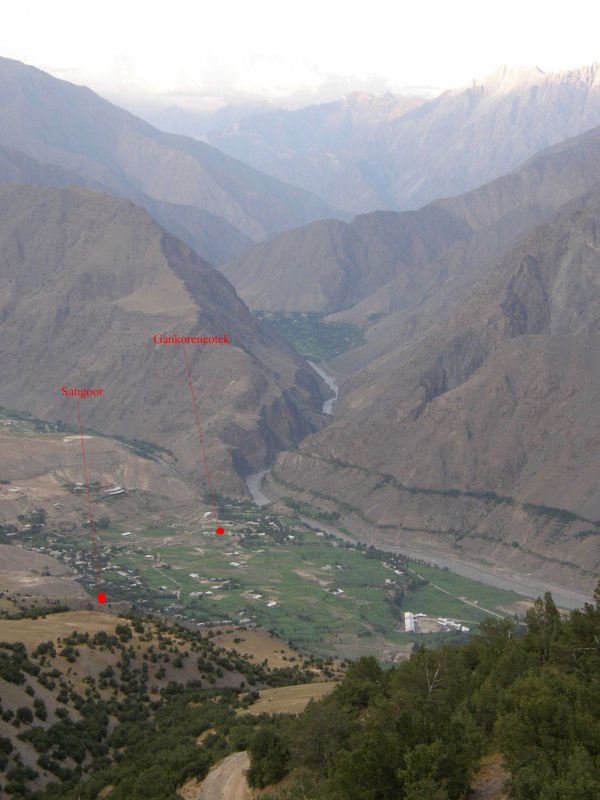
Overview of Gankoreneotek and Sangoor in the Chitral Valley.

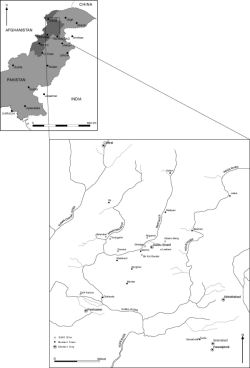
Map of NWFP showing selected Gandharan Grave sites.

Gandharan Grave Culture
The GGC is an archaeological phenomenon known from work in the second half of the twentieth century by Reference DaniDani (1963) and Reference StaculStacul (1987). The GGC is known primarily through excavations of graves in the valleys of Swat and Dir located south of Chitral and this area traditionally forms the geographical core of the culture, although sites have been identified in the Vale of Peshawar (Reference KhanKhan 1973) and the Taxila Valley (Reference DaniDani 1986). The dating scheme established by Dani and Stacul places the GGC between c.1500 and c. 500 BC. This rural culture is critical to understanding the period between the two major urban developments of South Asia, the Indus and the Early Historic, and establishing a scientific chronology is fundamental to this understanding.
Recent work
In 1999 a Pakistani-Bradford team carried out survey in Chitral, recording 15 cist graves which were identified as GGC sites (Reference AliAli et al. 2002; Figure 3). Pakistani teams carried out further survey and excavation in Chitral locating further large cemeteries and excavating a series of graves at the sites of Sangoor and Parwak (Reference AliAli et al. 2005; Reference AliAli & Zahir 2005). These excavations in 2003-4 showed that there were a number of similarities with grave construction styles from Swat and Dir, and some very similar grave goods, but required scientific dates to situate the graves chronologically in relation to the GGC.
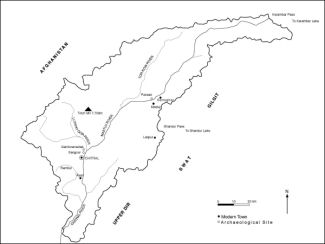
Map of Chitral showing location of Gankoreneotek, Sangoor and Parwak.

Current work
In August 2007 excavations were planned at Parwak specifically to obtain samples for dating, but a major land slide destroyed the village of Sanoghar and road access to the site. We therefore identified the site of Gankoreneotek and excavated two graves there. Grave construction, burials in the form of cremations and grave goods of pots, beads, and an iron spear head had similarities with GGC material from Swat and Dir. Samples of human bone from the 2007 excavations at Gankoreneotek, and the 2005 excavations at Sangoor and Parwak were collected.
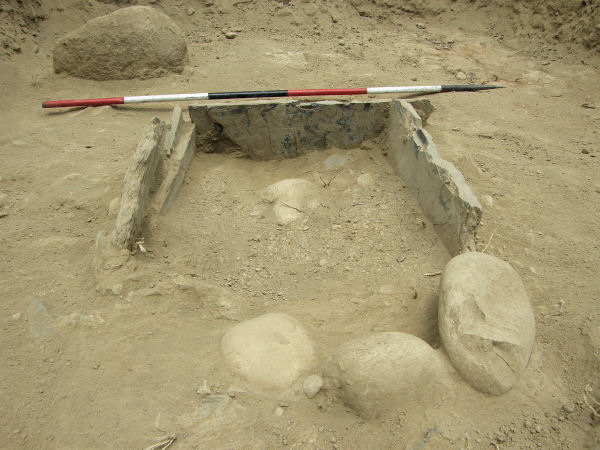
A total of seven samples human bone were submitted in 2007 to the University of Waikato Radiocarbon Dating Laboratory, Hamilton, New Zealand. These included six samples of inhumed bone from Sangoor and Parwak and a single sample of cremated bone from a cist grave at Gankoreneotek (Figure 4).
Gankoreneotek cist grave for cremation burial.

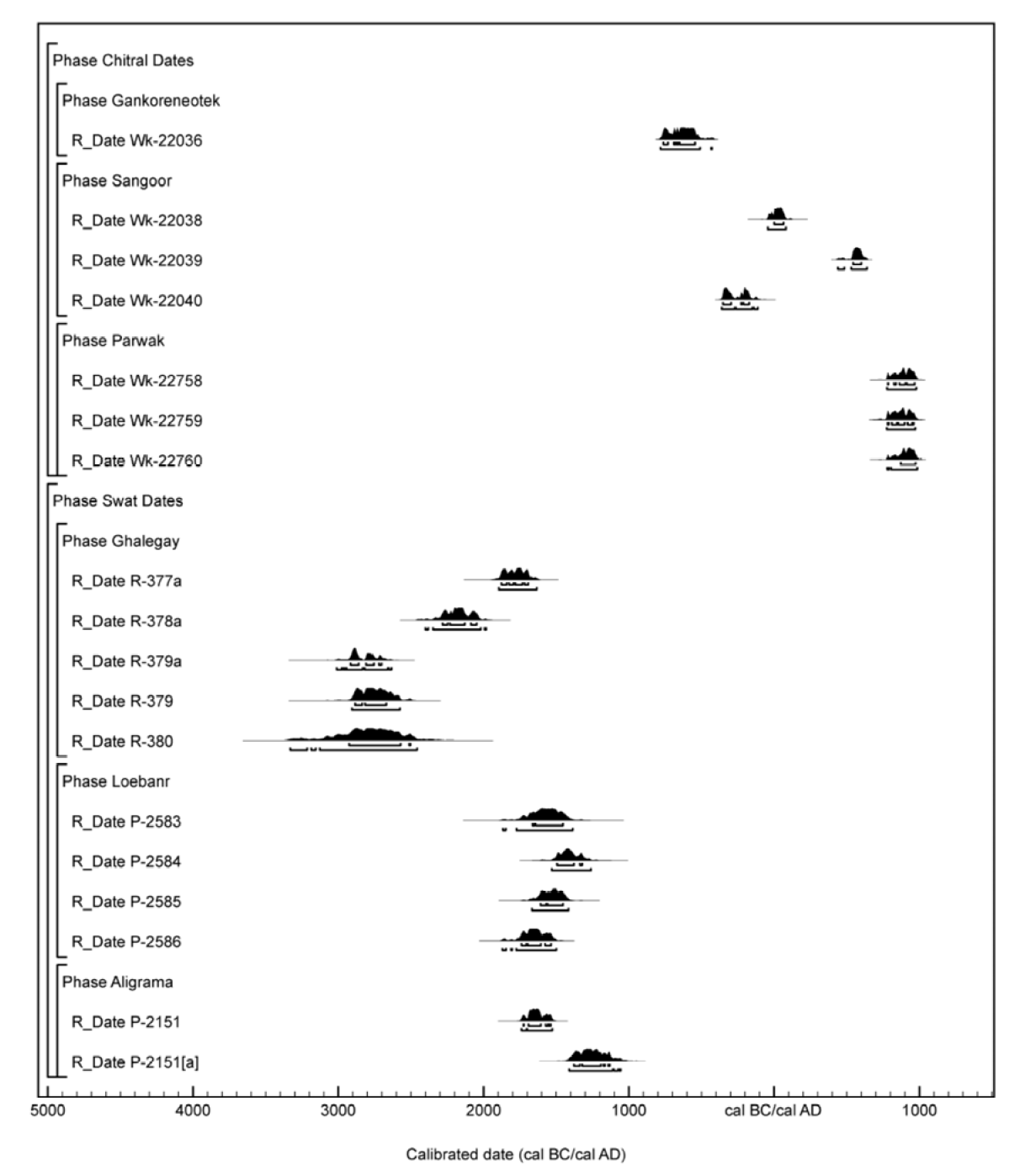
The dates from Gankoreneotek, Sangoor and Parwak range from 1000 BC to AD 1000. They are shown on Figure 5 (.pdf download), with dates from the Swat valley (further east) for comparison. The calibrations of the results, relating the radiocarbon measurements directly to calendar dates, are given in Table 1 (.pdf), and in Figure 5 (.pdf download), and have been calculated using the calibration curve of Reimer et al. (2004) and the computer program OxCal (v4) (Online manual: http://c14.arch.ox.ac.uk/oxcalhelp/hlp_contents.html). The calibrated ranges in Table 1 (.pdf download) have been calculated according to the maximum intercept method (Stuiver & Reimer 1986), while those in Figure 5, are derived from the probability method (Stuiver & Reimer 1993). All date ranges are quoted in the form recommended by Reference MookMook (1986), with the end points rounded outwards to 10 years.
Radiocarbon date probability distributions from radiocarbon ages presented in Table 1 from Chitral and Swat.

Implications of dates
These dates raise many questions about the archaeology of Chitral and our understanding of the GGC, which we will explore in our future work. We need to look afresh at the nature of sites and material culture that have been classified as GGC, and the geographical and chronological spread of sites in South and Central Asia. We also need to explore the role of Islam in Chitral and its impact on culture here, which is particularly important given the similarities between excavated graves and later Islamic graves. It is only with these new dates that we can begin to consider the form and development of the GGC outside the core area and beyond the traditionally accepted date range. These dates are the first scientific dates for any archaeological site in Chitral, and thus provide the basis for a chronology which can be expanded with future work.
Acknowledgements
We would like to thank Professor Graeme Barker, Cambridge University; Professor Robin Coningham, Durham University; Professor Timothy Insoll, Manchester University; Peter and Azra Meadows, Glasgow University; staff at the University of Leicester; staff and students at Hazara University; staff at Chitral Museum; Professor Brian Hemphill, University of California. The British Academy provided funding for both fieldwork and the dating, for which we are very grateful.