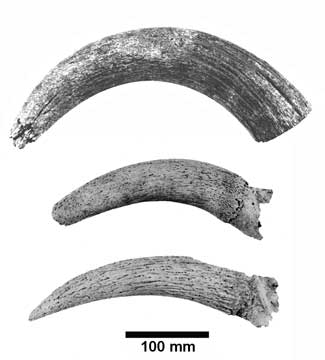


The horn core of an auroch bull (top) and two cows from Vác.

Three aurochs horn cores, found during the construction of the municipal baths in Vác, Hungary (Reference BartosiewiczBartosiewicz 1997), have been re-evaluated in light of radiocarbon dating. The remains date from the Hungarian Iron Age, thereby post-dating the large scale exploitation of aurochs in the Carpathian Basin.
Previous research
Three stray finds of aurochs (Bos primigenius Bojanus 1827) horn cores found during the construction of the municipal baths in Vác, Hungary were previously discussed from a technological perspective (Reference BartosiewiczBartosiewicz 1997; Figure 1). The finds were recovered from an urban area, dominated by late medieval occupation. In the absence of absolute dating, tentative interpretations concentrated on the possibility of high-status horn manufacturing. One horn core was identified as that of a bull on the basis of its robusticity and the simple curvature that made sure the tip fell within the animal's visual field (Rehkämper & Görlach 1999: 76). This shape is typical of wild bulls and provides functional advantage (Uerpmann 1999: 100); it is recognisable even in iconographic sources (e.g. Reference JohnstonJohnston 1755; Figure 2). The potential value of the large horn sheath, a unique raw material, was amply discussed.
Recent results
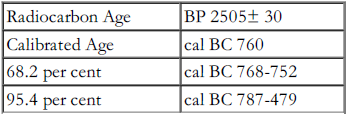
More recently, the bull horn core was sampled for AMS dating in the Christian-Albrechts-Universität in Kiel, Germany. The collagen sample extracted (KIA 6424) resulted in the calibrated (Stuiver & Reimer 1993) dates shown in Table 1.

This time range corresponds to sporadic traces of Iron Age occupation in the Vác area, centuries later, overwhelmed by medieval urban development (Torma 1993: 380). The radiocarbon date supports the terminus post quem date for the horn core established on the basis of the clear metal saw marks (Reference BartosiewiczBartosiewicz 1997: 1009, Figure 3). The use of iron objects first became general during the eighth century BC in the Carpathian Basin (Reference JeremJerem 2003: 177). Previously, a terminus ante quem date that could have been suggested on the basis of the known date of extinction of aurochs in this area was left open by raising the possibility of a late medieval import. Evidence of trading in auroch horn is known from a sawn-off horn core base from Chania on Crete (c. 1400-1375 BC: Reference PerssonPersson 1993: 122, Abb. 1). However, the radiocarbon date of the Vác specimen points to a period when aurochs were still present in the Carpathian Basin, making such speculations largely irrelevant.
Zoological interpretation
Horn conformation characteristic of aurochs bulls (Reference JohnstonJohnston 1755).

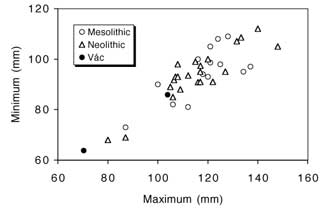
In Figure 3, the greatest and smallest diameters of the radiocarbon dated, sawn-off specimen (Figure 1, top) and of the intact cow horn core (Figure 1, centre) are compared to the basal diameters of early Holocene aurochs from Hungary. Comparative data in Figure 3 were taken from Bökönyi (1962, 1972), Krolopp and Vörös (1982), and Reference VörösVörös (1987), respectively. The base of the other aurochs cow horn core (Figure 1, bottom) was too damaged to provide a reliable measurement.
While, in a previous study, no significant size difference was found between the horn cores of Mesolithic and Neolithic bulls (Reference BartosiewiczBartosiewicz 1999: 108, Table 3), diameters of the Vác horn cores seem small by prehistoric standards. This is only partly due to the fact that the bull's horn core was truncated. The almost complete horn was sawn off near the base, where it becomes increasingly cylindrical, which makes estimates of the basal diameters quite reliable. Metric comparisons to late medieval horn sheaths of known sizes have shown that the horn of the Iron Age aurochs bull would have provided only a medium size drinking horn (Reference BartosiewiczBartosiewicz 1997: 1010, Figure 4).
On the basis of only two cases, this small size may be considered a random phenomenon. However, it reinforces the existing evidence for the size decrease of aurochs, hypothesised as resulting from a deterioration of its shrinking habitat (Reference BökönyiBökönyi 1984: 37); as yet, the decline of stature in domesticates during the Hungarian Iron Age is poorly understood (Reference BökönyiBökönyi 1974: Figures 9 and 49).
Plot of maximum and minimum base diameters of aurochs horn cores from Hungary. The sawn off specimen falls near the centre of the figure. See text for details.

Cultural interpretation
Horns represent no nutritive value but large horns must have been prized trophies, symbols of powerful beasts and valuable raw materials. This is indirectly shown, by, for example, a bronze mouthpiece/handle and representations of Hallstatt Period blast horns (e.g. Reference StareStare 1979: 161, Figures 2-3; Reference GustinGustin 1980: 253, Figure 1). Intrinsic value, enhanced by the dangers of procuring this special raw material, must have been inseparable from the kudos of owning high prestige items, such as may have been manufactured from at least one of the three specimens.
The pre-Christian age of the dated specimen raises the possibility of purely ritual deposition. This small assemblage may thus be of interest in connection with the impressive cache of 19 auroch horn cores analysed from the Roman sacrificial site of Bourbonne-les-Bains in France (Grant & Sauer forthcoming) although no supplementary archaeological evidence has been recorded for the Vác specimens.
Conclusions
The 2505± 30 BP radiocarbon date obtained for one of three aurochs horn cores points to the Iron Age, clearly separating these finds from the mass of medieval animal remains recovered in Vác, Hungary. Previous conclusions (Reference BartosiewiczBartosiewicz 1997) may thus be refined as follows:
-
• the morphometric and technological traits discussed in a previous study are still valid. Fine-tuned by the AMS date, they tell us about the size, shape and possible use of Iron Age aurochs horns;
-
• the aurochs was hunted in the Carpathian Basin during the Iron Age, but the horn core diameters of the three finds from Vác seem small in comparison to those of Mesolithic and Neolithic aurochs. This may be symptomatic of a population on the decline, even if the original basal diameters of the truncated bull horn core may have been somewhat larger than the greatest measurements taken somewhat above the sawn off base;
-
• on the basis of the pre-medieval date, the previously hypothesised import of raw materials for horn manufacturing must now be discounted;
-
• given the pre-Christian date the technical and ritual aspects of this small assemblage are impossible to separate from each other.
Acknowledgements
Grateful thanks are due to Prof. Dr. Pieter M. Grootes of the Leibniz Labor für Altersbestimmung und Isotopenforschung (Christian-Albrechts-Universität, Kiel) for the radiocarbon dating. Dr. Dirk Heinrich, Institut für Haustierkunde of the same University, helped with the organization and funding of this measurement. Dr. Zsuzsa Miklós, Archaeological Institute of the Hungarian Academy of Sciences offered archaeological information. The horn cores were photographed by Ms. Krisztina Pálfay. Last but not least, Dr. Annie Grant and another, anonymous, reviewer are thanked for their substantial contributions to the final version of this paper. Writing this short report was supported by Grant OTKA T047228.