





1 Introduction
Let $\mathcal {I}$
be an ideal on the set
$\mathcal {I}$
be an ideal on the set $\omega $
of all nonnegative integers. The bounding number
$\omega $
of all nonnegative integers. The bounding number $\mathfrak {b}_{\mathcal {I}}$
is the least cardinality of an unbounded set in the poset
$\mathfrak {b}_{\mathcal {I}}$
is the least cardinality of an unbounded set in the poset $(\omega ^\omega ,\leq ^{\mathcal {I}})$
, where
$(\omega ^\omega ,\leq ^{\mathcal {I}})$
, where $f\leq ^{\mathcal {I}} g$
if
$f\leq ^{\mathcal {I}} g$
if $\{n: f(n)> g(n)\}\in \mathcal {I}$
. Then the ordinary bounding number
$\{n: f(n)> g(n)\}\in \mathcal {I}$
. Then the ordinary bounding number $\mathfrak {b}$
is equal to
$\mathfrak {b}$
is equal to $\mathfrak {b}_{\mathrm {Fin}}$
and it is not difficult to show that
$\mathfrak {b}_{\mathrm {Fin}}$
and it is not difficult to show that $\mathfrak {b}_{\mathcal {I}}$
is a regular cardinal and
$\mathfrak {b}_{\mathcal {I}}$
is a regular cardinal and $\mathfrak {b} \leq \mathfrak {b}_{\mathcal {I}} \leq \mathfrak {d}$
for every ideal
$\mathfrak {b} \leq \mathfrak {b}_{\mathcal {I}} \leq \mathfrak {d}$
for every ideal $\mathcal {I}$
. In the realm of maximal ideals, the number
$\mathcal {I}$
. In the realm of maximal ideals, the number $\mathfrak {b}_{\mathcal {I}}$
can take various values, for instance there is always a maximal ideal
$\mathfrak {b}_{\mathcal {I}}$
can take various values, for instance there is always a maximal ideal $\mathcal {I}$
with
$\mathcal {I}$
with $\mathfrak {b}_{\mathcal {I}}=\mathrm {cf}(\mathfrak {d})$
and it is consistent that there exists a maximal ideal
$\mathfrak {b}_{\mathcal {I}}=\mathrm {cf}(\mathfrak {d})$
and it is consistent that there exists a maximal ideal $\mathcal {I}$
with
$\mathcal {I}$
with $\mathfrak {b}_{\mathcal {I}}=\kappa $
for any regular uncountable
$\mathfrak {b}_{\mathcal {I}}=\kappa $
for any regular uncountable $\kappa \leq \mathfrak {c}$
[Reference Canjar4–Reference Canjar6]. However,
$\kappa \leq \mathfrak {c}$
[Reference Canjar4–Reference Canjar6]. However, $\mathfrak {b}_{\mathcal {I}}=\mathfrak {b}$
for every ideal
$\mathfrak {b}_{\mathcal {I}}=\mathfrak {b}$
for every ideal $\mathcal {I}$
with the Baire property [Reference Farkas and Soukup7, Reference Staniszewski19] which makes the number
$\mathcal {I}$
with the Baire property [Reference Farkas and Soukup7, Reference Staniszewski19] which makes the number $\mathfrak {b}_{\mathcal {I}}$
dull in the realm of definable ideals.
$\mathfrak {b}_{\mathcal {I}}$
dull in the realm of definable ideals.
In the literature there are known at least two other ideal-like versions of the bounding number (see below for definitions) which seem more interesting. Below we describe both those versions. The aim of the article is to compare these two versions and to calculate values of these numbers for some ideals. Moreover, as a by-product, we answer a question of Kankaanpää [Reference Kankaanpää13].
Now we start our description of the first version. By an $\mathcal {I}$
-gap we mean a pair
$\mathcal {I}$
-gap we mean a pair $(\mathcal {A},\mathcal {B})$
of subfamilies of
$(\mathcal {A},\mathcal {B})$
of subfamilies of $\mathcal {I}^+$
such that the families
$\mathcal {I}^+$
such that the families $\mathcal {A}$
and
$\mathcal {A}$
and $\mathcal {B}$
are
$\mathcal {B}$
are $\mathcal {I}$
-orthogonal (i.e.,
$\mathcal {I}$
-orthogonal (i.e., $A\cap B\in \mathcal {I}$
for all
$A\cap B\in \mathcal {I}$
for all $A\in \mathcal {A}$
and
$A\in \mathcal {A}$
and $B\in \mathcal {B}$
) and there is no
$B\in \mathcal {B}$
) and there is no $C\subseteq \omega $
which
$C\subseteq \omega $
which $\mathcal {I}$
-separates
$\mathcal {I}$
-separates $(\mathcal {A},\mathcal {B})$
(i.e., there is no
$(\mathcal {A},\mathcal {B})$
(i.e., there is no $C\subseteq \omega $
with
$C\subseteq \omega $
with $A\cap C\in \mathcal {I}$
and
$A\cap C\in \mathcal {I}$
and $B\setminus C\in \mathcal {I}$
for each
$B\setminus C\in \mathcal {I}$
for each $A\in \mathcal {A}$
and
$A\in \mathcal {A}$
and $B\in \mathcal {B}$
). If
$B\in \mathcal {B}$
). If $(\mathcal {A},\mathcal {B})$
is an
$(\mathcal {A},\mathcal {B})$
is an $\mathcal {I}$
-gap such that
$\mathcal {I}$
-gap such that $|\mathcal {A}|=\kappa $
and
$|\mathcal {A}|=\kappa $
and $|\mathcal {B}|=\lambda $
, then we say that it is an
$|\mathcal {B}|=\lambda $
, then we say that it is an $\mathcal {I}$
-
$\mathcal {I}$
- $(\kappa ,\lambda )$
-gap.
$(\kappa ,\lambda )$
-gap.
The study of $\mathrm {Fin}$
-gaps has a long history [Reference Scheepers18]. For instance, Hausdorff proved that there is a
$\mathrm {Fin}$
-gaps has a long history [Reference Scheepers18]. For instance, Hausdorff proved that there is a $\mathrm {Fin}$
-
$\mathrm {Fin}$
- $(\omega _1, \omega _1)$
-gap, Rothberger showed that there is a
$(\omega _1, \omega _1)$
-gap, Rothberger showed that there is a $\mathrm {Fin}$
-
$\mathrm {Fin}$
- $(\omega , \mathfrak {b})$
-gap and the number
$(\omega , \mathfrak {b})$
-gap and the number $\mathfrak {b}$
is the least cardinal
$\mathfrak {b}$
is the least cardinal $\kappa $
such that there is a
$\kappa $
such that there is a $\mathrm {Fin}$
-
$\mathrm {Fin}$
- $(\omega , \kappa )$
-gap. On the other hand, Todorčević proved (under PFA) that any
$(\omega , \kappa )$
-gap. On the other hand, Todorčević proved (under PFA) that any $\mathrm {Fin}$
-gap is either of type
$\mathrm {Fin}$
-gap is either of type $(\omega _1 , \omega _1)$
or
$(\omega _1 , \omega _1)$
or $(\omega ,\mathfrak {b})$
. It is obvious that there is no
$(\omega ,\mathfrak {b})$
. It is obvious that there is no $\mathcal {I}$
-gap for a maximal ideal
$\mathcal {I}$
-gap for a maximal ideal $\mathcal {I}$
. Recently, there is a growing research on
$\mathcal {I}$
. Recently, there is a growing research on $\mathcal {I}$
-gaps for definable ideals
$\mathcal {I}$
-gaps for definable ideals $\mathcal {I}$
(e.g., Borel or analytic). For instance, Mazur [Reference Mazur16] proved that there is
$\mathcal {I}$
(e.g., Borel or analytic). For instance, Mazur [Reference Mazur16] proved that there is $\mathcal {I}$
-
$\mathcal {I}$
- $(\omega _1,\omega _1)$
-gap for every
$(\omega _1,\omega _1)$
-gap for every $F_\sigma $
ideal
$F_\sigma $
ideal $\mathcal {I}$
, and Todorčević [Reference Todorčević21] showed that the
$\mathcal {I}$
, and Todorčević [Reference Todorčević21] showed that the $\mathcal {I}$
-gaps spectrum for
$\mathcal {I}$
-gaps spectrum for $F_\sigma $
and analytic P-ideals
$F_\sigma $
and analytic P-ideals $\mathcal {I}$
contains the
$\mathcal {I}$
contains the $\mathrm {Fin}$
-gap spectrum.
$\mathrm {Fin}$
-gap spectrum.
Any $\mathcal {I}$
-
$\mathcal {I}$
- $(\omega ,\kappa )$
-gap is called an
$(\omega ,\kappa )$
-gap is called an $\mathcal {I}$
-Rothberger gap [Reference Brendle and Mejía3] and the smallest
$\mathcal {I}$
-Rothberger gap [Reference Brendle and Mejía3] and the smallest $\kappa $
for which there is an
$\kappa $
for which there is an $\mathcal {I}$
-Rothberger gap is called Rothberger number of
$\mathcal {I}$
-Rothberger gap is called Rothberger number of $\mathcal {I}$
which we will denote by
$\mathcal {I}$
which we will denote by $\mathfrak {b}_{R}(\mathcal {I})$
(we put
$\mathfrak {b}_{R}(\mathcal {I})$
(we put $\mathfrak {b}_{R}(\mathcal {I})=\mathfrak {c}^+$
in the case there is no
$\mathfrak {b}_{R}(\mathcal {I})=\mathfrak {c}^+$
in the case there is no $\mathcal {I}$
-gap). The ordinary bounding number
$\mathcal {I}$
-gap). The ordinary bounding number $\mathfrak {b}$
is equal to
$\mathfrak {b}$
is equal to $\mathfrak {b}_R(\mathrm {Fin})$
and
$\mathfrak {b}_R(\mathrm {Fin})$
and $\mathfrak {b}_{R}(\mathcal {I})=\mathfrak {c}^+$
for maximal ideals
$\mathfrak {b}_{R}(\mathcal {I})=\mathfrak {c}^+$
for maximal ideals $\mathcal {I}$
. Moreover, it is known [Reference Brendle and Mejía3, Remark 2.4(6,7)] that
$\mathcal {I}$
. Moreover, it is known [Reference Brendle and Mejía3, Remark 2.4(6,7)] that $\mathfrak {b}_{R}(\mathcal {I})=\mathfrak {b}$
for analytic P-ideals
$\mathfrak {b}_{R}(\mathcal {I})=\mathfrak {b}$
for analytic P-ideals $\mathcal {I}$
and
$\mathcal {I}$
and $\mathfrak {b}_{R}(\mathcal {I})\leq \mathfrak {b}$
for
$\mathfrak {b}_{R}(\mathcal {I})\leq \mathfrak {b}$
for $F_\sigma $
ideals
$F_\sigma $
ideals $\mathcal {I}$
. Interestingly,
$\mathcal {I}$
. Interestingly, $\mathfrak {b}_R(\mathcal {I})=\omega _1$
for some
$\mathfrak {b}_R(\mathcal {I})=\omega _1$
for some $F_\sigma $
ideals
$F_\sigma $
ideals $\mathcal {I}$
[Reference Brendle and Mejía3], and consequently
$\mathcal {I}$
[Reference Brendle and Mejía3], and consequently $\mathfrak {b}_R(\mathcal {I})$
can be consistently strictly smaller than
$\mathfrak {b}_R(\mathcal {I})$
can be consistently strictly smaller than $\mathfrak {b}$
.
$\mathfrak {b}$
.
Now we describe the second version of the bounding number that we will be interested in. Let $\geq _{\mathcal {I}}$
denote the binary relation on
$\geq _{\mathcal {I}}$
denote the binary relation on $\omega ^\omega $
given by
$\omega ^\omega $
given by
 $$ \begin{align*}f\geq_{\mathcal{I}} g \iff \{n\in\omega: f(n)<g(n)\}\in\mathcal{I}. \end{align*} $$
Let $\mathcal {D}_{\mathcal {I}}$
denote the family of all functions
$\mathcal {D}_{\mathcal {I}}$
denote the family of all functions $f\in \omega ^\omega $
such that
$f\in \omega ^\omega $
such that $f^{-1}(\{n\})\in \mathcal {I}$
for all n. Then the least cardinality of an unbounded family in the poset
$f^{-1}(\{n\})\in \mathcal {I}$
for all n. Then the least cardinality of an unbounded family in the poset ${(\mathcal {D}_{\mathcal {I}},\geq _{\mathcal {I}}\cap (\mathcal {D}_{\mathcal {I}}\times \mathcal {D}_{\mathcal {I}}))}$
will be denoted by
${(\mathcal {D}_{\mathcal {I}},\geq _{\mathcal {I}}\cap (\mathcal {D}_{\mathcal {I}}\times \mathcal {D}_{\mathcal {I}}))}$
will be denoted by $\mathfrak {b}(\mathcal {I})$
. The ordinary bounding number
$\mathfrak {b}(\mathcal {I})$
. The ordinary bounding number $\mathfrak {b}$
is equal to
$\mathfrak {b}$
is equal to $\mathfrak {b}(\mathrm {Fin})$
. In the realm of maximal ideals, the number
$\mathfrak {b}(\mathrm {Fin})$
. In the realm of maximal ideals, the number $\mathfrak {b}(\mathcal {I})$
can take various values, for instance it is consistent that there exists a maximal ideal
$\mathfrak {b}(\mathcal {I})$
can take various values, for instance it is consistent that there exists a maximal ideal $\mathcal {I}$
with
$\mathcal {I}$
with $\mathfrak {b}(\mathcal {I}) = \kappa $
for any regular uncountable
$\mathfrak {b}(\mathcal {I}) = \kappa $
for any regular uncountable $\kappa \leq \mathfrak {c}$
[Reference Canjar4–Reference Canjar6]. If
$\kappa \leq \mathfrak {c}$
[Reference Canjar4–Reference Canjar6]. If $\mathcal {I}$
is a P-ideal, then
$\mathcal {I}$
is a P-ideal, then $\mathfrak {b}\leq \mathfrak {b}(\mathcal {I})\leq \mathfrak {d}$
, and
$\mathfrak {b}\leq \mathfrak {b}(\mathcal {I})\leq \mathfrak {d}$
, and $\mathfrak {b}(\mathcal {I})=\mathfrak {b}$
for P-ideals with the Baire property [Reference Filipów and Kwela9]. However, there are
$\mathfrak {b}(\mathcal {I})=\mathfrak {b}$
for P-ideals with the Baire property [Reference Filipów and Kwela9]. However, there are $F_\sigma $
ideals
$F_\sigma $
ideals $\mathcal {I}$
with
$\mathcal {I}$
with $\mathfrak {b}(\mathcal {I})=\omega _1$
[Reference Filipów and Kwela9], and consequently
$\mathfrak {b}(\mathcal {I})=\omega _1$
[Reference Filipów and Kwela9], and consequently $\mathfrak {b}(\mathcal {I})$
can be consistently strictly smaller than
$\mathfrak {b}(\mathcal {I})$
can be consistently strictly smaller than $\mathfrak {b}$
.
$\mathfrak {b}$
.
Below, we list the main results of this article:
-
• $\mathfrak {b}(\mathcal {I})\leq \mathfrak {b}_{R}(\mathcal {I})$
for every ideal
$\mathcal {I}$
(Theorem 3.2).
$\mathfrak {b}(\mathcal {I})\leq \mathfrak {b}_{R}(\mathcal {I})$
for every ideal
$\mathcal {I}$
(Theorem 3.2). -
• It is consistent (Theorems 5.3 and 5.6) that there are ideals
$\mathcal {I}$
with-
–
$\mathfrak {b}=\mathfrak {b}(\mathcal {I})<\mathfrak {b}_{R}(\mathcal {I})\leq \mathfrak {c}$
; -
–
$\mathfrak {b}<\mathfrak {b}(\mathcal {I})<\mathfrak {b}_{R}(\mathcal {I})\leq \mathfrak {c}$
; -
–
$\mathfrak {d}<\mathfrak {b}(\mathcal {I})=\mathfrak {b}_R(\mathcal {I})\leq \mathfrak {c}$
; -
–
$\mathfrak {b}<\mathfrak {b}(\mathcal {I})=\mathfrak {b}_{R}(\mathcal {I})\leq \mathfrak {d}=\mathfrak {c}$
.
-
-
•
$\mathfrak {b}(\mathcal {I})=\mathfrak {b}_{R}(\mathcal {I})=\omega _1$
for every ideal
$\mathcal {I}$
such that
$\mathrm {CONV}\subseteq \mathcal {I}\subseteq \mathrm {CTBL}$
(Theorem 6.3). In particular,-
–
$\mathfrak {b}(\mathrm {CONV}) = \mathfrak {b}_{R}(\mathrm {CONV}) = \omega _1$
; -
–
$\mathfrak {b}(\mathrm {CTBL}) = \mathfrak {b}_{R}(\mathrm {CTBL}) = \omega _1$
; -
–
$\mathfrak {b}(\mathrm {CB}_{\alpha }) = \mathfrak {b}_{R}(\mathrm {CB}_{\alpha }) = \omega _1$
for each
$\alpha \geq 2$
.
-
-
•
$\mathfrak {b}_R(\mathcal {I})=\mathfrak {b}(\mathcal {I})=\mathfrak {b}$
for every P-ideal
$\mathcal {I}$
with the Baire property (Theorem 6.6). -
•
$\mathfrak {b}_R(\mathrm {NULL})\geq \mathfrak {p}$
, and consistently there is no
$\mathrm {NULL}$
-
$(\omega ,\mathrm {add}(\mathrm {NULL}))$
-gap (Theorem 7.1). This answers a question of Kankaanpää [Reference Kankaanpää13].





2 Preliminaries
An ideal on a set X is a nonempty family $\mathcal {I}\subseteq \mathcal {P}(X)$
which is closed under taking finite unions (i.e., if
$\mathcal {I}\subseteq \mathcal {P}(X)$
which is closed under taking finite unions (i.e., if $A,B\in \mathcal {I}$
then
$A,B\in \mathcal {I}$
then $A\cup B\in \mathcal {I}$
) and subsets (i.e., if
$A\cup B\in \mathcal {I}$
) and subsets (i.e., if $A\subseteq B$
and
$A\subseteq B$
and $B\in \mathcal {I}$
then
$B\in \mathcal {I}$
then $A\in \mathcal {I}$
), contains all finite subsets of X and
$A\in \mathcal {I}$
), contains all finite subsets of X and $X\notin \mathcal {I}$
. For an ideal
$X\notin \mathcal {I}$
. For an ideal $\mathcal {I}$
, we write
$\mathcal {I}$
, we write $\mathcal {I}^+=\{A\subseteq X: A\notin \mathcal {I}\}$
and call it the coideal of
$\mathcal {I}^+=\{A\subseteq X: A\notin \mathcal {I}\}$
and call it the coideal of $\mathcal {I}$
.
$\mathcal {I}$
.
If X is a countable infinite set, we consider $2^X=\{0,1\}^X$
as a product (with the product topology) of countably many copies of a discrete topological space
$2^X=\{0,1\}^X$
as a product (with the product topology) of countably many copies of a discrete topological space $\{0,1\}$
(which is homeomorphic to the Cantor space). By identifying subsets of X with their characteristic functions, we equip
$\{0,1\}$
(which is homeomorphic to the Cantor space). By identifying subsets of X with their characteristic functions, we equip $\mathcal {P}(X)$
with the topology of the space
$\mathcal {P}(X)$
with the topology of the space $2^X$
and therefore we can assign topological notions to ideals on X. In particular, an ideal
$2^X$
and therefore we can assign topological notions to ideals on X. In particular, an ideal $\mathcal {I}$
is Borel (analytic, has the Baire property, resp.) if
$\mathcal {I}$
is Borel (analytic, has the Baire property, resp.) if $\mathcal {I}$
is a Borel (analytic, with the Baire property, resp.) subset of
$\mathcal {I}$
is a Borel (analytic, with the Baire property, resp.) subset of $\mathcal {P}(X)$
.
$\mathcal {P}(X)$
.
An ideal $\mathcal {I}$
is a P-ideal if for every sequence
$\mathcal {I}$
is a P-ideal if for every sequence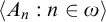 $\langle A_n : n\in \omega \rangle $
of elements of
$\langle A_n : n\in \omega \rangle $
of elements of $\mathcal {I}$
there is
$\mathcal {I}$
there is $A\in \mathcal {I}$
such that
$A\in \mathcal {I}$
such that $A_n\setminus A$
is finite for all
$A_n\setminus A$
is finite for all $n\in \omega $
.
$n\in \omega $
.
The vertical section of a set $A\subseteq X\times Y$
at a point
$A\subseteq X\times Y$
at a point $x\in X$
is defined by
$x\in X$
is defined by $A_{(x)} = \{y\in Y : (x,y)\in A\}$
. For ideals
$A_{(x)} = \{y\in Y : (x,y)\in A\}$
. For ideals $\mathcal {I}$
and
$\mathcal {I}$
and $\mathcal {J}$
on X and Y, respectively, we define the following ideal (called the Fubini product of
$\mathcal {J}$
on X and Y, respectively, we define the following ideal (called the Fubini product of $\mathcal {I}$
and
$\mathcal {I}$
and $\mathcal {J}$
):
$\mathcal {J}$
):
 $$ \begin{align*}\mathcal{I}\otimes \mathcal{J} = \{A\subseteq X\times Y: \{x\in X:A_{(x)}\notin\mathcal{J}\}\in \mathcal{I}\}.\end{align*} $$
We note that the above construction of the product of ideals also gives an ideal when applied to $\mathcal {I}=\{\emptyset \}$
or
$\mathcal {I}=\{\emptyset \}$
or $\mathcal {J}=\{\emptyset \}$
which are not ideals according to the definitions (they do not contain all finite sets). Namely, we will consider the following ideals:
$\mathcal {J}=\{\emptyset \}$
which are not ideals according to the definitions (they do not contain all finite sets). Namely, we will consider the following ideals:
 $$ \begin{align*} \begin{aligned} \mathcal{I}\otimes \{\emptyset\} &= \{A\subseteq X\times Y: \{x\in X:A_{(x)}\neq \emptyset\}\in \mathcal{I}\},\\ \{\emptyset\}\otimes \mathcal{J} &= \{A\subseteq X\times Y: A_{(x)}\in \mathcal{J} \text{ for every } x\}. \end{aligned} \end{align*} $$
In the studies of $\mathfrak {b}_{R}(\mathcal {I})$
, we can restrict to
$\mathfrak {b}_{R}(\mathcal {I})$
, we can restrict to $\mathcal {I}$
-gaps satisfying an additional property that
$\mathcal {I}$
-gaps satisfying an additional property that $\mathcal {A}$
is a partition of
$\mathcal {A}$
is a partition of $\omega $
[Reference Brendle and Mejía3, Lemma 2.2]. Consequently, a necessary condition for the number
$\omega $
[Reference Brendle and Mejía3, Lemma 2.2]. Consequently, a necessary condition for the number $\mathfrak {b}_{R}(\mathcal {I})$
to be well defined (i.e., to be
$\mathfrak {b}_{R}(\mathcal {I})$
to be well defined (i.e., to be $\leq \mathfrak {c}$
) is the existence of an infinite partition of
$\leq \mathfrak {c}$
) is the existence of an infinite partition of $\omega $
consisting of
$\omega $
consisting of $\mathcal {I}$
-positive sets. On the other hand, such a partition exists if and only if
$\mathcal {I}$
-positive sets. On the other hand, such a partition exists if and only if $\mathcal {I}$
is not a direct sum (see page 11 for the definition) of finitely many maximal ideals [Reference Filipów, Kwela and Leonetti10, Proposition 4.3]. In particular, such a partition exists for every ideal
$\mathcal {I}$
is not a direct sum (see page 11 for the definition) of finitely many maximal ideals [Reference Filipów, Kwela and Leonetti10, Proposition 4.3]. In particular, such a partition exists for every ideal $\mathcal {I}$
with the hereditary Baire property (i.e.,
$\mathcal {I}$
with the hereditary Baire property (i.e., $\mathcal {I}\restriction X = \{A\cap X: A\in \mathcal {I}\}$
has the Baire property for every
$\mathcal {I}\restriction X = \{A\cap X: A\in \mathcal {I}\}$
has the Baire property for every $X\in \mathcal {I}^+$
) [Reference Filipów, Kwela and Leonetti10, Proposition 2.5]. Note that Borel and analytic ideals have the hereditary Baire property. The following lemma gives a sufficient condition for
$X\in \mathcal {I}^+$
) [Reference Filipów, Kwela and Leonetti10, Proposition 2.5]. Note that Borel and analytic ideals have the hereditary Baire property. The following lemma gives a sufficient condition for $\mathfrak {b}_R(\mathcal {I})$
to be well defined.
$\mathfrak {b}_R(\mathcal {I})$
to be well defined.
Lemma 2.1. $\mathfrak {b}_{R}(\mathcal {I})\leq \mathfrak {c}$
if and only if there exists a partition
$\mathfrak {b}_{R}(\mathcal {I})\leq \mathfrak {c}$
if and only if there exists a partition $\{A_n:n<\omega \}$
of
$\{A_n:n<\omega \}$
of $\omega $
such that
$\omega $
such that $A_n\in \mathcal {I}^+$
for each n and
$A_n\in \mathcal {I}^+$
for each n and
 $$ \begin{align*}\forall C\subseteq\omega \left[ \forall n\, (C\cap A_n\in \mathcal{I}) \implies \exists B\in \mathcal{I}^+(B\cap C=\emptyset \land \forall n\, (B\cap A_n\in \mathcal{I}))\right]. \end{align*} $$
Proof. ( $\implies $
) Let
$\implies $
) Let $(\mathcal {A},\mathcal {B})$
be a Rothberger
$(\mathcal {A},\mathcal {B})$
be a Rothberger $\mathcal {I}$
-gap with
$\mathcal {I}$
-gap with $|\mathcal {B}|\leq \mathfrak {c}$
. Without loss of generality, we can assume that
$|\mathcal {B}|\leq \mathfrak {c}$
. Without loss of generality, we can assume that $\mathcal {A}=\{A_n:n<\omega \}$
is a partition of
$\mathcal {A}=\{A_n:n<\omega \}$
is a partition of $\omega $
into
$\omega $
into $\mathcal {I}$
-positive sets [Reference Brendle and Mejía3, Lemma 2.2]. Take any
$\mathcal {I}$
-positive sets [Reference Brendle and Mejía3, Lemma 2.2]. Take any $C\subseteq \omega $
such that
$C\subseteq \omega $
such that $C\cap A_n\in \mathcal {I}$
for each n. Since
$C\cap A_n\in \mathcal {I}$
for each n. Since $(\mathcal {A},\mathcal {B})$
is an
$(\mathcal {A},\mathcal {B})$
is an $\mathcal {I}$
-gap, there is
$\mathcal {I}$
-gap, there is $B\in \mathcal {B}$
such that
$B\in \mathcal {B}$
such that $B'=B\setminus C\notin \mathcal {I}$
. Then
$B'=B\setminus C\notin \mathcal {I}$
. Then $B'\in \mathcal {I}^+$
,
$B'\in \mathcal {I}^+$
, $B'\cap C=\emptyset $
, and
$B'\cap C=\emptyset $
, and $B'\cap A_n\subseteq B\cap A_n\in \mathcal {I}$
for all n.
$B'\cap A_n\subseteq B\cap A_n\in \mathcal {I}$
for all n.
( $\impliedby $
) Let
$\impliedby $
) Let $\{A_n:n<\omega \}$
be a partition of
$\{A_n:n<\omega \}$
be a partition of $\omega $
into
$\omega $
into $\mathcal {I}$
-positive sets with the required property. Let
$\mathcal {I}$
-positive sets with the required property. Let $\mathcal {B}=\{B\subseteq \omega : B\in \mathcal {I}^+ \text { and } B\cap A_n\in \mathcal {I}\text { for all }n\}$
. The pair
$\mathcal {B}=\{B\subseteq \omega : B\in \mathcal {I}^+ \text { and } B\cap A_n\in \mathcal {I}\text { for all }n\}$
. The pair $(\mathcal {A},\mathcal {B})$
is
$(\mathcal {A},\mathcal {B})$
is $\mathcal {I}$
-orthogonal. Once we show that
$\mathcal {I}$
-orthogonal. Once we show that $(\mathcal {A},\mathcal {B})$
cannot be
$(\mathcal {A},\mathcal {B})$
cannot be $\mathcal {I}$
-separated,
$\mathcal {I}$
-separated, $\mathfrak {b}_{R}(\mathcal {I})\leq |\mathcal {B}|\leq \mathfrak {c}$
and the proof will be finished. Take
$\mathfrak {b}_{R}(\mathcal {I})\leq |\mathcal {B}|\leq \mathfrak {c}$
and the proof will be finished. Take $C\subseteq \omega $
such that
$C\subseteq \omega $
such that $C\cap A_n\in \mathcal {I}$
for each n. Then there is
$C\cap A_n\in \mathcal {I}$
for each n. Then there is $B\in \mathcal {I}^+$
such that
$B\in \mathcal {I}^+$
such that $B\cap C=\emptyset $
and
$B\cap C=\emptyset $
and $B\cap A_n\in \mathcal {I}$
for each n. Since
$B\cap A_n\in \mathcal {I}$
for each n. Since $B\in \mathcal {B}$
and
$B\in \mathcal {B}$
and $B\setminus C=B\notin \mathcal {I}$
, C does not
$B\setminus C=B\notin \mathcal {I}$
, C does not $\mathcal {I}$
-separate
$\mathcal {I}$
-separate $(\mathcal {A},\mathcal {B})$
.
$(\mathcal {A},\mathcal {B})$
.
An ideal $\mathcal {I}$
on X is a
$\mathcal {I}$
on X is a $P^+$
-ideal (
$P^+$
-ideal ( $P^+(\mathcal {I})$
-ideal, resp.) if for any decreasing sequence
$P^+(\mathcal {I})$
-ideal, resp.) if for any decreasing sequence $\langle A_n : n\in \omega \rangle $
of
$\langle A_n : n\in \omega \rangle $
of $\mathcal {I}$
-positive sets there is
$\mathcal {I}$
-positive sets there is $A \in \mathcal {I}^+$
such that
$A \in \mathcal {I}^+$
such that $A\setminus A_{n}$
is finite (
$A\setminus A_{n}$
is finite ( $A\setminus A_{n}\in \mathcal {I}$
, resp.) for every n. Every
$A\setminus A_{n}\in \mathcal {I}$
, resp.) for every n. Every $F_\sigma $
-ideal is a
$F_\sigma $
-ideal is a $P^+$
-ideal [Reference Meza-Alcántara17, Lemma 3.2.4]. Obviously, every
$P^+$
-ideal [Reference Meza-Alcántara17, Lemma 3.2.4]. Obviously, every $P^+$
-ideal is
$P^+$
-ideal is $P^+(\mathcal {I})$
. On the other hand, the ideal
$P^+(\mathcal {I})$
. On the other hand, the ideal
 $$ \begin{align*}\mathrm{Fin}^2 = \mathrm{Fin}\otimes \mathrm{Fin} = \{A\subseteq \omega\times \omega: A_{(n)} \text{ is finite for all but finitely many } n\}\end{align*} $$
is $P^+(\mathrm {Fin}\otimes \mathrm {Fin})$
-ideal but it is not a
$P^+(\mathrm {Fin}\otimes \mathrm {Fin})$
-ideal but it is not a $P^+$
-ideal [Reference Filipów, Kowitz and Kwela8, Proposition 2.6(2)]. One can also show that the ideal
$P^+$
-ideal [Reference Filipów, Kowitz and Kwela8, Proposition 2.6(2)]. One can also show that the ideal
 $$ \begin{align*}\mathrm{CONV} = \{A\subseteq \mathbb{Q}\cap [0,1]: A \text{ has finitely many accumulation points in } [0,1]\}\end{align*} $$
is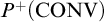 $P^+(\mathrm {CONV})$
-ideal but it is not a
$P^+(\mathrm {CONV})$
-ideal but it is not a $P^+$
-ideal. Each
$P^+$
-ideal. Each $P^+(\mathcal {I})$
-ideal has
$P^+(\mathcal {I})$
-ideal has $BW$
property (for definition see [Reference Filipów, Mrożek, Recław and Szuca12]), so the following ideals (which do not have
$BW$
property (for definition see [Reference Filipów, Mrożek, Recław and Szuca12]), so the following ideals (which do not have $BW$
property [Reference Filipów, Mrożek, Recław and Szuca11]) are not
$BW$
property [Reference Filipów, Mrożek, Recław and Szuca11]) are not $P^+(\mathcal {I})$
-ideals:
$P^+(\mathcal {I})$
-ideals:
 $$ \begin{align*} \begin{aligned} \mathcal{I}_d &= \left\{A\subseteq\omega: \limsup_{n\to\infty} \frac{|A\cap n|}{n}=0\right\}, \\\mathrm{NWD} & = \{A\subseteq\mathbb{Q}\cap [0,1]: A \text{ is nowhere dense in } [0,1]\}. \end{aligned} \end{align*} $$
The following proposition gives a sufficient condition for $\mathfrak {b}_R(\mathcal {I})$
to be well defined.
$\mathfrak {b}_R(\mathcal {I})$
to be well defined.
Proposition 2.2. Each of the following conditions guarantees (separately) that $\mathfrak {b}_{R}(\mathcal {I})\leq \mathfrak {c}$
:
$\mathfrak {b}_{R}(\mathcal {I})\leq \mathfrak {c}$
:
-
(1)
$\mathcal {I}$
is a
$P^+(\mathcal {I})$
-ideal and there exists an infinite partition of
$\omega $
consisting of
$\mathcal {I}$
-positive sets. -
(2) There is
$X\in \mathcal {I}^+$
such that
$\mathcal {I}\restriction X$
is a
$P^+(\mathcal {I}\restriction X)$
-ideal and there exists an infinite partition of X consisting of
$\mathcal {I}$
-positive sets. -
(3)
$\mathcal {I}$
is a Borel ideals and there is
$X\in \mathcal {I}^+$
such that
$\mathcal {I}\restriction X$
is a
$P^+(\mathcal {I}\restriction X)$
-ideal.


Proof. (1) Let $\{A_n:n<\omega \}$
be a partition of
$\{A_n:n<\omega \}$
be a partition of $\omega $
such that
$\omega $
such that $A_n\in \mathcal {I}^+$
for each n. We will use Lemma 2.1. Take any
$A_n\in \mathcal {I}^+$
for each n. We will use Lemma 2.1. Take any $C\subseteq \omega $
with
$C\subseteq \omega $
with $C\cap A_n\in \mathcal {I}$
for all n. Define
$C\cap A_n\in \mathcal {I}$
for all n. Define
 $$ \begin{align*}D_n=\bigcup \{ A_k\setminus C : k\geq n\}\end{align*} $$
for each n. Since $D_n\supseteq D_{n+1}$
and
$D_n\supseteq D_{n+1}$
and $D_n\notin \mathcal {I}$
for all n and
$D_n\notin \mathcal {I}$
for all n and $\mathcal {I}$
is a
$\mathcal {I}$
is a $P^+(\mathcal {I})$
-ideal, there exists
$P^+(\mathcal {I})$
-ideal, there exists $B\in \mathcal {I}^+$
such that
$B\in \mathcal {I}^+$
such that $B\setminus D_n\in \mathcal {I}$
for each n. In particular,
$B\setminus D_n\in \mathcal {I}$
for each n. In particular, $B'=B\cap D_0\notin \mathcal {I}$
. Then
$B'=B\cap D_0\notin \mathcal {I}$
. Then $B'\cap A_n \subseteq B\setminus D_{n+1}\in \mathcal {I}$
for each n and
$B'\cap A_n \subseteq B\setminus D_{n+1}\in \mathcal {I}$
for each n and $B'\cap C\subseteq D_0\cap C=\emptyset $
, so
$B'\cap C\subseteq D_0\cap C=\emptyset $
, so $\mathfrak {b}_{R}(\mathcal {I})\leq \mathfrak {c}$
by Lemma 2.1.
$\mathfrak {b}_{R}(\mathcal {I})\leq \mathfrak {c}$
by Lemma 2.1.
(2) Apply item (1) to the ideal $\mathcal {I}\restriction X$
and use the fact that
$\mathcal {I}\restriction X$
and use the fact that $\mathfrak {b}_{R}(\mathcal {I})\leq \mathfrak {b}_{R}(\mathcal {I}\restriction X)$
[Reference Brendle and Mejía3, Remark 2.4(2)].
$\mathfrak {b}_{R}(\mathcal {I})\leq \mathfrak {b}_{R}(\mathcal {I}\restriction X)$
[Reference Brendle and Mejía3, Remark 2.4(2)].
(3) Follows from item (2) and the fact that Borel ideals have the hereditary Baire property (hence there is an infinite partition of $\omega $
consisting of
$\omega $
consisting of $\mathcal {I}$
-positive sets [Reference Filipów, Kwela and Leonetti10, Proposition 2.5]).
$\mathcal {I}$
-positive sets [Reference Filipów, Kwela and Leonetti10, Proposition 2.5]).
Question 2.3. Is $\mathfrak {b}_{R}(\mathcal {I})\leq \mathfrak {c}$
for each Borel ideal
$\mathfrak {b}_{R}(\mathcal {I})\leq \mathfrak {c}$
for each Borel ideal $\mathcal {I}$
?
$\mathcal {I}$
?
3
$\mathfrak {b}(\mathcal {I})$
is less than or equal to
$\mathfrak {b}_{R}(\mathcal {I})$


For an ideal $\mathcal {I}$
, we use the following notation:
$\mathcal {I}$
, we use the following notation:
-
•
$\widehat {\mathcal {P}}_{\mathcal {I}}$
is the family of all sequences
$\langle A_n : n\in \omega \rangle $
such that
$A_n\in \mathcal {I}$
for all
$n\in \omega $
and
$A_n\cap A_k=\emptyset $
for
$n\neq k$
; -
•
$\mathcal {P}_{\mathcal {I}}$
is the family of all sequences
$\langle A_n : n\in \omega \rangle \in \widehat {\mathcal {P}}_{\mathcal {I}}$
with
$\bigcup \{A_n: n\in \omega \} = \omega $
.


Using the above notation, we can characterize the number $\mathfrak {b}(\mathcal {I})$
in the following more technical though useful manner.
$\mathfrak {b}(\mathcal {I})$
in the following more technical though useful manner.
Theorem 3.1 [Reference Filipów and Kwela9, Theorem 3.10].
For any ideal $\mathcal {I}$
on
$\mathcal {I}$
on $\omega $
,
$\omega $
,
 $$ \begin{align*} \begin{aligned} \mathfrak{b}(\mathcal{I}) = \min \left\{|\mathcal{E}|:\mathcal{E}\subseteq\widehat{\mathcal{P}}_{\mathcal{I}} \text{ and } \right. & \text{for every } \langle A_n\rangle\in\mathcal{P}_{\mathcal{I}} \text{ there exists } \langle E_n\rangle\in\mathcal{E} \text{ with } \\ & \left. {\bigcup_{n\in\omega}\left(A_n\cap \bigcup_{i\leq n}E_i\right)\notin\mathcal{I}} \right\}. \end{aligned} \end{align*} $$
With the aid of the above characterization, we can prove the following theorem.
Theorem 3.2. $\mathfrak {b}(\mathcal {I})\leq \mathfrak {b}_{R}(\mathcal {I})$
for every ideal
$\mathfrak {b}(\mathcal {I})\leq \mathfrak {b}_{R}(\mathcal {I})$
for every ideal $\mathcal {I}$
.
$\mathcal {I}$
.
Proof. It is enough to show that $\lambda <\mathfrak {b}(\mathcal {I})$
implies
$\lambda <\mathfrak {b}(\mathcal {I})$
implies $\lambda <\mathfrak {b}_{R}(\mathcal {I})$
. Let
$\lambda <\mathfrak {b}_{R}(\mathcal {I})$
. Let $\lambda <\mathfrak {b}(\mathcal {I})$
and take families
$\lambda <\mathfrak {b}(\mathcal {I})$
and take families $\mathcal {A},\mathcal {B}\subseteq \mathcal {P}(\omega )$
such that
$\mathcal {A},\mathcal {B}\subseteq \mathcal {P}(\omega )$
such that $|\mathcal {A}|=\omega $
,
$|\mathcal {A}|=\omega $
, $|\mathcal {B}|=\lambda $
,
$|\mathcal {B}|=\lambda $
, $\mathcal {A}=\{A_n:n\in \omega \}$
is a partition of
$\mathcal {A}=\{A_n:n\in \omega \}$
is a partition of $\omega ,$
and
$\omega ,$
and $A\cap B\in \mathcal {I}$
for any
$A\cap B\in \mathcal {I}$
for any $A\in \mathcal {A}$
and
$A\in \mathcal {A}$
and $B\in \mathcal {B}$
. We have to show that there is
$B\in \mathcal {B}$
. We have to show that there is $C\subseteq \omega $
such that
$C\subseteq \omega $
such that $A\cap C\in \mathcal {I}$
and
$A\cap C\in \mathcal {I}$
and $B\setminus C\in \mathcal {I}$
for any
$B\setminus C\in \mathcal {I}$
for any $A\in \mathcal {A}$
and
$A\in \mathcal {A}$
and $B\in \mathcal {B}$
.
$B\in \mathcal {B}$
.
For each $A\in \mathcal {A}$
and
$A\in \mathcal {A}$
and $B\in \mathcal {B}$
, we define
$B\in \mathcal {B}$
, we define $E_A^B=A\cap B$
. Then
$E_A^B=A\cap B$
. Then $E_A^B\in \mathcal {I}$
for each
$E_A^B\in \mathcal {I}$
for each $A,B$
. Moreover, since
$A,B$
. Moreover, since $\mathcal {A}$
is a partition of
$\mathcal {A}$
is a partition of $\omega $
,
$\omega $
, $E_{A_1}^B\cap E_{A_2}^B=\emptyset $
for any distinct
$E_{A_1}^B\cap E_{A_2}^B=\emptyset $
for any distinct $A_1,A_2\in \mathcal {A}$
.
$A_1,A_2\in \mathcal {A}$
.
Let $\mathcal {E}=\{\{E_A^B:A\in \mathcal {A}\}:B\in \mathcal {B}\}$
. Since
$\mathcal {E}=\{\{E_A^B:A\in \mathcal {A}\}:B\in \mathcal {B}\}$
. Since $|\mathcal {E}|\leq |\mathcal {B}| = \lambda <\mathfrak {b}(\mathcal {I})$
, there is a partition
$|\mathcal {E}|\leq |\mathcal {B}| = \lambda <\mathfrak {b}(\mathcal {I})$
, there is a partition $\{C_n:n\in \omega \}$
of
$\{C_n:n\in \omega \}$
of $\omega $
such that
$\omega $
such that $C_n\in \mathcal {I}$
for each n, and
$C_n\in \mathcal {I}$
for each n, and
 $$ \begin{align*}\bigcup_{n\in \omega}\left(C_n\cap \bigcup_{i\leq n} E^B_{A_i}\right)\in \mathcal{I}\end{align*} $$
for each $B\in \mathcal {B}$
. We claim that the set
$B\in \mathcal {B}$
. We claim that the set
 $$ \begin{align*}C = \bigcup_{n\in \omega}\left(A_n\cap \bigcup_{i<n} C_i\right)\end{align*} $$
separates the pair $(\mathcal {A},\mathcal {B})$
. First, we observe that
$(\mathcal {A},\mathcal {B})$
. First, we observe that
 $$ \begin{align*}A_k\cap C = A_k\cap \bigcup_{n\in \omega}\left(A_n\cap \bigcup_{i<n} C_i\right) = A_k\cap \bigcup_{i<k}C_i \in \mathcal{I} \end{align*} $$
for every $k\in \omega $
. Second, we observe that
$k\in \omega $
. Second, we observe that
 $$ \begin{align*} \begin{aligned} B \setminus C & = B \setminus \bigcup_{n\in \omega}\left(A_n\cap \bigcup_{i<n} C_i\right) = \bigcup_{n\in \omega}\left(A_n\cap B\right) \setminus \bigcup_{n\in \omega}\left(A_n\cap \bigcup_{i<n} C_i\right) \\ & = \bigcup_{n\in \omega}\left(A_n\cap B \setminus \bigcup_{i<n} C_i\right) = \bigcup_{n\in \omega}\left(E^B_{A_n} \setminus \bigcup_{i<n} C_i\right) \\ & \subseteq \bigcup_{n\in \omega}\left(C_n\cap \bigcup_{i\leq n }E^B_{A_i}\right) \in\mathcal{I} \end{aligned} \end{align*} $$
for every $B\in \mathcal {B}$
.
$B\in \mathcal {B}$
.
Remark 3.3. In Theorem 4.1 we provide a characterization of $\mathfrak {b}_R(\mathcal {I})$
which is similar to the above characterization of
$\mathfrak {b}_R(\mathcal {I})$
which is similar to the above characterization of $\mathfrak {b}(\mathcal {I})$
, and then Theorem 3.2 will easily follow from Theorem 4.1, However, we decided to prove Theorem 3.2 without the use of Theorem 4.1, since the above proof is much simpler.
$\mathfrak {b}(\mathcal {I})$
, and then Theorem 3.2 will easily follow from Theorem 4.1, However, we decided to prove Theorem 3.2 without the use of Theorem 4.1, since the above proof is much simpler.
As a corollary of Theorem 4.1, we can calculate $\mathfrak {b}(\mathcal {I})$
for some well-known ideals (for the definitions of ideals mentioned in this theorem see, e.g., [Reference Brendle and Mejía3]).
$\mathfrak {b}(\mathcal {I})$
for some well-known ideals (for the definitions of ideals mentioned in this theorem see, e.g., [Reference Brendle and Mejía3]).
Corollary 3.4. $\mathfrak {b}(\mathcal {I})=\omega _1$
for the following ideals
$\mathfrak {b}(\mathcal {I})=\omega _1$
for the following ideals $\mathcal {I}$
: (1)
$\mathcal {I}$
: (1) $\mathcal {ED}$
, (2)
$\mathcal {ED}$
, (2) $\mathcal {ED}_{\mathrm {Fin}}$
, (3) fragmented not gradually fragmented ideals
$\mathcal {ED}_{\mathrm {Fin}}$
, (3) fragmented not gradually fragmented ideals $\mathcal {I} = \mathcal {I}_{\{(a_i,\phi _i):j\in \omega \}}$
such that all
$\mathcal {I} = \mathcal {I}_{\{(a_i,\phi _i):j\in \omega \}}$
such that all $\phi _i$
are uniform submeasures, and (4) somewhere tall fragmented ideals
$\phi _i$
are uniform submeasures, and (4) somewhere tall fragmented ideals $\mathcal {I} = \mathcal {I}_{\{(a_i,\phi _i):j\in \omega \}}$
such that all
$\mathcal {I} = \mathcal {I}_{\{(a_i,\phi _i):j\in \omega \}}$
such that all $\phi _i$
are measures.
$\phi _i$
are measures.
Proof. Since $\mathfrak {b}(\mathcal {I})\geq \omega _1$
for each
$\mathfrak {b}(\mathcal {I})\geq \omega _1$
for each $\mathcal {I}$
[Reference Filipów and Kwela9, Theorem 4.2], we only need to show that
$\mathcal {I}$
[Reference Filipów and Kwela9, Theorem 4.2], we only need to show that $\mathfrak {b}(\mathcal {I})\leq \omega _1$
in the case of these ideals. Items (2)–(4) follow from Theorem 3.2 and the fact that
$\mathfrak {b}(\mathcal {I})\leq \omega _1$
in the case of these ideals. Items (2)–(4) follow from Theorem 3.2 and the fact that $\mathfrak {b}_{R}(\mathcal {I})=\omega _1$
in these cases [Reference Brendle and Mejía3, Theorems 3.1, 3.4, and 3.6]. Item (1) follows from item (2), the equality
$\mathfrak {b}_{R}(\mathcal {I})=\omega _1$
in these cases [Reference Brendle and Mejía3, Theorems 3.1, 3.4, and 3.6]. Item (1) follows from item (2), the equality $\mathcal {ED}_{\mathrm {Fin}} = \mathcal {ED}\restriction \{(n,k)\in \omega ^2: k\leq n\}$
and the inequality
$\mathcal {ED}_{\mathrm {Fin}} = \mathcal {ED}\restriction \{(n,k)\in \omega ^2: k\leq n\}$
and the inequality $\mathfrak {b}(\mathcal {I})\leq \mathfrak {b}(\mathcal {I}\restriction X)$
, which holds for every
$\mathfrak {b}(\mathcal {I})\leq \mathfrak {b}(\mathcal {I}\restriction X)$
, which holds for every $X\notin \mathcal {I}$
[Reference Filipów and Kwela9, Theorem 5.1].
$X\notin \mathcal {I}$
[Reference Filipów and Kwela9, Theorem 5.1].
Proposition 3.5. Let $\mathcal {I}$
and
$\mathcal {I}$
and $\mathcal {J}$
be ideals on
$\mathcal {J}$
be ideals on $\omega $
.
$\omega $
.
-
(1)
$\mathfrak {b}_{R}(\mathcal {I}\otimes \mathcal {J})\leq \mathfrak {b}_R(\mathcal {I})$
. -
(2) If
$\mathfrak {b}_{R}(\mathcal {I}) = \mathfrak {b}(\mathcal {I})$
, then
$\mathfrak {b}_{R}(\mathcal {I}\otimes \mathcal {J}) = \mathfrak {b}(\mathcal {I}\otimes \mathcal {J})=\mathfrak {b}(\mathcal {I})$
.


Proof. (1) If $\mathfrak {b}_{R}(\mathcal {I})=\mathfrak {c}^+$
, there is nothing to show, so assume that
$\mathfrak {b}_{R}(\mathcal {I})=\mathfrak {c}^+$
, there is nothing to show, so assume that $\mathfrak {b}_{R}(\mathcal {I})\leq \mathfrak {c}$
and take an
$\mathfrak {b}_{R}(\mathcal {I})\leq \mathfrak {c}$
and take an $\mathcal {I}$
-
$\mathcal {I}$
- $(\omega ,\mathfrak {b}_{R}(\mathcal {I}))$
-gap
$(\omega ,\mathfrak {b}_{R}(\mathcal {I}))$
-gap $(\mathcal {A},\mathcal {B})$
. Define
$(\mathcal {A},\mathcal {B})$
. Define $\mathcal {C} = \{A\times \omega : A\in \mathcal {A}\}$
and
$\mathcal {C} = \{A\times \omega : A\in \mathcal {A}\}$
and $\mathcal {D} = \{B\times \omega : B\in \mathcal {B}\}$
. Once we show that
$\mathcal {D} = \{B\times \omega : B\in \mathcal {B}\}$
. Once we show that $(\mathcal {C},\mathcal {D})$
is an
$(\mathcal {C},\mathcal {D})$
is an $\mathcal {I}\otimes \mathcal {J}$
-
$\mathcal {I}\otimes \mathcal {J}$
- $(\omega ,\mathfrak {b}_{R}(\mathcal {I}))$
-gap, the proof will be finished. Obviously,
$(\omega ,\mathfrak {b}_{R}(\mathcal {I}))$
-gap, the proof will be finished. Obviously, $|\mathcal {C}|=\omega $
and
$|\mathcal {C}|=\omega $
and $|\mathcal {D}|=\mathfrak {b}_{R}(\mathcal {I})$
. Moreover, since
$|\mathcal {D}|=\mathfrak {b}_{R}(\mathcal {I})$
. Moreover, since $A\cap B\in \mathcal {I}$
,
$A\cap B\in \mathcal {I}$
, $(A\times \omega )\cap (B\times \omega ) = (A\cap B)\times \omega \in \mathcal {I}\otimes \mathcal {J}$
. Thus,
$(A\times \omega )\cap (B\times \omega ) = (A\cap B)\times \omega \in \mathcal {I}\otimes \mathcal {J}$
. Thus, $(\mathcal {C},\mathcal {D})$
is
$(\mathcal {C},\mathcal {D})$
is $\mathcal {I}\otimes \mathcal {J}$
-orthogonal. Suppose that there is a set
$\mathcal {I}\otimes \mathcal {J}$
-orthogonal. Suppose that there is a set $C\subseteq \omega \times \omega $
which
$C\subseteq \omega \times \omega $
which $\mathcal {I}\otimes \mathcal {J}$
-separates the pair
$\mathcal {I}\otimes \mathcal {J}$
-separates the pair $(\mathcal {C},\mathcal {D})$
. Denote
$(\mathcal {C},\mathcal {D})$
. Denote $D = \{n\in \omega : C_{(n)}\notin \mathcal {J}\}$
, where
$D = \{n\in \omega : C_{(n)}\notin \mathcal {J}\}$
, where $C_{(n)} = \{k\in \omega : (n,k)\in C\}$
. If we show that the pair
$C_{(n)} = \{k\in \omega : (n,k)\in C\}$
. If we show that the pair $(\mathcal {A},\mathcal {B})$
is
$(\mathcal {A},\mathcal {B})$
is $\mathcal {I}$
-separated by the set D, we will obtain a contradiction. Take a set
$\mathcal {I}$
-separated by the set D, we will obtain a contradiction. Take a set $A\in \mathcal {A}$
. Since
$A\in \mathcal {A}$
. Since $(A\times \omega )\cap C\in \mathcal {I}\otimes \mathcal {J}$
,
$(A\times \omega )\cap C\in \mathcal {I}\otimes \mathcal {J}$
, $A\cap D \subseteq \{n\in \omega : ((A\times \omega )\cap C)_{(n)}\notin \mathcal {J}\}\in \mathcal {I}$
. Now take a set
$A\cap D \subseteq \{n\in \omega : ((A\times \omega )\cap C)_{(n)}\notin \mathcal {J}\}\in \mathcal {I}$
. Now take a set $B\in \mathcal {B}$
. Since
$B\in \mathcal {B}$
. Since $(B\times \omega )\setminus C\in \mathcal {I}\otimes \mathcal {J}$
,
$(B\times \omega )\setminus C\in \mathcal {I}\otimes \mathcal {J}$
, $B\setminus D \subseteq \{n\in \omega : ((B\times \omega )\setminus C)_{(n)}\notin \mathcal {J}\}\in \mathcal {I}$
. Thus D separates the pair
$B\setminus D \subseteq \{n\in \omega : ((B\times \omega )\setminus C)_{(n)}\notin \mathcal {J}\}\in \mathcal {I}$
. Thus D separates the pair $(\mathcal {A},\mathcal {B})$
.
$(\mathcal {A},\mathcal {B})$
.
(2) It is known that $\mathfrak {b}(\mathcal {I}) = \mathfrak {b}(\mathcal {I}\otimes \mathcal {J})$
[Reference Filipów and Kwela9, Theorem 5.13], so using item (1) and Theorem 3.2, we obtain
$\mathfrak {b}(\mathcal {I}) = \mathfrak {b}(\mathcal {I}\otimes \mathcal {J})$
[Reference Filipów and Kwela9, Theorem 5.13], so using item (1) and Theorem 3.2, we obtain
 $$ \begin{align*}\mathfrak{b}_{R}(\mathcal{I}\otimes \mathcal{J}) \leq \mathfrak{b}_{R}(\mathcal{I}) =\mathfrak{b}(\mathcal{I}) = \mathfrak{b}(\mathcal{I}\otimes \mathcal{J}) \leq \mathfrak{b}_{R}(\mathcal{I}\otimes\mathcal{J}).\\[-31pt] \end{align*} $$
For any positive $n\in \omega $
, we define by recursion the ideals
$n\in \omega $
, we define by recursion the ideals $\mathrm {Fin}^n$
by
$\mathrm {Fin}^n$
by
 $$ \begin{align*}\mathrm{Fin}^1=\mathrm{Fin} \quad \text{ and }\quad \mathrm{Fin}^{n+1} = \mathrm{Fin}\otimes \mathrm{Fin}^n.\end{align*} $$
Corollary 3.6. $\mathfrak {b}_{R}(\mathrm {Fin}^{n+1}) = \mathfrak {b}$
for each
$\mathfrak {b}_{R}(\mathrm {Fin}^{n+1}) = \mathfrak {b}$
for each $n\in \omega $
. In particular,
$n\in \omega $
. In particular, $\mathfrak {b}_{R}(\mathrm {Fin}\otimes \mathrm {Fin}) = \mathfrak {b}$
.
$\mathfrak {b}_{R}(\mathrm {Fin}\otimes \mathrm {Fin}) = \mathfrak {b}$
.
Proof. Since $\mathfrak {b}_{R}(\mathrm {Fin})=\mathfrak {b}(\mathrm {Fin})=\mathfrak {b}$
and
$\mathfrak {b}_{R}(\mathrm {Fin})=\mathfrak {b}(\mathrm {Fin})=\mathfrak {b}$
and $\mathrm {Fin}^{n+1} = \mathrm {Fin}\otimes \mathrm {Fin}^{n}$
, Proposition 3.5 finishes the proof.
$\mathrm {Fin}^{n+1} = \mathrm {Fin}\otimes \mathrm {Fin}^{n}$
, Proposition 3.5 finishes the proof.
4 Characterization of the Rothberger number
The characterization of the number $\mathfrak {b}(\mathcal {I})$
from Theorem 3.1 can be rephrased in the following manner:
$\mathfrak {b}(\mathcal {I})$
from Theorem 3.1 can be rephrased in the following manner:
 $$ \begin{align*} \begin{aligned} \mathfrak{b}(\mathcal{I}) = \min \left\{ \kappa: \right. & \exists_{\{E_n^\alpha: n<\omega \alpha<\kappa\}\subseteq \mathcal{I}} \, \left[ \left( \forall_{\alpha<\kappa}\,\forall_{n\in\omega}\, E^\alpha_n\cap \bigcup_{m\neq n} E^\alpha_m=\emptyset \right) \land \right. \\& \left. \left. \left( \forall_{\{A_n:n<\omega\}\in\mathcal{P}_{\mathcal{I}}} \, \exists_{\alpha<\kappa}\, \bigcup_{n\in\omega} \left( A_n\cap \bigcup_{i\leq n}E^\alpha_i \right) \notin\mathcal{I} \right) \right] \right\}. \end{aligned} \end{align*} $$
In Theorem 4.1, we show that the Rothberger number $\mathfrak {b}_{R}(\mathcal {I})$
can be characterized in a similar manner as the above characterization of
$\mathfrak {b}_{R}(\mathcal {I})$
can be characterized in a similar manner as the above characterization of $\mathfrak {b}(\mathcal {I})$
. It is worth to stress that the only difference between the above characterization of
$\mathfrak {b}(\mathcal {I})$
. It is worth to stress that the only difference between the above characterization of $\mathfrak {b}(\mathcal {I})$
and the below characterization of
$\mathfrak {b}(\mathcal {I})$
and the below characterization of $\mathfrak {b}_{R}(\mathcal {I})$
lies in the fact that in the former we only require
$\mathfrak {b}_{R}(\mathcal {I})$
lies in the fact that in the former we only require
 $$ \begin{align*}E^\alpha_n\cap \bigcup_{m\neq n} E^\alpha_m=\emptyset\end{align*} $$
for each $\alpha $
separately, whereas in the latter we will require disjointness for all
$\alpha $
separately, whereas in the latter we will require disjointness for all $\beta $
simultaneously, i.e.,
$\beta $
simultaneously, i.e.,
 $$ \begin{align*}E^\alpha_n\cap \bigcup_{\beta<\kappa} \left(\bigcup_{m\neq n} E^\beta_m\right)=\emptyset.\end{align*} $$
Theorem 4.1. For any ideal $\mathcal {I}$
,
$\mathcal {I}$
,
 $$ \begin{align*} \begin{aligned} \mathfrak{b}_R(\mathcal{I}) = \min \left\{\kappa: \right. & \left. \exists_{\{E_n^\alpha: n<\omega,\alpha<\kappa\}\subseteq \mathcal{I}}\, \left[\left( \forall_{\alpha<\kappa}\, \forall_{n\in\omega}\,E^\alpha_n\cap \bigcup_{\beta<\kappa} \left(\bigcup_{m\neq n} E^\beta_m\right)=\emptyset\right) \land \right.\right. \\& \left. \left.\left(\forall_{\{A_n:n<\omega\}\in\mathcal{P}_{\mathcal{I}}}\, \exists_{\alpha<\kappa}\, \bigcup_{n\in\omega}\left(A_n\cap \bigcup_{i\leq n}E^\alpha_i\right)\notin\mathcal{I}\right)\right]\right\}. \end{aligned} \end{align*} $$
Proof. $(\geq )$
Let
$(\geq )$
Let $(\mathcal {A},\mathcal {B})$
be an
$(\mathcal {A},\mathcal {B})$
be an $\mathcal {I}$
-gap of type
$\mathcal {I}$
-gap of type $(\omega ,\mathfrak {b}_{R}(\mathcal {I}))$
. Without loss of generality, we can assume that
$(\omega ,\mathfrak {b}_{R}(\mathcal {I}))$
. Without loss of generality, we can assume that $\mathcal {A}$
is a partition of
$\mathcal {A}$
is a partition of $\omega $
. Let
$\omega $
. Let $\mathcal {A} = \{A_n:n\in \omega \}$
and
$\mathcal {A} = \{A_n:n\in \omega \}$
and $\mathcal {B} = \{B_\alpha :\alpha <\mathfrak {b}_{R}(\mathcal {I})\}$
. We define
$\mathcal {B} = \{B_\alpha :\alpha <\mathfrak {b}_{R}(\mathcal {I})\}$
. We define
 $$ \begin{align*}E_n^\alpha = A_n\cap B_\alpha\in\mathcal{I}\end{align*} $$
for each $n<\omega $
and
$n<\omega $
and $\alpha <\mathfrak {b}_{R}(\mathcal {I})$
. Then
$\alpha <\mathfrak {b}_{R}(\mathcal {I})$
. Then $E_n^\alpha \cap E_m^\beta =\emptyset $
for each
$E_n^\alpha \cap E_m^\beta =\emptyset $
for each $n\neq m$
and arbitrary
$n\neq m$
and arbitrary $\alpha ,\beta <\mathfrak {b}_{R}(\mathcal {I})$
. Take any
$\alpha ,\beta <\mathfrak {b}_{R}(\mathcal {I})$
. Take any $\{D_n:n<\omega \}\in \mathcal {P}_{\mathcal {I}}$
. To finish the proof, we have to show that
$\{D_n:n<\omega \}\in \mathcal {P}_{\mathcal {I}}$
. To finish the proof, we have to show that
 $$ \begin{align*}\bigcup_{n\in\omega}\left(D_n\cap \bigcup_{i\leq n}E^\alpha_i\right)\notin\mathcal{I}\end{align*} $$
for some $\alpha <\mathfrak {b}_{R}(\mathcal {I})$
. Let us define
$\alpha <\mathfrak {b}_{R}(\mathcal {I})$
. Let us define
 $$ \begin{align*}C =\bigcup_{n\in\omega} \left(A_n\cap \bigcup_{i< n} D_i\right).\end{align*} $$
Since $C\cap A_n \subseteq \bigcup _{i< n} D_i \in \mathcal {I}$
for each n and
$C\cap A_n \subseteq \bigcup _{i< n} D_i \in \mathcal {I}$
for each n and $(\mathcal {A},\mathcal {B})$
is an
$(\mathcal {A},\mathcal {B})$
is an $\mathcal {I}$
-gap, there exists
$\mathcal {I}$
-gap, there exists ${\alpha <\mathfrak {b}_{R}(\mathcal {I})}$
with
${\alpha <\mathfrak {b}_{R}(\mathcal {I})}$
with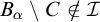 $B_\alpha \setminus C\notin \mathcal {I}$
. We claim that
$B_\alpha \setminus C\notin \mathcal {I}$
. We claim that
 $$ \begin{align*}B_\alpha\setminus C\subseteq \bigcup_{n\in\omega}\left(D_n\cap \bigcup_{i\leq n}E^\alpha_i\right).\end{align*} $$
Indeed, take $x\in B_\alpha \setminus C$
and let
$x\in B_\alpha \setminus C$
and let $n\in \omega $
be such that
$n\in \omega $
be such that $x\in A_n$
. Since
$x\in A_n$
. Since $x\notin C$
,
$x\notin C$
, $x\notin \bigcup _{i< n} D_i$
. Then there is
$x\notin \bigcup _{i< n} D_i$
. Then there is $k\geq n$
such that
$k\geq n$
such that $x\in D_k$
. Consequently,
$x\in D_k$
. Consequently,
 $$ \begin{align*}x\in D_k\cap A_n \cap B_\alpha= D_k\cap E^\alpha_n \subseteq D_k\cap \bigcup_{i\leq k} E^\alpha_i \subseteq \bigcup_{n\in\omega}\left(D_n\cap \bigcup_{i\leq n}E^\alpha_i\right).\end{align*} $$ $(\leq )$
Let
$(\leq )$
Let $\{E_n^\alpha : n<\omega , \alpha <\kappa \} \subseteq \mathcal {I}$
be such that
$\{E_n^\alpha : n<\omega , \alpha <\kappa \} \subseteq \mathcal {I}$
be such that $E_n^\alpha \cap E_m^\beta =\emptyset $
for each
$E_n^\alpha \cap E_m^\beta =\emptyset $
for each $\alpha ,\beta <\kappa $
and
$\alpha ,\beta <\kappa $
and $n\neq m$
and for any
$n\neq m$
and for any $\{D_n:n<\omega \} \in \mathcal {P}_{\mathcal {I}}$
there is
$\{D_n:n<\omega \} \in \mathcal {P}_{\mathcal {I}}$
there is $\alpha <\kappa $
with
$\alpha <\kappa $
with
 $$ \begin{align*}\bigcup_{n\in\omega}\left(D_n\cap \bigcup_{i\leq n}E^\alpha_i\right)\notin\mathcal{I}.\end{align*} $$
Let $\mathcal {A}=\{A_n:n\in \omega \}$
and
$\mathcal {A}=\{A_n:n\in \omega \}$
and $\mathcal {B}=\{B_\alpha :\alpha <\kappa \}$
, where
$\mathcal {B}=\{B_\alpha :\alpha <\kappa \}$
, where
 $$ \begin{align*}A_n =\bigcup_{\alpha<\kappa} E^\alpha_n \text{\ \ and\ \ } B_\alpha = \bigcup_{n<\omega} E^\alpha_n\end{align*} $$
for each $n\in \omega $
and
$n\in \omega $
and $\alpha <\kappa $
. If we show that
$\alpha <\kappa $
. If we show that $(\mathcal {A}, \mathcal {B})$
is an
$(\mathcal {A}, \mathcal {B})$
is an $\mathcal {I}$
-
$\mathcal {I}$
- $(\omega ,\lambda )$
-gap and
$(\omega ,\lambda )$
-gap and $\lambda \leq \kappa $
, the proof will be finished. Since
$\lambda \leq \kappa $
, the proof will be finished. Since $A_n\cap B_\alpha = E^\alpha _n\in \mathcal {I}$
, the families
$A_n\cap B_\alpha = E^\alpha _n\in \mathcal {I}$
, the families $\mathcal {A}$
and
$\mathcal {A}$
and $\mathcal {B}$
are
$\mathcal {B}$
are $\mathcal {I}$
-orthogonal. Obviously
$\mathcal {I}$
-orthogonal. Obviously $|\mathcal {B}|\leq \kappa $
. We claim that
$|\mathcal {B}|\leq \kappa $
. We claim that $|\mathcal {A}|=\omega $
. Indeed, otherwise
$|\mathcal {A}|=\omega $
. Indeed, otherwise $A_n=\emptyset $
for all but finitely many n, so there is k such that
$A_n=\emptyset $
for all but finitely many n, so there is k such that $E^\alpha _n=\emptyset $
for each
$E^\alpha _n=\emptyset $
for each $\alpha $
and
$\alpha $
and $n\geq k$
. Consequently, for any
$n\geq k$
. Consequently, for any $\{D_n :n<\omega \} \in \mathcal {P}_{\mathcal {I}}$
and any
$\{D_n :n<\omega \} \in \mathcal {P}_{\mathcal {I}}$
and any $\alpha <\kappa $
we have
$\alpha <\kappa $
we have
 $$ \begin{align*}\bigcup_{n\in\omega}\left(D_n\cap \bigcup_{i\leq n} E^\alpha_i\right)\subseteq \bigcup_{n<\omega}E^\alpha_n \in\mathcal{I},\end{align*} $$
a contradiction. Finally, we show that no C can $\mathcal {I}$
-separate
$\mathcal {I}$
-separate $(\mathcal {A},\mathcal {B})$
. Take any
$(\mathcal {A},\mathcal {B})$
. Take any $C\subseteq \omega $
such that
$C\subseteq \omega $
such that $A_n\cap C\in \mathcal {I}$
for any n. We need to find
$A_n\cap C\in \mathcal {I}$
for any n. We need to find $\alpha <\kappa $
such that
$\alpha <\kappa $
such that $B_\alpha \setminus C\notin \mathcal {I}$
. We define
$B_\alpha \setminus C\notin \mathcal {I}$
. We define $D^{\prime }_n = C\cap A_{n+1}$
for each
$D^{\prime }_n = C\cap A_{n+1}$
for each $n\in \omega $
. Let
$n\in \omega $
. Let $\omega \setminus \bigcup _{n\in \omega }D^{\prime }_n = \{a_n:n\in \omega \}$
. Now we define
$\omega \setminus \bigcup _{n\in \omega }D^{\prime }_n = \{a_n:n\in \omega \}$
. Now we define $D_n = D^{\prime }_n\cup \{a_n\}$
for each n. Then
$D_n = D^{\prime }_n\cup \{a_n\}$
for each n. Then $\{D_n:n\in \omega \}\in \mathcal {P}_{\mathcal {I}}$
, so there is
$\{D_n:n\in \omega \}\in \mathcal {P}_{\mathcal {I}}$
, so there is $\alpha <\kappa $
with
$\alpha <\kappa $
with
 $$ \begin{align*}\bigcup_{n\in\omega}\left(D_n\cap \bigcup_{i\leq n}E^\alpha_i\right)\notin\mathcal{I}.\end{align*} $$
Once we show that
 $$ \begin{align*}\bigcup_{n\in\omega}\left(D_n\cap \bigcup_{i\leq n}E^\alpha_i\right) \subseteq (B_\alpha\setminus C) \cup (A_0\cap C),\end{align*} $$
then $B_\alpha \setminus C\notin \mathcal {I}$
, because
$B_\alpha \setminus C\notin \mathcal {I}$
, because $A_0\cap C\in \mathcal {I}$
. Since
$A_0\cap C\in \mathcal {I}$
. Since
 $$ \begin{align*}\bigcup_{n\in\omega}\left(D_n\cap \bigcup_{i\leq n}E^\alpha_i\right) \subseteq \bigcup_{n\in\omega}\bigcup_{i\leq n}E^\alpha_i = B_\alpha,\end{align*} $$
we have
 $$ \begin{align*} \begin{aligned} \bigcup_{n\in\omega}\left(D_n\cap \bigcup_{i\leq n}E^\alpha_i\right) & = \bigcup_{n\in\omega}\left(D_n\cap \bigcup_{i\leq n}E^\alpha_i\right) \setminus C \\& \cup \bigcup_{n\in\omega}\left(D_n\cap \bigcup_{i\leq n}E^\alpha_i\right) \cap C \\& \subseteq (B_\alpha\setminus C) \cup \left(\bigcup_{n\in\omega}\left(D_n\cap \bigcup_{i\leq n}E^\alpha_i\right)\cap C\right). \end{aligned} \end{align*} $$
Now we show that
 $$ \begin{align*}C\cap \bigcup_{n\in\omega}\left(D_n\cap \bigcup_{i\leq n}E^\alpha_i\right) \subseteq A_0\cap C.\end{align*} $$
Indeed, using the facts that $A_{n+1}\cap \bigcup _{i\leq n}E^\alpha _i=\emptyset $
for each n,
$A_{n+1}\cap \bigcup _{i\leq n}E^\alpha _i=\emptyset $
for each n, ${B_\alpha \cap (\omega \setminus \bigcup _{n\in \omega }A_n)=\emptyset }$
and
${B_\alpha \cap (\omega \setminus \bigcup _{n\in \omega }A_n)=\emptyset }$
and
 $$ \begin{align*}\{a_n:n\in\omega\} = \left(\omega\setminus \bigcup_{n\in\omega}A_n\right)\cup A_0\cup \left(\bigcup_{n\geq 1}A_n\setminus C\right),\end{align*} $$
we obtain
 $$ \begin{align*} \begin{aligned} \bigcup_{n\in\omega}\left(D_n\cap \bigcup_{i\leq n}E^\alpha_i\right) \cap C & = \bigcup_{n\in\omega}\left((D^{\prime}_n\cup \{a_n\})\cap \bigcup_{i\leq n}E^\alpha_i\right) \cap C \\& = \bigcup_{n\in\omega}\left(((A_{n+1}\cap C) \cup\{a_n\})\cap \bigcup_{i\leq n}E^\alpha_i \right) \cap C \\& = \bigcup_{n\in\omega}\left(\{a_n\} \cap \bigcup_{i\leq n}E^\alpha_i\right) \cap C \\& \subseteq \{a_n:n\in \omega\}\cap B_\alpha \cap C \\& = \left(\left(\omega\setminus \bigcup_{n\in\omega}A_n\right)\cup A_0\cup \left(\bigcup_{n\geq 1}A_n\setminus C\right)\right)\cap B_\alpha \cap C \\& = A_0\cap B_\alpha\cap C. \end{aligned}\\[-33pt] \end{align*} $$
5 Consistently
$\mathfrak {b}(\mathcal {I})$
is less than
$\mathfrak {b}_{R}(\mathcal {I})$


We have either $\mathfrak {b}_{R}(\mathcal {I})\leq \mathfrak {b}$
or
$\mathfrak {b}_{R}(\mathcal {I})\leq \mathfrak {b}$
or $\mathfrak {b}_{R}(\mathcal {I})=\mathfrak {c}^+$
for ideals
$\mathfrak {b}_{R}(\mathcal {I})=\mathfrak {c}^+$
for ideals $\mathcal {I}$
for which the value
$\mathcal {I}$
for which the value $\mathfrak {b}_{R}(\mathcal {I})$
had been estimated so far in the literature. Moreover, it is consistent that
$\mathfrak {b}_{R}(\mathcal {I})$
had been estimated so far in the literature. Moreover, it is consistent that $\mathfrak {b}_{R}(\mathcal {I})<\mathfrak {b}$
for some ideal
$\mathfrak {b}_{R}(\mathcal {I})<\mathfrak {b}$
for some ideal $\mathcal {I}$
[Reference Brendle and Mejía3, Theorem 6.1]. In Theorem 5.3 we show that consistently the value of
$\mathcal {I}$
[Reference Brendle and Mejía3, Theorem 6.1]. In Theorem 5.3 we show that consistently the value of $\mathfrak {b}_{R}(\mathcal {I})$
can be strictly greater than
$\mathfrak {b}_{R}(\mathcal {I})$
can be strictly greater than $\mathfrak {b}$
and strictly less than
$\mathfrak {b}$
and strictly less than $\mathfrak {c}^+$
. However, this example is cooked up with the aid of maximal ideals, so the following questions remains open.
$\mathfrak {c}^+$
. However, this example is cooked up with the aid of maximal ideals, so the following questions remains open.
Question 5.1. Is it consistent that there exists a Borel ideal $\mathcal {I}$
such that
$\mathcal {I}$
such that ${\mathfrak {b}(\mathcal {I})<\mathfrak {b}_{R}(\mathcal {I})\leq \mathfrak {c}}$
?
${\mathfrak {b}(\mathcal {I})<\mathfrak {b}_{R}(\mathcal {I})\leq \mathfrak {c}}$
?
Lemma 5.2. $\mathfrak {b}_{R}(\mathcal {I}\otimes \{\emptyset \}) = \mathfrak {b}(\mathcal {I}\otimes \{\emptyset \}) = \mathfrak {b}(\mathcal {I})$
for any ideal
$\mathfrak {b}_{R}(\mathcal {I}\otimes \{\emptyset \}) = \mathfrak {b}(\mathcal {I}\otimes \{\emptyset \}) = \mathfrak {b}(\mathcal {I})$
for any ideal $\mathcal {I}$
.
$\mathcal {I}$
.
Proof. The second equality is proved in [Reference Filipów and Kwela9, Theorem 5.13] and the inequality $\mathfrak {b}_{R}(\mathcal {I}\otimes \{\emptyset \}) \geq \mathfrak {b}(\mathcal {I}\otimes \{\emptyset \})$
follows from Theorem 3.2. Below, we show that
$\mathfrak {b}_{R}(\mathcal {I}\otimes \{\emptyset \}) \geq \mathfrak {b}(\mathcal {I}\otimes \{\emptyset \})$
follows from Theorem 3.2. Below, we show that ${\mathfrak {b}_{R}(\mathcal {I}\otimes \{\emptyset \}) \leq \mathfrak {b}(\mathcal {I})}$
.
${\mathfrak {b}_{R}(\mathcal {I}\otimes \{\emptyset \}) \leq \mathfrak {b}(\mathcal {I})}$
.
Since, $\mathfrak {b}(\mathcal {I}) = \mathfrak {b}(\geq _{\mathcal {I}}\cap (\mathcal {D}_{\mathcal {I}}\times \mathcal {D}_{\mathcal {I}}))$
, there exists
$\mathfrak {b}(\mathcal {I}) = \mathfrak {b}(\geq _{\mathcal {I}}\cap (\mathcal {D}_{\mathcal {I}}\times \mathcal {D}_{\mathcal {I}}))$
, there exists $\mathcal {F}\subseteq \mathcal {D}_{\mathcal {I}}$
such that
$\mathcal {F}\subseteq \mathcal {D}_{\mathcal {I}}$
such that $| \mathcal {F}|=\mathfrak {b}(\mathcal {I})$
and for each
$| \mathcal {F}|=\mathfrak {b}(\mathcal {I})$
and for each $g\in \mathcal {D}_{\mathcal {I}}$
there is
$g\in \mathcal {D}_{\mathcal {I}}$
there is $f\in \mathcal {F}$
such that
$f\in \mathcal {F}$
such that $f\not \geq _{\mathcal {I}}g$
.
$f\not \geq _{\mathcal {I}}g$
.
Define $A_n=\omega \times \{n\}$
for each
$A_n=\omega \times \{n\}$
for each $n\in \omega $
and
$n\in \omega $
and $B_f=\{(n,k)\in \omega ^2: f(n)\leq k\}$
for each
$B_f=\{(n,k)\in \omega ^2: f(n)\leq k\}$
for each $f\in \mathcal {F}$
. Let
$f\in \mathcal {F}$
. Let $\mathcal {A} = \{A_n:n\in \omega \}$
and
$\mathcal {A} = \{A_n:n\in \omega \}$
and $\mathcal {B} = \{B_f:f\in \mathcal {F}\}$
. Once we show that
$\mathcal {B} = \{B_f:f\in \mathcal {F}\}$
. Once we show that $(\mathcal {A},\mathcal {B})$
is an
$(\mathcal {A},\mathcal {B})$
is an $(\mathcal {I}\otimes \{\emptyset \})$
-
$(\mathcal {I}\otimes \{\emptyset \})$
- $(\omega ,\mathfrak {b}(\mathcal {I}))$
-gap, the proof will be finished.
$(\omega ,\mathfrak {b}(\mathcal {I}))$
-gap, the proof will be finished.
Obviously, $|\mathcal {A}|=\omega $
and
$|\mathcal {A}|=\omega $
and $|\mathcal {B}|=\mathfrak {b}(\mathcal {I})$
. Since
$|\mathcal {B}|=\mathfrak {b}(\mathcal {I})$
. Since $f\in D_{\mathcal {I}}$
,
$f\in D_{\mathcal {I}}$
, $f^{-1}[\{n\}]\in \mathcal {I}$
for each
$f^{-1}[\{n\}]\in \mathcal {I}$
for each $n\in \omega $
. Then
$n\in \omega $
. Then
 $$ \begin{align*}A_n\cap B_f \subseteq \bigcup_{k\leq n} f^{-1}[\{k\}]\times \omega \in \mathcal{I}\otimes\{\emptyset\}.\end{align*} $$
Thus, the pair $(\mathcal {A},\mathcal {B})$
is
$(\mathcal {A},\mathcal {B})$
is $\mathcal {I}\otimes \{\emptyset \}$
-orthogonal.
$\mathcal {I}\otimes \{\emptyset \}$
-orthogonal.
Finally, we have to show that no C can $\mathcal {I}\otimes \{\emptyset \}$
-separate the pair
$\mathcal {I}\otimes \{\emptyset \}$
-separate the pair $(\mathcal {A},\mathcal {B})$
. Let
$(\mathcal {A},\mathcal {B})$
. Let $C\subseteq \omega \times \omega $
be such that
$C\subseteq \omega \times \omega $
be such that $A_n\cap C\in \mathcal {I}\otimes \{\emptyset \}$
for each n. Then all horizontal sections of the set C belong to
$A_n\cap C\in \mathcal {I}\otimes \{\emptyset \}$
for each n. Then all horizontal sections of the set C belong to $\mathcal {I}$
, i.e.,
$\mathcal {I}$
, i.e., $C^{(n)} = \{k\in \omega : (k,n)\in C\}\in \mathcal {I}$
for each n. We define
$C^{(n)} = \{k\in \omega : (k,n)\in C\}\in \mathcal {I}$
for each n. We define $g:\omega \to \omega $
by
$g:\omega \to \omega $
by
 $$ \begin{align*}g(i) = \begin{cases} i & \text{if } i\in\omega\setminus\bigcup_{n\in\omega}C^{(n)},\\ n & \text{if } i\in C^{(n)}\setminus \bigcup_{k<n}C^{(k)}. \end{cases}\end{align*} $$
Since $C^{(n)}\in \mathcal {I}$
for all n,
$C^{(n)}\in \mathcal {I}$
for all n, $g\in \mathcal {D}_{\mathcal {I}}$
and there is
$g\in \mathcal {D}_{\mathcal {I}}$
and there is $f\in \mathcal {F}$
such that
$f\in \mathcal {F}$
such that $f\not \geq _{\mathcal {I}} g$
. Then
$f\not \geq _{\mathcal {I}} g$
. Then ${D = \{i\in \omega : f(i)< g(i)\}\notin \mathcal {I}}$
. Observe that
${D = \{i\in \omega : f(i)< g(i)\}\notin \mathcal {I}}$
. Observe that $B_f\setminus C \supseteq \{(i,f(i)): i\in D\}$
as
$B_f\setminus C \supseteq \{(i,f(i)): i\in D\}$
as $\{(i,f(i)): i\in D\}\subseteq \{(i,f(i)): i\in \omega \}\subseteq B_f$
and given any
$\{(i,f(i)): i\in D\}\subseteq \{(i,f(i)): i\in \omega \}\subseteq B_f$
and given any $i\in D$
we have two cases:
$i\in D$
we have two cases:
-
•
$i\in \omega \setminus \bigcup _{n\in \omega }C^{(n)}$
, which gives us
$C\cap (\{i\}\times \omega )=\emptyset $
, so
$(i,f(i))\notin C$
, or -
•
$i\in C^{(n)}\setminus \bigcup _{k<n}C^{(k)}$
for some
$n\in \omega $
, which gives us
$C\cap (\{i\}\times \omega )\subseteq \{(i,j): j\geq g(i)\}$
, so
$(i,f(i))\notin C$
by the fact that
$i\in D$
.


Since $D\notin \mathcal {I}$
, we conclude that
$D\notin \mathcal {I}$
, we conclude that $B_f\setminus C \supseteq \{(i,f(i)): i\in D\}\notin \mathcal {I}\otimes \{\emptyset \}$
, so C does not
$B_f\setminus C \supseteq \{(i,f(i)): i\in D\}\notin \mathcal {I}\otimes \{\emptyset \}$
, so C does not $\mathcal {I}\otimes \{\emptyset \}$
-separate
$\mathcal {I}\otimes \{\emptyset \}$
-separate $(\mathcal {A},\mathcal {B})$
.
$(\mathcal {A},\mathcal {B})$
.
Theorem 5.3.
-
(1) If
$\mathfrak {d}=\mathfrak {c}$
, then there exists an ideal
$\mathcal {I}$
with
$\mathfrak {b}(\mathcal {I}) = \mathfrak {b}_{R}(\mathcal {I})=\mathrm {cf}(\mathfrak {d})$
. In particular, it is consistent that there exists an ideal
$\mathcal {I}$
such that
$\mathfrak {b}<\mathfrak {b}(\mathcal {I})=\mathfrak {b}_{R}(\mathcal {I})\leq \mathfrak {d}=\mathfrak {c}$
. -
(2) It is consistent that there exists an ideal
$\mathcal {I}$
with
$\mathfrak {d}<\mathfrak {b}(\mathcal {I})=\mathfrak {b}_R(\mathcal {I})\leq \mathfrak {c}$
.


Proof. (1) Canjar [Reference Canjar5] proved that, under $\mathfrak {d}=\mathfrak {c}$
, there exists a maximal P-ideal
$\mathfrak {d}=\mathfrak {c}$
, there exists a maximal P-ideal $\mathcal {J}$
such that
$\mathcal {J}$
such that $\mathfrak {b}(\mathcal {J})=\mathrm {cf}(\mathfrak {d})$
. Then taking
$\mathfrak {b}(\mathcal {J})=\mathrm {cf}(\mathfrak {d})$
. Then taking $\mathcal {I}=\mathcal {J}\otimes \{\emptyset \}$
and using Lemma 5.2, we obtain
$\mathcal {I}=\mathcal {J}\otimes \{\emptyset \}$
and using Lemma 5.2, we obtain $\mathfrak {b}(\mathcal {I})=\mathfrak {b}_{R}(\mathcal {I})=\mathrm {cf}(\mathfrak {d})$
.
$\mathfrak {b}(\mathcal {I})=\mathfrak {b}_{R}(\mathcal {I})=\mathrm {cf}(\mathfrak {d})$
.
(2) It is consistent [Reference Kwela15, Theorem 4.2] (more precisely, in the model obtained by adding $\aleph _2$
random reals to a model of GCH) that there exists an ideal
$\aleph _2$
random reals to a model of GCH) that there exists an ideal $\mathcal {J}$
with
$\mathcal {J}$
with ${\mathfrak {d}<\mathfrak {b}(\mathcal {J})\leq \mathfrak {c}}$
. Then
${\mathfrak {d}<\mathfrak {b}(\mathcal {J})\leq \mathfrak {c}}$
. Then $\mathfrak {d}<\mathfrak {b}_{R}(\mathcal {J}\otimes \{\emptyset \}) = \mathfrak {b}(\mathcal {J}\otimes \{\emptyset \}) = \mathfrak {b}(\mathcal {J})\leq \mathfrak {c}$
by Lemma 5.2.
$\mathfrak {d}<\mathfrak {b}_{R}(\mathcal {J}\otimes \{\emptyset \}) = \mathfrak {b}(\mathcal {J}\otimes \{\emptyset \}) = \mathfrak {b}(\mathcal {J})\leq \mathfrak {c}$
by Lemma 5.2.
For ideals $\mathcal {I}_i$
on
$\mathcal {I}_i$
on $X_i$
with
$X_i$
with $i\in \{0,1\}$
, we define the following ideal (called the direct sum of
$i\in \{0,1\}$
, we define the following ideal (called the direct sum of $\mathcal {I}_0$
and
$\mathcal {I}_0$
and $\mathcal {I}_1$
):
$\mathcal {I}_1$
):
 $$ \begin{align*}\mathcal{I}_0\oplus \mathcal{I}_1 = \{A\subseteq (X_0\times\{0\})\kern-1pt \cup\kern-1pt (X_1\times\{1\}): \{x\in X_i : (x,i)\kern-1pt \in\kern-1pt A\} \in\mathcal{I}_i \text{ for } i\kern-1pt \in\kern-1pt \{0,1\}\}.\end{align*} $$
Lemma 5.4. $\mathfrak {b}_{R}(\mathcal {I}\oplus \mathcal {J}) = \min \{\mathfrak {b}_{R}(\mathcal {I}),\mathfrak {b}_{R}(\mathcal {J})\}$
for any ideals
$\mathfrak {b}_{R}(\mathcal {I}\oplus \mathcal {J}) = \min \{\mathfrak {b}_{R}(\mathcal {I}),\mathfrak {b}_{R}(\mathcal {J})\}$
for any ideals $\mathcal {I}$
and
$\mathcal {I}$
and $\mathcal {J}$
.
$\mathcal {J}$
.
Proof. $(\leq )$
If
$(\leq )$
If $(\mathcal {A},\mathcal {B})$
is an
$(\mathcal {A},\mathcal {B})$
is an $\mathcal {I}$
-
$\mathcal {I}$
- $(\omega ,\mathfrak {b}_R(\mathcal {I}))$
-gap, then it is not difficult to check that
$(\omega ,\mathfrak {b}_R(\mathcal {I}))$
-gap, then it is not difficult to check that $(\{A\times \{0\}:A\in \mathcal {A}\}, \{B\times \{0\}: B\in \mathcal {B}\})$
is an
$(\{A\times \{0\}:A\in \mathcal {A}\}, \{B\times \{0\}: B\in \mathcal {B}\})$
is an $\mathcal {I}\oplus \mathcal {J}$
-
$\mathcal {I}\oplus \mathcal {J}$
- $(\omega ,\mathfrak {b}_R(\mathcal {I}))$
-gap. Similarly for
$(\omega ,\mathfrak {b}_R(\mathcal {I}))$
-gap. Similarly for $\mathcal {J}$
-gaps.
$\mathcal {J}$
-gaps. $(\geq )$
Let
$(\geq )$
Let $(\mathcal {A},\mathcal {B})$
be an
$(\mathcal {A},\mathcal {B})$
be an $\mathcal {I}\oplus \mathcal {J}$
-
$\mathcal {I}\oplus \mathcal {J}$
- $(\omega ,\mathfrak {b}_R(\mathcal {I}\oplus \mathcal {J}))$
-gap. For each
$(\omega ,\mathfrak {b}_R(\mathcal {I}\oplus \mathcal {J}))$
-gap. For each $A\in \mathcal {A}$
and
$A\in \mathcal {A}$
and $B\in \mathcal {B}$
let
$B\in \mathcal {B}$
let $A^0,A^1, B^0,B^1\subseteq \omega $
be such that
$A^0,A^1, B^0,B^1\subseteq \omega $
be such that $A = (A^0\times \{0\}) \cup (A^1\times \{1\})$
and
$A = (A^0\times \{0\}) \cup (A^1\times \{1\})$
and $B = (B^0\times \{0\}) \cup (B^1\times \{1\})$
. Let
$B = (B^0\times \{0\}) \cup (B^1\times \{1\})$
. Let $\mathcal {A}^i = \{A^i:A\in \mathcal {A}\}$
and
$\mathcal {A}^i = \{A^i:A\in \mathcal {A}\}$
and $\mathcal {B}^i = \{B^i:B\in \mathcal {B}\})$
for
$\mathcal {B}^i = \{B^i:B\in \mathcal {B}\})$
for $i=0,1$
. If we show that
$i=0,1$
. If we show that $(\mathcal {A}^0,\mathcal {B}^0)$
is an
$(\mathcal {A}^0,\mathcal {B}^0)$
is an $\mathcal {I}$
-
$\mathcal {I}$
- $(\omega ,|\mathcal {B}^0|)$
-gap or
$(\omega ,|\mathcal {B}^0|)$
-gap or $(\mathcal {A}^1, \mathcal {B}^1)$
is an
$(\mathcal {A}^1, \mathcal {B}^1)$
is an $\mathcal {J}$
-
$\mathcal {J}$
- $(\omega ,|\mathcal {B}^1|)$
-gap, the proof will be finished (as
$(\omega ,|\mathcal {B}^1|)$
-gap, the proof will be finished (as $|\mathcal {B}^0|,|\mathcal {B}^1|\leq \mathfrak {b}_R(\mathcal {I}\oplus \mathcal {J})$
).
$|\mathcal {B}^0|,|\mathcal {B}^1|\leq \mathfrak {b}_R(\mathcal {I}\oplus \mathcal {J})$
).
Since $(A^0\cap B^0)\times \{0\} \cup (A^{1}\cap B^{1})\times \{1\} = A\cap B \in \mathcal {I}\oplus \mathcal {J}$
for each
$(A^0\cap B^0)\times \{0\} \cup (A^{1}\cap B^{1})\times \{1\} = A\cap B \in \mathcal {I}\oplus \mathcal {J}$
for each $A\in \mathcal {A}$
and
$A\in \mathcal {A}$
and $B\in \mathcal {B}$
, the pair
$B\in \mathcal {B}$
, the pair $(\mathcal {A}^0,\mathcal {B}^0)$
is
$(\mathcal {A}^0,\mathcal {B}^0)$
is $\mathcal {I}$
-orthogonal and the pair
$\mathcal {I}$
-orthogonal and the pair $(\mathcal {A}^1,\mathcal {B}^1)$
is
$(\mathcal {A}^1,\mathcal {B}^1)$
is $\mathcal {J}$
-orthogonal.
$\mathcal {J}$
-orthogonal.
Suppose that there exists $C^0\subseteq \omega $
which
$C^0\subseteq \omega $
which $\mathcal {I}$
-separates
$\mathcal {I}$
-separates $(\mathcal {A}^0,\mathcal {B}^0)$
and there exists
$(\mathcal {A}^0,\mathcal {B}^0)$
and there exists $C^1\subseteq \omega $
which
$C^1\subseteq \omega $
which $\mathcal {J}$
-separates
$\mathcal {J}$
-separates $(\mathcal {A}^1, \mathcal {B}^1)$
. Then it is not difficult to see that
$(\mathcal {A}^1, \mathcal {B}^1)$
. Then it is not difficult to see that $C = (C^0\times \{0\})\cup (C^1\times \{1\})$
is a set which
$C = (C^0\times \{0\})\cup (C^1\times \{1\})$
is a set which $\mathcal {I}\oplus \mathcal {J}$
-separates
$\mathcal {I}\oplus \mathcal {J}$
-separates $(\mathcal {A},\mathcal {B})$
and yields a contradiction. Thus, either
$(\mathcal {A},\mathcal {B})$
and yields a contradiction. Thus, either $(\mathcal {A}^0,\mathcal {B}^0)$
is an
$(\mathcal {A}^0,\mathcal {B}^0)$
is an $\mathcal {I}$
-gap or
$\mathcal {I}$
-gap or $(\mathcal {A}^1,\mathcal {B}^1)$
is a
$(\mathcal {A}^1,\mathcal {B}^1)$
is a $\mathcal {J}$
-gap.
$\mathcal {J}$
-gap.
Notice that if $(\mathcal {A}^0,\mathcal {B}^0)$
is an
$(\mathcal {A}^0,\mathcal {B}^0)$
is an $\mathcal {I}$
-gap then
$\mathcal {I}$
-gap then $\mathcal {A}^0$
is infinite. Indeed, if
$\mathcal {A}^0$
is infinite. Indeed, if $\mathcal {A}^0$
was finite, then the set
$\mathcal {A}^0$
was finite, then the set $(\omega \setminus \bigcup \mathcal {A}^0)\times \{0\}$
would separate
$(\omega \setminus \bigcup \mathcal {A}^0)\times \{0\}$
would separate $(\mathcal {A}^0,\mathcal {B}^0)$
, a contradiction. Similarly we can show that
$(\mathcal {A}^0,\mathcal {B}^0)$
, a contradiction. Similarly we can show that $\mathcal {A}^1$
is infinite, provided that
$\mathcal {A}^1$
is infinite, provided that $(\mathcal {A}^1,\mathcal {B}^1)$
is a
$(\mathcal {A}^1,\mathcal {B}^1)$
is a $\mathcal {J}$
-gap.
$\mathcal {J}$
-gap.
Lemma 5.5. If $\mathcal {J}$
and
$\mathcal {J}$
and $\mathcal {K}$
are two maximal ideals such that
$\mathcal {K}$
are two maximal ideals such that $\mathfrak {b}(\mathcal {J})\leq \mathfrak {b}(\mathcal {K})$
, then
$\mathfrak {b}(\mathcal {J})\leq \mathfrak {b}(\mathcal {K})$
, then
 $$ \begin{align*}\mathfrak{b}_R(\mathcal{J}\oplus (\mathcal{K}\otimes \{\emptyset\}))=\mathfrak{b}(\mathcal{K}) \quad \text{and} \quad \mathfrak{b}(\mathcal{J}\oplus (\mathcal{K}\otimes \{\emptyset\}))=\mathfrak{b}(\mathcal{J}).\end{align*} $$
Proof. Denote $\mathcal {I}=\mathcal {J}\oplus (\mathcal {K}\otimes \{\emptyset \})$
. By [Reference Filipów and Kwela9, Theorems 5.1 and 5.13] we have
$\mathcal {I}=\mathcal {J}\oplus (\mathcal {K}\otimes \{\emptyset \})$
. By [Reference Filipów and Kwela9, Theorems 5.1 and 5.13] we have
 $$\begin{align*}\mathfrak{b}(\mathcal{I}) = \min\{\mathfrak{b}(\mathcal{J}),\mathfrak{b}(\mathcal{K}\otimes \{\emptyset\})\} = \min\{\mathfrak{b}(\mathcal{J}),\mathfrak{b}(\mathcal{K})\} = \mathfrak{b}(\mathcal{J}),\end{align*}$$
and by Lemmas 5.2 and 5.4 we have
 $$\begin{align*}\mathfrak{b}_{R}(\mathcal{I}) = \min\{\mathfrak{b}_{R}(\mathcal{J}),\mathfrak{b}_{R}(\mathcal{K}\otimes \{\emptyset\})\} = \min\{\mathfrak{c}^+,\mathfrak{b}(\mathcal{K})\} = \mathfrak{b}(\mathcal{K}).\\[-33pt] \end{align*}$$
If $\mathcal {I}$
is a maximal ideal, then
$\mathcal {I}$
is a maximal ideal, then $\mathfrak {b}(\mathcal {I})\leq \mathfrak {c} < \mathfrak {c}^+=\mathfrak {b}_{R}(\mathcal {I})$
. In Theorem 5.6 we show that
$\mathfrak {b}(\mathcal {I})\leq \mathfrak {c} < \mathfrak {c}^+=\mathfrak {b}_{R}(\mathcal {I})$
. In Theorem 5.6 we show that $\mathfrak {b}(\mathcal {I})<\mathfrak {b}_{R}(\mathcal {I})\leq \mathfrak {c}$
is also consistent.
$\mathfrak {b}(\mathcal {I})<\mathfrak {b}_{R}(\mathcal {I})\leq \mathfrak {c}$
is also consistent.
Theorem 5.6. In the model obtained by adding $\lambda $
Cohen reals to a model of GCH, for every two regular cardinals
$\lambda $
Cohen reals to a model of GCH, for every two regular cardinals $\kappa $
and
$\kappa $
and $\kappa '$
such that
$\kappa '$
such that $\aleph _1\leq \kappa \leq \kappa '< \lambda =\mathfrak {c}$
, there is an ideal
$\aleph _1\leq \kappa \leq \kappa '< \lambda =\mathfrak {c}$
, there is an ideal $\mathcal {I}$
with
$\mathcal {I}$
with $\mathfrak {b}(\mathcal {I})=\kappa $
and
$\mathfrak {b}(\mathcal {I})=\kappa $
and $\mathfrak {b}_R(\mathcal {I})=\kappa '$
. In particular, the following statements are consistent:
$\mathfrak {b}_R(\mathcal {I})=\kappa '$
. In particular, the following statements are consistent:
-
(1) there exists an ideal
$\mathcal {I}$
such that
$\mathfrak {b}=\mathfrak {b}(\mathcal {I})<\mathfrak {b}_{R}(\mathcal {I})\leq \mathfrak {c}$
; -
(2) there exists an ideal
$\mathcal {I}$
such that
$\mathfrak {b}<\mathfrak {b}(\mathcal {I})<\mathfrak {b}_{R}(\mathcal {I})\leq \mathfrak {c}$
.


Proof. By [Reference Canjar4, Reference Canjar6], in the model obtained by adding $\lambda $
Cohen reals to a model of GCH, for every regular cardinals
$\lambda $
Cohen reals to a model of GCH, for every regular cardinals $\aleph _1\leq \kappa \leq \kappa '< \lambda $
there are two maximal ideals
$\aleph _1\leq \kappa \leq \kappa '< \lambda $
there are two maximal ideals $\mathcal {J}$
and
$\mathcal {J}$
and $\mathcal {K}$
such that
$\mathcal {K}$
such that $\mathfrak {b}(\mathcal {J})=\kappa $
and
$\mathfrak {b}(\mathcal {J})=\kappa $
and $\mathfrak {b}(\mathcal {K})=\kappa '$
. Then Lemma 5.5 finishes the proof.
$\mathfrak {b}(\mathcal {K})=\kappa '$
. Then Lemma 5.5 finishes the proof.
6 Technical generalization of the Rathberger number
Below we define the number $\mathfrak {b}_R(\mathcal {I},\mathcal {J},\mathcal {K})$
which can be seen as a convenient tool for studying
$\mathfrak {b}_R(\mathcal {I},\mathcal {J},\mathcal {K})$
which can be seen as a convenient tool for studying $\mathfrak {b}_{R}(\mathcal {I})$
. For instance, we will use it to calculate
$\mathfrak {b}_{R}(\mathcal {I})$
. For instance, we will use it to calculate $\mathfrak {b}_{R}(\mathcal {I})$
for ideals which are between
$\mathfrak {b}_{R}(\mathcal {I})$
for ideals which are between $\mathrm {CONV}$
and
$\mathrm {CONV}$
and $\mathrm {CTBL}$
(Section 6.1) and to study
$\mathrm {CTBL}$
(Section 6.1) and to study $\mathfrak {b}_{R}(\mathcal {I})$
for P-ideals with the Baire property (Section 6.2).
$\mathfrak {b}_{R}(\mathcal {I})$
for P-ideals with the Baire property (Section 6.2).
Let $\mathcal {I}$
,
$\mathcal {I}$
, $\mathcal {J}$
, and
$\mathcal {J}$
, and $\mathcal {K}$
be ideals on
$\mathcal {K}$
be ideals on $\omega $
. By an
$\omega $
. By an $(\mathcal {I},\mathcal {J},\mathcal {K})$
-
$(\mathcal {I},\mathcal {J},\mathcal {K})$
- $(\kappa ,\lambda )$
-gap we mean a pair
$(\kappa ,\lambda )$
-gap we mean a pair $(\mathcal {A},\mathcal {B})$
such that
$(\mathcal {A},\mathcal {B})$
such that $|\mathcal {A}|=\omega $
,
$|\mathcal {A}|=\omega $
, $|\mathcal {B}|=\lambda $
, the families
$|\mathcal {B}|=\lambda $
, the families $\mathcal {A}$
and
$\mathcal {A}$
and $\mathcal {B}$
are
$\mathcal {B}$
are $\mathcal {K}$
-orthogonal, and there is no
$\mathcal {K}$
-orthogonal, and there is no $C\subseteq \omega $
which
$C\subseteq \omega $
which $(\mathcal {J},\mathcal {I})$
-separates
$(\mathcal {J},\mathcal {I})$
-separates $(\mathcal {A},\mathcal {B})$
, i.e.,
$(\mathcal {A},\mathcal {B})$
, i.e., $A\cap C\in \mathcal {J}$
and
$A\cap C\in \mathcal {J}$
and $B\setminus C\in \mathcal {I}$
for each
$B\setminus C\in \mathcal {I}$
for each $A\in \mathcal {A}$
and
$A\in \mathcal {A}$
and $B\in \mathcal {B}$
. The smallest
$B\in \mathcal {B}$
. The smallest $\kappa $
for which there is an
$\kappa $
for which there is an $(\mathcal {I},\mathcal {J},\mathcal {K})$
-
$(\mathcal {I},\mathcal {J},\mathcal {K})$
- $(\omega ,\kappa )$
-gap will be denoted by
$(\omega ,\kappa )$
-gap will be denoted by $\mathfrak {b}_{R}(\mathcal {I},\mathcal {J},\mathcal {K})$
and we put
$\mathfrak {b}_{R}(\mathcal {I},\mathcal {J},\mathcal {K})$
and we put $\mathfrak {b}_{R}(\mathcal {I},\mathcal {J},\mathcal {K})=\mathfrak {c}^+$
in the case there is no such gaps.
$\mathfrak {b}_{R}(\mathcal {I},\mathcal {J},\mathcal {K})=\mathfrak {c}^+$
in the case there is no such gaps.
The following lemma shows that $\mathfrak {b}_{R}(\mathcal {I},\mathcal {J},\mathcal {K})$
is piecewise monotone: decreasing with respect to the last coordinate and increasing with respect to the first and second one.
$\mathfrak {b}_{R}(\mathcal {I},\mathcal {J},\mathcal {K})$
is piecewise monotone: decreasing with respect to the last coordinate and increasing with respect to the first and second one.
Lemma 6.1.
-
(1) If
$\mathcal {K}\subseteq \mathcal {K}'$
, then
$\mathfrak {b}_{R}(\mathcal {I},\mathcal {J},\mathcal {K})\geq \mathfrak {b}_{R}(\mathcal {I},\mathcal {J},\mathcal {K}')$
. -
(2) If
$\mathcal {J}\subseteq \mathcal {J}'$
, then
$\mathfrak {b}_{R}(\mathcal {I},\mathcal {J},\mathcal {K})\leq \mathfrak {b}_{R}(\mathcal {I},\mathcal {J}',\mathcal {K})$
. -
(3) If
$\mathcal {I}\subseteq \mathcal {I}'$
, then
$\mathfrak {b}_{R}(\mathcal {I},\mathcal {J},\mathcal {K})\leq \mathfrak {b}_{R}(\mathcal {I}',\mathcal {J},\mathcal {K})$
.


Proof. Straightforward.
6.1 Rothberger number for ideals which are between
$\mathrm {CONV}$
and
$\mathrm {CTBL}$


Lemma 6.2. $\mathfrak {b}_{R}(\mathrm {CTBL},\mathrm {CTBL},\mathrm {CONV}) \leq \omega _1$
, where
$\mathfrak {b}_{R}(\mathrm {CTBL},\mathrm {CTBL},\mathrm {CONV}) \leq \omega _1$
, where
 $$ \begin{align*}\mathrm{CTBL} = \{A\subseteq\mathbb{Q}\cap [0,1]: |\overline{A}|\leq \omega\}\end{align*} $$
and the closure $\overline {A}$
is taken in the space
$\overline {A}$
is taken in the space $[0,1]$
.
$[0,1]$
.
Proof. Let $\{U_n:n\in \omega \}$
be a countable base for the topology on
$\{U_n:n\in \omega \}$
be a countable base for the topology on $[0,1]$
. Inductively, we pick infinite sets
$[0,1]$
. Inductively, we pick infinite sets
 $$ \begin{align*}A_n\subseteq \mathbb{Q}\cap \left(U_n \setminus \bigcup_{i<n}\overline{A_i}\right)\end{align*} $$
such that $\overline {A_n}$
is a perfect nowhere dense set,
$\overline {A_n}$
is a perfect nowhere dense set, $\overline {A_n}\subseteq U_n$
and
$\overline {A_n}\subseteq U_n$
and
 $$ \begin{align*}\overline{A_n}\cap \bigcup_{i<n}\overline{A_i}=\emptyset.\end{align*} $$
For all $n\in \omega $
and
$n\in \omega $
and $\alpha <\omega _1$
, we pick convergent sequences
$\alpha <\omega _1$
, we pick convergent sequences $x^{n,\alpha } : \omega \to A_n$
having pairwise distinct limits
$x^{n,\alpha } : \omega \to A_n$
having pairwise distinct limits $y^{n,\alpha }$
. Then, we define
$y^{n,\alpha }$
. Then, we define
 $$ \begin{align*}B_\alpha = \bigcup_{n\in \omega} \{x^{n,\alpha}(i): i\in\omega\}\end{align*} $$
for each $\alpha <\omega _1$
.
$\alpha <\omega _1$
.
Let $\mathcal {A}=\{A_n:n\in \omega \}$
and
$\mathcal {A}=\{A_n:n\in \omega \}$
and $\mathcal {B}=\{B_\alpha :\alpha <\omega _1\}$
. Once we show that
$\mathcal {B}=\{B_\alpha :\alpha <\omega _1\}$
. Once we show that $(\mathcal {A},\mathcal {B})$
is a
$(\mathcal {A},\mathcal {B})$
is a $(\mathrm {CTBL},\mathrm {CTBL},\mathrm {CONV})$
-
$(\mathrm {CTBL},\mathrm {CTBL},\mathrm {CONV})$
- $(\omega ,\omega _1)$
-gap, the proof will be finished.
$(\omega ,\omega _1)$
-gap, the proof will be finished.
Obviously, $|\mathcal {A}|=\omega $
and
$|\mathcal {A}|=\omega $
and $|\mathcal {B}|=\omega _1$
. Since
$|\mathcal {B}|=\omega _1$
. Since $A_n\cap B_\alpha = \{x^{n,\alpha }(i):i\in \omega \} \in \mathrm {CONV}$
for any n and
$A_n\cap B_\alpha = \{x^{n,\alpha }(i):i\in \omega \} \in \mathrm {CONV}$
for any n and $\alpha $
, the families
$\alpha $
, the families $\mathcal {A}$
and
$\mathcal {A}$
and $\mathcal {B}$
are
$\mathcal {B}$
are $\mathrm {CONV}$
-orthogonal.
$\mathrm {CONV}$
-orthogonal.
Let $C\subseteq \mathbb {Q}\cap [0,1]$
be such that
$C\subseteq \mathbb {Q}\cap [0,1]$
be such that $A_n\cap C\in \mathrm {CTBL}$
for each n. We need to find
$A_n\cap C\in \mathrm {CTBL}$
for each n. We need to find $\alpha $
with
$\alpha $
with $B_\alpha \setminus C\notin \mathrm {CTBL}$
. For each n, since
$B_\alpha \setminus C\notin \mathrm {CTBL}$
. For each n, since $A_n\cap C\in \mathrm {CTBL}$
, there is
$A_n\cap C\in \mathrm {CTBL}$
, there is $\alpha _n<\omega _1$
such that
$\alpha _n<\omega _1$
such that $y^{n,\alpha }\notin \overline {A_n\cap C}$
for each
$y^{n,\alpha }\notin \overline {A_n\cap C}$
for each $\alpha>\alpha _n$
. Take any countable ordinal
$\alpha>\alpha _n$
. Take any countable ordinal $\alpha> \sup \{\alpha _n:n<\omega \}$
. Then
$\alpha> \sup \{\alpha _n:n<\omega \}$
. Then $y^{n,\alpha }\notin \overline {A_n\cap C}$
for each n, so
$y^{n,\alpha }\notin \overline {A_n\cap C}$
for each n, so $x^{n,\alpha }(i)\notin C$
for all but finitely many
$x^{n,\alpha }(i)\notin C$
for all but finitely many $i\in \omega $
. Consequently,
$i\in \omega $
. Consequently, $x^{n,\alpha }(i)\in B_\alpha \setminus C$
for all but finitely many
$x^{n,\alpha }(i)\in B_\alpha \setminus C$
for all but finitely many $i\in \omega $
, hence
$i\in \omega $
, hence $y^{n,\alpha }\in \overline {B_\alpha \setminus C}$
. Since
$y^{n,\alpha }\in \overline {B_\alpha \setminus C}$
. Since $y^{n,\alpha }\in U_n$
,
$y^{n,\alpha }\in U_n$
, $\overline {B_\alpha \setminus C} = [0,1]$
. Thus,
$\overline {B_\alpha \setminus C} = [0,1]$
. Thus, $B_\alpha \setminus C\notin \mathrm {CTBL}$
.
$B_\alpha \setminus C\notin \mathrm {CTBL}$
.
For a countable ordinal $\alpha $
, we have the following
$\alpha $
, we have the following $\alpha $
-th Cantor–Bendixson ideal [Reference Meza-Alcántara17]
$\alpha $
-th Cantor–Bendixson ideal [Reference Meza-Alcántara17]
 $$ \begin{align*}\mathrm{CB}_{\alpha} = \{A\subseteq \mathbb{Q}\cap [0,1]: (\overline{A})^{(\alpha)}=\emptyset\},\end{align*} $$
where the closure $\overline {A}$
and the
$\overline {A}$
and the $\alpha $
-th Cantor–Bendixson derivative
$\alpha $
-th Cantor–Bendixson derivative $(\overline {A})^{(\alpha )}$
are taken in the space
$(\overline {A})^{(\alpha )}$
are taken in the space $[0,1]$
(see, e.g., [Reference Kechris14]). It is not difficult to see that
$[0,1]$
(see, e.g., [Reference Kechris14]). It is not difficult to see that $\mathrm {CB}_{0} = \{\emptyset \}$
,
$\mathrm {CB}_{0} = \{\emptyset \}$
, $\mathrm {CB}_{1}=\mathrm {Fin}$
,
$\mathrm {CB}_{1}=\mathrm {Fin}$
, $\mathrm {CB}_{2}= \mathrm {CONV,}$
and
$\mathrm {CB}_{2}= \mathrm {CONV,}$
and
 $$ \begin{align*}\mathrm{CTBL} = \bigcup_{\alpha<\omega_1}\mathrm{CB}_{\alpha}.\end{align*} $$
Theorem 6.3. If $\mathrm {CONV}\subseteq \mathcal {I}\subseteq \mathrm {CTBL}$
, then
$\mathrm {CONV}\subseteq \mathcal {I}\subseteq \mathrm {CTBL}$
, then $\mathfrak {b}(\mathcal {I})=\mathfrak {b}_{R}(\mathcal {I})=\omega _1$
. In particular,
$\mathfrak {b}(\mathcal {I})=\mathfrak {b}_{R}(\mathcal {I})=\omega _1$
. In particular,
-
(1)
$\mathfrak {b}(\mathrm {CONV}) = \mathfrak {b}_{R}(\mathrm {CONV}) = \omega _1$
; -
(2)
$\mathfrak {b}(\mathrm {CTBL}) = \mathfrak {b}_{R}(\mathrm {CTBL}) = \omega _1$
; -
(3)
$\mathfrak {b}(\mathrm {CB}_{\alpha }) = \mathfrak {b}_{R}(\mathrm {CB}_{\alpha }) = \omega _1$
for each
$\alpha \geq 2$
.


Proof. Using Theorem 3.2 and the fact that $\mathfrak {b}(\mathcal {I})\geq \omega _1$
for each
$\mathfrak {b}(\mathcal {I})\geq \omega _1$
for each $\mathcal {I}$
[Reference Filipów and Kwela9, Theorem 4.2], we obtain
$\mathcal {I}$
[Reference Filipów and Kwela9, Theorem 4.2], we obtain $\omega _1\leq \mathfrak {b}(\mathcal {I}) \leq \mathfrak {b}_{R}(\mathcal {I})$
. Now using Lemmas 6.1 and 6.2, we obtain
$\omega _1\leq \mathfrak {b}(\mathcal {I}) \leq \mathfrak {b}_{R}(\mathcal {I})$
. Now using Lemmas 6.1 and 6.2, we obtain $\mathfrak {b}_{R}(\mathcal {I}) = \mathfrak {b}_{R}(\mathcal {I},\mathcal {I},\mathcal {I}) \leq \mathfrak {b}_{R}(\mathrm {CTBL},\mathrm {CTBL},\mathrm {CONV})\leq \omega _1$
.
$\mathfrak {b}_{R}(\mathcal {I}) = \mathfrak {b}_{R}(\mathcal {I},\mathcal {I},\mathcal {I}) \leq \mathfrak {b}_{R}(\mathrm {CTBL},\mathrm {CTBL},\mathrm {CONV})\leq \omega _1$
.
6.2 Rothberger number for P-ideals
It is known [Reference Brendle and Mejía3, Theorem 2.3(7)] that ${\mathfrak {b}_{R}(\mathcal {I})=\mathfrak {b}}$
for all analytic P-ideals. Below we extend this result to all P-ideals with the Baire property.
${\mathfrak {b}_{R}(\mathcal {I})=\mathfrak {b}}$
for all analytic P-ideals. Below we extend this result to all P-ideals with the Baire property.
Lemma 6.4. $\mathfrak {b}_{R}(\mathcal {I},\mathrm {Fin},\mathrm {Fin})=\mathfrak {b}$
for every ideal
$\mathfrak {b}_{R}(\mathcal {I},\mathrm {Fin},\mathrm {Fin})=\mathfrak {b}$
for every ideal $\mathcal {I}$
with the Baire property.
$\mathcal {I}$
with the Baire property.
Proof. By Lemma 6.1, we have $\mathfrak {b} =\mathfrak {b}_{R}(\mathrm {Fin},\mathrm {Fin},\mathrm {Fin})\leq \mathfrak {b}_{R}(\mathcal {I},\mathrm {Fin},\mathrm {Fin})$
. We will show that
$\mathfrak {b} =\mathfrak {b}_{R}(\mathrm {Fin},\mathrm {Fin},\mathrm {Fin})\leq \mathfrak {b}_{R}(\mathcal {I},\mathrm {Fin},\mathrm {Fin})$
. We will show that $\mathfrak {b}_{R}(\mathcal {I},\mathrm {Fin},\mathrm {Fin})\leq \mathfrak {b}$
for ideals
$\mathfrak {b}_{R}(\mathcal {I},\mathrm {Fin},\mathrm {Fin})\leq \mathfrak {b}$
for ideals $\mathcal {I}$
with the Baire property.
$\mathcal {I}$
with the Baire property.
Since $\mathcal {I}$
has the Baire property, there exists a sequence
$\mathcal {I}$
has the Baire property, there exists a sequence $m_1<m_2<\dots $
such that if there are infinitely many k with
$m_1<m_2<\dots $
such that if there are infinitely many k with $[m_k,m_{k+1})\subseteq A$
, then
$[m_k,m_{k+1})\subseteq A$
, then $A\notin \mathcal {I}$
[Reference Talagrand20, Théorème 21] (see also [Reference Bartoszyński and Judah1, Theorem 4.1.2]).
$A\notin \mathcal {I}$
[Reference Talagrand20, Théorème 21] (see also [Reference Bartoszyński and Judah1, Theorem 4.1.2]).
Take any partition $\{D_n:n\in \omega \}$
of
$\{D_n:n\in \omega \}$
of $\omega $
into infinite sets and any unbounded family
$\omega $
into infinite sets and any unbounded family $\{f_\alpha :\alpha <\mathfrak {b}\}$
in
$\{f_\alpha :\alpha <\mathfrak {b}\}$
in $(\omega ,\leq ^*)$
.
$(\omega ,\leq ^*)$
.
Define
 $$ \begin{align*}A_n = \bigcup_{k\in D_n}[m_k,m_{k+1}) \ \ \ \text{and} \ \ \ B_\alpha = \bigcup_{n\in \omega} \bigcup_{k\in D_n\cap f_\alpha(n)} [m_k,m_{k+1})\end{align*} $$
for each $n\in \omega $
and
$n\in \omega $
and $\alpha <\mathfrak {b}$
.
$\alpha <\mathfrak {b}$
.
Let $\mathcal {A}=\{A_n:n\in \omega \}$
and
$\mathcal {A}=\{A_n:n\in \omega \}$
and $\mathcal {B}=\{B_\alpha :\alpha <\mathfrak {b}\}$
. Once we show that
$\mathcal {B}=\{B_\alpha :\alpha <\mathfrak {b}\}$
. Once we show that $(\mathcal {A},\mathcal {B})$
is an
$(\mathcal {A},\mathcal {B})$
is an $(\mathcal {I},\mathrm {Fin},\mathrm {Fin})$
-
$(\mathcal {I},\mathrm {Fin},\mathrm {Fin})$
- $(\omega ,\kappa )$
-gap with some
$(\omega ,\kappa )$
-gap with some $\kappa \leq \mathfrak {b}$
, the proof will be finished.
$\kappa \leq \mathfrak {b}$
, the proof will be finished.
Using the fact that $D_n$
are pairwise disjoint, we see that
$D_n$
are pairwise disjoint, we see that $|\mathcal {A}|=\omega $
. Obviously,
$|\mathcal {A}|=\omega $
. Obviously, $|\mathcal {B}|\leq \mathfrak {b}$
. Moreover, for any n and
$|\mathcal {B}|\leq \mathfrak {b}$
. Moreover, for any n and $\alpha $
,
$\alpha $
,
 $$ \begin{align*}A_n\cap B_\alpha = \bigcup_{k\in D_n\cap f_\alpha(n)} [m_k,m_{k+1}) \in \mathrm{Fin}.\end{align*} $$
Thus $\mathcal {A}$
and
$\mathcal {A}$
and $\mathcal {B}$
are
$\mathcal {B}$
are $\mathrm {Fin}$
-orthogonal.
$\mathrm {Fin}$
-orthogonal.
Finally, take any $C\subseteq \omega $
such that
$C\subseteq \omega $
such that $A_n\cap C\in \mathrm {Fin}$
for each n. We need to find
$A_n\cap C\in \mathrm {Fin}$
for each n. We need to find $\alpha $
such that
$\alpha $
such that $B_\alpha \setminus C\notin \mathcal {I}$
. Let
$B_\alpha \setminus C\notin \mathcal {I}$
. Let $f:\omega \to \omega $
be defined by
$f:\omega \to \omega $
be defined by
 $$ \begin{align*}f(n)= \min\{k\in D_n: (A_n\cap C) \cap [m_k,m_{k+1})=\emptyset\}.\end{align*} $$
Let $\alpha <\mathfrak {b}$
be such that the set
$\alpha <\mathfrak {b}$
be such that the set $E = \{n\in \omega : f(n)<f_\alpha (n)\}$
is infinite. Then
$E = \{n\in \omega : f(n)<f_\alpha (n)\}$
is infinite. Then $[m_{f(n)}, m_{f(n)+1}) \subseteq B_\alpha \setminus (A_n\cap C)$
for each
$[m_{f(n)}, m_{f(n)+1}) \subseteq B_\alpha \setminus (A_n\cap C)$
for each $n\in E$
. Since
$n\in E$
. Since $[m_{f(n)}, m_{f(n)+1}) \subseteq A_n$
,
$[m_{f(n)}, m_{f(n)+1}) \subseteq A_n$
, $[m_{f(n)}, m_{f(n)+1}) \subseteq B_\alpha \setminus C$
for each
$[m_{f(n)}, m_{f(n)+1}) \subseteq B_\alpha \setminus C$
for each $n\in E$
. Consequently,
$n\in E$
. Consequently, $B_\alpha \setminus C \notin \mathcal {I}$
.
$B_\alpha \setminus C \notin \mathcal {I}$
.
Lemma 6.5. $\mathfrak {b}_R(\mathcal {I})\leq \mathfrak {b}(\mathcal {I},\mathrm {Fin},\mathrm {Fin})$
for each P-ideal
$\mathfrak {b}_R(\mathcal {I})\leq \mathfrak {b}(\mathcal {I},\mathrm {Fin},\mathrm {Fin})$
for each P-ideal $\mathcal {I}$
.
$\mathcal {I}$
.
Proof. By Lemma 6.1, $\mathfrak {b}_R(\mathcal {I})\leq \mathfrak {b}_R(\mathcal {I},\mathcal {I},\mathrm {Fin})$
. To finish the proof, we will show that
$\mathfrak {b}_R(\mathcal {I})\leq \mathfrak {b}_R(\mathcal {I},\mathcal {I},\mathrm {Fin})$
. To finish the proof, we will show that $\mathfrak {b}_R(\mathcal {I},\mathcal {I},\mathrm {Fin})\leq \mathfrak {b}_R(\mathcal {I},\mathrm {Fin},\mathrm {Fin})$
for every P-ideal
$\mathfrak {b}_R(\mathcal {I},\mathcal {I},\mathrm {Fin})\leq \mathfrak {b}_R(\mathcal {I},\mathrm {Fin},\mathrm {Fin})$
for every P-ideal $\mathcal {I}$
.
$\mathcal {I}$
.
Let $(\mathcal {A},\mathcal {B})$
be an
$(\mathcal {A},\mathcal {B})$
be an $(\mathcal {I},\mathrm {Fin},\mathrm {Fin})$
-
$(\mathcal {I},\mathrm {Fin},\mathrm {Fin})$
- $(\omega ,\mathfrak {b}_{R}(\mathcal {I},\mathrm {Fin},\mathrm {Fin}))$
-gap. Then
$(\omega ,\mathfrak {b}_{R}(\mathcal {I},\mathrm {Fin},\mathrm {Fin}))$
-gap. Then $\mathcal {A}$
and
$\mathcal {A}$
and $\mathcal {B}$
are
$\mathcal {B}$
are $\mathrm {Fin}$
-orthogonal. Take any
$\mathrm {Fin}$
-orthogonal. Take any $C\subseteq \omega $
such that
$C\subseteq \omega $
such that $A\cap C\in \mathcal {I}$
for all
$A\cap C\in \mathcal {I}$
for all $A\in \mathcal {A}$
. Since
$A\in \mathcal {A}$
. Since $\mathcal {I}$
is a P-ideal and
$\mathcal {I}$
is a P-ideal and $\mathcal {A}$
is countable, there exists
$\mathcal {A}$
is countable, there exists $D\in \mathcal {I}$
such that
$D\in \mathcal {I}$
such that $(A\cap C)\setminus D\in \mathrm {Fin}$
for each
$(A\cap C)\setminus D\in \mathrm {Fin}$
for each $A\in \mathcal {A}$
. Let
$A\in \mathcal {A}$
. Let $C' = C\setminus D$
. Since
$C' = C\setminus D$
. Since $A\cap C' \in \mathrm {Fin}$
for each
$A\cap C' \in \mathrm {Fin}$
for each $A\in \mathcal {A}$
, there exists
$A\in \mathcal {A}$
, there exists $B\in \mathcal {B}$
with
$B\in \mathcal {B}$
with $B\setminus C'\notin \mathcal {I}$
. Then
$B\setminus C'\notin \mathcal {I}$
. Then $B\setminus C=(B\setminus C')\setminus D\notin \mathcal {I}$
(as
$B\setminus C=(B\setminus C')\setminus D\notin \mathcal {I}$
(as $D\in \mathcal {I}$
), so C does not
$D\in \mathcal {I}$
), so C does not $(\mathcal {I},\mathcal {I})$
-separate
$(\mathcal {I},\mathcal {I})$
-separate $(\mathcal {A},\mathcal {B})$
.
$(\mathcal {A},\mathcal {B})$
.
Theorem 6.6. $\mathfrak {b}_R(\mathcal {I})=\mathfrak {b}(\mathcal {I})=\mathfrak {b}$
for each P-ideal
$\mathfrak {b}_R(\mathcal {I})=\mathfrak {b}(\mathcal {I})=\mathfrak {b}$
for each P-ideal $\mathcal {I}$
with the Baire property.
$\mathcal {I}$
with the Baire property.
Proof. The inequality $\mathfrak {b}_R(\mathcal {I})\leq \mathfrak {b}$
follows from Lemmas 6.4 and 6.5. The inequalities
$\mathfrak {b}_R(\mathcal {I})\leq \mathfrak {b}$
follows from Lemmas 6.4 and 6.5. The inequalities $\mathfrak {b}_R(\mathcal {I})\geq \mathfrak {b}(\mathcal {I})\geq \mathfrak {b}$
follow from Theorem 3.2 and the fact that
$\mathfrak {b}_R(\mathcal {I})\geq \mathfrak {b}(\mathcal {I})\geq \mathfrak {b}$
follow from Theorem 3.2 and the fact that $\mathfrak {b}(\mathcal {I})\geq \mathfrak {b}$
for P-ideals [Reference Filipów and Kwela9, Theorem 4.5].
$\mathfrak {b}(\mathcal {I})\geq \mathfrak {b}$
for P-ideals [Reference Filipów and Kwela9, Theorem 4.5].
7 Rothberger number for the ideal
$\mathrm {NULL}$

Kankaanpää [Reference Kankaanpää13] proved that $\mathfrak {b}_{R}(\mathrm {NWD})=\mathrm {add}(\mathcal {M})$
, where
$\mathfrak {b}_{R}(\mathrm {NWD})=\mathrm {add}(\mathcal {M})$
, where $\mathrm {add}(\mathcal {M})$
is the least cardinal
$\mathrm {add}(\mathcal {M})$
is the least cardinal $\kappa $
such that there exists a family of
$\kappa $
such that there exists a family of $\kappa $
meager subsets of the real line which union is not meager. In particular, there is an
$\kappa $
meager subsets of the real line which union is not meager. In particular, there is an $\mathrm {NWD}$
-
$\mathrm {NWD}$
- $(\omega , \mathrm {add}(\mathcal {M}))$
-gap. He also asked [Reference Kankaanpää13, Question 4] whether there is a
$(\omega , \mathrm {add}(\mathcal {M}))$
-gap. He also asked [Reference Kankaanpää13, Question 4] whether there is a $\mathrm {NULL}$
-
$\mathrm {NULL}$
- $(\omega , \mathrm {add}(\mathcal {N}))$
-gap, where
$(\omega , \mathrm {add}(\mathcal {N}))$
-gap, where $\mathrm {add}(\mathcal {N})$
is the least cardinal
$\mathrm {add}(\mathcal {N})$
is the least cardinal $\kappa $
such that there exists a family of
$\kappa $
such that there exists a family of $\kappa $
Lebesgue null sets which union is not Lebesgue null, and
$\kappa $
Lebesgue null sets which union is not Lebesgue null, and
 $$ \begin{align*}\mathrm{NULL} = \{A\subseteq\mathbb{Q}\cap [0,1]: \overline{A} \text{ has Lebesgue measure zero}\},\end{align*} $$
where the closure $\overline {A}$
is taken in the space
$\overline {A}$
is taken in the space $[0,1]$
. The following theorem shows that the pseudointersection number
$[0,1]$
. The following theorem shows that the pseudointersection number $\mathfrak {p}$
(see, e.g., [Reference Blass2, Definition 6.2]) is a lower bound on the Rothberger number for the ideal
$\mathfrak {p}$
(see, e.g., [Reference Blass2, Definition 6.2]) is a lower bound on the Rothberger number for the ideal $\mathrm {NULL}$
and consequently answers the above question.
$\mathrm {NULL}$
and consequently answers the above question.
Theorem 7.1. $\mathfrak {b}_R(\mathrm {NULL})\geq \mathfrak {p}$
. In particular, it is consistent that there is no
$\mathfrak {b}_R(\mathrm {NULL})\geq \mathfrak {p}$
. In particular, it is consistent that there is no $\mathrm {NULL}$
-
$\mathrm {NULL}$
- $(\omega , \mathrm {add}(\mathcal {N}))$
-gap.
$(\omega , \mathrm {add}(\mathcal {N}))$
-gap.
Proof. It is known [Reference Kwela15, Corollary 3.7(b)] that $\mathfrak {p}\leq \mathfrak {b}(\mathrm {NULL})$
, so Theorem 3.2 finishes the proof of the inequality. It is consistent that
$\mathfrak {p}\leq \mathfrak {b}(\mathrm {NULL})$
, so Theorem 3.2 finishes the proof of the inequality. It is consistent that $\mathrm {add}(\mathcal {N})<\mathfrak {p}$
[Reference Blass2, Section 11.1], so the proof of “in particular” part is finished.
$\mathrm {add}(\mathcal {N})<\mathfrak {p}$
[Reference Blass2, Section 11.1], so the proof of “in particular” part is finished.


 Open access

