

1. Introduction
In southern Italy, the relics of a Paleogene suture zone are widely exposed in the Calabrian Terranes (Calabrian arc; Haccard, Lorenz & Grandjaquet, Reference Haccard, Lorenz and Grandjaquet1972; Alvarez, Reference Alvarez1976; Cella et al. Reference Cella, Cirrincione, Critelli, Mazzoleni, Pezzino, Punturo, Fedi and Rapolla2004; Cirrincione et al. Reference Cirrincione, Fazio, Fiannacca, Ortolano, Pezzino and Punturo2015), the orocline of the peri-Tyrrhenian belt of the central Mediterranean, which is now located at the trailing edge of the Neogene–Quaternary accretionary wedge in the Ionian Basin (Fig. 1). This region is ideal for detailing the tectonic evolution and relative style of deformation during the Africa–Europe collision, at the transition from the Paleogene to the Neogene.
Tectonic sketch map of the central Mediterranean from Sicily to southern Italy. In the inset, the crustal thickness (from Ghisetti & Vezzani, Reference Ghisetti and Vezzani1982) and distribution of the major crustal domains of southern Italy are reported.

In the northern portion of the Calabrian Terranes, a Europe-verging collision zone forms the Palaeogene edifice. This edifice includes ophiolite-bearing Mesozoic oceanic terrains, which are sandwiched between a Variscan basement rock-complex (Sila Unit; Graessner & Schenk, Reference Graessner and Schenk2001; Barca et al. Reference Barca, Cirrincione, De Vuono, Fiannacca, Ietto and Lo Giudice2010), at the top, and a metapelitic basement complex, showing metamorphosed Mesozoic carbonate covers, at the bottom (Piluso, Cirrincione & Morten, Reference Piluso, Cirrincione and Morten2000). The ophiolitic units and the underlying basement complex show a high-pressure/low-temperature (HP/LT) Eo-Alpine (35 Ma; Cello, Morten & De Francesco, Reference Cello, Morten and De Francesco1991) metamorphic mineral assemblage, overprinted by later retrograde effects. The Paleogene deformation in the northern portion of the Calabrian area is thus the product of a collisional event that results in the syn-tectonic exhumation of a deep crustal root.
At the southern edge of the orocline, a different architecture of the Paleogene edifice characterizes the Peloritani Mountains. Several authors (Ogniben, Reference Ogniben1960; Atzori & Vezzani, Reference Atzori and Vezzani1974; Lentini & Vezzani, Reference Lentini and Vezzani1975; Amodio-Morelli et al. Reference Amodio-Morelli, Bonardi, Colonna, Dietrich, Giunta, Ippolito, Liguori, Lorenzoni, Paglionico, Perrone, Piccarreta, Russo, Scandone, Zanettin-Lorenzoni and Zuppetta1976; Bouillin et al. Reference Bouillin, Majeste-Menjoulas, Baudelos, Cygane and Fourier-Vinas1987; Pezzino et al. Reference Pezzino, Angi, Cirrincione, De Vuono, Fazio, Fiannacca, Lo Giudice, Ortolano and Punturo2008) described the Peloritani edifice as an imbricated Africa-verging tectonic stack of Variscan metamorphic basement rocks that, together with their Mesozoic sedimentary cover, derived from the positive tectonic inversion of the former European margin of Neotethys. The current geological models connect most of the Paleogene tectonics of the Peloritani Mountains to the brittle deformation of the European continental back-stop of the Africa-verging Neotethys subduction complex (e.g. Sicilide Complex of Ogniben, Reference Ogniben1960; Roure et al. Reference Roure, Howel, Muller and Moretti1990; Barbera, Critelli & Mazzoleni, Reference Barbera, Critelli and Mazzoleni2011). This interpretation conflicts with the evidence of a diffuse Alpine metamorphic overprint that is detectable along large portions of the Variscan basement units as well as part of the Mesozoic sediments (Ferla & Azzaro, Reference Ferla and Azzaro1976; Cirrincione & Pezzino, Reference Cirrincione and Pezzino1991, Reference Cirrincione and Pezzino1994; Messina et al. Reference Messina, Compagnoni, De Francesco and Russo1992; Pezzino et al. Reference Pezzino, Angi, Cirrincione, De Vuono, Fazio, Fiannacca, Lo Giudice, Ortolano and Punturo2008; Fazio et al. Reference Fazio, Punturo and Cirrincione2010; Cirrincione et al. Reference Cirrincione, Fazio, Ortolano, Pezzino and Punturo2011), thus implying the syn-tectonic exhumation of deep crustal levels, similarly to the northern part of the orocline.
A detailed geological-structural mapping (1:10,000 scale), integrated with petrographic–mineralogic investigations and stratigraphic analyses on the Paleogene – Early Miocene syn-orogenic successions, has been carried out in the southeastern sectors of the Peloritani Mountains. Our study aims at detailing the relation between the Alpine metamorphic events and the Palaeogene deformation of the region. The main target is the identification of the tectonic structures that leaded the Paleogene exhumation of the Alpine metamorphic units and the definition of their evolution in the overall tectono–stratigraphic model of this key area of the central Mediterranean.
2. Regional setting
The Peloritani Mountains represent a segment of the Africa–Europe collision belt that developed during the Tertiary–Quaternary in the central Mediterranean (Dewey et al. Reference Dewey, Helman, Turco, Hutton, Knott, Coward, Dietrich and Park1989; Boccaletti, Nicolich & Tortorici, Reference Boccaletti, Nicolich and Tortorici1990). They are the southernmost edge of the Calabrian Terranes, the arc-shaped thickened crust area which is now confined between the Ionian subduction zone, to the east, and the wide back-arc oceanic Tyrrhenian Basin, to the west (Fig. 1). The backbone of the Peloritani Mountains consists of relics of a Meso-Alpine suture zone that now rests at the trailing edge of the Neogene–Quaternary accretionary wedge that developed from the Ionian Basin subduction (Ben Avraham et al. Reference Ben Avraham, Boccaletti, Cello, Grasso, Lentini, Torelli and Tortorici1990; Critelli et al. Reference Critelli, Muto, Tripodi, Perri and Schattner2011, Reference Critelli, Muto, Tripodi and Perri2013).
In the Peloritani Mountains, the Meso-Alpine suture zone is composed of several superimposed basement nappes (Calabride Complex; Ogniben, Reference Ogniben1960) (Fig. 2), mostly consisting of Variscan metamorphic terrains with discontinuous remnants of their Meso-Cenozoic sedimentary covers (Lentini & Vezzani, Reference Lentini and Vezzani1975; Amodio-Morelli et al. Reference Amodio-Morelli, Bonardi, Colonna, Dietrich, Giunta, Ippolito, Liguori, Lorenzoni, Paglionico, Perrone, Piccarreta, Russo, Scandone, Zanettin-Lorenzoni and Zuppetta1976; Lentini, Catalano & Carbone, Reference Lentini, Catalano and Carbone2000; Perrone et al. Reference Perrone, Martin-Algarra, Critelli, Decandia, D'Errico, Estevez, Iannace, Lazzarotto, Martin-Martin, Martin-Rojas, Mazzoli, Messina, Mongelli, Vitale, Zaghloul, Chalouan and Moratti2006; Critelli et al. Reference Critelli, Mongelli, Perri, Martin-Algarra, Martin-Martin, Perrone, Dominici, Sonnino and Zaghloul2008). The Peloritani Mountains edifice overthrusted the Paleogene Neotethys accretionary wedge terrains (Sicilide Complex: Ogniben, Reference Ogniben1960; or Unità di Monte Soro: Lentini, Catalano & Carbone, Reference Lentini, Catalano and Carbone2000; Barbera, Critelli & Mazzoleni, Reference Barbera, Critelli and Mazzoleni2011), along a NW–SE-oriented, NE-dipping regional thrust (Peloritani sole-thrust; PST in Fig. 3). The hangingwall of this main regional thrust is now bounded by a NW–SE-oriented alignment, described as the Taormina Line (TL in the profile of Fig. 2) (Amodio-Morelli, et al. Reference Amodio-Morelli, Bonardi, Colonna, Dietrich, Giunta, Ippolito, Liguori, Lorenzoni, Paglionico, Perrone, Piccarreta, Russo, Scandone, Zanettin-Lorenzoni and Zuppetta1976; Lentini & Vezzani, Reference Lentini and Vezzani1978; Ghisetti & Vezzani, Reference Ghisetti and Vezzani1982; Ghisetti et al. Reference Ghisetti, Pezzino, Atzori and Vezzani1991; Lentini, Carbone & Catalano, Reference Lentini, Carbone and Catalano1994; Lentini, Catalano & Carbone, Reference Lentini, Catalano and Carbone2000). This alignment is controlled by a set of left-stepping, en échelon dextral faults that developed at the southern boundary of the Calabrian Terranes, to accommodate the southeastward shifting of the orocline, relative to the E–W-striking Sicily collision belt (Lentini et al. Reference Lentini, Carbone, Catalano and Grasso1995, Reference Lentini, Carbone, Catalano and Grasso1996).
Geological map of the southeastern sectors of the Peloritani Mountains. For the units represented in the cross-section, see the legend above.

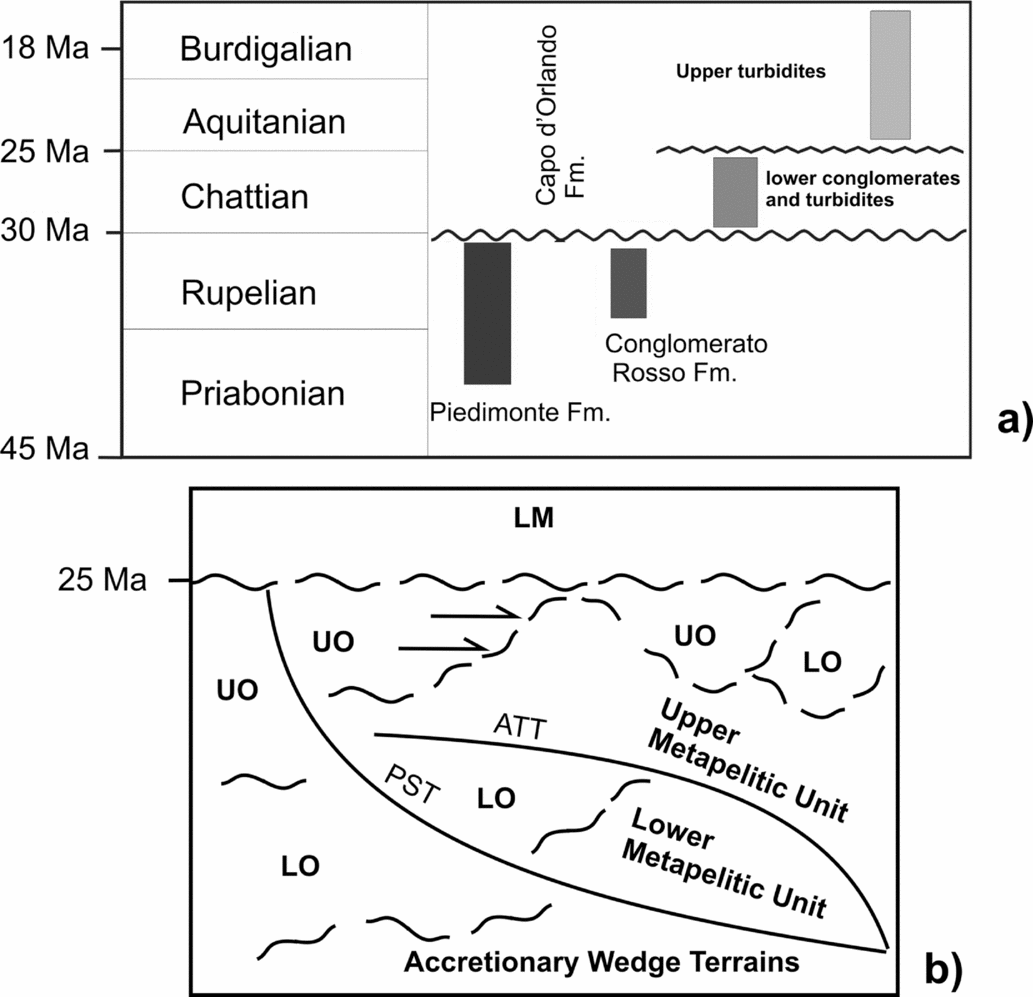
(a) Stratigraphic scheme of syn-tectonic terrigenous deposits of the Peloritani Mountains; (b) geometry of the Paleogene–Neogene syn-tectonic terrigenous sequences of the Peloritani Mountains and their relation to the main shear zones. UO = Upper Oligocene deposits of the Capo d'Orlando Flysch; LO = Lower Oligocene syn-tectonic terrigenous sequences; LM = Lower Miocene deposits of the Capo d'Orlando Flysch; PST = Peloritani sole-thrust; ATT = Alì–Taormina Thrust.
3. Tectonic units of the eastern Peloritani Mountains
The detailed field mapping carried out in the eastern portion of the Peloritani Mountain Belt evidenced the occurrence of two major superimposed rock-complexes that involve distinct portions of a Variscan continental basement (Fig. 2), confirming the classical main distinction between a high-grade metamorphic complex (e.g. Aspromonte Nappe: Ogniben, Reference Ogniben1960) and the underlying metapelitic units (Galati Nappe: Ogniben, Reference Ogniben1960).
The uppermost rock-complex, extensively cropping out in the northeastern sector of the mountain belt, is here designed as the Aspromonte Unit (AU in Fig. 2). It is composed of high-grade metamorphic rocks, which mainly consist of: (a) fine-grained biotitic paragneiss; (b) medium-coarse-grained metapelitic migmatites; and (c) augen-gneiss with large eyes of K-feldspar, plagioclase and quartz. Amphibolite bodies and horizons of marbles and Ca-silicates fels are interleaved within the prevailing paragneiss. In the northernmost sector, Late Variscan trondhjemite and leucogranodiorite bodies intrude the paragneiss (Puglisi & Rottura, Reference Puglisi and Rottura1973; Fiannacca et al. Reference Fiannacca, Brotzu, Cirrincione, Mazzoleni and Pezzino2005, Reference Fiannacca, Williams, Cirrincione and Pezzino2008, Reference Fiannacca, Williams, Cirrincione and Pezzino2013; Williams et al. Reference Williams, Fiannacca, Cirrincione and Pezzino2012; Ortolano et al. Reference Ortolano, Visalli, Cirrincione and Rebay2014). The Aspromonte Unit overthrusted the top of the metapelitic complex along a regional thrust surface, here designed as the Aspromonte Basal Thrust (ABT in Fig. 2).
Within the metapelitic complex, we distinguished an upper horizon (Upper Metapelitic Unit; UMU in Fig. 2) that groups low- to medium-grade Variscan metapelitic terrains, showing a well-defined Alpine metamorphic overprint (Atzori & Vezzani, Reference Atzori and Vezzani1974; Atzori & Ferla, Reference Atzori and Ferla1979; Fazio et al. Reference Fazio, Cirrincione and Pezzino2008; Cirrincione et al. Reference Cirrincione, Fazio, Fiannacca, Ortolano and Punturo2009, Reference Cirrincione, Fazio, Heilbronner, Kern, Mengel, Ortolano, Pezzino, Punturo, Spalla, Marotta and Gosso2010; Appel et al. Reference Appel, Cirrincione, Fiannacca and Pezzino2011). This unit corresponds to the inner and upper portion of the previous Galati Nappe of Ogniben (Reference Ogniben1960) (or Mandanici Units and Metamorphites III of Lentini & Vezzani, Reference Lentini and Vezzani1975). The Upper Metapelitic Unit consists of rocks showing mineral assemblages that indicate a prevalent greenschist facies metamorphism, with a northward increase of the metamorphic grade, from low to middle, approaching the staurolite isograde (Atzori & Vezzani, Reference Atzori and Vezzani1974; Fiannacca et al. Reference Fiannacca, Lo Po’, Ortolano, Cirrincione and Pezzino2012). Rock types include phyllites, marbles and metavolcanics. This unit crops out in the central and southern sectors of the mountain belt, representing the intermediate Alpine thrust nappe of the Peloritani belt (Fiannacca et al. Reference Fiannacca, Lo Po’, Ortolano, Cirrincione and Pezzino2012). The Upper Metapelitic Unit is emplaced at the hangingwall of the Alì–Taormina Thrust (ATT in Figs 2, 3). At the footwall of this thrust surface, a distinct lower metapelitic horizon (Lower Metapelitic Unit; LMU in Fig. 2) groups the very low- to low-grade Variscan metapelitic terrains that are unaffected by the Alpine overprint. This unit corresponds to the external and lower portion of the Galati Nappe of Ogniben (Reference Ogniben1960) (or Metamorphites II and I of Lentini & Vezzani, Reference Lentini and Vezzani1975). It is composed of pelitic- and psammitic-derived metasediments (slates and phyllites) interleaved with basic metavolcanics, metavolcanoclastic and metacarbonates levels. In the upper part of the succession, quartz-phyllites and porphyroids occur (Atzori, Reference Atzori1970; Atzori & Ferla, Reference Atzori and Ferla1979; Trombetta et al. Reference Trombetta, Cirrincione, Corfu, Mazzoleni and Pezzino2004). Metabasites suggest a metamorphic grade typical of sub-greenschist facies (Cirrincione, Atzori & Pezzino, Reference Cirrincione, Atzori and Pezzino1999; Cirrincione et al. Reference Cirrincione, Fiannacca, Lo Giudice and Pezzino2005). The Peloritani sole-thrust brought this unit above the Paleogene Neotethyan accretionary wedge units, forming several imbricated tectonic slices at the leading edge of the Peloritani Mountains thrust edifice, which are well exposed along the Taormina coastal area (see profile in Fig. 2). To the north, small outcrops of the Lower Metapelitic Unit Terranes occur in several tectonic windows at the footwall of the Alì–Taormina Thrust (Fig. 2).
4. Mesozoic sequences of the Peloritani Mountains
In the eastern Peloritani Mountains, distinct Mesozoic sequences, classically referred to the ‘Longi-Taormina Nappe’ (Ogniben, Reference Ogniben1960; ‘chaine calcaire’ of Caire, Duee & Truillet, Reference Caire, Duee and Truillet1965), widely crop out. They form highly sheared structural horizons, marking the thrust surfaces that separate the superimposed basement nappes (Fig. 2).
The Aspromonte Basal Thrust shows a 30 m thick shear zone that involves lithons made up of Triassic to Cretaceous metasediments deriving from the Alì succession (Truillet, Reference Truillet1968; Cirrincione & Pezzino, Reference Cirrincione and Pezzino1991; Cirrincione et al. Reference Cirrincione, Fazio, Ortolano, Pezzino and Punturo2011). The metasedimentary lithons are included in mylonitic rocks deriving from the ductile shearing of both the hangingwall and footwall rock units (Cirrincione & Pezzino, Reference Cirrincione and Pezzino1994).
A large part of the Alì sequence, which is widely exposed along the Ionian coast near the Capo Alì (Fig. 2), is involved along the Alì–Taormina Thrust, at the base of the Upper Metapelitic Unit. The Alì succession, described as the ‘Alì Unit’ by several authors (Atzori, Reference Atzori1968; Truillet, Reference Truillet1968; Bonardi et al. Reference Bonardi, Giunta, Liguori, Perrone, Russo and Zuppetta1976), is composed of a passive margin sequence represented by basal red conglomerates, upward grading into calcareous–dolomitic series, showing several intercalated evaporitic layers. The upper part of the sequence prevalently consists of pelagic limestones and marls.
Further south, the Alì–Taormina Thrust shows a very thick shear zone, which is characterized by the occurrence of lithons deriving from distinct Mesozoic succession. Massive limestones, upward grading to brachiopodes-bearing sandy limestones, ranging in age from Early to Middle Lias (Appel et al. Reference Appel, Cirrincione, Fiannacca and Pezzino2011), are involved in the shear zone cropping out at the top of Mount Galfa (Fig. 2). These lithons are located at the northern edge of an almost continuous alignment of blocks, marking the Alì–Taormina Thrust, from the village of Limina to Taormina (Fig. 2). In the Taormina area, the shear zone involves very large slices of Mesozoic successions that have previously been described as Taormina Unit (Caire, Duee & Truillet, Reference Caire, Duee and Truillet1965; Lentini & Vezzani, Reference Lentini and Vezzani1975) and Capo S. Andrea Unit (Lentini & Vezzani, Reference Lentini and Vezzani1975). The slices of the Mesozoic successions detected near Taormina (Fig. 2) are composed of basal infraliassic red conglomerates (Verrucano Formation of Lentini & Vezzani, Reference Lentini and Vezzani1975; Perrone et al. Reference Perrone, Martin-Algarra, Critelli, Decandia, D'Errico, Estevez, Iannace, Lazzarotto, Martin-Martin, Martin-Rojas, Mazzoli, Messina, Mongelli, Vitale, Zaghloul, Chalouan and Moratti2006; Critelli et al. Reference Critelli, Mongelli, Perri, Martin-Algarra, Martin-Martin, Perrone, Dominici, Sonnino and Zaghloul2008; Perri et al. Reference Perri, Critelli, Mongelli and Cullers2011), platform carbonates and dolomites, passing upward to a thick Middle Lias – Eocene basin sequence, made up of pelagic limestones and marls. The slices of the Mesozoic succession cropping out at Capo S. Andrea consist of a condensed sequence composed of basal infraliassic red conglomerates, upward evolving to Liassic platform carbonates. Pelagic limestones, ranging in age from Late Liassic to Early Cretaceous, and Late Cretaceous to Eocene marls, form the top of the sequence.
Isolated sedimentary sheared blocks are also widespread in the whole southern portion of the Peloritani edifice. They are emplaced within the basal levels of the Upper Metamorphic Unit, in the areas where the basal thrust approaches the topographic surface.
5. Syn-tectonic terrigenous sequences
A huge volume of syn-tectonic clastic deposits, ranging in age from the Late Eocene to the Early Miocene, unconformably cover the Peloritani units, also extending on the accretionary wedge terrains located at the footwall of the Peloritani sole-thrust. These terrigenous sediments form distinct sequences, which are separated by main angular unconformities (Fig. 3).
5.a. Late Eocene – Early Oligocene deposits
The older syn-tectonic sequence is represented by the Oligocene turbiditic deposits of the Piedimonte Formation (Truillet, Reference Truillet1968; LO in Figs 2, 3) that mainly rests on the Neotethyan accretionary wedge terrains, at the front of the Peloritani Mountain Belt (Truillet, Reference Truillet1968; Lentini et al. Reference Lentini, Carbone, Catalano and Grasso1995; Fig. 2). These horizons, referring to the end of the Priabonian to the Rupelian (Appel et al. Reference Appel, Cirrincione, Fiannacca and Pezzino2011; Fig. 3) are made up of conglomerates, turbiditic sandstones and clays that form, as a whole, a southward-prograding clastic fan. The analyses of the conglomerates evidenced the occurrence of cm- to dm-sized well-rounded pebbles, immersed in a coarse-grained sandy matrix. Pebbles derive from both crystalline (e.g. phyllites, micaschists, gneisses, granitoids) and sedimentary (Mesozoic limestones) rocks. The sandstones, which form thin-bedded turbidites, show an arkosic composition. At present, the Late Eocene – Early Oligocene clastic terrains are involved in several imbricated thrusts that developed at the front of the Peloritani sole-thrust (Fig. 3).
Further highly sheared undated clastic deposits (Truillet, Reference Truillet1968; Lentini et al. Reference Lentini, Carbone, Catalano and Grasso1995), consisting of conglomerates passing upward to turbiditic arkosic sandstones, are distributed in the Peloritani Mountains. The basal conglomerates show a reddish to grey coarse-grained sandy matrix supporting cm- to dm-sized well-rounded pebbles mainly made up of granitoids, high-grade metamorphites and carbonates that, locally (e.g. Forza d'Agrò – Capo S. Alessio ridge), are prevalent. These deposits (LO outcropping in the surroundings of Capo S. Alessio in Fig. 2), largely corresponding to the ‘Conglomerato Rosso Formation’ (Truillet, Reference Truillet1968; Bonardi et al. Reference Bonardi, De Vivo, Giunta and Perrone1982; Lentini et al. Reference Lentini, Carbone, Catalano and Grasso1995) (Fig. 3), also include, in the Limina area, sequences previously interpreted as part of the Capo d'Orlando Flysch (Catalano & Di Stefano, Reference Catalano and Di Stefano1996). Furthermore, these deposits are confined in the southern sectors of the Peloritani Mountains between Rocca Novara and Capo S. Alessio (Fig. 2), overlying the metamorphic terrains of both the Lower and the Upper Metapelitic Units. Imbricated slices of this sequence form an antiformal stack at the footwall of the Alì–Taormina Thrust, in the area immediately to the south of Forza d'Agrò – Capo S. Alessio ridge. In some locations (e.g. the Rocca Novara, Limina and Forza d'Agrò – Capo S. Alessio areas) the clastic deposits form very highly sheared slices that are sandwiched between local duplications involving the Upper Metapelitic Unit (Fig. 2). Finally, smaller outcrops, resting on the terrains of both the metapelitic units, are distributed along the Alcantara River valley (Fig. 2). The Conglomerato Rosso pre-dates the Chattian basal levels of the overlying Capo d'Orlando Flysch and, thus, can be assigned to the Rupelian (Fig. 3).
5.a.1. Late Oligocene deposits
The Late Oligocene deposits are widely distributed in the southern sectors of the Peloritani Mountains up to the south of the Taormina Line, overlying the previous clastic sequences that, in turn, rest on the accretionary wedge terrains. These deposits have been classically grouped in the Capo d'Orlando Formation (Ogniben, Reference Ogniben1960) and are characterized by variable thickness and facies distribution. A very thick sequence, including basal conglomerates and Upper Chattian turbidites (Catalano & Di Stefano, Reference Catalano and Di Stefano1996), is located at the front of the Peloritani edifice, being involved on both the hangingwall and footwall of the Peloritani sole-thrust (UO in Figs 2, 3). The Late Oligocene conglomerates are made up of well-rounded cm- to dm-sized pebbles of different nature, such as phyllites, gneisses, amphibolites, marbles, granitoids, porphyrites and Mesozoic carbonates. Several cannibalized pebbles from older clastic deposits have been recognized (Mazzoleni, Reference Mazzoleni1991; Cirrincione, Reference Cirrincione1996). Turbidites consists of thin-bedded arkose sandstones alternated with clay levels. The described sequence shows the maximum thickness in the footwall of the Peloritani sole-thrust, whereas, to the north, it progressively onlaps on the external units of the Peloritani Mountains edifice. As a consequence, the basal conglomerates and the Upper Oligocene turbidites are confined to the southern portion of the mountain belt, where they unconformably cover both the two superimposed metapelitic units and seal the Alì–Taormina Thrust (ATT in Fig. 3). These deposits are also distributed in the more internal areas of the mountain belt, in the surroundings of Forza d'Agrò, where they drape the metapelites of the Upper Metapelitic Unit, stacked in the Forza d'Agrò – Capo S. Alessio ridge (Fig. 2).
5.a.2. Early Miocene deposits
The Lower Miocene horizons of the Capo d'Orlando Flysch (LM in Figs 2, 3) are largely distributed on the entire region, from the Peloritani mountain belt to the Neotethyan accretionary wedge terrains at the footwall of the Peloritani sole-thrust (Lentini et al. Reference Lentini, Carbone, Catalano and Grasso1995). These deposits, assigned to an Aquitanian – Early Burdigalian age (Catalano & Di Stefano, Reference Catalano and Di Stefano1996), are characterized by the occurrence of thick levels of turbiditic arkosic sandstones that are interleaved within thin-bedded turbidites. Along the Alcantara River Valley the Lower Miocene clastic deposits seal the Peloritani sole-thrust (Figs 2, 3). In the southern portion of the Peloritani Mountain Belt, these sequences unconformably cover the previous clastic deposits, whereas in the northern portion they directly lie on the crystalline basements of the Aspromonte and the Upper Metapelitic Units, sealing the Alì–Taormina Thrust and the Aspromonte Basal Thrust.
6. Structural and petrographic features of the metamorphic units
In this section, we describe in detail the lithological, micro- and meso-structural and petrographic features of the Peloritani basement nappes. The results of these analyses are here exposed according to the chronology of the events, separating the Variscan features from those attributed to the Alpine event.
6.a. Variscan structural and metamorphic features
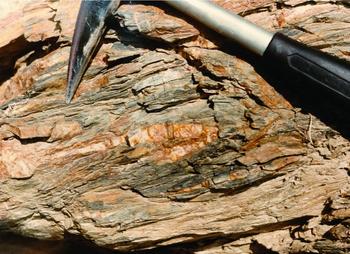
The structural analyses of the basement rocks from the eastern Peloritani Mountains evidenced that relict hinges of decimetric to centimetric isoclinal folds (b1E; Figs 4, 5) represent the earliest structures that we assign to the E1 deformational event (Cirrincione & Pezzino, Reference Cirrincione and Pezzino1991). In the metapelitic rocks, these isoclinal folds transpose the previous surfaces, disguising older fabrics and producing the main schistosity (S1E). During the E1 event, the principal Variscan metamorphic assemblages developed (Atzori & Ferla, Reference Atzori and Ferla1979). A successive deformation event (E2) produced the crenulation of the old S1E fabric and the development of the S2E crenulation cleavage (Pezzino, Reference Pezzino1982) exclusively on metapelitic rocks.
Variscan isoclinal fold (E1 event) in the phyllites of the Upper Metapelic Unit.
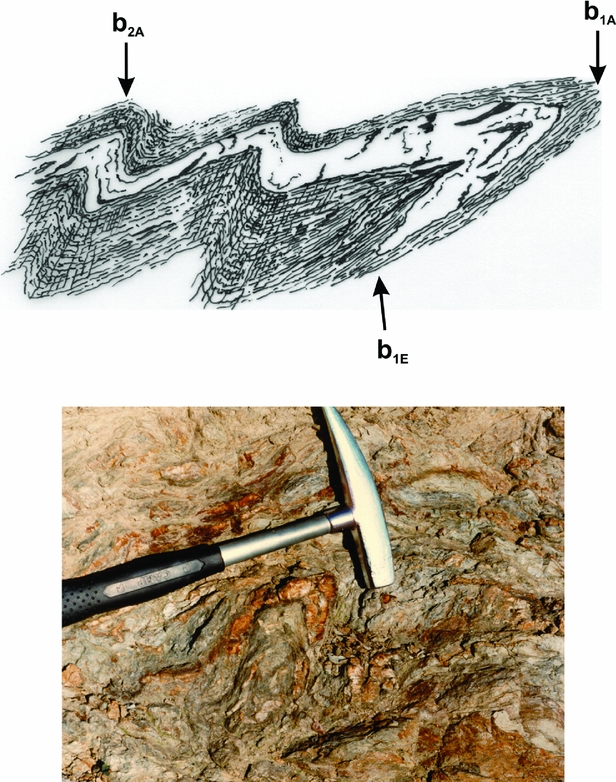
Type 3 interference pattern affecting the phyllites of the Upper Metapelic Unit, due to the superposition of the Alpine isoclinal fold (A1) on Variscan fold (E1).
In the Lower Metapelitic Unit, the P–T conditions of the E1 are typical of the prehnite–pumpellyite zone of the sub-greenschist facies. During the E2 stage, the introduction of a more CO2-rich fluid along the S2E stabilized locally the ‘Cal+Chl transitional facies assemblage’, replacing the previous sub-greenschist facies assemblages (Cirrincione, Atzori & Pezzino, Reference Cirrincione, Atzori and Pezzino1999).
In the metamorphic rocks of the Upper Metapelitic Unit, the syn-S1E metamorphic assemblages range from greenschist facies to Staurolite isograde, whereas in the rocks of the Aspromonte Unit, S1E is exclusively marked by amphibolitic-facies assemblages. In the rocks of these two upper units, a syn-S2E greenschist facies assemblage often occurs (Cirrincione, Atzori & Pezzino, Reference Cirrincione, Atzori and Pezzino1999).
6.b. Alpine structural and metamorphic features of the Peloritani Units
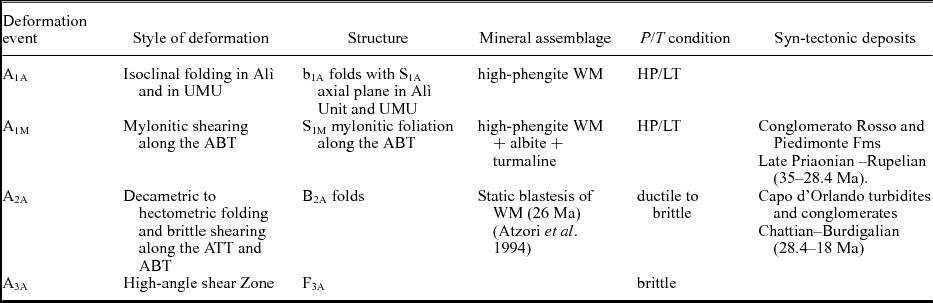
A well-defined Alpine structural and metamorphic overprint has been recognized in the Aspromonte and the Upper Metapelitic Units Terranes, as well as in the Mesozoic blocks that are involved within the shear zones, developing along the Aspromonte Basal Thrust and in the inner portion of the Alì–Taormina Thrust (Fig. 2). The Alpine features are grouped in distinct cycles of deformation and metamorphic events, affecting the two units and the shear zones during the Alpine evolution (Table 1).
Main Alpine deformation events of the Peloritani Mountains, with related petrographic and structural features, and their relation to the syn-tectonic clastic deposits
6.b.1. Early Alpine metamorphic events
The earlier structural pattern consists of isoclinal folds (b1A; Fig. 5), associated with axial plane schistosity (S1A) that we assigned to the A1 deformation event. The A1 produced mineral assemblages ranging from sub-greenschist to greenschist facies (Cirrincione & Pezzino, Reference Cirrincione and Pezzino1991). In the augen gneiss of the Aspromonte Unit the S1A usually intersects the S1E at low angles. In the leucocratic bodies intruded in the high-grade metamorphic rocks of the Aspromonte Unit, this S1A fabric occurs as penetrative and pervasive surfaces that are marked by small localized domains of greenschist facies assemblages. In the metapelitic rocks of the UMU, the A1 event produced type 3 interference pattern (Ramsay, 1967) due to the quasi-parallelism of the older S1E with the new S1A surfaces (Cirrincione & Pezzino, Reference Cirrincione and Pezzino1991). The discordance between b-axes of the Alpine over the Variscan isoclinal folds is of about 20°. In the marls and in the calc-marls of the sheared Mesozoic blocks of the Alì Unit, involved in the Aspromonte Basal Thrust (ABT in Table 1), S1A is generated by transposition of the sedimentary bedding S0. Within the large tectonic slice of the Alì Unit involved in the Alì–Taormina Thrust (ATT in Table 1), the more competent Mesozoic limestone layers usually show ‘pinch-and-swell’ boudinage. Extensional calcite veins, oriented sub-perpendicular to the S1A schistosity, are very common.
Mineralogical assemblages developed during the first Alpine cycle are easily recognizable in the metasediments of the Alì Unit and are also detectable as an overprint in the metamorphic rocks of UMU. The Alpine mineralogical assemblages show a northward-increasing grade, from anchimetamorphism (Taormina area) to sub-greenschist or greenschist facies assemblages (Alì area). XRD analyses carried out on samples from the UMU evidenced the presence of two populations of white micas (Fig. 6). The first population shows low b 0 value (b 0=8.985 Å), typical of the low-P conditions of the Variscan metamorphism (Sassi, Reference Sassi1972; Guidotti & Sassi, Reference Guidotti and Sassi1976), while the second population displays high b 0 value (b 0=9.0252 Å), compatible with the higher-P conditions of the Alpine metamorphism (Atzori et al. Reference Atzori, Cirrincione, Del Moro and Pezzino1994).
Si vs Altot diagram showing the two generations of white mica within the mylonitic gneiss of the Aspromonte Unit.

Along the Aspromonte Basal Thrust and within the Aspromonte Unit, the fabric of the A1 event dissolves into ductile shear zones, marked by mylonitic rocks that developed from progressive deformation, with local pervasive recrystallization and reorganization A1M (Fig. 7). Along the shear zones, the increase of shearing produced rotation of the S-surface toward C-surface that, in the ultramylonitic stage, represents the main foliation S1M.
Ductile shear zone along the Aspromonte Basal Thrust, within gneiss of the Aspromonte Unit.

The mylonitic gneisses of the Aspromonte Unit show survived non-recrystallized ‘harder phases’, within a groundmass constituted by ribbon of quartz and fish-textured white mica. Ribbon of mosaical quartz with homogeneous grain size and triple junctions (b 2 mylonitic-type according to Boullier & Bouchez, Reference Boullier and Bouchez1978) suggests that ductile deformation was accompanied by intense late recrystallization in which restoration prevents the accumulation of dislocations. Along these shear bands, elongated crystals of high-phengitic white mica and tourmaline occur (Fig. 8a).
Two generations of white mica within the Upper Metapelitic Unit: (a) syn-kinematic generation; (b) post-kinematic generation; (scale 40×; N+).

6.b.2. Late Alpine metamorphic events
The onset of the Late Alpine deformation (A2 event in Table 1) produced metric to decametric southwest-verging asymmetrical folds (b2A; Fig. 5), with the associated S2A foliation, refolding the previous mylonitic bands (S1M). The style of deformation, coupled with the absence of blastesis along the S2A foliation, confines this folding in shallower crust levels. Nevertheless, during the A2 event, a static mineralogical and microstructure reorganization affected the innermost portion of the Alpine edifice, where the local blastesis of white mica, tourmaline and, in places, chloritoid occurred (Fig. 8). This second Alpine generation of white mica shows decussate and mimetic microstructure on intrafolial syn-shear folds or on relicts of the isoclinal hinges of the previous Variscan and Alpine events. The chemical composition of this second white mica generation shows lower phengitic contents than syn-mylonitic ones (Fig. 6), suggesting lower barometric condition (Atzori et al. Reference Atzori, Cirrincione, Del Moro and Pezzino1994).
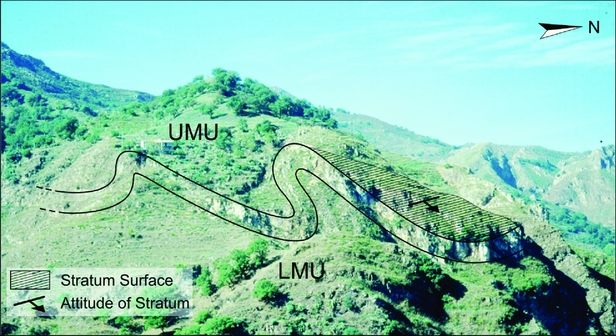
The b2A asymmetric folds also deform the contacts of the lithons of Mesozoic terrains within the crystalline basement rocks, along the Aspromonte Basal Thrust (Fig. 9). In the area of Mount Galfa, a set of NW–SE-oriented chevron folds involves the large blocks of the Mesozoic succession and the overlying phyllites of the LMU, which are localized in the core of synclines. Mesoscale structural analysis of the asymmetric folds evidenced that the distribution of fold axes, consistently with the orientation of slicken-fibres and lineations, indicates a dominant SW-verging direction of transport (Fig. 10).
Asymmetric folds in the carbonates of the M. Galfa succession involved along the shear zone of the Alì–Taormina Thrust.
Slip-vectors measured on mesoscale R and P shear planes bounding the carbonate lithons along the Alì–Taormina Thrust in the area from Mount Galfa to Taormina. The stereoplot refers to the mesoscale fold axes measured along this portion of the shear zone.

The A2 deformative event evolved into brittle shearing that produced thick cataclastic bands along the main shear zones. Cataclastic horizons are peculiar to the externalmost portion of the Alì–Taormina Thrust, which is characterized by lithons of Mesozoic to Tertiary sedimentary successions (e.g. Taormina and Capo S. Andrea units; Lentini & Vezzani, Reference Lentini and Vezzani1975). In this area, the Mesozoic blocks are bounded by conjugate sets of shear planes, forming north-dipping thrust ramps and south-dipping low-angle normal faults. In the Mount Galfa area, a very thick duplex structure characterizes the shear zone, where imbricate assemblage due to the occurrence of sets of N-dipping planes has been recognized. A substantial thinning of the sheared rock horizon occurs where sets of S-dipping planes developed along the shear zone, to the NW of Mount Galfa. Finally, in its externalmost edge, the shear zone involves the entire Meso-Cenozoic succession of the Taormina region that, being tectonically repeated along the N-dipping planes and severely stretched along the S-dipping planes, is characterized by a large-scale pinch-and-swell geometry.
Consistently with the overall vergence of the shear zone, these brittle surfaces actually represent P and R shear planes that, displacing the previous Alpine layering and structural assemblages, testify to the late evolution of the Alì–Taormina Thrust at very shallow crustal levels.
Impressive NW–SE-oriented strike-slip dextral faults (F3A) displace the entire thrust edifice of the Peloritani Mountain Belt (Fig. 2). The strike-slip tectonics form two distinct belts: the former affects the region from Rocca Novara to Capo S. Alessio (Catalano, Di Stefano & Vinci, Reference Catalano, Di Stefano and Vinci1996); the latter identifies the Taormina Line (Ghisetti et al. Reference Ghisetti, Pezzino, Atzori and Vezzani1991; Pavano et al. Reference Pavano, Romagnoli, Tortorici and Catalano2015). In the Capo S. Alessio area, distinct left-stepping dextral fault segments have been recognized. These structures represent the southeastern portion of a larger NW–SE-oriented shear zone that extends from Capo d'Orlando, on the Tyrrhenian coast, to Capo S. Alessio (Catalano, Di Stefano & Vinci, Reference Catalano, Di Stefano and Vinci1996). Along this shear zone, the dextral fault segments are associated with roughly E–W-oriented S-verging thrust that, developed at the tip of the strike-slip faults, accommodated the lateral motion. In this region, fault segments developed during the earlier phase of activity are sealed by the Lower Miocene deposits of the Capo d'Orlando Flysch. Most of the structures have reac- tivated during the Neogene, also dissecting the Lower Miocene turbidites (Fig. 2).
Along the Taormina Line, strike-slip tectonics are represented by distinct NW–SE-oriented fault segments that displace the previous low-angle thrust surfaces. Also in this case, push-up structures, bordered by E–W S-verging thrust, developed in the interference zones between left-stepping dextral faults. The main reactivated Neogene–Quaternary dextral faults form a discrete strike-slip belt that replaces both the Peloritani Mountains units and the innermost portion of the Neotethian accretionary wedge (Fig. 2).
7. Discussion and conclusions
Our study points out that the backbone of the Peloritani Mountain Belt is composed of a Paleogene Africa-verging thrust edifice that includes two superimposed tectonic horizons, mainly made up of Variscan metamorphic terrains. The upper horizon includes the high-grade Aspromonte Unit (AU) and the low- to medium-grade Upper Metapelitic Unit (UMU), which experienced a clear Alpine metamorphic overprint. The lower horizon consists of the very low- to low-grade Lower Metapelitic Unit (LMU), unaffected by the Alpine overprint. These tectonic horizons are separated by a main regional thrust surface extending from the Alì to the Taormina area (Alì–Taormina Thrust), along which highly deformed relics of distinct Mesozoic to Tertiary passive margin successions are involved.
The Alpine overprint, affecting the hangingwall of the Alì–Taormina Thrust, includes two well-defined stages that developed in earlier HP/LT conditions (A1) and in later lower-pressure and static conditions (A2) (Atzori et al. Reference Atzori, Cirrincione, Del Moro and Pezzino1994), respectively.
In addition, the style of deformation of the Mesozoic carbonate lithons involved along the Alì–Taormina Thrust reveals that blocks from the different successions have been deformed at variable crustal levels (Fig. 11). Carbonate blocks show clear evidence of deformation from brittle, in the Taormina area, to greenschist facies metamorphic condition, in the Alì area. In the northernmost Alì area, the carbonate lithons are characterized by a polyphase deformation, including superimposed metamorphic, ductile and brittle structural features. In the intermediate Galfa area, the sheared carbonate succession displays superimposed ductile and brittle structural features.
Schematic geometry of the shear zone along the Alì–Taormina Thrust (A) and model of the related structural assemblages in the distinct portion of the shear zone (B).
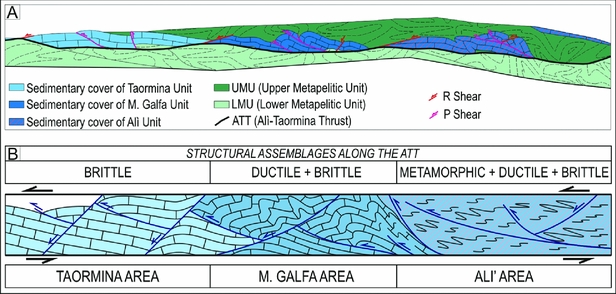
Finally, the carbonate blocks of the Taormina area exclusively show brittle structural associations (Fig. 11B). The structural assemblages of the lithons along the Alì–Taormina Thrust suggest the primary northward dip of the shear zone, whereas their overall polyphase deformation is indicative of the syn-kinematic exhumation of the shear zone. The orientation of fold axes and slip-vectors of the conjugate fault planes bordering the lithons indicates a prevalent SW-directed sense of motion along the thrust (Fig. 10). The Alì–Taormina Thrust represents the sole thrust of the Alpine metamorphic units and can thus be interpreted as the regional-scale crustal ramp that drove the entire exhumation of the inner portions of the Peloritani Mountain Belt.
The nature of the Mesozoic sedimentary covers involved along the Alì–Taormina Thrust suggests that the Alpine tectonic events are related to a process of a positive tectonic inversion of a continental palaeomargin (Fig. 12A). The Alpine history of the mountain belt implies an earlier underplating of a large sector of the Peloritani continental basement (Fig. 12B), responsible for the A1 and A2 metamorphic events that was followed by tectonic uplift towards shallower crustal levels, where the A3 brittle shearing occurred. The re- sult of this Alpine evolution was the emplacement of the inner basement units on the external portions of the palaeomargin, almost unaffected by the Alpine overprint (Fig. 12C).
Deformation history of the Alpine positive tectonic inversion and exhumation of the European palaeomargin units in the Peloritani Mountain Belt.

Our study also provides some fundamental constraints on the timing of the mountain building. The Alpine HP/LT metamorphic event (A1), connected to the underplating, affected the Early Cretaceous horizons (Atzori, Reference Atzori1968), at the top of the Alì succession. The acme of this tectono-metamorphic stage occurred immediately before the onset of the exhumation of the Peloritani edifice, marked by the conspicuous clastic deposition on the top of the Neotethyan accretionary wedge. The syn-tectonic clastic deposition started at the Eocene–Oligocene transition (Fig. 3), constraining the Alpine HP/LT event at c. 35 Ma BP. In the frontal areas of the Peloritani Mountains, the exhumation of the Upper Metapelitic Unit was completed before the deposition of the Conglomerato Rosso, while the motion along the Alì–Taormina Thrust ended before the deposition of the Chattian basal conglomerates of the Capo d'Orlando, at c. 28 Ma. In the external portion of the Peloritani Mountain Belt, the erosion of huge amounts (>10 km) of the high-grade metamorphic basement of the Aspromonte Unit caused the exhumation of the Upper Metapelitic Unit in a very short time-span (<5 Ma). This evidence is compatible with the occurrence of a continental collision that caused the tectonic inversion of the Europe continental margin and the shearing along the Alì–Taormina Thrust.
During the Chattian, metamorphic conditions still affect the innermost portion of the Alì area, where static blastesis in greenschist facies conditions occurred after the deactivation of the Alì–Taormina Thrust. This implies the later exhumation of the inner portion of the Alpine edifice, coinciding with motion along the Peloritani sole-thrust (PST in Fig. 3) associated with the deposition of the Late Chattian clastic deposits of the Capo d'Orlando Flysch. The overall exhumation of the Peloritani edifice ended before the deposition of the Early Miocene turbidites of the Capo d'Orlando that largely cover the Alpine units in the inner portion of the mountain belt.
In conclusion, our paper evidences that the Paleogene evolution of the Peloritani Mountains was characterized by the rapid uplift and exhumation of deep-seated crustal levels that experienced a polyphase Alpine deformation from ductile to brittle conditions. The exhumation of the Alpine metamorphic units was associated with the SW-verging emplacement of slices of continental crusts along two main thrusts, originated from the positive tectonic inversion of the European continental palaeomargin. A main thrust surface, the Alì–Taormina Thrust, brings the exhumed Alpine metamorphic units of the inner Peloritani Mountains on the external areas of the mountain belt. This thrust surface involves the relics of the Meso-Cenozoic sedimentary successions of the primary European palaeomargin that are now distributed along the shear zone. Thus, the alignment of the sedimentary units, characterizing the Peloritani Mountains from Alì to Taormina, represents the surface expression of the main regional thrust, rather than distinct tectono-stratigraphic units as proposed by previous authors. The motion along this crustal thrust was active for c. 5 Ma and caused the earlier exhumation of the externalmost Alpine units of the Peloritani Mountains. The metamorphic Alpine history of the Peloritani Mountains also went on after the definitive emplacement along the Alì–Taormina Thrust. Residual orogenic load in the innermost sectors of the Peloritani was removed during the successive 5 Ma, when the Peloritani sole-thrust, located at the trailing edge of the Neotethyan accretionary wedge, carried the entire Peloritani edifice towards shallow crustal levels.
The complete definition of the crustal architecture of the Peloritani collision belt outlined with the activation of wrench tectonics that replaced the previous thrust geometry. The impressive strike-slip fault systems, distributed both within (Capo d'Orlando – Capo S. Alessio Fault Zone; Catalano, Di Stefano & Vinci, Reference Catalano, Di Stefano and Vinci1996) and at the front of the Peloritani Mountain Belt (Taormina Line; Ghisetti et al. Reference Ghisetti, Pezzino, Atzori and Vezzani1991), developed after the definitive inhibition of thrust motion, probably due to the impingement of the European and the African continental crusts. As a consequence, the dextral shear zones can be interpreted as the surface evidences of the suture zone between the two colliding plates.
Acknowledgements
We are sincerely grateful to the two anonymous referees for their valuable and constructive suggestions.
This paper was funded by the Ministry of Education, Universities and Research of Italy (PRIN – Progetti di Ricerca di Interesse Nazionale project, Birth and death of oceanic basin: Geodynamic processes from the rifting to the continental collision in the Mediterranean and circum-Mediterranean orogens, grants to G. Capponi and S. Catalano).



