

Figures
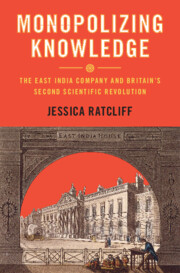
I.1The Company’s headquarters: East India House, Leadenhall Street.
I.2Syntypes of Paludina lecythoides, once in the East India Company’s museum.
I.3A circa first-century CE reliquary casket excavated from a Buddhist stupa in Afghanistan.
I.4A view of a new gallery of the East India Company’s museum at India House, 1858.
1.1Drawing of the old India House on Leadenhall Street, 1628–1746.
2.3Pandanus Odorifer (Pandanus Odorifissimus), known for its aromatic oil.
3.1Plan showing the site of the East India House within the City of London.
3.2View of India House looking south down Leadenhall Street.
3.3The remaining central design of the Leadenhall Street mosaic.
3.4Frontispiece to the auction catalog for the duchess of Portland’s museum.
3.5Tipu’s tiger, constructed in Mysore in the 1780s or 1790s.
3.6Sketch of Haileybury College, with cows and students in the foreground.
4.2Basement floor of India House with “Book Rooms” highlighted.
4.3Plan of the ground floor of East India House as it was in 1860.
4.6Type specimen of Rotala Rotundifolia collected by Francis Buchanan-Hamilton.
4.7“The Storming of Monopoly Fort,” an 1813 satirical cartoon by Charles Williams.
4.8Extracts from “Sutta Pitaka” (“Basket of Discourse”), a canonical collection of Buddhist texts.
4.9A holotype specimen of Osphromenus trichopterus cantoris.
5.2Wilkins’s table of the elements of the Devanagari characters and numerals.
5.3William Sharp Macleay’s sample classification of the animal kingdom.
5.4Rhinolophus Lavartus (horseshoe bat) type specimen collected by Thomas Horsfield.
5.5Label for Rhinolophus Lavartus (horseshoe bat) type specimen collected by Thomas Horsfield.
6.3Engraving of a regular meeting of the Court of Proprietors at India House.
6.4Engraving of a meeting of the Court of Directors at India House.
7.4View of part of the India Section of the Great Exhibition in 1851.
7.6The transformed secretary’s apartment for the new museum at India House.

 Open access