

Anthropology, Archaeology and Egyptology
In the preface of Egyptology and the Social Sciences, Kent Weeks (Reference Weeks1979: v) wrote:
we consider extremely encouraging the fact that Egyptologists are now, after half a century of reluctance, beginning to approach such fields as anthropology for ideas, while anthropologists are also beginning to realize that, beneath Egyptology’s staid and sometimes formidable exterior, there lies a wealth of data of great value for their studies.
In the almost forty years since that publication, the dialogue he hinted at has not been as lively as he anticipated. Many authors have successfully incorporated theoretical models from the social sciences into Egyptology (Baines Reference Baines, Verbovsek, Backes and Jones2011: 576–8), but very few of those proposals have been followed by engaged discussions in the literature.1 Whether this is due to discomfort with rapidly changing disciplines (Weeks Reference Weeks1979: 21) or to mistrust of studies that go beyond a narrowly evidential basis (Baines Reference Baines, Verbovsek, Backes and Jones2011: 575), many Egyptologists remain reluctant to integrate theoretical approaches into their work. In contrast, in this book I advocate that a productive dialogue between Egyptology, anthropology and archaeology is not only possible but necessary. The rich dataset provided by Egyptology could be invaluable for anthropologists and archaeologists, while the methods and theoretical approaches of the latter disciplines may offer fresh insights into Egyptian material.
Anthropology, with its aim of facilitating a holistic study of humanity, is more commonly concerned with existing societies that can be objects of participant observation, yet many anthropologists also need to rely on archives (cf. ethnography of the Nayar combining interviews and British archival material: Stone Reference Stone2006: 152) and incorporate ethnohistorical methods (e.g. Carmarck Reference Carmarck1972: esp. 229–36; Abler Reference Abler1982; Trigger Reference Trigger1982; Silverman and Gulliver Reference Silverman, Gulliver, Kalb and Tak2005; Harkin Reference Harkin2010). Ancient cultures, which have traditionally been explored through archaeology, may also be suited to anthropological analysis, as for instance a long tradition of scholarship on Maya studies demonstrates (e.g. McAnany Reference McAnany1995; Robin Reference Robin and Stone2000; Joyce Reference Joyce, Van Dyke and Alcock2003). Consequently, anthropological archaeology has become more popular over the last decade as a result of a growing awareness that anthropology and archaeology are ‘inextricably bound together’ (Gosden Reference Gosden1999: 11). The distinction is blurred between those societies that are prone to being observed through the anthropological lens and those that are not. Thus, my point of departure is that it is possible to study aspects of ancient Egyptian culture based on an archaeo-anthropological approach.
As with other social sciences, there has been a history of missed opportunities in the relationship between anthropology and Egyptology. Judith Lustig (Reference Lustig1997b: 7) stated that anthropologists view Egyptology as an ‘antitheoretical, descriptive field’ in the same volume in which William Y. Adams (Reference Adams and Lustig1997: 32) ruled out the possibility of a total reconciliation between Egyptology and anthropology:
While there is at present some reconvergence of interest between Egyptology and anthropology, the basic personalities of the two disciplines remain far apart. I see no reason to expect that this will change; the two fields simply appeal to people with different backgrounds, different interests and different ideological commitments.
There have been other, more optimistic accounts regarding the relationship between Egyptology and anthropology. For example, at his inaugural lecture at the University of Oxford, Francis Llewellyn Griffith noted the inextricability of these two disciplines when he proposed that: ‘Egyptology is, as I have already stated in other words, a prolific branch of the great science of anthropology, probably destined to illuminate the general history of mankind more searchingly and powerfully than the anthropology of a hundred other countries’ (Griffith Reference Griffith1901: 9). While such an assertion should be framed within the drive for the institutionalisation of Egyptology as a subject of study in its own right at the beginning of the twentieth century (Stevenson Reference Stevenson and Carruthers2015: 19–20), Griffith is not alone in highlighting an engagement of Egyptology and anthropology (see e.g. O’Connor Reference O’Connor and Lustig1997: 18–22). Several authors acknowledge the influence of anthropology openly (e.g. Meskell Reference Meskell1999; Reference Meskell2004; Lehner Reference Lehner, Kohler and Gumerman2000; Nyord Reference Nyord2009; Bussmann Reference Bussmann2010), although, as Richard Bussmann (Reference Bussmann2015) points out, many others are not explicit about the anthropological models from which they take inspiration. The Lady Wallis Budge Symposium on Egyptology and Anthropology: Historiography, Theoretical Exchange, and Conceptual Development, held at the University of Cambridge in July 2017 (Nyord and Howley Reference Nyord and Howley2018), constitutes a prime illustration of a renewed interest in bridging the gap between the study of Egyptology and the use of broader anthropological interpretative models. It still remains an open question how and when such initiatives may crystallise in the scholarly literature.
Egyptology ultimately entails the investigation of ancient Egypt, and as such it is defined by its focus rather than by a unified approach. As an area study, Egyptology needs to rely on methods developed by various disciplines, such as philology, art history or historiography, to articulate the analysis of its wealth of data appropriately. Given this historical borrowing of methods from other disciplines, it is striking that archaeology and anthropology struggle to be regarded as promising sources of productive methodological approaches for Egyptology.
The material culture of Egypt is incredibly rich, comprising a vast corpus of both inscribed and uninscribed artefacts. While the latter have received some attention, it is the former that were, and are still, regarded by many as the main source of information for decoding life in the past. In terms of approach, Egyptology has conventionally shown a preference for philological methods, a choice that is deeply ingrained in the tradition of Orientalism. Orientalists have had a tendency to favour the authority of texts over that of any other sources, displaying what Edward Said (Reference Said2003 [1978]: 92–3), the main proponent of Orientalism, described as the ‘textual attitude’.
The birth of Egyptology is indeed tied in with Orientalism (e.g. Thompson Reference Thompson2010; Thomasson Reference Thomasson2013; Riggs Reference Riggs and Carruthers2015; Reference Riggs2017: 188–9). As a fascination for Egypt has existed since classical times (Olabarria Reference Olabarria, Fletcher and Umurhan2019), the idea of an exotic, enchanting Orient of which Egypt was an important component is not exclusively a product of modern imperialism.2 The geographical definition of Egypt as a confined space, however, and how this becomes the object of an entire area of study is very much in line with the Orientalist treatment of the East as an allegedly homogenous unit.
Edward Said (Reference Said2003 [1978]: 2–3) defined Orientalism as a threefold enterprise. First, it is an academic discipline that is based on European knowledge of the Orient. Starting from the Foulcaudian premise that knowledge is not discovered but is created, Said (Reference Said2003 [1978]: 21–4) claims that a pre-existing European imagery about the Orient influenced the demarcation of what the Orient was and how it could be analysed. In this sense, Egyptology itself – or rather, Orientalist scholars working on this region – would have created Egypt as an object of study that is artificially delineated in geographical terms.3
Second, Orientalism is a particular mindset that is based on an East–West dichotomy. These two abstract entities are presented as being in binary opposition, and defined by virtue of ‘tropes of difference’ (Mitchell Reference Mitchell and Preziosi2009 [1989]: 409) that are not based on observation or academic enquiry but rather on a self-affirmation of Western identity as the opposite of the East. Egypt is included within an undifferentiated East that is portrayed as a static, oppressive and over-spiritual setting in contrast with the forward-thinking and liberating West.
Third, it entails an idea of domination and subjugation. Said (Reference Said2003 [1978]: 177) is concerned with the process of creation of knowledge, which he thinks cannot be separated from the effect of power relations and hierarchy. Studying the origins of a civilisation was essentially seen as a means of understanding it, and hence subjugating and dominating it. Egypt received special attention from both French and British scholars during the time of colonial rule, and much has been written about the effect that imperialistic yearnings had on the study of Egyptian antiquities during the nineteenth century (e.g. Mitchell Reference Mitchell1988). The race towards the deciphering of hieroglyphic writing, for example, can be understood as an imperialistic effort to claim dominion over the Egyptian past (Hassan Reference Hassan and Wendrich2010: 265–6).
The textual attitude exhibited by early Orientalists definitely guided the study of ancient Egypt. Since Champollion cracked the code with the help of the Rosetta stone (Parkinson Reference Parkinson1999), many researchers directed their efforts towards editing texts that had been waiting to be translated for thousands of years. Meanwhile, the material culture was not deemed in need of so much attention. Excavations continued, but archaeological data were regarded by many as merely a secondary source to support information obtained through texts (Wendrich Reference Wendrich and Wendrich2010: 1; Bussmann Reference Bussmann2015). Instead of an integrated analysis, archaeological data acquired a subordinate role that in many cases persists today.4
Willeke Wendrich (Reference Wendrich and Wendrich2010: 1) also claims that this focus on textual and iconographic sources has led many authors to believe that the abundant archaeological data from ancient Egypt just speaks for itself. A misunderstanding of archaeology as an exclusively descriptive discipline results in a dearth of references to archaeological theory in most publications about the material culture of ancient Egypt (Meskell Reference Meskell2004: esp. 15). A methodological drive, unwittingly or not, motivates the collection and interpretation of data (e.g. Shanks and Hodder Reference Shanks, Hodder, Hodder, Shanks, Alexandri, Buchli, Carman, Last and Lucas1995). Accordingly, when the nature of such an underlying model is not stated explicitly, the possible biases of the work may go unnoticed. Archaeological interpretation is first and foremost a creative academic endeavour that should acknowledge that the elucidation of meaning is multivocal and subjective. In this sense, it should be essential to state the methodological foundations of any piece of interpretative analysis in order to place it within a corpus of scholarship and to assess its wider implications.
Kinship and marriage in ancient Egypt provide a fascinating case study that showcases how a framework that combines archaeology and anthropology can yield productive results in the investigation of social fabric. The subject of kinship has traditionally been approached from sociocultural anthropology, while the types of sources that we may use to decode kinship in ancient Egypt are often treated archaeologically. This book focuses on how forms of kinship are displayed on monuments in the First Intermediate Period and Middle Kingdom (ca 2150–1650 BCE) and on the role that those monuments have played in constructing and reinterpreting what it meant to be related.
Archaeology and anthropology are not monolithic disciplines, and there is a wealth of different approaches that one could adopt to study ancient material. The specific theoretical models that inform my work draw on postprocessual trends and are anchored in the firm belief that social phenomena need to be defined and analysed within their own unique cultural context. Such a non-essentialist approach reminds us that categories like kinship and marriage, often regarded as universal, should never be taken for granted. On the contrary, a contextually driven definition may show that the parameters that determine who is a relative are culturally constructed. The tracing and characterisation of sociocultural facts, however, are notably challenging tasks in the study of ancient cultures, not least because the available sources present a view of society that might not correspond with lived experience. Material culture need not be read as a static descriptor of life in ancient Egypt, but could rather be assessed in terms of the impact it had on audiences.
The next two sections develop my two principal theoretical approaches, kinship as a process and material agency, illustrating how they can be articulated successfully using the ancient Egyptian evidence. The notion of performativity permeates both these models, under the assumption that daily practice constructs and gives meaning to sociocultural phenomena such as kinship and marriage.
Processual Kinship: Understanding Relatedness
Kinship and marriage are components of daily life, and it is all too easy to take their meaning and the processes of their construction for granted. They are, however, culturally driven and socially contingent phenomena. The analysis of families and social structure of any time period must therefore take into account the variability of these categories, since they adapt to their social environment(s). As I mentioned earlier, anthropology is not a unified body of theory, and definitions of kinship and marriage have been attempted from the perspectives of a number of theoretical approaches, leading to various interpretations of what kinship is and what it does. In the following paragraphs I outline a brief intellectual history of kinship theory, but it should be borne in mind that the trends described are not mutually exclusive. Instead, some of them developed simultaneously and are still being reinterpreted and readapted in the multifaceted discipline that is kinship studies.5
Kinship was historically regarded as one of the pillars of anthropological research since its inception, and, in a way, to write a history of kinship studies is to write a history of anthropological thought. As a matter of fact, kinship was long regarded as an essential part of any respectable ethnographic work (Carsten Reference Carsten, Stimpson and Herdt2014: 207–8). As anthropologist Robin Fox (Reference Fox1983 [1967]: 10) put it, ‘kinship is to anthropology what logic is to philosophy or the nude is to art; it is the basic discipline of the subject’.
The main reason for this early interest in kinship is perhaps that it was considered the preferred organisational principle in stateless societies. Thus, in the absence of governmental structures, individuals would resort to kinship and marriage as a way to determine and construe their social roles. Evolutionary anthropologists saw this kinship-dominated society as an initial stage that would then advance to allegedly more sophisticated forms of social control, leading to the nineteenth-century Western nuclear family as a superior organisational principle (Fox Reference Fox1983 [1967]: 16–20). While an evolutionary model would facilitate comparison between different societies, the approach was entirely teleological, as it traces a unidirectional development line towards the conventional family prototypes of the time. In addition, evolutionary schemes were plainly speculative, since several of the stages they postulated were not based on any type of recorded ethnographic evidence. A well-known example is the myth of primitive matriarchy, conceived as an intermediary stage between primitive promiscuity and patriarchy, in which women held authority over men (e.g. Bachofen Reference Bachofen1861; Morgan Reference Morgan1998 [1877]; on the influence of Bachofen on Morgan, see Trautmann Reference Trautmann1987: 191–4).6 The matriarchal phase was a scholarly projection intended to round out the evolutionary fallacy. Even though cultural evolutionism is largely discredited nowadays, many of the assumptions to which it gave rein persist in the academic imagination.7 For example, the idea of a dichotomy between a kinship-based society and a more advanced state-based society is to some extent still present in the work of some authors (see Campagno Reference Campagno2002: 57–77 for a criticism of the persistence of institutional evolutionism).
Two main approaches, functionalism and structuralism, dominated the anthropological discourse until the mid-twentieth century, and both had their roots in the study of kinship. Functionalism claimed that any given aspect of a culture had a purpose that contributed to its maintenance as a whole. Popular among anthropologists of the British school such as B. Malinowski, A. R. Radcliffe-Brown or M. Fortes, functionalism was preoccupied with the role that kinship played in the political organisation of societies in the absence of a central government. Meyer Fortes (Reference Fortes and Goody1958: 2) proposed a distinction between the ‘domestic’ and the ‘politico-jural’ domains of kinship. The former was considered almost universal, and hence less interesting, while the latter was seen as prone to variability and, as such, a fascinating target of study for cross-cultural anthropological comparison. This focus on the ‘politico-jural’ domain might be regarded as a legacy from sociocultural evolutionism but should instead be framed within the search for the optimal manner of political organisation in the context of colonialism. Functionalists considered that in order to achieve internal stability, stateless societies would require well-defined and distinct groups, which they identified as unilineal descent groups (Carsten Reference Carsten2012). Descent theory explored the formation of such groups, paying attention to discrete norms of inclusion and exclusion.
Structuralism, on the other hand, was less concerned with descent and more with alliance. Inspired by Marcel Mauss’s (Reference Mauss2002 [1969]) theories on gift-giving, Claude Lévi-Strauss focused on affinal relations as an expression of relationships among groups. Due to the universality of the prohibition of incest, exogamous groups would exchange women for survival and perpetuation, thus giving cause for marriage rules that he regarded as ‘elementary structures’ (Lévi-Strauss Reference Lévi-Strauss1969 [1949]). The main purpose of structuralism was not to decode kinship per se but to assess the mechanisms by which the human mind constructed categories that were recurrent in most societies. Lévi-Strauss regarded kinship as the prime case study in approaching the transition from nature to culture, since the taboo of incest is universally accepted yet susceptible to cultural variation.
While entirely different in scope, these approaches share some common ground. Both the analyses of specific descent units and of general elementary structures are essentially ahistorical endeavours with a tendency to decontextualise their object of study. In addition, their focus on normativity omits the variability of personal experience from the equation. Thus, functionalism and structuralism are both deeply interested in classification and abstraction. This consideration led to the use of complicated formulae and diagrams that made kinship obscure to the non-initiated; as a consequence, kinship started to be regarded by many as an obsolete discipline that was unable to reflect the flexibility of lived experience as perceived by the social actors.
In a scholarly context where the anthropology of kinship was losing momentum, David Schneider delivered the coup de grace that almost definitively displaced this discipline in the 1970s. Schneider was one of the first authors to successfully examine kinship from the point of view of the symbols on which it is constructed. His well-known analysis of American kinship (1968) demonstrated the essential role that the concept of blood plays in the understanding of family relations in that culture.8 Deriving from the importance of the biological metaphor of blood, he posited the existence of a ‘doctrine of genealogical unit of mankind’ (Schneider Reference Schneider1984: 119–20) that was used as a basis for cross-cultural comparison of kinship. Such a model was, however, fundamentally flawed, as it was grounded on the pervasiveness of the symbol of blood among anthropologists.
Schneider’s devastating critique of kinship led him to claim that kinship is a ‘non-subject’ (Schneider Reference Schneider and Reining1972: 51) because it was based on assumptions about family that are essentially Western and, hence, cannot be taken as universal.9 Kinship, however, has proven to be a phoenix rising up from its ashes and new interpretative frameworks were developed in response to these criticisms (Godelier Reference Godelier2011 [2004]: 21–2).
One of these approaches arising from Schneider’s critique is that of so-called new kinship studies, with Janet Carsten, Professor of Social and Cultural Anthropology at the University of Edinburgh and fellow of the British Academy, as one of its main proponents. She did fieldwork on Langkawi (Malaysia), where she approached relatedness from the point of view of commensality, showing that the repeated sharing of rice within a domestic space creates a shared substance, which may be the basis for kinship in that local culture (Carsten Reference Carsten1995; Reference Carsten1997). It is by being in the field that she realised to what extent ‘being kin’ was embedded in everyday life for the Malay actors (Edmonds and Warburton Reference Edmonds and Warburton2016).
The book Cultures of Relatedness (Carsten Reference Carsten2000b) could be considered a sort of manifesto of new kinship studies, with an introductory chapter outlining the main features of this theoretical approach (Carsten Reference Carsten and Carsten2000a).
To start with, new kinship studies should be understood within a culturalist framework drawn from Schneider’s critique of kinship. The authors of these studies are deeply influenced by Clifford Geertz, who claimed that the interpretation of meaning is the essential endeavour that any anthropologist needs to undertake in order to understand a culture. He famously stated that ‘man is an animal suspended in webs of significance he himself has spun, I take culture to be those webs, and the analysis of it to be therefore not an experimental science in search of law, but an interpretive one in search of meaning’ (Geertz Reference Geertz1973: 5). The effect of focusing on the domain of cultural symbols in this anti-universalist manner is that many classical categories of analysis are diluted. For instance, if kinship is regarded as part of the dense web that is culture, then it will be understood as a non-essentialist phenomenon: that is, one that needs to be analysed and defined contextually.
Second, it is an anti-dualist model that rejects traditional dichotomies such as biology–culture. In a conventional understanding, kinship involves relationships between people based on descent and/or marriage. As Fox (Reference Fox1983 [1967]: 27) said alluding to T. S. Eliot, ‘kinship and marriage are about the basic facts of life. They are about birth, and copulation, and death’. This type of biologicist approach has been harshly criticised (e.g. Collier and Yanagisako Reference Collier, Yanagisako, Collier and Yanagisako1987) because it fails to note that these ‘facts of life’ are also culturally constructed. Carsten (Reference Carsten and Carsten2000a: 4) explicitly endorses the need to ‘move away from a pre-given analytic opposition between the biological and the social on which much anthropological study of kinship has rested’.10 A second dichotomy that is openly rejected is that of domestic/private–politic/public, which was at the heart of the functionalist consideration of the politico-jural domain. Aspects that in previous studies would have been relegated to the ‘private sphere’ and hence considered inessential for the study of communal social structures – namely gender, substance and personhood (Carsten Reference Carsten2004) – now take the forefront as markers of relatedness.
Finally, new kinship studies advocate firmly against the reification of kinship, leaning towards the more encompassing notion of ‘relatedness’. For these authors, relatedness is eminently processual in the sense that it is constructed and reconstructed throughout one’s life. The way Janet Carsten (Reference Carsten2013: 248) phrased it is eloquent: ‘it is in the gradual accumulation of everyday experiences through living together over time – in both the ritual and non-ritual moments – that kinship acquires its particular power’. Placing an emphasis on what actors do in their everyday lives together with others may be reminiscent of Bourdieu’s (Reference Bourdieu and Nice1977: 79–86) notion of habitus in that relatedness seems to be constructed through performative practice.11 Thus, relatedness can be defined as an articulation of the ‘given’ and the ‘made’. Although I retain the term ‘kinship’ occasionally in this book for convenience, I also understand it as a process of social negotiation that should be described in emic terms – that is, from the perspective of the ancient Egyptians – as far as possible.
Discussions on what kinship really is and how to approach it differently have taken place since the beginning of its establishment as an academic enterprise, and sometimes it has even been denied any independent status, as with the culturalist critique outlined above. However, new kinship studies do not aim to produce a new definition of kinship because the stress is not placed on what kinship is but on what it does and what it means to the actors involved. Adopting a theoretical approach based on new kinship studies helps us to avoid transposing our modern Euro-American conceptions of kinship onto the Egyptian material. It is the performative practice of kinship that creates relatedness, and this needs to be assessed within its own sociocultural context.
Kinship deals not only with descent and marriage but also with the ideology of human relationships (Keesing Reference Keesing1975: 11; Stone Reference Stone2006: 6). The cultural understanding of kinship affects various interrelated spheres such as reproduction, rights and duties, prescriptive or preferential marriage rules, kinship terminology and patterns of residence. In the words of Janet Carsten (Reference Carsten2004: 9), kinship involves not only rights, rules, and obligations but it is also ‘a realm of new possibilities’, and this book intends to explore the possibilities that new kinship studies open up in the study of ancient Egyptian relatedness.
In keeping with its lack of theoretical engagement, Egyptology has not shown much interest in anthropology of kinship and, with the exception of Detlef Franke’s comprehensive doctoral thesis (Reference Franke1983a), few systematic works have been published. General studies on ancient Egyptian kinship include those of Allam (Reference Allam, Helck and Westendorf1977), Forgeau (Reference Forgeau, Burguière, Klapisch-Zuber, Segalen and Zonabend1996 [1986]), Feucht (Reference Feucht and Redford2001), Franke (Reference Franke and Redford2001b) and Campagno (Reference Campagno2009b), as well as two edited volumes on kinship in several ancient societies also treating Egypt (Campagno Reference Campagno2006b; Reference Campagno2009c). These provide a useful point of departure, but kinship and marriage and their broader implications remain open to further research.
Kinship, as a sociocultural phenomenon, is particularly difficult to examine in relation to past societies, especially when attempting to apply a less descriptive and more interpretive approach, such as one inspired by new kinship studies. It may be for this reason that kinship and marriage in ancient Egypt are not usually given an anthropological focus, and these topics are seldom set in their broader theoretical framework. Instead, scholars tend to favour the investigation of specific aspects, such as kinship terminology (e.g. Robins Reference Robins1979; Willems Reference Willems1983; Franke Reference Franke1983a: 11–177) or inheritance (e.g. Eyre Reference Eyre1992; Lippert Reference Lippert2013). All these facets of life, however, become entangled when they are explored from the perspective of relatedness.
One of the most popular methods for decoding the meaning of kinship in ancient Egypt is to analyse representations of the family in elite tomb decoration (e.g. Whale Reference Whale1989; Lustig Reference Lustig1993; Reference Lustig and Lustig1997a; Roth Reference Roth1999; Myśliwiec Reference Myśliwiec, Hawass, Der Manuelian and Hussein2010; McCorquodale Reference McCorquodale2013). This approach can be framed within the marked tendency among scholars to employ pictorial sources to assess social structure, no doubt because Egyptian visual culture is rich in depictions of social groups. Such depictions have often been understood as reflecting social practices more or less directly in order to use them to reconstruct kinship patterns. It is, however, first necessary to question what those depictions do and how they may articulate concerns other than the simple representation of ‘reality’.
Moreover, an enquiry into how and why certain social categories came into being and became significant for ancient Egyptian actors involves interpreting not only iconographic but also inscriptional and archaeological sources with all their inherent biases. My work focuses especially on monumental sources to explore how kin relations are displayed and perpetuated, but I take other material into account to provide a more nuanced picture of relatedness from an emic perspective. The nature of different sources may of course have an impact on our understanding of the social fabric in ancient Egypt, as the depiction of the social groups that they present varies.
Authors who rely mainly on discursive sources have argued that Egyptian society was based on nuclear families and that extended families played no significant role (e.g. Allam Reference Allam, Helck and Westendorf1977: 105, 108; Ritner Reference Ritner, Bodel and Olyan2008: 172; Flamarion Cardoso Reference Flamarion Cardoso and Campagno2009: 90). The nuclear family seems to be highlighted in some literary works, self-presentation inscriptions and also in some representations in elite tombs, where the importance of founding a new household and taking a wife is emphasised. For example, the Teaching of Ptahhotep asserts:  : ‘if you are effective, you should found your household and you should love your wife with due measure’ (Papyrus Prisse 10,8–9: Žába Reference Žába1956: 41–2, nos 325–6). In a similar fashion, the early eighteenth dynasty self-presentation text of Ahmose, son of Abana, narrates:
 : ‘while I was a young man, before I had taken a wife, I slept in a hammock of net (?). After I had established a household, then I was taken away to the “Northern Ship” because I was valiant’ (Urk. iv 2,15–6 and 3,2: Sethe Reference Sethe1906). Teachings also stress the father–son relationship, especially in terms of the importance of transmission of ideas and traditions:
  , ‘how good it is that a son should receive what his father says’ (Papyrus Prisse 16, 5–6: Žába Reference Žába1956: 58, no. 543).12
By contrast, those scholars who focus on the assessment of socioeconomic processes emphasise the salience of extended families (e.g. Eyre Reference Eyre1992: 216, n. 58; Reference Eyre and Allam1994: 113; Moreno García Reference García, Carlos, Pantalacci and Berger-El-Naggar2005: 226–7; Reference García, Carlos and Campagno2006: 127). Depictions and mentions of relatives on monuments with two-dimensional representations of social groups such as stelae, wall paintings and tomb reliefs, as well as offering tables and statuary indicate that extended families may have been the basis of Egyptian social structure (Seidlmayer Reference Seidlmayer, Hawass and Richards2007; Münch Reference Münch2009). Other sources that seem to confirm this hypothesis are multiple burials, private correspondence and patterns identified in settlements. For example, some houses at Lahun that had been designed to accommodate small groups were modified to cater for larger groups (Kemp Reference Kemp1989: 156–7; Reference Kemp2006: 219, 221; Kóthay Reference Kóthay and Győry2001: 367; Willems Reference Willems2014: 205–6).
The variety of definitions of family alluded to in these sources is hardly surprising: a unified, monolithic view of relatedness might not have existed in ancient Egypt. Whereas the notions of nuclear and extended families appear to be difficult to reconcile, an examination of the sources from an emic perspective may show that these were not seen as conflicting strategies of social organisation. The following chapters explore the possibilities offered by a careful characterisation and a contextual interpretation of the primary sources in search of ancient Egyptian relatedness.
Forms of kinship are not universal and need to be studied within their sociocultural context. In the case of ancient Egypt, this means that relatedness needs to be explained through its material embodiment – inscriptional, pictorial or archaeological – where several definitions of kinship and marriage are articulated. The approach that I use to explore relatedness in ancient Egyptian sources is based on the notion of material agency.
Material Agency: How Stelae Make People
Studying sociocultural processes in ancient civilisations is not easy because of the need to rely on the material expressions of such immaterial phenomena. Traditional observation and interaction-based methodologies employed for anthropological research, such as participant observation, are impracticable for a society that no longer exists (although see remarks on how ethnographers build diachronic models in ‘The Craft of Koinography and the Dynamism of the Kin Group’ in Chapter 5), so our observations need to be based on contemporary readings of ancient sources.
A large number of sources for the investigation of kinship and marriage can be considered monumental in that they were set up to be displayed and observed by an audience. In this sense, the image of relatedness that reaches us is filtered through display. This feature raises the question of the reliability of those sources for attaining a reconstruction of the practice of kinship in antiquity. Thus, it is important to assess to what extent the display of kin ties would correlate with the way relatedness was perceived in ancient Egypt and, in doing so, investigate the modes of display that are present in the monumental record.
In this book, stelae are my main source for exploring representations of social groups in ancient Egypt because of the variability of the categories of display that they exhibit. Stelae, their characterisation, contextualisation and interpretative possibilities, are an underlying thread throughout subsequent chapters (e.g. see section ‘Assessing Context: The Site of Abydos’ in Chapter 2 for their archaeological setting at Abydos, section ‘Chapels and Workshops: Materiality’ in Chapter 3 for analytical categories of groups of stelae, section ‘The Craft of Koinography and the Dynamism of the Kin Group’ in Chapter 5 for a dynamic approach to kin groups through stelae). Here, I use them as a case study to discuss how material agency can be applied to ancient Egyptian sources.
Stelae – slabs of stone or wood bearing depictions and/or representations on at least one of their sides – are a fundamental source for the study of the display of social trends due to their ubiquity and internal variability.13 Their analysis entails some methodological problems (Olabarria Reference Olabarria, De Araújo and Sales2012: 881–8), but stelae remain a prime means of expression of personal and/or group choices. Some authors have overemphasised the uniformity of representations on stelae (e.g. Rosati Castellucci Reference Rosati Castellucci and Roveri1988: esp. 108; Bright Reference Bright2006) in part because some design elements, such as the laden table of offerings, reappear in most of them. Despite the persistence of some iconographic themes, stelae vary considerably in composition, thereby making the weight of individual decisions conspicuous (Franke Reference Franke2003b: 57; Backes Reference Backes, Grallert and Grajetzki2007: 14).
The Middle Kingdom has been dubbed the period of ‘classical stelae’ (Hölzl Reference Hölzl and Redford2001: 320), particularly due to the large number of stelae that have been retrieved from Abydos (Pörtner Reference Pörtner1911; Müller Reference Müller1933; Pflüger Reference Pflüger1947; Shoukry Reference Shoukry1958; Simpson Reference Simpson1974b; Rosati Castellucci Reference Rosati Castellucci and Roveri1988). Abydos is a site of great cultic importance in Upper Egypt where stelae were a fundamental component of the monumental landscape. As discussed in detail in section ‘Assessing Context: The Site of Abydos’ in Chapter 2 probably thousands of commemorative stelae were erected alongside the processional route leading from the Temple of Osiris to Umm el-Qaab. Many were clustered into groups, and there would have been myriad memorial chapels with associated structures filling the site. Thus, stelae set up in Abydos may have had the double function of presenting the individual and his group while perpetuating their roles and status through memory, and assuring their participation in the Mysteries of Osiris at the site. The social implications of all this material and the many ways in which the ancient actors may have engaged with it are explored in subsequent chapters of this book.
Even though we may focus on their functions, the aesthetic qualities of stelae should not be overlooked, and I would argue that stelae can indeed be seen as works of art. Art, however, is a multifunctional phenomenon that should not be understood exclusively from the individualistic, subjective and ostensibly non-functional perspective often applied to Western art. Egyptian art had implications for the society as a whole and, as defined by Baines (Reference Baines and Baines2007 [1994]: 301), it exhibited ‘a surplus of order and aesthetic organisation which goes beyond the narrowly functional’. A possible way to approach stelae is thus to treat them as aesthetic-functional products of Egyptian material culture whose artistic dimension may have fulfilled an instrumental function in addition to a purely aesthetic one.
The acknowledgement of the visual impact of stelae is important for assessing their role as agents that could have certain effects on people as well as contribute to creating universes of meaning. Discussions on agency have transcended the boundaries of sociological and philosophic studies in the last decades, entering into anthropological and archaeological theory. The most influential treatment of this idea in the area of material culture was developed by Alfred Gell in his seminal book Art and Agency: An Anthropological Theory (Reference Gell1998), where he crafted an intricate framework to analyse art objects as social actors. Gell’s theory opens up possibilities in archaeology and material culture studies (e.g. Dobres and Robb Reference Dobres and Robb2000; Gardner Reference Gardner2004) that are being applied increasingly to civilisations of the ancient Near East (e.g. Bahrani Reference Bahrani2003: esp. 75–84; Feldman Reference Feldman, Cheng and Feldman2007; Winter Reference Winter and Winter2010 [2007]; Steadman and Ross Reference Steadman and Ross2010; McCorriston Reference McCorriston2011: esp. 207–16; Evans Reference Evans2012: esp. 143–5) and, to a more limited extent, to Egyptology (Wengrow Reference Wengrow, Osborne and Tanner2006; Kjølby Reference Kjølby2007; Reference Kjølby, Nyord and Kjølby2009; Exell Reference Exell2009: esp. 131–5; Frood Reference Frood, Enmarch and Lepper2013; Vischak Reference Vischak2015: 7–15).
In the context of his theory, agents should not be defined as actors that do things, but rather as actors in the vicinity of whom events happen (Gell Reference Gell1998: 16). This definition is arguably the most contentious and misunderstood point of his theory, because it downplays the notion of intentionality, which is pivotal to other authors.
A major issue is whether agency is an exclusively human prerogative or whether it can be attributed to objects, but this depends entirely on how agency is defined. If intentionality is a prerequisite for envisaging objects as agents, then object agency is usually rejected. Ross and Steadman (Reference Ross, Steadman, Steadman and Ross2010: 1), for example, define agency as ‘the human capacity for motivated, reflexive action having some consequence (if not always an expected or intended outcome)’. On this premise, Lynn Meskell (Reference Meskell2004: esp. 51–5) dismisses Gell’s concept of agency as an appealing theory that cannot be uniformly applied.
Intentionality is, however, a difficult parameter to assess. First, many assume that only humans may have intention, but sometimes objects may be imbued with person-like qualities by virtue of which agency could be attributed to them.14 Second, I agree with Marian Feldman (Reference Feldman, Steadman and Ross2010: 149; see also Giddens Reference Giddens1984: 9) that actions may sometimes have unintended consequences, so a definition resting exclusively on intentionality is too restrictive. An example of non-intentionality is that derived from the notion of habitus as the result of the socialisation of a human being who ends up unconsciously acting as it is socially expected of him or her (Bourdieu Reference Bourdieu and Nice1990 [1980]: esp. 52–65).
Instead, Gell (Reference Gell1998: 22, 123) advocated a non-classificatory, context-driven characterisation of agency – which should not be defined on the basis of intentionality. This understanding of agency is purely relational: that is, it brings to the forefront the network of social relations in which things are embedded. Something cannot be an agent intrinsically; rather, something or someone is acting as an agent only insofar as someone or something else is acting as a patient (Gell Reference Gell1998: 20). This definition, which highlights the importance of performative actions, is in line with my non-essentialist view of social practices.
The question remaining is how this understanding of agency may inform our analysis of ancient monuments. The methodology employed needs to address the relational aspect of agency, which is constructed contextually through shared practice. Three key notions can explore that reciprocal relationship between people and art objects: namely enchantment, distributed personhood and object biographies.
Enchantment is defined as the captivation felt by the observer of a work of art (Gell Reference Gell1998: esp. 68–72; Gosden Reference Gosden2005; Garrow and Gosden Reference Garrow and Gosden2012). In his exploration of what he termed ‘technologies of enchantment’, Gell (Reference Gell1998: 74) underscored the psychological impact of art, which cannot be dissociated from its practical or social functions. Technologies of enchantment imply the use of art to manipulate social conduct; thus, the object acts in the world as an agent, promoting certain actions or feelings in the viewers – the patients in this case.
Stelae participate in these technologies of enchantment, with their aesthetic value complementing and even driving attention toward their practical role as perpetuators of memory. Stelae also possessed a strong sociopolitical dimension as status markers, a feature that Wengrow (Reference Wengrow, Osborne and Tanner2006: 39) has termed ‘enchantment of authority’ in relation to first-dynasty monumental mastabas. Agency can be created through strategies such as use of colour, variation in shape, scene composition or repetition of certain patterns to gain the viewer’s attention. Scale was one of the most obvious visual devices used to direct the eye towards the most important part of the object: the representation of the main person being commemorated on the stela (Schäfer Reference Schäfer and Baines1986 [1919]: 230–4). The stela of Dedu at the Oriental Museum in Durham (Figure 1) is a characteristic example of how some figures take a pre-eminent role in relation to those who are depicted in subordination to them. In addition, some design features may have been used as devices to capture the attention of the audience (Hill Reference Hill, Hawass and Wegner2010: 229). This may be the case of the ankh sign as used on the stela of Senebef that features a large openwork ankh in the middle of the composition (Vienna ÄS 109: Oppenheim et al. Reference Oppenheim, Arnold, Arnold and Yamamoto2015: 267–8, cat. 203).15

1 Stela of Dedu. Oriental Museum Durham N.1932 (= EG 503).
Once the attention of the literate observer was on the object, the inscriptions may have played an important role as well, because they often appealed to the passer-by to act on behalf of the person in whose memory the stela had been erected (Olabarria in Reference Olabarriapreparation-a). One of the stelae of the bowman Nefernay (Figure 2), for instance, includes an appeal to the living that urges the observer to pronounce an invocation offering 
 : ‘because it is more beneficial for the one who acts than for the one for whom one acts’ (Florence, Museo Archaeologico 2590: Bosticco Reference Bosticco1959; Simpson Reference Simpson1974b: ANOC 44.2, pl. 63). Even if the inscription itself was not understood due to the extent of illiteracy, the presence of writing on the object enhanced its status and encouraged admiration and respect towards it, because hieroglyphic writing had a quasi-sacred character (Baines Reference Baines and Baines2007 [1983]: 37–8).
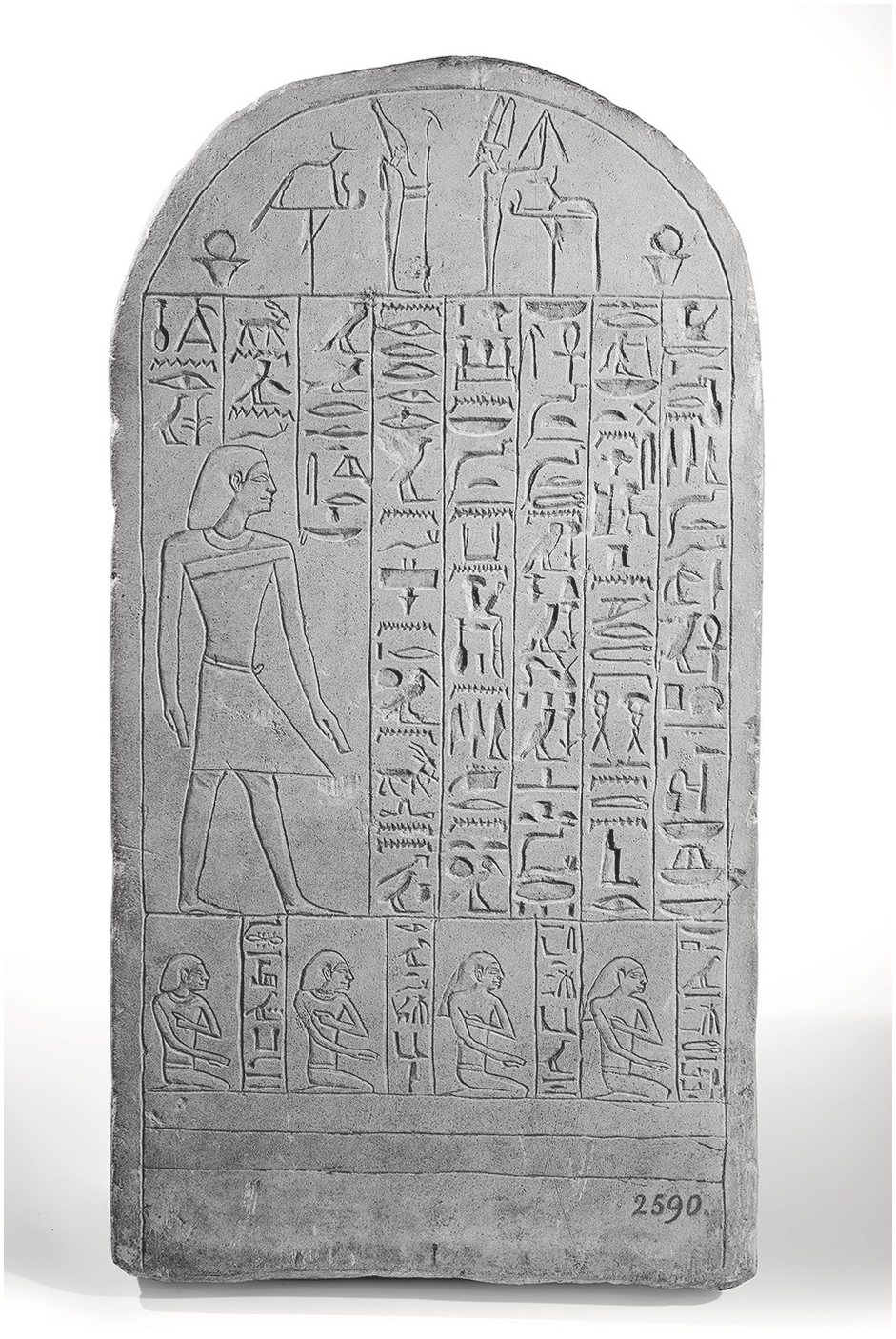
2 Stela of Nefernay. Florence 2590 = ANOC 44.2.
The concept of distributed personhood was inspired by Marcel Mauss’s (Reference Mauss2002 [1969]) treatment of the gift as well as Marilyn Strathern’s (Reference Strathern1988: 13–15) analysis of how people in Melanesia are both individually and dividually conceived. For Mauss the Maori concept hau represented a kind of internal force of the given object that connects it to past owners, demanding that it be returned to its original possessor. This Melanesian notion provides a powerful symbol to explain how one’s presence and agency – even after death – can be extended through space and time by means of objects, which may acquire an agency and a micro-history of their own. In Gell’s words (Reference Gell1998: 103), ‘as social persons, we are present, not just in our singular bodies, but in everything in our surroundings which bears witness to our existence, our attributes, and our agency’.16
An object may consist of many spatially separated parts that need to be brought together in order to reconstruct agency. For this reason, Gosden (Reference Gosden, Meskell and Preucel2004: 171) proposes studying distributed personhood through ‘assemblages of objects’ that share some properties through a dense network of relationships that link them physically and aesthetically to other objects. This approach works particularly well with ancient Egyptian material culture, as illustrated by Annette Kjølby’s (Reference Kjølby2007; Reference Kjølby, Nyord and Kjølby2009) analysis of New Kingdom non-royal statues. For elite Egyptians there was a constant concern with materialising the self, as exemplified by the desire to preserve the body after death (Meskell Reference Meskell2004: 124–30; Reference Meskell and Miller2005: 58–62). A principal function of mummies may have been to construct a ‘perfect image’ of the deceased that would provide a material basis for the ba to be able to return to the appropriate tomb every night (Taylor Reference Taylor2001: 16, 20; Riggs Reference Riggs2014). Statues share the mummy’s function as a material basis where personhood may reside; the fact that there are statues of the same individual deposited throughout Egypt can be explained by the model of distributed personhood. The inscriptions that accompany those statues often reinforce their self-presentation and thus should be considered as an essential part of their materiality.
Gell’s notion of distributed personhood yields excellent results with stelae as these are also externalised constituents of a self that are spread in time and space. The social persona of the Egyptians – both of the owner of the stela and of those with whom he or she was represented – manifested itself through these stelae, which also fulfilled a memorialising function comparable to that of some statues. The model of assemblages presented by Gosden becomes especially relevant with stelae because they were often clustered into groups. These groups constitute material, tangible attestations of networks of relationships among objects and, consequently, among people. The stela group of Iuefenersen, studied in detail in Chapter 6, consists of five stelae from at least two different sites, Abydos and Elephantine. Iuefenersen is present in all five monuments and, since at least some of them were found in different, distant locations, they instantiate his distributed personhood.
Object biography has been widely pursued in archaeological theory and anthropology, especially since the publication of The Social Life of Things: Commodities in Cultural Perspective (Appadurai Reference Appadurai1986b), which investigates the interaction between objects – commodities in that book – and humans.17 As defined by Chris Gosden and Yvonne Marshall (Reference Gosden and Marshall1999: 169), this model frames the way human and object histories inform each other in the convenient metaphor of biography.
These biographies emphasise how interrelations of humans and objects create meanings that are prone to change as time goes by because objects accumulate further layers of meaning that may provoke new, unexpected effects on people. Gell (Reference Gell1998: 11) argues that the biographies of things and of people are intertwined, impacting and modifying each other constantly. In order to account for these changes in meaning and function, objects and their contexts should then be approached from a dynamic perspective that may acknowledge the existence of multiple biographies of an object. Meskell (Reference Meskell2004: 56–7) remarks that Appadurai (Reference Appadurai and Appadurai1986a) and Kopytoff (Reference Kopytoff and Appadurai1986) do not seem to be interested in objects per se but in underlying cultural and historical processes. Yet there may not be such a thing as ‘an object per se’ – except perhaps from a purely processual perspective – because objects exist with society, in the same way as society exists with objects.18
Ancient Egyptian stelae provide specific examples of how the life histories of objects and of their owners become entangled and influence each other. Iuefenersen, mentioned earlier, holds different titles on each of his monuments in a way that may indicate how he accrued status throughout his lifetime (see Chapter 6). Since he was a draughtsman, one could argue that the experience that he acquired producing stelae may have influenced the progression in his position. Groups of stelae like Iuefenersen’s, as far as we can reconstruct them, constitute a crucial unit of analysis, since they are the material expression of connections among individuals and their kin, and they display the reciprocal informing of material and human biographies.
An assessment of the role of stelae as agents through the notions of technologies of enchantment, distributed personhood and object biographies exemplifies how objects and people are interconnected and mutually dependent. Objects have an effect on people, and people construct much of the meaning inherent in objects. Awareness of this interdependence is essential for a deeper understanding of stelae as objects that describe and define people and therefore provide significant sources for the analysis of social groups. In light of these observations, it is obvious that Egyptians made stelae. They designed them, fashioned them skilfully according to different styles and trends, and set them up in tombs and memorial chapels, often along processional routes, but stelae also played a role in the formation of those who shaped them. Individuals are socialised into a given material culture that predates them and that will probably outlive them (Gosden Reference Gosden2005: 194–7).19 Changes in material culture occur gradually (with exceptions that should be a matter of analysis), and innovations introduced by individuals require time to be standardised and fully incorporated into the material repertoire of a civilisation. Is it then possible to state that objects have a stronger influence on human lives than humans have on objects, even if it is humans who produce those objects?
This theoretical conundrum is the subject of a book by Ian Hodder (Reference Hodder2012). He presents an alternative model for the analysis of human–thing interrelations that he denominates as entanglement. His approach is similar to Gell’s notion of agency, since he argues that human and material lives inform each other. Hodder (Reference Hodder2012: 88) expresses entanglement in the formula Entanglement = (HT) + (TT) + (TH) + (HH): that is, humans depend on things (HT), things depend on other things (TT), things depend on humans (TH) and humans depend on other humans (HH). This classification enables an interdisciplinary approach that combines idealism and materialism because ideas and materials are no longer seen as individually determining factors in human action. In his words, ‘what is determinative is the entanglement itself, the totality of the links which hold and produce individual events, things, humans’ (Hodder Reference Hodder2012: 112).
Insofar as elite Egyptians created stelae, those stelae and their universes of meaning contributed to the creation of Egyptians. Information obtained from stelae therefore offers a window on to the lived experience of the people who produced them. This does not mean that what they show should be taken at face value, as this would disregard the weight of idealisation. However, they should not be rejected as purely imaginary and inadequate for the reconstruction of the social landscape.20 As Valerie Hope (Reference Hope and Oliver2000: 181) eloquently explains for Roman stelae:
Each tombstone tells a story and within the cemetery the tombstones are united to tell a wider story still. The funerary monuments are thus a method for accessing the living society. Yet the insight gained is not always a direct reflection of that society. The tombstones are persuasive in the image they present of the world; they may not lie, but they do make claims of status, wealth and position which cannot always be sustained. The funerary monuments reflect not the realities of Roman society but the rhetoric of language and images through which that society was constructed.
How reliable then are monuments as evidence for reconstructing familial structures in ancient Egypt? In terms of Hodder’s theory, it is not the monuments alone that give us the key to understanding social reality, but the emphasis should rather be placed on the links that produce the entanglement. It is the understanding of that entanglement – the mutual relationship between Egyptians and these monuments – that can contribute to a better insight into social trends. Thus, as with relatedness in the previous section, here I am proposing a relational approach that illustrates the performativity and constructiveness of the social fact.
Monuments are then agents that can produce an effect on their viewers; they have the capacity to present a social picture that is probably accepted and treated as stereotypical by those who are socialised into the world in which these products of material culture had a pivotal role.21 Stelae are not meant to present a trustworthy image of daily life and they are not legal documents (Grajetzki Reference Grajetzki and Fitzenreiter2005: 62; Fitzenreiter Reference Fitzenreiter and Fitzenreiter2005: 80–5). Therefore, it is not plausible to pursue basing an actual composition and functioning of society on them because they are not representing reality, they are actively creating a reality. The extent to which the idealised reality shown on stelae corresponds to lived experience, for example in terms of the composition of family groups, is not as important for the present discussion as the reasons behind the particular choices of what is shown, the attitude of the actors – as far as it can be glimpsed – towards those representations, and the impact that those depictions may have had on their self-conception.
The ‘law of recurrence’ postulated by Roger Bastide (Reference Bastide1973 [1971]: 6) propounds that ‘the idea which we have of ourselves transforms us to the point where we end by becoming what we believe ourselves to be. Our concept of social reality suffices to cause us to change it until we are re-creating it when we believe we are only examining it.’ Although this description refers to ideas of the self, representations of social groups on ancient Egyptian monuments can also be interpreted through this approach because society could have been influenced by a widely sanctioned self-perception presented on stelae. This interrelation reinforces a process of reciprocal construction of self and society.
It is uncertain, however, to what extent stelae are perceived as bearers of agency in an ancient Egyptian context. Perception is embodied and situational, and depends on the stance of the observer, but objects also manifest their connections with other objects as they are perceived by an individual or a group (Spurling Reference Spurling1977: 30–1; see also Merleau-Ponty Reference Merleau-Ponty1962 [1945]). As ancient actors looked at stelae, they could create sequences of connections that charged the objects with further layers of meaning, one of which could have related to the constitution of the social groups as they were displayed on them.
John Ma (Reference Ma, Newby and Leader-Newby2007) presents the case study of Hellenistic honorific statues to illustrate the almost symbiotic interaction of objects and people in the construction of social relations. He discusses how the inscriptions accompanying the statues interact with the viewer and complement the information conveyed by the image itself (Ma Reference Ma, Newby and Leader-Newby2007: 205–9).22 Ma’s example illustrates how social consciousness can be created through the materiality of the statues themselves and through the recursive thinking of people interacting with them: ‘The statue, in its shocking lifelikeness, says “Look at me”. The name caption (“Herodotus”), in its deference, says “Look at him”. The honorific formula and decree, in their determination to speak of civic culture, say “Look around you”’ (Ma Reference Ma, Newby and Leader-Newby2007: 220). Similarly, stelae urge observers to look around them. They actively create a social fabric – or ‘social matrix’ (Münch Reference Münch2009: 252) – within which kinship and marriage constitute a privileged nexus. It is in this manner that stelae, by displaying kin, were in fact making kin.
The study of kinship and marriage through the perspectives of relatedness and material agency illustrates the potential of the articulation of anthropology and archaeological theory for the study of ancient Egypt. Structural interpretive biases are not addressed by the accumulation of new case studies but by a thoughtful rethinking of the entire framework. These theoretical approaches need to be firmly anchored in the primary sources to prove their relevance and potential. In Chapter 2, I characterise stelae further, paying special attention to their archaeological contextualisation and its impact on possible modes of monumental display.


