

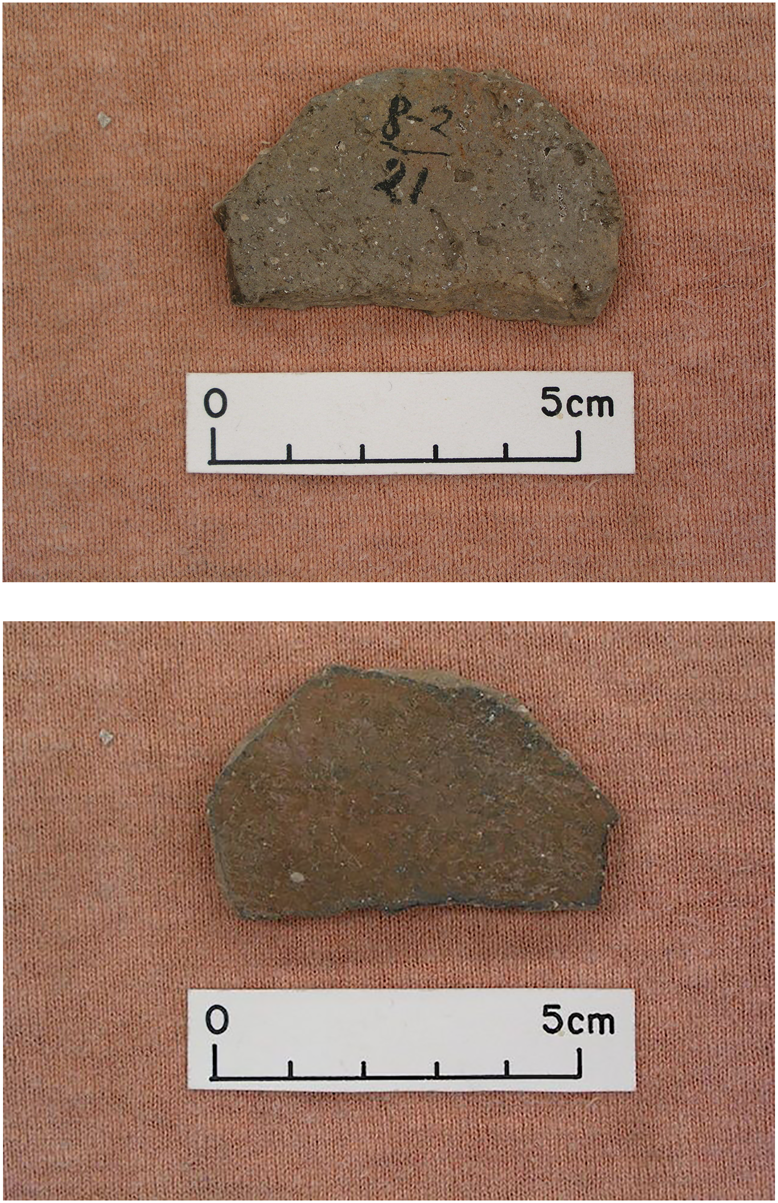
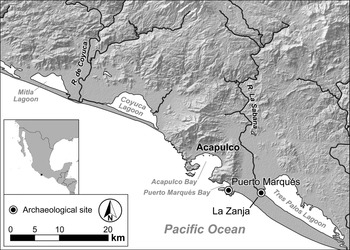
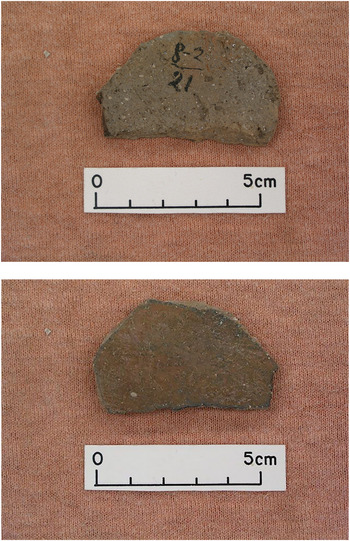
More than 50 years ago archaeologist Charles E. Brush (Reference Brush1965) published a report in Science about what he thought was the earliest known pottery from Mexico, which he had discovered at two archaeological sites in coastal Guerrero: Puerto Marqués and La Zanja (Figure 1). Brush described this pottery as friable, with distinctive interior surfaces characterized by small pits and gouges. He thought the surface treatment originated during production from wiping vessel interiors before the clay was almost dry, causing inclusions to be dragged or removed or both. The rough vessel interiors contrasted with the smooth, often red-slipped vessel exterior surfaces (Figure 2). Brush named it “Pox Pottery,” argued for an approximate date of 2440 ± 140 based on a single radiocarbon date, and noted its similarity to early pottery reported from the Tehuacan Valley in Puebla, Mexico (MacNeish Reference MacNeish1964).
A portion of the Guerrero coastline showing the locations of Puerto Marqués and La Zanja archaeological sites (map drawn by Douglas J. Kennett and digitized by Thomas Harper).

A body sherd from Brush's Pox Pottery collection in the INAH Ceramoteca. Top: Sherd interior. Bottom: Red-slipped sherd exterior (photographs by Barbara Voorhies). (Color online)
During new excavations we conducted at Puerto Marqués and La Zanja, we recovered Early Formative period pottery, some with pitted interior surfaces, in the deepest ceramic-bearing deposits (Voorhies and Kennett Reference Voorhies, Kennett and Robles2016). In this article we reevaluate the typological character of “Pox Pottery” and present Bayesian chronologies for Puerto Marqués and La Zanja based on new AMS 14C dates to constrain the age of these Early Formative deposits. Our specific research goal going into the project was not to study “Pox Pottery” but to investigate the cultural transition that took place in coastal Guerrero from the Archaic (~6000–2000 BC) to Early Formative (2000–600 BC) time periods (Kennett et al. Reference Kennett, Barbara Voorhies, Martínez, Rick and Erlandson2008; Voorhies and Kennett Reference Voorhies, Kennett, Borejsza, Joyce and Lohse2021). Previously, archaeologist Rubén Manzanilla López directed a project focusing on Puerto Marqués and its surroundings (Manzanilla López Reference Manzanilla López2000; Manzanilla López et al. Reference Manzanilla López, González and Sánchez1991:3), but it did not address this particular cultural transition because of a lack of relevant evidence.
The Archaeological Sites
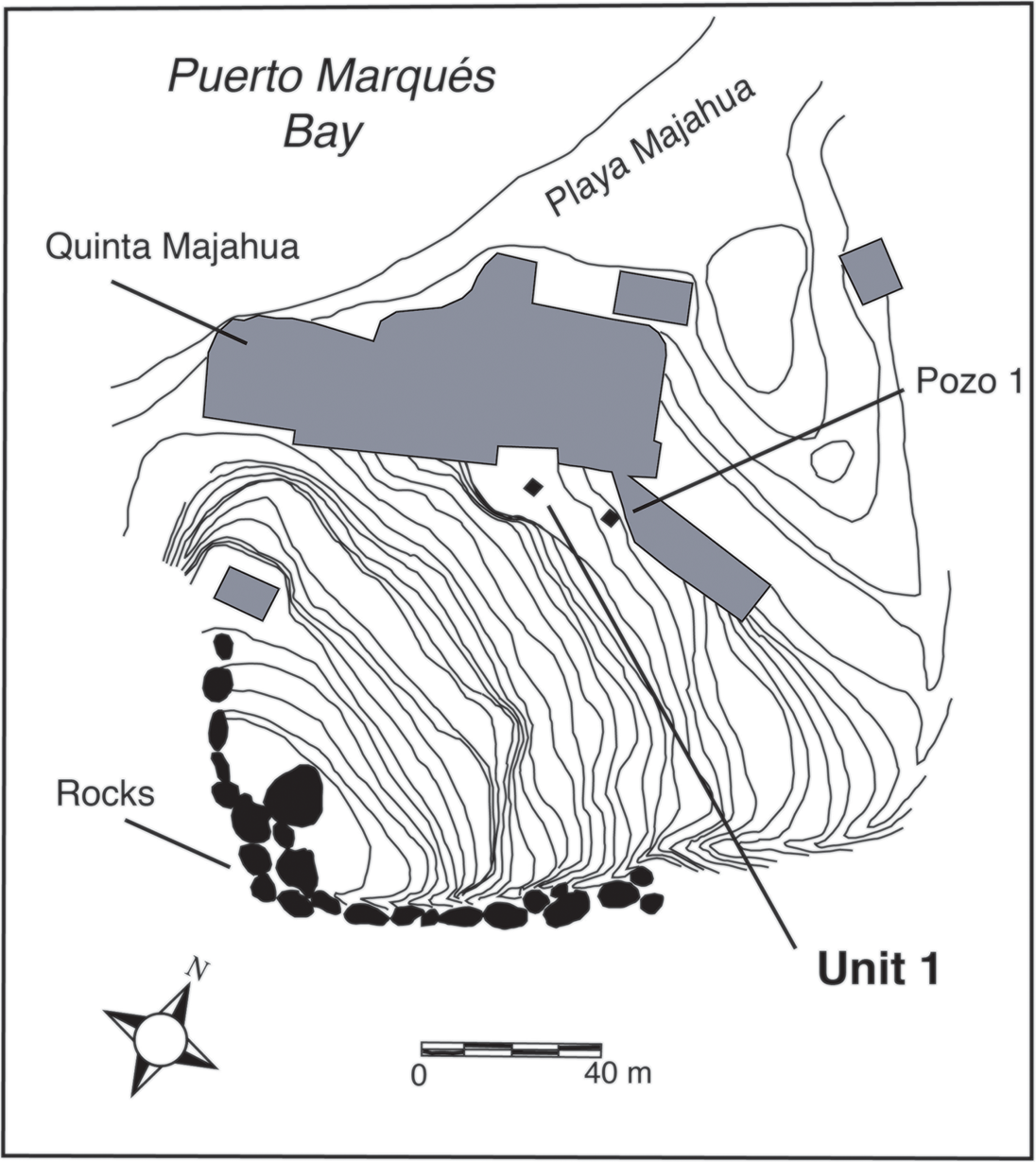
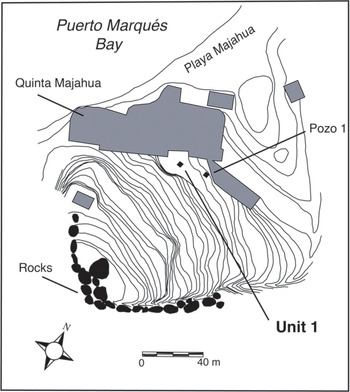
The Puerto Marqués archaeological site is located on a hillside on the southern margin of Puerto Marqués Bay that overlooks Playa Majahua, a small, narrow sandy beach (Figure 3). The site is a poorly defined mound measuring approximately 150 × 130 m and reaches a height of 22 m asl (Barba et al. Reference Barba, Guillermo Pérez and Linares1989; Manzanilla López et al. Reference Manzanilla López, González and Sánchez1991:13). We placed our test pit (Unit 1) immediately behind the buildings of a former residence and close to the test pits previously excavated by Manzanilla López (Pozo 1) and Brush. Since Brush's time this area had been terraced, resulting in the removal of about 2.5 m of the upper archaeological deposits.
Topographic map of the Puerto Marqués archaeological site showing Pozo 1, the test pit excavated by Manzanilla López and colleagues (Reference Manzanilla López, González and Sánchez1991), and Unit 1, excavated by the present authors (map adapted from Barba et al. Reference Barba, Guillermo Pérez and Linares1989).
The earliest pottery that Brush encountered in his excavation at Puerto Marqués was between 6.00 m and 6.60 m below the surface (levels 31–33; Brush Reference Brush1969), immediately overlying aceramic cultural deposits in the lowest excavation levels. In the general Mesoamerican chronology, this pottery falls within the Early Formative period.Footnote 1 The total number of “pox” potsherds that Brush recovered is unclear because of the particular classification method that he used and reported for the ceramic collection. However, he reported that 35% (N = 189) of 547 analyzed body potsherds had the characteristic pitted interior surfaces (Brush Reference Brush1969:Table 5A and Table 5D). He also reported that he found only five rim sherds from these excavation levels, consequently making assessments of vessel form very difficult (Brush Reference Brush1969:Table 6).
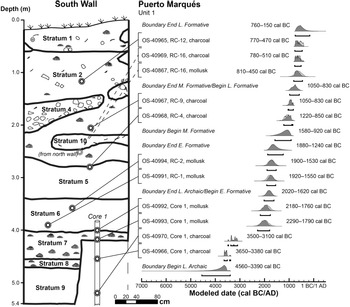
Our excavation measured 2.0 × 2.0 m at the onset and was ~5.40 m deep (Figure 4), but was stepped down three times: at 3.2 m when it measured 2.0 × 1.0 m, at 4.4 m when it measured 1.0 × 1.0 m, and at 5.0 m when it became only 1.0 × 0.5 m. We encountered aceramic cultural deposits in the lowest levels, from 4.00 m to 5.40 m below the surface, despite the presence of a few potsherds that we considered intrusive. Directly overlying the aceramic strata are the deposits with the earliest potsherds (Stratum 6), including those with the attributes that Brush attributed to “pox.”
South wall of Unit 1 at Puerto Marqués showing strata and position of radiocarbon samples. Graph of modeled dates is shown on the right (drawn by Barbara Voorhies and Thomas Harper).

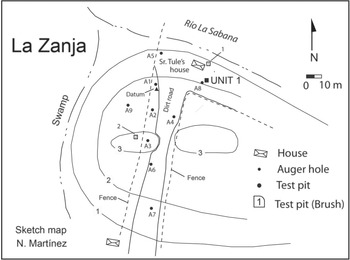
La Zanja, the second site where Brush found “Pox Pottery,” is adjacent to the Tres Palos lagoon, approximately 8 km southeast of Puerto Marqués and about 5 km from the ocean.Footnote 2 The site is a single large, low mound (Figure 5) that is approximately 4 ha in area and 3.2 m high. The Río La Sabana flows along the mound's northern margin, but the remainder of the mound's base is surrounded by marsh. Brush dug two test pits into the mound but found “Pox Pottery” in only one of them: Test Pit 2. There Brush reported 73 “pox” potsherds in the sediment between 3.40 and ~4.30 m (levels 16–22) below the surface (Reference Brush1969:Figure 6). He terminated the excavations after reaching the water table and before reaching either preceramic strata or culturally sterile strata.
Sketch map of the La Zanja mound showing the locations of Brush's test pits and Unit 1 excavated by Douglas J. Kennett (sketch map by Natalia Martínez and drafted by Douglas J. Kennett).

Rim profiles of vessel forms dating to the Early and Middle Formative periods (drawn by Josue Gomez).

We placed a test pit (Unit 1) near the top of the La Zanja mound based on results of surface collection of cultural material and an exploratory auguring program. The 2 × 2 m unit was excavated in 20 cm levels within cultural strata. The water table was reached at 1.08 m below the surface, and we resorted to the use of several pumps to continue excavating. Even with groundwater flowing into the unit, the deposits were compact, and we were able to keep stratigraphic control of excavated material.
The bottom of the test pit reached a depth of 3.60 m below the surface at the end of excavation (Figure 4). The lowest stratum, Stratum VII, is reddish-brown sand that is culturally sterile. It is overlain by Stratum VI, a highly compact deposit with a gray-colored clay matrix that contains Early Formative period pottery, including sherds with pitted interior surfaces.
Ceramic Analysis
We analyzed the pottery collections from both sites using the type system of ceramic classification, which since Brush's time has become the standard method used by archaeologists in Mesoamerica. Brush, in contrast, analyzed his collection using single attributes, a classification method that was never widely used by Mesoamerican ceramic analysts. In the case of “Pox Pottery” the salient attribute is a particular surface finish of vessel interiors, which Brush observed on vessel body potsherds, the most abundant type of potsherd in his small Early Formative collection. We analyzed potsherds from vessel rims, necks, and bases but did not systematically include body sherds in the statistical study. However, we did observe body sherds during the initial sorting of ceramics.
Our Early Formative ceramic assemblages for the two sites are exceedingly unequal in size. We recorded only 15 potsherds from Puerto Marqués (Table 1) compared to 516 potsherds from La Zanja (Table 2). The vast majority of studied potsherds from both sites belong to established ceramic types (see Cabrera Guerrero Reference Cabrera Guerrero1990; Ekholm Reference Ekholm1948; Manzanilla López et al. Reference Manzanilla López, González and Sánchez1991). Gómez, Kennett, and Voorhies (Reference Gomez, Kennett and Voorhies2011) also briefly describe these established types, along with several newly defined ceramic types from the La Zanja collection.
Potsherd Frequency by Ceramic Type and Excavation Level (cm) in Early and Middle Formative Period Deposits at Unit 1, Puerto Marqués.

Notes: Sherds in the Archaic period deposits, thought to be intrusive, are also shown. The number of potsherds with the “pox” attribute is shown in parentheses.
Potsherd Frequency by Ceramic Type and Excavation Level (cm) in Deposits of Unit 1, La Zanja.

Note: The number of potsherds with the “pox” attribute is shown in parentheses.
Potsherd frequencies by ceramic type and excavation level in Unit 1, Puerto Marqués, are shown in Table 1. The deposits lying between 120 and 300 cm date to the Middle Formative period (Strata 2–4), whereas those lying between 300 and 400 cm (Strata 5 and 6) are Early Formative in age. Late Formative period potsherds are evident in low frequency in the uppermost Middle Formative levels (120–140 cm) and mark a poorly defined transition that is truncated by the uppermost disturbed deposits. The three potsherds in the Archaic period deposits, which we think are intrusive, are also tabulated. The majority of sherds in the very small collection that dates to the Early Formative period (n = 15) belong to the Acapulco Red ceramic type. Six of these had the characteristic “pox” attribute (40%). Potsherd frequencies by ceramic type and excavation level in Unit 1, La Zanja, are shown in Table 2. The deposits between 60 and 220 cm (Strata II–V) date to the Middle Formative period, whereas those between 220 and 360 cm (Stratum VI) are Early Formative in age. We observed the “pox” attribute, tabulated in parentheses in Table 2, in some of these Early Formative period potsherds (n = 22; ~4%), but this attribute occurs less frequently in the earliest Middle Formative period assemblage (n = 3; ~0.4%). These percentages are consistent with observations of the “pox” attribute in body sherds examined when the ceramics were originally sorted (Kennett et al. Reference Kennett, Voorhies, Iriarte, Piperno and Wake2006).
Acapulco Red, Acapulco Plain, and Red Slipped wares are the main ceramic types present in the Early Formative period levels (300–360 cm) at Puerto Marqués, but as mentioned the sample is small (n = 15). Twelve of the 15 sherds are Acapulco Red wares, and of these, 6 exhibit the “pox” attribute. Necked jars (60%) and bowls (25%) dominate the assemblage, and tecomates are rare (6%). La Zanja offers a clearer view of Early Formative period ceramic types. Acapulco Red, Acapulco Plain, Brown ware, and Red Slipped are the most abundant ceramic types in the Early Formative period deposits. Icacos Orange also occurs throughout the Early Formative period deposits but is most abundant near the transition to the Middle Formative. These types coincide with the descriptions of Early Formative ceramic assemblages made by Brush (Reference Brush1969:57–58), but he emphasized the “pox” attribute, which occurs only in a small number of Acapulco Red, Red Slip, White Polished, Icacos Red on White, Tabares Brown, Sabana Black, Acapulco Red, and Icacos Brown sherds. The “pox” attribute is seen most commonly in Acapulco Red, which concurs with Voorhies's observation of sherds from Brush's collection that is curated in the INAH Ceramoteca in Mexico City. Acapulco Red vessel forms include tecomates (5%), small mouth jars with vertical necks and direct or slightly outflaring rims (16%), and bowls with simple silhouettes and direct, everted, or slightly thickened rims (64%). Decorative incising occurs on some Acapulco Red vessels, but the fragmentary nature of the assemblage makes it difficult to characterize these decorative features (Figure 6).
Black and White wares mark the transition between the Early and Middle Formative periods at both Puerto Marqués and La Zanja. This decorative combination became widespread in Mesoamerica during the Middle Formative period, along with gray and white wares (Flannery and Marcus Reference Flannery and Marcus2000). At Puerto Marqués this transition is marked by the appearance of Icacos Red on White and Condesa White and Red wares above 300 cm. Major Middle Formative period vessel forms at Puerto Marqués include jars (54%), bowls (23%), plates (14%), and tecomates (11%). Black and White wares are more common at La Zanja. These include Caleta White Slip and White Polished wares that occur in greater abundance at and above the transition between the Early and Middle Formative periods (above 260 cm). Icacos Red on White and Condesa White and Red occur in low frequencies in the Early Formative deposits at La Zanja: they are most abundant in Middle Formative period deposits above 220 cm when Sabana Black becomes abundant (220–280 cm). Sabana Black occurs notably earlier than previously reported for this region (Cabrera Guerrero Reference Cabrera Guerrero1990:107). Major vessel forms include bowls (66%), tecomates (14%), and plates (12%). Jars are present but in very low numbers (3.6%).
The Middle to Late Formative period transition was only identified at Puerto Marqués with the appearance of Tambuco Incised and Acapulco Fine Paste in the upper part of Stratum 2 (above 140 cm; see Figure 4) that is truncated by the upper mixed deposits. The appearance of Tambuco Incised and Acapulco Fine Paste correlates with a decline in Condesa White and Red, White Polished, and Icacos Red on White wares in the Middle Formative period deposits at Puerto Marqués.
Overall, ceramics with the pitted interior surfaces primarily occur in Early Formative period deposits as observed by Brush (Reference Brush1969), but this attribute is only found in a small percentage of sherds and in a wide range of pottery types. Therefore, “Pox Pottery” is not a bona fide ceramic type as is often mistakenly supposed, but simply a particular surface finish most commonly found in the interiors of jars and tecomates.
Bayesian Radiocarbon Chronology
We established a Bayesian chronology for the Early, Middle, and Late Formative period pottery assemblages represented at Puerto Marqués and La Zanja based on 19 radiocarbon dates obtained from the National Ocean Sciences Accelerator Mass Spectrometry (NOSAMS) facility. Charcoal samples collected through each of the sequences were prepared with a series of heated acid-base-acid leaches to remove inorganic carbon and mobile organic acid phases and then were combusted at a high temperature to create CO2. Marine shell samples from the Puerto Marqués sequence were acid-etched with HCL and then directly hydrolyzed with strong acid, H3PO4, to convert the carbonate to CO2. Gas samples were graphitized and radiocarbon (14C) concentrations measured using Accelerator Mass Spectrometry. All 14C ages were δ13C-corrected for mass-dependent fractionation with measured 13C/12C values (Stuiver and Polach Reference Stuiver and Polach1977) and calibrated using OxCal version 4.4 (Bronk Ramsey Reference Bronk Ramsey2020) and the IntCal20 northern hemisphere radiocarbon age curve (Reimer et al. Reference Reimer, Austin, Bard, Bayliss, Blackwell, Ramsey, Butzin, Cheng, Edwards, Friedrich, Grootes, Guilderson, Hajdas, Heaton, Hogg, Hughen, Kromer, Manning, Muscheler, Palmer, Pearson, van der Plicht, Reimer, Richards, Scott, Southon, Turney, Wacker, Adolphi, Büntgen, Capano, Fahrni, Fogtmann-Schulz, Friedrich, Köhler, Kudsk, Miyake, Olsen, Reinig, Sakamoto, Sookdeo and Talamo2020). Marine shell dates were calibrated using the Marine20 calibration curve (Heaton et al. Reference Heaton, Köhler, Butzin, Bard, Reimer, Austin, Bronk Ramsey, Grootes, Hughen, Kromer, Reimer, Adkins, Burke, Cook, Olsen and Skinner2020). A local marine reservoir correction (ΔR) was estimated based on a pair of samples from the same context: OS-40969 (charcoal; 2490 ± 35) and OS-40867 (shell; 3090 ± 75). Application of a ΔR value of 100 ± 50 renders the intercept and calibrated age ranges of each of these dates roughly equivalent. The relevant radiocarbon details and results are presented in Table 3.
Radiocarbon Samples and their Results for the Archaeological Sites of La Zanja and Puerto Marqués.

We established Bayesian chronologies (sensu Kennett et al. Reference Kennett, Culleton, Voorhies and Southon2011) for both Puerto Marqués and La Zanja based on the stratigraphic observations made in the field and the associated radiocarbon dates. Bayesian chronological models are built using the available radiocarbon dates for a site combined with nonquantitative contextual information obtained in the field (e.g., stratigraphic position and artifact assemblages; Kennett et al. Reference Kennett, Culleton, Dexter, Mensing and Thomas2014). Contextual information provides the framework for constraining probability distributions and the grounds for removing problematic radiocarbon dates. When the modeled distribution completely overlaps with the calibrated date range, there is a good fit between the data and the model. An agreement index (A) provides a measure of fit between the data and model, with values closest to 100% representing strong concordance. Agreement indices falling below the critical value A′ = 60% indicate a poor fit between the data and the model. This index is used to identify outlier dates or incorrect stratigraphic assumptions (Bronk Ramsey Reference Bronk Ramsey2009). An agreement index for the overall sequence is also provided for each model (Sequence [Amodel]). All of the modeling results for Puerto Marqués and La Zanja are discussed later in the article and can be found in the supporting documentation (Supplemental Table 1). Only segments of the Early, Middle, and Late Formative periods are represented at Puerto Marqués and La Zanja, and these do not reflect the age ranges for these periods regionally. The Late Formative period is only represented at Puerto Marqués, but the boundary for the start of these deposits is poorly constrained in our model.
Figure 4 shows the chronostratigraphic model for Puerto Marqués. In this figure, the light-gray probability distributions represent calibrated date ranges without model constraints. The dark-gray distribution shows these probability estimates trimmed or shifted based on the constraints of the stratigraphic model. Modeled distributions were established for deposits at Puerto Marqués dating to the Late Archaic (3890–1820 cal BC), Early Formative (1820–1400 cal BC), Middle Formative (1000–770 cal BC), and the transition to the earliest part of the Late Formative (770–150 cal BC). The beginning and end of each period are represented by the mean (μ) of the modeled phase boundaries that bracket each interval (see Supplemental Table 1) and are conservative estimates for the length of these periods represented at Puerto Marqués. The sequence is not continuous, and the model reflects a substantial hiatus in the Early Formative period (see the later discussion). No outliers were detected, and the agreement indices for the sequence (Amodel = 115.5) and the overall model (Aoverall = 108.4) indicate strong corroboration with the radiocarbon data.
The earliest Acapulco Red sherds at Puerto Marqués, some with the “pox” attribute, occur in the upper portion of Stratum 6 and into Stratum 5 and date to the Early Formative between 1820 and 1400 cal BC. These Early Formative sherds are directly associated with a radiocarbon date (OS-40991) with a 2-sigma range between 1900 and1530 cal BC (a mean age of 1720 cal BC). A gap in the radiocarbon record occurs between 1400 and 1000 cal BC and the appearance of Middle Formative period White wares (Icacos Red on White and Condesa White and Red wares above 300 cm) in Strata 2–4 dating between 1000 and 770 cal BC. Middle Formative White Wares decline in frequency in the upper portion of Stratum 2 (140–120 cm) with the first appearance of Late Formative period ceramics (Tambuco Incised and Acapulco Fine Paste) at some time between 770 and 150 cal BC. Levels above 120 cm (Stratum 1) were highly disturbed and contained a mixture of modern and prehistoric materials that occurred when the modern terrace that truncated Brush's original section was cut.
The chronostratigraphic model for La Zanja is shown in Figure 7. A Bayesian chronological model was established for the Early and Middle Formative periods based on a sequence of seven radiocarbon dates. Formative period deposits between 220 and 360 cm (Stratum VI) date to 1330–1060 cal BC. The earliest Early Formative sherds, some with the “pox” attribute, are directly associated with a radiocarbon date (OS-40991), with a 2-sigma range between 1390 and 1120 cal BC (a mean age of 1240 cal BC). The upper Middle Formative period deposits (60–220 cm, Strata II–V) date to 900–600 cal BC. The sequence appears to be relatively continuous, with no obvious gaps in the record. Reversals occur within the Early and Middle Formative period deposits, but no outliers were removed from the model. Agreement indices for the sequence (Amodel = 91.8) and the overall model (Aoverall = 90.1) indicate strong corroboration between the phased model and the chronostratigraphic data.
Profile of the north wall of Unit 1 at La Zanja showing strata and position of radiocarbon samples. Graph of modeled dates is shown on the right (drawn by Douglas J. Kennett and Thomas Harper).

The Early Formative period ceramic assemblage at La Zanja is larger (n = 516) and covers a period of time (1330–1060 cal BC) that is not well represented at Puerto Marqués. Ceramic types predominantly found in Stratum VI (220–360 cm) include Red Slip, Taberas Brown, Icacos Orange, Sabana Gray, Sabana Black, Acapulco Plain, Acapulco Red, and Icacos Brown wares. The “pox” attribute occurs in low frequency (n = 20; 3.9%) in Red Slip, Tabera Brown, Sabana Black, and Icacos Brown, but is most common in Acapulco Red wares (8.7%). White and Black wares appear in the uppermost Early Formative period levels (220–280 cm) but are more abundant in Middle Formative period strata (II–V; 60–220 cm) dating between 900 and 600 cal BC. These wares include White Polished, Condesa White on Red, Icacos Red on White, Caleta White, Sabana Black, and Black on White. Taberas Brown and Acapulco Red wares persist throughout the Middle Formative period deposits, and a small number have the “pox” attribute (n = 3; ~0.4%).
Discussion and Conclusions
“Pox Pottery” continues to be cited in textbooks as the earliest pottery in Mesoamerica despite questions regarding its stratigraphic association and the accuracy of the single radiocarbon date of ~2440 BC. Here we demonstrate that Acapulco Red ceramics at Puerto Marqués, some with the “pox” attribute, date between 1820 and 1400 cal BC. The assemblage of these early ceramics is small and dominated by globular necked jars and gourd-shaped tecomates. A wider range of ceramic types and vessel forms (necked jars, bowls, and tecomates) occur in Early Formative period deposits at La Zanja dating from 1330 to 1060 cal BC; a small percentage of these, most notably Acapulco Red wares, have the “pox” attribute. The Middle Formative period is marked by the appearance of Black and White wares, and the “pox” attribute is uncommon in these later assemblages. We argue that pottery on the Guerrero coast did not occur as early as originally thought and that “pox” is not a ceramic type. We agree with Brush (Reference Brush1965) that this attribute resulted from the removal of coarse-grained sand temper during the production process.
The earliest Acapulco Red wares (1820–1400 cal BC) from coastal Guerrero are stylistically similar to other Red-on-Buff traditions west of the Isthmus of Tehuantepec and the Central Mexican Highlands (Flannery and Marcus Reference Flannery and Marcus1994; Hepp Reference Hepp, Englehardt and Carrasco2019; Winter Reference Winter1992). They are similar in character to pottery from Espiridión/Tierras Largas in highland Oaxaca dating to 1900–1500 cal BC and to Tlacuache pottery from coastal Oaxaca dating to 1950–1530 cal BC (Hepp Reference Hepp, Englehardt and Carrasco2019). There are also similarities with Purrón Pottery from the Tehuacan Valley (García Cook and Merino Carrión Reference García Cook, Carrión, Carrión and Cook2005; Hepp Reference Hepp, Englehardt and Carrasco2019; Johnson and MacNeish Reference Johnson, MacNeish and Johnson1972), which is poorly dated but likely dates to ~1900–1680 cal BC. Acapulco Red wares are distinctive from the gourd-inspired and finely made thin-walled Barra Phase ceramics from coastal Chiapas, Mexico, dating to 1900–1700 cal BC (Blake and Clark Reference Blake, Clark, Brumfiel and Fox1993), Ojochi pottery from the Mexico's Gulf Coast dating to 1750–1550 cal BC (Arnold Reference Arnold2003), and Barahona ceramics from northern Honduras dating to 1600–1400 cal BC (Joyce and Henderson Reference Joyce and Henderson2001). Some specimens with specular red slip appear to have been imported from the Soconusco area, whereas others with white slip seem to have originated elsewhere, suggesting a high level of contact and exchange between culturally distinct regions.
Hepp (Reference Hepp, Englehardt and Carrasco2019) has suggested that an early Red-on-Buff ceramic tradition developed west of the Isthmus of Tehuantepec and in the Central Mexican Highlands in parallel with the distinctive Locona tradition (Barra, Locona) in coastal Chiapas that extended across the Isthmus of Tehuantepec to the Gulf Coast (Ojochi pottery). The age and character of the Red-on-Buff pottery from coastal Guerrero described here are consistent with this idea. Three contemporary and distinct ceramic traditions—Red-on-Buff, Locona, and Barahona—in Mesoamerica dating between 1900 and 1400 cal BC suggest either (1) differential local adoption during the rapid transmission of ceramic technology (“dependent invention”; Clark and Gosser Reference Clark, Gosser, Barnett and Hoopes1995) from earlier Central and South America traditions or (2) an independent origin of ceramic technology (Hepp Reference Hepp, Englehardt and Carrasco2019). Hepp (Reference Hepp, Englehardt and Carrasco2019) has argued for at least two distinct networks of interregional interaction and possibly cultural or linguistic divisions based on the distribution of Red-on-Buff ceramics, the dominance of obsidian from Central Mexican sources, and the absence of Central American sources in coastal Oaxaca. The presence of contemporary Red-on-Buff ceramics in coastal Guerrero, combined with obsidian exclusively from Central Mexican sources (Ucareo, Paredon, and Otumba; Ebert et al. Reference Ebert, Dennison, Hirth, McClure and Kennett2014), is consistent with this hypothesis.
Overall, the earliest Acapulco Red wares from coastal Guerrero, some with the “pox” attribute, remain among the earliest ceramic traditions in Mesoamerica. Our results help constrain the early age (1900–1400 cal BC) and geographic extent of Red-on-Buff ceramic traditions west of the Isthmus of Tehuantepec and into the Central Mexican Highlands. Future excavations and high-resolution chronological work in Mexico and Central America will be required to determine whether ceramic technology has an independent origin in Mexico or was adopted rapidly as it dispersed northward out of South America.
Acknowledgments
This work was supported by the National Science Foundation under Grant IBCS-02112215 and carried out with permission from the Consejo de Arqueología, Instituto Nacional de Antropología e Historia, Mexico. We thank Arqlgo. Cuautémoc Reyes Alvarez (Centro Regional de Guerrero, Instituto Nacional de Antropología e Historia) for facilitating our research; Dr. Rubén Manzanilla López for generously sharing insights about the prehistory of Puerto Marqués; and Lic. Martha E. Cabrera Guerrero for her environmental and archaeological knowledge of the region. Ing. Paul Rangel Merkley kindly provided access to the Puerto Marqués site, whereas Ing. Victor Hugo Martínez and Ing. Francisco Rodríguez from Desarrollo Integral de Ingenería SAdeCV aided the project in innumerable ways. Barbara Voorhies oversaw excavations at Puerto Marqués, and Douglas Kennett supervised the La Zanja excavations. Josue Gomez conducted the ceramic analysis, and Kennett developed the site chronology with assistance from Thomas Harper. We extend special thanks to our able archaeology field crew: Cassandra Albush, Natalia Martínez Tagueña, Juan Jorge Morales, Amparo Robles Salmerón, Cameron M. Walker, and Nathan Wilson. Thomas Harper assisted with the graphics. Finally, our immense gratitude to John E. Clark, former director of the New World Archaeological Foundation, Brigham Young University, for lending us field vehicles, field equipment, and workspace for post-fieldwork analyses.
Data Availability Statement
All data required to replicate this study are provided in the supplemental materials.
Supplemental Materials
For supplemental material accompanying this article, visit https://doi.org/10.1017/laq.2021.14.
Supplemental Table 1. Bayesian Modeling Results for Puerto Marqués and La Zanja.


 Open access

