


Introduction
During the Palaeolithic, the cultural significance of caves with rock art was progressively shaped by the different activities that prehistoric communities carried out within them, thus transforming a physical space into a symbolic space. The construction of these symbolic spaces occurred through a series of processes of symbolization of the physical elements of the caves which took place at different times or moments in which successive and different human actions left diverse traces that are recognizable in the archaeological record of the cavities, and whose study can help to substantially improve our understanding of Palaeolithic views on rock art.
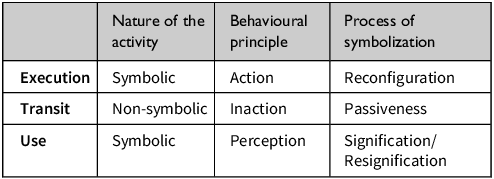
The construction of any symbolic space is primarily sustained on the human determination of imposing a cultural dimension onto the material elements present in the physical space (whether they have a natural or cultural origin), in an attempt to provide them with a social meaning that goes beyond their original form, thus converting them into a symbol of a culturally sanctioned system of values (beliefs, cults, experiences, worldviews, cosmogonies, etc.). In this sense, the symbolic construction of space begins with what we define as ‘times of execution’. These times refer to those specific moments for which there is evidence of an activity intended to modify or reconfigure the physical space (whether it is the cave or a part of it), in order to provide it with a new meaning that is representative of the culture that produces it (Ibero Reference Ibero2023). This activity might be immaterial in nature (performing rites, ceremonies, etc.) thus leaving no archaeological trace that can be directly attributable to it. However, sometimes these activities have a material endorsement that leaves its residue in the archaeological record. Instances of this are a single or multiple burial, an engraving or painting on the rock walls, a non-utilitarian modification of the physical space, or a deposit of specific artefacts. The premises of this work focus on this second scenario and, in particular, on the case of rock art.
In caves with rock art it is relatively common that several ‘times of execution’ coalesce in a single space, or even in a single composition, as the artistic ensembles can be the product of:
-
(a) continuous visits within a single cultural frame which occurred within a short period of time (suggesting an attempt at ‘sustaining’ the significance provided to the cave in those earlier times of execution, thus aiding to maintain ‘configured’ the social meaning previously given to the physical space); or
-
(b) discontinuous visits from different cultural frames distanced by several millennia (suggesting an attempt at ‘reconfiguring’ the significance of the cave and/or the images on their walls).
Thus, in order to identify and define the different times of execution properly within a single space, it is fundamental to carry out detailed morpho-stylistic, stratigraphic and chronological analyses of their rock-art ensembles, as well as carefully assessing their graphic processes.
Once one of these times of execution has occurred, the symbolic space is endorsed with a new cultural meaning, and the material evidence of the symbolization (in our case, the images that configure rock art) is exposed to the perception of every subsequent visitor. The archaeological study of events of perception of earlier graphic activities is certainly constrained, as it is limited to the archaeological plausibility of identifying their impact on the physical space in which rock art was exposed. However, recent works have shed light on the scientific potential of this line of research for the study of reuse (Garate et al. Reference Garate, Medina-Alcaide and Intxaurbe2025; Reference Garate, Rivero, Intxaurbe and Díaz-González2021; Ibero et al. Reference Ibero, García-Diez and Ochoa2024) and visitation (García-Diez et al. Reference García-Diez, Smith and Muñoz2021; Intxaurbe et al. Reference Intxaurbe, Gárate, Arriolabengoa and Medina-Alcaide2022; Medina-Alcaide et al. Reference Medina-Alcaide, Vandevelde and Quiles2023; Reference Medina-Alcaide, Garate and Intxaurbe2021; Ortega et al. Reference Ortega, Martín-Merino and García-Diez2020) of rock-art spaces, showing new ways to approach this topic theoretically and methodologically.
Nevertheless, it should be noted that not every event of visualization of earlier graphic evidence necessarily participates in the process of symbolization of cave space. There are archaeological traces left by some activities that do not rule out a potential Palaeolithic perception of pre-existing material evidence of symbolic behaviour (for instance, due to their spatial relationship with these, or their location within the cave topography), but for which the record suggests a graphic ‘silence’ (that is, the absence of evidence of contemporary graphic executions in the cave, as well as absence of contemporary spatial or graphic interactions with those pre-existing graphic executions). Therefore, these are activities that leave certain archaeological traces (for example, remains of combustion marks on walls, human imprints, accidental damaging of geomorphological elements, etc.) which suggest that they were not intended to reconfigure or resignify the symbolic dimension of the space in which they appear, but merely to move through it or stay in it. These human actions correspond to what we might call ‘times of transit’ through the symbolic space, that is, events in which symbolic spaces were visited but the motivations for which we cannot determine with certainty, although we can determine archaeologically that they do not participate directly in any known process of graphic symbolization. However, for this to be possible the archaeological data must guarantee:
-
(a) that these ‘times of transit’ are not contemporary with any moment of the known symbolic ‘times of execution’ in the same space; and
-
(b) that both the nature of the archaeological evidence of transit and their spatial context point to a non-symbolic attitude towards the pre-existing traces of symbolization.
Hence, a profound chronological and spatial knowledge of caves with rock art is necessary in order to identify this type of non-symbolic behaviour properly and to understand its relationship with rock art.
Finally, certain archaeological traces suggest the existence of events of perception of pre-existing symbolic evidence that, due to their spatial relationship with them and/or to their intrinsic nature, allow us to attribute them a symbolic purpose linked to those earlier material evidence of symbolization. Unlike in the times of transit, in these cases there is a process of symbolization of space carried out through an activity that is, in contrast, different from that of the time of execution whose forms are perceived (otherwise we would speak of a second time of execution). In the case of rock art, these are human activities aimed at re-signifying the physical space and/or the cultural images contained in it through an active exercise of perception of the forms produced in an earlier time of execution. We conceptualize these events as ‘times of use’, whose identification requires the existence of archaeological evidence of (a) transit through a symbolic space in moments later to its symbolization and (b) an active engagement towards the material traces of that earlier symbolization, which result in a direct but non-modifying use of its perceptual forms. Although, given their generally immaterial nature, it is nearly impossible to identify all the times of use within a cave, recent studies on internal context (Medina-Alcaide et al. Reference Medina-Alcaide, Garate, Ruiz-Redondo and Sanchidrián2018), lightning (Medina-Alcaide Reference Medina-Alcaide2025; Wisher & Needham Reference Wisher and Needham2023) and perception of rock art (Ibero et al. Reference Ibero, García-Diez and Ochoa2024; Intxaurbe et al. Reference Intxaurbe, Gárate, Arriolabengoa and Medina-Alcaide2022) have configured a new line of research capable of addressing this issue from both an archaeological and an anthropological perspective. It is the succession of these different times (Table 1) that constructed the symbolic structure that we see today in Palaeolithic caves. However, the traditional conception of rock art has privileged the role of action over that of perception in the symbolic construction of space. Consequently, in recent years some works have analysed archaeological evidence spatially close to graphic symbolic spaces, in many cases linking directly the dates obtained for the context with the time of execution of the rock art, which may imply a serious methodological bias which does not account for the prolonged symbolic life of decorated caves. On the contrary, carefully assessing the spatial and chronological aspects of the three dimensions of time proposed here can make it possible to understand rock art beyond its creation, thus assessing the possible uses of rock art by the multiple prehistoric groups that did not create it and, finally, helping to approach the cultural value that this type of archaeological manifestation had for Palaeolithic communities. However, it should be noted that this succession of times does not conform to a single behavioural sequence or model, as symbolization is a dynamic process that may have occurred differently in each cave, or even in each area of a single cave.
Structural characteristics of the different times proposed in this article.

In order to explore these theoretical premises methodologically, this work analyses a specific case of the Palaeolithic iconography of the Cave of Altamira. To this end, the rock art of a specific topographical area of the cave (ALT.V.I.) has been fully studied, analysing the existing superpositions between the different figures, carrying out a morpho-stylistic analysis of the graphic ensemble, chronologically contextualizing its images using the dated portable art record, and dating and analysing new evidence spatially linked to the rock-art manifestations of this space. The application of these methods has made it possible to discuss the potential times of execution, transit and use of this space of the cave. This discussion, although necessarily partial, can help to produce an overview of the processes of symbolization that participated in the construction of a fundamental Palaeolithic site such as Altamira, as well as laying the foundations for studying the processes of cave symbolization from a broader perspective.
The Cave of Altamira: archaeological context and cave art
The Cave of Altamira, declared a World Heritage Site by UNESCO in 1985, is located in the north of the Iberian peninsula (Santillana del Mar, Cantabria, Spain), on top of a subtle rise in the coastal area in the centre of the Cantabrian region, 159 m above sea level (Fig. 1A). It is a single gallery made of limestone materials with a longitudinal development of 290 metres. Altamira was the first cave where Palaeolithic cave art was identified (Sanz de Sautuola Reference Sanz de Sautuola1880), leading to a long debate (Barandiarán Reference Barandiarán1995; Heras et al. Reference Heras, Prada, Ordás, Díaz-González and Fatás2023) on the capacity of Palaeolithic groups to produce symbols, which was settled in 1902 (Cartailhac Reference Cartailhac1902). Since then, several investigations have focused on studying its human occupations and its parietal art.
(A) Geographical location of the Cave of Altamira; (B) topographic map of the cavity with indication of Sector V (in red); (C) photograph of the environment of the area of study. (© Altamira Museum. Photograph: P. Saura.)

An important archaeological site is preserved at the entrance. The latest research proposes a sequence with eight levels dated by AMS 14C between 26,784 and 16,866 cal. bp (Heras et al. Reference Heras, Montes, Lasheras, Rasines and Fatás2008; Lasheras et al. Reference Lasheras, Fernández, Montes, Arias, Corchón, Menéndez and Rodríguez2012 Reference Lasheras, Montes, de las Heras, Rasines, Fatás, Santonja, Pérez-González and Machado2005; Reference Lasheras, Montes, de las Heras, Rasines, Fatás, Santonja, Pérez-González and Machado2005-2006; Rasines et al. Reference Rasines, Montes, Lasheras, Muñoz, de las Heras, Fatás and Ortiz de Landaluze2009). Levels 1 to 5 correspond to the Middle Magdalenian; level 6, whose upper surface is eroded at the contact with level 5, contains materials from the Late Solutrean; level 7 is also Solutrean; and finally, the oldest occupation that has been documented is level 8, from the Late Gravettian. These levels are covered by large blocks from the partial collapse of the roof, and the existence of previous occupations cannot be ruled out. In short, the entrance hall of Altamira contains an archaeological site where prolonged Upper Palaeolithic occupation has been documented, whereas in excavations in the exterior area Acheulean and Mousterian occupations have also been documented (Díaz-González et al. Reference Díaz-González, Serna and Prada2020).
Since its scientific discovery, several investigations have studied the rock art of Altamira (Alcalde del Río Reference Alcalde del Río1906; Bayarri et al. Reference Bayarri, Latova, Lasheras, de las Heras and Prada2015a,b; Reference Bayarri, Prada, Garcia, Díaz-González, de las Heras and Fatás2023a,b; Reference Bayarri, Prada, Garcia, de las Heras and Fatás2024; Breuil & Obermaier Reference Breuil and Obermaier1935; Cartailhac & Breuil Reference Cartailhac and Breuil1906; Collado et al. Reference Collado, García, Fatás and Collado2018; Freeman et al. Reference Freeman, González-Echegaray, de Quirós and Ogden1987; García-Diez et al. Reference García-Diez, Ibero and Ochoa2024; Heras Reference Heras, Gutiérrez Cuenca, Gárate and Boado del Castillo2018; Heras & Lasheras Reference Heras, Lasheras, Salas, Carbonell, Bermudez de Castro and Arsuaga2014; Reference Heras and Lasheras2010; Heras et al. Reference Heras, Prada, Díaz-González, Ordás, Averbouh, Feruglio, Plassard, Sauvet, Averbouh, Feruglio, Plassard and Sauvet2022; Reference Heras, Prada, Ordás, Díaz-González and Fatás2023 Reference Heras, Montes, Lasheras, de las Heras, Lasheras, Arrizabalaga and de la Rasilla2013; Reference Heras, Prada, Díaz-González, Ordás, Averbouh, Feruglio, Plassard and Sauvet2021; Lasheras et al. Reference Lasheras, Fernández, Montes, Arias, Corchón, Menéndez and Rodríguez2012; Ordás et al. Reference Ordás, Prada, Díaz-González, García Atiénzar and Garciela González2019; Pike et al. Reference Ortega, Martín-Merino and García-Diez2013; Reference Pike, Hoffmann and García2012; Sanz de Sautuola Reference Sanz de Sautuola1880). The cave contains practically all the themes (animals, anthropomorphs and signs), techniques (painting, drawing, different types of engravings and use of natural rock forms) and styles known for Palaeolithic rock art. The figures are distributed throughout the entirety of the cave, although they are prominently concentrated on the Ceiling of the Polychrome Hall and the Final Gallery. The Ceiling contains the well-known set of naturalistic bison, engraved and painted in red and black, some adapting their morphology to the natural volumes of the rock support. When these polychrome figures were painted, other representations of different styles were already depicted, which implies a reiteration of graphic actions in a single symbolic space for at least 25,000 years on a surface of around 150 square metres.
Rock art and archaeological context of the topographic unit I of sector V (ALT.V.I)
The project El primer arte de la Humanidad: la cueva de Altamira (Santillana del Mar, Cantabria) was launched in 2021, aimed at studying specific topographic sectors of the cave in order to obtain new documentation and address specific research problems. This has allowed us to study thoroughly the topographic unit I of sector V, an area in which Breuil and Obermaier (Reference Breuil and Obermaier1935) identified a small number of figures, but which has remained essentially unstudied since the discovery of the cave art of Altamira in the late eighteenth century.
In this area (sector V), located 47 m from the entrance after passing by the Polychrome Ceiling, we find an irregular wall front (topographic unit ALT.V.I.; Fig. 2) 28 m in length that presents a longitudinal and slightly curved general layout that is structured along limestone strata at different heights and depths, generated by sliding of the horizontal strata in which the Altamira karst developed. The floor on which the topographic unit is located has been modified since the discovery of the cavity, consisting of its lowering and the removal of blocks. However, a small portion of the original floor has been preserved along the total length of the wall (Fig. 2C).
(A) Topographic map of Sector V of the Cave of Altamira, indicating the studied area (in red); (B) topographic detail with transversal and longitudinal sections of Sector V (in plan and in sections the black or empty areas correspond to the modern walls); (C) photogrammetric model of ALT.V.I, indicating the position of the identified graphic and archaeological evidence.

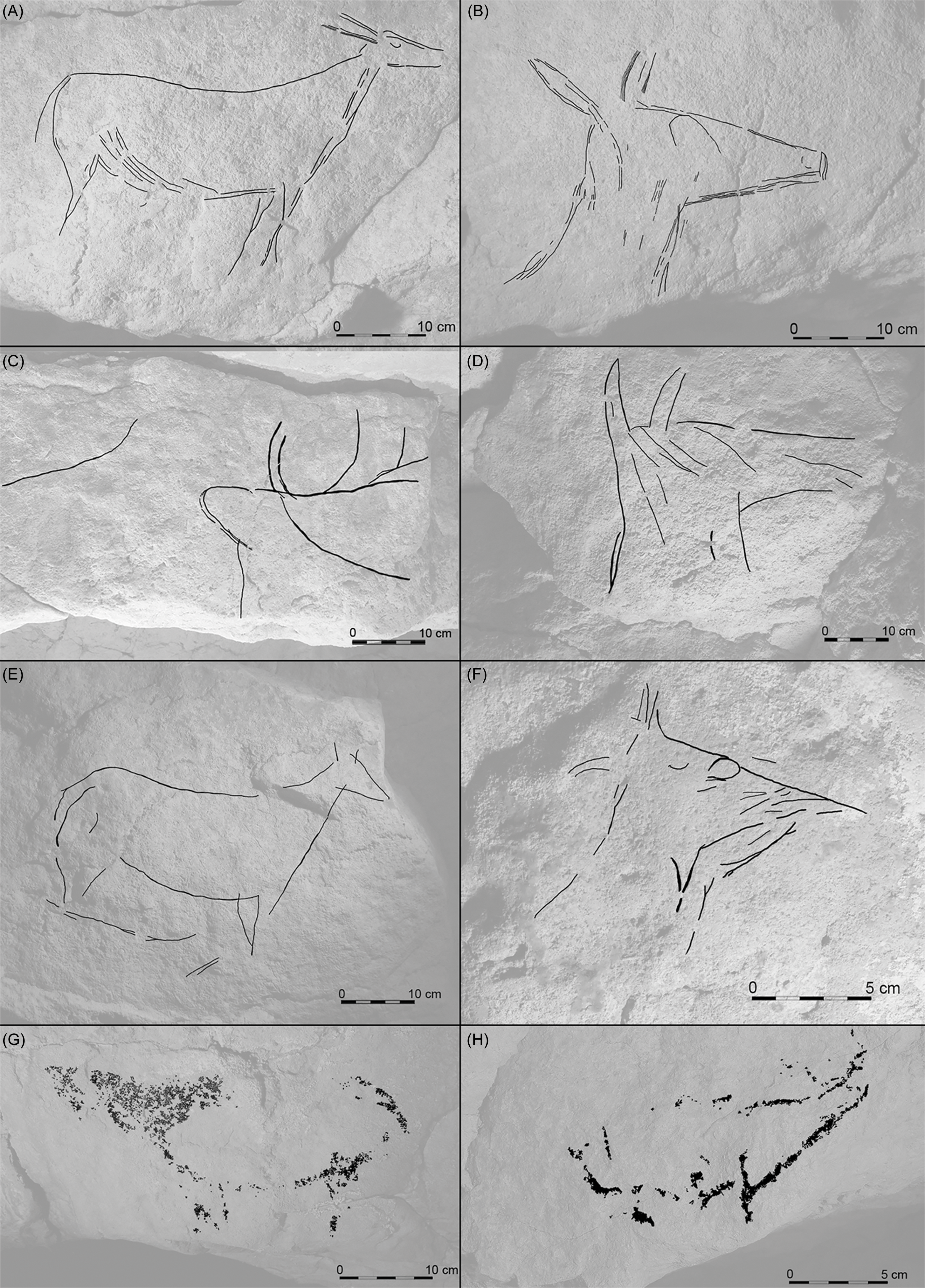
The documented graphic evidence of ALT.V.I. consists of 16 linear motifs, 6 hinds, 3 stags, 1 horse, 4 indeterminate zoomorphic shapes (of which one could correspond to a deer and two to horses), 1 pseudo-quadrangular shape, 1 pseudo-triangular shape and 1 pseudo-scalariform shape (Figs 3 and 4). The figures were mostly drawn with simple, incised contour engraving with a fine, shallow groove, and only five (2 linear shapes, 1 deer, 1 possible horse and 1 undetermined animal) were executed in black drawing. In addition, 19 red marks and 32 black marks have been documented; in some cases of the former (at least for those that show a pseudo-circular or pseudo-ellipsoidal shape and are internally organized in linear series) their intentional and, therefore, graphic nature could be considered.
Selection of figures from ALT.V.I. (A) ALT.V.I.14; (B) ALT.V.I.15; (C) ALT.V.I.17; (D) ALT.V.I.20; (E) ALT.V.I.21; (F) ALT.V.I.28; (G) ALT.V.I.31; (H) ALT.V.I.33.
Recreation of the engraving process of ALT.V.I.21. (© Paula López Calle.)
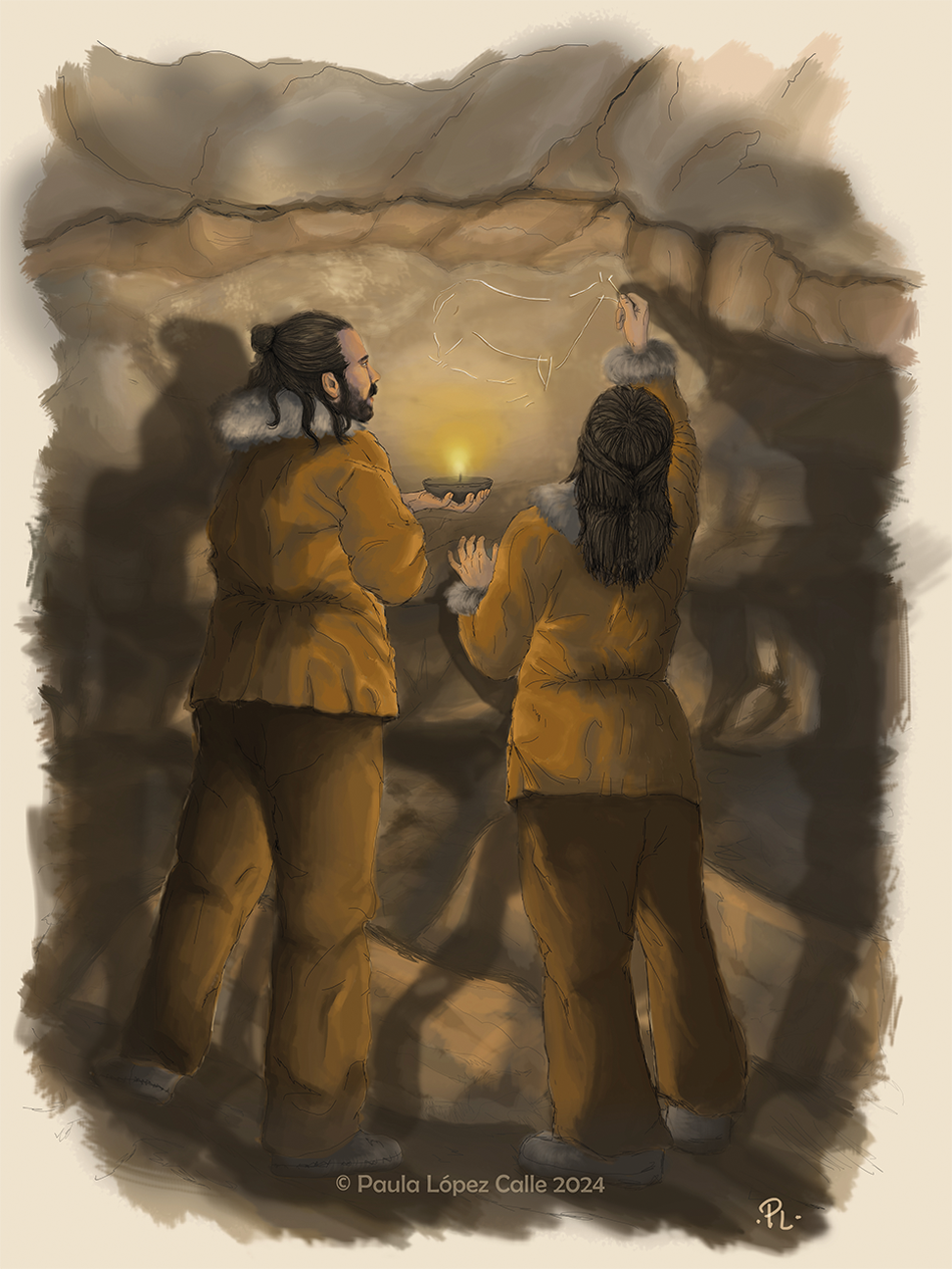
The study of this rock-art ensemble has allowed us to document: (a) the use of the support as a framing resource (implantation of a figure within a wall canvas well delimited by changes of plane or cracks) and the fitting of the represented images (implantation of a figure directly at one of the limits that define the given frame); (b) references to potential representations of the ground line, created by placing the limbs of figures at the edge of a ledge defined by the morphology of the support or even through the indication of a horizontal line engraved directly under the limbs; (c) the presence of partial interior fillings (on the head, chest and/or belly) engraved in multiple rectilinear parallel lines at different densities (being denser in areas of the chest and lighter in areas of the head), and occurring exclusively in representations of deer, which can be interpreted as an indication of the profuse fur (belly and chest) or the shading of depressed areas of the morphology of the head (tear ducts and jaw area); and (d) the duplication of several anatomical lines (e.g. the eye, the frontal line, the jaw and the neck, and even the buttock) of the same anatomical part in the same animal figure, with an uncertain purpose. (We have considered the following: a possible convention intended to generate an intentional perceptual ambiguity; a potential search for the representation of movement; or, the hypothesis we consider more plausible, that they are rectifications occurred during the graphic process. According to research on technique and skill of palaeolithic graphic processes (Rivero Reference Rivero2011; Reference Rivero2016), this would imply recognizing the existence of errors in the general conception of the scheme of the figure that were subsequently repeated and corrected, and that could point towards a participation of ‘inexperienced’ hands in the decoration of this space).
Fieldwork has also allowed documentation of two pieces of archaeological evidence spatially associated to the rock art:
-
(a) A small flint flake recovered directly from the ground surface. Its superficial location, added to the non-specificity of its morphological characteristics, makes it impossible to assess neither its primary position nor its cultural origin.
-
(b) Remains of charcoal, located right beneath some of the engravings and inserted within the stratigraphic section of the unaltered portion of the floor (Fig. 5). These were located 105 cm below ALT.V.I.14 and 20 cm from the wall. In order to confirm that the charcoal was not accidentally placed in the stratigraphic section in recent times, a micro-excavation was carried out. This enabled confirmation that it was indeed well inserted below the calcite crust that seals the Palaeolithic deposit, in a clay-sandy level with small centimetre-sized limestone fragments with sharp edges (whose origin is probably linked to the fragmentation of the host rock). In order to determine the dimensions of the charcoal and to assess the nature of its deposition, an area of approximately 5.5 cm wide and 5 cm long was excavated, reaching a maximum of 1 cm in depth. This confirmed that it was a fragment of charcoal approximately 5 cm long (exceeding the excavation limit on the right) and 1 cm in height (Fig. 5C). In addition, three other small fragments (less than 1 cm) of charcoal were scattered across the excavated surface. It is complex to interpret the nature of these fragments, but experimental programmes show that this type of residue (located in primary position, spatially associated with black marks on walls, accumulated in several fragments, showing a pattern of scattered dispersion, and heterogeneous in the size of the fragments) is highly compatible with the use of objects intended for lighting and, in particular, with torches (Medina-Alcaide et al. Reference Medina-Alcaide, Garate and Intxaurbe2021).
Figure 5.Location (A and B), section (C) and top view (D) of the dated charcoal, indicating in red the remains of charcoal located after the calcite layer was excavated.


In addition, a radiocarbon date of this charcoal sample was obtained and analysed by AMS. The result was 13,470±50 bp (Beta-678200). Radiocarbon analysis information is as follows: IRMS δ13C: –24.8 o/oo, acid/alkali/acid pretreatment, modern coal percentage: 18.70±0.12 pMC, modern coal fraction: 0.1870±0.0012, D14C: –813.04±1.16 o/oo, Δ14C: – 14.68±1.16 o/oo (1950:2023). The calibrated result (Bronk-Ramsey Reference Bronk-Ramsey2009; Reimer et al. Reference Reimer, Austin and Bard2020) at 95.4% confidence using INTCAL20 and calibrated with OxCal4.4 corresponds to 16,395–16,039 cal. bp, a timespan which corresponds to a moment in the late Middle Magdalenian or the early Upper Magdalenian.
Discussion: times of execution, transit and use of ALT.V.I.
There is no numeric dating available for the graphic ensemble. This implies that the dating of their execution times is based on (a) an internal analysis based on parietal stratigraphy; and (b) an external comparison with other graphic sets which have been directly dated or whose stratigraphic context has been dated.
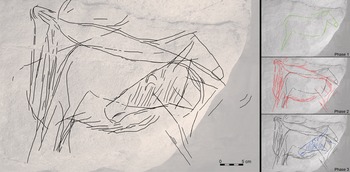
The internal argumentation stems from the only documented superposition of the ensemble (Fig. 6), which shows the following graphic phases:
ALT.V.I.9, ALT.V.I.10, ALT.V.I.11, ALT.V.I.12 and ALT.V.I.13. (A) Tracings of the representations; (B) phases of execution.

Graphic Phase 1
Horse (inventory number ALT.V.I.11 of the Museo Nacional y Centro de Investigación Altamira), characterized by: (a) formal configuration centred on the external contour; (b) rigid character of the contour line; (c) incompleteness of the basic anatomy due to the absence of a front limb; (d) slightly oversized head; (e) minimal reference to the internal anatomical detail (mouth and nostrils); (f) only one limb per pair; and (g) perspective in absolute profile.
Graphic Phase 2
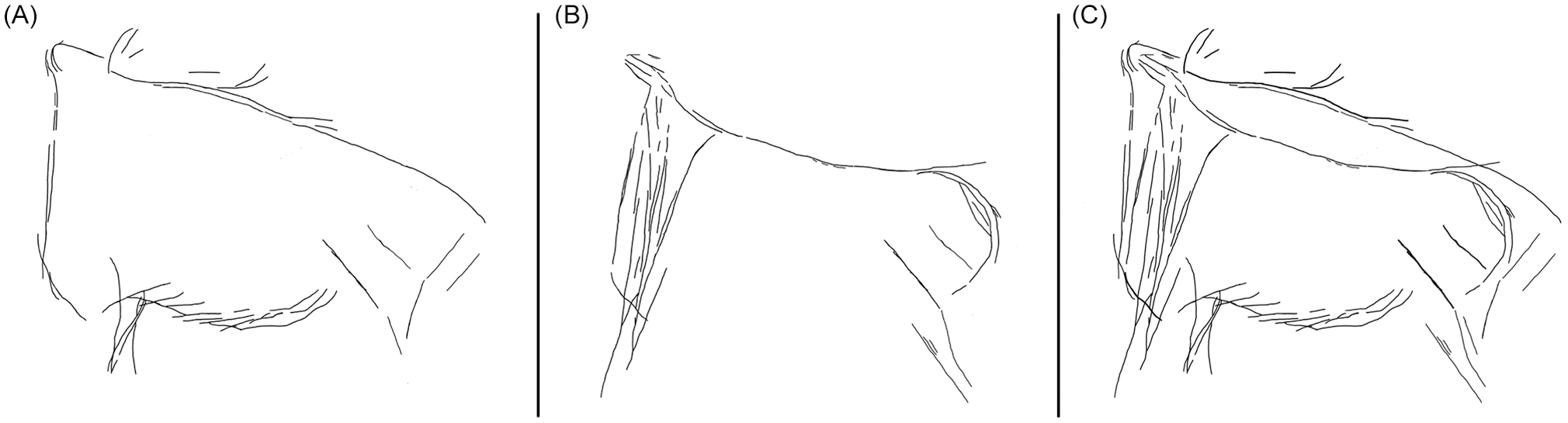
Deer (ALT.V.I.12), characterized by the drawing of two heads, two chests, at least three front limbs and two possible cervical-dorsal lines. These duplications determine several possible readings, but considering the order of superpositions between anatomical regions we believe it most plausible that a disproportionated figure of a deer was initially drawn, its anatomy being subsequently expanded/rectified in order to execute a figure more adjusted to a real representation. The first layout (phase 2.1; Fig. 7A) is characterized by: (a) configuration centred on the external contour; (b) rigid character of the contour; (c) filling of lines with a parallel tendency associated with the lower part of the belly; (d) imbalance in the proportions: the front and central part are bulging, while the back part is more delicate; (e) one limb per pair; and (f) possibly in absolute profile. The second layout (phase 2.2; Fig. 7B) is characterized by: (a) configuration centred on the outer contour; (b) rigidity of the layout of the front and central part, compared to modulation of the back part; (c) filling associated with the chest, lower part of the belly and buttocks by means of parallel lines; (d) unbalanced proportions: small head and delicate hindquarters compared to broad front quarters; and (e) oblique biangular perspective of the front limbs. Comparing both layouts resulting from this process (Fig. 7C), the following considerations can be made: (a) importance of the outline with a greater presence of filling in the second outline; (b) rigidity of the outline in the first layout, which is partially softened later; (c) unbalanced anatomical proportions in both layouts, being more pronounced in the first; and (d) base representation in absolute profile, which in the second is modified to oblique biangular in the limbs.
Phases of creation of ALT.V.I.12. (A) Engraving of a first deer; (B) engraving of a second deer within the inner frame of the previous one; (C) final image.

Graphic Phase 3
Hind (ALT.V.I.10), characterized by: (a) anatomical incompleteness of the head region; (b) presence of internal anatomical detail (eye—duplicated—and mouth); (c) internal filling of the head with parallel lines; and (d) absolute profile.
From this morpho-stylistic analysis of the stratigraphic information, it is possible to elaborate on further internal and external comparisons which can help to establish a chronological sequence for the execution of the graphic ensemble of ALT.V.I:
ALT.V.I.11 (horse) shares some morpho-stylistic characteristics (summary expression of the anatomy based on the contour lines, lack of interior details, angular articulation between anatomical regions, absolute perspective, anatomical disproportion, static appearance and null representation of movement) with ALT.V.21, which have also been identified in the scarce Gravettian portable art record (García-Diez & Ochoa Reference García-Diez, Ochoa, de las Heras, Lasheras, Arrizabalaga and de la Rasilla2013; Ochoa et al. Reference Ochoa, García-Diez, Maíllo, Arrizabalaga and Pettitt2018). Furthermore, taking the Cantabrian area as a reference, where the contextualized figurative portable pre-Magdalenian record is extremely scarce, it is not possible to link these figures to a moment of the Lower to Middle Solutrean due to the absence of animal representations. But among the few later Solutrean examples, a possible horse (or maybe a deer) could be considered, engraved on a block fallen from the wall in El Buxu cave and recovered in a chrono-cultural context of the upper Solutrean (Menéndez & Ocio Reference Menéndez, Ocio, Bueno Ramírez and de Balbín Behrmann1997). For this, the comparison with the Mediterranean area must be focused on the El Parpalló portable record (Villaverde Reference Villaverde1994). Study of its long graphic sequence allows us to consider that the Altamira characters in ALT.V.11 and ALT.V.21 can be traced to the Gravettian, but also to the Lower and even the Middle Solutrean, considering the graphic continuity that occurs between chrono-cultural phases at an internal level. But, although it is not definitory, those graphic elements that are incorporated into the evolutionary dynamics of El Parpalló during the Lower and Middle Solutrean are not recognized in the Altamira figures ALT.V.11 and ALT.V.21. In conclusion, we consider it very plausible that ALT.V.I.11 and ALT.V.21 were executed in a pre-Magdalenian moment, probably not earlier than the middle phases of the Gravettian period. It is difficult to propose a more precise chrono-cultural attribution for these two figures, but it is worth considering as a hypothesis the greater probability that they were produced during the Gravettian, considering the absence of clear comparative references in the Cantabrian area.
ALT.V.I.12 (deer) shares with ALT.V.14 some morpho-stylistic elements (presence of striated filling in neck and ventral region, as well as biangular oblique perspective of the front limbs) which are characteristic of the well-contextualized or even dated engraved scapula from the Lower Magdalenian of Altamira, El Castillo, El Mirón, Rascaño or El Juyo (Almagro Basch Reference Almagro Basch1976; Barandiarán 1972; Reference Barandiarán1994; Corchón Reference Corchón1986; Heras Reference Heras, Gutiérrez Cuenca, Gárate and Boado del Castillo2018) (Fig. 8). Furthermore, ALT.V.12 shows other graphic links (configuration and perspective of the antlers, as well as a slightly elevated position of the head) with ALT.V.17, which are also present in a partial image of a deer from El Castillo recovered in the Lower Magdalenian level (Corchón Reference Corchón1986, 319, fig. 76). For all these reasons, we consider it highly probable that ALT.V.12, ALT.V.14 and ALT.V17 belong to the Cantabrian Lower Magdalenian period (Álvarez-Alonso Reference Álvarez Alonso2007; González Sainz & Urquijo Reference González Sainz, González Urquijo and Fano2004). Currently, the numerical information available confirms that the portable pieces from Altamira and El Castillo used as a reference (which could be extended to El Mirón cave, among others) should be ascribed to a time between 18,262 and 17,060 cal. bp considering the direct dating of portable objects (Heras Reference Heras, Gutiérrez Cuenca, Gárate and Boado del Castillo2018; Valladas et al. Reference Valladas, Cachier and Maurice1992), a range that would be extended to 19,472–18,250 cal. bp considering the dates of all the archaeological levels where they were recovered (González Morales et al. Reference González Morales, Straus and Marín Arroyo2006; Heras et al. Reference Heras, Lasheras, Rasines, Montes, Prada, Muñoz and Clottes2012).
Formal comparison between ALT.V.I.15 (A) and pieces of Lower Magdalenian portable art: El Juyo (B) and Altamira (C).
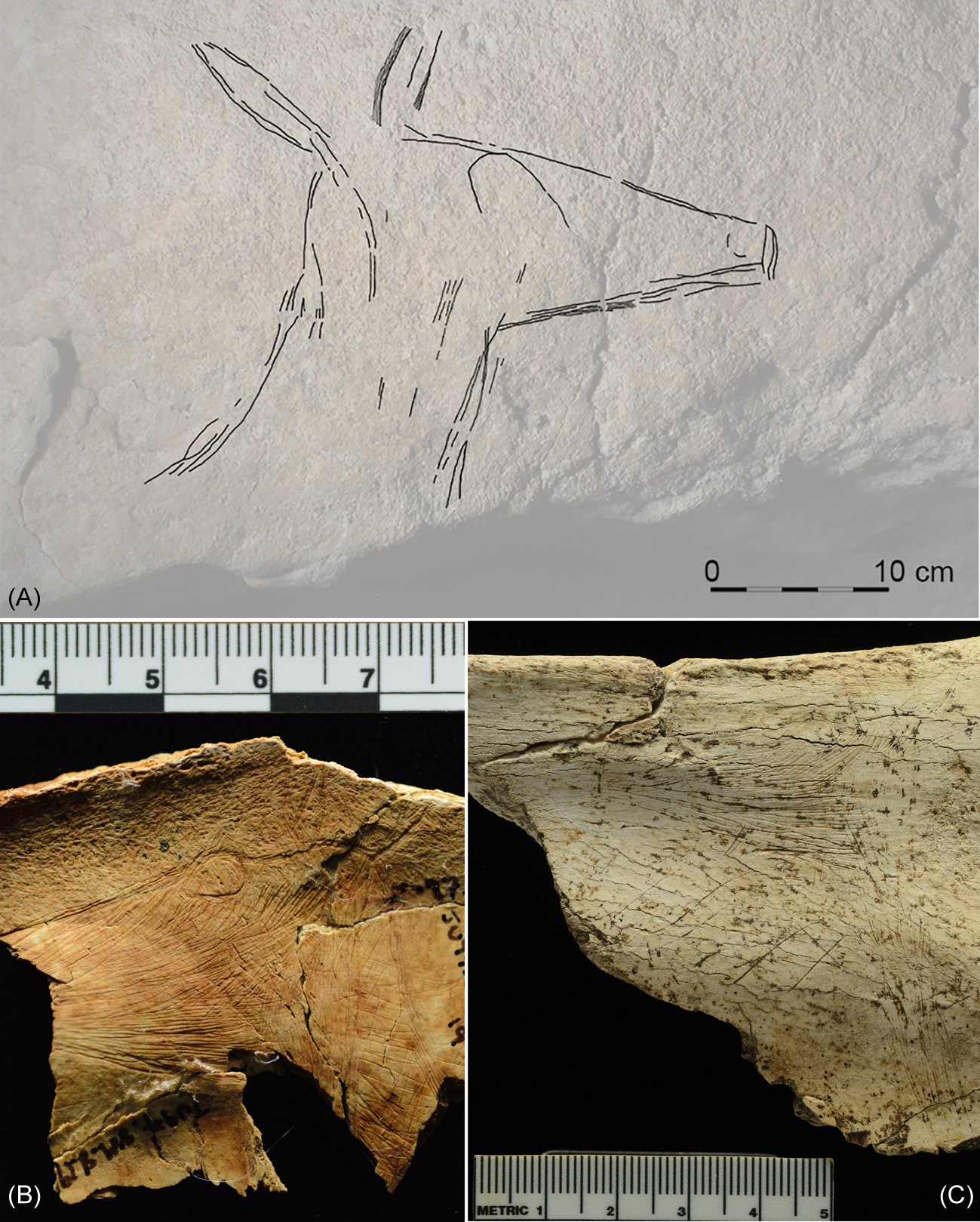
ALT.V.I.10 (hind) shares with other hinds of the ensemble (ALT.V.I.22, ALT.V.I.15, ALT.V.I.20 and ALT.V.I.28) various characteristics such as the anatomical scheme, the trapezoidal morphology of the head, or the internal filling. These features allow us to link these figures, once again, with various portable pieces from Altamira and El Castillo (Corchón Reference Corchón1986) attributed to the Lower Magdalenian.
This means that the figures of ALT.V.I produced during the Lower Magdalenian can be contextualized in two different ‘lines of stylistic comparison’ (one based on the formal characteristics of ALT.V.12, and another based on those of ALT.V.10) which, without being completely independent in morpho-stylistic terms (since they show some shared features, essentially concerning to the internal linear filling), broadly configure two different conceptions of the figuration scheme.
In addition, the ALT.V.I. ensemble contains a small group of black zoomorphic drawings (ALT.V.I.31 (possible horse) and ALT.V.I.33 (deer)) that cannot be numerically dated or related to the parietal stratigraphy, but which allow us to reflect on their chronology based on the external comparison of their morpho-stylistic characteristics. In this sense, both figures share a slight elongation of the neck, whereas ALT.V.I.31 shows a well-defined flat ink filling in the anterior part, together with the fact that the morphology of its hindquarters tends to be slightly pointed. The search for references in the peninsular portable record is not conclusive, but comparison with the Périgord record (Tosello Reference Tosello2003) allows us to recognize similar configurations of the hindquarters in the portable art of the Middle/Upper Magdalenian of Laugerie-Basse, Limeuil or La Madeleine, among others. Without being definitory (due to potential biases in our reading of the images, given their poor state of conservation) features such as elongation of the neck or microcephaly have been identified for final phases of the Magdalenian period in the portable records of the Cantabrian (Ibero et al. Reference Ibero, García-Diez, Ochoa and López-Calle2023), Mediterranean (Domingo & Román Reference Domingo and Roman2020) and interior areas (García-Diez Reference García-Diez and Cacho2013) of the Iberian peninsula. For all these reasons, and even though they are not very diagnostic figures, the images could be preliminarily assigned to a moment between the Middle Magdalenian and the Late Magdalenian.
In conclusion, all this information allows us to propose the following cultural sequence for the execution of the graphic manifestations of ALT.V.I.
First Cultural Phase
The first phase shows a very constrained graphic activity, focused on the engraving of simple line figures with a notable simplification of the anatomical structure. The small number of figures involved (n=2), as well as the obvious morpho-stylistic and technical (medium-width U- and V-shaped grooves) similarities, make it possible to consider that the rock art of this phase could have been produced in a single time of execution, through which the process of symbolization of this space of the cave was inaugurated at some point in the Gravettian, probably in its second half, approximately between 32,500 and 24,500 cal. bp.
Second Cultural Phase
The second phase shows the greatest graphic intensity and includes most of the engravings, as well as some of the non-figurative engraved representations of a linear and geometric type. Regarding the representations of animals, they progressively incorporate a tendency towards anatomical proportion and develop the treatment of animal corporeality through rigid interior fillings. Morpho-stylistic analysis has allowed us to place this phase in the Cantabrian Lower Magdalenian, approximately between 19,500 and 17,000 cal. bp. Study of the graphic process offers some arguments (the aforementioned coexistence of two ‘lines of stylistic comparison’ or the coexistence of figures of technically correct construction with others showing possible rectifications) that allow us to point to a likely intervention of different hands in the construction of the iconographic ensemble of this second phase. In this case we would not have sufficient information to assert synchrony or diachrony between the action of both hands, so we cannot determine with certainty how many times of execution occurred within this cultural phase. The only argument available for this purpose (the existence of overlaps between both actions), although not definitory, would incline us to consider a potential diachrony between both actions. This would imply accepting the existence of at least two times of execution within this cultural phase, although we cannot establish the chronological distance that separates them.
Third Cultural Phase
This phase cannot be asserted with certainty, but its external contextualization opens the possibility to the existence of a symbolic activity of low graphic intensity occurred between the Middle Magdalenian and the final moments of the Upper Palaeolithic, approximately between 16,500 and 12,500 cal. bp. The phase is defined by the black figures on the far left of the wall, spatially segregated from the bulk of the representations executed in previous times and showing a homogeneity in technique, size and compositional position that suggests its probable attribution to a single time of execution, the last one that occurred in this space of the cave.
Our proposal of a long sequence implies a different vision to the one traditionally considered, as it entails figures being added to the large composition that constitutes ALT.V.I throughout different cultural periods.
In this sense, it is possible to recognize the existence of —at least— three execution times separated by millennia and pertaining to different cultural traditions (although, as stated, it is perfectly plausible that there were more, especially during the second cultural phase). This, added to the differences in the spatial structuring of the different phases (localized and concentrated for the time of execution of the Gravettian, extensive and covering for the ones of the lower Magdalenian, and concentrated on the left end for the one of the advanced Magdalenian), suggests that the construction of this symbolic space could have been produced from successive reconfigurations of the compositional space itself, in which different value systems kept on modifying the cultural meaning of the space through the introduction of their own graphic particularities.
The archaeological findings obtained in the context of ALT.V.I also allow us to assess the relationship between graphic activity, graphic space and human presence, which opens the door to discussing the possible times of transit and times of use for this symbolic space.
The chronological information extracted from the dating of the charcoal sample taken at the foot of the engravings, contrasted with the spatial knowledge of its immediate context, allows us to suggest that the person(s) who visited ALT.V.I some 16,395–16,039 cal. bp did so:
-
(a) at a time when the engravings of the Gravettian and Lower Magdalenian phases were already exposed on the wall;
-
(b) at a very close distance to the decorated wall (20 cm);
-
(c) just below the area of greatest concentration of figurative engravings in the entire space, including some of the most visible figures in the area (although we cannot know what the taphonomic conditions of the Gravettian and Lower Magdalenian engravings were c. 16,000 cal. bp, we can be certain that they were equally or better preserved—and hence more or equally visible—than they are today); and
-
(d) burning a piece of wood that experimental studies assume might have had a potential lighting function.
All of this allows us to determine, with a high degree of certainty, that at 16,395–16,039 cal. bp there was an event of visualization of the Gravettian and Lower Magdalenian rock art of ALT.V.I. However, the nature (symbolic or not) of this event remains to be determined, as well as its potential link with other times or moments of the cave. In this sense, the result of the radiocarbon date obtained cannot be linked to the phases of graphic activity proposed with greater certainty (Gravettian and Lower Magdalenian) but leaves open the possibility of its attribution to the time of execution of the zoomorphic black figures, if the chrono-cultural attribution proposed earlier is accepted. Taking this into account, two hypotheses can be put forward:
-
(a) That the date from the charcoal is linked to the last phase of graphic activity in this space (Third Cultural Phase), its presence being the incidental result of other symbolic human actions corresponding to the last time of execution in ALT.V.I.
-
(b) That the date from the charcoal is not linked to any moment of graphic activity, corresponding therefore either to a time of transit or a time of use of the pre-existing rock art of ALT.V.I.
The main argument in favour of the first option is the dating of the carbon fraction of another Magdalenian black figure in the Polychrome Ceiling (Bison XLIV; 13,570±190 bp and 14,410±200 bp, GifA-96067 and GifA-91249: Valladas et al. Reference Valladas, Cachier and Maurice1992; 13,130±120 bp, GifA-96067: Moure et al. Reference Moure, González Sainz, Bernaldo de Quirós, Cabrera Valdés and Moure1996). The calibrated lapse for the execution of this figure (between 18,149 and 15,350 cal. bp, or 16,990–15,350 cal. bp if the humic fraction is not considered) overlaps with the one obtained for our charcoal (16,395–16,039 cal. bp), which indicates that at this moment there was a time of execution within the process of symbolization of the cave to which the zoomorphic black paintings of ALT.V.I. could potentially be linked. This would imply accepting that the charcoal of ALT.V.I would be contextual evidence of the graphic intervention carried out in this time of execution, an intervention that would have been extensive as it would have encompassed separated topographic areas of the cave. Likewise, this would mean that the person(s) who painted both the black bison on the Polychrome Ceiling and the zoomorphic paintings of ALT.V.I. observed the Gravettian and Lower Magdalenian engravings of ALT.V.I and decided not to act on them graphically, in this area renouncing superposition or close juxtaposition between figures (something they did not do, however, on the Polychrome Ceiling), and preferring to expand the composition by adding new figures on an adjacent surface of the compositional space (about 7 m from the nearest engraving).
On the contrary, the arguments in favour of the second option are the large distance (about 16 m) between the location of the charcoal and the nearest black figure of ALT.V.I, as well as the notable divergences in the anatomical construction of the black bison dated in the Polychrome Ceiling (proportionate and showing plenty of anatomical details) and that of the zoomorphic black figures of ALT.V.I. (disproportionate and with a summary configuration), which make it difficult to maintain, under morpho-stylistic criteria, that they could belong to the same time of execution. If this second alternative were accepted, it would be worth reflecting on the topographic conditions of the sector in order to discuss further the symbolic or non-symbolic nature of the activity that resulted in the abandonment of this charcoal (that is, whether its appearance corresponds to a time of transit or a time of use of ALT.V.I.). Unfortunately, due to the reconditioning activities carried out in the cave at the beginning of the twentieth century, we do not have exhaustive knowledge of the original topographic conditions of this sector of the cave of Altamira. Thus, we cannot accurately determine whether the engravings were in a favourable area for transit (which would be an argument supportive of considering the charcoal as a residual evidence of a time of transit) or in a unfavourable area for transit (which would be an argument in favour of considering the charcoal as the result of a voluntary approximation to the engraved wall from a time of use, that is, an event of active and symbolic perception of the pre-existing images). In this sense, the only possible archaeological argument is the absence of torch marks on the walls and ceiling of this area (which are rather frequent in other areas of the cave which are favourable for transit), which might imply that transit was not very frequent in this area, thus reinforcing the hypothesis that the charcoal could potentially belong to a time of use in which this space in Altamira was explicitly visited with the purpose of observing the images captured millennia earlier on its walls, thus giving them a new meaning, intrinsic to the observing culture, which has been lost to us today.
At the moment, we cannot decide on one option or the other due to the lack of new information. In any case, regardless of the alternative that is favoured, all the information summed up here (Table 2) suggests that human presence in cave spaces could have resulted in the visualization of pre-existing graphic devices without subsequent graphic intervention directly associated with them. This invites reconsideration of the traditional research strategy directly associating the results of dating contextual archaeological evidence with the age of cave art, and points instead to the need of taking into consideration the role played by perception in the use and/or expansion of the iconographic content of caves.
Summary of the symbolization processes and times identified in ALT.V.I.

Conclusion
The study of cave art and the archaeological context related to human presence in caves allows us to understand the potential use given to Palaeolithic rock art over the millennia. This involves dating archaeological evidence as precisely as possible, as well as contextualizing it spatially, in order to assess fully the potential synchronicities or diachronies between different archaeological phenomena. This makes it possible to identify times of use of cave art that are not necessarily linked to iconographic creation, thereby helping to improve our understanding of the complex processes that transformed caves into symbolic spaces.
The study of a specific topographic area of the cave of Altamira has shown that numerically reduced figurative graphic ensembles can also be the result of repeated and non-continuous graphic actions, carried out by different cultural traditions of the Upper Palaeolithic (second half of the Gravettian, 32,500–24,500 cal. bp; Lower Magdalenian, 19,500–17,000 cal. bp; and the Middle or Late Upper Magdalenian, 16,500–12,500 cal. bp). For its part, the execution of panels with superimposed figures constructed over a long period of time demonstrates the timeless value of cave art. In this sense, our study has shown archaeologically that graphic motifs created at a first time of execution were observed thousands of years later. However, this later observation could subsequently be followed by different behavioural scenarios, as the observed images could either be compositionally incorporated in a new time of execution, or simply perceived and re-signified in a later time of use. Accordingly, the temporal relationship established between the execution of the cave art and the subsequent human presence in the decorated space has served us to reaffirm the timeless value of these images for the Palaeolithic communities, and suggests that both graphic action and perception participated in the constant processes of reappropriation of the images/symbols captured on the walls, both being fundamental (and, at times, complementary) tools for the transformation of caves into symbolic spaces endowed with an ever-changing cultural meaning.
Although the results of this article represent only a small sample from a specific area of a single cave, they constitute a call for attention about the need to reflect on the importance that other archaeologically ‘passive’ behaviours might have had in the configuration of Palaeolithic caves as symbolic spaces. Furthermore, all this emphasizes the importance of the cave of Altamira as a symbolic space in the mentality and idiosyncrasy of very different human groups throughout the Upper Palaeolithic, and invites us to continue studying the cultural mechanisms that served to sustain the same cultural practices in the same spaces for thousands and thousands of years.
Acknowledgements
This work is part of the project Un presente eterno: la atemporalidad del arte rupestre paleolítico (PID2020-115347GBI00), funded by the Ministry of Science and Research of the Government of Spain. It has also had the support of the Fundación Atapuerca. The work of Álvaro Ibero has been funded by a FPU Predoctoral Grant (ref. 21/02699) by the Ministry of Universities of the Government of Spain. Blanca Ochoa is the beneficiary of a Juan de la Cierva-incorporación Grant (IJC2020-044629-I) funded by MCIN/AEI/10.13039/501100011033 and by the European Union NextGenerationEU/PRTR.





 Open access

