


Introduction
In recent years, several incidents have drawn attention to the role of state security forces, including the police and military, in far-right violence. Key examples include the storming of the U.S. Capitol on January 6, 2021, by Trump supporters (Villamil et al., Reference Villamil, Turnbull-Dugarte and Rama2024), and the attack on political institutions in Brasília on January 8, 2023, by Bolsonaro supporters (Brito, Reference Brito2024). The involvement of security forces in such events is particularly concerning given their monopoly on legitimate violence. If their association with far-right ideologies is confirmed, it raises serious concerns about the anti-democratic tendencies of these occupational groups. This alignment could lead to the imposition of an order that aligns with the interests of the security forces (Lipset, Reference Lipset1972), often at the expense of vulnerable populations.
We define far-right parties following Mudde’s (Reference Mudde2007) framework, which characterizes them as both nativist and authoritarian. Nativism is the belief that the state should be exclusively inhabited by members of the native group, viewing non-native elements as inherently threatening to the homogenous nation-state. Authoritarianism refers to a preference for a strictly ordered society in which violations of authority are harshly punished. While party systems vary across national contexts, we apply the far-right label to parties that consistently promote these core ideological features. Our categorization emphasizes broadly shared ideological profiles over country-specific variation in policy positions or differences in organizational form, in line with a comparative approach focused on cross-national patterns of far-right support.
Our analysis focuses on security forces, encompassing both police and military personnel. While the police are primarily responsible for domestic law enforcement and everyday interaction with citizens, the military has traditionally been oriented toward external defense and national sovereignty. Despite these differences in function and culture, growing overlap in tasks such as counter-terrorism and border control makes it increasingly reasonable to examine them together as security forces in the European context (Herschinger et al., Reference Herschinger, Jachtenfuchs and Kraft-Kasack2011).Footnote 1
Although security forces are traditionally considered apolitical (Reiner, Reference Reiner2000), it is important to remember, for instance, that they have historically played a role in maintaining order during 20th-century Western European dictatorships. These groups share certain authoritarian and nationalist values commonly associated with far-right ideologies, and far-right parties are also perceived as staunch defenders of security forces, particularly in the context of controversies related to violence or racism. Therefore, this apparent alignment warrants further investigation.
Using data from the European Social Survey, this research note demonstrates that, contrary to our expectations, security forces do not disproportionately support far-right parties compared to the general electorate. Looking at predictors of far-right support, we also find that their support is driven by anti-immigration attitudes—a topic amplified by far-right parties, especially during the so-called refugee crisis in Europe.Footnote 2
This research note contributes to the literature by deepening the understanding of the relationship between security forces and far-right parties, particularly by expanding beyond single-case studies (Papanicolaou and Papageorgiou, Reference Papanicolaou and Papageorgiou2016; Villamil et al., Reference Villamil, Turnbull-Dugarte and Rama2024) to a broader European context. Furthermore, by pitting immigration attitudes against authoritarian and law-and-order preferences, it challenges prevailing assumptions about the drivers of far-right support among security forces.
The remainder of this research note is organized in five sections: The first presents the theoretical framework, examining the main explanations for far-right support among the general electorate and among security forces. The methodology section describes the data, variables, and models used. The results section presents our findings. The discussion section interprets the findings and embeds them in the broader literature. We conclude by examining the broader implications of our results and highlighting limitations and further avenues for research.
Theoretical framework
The fourth wave of far-right parties and the immigration threat
As Mudde (Reference Mudde2019) explains, although far-right parties have traditionally remained on the periphery of the political establishment, the first significant wave of far-right politics in Western Europe began in the 1980s, driven by unemployment and mass immigration. This wave also included various post-communist parties following the collapse of the Berlin Wall. It was not until the new millennium that far-right parties became more mainstream, expanding to a broader range of countries. The so-called fourth wave, however, was catalyzed by three major crises: the terrorist attacks of September 11, 2001, the global recession of 2008, and the refugee crisis of 2015. This wave gained prominence due to increasing support for far-right parties and their extension to countries where they had previously been less influential (Heyne and Manucci, Reference Heyne and Manucci2021). Currently, far-right parties are entering governments in a variety of ways, with the new wave marked by its Islamophobic rhetoric and populist protests. These elements have increasingly dominated the political agenda, resulting in the introduction of more stringent immigration policies. According to Mudde (Reference Mudde and Rydgren2022), the refugee crisis significantly reshaped European politics by framing non-European immigration and multiculturalism as perceived threats to European identity and security.
Immigration attitudes are, therefore, key in predicting far-right voting, with several theories explaining this link. Social identity theory suggests perceived threats to national identity heighten in-group/out-group divisions, pushing support for parties that protect cultural homogeneity (Turner et al., Reference Turner, Brown and Tajfel1979). Economic competition theories propose that those who see immigrants as job or welfare competitors are more likely to back far-right agendas (Dancygier & Donelly, Reference Dancygier and Donnelly2013; Scheve and Slaughter, Reference Scheve and Slaughter2001). Recent research highlights the continued importance of both cultural and economic concerns (Halikiopoulou and Vlandas, Reference Halikiopoulou and Vlandas2020). Issue salience theory argues that when elites and media emphasize immigration, anti-immigrant sentiments are triggered, boosting far-right support (Bélanger and Meguid, Reference Bélanger and Meguid2008). Additionally, broader societal trends, like unemployment and immigration rates, can influence the salience of the issue (Dennison and Kriesi, Reference Dennison and Kriesi2023).
The ideological affinity between far-right parties and security forces
If attitudes toward immigrants seem to play a central role in explaining overall electoral support for the far-right parties, other factors appear to take precedence when focusing specifically on the professional group of security forces. The literature on security forces shows that there is a historical affinity between the police and far-right support. This was the case in the United States in the 1930s and 1940s, when police officers were among the primary sources of support for the Ku Klux Klan (Lipset, Reference Lipset1972). This connection was also evident in the early 1970s during periods of racial unrest (Lipset, Reference Lipset1972). While Lipset acknowledged that far-right sympathies among police were limited to a minority, recent studies of European security forces suggest that such support may be more widespread, and even if it remains a minority, it can complicate civil-military relations (Villamil et al., Reference Villamil, Turnbull-Dugarte and Rama2024).
Lubbers and Scheepers (Reference Lubbers and Scheepers2002), for instance, show that police and military personnel in France were particularly supportive of the far-right Front National, noting that security forces’ desire for respect and obedience likely pushed them toward supporting Le Pen’s party. Papanicolaou and Papageorgiou (Reference Papanicolaou and Papageorgiou2016), in turn, demonstrate that far-right support in Greece was particularly strong among the police. Their study found that the police in Athens’ large units had extensive ties with the far-right party Golden Dawn. In the 2012 elections, the party secured the fifth-most votes, but the analysis of returns from special electoral rolls for law enforcement revealed a significantly higher share of votes for far-right parties, particularly Golden Dawn, compared to regular polling stations (Papanicolaou and Papageorgiou, Reference Papanicolaou and Papageorgiou2016).
Research specifically on the relationship between the military and far-right politics is rare, but a Spanish study warrants our attention. Villamil et al. (Reference Villamil, Turnbull-Dugarte and Rama2024) argue that military personnel in Spain represent a group with clear ideological affinities that make them a key source of far-right electoral support. Based on data from a large national dataset and census tracts, the authors confirmed that military personnel were significantly more likely to support the far-right party VOX, and that the location of military facilities was linked to increased local support for this populist radical right-wing party (Villamil et al., Reference Villamil, Turnbull-Dugarte and Rama2024).
In summary, country-level case studies posit that security forces share the authoritarian and nationalist values that are central to far-right ideologies. Their training and work, which often involve enforcing law and order, position them as key actors in national security, reinforcing the authoritarian traits they bring from their social background (Lipset, Reference Lipset1972). Although conditions vary over time and across countries, security forces generally have lower socio-economic status and face challenging working conditions. These factors, combined with the need to enforce laws while risking their lives, contribute to what Lipset (Reference Lipset1972) describes as feelings of resentment against society, which may push security forces toward parties that reject the established political order.
Methodology
Aiming to explore the drivers of far-right support among security forces, we draw on rounds 1 (2002/3) to 9 (2018/19) of the European Social Survey (ESS).Footnote 3 With this approach we are able to reach a sample of 2,167 respondents who are employed in the police (N = 1,398) or the military (N = 769) and who have voted in their national elections. Of those, 188 have voted for a far-right party at any given time in the study period.Footnote 4 In the analysis, we collapse police and military into a joint security forces indicator and assess differernces in attitudes and voting behavior relative to the general pool of voters (N = 207,926). We also perform and show analyses conducted within the police and military subcategories.
To determine if a respondent supports a far-right party, we combine information from the ESS on their self-reported vote choice in the last national election with the PopuList database (Rooduijn et al., Reference Rooduijn2023), which records for most major parties in Europe whether they are far-right (populist) based on expert judgements. In conceptualising far-right parties, PopuList follows Mudde’s (Reference Mudde2007) definition discussed above. As a result, far-right vote choice is a binary indicator that equals one if a respondent has voted for a far-right party in the last national election. Given the dichotomous nature of our dependent variable, we opt for logistic regression models in our analysis.
To proxy law-and-order preferences and authoritarian attitudes more generally, we use three items from the ESS that have been employed in previous research as indicators for those concepts (Gaubinger, Reference Gaubinger2020). For all three items, respondents are asked to indicate on a scale from 1 (“not like me at all”) to 6 (“very much like me”) how much a hypothetical person who supports a given statement resembles them. The three statements are: “Important that government is strong and ensures safety”; “Important to do what is told and to follow rules”; and “Important to follow traditions and customs”. Since the Cronbach’s alpha for the three items is relatively low (.54), we consider them separately in the analysis.
We measure immigration attitudes using a standardized index comprising six recurring items across survey rounds, achieving a high level of internal consistency (Cronbach’s alpha = .88). For all items, higher values indicate more negative attitudes toward immigration. The included items, which cover different dimensions of immigration attitudes, are as follows: “Immigration good or bad for country’s economy?” (scale: 0–10); “Country’s cultural life enriched or undermined by immigrants?” (0–10); “Immigrants make country a better or worse place to live?” (0–10); “Allow many/few immigrants of the same race/ethnic group as majority?” (scale: 1–4); “Allow many/few immigrants of different race/ethnic group as majority?” (1–4); “Allow many/few immigrants from poorer countries outside Europe?” (1–4).
To assess if the relationship between attitudes and far-right voting is robust, we include a series of potential confounders as control variables. First, we control for self-placement on a general left-right scale. Second, given the time-series cross-national nature of our sample, we add country and survey-round fixed effects. Finally, we account for potential socio-demographic differences, particularly gender, age (operationalized as a categorical variable), and a four-level categorical variable for educational attainment (levels: no secondary education; lower secondary; upper secondary; post-secondary).
Results
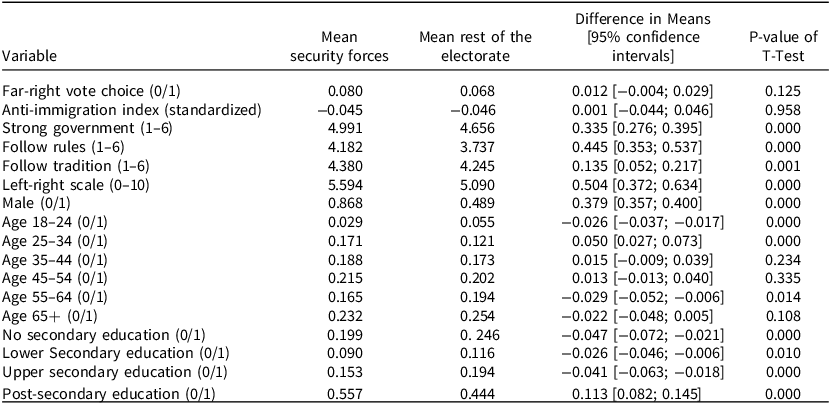
We begin by assessing differences between security forces and the general electorate on our key variables of interest. To this end, Table 1 displays the mean value on those variables among the two groups, the difference between the means along with 95 percent confidence intervals, as well as the p-value of t-tests formally comparing the difference in means between the groups. We applied weights (population weight multiplied by the design weight) before estimating means.
Means of variables and p-value of t-test of difference in means

Table 1 Long description
A table comparing means of variables and p-values of t-tests between security forces and the electorate. The table has 19 rows and 5 columns. The columns are labeled Variable, Mean security forces, Mean rest of the electorate, Difference in Means [95% confidence intervals], and P-value of T-Test. Row 1: Far-right vote choice (0/1), 0.080, 0.068, 0.012 [-0.004; 0.029], 0.125. Row 2: Anti-immigration index (standardized), -0.045, -0.046, 0.001 [-0.044; 0.046], 0.958. Row 3: Strong government (1-6), 4.991, 4.656, 0.335 [0.276; 0.395], 0.000. Row 4: Follow rules (1-6), 4.182, 3.737, 0.445 [0.353; 0.537], 0.000. Row 5: Follow tradition (1-6), 4.380, 4.245, 0.135 [0.052; 0.217], 0.001. Row 6: Left-right scale (0-10), 5.594, 5.090, 0.504 [0.372; 0.634], 0.000. Row 7: Male (0/1), 0.868, 0.489, 0.379 [0.357; 0.400], 0.000. Row 8: Age 18-24 (0/1), 0.029, 0.055, -0.026 [-0.037; -0.017], 0.000. Row 9: Age 25-34 (0/1), 0.171, 0.121, 0.050 [0.027; 0.073], 0.000. Row 10: Age 35-44 (0/1), 0.188, 0.173, 0.015 [-0.009; 0.039], 0.234. Row 11: Age 45-54 (0/1), 0.215, 0.202, 0.013 [-0.013; 0.040], 0.335. Row 12: Age 55-64 (0/1), 0.165, 0.194, -0.029 [-0.052; -0.006], 0.014. Row 13: Age 65+ (0/1), 0.232, 0.254, -0.022 [-0.048; 0.005], 0.108. Row 14: No secondary education (0/1), 0.199, 0.246, -0.047 [-0.072; -0.021], 0.000. Row 15: Lower Secondary education (0/1), 0.090, 0.116, -0.026 [-0.046; -0.006], 0.010. Row 16: Upper secondary education (0/1), 0.153, 0.194, -0.041 [-0.063; -0.018], 0.000. Row 17: Post-secondary education (0/1), 0.557, 0.444, 0.113 [0.082; 0.145], 0.000.
Note: The combined weight (population weight*design weight) was applied to the data before calculating the means.
Source: ESS rounds 1–9.
The first and most important insight from Table 1 is that security forces across Europe are not significantly more likely to vote for a far-right party than the rest of the electorate. While the probability of choosing a far-right party among security forces equals eight percent, it is only slightly lower among the average voter (6.8%), and the t-test reveals no statistically significant difference between the groups. We also do not find a significant difference between the two groups on their immigration attitudes. In contrast, security forces are significantly more likely to prefer a strong government that ensures safety, more likely to agree that it is important to follow rules and tradition, and position themselves more on the right than the rest of the electorate. Socio-demographically, those in the security forces are overwhelmingly male, more likely to be between the ages of 25 and 34, less likely to have an upper secondary degree, and more likely to have a post-secondary education relative to the rest of the electorate.
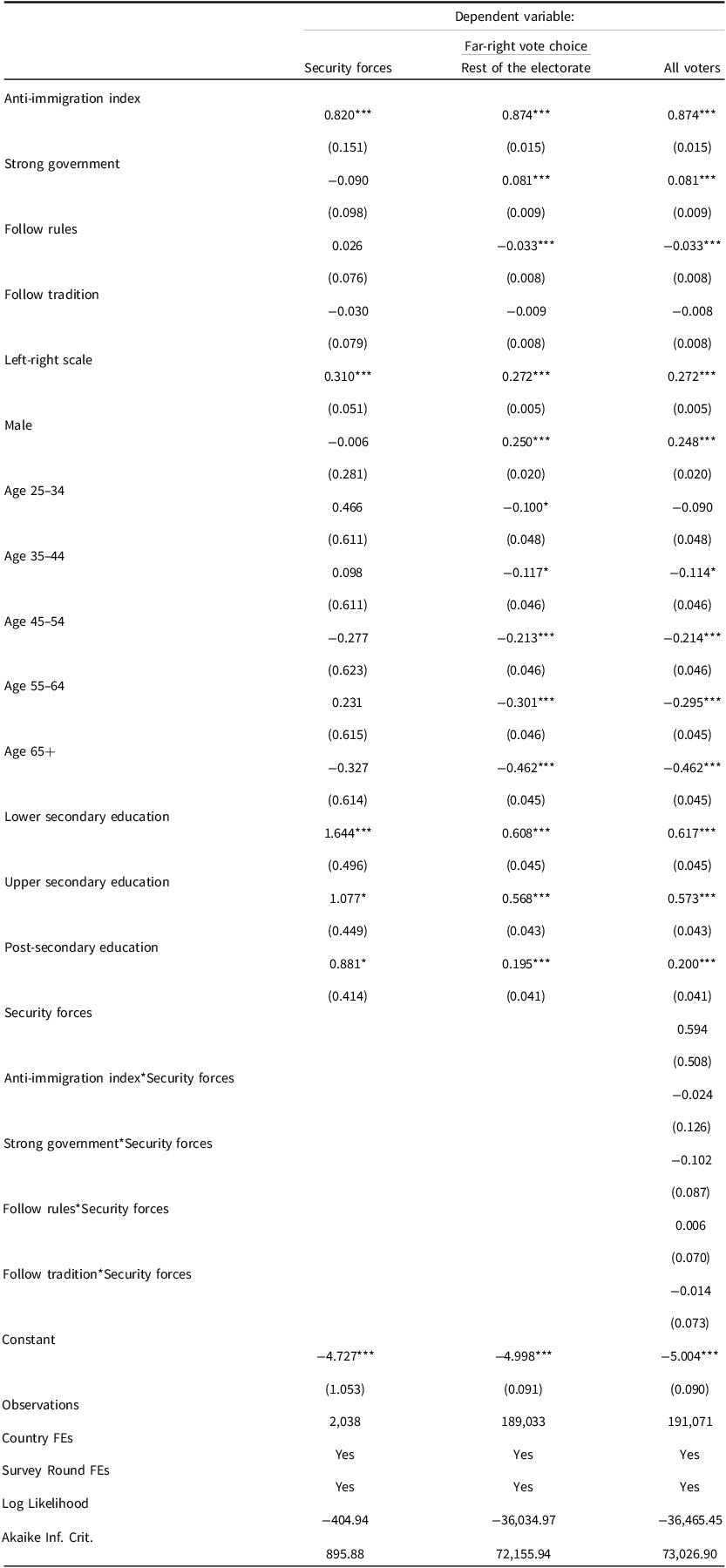
Having established the attitudinal and socio-demographic profile of the security forces relative to the rest of the electorate, we now explore the predictors of far-right vote choice among these two groups. Focusing first on the security forces subsample, the first model in Table 2 shows logistic regression model coefficients with standard errors in parentheses.Footnote 5
Predictors of far-right voting among security forces and the rest of the electorate

Table 2 Long description
A table with 21 rows and 11 columns comparing predictors of far-right voting among security forces and the rest of the electorate. The columns are labeled as follows: Dependent variable, Security forces, Rest of the electorate, All voters. The rows are labeled with various predictors such as Anti-immigration index, Strong government, Follow rules, Follow tradition, Left-right scale, Male, Age 25-34, Age 35-44, Age 45-54, Age 55-64, Age 65+, Lower secondary education, Upper secondary education, Post-secondary education, Security forces, Anti-immigration index*Security forces, Strong government*Security forces, Follow rules*Security forces, Follow tradition*Security forces, Constant. Each cell contains coefficients with standard errors in parentheses. The table also includes observations, Country FEs, Survey Round FEs, Log Likelihood, and Akaike Inf. Crit. at the bottom.
Note: *p < 0.05; ***p < 0.001. Logistic regression models with standard errors in parentheses. “Age 18–24” and “No secondary education” serve as reference categories. The slightly reduced number of observations relative to the full sample size indicated in the text is due to missing values in the independent variables.
Source: ESS rounds 1–9.
Our key finding is that anti-immigration sentiment is a strong predictor of far-right voting among members of the security forces. The anti-immigration attitudes index is highly statistically significant (p < .001). In contrast, neither law-and-order preferences—such as support for a strong government that ensures public safety—nor broader authoritarian values (e.g., emphasis on rule-following and tradition) are significant predictors of far-right vote choice in this group. As expected, identifying as more right-leaning on the left-right scale is positively associated with support for far-right parties among police and military personnel. Regarding socio-demographic factors, individuals with intermediate levels of education are the most likely to express far-right sympathies. Gender and age, however, show no significant correlation with far-right voting within the security forces.
In the second column in Table 2, we present a similar model, this time focusing on ESS respondents who are not employed in the police or military. As in the previous analysis, anti-immigration attitudes remain a strong predictor of far-right voting. However, in this broader population, a preference for law and order (i.e., support for a strong government that ensures public safety) is also positively associated with voting for a far-right party. While there is a significant relationship between the support for following rules and voting for a far-right party, the coefficient is negative, which is contrary to our theoretical expectations. Finally, the regression model also suggests that placing oneself more on the right on the ideological spectrum, being male, younger, and having an intermediate education increases the odds of choosing a far-right party among the general electorate.
Finally, in column 3 we show a model utilizing the entire sample and interacting our key attitudinal variables with an indicator for being occupied in the security forces. We do not observe that the predictive effect of law-and-order preferences or broader authoritarian attitudes significantly varies between security forces and the rest of the electorate. Neither do we find an interaction effect for immigration attitudes. Overall, having an anti-immigrant stance emerges as the main predictor of far-right voting, both among security forces and the broader electorate.
The logistic regression coefficients reported in Table 2 are informative about the direction and statistical significance of each predictor but are difficult to interpret in terms of substantive effect size. In addition, one might be concerned that combining police and military into a single ‘security forces’ category might mask significant variation between the two occupational groups. To address these issues, Figure 1 presents average marginal effects (AMEs) for our attitudinal predictors, based on models estimated separately among military personnel, police officers, and the combined security forces sample, with demographic controls and country fixed effects. AMEs represent the average change in the predicted probability of far-right voting associated with a one-unit increase in each predictor, allowing for a more intuitive comparison of effect magnitude across variables and subsamples.
Average marginal effects of attitudinal predictors on far-right vote choice among security forces.
Note: The figure displays average marginal effects based on logistic regression models with 95% confidence intervals. The estimates are based on three separate models that used the respective subsamples listed in the figure legend. All models include gender, age, education, and fixed effects for country and survey round as control variables.
Source: ESS, rounds 1–9.

The figure confirms that anti-immigration attitudes are by far the strongest predictor of far-right vote choice across all three groups, with AMEs of 0.048 (combined), 0.044 (police), and 0.056 (military). Thus, a one-unit increase on the anti-immigration index increases the probability of choosing a far-right party by around five percentage points for members of the security forces. Given that the mean probability of indicating a far-right vote is eight percent among security forces (police: 8.3%; military: 7.5%), these AMEs seem substantivaly meaningful. In contrast, ideological self-placement on the left-right scale has a smaller but still significant association with far-right voting, with AMEs around 0.017–0.02. The effects of law-and-order preferences, rule-following, and traditional values are close to zero and not statistically significant, suggesting that law-and-order preferences or broader authoritarian attitudes do not meaningfully drive far-right voting within security institutions. Importantly, the patterns are highly consistent across the police and military subsamples, indicating that the political drivers of far-right support are similar across both branches of the security forces.
Discussion
With the rise of the far-right and some salient violent cases, analyzing the relationship between far-right parties and the security forces has become particularly important, considering the anti-democratic nature of these parties and the monopoly on violence held by security forces. We recall that in this study, the term ‘security forces’ is operationalised to encompass specific occupational categories. For the police, this includes inspectors, detectives, customs and border officers, police officers, and prison guards; for the military, it comprises commissioned and non-commissioned personnel, as well as other armed forces roles.
The scarce literature on the relationship between far-right parties and security forces has documented cross-national variation—for example, in Spain, France and Greece—suggesting that country-level heterogeneity and temporal dynamics may exist.Footnote 6 Overall, however, it highlights the shared values of authority and law and order. According to these studies, these values, defended by far-right parties and inherent to the professional socialization of security forces, underpin the electoral support of security forces for the far right (Lubbers and Scheepers, Reference Lubbers and Scheepers2002; Papanicolaou and Papageorgiou, Reference Papanicolaou and Papageorgiou2016; Villamil et al., Reference Villamil, Turnbull-Dugarte and Rama2024).
However, our study shows that, contrary to expectations based on the academic literature, security forces across Europe are not significantly more likely to vote for a far-right party than the rest of the electorate (cf. Table 1). A potential explanation for this somewhat surprising result might lay in the fact that we also do not find a significant difference between the two groups on their immigration attitudes, which the literature and our analyses have shown to be key predictors of far-right voting. However, in line with standard explanations of police and military political behavior, we do find that security forces are significantly more likely to prefer a strong government that ensures safety, more likely to agree that it is important to follow rules and tradition, and position themselves more on the right than the rest of the electorate.
Our central finding is that aversion to immigration turns out to be the key predictor of far-right voting among security forces. The anti-immigration attitudes index is highly statistically significant and strongly predictive of a far-right vote. In contrast, neither law-and-order preferences nor broader authoritarian attitudes predict far-right vote choice among security forces. It appears that they do not matter as much for far-right voting as previously assumed. Turning to socio-demographics, we find that having intermediate levels of education is most strongly associated with far-right sympathies among security forces, which aligns with findings from the broader literature on the determinants of far-right voting (Bornschier et al., Reference Bornschier2021). Neither gender nor age are correlated with a far-right vote among security forces.
Finally, our models also suggest that preferring a strong government ensuring safety, being more on the right of the political spectrum, being male, younger, and having an intermediate education increases the odds of choosing a far-right party among the general electorate, which is mostly in line with the literature on far-right voting (Abou-Chadi, Reference Abou-Chadi2024; Bornschier et al., Reference Bornschier2021; Mudde, Reference Mudde2007). Most importantly, an anti-immigrant view emerges as the main predictor of a far-right vote choice, both among security forces and the broader electorate.
Conclusion
This research note challenges existing literature by making two main contributions: first, it shows that security forces do not vote for far-right parties at higher rates than the general population; second, attitudes toward immigration are the strongest predictor of far-right voting for both security forces and the general electorate.
These findings, from our perspective, have clear implications, both for the academic literature and for society. Future research should investigate the relevance of historical nostalgia in explaining far-right voting on some segments of the electorate. This is particularly pertinent when considering that national case studies on security forces voting for far-right parties, which emphasize law-and-order values, appear to be closely linked to the legacy of military dictatorships in the 20th century, meaning Spain and Greece in particular (Papanicolaou and Papageorgiou, Reference Papanicolaou and Papageorgiou2016; Villamil et al., Reference Villamil, Turnbull-Dugarte and Rama2024).
While targeted training on bias and anti-discrimination may help mitigate exclusionary attitudes, existing evidence—particularly for frontline police—is mixed and inconclusive (e.g., Lai and Lisnek, Reference Lai and Lisnek2023). Given their direct engagement in immigration-related tasks such as border control, counter-terrorism, and human trafficking, security forces may develop or reinforce perceptions of immigration as a threat to social order. Their strong attachment to national identity and sovereignty can also make them more receptive to far-right narratives framing immigration as a risk to national cohesion, amplifying in-group versus out-group dynamics. As such, the convergence between security forces and far-right parties may be more than conjunctural, potentially rooted in deeper institutional logics and enduring political orientations that warrant further investigation. Additionally, our findings suggest that far-right sympathies stemming from anti-immigration attitudes within security forces may translate into discriminatory practices against immigrant and minority communities, undermining the principle of equal protection under the law. This not only exacerbates social marginalisation of immigrants and erodes trust in law enforcement but also poses risks to the legitimacy and democratic integrity of institutions tasked with enforcing state authority.
Our research has several limitations. The first of these relates to the European Social Survey (ESS) data. Despite considering several countries over a period of 17 years and across nine rounds, survey responses may be prone to social desirability bias, which is especially relevant when examining politically sensitive behavior, such as far-right-voting, among police and military personnel. Therefore, survey responses may not fully reflect actual voting behavior. Cross-validating our findings with those of other national surveys, using selection models, or calibration against electoral results could help address this concern. Second, because the analysis is based on observational, cross-sectional data, it identifies correlations rather than causal effects. Accordingly, potential sources of endogeneity should be considered when interpreting the results, and future work should attempt to corroborate our findings in a more causal setting. Finally, while the ESS allows us to maximize the sample size of security forces, the measures we use to proxy authoritarian attitudes only captures specific dimensions such as law-and-order preferences. While these items remain theoretically defensible as proxies for authoritarian tendencies, given their use in prior ESS-based research on political attitudes and far-right voting (Gaubinger, Reference Gaubinger2020), validated scales from political psychology, such as right-wing authoritarianism (RWA) (Altemayer, Reference Altemeyer1996) and social dominance orientation (SDO) (Pratto et al., Reference Pratto1994), would allow researchers to measure authoritarian predispositons more broadly. Future scholarship should consider incorporating these measures while ensuring a large enough sample size.
Supplementary material
The supplementary material for this article can be found at https://doi.org/10.1017/S1755773926100332.
Data availability statement
The data that support the findings of this study are available from the corresponding author, Jeyhun Alizade, upon reasonable request.
Acknowledgements
We thank Irene Pañeda Fernandez for helpful suggestions, and Gayatri Shejwal for excellent research assistance.
Funding statement
This work benefited from the funding of projet DIRESOC - VS/2018/0021/VP 2017/004. The open access publication was funded by the WZB Berlin Social Science Center.
Competing interests
The authors declare none.


 Open access

