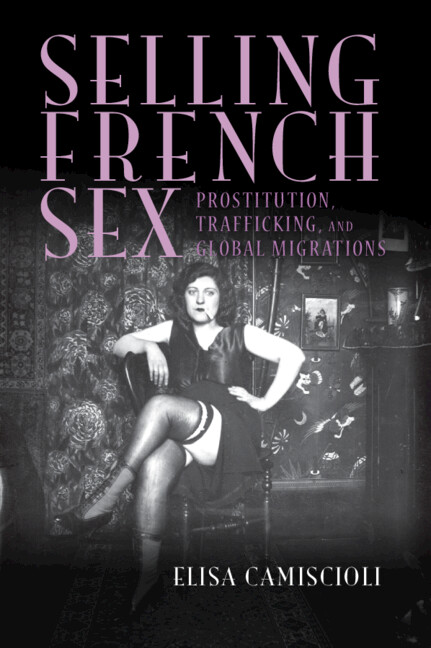

Selling French Sex is an illuminating account of the cultural, social, and economic history of the sale of 'French sex'. It explores the discourses and experiences surrounding the early twentieth century debate on sex trafficking, which mobilized various international reform movements to combat the coerced prostitution of young women abroad. According to popular legend and empirical studies, French women were present in brothels all over the world, where they were the most desired and best paid in the business. But were they trafficking victims or willing migrants? In this timely book, Elisa Camiscioli reconstructs the networks and mechanisms of cross-border migrations for sexual labor; elucidates women's motives for leaving and staying; and explains why French migrant sexual labor occupied such a prominent place in the underworld of prostitution, as well as in the imaginaries of anti-trafficking campaigners, immigration officials, and ordinary consumers of vice.
Winner, 2025 Gilbert Chinard Prize, The Society for French Historical Studies
‘With a cast of colorful characters - pimps, prostitutes, policemen, consular officials, and more - moving from Paris and other French cities to Havana, Buenos Aires, and throughout the Americas, Elisa Camiscioli links theories of embodiment and melodramas of trafficking to the experiences of women who sought adventure and livelihood by selling sex. Theoretically sophisticated and empirically innovative, this book reconceptualizes the history of prostitution through the history of migration and immigration control to trouble the boundaries between agency and coercion, public and private, work and leisure. A major achievement!’
Eileen Boris - author of Making the Woman Worker: Precarious Labor and the Fight for Global Standards, 1919–2019
‘Elisa Camiscioli’s impressive book is both an essential contribution to French history and a necessary reference in the global history of migration and sex trafficking in the twentieth century. Demonstrating clearly that the simple alternatives of ’coercion’ and ‘agency’ cannot fully encompass the lives of trafficked women, Camiscioli’s book provides a nuanced and humane account of a disturbing and often hidden subject.’
Joshua Cole - University of Michigan
‘A groundbreaking work. Elisa Camiscioli brilliantly imbeds the history of twentieth-century French sex trafficking within the global history of migration, bringing a fresh perspective to both phenomena. Her analysis of the term ‘white slavery’ gives us novel insights into the links between sex and race. Lucidly written and impressively researched, Camiscioli has given us a vibrant transnational history of immigration, women, sexuality, and France.’
Mary Louise Roberts - author of What Soldiers Do: Sex and the American GI in World War II France
‘Camiscioli constructs an intimate history of marginalized young French female migrants under surveillance as victims of ‘trafficking.’ She shrewdly resists assessing their experience according to the stark dichotomies of coercion and consent. Instead, her protagonists appear as vulnerable, yet resourceful migrants driven by economic precarity and propelled by aspirations to upward mobility. This is a deeply researched, brilliantly crafted and ‘human scale’ study.’
Judith R. Walkowitz - Johns Hopkins University
‘In this expertly researched and absorbing monograph, Elisa Camiscioli brings to life the experience of subjects left out of many historical accounts: women who migrated from France to engage in sex work in the years after World War I … she argues convincingly for understanding French women who migrated to sell sex in this period as figures caught in and representative of a global shift in attitudes toward immigration and international debates about sex work … To approach these women as migrants is, for Camiscioli, to be attentive to the ways in which their lived experiences exceeded and belied the often lurid criminological gaze of trafficking opponents at the turn of the century.’
Patricia Tilburg Source: Journal of Modern History
‘… the focus is on French emigration, thereby opening French history more fully onto the world, embedding it within a global history and changing how we understand modern global migration on both sides of the Atlantic. This is a major achievement, one that those of us still entrenched in national histories especially need to grapple with … Selling French Sex will be of clear interest to scholars of women, global migration, sex work, and trafficking, but all scholars would benefit from engaging with her sensitive treatment of the fraught category of agency.’
Hannah Frydma Source: American Historical Review
Loading metrics...
* Views captured on Cambridge Core between #date#. This data will be updated every 24 hours.
Usage data cannot currently be displayed.
This section outlines the accessibility features of this content - including support for screen readers, full keyboard navigation and high-contrast display options. This may not be relevant for you.
Accessibility compliance for the HTML of this book is currently unknown and may be updated in the future.
