





J.K. Rowling is among the best-selling authors of all time. 1 To date unrecognised is that Rowling may be the most prolific popular author on the topic of suicide (see Fig. 1 and Supplementary Material available at https://doi.org/10.1192/bjp.2026.10547). Indeed, every one of her novels has some connection to suicide, in most cases explicit and entwined within the main plot. Media can influence suicide rates at a population level, and prior meta-analyses have found that fictional depictions of suicide may result in increases in suicide deaths and attempts across populations. Reference Niederkrotenthaler, Kirchner, Till, Sinyor, Tran and Pirkis2 Given that Rowling’s work has exposed so many people worldwide to specific ideas and themes surrounding suicide, her writing deserves scientific attention. This narrative review summarises the various ways that Rowling covers suicide in her 17 published works to date: seven Harry Potter novels and The Tales of Beedle the Bard; the adult mystery The Casual Vacancy; and the eight-volume Cormoran Strike series published under the pseudonym Robert Galbraith. It then considers the implications of Rowling spreading stories of hope and survival that also include substantial graphic suicide content.
Characters experiencing suicide and related thoughts and behaviours in novels by J.K. Rowling.

Rowling has publicly described personal lived experience of suicidal ideation occurring just before publishing the Harry Potter series. At the time, she was a single mother experiencing poverty and suffering from clinical depression. She contemplated suicide (‘We’re talking suicidal thoughts here, we’re not talking “I’m a little bit miserable”’ Reference Connellan3 ). Rowling sought help, specifically psychotherapy, and mastered her suicidal crisis: ‘What’s to be ashamed of? I went through a really rough time, and I am quite proud that I got out of that’. 4
The Harry Potter series
In 2017, I first proposed that the Harry Potter novels could be understood as a hidden meditation on suicide. Reference Sinyor5 Suicide is pervasive among those closely tied to the series’ villain Voldemort, particularly in the context of absent or lost love. The pub in the village where Voldemort’s father grew up is called The Hanged Man. Reference Rowling6 Voldemort’s mother dies by suicide following unrequited love. Reference Rowling7 His henchman dies by suicide using his silver hand conjured by Voldemort. Reference Rowling8 The Bloody Barron, ghost of Voldemort’s house, died in a murder-suicide, Reference Rowling8 and head of house Severus Snape expresses a wish to be dead, Reference Rowling8 both in the context of unrequited love (see also The Warlock in The Tales of Beedle the Bard Reference Rowling9 in the Supplementary Material).
Suicide is also a theme for the Harry Potter series protagonists. Arguably, school headmaster Albus Dumbledore dies in a sort of assisted suicide, orchestrating his murder at the hands of Severus Snape. Reference Rowling8 Notably, Voldemort’s actions eventually lead Harry himself to manifest suicidal ideation in book five. Reference Rowling10
We later discover that, when Voldemort murders Harry’s parents, a piece of his soul is transferred into Harry and he becomes a ‘Horcrux’. Reference Rowling8 Harry is quite literally scarred by the death of his parents and, if we understand Voldemort as a metaphor for the link between trauma and suicide, then the piece of Voldemort in Harry can be thought of as a death wish arising from his character’s foundational trauma. Harry voices suicidal ideation only in book five, in which his mental connection to Voldemort is strongest. Reference Rowling10 The ‘Resurrection Stone’, an object of fascination for Harry, helps its possessor to reunite with dead loved ones; its original owner, Cadmus Peverell, discovers that it does not truly revive the deceased, and ‘driven mad with hopeless longing, [Cadmus] killed himself so as to join [his lost love]’. Reference Rowling8
Rowling has publicly emphasised the importance of parental love in her life story and personal story of survival. Her mother’s early death from multiple sclerosis had a profound impact and led her to make generous philanthropic contributions to research, and to found a clinic in her mother’s name at the University of Edinburgh. 11 Rowling has described missing her mother and feeling anger that she can no longer share her experiences with her. Reference Rowling12 Notably, Rowling points to love for her own daughter as the impetus for seeking help when she was depressed and experiencing suicidal ideation:
‘Mid-twenties life circumstances were poor and I really plummeted. The thing that made me go for help . . . was probably my daughter.’ Reference Connellan3
The Harry Potter series embodies Rowling’s thesis that love, in particular parental love, is a path to surviving suicidal crises. At the series climax, like Dumbledore, Harry chooses a sort of altruistic suicide in which he walks into certain death to protect his friends and his school. Reference Rowling8 He uses the Resurrection Stone not to reverse the past, but to bring back the memories of those he loves to be with him and to support him as he dies. He accepts what he cannot change, and the killing curse destroys the part of Voldemort within him. Freed from the death wish arising from his trauma, Harry has a conversation in his own mind with Dumbledore, who presents him with a choice to move ‘on’ or to return to life. Reference Rowling8 Voldemort, who cannot feel love, is destroyed and Harry, who is capable of deep love and human connection, survives. Like Rowling herself, ‘The Boy Who Lived’ chooses life.
The Casual Vacancy
Rowling’s novels for adults include a deeper and more expansive exploration of these and other suicide-related themes. Her first adult novel, The Casual Vacancy, has three characters who experience suicidal crises. Colin Wall is deputy headteacher of a local high school who is plagued by obsessive–compulsive disorder, characterised by ‘bad thoughts’ that he is a paedophile, fears that he will assault the youth whose education he oversees and has a non-fatal suicide attempt. Reference Rowling13 Here again, Rowling draws on her own life experience as described in an interview about the novel:
‘These are things I know from the inside. … When I was in my teens I had issues with OCD.’ 14
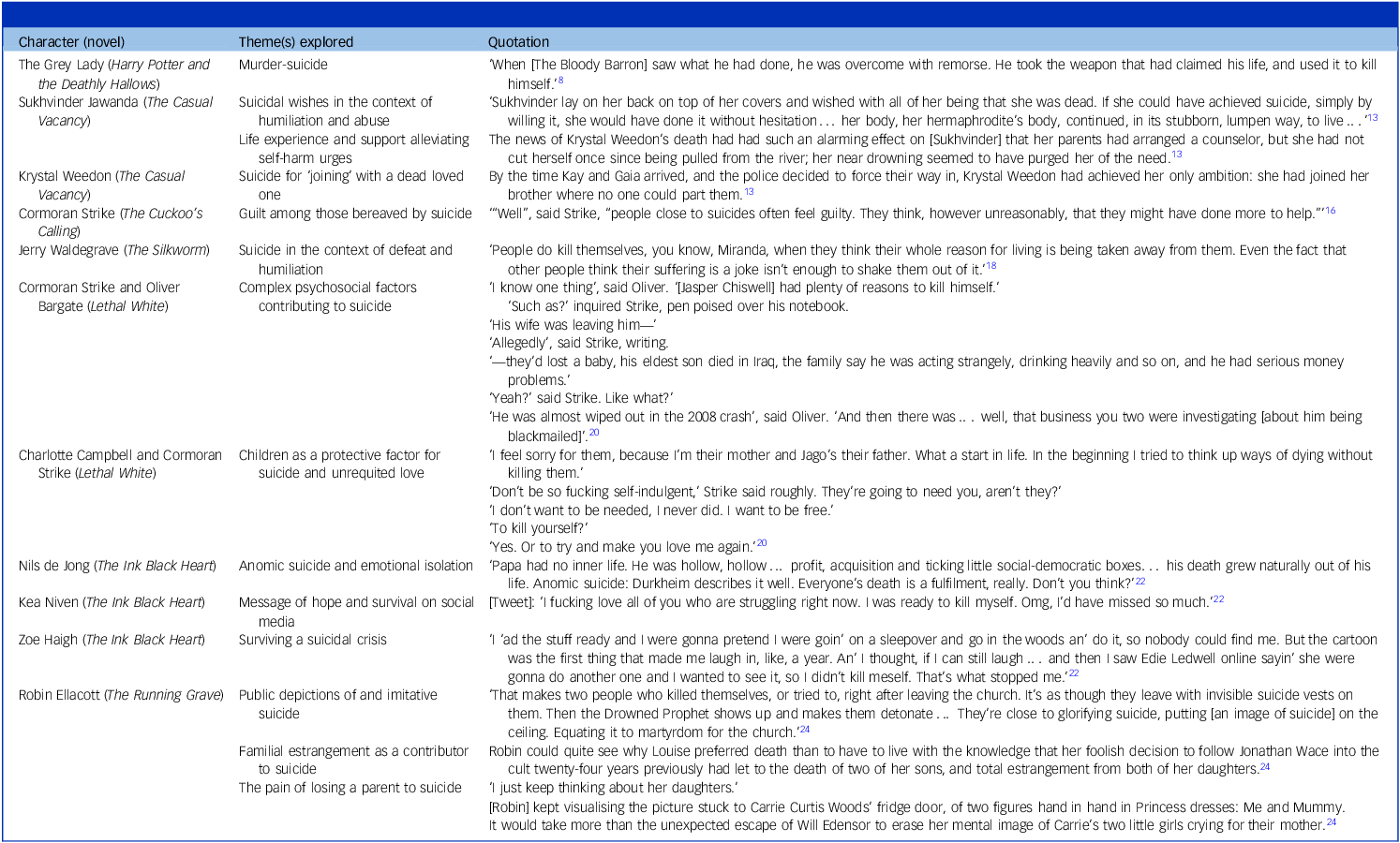
Rowling has publicly disclosed that she is also a ‘domestic abuse and sexual assault survivor’, and has said that ‘the scars left by violence and sexual assault don’t disappear, no matter how loved you are, and no matter how much money you’ve made’. Reference Rowling15 Sukhvinder Jawanda and Krystal Weedon are characters who experience suicidal crises following mistreatment by male characters. Sukhvinder is cyberbullied and publicly humiliated by a fellow student for her racial background and physical appearance. Reference Rowling13 The portrayal of Sukhvinder’s crisis is particularly heartbreaking and among the most realistic of Rowling’s depictions of psychic pain and hopelessness (see Table 1 for evocative quotations from Sukhvinder and others). Rowling includes multiple graphic depictions of the self-harm that Sukhvinder uses as a coping mechanism (‘Some of her self-hatred had oozed out with the blood’). Reference Rowling13
Evocative quotations regarding suicide and self-harm in J.K. Rowling’s novels

Krystal Weedon suffers from poverty, bullying and neglect. She is raped by her mother’s drug dealer and then, at the novel’s climax, is unintentionally responsible for the death of her 3-year-old brother to whom she is more a mother than a sister. Reference Rowling13 Krystal’s character arc explores whether a strong person can overcome social biases and extreme life adversity to persevere and become a valued member of society. Ultimately, Krystal fails to protect the person she loves the most. Her sorrow in the context of bereavement leads her to die by suicide for ‘joining’ with the deceased, Reference Rowling13 the same reason that Harry Potter experiences suicidal ideation.
The Cormoran Strike series
The eight Cormoran Strike mystery novels to date represent the apotheosis of Rowling’s exploration of suicide, and include several dozen characters who die by suicide, experience non-fatal suicidal crises or are wrongly suspected of dying by suicide, with numerous other comments and reflections by various characters about suicide (see Supplementary Material for additional details). The first novel in the series is an investigation into the apparent suicide of a celebrity, and explores ideas including motivations for suicide, common suicide locations and methods and media coverage of suicide. Reference Galbraith16 The mother of the series protagonist, Strike, is described as previously dying in a possible suicide. Reference Galbraith16
The integrated motivational–volitional model posits that suicide fundamentally arises as a result of feeling trapped following an experience of defeat and humiliation. Reference O’Connor RC, Kirtley17 A key plot point in the second novel is the suicide of first-time novelist Elspeth Fancourt, who ends her life after her book receives poor reviews and following a parody of the novel being released anonymously. Reference Galbraith18 The novel ends with Strike speculating that the story’s villain, who he has just caught, may be planning suicide (‘Off to kill herself, probably’), and she is subsequently placed on suicide watch while in custody. Reference Galbraith18 The notion that those accused or convicted of crimes are defeated, trapped and may attempt or die by suicide recurs in books four, five, seven and eight.
The third Cormoran Strike novel has the smallest amount of suicide content, but does include an important juxtaposition regarding the potential suicides of the series’ two most important female characters. Reference Galbraith19 Charlotte Campbell, Strike’s former fiancée, suffers from depression and an alcohol use disorder and is emotionally dysregulated. Strike recalls that, when they fought, he might find himself needing to ‘restrain her from throwing herself from the high balcony’. Reference Galbraith19 Robin Ellacott is Strike’s business partner, and the woman he secretly loves. Like Charlotte, she has suffered from mental illness. Unlike Charlotte, she engages well with psychotherapy. Reference Galbraith20
Robin is a sexual assault survivor who suffers a vicious physical attack by the killer in the third book. After Robin fights with her partner Matthew, he texts pleading with her to confirm that she is still alive. In contrast to Charlotte, Robin replies, ‘Oh, don’t flatter yourself. Like I’d kill myself over you’. Reference Galbraith19
By book four, the number and variety of suicide depictions escalate substantially. Strike is hired by a Member of Parliament, Jasper Chiswell, to investigate blackmail. Reference Galbraith20 Chiswell believes the blackmailer to be the husband of another Member of Parliament Reference Galbraith20 whose daughter previously died by suicide after nude photos of her were circulated without her consent, again repeating the theme of public humiliation precipitating suicide, particularly in women who have experienced sexual victimisation. Reference Galbraith20 Later, Chiswell himself dies in an apparent suicide, although we later learn that he was murdered. Reference Galbraith20
As the main plot unfolds, we learn that Strike’s ex, Charlotte, who is recently married to another man, is now pregnant; she expresses a lack of maternal love and only a desire to be dead or with Strike. Reference Galbraith20 Later, Strike muses that Charlotte’s choice to leave him for another man ‘had been self-immolation, done purely for spectacular effect, a Charlottian form of sati’. Reference Galbraith20 At the conclusion of the book, Chiswell’s killer attempts suicide when cornered by the police. Reference Galbraith20
Book five repeats many suicide-related themes already explored, including suicide in women mistreated by men, in criminals and in those suffering public humiliation. Reference Galbraith21 Meanwhile, Charlotte’s suicidal ideation and lack of connection to her children escalate. She texts Strike:
‘Id [sic] rather die than have more [kids]. Actually I’d rather die than most things. But you know that about me.’ Reference Galbraith21
She is admitted to the hospital and attempts suicide in the hospital grounds while on the telephone with Strike. Reference Galbraith21
Book six contains what is, arguably, Rowling’s most scholarly treatment of suicide. The plot centres on an internet gaming community and an ‘alt-right’ misogynistic group whose agenda is to harass and bully women into suicide online; the prime suspect’s username is ‘Anomie’, after French sociologist Émile Durkheim’s concept of anomic suicide. Reference Galbraith22,Reference Durkheim23
Most suicide depictions in the Cormoran Strike series focus on death and tragedy. Notably, however, in book six, two minor characters also describe how their drive to participate in life and to find meaning and purpose prevented them from attempting suicide (see Table 1; Kea Niven and Zoe Haigh).
Book seven explores how indoctrination and abuse by a religious cult influence characters to consider and, in some cases, die by suicide. Reference Galbraith24 As in previous books, people involved in its central crime attempt suicide. Reference Galbraith24 Unlike previous books, the person under suspicion who dies by suicide is a mother, Cherie Gittins, who participated in a murder years previously. Reference Galbraith24 After Cherie is interrogated by Strike and Robin, her husband reports that he has found her dead. Reference Galbraith24 Robin feels guilty and distressed that Cherie’s young children have been left without a mother. Reference Galbraith24
The repeated focus on the importance of not dying and leaving daughters and children behind aligns with Rowling’s public statements about her own life, and that her daughter was the motivating factor for her seeking help:
‘She was something that earthed me, grounded me, and I thought, this isn’t right, this can’t be right, she cannot grow up with me in this state.’ 25
From the standpoint of suicide-related narratives in the series, arguably the most important event of book seven is that Charlotte dies by suicide (this event is also the major suicide focus of book eight, with more than 20 mentions). Reference Galbraith24,Reference Galbraith26 Charlotte’s suicide occurs in the context of a charge against her for assault, but Strike believes her motivation to be unrequited love for him, a fact that Charlotte confirms in her suicide note. He thinks:
‘You can’t hold onto someone by threatening to top yourself if they leave. It isn’t right. You had kids. You should have stayed alive for them.’
And says:
‘She was full of drink and drugs when she wrote that letter, and you’ve got a duty to the living… To her kids above all.’
Processing his bereavement, Strike describes Charlotte as a ‘walking suicide even when I met her’. Of her misery he says:
‘[S]he was in love with it. It’s dangerous to make a cult of your own unhappiness. Hard to get out, once you’ve been in there too long. You forget how.’
One could argue that this description could also apply to Voldemort. Harry and Voldemort are both orphans with profound sadness and anger, but the former embraces love and the people around him while the latter does not and, at least in the end, appears incapable of doing so. This duality arguably also exists for Sukhvinder and Krystal in The Casual Vacancy.
In these characters, Rowling also skilfully explores the dialectic of free will and determinism in suicide. Strike and Robin’s friend Ilsa is said to have ‘scathingly categoriz[ed] Charlotte’s various suicide attempts into two categories: those meant to manipulate, and those that were genuine’. Reference Galbraith24 Here we see suicide as both a maladaptive form of communication and a true wish to be dead in the context of a depressive illness and/or substance intoxication. Strike notes that, at her best, Charlotte ‘always regretted the things she’d done when high, or angry’. Strike notes that he once quoted Aeschylus, the famed Greek dramatist, to Charlotte:
‘Happiness is a choice that requires effort at times… Didn’t go down well’.
Discussion and implications
Voldemort, Krystal and Charlotte are all, to an extent, victims of their own circumstances and these circumstances, at least in part, lead each to their own destruction. However, each of them also makes choices that have a major bearing on that outcome. In contrast, Harry, Sukhvinder and Robin make different choices. They seek help and find love and support from those around them. With respect to Robin and Charlotte, this distinction manifests in Strike’s imagined conversation with Charlotte after her death. Charlotte says to Strike, ‘Would Robin kill herself over you?’. He replies that she would have more sense.
Here we see the culmination of Rowling’s thesis arising from her own lived experience – that the choice to find and embrace love and support is ultimately the difference-maker in whether a person will die by suicide. Rowling is Robin, and Charlotte is whom she might have been.
As reflected in Rowling’s works, suicide is a heterogeneous phenomenon, and the idea that love and support is the difference-maker certainly would not apply to every instance of real-life suicide. Nevertheless, Rowling’s central message of hope is a powerful and notable one.
A key public health consideration is whether Rowling’s works might be helpful or harmful for suicide prevention. Popular stories of identifiable people dying by suicide often provoke increased suicides, the so-called Werther effect, named after the titular character in Goethe’s The Sorrows of Young Werther, who dies by suicide. Reference Niederkrotenthaler, Voracek, Herberth, Till, Strauss and Etzersdorfer27 In contrast, we often observe fewer suicides across the population after stories of mastery of suicide crises are disseminated by the media, the so-called Papageno effect. Reference Niederkrotenthaler, Voracek, Herberth, Till, Strauss and Etzersdorfer27 Rowling’s stories align much more closely with Papageno narratives, given that her protagonists, particularly Harry in the Harry Potter series and Robin in the Cormoran Strike series, each survive trauma and make choices that lead to survival.
Rowling’s work and public statements likewise emphasise that defeat and failure do not determine the future, and certainly do not have to lead to suicide. In a 2008 Harvard commencement address, Rowling summarised her story thus:
‘What I feared most for myself at your age was not poverty, but failure… I had failed on an epic scale. An exceptionally short-lived marriage had imploded, and I was jobless, a lone parent, and as poor as it is possible to be in modern Britain, without being homeless… I was the biggest failure I knew… That period of my life was a dark one… I was set free, because my greatest fear had been realised, and I was still alive, and I still had a daughter whom I adored…’
Rowling’s coverage of suicide is not without its drawbacks from a suicide prevention perspective. Krystal Weedon’s story in The Casual Vacancy does follow a more traditionally Werther narrative that could cause harm in some at-risk readers; however, this differs notably from typical Werther depictions in that Krystal is only one of an ensemble of characters and that, among those characters, the reader is also shown a story arc (Sukhvinder’s) that follows a clear Papageno narrative.
Guidelines for entertainment media warn against depictions of suicide methods, 28 and Rowlings’ novels, particularly the Cormoran Strike series, include highly detailed descriptions of suicide methods, including unusual suicide methods whose depictions are specifically discouraged by guidelines. 29 Suicide prevention experts should engage with popular authors and other entertainment creators to ensure that they are aware of guidelines and the rationale for them. Notably, whether overarching narratives encouraging survival and coping, such as those in Rowling’s books, mitigate some or all of the harms of the inclusion of harmful content, such as suicide methods, remains an open scientific question.
The other aspect of Rowling’s novels that could be viewed as concerning is the repeated portrayal of suicide in people accused or convicted of crimes. In addition to this occurring in books four, five, seven and eight, Strike speculates about the potential for suicide in additional villainous characters in books two and seven. The concern with such depictions is that they imply that suicide is an expected and/or appropriate response to accusations of criminal behaviour. The concept is expressed pithily by Kea Niven in book six:
‘It’s OK to be glad when terrible people die. I’m not going to pretend I’m sorry.’
It is ethically problematic if societies encourage those accused or convicted of crimes to take their own lives.
Because Rowling’s collected works have been released and consumed steadily over decades, it may not be practically possible to measure whether they have had any impact on actual suicide deaths. However, there is reason to suspect they may have saved lives because of recent evidence regarding the importance of overarching narrative. For example, Logic’s HipHop song of survival was associated with decreased suicides despite the music video including a graphic depiction of a suicide method. Reference Niederkrotenthaler, Tran, Gould, Sinyor, Sumner and Strauss30 Contrast this with findings regarding the first seasons of the Netflix series 13 Reasons Why and Squid Game, which both included substantial, graphic depictions of suicide. Reference Niederkrotenthaler, Stack, Till, Sinyor, Pirkis and Garcia31,Reference Sinyor, Shin, Lee, Stack, Men and Niederkrotenthaler32 13 Reasons Why had a clear Werther narrative and was associated with increased suicides, Reference Niederkrotenthaler, Stack, Till, Sinyor, Pirkis and Garcia31 whereas Squid Game had a more ambiguous narrative and had no impact on suicides. Reference Sinyor, Shin, Lee, Stack, Men and Niederkrotenthaler32 These are just a few examples of recent evidence that the active ingredient in the Papageno and Werther effects appears to be the overarching message of a story. Despite the inclusion of potentially problematic content, Rowling’s overarching focus is clearly on Papageno narratives of survival.
Rowling’s works have provided hundreds of millions of readers with a profound window into how and why suicide arises and how crises can be overcome. In each of her fictional domains, Rowling presents the reader with a yin and yang (Harry Potter series – Harry and Voldemort; The Casual Vacancy – Sukhvinder and Krystal; Cormoran Strike series – Robin and Charlotte), with one character, with whom we are meant to identify, embodying the successful navigation or avoidance of a suicidal crisis following trauma, and another character embodying self-destruction and death. In so doing, Rowling both portrays and affirms her own path to crisis mastery while also showing the reader ‘what could have been’ under other circumstances and with different choices. It would be dubious to claim that Rowling’s achievements as an author are under-recognised. However, with respect to suicide, this statement may well be true. Rowling’s works collectively represent a triumph in their vivid depictions of, and philosophical perspectives regarding, people surviving serious life adversity. They teach us how to survive and, perhaps even more importantly, signal to at-risk readers that they can survive even when life appears hopeless. Those of us in the suicide prevention community are increasingly finding evidence that stories and narratives of survival save lives. Reference Niederkrotenthaler, Tran, Gould, Sinyor, Sumner and Strauss30 Whether that has been the case with Rowling’s novels may never be known, but this reader hopes that her messages of hope regarding suicide have, and will lead to, more ‘Lumos’ and less ‘Nox’.
Supplementary material
The supplementary material for this article is available online at https://doi.org/10.1192/bjp.2026.10547
Acknowledgements
M.S. thanks Dr Sikky Shiqi Chen for her assistance in creating the figure for this article. He also thanks Professor Alan Verskin for first recommending he read the Harry Potter books, and then the Cormoran Strike books two decades later.
Funding
This work was supported in part by an Academic Scholars Award from the Department of Psychiatry at Sunnybrook Health Sciences Centre.
Declaration of interest
M.S. has developed a free-to-use, school-based cognitive–behavioural therapy skills intervention for youth aged 12–14 years that utilises the novel Harry Potter and the Prisoner of Azkaban (available at myowl.org).



 Open access


eLetters
No eLetters have been published for this article.