


INTRODUCTION
Date palm (Phoenix dactylifera L.) is an important fruit crop in the palm family (Arecaceae) grown in the arid and semi-arid regions of the world, including Saudi Arabia. Date palm is one of the most important cash crops that contributes significantly to agroecosystems in Saudi Arabia and plays a major role in the national economy and agricultural sector through its contribution to economic growth, and meeting local market needs. There are more than 400 date palm cultivars in Saudi Arabia and each region is characterized by certain cultivars, but only approximately 50–60 cultivars are used commercially (Mikki Reference Mikki, Afifi and Al-Badawy1998). Saudi Arabia is considered one of the top three date-producing countries in the world. In 2013, date production in Saudi Arabia reached 1 065 032 tonnes, from 3·7 million trees (FAO 2013). However, despite great government support and attention to date palm cultivation in Saudi Arabia, the level of date productivity remains low compared with other date-producing countries, and exports of dates have not reached the expected level (Aleid et al. Reference Aleid, Al-Khayri, Al-Bahrany, Al-Khayri, Jain and Johnson2015). A number of factors could be behind this reduction, such as plant diseases, insect pests as well as environmental stress factors including salinity, drought and temperature extremes as a result of climate change.
Changes in climate have serious implications in the agricultural sector due to direct exposure to and dependence on weather conditions, both of agriculture and other natural resources (Yu et al. Reference Yu, Zhu, Breisinger and Hai2010). A substantial number of studies have been conducted on the impacts of climate change on agricultural productivity. As an example, it has been reported that climate change could lower agricultural productivity in four agricultural sectors (paddy rice, wheat, other grains and other crops) in Southeast Asia, specifically by 15–26% in Thailand, 2–15% in Vietnam, 12–23% in the Philippines and 6–18% in Indonesia (Zhai & Zhuang Reference Zhai, Zhuang, Anbumozhi, Breiling, Pathmarajah and Reddy2012). In some countries, it has been projected that reductions in yields from rain-fed agriculture could reach as high as 50% by 2020 (Field et al. Reference Field, Barros, Stocker, Qin, Dokken, Ebi, Mastrandrea, Mach, Plattner, Allen, Tignor and Midgley2012). In addition, IPCC (Reference Parry, Canziani, Palutikof, Van Der Linden and Hanson2007) has documented that a 40% decline in agricultural productivity is expected in India by 2080 as a result of climate change.
Saudi Arabia is one of those countries that are highly vulnerable to the adverse effects of climate change, due to its arid climate. It has been predicted that the average temperatures in Saudi Arabia would increase by as much as 6·0 °C by 2100 as a consequence of climate change, and the crop irrigation water demands would rise by about 602 and 3122 million m3 (MCM) at 1 and 5 °C increases, respectively, and the expected yield of different types of field fruit trees and crops will experience losses that range from 5 to >25% (Zatari Reference Zatari2011). This means that climate change is expected to impact heavily on agriculture and food production in Saudi Arabia, especially through reducing water availability and direct effects on crop yields. For example, during the 2010 season many farmers noticed unusual early blooming of date palm as a direct consequence of climate change (Darfaoui & Assiri Reference Darfaoui and Assiri2009). To deal with such change, optimizing the cropping pattern in Saudi Arabia according to the regional competitive advantage was considered as one of the actions to adapt to the adverse effects of climate change. Alabdulkader et al. (Reference Alabdulkader, Al-Amoud and Awad2016) applied a mathematical sector model to optimize the date palm cropping pattern using limited water resources and cultivated lands. The results showed great potential for Saudi Arabia to adapt to the adverse effects of climate change by optimizing date palm cropping in accordance with its scarce water resources and limited cultivated lands.
Climate change may also impact an economy directly by affecting its agricultural outputs. For instance, it has been reported that maize production in Africa and South America could decline by 10% by 2055, causing a loss of $2 billion per year due to climate change (Jones & Thornton Reference Jones and Thornton2003). Moreover, the total annual income from date palms in Middle Eastern countries has declined from 1990 to 2000 due to plant diseases and water shortages resulting from climate change (Zaid & Arias Jiménez Reference Zaid and Arias Jiménez2002). Currently, at a global scale, 0·20–0·25 of harvested crops are lost due to harvest disease and these losses are expected to rise with climate change (Dixon Reference Dixon2012). Consequently, food security will be affected and the global and regional agricultural productivity will be negatively impacted. Added to this, climate change is very likely to have significant impacts on the distribution, quantity and quality of global agricultural production (Thung & Rao Reference Thung, Rao and Singh1999; Wheeler & Von Braun Reference Wheeler and Von Braun2013).
Decision makers should prepare management strategies that address climate change impacts on agriculture to achieve long-term sustainable production of cash crops such as date palm. Thus, information on the potential distribution of the species and the relative abundance under projected future climate scenarios is essential. A variety of distribution models have been used to study the effect of climate change on species distribution, including bioclimate envelope models (e.g. Spatial Evaluator of Climate Impacts on the Envelope of Species (SPECIES)) (Hampe Reference Hampe2004), global climate models (GCMs) (e.g. UKMO-HadCM3, GFDL-CM2·0 and MIROC3·2) (Porfirio et al. Reference Porfirio, Harris, Lefroy, Hugh, Gould, Lee, Bindoff and Mackey2014), ecological niche models (e.g. generalized linear model) (Silva et al. Reference Silva, Vilela, De Marco and Nemésio2014), MaxEnt (Nazeri et al. Reference Nazeri, Jusoff, Madani, Mahmud, Bahman and Kumar2012), random forest (Vincenzi et al. Reference Vincenzi, Zucchetta, Franzoi, Pellizzato, Pranovi, De Leo and Torricelli2011), boosted regression tree (Radinger et al. Reference Radinger, Wolter and Kail2015) and CLIMEX (Aljaryian et al. Reference Aljaryian, Kumar and Taylor2016; Shabani et al. Reference Shabani, Kumar and Ahmadi2016). CLIMEX, a mechanistic model, is a well-known climate modelling software for predicting species’ responses to climate change due to its extensive phonological observations and geographic range (Sutherst et al. Reference Sutherst, Maywald and Kriticos2007). With CLIMEX, users can detect areas where selected species can be established and maintained or developed based on predicted climate changes. CLIMEX has been extensively used in multiple applications; some examples include projecting crop diseases such as Fusarium oxysporum f. spp. (Shabani et al. Reference Shabani, Kumar and Esmaeili2014a ), determining the impact of climate change on invasive weeds such as Lantana camara L. (Taylor et al. Reference Taylor, Kumar, Reid and Kriticos2012b ) and illustrating the potential distribution of the common bean (Ramirez-Cabral et al. Reference Ramirez-Cabral, Kumar and Taylor2016), among other applications.
Most studies examining climate change effects on species using CLIMAX often use climate variables alone and exclude non-climatic parameters such as soil type, land use and topography. Hence, it is possible that some projected suitable regions for specifically studied species may be inaccurate, and may be unsuitable with regard to non-climatic parameters. Therefore, to overcome this limitation, incorporation of climatic and non-climatic parameters has been suggested to achieve greater accuracy and more robust results, since the results must satisfy more extensive requirements (Sutherst et al. Reference Sutherst, Maywald and Kriticos2007; Beaumont et al. Reference Beaumont, Hughes and Pitman2008). As an example, Cheng et al. (Reference Cheng, Wan and Guo2006) found that the combination of biotic and non-biotic factors led to a significant improvement in the prediction of potential distribution of Frankliniella occidentalis in China compared with prediction by climate variables alone. Additionally, Shabani et al. (Reference Shabani, Kumar and Taylor2014b ) projected date palm distribution at the national level for Iran by including non-climatic parameters such as land use, topography and soil taxonomy and found that only 220 000 km2 would be suitable for date palm cultivation, compared with 610 000 km2 based on climatic suitability. In other words, the incorporation of climatic and non-climatic factors is the key, and provides better results than models based purely on climatic factors when assessing the impact of climate change on predicting the future distribution and fate of economically important crops, such as date palm.
The above-mentioned studies provide evidence that climate change represents a massive threat to plant and crop distribution. It is highly likely that the productivity potential of some regions will increase while others will decrease as a result of climate change and unsuitability due to abiotic factors (e.g. slope, soil texture, soil taxonomy, soil salinity and land use). Therefore, it is vital to consider the impact of both climatic and non-climatic parameters when predicting the potential future distribution of the species. The main objectives of the current study were to (i) develop climatic models of date palm in Saudi Arabia for the current time, 2050 and 2100; (ii) find the main climatic stresses that may drastically affect date palm in Saudi Arabia by 2050 and 2100; (iii) refine the projection based on suitability of soil taxonomy, soil texture, soil salinity, slope and land use to find areas that are practical, accurate and possible to cultivate date palm; and (iv) identify the most sensitive climatic parameters through a sensitivity analysis. The models will be used to investigate how these changes will impact the potential future distribution of date palm in Saudi Arabia. It is assumed that climate change will alter the agricultural areas that currently produce date palm. Model results from the current study will benefit governments and decision makers by preparing for the circumstances ahead, and along this line increase economic advantages that can help enhance local economies. Even more importantly, those managing areas that could become unfavourable can be made aware of the circumstances and the likely change to their economies, providing a chance to plan for other sources of income.
MATERIALS AND METHODS
Current distribution of date palm (Phoenix dactylifera L.)
Information on the current geographical distribution and locations of P. dactylifera are essential for modelling the future distribution of this crop. Based on P. dactylifera literature in the CAB Abstracts databases (e.g. Hassan et al. Reference Hassan, Bakhsh, Gill, Maqbool and Ahmed2006; Bokhary Reference Bokhary2010; Al-Senaidy & Ismael Reference Al-Senaidy and Ismael2011; Shabani et al. Reference Shabani, Kumar and Taylor2012, Reference Shabani, Kumar and Taylor2014b , Reference Shabani, Kumar and Taylor c ; Shabani & Kumar Reference Shabani and Kumar2013) and the Global Biodiversity Information Facility (GBIF), date palm can be found worldwide in large parts of northern and central Algeria; south-eastern Spain; Sudan; Australia; south-western USA; Greece; north-western Libya; north-eastern Egypt; south-western, southern and south-eastern Iran; Yemen; India; Oman; and in central, northern, eastern, southern, western and south-western Saudi Arabia.
In the present study, an attempt has been made to maximize the number of occurrences in Saudi Arabia to improve the accuracy of model predictions. Model predictions were based on satellite images available from the United States Geological Survey (USGS) database and GBIF along with data acquired from the Center of Palms and Dates Research, the National Center for Palms and Dates (NCPD) and the Ministry of Agriculture in Saudi Arabia. A total of 930 records were collected, only 460 of which were used after excluding duplicate points and records with no geographic coordinates. This step is an important part of data quality control, as only verified location points with geographic coordinates can be used in the parameter fitting procedure. Thus, 460 records were used in parameter fitting (Fig. 1).
Current and modelled potential distribution of P. dactylifera in Saudi Arabia. EI, eco-climatic index; P. dactylifera, Phoenix dactylifera. Colour online.

CLIMEX software
CLIMEX is an eco-climatic modelling package used to describe the relationship between the current and projected niche of any species (Wharton & Kriticos Reference Wharton and Kriticos2004; Kriticos et al. Reference Kriticos, Yonow and McFadyen2005). Basically, it predicts the potential distribution and relative abundance of a species in a new region using climatic information, biological data and the known geographic distribution of that species. Climate predictions can be made at regional and world scales (Sutherst et al. Reference Sutherst, Maywald and Kriticos2007). This method assumes that species populations increase during suitable climate seasons and decrease during unsuitable seasons. CLIMEX uses different indices that are grouped into growth-related and stress-related indices to predict the potential growth and survival of a species at a given location. The potential population growth during favourable seasons is described by an annual growth index (GIA), while four stress indices (SI) (cold, hot, wet and dry stresses) describe the population survival possibility during unfavourable seasons (Sutherst et al. Reference Sutherst, Maywald and Kriticos2007). The GIA is determined from different growth indices, including the temperature index (TI) and the moisture index (MI) that describe the species’ temperature and soil moisture requirements for population growth. The four climatic parameters used to describe the suitable temperature for population growth are DV0 and DV3 (limiting low and high temperatures, respectively) and DV1 and DV2 (lower and upper optimal temperatures, respectively). Similarly, the MI comprises four climatic parameters, which are SM0 and SM3 (limiting low and high soil moisture, respectively), and SM1 and SM2 (lower and upper optimal soil moisture, respectively). These indices, TI and MI, are multiplied to provide a weekly growth index and the yearly average of this gives the GIA. The SI, cold, hot, wet and dry stresses, are combinations of the two parameters, the threshold value and the stress accumulation rate. Stress accumulation during the year is exponential and once this value equals 1, the species will be unable to survive in that geographic region (Sutherst et al. Reference Sutherst, Maywald and Kriticos2007).
The model combines these growth and SI into an overall eco-climatic index (EI) that represents the suitability of the location for the species under various climate change scenarios as a number between 0 and 100. If the EI value is close to 0, it indicates that a site is unsuitable for the species, values from 0 to 10 indicate marginal habitats, values from 10 to 20 indicate a suitable climate area and EI values >20 indicate optimal conditions for the species (Sutherst & Maywald Reference Sutherst and Maywald2005). The outcome models provided by CLIMEX will predict almost all climatically suitable areas for date palm and provide early risk assessments to decision makers about the potential effects of climate change on this essential crop.
Climate data, global climate models and climate change scenarios
CLIMEX for Windows, version 5 was used to develop potential distribution models for date palm under two future climate scenarios, 2050 and 2100, chosen to provide snapshots of climate change projections for the near and further future, respectively. The CliMond 10’ gridded climate data (http://www.hearne.com.au/Software/CLIMEX/Editions#version_CLIMEX3.0.2) were used to model the potential distribution of date palm. To project potential future climate in 2050 and 2100, overall minimum and maximum monthly temperatures (T min and T max, respectively), overall monthly precipitation (P total) and the relative humidity at 09.00 h (RH9.00) and 15.00 h (RH15.00) were used. The potential distribution of date palms under future climate was based on two different GCMs, namely, CSIRO-Mk3·0 (CS) and MIROC-H (MR) (Center for Climate Research, Japan), available as part of the CliMond data sets.
These two models were selected from 23 GCMs because of the availability of temperature, precipitation, mean sea level pressure and specific humidity, which are required for CLIMEX (Nakicenovic et al. Reference Nakicenovic, Alcamo, Davis, de Vries, Fenhann, Gaffin, Gregory, Grubler, Jung, Kram, La Rovere, Michaelis, Mori, Morita, Pepper, Pitcher, Price, Riahi, Roehrl, Rogner, Sankovski, Schlesinger, Shukla, Smith, Swart, van Rooijen, Victor and Dadi2000). Moreover, the models contain relatively small horizontal grid spacing and performed well compared with other GCMs in representing the core aspects of the observed climate at a regional scale, according to Taylor et al. (Reference Taylor, Kumar, Reid and Kriticos2012b ) and Kriticos et al. (Reference Kriticos, Webber, Leriche, Ota, Macadam, Bathols and Scott2012). The A2 emission scenario was selected in the current study because it includes different variables such as financial, demography and technological forces driving greenhouse gas (GHG) emissions. The A2 emission scenario considers a world with higher population growth but slower economic growth and technological changes, and assumes moderate global GHG emissions compared with the other emissions scenarios such as A1F1, A1B, B2, A1T and B1 by 2100 (Suppiah et al. Reference Suppiah, Hennessy, Whetton, McInnes, Macadam, Bathols, Ricketts and Page2007; Kriticos et al. Reference Kriticos, Webber, Leriche, Ota, Macadam, Bathols and Scott2012; Taylor et al. Reference Taylor, Kumar, Reid and Kriticos2012b ).
Fitting CLIMEX parameters
The basic CLIMEX parameter values for date palm modelling were taken from Shabani et al. (Reference Shabani, Kumar and Taylor2012). For a detailed description of these CLIMEX parameters and the procedure by which they were selected, refer to Shabani et al. (Reference Shabani, Kumar and Taylor2012). In the current study, to ensure all date palm occurrences were within the suitable groups of climate in Saudi Arabia, 6 out of 14 parameters were slightly modified based on current date palm occurrence, including SM0, SM1, SM2, the cold stress temperature threshold (TTCS), the cold stress temperature rate (THCS) and the wet stress rate (HWS). Temperature and moisture response parameter values were then transformed into CLIMEX compatible temperature and MI parameters and cold, heat, dry and wet stress threshold (SMWS) values.
The CLIMEX parameter values that were used for P. dactylifera were set as follows: DV0 at 14 °C, DV1 at 20 °C, DV2 at 39 °C, DV3 at 46 °C, SM0 at 0·007, SM1 at 0·014, SM2 at 0·82, SM3 at 0·9, the TTCS at 4 °C, the THCS at –0·011/week, the heat stress parameter threshold (TTHS) at 46 °C, the heat stress accumulation rate (THHS) at 0·9/week, the SMWS at 0·9 and the HWS at 0·024/week. The fitted parameters were then used to project the date palm's potential distribution in Saudi Arabia under two future climate scenarios in 2050 and 2100. The data sets were output from CLIMEX and imported into geographic information system software (ArcGIS Software Version 10·2) for further processing and mapping. All locations were classified into two classes of suitability for date palm using EI values. Locations with EI = 0 were classified as unsuitable while EI >0 were classified as suitable.
Non-climatic parameters
Soil taxonomy
To define the current extent of date palm cultivation in Saudi Arabia, Landsat satellite images with 30 m spatial resolution were used. The general soil map of Saudi Arabia (1 : 4 000 000) obtained from the Ministry of Agriculture, which represents soil taxonomy, was used to extract all soil types that are suitable for date palm cultivation by overlaying the date palm observation layer onto the soil map. The results identified 9 out of 12 suitable soil types, namely: Calciorthids, Camborthids, Gypsiorthids-Calciorthids, Haplaquepts-Eutrochrepts, Torriorthents, Salorthids, Torrifluvents-Torripsamments-Calciorthids, Torriorthents-Calciorthids and Torripsamments-Torriorthents. The details of all the soil types can be found in Soil Survey Staff (2010).
Soil texture
The soil texture map of Saudi Arabia (1 : 4 000 000) was obtained from the Ministry of Agriculture. To determine which soil textures are suitable for date palm growth and cultivation, the locations of date palm observations were considered, and the date palm occurrences were overlaid onto the soil texture map. The results revealed that the soil textures suitable for date palm cultivation in Saudi Arabia are sand; sandy loam comprising 60% sand, 10% clay and 30% silt; loam soil comprising 40% sand, 40% silt and 20% clay; and clay loam comprising 40% sand, 30% silt and 30% clay. This is supported by the fact that date palm is not sensitive to soil types and can grow in a range of diverse types of soil from sand, sandy loam and clays to heavy alluvial soils (Morton & Dowling Reference Morton and Dowling1987; Lim Reference Lim2012).
Soil salinity
Date palm is considered to have the highest salt tolerance of all fruit crops: some date palm varieties can adapt to levels of soil salinity up to 12·8 dS/m (Ramoliya & Pandey Reference Ramoliya and Pandey2003) while others can tolerate much higher levels, up to 34 dS/m (Abbas et al. Reference Abbas, Jasim and Shareef2015). Nevertheless, excessive salt can cause significant reductions in the growth, yield and fruit quality of date palm (Erskine et al. Reference Erskine, Moustafa, Osman, Lashine, Nejatian, Badawi and Ragy2004). Ayers & Westcot (Reference Ayers and Westcot1985) reported that the minimum electrical conductivity (EC) to have maximum yield for date palm is 4·0 dS/m, while the plant produced no yield at the EC of 32 dS/m. Additionally, a study conducted by Alrasbi et al. (Reference Alrasbi, Hussain and Schmeisky2010) indicated that decreases of 53, 48, 39 and 46% occurred in date palm trunk height, number of fronds, leaf length and trunk girth, respectively, at an EC of 18 dS/m. Thus, it is clear that date palm plants will be affected negatively when soil salinity extends beyond its tolerance potential. In the current study, a soil salinity map of Saudi Arabia obtained from the Harmonized World Soil Database (HWSD) was used to extract all soil salinity levels suitable for date palm. Thus, areas with soil salinity of 4–16 dS/m were considered as suitable while areas with soil salinity >16 dS/m were considered unsuitable.
Land use
The most suitable land uses were targeted based on the current land use map of the country, obtained from the Food & Agriculture Organization (FAO) geo-network, and the current distribution of date palm. Agricultural land including cropland, sparsely vegetated areas, irrigated lands and managed bare area were considered suitable for date palm cultivation. The remaining land use types, such as urban areas, mountains, wetland, road and commercial sites were considered unsuitable land use types.
Landform
Date palm is characterized by a deep root system that reaches horizontally up to 25 m away from the trunk, and vertically more than 6 m deep, which helps to hold down the soil and take up water and nutrients stored deep underground (Zaid & Arias Jiménez Reference Zaid and Arias Jiménez2002). In the current study, based on the current landform map of the country, obtained from the Ministry of Agriculture, and the current distribution of date palm, attempts were made to find possible land forms that enable date palm to establish its deep network of roots. Thus, pediplain, gypseous pediplain, degraded pediplain, sand sheet, sand dunes, alluvial fans, alluvial plain and wadi were identified as potentially suitable for date palm growth and its root establishment and distribution.
Slope
The Advanced Spaceborne Thermal Emission and Reflection Radiometer (ASTER) digital elevation model of Saudi Arabia at 30 m spatial resolution, obtained from the King Abdul-Aziz City of Science and Technology in Saudi Arabia, was used to generate a slope surface map. By considering the location of each date palm farm, 0·90 of the locations were found on slopes <7°. These areas were considered as suitable for date palm growth while areas with slopes >7° were considered unsuitable. This is supported by the fact that steeply sloped areas will affect date palm growth by affecting run-off, insolation, temperature, moisture and depth of the soil. The steeper the slope, the greater the run-off and soil erosion. Further, the intensity of insolation, temperature, moisture of the soil surface and depth of soil varies with increasing slope (Dash Reference Dash2001). Additionally, various studies report that lands with slopes >10° are unsuitable for a date palm plantation (Salah et al. Reference Salah, Van Ranst and Hisham2001; Chao & Krueger Reference Chao and Krueger2007; Jain Reference Jain2011). Subsequently, the classified slope data in raster format were converted to polygon shape files and queries were designed using attributes and date palm locations to extract those areas demonstrating suitable slope.
Refining the CLIMEX outputs
CLIMEX outputs from both the CS and MR GCMs for 2050 and 2100 were overlaid on the location of areas comprising suitable soil taxonomy, soil texture, soil salinity, land use, landform and slope for the whole country. Locations that satisfied the condition of EI >0 and all the above environmental conditions were selected and extracted, using ArcGIS software, as areas suitable for date palm cultivation, while areas with EI = 0 were classified as unsuitable.
Climate sensitivity analysis
Sensitivity analysis is an effective tool to identify the input parameters that are most influential to model predictions. The latest version of CLIMEX software (Version 5) has a newly developed climate sensitivity analysis function. This function adjusts the fitted parameter values upward and then downward by a certain amount, then the impact on the species range and a set of selected state variables is determined. Most of the variables (e.g. TI change, CS change and HS change) describe the mean sum square change of the index value (e.g. EI) at all given locations and are included in the sensitivity analysis. CLIMEX presents the results of the sensitivity analysis to users in a table that shows all the parameters, the amount by which they have been adjusted on both sides, and the effect of this adjustment on those particular variables. Parameters found to have significant influence on model results when they are adjusted are those that are considered sensitive.
In the current study, by using the newly developed function, a sensitivity analysis was performed to quantify the response of date palm to the 14 parameters used in the model. From the baseline model, different incremental models were developed to reflect the possible range of these variables that might occur in Saudi Arabia. During this procedure, only one parameter was adjusted at a time, while all other parameters were held constant as in the baseline model.
RESULTS
Current climate
The current and potential distribution of P. dactylifera in Saudi Arabia is shown in Fig. 1. The map illustrates that current distribution is consistent with the EI values of the CLIMEX model. The modelled result indicated that the majority (0·95) of the P. dactylifera records fall within the highly suitable category, which confirms that the selected values for the different parameters in CLIMEX were optimum. Further, the CLIMEX projection shows only 1·95 million ha in the northern and north-western parts of the country as having marginal climatic conditions with EI values between 1 and 10.
Non-climate parameters
Table 1 shows the suitable and unsuitable areas for date palm cultivation in Saudi Arabia based on non-climatic parameters. Considering the suitability of soil taxonomy in Saudi Arabia, results showed that approximately 0·75 of the area is suitable for date palm cultivation. Only portions of the western part of the country are unsuitable in terms of soil taxonomy. Additionally, a large area of approximately 167·40 million ha is suitable for date palm cultivation in terms of soil texture and spans the country, and only approximately 0·22 of the area was defined as unsuitable. Furthermore, the current results highlight that portions of eastern, western and northern Saudi Arabia have soils with salinities >16 dS/m, which indicates that the soil in these parts is unsuitable for date palm growth. The area of suitable land use indicates that the majority of the northern, eastern and southern sectors of Saudi Arabia have suitable land use classes that are conducive to date palm growth. Only some areas in the western part of the country are not suitable. The results identified approximately 125·59 million ha in Saudi Arabia with suitable landforms that are conducive for date palm growth. Suitable landform areas were mainly located in the southern to the north-eastern part, while those areas in the western region do not meet the landform date palm cultivation requirements. Moreover, almost the whole country has a suitable slope, which is <7°, excluding only the mountainous regions.
Suitable and unsuitable area for P. dactylifera cultivation in Saudi Arabia based on non-climatic parameters (colour online)

P. dactylifera, Phoenix dactylifera.
 Suitable.
  Unsuitable
Future climate projections based on climate
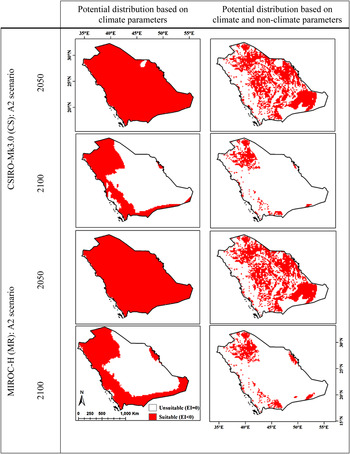
The modelling results of the CS and MR GCMs under the A2 emission scenario forecasting the optimal distribution of P. dactylifera for 2050 and 2100 are illustrated in Fig. 2. A quick comparison of the modelled maps for 2050 and the current time shows that there are no significant differences between the currently suitable areas for date palm cultivation and the result of CS and MR GCMs for 2050 is based on climate alone. Both models agree that almost 0·95 of Saudi Arabia will remain climatically suitable for date palm cultivation by 2050. However, both CS and MR GCMs project that large parts (0·70–0·75) of Saudi Arabia will become climatically unsuitable for date palm cultivation by 2100. The results of the CS GCM indicate that the total area conducive for date palm cultivation will decline to approximately 62·05 million ha by 2100 (Table 2). The same trend is also observed using MR GCM, which estimates a reduction of suitable areas to 79·16 million ha by 2100 (Table 2).
The EI for P. dactylifera for 2050 and 2100 under CS and MR GCMs running with the A2 emission scenario. Colour online. CS, CSIRO-Mk3·0; EI, eco-climatic index; MR, MIROC-H; P. dactylifera, Phoenix dactylifera.
Results of CS and MR GCMs and the refined outputs using all suitable non-climate parameters for P. dactylifera cultivation for 2050 and 2100

CS, CSIRO-Mk3·0; MR, MIROC-H; P. dactylifera, Phoenix dactylifera.
Refined result
The potential distribution of date palm generated using both climate and non-climatic data with CS and MR GCMs demonstrates a general reduction of suitable area (Fig. 2). Based on climate alone, the output of the CS and MR GCMs predicts that almost 0·95 of Saudi Arabia is projected to remain suitable for date palm growth by 2050. However, only 0·75 of this area is suitable for growth of date palm after considering non-climatic parameters. The refined CS and MR results show that approximately 80·17 and 80·46 million ha, respectively, will be highly conducive for this species to grow by 2050 (Table 2). By 2100, the situation is markedly less favourable when refining the CS and MR GCMs using the six non-climatic parameters. The refined results indicate that only approximately 0·15 of Saudi Arabia will be highly suitable for date palm cultivation by 2100. Changes in heat stress from current time to 2100 are shown in Fig. 3. Figure 4 indicates the extent of agreement in the CLIMEX projection of suitable areas for P. dactylifera under CS and MR GCMs running with the A2 emission scenario for 2050 and 2100.
Changes in heat stress from current time to 2100. Colour online.

Agreement in the CLIMEX projection of suitable areas for P. dactylifera under CS and MR GCMs running with the A2 emission scenario for 2050 and 2100. CS, CSIRO-Mk3·0; EI, eco-climatic index; GCM, global climate model; MR, MIROC-H; P. dactylifera, Phoenix dactylifera. Colour online.

Sensitivity to model parameters
Table 3 shows that SM1, TTCS and SMWS are the most sensitive parameters influencing the modelled distributions of date palm in Saudi Arabia. Increasing the SM1, TTCS and SMWS to 0·0014%, 5 °C and 1, respectively, led to the most profound effects on EI values. The EI change values were maximized by changing SM1, TTCS and SMWS parameters, to 13·97, 11·13 and 8% respectively. However, changes in SM0, DV1 and HWS resulted in lower changes in EI. An adjustment in these parameters had only moderate effects on the EI value changes. With changes to SM0, DV1 and HWS, EI values changed by 5·06, 4·02 and 3·64%, respectively. In other words, suitable areas for date palm cultivation changed less rapidly with SM0, DV1 and HWS adjustments from the baseline model. Additionally, alterations to the other parameters SM2, SM3, DV0, DV2, DV3, THCS and TTHS had little effect on the EI value, whereas changes in THHS had no effect on the EI value (Table 3).
Sensitivity analysis of CLIMEX parameters of P. dactylifera model as change of EI

EI, eco-climatic index; P. dactylifera, Phoenix dactylifera.
DISCUSSION
A niche model was developed using CLIMEX species distribution modelling to estimate date palm potential distribution under current and future climate scenarios. The results showed that under the current climate, large parts of Saudi Arabia are highly conducive to date palm growth and cultivation, and this agrees well with the observed distribution. The major reason for this highly suitable climate is because there are no heat, wet, cold or dry stressors in this region under the current climate. In addition, sensitivity analysis results revealed that P. dactylifera distribution is highly sensitive to changes in SM1, TTCS and SMWS parameters, and moderately sensitive to changes in SM0, DV1 and HWS parameters. These results contrasted with those of Shabani & Kumar (Reference Shabani and Kumar2014), who conducted a sensitivity analysis of CLIMEX parameters based on the Taguchi method of modelling the potential distribution of date palm in Iran and found that the distribution of date palm was highly sensitive to changes in DV3, DV3, SM2 and SM3, and slightly sensitive to changes in SM1, SM0 and SMWS parameters. These considerable differences between the current results and those of Shabani & Kumar (Reference Shabani and Kumar2014) are probably attributed to the different sensitivity analysis methods used.
Generally, climate change negatively affects plant growth and development via an increase of abiotic stresses (i.e., heat, cold, drought and wet). It has been reported that when global average temperature increases by >3·5 °C, a significant extinction of plant species is expected due to lethal heat stress (IPCC Reference Parry, Canziani, Palutikof, Van Der Linden and Hanson2007). Extensive agricultural production losses have been attributed to disturbances in growth due to climate change-associated heat stress (Kotak et al. Reference Kotak, Larkindale, Lee, von Koskull-Döring, Vierling and Scharf2007). For example, it has been shown that exposure of Coffea arabica to changes in heat stress affects its growth and yield and raises the stachyose and raffinose levels during abiotic stress events (Drinnan & Menzel Reference Drinnan and Menzel1995). Similarly, Shabani et al. (Reference Shabani, Kumar and Taylor2014c ) found that there will be a substantial reduction in suitable areas for date palm cultivation in central Iran as a consequence of increased heat stress by 2100. In the current study, when climate alone is considered, the projection showed that 0·70 of the current date palm cultivation area is located in the central and southwestern parts of Saudi Arabia. These areas will remain climatically suitable for date palm cultivation since both GCMs indicate that date palms will not suffer from any dry, wet or cold stress by 2050. However, both MR and CS GCMs projected that the majority of the central regions will become unsuitable by 2100 as a result of a significant increase in heat stress. These changes will impose serious restrictions on date palm growth and development and eventually have a negative impact on society. Heat stress, similar to other abiotic stress, imposes adverse effects on different physiological processes of date palm such as germination, growth, development, reproduction and yield. At high temperatures, date palm seeds will still germinate but at a lower rate. However, when seedlings develop and are exposed to excessive heat, they may experience heat shock (El Hadrami et al. Reference El Hadrami, Daayf, El Hadrami, Jain, Al-Khayri and Johnson2011). Additionally, excessive heat over an extended period and during stages of fruit development can influence the quality of date palm (Jarvis et al. Reference Jarvis, Hodgkin, Brown, Tuxill, Noriega, Smale and Sthapit2016). In areas where date palm thrives, high temperatures are responsible for an increase in soil evaporation and transpiration of the plant, which consequently induces low plant–water potentials and high transpiration rates (El Hadrami et al. Reference El Hadrami, Daayf, El Hadrami, Jain, Al-Khayri and Johnson2011). Heat stress can also cause injuries to the cell wall that can lead to a collapse of cellular organization (Schlesinger Reference Schlesinger1990). These injuries eventually result in starvation, production of toxic compounds, reduction in ion flux, an increase of reactive oxygen species and inhibition of plant growth (Wahid et al. Reference Wahid, Gelani, Ashraf and Foolad2007).
Climate has long been considered the main determinant of species distribution (Woodward Reference Woodward1987). Nevertheless, different factors unrelated to climate (e.g. topography, land uses, soil types) often play a vital role in determining the patterns of species distribution. For example, species might be missing from sites within their climatic boundaries due to inappropriate resources under suitable climatic conditions (Araújo & Pearson Reference Araújo and Pearson2005). Therefore, pure climate models are likely to provide incomplete predictions when species move from equilibrium with climate owing to a suite of non-climatic factors (Luoto et al. Reference Luoto, Heikkinen, Pöyry and Saarinen2006). Modelling performance might be considerably improved by combining abiotic factors in the models, as this allows for the identification of regions with suitable climate but unsuitable local environmental conditions to achieve more realistic estimates of distribution changes (Alahuhta et al. Reference Alahuhta, Heino and Luoto2011; Shabani et al. Reference Shabani, Kumar and Taylor2014b ). In respect of slope, for date palm, irrigation should be applied in a controlled manner in order to provide an optimum situation for crop transpiration, and for this, flat land or areas with slopes <7° would be appropriate for date palm cultivation (Kassem Reference Kassem2007). Furthermore, it has been documented that slope greatly impacts plant root systems (Caviezel et al. Reference Caviezel, Hunziker, Schaffner and Kuhn2014) at the expense of depth (Khuder et al. Reference Khuder, Danjon, Stokes, Fourcaud and Salmén2006). For young date plantlets, root depth can vary from 25 to 50 cm and the radius from 10 to 30 cm, depending on the size of the plant, and this means that irrigation water must be applied within these boundaries to enable the plant roots to reach it (Manickavasagan et al. Reference Manickavasagan, Mohamed Essa and Sukumar2012). However, it is important to apply water in such a way that it does not reach the deeper soil levels in order to ensure proper root development of date palms (Zaid & Arias Jiménez Reference Zaid and Arias Jiménez2002). Thus, considering the effects of non-climatic parameters in potential date palm distribution, taking into account slopes where tree roots have a greater positive impact on slope stability should not be neglected, as the slope influences spatial root distribution and areas suitable for date palm establishment (Vergani et al. Reference Vergani, Schwarz, Cohen, Thormann and Bischetti2014; Rogers & Benfey Reference Rogers and Benfey2015). In line with such expectations, the CLIMEX results were refined in the current study using six non-climatic parameters including soil salinity, soil taxonomy, soil texture, land use, landform and slope. The suitable areas where date palm could be established by 2050 were constrained by non-climatic factors, as the realized distribution of date palm is substantially smaller than the climate envelope projected by both MR and CS GCMs for 2050. For example, both models show that 177·04 and 178·18 million ha may become conducive by 2050 considering climatic factors alone, while 97 million ha of these projections are not actually valid due to the unsuitability of soil salinity, soil taxonomy, soil texture, land use, landform or slope variables. Further, both models indicate only 0·35 of areas located from 25 to 35° N and 35 to 45° E are going to be suitable for date palm cultivation by 2100 based on both climate change and suitability of the six non-climatic factors. Similarly, for the same year, both models showed that the south-western region, which is projected to be suitable based only on climate, it is not a practical place for date palm cultivation because of the unsuitability of soil salinity, soil taxonomy, soil texture, land use, landform and slope.
Areas projected to be climatically suitable for date palm cultivation by the pure climate models of both MR and CS GCMs for 2100 were much higher than those projected based on non-climatic parameters. It was not surprising that models showed differences between pure climate and non-climatic variables. Including non-climatic variables improved model accuracy compared with the pure climate models. These findings are supported by others who found that the inclusion of non-climatic variables increases the prediction accuracy of bioclimatic models (e.g. Sormunen et al. Reference Sormunen, Virtanen and Luoto2011; Hyvönen et al. Reference Hyvönen, Luoto and Uotila2012; Taylor et al. Reference Taylor, Kumar and Reid2012a ; Shabani et al. Reference Shabani, Kumar and Taylor2014b ). Accordingly, based on the current and previous studies, it is clear that climate is not the sole determinant of establishment (Sutherst & Maywald Reference Sutherst and Maywald1985) and other factors can play a major role in determining species distribution and dynamics of distribution changes.
Both models are relatively consistent in the projections of suitable areas for date palm cultivation and showed a similar trend. However, variations between the results of the CS and MR GCMs can be observed in Fig. 2 and Table 1. For example, areas projected to be climatically suitable for date palm cultivation by MR were somewhat larger compared with the CS GCM. These differences in projected areas conducive to date palm are due to differences between the two models in their temperature and rainfall predictions. The CS model predicts an increase in temperature of 2·11 °C, while the MR model assumes that temperature will rise by approximately 4·31 °C by 2100 (Kriticos et al. Reference Kriticos, Webber, Leriche, Ota, Macadam, Bathols and Scott2012). These two models also differed in rainfall pattern predictions: the CS model predicts a 14% reduction in future mean annual rainfall, while the MR model predicts only a 1% drop (Kriticos et al. Reference Kriticos, Webber, Leriche, Ota, Macadam, Bathols and Scott2012). To decrease the uncertainty of projections and satisfy the non-climatic parameters, once the two modelled outputs were refined using non-climatic parameters, intersection techniques were utilized to extract areas in common between both GCM projections. The modelling output led to better agreement between CS and MR GCMs in projections of suitable areas for date palm. Both MR and CS GCMs project that 80·17 million ha of Saudi Arabia will be climatically suitable for date palm cultivation by 2050. Additionally, analysis from both GCMs showed that only 17·86 million ha of the study area would be suitable for date palm cultivation by 2100. This result confirms that the inclusion of non-climatic variables increases the prediction accuracy of bioclimatic models.
Overall, there will be less area conducive for date palm cultivation in Saudi Arabia by 2100 as a result of heat stress. The country will be unable to cultivate this cash crop at the same level in the future as it has previously, which will lead to significant economic decline. For example, it was reported that the quantity of date palm exports from Saudi Arabia was 77·8 thousand tonnes (valued at US$86.3 million) in 2011 (FAO 2013). Hence, if date production falls by a large percentage in the future, then Saudi Arabia may become a net importer rather than a net exporter. Thus, the findings reported in the current study can be considered a useful starting point to provide some advanced warning of this situation so that the government and agricultural organizations can prepare management strategies for this situation, and even more importantly become aware of any potential adverse effects on the agricultural sector.
It should be noted that although the current study showed that large areas of Saudi Arabia are climatically suitable for date palm cultivation, and date palm is able to survive under arid climate, it does require sufficient water of acceptable quality to reach its potential yield. Besides, date palm production is labour intensive and requires workers with sufficient experience; therefore, operating costs are relatively high. This means that the lack of water resources in Saudi Arabia as a result of climate change coupled with the shortage of skilled labourers is the most significant cost and obstacle to expanding date palm cultivation in the future. Furthermore, limitation of arable lands is another key factor in the expansion of date plantation in Saudi Arabia, which will limit future date palm distribution. In addition, the regional comparative advantage between crops is another factor to consider (Alabdulkader et al. Reference Alabdulkader, Al-Amoud and Awad2012). Therefore, the results of the present study could be an initial step and an economical integrated assessment should be undertaken to prioritize which areas will cost less. In other words, an economic feasibility must be estimated based on the assumption that the decision to plant date palms by landholders is motivated by a desire to maximize their return to land.
CONCLUSIONS
This research developed potential distribution models for current and future date palm cultivation in Saudi Arabia. The results from both GCMs showed a significant reduction in climatic suitability for date palm cultivation in Saudi Arabia. The MR projected a larger area as unsuitable for date palm cultivation in 2100 compared with CS. The inclusion of six non-climatic parameters, soil taxonomy, soil texture, soil salinity, landform, land use and slope resulted in more realistic estimates of the distribution models. The sensitivity analysis indicated that SM1, TTCS and SMWS parameters were the most sensitive parameters among the other investigated parameters in terms of suitable area for date palm cultivation in this region. The current results suggest that the CLIMEX model can provide a useful first-filter estimate for the identification of potential distributional changes of date palm at regional scales. Such modelling is useful for planning long-term strategies and reducing economic effects in areas that might be adversely impacted and for preparing to take advantage of new opportunities in areas that might be positively impacted. This type of long-term planning is mainly applicable to date palm production, as this species needs a prolonged period to establish and become productive.



