





1. Introduction
The most popular model for financial data $r_t$
is the so-called GARCH(p, q) (generalized autoregressive conditionally heteroscedastic) model, introduced in [Reference Bollerslev2]:
$r_t$
is the so-called GARCH(p, q) (generalized autoregressive conditionally heteroscedastic) model, introduced in [Reference Bollerslev2]:
 \begin{equation} r_t=z_t\sigma_t, \qquad \sigma_t^2=\alpha_0+\sum_{i=1}^q\alpha_ir_{t-i}^2+\sum_{j=1}^p\beta_j\sigma_{t-j}^2, \quad t\in\mathbb{Z}, \end{equation}
where $(z_t\mid t\in\mathbb{Z})$
is a family of independent and identically distributed (i.i.d.) random variables with
$(z_t\mid t\in\mathbb{Z})$
is a family of independent and identically distributed (i.i.d.) random variables with $\mathbb{E} z_t=0$
and
$\mathbb{E} z_t=0$
and $\mathbb{E} z_t^2=1$
,
$\mathbb{E} z_t^2=1$
, $\sigma_t\ge 0$
is
$\sigma_t\ge 0$
is $\mathcal{F}_{t-1}$
-measurable for all
$\mathcal{F}_{t-1}$
-measurable for all $t\in\mathbb{Z}$
(with
$t\in\mathbb{Z}$
(with $\mathcal{F}_t=\sigma(z_s\mid s\le t)$
),
$\mathcal{F}_t=\sigma(z_s\mid s\le t)$
), $\alpha_0>0$
, and
$\alpha_0>0$
, and $\alpha_i,\beta_j\ge 0$
for
$\alpha_i,\beta_j\ge 0$
for $i,j\ge1$
. The GARCH(0, q) model is called ARCH(q) and was introduced in [Reference Engle5] a bit earlier. Of course, the equalities in (1.1) are in fact equations with respect to
$i,j\ge1$
. The GARCH(0, q) model is called ARCH(q) and was introduced in [Reference Engle5] a bit earlier. Of course, the equalities in (1.1) are in fact equations with respect to $r_t$
, and it is not clear if they have a strictly stationary solution, i.e. if the GARCH process exists.
$r_t$
, and it is not clear if they have a strictly stationary solution, i.e. if the GARCH process exists.
If there exists a GARH process then (see, e.g., [Reference Kazakevičius and Leipus8]) $\sum_{j=1}^p\beta_j<1$
and
$\sum_{j=1}^p\beta_j<1$
and
 \begin{equation} r_t^2=z_t^2\Bigg(a_0+\sum_{i\ge 1}a_ir_{t-i}^2\Bigg),\quad t\in\mathbb{Z}, \end{equation}
where the coefficients $a_i$
are obtained from the equations
$a_i$
are obtained from the equations
 \begin{equation*} a_0=\Bigg(1-\sum_{j=1}^p\beta_j\Bigg)^{-1}, \qquad \sum_{i\ge 1}a_iu^i=\Bigg(1-\sum_{j=1}^p\beta_ju^j\Bigg)^{-1}\sum_{i=1}^q\alpha_iu^i \quad \text{for $\lvert u\rvert\le 1$.}\end{equation*}
Moreover, the process $(r_t\mid t\in\mathbb{Z})$
is strictly stationary and adapted:
$(r_t\mid t\in\mathbb{Z})$
is strictly stationary and adapted: $r_t$
is
$r_t$
is $\mathcal{F}_t$
-measurable for all
$\mathcal{F}_t$
-measurable for all $t\in\mathbb{Z}$
. It is therefore natural to consider the general ARCH(
$t\in\mathbb{Z}$
. It is therefore natural to consider the general ARCH( $\infty$
) model, defined by (1.2) without any restraints on the coefficients
$\infty$
) model, defined by (1.2) without any restraints on the coefficients $(a_i)$
(except non-negativity), and ask when such equations are consistent – i.e. have an adapted strictly stationary solution.
$(a_i)$
(except non-negativity), and ask when such equations are consistent – i.e. have an adapted strictly stationary solution.
For GARCH models one condition is well known: if $\sum_{i=1}^q\alpha_i+\sum_{j=1}^p\beta_j<1$
then a GARCH process exists, it is unique, and square-integrable. [Reference Bougerol and Picard3] proved that the same holds if
$\sum_{i=1}^q\alpha_i+\sum_{j=1}^p\beta_j<1$
then a GARCH process exists, it is unique, and square-integrable. [Reference Bougerol and Picard3] proved that the same holds if $\sum_{i=1}^q\alpha_i+\sum_{j=1}^p\beta_j=1$
(provided
$\sum_{i=1}^q\alpha_i+\sum_{j=1}^p\beta_j=1$
(provided $z_t^2$
is not degenerate at 1); however, in this case the GARCH process is not square-integrable. We believe that the analogous statement is true for the general ARCH(
$z_t^2$
is not degenerate at 1); however, in this case the GARCH process is not square-integrable. We believe that the analogous statement is true for the general ARCH( $\infty$
) model. It is easily shown that the condition
$\infty$
) model. It is easily shown that the condition $\sum_{i\ge 1}a_i<1$
is necessary and sufficient for the existence of a strictly stationary square-integrable solution to (1.2). However, the case where
$\sum_{i\ge 1}a_i<1$
is necessary and sufficient for the existence of a strictly stationary square-integrable solution to (1.2). However, the case where $\sum_{i\ge 1}a_i=1$
, is not so obvious. In this case, we call any adapted strictly stationary solution to (1.2) an IARCH process (integrated ARCH, following the analogous situation in ARMA processes). Below, we prove the existence of an IARCH process under some mild assumptions on the coefficients
$\sum_{i\ge 1}a_i=1$
, is not so obvious. In this case, we call any adapted strictly stationary solution to (1.2) an IARCH process (integrated ARCH, following the analogous situation in ARMA processes). Below, we prove the existence of an IARCH process under some mild assumptions on the coefficients $(a_i)$
.
$(a_i)$
.
To formulate our result, let us make some changes in notation. First, we denote $r_t^2$
and
$r_t^2$
and $z_t^2$
by
$z_t^2$
by $\tilde X_t$
and
$\tilde X_t$
and $\tilde\varepsilon_t$
, respectively. Then (1.2) becomes
$\tilde\varepsilon_t$
, respectively. Then (1.2) becomes
 \begin{equation} \tilde X_t=\tilde\varepsilon_t\Bigg(a_0+\sum_{i\ge 1}a_i\tilde X_{t-i}\Bigg), \quad t\in\mathbb{Z}. \end{equation}
Of course, $(\tilde\varepsilon_t\mid t\in\mathbb{Z})$
are i.i.d. with
$(\tilde\varepsilon_t\mid t\in\mathbb{Z})$
are i.i.d. with $\mathbb{E}\tilde\varepsilon_t=1$
. If equations (1.3) have an adapted strictly stationary solution
$\mathbb{E}\tilde\varepsilon_t=1$
. If equations (1.3) have an adapted strictly stationary solution $(\tilde X_t\mid t\in\mathbb{Z})$
, equations (1.2) have a solution
$(\tilde X_t\mid t\in\mathbb{Z})$
, equations (1.2) have a solution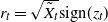 $r_t=\sqrt{\tilde X_t}\textrm{sign}(z_t)$
, i.e. an IARCH process exists. Next, we define
$r_t=\sqrt{\tilde X_t}\textrm{sign}(z_t)$
, i.e. an IARCH process exists. Next, we define $X_n=\tilde X_{-n}/a_0$
and
$X_n=\tilde X_{-n}/a_0$
and $\varepsilon_n=\tilde\varepsilon_{-n}$
for
$\varepsilon_n=\tilde\varepsilon_{-n}$
for $n\ge 1$
. Then
$n\ge 1$
. Then $(a_i)$
is a sequence of non-negative real numbers,
$(a_i)$
is a sequence of non-negative real numbers, $(\varepsilon_i)$
a sequence of independent copies of some non-negative random variable
$(\varepsilon_i)$
a sequence of independent copies of some non-negative random variable $\varepsilon$
, and
$\varepsilon$
, and $\sum_{i\ge1}a_i=\mathbb{E}\varepsilon=1$
. Moreover, (1.3) transforms into the system of equations that we call a non-homogeneous IARCH equation:
$\sum_{i\ge1}a_i=\mathbb{E}\varepsilon=1$
. Moreover, (1.3) transforms into the system of equations that we call a non-homogeneous IARCH equation:
 \begin{equation} X_n=\varepsilon_n\Bigg(1+\sum_{i\ge 1}a_iX_{n+i}\Bigg),\quad n\ge 1.\end{equation}
By a solution to it we mean any strictly stationary sequence $(X_n)$
of non-negative random variables such that, almost surely, all equalities (1.4) hold. We call the equation consistent if it has a solution. The non-homogeneous IARCH problem is to find conditions on
$(X_n)$
of non-negative random variables such that, almost surely, all equalities (1.4) hold. We call the equation consistent if it has a solution. The non-homogeneous IARCH problem is to find conditions on $(a_i)$
and the distribution of
$(a_i)$
and the distribution of $\varepsilon$
that guarantee consistency of (1.4).
$\varepsilon$
that guarantee consistency of (1.4).
It is known from the general theory of ARCH processes (see [Reference Kazakevičius and Leipus8]) that if the IARCH equation is consistent then it has a minimal solution $(X_n^*)$
with
$(X_n^*)$
with
 \begin{equation} X_n^*=\varepsilon_n\Bigg(1+\sum_{k\ge 1}\sum_{i_1,\dots,i_k\ge 1}a_{i_1}\cdots a_{i_k}\varepsilon_{n+i_1}\varepsilon_{n+i_1+i_2}\cdots\varepsilon_{n+i_1+\cdots+i_k}\Bigg).\end{equation}
Then the family $(\tilde X_t\mid t<0)$
defined by
$(\tilde X_t\mid t<0)$
defined by $\tilde X_t=a_0X^*_{-t}$
satisfies equations (1.3) for
$\tilde X_t=a_0X^*_{-t}$
satisfies equations (1.3) for $t<0$
, and can be extended by recursion to a complete solution of (1.3) that is adapted and strictly stationary. Therefore the consistency of (1.4) means that an IARCH process exists.
$t<0$
, and can be extended by recursion to a complete solution of (1.3) that is adapted and strictly stationary. Therefore the consistency of (1.4) means that an IARCH process exists.
Equation (1.3) with $a_0=0$
is essentially different. We write it in the form
$a_0=0$
is essentially different. We write it in the form
 \begin{equation} Z_n=\varepsilon_n\sum_{i\ge 1}a_iZ_{n+i},\quad n\ge 1,\end{equation}
and call it the homogeneous IARCH equation. Its solution is a strictly stationary sequence $(Z_n)$
of non-negative random variables such that, almost surely, all equations (1.6) hold. Equation (1.6) always has a trivial solution
$(Z_n)$
of non-negative random variables such that, almost surely, all equations (1.6) hold. Equation (1.6) always has a trivial solution $Z_n=0$
, and therefore the homogeneous IARCH problem is to find out if non-trivial solutions exist.
$Z_n=0$
, and therefore the homogeneous IARCH problem is to find out if non-trivial solutions exist.
The homogeneous IARCH problem is related to the problem of uniqueness of a solution to IARCH equation. A solution $(X_n)$
to (1.4) is called causal if, for some measurable function
$(X_n)$
to (1.4) is called causal if, for some measurable function $f\colon\mathbb{R}_+^{\infty}\to\mathbb{R}_+$
,
$f\colon\mathbb{R}_+^{\infty}\to\mathbb{R}_+$
, $X_n=f(\varepsilon_n,\varepsilon_{n+1},\dots\!)$
,
$X_n=f(\varepsilon_n,\varepsilon_{n+1},\dots\!)$
, $n\ge 1$
. Causal solutions to (1.6) are defined in a similar way. The minimal solution (1.5) is a causal solution with the following property: for any solution
$n\ge 1$
. Causal solutions to (1.6) are defined in a similar way. The minimal solution (1.5) is a causal solution with the following property: for any solution $(X_n)$
and all
$(X_n)$
and all $n\ge 1$
, almost surely
$n\ge 1$
, almost surely $X_n^*\le X_n$
. Hence, if the IARCH equation is consistent and
$X_n^*\le X_n$
. Hence, if the IARCH equation is consistent and $(Z_n)$
is a non-trivial causal solution to (1.6) then
$(Z_n)$
is a non-trivial causal solution to (1.6) then $(X_n)$
with
$(X_n)$
with $X_n=X_n^*+Z_n$
is another solution to (1.4). Conversely, if the minimal solution
$X_n=X_n^*+Z_n$
is another solution to (1.4). Conversely, if the minimal solution $(X_n^*)$
is not unique and
$(X_n^*)$
is not unique and $(X_n)$
is another causal solution, then
$(X_n)$
is another causal solution, then $(Z_n)$
with
$(Z_n)$
with $Z_n=X_n-X_n^*$
is a solution to (1.6).
$Z_n=X_n-X_n^*$
is a solution to (1.6).
However, the homogeneous IARCH problem is larger than the uniqueness problem: the homogeneous IARCH equation can possibly also have a non-trivial solution in the case where equation (1.4) is inconsistent. Moreover, it is not clear how equations (1.4) and (1.6) are related, if non-causal solutions are also considered.
We refer to the set of problems described above as the IARCH problem. It has a long history. The first result concerning IARCH processes was obtained in [Reference Bougerol and Picard3], which proved that the IARCH equation is consistent in the case where $\varepsilon$
is non-degenerate and the generating function
$\varepsilon$
is non-degenerate and the generating function $a(u)=\sum_{i\ge 1}a_iu^i$
of the sequence
$a(u)=\sum_{i\ge 1}a_iu^i$
of the sequence $(a_i)$
is rational (equals the quotient of two polynomials). [Reference Baillie, Bollerslev and Mikkelsen1] considered the model with
$(a_i)$
is rational (equals the quotient of two polynomials). [Reference Baillie, Bollerslev and Mikkelsen1] considered the model with $a(u)=1-(1-u)^{d}$
(where
$a(u)=1-(1-u)^{d}$
(where $0<d<1$
), but their proof of consistency was incorrect; see the discussion in [Reference Mikosch and Stărică11]. [Reference Kazakevičius and Leipus9] proved the consistency of (1.4) in the case where the
$0<d<1$
), but their proof of consistency was incorrect; see the discussion in [Reference Mikosch and Stărică11]. [Reference Kazakevičius and Leipus9] proved the consistency of (1.4) in the case where the $a_i$
decay exponentially. [Reference Douc, Roueff and Soulier4] gave a simple consistency proof under the following condition: for some
$a_i$
decay exponentially. [Reference Douc, Roueff and Soulier4] gave a simple consistency proof under the following condition: for some $0<r<1$
,
$0<r<1$
,
 \begin{equation} \sum_{i\ge 1}a_i^r\mathbb{E}\varepsilon^r<1.\end{equation}
There are also some results concerning the homogeneous IARCH problem. [Reference Bougerol and Picard3] proved the uniqueness of the solution in the case where a(u) is a rational function, and [Reference Kazakevičius and Leipus10] generalized that result to the case where coefficients decay exponentially. [Reference Douc, Roueff and Soulier4] showed, under condition (1.7), that there exists a unique causal solution $(X_n)$
with
$(X_n)$
with $\mathbb{E} X_n^r<\infty$
. [Reference Giraitis, Surgailis and Škarnulis6] is the only case that considered equation (1.6) itself, unrelated to the corresponding non-homogeneous equation. They obtained necessary and sufficient conditions for the existence of a square-integrable solution
$\mathbb{E} X_n^r<\infty$
. [Reference Giraitis, Surgailis and Škarnulis6] is the only case that considered equation (1.6) itself, unrelated to the corresponding non-homogeneous equation. They obtained necessary and sufficient conditions for the existence of a square-integrable solution $(Z_n)$
to (1.6).
$(Z_n)$
to (1.6).
Our main result in this paper is the following theorem.
Theorem 1.1. If $\varepsilon$
is non-degenerate and, for some
$\varepsilon$
is non-degenerate and, for some $\alpha>1$
,
$\alpha>1$
, $\sum_{i>l}a_i=O(l^{-\alpha})$
as
$\sum_{i>l}a_i=O(l^{-\alpha})$
as $l\to\infty$
, then (1.4) has a solution
$l\to\infty$
, then (1.4) has a solution $(X_n)$
with
$(X_n)$
with $\mathbb{E} X_n^r<\infty$
for all
$\mathbb{E} X_n^r<\infty$
for all $r\in(0;\;1)$
.
$r\in(0;\;1)$
.
Since $l^{\alpha}\sum_{i>l}a_i\le\sum_{i>l}i^{\alpha}a_i\le\sum_{i\ge1}i^{\alpha}a_i$
, we also get the following statement as a corollary of Theorem 1.1.
$l^{\alpha}\sum_{i>l}a_i\le\sum_{i>l}i^{\alpha}a_i\le\sum_{i\ge1}i^{\alpha}a_i$
, we also get the following statement as a corollary of Theorem 1.1.
Corollary 1.1. If $\varepsilon$
is non-degenerate and, for some
$\varepsilon$
is non-degenerate and, for some $\alpha>1$
,
$\alpha>1$
, $\sum_{i\ge 1}i^{\alpha}a_i<\infty$
, then (1.4) has a solution
$\sum_{i\ge 1}i^{\alpha}a_i<\infty$
, then (1.4) has a solution $(X_n)$
with
$(X_n)$
with $\mathbb{E} X_n^r<\infty$
for all
$\mathbb{E} X_n^r<\infty$
for all $r\in(0;\;1)$
.
$r\in(0;\;1)$
.
Since $\mathbb{E}\varepsilon=1$
, the assumption that
$\mathbb{E}\varepsilon=1$
, the assumption that $\varepsilon$
is non-degenerate excludes only one case, where
$\varepsilon$
is non-degenerate excludes only one case, where $\varepsilon=1$
almost surely. It is easily seen that in that case (1.4) is inconsistent; therefore, the assumption is absolutely necessary. The statement about moments of a solution is the strongest that could be expected, because the IARCH equation has no solution in
$\varepsilon=1$
almost surely. It is easily seen that in that case (1.4) is inconsistent; therefore, the assumption is absolutely necessary. The statement about moments of a solution is the strongest that could be expected, because the IARCH equation has no solution in $L^1$
: taking expectations of both sides in (1.4) yields (at least for causal solutions with
$L^1$
: taking expectations of both sides in (1.4) yields (at least for causal solutions with $\mathbb{E} X_n=\mu$
)
$\mathbb{E} X_n=\mu$
) $\mu=1+\sum_{i\ge 1}a_i\mu=1+\mu$
.
$\mu=1+\sum_{i\ge 1}a_i\mu=1+\mu$
.
Of course, Theorem 1.1 does not solve the non-homogeneous IARCH problem – it does not even cover completely the result of [Reference Douc, Roueff and Soulier4]. To see this, consider the sequences $(a_i)$
such that
$(a_i)$
such that $a_i\sim ci^{-1-\alpha}$
as
$a_i\sim ci^{-1-\alpha}$
as $i\to\infty$
, with some
$i\to\infty$
, with some $c,\alpha>0$
(
$c,\alpha>0$
( $\alpha$
should be positive, because
$\alpha$
should be positive, because $(a_i)$
is summable). If
$(a_i)$
is summable). If $\alpha>1$
then our Theorem 1.1 applies and we have the answer: (1.4) is always consistent, and no assumptions about
$\alpha>1$
then our Theorem 1.1 applies and we have the answer: (1.4) is always consistent, and no assumptions about $\varepsilon$
are needed (so our result in this case is better than that of [Reference Douc, Roueff and Soulier4], since (1.7) requires
$\varepsilon$
are needed (so our result in this case is better than that of [Reference Douc, Roueff and Soulier4], since (1.7) requires $\mathbb{E}\varepsilon^r$
to be smaller than
$\mathbb{E}\varepsilon^r$
to be smaller than $\big(\sum_{i\ge 1}a_i^r\big)^{-1}$
). The case
$\big(\sum_{i\ge 1}a_i^r\big)^{-1}$
). The case $0<\alpha\le 1$
, however, is still unclear: our theorem does not apply here, while the result of [Reference Douc, Roueff and Soulier4] shows that (1.4) is consistent for some
$0<\alpha\le 1$
, however, is still unclear: our theorem does not apply here, while the result of [Reference Douc, Roueff and Soulier4] shows that (1.4) is consistent for some $\varepsilon$
. So, there are two possibilities, in our opinion. First, the IARCH equation is always consistent, provided
$\varepsilon$
. So, there are two possibilities, in our opinion. First, the IARCH equation is always consistent, provided $\varepsilon$
is non-degenerate (until now, we still do not have any counterexample). Second, starting from the point
$\varepsilon$
is non-degenerate (until now, we still do not have any counterexample). Second, starting from the point $\alpha=1$
we can get both consistent and inconsistent IARCH equations, depending on the distribution of
$\alpha=1$
we can get both consistent and inconsistent IARCH equations, depending on the distribution of $\varepsilon$
. In the second case, the necessary and sufficient conditions for consistency would be very different from (1.7) (again, in our opinion). We intend to clarify the situation in the near future.
$\varepsilon$
. In the second case, the necessary and sufficient conditions for consistency would be very different from (1.7) (again, in our opinion). We intend to clarify the situation in the near future.
The corollary generalizes our unpublished result in [Reference Kazakevičius7], which corresponds to the case $\alpha=2$
. There, we used our subadditive ergodic theorem for double sequences as the main tool for cracking the problem. In the present paper we use a similar but somewhat sharper tool, which is detailed in Section 2 (see Proposition 2.1). Section 3 contains the proof of Theorem 1.1.
$\alpha=2$
. There, we used our subadditive ergodic theorem for double sequences as the main tool for cracking the problem. In the present paper we use a similar but somewhat sharper tool, which is detailed in Section 2 (see Proposition 2.1). Section 3 contains the proof of Theorem 1.1.
We end this introduction by describing some notation used in both sections. By a sequence we mean a family with index set $\mathbb{N}=\{1,2,\dots\}$
, and
$\mathbb{N}=\{1,2,\dots\}$
, and $E^{\infty}=E^{\mathbb{N}}$
is the set of all sequences of elements of the set E. If J is a finite set then the number of its elements is denoted by
$E^{\infty}=E^{\mathbb{N}}$
is the set of all sequences of elements of the set E. If J is a finite set then the number of its elements is denoted by $\lvert J\rvert$
.
$\lvert J\rvert$
.
We assume that all random variables are defined on some probability space $(\Omega,\mathbb{P})$
,
$(\Omega,\mathbb{P})$
, $\mathbb{E}$
stands for the corresponding expectation operator, and
$\mathbb{E}$
stands for the corresponding expectation operator, and $\mathbb{E}^Y$
for conditional expectation given a random variable Y. We write
$\mathbb{E}^Y$
for conditional expectation given a random variable Y. We write $\mathcal{L}(Y)$
for the distribution of a random variable Y,
$\mathcal{L}(Y)$
for the distribution of a random variable Y, $\mathcal{L}(Y\mid W)$
for its conditional distribution given an event W, and
$\mathcal{L}(Y\mid W)$
for its conditional distribution given an event W, and $\mathbf{1}_W$
for the indicator of the event W. For short, we write
$\mathbf{1}_W$
for the indicator of the event W. For short, we write $L^r$
instead of
$L^r$
instead of $L^r(\Omega,\mathbb{P})$
.
$L^r(\Omega,\mathbb{P})$
.
We set $I=\{i\mid a_i>0\}$
and use the letter i for elements of various sets
$I=\{i\mid a_i>0\}$
and use the letter i for elements of various sets $I^k$
,
$I^k$
, $k\ge 1$
. For
$k\ge 1$
. For $i=(i_1,\dots,i_k)\in I^k$
, we define
$i=(i_1,\dots,i_k)\in I^k$
, we define $\lvert i\rvert=i_1+\cdots+i_k$
and
$\lvert i\rvert=i_1+\cdots+i_k$
and $\xi(i)=a_{i_1}\cdots a_{i_k}\varepsilon_{i_1}\varepsilon_{i_1+i_2}\cdots\varepsilon_{i_1+\cdots+i_k}$
, and set
$\xi(i)=a_{i_1}\cdots a_{i_k}\varepsilon_{i_1}\varepsilon_{i_1+i_2}\cdots\varepsilon_{i_1+\cdots+i_k}$
, and set $\eta_{k,n}=\sum_{i\in I^k,\lvert i\rvert=n}\xi(i)$
. Note also that
$\eta_{k,n}=\sum_{i\in I^k,\lvert i\rvert=n}\xi(i)$
. Note also that $\eta_{k,n}=0$
for
$\eta_{k,n}=0$
for $k>n$
.
$k>n$
.
If Y is any random variable of the form $Y = f(\varepsilon_1,\varepsilon_2,\dots\!)$
, where
$Y = f(\varepsilon_1,\varepsilon_2,\dots\!)$
, where $f\colon\mathbb{R}^{\infty}\to\mathbb{R}$
is a measurable function, we define, for
$f\colon\mathbb{R}^{\infty}\to\mathbb{R}$
is a measurable function, we define, for $j\ge 1$
,
$j\ge 1$
, $Y^{(j)}=f(\varepsilon_{j+1},\varepsilon_{j+2},\dots\!)$
. Obviously,
$Y^{(j)}=f(\varepsilon_{j+1},\varepsilon_{j+2},\dots\!)$
. Obviously, $Y^{(j)}$
is equidistributed with Y and independent of
$Y^{(j)}$
is equidistributed with Y and independent of $(\varepsilon_i\mid i\le j)$
.
$(\varepsilon_i\mid i\le j)$
.
Finally, $\iota$
stands for the random variable taking values
$\iota$
stands for the random variable taking values $i\in I$
with probabilities
$i\in I$
with probabilities $a_i$
,
$a_i$
, $(\iota_k)$
is a sequence of independent copies of
$(\iota_k)$
is a sequence of independent copies of $\iota$
, and
$\iota$
, and $S_k=\iota_1+\cdots+\iota_k$
. Clearly, for any
$S_k=\iota_1+\cdots+\iota_k$
. Clearly, for any $i\in I^k$
,
$i\in I^k$
,
 \begin{equation*} \mathbb{E}\xi(i)=a_{i_1}\cdots a_{i_k}=\mathbb{P}(\iota_1=i_1,\dots,\iota_k=i_k),\end{equation*}
and therefore $\mathbb{E}\eta_{k,n}=\mathbb{P}(S_k=n)$
. Note also that, under the assumptions of Theorem 1.1,
$\mathbb{E}\eta_{k,n}=\mathbb{P}(S_k=n)$
. Note also that, under the assumptions of Theorem 1.1, $\mathbb{E}\iota<\infty$
.
$\mathbb{E}\iota<\infty$
.
2. The main tool
The main result in this section is Proposition 2.1. It is preceded by two lemmas about some special functions on $\mathbb{R}_+^m$
, where
$\mathbb{R}_+^m$
, where $\mathbb{R}_+=[0;\;\infty)$
and
$\mathbb{R}_+=[0;\;\infty)$
and $m\ge 2$
(we will use them in the case where
$m\ge 2$
(we will use them in the case where $m=2$
). Here is some additional notation that is used only in this section: for
$m=2$
). Here is some additional notation that is used only in this section: for $x=(x_1,\dots,x_m)\in\mathbb{R}_+^m$
, we define
$x=(x_1,\dots,x_m)\in\mathbb{R}_+^m$
, we define $\lvert x\rvert=x_1+\cdots+x_m$
and
$\lvert x\rvert=x_1+\cdots+x_m$
and $x^*=x/\lvert x\rvert$
(provided
$x^*=x/\lvert x\rvert$
(provided $\lvert x\rvert\ne 0$
); we write
$\lvert x\rvert\ne 0$
); we write $e=(1,\dots,1)\in\mathbb{R}_+^m$
and
$e=(1,\dots,1)\in\mathbb{R}_+^m$
and $H_u=\{x\in\mathbb{R}_+^m\mid \lvert x\rvert=u\}$
.
$H_u=\{x\in\mathbb{R}_+^m\mid \lvert x\rvert=u\}$
.
Let us introduce the functions of interest. If $b=(b_1,\dots,b_m)$
is any vector with positive components, for
$b=(b_1,\dots,b_m)$
is any vector with positive components, for $x\in\mathbb{R}_+^m$
define
$x\in\mathbb{R}_+^m$
define
 \begin{equation} f_b(x)=\lvert x\rvert\log\lvert x\rvert-\sum_{i=1}^mx_i\log x_i+\sum_{i=1}^mx_i\log b_i\end{equation}
(assuming $0\log0=0$
). Here is the first result we need.
$0\log0=0$
). Here is the first result we need.
Lemma 2.1. The largest value of $f_b$
on
$f_b$
on $H_u$
equals
$H_u$
equals $u\log\lvert b\rvert$
and is attained at the unique point
$u\log\lvert b\rvert$
and is attained at the unique point $ub^*$
.
$ub^*$
.
Proof. If $u=0$
, the statement of the theorem is obvious, because the set
$u=0$
, the statement of the theorem is obvious, because the set $H_u$
only contains the point 0. If
$H_u$
only contains the point 0. If $u>0$
then, for all
$u>0$
then, for all $x\in H_u$
,
$x\in H_u$
,
 \begin{align*} f_b(x) & = u\log u-u\sum_{i=1}^mx^*_i\log x_i+u\sum_{i=1}^mx^*_i\log b_i \\[5pt] & = -u\Bigg(\sum_{i=1}^mx^*_i\log x^*_i-\sum_{i=1}^mx^*_i\log b_i\Bigg) = u\log\lvert b\rvert-uD_{\mathrm{KL}}(x^*\parallel b^*), \end{align*}
where $D_{\mathrm{KL}}(x^*\parallel b^*)$
is the Kullback–Leibler divergence from
$D_{\mathrm{KL}}(x^*\parallel b^*)$
is the Kullback–Leibler divergence from $b^*$
to
$b^*$
to $x^*$
(both considered as probability distributions on
$x^*$
(both considered as probability distributions on $\{1,\dots,m\}$
). The assertion of the lemma now follows from the well-known fact that
$\{1,\dots,m\}$
). The assertion of the lemma now follows from the well-known fact that $D_{\mathrm{KL}}(x^*\parallel b^*)\ge 0$
, with equality only in the case where
$D_{\mathrm{KL}}(x^*\parallel b^*)\ge 0$
, with equality only in the case where $x^*=b^*$
, i.e.
$x^*=b^*$
, i.e. $x=ub^*$
.
$x=ub^*$
.
In the proof of the lemma we established a useful formula: for $x\ne 0$
,
$x\ne 0$
,
 \begin{equation*} f_b(x)=\lvert x\rvert\log\lvert b\rvert-\lvert x\rvert D_{\mathrm{KL}}(x^*\parallel b^*).\end{equation*}
It yields that $f_b(cx)=c{\kern1pt}f_b(x)$
for all
$f_b(cx)=c{\kern1pt}f_b(x)$
for all $c\ge 0$
and
$c\ge 0$
and $x\in\mathbb{R}_+^m$
; if
$x\in\mathbb{R}_+^m$
; if $c>0$
and
$c>0$
and $x\ne0$
the equality follows from the fact that
$x\ne0$
the equality follows from the fact that $(cx)^*=x^*$
and in the remaining cases it is verified directly.
$(cx)^*=x^*$
and in the remaining cases it is verified directly.
Our second lemma explains why the function $f_e$
is so important. Recall the definition of the multinomial coefficients: if
$f_e$
is so important. Recall the definition of the multinomial coefficients: if $p_1,\dots,p_m$
are non-negative integers,
$p_1,\dots,p_m$
are non-negative integers, $p=(p_1,\dots,p_m)$
, and
$p=(p_1,\dots,p_m)$
, and $q=p_1+\cdots+p_m$
, then
$q=p_1+\cdots+p_m$
, then
 \begin{equation*} \binom{q}{p}=\frac{q!}{p_1!\cdots p_m!}.\end{equation*}
Lemma 2.2. Let n and $p_1,\dots,p_m$
be non-negative integers, depending on some natural parameter k (which is ommitted from the notation for the sake of readability), and
$p_1,\dots,p_m$
be non-negative integers, depending on some natural parameter k (which is ommitted from the notation for the sake of readability), and $q=p_1+\cdots+p_m$
. If
$q=p_1+\cdots+p_m$
. If $n\to\infty$
and
$n\to\infty$
and $p_i/n\to x_i$
as
$p_i/n\to x_i$
as $k\to\infty$
for some finite
$k\to\infty$
for some finite $x_i$
(and all
$x_i$
(and all $i=1,\dots,m$
), then
$i=1,\dots,m$
), then
 \begin{equation*} \frac1n\log\binom{q}{p}\to f_e(x)\quad\text{as $k\to\infty$,} \end{equation*}
where $p=(p_1,\dots,p_m)$
and
$p=(p_1,\dots,p_m)$
and $x=(x_1,\dots,x_m)$
.
$x=(x_1,\dots,x_m)$
.
Proof. We consider two separate cases.
Step 1: The case where $n=q$
. By Stirling’s formula,
$n=q$
. By Stirling’s formula, $\log s!=s\log s-s+o(s)$
as
$\log s!=s\log s-s+o(s)$
as $s\to\infty$
. Hence
$s\to\infty$
. Hence $\log p_i!=p_i\log p_i-p_i+o(p_i)=p_i\log p_i-p_i+o(q)$
as
$\log p_i!=p_i\log p_i-p_i+o(p_i)=p_i\log p_i-p_i+o(q)$
as $N\ni k\to\infty$
for all infinite
$N\ni k\to\infty$
for all infinite $N\subset\mathbb{N}$
such that
$N\subset\mathbb{N}$
such that $p_i\to\infty$
as
$p_i\to\infty$
as $N\ni k\to\infty$
. On the other hand, the assumption
$N\ni k\to\infty$
. On the other hand, the assumption $q\to\infty$
yields that the relation obtained also holds for all N such that
$q\to\infty$
yields that the relation obtained also holds for all N such that $p_i=O(1)$
as
$p_i=O(1)$
as $N\ni k\to\infty$
. Any sequence of non-negative numbers contains a subsequence that either tends to
$N\ni k\to\infty$
. Any sequence of non-negative numbers contains a subsequence that either tends to $\infty$
or is bounded; therefore, for all i,
$\infty$
or is bounded; therefore, for all i, $\log p_i!=p_i\log p_i-p_i+o(q)$
as
$\log p_i!=p_i\log p_i-p_i+o(q)$
as $k\to\infty$
. Moreover, by Stirling’s formula,
$k\to\infty$
. Moreover, by Stirling’s formula, $\log q!=q\log q-q+o(q)$
as
$\log q!=q\log q-q+o(q)$
as $k\to\infty$
. Hence
$k\to\infty$
. Hence
 \begin{equation*} \log\binom{q}{p}=q\log q-q-\sum_{i=1}^m(p_i\log p_i-p_i)+o(q)=f_e(p)+o(q) \end{equation*}
and
 \begin{equation*} \frac1q\log\binom{q}{p}=\frac1q {\kern1pt}f_e(p)+o(1)=f_e(p/q)+o(1)\to f_e(x)\quad\text{as $k\to\infty$.} \end{equation*}
Step 2: The general case. First let $\lvert x\rvert>0$
. If
$\lvert x\rvert>0$
. If $p_i/n\to x_i$
, then
$p_i/n\to x_i$
, then $q/n\to \lvert x\rvert$
(and therefore
$q/n\to \lvert x\rvert$
(and therefore $q\to\infty$
) and
$q\to\infty$
) and $p_i/q\to x_i/\lvert x\rvert=x^*_i$
as
$p_i/q\to x_i/\lvert x\rvert=x^*_i$
as $k\to\infty$
. By Step 1,
$k\to\infty$
. By Step 1,
 \begin{equation*} \frac1n\log\binom{q}{p}=\frac{q}{n}\frac1q\log\binom{q}{p}\to \lvert x\rvert f_e(x^*)=f_e(x) \quad \text{as $k\to\infty$.} \end{equation*}
Now consider the remaining case, where $x=0$
and therefore
$x=0$
and therefore $f_e(x)=0$
. Let N be an arbitrary infinite set of natural numbers. If
$f_e(x)=0$
. Let N be an arbitrary infinite set of natural numbers. If $q\to\infty$
as
$q\to\infty$
as $N\ni k\to\infty$
, by Step 1 we get
$N\ni k\to\infty$
, by Step 1 we get
 \begin{equation*} \frac1n\log\binom{q}{p}=\frac qn\frac1q\log\binom{q}{p}=o(1)O(1)\to 0\quad\text{as $N\ni k\to\infty$}. \end{equation*}
If $q=O(1)$
as
$q=O(1)$
as $N\ni k\to\infty$
, then
$N\ni k\to\infty$
, then
 \begin{equation*} \frac1n\log\binom{q}{p}=\frac1nO(1)\to 0 \quad\text{as $N\ni k\to\infty$}. \end{equation*}
The same argument as in Step 1 then yields
 \begin{equation*} \frac1n\log\binom{q}{p}\to0=f_e(x)\quad\text{as $k\to\infty$.} \end{equation*}
Now we are ready to prove the main result of this section.
Proposition 2.1. If the random variable $\varepsilon$
is non-degenerate then, for all
$\varepsilon$
is non-degenerate then, for all $r,\gamma\in(0;\;1)$
, there exist a
$r,\gamma\in(0;\;1)$
, there exist a $\delta>0$
and a random variable C with the following properties:
$\delta>0$
and a random variable C with the following properties:
-
(i) $\mathbb{E} C^r<\infty$
;
$\mathbb{E} C^r<\infty$
; -
(ii) for all
$n\ge 1$
and
$k\ge\gamma n$
,
$\eta_{k,n}\le C\mathrm{e}^{-\delta n}$
.


Proof. We write $\pi_2=\mathbb{P}(\varepsilon>1)$
and
$\pi_2=\mathbb{P}(\varepsilon>1)$
and $\pi_1=1-\pi_2$
. Since
$\pi_1=1-\pi_2$
. Since $\mathbb{E}\varepsilon=1$
and
$\mathbb{E}\varepsilon=1$
and $\varepsilon$
is non-degenerate, both these numbers are positive. Let
$\varepsilon$
is non-degenerate, both these numbers are positive. Let $Q_n=\sum_{i=1}^n\mathbf{1}_{\{\varepsilon_i>1\}}$
and
$Q_n=\sum_{i=1}^n\mathbf{1}_{\{\varepsilon_i>1\}}$
and $\tilde\eta_{k,n}=\mathbb{E}^{Q_n}\eta_{k,n}$
. Clearly,
$\tilde\eta_{k,n}=\mathbb{E}^{Q_n}\eta_{k,n}$
. Clearly, $Q_n$
is distributed according to the binomial law:
$Q_n$
is distributed according to the binomial law:
 \begin{equation*} \mathbb{P}(Q_n=q)=\binom{n}{q}\pi_1^{n-q}\pi_2^q\quad\text{for $q=0,\dots,n$.} \end{equation*}
Let us find out how $\tilde\eta_{k,n}$
is computed.
$\tilde\eta_{k,n}$
is computed.
Write $z_1=(1/{\pi_1})\mathbb{E}\varepsilon\mathbf{1}_{\{\varepsilon\le 1\}}$
and
$z_1=(1/{\pi_1})\mathbb{E}\varepsilon\mathbf{1}_{\{\varepsilon\le 1\}}$
and $z_2=(1/{\pi_2})\mathbb{E}\varepsilon\mathbf{1}_{\{\varepsilon>1\} }$
, and fix any
$z_2=(1/{\pi_2})\mathbb{E}\varepsilon\mathbf{1}_{\{\varepsilon>1\} }$
, and fix any $0\le q\le n$
and any partition (S, T) of the set
$0\le q\le n$
and any partition (S, T) of the set $\{1,\dots,n\}$
with
$\{1,\dots,n\}$
with $\lvert S\rvert=k$
. Then
$\lvert S\rvert=k$
. Then
 \begin{align*} &\mathbb{E} \prod_{j\in S}\varepsilon_j\mathbf{1}_{\{Q_n=q\}} \\ & \quad = \sum_{p=0}^q\sum_{\substack{S'\subset S\\ \lvert S'\rvert=p}}\sum_{\substack{T'\subset T\\ \lvert T'\rvert=q-p}} \mathbb{E}\prod_{j\in S}\varepsilon_j\prod_{j\in S'}\mathbf{1}_{\{\varepsilon_j>1\}} \prod_{j\in S\setminus S'}\mathbf{1}_{\{\varepsilon_j\le1\}}\prod_{j\in T'}\mathbf{1}_{\{\varepsilon_j>1\}} \prod_{j\in T\setminus T'}\mathbf{1}_{\{\varepsilon_j\le 1\}} \\ & \quad = \sum_{p=0}^q\sum_{\substack{S'\subset S\\ \lvert S'\rvert=p}}\sum_{\substack{T'\subset T\\ \lvert T'\rvert=q-p}} (\pi_1z_1)^{k-p}(\pi_2z_2)^{p}\pi_1^{n-k-q+p}\pi_2^{q-p} \\ & \quad = \pi_1^{n-q}\pi_2^q\sum_{p=0}^q\binom{k}{p}\binom{n-k}{q-p}z_1^{k-p}z_2^p. \end{align*}
Denoting the sum on the right-hand side by $h_{k,n}(q)$
we get, on the set
$h_{k,n}(q)$
we get, on the set $\{Q_n=q\}$
,
$\{Q_n=q\}$
,
 \begin{equation*} \mathbb{E}^{Q_n} \prod_{j\in S}\varepsilon_j=\binom{n}{q}^{-1}h_{k,n}(q), \end{equation*}
which yields
 \begin{equation*} \tilde\eta_{k,n} = \sum_{i\in I^k,\lvert i\rvert=n}a_{i_1}\cdots a_{i_k}\mathbb{E}^{Q_n}\prod_{j\in\{i_1,i_1+i_2,\dots,i_1+\cdots+i_k\}}\varepsilon_j= \mathbb{P}(S_k=n)\binom{n}{q}^{-1}h_{k,n}(q). \end{equation*}
Since $\binom{m}{l}=0$
for
$\binom{m}{l}=0$
for $l<0$
and for
$l<0$
and for $l>m$
, the actual domain of index p in the sum defining
$l>m$
, the actual domain of index p in the sum defining $h_{kn}(q)$
is defined by the inequalities
$h_{kn}(q)$
is defined by the inequalities
 \begin{equation} 0\le p\le k,\qquad 0\le q-p\le n-k. \end{equation}
Notice also that
 \begin{equation} 0<z_1<1<z_2,\qquad\pi_1+\pi_2=1,\qquad \pi_1z_1+\pi_2z_2=1. \end{equation}
Now we fix $r,\gamma\in(0;\;1)$
and define
$r,\gamma\in(0;\;1)$
and define $C_{n}=\max_{k\ge\gamma n}\eta_{k,n}$
,
$C_{n}=\max_{k\ge\gamma n}\eta_{k,n}$
, $\tilde C_n=\max_{k\ge\gamma n}\tilde\eta_{k,n}$
, and
$\tilde C_n=\max_{k\ge\gamma n}\tilde\eta_{k,n}$
, and $\bar C_n(q)=\max_{k\ge\gamma n}h_{k,n}(q)$
. Clearly,
$\bar C_n(q)=\max_{k\ge\gamma n}h_{k,n}(q)$
. Clearly,
 \begin{equation*} \tilde C_n\le\binom{n}{Q_n}^{-1}\bar C_n(Q_n). \end{equation*}
The remaining proof is performed in four steps.
Step 1. We prove that $\varlimsup_{n\to\infty}\big({\log\mathbb{E}\tilde C_n^r}\big)/{n}\le c$
with
$\varlimsup_{n\to\infty}\big({\log\mathbb{E}\tilde C_n^r}\big)/{n}\le c$
with $c=\max_{(x,y)\in E}h(x,y)$
, where the set
$c=\max_{(x,y)\in E}h(x,y)$
, where the set $E\subset\mathbb{R}^2\times\mathbb{R}^2$
is defined by inequalities
$E\subset\mathbb{R}^2\times\mathbb{R}^2$
is defined by inequalities $0\le x_1\le y_1$
,
$0\le x_1\le y_1$
, $0\le x_2\le y_2$
,
$0\le x_2\le y_2$
, $x_1+x_2\ge\gamma$
,
$x_1+x_2\ge\gamma$
, $y_1+y_2=1$
, and, for
$y_1+y_2=1$
, and, for $(x,y)\in E$
,
$(x,y)\in E$
, $h(x,y)=(1-r)\,f_{\pi}(y)+r(\,f_{\pi z}(x)+f_{\pi}(y-x))$
(here,
$h(x,y)=(1-r)\,f_{\pi}(y)+r(\,f_{\pi z}(x)+f_{\pi}(y-x))$
(here, $\pi=(\pi_1,\pi_2)$
,
$\pi=(\pi_1,\pi_2)$
, $\pi z=(\pi_1z_1,\pi_2z_2)$
, and the functions
$\pi z=(\pi_1z_1,\pi_2z_2)$
, and the functions $f_b$
are defined by (2.1)).
$f_b$
are defined by (2.1)).
Find $q_n$
such that
$q_n$
such that
 \begin{equation*} \binom{n}{q_n}^{-r}\bar C_n(q_n)^r\mathbb{P}(Q_n=q_n) = \max_{0\le q\le n}\binom{n}{q}^{-r}\bar C_n(q)^r\mathbb{P}(Q_n=q); \end{equation*}
then
 \begin{align*} \mathbb{E}\tilde C_n^r \le \mathbb{E}\binom{n}{Q_n}^{-r}\bar C_n(Q_n)^r & = \sum_{q=0}^n\binom{n}{q}^{-r}\bar C_n(q)^r\mathbb{P}(Q_n=q) \\[5pt] & \le (n+1)\binom{n}{q_n}^{-r}\bar C_n(q_n)^r\mathbb{P}(Q_n=q_n) \\[5pt] & = (n+1)\binom{n}{q_n}^{1-r}\bar C_n(q_n)^r\pi_1^{n-q_n}\pi_2^{q_n} \end{align*}
and it suffices to show that
 \begin{equation*} \varlimsup_{n\to\infty}\frac1n\left((1-r)\log\binom{n}{q_n} + r\log\bar C_n(q_n)+(n-q_n)\log\pi_1+q_n\log\pi_2\right)\le c. \end{equation*}
Let $N_0$
be an infinite subset of
$N_0$
be an infinite subset of $\mathbb{N}$
such that in the latter formula
$\mathbb{N}$
such that in the latter formula $\varlimsup_{n\to\infty}$
can be replaced by
$\varlimsup_{n\to\infty}$
can be replaced by $\lim_{N_0\ni n\to\infty}$
. Let N be an arbitrary infinite subset of
$\lim_{N_0\ni n\to\infty}$
. Let N be an arbitrary infinite subset of $N_0$
. Then it suffices to prove the analogous inequality, where
$N_0$
. Then it suffices to prove the analogous inequality, where $\varlimsup_{n\to\infty}$
is replaced by
$\varlimsup_{n\to\infty}$
is replaced by $\lim_{N\ni n\to\infty}$
. Without loss of generality we can assume that
$\lim_{N\ni n\to\infty}$
. Without loss of generality we can assume that $q_n/n\to y_2$
as
$q_n/n\to y_2$
as $N\ni n\to\infty$
, where
$N\ni n\to\infty$
, where $y_2\in[0;\;1]$
is some fixed number. Write
$y_2\in[0;\;1]$
is some fixed number. Write $y_1=1-y_2$
and
$y_1=1-y_2$
and $y=(y_1,y_2)$
. Then, by Lemma 2.2,
$y=(y_1,y_2)$
. Then, by Lemma 2.2,
 \begin{equation*} \frac1n\log\binom{n}{q_n}\to f_e(y)\quad\text{as $N\ni n\to\infty$.} \end{equation*}
Moreover,
 \begin{equation*} \log\bar C_n(q_n) = \log\bar h_{k_n,n}(q_n) \le \log\bigg((n+1)\binom{k_n}{p_n}\binom{n-k_n}{q_n-p_n}z_1^{k_n-p_n}z_2^{p_n}\bigg) \end{equation*}
for some sequences $(k_n)$
and
$(k_n)$
and $(p_n)$
with
$(p_n)$
with $k_n\ge\gamma n$
. Without loss of generality, we can assume that
$k_n\ge\gamma n$
. Without loss of generality, we can assume that $p_n/n\to x_2$
and
$p_n/n\to x_2$
and $(k_n-p_n)/n\to x_1$
as
$(k_n-p_n)/n\to x_1$
as $N\ni n\to\infty$
, with some non-negative
$N\ni n\to\infty$
, with some non-negative $x_1,x_2$
. Writing
$x_1,x_2$
. Writing $x=(x_1,x_2)$
, then inequalities (2.2) and
$x=(x_1,x_2)$
, then inequalities (2.2) and $k_n\ge\gamma n$
imply
$k_n\ge\gamma n$
imply $(x,y)\in E$
. Moreover, by Lemma 2.2,
$(x,y)\in E$
. Moreover, by Lemma 2.2,
 \begin{equation*} \lim_{N\ni n\to\infty}\frac1n\log\bar C_n(q_n)\,\le\, f_e(x)+\,f_e(y-x)+\sum_{i=1}^2x_i\log z_i. \end{equation*}
Therefore the limit of interest does not exceed
 \begin{align*} & (1-r)\,f_e(y)+r\Bigg(\,f_e(x)+f_e(y-x)+\sum_{i=1}^2x_i\log z_i\Bigg)+\sum_{i=1}^2y_i\log\pi_i \\[5pt] & \quad = (1-r)\Bigg(\,f_e(y)+\sum_{i=1}^2y_i\log\pi_i\Bigg) + r\Bigg(\,f_e(x)+f_e(y-x)+\sum_{i=1}^2x_i\log z_i+\sum_{i=1}^2y_i\log\pi_i\Bigg) \\[5pt] & \quad = (1-r)\,f_{\pi}(y)+r(\,f_{\pi z}(x)+f_{\pi}(y-x)) \le c. \end{align*}
Step 2. We prove that $c<0$
. The equalities in (2.3) mean that
$c<0$
. The equalities in (2.3) mean that $\lvert\pi\rvert=\lvert\pi z\rvert=1$
. By Lemma 2.1, for all
$\lvert\pi\rvert=\lvert\pi z\rvert=1$
. By Lemma 2.1, for all $(x,y)\in E$
,
$(x,y)\in E$
,
 \begin{equation} f_{\pi}(y)\le 0, \qquad f_{\pi z}(x)\le 0, \qquad f_{\pi}(y-x)\le 0, \end{equation}
and therefore $h(x,y)\le 0$
. Hence
$h(x,y)\le 0$
. Hence $c\le 0$
. Suppose
$c\le 0$
. Suppose $c=0$
. Then, by continuity,
$c=0$
. Then, by continuity, $h(x,y)=0$
for some
$h(x,y)=0$
for some $(x,y)\in E$
, and at that point all three of the inequalities in (2.4) become equalities. Since
$(x,y)\in E$
, and at that point all three of the inequalities in (2.4) become equalities. Since $\lvert y\rvert=1$
, by Lemma 2.1 we get
$\lvert y\rvert=1$
, by Lemma 2.1 we get $y=\pi$
,
$y=\pi$
, $x=\lvert x\rvert\pi z$
, and
$x=\lvert x\rvert\pi z$
, and $y-x=\lvert y-x\rvert\pi=(1-\lvert x\rvert)\pi$
, which yields
$y-x=\lvert y-x\rvert\pi=(1-\lvert x\rvert)\pi$
, which yields $\lvert x\rvert\pi z=x=\lvert x\rvert\pi$
. We get a contradiction, because
$\lvert x\rvert\pi z=x=\lvert x\rvert\pi$
. We get a contradiction, because $\pi z\ne\pi$
and
$\pi z\ne\pi$
and $(x,y)\in E$
implies
$(x,y)\in E$
implies $\lvert x\rvert\ge\gamma$
.
$\lvert x\rvert\ge\gamma$
.
Step 3. We prove that $\varlimsup_{n\to\infty}\big({\log\mathbb{E} C_n^r}\big)/{n}<0$
. By the concavity of the function
$\varlimsup_{n\to\infty}\big({\log\mathbb{E} C_n^r}\big)/{n}<0$
. By the concavity of the function $x^r$
and by the fact that
$x^r$
and by the fact that $\eta_{k,n}=0$
for
$\eta_{k,n}=0$
for $k>n$
,
$k>n$
,
 \begin{align*} \mathbb{E} C_n^r \le \mathbb{E}\Bigg(\sum_{k\ge\gamma n}\eta_{k,n}\Bigg)^r & = \mathbb{E}\mathbb{E}^{Q_n}\Bigg(\sum_{k\ge\gamma n}\eta_{k,n}\Bigg)^r \\[5pt] & \le \mathbb{E}\Bigg(\mathbb{E}^{Q_n}\sum_{k\ge\gamma n}\eta_{k,n}\Bigg)^r \\[5pt] & = \mathbb{E}\Bigg(\sum_{k\ge\gamma n}\tilde\eta_{k,n}\Bigg)^r \le \mathbb{E}\Big(n\max_{k\ge\gamma n}\tilde\eta_{k,n}\Big)^r = n^r\mathbb{E}\tilde C_n^r. \end{align*}
Then, by the results of Steps 1 and 2,
 \begin{equation*} \varlimsup_{n\to\infty}\frac{\log\mathbb{E} C_n^r}{n} \le \varlimsup_{n\to\infty}\frac{r\log n+\log\mathbb{E}\tilde C_n^r}{n} = \varlimsup_{n\to\infty}\frac{\log\mathbb{E}\tilde C_n^r}{n} < 0. \end{equation*}
Step 4. By the Step 3 result, there exists a $t>1$
such that
$t>1$
such that $\sum_{n\ge 1}t^n\mathbb{E} C_n^r<\infty$
. Then, by the well-known inequality
$\sum_{n\ge 1}t^n\mathbb{E} C_n^r<\infty$
. Then, by the well-known inequality $(\!\sum_ix_i)^r\le \sum_ix_i^r$
, valid for any family
$(\!\sum_ix_i)^r\le \sum_ix_i^r$
, valid for any family $(x_i)$
of non-negative numbers, we get
$(x_i)$
of non-negative numbers, we get
 \begin{equation*} \mathbb{E}\Bigg(\sum_{n\ge 1}C_nt^n\Bigg)^r \le \mathbb{E}\sum_{n\ge 1}C_n^rt^{nr} \le \mathbb{E}\sum_{n\ge 1}C_n^rt^n<\infty. \end{equation*}
Writing $C=\sum_{n\ge 1}C_nt^n$
, then
$C=\sum_{n\ge 1}C_nt^n$
, then $\mathbb{E} C^r<\infty$
. Writing
$\mathbb{E} C^r<\infty$
. Writing $t=\mathrm{e}^{\delta}$
, we get, for all
$t=\mathrm{e}^{\delta}$
, we get, for all $n\ge 1$
and
$n\ge 1$
and $k\ge\gamma n$
,
$k\ge\gamma n$
, $C_n\mathrm{e}^{\delta n}\le C$
and
$C_n\mathrm{e}^{\delta n}\le C$
and $\eta_{k,n}\le C_n\le C\mathrm{e}^{-\delta n}$
.
$\eta_{k,n}\le C_n\le C\mathrm{e}^{-\delta n}$
.
The assertion of the proposition can be reformulated as follows: for any $r\in(0;\;1)$
and
$r\in(0;\;1)$
and $u>1$
there exists a
$u>1$
there exists a $\delta>0$
and a random variable C with
$\delta>0$
and a random variable C with $\mathbb{E} C^r<\infty$
such that
$\mathbb{E} C^r<\infty$
such that $\eta_{k,n}\le C\mathrm{e}^{-\delta k}$
for all
$\eta_{k,n}\le C\mathrm{e}^{-\delta k}$
for all $k\ge 1$
and
$k\ge 1$
and $n\le uk$
. Indeed, if we write
$n\le uk$
. Indeed, if we write $\gamma=u^{-1}$
and find
$\gamma=u^{-1}$
and find $\delta$
and C as in the theorem, then for
$\delta$
and C as in the theorem, then for $k\ge 1$
and
$k\ge 1$
and $n\le uk$
we get
$n\le uk$
we get $\eta_{k,n}\le C\mathrm{e}^{-\delta n}\le C\mathrm{e}^{-\delta k}$
(because
$\eta_{k,n}\le C\mathrm{e}^{-\delta n}\le C\mathrm{e}^{-\delta k}$
(because $\eta_{k,n}=0$
for
$\eta_{k,n}=0$
for $n<k$
).
$n<k$
).
3. Proof of Theorem 1.1
The proof of Theorem 1.1 is preceded by the following lemma. We believe that it is well known, but we could not find its proof in the literature, so we have added our own proof for completeness.
Lemma 3.1. If $\zeta$
is a non-negative random variable with
$\zeta$
is a non-negative random variable with $\mathbb{E}\zeta<\infty$
, and
$\mathbb{E}\zeta<\infty$
, and $\zeta_l$
is another random variable with
$\zeta_l$
is another random variable with $\mathcal{L}(\zeta_l)=\mathcal{L}(\zeta\mid\zeta\le l)$
, then
$\mathcal{L}(\zeta_l)=\mathcal{L}(\zeta\mid\zeta\le l)$
, then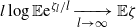 $l\log\mathbb{E}\mathrm{e}^{\zeta_l/l}\xrightarrow[l\to\infty]{}\mathbb{E}\zeta$
.
$l\log\mathbb{E}\mathrm{e}^{\zeta_l/l}\xrightarrow[l\to\infty]{}\mathbb{E}\zeta$
.
Proof. Since $\mathbb{P}(\zeta\le l)\to 1$
, we get
$\mathbb{P}(\zeta\le l)\to 1$
, we get $\mathbb{E}\mathrm{e}^{\zeta_l/l}\sim\mathbb{E}\mathbf{1}_{\{\zeta\le l\}}\mathrm{e}^{\zeta/l}$
as
$\mathbb{E}\mathrm{e}^{\zeta_l/l}\sim\mathbb{E}\mathbf{1}_{\{\zeta\le l\}}\mathrm{e}^{\zeta/l}$
as $l\to\infty$
. For all l, almost surely,
$l\to\infty$
. For all l, almost surely, $\mathbf{1}_{\{\zeta\le l\}}\mathrm{e}^{\zeta/l}\to 1$
and
$\mathbf{1}_{\{\zeta\le l\}}\mathrm{e}^{\zeta/l}\to 1$
and $\mathbf{1}_{\{\zeta\le l\}}\mathrm{e}^{\zeta/l}\le \mathrm{e}$
; therefore
$\mathbf{1}_{\{\zeta\le l\}}\mathrm{e}^{\zeta/l}\le \mathrm{e}$
; therefore $\mathbb{E}\mathbf{1}_{\{\zeta\le l\}}\mathrm{e}^{\zeta/l}\to 1$
as
$\mathbb{E}\mathbf{1}_{\{\zeta\le l\}}\mathrm{e}^{\zeta/l}\to 1$
as $l\to\infty$
. Hence
$l\to\infty$
. Hence $\mathbb{E}\mathrm{e}^{\zeta_l/l}\to 1$
and
$\mathbb{E}\mathrm{e}^{\zeta_l/l}\to 1$
and
 \begin{equation*} l\log\mathbb{E}\mathrm{e}^{\zeta_l/l} \sim l(\mathbb{E} \mathrm{e}^{\zeta_l/l}-1) = \mathbb{E} l(\mathrm{e}^{\zeta_l/l}-1)\sim\mathbb{E} l(\mathrm{e}^{\zeta/l}-1)\mathbf{1}_{\{\zeta\le l\}}. \end{equation*}
It remains to apply the dominated convergence theorem once again: almost surely,
 \begin{equation*} l(\mathrm{e}^{\zeta/l}-1)\mathbf{1}_{\{\zeta\le l\}}\to\zeta, \qquad 0 \le l(\mathrm{e}^{\zeta/l}-1)\mathbf{1}_{\{\zeta\le l\}} \le \sup_{\theta\in(0;\;1)}(\zeta\mathrm{e}^{\theta\zeta/l})\mathbf{1}_{\{\zeta\le l\}} \le \mathrm{e}\zeta, \end{equation*}
and $\mathbb{E}\mathrm{e}\zeta<\infty$
; therefore
$\mathbb{E}\mathrm{e}\zeta<\infty$
; therefore $\mathbb{E} l(\mathrm{e}^{\zeta/l}-1)\mathbf{1}_{\{\zeta\le l\}}\to\mathbb{E}\zeta$
as
$\mathbb{E} l(\mathrm{e}^{\zeta/l}-1)\mathbf{1}_{\{\zeta\le l\}}\to\mathbb{E}\zeta$
as $l\to\infty$
.
$l\to\infty$
.
Proof of Theorem
1.1. We first give an outline of the proof. Since $L^{r_2}\subset L^{r_1}$
for
$L^{r_2}\subset L^{r_1}$
for $0<r_1<r_2$
, we need to prove the second assertion of the theorem only for
$0<r_1<r_2$
, we need to prove the second assertion of the theorem only for $r<1$
sufficiently close to 1. We fix
$r<1$
sufficiently close to 1. We fix $r\in(1/\alpha;\;1)$
, because in that case
$r\in(1/\alpha;\;1)$
, because in that case
 \begin{equation} \sum_{i\ge 1}a_i^r<\infty. \end{equation}
Indeed, the assumption of the theorem implies that $a_i=O(i^{-\alpha})$
(a very rough estimate, but sufficient for our purposes); then
$a_i=O(i^{-\alpha})$
(a very rough estimate, but sufficient for our purposes); then $a_i^r=O(i^{-\alpha r})$
and (3.1) follows, because
$a_i^r=O(i^{-\alpha r})$
and (3.1) follows, because $\alpha r>1$
. We will need inequality (3.1) at the end of the proof.
$\alpha r>1$
. We will need inequality (3.1) at the end of the proof.
The minimal solution to the IARCH equation is given by (1.5); we need to prove that it belongs to $L^r$
. Of course, this is true if and only if
$L^r$
. Of course, this is true if and only if $\sum_{k\ge 1}\sum_{i\in I^k}\xi(i)\in L^r$
. For any fixed k,
$\sum_{k\ge 1}\sum_{i\in I^k}\xi(i)\in L^r$
. For any fixed k,
 \begin{equation*} \mathbb{E}\sum_{i\in I^k}\xi(i)=\sum_{i_1,\dots,i_k\in I}a_{i_1}\cdots a_{i_k}=\Bigg(\sum_{i\ge 1}a_i\Bigg)^k=1; \end{equation*}
therefore $\sum_{i\in I^k}\xi(i)$
belongs to
$\sum_{i\in I^k}\xi(i)$
belongs to $L^1$
and it suffices to prove that
$L^1$
and it suffices to prove that $\sum_{k\ge k_0}\sum_{i\in I^k}\xi(i)\in L^r$
for some
$\sum_{k\ge k_0}\sum_{i\in I^k}\xi(i)\in L^r$
for some $k_0$
. The idea of the proof is to cover the set
$k_0$
. The idea of the proof is to cover the set $I^*=\bigcup_{k\ge k_0}I^k$
by a finite number of its subsets
$I^*=\bigcup_{k\ge k_0}I^k$
by a finite number of its subsets $I^*_l$
and show that each partial sum
$I^*_l$
and show that each partial sum $\sum_{i\in I^*_l}\xi(i)$
belongs either to
$\sum_{i\in I^*_l}\xi(i)$
belongs either to $L^r$
or to
$L^r$
or to $L^1$
. Different subsets
$L^1$
. Different subsets $I_l^*$
may intersect. Let us describe the appropriate cover.
$I_l^*$
may intersect. Let us describe the appropriate cover.
Fix $q\in(1/\alpha;\;1)$
and an integer
$q\in(1/\alpha;\;1)$
and an integer $s\ge 1$
with
$s\ge 1$
with
 \begin{equation} \frac{s+1}{s\alpha}<q, \end{equation}
and let $k_0=s(s+1)$
. For
$k_0=s(s+1)$
. For $k\ge k_0$
and
$k\ge k_0$
and $i=(i_1,\dots,i_k)\in I^k$
let p(i) denote the number of indices j with
$i=(i_1,\dots,i_k)\in I^k$
let p(i) denote the number of indices j with $i_j>k^q$
:
$i_j>k^q$
: $p(i)=\lvert J(i)\rvert$
, where
$p(i)=\lvert J(i)\rvert$
, where $J(i)=\{j\mid i_j>k^q\}$
. Then the first set of our cover will be
$J(i)=\{j\mid i_j>k^q\}$
. Then the first set of our cover will be
 \begin{equation} \bigcup_{k\ge k_0}\{i\in I^k\mid p(i)\ge s\}. \end{equation}
Next, fix $u>\mathbb{E}\iota$
and set
$u>\mathbb{E}\iota$
and set $\delta'=1/(s+1)$
. If
$\delta'=1/(s+1)$
. If $p(i)=p<s$
then
$p(i)=p<s$
then $J(i)=\{j_1,\dots,j_p\}$
with
$J(i)=\{j_1,\dots,j_p\}$
with $j_1<\cdots<j_p$
. Write
$j_1<\cdots<j_p$
. Write $j_0=0$
,
$j_0=0$
, $j_{p+1}=k+1$
, and, for
$j_{p+1}=k+1$
, and, for $0\le m\le p$
,
$0\le m\le p$
, $l_m(i)=\sum_{j_m<j<j_{m+1}}1$
and
$l_m(i)=\sum_{j_m<j<j_{m+1}}1$
and $n_m(i)=\sum_{j_m<j<j_{m+1}}i_j$
. Of course,
$n_m(i)=\sum_{j_m<j<j_{m+1}}i_j$
. Of course, $n_m(i)\le k^ql_m(i)$
for all m, and
$n_m(i)\le k^ql_m(i)$
for all m, and $\sum_{m=0}^pl_m(i)=k-p$
. The latter equality implies that, for
$\sum_{m=0}^pl_m(i)=k-p$
. The latter equality implies that, for $k\ge k_0$
and some
$k\ge k_0$
and some $0\le m\le p$
,
$0\le m\le p$
,
 \begin{equation*} l_m(i)\ge\frac{k-p}{p+1}>\frac{k}{s}-1\ge \delta'k. \end{equation*}
Let m(i) be the first such m. Now, set $I_k(m,p)=\{i\in I^k\mid p(i)=p,\ m(i)=m\}$
and
$I_k(m,p)=\{i\in I^k\mid p(i)=p,\ m(i)=m\}$
and
 \begin{gather*} I_k'(m,p)=\{i\in I_k(m,p)\mid n_m(i)>2ul_m(i)\},\\[5pt] I_k''(m,p)=\{i\in I_k(m,p)\mid n_m(i)\le 2ul_m(i)\}. \end{gather*}
Then our cover also contains the sets
 \begin{align} \bigcup_{k\ge k_0}I_k'(m,p),\quad 0\le m\le p<s, \end{align}
 \begin{align} \bigcup_{k\ge k_0}I_k''(m,p),\quad 0\le m\le p<s. \end{align}
Below we prove that the sums with index sets (3.3) and (3.4) belong to $L^1$
, while the sums with index sets (3.5) belong to
$L^1$
, while the sums with index sets (3.5) belong to $L^r$
.
$L^r$
.
Step 1. We first prove that $\sum_{k\ge k_0}\sum_{i\in I^k,p(i)\ge s}\mathbb{E}\xi(i)<\infty$
. For any fixed k, the inner sum equals the probability that at least s random variables from
$\sum_{k\ge k_0}\sum_{i\in I^k,p(i)\ge s}\mathbb{E}\xi(i)<\infty$
. For any fixed k, the inner sum equals the probability that at least s random variables from $\iota_1,\dots,\iota_k$
are greater than
$\iota_1,\dots,\iota_k$
are greater than $k^q$
. That probability does not exceed
$k^q$
. That probability does not exceed
 \begin{equation*} \binom{k}{s}(\mathbb{P}(\iota>k^q))^s=O(k^s)O(k^{-q\alpha s})\quad \text{as $k\to\infty$.} \end{equation*}
Moreover, by (3.2), $q\alpha s>1+s$
. Hence the sequence of inner sums is summable.
$q\alpha s>1+s$
. Hence the sequence of inner sums is summable.
Step 2. We next prove that, for any $p<s$
and
$p<s$
and $0\le m\le p$
,
$0\le m\le p$
, $\sum_{k\ge k_0}\sum_{i\in I_k'(m,\,p)}\mathbb{E}\xi(i)<\infty$
. For
$\sum_{k\ge k_0}\sum_{i\in I_k'(m,\,p)}\mathbb{E}\xi(i)<\infty$
. For $k\ge k_0$
,
$k\ge k_0$
, $p<s$
, and
$p<s$
, and $0\le m\le p$
write
$0\le m\le p$
write
 \begin{equation*} T'_k(m,p)=\sum_{i\in I'_k(m,p)}\xi(i), \qquad T''_k(m,p)=\sum_{i\in I''_k(m,p)}\xi(i). \end{equation*}
Then
 \begin{multline*} T'_k(m,p) = \sum_{\substack{0\le l_0,\dots,l_{m-1}\le \delta'k<l_m\\ l_{m+1},\dots,l_p\ge 0\\ l_0+\cdots+l_p=k-p}} \sum_{\substack{n_0,\dots,n_p\ge 0\\ n_m>2ul_m}}\sum_{j_1,\dots,j_p>k^q} \tilde\eta_{k,l_0,n_0}a_{j_1}\varepsilon_{n_0+j_1}\tilde\eta_{k,l_1,n_1}^{(n_0+j_1)} \times \cdots \\[5pt] \cdots \times a_{j_p}\varepsilon_{n_0+j_1+\cdots+n_{p-1}+j_p}\tilde\eta_{k,l_p,n_p}^{(n_0+j_1+\cdots+n_{p-1}+j_p)}, \end{multline*}
where, for $l,n\ge 0$
,
$l,n\ge 0$
,
 \begin{equation*} \tilde\eta_{k,l,n}=\sum_{\substack{i\in I^l\\ i_1,\dots,i_l\le k^q\\ i_1+\cdots+i_l=n}}\xi(i) \end{equation*}
and we use the notation $Y^{(j)}$
described in the introduction. Note also that in the case
$Y^{(j)}$
described in the introduction. Note also that in the case $l=0$
we assume the existence of the unique ‘empty family’
$l=0$
we assume the existence of the unique ‘empty family’ $(i_1,\dots,i_l)$
with
$(i_1,\dots,i_l)$
with $\sum_{j=1}^li_j=0$
and
$\sum_{j=1}^li_j=0$
and $\xi(i_1,\dots,i_l)=1$
; therefore
$\xi(i_1,\dots,i_l)=1$
; therefore $\tilde\eta_{k,0,0}=1$
and
$\tilde\eta_{k,0,0}=1$
and $\tilde\eta_{k,0,n}=0$
for
$\tilde\eta_{k,0,n}=0$
for $n>0$
. Since
$n>0$
. Since $Y^{(j)}$
is equidistributed with Y and independent of
$Y^{(j)}$
is equidistributed with Y and independent of $(\varepsilon_i\mid i\le j)$
, we get
$(\varepsilon_i\mid i\le j)$
, we get
 \begin{align*} & \mathbb{E} T'_k(m,p) \\[5pt] & \qquad \le \sum_{\substack{0\le l_0,\dots,l_{m-1}\le \delta'k<l_m\\ l_{m+1},\dots,l_p\ge 0\\ l_0+\cdots+l_p=k-p}} \sum_{\substack{n_0,\dots,n_p\ge 0\\ n_m>2ul_m}}\sum_{j_1,\dots,j_p>k^q} \mathbb{E}\tilde\eta_{k,l_0,n_0}a_{j_1}\mathbb{E}\tilde\eta_{k,l_1,n_1}\cdots a_{j_p}\mathbb{E}\tilde\eta_{k,l_p,n_p}. \end{align*}
Let $\tilde\iota_k$
be the random variable with
$\tilde\iota_k$
be the random variable with $\mathcal{L}(\tilde\iota_k)=\mathcal{L}(\iota\mid\iota\le k^q)$
,
$\mathcal{L}(\tilde\iota_k)=\mathcal{L}(\iota\mid\iota\le k^q)$
, $(\tilde\iota_{k,j})$
a sequence of independent copies of
$(\tilde\iota_{k,j})$
a sequence of independent copies of $\tilde\iota_k$
, and
$\tilde\iota_k$
, and $\tilde S_{k,l}=\tilde\iota_{k,1}+\cdots+\tilde\iota_{k,l}$
. Then
$\tilde S_{k,l}=\tilde\iota_{k,1}+\cdots+\tilde\iota_{k,l}$
. Then
 \begin{equation*} \mathbb{P}(\tilde S_{k,l}>2ul) = \mathbb{P}\big(\mathrm{e}^{\tilde S_{k,l}/k^q}>\mathrm{e}^{2ul/k^q}\big) \le \mathrm{e}^{-2ul/k^q}\mathbb{E}\mathrm{e}^{\tilde S_{k,l}/k^q} = \mathrm{e}^{l\Lambda_k}, \end{equation*}
where $\Lambda_k=\log\mathbb{E}\mathrm{e}^{\tilde\iota_k/k^q}-2u/k^q$
. By Lemma 3.1,
$\Lambda_k=\log\mathbb{E}\mathrm{e}^{\tilde\iota_k/k^q}-2u/k^q$
. By Lemma 3.1, $k^q\log\mathbb{E}\mathrm{e}^{\tilde\iota_k/k^q}\to\mathbb{E}\iota<u$
as
$k^q\log\mathbb{E}\mathrm{e}^{\tilde\iota_k/k^q}\to\mathbb{E}\iota<u$
as $k\to\infty$
. Therefore, if k is large enough, say
$k\to\infty$
. Therefore, if k is large enough, say $k\ge k'_0\ge k_0$
, then
$k\ge k'_0\ge k_0$
, then $\Lambda_k\le u/k^q-2u/k^q=-u/k^q$
and hence, for all l,
$\Lambda_k\le u/k^q-2u/k^q=-u/k^q$
and hence, for all l, $\mathbb{P}(\tilde S_{k,l}>2ul)\le\mathrm{e}^{-ul/k^q}$
. This yields, for
$\mathbb{P}(\tilde S_{k,l}>2ul)\le\mathrm{e}^{-ul/k^q}$
. This yields, for $k\ge k'_0$
,
$k\ge k'_0$
,
 \begin{align*} \sum_{n_m>2ul_m}\mathbb{E}\tilde\eta_{k,l_m,n_m} &\le\mathbb{P}\big(\iota_1,\dots,\iota_{l_m}\le k^q,\ \iota_1+\cdots+\iota_{l_m}>2ul_m\big)\\[5pt] &\le\mathbb{P}(\tilde S_{k,l_m}>2ul_m) \le\mathrm{e}^{-ul_m/k^q} \le\mathrm{e}^{-u\delta'k^{1-q}} \end{align*}
(the last inequality holds for $l_m>\delta'k$
). Since
$l_m>\delta'k$
). Since $\sum_{n\ge 0}\mathbb{E}\tilde\eta_{k,l,n}\le 1$
for all l, we get (for
$\sum_{n\ge 0}\mathbb{E}\tilde\eta_{k,l,n}\le 1$
for all l, we get (for $k\ge k_0'$
)
$k\ge k_0'$
)
 \begin{equation*} \mathbb{E} T'_k(m,p) \le \Bigg(\sum_{l=0}^k1\Bigg)^p\Bigg(\sum_{j>k^q}a_j\Bigg)^p\mathrm{e}^{-u\delta'k^{1-q}} = O\big(k^{p(1-q\alpha)}\big)\mathrm{e}^{-u\delta'k^{1-q}}, \end{equation*}
which means that $\sum_{k\ge k_0'}\mathbb{E} T'_k(m,p)<\infty$
. Of course, then
$\sum_{k\ge k_0'}\mathbb{E} T'_k(m,p)<\infty$
. Of course, then $\sum_{k\ge k_0}\mathbb{E} T'_k(m,p)<\infty$
as well, because
$\sum_{k\ge k_0}\mathbb{E} T'_k(m,p)<\infty$
as well, because $\mathbb{E} T'_k(m,p)\le 1$
for all k.
$\mathbb{E} T'_k(m,p)\le 1$
for all k.
Step 3. We now prove that, for any $p<s$
and
$p<s$
and $0\le m\le p$
,
$0\le m\le p$
, $\sum_{k\ge k_0}\sum_{i\in I_k''(m,\,p)}\xi(i)$
belongs to
$\sum_{k\ge k_0}\sum_{i\in I_k''(m,\,p)}\xi(i)$
belongs to $L^r$
. Since
$L^r$
. Since $\big(\sum_kx_k\big)^r\le\sum_kx_k^r$
for any countable family of non-negative numbers
$\big(\sum_kx_k\big)^r\le\sum_kx_k^r$
for any countable family of non-negative numbers $(x_k)$
, it suffices to show that
$(x_k)$
, it suffices to show that $(\mathbb{E} T''_k(m,p)^r)$
is summable, where
$(\mathbb{E} T''_k(m,p)^r)$
is summable, where $T''_k(m,p)$
is defined in Step 2. Similarly to before,
$T''_k(m,p)$
is defined in Step 2. Similarly to before,
 \begin{multline*} T_k''(m,p) \le \sum_{\substack{0\le l_0,\dots,l_{m-1}\le \delta'k<l_m\\ l_{m+1},\dots,l_p\ge 0\\ l_0+\cdots+l_p=k-p}} \sum_{\substack{n_0,\dots,n_p\ge 0\\ n_m\le 2ul_m}}\sum_{j_1,\dots,j_p>k^q} \tilde\eta_{k,l_0,n_0}a_{j_1}\varepsilon_{n_0+j_1}\tilde\eta_{k,l_1,n_1}^{(n_0+j_1)} \times \cdots \\[5pt] \cdots \times a_{j_p}\varepsilon_{n_0+j_1+\cdots+n_{p-1}+j_p}\tilde\eta_{k,l_p,n_p}^{(n_0+j_1+\cdots+n_{p-1}+j_p)}; \end{multline*}
therefore $T_k''(m,p)^r$
does not exceed the same sum of the rth powers of variables. Since all the multipliers are independent and
$T_k''(m,p)^r$
does not exceed the same sum of the rth powers of variables. Since all the multipliers are independent and $Y^{(j)}$
is equidistributed with Y, we get that
$Y^{(j)}$
is equidistributed with Y, we get that $\mathbb{E} T''_k(m,p)^r$
does not exceed
$\mathbb{E} T''_k(m,p)^r$
does not exceed
 \begin{equation*} \sum_{\substack{0\le l_0,\dots,l_{m-1}\le \delta'k<l_m\\ l_{m+1},\dots,l_p\ge 0\\ l_0+\cdots+l_p=k-p}} \sum_{\substack{n_0,\dots,n_p\ge 0\\ n_m\le 2ul_m}}\sum_{j_1,\dots,j_p>k^q} \mathbb{E}\tilde\eta_{k,l_0,n_0}^ra_{j_1}^r\mathbb{E}\varepsilon^r\mathbb{E}\tilde\eta_{k,l_1,n_1}^r\cdots a_{j_p}^r\mathbb{E}\varepsilon^r\mathbb{E}\tilde\eta_{k,l_p,n_p}^r. \end{equation*}
Note that $\tilde\eta_{k,l,n}=0$
for
$\tilde\eta_{k,l,n}=0$
for $n\not\in[l;\;k^{q}l]$
, and
$n\not\in[l;\;k^{q}l]$
, and $\mathbb{E}\tilde\eta_{k,l,n}^r\le(\mathbb{E}\tilde\eta_{k,l,n})^r\le1$
for all k, l, n. Moreover,
$\mathbb{E}\tilde\eta_{k,l,n}^r\le(\mathbb{E}\tilde\eta_{k,l,n})^r\le1$
for all k, l, n. Moreover, $\mathbb{E}\varepsilon^r\le(\mathbb{E}\varepsilon)^r\le 1$
. Next, we use Proposition 2.1 and find a random variable C with
$\mathbb{E}\varepsilon^r\le(\mathbb{E}\varepsilon)^r\le 1$
. Next, we use Proposition 2.1 and find a random variable C with $\mathbb{E} C^r<\infty$
and
$\mathbb{E} C^r<\infty$
and $\delta$
such that
$\delta$
such that $\eta_{l,n}\le C\mathrm{e}^{-\delta n}$
for all
$\eta_{l,n}\le C\mathrm{e}^{-\delta n}$
for all $l\ge 1$
and
$l\ge 1$
and $n\le 2ul$
. Then
$n\le 2ul$
. Then
 \begin{align*} \sum_{\substack{l_m>\delta'k\\ n_m\le 2ul_m}}\mathbb{E}\tilde\eta_{k,l_m,n_m}^r & \le \sum_{\substack{l_m>\delta'k\\ l_m\le n_m\le 2ul_m}}\mathbb{E}\eta_{l_m,n_m}^r \\[5pt] & \le \sum_{\substack{l_m>\delta'k\\ l_m\le n_m\le 2ul_m}}\mathbb{E}(C\mathrm{e}^{-\delta n_m})^r \\[5pt] & \le \mathbb{E}C^r\sum_{\substack{l_m>\delta'k\\ l_m\le n_m\le 2ul_m}}\mathrm{e}^{-\delta rn_m}\\[5pt] & \le 2uk\mathbb{E}C^r\sum_{l>\delta'k}\mathrm{e}^{-\delta rl} \le \frac{2uk\mathbb{E} C^r}{1-\mathrm{e}^{-\delta r}}\mathrm{e}^{-\delta\delta'rk}. \end{align*}
Hence
 \begin{equation*} \mathbb{E}T''_k(m,p)^r \le \Bigg(\sum_{j>k^q}a_j^r\sum_{l=0}^k\sum_{n\le k^ql}1\Bigg)^p\frac{2uk\mathbb{E} C^r}{1-\mathrm{e}^{-\delta r}} \mathrm{e}^{-\delta\delta'rk} = O(k^{(q+2)p+1})\mathrm{e}^{-\delta\delta'rk}, \end{equation*}
which means that $\sum_{k\ge k_0}\mathbb{E} T''_k(m,p)^r<\infty$
.
$\sum_{k\ge k_0}\mathbb{E} T''_k(m,p)^r<\infty$
.
Acknowledgement
I would like to thank both anonymous referees for useful comments that allowed me to significantly improve the paper.
Funding information
There are no funding bodies to thank relating to the creation of this article.
Competing interests
There were no competing interests to declare which arose during the preparation or publication process of this article.


 Open access

