





Introduction
Dissolved organic carbon (DOC) is the largest reactive reservoir of organic carbon in aquatic environments and plays a critical role in global carbon cycling (Battin et al. Reference Battin, Luyssaert, Kaplan, Aufdenkampe, Richter and Tranvik2009; Derrien et al. Reference Derrien, Brogi and Gonçalves-Araujo2019; Hedges Reference Hedges1992). It serves as a crucial source of carbon and energy for aquatic organisms, playing a vital role in regulating biogeochemical processes, nutrient cycling, and pollutant transport within freshwater ecosystems (Battin et al. Reference Battin, Lauerwald, Bernhardt, Bertuzzo, Gener, Hall, Hotchkiss, Maavara, Pavelsky and Ran2023; Leenheer and Croue Reference Leenheer and Croue2003). The origins of DOC in water are varied, encompassing recently produced (terrestrial/aquatic) litters and metabolic by-products, soil organic carbon, aged organic carbon from bedrocks, and anthropogenic pollution (Butman et al. Reference Butman, Wilson, Barnes, Xenopoulos and Raymond2015; Drake et al. Reference Drake, Van Oost, Barthel, Bauters, Hoyt, Podgorski, Six, Boeckx, Trumbore and Ntaboba2019; Nai et al. Reference Nai, Zhong, Yi, Lai, He, Dittmar, Liu, Li and Xu2023). Radiocarbon (14C) dating of DOC in freshwater ecosystems could help elucidate the origins of organic carbon and estimate its turnover rate, hence enhancing the evaluation of carbon source-sink dynamics and providing critical insights into the function of DOC within the global carbon cycle (Hood et al. Reference Hood, Fellman, Spencer, Hernes, Edwards, D’Amore and Scott2009; Marwick et al. Reference Marwick, Tamooh, Teodoru, Borges, Darchambeau and Bouillon2015; McDonough et al. Reference McDonough, Andersen, Behnke, Rutlidge, Oudone, Meredith, O’Carroll, Santos, Marjo and Spencer2022).
Radiocarbon dating of DOC relies on analytical methods that effectively prevent exogenous carbon contamination. Several methods have been developed for the extraction and analysis of 14C in DOC. Over the years, various methodologies have been developed for the extraction and analysis of 14C in DOC. Williams et al. (Reference Williams, Oeschger and Kinney1969) first introduced the UV oxidation method for 14C-DOC analysis, which through continuous improvement, has achieved low 14C background values with reduced sample sizes (Beaupre et al. Reference Beaupre, Druffel and Griffin2007; Williams and Druffel Reference Williams and Druffel1987; Xu et al. Reference Xu, Roberts, Elder, Kurz, McNichol, Reddy, Ward and Hanke2021; Xue et al. Reference Xue, Ge and Wang2015). However, its limited sample throughput and dependence on specialized equipment hinder its broader adoption. Combustion following freeze-drying enables direct 14C measurement, but it is time-consuming and may result in elevated procedural blanks (Burr et al. Reference Burr, Thomas, Reines, Jeffrey, Courtney, Jull and Lange2001; Palmer et al. Reference Palmer, Hope, Billett, Dawson and Bryant2001). Ultrafiltration and solid-phase extraction provide advantages in fractionating DOC by molecular weight and chemical characteristics, respectively, but require extensive pre-processing and may introduce biases through selective retention of specific compounds (Druffel et al. Reference Druffel, Williams, Bauer and Ertel1992; Wassenaar et al. Reference Wassenaar, Aravena, Hendry and Fritz1991). Leonard et al. (Reference Leonard, Castle, Burr, Lange and Thomas2013) and Lang et al. (Reference Lang, McIntyre, Bernasconi, Früh-Green, Voss, Eglinton and Wacker2016) proposed a high-throughput, low-cost wet oxidation method for 14C-DOC analysis, achieving effective control over low background values. Here, we present an improved 14C-DOC analytical method based on previous wet oxidation techniques in a simulated freshwater matrix, which features low background values, reduced complexity, and minimized costs. This method enhances accessibility and accuracy in radiocarbon dating of DOC by employing straightforward experimental procedures and minimizing extraneous carbon interference. This method could provide a practical and reliable approach for most radiocarbon laboratories, providing a reliable framework for investigating carbon cycling and residence time in freshwater systems.
Materials and procedures
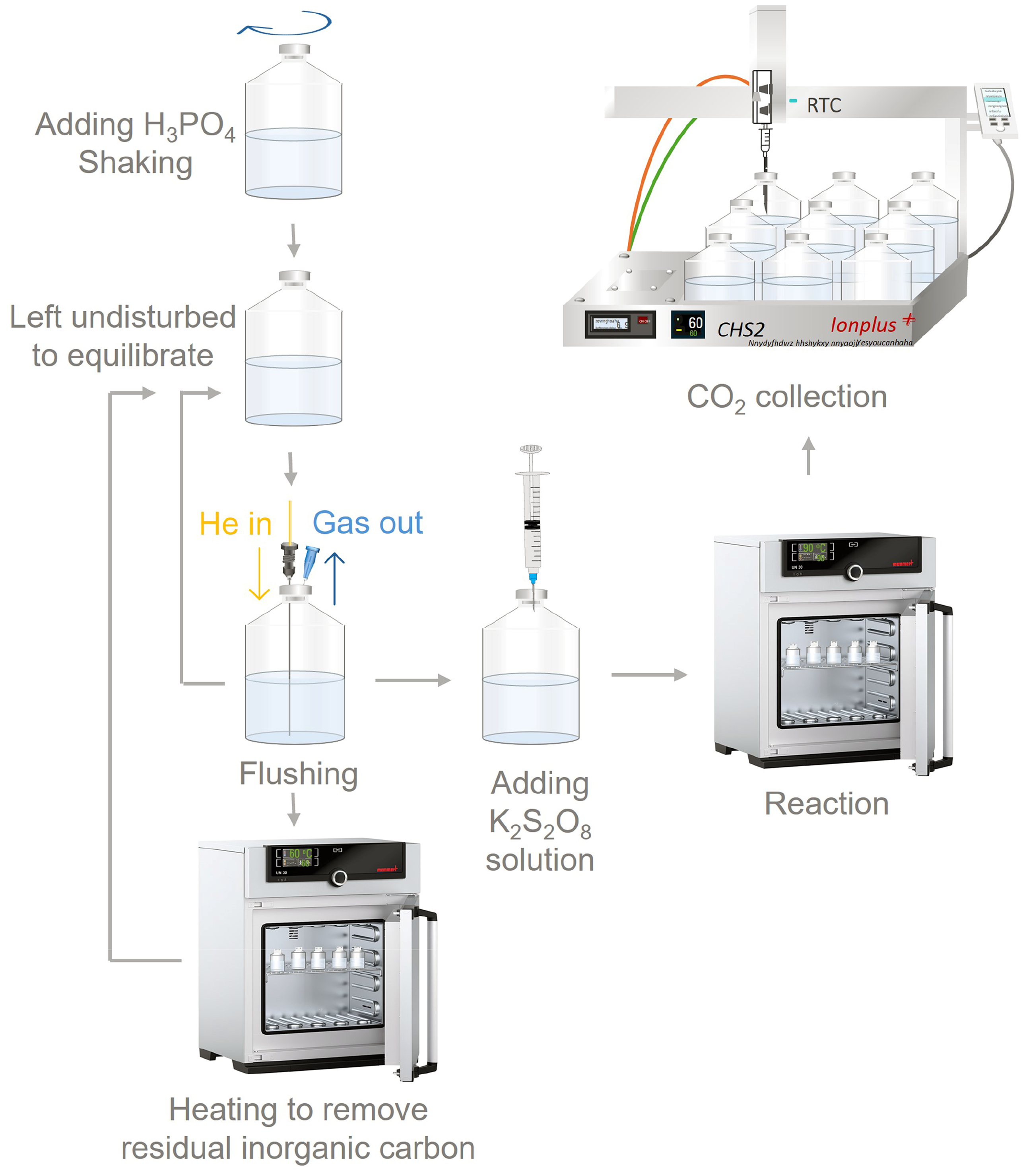
The wet oxidation method for 14C-DOC (Figure 1) was conducted in a 100 mL crimp-sealed glass vial. A chemical blank, phthalic anhydride (PhA Sigma Aldrich, PN-320064-10 g) and an oxalic acid standard from the International Atomic Energy Agency (IAEA-C8, 0.1513 ± 0.0007 F14C) (Clercq et al. Reference Clercq, Van Der Plicht and Gröning1997) were used as standards to verify the feasibility of the method. Synthetic solutions containing inorganic carbon are formulated with pulverized shell standard, a calcium carbonate powder (0.1503 ± 0.0007 F14C, 2553 ± 63 BP, n = 40). The measurement of radiocarbon is highly sensitive to extraneous carbon contamination (Lang et al. Reference Lang, McIntyre, Bernasconi, Früh-Green, Voss, Eglinton and Wacker2016). The multi-step procedure of converting DOC into CO2 and final 14C analysis presents the potential to introduce extraneous carbon contamination at various stages. These potential sources of extraneous carbon can originate from the residual inorganic carbon (i.e. atmospheric CO2) in the crimp-sealed glass vials, or as impurities in the oxidant. In addition, effective removal of inorganic carbon present in the aqueous samples is required for the analysis of the target analyte DOC. Therefore, a procedural blank is employed to evaluate potential contamination: a 14C-free PhA solution is subjected to the same experimental procedures as the unknown DOC samples.
Pretreatment steps for 14C-DOC via wet oxidation method.

DOC solutions were separately prepared by dissolving PhA (3.5 mg/50 mL) and IAEA-C8 (7.5 mg/ 50 mL) in UV treated Milli-Q water (18 MΩ·cm, total organic carbon < 3 ppb), followed by the addition of (8.3 mg/50 mL) calcium carbonate powder (CaCO3, UNSW Internal Standard-4804). The mixtures were homogenized using an ultrasonic bath (20 min, 25 °C) to efficiently disperse the CaCO3 powder (UNSW Internal Standard-4804) and simulate inorganic carbon in natural water samples. The bulk solutions are subsampled, 50 mL of the homogenized solution is transferred into a 100 mL crimp-sealed glass vial, followed by the addition of 1 mL of phosphoric acid (H3PO4, 85%, AR grade, Chem-supply Pty Ltd, Australia). The vial is crimp-sealed using a grey-butyl septa and aluminum crimp cap. All glassware is cleaned by combusted at 480°C for 4 hr, and grey-butyl septa are cleaned by immersion in 8 g/L potassium persulfate (K2S2O8, ACS reagent, Sigma-Aldrich, Germany) solution at 60°C for 8 hr followed by a Milli-Q water rinse.
The synthetic DOC solution and phosphoric acid mixture is aggressively shaken for 1 min by hand and then left to react for over 12 hr, ensuring complete transformation of inorganic carbon (UNSW Internal Standard-4804) to CO2. The headspace and the solution are purged with high-purity helium (He) gas (99.999%) for 20 min to effectively strip the synthetic solution and purge the headspace of the 100 mL vial. Following the helium purge, the sample is left undisturbed at room temperature for over 12 hr to allow dissolved gases to reach equilibrium, after which a second 20-min helium purge is conducted. The sample is then placed in an oven at 60°C overnight, ensuring that any residual inorganic carbon was fully converted to CO2. The purge-equilibrium cycle was then repeated twice more to ensure the complete removal of inorganic carbon in the synthetic DOC solution.
The oxidizing reagent K2S2O8 is prepared as a saturated solution (40 g/L) of K2S2O8, prepared by dissolving 4 g of K2S2O8 and 100 µL of H3PO4 in 100 mL Milli-Q water (Lang et al. Reference Lang, Früh-Green, Bernasconi and Wacker2013). The prepared oxidizing solution is sealed in 100 mL glass crimp vials and placed in an oven at 60°C for 8 hr for pre-oxidization. Any potential inorganic carbon contaminants are removed by purging the solution with high-purity helium gas prior to use a procedure which has been proven to effectively remove extraneous carbon contamination from the oxidant (Rauber et al. Reference Rauber, Salazar, Yttri and Szidat2023).
After the final purge of inorganic carbon from the synthetic DOC solution, 10 mL of the pre-oxidized K2S2O8 solution is immediately injected into the sample using a clean syringe (one 10-mL pre-wash with 40 g/L K2S2O8 solution). To accelerate the oxidation process, the vial is shaken and placed in an oven at 90°C for 12 hr. The sample is taken out of the oven and allowed to cool to room temperature.
The automated Carbonate Handling System (CHS2, Ionplus) transfers the CO2, produced from the oxidation of DOC and accumulated in the headspace of the 100 mL glass vial through a selectively permeable Nafion™ polymer membrane in a helium carrier gas. The Nafion™ polymer membrane transfers water molecules from one side of the membrane to the other by a first order kinetic reaction. The dry sample gas of CO2 is transferred into the Automated Graphitization Equipment (AGE3, Ionplus) system with the helium carrier gas. The CO2 purging time of the headspace is set to 360 s, with a helium gas flow rate of 60 mL/min. The CO2 is concentrated in a zeolite trap, which is heated to 420°C to release pure CO2 into the graphitization reactor tube. The CO2 sample is then reduced to graphite at 580°C with hydrogen on iron powder. Radiocarbon analysis of the graphite target is conducted using the Mini Carbon Dating System (MICADAS, Ionplus) at University of New South Wales in the Chronos Radiocarbon Laboratory (Turney et al. Reference Turney, Becerra-Valdivia, Sookdeo, Thomas, Palmer, Haines, Cadd, Wacker, Baker and Andersen2021) and the procedure is detailed elsewhere (Suter et al. Reference Suter, Müller, Alfimov, Christl, Schulze-König, Kubik, Synal, Vockenhuber and Wacker2010; Synal et al. Reference Synal, Stocker and Suter2007; Wacker et al. Reference Wacker, Bonani, Friedrich, Hajdas, Kromer, Nemec, Ruff, Suter, Synal and Vockenhuber2010). Transmission and fractionation are corrected and normalized to the NIST OxA2-SRM 4990C (OXAII) for the MICADAS AMS measurements, with radiocarbon results reported as the fraction of modern carbon (F14C).
Results
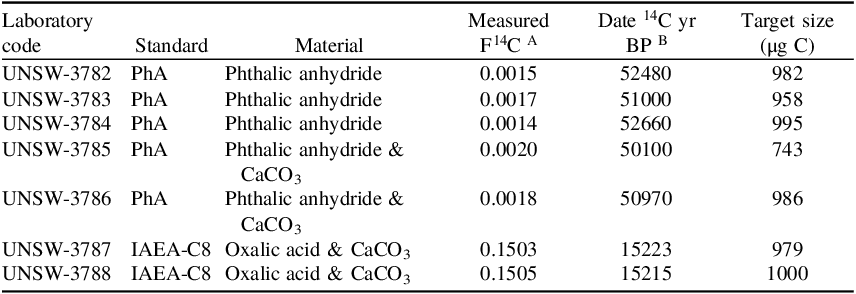
The F14C value of PhA determined using the traditional high-temperature combustion method in the laboratory is 0.0015 ± 0.0006 (n = 626). The background value of PhA obtained using the wet oxidation method proposed in this study was 0.0015 ± 0.0002 (n = 3) (Table 1), and consistent with the expected value for traditional high-temperature combustion method. Thus providing, with confidence, the outlined wet oxidation method described above introduced negligible extraneous carbon contamination during this pre-treatment procedure.
Results of the tested standards (no chemical blank correction applied)

A F14C values have uncertainties of less than 0.0005 at the 1σ level. B There are several assumptions implicit in the citation of a conventional radiocarbon age (date), for example the Libby half-life for 14C of 5568 years was used; ‘before present’ (BP) refers to 1950 for the reference year zero; and that 0.95 NBS Oxalic Acid provided the modern reference standard. Radiocarbon years BP (14C yr BP) are the units to express the date.
In natural non-saline water samples, inorganic carbon is typically present. To evaluate whether inorganic carbon is effectively removed using this experimental method an additional 8.3 mg/50 mL of CaCO3 powder (UNSW Internal Standard-4804, 0.1503 ± 0.0007 F14C, 2553 ± 63 BP, n = 40) is added to each PhA sample. The F14C mean value of the PhA & CaCO3 samples is 0.0018 ± 0.0001 (n = 2) (Table 1) and equivalent to a radiocarbon age of 50,500 BP. Again, the chemical blank of PhA verifies that modern CO2 was not introduced by the method and the chemical blank of PhA and inorganic carbon show that the (1 mg C/50 mL) 2553 BP carbonate powder was stripped from solution before the DOC oxidation reaction. Further validation of the wet oxidation method was conducted using IAEA-C8 as an internal standard with added CaCO3 powder. The F14C value of IAEA-C8 has been reported as 0.1504 ± 0.0017 (Clercq et al. Reference Clercq, Van Der Plicht and Gröning1997) and 0.1504 ± 0.0006 (n = 316) at Chronos Radiocarbon Laboratory. The weighted mean of the measured F14C values for IAEA-C8 processed with the wet oxidation method was 0.1503 ± 0.0001 (n = 2). This indicates that both the inorganic carbon present in the sample and that in the headspace of the crimp-sealed glass vials could be effectively removed, with oxidative reaction of the IAEA-C8 yielding an accurate value for the radiocarbon standard.
Discussion
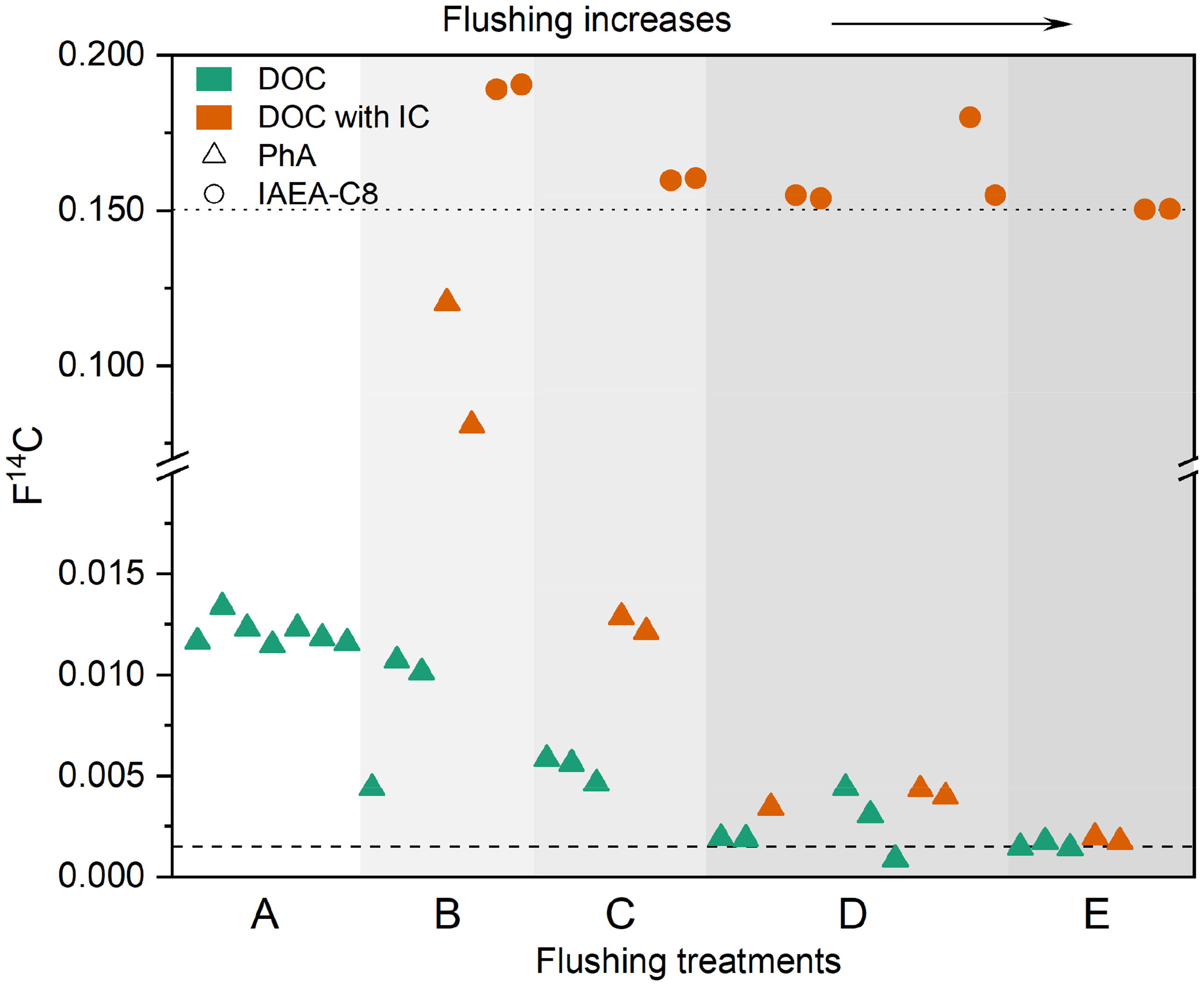
Effective removal of extraneous carbon is crucial for obtaining accurate radiocarbon values. Based on the measured inorganic carbon content in the samples, it is possible to calculate the theoretical amount of H3PO4 required to completely convert inorganic carbon to CO2. Consequently, adding excess H3PO4 to the samples and purging with CO2-free gas is a reasonable approach to effectively remove both the inorganic carbon present in the sample and that in the headspace of the vial. However, experimental results indicate that multiple stages of helium purging are necessary to achieve effective removal of extraneous inorganic carbon in the matrix to allow for the accurate measure of the target analyte DOC (Figure 2).
Radiocarbon measurements of phthalic anhydride (PhA, triangle) and International Atomic Energy Agency Oxalic Acid standard (circle) obtained from wet oxidation method with different flushing strategies. A, headspace flushing; B, headspace and solution flushing once for 10 min, C, headspace and solution flushing once for 20 min, D, headspace and solution flushing 3 times for 20 min every time; E, headspace and solution flushing 4 times for 20 min every time. DOC samples without IC are colored in red and with IC are colored in blue. Dotted line and dashed line represent the expected F14C value for IAEA-C8 and PhA, respectively. All F14C values have uncertainties of less than 0.0008 at the 1σ level.

Different sample purging strategies were applied to evaluate their effects on radiocarbon analysis of DOC (Figure 2). When only the headspace of the sample was purged, the F14C value of PhA without added inorganic carbon was 0.0121 ± 0.0006 (n = 7), indicating that extraneous carbon contamination was not effectively removed. When a single purging step was applied to the entire sample, including both the headspace and liquid phase, the background value improved to some extent, yet trace amounts of extraneous carbon remained (Figure 2, B, C). When the number of purging cycles was increased to three (Figure 2, D), with equilibration periods between each purging step to allow for gas-liquid equilibrium, the F14C value of PhA without inorganic carbon was 0.0024 ± 0.0012 (n = 5), while that of PhA with inorganic carbon was 0.0039 ± 0.0004 (n = 3). Correspondingly, the F14C value of IAEA-C8 with inorganic carbon was also higher than expected values (Figure 2, D). This suggests that three purging cycles are still insufficient to completely remove extraneous carbon.
When the number of purging cycles was further increased to four (Figure 2, E), both PhA with and without added inorganic carbon reached F14C values comparable to expected F14C value of PhA via the traditional high-temperature combustion method (0.0015 ± 0.0006, n = 626). Recent studies have reported DOC radiocarbon analysis methods using 12 mL Exetainer vials, where a single purging step was sufficient to effectively control extraneous carbon contamination (Lang et al. Reference Lang, McIntyre, Bernasconi, Früh-Green, Voss, Eglinton and Wacker2016; McIntyre et al. Reference McIntyre, Lechleitner, Lang, Haghiour, Fahrni, Wacker and Synal2016; Strähl et al. Reference Strähl, Lechleitner, Laemmel, Geissbühler, Salazar, Daellenbach and Szidat2024). However, based on the comparison of purging strategies in this study, a multi-stage approach (four purging-equilibration cycles) is necessary for effective removal of extraneous carbon from DOC samples of tens of milliliters in volume.
This multi-step purging process increases the sample preparation time of DOC analysis, however a prerequisite for consistent backgrounds and accurate results. Additional methods and types of sparging apparatus should be investigated to reduce the preparation time of this critical step. Many previous studies have generally reached a consensus that F14C results are dependent on the carbon content of the sample (Lang et al. Reference Lang, McIntyre, Bernasconi, Früh-Green, Voss, Eglinton and Wacker2016; Leonard et al. Reference Leonard, Castle, Burr, Lange and Thomas2013; Strähl et al. Reference Strähl, Lechleitner, Laemmel, Geissbühler, Salazar, Daellenbach and Szidat2024; Xu et al. Reference Xu, Roberts, Elder, Kurz, McNichol, Reddy, Ward and Hanke2021; Ziolkowski and Druffel Reference Ziolkowski and Druffel2009), especially for low concentration DOC sample, where the uncertainty in F14C values increases significantly.
The method described here outlines an effective procedure for a known concentration of DOC, the effective concentration of DOC solutions of PhA and IAEA-C8 are both 3.3 mmol/L (2 mg C in 50 mL). With the oxidation of DOC by K2S2O8 and recovery of CO2 sample from the headspace at 100% efficiency, these concentrations of DOC in the PhA and C8 solutions yield 2000 μg C for the graphite target and AMS radiocarbon analysis. Results indicate a recovery rate of DOC in this improved wet oxidation method was 58.4% ± 7.4% (n = 6), which may be due to the residual CO2 remaining in gas-liquid equilibrium (Molnár et al. Reference Molnár, Hajdas, Janovics, Rinyu, Synal, Veres and Wacker2013). Molnár et al. (Reference Molnár, Molnár, Veres, Czébely, Rinyu, Rozmanitz and Janovics2022) suggested that by performing timed repeats of CO2 collection from the headspace, the recovery rate could be increased to 75%–80%. In addition, methods and types of sparging apparatus could be investigated to improve the headspace recovery. Methods which sparge the liquid sample and collect the headspace gas simultaneously may may enhance CO2 capture efficiency, thereby effectively increasing the DOC recovery rate in the wet oxidation method. It is important be noted that incomplete CO2 recovery from the headspace may cause kinetic fractionation of 13C, whereas 14C is largely unaffected as the values are normalized to a standard δ13C values during data processing (Molnár et al. Reference Molnár, Hajdas, Janovics, Rinyu, Synal, Veres and Wacker2013; Takahashi et al. Reference Takahashi, Handa and Minami2021; Xu et al. Reference Xu, Roberts, Elder, Kurz, McNichol, Reddy, Ward and Hanke2021). Consequently, the method is appropriate for 14C-DOC analysis, but not for δ13C studies. Moreover, due to the incomplete recovery of CO2, carbon isotope measurements alone cannot determine whether all DOC has been fully oxidized. To improve the recovery, we recommend that the oxidation efficiency of DOC could also be assessed via measuring residual DOC concentrations in the post-reaction solution in future studies.
The method indicated that a concentration of 20 mg C/L DOC (1 mg C/50 mL) is required for sufficient CO2 to yield a 500 μg C for a graphite target sufficient for high-resolution radiocarbon analysis. Increasing the sample volume is an effective approach to obtaining sufficient carbon for reliable radiocarbon values in lower concentration DOC samples. In natural freshwater samples, DOC concentrations vary from 0.002 mg C/L to 1041 mg C/L (Marwick et al. Reference Marwick, Tamooh, Teodoru, Borges, Darchambeau and Bouillon2015; McDonough et al. Reference McDonough, Santos, Andersen, O’Carroll, Rutlidge, Meredith, Oudone, Bridgeman, Gooddy and Sorensen2020). A lower recovery rate requires larger sample volumes for low-DOC-content samples, thereby increasing the difficulty of radiocarbon analysis for DOC. This improved wet oxidation method could be coupled with existing rotary evaporation techniques to improve the range of DOC concentrations measurable by AMS.
Conclusion
This study presents an improved wet oxidation protocol for DOC radiocarbon analysis, demonstrating low procedural blanks, effective removal of extraneous carbon, and reliable radiocarbon measurements comparable to conventional high-temperature combustion techniques. The implementation of multiple purging-equilibration cycles was found to be essential for eliminating inorganic carbon contamination, particularly for larger sample volumes. Future experimental optimizations should focus on enhancing DOC recovery rates and combining rotary-evaporation preconcentration techniques to investigating the influence of varying DOC concentrations on F14C measurement results, aiming to reduce sample size requirements for the analytical method and the dynamic range of DOC concentrations measurable in natural sample.
Acknowledgments
We thank Dr. Tsun-You Pan and Prof. Tim Barrows for assistances during the experiments and thank for Prof. Andy Baker for constructive comments in improving the manuscript.
Compting interests
The authors declare no potential financial interest.

 Open access

