




1. Introduction
The Early Neolithic lakeshore settlement of La Marmotta, located beneath the waters of Lake Bracciano (Anguillara Sabazia, Italy), stands as one of the most significant and well-preserved prehistoric sites in the central Mediterranean (Figure 1). Discovered in 1989 and excavated extensively until 2009, the site extends over approximately two hectares, of which about 25% has been excavated. Situated at a depth of 11 m (8 m of water and 3 m of sediment), its exceptional preservation conditions have yielded an extraordinary array of both organic and inorganic materials (Beccaccioli et al. Reference Beccaccioli, Moricca, Faino, Reale, Mineo and Reverberi2023; Gibaja et al. Reference Gibaja, Mineo, Santos, Morell, Caruso-Fermé, Remolins, Masclans and Mazzucco2024; Mineo et al. Reference Mineo, Mazzucco, Rottoli, Remolins, Caruso-Fermé and Gibaja2023a, Reference Mineo, Gibaja and Mazzucco2023b). Excavations uncovered around 3400 piles that supported dwelling structures, along with the remains of wattle-and-daub walls, thatched roofs made of plant materials, and wooden floors constructed from timber or bark. A total of 14 possible rectangular dwellings were identified, each measuring roughly 8–10 m in length and 6 m in width and featuring internal walls and central hearths.
Location of La Marmotta settlement (map performed by G. Remolins and published in Mineo et al. Reference Mineo, Mazzucco, Rottoli, Remolins, Caruso-Fermé and Gibaja2023a and Gibaja et al. Reference Gibaja, Mineo, Santos, Morell, Caruso-Fermé, Remolins, Masclans and Mazzucco2024).

La Marmotta was sustained by a consolidated domestic economy that relied on a wide range of animal and plant resources, including goats, sheep, cattle, pigs, wheat, barley, and legumes such as lentils, broad beans, and peas. Most of these species were domesticated (75% of the fauna and 65% of the plants), although wild resources also played a complementary role. More than 20,000 botanical remains, including whole grain ears, fruit seeds, and psychoactive or medicinal plants such as Papaver somniferum and Daedaleopsis tricolor, highlight the community’s deep engagement with the surrounding ecosystem (Rottoli Reference Rottoli1993; Portillo et al. Reference Portillo, Hamon, García-Martínez, Macià, Remolins, Mazzucco, Mineo and Gibaja2024; Arobba et al. Reference Arobba, Caramiello, Morandi, Gibaja, Mineo and Mazzucco2024). Exceptional finds such as wooden tools, flint-inlaid sickles, arches, spindles, basketry, textiles (Figure 2), and five dugout canoes—two of them exceeding 10 m in length—underscore a high level of technological expertise (Caruso-Fermé et al. Reference Caruso-Fermé, Monteiro, Brizzi, Mineo, Remolins, Mazzucco, Morell and Gibaja2026 and Reference Caruso-Fermé, Mineo, Ntinou, Remolins, Mazzucco and Gibaja2021; Mazzucco et al. Reference Mazzucco, Mineo, Arobba, Caramiello, Caruso-Fermé, Gassin, Guilbeau, Ibáñez, Morandi, Mozota, Pichon, Portillo, Rageot, Remolins, Rottoli and Gibaja2022; Mineo et al. Reference Mineo, Gibaja and Mazzucco2023b).
Left: Basketry fragments, including one preserving food residues (Mineo et al. Reference Mineo, Mazzucco, Rottoli, Remolins, Caruso-Fermé and Gibaja2023a). Upper right: Spindle whorls with preserved threads (Mineo et al. Reference Mineo, Gibaja and Mazzucco2023b). Lower right: Complete sickle from La Marmotta (Mineo et al. Reference Mineo, Mazzucco, Rottoli, Remolins, Caruso-Fermé and Gibaja2023a). All items originate from the La Marmotta site and are housed at the Museo delle Civiltà, Rome.

In particular, the canoes (Figure 3) from La Marmotta, currently the oldest known in the Neolithic Mediterranean, attest to advanced boatbuilding traditions and offers direct evidence for early navigation, likely facilitating mobility and exchange across aquatic landscapes (Gibaja et al. Reference Gibaja, Mineo, Santos, Morell, Caruso-Fermé, Remolins, Masclans and Mazzucco2024). These technological achievements position the site as a critical node for understanding the role of aquatic mobility and close-range coastal navigation in the spread of farming communities during the Neolithic (e.g., Isern et al. Reference Isern, Zilhão, Fort and Ammerman2017).
Excavation of canoe no. 5 (Museo delle Civiltà, Rome) (Mineo et al. Reference Mineo, Mazzucco, Rottoli, Remolins, Caruso-Fermé and Gibaja2023a). Bottom: Marmotta 2 canoe, Museo delle Civiltà, Rome (Gibaja et al. Reference Gibaja, Mineo, Santos, Morell, Caruso-Fermé, Remolins, Masclans and Mazzucco2024).

La Marmotta contributes to broader research on prehistoric lakeshore settlements in southern Europe, alongside sites like La Draga (Spain) and Dispilio (Greece), all of which offer exceptional preservation and opportunities for reconstructing early lifeways through integrated archaeobotanical, dendrochronological, and paleoenvironmental analyses. Recent high-resolution chronological research at La Draga (northeastern Iberia) has revealed a complex and prolonged occupation sequence between ca. 5300 and 4900 cal BC, characterized by multiple construction and reuse episodes of wooden structures, identified through combined radiocarbon dating, dendrochronology, and stratigraphic microphasing (Andreaki et al. Reference Andreaki, Barceló, Antolín, Gassmann, Hajdas, López-Bultó and Terradas2022; López-Bultó et al. Reference López-Bultó, Andreaki, Gassmann, Barceló, Antolín, Palomo, Piqué, Ballmer, Hafner and Tinner2025). Similarly, Dispilio shows radiocarbon evidence spanning from ca. 5470 to 1980 cal BC (2σ), with the main Neolithic occupation concentrated in the mid-sixth to early fifth millennia cal BC (Facorellis et al. Reference Facorellis, Sofronidou and Hourmouziadis2016). The site yielded richly stratified deposits with complex architectural remains, wooden artifacts, and diverse ceramic assemblages, including inscribed wooden and clay objects possibly related to symbolic or communicative practices. As at La Marmotta and La Draga, the ceramic variability at Dispilio does not align closely with the radiocarbon sequence, illustrating the divergence between relative and absolute chronologies and emphasizing the importance of developing integrated, site-based chronological models.
Despite its extraordinary archaeological record, La Marmotta’s internal chronology remains imprecise. The site has traditionally been dated to ca. 5600–5150 cal BC, primarily based on ceramic decorative styles, particularly Cardial and Painted Ware, with limited support from absolute dating (Fugazzola and Mineo Reference Fugazzola and Mineo1995; Mazzucco et al. Reference Mazzucco, Mineo, Arobba, Caramiello, Caruso-Fermé, Gassin, Guilbeau, Ibáñez, Morandi, Mozota, Pichon, Portillo, Rageot, Remolins, Rottoli and Gibaja2022). This scheme, originally proposed by Fugazzola (Reference Fugazzola, Fugazzola, Pessina and Tiné2002), and later refined by Delpino (Reference Delpino, Anzidei and Carboni2020), divides the site’s occupation into three sequential units (Fugazzola Reference Fugazzola1996; Fugazzola et al. Reference Fugazzola, D’Eugenio and Pessina1993): Level II, interpreted as the foundation of the settlement and associated with impressed, Cardial and, occasionally, incised decoration (Delpino Reference Delpino, Anzidei and Carboni2020); Level I, characterised by painted and incised ware in the Sasso-Fiorano style, with linear and geometric motifs, linear painted designs and sporadic Cardial decoration (Delpino Reference Delpino, Anzidei and Carboni2020); and, finally, the Chiocciolaio level, considered to represent the abandonment of the site and composed of dark silt formed by abundant plant remains and the collapse of dwelling structures.
However, these “levels” derive from the historical excavation nomenclature and refer to broad sedimentary units defined during long-term underwater fieldwork rather than to stratigraphically homogeneous geoarchaeological units. Excavation strategies evolved over time, and subdivisions were sometimes established on the basis of macroscopic criteria such as sediment colour or texture, before being correlated with ceramic decoration styles. Moreover, in waterlogged lakeshore contexts, sediment accumulation is often relatively continuous and dominated by organic deposition, compaction processes and occasional minor vertical displacements. Such dynamics may blur the stratigraphic separation of individual occupational episodes, even in settlements inhabited for several generations. At La Marmotta, the frequent coexistence of painted and impressed decorative traditions within the same excavation units—including occasionally on the same vessel—further challenges the assumption that ceramic variability reflects successive chronological phases.
Consequently, the traditional chronological framework presents three main limitations. First, stratigraphic continuity makes it difficult to isolate clear occupational phases. Second, different ceramic styles frequently co-occur within the same excavation units, calling into question their validity as independent temporal markers. Finally, although earlier excavations produced numerous radiocarbon determinations, the published records often lack essential contextual and laboratory details (e.g., sample species and pretreatment), limiting reproducibility and chronological resolution. Moreover, while many dendrochronological dates are available, no direct measurements were obtained on the wooden implements themselves, further constraining the reliability and resolution of previous chronological models (Ballmer et al. Reference Ballmer, Hafner and Tinner2025).
To address these gaps, the present study has three main goals: 1. Refine the absolute chronology of La Marmotta through a new radiocarbon dating program, focusing on short-lived botanical remains and select wooden artifacts; 2. Assess whether ceramic diversity reflects chronological variation or instead results from coexisting functional or cultural practices, by testing the robustness of ceramic-based phasing through statistical methods and Bayesian chronological modeling, and 3. Establish the temporal placement and distribution of the five canoes within the overall occupational span of the site, in order to determine whether their construction reflects a continuous technological tradition or distinct episodes of boatbuilding activity.
2. Materials and methods
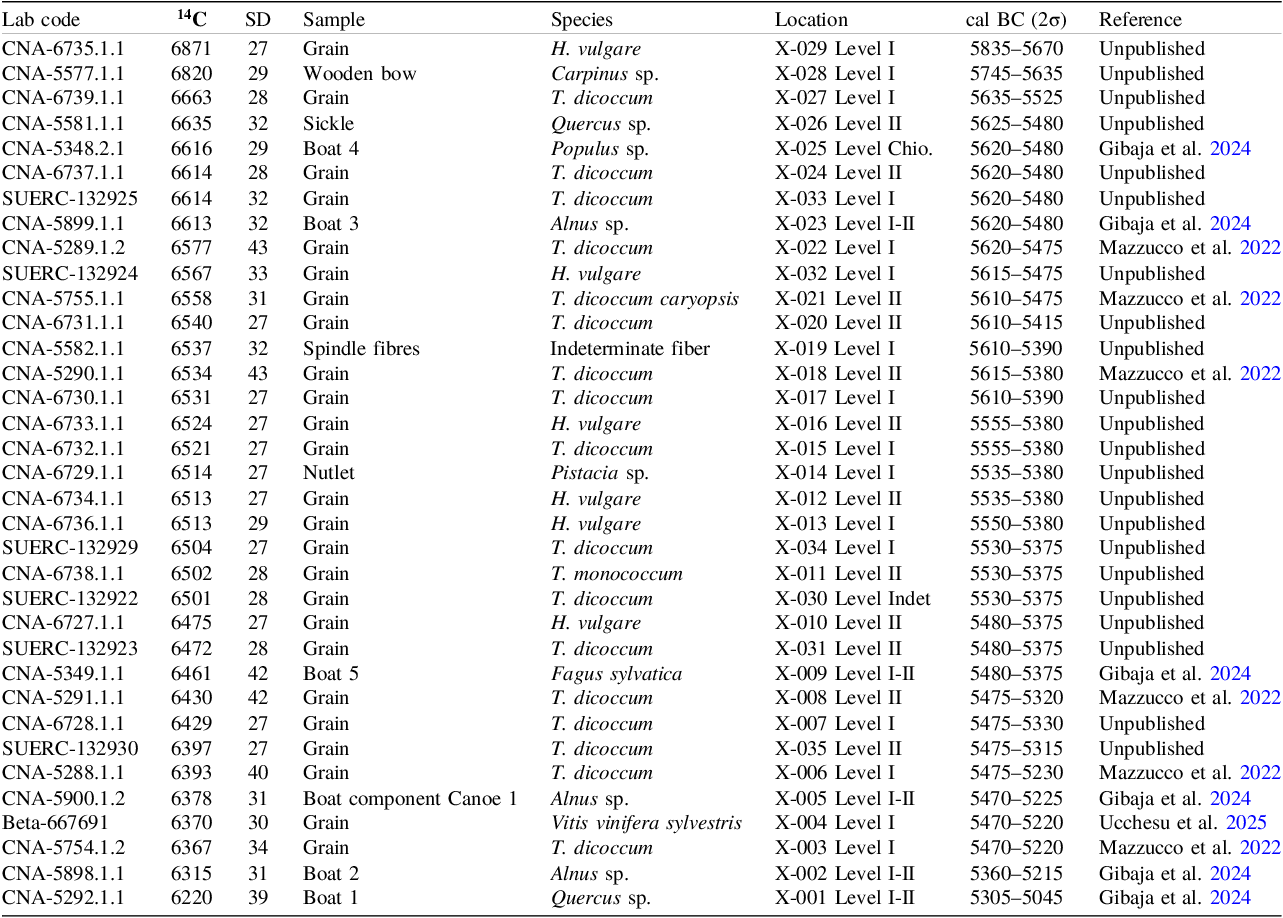
A total of 35 AMS radiocarbon determinations were analyzed (Table 1 and SI-1). Of these, 22 are newly obtained and unpublished, produced specifically for this research, while thirteen dates were previously published (Table 1 and SI-1). Most samples (n = 26) consisted of charred seeds recovered from well-documented excavation units. These short-lived botanical remains were selected specifically to avoid reservoir effects and the “old wood” problem. The remaining nine samples correspond to wooden artifacts with secure stratigraphic contexts and good preservation. Importantly, the seeds were selected from contexts associated with diverse ceramic decorative styles allowing for an evaluation of their potential chronological significance.
Radiocarbon dates of the lakeshore settlement of La Marmotta.

The sampling strategy was designed to maximize chronological precision and contextual clarity while addressing two specific objectives. First, to evaluate the chronology of Levels I and II, seeds were selected from clusters of cereal ears documented in different sectors of the site. Second, to explore the relationship between sample chronology and ceramic decorative motifs, seeds were collected from the interior of several vessels exhibiting diverse morphologies and decorative styles. Botanical samples were thus drawn from all major occupation levels and prioritized when preservation conditions and association with diagnostic materials were clear. Wooden artifacts were included only when the object’s preservation state, spatial context, and stratigraphic integrity were deemed reliable.
Each radiocarbon sample derived from a context containing associated ceramic material, allowing its attribution to one or more stylistic categories traditionally recognised at La Marmotta (Figure 4). Macroscopic analysis of selected vessels from these contexts (see SI-2 and SI-3) reveals a broad range of technological treatments, morphologies, and decorative techniques. Surface finishes vary from smoothed and polished to untreated, with predominantly mixed or reduced firing atmospheres. Vessel shapes include geminated forms with suspension handles, open and semi-spherical bowls, bottle-shaped vessels, and bitruncated conical profiles. Decorative schemes encompass painted motifs, impressed patterns, negative decoration on black backgrounds, plastic appliqués, and pigment traces
Plan of the La Marmotta site showing the location of the radiocarbon-dated samples by G.Remolins.

All samples were pretreated and analyzed following standard AMS radiocarbon protocols at three laboratories: Centro Nacional de Aceleradores (CNA, Seville), Beta Analytic (Miami), and the Scottish Universities Environmental Research Centre (SUERC, Glasgow). Charred seeds underwent an acid–base–acid (ABA) pretreatment to eliminate carbonates and humic substances. Wooden samples were mechanically cleaned and, where preservation allowed, subjected to hot alkali and acid rinses to remove secondary carbon. The pretreated samples were combusted to CO₂, converted to graphite, and measured via accelerator mass spectrometry (AMS). All samples yielded δ1 3C values consistent with expected ranges for terrestrial C₃ plants and percent modern carbon (pMC) values with low associated errors (SI-1), supporting the good preservation and reliability of the organic material for radiocarbon dating.
Radiocarbon dates were calibrated using OxCal v.4.4 software (Bronk Ramsey Reference Bronk Ramsey2009) and the IntCal20 calibration curve (Reimer et al. Reference Reimer, Austin, Bard, Bayliss, Blackwell, Bronk Ramsey, Butzin, Cheng, Edwards, Friedrich, Grootes, Guilderson, Hajdas, Heaton, Hogg, Hughen, Kromer, Manning, Muscheler and Talamo2020). To assess potential contemporaneity among samples from different ceramic contexts, Chi-square tests were performed (Ward and Wilson Reference Ward and Wilson1978).
A Bayesian modeling approach in OxCal (Bronk Ramsey Reference Bronk Ramsey2009) was applied to investigate the temporal structure of the dataset and to directly contrast the site’s traditional ceramic-based phasing with the radiocarbon evidence.
Specifically, we evaluated two alternative scenarios for La Marmotta’s occupational history: (1) the conventional model interpreting the excavation-defined levels as three stratigraphically superposed phases—Level II (earlier) followed by Level I (later), capped by the Chiocciolaio, which is interpreted as an abandonment level affected by reworking—derived from the traditional decoration-based classification, and (2) a single, continuous phase of settlement during which Cardial-Impressa and Painted Ware styles were in simultaneous use. This second scenario could also be interpreted more broadly to account for a third possibility, namely that vertical displacement of materials may have blurred the stratigraphy, making it difficult to distinguish discrete occupational levels.
The apparent “intermediate” II-I association is not a distinct stratigraphic phase but results from the extraordinary length of the dugout canoes, which cut across Levels II and I. For this reason, the canoe dates were not included in the initial stratigraphic Bayesian models used to define the occupational chronology of the settlement. Once this chronological framework had been established, the canoe dates were incorporated into the single-phase model to assess whether they fell within the overall chronological distribution of the site. The Chiocciolaio level was not included in the model, as only a single radiocarbon date is available for this horizon, which contains much less material and is generally interpreted as corresponding to the abandonment of the settlement. Likewise, the radiocarbon date that could not be assigned to any stratigraphic level has not been integrated into the phase model.
In the first Bayesian model, all radiocarbon determinations were grouped according to their stratigraphic attribution, with a Boundary set between phases and slight overlap permitted to account for minor post-depositional mixing. This configuration directly tests whether the radiocarbon evidence supports two discrete occupational episodes. Given the decoration-based phasing traditionally proposed, it was essential to assess this scenario before considering alternative models.
In the second model, all radiocarbon dates were grouped in a single Phase, with a contiguous Boundaries structure marking the start and end of site occupation. This approach tests whether the dataset, regardless of ceramic or stratigraphic attribution, is better explained as one occupational span. The model included a Single Outlier Analysis (prior probability = 0.05 for each date) to statistically downweight anomalous determinations rather than excluding them a priori, thereby avoiding circular reasoning.
Finally, the five wooden canoes were modeled separately to assess whether their construction reflected a continuous technological tradition or distinct episodes within the settlement’s occupation. Of the 35 dated samples, six were associated with these five individual dugout canoes.
3. Results
The two-phase overlapping model—representing Level II and Level I—produced an overall agreement above 90. However, the modeled start boundaries yielded a counterintuitive sequence (see SI-4.1): Level I started earlier (5830–5670 cal BC) than Level II (5590–5480). This ordering contradicts both the expected stratigraphic succession and the ceramic classification on which the phasing was originally based and reflects the extensive overlap of radiocarbon determinations across levels.
This interpretation is further reinforced by the results of the strictly sequential two-phase model (Level II → Level I), which failed to converge in OxCal, producing a “null distribution” error (SI-4.2). Such lack of convergence indicates that the chronological constraints required by a sequential framework are incompatible with radiocarbon data. Together, the failure of the sequential model and the implausible ordering produced by the overlapping model provide strong evidence that the ceramic-based stratigraphic phasing framework is not supported by the absolute dating record.
When all radiocarbon determinations —including those from the canoes and the single date not attributable to any stratigraphic level— were included in a single contiguous phase, the model produced an occupational range between 5765–5670 cal BC and 5320–5225 cal BC at 95.4% probability, corresponding to an estimated duration of 295–530 years. The overall agreement index remained acceptable (Amodel 71.1 and Aoverall 70.6), but the very early start boundary—extending nearly two centuries earlier than the main cluster of dates—appears inconsistent with the broader archaeological context. This early start is driven almost entirely by the two oldest determinations in the dataset (CNA-6735.1.1 and CNA-5577.1.1), both of which are statistically identified as outliers even within this modeling run. Strikingly, both originate from Level I, which under the traditional ceramic decoration-based framework should represent the most recent phase. Their position as the earliest dates in the sequence directly contradicts the expected stratigraphic order, further undermining the validity of the ceramic-based phasing and indicating that the true onset of occupation was likely much later than suggested by this unadjusted model. It is also worth noting that some of the very early or late determinations on wooden artifacts, particularly those treated with polyethylene glycol (PEG) during conservation, may yield distorted radiocarbon ages. As shown in the recent study of the La Marmotta canoes (Gibaja et al. Reference Gibaja, Mineo, Santos, Morell, Caruso-Fermé, Remolins, Masclans and Mazzucco2024), PEG molecules can be extremely difficult to remove entirely from the wood structure, even after aggressive chemical pretreatments, and their residual presence can either artificially age or rejuvenate samples depending on the 1⁴C content of the compound. Although in most cases the effect at La Marmotta appears to have been minor, the persistence of PEG nonetheless introduces an additional level of uncertainty.
Introducing a Single Outlier Analysis (prior probability = 0.05 for each determination) greatly improved the model fit (Amodel = 156.8; Aoverall = 139.8, SI-4.3) and produced a more coherent occupational span between 5560–5490 and 5460–5385 cal BC, with an estimated duration of 28–152 years (Figure 5). In this model, the four earliest and five most recent determinations were flagged as statistical outliers and downweighted accordingly (highlighted in red in Figure 5). These dates are dispersed at the temporal extremes rather than forming consistent early or late clusters, suggesting that they may reflect sample-specific or preservation issues related to consolidant treatment, rather than representing distinct occupational phases.
Single Bounded Phase Bayesian Model of the analyzed radiocarbon dates from La Marmotta, with outlier analysis results highlighted in red.

When the canoe chronology is compared with the overall site sequence in the single-phase contiguous model, most canoe determinations (green in Figure 6) fall within the main occupational range of La Marmotta. Three of the six dates, including at least one from each of Canoes 1 and 2—occur at the recent extreme of the sequence and are flagged as statistical outliers in the site-wide model (red in Figure 6). These canoes come from Levels I and II, consistent with their construction towards the final stages of the settlement’s occupation. The remaining canoe dates align with the core of the occupational span, indicating that boatbuilding was a recurrent activity throughout much of the site’s use-life (5620–5490 to 5310–5085 cal BC; span 200–485 years; Gibaja et al. Reference Gibaja, Mineo, Santos, Morell, Caruso-Fermé, Remolins, Masclans and Mazzucco2024). The occurrence of some canoe dates among the most recent outliers does not necessarily imply a discrete late phase but may instead reflect isolated late-stage construction events or contextual/taphonomic/preservation effects influencing their radiocarbon ages.
Single Bounded Phase Bayesian Model of the analyzed radiocarbon dates from La Marmotta, with the radiocarbon dates associated with the canoes highlithed in green and the outliers in red.

When modeled independently, the six canoe determinations produce a range of 5620–5490 to 5285–5085 cal BC (95.4% probability). The earlier start boundary compared to the integrated site-wide contiguous phase (5560–5490 cal BC) results from the independent model’s lack of constraints from the broader occupational dataset. In the integrated model, the earliest canoe determinations are downweighted by outlier analysis, and the three late canoe dates remain among the most recent outliers. These differences reflect the influence of model structure and statistical treatment of outliers rather than a genuine chronological gap, supporting the interpretation that canoe construction was part of the community’s activities from the outset and continued until the end of La Marmotta’s occupation.
4. Discussion and conclusions
The new radiocarbon dataset and Bayesian modeling results presented here refine La Marmotta’s chronological framework and challenge earlier interpretations based on ceramic decorative classifications. Whereas previous models envisaged a multi-phase occupation marked by the succession of ceramic styles (Cardial–Impressed and Painted Ware), the radiocarbon evidence instead supports a continuous occupation between approximately 5560–5490 and 5460–5385 cal BC, lasting 28–152 years—equivalent to roughly 1–5 generations (based on a 30-year generation, Whittle and Bayliss Reference Whittle and Bayliss2007). The identified outliers (four oldest, five most recent) are scattered at the temporal extremes and show no structured pattern indicative of additional phases, reinforcing the interpretation of a short, uninterrupted settlement occupation. This occupational span also coincides with the earliest direct evidence of emmer wheat (Triticum dicoccum) and opium poppy (Papaver somniferum) cultivation in the central Mediterranean (Salavert et al. Reference Salavert, Zazzo, Martin, Antolín, Gauthier, Thil, Tombret, Bouby, Manen, Mineo, Mueller-Bieniek, Piqué, Rottoli, Rovira, Toulemonde and Vostrovská2020), suggesting that La Marmotta formed part of a wider agricultural system already characterized by a diverse crop package by the mid-sixth millennium BC.
Attempts to model the proposed ceramic sequence as multiple phases consistently failed to produce archaeologically coherent results. The two-phase overlapping model, despite achieving an acceptable agreement index, yielded a stratigraphic order incompatible with the ceramic sequence. The strictly sequential version failed to converge, largely because several Level I determinations predate those from Level II. These results demonstrate that the chronological constraints implied by the decoration-based framework are incompatible with radiocarbon evidence.
The chronological overlap across stratigraphic levels and ceramic decorative traditions indicates that pottery variation at La Marmotta is not a reliable temporal marker. Macroscopic analysis of ceramics from the same contexts as the dated samples (SI-2 and SI-3) reveals frequent combinations of decorative traits—such as Cardial-Impressed and Painted Ware—on single vessels, suggesting that stylistic diversity reflects functional or social choices within a single community rather than sequential cultural stages. Post-depositional processes must also be considered, since vertical displacements are common in waterlogged contexts and seeds—the primary material dated—are particularly mobile. To mitigate this, preference was given to seeds preserved within ceramic matrices, which are less likely to have been redeposited. Even so, the co-occurrence of different decorative traditions on the same vessels, combined with the narrow chronological span of the radiocarbon determinations, strongly supports interpreting the ceramic assemblage as part of a single occupational horizon rather than as evidence of distinct phases. Comparable patterns have been documented at other lakeshore settlements, such as La Draga (Spain; Andreaki et al. Reference Andreaki, Barceló, Antolín, Gassmann, Hajdas, López-Bultó and Terradas2022) and Dispilio (Greece; Kotsakis and Giagkoulis Reference Kotsakis, Giagkoulis, Ballmer, Hafner and Tinner2024), where ceramic variability likewise fails to map onto clear chronological divisions.
Independent modeling of canoe dates places all five examples—the oldest known Neolithic watercraft in the Mediterranean—between 5620 and 5085 cal BC, corresponding to roughly four to five generations. Most determinations align with the main occupational span of La Marmotta, indicating that boatbuilding was a recurrent activity throughout the settlement’s use-life. Three determinations from Canoes 1 and 2, recovered in Levels I and II, appear among the most recent outliers in the site-wide model. These may reflect late-stage construction episodes near the end of the occupation or minor contextual/preservation effects that slightly altered their radiocarbon ages. Nevertheless, they still fall within the broader occupational range, underscoring continuity in dugout canoe production from the outset until the community’s abandonment.
The slightly earlier start boundary produced by the independent canoe model (5620–5490 cal BC) compared to the integrated settlement model (5560–5490 cal BC) stems from methodological factors rather than a genuine chronological offset. In the independent model, the earliest canoe determinations have full weight in defining the start boundary, whereas in the integrated model they are constrained within the broader occupational framework and downweighted by outlier analysis. Consequently, the settlement’s start appears marginally later in the integrated model, but the occupational spans of the site and the canoe-building tradition still overlap almost entirely. This convergence reinforces the interpretation that boatbuilding was part of the community’s technological repertoire from the outset and was sustained throughout its relatively short occupation.
The stratigraphic and spatial consistency of pottery distributions, together with the new radiocarbon evidence, rules out significant post-depositional disturbance by water action, strengthening the reliability of the site’s stratigraphy. Ongoing refitting work on the La Marmotta pottery assemblage (Remolins et al. in preparation) suggests that most inter-level connections occur between Levels I and II, reinforcing their interpretation as a single depositional unit. This supports viewing ceramic and technological diversity as intrinsic to the community’s occupational dynamics rather than the result of taphonomic processes. While seeds alone could be affected by post-depositional movement, those preserved inside ceramic vessels confirm the contemporaneity of different decorative traditions within a relatively short chronological span.
These results also have implications for how the architectural record is interpreted. Although approximately 3,400 wooden piles were documented during excavation and fourteen possible rectangular dwellings have been proposed on the basis of their spatial distribution, the definition and delimitation of these architectural units remain partly interpretative. The reconstruction of house plans was primarily based on spatial clustering of piles rather than on clearly separated construction horizons. In several cases, the morphology and extent of these structures vary between published plans, reflecting the inherent difficulty of interpreting architectural patterns within a continuous waterlogged sedimentary matrix. A detailed architectural and micro-stratigraphic reassessment of these dwellings—including targeted dendrochronological sampling of securely preserved outer growth rings—would undoubtedly refine our understanding of intra-site dynamics.
Taken together, these results depict La Marmotta as a socially and technologically dynamic Early Neolithic settlement whose occupation was continuous but relatively short-lived. Stylistic and technological variability did not signal diachronic change but formed part of the internal dynamics of a single community. Overall, the results from La Marmotta align with current debates emphasising the need to critically reassess chrono-typological frameworks in prehistoric archaeology. They highlight the limitations of relying on decoration-based ceramic frameworks as chronological tools and demonstrate the value of integrated, high-resolution absolute dating programmes. Such approaches not only refine site-specific chronology but also contribute to broader interpretative shifts in our understanding of the Neolithic transition, moving away from narratives of fragmentation and abrupt cultural change towards models of continuity, coexistence, and resilience. At La Marmotta, the evidence points to overlapping practices embedded within a socially diverse and technologically skilled community, suggesting that similar patterns may characterise other early farming settlements in the western Mediterranean. This perspective invites a redefinition of cultural phases that better captures the complexity and adaptability of early farming communities.
Supplementary material
To view supplementary material for this article, please visit https://doi.org/10.1017/RDC.2026.10222
Acknowledgments
This research was made possible by the research collaboration established between the Museo delle Civiltà and the Spanish National Research Council (CSIC). This research is part of the projects: Tools, Techniques and Specialists: the keys to understand the Mesolithic-Neolithic transition in Mediterranean Europe (PID2020-112513RB-I00/AEI/10.13039/501100011033) and Evaluating economic patterns during the Neolithic in archaeological contexts of the Mediterranean and Atlantic area of the Iberian Peninsula (PID2024-156288NB-I00), funded by MICIU/AEI/10.13039/501100011033/ FEDER, UE, as well as the Beatriu de Pinós postdoctoral programme of the Department of Research and Universities of the Government of Catalonia (2022 BP00096).




 Open access

