

1 Introduction
There is substantial evidence that the earnings of engineering, physical science, and other technical/mathematical majors are higher than those of individuals who major in arts, humanities, and education, holding fixed a wide range of other factors.Footnote 1 The expected private and social benefits to science, technology, engineering, and math (STEM) fields have prompted various political initiatives aimed at increasing the number of STEM graduates.Footnote 2 But it has also created concerns about the possible decline in liberal arts fields and prompted discussions about rethinking or re-envisioning the arts, humanities, and social sciences.Footnote 3 The American Academy of Arts & Sciences (AAAS) report, The Heart of the Matter, released in June 2013, received extensive media attention and generated substantial debate. Despite the benefits of STEM education, the AAAS report argues that too narrow of a focus on science and math at the cost of greater breadth of knowledge may hamper innovation, reduce long run economic growth, and reduce democratic participation as we lose shared knowledge of history and civics. The AAAS report also argues that reading, writing, speaking, and critical thinking skills that students learn from humanities and social science courses are key to individuals adapting to a changing society and to being flexible in their future career paths. In effect, the AAAS report argues that there are both private and social returns that should be taken into account in allocating resources across fields in higher education.
One possible solution to the decline in liberal arts education, which may concurrently mitigate the weakening of educational breadth or narrowness of skill sets, may be provided by encouraging double majoring among college students. Double majoring is common at about 20% of college graduates. The AAAS report lauds efforts, such as new interdisciplinary majors and novel major/minor combinations, which promote “greater integration across curricular domains” (p. 34). Greater integration may be efficiently achievable through double majoring by choosing majors among existing options. Of course, in the absence of a private economic payoff to double majoring, students might forgo taking on additional work or challenges. Furthermore, there may be institutional barriers to double majoring in diverse fields.
We use data from the 2010 National Survey of College Graduates (NSCG) to provide recent evidence about whether there is a private economic payoff to double majoring. In addition to examining the relation between double majors and the private financial benefits of education, we also seek to address the concerns regarding broader societal benefits of diverse educational backgrounds and to obtain a general sense of the overall societal desirability of double majors.
The components of a benefit-cost assessment of double majors consist of both monetized and nonmonetized effects. Starting with costs, if students take longer to graduate with a double major than with a single major, the principal additional private costs include the opportunity cost of delayed entry into the labor market and the direct costs of additional tuition, fees, and room and board. In addition, double majoring may crowd out students from some educational opportunities if there are capacity constraints at universities or in majors within a university. There may also be costs associated with the extra effort, although Pitt and Tepper (Reference Pitt and Tepper2012) find that students report little to no added stress from pursuing a double major. Overall, the empirical evidence we present later suggests that the costs associated with double majoring do not loom particularly large.
The benefit components are more diverse and are amenable to our empirical analysis. To identify the benefits of double majoring, we distinguish three categories consistent with the approach advocated in the Office of Management and Budget (2003) guidelines: monetized benefits, quantified but not monetized benefits, and benefits that are not quantified.Footnote 4 We first address the monetary returns to different types of double majors in terms of the incremental rates of return that they yield.Footnote 5 If those who double major are self-selected based on their greater ability, the private return to encouraging greater double majoring may be small, or even negative. Second, we estimate the relation of different double majors with a series of measures that capture many of the broader possible dividends of double majors both for the individual and society, including research and development, job matching, and job satisfaction. Although these effects are not monetized, they do highlight the factors that appear to be most influential, particularly effects on research and development and job matching.
Our analysis provides updated information on the monetized benefits component – whether double majors have higher earnings relative to those with single majors in a field, as well as estimates of the returns to different combinations of double majors. We specifically address whether combining a liberal arts major – which we define as an arts, humanities, or social science major – with the higher paying STEM or business majors provides an economic payoff. Although the AAAS report makes no mention of individual economic returns from studying the liberal arts, the broader skill set and knowledge and the ability to adapt and be flexible, all discussed in the report, could lead to better job opportunities and higher earnings. We also examine the broader ramifications of double majors on job-related research and development activities, job matching, and job satisfaction, making it possible to evaluate the extent to which double majoring across various combinations of fields relates to overall social benefits.Footnote 6
Whether or not double majoring is associated with higher earnings is addressed in Del Rossi and Hersch (Reference Del Rossi and Hersch2008). Using data from the 2003 NSCG, Del Rossi and Hersch show that double majors have higher earnings than single majors, with the largest gains occurring among those who have double majors across disparate areas. In addition to examining a broader set of social measures, this paper makes distinctive contributions beyond the analysis of Del Rossi and Hersch (Reference Del Rossi and Hersch2008). First, we use data from the more recent 2010 NSCG in our analysis. This allows for an examination of possible differences in returns to majors that may have arisen from changes in the economic environment following the Great Recession.Footnote 7 Second, given the continued gender differences in choice of college majors, we allow for the returns to different single and double major combinations to vary by gender.
In support of proponents who claim an advantage to educational breadth, we generally find that double majoring across disciplinary groups is associated with higher returns than double majoring within a disciplinary group. Despite the additional skills that supporters claim liberal arts majors develop, we find little evidence that the combination of a liberal arts major with a business or STEM major is associated with higher returns to the earnings of college graduates than graduates with a single major in business or STEM fields.
Even when there is not a substantial private return to double majors, there could be important societal benefits. Although there has been substantial research estimating the private returns to education and some research estimating the returns to specific college majors, there is little investigation of the social returns to education in addition to private benefits. An exception is Blomquist, Coomes, Jepsen, Koford and Troske (Reference Blomquist, Coomes, Jepsen, Koford and Troske.2014), who find substantial social benefits to community college education. Blomquist et al. (Reference Blomquist, Coomes, Jepsen, Koford and Troske.2014) compare the societal gains to community college education versus high school education. Our objective is similarly focused on examining broader societal benefits to education, but our context differs in that we seek to identify whether the private benefits to double majoring provide sufficient incentive to induce students to choose double majors in a way to enhance the social value provided by broader based liberal arts training.
In terms of social benefits, we find that certain fields and disparate double major combinations have stronger relations with research and development (R&D) activities and job match, but little evidence that job satisfaction varies significantly by major. Mirroring some of the earnings results, compared to single STEM majors, double major combinations that include a STEM major are generally no more likely to have positive social benefits of more research and development and often have lower likelihood of a close job match. Broadly speaking, graduating with a liberal arts major tends to be related to lower job match quality compared to other fields, while graduating with a double major in liberal arts and business may enhance research and development compared to graduating with a single major in liberal arts or business.
These findings of enhanced R&D associated with combining liberal arts and business supports the AAAS arguments that educational breadth is socially valuable. But the fairly limited private earnings benefit to this combination suggests little incentive for students to pursue this double major combination.
2 Background
Although there has been substantial research on the economic returns to college majors, there is far less understanding of how students choose majors, and little information on the choice of double majoring. Bettinger (Reference Bettinger and Clotfelter2010) provides a valuable summary of the two conceptual frameworks that have been used to explain how students choose their college major. As Bettinger discusses, one framework draws on psychology and sociology and relates personality types to careers, which can then inform students of suitable college majors. The second framework draws on the human capital model, in which students make educational decisions (such as college attendance and major) to maximize their expected lifetime utility. Clearly, selection into majors is a fundamental concern, and data availability leads most analyses of college major choice to take a selection on observables approach. A large step forward in analyzing major choice is provided by Kirkeboen, Leuven and Mogstad (Reference Kirkeboen, Leuven and Mogstad2016), who use Norwegian data on students’ ex ante ranking of degree programs combined with exogenous institutional cutoffs on application scores into programs to credibly estimate the return to a college major relative to the individual student’s next best alternative.
Double majoring was ignored in the economics literature prior to the work of Del Rossi and Hersch (Reference Del Rossi and Hersch2008). Since their research was conducted, there have been additional studies examining double majors. The same concerns about selection bias that arise in choice of majors similarly hold for the decision to double major or to select a combination of majors.
Accordingly, the empirical literature following Del Rossi and Hersch (Reference Del Rossi and Hersch2008) has likewise taken a selection on observables approach to estimate the returns to double majoring relative to having a single major in a field.Footnote 8 Hemelt (Reference Hemelt2010) performs an analysis similar to that of Del Rossi and Hersch (Reference Del Rossi and Hersch2008) also using the 2003 NSCG and finds a premium from double majoring similar to theirs that ranges from 2.6 to 3.2% for individuals whose highest degree is a bachelor’s. Like Del Rossi and Hersch (Reference Del Rossi and Hersch2008), Hemelt (Reference Hemelt2010) finds that the highest gains to double majoring come from combining majors that are more technical or practical – business, computer science, and engineering. Pitt and Tepper (Reference Pitt and Tepper2012), in examining average earnings by single majors and combinations of majors using the 2003 NSCG, find that combining a humanities degree with majors in business, social sciences, and education is associated with higher average salaries, supporting the arguments of the AAAS report.Footnote 9 Other studies on double majoring are based on evidence from single universities rather than national samples and do not examine earnings consequences associated with double majors.Footnote 10
As the AAAS study emphasizes, education has a variety of social benefits apart from the direct effect on worker earnings which our data permit us to explore. Research and development is expected to be strongly related to STEM training, but supporters of liberal arts argue that a broader education that focuses on developing critical thinking skills and complex problem solving as well as creativity could enhance STEM training and lead to even more R&D, including better product development and design.Footnote 11 In Pitt and Tepper (Reference Pitt and Tepper2012), students with double majors that cross disparate fields of study self-report greater gains in creativity from their double major; the gains seem to be tied to those with an arts and humanities major as one of their majors. Our data provide information on work activities related to R&D, and we examine whether different major combinations are more likely to be involved in R&D activities.
Another economic productivity relationship involves the relation of education with job match quality. Types of college major may influence whether worker skills are matched appropriately to their jobs, which in turn affects both societal productivity and individual earnings. There is substantial literature focusing on whether workers are mismatched with their jobs, with most of the concern over whether workers are overeducated (e.g., see the survey by McGuinness, Reference McGuinness2006). Overeducation is associated with higher turnover and lower job satisfaction, and because education is heavily publicly subsidized, overeducation is also wasteful of societal resources. One way that double majoring can lower the extent of mismatch is by providing workers with greater versatility in skills. Because future demand for specific skills is uncertain, double majoring may also facilitate worker transitions as the economy changes.Footnote 12 On the other hand, double majoring may be a form of overeducation. Using the 2003 NSCG, Pitt and Tepper (Reference Pitt and Tepper2012) find that on average, individuals with double majors are less likely to report a close relationship between their job and their major.
Studies suggest that education has additional ramifications in addition to the pecuniary benefits of higher earnings (e.g., Oreopoulos & Salvanes, Reference Oreopoulos and Salvanes2011). We assess the impact on well-being by exploring how different double major combinations are related to job satisfaction. In addition to providing greater versatility in skills that may improve job match quality, double majoring can enhance job satisfaction by creating socially valued links with a greater range of coworkers. There is also substantial evidence that job satisfaction is negatively related to worker turnover, which imposes costs on both the worker and the firm (e.g., Clark, Reference Clark2001).
3 Description of the data
We use data from the 2010 NSCG, which is one of the surveys included in the Scientists and Engineering Statistical Data System (SESTAT) sponsored by the National Science Foundation. These surveys provide detailed information on education, labor market characteristics, and demographics.Footnote 13 This nationally representative data set of college graduates oversamples groups of special interest to the SESTAT program (specifically, those in science and engineering fields). We take into account the sample design using the provided probability weights for all reported estimates so that our estimates are representative of the entire college-educated population. All of our analyses are presented separately for males and females.
In addition to providing coverage of the entire college-educated population, most important for our purposes is that the NSCG survey respondents report their primary major field and field of second major (if any) for their first bachelor’s degree choosing from 140 fields of study.Footnote 14 We classify graduates as having a double major if they report both a major field of study and a second major that is different than their first reported major field for their first bachelor’s degree awarded.
We group the 140 major fields available for first and second majors into four categories of majors: education, liberal arts, business, and STEM. Education includes all teacher education majors. The liberal arts category includes majors in the arts, humanities, and social sciences (excluding economics). The arts majors include dramatic arts, fine arts, music, and other visual and performing arts. Humanities majors include philosophy, religion, English literature or writing, other foreign languages and literatures, and history. The groupings of these two areas follow closely the definition of arts and humanities defined in the AAAS report. The social science fields include anthropology, archeology, political science, psychology, and sociology. The business majors category includes traditional business administration, marketing and management, accounting, and economics.Footnote 15 STEM fields include the natural and physical sciences, computer science, engineering, and mathematics.Footnote 16
For individuals who earned a double major, these four categories – education, liberal arts, business, and STEM – yield ten possible double major combinations. However, due to the small number who double major in education with business or with STEM fields and due to finding no significant differences in coefficient estimates on different education double majors, we combine all education double majors into one group. Therefore, there are eleven mutually exclusive possible major categories used in the analysis – four single major groups and seven double major combinations.
We examine earnings, R&D activities, job match, and job satisfaction. We use annual salary on the principal job as our key earnings measure.Footnote 17 Respondents indicate whether or not certain work activities take up at least 10% of their time, and we define an indicator for respondents who spend 10% or more of their time on any R&D activities (which include basic research, applied research, development, and design). For job match, survey respondents report whether their job is closely, somewhat, or not related to the field of their highest degree, and we define an indicator variable for those reporting that their principal job is closely related. Respondents rate their overall satisfaction with their job on a four point scale from very dissatisfied to very satisfied. We define an indicator for those reporting that they are very satisfied. Each of these variables is regressed on a set of single majors and double major combinations and a wide range of educational, employment, and demographic variables available in the NSCG. We emphasize that our estimates provide information on the correlation between major or combination of majors and earnings, R&D activities, job match, and job satisfaction, but these are not estimates of causal effects.
In addition to including information on majors and combinations of majors, the regressions control for educational attainment beyond the first bachelor’s degree derived from type and field of highest degree, with mutually exclusive indicators for those with an MBA, master’s in a nonbusiness field, PhD, MD, JD, or other professional degree. We also define an indicator variable for whether the respondent has an additional bachelor’s degree (which would differ from a double major in that the additional bachelor’s degree would be awarded at a different time than the first bachelor’s degree).
The regressions also control for demographic characteristics of race (with mutually exclusive categories of white, Black/African American, Asian, American Indian/Alaskan native, Native Hawaiian/Pacific Islander, more than one race; white is the omitted category in the regressions), whether Hispanic or Latino ethnicity, and whether married or living in a marriage-like relationship (hereafter simply referred to as “married”). We control for employment characteristics as follows. An indicator variable for whether the respondent is a part-time worker, derived from working less than 35 hours per week, is included. We also control in the regressions for tenure on the job and its square. Because information on total actual work experience is not available, we proxy experience by age, and control for age and its square.Footnote 18 Additional control variables included in earnings regressions are indicators for class of worker (self-employed or private employer, with government employer as the excluded category) and for whether the principal employer is located in the South.
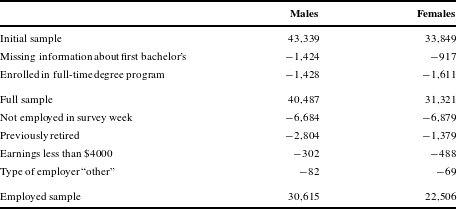
Because the measures we examine – earnings, R&D activities, job match, and job satisfaction – are available only for those who are employed, we make the following sample restrictions to create our regression sample. First, because we examine degree fields for the first bachelor’s degree, we eliminate observations for which field of first bachelor’s degree is not reported. We also restrict the sample to those who are employed, have not previously retired, are not currently full-time students in a degree program, and have earnings greater than or equal to $4000. We also drop the few observations that report “other” as their type of employer. Appendix A indicates the number of observations that are eliminated by each of the restrictions for both males and females. These restrictions result in sample sizes of 30,615 employed males and 22,506 employed females. As we also examine statistics for the full sample (not restricted to those employed), Appendix A also shows the sample sizes and effects of restrictions for all respondents.Footnote 19
4 Types of majors and comparisons of single and double majors
Before turning to our regression estimates, we begin by examining sample characteristics by single or double major status for the full sample, regardless of employment status. We expect that if stronger students self-select into double majoring, the observable characteristics that are positively correlated with student ability will also be higher. For example, double majoring may be associated with the type of educational institution, which in turn is related to institutional selectivity and the corresponding ability of the students. Furthermore, advantages associated with double majoring may be reflected in a greater likelihood of employment or of earning a graduate degree.
Thus, we start by presenting in Table 1 the following statistics, stratified by single or double major as well as by sex for the full sample: labor force participation rate, employment rate, highest degree (e.g., additional BA degree, MBA, JD, PhD, etc.), and parents’ education. We also provide information on age, ethnicity, and race. To examine whether double majoring is related to institution type, we use the groupings defined in Hersch (Reference Hersch2013), which show how Carnegie classifications map into measures of college selectivity. These groupings (and labels as used in Hersch) are as follows: Private Research I and II (tier 1); Private Liberal Arts I (tier 2); Public Research I (tier 3); and remaining U.S. institutions that are not special focus (tier 4), with a fifth category for not classified bachelor’s degrees (e.g., special focus, non-U.S., or not available).
Means or percentages by single or double major, full sample.

Note: Authors’ calculations from the 2010 National Survey of College Graduates. Standard deviations for continuous variables are given in parentheses. All values are calculated using NSCG sample weight. The following indicates statistically significant differences in means across those with single majors compared to those with double majors: $+$
$+$ $p<0.10$
; *
$p<0.10$
; * $p<0.05$
; **
$p<0.05$
; ** $p<0.01$
.
$p<0.01$
.
As Table 1 demonstrates, double majors are older on average than single majors, reflecting a declining rate of double majoring over time. Double majors are more likely to have a JD, nonbusiness master’s degree, or a PhD (statistically significant for females only) than single majors, but are not more likely to attain other graduate degrees, providing mixed evidence of the correlation between double majoring and ability.Footnote 20 Type of institution matters as well, as those with double majors are more likely to be graduates of selective private liberal arts colleges than those with single majors and less likely to have graduated from a public research institution. The greater concentration of private liberal arts college graduates among double majors may reflect greater ability of those students. Alternatively, as tier 3 schools are also selective, the differences in the likelihood of single or double major achievement between tier 2 and tier 3 graduates may reflect barriers to double majoring at large, public research universities and the administrative ease of double majoring and encouragement of multidisciplinary exploration at liberal arts colleges.
Parents’ education is often used as a proxy for socioeconomic background or ability, but among females, there are no significant differences in mother’s education by single or double major status. Among males, there is a greater share of mothers and fathers with less than a bachelor’s degree and a smaller share of mothers and fathers with bachelor’s degrees amongst graduates with a double major. Notably, and somewhat surprisingly, employment and labor force participation rates are higher for single majors than double majors. One possible explanation for the lower employment and labor force participation rates may be related to the higher average age of double majors in that a greater share may be retired, but when we restrict to those under age 65, we continue to find these rates are lower for double majors, although the differences are not statistically significant for females.Footnote 21
For the rest of our analysis, we focus on the employed sample. To further explore additional costs associated with double majoring as well as possible differences in ability, Table 2 reports the mean years between high school graduation and completion of the first bachelor’s degree, by single and double majoring choice and type of bachelor’s institution. Across single and double majoring status, graduates of tier 1 and tier 2 schools spend less time between high school graduation and bachelor’s degree completion, and the differences in years are not statistically different between tier 1 and tier 2 schools. Tier 4 institutions and the not classified schools have the longest mean times to completion.Footnote 22 With the exception of tier 3 for males, the average time between high school and first bachelor’s degree completion within each tier is less for those with double majors, but these mean differences are not significantly different except for three instances noted in Table 2. For females, none of the differences in mean time across single and double majors are statistically significant. Interestingly, female college graduates take longer on average than males to achieve their first bachelor’s degree. There is little evidence from the statistics in Table 2 that double majoring in general leads to students taking additional time to graduate, so there are unlikely to be added time and tuition costs to double majoring.
Mean years between high school and first bachelor’s degree.

Note: Authors’ calculations from the 2010 National Survey of College Graduates. All values are calculated using NSCG sample weight. The following indicates statistically significant differences in means across double major status within gender: $+$
$+$ $p<0.10$
; *
$p<0.10$
; * $p<0.05$
.
$p<0.05$
.
Appendix B provides sample characteristics for the variables used in the regression. As noted in Appendix B, 17% of males and 19% of females earned a double major with that difference statistically significant at the 1% level; the rate of double majoring pooling males and females is 18%, the same rate found in the 2003 NSCG by Del Rossi and Hersch (Reference Del Rossi and Hersch2008).
Table 3 reports the distribution of majors for males and females. All differences in means for males and females are statistically significant at the 1% level, except for double majors with two business majors and double majors in business and liberal arts. Females are almost three times more likely to major in education, and they have higher rates of majoring in liberal arts fields. These differences are mirrored by the higher rates of majoring in STEM fields for males, who are approximately 45% more likely to earn a single major in a STEM field and twice as likely to earn a double major in two STEM fields as females. Males are also more likely to single major in business fields (close to 50% higher than the female rate).
Distribution of majors.
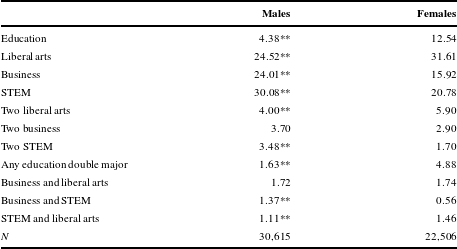
Note: Authors’ calculations from the 2010 National Survey of College Graduates. The percent by gender in each major or combination of majors is reported. All values are calculated using NSCG sample weight. ** indicates statistically significant difference in means across gender: $p<0.01$
.
$p<0.01$
.
Notably, a substantial share of the sample reports liberal arts as either their single major or as one of their double majors – 31% for males and 41% for females (not including any education–liberal arts double majors). In terms of types of double major combinations, few graduate with the disparate combination of liberal arts and business or liberal arts and STEM that would seem to provide the most broad or diverse range of skills and perspectives. The higher percentage of double majors within the same category compared to double majors across different categories may reflect institutional barriers that make completing requirements for two majors that are offered in different colleges difficult, such as differences in general education or core requirements, academic calendars, and course times. For example, science lab times and performance-based courses may cut across time blocks and limit student opportunities to fulfill requirements associated with other majors.
5 Empirical specification and hypotheses
The principal monetized benefit of education, and the primary focus of economics research, is on the returns to education. Accordingly, we begin by estimating conventional log earnings equations augmented with indicators for college major fields of the general form indicated in equation (1):
 $$\begin{eqnarray}\ln Y_{i}=X_{i}\unicode[STIX]{x1D6FD}+S_{i}\unicode[STIX]{x1D6FE}+D_{i}\unicode[STIX]{x1D6FF}+\unicode[STIX]{x1D700}_{i}\end{eqnarray}$$ $Y_{i}$
represents individual
$Y_{i}$
represents individual $i$
’s earnings, and
$i$
’s earnings, and $X_{i}$
is a vector of demographic, educational, and employment-related characteristics, such as race, graduate degree, and employer type. The vector
$X_{i}$
is a vector of demographic, educational, and employment-related characteristics, such as race, graduate degree, and employer type. The vector $S_{i}$
includes indicators for field of major for those with a single major. The vector
$S_{i}$
includes indicators for field of major for those with a single major. The vector $D_{i}$
includes indicators for various double major combinations. These single and double major categories are mutually exclusive. The coefficient parameters to be estimated are the vectors
$D_{i}$
includes indicators for various double major combinations. These single and double major categories are mutually exclusive. The coefficient parameters to be estimated are the vectors $\unicode[STIX]{x1D6FD}$
,
$\unicode[STIX]{x1D6FD}$
, $\unicode[STIX]{x1D6FE}$
and
$\unicode[STIX]{x1D6FE}$
and $\unicode[STIX]{x1D6FF}$
, and
$\unicode[STIX]{x1D6FF}$
, and $\unicode[STIX]{x1D700}_{i}$
is the random error term. We estimate corresponding equations by probit for our other components of benefits by replacing earnings with indicators of R&D activities, job match quality, and job satisfaction, where we examine whether respondents spend 10% or more of their work time on R&D activities, whether their job is closely related to their highest degree field, and whether respondents are very satisfied with their principal job.
$\unicode[STIX]{x1D700}_{i}$
is the random error term. We estimate corresponding equations by probit for our other components of benefits by replacing earnings with indicators of R&D activities, job match quality, and job satisfaction, where we examine whether respondents spend 10% or more of their work time on R&D activities, whether their job is closely related to their highest degree field, and whether respondents are very satisfied with their principal job.
Our hypotheses with respect to the benefit components are of two types, although the following discussion emphasizes the expected relation of double majoring with monetary returns. First, we test hypotheses comparing the returns to a single major to that of a double major which includes that single major as one of the two majors. For example, we compare the returns to having a single major in business with the returns to having a double major in which one of the two majors is in a business field and the other major is outside of the business field. We might expect that the return when a second major is added would be greater than the return to a single major due to additional breadth and skills. This result would lend support to the argument that students can diversify their marketable skill set with a liberal arts major. However, if double majoring leads to lower grades or sacrifices deeper knowledge of a field, double majors may have lower returns than those with corresponding single majors. Also, the reason for double majoring may affect the return to the double major. For example, pairing a chemistry major with an education major may be associated with lower pay than a single major in chemistry if the reason for the double major is to gain certification as a science teacher.
Our second set of hypotheses compares returns to double major combinations that are likely to provide different types of knowledge and approaches with those major combinations that would largely provide similar training. Double majoring within closely related fields may have limited value in terms of providing broader knowledge and different perspectives, approaches, or skill sets. Del Rossi and Hersch (Reference Del Rossi and Hersch2008) found that the return to having dissimilar majors is greater than the return to having similar majors, and we examine whether this result holds up for more recent data and whether this is true across all disparate combinations.Footnote 23
6 Earnings, R&D, job match, and job satisfaction regression results
The first columns of Tables 4A and 4B report results from the earnings regressions for males and females, respectively. The regressions show the usual results with respect to the demographic and job-related variables. The regressions also show substantially higher earnings among those with professional and graduate degrees relative to those whose highest degree is a bachelor’s, with females receiving larger returns than males for nonbusiness master’s degrees, PhDs, and other professional degrees. We also find that returns to the different single and double major categories are very similar for males and females. In fact, in a pooled regression there are no statistically significant interactions of single or double major combinations with the male indicator variable. That is, although the distribution of majors across males and females is significantly different, the returns to majors are not. This pattern of results is different from a number of earlier studies including Brown and Corcoran (Reference Brown and Corcoran1997) and Eide (Reference Eide1994), but more recent studies report mixed findings. For instance, Graham and Smith (Reference Graham and Smith2005) find that whether males and females receive similar returns to science and engineering majors depends on whether or not they work in a science and engineering occupation. McDonald and Thornton (Reference McDonald and Thornton2007) find that average starting salaries for male college graduates exceed that of females for most fields through 2001. Zhang (Reference Zhang2008) finds that both the distribution of college majors and the returns to those majors contribute to the gender earnings gap. Morgan (Reference Morgan2008) finds that within-major pay penalties are virtually zero for professional and scientific fields but present for business, social science, and humanities majors.
Benefits to double majors, males.

Note: Authors’ calculations from the 2010 National Survey of College Graduates. Robust standard errors are reported in parentheses. All values are calculated using NSCG sample weight. Excluded major group is single education major. The earnings column reports results from an OLS regression with the natural log of earnings as the dependent variable. The R&D, job match, and job satisfaction equations are estimated by probit, and marginal effects are reported. $+$
$+$ $p<0.10$
; *
$p<0.10$
; * $p<0.05$
; **
$p<0.05$
; ** $p<0.01$
.
$p<0.01$
.
Benefits to double majors, females.

Note: Authors’ calculations from the 2010 National Survey of College Graduates. Robust standard errors are reported in parentheses. All values are calculated using NSCG sample weight. Excluded major group is single education major. The earnings column reports results from an OLS regression with the natural log of earnings as the dependent variable. The R&D, job match, and job satisfaction equations are estimated by probit, and marginal effects are reported. $+$
$+$ $p<0.10$
; *
$p<0.10$
; * $p<0.05$
; **
$p<0.05$
; ** $p<0.01$
.
$p<0.01$
.
In a comparison of returns to different majors, Tables 4A and 4B results show that, relative to the excluded category of a single major in education, most other fields are associated with higher earnings. The returns for males to single liberal arts majors, double liberal arts majors, and double majors that include education are not statistically different from the single education major, and the business and liberal arts double major for females has an insignificant coefficient. For males, business majors (single or having two business majors) have the lowest additional return of 22% more than single education majors, and the business–STEM double major combination is associated with the highest returns – 44% more than single education majors.Footnote 24 For females, on the low end of returns, individuals with a single liberal arts major have earnings that are 8% higher than single education majors, and at the high end, single STEM, two STEM majors, and the business and STEM double major combination all have returns close to 40% greater than the return to a single education major.Footnote 25
The rest of the columns in Tables 4A and 4B present marginal effects from probit regressions on other benefit components. From the R&D regressions, few variables beyond education-related variables are related to the likelihood of R&D activities on the job. The likelihood of R&D activities is higher for private employees for both males and females and for male self-employed individuals compared to government employees. For both genders, PhD recipients are more likely to do R&D on the job, and JDs are less likely to do R&D. For males, those with either an MD or other professional degree are less likely to do R&D, while for females having a master’s degree (MBA or other) leads to a higher likelihood of doing R&D work.
In terms of undergraduate fields of study and R&D, not surprisingly, having a single major in STEM or a double major involving a STEM major is associated with higher likelihood of R&D activities on the job. Of particular interest is whether combining liberal arts with STEM is associated with a higher probability of R&D. Individuals with double majors involving at least one liberal arts major do have a greater likelihood of R&D on the job than single education majors and single business majors and, for females, also a greater likelihood than a single liberal arts major.
Next, Tables 4A and 4B show results of estimating the probability of the principal job being closely related to an individual’s highest degree. Those who earn graduate degrees, and those who complete a second bachelor’s degree, have better job matches. Job match likelihood is also higher with age and, for females, being married. But the relation between college major and job match varies by the field. Relative to an education major, having a liberal arts major (single or in a combination with any other major) is associated with a lower likelihood of a close job match for males and females. For females, for whom job match quality is actually higher on average, having a single business major, an education double major, or business and STEM double major are all associated with a lower likelihood that the job is closely related to the highest degree.
The last columns of Table 4A and 4B report estimates for job satisfaction. For males, all graduate degrees are associated with a higher likelihood of being very satisfied with one’s job, while for females, a nonbusiness master’s degree, an MD, and other professional degree are associated with greater job satisfaction. Being married is associated with greater job satisfaction for both males and females. Those of minority race have lower job satisfaction. In terms of college majors, for females, there are no statistically significant relationships of job satisfaction with single or double major combinations; that is, job satisfaction does not vary by college major. For males, compared to those with single education majors, individuals with a single liberal arts major, two business majors, a business and STEM double major, or the STEM–liberal arts major combination are less likely to be very satisfied with their job, with the magnitude of the difference ranging from 8 percentage points for single liberal arts majors to 14 percentage points for those with two business majors. There are no significant differences in magnitude of these effects across major groupings.
7 Comparing single majors to double majors
In Tables 5A and 5B, we summarize the results of tests of the equality of coefficients for each of our benefit components for males and females, respectively, by comparing the returns to a single major in a field to that of having a double major that includes that single major as one of the two majors. For example, for the earnings regressions, we compare the returns to a single major in the liberal arts to the returns to having a double major where one major is in the liberal arts and one major is in a STEM field. In the tables, a “ $+$
” (“
$+$
” (“ $-$
”) indicates that the double major combination has a statistically significant higher (lower) coefficient estimate at the 10% level or better than the single major to which it is being compared.
$-$
”) indicates that the double major combination has a statistically significant higher (lower) coefficient estimate at the 10% level or better than the single major to which it is being compared.
Comparisons of single majors versus double major combinations, males.

Note: Authors’ calculations from the 2010 National Survey of College Graduates. Table reports tests of significant differences between single major and double major combinations that include the single major given in the first column, based on the regressions reported in Table 4A.
“ $+$
” (“
$+$
” (“ $-$
”) indicates that the double major combination has a statistically significant higher (lower) coefficient estimate than the single major to which it is being compared at
$-$
”) indicates that the double major combination has a statistically significant higher (lower) coefficient estimate than the single major to which it is being compared at $p<0.10$
. “0” indicates no differences at
$p<0.10$
. “0” indicates no differences at $p<0.10$
.
$p<0.10$
.
Comparisons of single majors versus double major combinations, females.
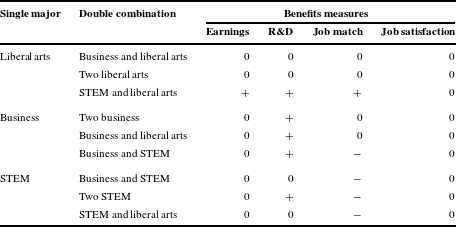
Note: Authors’ calculations from the 2010 National Survey of College Graduates. Table reports tests of significant differences between single major and double major combinations that include the single major given in the first column, based on the regressions reported in Table 4B.
“ $+$
” (“
$+$
” (“ $-$
”) indicates that the double major combination has a statistically significant higher (lower) coefficient estimate than the single major to which it is being compared at
$-$
”) indicates that the double major combination has a statistically significant higher (lower) coefficient estimate than the single major to which it is being compared at $p<0.10$
. “0” indicates no differences at
$p<0.10$
. “0” indicates no differences at $p<0.10$
.
$p<0.10$
.
We start with the earnings results, which reflect the private value of double majoring. For males, double majoring relative to a single major is associated with higher earnings in some fields. Relative to a single major in the liberal arts, earnings are higher for those with one major in the liberal arts and one in business or one in STEM (and the returns are of the same magnitude for those double majors); and the business–STEM double major combination has significantly higher returns for males than either a single STEM major or a single business major, with the bigger incremental differences comparing single business to the business–STEM double major category. For females, having a second major, whether it is in the same category or in a different category, does not result in higher returns to the bachelor’s degree, except for the higher return to those who graduate with a double major in STEM and the liberal arts compared to graduates with a single major in the liberal arts. This combination of STEM and liberal arts may lead to smaller increased earnings for females than a single STEM major, although the difference is not quite statistically significant at conventional levels $(p=0.109)$
.
$(p=0.109)$
.
Turning to R&D, not surprisingly, individuals who have a double major with a STEM major are more likely to do R&D in their principal job compared to those with a single liberal arts, business, or STEM major. However, the reverse is not true – combining a business major or liberal arts major with a STEM major does not increase the likelihood of R&D activities compared to those with single majors in STEM. The combination of liberal arts and business yields some interesting results. For males, the combination of business and liberal arts is associated with a greater likelihood of R&D than a single business major or a single liberal arts major. Similarly, for females, the business–liberal arts double major has a greater likelihood of R&D than a single business major.
Next, the relationship between major categories and job match quality varies substantially across gender. Table 5A shows that males who have either a STEM–liberal arts or a business–liberal arts double major combination have a lower likelihood of a close job match than individuals with either a single business or single STEM major. That is, the versatility of skills gained by adding a liberal arts major seems to reduce job match quality for males. For females, job match is higher for STEM–liberal arts majors than for single liberal arts majors. However, females who graduate with a double major in business and STEM, liberal arts and STEM, or even two STEM degrees, have lower job match likelihood than single STEM majors.
As noted above in the discussion of Tables 4A and 4B, job satisfaction does not vary across single or double major combinations for females, and even when it does vary by major for males, with satisfaction lower for some majors compared to single education majors, there are no significant differences in coefficients when comparing single majors to double major combinations.
8 Comparing double major combinations
Tables 6A and 6B provide levels of statistical significance for tests of difference in returns to having various double major combinations. The question addressed is whether there are differences in returns to earnings and likelihood of R&D, job match, and job satisfaction between those who have two majors within a disciplinary group and those who have two majors that cross disciplinary groups. In terms of earnings, the hypothesis being tested is whether employers reward employees who have a wide range of skills that might be learned by combining very different majors. R&D may increase when individuals have a background that encourages interdisciplinary thinking and enables them to see problems from a wide range of cross-disciplinary perspectives. In contrast, having a broader background that is less focused on a particular field or occupation may reduce job match. In the tables, a “ $+$
” (“
$+$
” (“ $-$
”) indicates that the double major combination that crosses disciplinary group has a statistically significant higher (lower) coefficient estimate at the 10% level or better than the within disciplinary group major.
$-$
”) indicates that the double major combination that crosses disciplinary group has a statistically significant higher (lower) coefficient estimate at the 10% level or better than the within disciplinary group major.
What is clear from these tests for male college graduates (Table 6A) is that there is a consistent positive relation on earnings of having a double major that contains at least one major from business or STEM fields, and that a double major that combines the two fields has higher earnings than a double major within either field. The business–liberal arts and STEM–liberal arts combinations have higher earnings than two liberal arts majors, but no higher returns to earnings than doubling within STEM or within business. There are few differences in returns across similar or dissimilar double major combinations for females (Table 6B). Only the STEM–liberal arts combination has statistically significant higher returns than the two liberal arts majors group when comparing double majors within disciplinary groups to cross-discipline double majors.
In contrast to females, for which there are no differences in estimated coefficients in the R&D equation, males who graduate with a STEM and liberal arts double major have a greater likelihood of R&D work activities, which is significantly higher than those who have two liberal arts majors. Combining business and STEM majors results in a lower likelihood of R&D for males than two STEM majors. There are no other significant differences for males in terms of likelihood of R&D.
Comparisons of double major combinations, males.

Notes: Authors’ calculations from the 2010 National Survey of College Graduates. Table reports tests of significant differences between double major combinations that cross disciplinary groups and double majors within a disciplinary group based on the regressions reported in Table 4A.
“ $+$
” (“
$+$
” (“ $-$
”) indicates that the double major combination that crosses disciplinary groups has a statistically significant higher (lower) coefficient estimate than the double major combination within a disciplinary group at
$-$
”) indicates that the double major combination that crosses disciplinary groups has a statistically significant higher (lower) coefficient estimate than the double major combination within a disciplinary group at $p<0.10$
. “0” indicates no differences at
$p<0.10$
. “0” indicates no differences at $p<0.10$
.
$p<0.10$
.
Comparisons of double major combinations, females.

Source: Authors’ calculations from the 2010 National Survey of College Graduates. Table reports tests of significant differences between double major combinations that cross disciplinary groups and double majors within a disciplinary group based on the regressions reported in Table 4A.
“ $+$
” (“
$+$
” (“ $-$
”) indicates that the double major combination that crosses disciplinary groups has a statistically significant higher (lower) coefficient estimate than the double major combination within a disciplinary group at
$-$
”) indicates that the double major combination that crosses disciplinary groups has a statistically significant higher (lower) coefficient estimate than the double major combination within a disciplinary group at $p<0.10$
. “0” indicates no differences at
$p<0.10$
. “0” indicates no differences at $p<0.10$
.
$p<0.10$
.
There are mixed results in terms of job match for males. Combining STEM and liberal arts disciplines is related to higher job match for males than having two liberal arts majors, but combining liberal arts with either business or STEM is related to a lower likelihood of job match than doubling within business or within STEM for males. For females, combining business with either a liberal arts or STEM major is related to a smaller likelihood of job match than having two business majors, and the combination of business and STEM is associated with lower job match quality than two STEM degrees. For females, the disparate skills earned from those two majors seem to be associated with a lower likelihood of close match of degree and jobs.
Although, for males, a number of majors are associated with lower job satisfaction relative to a single education major, there are no significant differences in the coefficient estimates and, for females, no coefficient differences are statistically significant.
9 Conclusions
Increased emphasis on STEM fields has caused concern that society is losing benefits associated with broader liberal arts education. Measured solely by monetary returns to education, STEM and business majors earn substantially more than liberal arts majors. Double majoring is one educational strategy that may combine advantages of technical training with liberal arts education, allowing access to higher paying occupations as well as cultivating critical thinking and communication skills. Using data from the 2010 NSCG, we examine whether double majoring is associated with private and social benefits beyond that associated with a single major in the same field, and whether combinations of double majors that cut across disciplines are associated with higher earnings than double majors within a discipline. The benefits measures we examine are earnings, R&D, job match with field of degree, and job satisfaction.
The strongest private and social benefits to double majoring relate to earnings and R&D. For both males and females, R&D activity is higher among those with double majors that include business relative to those with a single business degree, and is higher for those who double major in two STEM fields relative to a single STEM major. For males, the business and STEM double major combination is associated with higher earnings than either business or STEM as a single major, and graduates with liberal arts and either STEM or business as a second major earn more than those with liberal arts degrees. There is little evidence that double majors have greater job match quality or job satisfaction than those with single majors in one of the same fields.
In Pitt and Tepper (Reference Pitt and Tepper2012), students report that their main purpose of double majoring is to enhance their job market or graduate school prospects, but even so, they tend to choose combinations that are complementary and have an overlap in requirements. We do find that double majors within the broad groups of STEM, business, and the liberal arts are more common than cross-group double majors. However, our analysis shows that these combinations, perhaps a result of institutional barriers creating difficulties in majoring across colleges or schools within a larger institution, are not associated with higher earnings and that, especially for male individuals, there are higher returns for graduating with a double major in more disparate fields than for graduating with a double major within a field. Males who combine business and STEM have higher earnings than those with double majors that are both within STEM or both within business. Even if there is upward bias in returns due to selection into certain major combinations in that more able students double major, there is no consistent general earnings advantage to double majoring, and there are almost no significant differences in returns across double major combinations for females. As with the comparison of double majors to single majors, the combinations of double majors are not strongly associated with job match quality or job satisfaction.
There is little evidence from analysis of the 2010 NSCG that encouraging students to pursue double majors that include a liberal arts major will be associated with higher earnings. However, contrary to popular belief and some parents’ worries, we did not find that combining a liberal arts major with a business or STEM major is associated with significantly lower earnings.
Our analysis supports the continued push to increase the number of STEM majors, either as single majors or as double majors, both from the private benefit, or earnings, perspective, and from the perspective of the social benefits of R&D. Without a financial benefit, few STEM majors will have incentive to broaden their educational curriculum into the arts, humanities, or social sciences, but we find little evidence that graduating with the different skills and knowledge gained from a liberal arts major has additional social benefits compared to a single STEM major based on our measures of R&D, job match, and job satisfaction. In contrast, the pairing of a business major and a liberal arts major appears to have a positive association with more R&D activities compared to either major alone. From our earnings regressions, we did not find a financial incentive to pair these majors compared to a single business major.
In sum, there is little evidence of costs to double majoring, but there are no widespread, dramatic individual or societal benefits to pursuing double majors either. For the few major combinations that are associated with higher social benefit components, there are not corresponding private incentives to pursue those combinations. Despite the lack of higher earnings from most double major combinations, double majoring is quite common, with nearly 20% of college graduates earning a double major. The large share of students who choose to double major suggests a high value of consumption benefits or overestimation of the private economic benefits of double majors.
Appendix A. Construction of sample
Appendix B. Sample means or percentages for regression sample

Appendix C. Robustness tests
We examined a number of alternative samples for the earnings regressions. We restricted the sample to those under age 66. Estimated returns to single and double majors were not noticeably affected by this change in terms of magnitude and statistical significance. We also estimated an earnings regression for males and females who are full-time workers. Again, there is little effect on the returns to education variables, with two exceptions: for males, having a double major in education or having an additional bachelor’s degree has positive and statistically significant effects on earnings.
For all benefits components, we estimated models for the samples of males and females whose highest degree is a bachelor’s degree and whose highest degree is a graduate degree. The results are very similar in terms of significance and magnitude of coefficient estimates for the bachelor’s degree only samples, while for those who earned a graduate degree, some bachelor’s degree majors become statistically insignificant, especially for the nonearnings regressions.
As a further check on the robustness of our results, we examined the effect of major categories on two alternative measures of earnings: the log of hourly wage and the log of total earnings from all jobs as the dependent variable.Footnote 26 For both alternative dependent variables, the magnitude and significance of the returns to majors are quite similar to the results reported using the other earnings measure based on annual salary on the principal job. One interesting difference is that for both the log wage and log total earnings regressions, the double major of business and liberal arts has a greater return than single business majors for males. In fact, for the total earnings equation for males, the highest return is that of the business–liberal arts double major. Interestingly, this double major combination for females is not statistically significant for any of the dependent variables we examined. Delving into this result further, males with a business–liberal arts double major are more likely to major in a social science field within the liberal arts category than females (74% versus 65%), and on the business side of this double major, close to 65% of males and 44% of females have a major in economics. These differences in major choice can help explain why this particular double major has the potential for higher returns for males.



