

3.1 Introduction
Global energy challenges and responses to climate change are intrinsically intertwined. Efforts to achieve the Sustainable Development Goal on energy (SDG 7) – to provide ‘access to affordable, reliable, sustainable and modern energy for all’ (United Nations 2015) – will affect the possibility to reach the goals set out in the Paris Agreement under the United Nations Framework Convention on Climate Change (UNFCCC) to keep global warming under 2 degrees, and vice versa. Such efforts are thus interdependent and situated in a ‘climate-energy nexus’.
In this chapter, we map the increasingly dense institutional complex of governance institutions occupying the climate-energy nexus. In global climate governance, international and transnational institutions have proliferated since the adoption of the UNFCCC in 1992, which has led to an increasingly fragmented global climate governance architecture (Bäckstrand Reference Bäckstrand2008; Biermann et al. Reference Biermann, Pattberg, van Asselt and Zelli2009; Keohane and Victor Reference Keohane and Victor2011; Abbott Reference Abbott2012; Bulkeley et al. Reference Bulkeley, Andonova, Betsill, Compagnon, Hale, Hoffmann, Newell, Paterson, Roger and VanDeveer2014; Falkner Reference Falkner2014). Similarly, global energy governance has been characterized as fragmented (e.g. Dubash and Florini Reference Dubash and Florini2011; Van de Graaf Reference Van de Graaf2013; Escribano Reference Escribano2015), partly due to the diversity of governance efforts involved and the way it deals with different energy sources (e.g. coal, gas, solar, and wind), and challenges (energy security, energy access and environmental sustainability).
Despite the interdependence between climate change and energy governance, scholars studying institutional structures often only focus on one issue area. For example, in an effort to understand institutional complexity of global climate change governance, and the causes and consequences thereof, several studies introduced mappings of the broader institutional complex. Keohane and Victor (Reference Keohane and Victor2011) discussed the regime complex for climate change by demonstrating a plethora of international state-based governance arrangements, and evaluated the emerging regime complex as ‘loosely coupled’, with institutions that are not integrated or arranged in a clear hierarchy (Keohane and Victor Reference Keohane and Victor2011, 9). Others have mapped climate governance institutions beyond the international realm, focusing on transnational and private climate governance (e.g. Pattberg and Stripple Reference Pattberg and Stripple2008; Abbott Reference Abbott2012; Bulkeley et al. Reference Bulkeley, Andonova, Betsill, Compagnon, Hale, Hoffmann, Newell, Paterson, Roger and VanDeveer2014; Hale and Roger Reference Hale and Roger2014). Subsequent research sought to combine both spheres (Widerberg et al. Reference Widerberg, Pattberg and Kristensen2016), operationalizing a heuristic framework that had been developed by Abbott and Snidal (Reference Abbott and Snidal2009a; Reference Abbott and Snidal2009b; Abbott Reference Abbott2012).
Similarly, a growing body of literature has mapped the global energy complex (e.g. Suding and Lempp Reference Suding and Lempp2007; Kerebel and Keppler Reference Kérébel and Keppler2009; Lesage et al. Reference Lesage, Van de Graaf and Westphal2010; Colgan et al. Reference Colgan, Keohane and Van de Graaf2012; Sovacool and Florini Reference Sovacool and Florini2012; Leal-Arcas and Filis Reference Leal-Arcas and Filis2013; Wilson Reference Wilson2015; Escribano Reference Escribano2015). However, these mappings led to strikingly different results, with the number of governance efforts ranging from six, identified by Kerebel and Keppler (Reference Kérébel and Keppler2009), to fifty, identified by Sovacool and Florini (Reference Sovacool and Florini2012) (Van de Graaf and Colgan Reference Van de Graaf and Colgan2016). Like the institutional complex itself, the mapping efforts have been rather fragmented in terms of focus on energy source, or type of institution. Whereas a number of studies exclusively focus on oil and gas (e.g. Kerebel and Keppler Reference Kérébel and Keppler2009), others target renewable energy sources (e.g. Barnsley and Ahn Reference Barnsley and Ahn2014). Additionally, while some mappings are restricted to intergovernmental organizations (e.g. Wilson Reference Wilson2015), others also include nongovernmental organizations; and hybrid or public–private institutions (Sovacool and Florini Reference Sovacool and Florini2012). Sanderink et al. (Reference Sanderink, Kristensen, Widerberg and Pattberg2018), finally, merged these different criteria and introduced a novel and comprehensive mapping of global energy governance, following a methodology similar to Widerberg et al. (Reference Widerberg, Pattberg and Kristensen2016).
What is missing to date is an integrated mapping and coherent analysis of the institutional complex governing the nexus between climate change and energy. Consequently, this chapter identifies the institutions that address both challenges simultaneously. The aims of this chapter are twofold: first, we provide a pioneering mapping and analysis of the climate-energy institutional nexus. Second, we introduce novel empirical data and input for the three case studies on the subfields of renewable energy, fossil fuel subsidy reform, and carbon pricing (see Chapters 4–6).
Concretely, this chapter analyzes the climate-energy nexus along the distinction between the macro level (the overall nexus) and the meso level (the various subfields within the broader climate and energy institutional complex). Each level is scrutinized along a number of analytical questions, including the major dimensions that were introduced in Chapter 2. When were the institutions established, and how did the institutional complex develop over time? What types of institutions populate the climate-energy nexus? Who are the institutional members to the institutions, and how are these connected? What kind of governance functions do these institutions fulfil? What is their thematic focus?
The chapter proceeds as follows: Section 3.2 introduces the methodology and data collection approach. Section 3.3 provides an introduction to the three subfields; Sections 3.4 and 3.5 then provide the mapping and analysis of the macro and meso levels of the climate-energy nexus. Section 3.6 concludes with a set of final remarks and sets the stage for the subsequent chapters.
3.2 Methodology
Mapping the institutional complex that governs the climate-energy nexus and the three subfields is carried out in two steps. First, compiling a database that includes the institutions actively addressing the climate-energy nexus; and second, visualizing and analyzing the data. The next subsections describe these two steps in more detail, including our dataselection criteria and data analysis.
3.2.1 Data Selection
The database consists of institutions that govern both climate change and energy. In line with our definition of global governance (see Chapter 2), our criteria for inclusion and exclusion are based on previous work by the CONNECT project,Footnote 1 which includes institutions that are (i) intergovernmental or transnational, which not only have the (ii) intentionality to steer policy and the behaviour of their members or a broader community, but also explicitly refer to a (iii) common governance goal, to be accomplished by (iv) significant governance functions (Widerberg et al. Reference Widerberg, Pattberg and Kristensen2016). For the climate-energy nexus as a whole, the overarching governance goals are twofold. On the one hand, institutions strive to mitigate climate change, i.e. to stabilize greenhouse gas concentrations in the atmosphere at a level that will prevent dangerous human interference with the climate system. On the other hand, institutions in the nexus adhere to the proposition that decarbonizing the energy sector is essential to combat climate change. Taken together, the governance goal that unites institutions in the nexus is greenhouse gas mitigation through a transformation toward low-carbon or fossil-free energy systems, excluding those focusing on carbon capture and storage (CCS) and nuclear power.
For populating the database, we used two key sources. First, the CONNECT project’s database on global climate change governance (Widerberg et al. Reference Widerberg, Pattberg and Kristensen2016), and secondly, the CONNECT dataset on global energy governance (Sanderink et al. Reference Sanderink, Kristensen, Widerberg and Pattberg2018). The database on climate governance builds on previous case studies (particularly Hoffmann Reference Hoffmann2011; Bulkeley et al. Reference Bulkeley, Andonova, Betsill, Compagnon, Hale, Hoffmann, Newell, Paterson, Roger and VanDeveer2014; Hale and Roger Reference Hale and Roger2014) and a thorough assessment of two online databases: the Climate Initiative Platform (climateinitiativesplatform.org) and the Non-State Actor Zone for Climate Action (NAZCA, climateaction.unfccc.int). Similarly, the dataset on global energy governance includes previous mapping exercises (Suding and Lempp Reference Suding and Lempp2007; Kerebel and Keppler Reference Kérébel and Keppler2009; Lesage, Van de Graaf, and Westphal Reference Lesage, Van de Graaf and Westphal2010; Colgan, Keohane, and Van de Graaf Reference Colgan, Keohane and Van de Graaf2012; Sovacool and Florini Reference Sovacool and Florini2012; Escribano Reference Escribano2015; Wilson Reference Wilson2015), complemented with data from the Climate Initiatives Platform, NAZCA, and the Portal on Cooperative Initiatives (unfccc.int/focus/mitigation/items/7785.php). From these two key sources, we selected those institutions focusing on climate and energy simultaneously for the climate-energy nexus database. Finally, a small number of institutions were added based on complementary discussions with experts on climate-energy overlaps.Footnote 2
3.2.2 Data Analysis
The data we retrieved for the selected institutions includes: name of institution, starting year, membership data, governance functions, and thematic focus. Based thereon, the mappings of the climate-energy nexus and the subfields can be illustrated in various ways. First, we started with a timeline demonstrating how, when, and in which context the institutional complex governing the climate-energy nexus emerged.
Second, for an overview of the institutional complex and the subfields, we used a heuristic framework developed by Abbott and Snidal (Reference Abbott and Snidal2009a; Reference Abbott and Snidal2009b; Abbott Reference Abbott2012) for mapping global governance architectures, called ‘governance triangle’. We situated the institutions from our database in the governance triangle according to their membership, i.e. the type of their constituent actors: public, firm, and/or civil society organization (CSO). The public category includes individual states (or their governmental agencies, respectively), groups of states, international organizations (IOs), cities, or regions. The firm category comprises (groups of) firms, industry associations, and investors. Finally, CSOs include nongovernmental organizations (NGOs), other organizations that represent civil society, and networks and coalitions of CSOs. Based on the three actor categories, the governance triangle is divided into seven zones. Institutions in zones 1–3, the vertex zones, are constituted by a single type of actor. Those in zones 4–6, the quadrilateral zones, include two types of actors. Finally, the institutions in the central zone 7 are those that involve all three types, also called multi-stakeholder institutions. In the respective triangles that follow in this chapter, we will also use greyscale to mark these different actor patterns.
Third, for each institution in the dataset we collected membership data using a methodology developed by the CONNECT project (Widerberg et al. Reference Widerberg, Pattberg and Kristensen2016). Members are defined as ‘actors with the formal position to influence the rules, norms, operations or performance of an institution’ (Widerberg et al. Reference Widerberg, Pattberg and Kristensen2016, 19). Moreover, they may gain benefits from their membership through access to their institution’s network, and due to material, reputational, or other types of benefits that the institution is expected to yield. On the other hand, we excluded ‘supporting’ organizations or countries from the dataset. These could be organizations that merely support an institution’s values, rules, norms, or mission by way of a public statement or endorsement. Moreover, we only accounted for collective actors such as countries, companies, cities, regions, or NGOs as members, i.e. not their individual representatives.
To tackle further ambiguities, we used four rules when collecting the membership data. First, for institutions engaging in pledges and commitments, only the organizing or lead institutions have been included (e.g. DivestInvest). Second, for institutions engaged in certifications and registries, we only considered those organizations with the power to hand out or change the certificates as well as those collecting the data for the registries (e.g. Gold Standard). Third, in cases where we have not been able to establish authority due to a networked mode of governance (e.g. in city networks) we treated all participants as members (e.g. Covenant of Mayors). Fourth, for institutions where a member may join a decision-making body, such as the steering committee or board of directors, all members with such privileges have been included (e.g. International Emissions Trading Association).
The membership data we gathered, based on these rules and criteria, enabled us to explore in more detail who the key actors in the climate-energy nexus are. We summarized these in a network diagram (see Section 3.4.2.2), with nodes representing institutions and members and edges indicating which members are shared among the institutions. This type of visualization highlights which institutions are central and which countries are best connected in terms of membership.
Fourth, another form of visualization, the governance decagon, displays the governance functions that individual institutions perform. The decagon is divided into ten segments representing four different governance functions, which were also introduced in Chapter 2, and combinations of these. The governance function ‘standards and commitments’ refers to rule-making and implementation schemes, involving mandatory compliance, standards for measurements and disclosure, and voluntary and private standards and commitments. The function ‘operational activities’ comprises, for example, technology research and development, pilot projects, demonstration and deployment activities, skills enhancement, and best practices. The ‘information and networking’ governance function encompasses information-sharing forums and networking, such as technical consulting, training, and information services to build capacity, share knowledge, and support local governments. Finally, the governance function ‘financing’ refers to any operational activities that involve financing schemes. A number of institutions employ more than two governance functions, but for the purpose of clarity the decagon is restricted to two functions per institution. In such cases, the authors had to make a final call on how the institutions should be classified, often based on a judgement of which governance functions appear dominant, while additional governance functions may be elaborated on in the analyses of Chapters 4–6.
Finally, after compiling and evaluating the dataset, we determined for each institution individually which thematic focus is most relevant. After studying the institutions’ websites, we distinguished eight foci: (1) increasing the uptake of renewable energy; (2) pricing and trading of carbon emissions; (3) reforming harmful fossil fuel subsidies; (3) improving energy efficiency; (4) expanding worldwide access to low-carbon energy (services); (5) financing climate mitigation actions and decarbonizing investments; (7) developing low or zero carbon technologies; and (8) transitioning toward clean fuels in the transport sector. The institutions that govern toward these thematic foci form the three subfields that we scrutinize in this volume (renewable energy, fossil fuel subsidy reform, and carbon pricing), and five additional ones in the climate-energy nexus. These subfields should not be considered as silos: first, since institutions can address multiple thematic foci, and second, these thematic foci are crosscutting. For example, clean technologies can include fuel-efficient engines for the transport sector, and financing mechanisms may be designed to make clean cooking appliances accessible. As a consequence, subfields in the climate-energy nexus can show overlaps in terms of institutions.
3.3 Three Subfields of the Climate-Energy Nexus: Renewable Energy, Fossil Fuel Subsidy Reform, and Carbon Pricing
Various themes and activities fall into the intersection of the climate and energy domains, for instance promoting energy efficiency and respective technologies, contributing to worldwide access to renewable and low-carbon energy, and introducing non-fossil fuels in the transport sector. The institutions centred around these and other thematic foci constitute various subfields within the institutional complex for the climate-energy nexus. The three subsequent chapters of this volume put particular emphasis on three of these subfields and analyze them at the meso and micro levels: renewable energy, fossil fuel subsidy reform, and carbon pricing. In what follows, we briefly introduce these three subfields and outline some of the key institutions therein.
The subfield focusing on renewable energy comprises institutions that support uptake, installation, technologies, and information-sharing on renewable energy (see Sanderink, Chapter 4). Renewables play a significant role in the world’s trajectory to sustainable development. An enhanced uptake helps to alleviate the increasing scarcity of energy sources and reduce air pollution and greenhouse gas emissions. The growing renewable energy sector is also highly compatible with decentralized and small-scale deployment efforts to expand energy access. Yet, despite environmental concerns raised in the early 1990s (e.g. UNCED 1992), it was not until the turn of the millennium that renewable energy started to receive increased attention (Röhrkasten Reference Röhrkasten2015). UN work on renewable energy remains weakly developed, and, arguably as a result, a series of institutions on this topic have emerged outside the UN framework. Important intergovernmental institutions are the International Renewable Energy Agency (IRENA) and the International Energy Agency (IEA). Additionally, a range of multi-stakeholder partnerships were established, such as the Renewable Energy and Energy Efficiency Partnership (REEEP) and the Renewable Energy Policy Network for the 21st Century (REN21). Moreover, minilateral institutions such as the G8 and G20 are seen as key in promoting renewables (e.g. Florini and Sovacool Reference Florini and Sovacool2009; Colgan and Van de Graaf Reference Colgan and Van de Graaf2014).
The second subfield under scrutiny in this volume consists of institutions that support the reform of harmful fossil fuel subsidies. Fossil fuels are still heavily subsidized around the globe and therefore remain highly competitive, with respective infrastructures kept in place. Yet, the urgency of reforms has been increasingly recognized (see Verkuijl and van Asselt, Chapter 5). Research shows that removing fossil fuel subsidies connected to consumption in twenty-seven countries between 2013 and 2020 would lead to an 8 per cent reduction in global greenhouse gas emissions (Burniaux and Chateau Reference Burniaux and Chateau2014). International cooperation efforts play an important role in worldwide fossil fuel subsidy reform, and can be traced back to the G20 summit in Pittsburgh in 2009. The meeting led to a first international commitment to address fossil fuel subsidies (G20 2009), closely followed by a similar pledge by twenty-one members of the Asia Pacific Economic Cooperation (APEC) (APEC 2009). Subsequently, several additional institutions became active in the field such as the IEA, Friends of Fossil Fuel Subsidy Reform (Friends), the International Monetary Fund (IMF), and the Global Subsidies Initiative (GSI).
Finally, the third subfield consists of institutions that aim at putting a price on carbon, facilitating a trade system, and providing a system for offsetting emissions. Putting a price on carbon is seen as a fundamental solution to climate change (e.g. Sterner and Coria Reference Sterner and Coria2011; Tol Reference Tol2011). This argument rests upon the idea that climate change is best addressed by creating an incentive for individuals to reduce emissions with the help of a price signal (see Skovgaard and Canavan, Chapter 6). Carbon taxes, emission trading systems, and mechanisms to offset emissions are well-known examples of these market-based instruments. The first signs of this market-based approach can be traced back to the 1997 Kyoto Protocol, which introduced the Clean Development Mechanism (CDM), enabling countries to trade emission-reduction credits they had earned through respective projects in developing countries. This early mechanism notwithstanding, most institutions were established after 2007. Important institutions led by public actors are the International Carbon Action Partnership (ICAP) and the Partnership for Market Readiness (PMR). In addition, carbon pricing involves key private institutions, such as the Gold Standard, and public–private cooperation efforts, for instance the Networked Carbon Markets Initiative (NCM).
Having introduced the thematic foci that are at the intersection of both the climate change and energy issue areas, the next sections will discuss the mappings and analyses of the institutional complex governing the climate-energy nexus at the macro level, and the three subfields at the meso level.
3.4 Analyzing the Institutional Complex (Macro Level)
This section presents and discusses our findings on the institutional complex governing the climate-energy nexus at the macro level.Footnote 3
3.4.1 Starting Year
Figure 3.1 shows the increase of institutions addressing climate and energy issues from 1954 to 2016. The dark grey lines represent new institutions per year, while the light grey line shows the cumulative trend.
Timeline based on starting years of included institutions from 1954 to 2016.
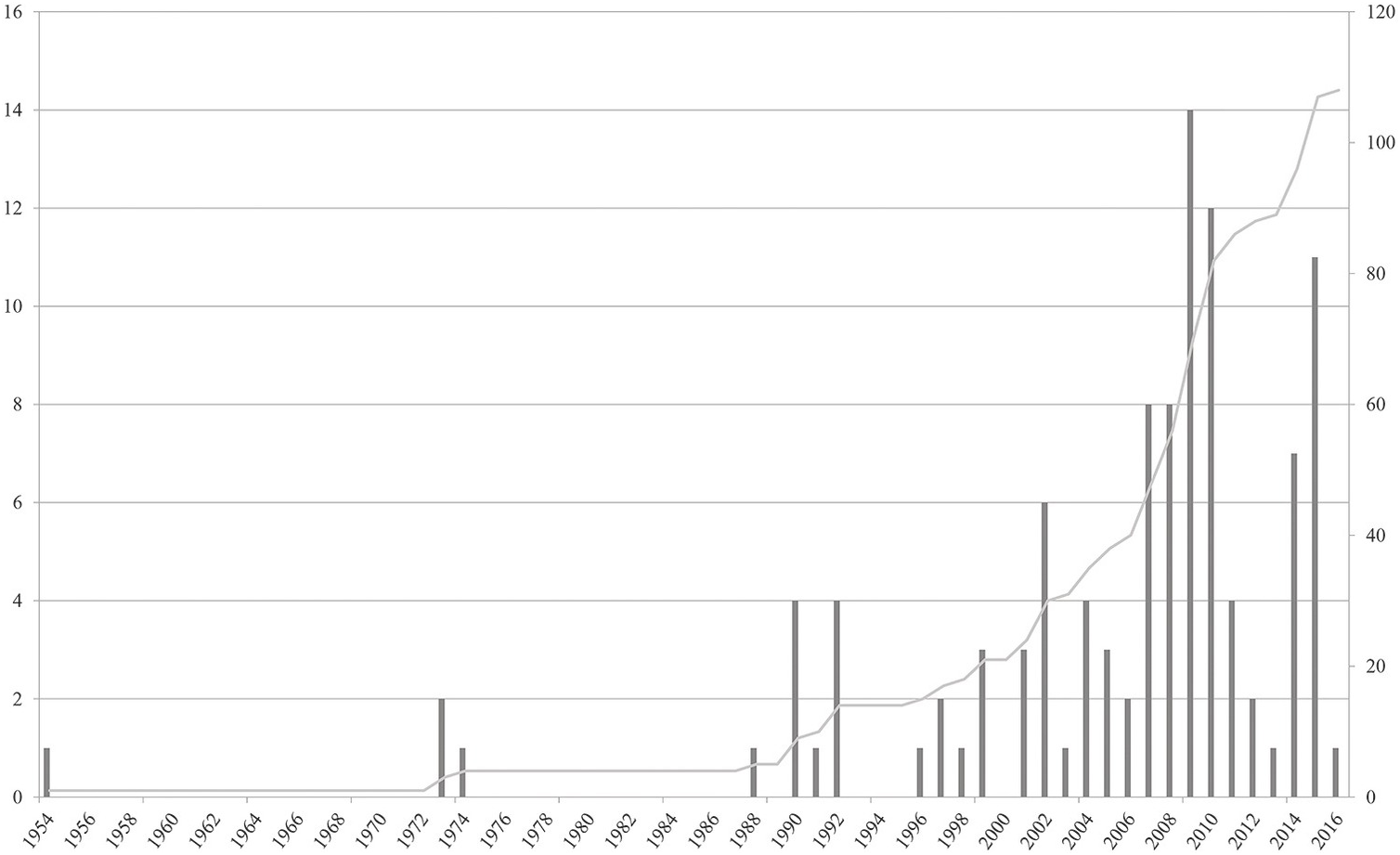
The oldest institution, and the only one established in the 1950s, is the International Solar Energy Society (ISES), which demonstrates the long history of knowledge on this energy source. Thereafter, it took until the early 1970s for new institutions to emerge and to address the climate-energy nexus. At first glance it seems as if this trend is related to the UN Conference on the Human Environment that took place in 1972 in Stockholm. However, closer inspection shows that these are institutions that were initially established in response to the oil crises in 1970s, which then gradually expanded their activities in light of international climate negotiations in the 1990s. Thereafter, a number of institutions were founded around 1992 when the UN Earth Summit took place in Rio de Janeiro and the UNFCCC was agreed upon. From that point onwards, the graph shows a steep increase in institutions for the following twenty years, and again around 2015, in parallel to the run-up to Agenda 2030 and its SDGs.
3.4.2 Membership
The next subsections are based on membership data. They provide an overview of the overall institutional complex while distinguishing membership types and describing in more detail the distribution and connectedness of institutions and its members.
3.4.2.1 Membership Types per Institution
The institutional complex governing the climate-energy nexus is presented in Figure 3.2. The governance triangle provides insights on the amount of active institutions and the different forms of governance in the institutional complex of the climate-energy nexus. For this constantly changing complex, it provides a snapshot as of January 2017, when the final cut for mapping was done. The figure structures the different institutions according to their constituting types of actors.
Governance triangle of the climate-energy nexus.

The snapshot of the institutional complex governing the climate-energy nexus comprises 108 institutions. Public agencies are involved in seventy-eight institutions (72 per cent) and exclusively in forty-eight of them (44 per cent) (zone 1). Well-known examples of institutions constituted by solely public actors are the UNFCCC, the Clean Energy Ministerial (CEM), and the IEA. Other, less familiar institutions that fall into zone 1 are, for instance, the Africa Renewable Energy Initiative (AREI) and the International Network on Gender and Sustainable Energy (ENERGIA), which both seek to enhance worldwide access to sustainable energy (AREI 2018; ENERGIA 2018).
Private actors are involved in sixty institutions (56 per cent) and the exclusively private tier (zone 2, 3 and 6) includes a total of thirty institutions (28 per cent). The first core type of private actors, denoted as ‘firm’ in the figure, i.e. (groups of) firms, investors, and industry associations, are part of fifty-one institutions (47 per cent). Seventeen of these are exclusively constituted by such firm actors, for example the Climate and Energy Cluster of the World Business Council for Sustainable Development (WBCSD_E&C), which facilitates the sharing of best practices concerning cutting-edge climate and energy topics between its members (WBCSD 2018). The second main type of private actors – NGOs and other organizations representing civil society – are involved in 35 institutions (32 per cent), of which seven are exclusively formed by such CSOs. One example for the latter is the Go Fossil Free (GFF) campaign, committed to a fossil-free society (GFF 2018). Both private actor types, firms and CSOs, cooperate in six institutions, for example in the Global Solar Council (GSC) to promote the uptake of solar energy (GSC 2018).
Public and private actors join forces in the ‘hybrid’ zones (4, 5, and 7), in which thirty institutions (28 per cent) are situated. These include collaborations between public actors and firms (8), such as the Carbon Pricing Leadership Coalition (CPLC), and cooperative efforts between public actors and CSOs (2), for instance the Global Fuel Economy Initiative (GFEI). This leaves the majority of hybrid institutions (20) to be multi-stakeholder partnerships in which all actor types are included, such as the Global Alliance for Clean Cookstoves (GACC) and Energy for Impact (E4I).
3.4.2.2 Membership Distribution
This subsection examines the membership directories of the individual institutions. Actors are considered members when they have a formal position to influence the rules, norms, operations, and performances of an institution (see Section 3.2.2).Footnote 4 The membership data provides insights into the degree of involvement of different actor types across the entire institutional complex as well as per zone in the governance triangle and enables us to explore the level of connectedness between institutions and respective members.
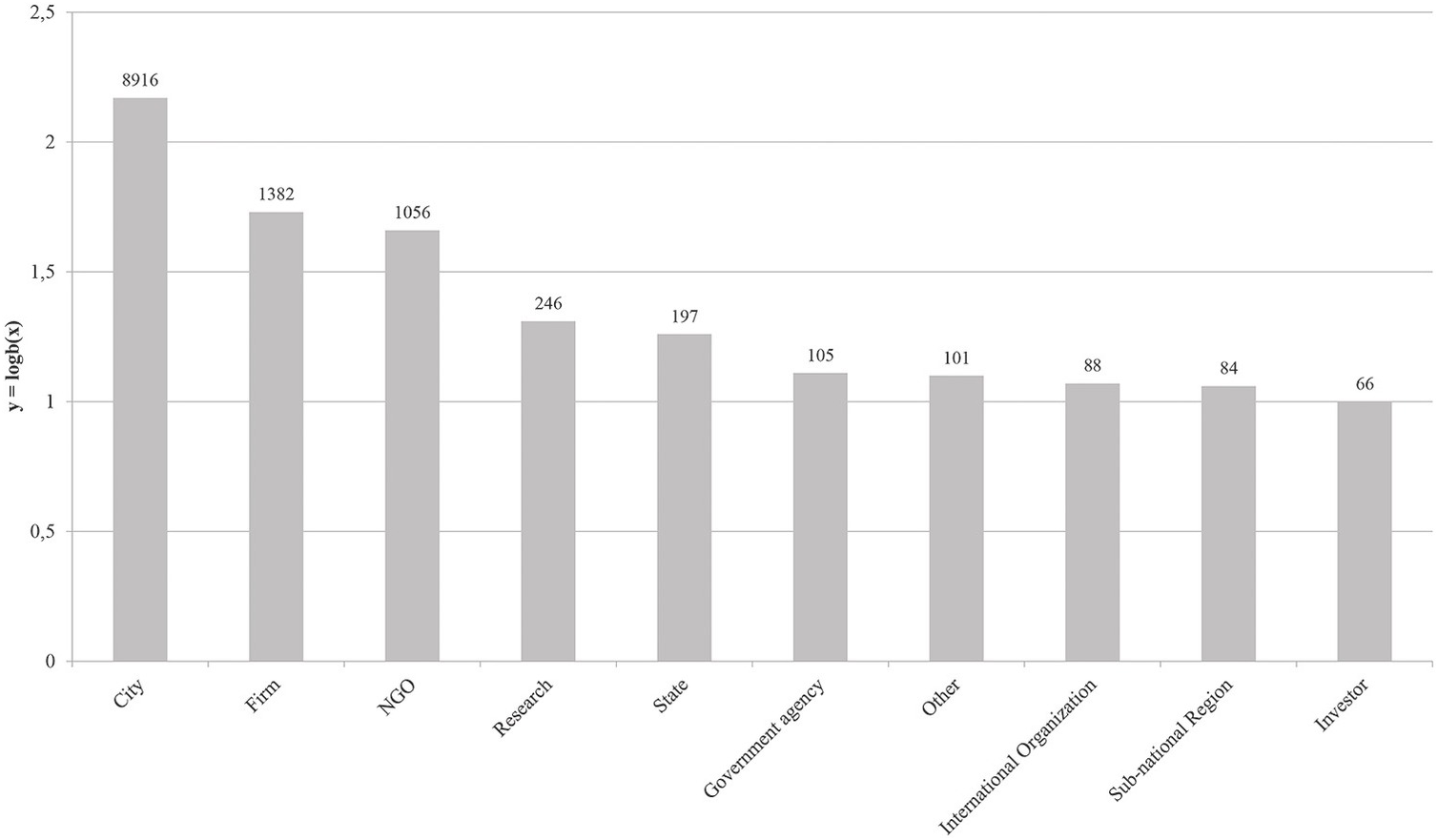
The result of the membership data collection is a total of 13,812 members in the climate-energy nexus (as of January 2017).Footnote 5 The number of unique members is 12,241, as one actor can be a member of two or more institutions. There are major differences in the number of members between the institutions; for instance, ICLEI (Local Governments for Sustainability) has 1,156 members, whereas the Western Climate Initiative (WCI) has ‘only’ 4. Furthermore, there exist differences in the numbers of members per type of actor, as shown in Figure 3.3. Cities are by far the best-represented type of member, followed by firms and NGOs. The remaining categories are much less prominent.
Total number of members in different categories (N = 12,241).
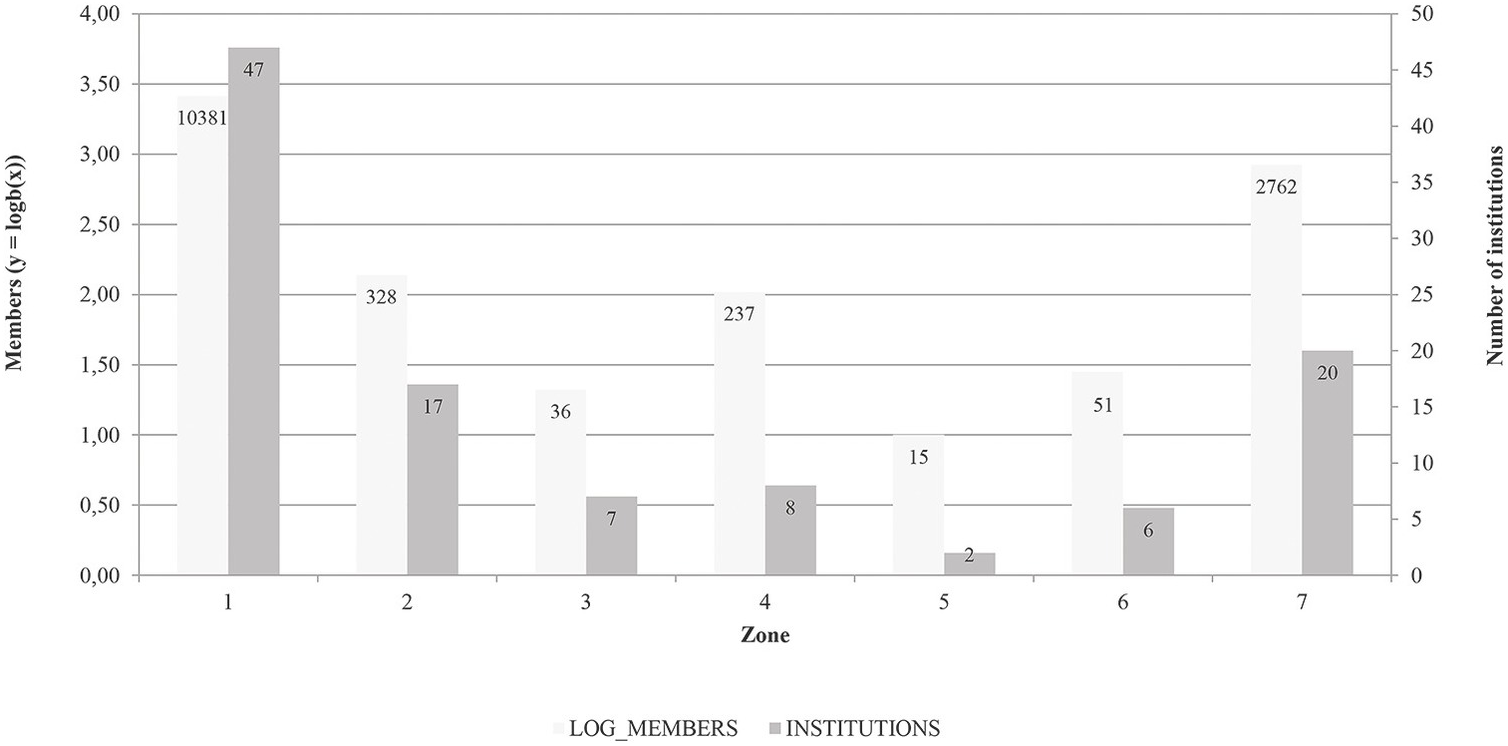
The distribution of members is reflected in the size of each zone. Figure 3.4 shows the number of members and institutions in each zone. The figure suggests that zone 1 (public) is by far the largest zone, followed by zone 7 (multi-stakeholder), in terms of number of institutions as well as the number of members. Note that the member categories ‘state’ and ‘government agency’ have been merged since it could be argued that government agencies are acting in the name of the state. Moreover, the European Union has been added as it has competency within climate change issues to engage in international treaties on behalf of its member states.
Number of members and institutions per zone (1 = public, 2 = firms, 3 = CSOs, 4 = public/firm, 5 = public/CSO, 6 = firm/CSO, 7 = public/firm/CSO).
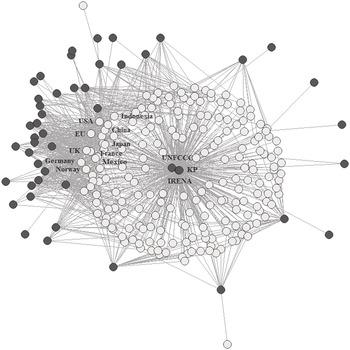
Based on the membership data, it is possible to explore in more detail who the main actors are in addressing the climate-energy nexus. One possibility to depict the centrality of certain actors is a network diagram. We applied this tool for the actor type of states and show the resulting graph in Figure 3.5. The network diagram highlights how the climate-energy nexus consists of a highly interconnected group of actors and institutions. The white nodes represent institutions, whereas the black nodes represent countries. The three central institutions are the UNFCCC, the Kyoto Protocol, and IRENA. The best-connected countries in terms of membership are (in descending order) Germany, the United States, European Union, United Kingdom, Mexico, Norway, China, France, Indonesia and Japan.
Network graph of institutions and states in the climate-energy governance nexus.
3.4.3 Governance Functions
The institutional complex of the climate-energy nexus can also be visualized based on the governance functions of the active institutions. This is displayed in the governance decagon for the climate-energy nexus in Figure 3.6.
Governance decagon of the climate-energy nexus (institutions per governance function).
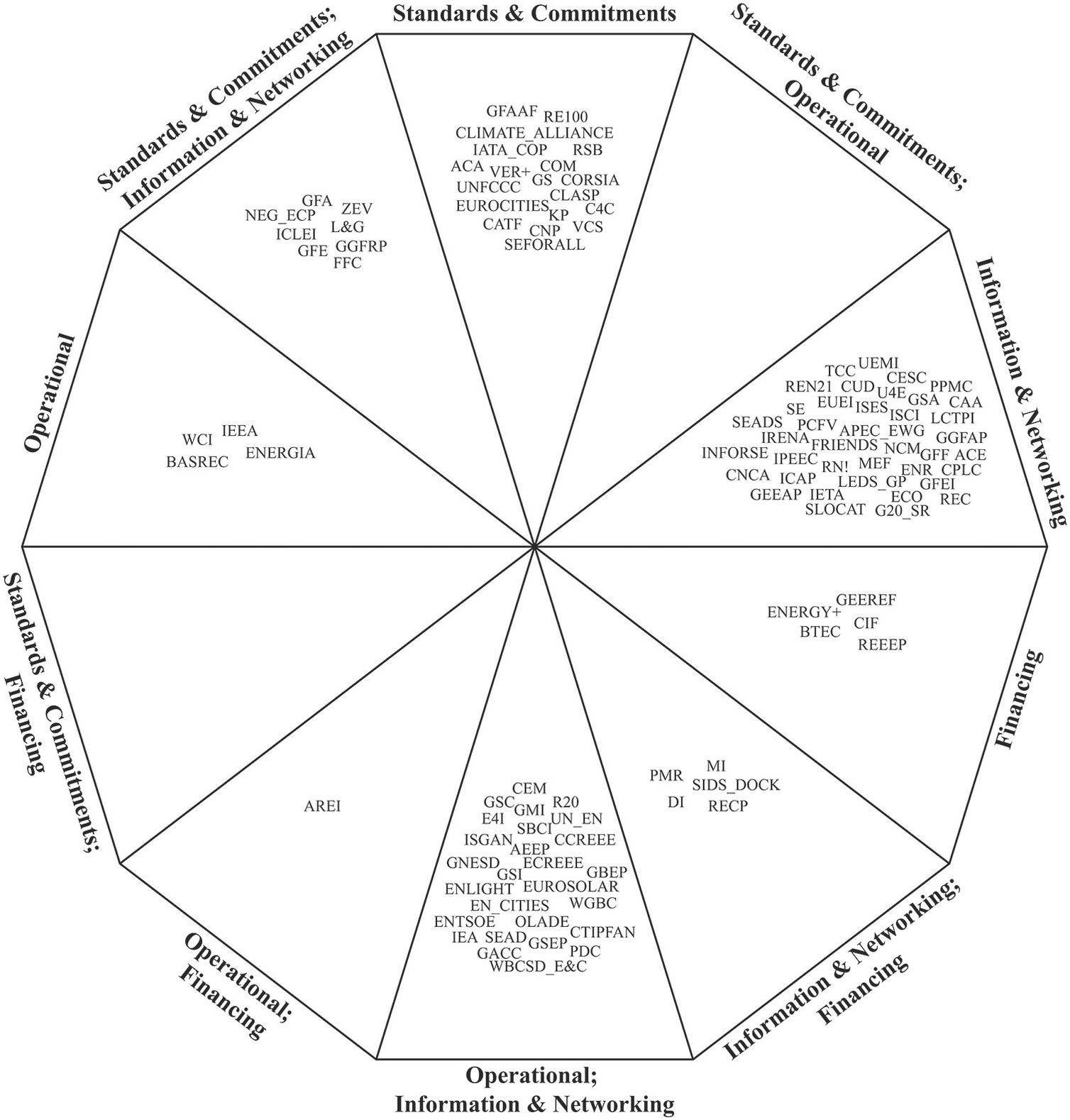
‘Information and networking’ is by far the most common governance function, with thirty-nine occurrences. This implies that most institutions focus on conducting research and publishing reports and/or on organizing meetings and conferences to facilitate the sharing of this knowledge and expertise. One example is IRENA, which serves as a centre of excellence, and a repository of policy, technology, resource, and financial knowledge on renewable energy (IRENA 2018). The second most common governance functions is the combination of ‘information and networking’ and ‘operational’ activities, which we found for twenty-seven institutions. This implies that a high number of institutions concentrate on implementing programmes and projects on the ground in addition to sharing information, such as the IEA, which, besides providing authoritative analyses for the full spectrum of energy issues, organizes training and capacity-building workshops (IEA 2018). Furthermore, nineteen institutions focus on ‘standards and commitments’ and eight are combining ‘standards and commitments’ with ‘information and networking’. Hence, there is a fair share of institutions that seek to introduce rule-making and implementation schemes, such as the RE100 initiative, which unites private actors committed to 100 per cent renewable electricity (RE100 2018). No institution combines the roles of ‘standards and commitments’ and ‘financing’, or ‘operational’ and ‘financing’.
Whereas the governance triangle displays a high degree of institutional complexity, particularly in terms of number of institutions, the decagon shows that there is, on top of that, an uneven distribution of the institutions across the governance functions. Table 3.1 summarizes the findings depicted in Figures 3.2 and 3.6, and combines information on membership and governance functions per institution.
| Zone | Standards & Commitments | Operational | Information & Networking | Financing | Standards & Commitments + Operational | Operational + Information & Networking | Information & Networking + Financing | Standards & Commitments + Information & Networking | Standards & Commitments + Financing | Operational + Financing | Total (Zone) | % |
|---|---|---|---|---|---|---|---|---|---|---|---|---|
| 1-public | 7 | 3 | 15 | 2 | 0 | 13 | 4 | 3 | 0 | 1 | 48 | 44% |
| 2-firm | 6 | 1 | 4 | 1 | 0 | 2 | 0 | 3 | 0 | 0 | 17 | 16% |
| 3-cso | 2 | 0 | 2 | 0 | 0 | 3 | 0 | 0 | 0 | 0 | 7 | 6% |
| 4-public/firm | 1 | 0 | 3 | 0 | 0 | 3 | 0 | 1 | 0 | 0 | 8 | 7% |
| 5-public/cso | 0 | 0 | 2 | 0 | 0 | 0 | 0 | 0 | 0 | 0 | 2 | 2% |
| 6-firm/cso | 1 | 0 | 4 | 0 | 0 | 1 | 0 | 0 | 0 | 0 | 6 | 6% |
| 7-public/firm/cso | 2 | 0 | 9 | 2 | 0 | 5 | 1 | 1 | 0 | 0 | 20 | 19% |
| Total | 19 | 4 | 39 | 5 | 0 | 27 | 5 | 8 | 0 | 1 | 108 | 100% |
What can be derived from the table is that the governance function ‘standards and commitments’ is as much performed by private institutions as by public institutions, while the responsibility for ‘information and networking’ lies mostly with public institutions. This is in contradiction to the general presumption that public institutions are the ones to set the rules, while private institutions are to perform informal functions, i.e. networking and raising awareness.
3.4.4 Thematic Focus
Next, we describe the distribution of the institutions in more detail according to their thematic focus by means of the chart in Figure 3.7. The figure highlights important themes at the intersection of climate and energy governance, and the varying degrees of representation, and arguably significance, in terms of institutions.
Primary Thematic Focus of 108 Institutions.
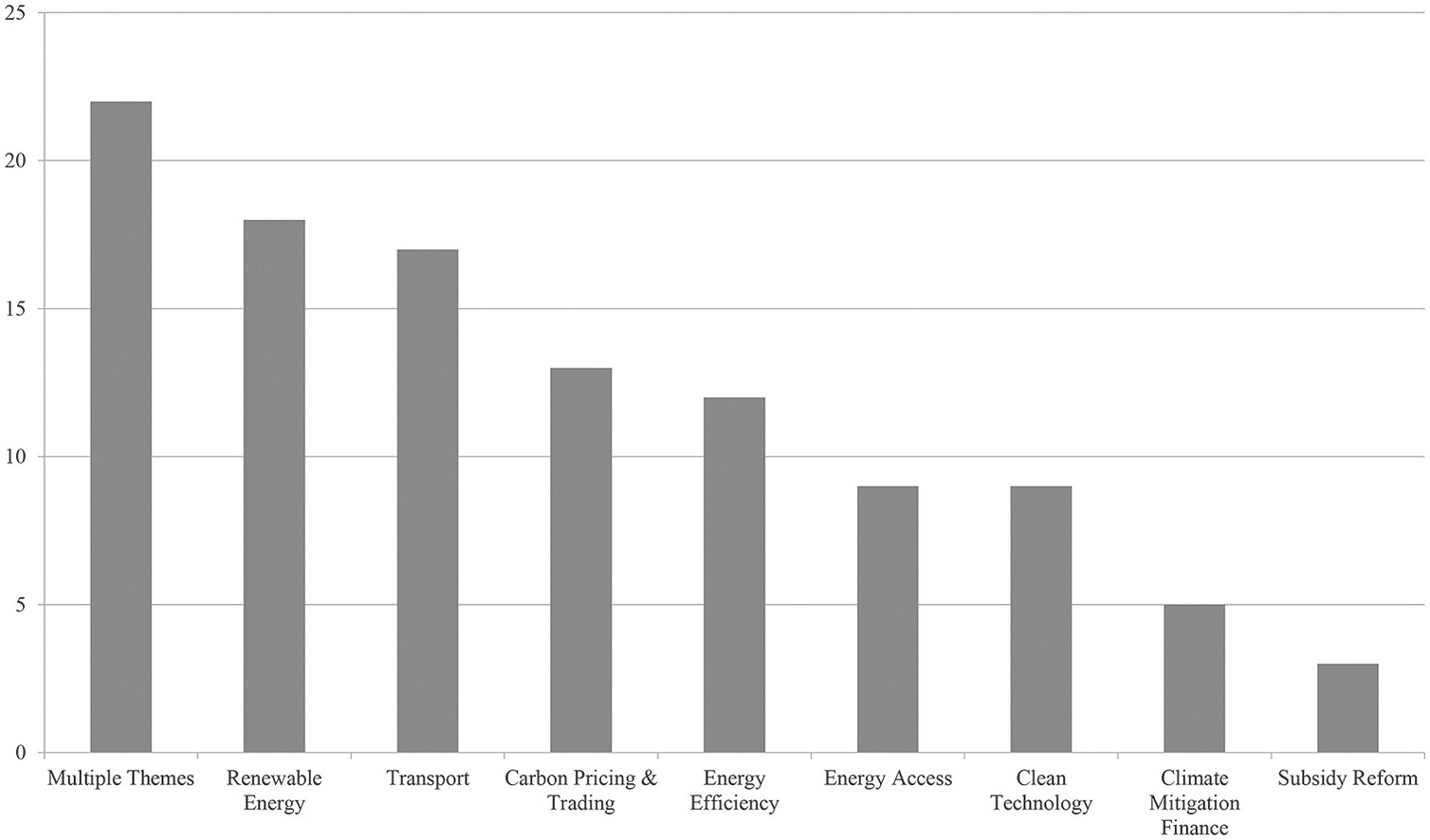
Most institutions in the climate-energy nexus address several themes and respective goals at the same time to tackle climate and energy challenges. For example, ICLEI, uniting local governments for sustainability, is engaged in energy-efficient city agendas, eco-mobility, and low-carbon development (ICLEI 2018). In addition, many institutions in the institutional complex specifically target increasing the uptake of renewables, such as IRENA and RE100, or transportation modes, such as the Climate Action Takes Flight (CATF) initiative and the Global Green Freight Action Plan (GGFAP). Carbon pricing and trading, and energy efficiency, are the fourth and fifth most preferred themes. Examples of institutions that focus on these two themes are, respectively, CPLC and the International Partnership for Energy Efficiency Cooperation (IPEEC).
As alluded to in Section 3.2.2, the subfields that address these thematic foci should not be seen as silos, but can show overlaps in terms of institutions. First, several institutions focus on ‘multiple themes’, for instance renewable energy and subsidy reform specifically, and are therefore situated in the two respective subfields. Second, various institutions address a crosscutting theme, for example climate mitigation finance for implementing energy efficiency measures, and are therefore part of both the climate mitigation finance and energy efficiency subfields. Hence, the numbers in Figure 3.7 do not coincide with the mappings of the subfields that are scrutinized in Section 3.5 and the subsequent chapters. However, the figure does provide first insights into the subfields’ varying degrees of institutional complexity. Whereas the uptake of renewables is addressed by a high number of institutions, fossil fuel subsidy reform is governed by only a few; meanwhile, the number of institutions on carbon pricing and trading is at the centre of this continuum.
3.4.5 Discussion
Besides the high number of institutions involved in governing the climate-energy nexus, we found a high degree of diversity among these institutions. Institutions constituted by public actors are dominant, although private actors also contribute significantly as the high number of private and multi-stakeholder institutions indicates. Thus, while much scholarly attention has shifted toward transnational global governance, including nonstate and sub-national actors on climate change, energy, and other environmental issues (e.g. Goldthau Reference Goldthau2012; Bulkeley et al. Reference Bulkeley, Andonova, Betsill, Compagnon, Hale, Hoffmann, Newell, Paterson, Roger and VanDeveer2014; and Hsu et al. Reference Hsu, Widerberg, Weinfurter, Chan, Roelfsema, Lütkehermöller and Bakhtiari2018), our mapping suggests that state governments and other public agencies retain formal authority in the climate-energy nexus (Jordan et al. Reference Jordan, Huitema, Hildén, van Asselt, Rayner, Schoenefeld, Tosun, Forster and Boasson2015).
Analyzing the membership data in more detail further substantiates the dominant role played by (inter)governmental entities. Cities are by far the most represented actor type and, together with other public actors, they occupy more than three-quarters of the entire institutional complex, clearly outmatching the presence of businesses, NGOs, research organizations, investors, and other private actors. Furthermore, the network diagram on states and institutions (figure 3.5) highlights the UNFCCC, Kyoto Protocol, and IRENA as the central institutions which may be explained by the high degree of universality and inclusiveness of these three intergovernmental institutions. The diagram additionally unveils that not only Western (European) countries are of key importance in governing the climate-energy nexus, but that countries such as China, Mexico, and Indonesia are equally involved.
Moreover, there is no clear division of labour among institutions in terms of governance functions, even though all are covered within the nexus. The institutional complex is dominated by institutions that share information and facilitate networking opportunities, and there is a fair share of institutions that implement projects and programmes to have an impact on the ground. By contrast, standard-setting and financing functions are performed by a smaller sample of institutions. These findings illustrate that, within the climate-energy nexus, private institutions do not shy away from setting standards, while public institutions predominantly perform informal functions. Further studies have to show whether this uneven distribution of governance functions has implications for the performance of the institutional complex of the nexus as a whole, i.e. at the macro level.
Furthermore, the examination of key themes at the intersection of climate and energy governance provides interesting first insights into the subfields of the climate-energy nexus. First and foremost, there is a high number of institutions focusing on multiple themes, which suggests that there are many overlapping institutions among the subfields, an issue that will be explored in subsequent chapters. Second, the degree of institutional complexity appears to vary across the subfields. The numbers of institutions addressing the respective thematic foci suggest that the subfield for renewable energy is most densely populated, whereas the subfield for fossil fuel subsidy reform consists of only a few institutions. Given that carbon pricing is in the middle of this continuum, the three subfields covered in the book provide a useful variation for the analyses in Chapters 4–6 and the comparative study in Chapter 8.
In sum, over the past twenty-five years the institutions governing the climate-energy nexus evolved into a densely populated complex dominated mostly by public actors, in which governance functions are unevenly spread, and the degree of complexity varies considerably across the subfields.
3.5 Analyzing the Subfields: Renewable Energy, Fossil Fuel Subsidy Reform, and Carbon Pricing (Meso Level)
This section describes and analyzes those institutions that, exclusively or as one of their multiple foci, address one of the three subfields of the climate-energy nexus covered in the book. To illustrate the three meso-level institutional complexes, similar figures are used as in the previous section: the governance triangle providing insights on the types of actors involved, and the governance decagon displaying the governance functions of the individual institutions. Like in the previous section, the illustrations are snapshots of the subfields as of January 2017.
3.5.1 Renewable Energy
Figure 3.8 presents the governance triangle for the institutions that aim to promote the uptake of renewables globally. The institutional complex comprises forty-six institutions, making the renewable energy subfield the largest within the climate-energy nexus. Nineteen of these institutions focus exclusively on renewable energy, while for the remaining number renewables are but one part of their portfolio.
Governance Triangle for the subfield of renewable energy.

Most institutions within the governance triangle are constituted by public actors, including (groups of) states, international organizations, cities, and regions. These actors are involved in thirty-eight institutions, of which twenty-eight are purely public (zone 1). Widely known examples of the latter are IRENA and the IEA, while less familiar ones are, for instance, Energy Cities (EN_CITIES) and the International Solar Cities Initiative (ISCI), both involving local authorities committed to facilitating energy transitions.
Private actors engage in eighteen institutions while the exclusively private tier (zone 2, 3, and 6) counts ten institutions. (Groups of) firms, investors, and industry associations take part in seventeen institutions (37 per cent), of which four are purely firm-based. These include, among others, the Carbon Neutral Protocol (CNP), which provides instruments to achieve carbon neutrality such as renewable energy certificates (CNP 2018). The third main category of actors, NGOs and other CSOs, is involved in thirteen institutions (28 per cent), of which two exclusively include CSOs. One example is the International Network for Sustainable Energy (INFORSE), which constitutes a network of NGOs working on sustainable energy solutions (INFORSE 2018). On top of that, different types of firm and CSO actors join forces in three institutions: GSC, RE100, and ISES.
Public and private actors unite in the ‘hybrid’ zones (zones 4, 5, and 7) through eight institutions (17 per cent), of which seven are multi-stakeholder partnerships, including all three types of actors. Well-known multi-stakeholder partnerships are Sustainable Energy for All (SEFORALL) and REN21, which are committed to, respectively, substantially increasing the uptake of renewables by 2030 in accordance to the SDG 7 target, and to connecting stakeholders to facilitate joint action toward a global transition to renewables (SEforALL 2018; REN21 2018). Finally, the one institution in which public actors partner up with firm-based actors is the Low Carbon Technology Partnerships initiative (LCTPI). This is a partnership between the WBCSD, the IEA, and the UN’s Sustainable Development Solutions Network. Its REscale programme brings together energy and technology companies who aim to accelerate the deployment of renewables (LCTPi 2018).
The governance decagon in Figure 3.9 highlights the governance functions of the individual institutions. Most of them (17) govern through ‘information and networking’ and ‘operational’ activities simultaneously, for example Regions for Climate Action (R20), which combines informing and supporting climate-resilient project development (R20 2018). Fifteen institutions solely concentrate on ‘information and networking’ (15). For instance, it is the primary function of REN21 to inform the international community on the status of renewable energy (REN21 2018). In addition, there are eight institutions that set ‘standards and commitments’. One example is the Roundtable for Sustainable Biomaterials (RSB), which provides a certification scheme supporting the development of a sustainable bioeconomy (RSB 2018). Only three institutions focus on developing and providing ‘financing’ mechanisms, including REEEP, which aims to strengthen markets for clean energy in low- and middle-income countries (REEEP 2018).
Governance decagon for the sub-field of renewable energy (institutions per governance function) (Author’s data).
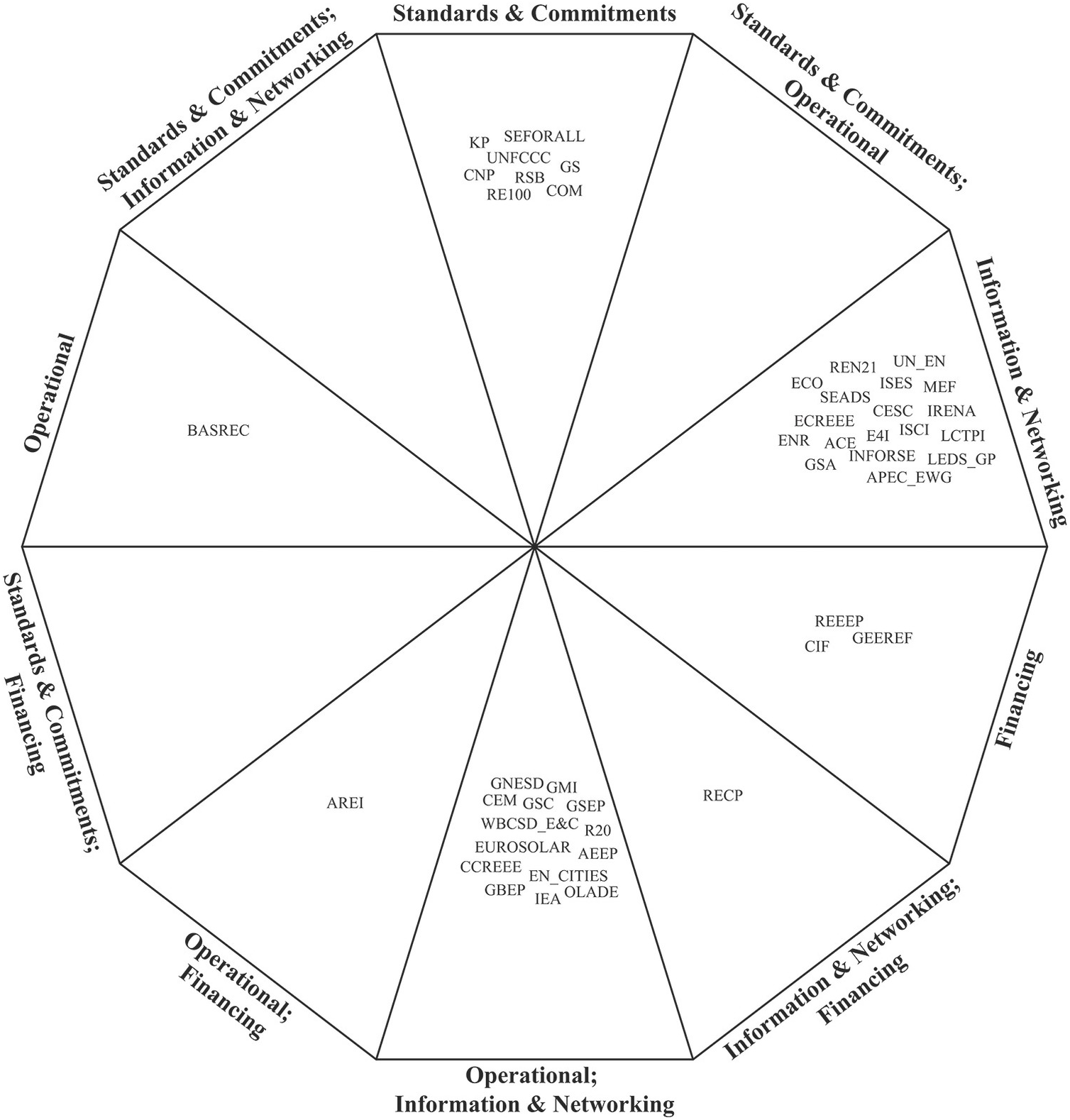
Finally, all other fields are at best filled with one institution. The Baltic Sea Region Energy Cooperation (BASREC) prefers ‘operational’ practices, AREI combines ‘operational’ activities with the development of ‘financing’ mechanisms, and the Africa-EU Renewable Energy Cooperation Program (RECP) facilitates ‘information and networking’ in addition to developing ‘financing’ mechanisms.
3.5.2 Fossil Fuel Subsidy Reform
The governance triangle in Figure 3.10 displays which types of actors take part in institutions that work toward removing harmful fossil fuel subsidies. The institutional complex comprises only a small number of institutions (six), with half of these addressing subsidy reform as their main priority.
Governance triangle for the sub-field of fossil fuel subsidy reform.
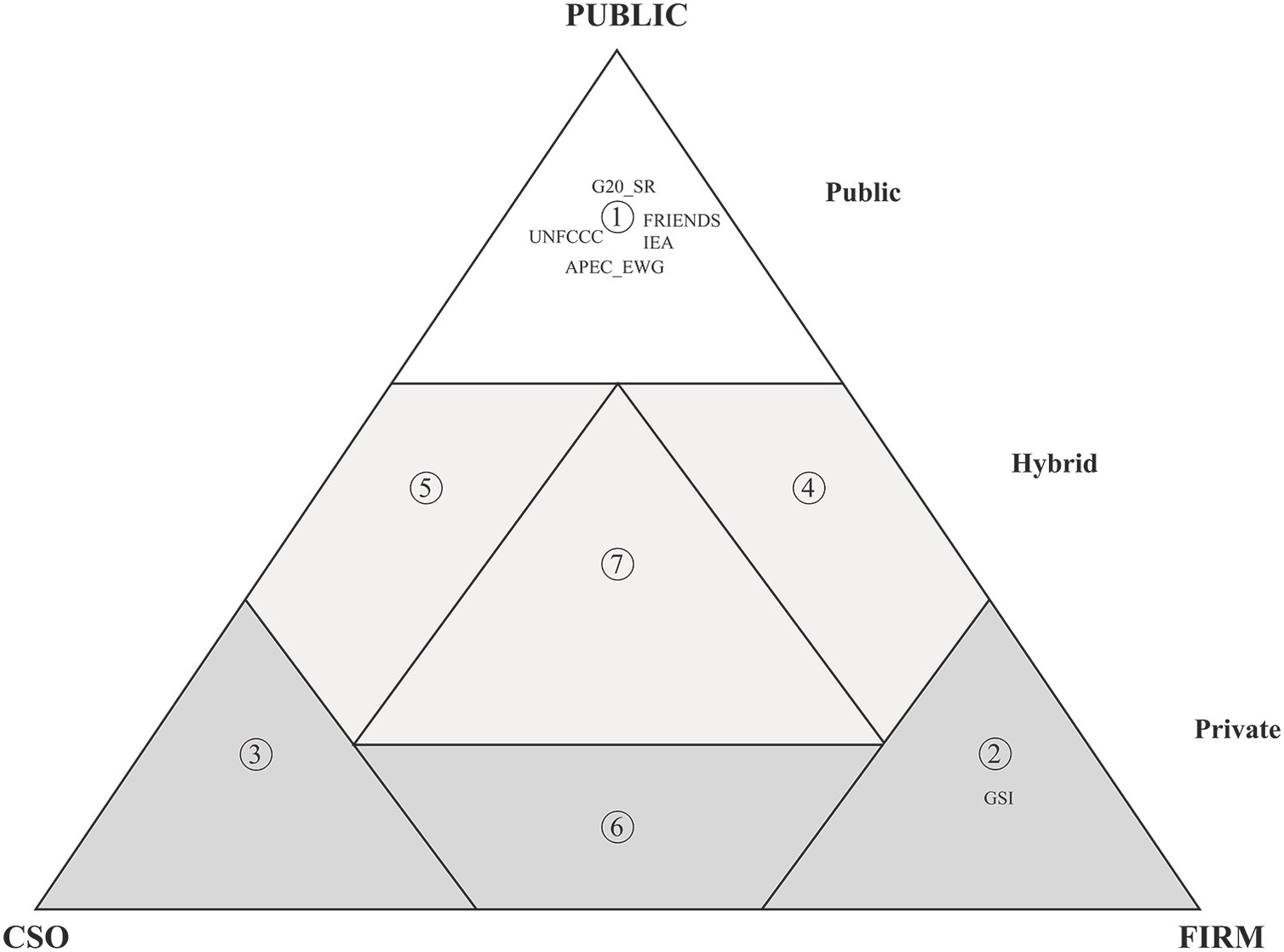
Clearly, the largest share of institutions (five) has exclusively public membership, including some of the leading institutions in the climate-energy nexus: the UNFCCC, Friends, IEA, the G20 Subsidy Reform, and the APEC Energy Working Group. Only one institution is constituted by firms, namely GSI. This initiative is led by the International Institute for Sustainable Development, and supports international processes, national governments, and CSOs to align subsidies with sustainable development (IISD 2018).
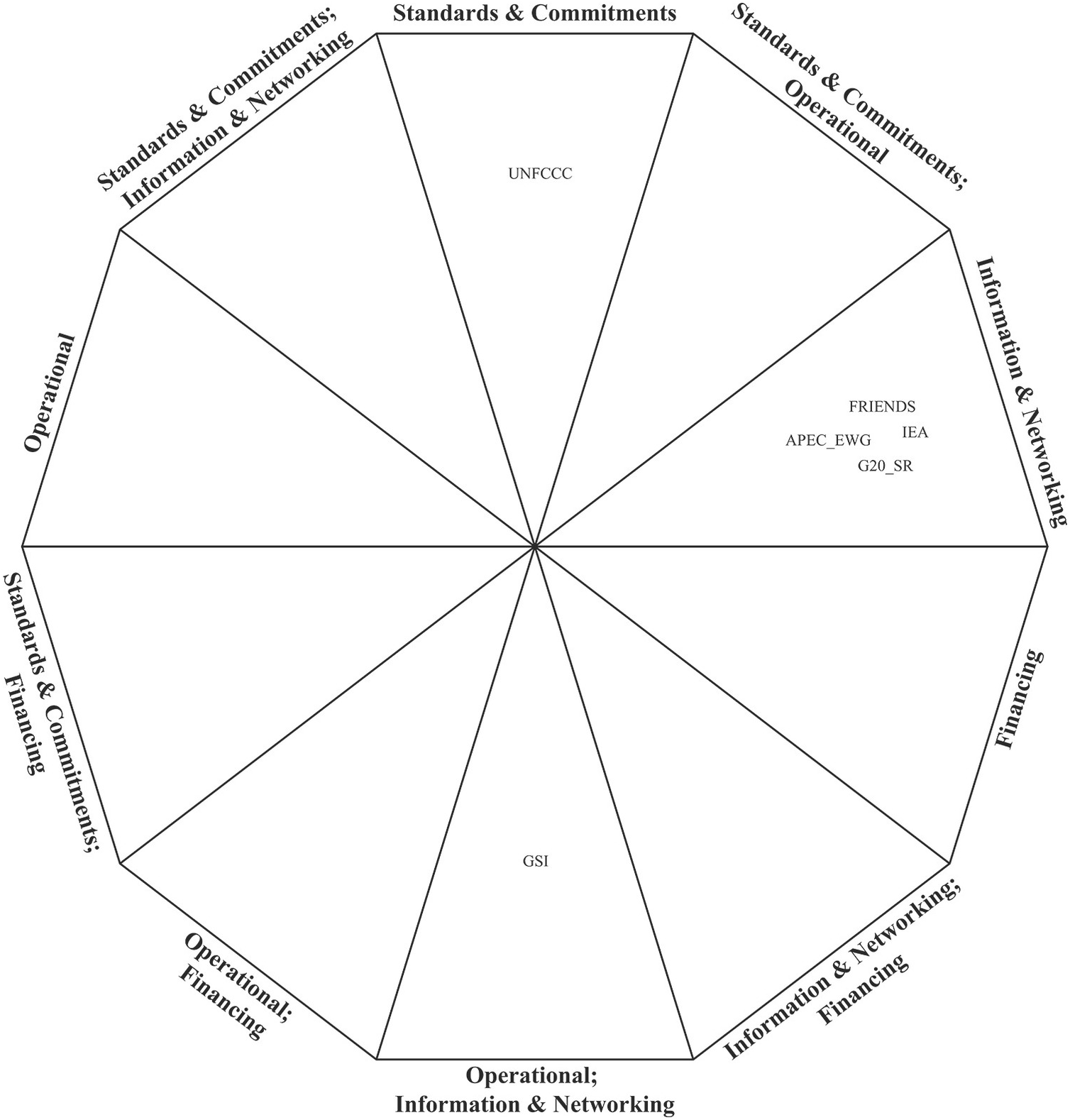
The governance functions of the six institutions are visualized in Figure 3.11. It shows that ‘information and networking’ is the predominant way in which institutions on fossil fuel subsidy reform operate. No less than four of the six institutions adhere to this governance function. These include the IEA, Friends, APEC Energy Working Group, and G20 Subsidy Reform, which broadly focus on sharing information and organizing events to convince their members and the wider community of the urgency to reform fossil fuel subsidies. The remaining two institutions concentrate on standard-setting for this subfield (UNFCCC) and, respectively, ‘information and networking’ in combination with ‘operational’ activities (GSI).
Governance decagon for the fossil fuel Subsidy reform sub-field (institutions per governance function) (Author’s data).
3.5.3 Carbon Pricing
The governance triangle in Figure 3.12 includes all institutions in the climate-energy nexus dataset that aim at putting a price on carbon, facilitating a carbon trade scheme, or providing a system for offsetting emissions. The institutional complex comprises fifteen individual institutions.Footnote 6 Of these, thirteen focus exclusively on carbon pricing.
Governance triangle for the sub-field of carbon pricing.
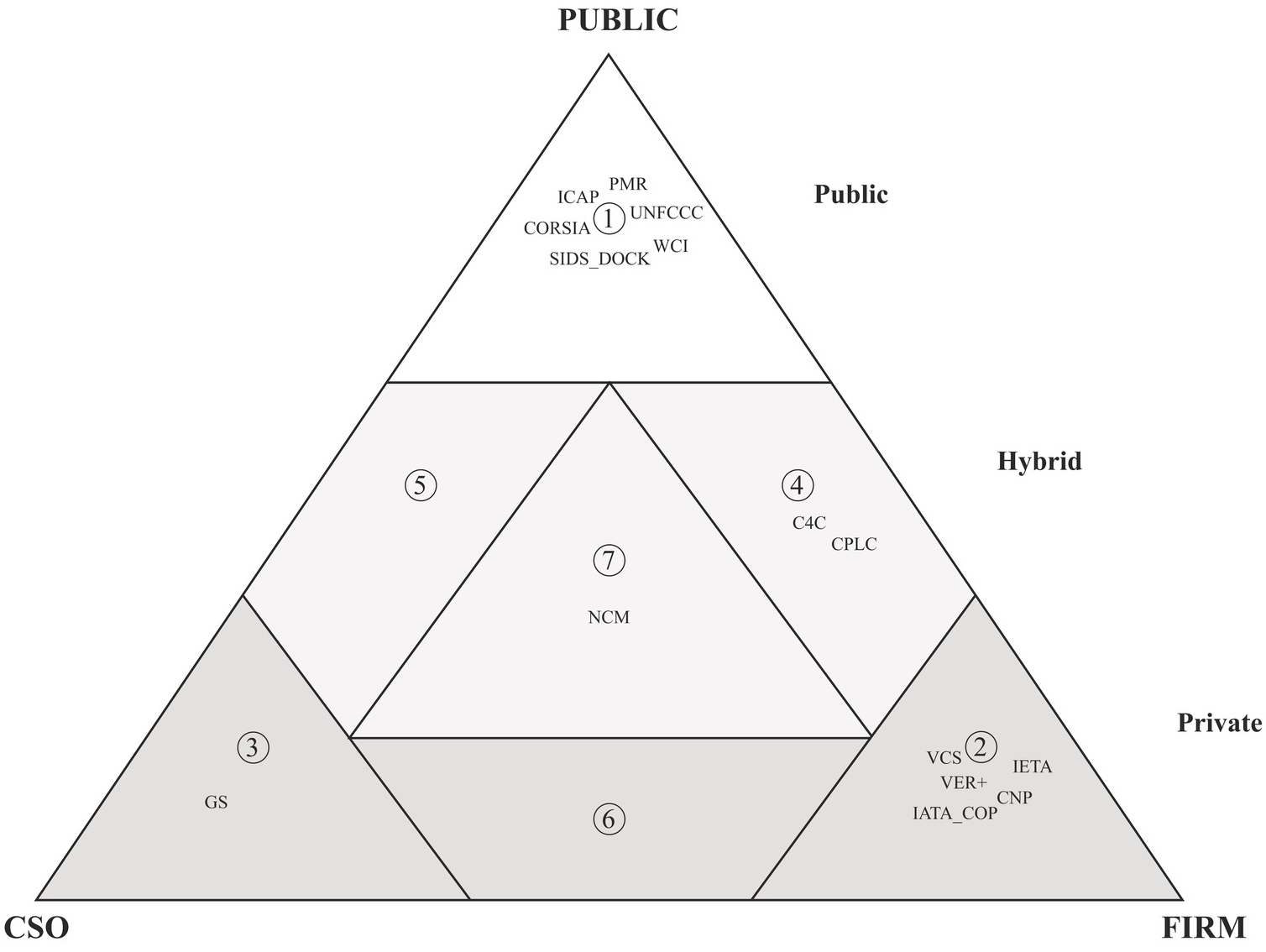
Most institutions fall exclusively either into the public arena or the firm sector. Concretely, six institutions are constituted by (groups of) states, cities, and regions, for example, the WCI that supports the implementation of emissions-trading programmes, and PMR that offers country-specific guidance on Emissions Trading Registries (WCI 2018; PMR 2018). Six others count solely (groups of) firms, investors, and industry associations as their members. These include, for instance, the Verified Carbon Standard (VCS, recently renamed to VERRA), a voluntary programme for certifying emission-reduction projects, and the International Emissions Trading Association (IETA), which aims at establishing effective market-based trading systems for greenhouse gas emissions (IETA 2018; VERRA 2018). Finally, three institutions represent hybrid efforts. These include the UN Global Compact Caring for Climate (C4C) and CPLC, which consist of firms and public actors, and NCM, which is the only institution in this subfield that exhibits all three types of actors.
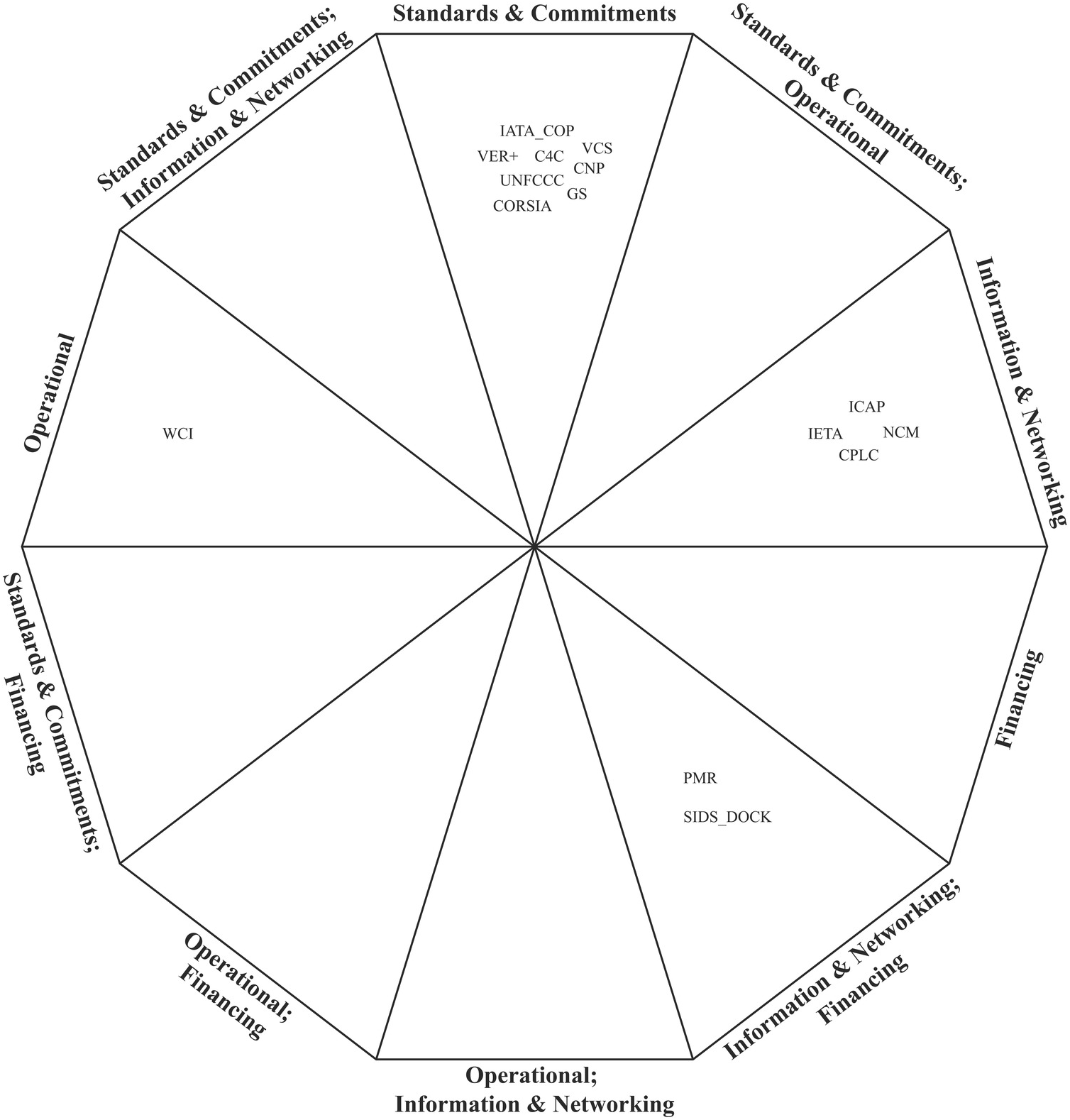
Figure 3.13 presents the governance decagon for the carbon pricing subfield, depicting the governance functions performed by each institution. Unlike the previous figures for renewable energy and fossil fuel subsidy reform, the main governance function for this subfield is setting ‘standards and commitments’ (by seven institutions). While the VCS and the CNP have established standards to certify emission reductions, the International Air Transport Association (IATA) provides a mechanism to offset carbon emissions for the aviation sector (IATA 2018). ‘Information and networking’ is performed by four institutions, for example by ICAP, which connects countries, subnational, and supranational entities that either have established carbon markets or plan to do so (ICAP 2018). In addition, PMR and the Small Island Developing States Sustainable Energy Initiative (SIDS_DOCK) combine ‘information and networking’ with the development of ‘financing’ mechanisms. Finally, WCI falls into the category ‘operational’ as it provides administrative and technical services supporting the implementation of emissions-trading programmes.
Governance decagon for the subfield of carbon pricing (institutions per governance function) (Author’s data).
3.5.4 Discussion
Having scrutinized the three subfields for renewable energy, fossil fuel subsidy reform, and carbon pricing, we arrive at interesting first insights on each of the institutional complexes. One key observation concerns regards the varying degrees of institutional complexity across the subfields.
The highest degree of complexity was found for the renewable energy subfield, in terms of the number of institutions, but also, as this section has shown, regarding memberships and governance functions. The subfield includes a wide range of public and private actors, while public institutions dominate. All governance functions are addressed, while the main emphasis is laid on information-sharing, networking, and operational activities. Moreover, the subfield shows characteristics similar to the overall institutional complex addressing the climate-energy nexus – which is clearly related to the fact that the subfield of renewable energy is constituted by almost half of the institutions in the entire dataset.
The lowest degree of complexity, in turn, was found in the fossil fuel subsidy reform subfield: there are only seven institutions, of which six are exclusively public, and information and networking is the dominant instrument to govern subsidy reform. This said, it is important to consider other institutions as well. These have not been included in this chapter’s dataset, since they do not fit our selection criteria (Section 3.2.1). This is mostly due to their chief thematic foci that divert from, or go beyond, the climate and energy domains. Examples are the Organisation for Economic Co-operation and Development (OECD), the World Trade Organization (WTO), and the IMF. To complete the picture, these institutions are included and elaborated on in Chapter 5, which provides an in-depth analysis of the subfield.
In the middle of the continuum is the carbon pricing subfield, not solely with regard to the number and types of institutions involved, but also in terms of the governance functions they perform. The subfield features a balance of exclusively public institutions and purely private institutions. Furthermore, carbon pricing is predominantly governed through setting standards and commitment. This mostly includes certification schemes for emission reductions and carbon offsetting. Finally, we found an important distinction between institutions that aim to establish prerequisites for a carbon market and those that focus on existing ones. For instance, SIDS_DOCK, an alliance between small island states, assists its members in connecting national energy sectors to EU and US carbon markets, but it does not facilitate carbon pricing, trading, or offsetting itself. As a result, this creates a discrepancy between the dataset included in this chapter and the cases studied in Chapter 6.
Furthermore, it is of interest to examine overlapping institutions across the three subfields and to what extent these represent thematic overlaps. Fossil fuel subsidy reform inherently supports the uptake of renewable energy; when harmful subsidies are removed, fossil fuels make way for renewables. Nevertheless, the fossil fuel subsidy reform and renewable energy subfields share only two institutions: the APEC Energy Working Group and the IEA, which are both intergovernmental cooperation efforts addressing energy issues in the broadest sense. Similarly, while putting a price on carbon provides an incentive to shift to renewable energy, only the CNP is an overlapping institution bridging both subfields. Finally, the one institution shared by all three subfields, and therewith providing the only connection between the fossil fuel subsidy reform and carbon pricing subfields, is the UNFCCC. This suggests that the central role of the UNFCCC regime is not restricted to global climate change governance, but transcends well into global energy governance as a major hub targeting the low-carbon transformation of energy systems.
3.6 Conclusions
The Paris Agreement and Agenda 2030, and particularly SDG 7 to ensure sustainable energy for all, highlight the importance of an effective and integrated approach to the interconnected climate and energy challenges. While existing studies have provided insights into the institutional complexity of either global climate or energy governance, governance scholars had yet to uncover the institutional complex addressing the nexus between both domains. Against this backdrop, this chapter first identified and mapped the macro level of this nexus, i.e. all institutions that address climate and energy challenges simultaneously. Furthermore, the chapter zoomed in on the institutions that constitute three subfields at the meso level: renewable energy, fossil fuel subsidy reform, and carbon pricing.
The climate-energy nexus can be characterised as institutionally complex, reflecting the past twenty-five years of intense discussions in the international community on both challenges and sustainable development more broadly. This chapter conveyed and analyzed this complexity in various ways. The climate-energy nexus involves a high number of very different institutions – with a strong presence of exclusively public institutions, while private actors contribute significantly through a fair share of private and multi-stakeholder institutions. Membership data further substantiates the dominance of public actors, and cities particularly. Second, even though all governance functions are performed across the institutional complex, there appears to be a strong focus on information and networking, and operational activities to some extent, while only a minority of institutions in the nexus focus on standards and commitments and financing mechanisms. Finally, while most institutions target various themes and activities, most attention is directed toward the uptake of renewables, transforming the transport sector, carbon pricing, and increasing energy efficiency.
Delving into the selected subfields at the meso level provided first insights on the differences and commonalities across the three respective complexes. The renewable energy subfield has the highest concentration of public, private, and hybrid institutions, which focus mostly on information-sharing and networking. On the other end, the subfield of fossil fuel subsidy reform is sparsely populated and marked by a prevalence of public institutions, which predominantly govern through information and networking. This leaves the carbon pricing subfield at the centre of the continuum, exhibiting a balance between public and private institutions, with both camps focusing mostly on standards and commitments.
While this chapter has provided an innovative and novel mapping, it could not go into detail on the processes taking place within and across the institutional complexes. Such much-needed analyses on questions of coherence, management, legitimacy, and effectiveness in the climate-energy nexus – will be provided by the subsequent chapters of this book. The mapping serves as the empirical basis for these crucial endeavours. First, the comprehensive dataset has helped to select appropriate case studies for Chapters 4–6, which explore varying degrees of coherence and management attempts within the three subfields. Second, our chapter provides key data for evaluating the effectiveness and legitimacy of five individual institutions in Chapter 7. Finally, our findings support the comparative assessment of institutional effectiveness for the three subfields in Chapter 8, from which lessons can be drawn for the performance of the overall institutional complex governing the climate-energy nexus.
By the same token, the dataset presented in this chapter is the first step toward creating a knowledge base that can serve as a tool for policy makers, businesses, and other organizations alike. It improves our understanding of the institutional complexity that characterizes the climate-energy nexus, and guides actors to navigate the institutionally complex global climate and energy governance landscape.


 Open access