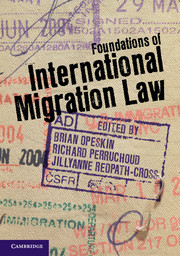
Book contents
- Frontmatter
- Summary contents
- Detailed contents
- Preface
- List of case studies
- List of boxes
- List of figures
- List of maps
- List of tables
- Notes on contributors
- Abbreviations
- 1 Conceptualising international migration law
- 2 Contemporary patterns of international migration
- 3 Sources of international migration law
- 4 Nationality and statelessness
- 5 State sovereignty and freedom of movement
- 6 International human rights of migrants
- 7 Refugees and asylum
- 8 Women, children and other marginalised migrant groups
- 9 Human trafficking and smuggling
- 10 International migration by sea and air
- 11 International labour migration
- 12 International trade law and labour mobility
- 13 Global migration institutions and processes
- 14 Regional processes, law and institutional developments on migration
- 15 Emerging legal issues in international migration
- Appendix 1 Cases
- Appendix 2 Treaties and other international instruments
- Glossary
- Index
- References
1 - Conceptualising international migration law
Published online by Cambridge University Press: 05 November 2012

Book contents
- Frontmatter
- Summary contents
- Detailed contents
- Preface
- List of case studies
- List of boxes
- List of figures
- List of maps
- List of tables
- Notes on contributors
- Abbreviations
- 1 Conceptualising international migration law
- 2 Contemporary patterns of international migration
- 3 Sources of international migration law
- 4 Nationality and statelessness
- 5 State sovereignty and freedom of movement
- 6 International human rights of migrants
- 7 Refugees and asylum
- 8 Women, children and other marginalised migrant groups
- 9 Human trafficking and smuggling
- 10 International migration by sea and air
- 11 International labour migration
- 12 International trade law and labour mobility
- 13 Global migration institutions and processes
- 14 Regional processes, law and institutional developments on migration
- 15 Emerging legal issues in international migration
- Appendix 1 Cases
- Appendix 2 Treaties and other international instruments
- Glossary
- Index
- References
Summary
THE EVOLUTION OF INTERNATIONAL MIGRATION LAW
Migration has been an integral part of human activity for as long as people have inhabited the earth. Whether moving as individuals, families or tribes, migration is an age-old response to the physical need for food, shelter and security, and the psychological need for adventure and exploration. However, while migration has marked all periods of human history, the phenomenon of ‘international migration’ had to await the reordering of the geopolitical landscape as a collection of territorial States in which governments had authority over settled populations residing within defined geographic boundaries.
The Treaty of Westphalia (1648) was a critical turning point in establishing that new landscape, but for the next two centuries individuals still enjoyed substantial freedom in traversing the boundaries of the State. This reflected an attitude of hospitality to strangers that was inherited from ancient cultures and expressed through cosmopolitanism. This attitude can be seen in the scholarly works of the great writers of international law of the eighteenth and nineteenth centuries, who, with few exceptions, took a liberal attitude to the movement of people across borders for trade, commerce and other purposes. If law in this early period paid scant attention to regulating migration, it was partly for the practical reason that the number of people involved was modest because modes of transport were confined to land crossings by foot or horse, and sea crossings by wind-powered sailing vessels. There were some notable exceptions to this laissez-faire approach, but the circumstances in which law was invoked to regulate international migration were few.
Information
- Type
- Chapter
- Information
- Foundations of International Migration Law , pp. 1 - 16Publisher: Cambridge University PressPrint publication year: 2012
References
Of Systems, Boundaries, and Territoriality: An Inquiry into the Formation of the State System 1986 39 World Politics27CrossRefGoogle Scholar
The General Admission of Aliens under International Law 1983 77 American Journal of International Law804CrossRefGoogle Scholar
1891
1937
1937
The Evolution of Refugee Status in International Law: 1920–1950 1984 33 International and Comparative Law Quarterly348CrossRefGoogle Scholar
1935
1938
1807–2007: Over 200 Years of Campaigning against SlaveryAnti-Slavery International 2005Google Scholar
1927
1932
1948
A World Made New: Eleanor Roosevelt and the Universal Declaration of Human RightsRandom House 2001Google Scholar
1954
1967
1960
1975
1976
1976
1990
2003
Compendium of International Migration Law InstrumentsTMC Asser Press 2007
The Human Rights of Aliens in Contemporary International LawManchester University Press 1984 122Google Scholar
International Legal Norms on Migration: Substance without ArchitectureInternational Migration LawTMC Asser Press 2007 467Google Scholar
International Legal Norms and Migration: A ReportMigration and International Legal NormsTMC Asser Press 2003 1CrossRefGoogle Scholar
1980
1923
Migration, droits de l’homme et souveraineté: le droit international dans tous ses étatsMondialisation, migration et droits de l’homme: le droit international en question, Volume IIBruylant 2007 13Google Scholar
2006
1954
2003
2004
Accessibility standard: Unknown
Why this information is here
This section outlines the accessibility features of this content - including support for screen readers, full keyboard navigation and high-contrast display options. This may not be relevant for you.Accessibility Information
Accessibility compliance for the PDF of this chapter is currently unknown
and may be updated in the future.
- 4
- Cited by