

Introduction
The relationship between workers and labor unions has long been central to debates in political economy and industrial relations (IR) (Bensusán Reference Bensusán2019; Gumbrell-McCormick and Hyman Reference Gumbrell-McCormick and Hyman2018; Waddington et al. Reference Waddington, Müller and Vandaele2023). At stake is whether unions represent the collective interests of the working class as a whole or whether their organizational structures and strategies leave segments of workers—particularly those outside standard employment relations—without effective representation.
Two major perspectives have crystallized around this question. The first, the representation gap hypothesis, argues that the expansion of precarious and informal employment has created a structural divide between insiders in secure, formal jobs and outsiders in insecure, informal ones (Culpepper and Regan Reference Culpepper and Regan2014; Jansen and Lehr Reference Jansen and Lehr2022; Rueda Reference Rueda2005; Collier and Handlin Reference Collier and Handlin2009; Standing Reference Standing2011). From this view, outsiders tend to perceive unions as organizations that primarily represent formal workers, leading them to distance themselves from union membership and union-centered demands. The second perspective, the class solidarity hypothesis, builds upon Marxist class analysis and maintains that precarious and standard workers share common material interests rooted in their collective subordination to capital (Wright Reference Wright2015; Elbert Reference Elbert2026). According to this tradition, unions—understood as class organizations—actively pursue strategies to revitalize their constituencies, including repertoires designed to extend rights to precarious workers and incorporate them into collective structures (Benassi and Vlandas Reference Benassi and Vlandas2016; Pulignano et al. Reference Pulignano, Gervasi and de Franceschi2016; Marques et al. Reference Marques, Benassi, Costa and Pinto2025; Visser Reference Visser2024; Webster et al. Reference Webster, Ludwig, Masikane and Spooner2021). As such, outsiders are expected to endorse labor unions to a similar degree as insiders (Oliver and Morelock Reference Oliver and Morelock2021).
These competing perspectives have spurred extensive debate in the Global North, especially around the insider–outsider framework, yet they remain largely untested in Latin America. This absence is striking given the region’s structural reliance on informal employment. In many Latin American countries, a large share—and often the majority—of the workforce is employed informally, either in unregistered salaried positions or in self-employment beyond formal regulatory frameworks (OIT 2022; Bensusán Reference Bensusán2019). At the same time, unions have historically played a central role in national politics, functioning not only as bargaining agents but also as political actors shaping public policy and democratic trajectories (Etchemendy Reference Etchemendy2019; Bogliaccini Reference Bogliaccini2024; Pérez-Ahumada Reference Pérez-Ahumada2023). Despite the prominence of both informality and unionism, we still know little about whether informal workers view unions as legitimate vehicles of representation or whether unions are perceived primarily as organizations of formal, insider workers. Put differently, it remains unclear whether informality translates into a representation gap in Latin America.
This article addresses this gap. Specifically, we ask: Do formal and informal workers in Latin America hold similar views of labor unions, or do their distinct labor-market positions give rise to contrasting attitudes toward unionization and the broader role of unions? To answer this question, we analyze comparative survey evidence from Argentina and Chile, two countries with contrasting institutional trajectories of unionism. Argentina has long featured a neo-corporatist model in which unions possess substantial institutional power and political influence (Cook Reference Cook2007; Etchemendy Reference Etchemendy2019). Chile, by contrast, underwent profound neoliberal restructuring under Pinochet’s dictatorship (1973–90), which fragmented collective bargaining and curtailed union power, leaving unions organizationally weak and fragmented (Pérez-Ahumada Reference Pérez-Ahumada2023; Osorio and Velásquez Reference Osorio and Velásquez2022). These contrasting legacies provide analytical leverage for assessing whether the relationship between informality and union attitudes hinges on national political and institutional contexts or whether it reflects broader class dynamics that transcend country contexts.
To achieve these objectives, we draw on data from the National Survey of Class, Labor, and Conflict (CONCLAT Survey), an original 2025 survey conducted in Argentina and Chile and representative of the employed populations of each country. Overall, our results offer stronger support for the class solidarity hypothesis than for the representation gap thesis. In some specific instances, informal self-employed workers express less favorable views of unions than formal workers—e.g., less willing to join unions in Argentina or a weaker belief in Chile that unions protect the rights of informal workers. However, across most statistical analyses, formal and informal workers in both countries exhibit similar (and often equally positive) attitudes toward unions, suggesting that labor-market precarity does not systematically produce divergent class orientations. Moreover, in some cases, Chilean informal salaried workers even express significantly more positive attitudes toward unions than their formal counterparts. Finally, our statistical analyses uncover a cross-national pattern: Argentine workers consistently rate unions as more important, whereas Chilean workers show a higher willingness to unionize. Together, these findings suggest that the representation gap thesis may not fully capture workers’ orientations and point to the potential relevance of solidaristic dynamics likely shaped by national institutional and political contexts.
By introducing Latin American evidence into this debate, the article makes two contributions. First, rather than proposing a “new” theory of labor-market dualism, it tests two competing explanations. In doing so, it extends the study of insider–outsider dynamics beyond the Global North and shows that the relationship between informality and union attitudes is context-specific rather than universal. Second, it underscores the need to differentiate among categories of informal work. Although informal salaried and self-employed workers are often grouped together as “outsiders,” our findings indicate that they sometimes hold distinct orientations toward unions and that these patterns vary across countries. These insights carry implications for theories of representation gaps and for understanding the future of labor politics in a region where informality remains pervasive.
Attitudes to Labor Unions
Attitudes toward labor unions are shaped by both economic mechanisms associated with workers’ socioeconomic position and material interests and ideational mechanisms related to individuals’ political orientations and value systems (Frangi et al. Reference Frangi, Koos and Hadziabdic2017; Pérez-Ahumada and Carrasco Reference Pérez-Ahumada and Carrasco2025; Oliver and Morelock Reference Oliver and Morelock2021).
The first type of mechanisms are typically emphasized in Marxist theories of labor unions (Hyman Reference Hyman2001). From this perspective, unions represent workers’ collective response to their structural subordination within production relations (Hyman Reference Hyman2001). Consequently, support for union collective action tends to be significantly stronger among those belonging to the working class—or those in subordinate labor-market positions, relative to employers or upper-level managers (Wright Reference Wright2015; Pérez-Ahumada and Carrasco Reference Pérez-Ahumada and Carrasco2025; Frangi et al. Reference Frangi, Koos and Hadziabdic2017; Givan and Hipp Reference Givan and Hipp2012).
However, when it comes to actual union membership, the relationship becomes more complex. Workers in more precarious labor-market positions—such as younger or less-educated individuals—are generally less likely to join unions because of their limited access to unionized workplaces (Jensen Reference Jensen2020). In contrast, unionization is more common among workers in stable, permanent, or long-tenure positions, as well as in unionized workplaces where the benefits of joining outweigh potential costs (which are usually concentrated in large firms, in the public sector and in industries such as mining and manufacturing) (Jansen and Lehr Reference Jansen and Lehr2022; Scheuer Reference Scheuer2011).
Attitudes toward unions are also shaped by ideational mechanisms, grounded in individuals’ beliefs, values, and ideological identities (Frangi et al. Reference Frangi, Koos and Hadziabdic2017). These mechanisms motivate political action independently of class-based material interests and influence how people evaluate unions and their role in society (Frangi et al. Reference Frangi, Koos and Hadziabdic2017). Consistent with unions’ historical alignment with the political Left, individuals holding left-wing or progressive orientations are significantly more likely to support or join unions than those with conservative or right-wing views (Frangi et al. Reference Frangi, Koos and Hadziabdic2017; Trentini Reference Trentini2022; Pérez-Ahumada and Carrasco Reference Pérez-Ahumada and Carrasco2025). Although the strength of this relationship may fluctuate over time, it remains one of the most consistent predictors of both union support and membership.
Labor-Market Dualism, Informal Employment, and Union Representation Gaps
In addition to examining the factors that motivate workers to unionize, research has also examined how structural economic transformations have reshaped unions and their responses to such transformations. Neoliberal globalization altered workforce composition expanding migrant and female employment in atypical jobs, thereby weakening unions’ capacity to increase their membership (Bensusán Reference Bensusán2019; Schnabel Reference Schnabel2013; Waddington et al. Reference Waddington, Müller and Vandaele2023). Additionally, in contemporary neoliberal economies, many workers are in flexible or low-quality arrangements, limiting precarious workers’ chances of unionizing (Bensusán Reference Bensusán2019; Jansen and Lehr Reference Jansen and Lehr2022; Jensen Reference Jensen2020). These limits shape attitudes: non-union members tend to be less sensitive to workplace issues, so they have less positive opinions about the role of unions (Givan and Hipp Reference Givan and Hipp2012).
Considering this phenomenon, part of the literature argues that trade unions can contribute to the dualization of labor markets by concentrating their resources and representation on a core group of “insider” workers—typically those in stable, formal, or well-organized sectors—while neglecting or excluding “outsiders,” such as temporary, informal, or precarious workers (Emmenegger Reference Emmenegger2014; Rueda Reference Rueda2005; Visser Reference Visser2024). Doellgast et al. (Reference Doellgast, Lillie, Pulignano, Doellgast, Lillie and Pulignano2018) show that dualism develops as part of a “vicious circle” in which fragmented labor market and welfare institutions, which are predominant in decentralized IR systems, combined with exclusionary forms of worker identity, erode solidarity and strengthen employers’ ability to promote precarious employment (Visser Reference Visser2024; Carver and Doellgast Reference Carver and Doellgast2021). The implication is that dualism often results from institutional fragmentation and union weakness, rather than deliberate insider exclusion. Under such conditions, employers can exploit divisions between unions to negotiate concessions, especially in highly competitive sectors or during economic downturns (Emmenegger Reference Emmenegger2014; Carver and Doellgast Reference Carver and Doellgast2021).
Regardless of whether unions are seen as the primary driver of dualism, several scholars argue that it inevitably forces them to confront a “representation gap” that undermines their collective power (Culpepper and Regan Reference Culpepper and Regan2014; Jansen and Lehr Reference Jansen and Lehr2022; Rueda Reference Rueda2005; Collier and Handlin Reference Collier and Handlin2009). Rueda (Reference Rueda2005) contends that the cleavage between insiders and outsiders has substantially shaped the trajectory of trade union movements. Insiders tend to prioritize the preservation of their existing labor protections and show less interest in addressing issues such as unemployment, whereas outsiders focus their demands on problems like joblessness and the extension of protective labor legislation. This dynamic creates a strategic dilemma for unions, whose predominantly insider membership pressures them to defend particular interests at the expense of solidarity (Culpepper and Regan Reference Culpepper and Regan2014, 724; Emmenegger Reference Emmenegger2014).
In line with this view, Jansen and Lehr (Reference Jansen and Lehr2022) show that outsiders—especially the unemployed, solo self-employed, and workers on fixed-term contracts—are less willing to join unions because they doubt unions’ capacity to represent them. This supports Visser’s (Reference Visser2024, 636) argument that such dynamics may push unions onto a “dead-end” path of dualization, where concentrating on insiders reinforces exclusionary tendencies. Moreover, as Doellgast et al. (Reference Doellgast, Lillie, Pulignano, Doellgast, Lillie and Pulignano2018) note, this insider–outsider divide can deepen particularistic identities, erode solidarity, and enable employers to exploit workforce divisions, thereby entrenching dualism.
In Latin America, the insider–outsider divide is closely tied to widespread low-quality jobs and high informality (Bensusán Reference Bensusán2019). In 2022, nearly half of Latin American workers were informal—ranging from 26% in Chile to 82% in Bolivia—and 25% were non-professional independent workers (OIT 2022, 167–76). In this context, unions have prioritized the most “organizable” and protected segments of waged labor (Bensusán Reference Bensusán2019). This may have limited unions’ ability to represent precarious and self-employed workers, as informal self-employed workers tend to report lower trust in unions than formal workers, and trust in unions is lower in countries with higher informality (Pérez-Ahumada and Carrasco Reference Pérez-Ahumada and Carrasco2025). This indicates that informality is a structural feature that restricts unions’ capacity to organize broader sectors of the working class (Collier and Handlin Reference Collier and Handlin2009; Sarmiento et al. Reference Sarmiento, Tilly, Toledo and Luis Gayosso Ramírez2016; Bensusán Reference Bensusán2019).
On a theoretical level, this evidence suggests that the prevalence of informal work arrangements could generate a class cleavage that divides the working class between a “protected” and a “precarious” segment (Standing Reference Standing2011). Taking part of this debate, influential authors such as Alejandro Portes considered decades ago that informal workers would constitute a new social class with different interests and identities than the formal proletariat (Portes Reference Portes1985; Portes and Hoffman Reference Portes and Hoffman2003).
Unions as Inclusionary Class Organizations: Critiques of the Representation Gap Argument
In recent years, some scholars have questioned the arguments derived from the “union representation gap” thesis, noting that this perspective tends to overstate the divide of interests between formal and informal or precarious workers. Mounting evidence suggests that unions have not passively accepted this division. Instead, they have actively sought to incorporate precarious and non-standard workers, developing new repertoires of action, organizational forms, and identities that extend beyond traditional membership bases (Benassi and Vlandas Reference Benassi and Vlandas2016; Pulignano et al. Reference Pulignano, Gervasi and de Franceschi2016; Marques et al. Reference Marques, Benassi, Costa and Pinto2025; Visser Reference Visser2024).
Studies in Europe show that unions frequently represent temporary, part-time, and self-employed workers in both collective bargaining and policy advocacy (Benassi and Vlandas Reference Benassi and Vlandas2016; Durazzi Reference Durazzi2017; Pulignano et al. Reference Pulignano, Gervasi and de Franceschi2016). In some cases, unions also organize precarious (e.g., self-employed and temporary) workers by creating specific structures for their affiliation and representation (Pulignano et al. Reference Pulignano, Gervasi and de Franceschi2016). In the Ghent systems of Northern Europe (e.g., Belgium, Denmark, Finland, and Sweden), encompassing institutions and high union density enable unions to integrate temporary workers through broad-based collective agreements, while in southern Europe (e.g., Spain and Italy), where institutional supports are weaker, inclusiveness is often ideologically driven: unions’ working-class orientations and solidaristic traditions motivate efforts to represent outsiders (Benassi and Vlandas Reference Benassi and Vlandas2016; Durazzi Reference Durazzi2017; Marques et al. Reference Marques, Benassi, Costa and Pinto2025).
While inclusionary strategies are not universal, research has identified the conditions under which they are most likely to occur (Marques et al. Reference Marques, Benassi, Costa and Pinto2025; Doellgast et al. Reference Doellgast, Lillie, Pulignano, Doellgast, Lillie and Pulignano2018; Carver and Doellgast Reference Carver and Doellgast2021). Doellgast et al. (Reference Doellgast, Lillie, Pulignano, Doellgast, Lillie and Pulignano2018) demonstrate that unions’ capacity to counteract precariousness depends on the interaction between inclusive institutions—such as coordinated bargaining and sectoral agreements—and solidaristic worker identities and ideologies that foster cross-group cooperation (see also Marques et al. [Reference Marques, Benassi, Costa and Pinto2025]). These two factors form a “virtuous circle”: inclusive institutions promote solidaristic practices, which in turn reinforce institutional power and limit employers’ capacity to exploit divisions within the workforce. Along the same lines, Carver and Doellgast (Reference Carver and Doellgast2021) identify two successful “paths to solidarity”: one based on conflictual mobilization when institutional power is weak, and another based on social partnership where institutional strength remains. Other authors emphasize how unions’ inclusionary strategies are stronger when collective bargaining institutions encourage union coordination and density, and where unions are ideologically committed to working-class unity—i.e., are committed to representing worker interests across occupational, sectoral, or contractual lines (Pulignano et al. Reference Pulignano, Gervasi and de Franceschi2016; Marques et al. Reference Marques, Benassi, Costa and Pinto2025). Highlighting the importance of political dynamics, others show how unions’ inclusionary strategies are more to likely emerge when their power is challenged by new actors—e.g., self-employed associations or radical company-level unions—that question their representativity (Natili and Puricelli Reference Natili and Puricelli2023; Meardi et al. Reference Meardi, Simms and Adam2021).
Similar patterns are observed in some African and Latin American countries, where, despite union weakness and high informality, unions play a key role in mobilizing informal workers or in providing support and access to institutional power for emerging organizations of precarious workers (Webster et al. Reference Webster, Ludwig, Masikane and Spooner2021; Julián Véjar Reference Véjar2018; Elbert Reference Elbert2026). For instance, qualitative research in countries such as Argentina, Chile and Perú shows that in several instances formal unionized workers have been able to develop inclusive organizing strategies together with precarious and informal workers (Holland Reference Holland2022; Manky Reference Manky2019; Elbert Reference Elbert2026). In the specific cases of Argentina and Chile, union organizers and political activists affiliated with left-wing parties have played a key role in fostering an inclusive culture of solidarity at the grassroots level (Varela Reference Varela2015; Manky Reference Manky2019; Julián Véjar Reference Véjar2018). This dynamic likely reflects long-term patterns of party–union linkages in both countries. As discussed in the case comparison section, in Argentina the historical integration of unions within Peronism, together with the emergence of new grassroots left-leaning unions, has sustained broad cross-class organizing capacities (Elbert Reference Elbert2026). In Chile, by contrast, enduring—though weaker—ties between unions and left-leaning parties have helped maintain solidaristic practices at the grassroots level despite institutional constraints (Julián Véjar Reference Véjar2018; Manky Reference Manky2019).
This evidence contradicts the widespread assumption that working-class segmentation in Latin America necessarily blocks labor’s collective action because it produces diverging interests and organizing strategies that separate formal and informal workers (Roberts Reference Roberts2002). In fact, recent meta-analyses of survey studies across the region show no consistent empirical basis for expecting relevant differences in political behavior between these groups (Baker and Dorr Reference Baker and Dorr2022). On the contrary, findings indicate that, across many dimensions, there are no statistically significant differences; and where differences do exist, they tend to be substantively small (Baker and Dorr Reference Baker and Dorr2022; Baker and Velasco-Guachalla 2018).
Taken together, this evidence reflects what Visser (Reference Visser2024, 641) describes as “revitalization,” a process of democratic experimentation in which unions redefine their constituencies and adopt new repertoires to protect a broader spectrum of workers, including migrants, platform workers, and the solo self-employed. Rather than remaining constrained by the representation of insider interests through collective bargaining, revitalizing unions embrace strategies akin to social movement unionism (Seidman Reference Seidman1993), engaging in cross-movement alliances around issues such as welfare, housing, and civil rights. These initiatives also challenge deterministic accounts of unions’ role in dual labor markets. They show that the boundary between insiders and outsiders appears increasingly porous, as insiders do not consistently defend privileges, and outsiders seldom articulate interests antagonistic to unions (Meardi et al. Reference Meardi, Simms and Adam2021).
At a theoretical level, this is consistent with Marxist scholars such as Erik O. Wright (Reference Wright2015), who criticize Standing’s (Reference Standing2011) concept of “Precariat” by arguing that both precarious and protected workers belong to the same social class because they share the same objective material interests arising from their common structural location in relations of exploitation. In other words, although precarious workers constitute a materially deprived segment of the working class, it does not follow that their class interests are opposed to those of protected workers. On the contrary, since both groups are subject to exploitation and domination within production, their material interests are more aligned than the idea of the Precariat suggests. Building on Flanders’s (Reference Flanders1970) definition of labor unions, Gumbrell-McCormick and Hyman (Reference Gumbrell-McCormick and Hyman2018, 32) support this argument by contending that unions have always had two faces. As a “vested interest,” they defend the particular interests of relatively advantaged groups with market power, who have “disproportionately filled the ranks of union membership and leadership.” Yet, as a “sword of justice,” unions also fight for the oppressed and underprivileged. According to Gumbrell-McCormick and Hyman, these two faces are usually in tension, but are mediated by union ideologies and identities.
The role of unions as “sword of justice” can explain why, while low-wage and precarious workers have become a less central constituency in many European countries (Jensen Reference Jensen2020; Waddington et al. Reference Waddington, Müller and Vandaele2023), unions continue to act as distributive forces that reduce income inequality between employers and employees, as well as between highly paid and poorly paid workers, including precarious groups like immigrants (Kerrissey Reference Kerrissey2015; Svarstad Reference Svarstad2024). Membership of labor unions also promotes egalitarian distributive norms among workers, leading union members—especially high-wage members—to support redistribution (Mosimann and Pontusson Reference Mosimann and Pontusson2017). This can appeal to precarious workers, thereby increasing their support of labor unions (Oliver and Morelock Reference Oliver and Morelock2021). Consistent with this reasoning, empirical evidence suggests that outsiders/precarious workers are more likely to endorse labor unions than insiders (Frangi et al. Reference Frangi, Koos and Hadziabdic2017; Oliver and Morelock Reference Oliver and Morelock2021), in part because they may exhibit “aspirational solidarity” with unions—that is, they anticipate that unions may eventually play a role in improving their working conditions (Oliver and Morelock Reference Oliver and Morelock2021).
Theoretical Synthesis and Hypotheses
The two perspectives generate contrasting expectations regarding formal and informal workers’ attitudes toward labor unions. In this article, we test these expectations. Building on recent empirical research showing that the study of union attitudes is key to understanding unions’ capacity to strengthen their legitimacy among different categories of workers—including insiders and outsiders (Frangi et al. Reference Frangi, Koos and Hadziabdic2017; Oliver and Morelock Reference Oliver and Morelock2021; Pérez-Ahumada and Carrasco Reference Pérez-Ahumada and Carrasco2025), we examine whether formal and informal workers in Argentina and Chile differ in their perceptions of unions, specifically in their willingness to join them and in their views on unions’ importance for improving wages and working conditions, reducing inequality, and protecting the rights of informal workers.
The arguments reviewed above lead to two general hypotheses regarding formal and informal workers’ perceptions and attitudes toward labor unions:
H1 (representation gap hypothesis): There is a union representation gap between formal and informal workers. Informal workers therefore have more negative perceptions of the importance of unions (H1a) and are less willing to join unions (H1b) than formal workers.
H2 (class solidarity hypothesis): Formal and informal workers belong to the same social class and share similar material interests. Consequently, no statistically significant differences should exist between formal and informal workers in their perceptions of the importance of unions (H2a) and their willingness to join unions (H2b).
Labor Unions and the Formal-Informal Divide in Argentina and Chile
Argentina and Chile are good cases for studying informal workers’ attitudes to labor unions because they represent two contrasting examples of IR and labor mobilization in Latin America. While Argentina represents a prototypical case of a neo-corporatist system rooted in centralized bargaining, quasi-monopoly of union representation, and strong trade unions (Cook Reference Cook2007; Etchemendy Reference Etchemendy2019), Chile is usually referred to as an extreme case of a fragmented IR system based on decentralized bargaining, fragmented unions, and a weak labor movement (Pérez-Ahumada Reference Pérez-Ahumada2023; Julián Véjar Reference Véjar2018; Bogliaccini Reference Bogliaccini2024). In this sense, these two countries are well suited for a research design based on the selection of “divergent” cases in order to improve existing theories and explanations (Seawright and Gerring Reference Seawright and Gerring2008).
Argentina
The Argentine contemporary model of unionism is the result of an IR system established by Juan D. Perón in the 1940s–50s; which institutionalized patterns of labor conflict and organization that emerged in this country during the first decades of the twentieth century. Perón centralized collective bargaining at the sectoral level and limited legal personhood (personería gremial) to the most representative union in each industry. He also granted unions control over welfare funds (obras sociales), providing them with resources and cementing a state-corporatist alliance between the CGT and the Peronist movement (Natalucci and Morris 2016; Senén Reference Senén2011; Drake Reference Drake1996).
Unlike Chile, Argentina’s military dictatorship (1976–83) had limited success with market reforms, so liberalization advanced under Carlos Menem (1989–1999) and Fernando de la Rúa (1999–2001). Their reforms decentralized bargaining, cut labor costs, and weakened unions’ power, leading to a decline in membership and predominance of firm-level negotiations (Marticorena Reference Marticorena2014; Senén et al. Reference Senén, Trajtemberg and Medwid2010). Yet, unions retained control over welfare funds. During the early 2000s, in the context of a revitalized labor movement, Néstor Kirchner’s government promoted new labor laws which recentralized bargaining and strengthened the right to strike (Senén Reference Senén2011).
Union membership rose from 25 percent (1995–2000) to 40 percent (2005–10), while collective bargaining coverage expanded from 3 to 5 million workers (Senén Reference Senén2011). The strengthening of union power in the system of IR was not fully translated into the political arena and political tensions emerged both within labor and between different union federations and the government (Schipani Reference Schipani2021). At the peak of its regained influence, the Confederación General del Trabajo (CGT) faced internal splits and overt conflicts with Cristina Fernández’s government (Anigstein Reference Anigstein2019; Natalucci and Morris 2016). Still, unionization remained around 30 percent—almost double Chile’s—and unions’ political influence continued to surpass that of their Chilean counterparts (Etchemendy and Collier Reference Etchemendy and Collier2007; Senén Reference Senén2011).
That said, in recent years Argentine unions have faced significant challenges. Compared to Chile, informal employment in Argentina is higher and persistent; and it has been difficult for unions to sustain real wage gains in a context of high macroeconomic instability (Carneiro Reference Carneiro2026). According to ILO estimates, in 2023 the rate of informal employment in Argentina was 47 percent, that is nearly double the rate of Chile (25 percent) (OIT 2023, 58). Some analysts speculate that the high levels of informal employment, official labor unions’ inability to represent informal workers, and the highly bureaucratic organization of official unions inherited from the state-corporatist era have dramatically affected unions’ legitimacy (D’Urso and Longo Reference D’Urso and Longo2018; Pérez-Ahumada and Carrasco Reference Pérez-Ahumada and Carrasco2025). With an average trust of only 15 percent in labor unions, by the beginning of 2020s, Argentina reported one of the lowest levels of confidence in labor unions across all Latin American countries (Pérez-Ahumada and Carrasco Reference Pérez-Ahumada and Carrasco2025).
Chile
Compared to their Argentine counterparts, Chilean unions have long operated under fewer favorable institutions than in Argentina. The 1931 labor code excluded public-sector employees, discouraged sectoral bargaining, and limited union federations (Feres et al. Reference Feres, Rojas, López and Durán2009; Angell Reference Angell1972). To compensate, unions allied with Marxist parties such as the Communist (PC) and Socialist (PS) parties, becoming key political actors and structuring class politics around a left/right cleavage. The Pinochet dictatorship (1973–90) focused on breaking these ties and “depoliticizing” IR. The 1979 labor code banned sectoral bargaining, allowed strike replacements, and promoted inter-union competition (Feres et al. Reference Feres, Rojas, López and Durán2009).
After 1990, center-left governments improved dismissal protections, reduced weekly hours, and reinforced the Labor Directorate, but preserved core restrictions: strike replacements, inter-union competition, and firm-level bargaining as the norm (Feres et al. Reference Feres, Rojas, López and Durán2009). In a similar vein, the new labor legislation implemented by socialist President Michelle Bachelet in 2017 also failed to strengthen collective rights, keeping multi-company bargaining voluntary and allowing “minimum services” to limit strikes (Pérez-Ahumada Reference Pérez-Ahumada2023). The persistence of this anti-union legislation has had detrimental effects on workers’ organization. By 2023, only 16 percent of employees belong to a union, and a similar percentage was covered by collective agreement (Dirección del Trabajo Reference del Trabajo2023b, Reference del Trabajo2023a).
Despite this unfavorable context, Chile experienced a renaissance of labor activism between the late 2000s and 2010s (OHL 2020; Medel et al. Reference Medel, Velásquez and Pérez2023; Osorio and Velásquez Reference Osorio and Velásquez2022). This resurgence was reflected in a sharp increase in the number of strikes, which rose from 186 in 2005 to around 430 in 2019 (OHL 2021, 8). The growth in strike activity served as an important stimulus for the rise in unionization, with the unionization rate increasing from 13 percent in 2006 to 19 percent in 2020 (Pérez-Ahumada and Godoy-Márquez Reference Pérez-Ahumada and Godoy-Márquez2025). The revival of labor activism also contributed to strengthening unions’ legitimacy. By 2020, Chile stood out as the Latin American country where workers expressed the highest levels of trust in unions, with 45 percent of workers reporting that they trusted unions “somewhat” or “a lot” (Pérez-Ahumada and Carrasco Reference Pérez-Ahumada and Carrasco2025).
That said, the revitalization of labor in Chile has been modest compared to Argentina. To this day, Chile’s National Confederation of Workers (Central Unitaria de Trabajadores y Trabajadoras, CUT) plays only a marginal role in national politics. The CUT has been unable to overcome recurrent political and organizational crises, which have undermined its legitimacy (Pérez-Ahumada Reference Pérez-Ahumada2023). Likewise, the ties between the working class and left-wing parties remain weak. With the notable exception of the Communist Party, which continues to place class struggle at the center of its platform, traditional labor parties such as the Socialist Party have become electoral-professional organizations dominated by technical cadres (Carneiro et al. Reference Carneiro, Fuentes and Midaglia2020; Pérez-Ahumada Reference Pérez-Ahumada2023). Moreover, although electorally successful, the new Left represented by the Broad Front (Frente Amplio) has maintained weak connections to both the popular sectors and the labor movement.
Based on the cases of Argentina and Chile, we propose a third set of hypotheses:
H3 (cross-national variation hypothesis): In Chile, labor unions are institutionally weaker but enjoy greater legitimacy than in Argentina. Therefore, in Argentina workers’ perceptions of the importance of unions are more positive than in Chile (H3a). However, in Chile workers’ willingness to join unions is higher (H3b) than in Argentina.
Data and Methods
We use data from the National Survey of Class, Labor, and Conflict (CONCLAT Survey) (Pérez-Ahumada Reference Pérez-Ahumada2026), conducted between November 2024 and January 2025 in Chile (N = 2,635) and between April and August 2025 in Argentina (N = 1,406). In both countries, the survey follows a probabilistic, stratified, multistage sampling design and covers both major urban and rural areas. They target a nationally representative sample of employed men and women aged 18 or older who are habitual residents of private dwellings.
Dependent Variables
To examine workers’ attitudes toward labor unions, we analyze several dependent variables. The first set captures perceptions of unions’ importance and is based on the following survey question: “On a scale from 0 to 10, where 0 is ‘not important at all’ and 10 is ‘very important,’ how important do you think unions are for…? 1) achieving better wages and working conditions for workers, 2) reducing income inequality in the country, and c) protecting the rights of informal workers.” To assess the general importance attributed to unions in each country, we also constructed an Index of Unions’ Importance, calculated as the average of these three items (range 0–10). The items show strong internal consistency, with inter-item correlations of 0.70 in Chile (Cronbach’s α = 0.87) and 0.77 in Argentina (Cronbach’s α = 0.91).
Additionally, we examined respondents’ willingness to join a union. This dependent variable was based on the survey question: “Regardless of your current labor or contractual situation, if you could join a union, would you do so?” Responses were recoded as 1 = maybe, probably, and definitely, and 0 = otherwise.
Independent Variable
The main independent variable is social class, measured using an eight-category class schema based on the Marxist class typology proposed by E. O. Wright (Reference Wright1997). Wright’s model identifies categories derived from the unequal control over productive three assets: ownership of the means of production (which differentiates proprietor from salaried classes), skills (which differentiate experts from skilled and unskilled workers), and authority (which distinguishes supervisors and managers from non-managerial workers). These categories represent individuals’ positions in relations of exploitation, namely their location in the extraction and appropriation of surplus labor. Considering this study’s goals and prior research highlighting the importance of identifying informal classes in the two countries analyzed (Elbert and Pérez Reference Elbert and Pérez2018), respondents’ class location was measured in eight categories: 1) Small employers, namely small owners of the means of production who hire labor; 2) Petit bourgeoisie, in other words formal self-employed workers whose business activity is legally registered in the national tax revenue system; 3) Expert managers, that is, highly educated salaried workers with supervisory, sanctioning, and decision-making authority (e.g., the ability to hire or dismiss workers, sanction workers, or propose changes to the labor process); 4) Skilled and unskilled supervisors, that is, employees with supervisory roles but without sanctioning or decision-making authority; 5) Non-managerial experts (highly skilled workers—professionals—with no supervisory or managerial authority); 6) Formal salaried workers, that is, skilled and unskilled workers with no authority roles who are employed under a formal contractual arrangement (i.e., have a written contract); 7) Salaried informal workers, that is, non-managerial workers in informal contractual situations (e.g., without a written contract), and 8) Informal self-employed, that is, solo self-employed workers without tertiary education and engaged in informal economic activity (i.e., activity not registered in the national tax system).
As noted above, we distinguish between formal salaried workers and informal class positions using criteria such as the existence of a written contract (for salaried workers) and education levels and engagement in formally registered activities (for the self-employed). These criteria closely resemble those used in previous research (Maurizio et al. Reference Maurizio, Monsalvo, Catania and Martínez2023; OIT 2023). Because they are strongly correlated with other indicators of job precariousness (e.g., income) (OIT 2023), alternative distinctions within working-class categories would likely produce results similar to those reported here.
Controls
Our statistical models include the following controls: gender (1 = female); age (in years); sector of employment (1 = private sector, 0 = public sector); political identification (1 = Left, 2 = Center, 3 = Right, 4 = not identified on the Left–Right continuum); union membership (1 = yes, 0 = no); and industrial activity, measured in 10 large sectors as defined by the ISIC Rev. 4 classification: agriculture, forestry, and fishing (group A); mining and manufacturing (BC); infrastructure, energy, and construction (DEF); commerce, accommodation, and food services (GI); transport and storage; communications, finance, and business services (JKLMN); public administration and defense (O); education, health, and social services (PQ); culture, personal services, and international organizations (RSU); and household production for own use (T).
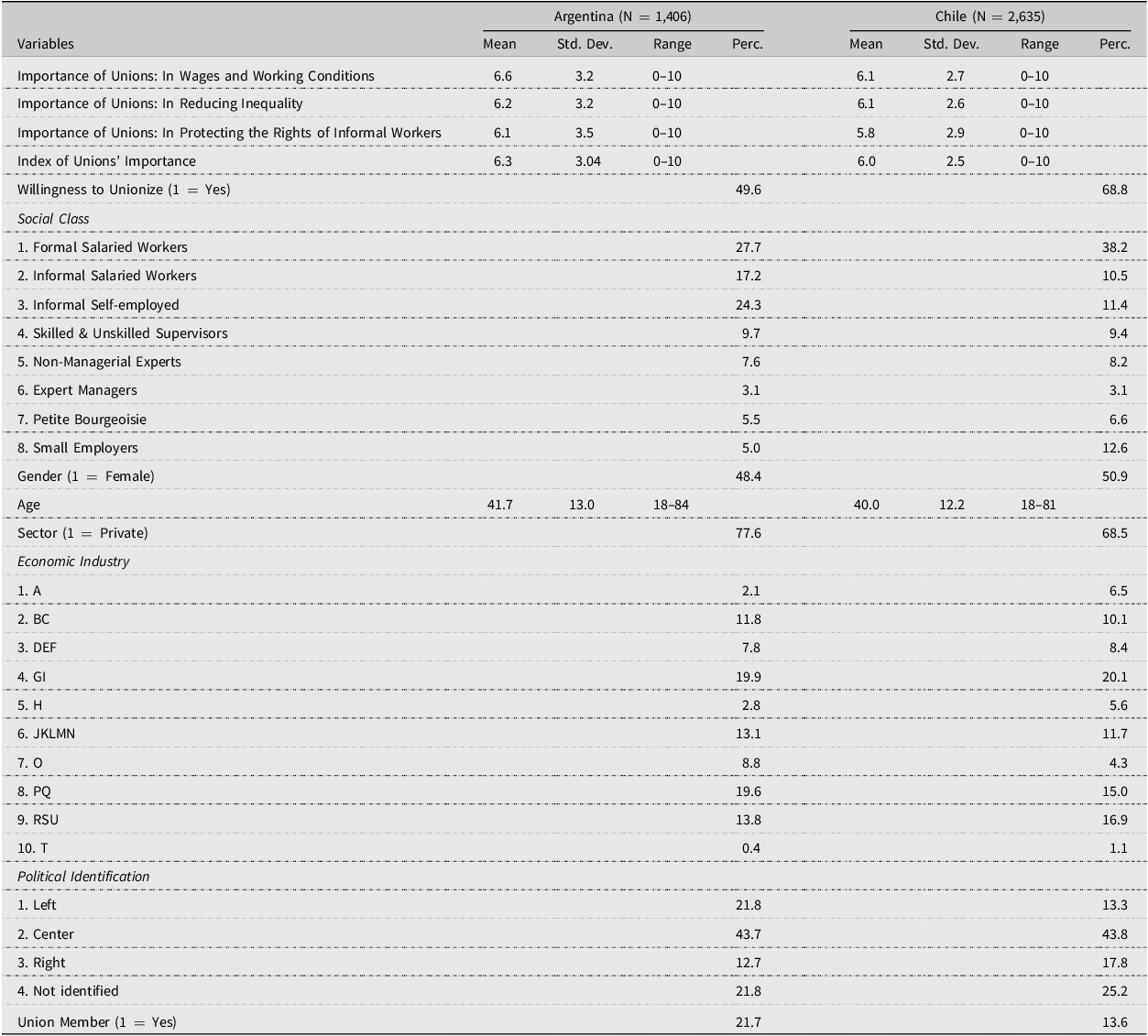
Table 1 presents the descriptive statistics for these controls, and the rest of the variables used in the analyses.
Descriptive Statistics

Analytical Strategy
To test the hypothesis regarding the relationship between social class and attitudes toward labor unions, we estimate OLS and logistic regression models, depending on the type of dependent variable. In the case of Chile, the sampling procedure resulted in a slight overrepresentation of the property-owning classes. To correct for this imbalance and ensure that the estimates reflect the underlying population structure, all regression models were estimated using survey weights.
In our statistical models, the reference category for social class is the “formal salaried working class,” as our main interest lies in comparing formal and informal working-class positions. That said, for comparative purposes, in some models we also examine the coefficients associated with other class locations.
All data and codes used in this article are available in the OSF repository.Footnote 1
Findings
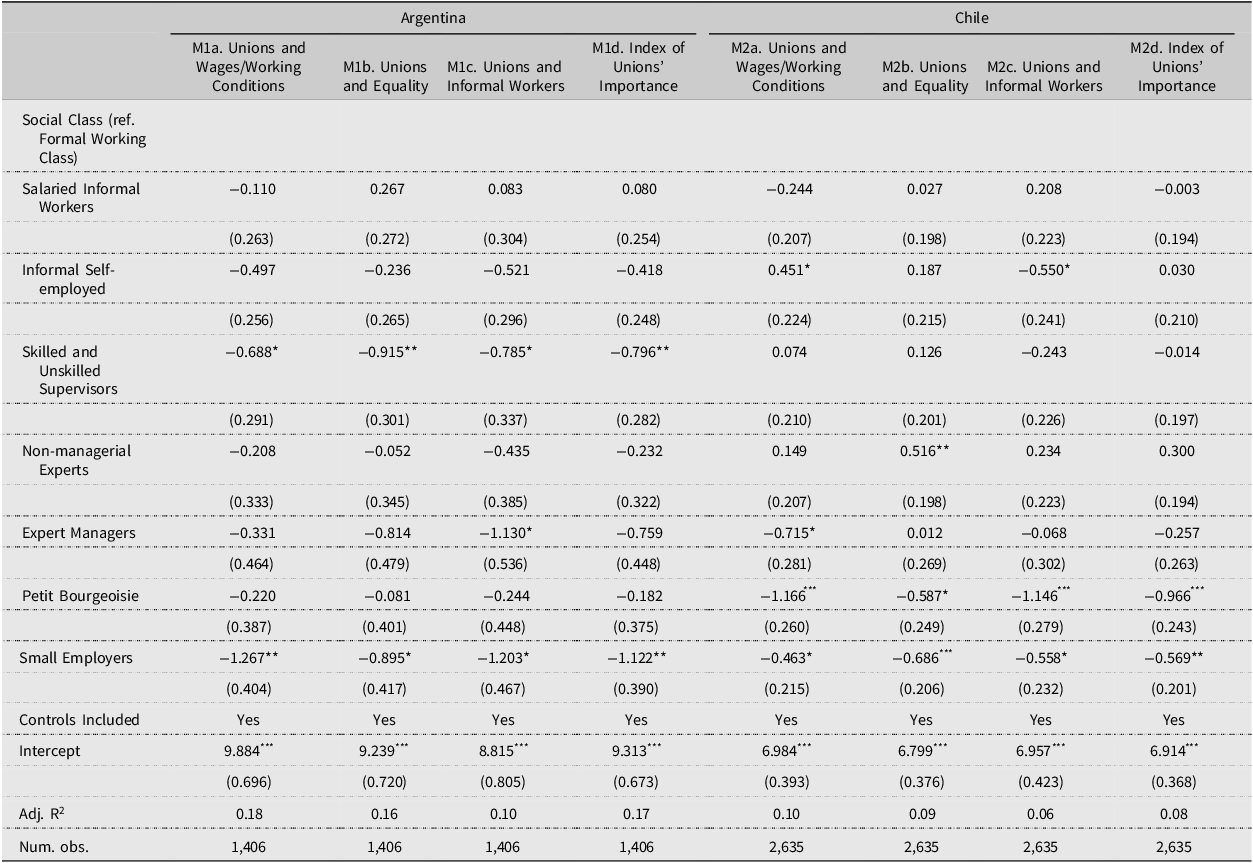
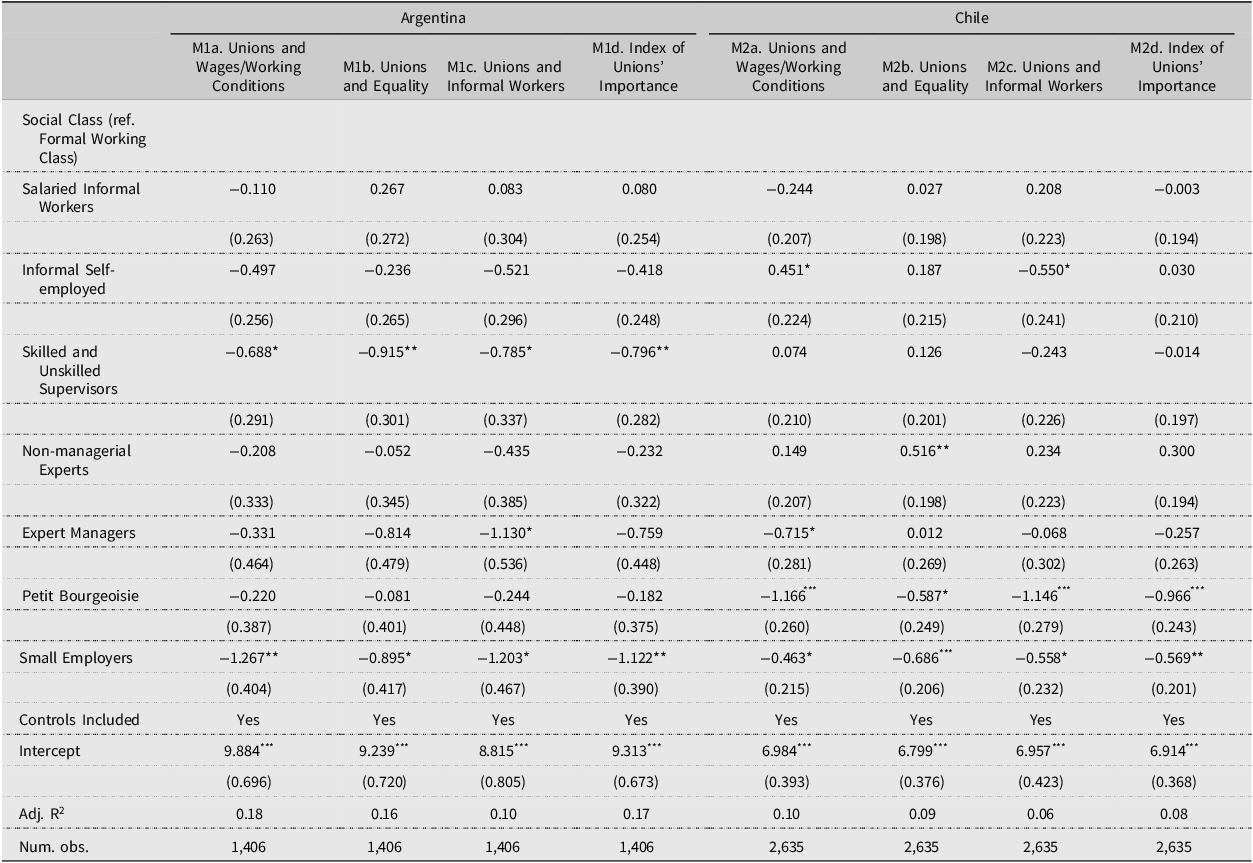
Table 2 presents the regression models predicting perceptions of unions’ importance. Perceived importance of unions for improving wages and working conditions is shown in Models 1a (Argentina) and 2a (Chile). Models 1b and 2b display perceptions of the unions’ role in reducing income inequality, while Models 1c and 2c present perceptions of unions’ role in protecting the rights of informal workers. Finally, Models 1d and 2d report the results for the overall Index of Unions’ Importance.
Determinants of Perceived Importance of Labor Unions in Argentina and Chile, 2025 (Unstandardized OLS Regression Coefficients; Standard Errors in Parentheses)
Note: The following controls were included in the models but are not reported in the table: sex, age, sector of employment, economic industry, political identity, and union membership.
*** p < 0.001; **p < 0.01; *p < 0.05.
Models 1a and 2a show that, in Argentina, informal salaried and self-employed workers hold perceptions essentially identical to those of formal workers. In Chile, the pattern is similar, although the informal self-employed express significantly more positive views of unions (b = 0.45; p < 0.05). Likewise, Models 1b and 2b indicate that formal and informal workers in both countries share similar views about unions’ importance for reducing income inequality. A different pattern emerges in Models 1c and 2c, which examine perceptions of unions’ role in protecting informal workers’ rights. In Argentina, no statistically significant differences appear across labor-market groups. In Chile, however, a clear divide emerges: the informal self-employed report significantly less positive perceptions (b = −0.55; p < 0.05), while the perceptions of informal salaried workers remain statistically similar to those of formal workers.
Taken together, the results in Table 2 align more closely with H2a (class solidarity hypothesis) than with H1a (representation gap hypothesis). Except for the Chilean informal self-employed workers’ perceptions on one item (Model 2c), informal workers do not express more negative evaluations of unions than formal workers. Furthermore, in some instances—particularly Model 2a—informal self-employed workers even report more positive views than formal workers.
This pattern is reinforced by the results for the Index of Unions’ Importance (Models 1d and 2d), where informal workers in neither country exhibit significantly less favorable perceptions than formal workers. To illustrate this pattern more clearly, we calculated the average marginal scores (marginal effects) for each social class on the 0–10 Index of Unions’ Importance. These scores were computed using the coefficients from Models 1d and 2d while holding all other variables constant at their means (for interval variables) or modal categories (for categorical variables). The results are presented in Figure 1. As shown in Figure 1, informal workers in neither Argentina nor Chile display significantly lower scores on the index. While in Chile the scores for all worker categories are nearly identical, in Argentina informal self-employed workers report slightly lower scores than both formal and informal salaried workers—although this difference is not statistically significant.
Average Marginal Effects of Social Class on the Index of Unions’ Importance.

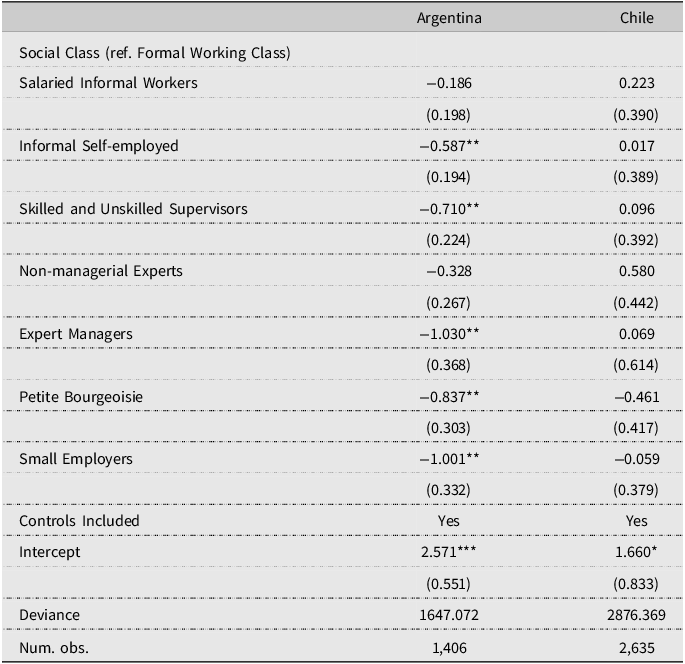
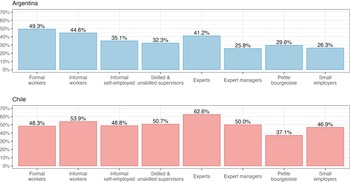
Table 3 presents the logistic regression models predicting willingness to join unions. In Argentina, the results partially support the representation gap hypothesis (H1b): relative to formal workers, informal self-employed workers are less willing to join unions. To facilitate interpretation of the logistic regression coefficients, we calculated the predicted probabilities of being willing to join a union for each social class. The results are displayed in Figure 2. As shown there, in Argentina the probability that a formal worker is willing to join a union is nearly 49 percent, whereas for an informal self-employed worker it is about 35 percent. This difference is statistically significant (p < 0.01). However, consistent with the class solidarity hypothesis (H2b), the results also show no statistically significant differences between Argentine formal workers and informal salaried workers
Determinants of Willingness to Join Unions in Argentina and Chile, 2025 (Logistic Regression Coefficients [log odds]; Standard Errors in Parentheses)

Note: The following controls were included in the models but are not reported in the table: sex, age, sector of employment, economic industry, political identity, and union membership.
***p < 0.001; **p < 0.01; *p < 0.05.
Predicted Probabilities of Willingness to Join a Union.

Similarly, the results for Chile indicate no statistically significant differences between formal and informal workers (both salaried and self-employed). Moreover, Figure 2 shows that the predicted probability of being willing to join a union for informal salaried workers is nearly 54 percent—about six percentage points higher than the probability for formal workers. Although this difference is not statistically significant, it suggests that informal salaried workers may even be more willing to join unions than their formal counterparts.
All things considered, the findings from Table 3 provide stronger support for the class solidarity hypothesis than for the representation gap hypothesis. Except for the Argentine informal self-employed, informal workers in both countries exhibit levels of willingness to join unions that are similar to those of formal workers.
Finally, our third hypothesis (H3) proposed that workers’ attitudes toward labor unions should vary across countries. Consistent with H3a, Figure 1 suggests that Argentine formal and informal workers hold more positive perceptions of unions’ importance than their Chilean counterparts. For example, the average score among formal and informal salaried workers in Argentina is around 6.3—about one point higher on the 0–10 scale than the equivalent groups in Chile. Although these differences are modest, the pattern is consistent across classes: in Chile, no class group scores higher on the Index of Unions’ Importance than its corresponding group in Argentina.
That said, and largely consistent with H3b, Figure 2 shows that Chilean workers are generally more willing to join a union than Argentine workers. For instance, in Chile the predicted probability that a salaried informal worker or an informal self-employed worker is willing to unionize is 54 percent and 49 percent, respectively—nearly 10 and 14 percentage points higher than their Argentine counterparts. In Chile, willingness to join a union is comparatively higher across all classes except formal workers (which is nearly identical to that of Argentine formal workers). It is also notably high among groups such as experts and, somewhat unexpectedly, small employers. In Argentina, by contrast, pro-union membership attitudes are more clearly structured by class: they are highest among formal salaried workers and significantly lower among groups such as supervisors, expert managers, and small employers.
All in all, Figures 1 and 2 reveal meaningful cross-national differences in workers’ attitudes toward labor unions, which align closely with both H3a and H3b.
Discussion
Building on debates about labor-market dualism, union revitalization, and the insider–outsider divide, we have evaluated two competing perspectives: the representation gap hypothesis—which expects informal or precarious workers to be less supportive of unions—and the class solidarity hypothesis, which posits that formal and informal workers share broadly similar orientations toward collective representation, given their common exposure to exploitation and labor-market risks.
Overall, the findings provide little evidence for a deep or systematic attitudinal cleavage between formal and informal workers. Some results do align with the representation gap argument—namely, the lower willingness to unionize among the Argentine informal self-employed and the less positive views of unions’ role in protecting informal workers among their Chilean counterparts. Prior studies in Latin America show that informal self-employed workers tend to report lower trust in unions (Pérez-Ahumada and Carrasco Reference Pérez-Ahumada and Carrasco2025), likely reflecting unions’ more limited reach among non-standard workers (Bensusán Reference Bensusán2019). Consistent with this scholarship, our results suggest that labor-market outsiders such as the informal self-employed may indeed question unions’ ability to represent or defend them. This may even deepen unions’ particularistic identities, thereby reinforcing dualist class divides between formal and informal workers (Jansen and Lehr Reference Jansen and Lehr2022; Standing Reference Standing2011; Collier and Handlin Reference Collier and Handlin2009).
However, our evidence also shows that this pattern is neither widespread nor generalizable. Across most models, informal workers (both salaried and self-employed) express views of unions that are statistically indistinguishable from those of formal workers. In some instances—for example, perceptions of unions’ ability to improve wages and working conditions or willingness to join unions in Chile—informal workers even report more positive assessments than their formal counterparts. Taken together, the overall pattern provides stronger support for the class solidarity hypothesis.
As established above, the class solidarity hypothesis—rooted in Marxist class analysis and IR scholarship (Wright Reference Wright2015; Hyman Reference Hyman2001) and further developed by research on union revitalization (Webster et al. Reference Webster, Ludwig, Masikane and Spooner2021; Visser Reference Visser2024; Doellgast et al. Reference Doellgast, Lillie, Pulignano, Doellgast, Lillie and Pulignano2018), argues that labor-market differences in job stability or contractual form do not necessarily translate into divergent class identities or political preferences. Our findings offer support for this perspective. In this sense, they echo the argument that precarious workers can exhibit “aspirational solidarity” with unions (Oliver and Morelock Reference Oliver and Morelock2021), anticipating that unions might eventually expand their representational reach. They also align with scholarship showing that unions, as a “sword of justice” (Gumbrell-McCormick, and Hyman Reference Gumbrell-McCormick and Hyman2018), cultivate working-class ideologies and egalitarian commitments that extend beyond narrow insider interests, thereby fostering broader working-class identification among precarious and non-precarious groups (Carver and Doellgast Reference Carver and Doellgast2021; Marques et al. Reference Marques, Benassi, Costa and Pinto2025; Pulignano et al. Reference Pulignano, Gervasi and de Franceschi2016).
Accepting this Marxist-inspired hypothesis does not imply that unions in Argentina and Chile necessarily adopt explicitly Marxist orientations (although this may occur in some specific instances). As Hyman (Reference Hyman2001) points out, unions often combine multiple and sometimes overlapping political identities: they may pursue cooperative strategies with employers while simultaneously recognizing the employment relationship as structured by exploitation. Rather than suggesting the presence of a labor movement guided by a “pure” Marxist orientation, our findings point to the persistence of the broader class-based solidaristic orientations emphasized in Marxist theory.
Overall, the limited magnitude of insider–outsider differences in attitudes found in this article is consistent with the argument that unions should not necessarily be seen as promoters of labor-market dualization. Research across developed and developing countries shows that unions—especially those led by left-wing leadership—have deliberately pursued inclusionary strategies to incorporate temporary, informal, and self-employed workers, for example by representing them in collective bargaining, creating dedicated organizational structures, or advocating for universal labor protections (Benassi and Vlandas Reference Benassi and Vlandas2016; Doellgast et al. Reference Doellgast, Lillie, Pulignano, Doellgast, Lillie and Pulignano2018; Webster et al. Reference Webster, Ludwig, Masikane and Spooner2021; Varela Reference Varela2015; Elbert Reference Elbert2026; Manky Reference Manky2019). These dynamics reaffirm the argument that the insider–outsider divide is shaped less by fixed worker identities than by institutional configurations and power resources associated with unions’ capacity to extend rights to precarious workers despite employers’ opposition (Doellgast et al. Reference Doellgast, Lillie, Pulignano, Doellgast, Lillie and Pulignano2018; Benassi and Vlandas Reference Benassi and Vlandas2016). Furthermore, these dynamics may help explain why formal and informal workers in our study do not express sharply divergent views, and why their political behavior appears broadly similar, as suggested by other investigations (Baker and Dorr Reference Baker and Dorr2022).
Finally, the cross-national evidence presented above offers important insights into how institutional and political contexts shape workers’ attitudes toward labor unions in Latin America. As argued earlier, Argentina and Chile constitute analytically valuable contrasting cases—one a paradigmatic neo-corporatist system with historically strong unions, the other an extreme case of fragmented IR characterized by decentralized bargaining and weak union power (Etchemendy Reference Etchemendy2019; Pérez-Ahumada Reference Pérez-Ahumada2023). Our findings suggest that these political and institutional characteristics probably continue to structure workers’ perceptions of unions, including among groups often portrayed as “outsiders” in contemporary labor markets.
First, Argentine workers—both formal and informal—assign greater importance to unions than their Chilean counterparts, probably reflecting the historically strong position of Argentine unionism. Unlike Chile, unions in Argentina resisted neoliberal reforms more effectively and rebuilt organizational and political capacities during the 2000s and 2010s (Pérez-Ahumada Reference Pérez-Ahumada2023; D’Urso and Longo Reference D’Urso and Longo2018; Marticorena Reference Marticorena2014). As a result, unions remain highly visible and influential political actors, even amid internal fragmentation within the CGT and declining trust in recent years (Schipani Reference Schipani2021; Pérez-Ahumada and Carrasco Reference Pérez-Ahumada and Carrasco2025).
Second, Chilean workers across most class locations report higher willingness to join unions. This aligns with evidence showing higher trust in unions in Chile than in Argentina (Pérez-Ahumada and Carrasco Reference Pérez-Ahumada and Carrasco2025). Despite institutional constraints inherited from the Pinochet era, Chile experienced a revival of labor mobilization since the late 2000s (see, e.g., Osorio and Velásquez Reference Osorio and Velásquez2022), which strengthened unions’ legitimacy (Pérez-Ahumada and Carrasco Reference Pérez-Ahumada and Carrasco2025). This context helps explain why even typically fewer union-oriented groups, including informal and some middle-class workers (e.g., non-managerial experts), report relatively high willingness to unionize. A complementary explanation is that the decentralized structure of Chilean unionism, while contributing to organizational weakness, may also enhance legitimacy by fostering closer workplace-level ties between unions and rank-and-file workers. In turn, this relative weakness may generate an aspirational demand for unions, particularly among non-unionized workers.
By contrast, despite their strong institutional and political power, Argentine unions face longstanding legitimacy challenges. These problems stem in part from highly centralized and bureaucratized decision-making structures and, in some cases, weak engagement with rank-and-file mobilization—dynamics that have contributed to the emergence of alternative, grassroots unions in several sectors (D’Urso and Longo Reference D’Urso and Longo2018; Elbert Reference Elbert2026). Such organizational features may limit traditional sectoral unions’ ability to represent segments of non-standard workers who fall outside typical bargaining coverage.
Taken together, the combination of higher perceived union importance in Argentina and higher willingness to unionize in Chile has important implications for understanding workers’ attitudes toward unions. It suggests that union strength and union legitimacy do not necessarily move in tandem. Strong institutional legacies, as in Argentina, can sustain broad perceptions of unions’ societal relevance even amid declining trust. Conversely, weaker institutional frameworks may generate a form of aspirational demand for collective organization, as in Chile’s revitalized yet structurally constrained labor movement.
Conclusion
Neoliberal transformations over recent decades—including deregulation, privatization, and the expansion of precarious and informal employment, have profoundly reshaped labor markets. In Latin America, these shifts weakened employment protections, fragmented bargaining structures, and limited unions’ capacity to reach workers outside standard employment relations. As a result, longstanding questions about unions’ political relevance, representational scope, and ability to cultivate solidaristic identities have become increasingly salient. It is within this context that two competing perspectives have gained prominence: the representation gap hypothesis, which expects outsiders to distance themselves from unions, and the class solidarity hypothesis, which anticipates that workers across labor-market positions share broadly similar orientations rooted in common class interests.
Our article evaluated these perspectives through a comparative analysis of workers’ attitudes toward unions in Argentina and Chile. We showed that the class solidarity hypothesis provides a more compelling explanation of the patterns observed. Although some informal self-employed workers express some skeptical views (particularly in domains where unions’ protective reach is weakest) these instances are limited. Across most analyses, informal workers in both countries hold attitudes statistically similar to, and occasionally more favorable than, those of formal workers. These findings indicate that employment status alone does not generate divergent class interests or systematically undermine support for collective representation.
More broadly, the results are consistent with the possibility that unions in both countries have not simply adapted passively to labor-market dualization. Prior research suggests that unions may pursue inclusionary strategies—such as expanding bargaining agendas, developing new organizational forms, or advocating for broader labor protections—to incorporate precarious and informal workers. While our findings do not allow us to directly assess these mechanisms, such dynamics could help account for the relatively limited attitudinal differences observed between formal and informal workers.
Finally, the cross-national comparison suggests that institutional and political contexts may play an important role in shaping how workers understand the role and importance of unions. Differences in union strategies, political linkages, and historical trajectories of labor conflict may contribute to the variation we observe between Argentina and Chile. In this sense, attitudes toward unions appear to be influenced not only by employment status but also by broader class dynamics and the institutional environments in which labor movements operate.
Acknowledgments
The authors would like to thank the anonymous reviewers for their valuable comments and constructive feedback, which helped improve the manuscript.This research was funded by Chile’s National Agency for Research and Development - ANID (FONDECYT project 1230056).
Competing interests
The authors declare none.


 Open access

