

1. Introduction
Environmental concerns, such as the protection of ecosystems and biodiversity, the treatment of waste and chemicals, or the prevention and remediation of environmental damage, are recurring issues in international investment law. Sustainable development is in fact one of the objectives of many modern international investment agreements (IIAs), which increasingly contain provisions or chapters dedicated to sustainable development and/or climate change.Footnote 1 A notable share of investor-state dispute settlement (ISDS) proceedings based on IIAs, which can take the form of either bilateral investment treaties (BIT) or investment chapters of free trade agreements (FTA), deal directly or incidentally with environmental policies.Footnote 2 They often do so by analyzing whether an environmental measure adopted at the domestic level complies with the standards of protection contained in an applicable IIAFootnote 3 or by interpreting environmental clauses contained therein in the context of a particular dispute.Footnote 4 Foreign investors have also used ISDS in recent years to challenge amendments to, or rollbacks of, several European Union (EU) member states’ frameworks in the renewable energy sectorFootnote 5 or to deter intended reform efforts, such as the phasing out of coal-fired power plants,Footnote 6 the conversion of coal-fired power plants into gas-fired ones,Footnote 7 or the freezing of grants for mining licences,Footnote 8 which has led to an overall increase since 2016 in the number of investor-state disputes with environmental components.Footnote 9
Several authors have predicted that the next wave of investor-state arbitration claims will likely target host state measures aimed at implementing the mitigation and adaptation goals of the Paris Agreement Footnote 10 and, more specifically, their nationally determined contributions (NDC).Footnote 11 The decision reached during the fifth Conference of the Parties (COP) serving as the Meeting of the Parties to the Paris Agreement during the COP28 of the United Nations Framework Convention on Climate Change (UNFCCC), which calls on parties to “accelerat[e] efforts towards the phase-down of unabated coal power” and to “transition[] away from fossil fuels in energy systems,” indicates as much.Footnote 12 Others have noted that foreign investors have already sought compensation on the basis of applicable IIAs for the damages caused by state measures and regulations aiming at transitioning from fossil-fuel based economic activities to a greener economy,Footnote 13 which could in turn hinder global efforts to combat the adverse effects of climate change and meet the Paris Agreement targets.Footnote 14
In this context, the present article seeks to address the following questions: what is the definition of “climate-related ISDS proceedings” and how many cases have been identified so far? How have investor-state tribunals used the climate regime in these cases to date, and is there room for further integration between international climate law and international investment law? Section 1 sets the stage by seeking to reconcile differing definitions of climate-related ISDS proceedings. Based on the work of the Sabin Center for Climate Change Law (Sabin Center) at Columbia Law School and the United Nations Conference on Trade and Development (UNCTAD), this section argues that there is a significant gap between the number of investor-state disputes having a direct relevance with climate change, on the one hand, and the number of such cases that have actually raised climate change as a material legal or factual issue. Section 2 reviews how investment tribunals have used the climate regime in such cases so far. Based on the comprehensive analysis of the 358 individual cases identified by UNCTAD as “related to measures or sectors that are of direct relevance to climate action,”Footnote 15 it argues that, while international investment law and climate change mitigation (and adaptation) “co-exist,”Footnote 16 ISDS tribunals have virtually never engaged in any sort of substantial analysis of international climate change treaties, such as the UNFCCC,Footnote 17 the Kyoto Protocol,Footnote 18 the Paris Agreement, and related instruments, rules, or practices created by United Nations (UN) institutions and bodies (together, the climate regime).Footnote 19
Against this backdrop, section 3 analyzes ways for arbitrators and parties to ISDS proceedings to better consider the climate regime — in particular, the Paris Agreement and instruments arising therefrom — in ISDS proceedings beyond its current limited role as an element of context. While the literature has mostly focused on integrating climate change concerns in ISDS, the present article goes further by exploring how states’ international climate obligations could play a greater role — for instance, by providing states with a justification for implementing more ambitious regulations or tribunals with guidance for interpreting substantive obligations in investment treaties. Drawing from past case law evidencing limited, but emerging, synergies between international environmental law and international investment law,Footnote 20 it explores how parties to ISDS proceedings and tribunals could rely, where relevant, on international treaties and related instruments addressing the climate emergency. It will do so through the assessment of three strategies pursuant to which parties and tribunals could better integrate the climate regime, where appropriate, in resolving investor-state disputes.
2. Investor-state arbitration is highly relevant to climate change mitigation and adaptation efforts
The intersection between the climate regime and ISDS has drawn a lot of attention in the last few years from insideFootnote 21 and outsideFootnote 22 the arbitration community. Critics of ISDS as a mechanism to settle disputes between foreign investors and host states involving climate change policy have pointed out the chilling effect of ISDS on mitigation and adaptation efforts.Footnote 23 In a 2023 report, David Boyd, the UN special rapporteur on human rights and the environment, condemned the settlement of disputes between host states and foreign investors through arbitration as an “unjust, undemocratic and dysfunctional process.”Footnote 24 The report stresses that ISDS, by “slowing, weakening and in some cases reversing climate and environmental actions,” is likely to have “catastrophic consequences … for climate and environment action and human rights.”Footnote 25 Others have advanced the thesis that international investment arbitration could be a useful tool to mitigate, and adapt to, the adverse effects of climate change by fostering compliance with climate change policy objectives.Footnote 26 An analysis of current practice suggests that ISDS is a double-edged sword: on the one hand, IIAs can be used as tools to promote and protect certain categories of foreign private investment, including those advancing the mitigation and adaptation targets set by parties to the Paris Agreement in their NDCs;Footnote 27 on the other hand, litigation risks may dissuade states from taking ambitious measures to tackle climate change, including when such efforts seek to implement state commitments under the Paris Agreement. Footnote 28 This apparent contradiction prompts the following question: what do we mean by “climate change-related ISDS cases,” and how many cases are we talking about?
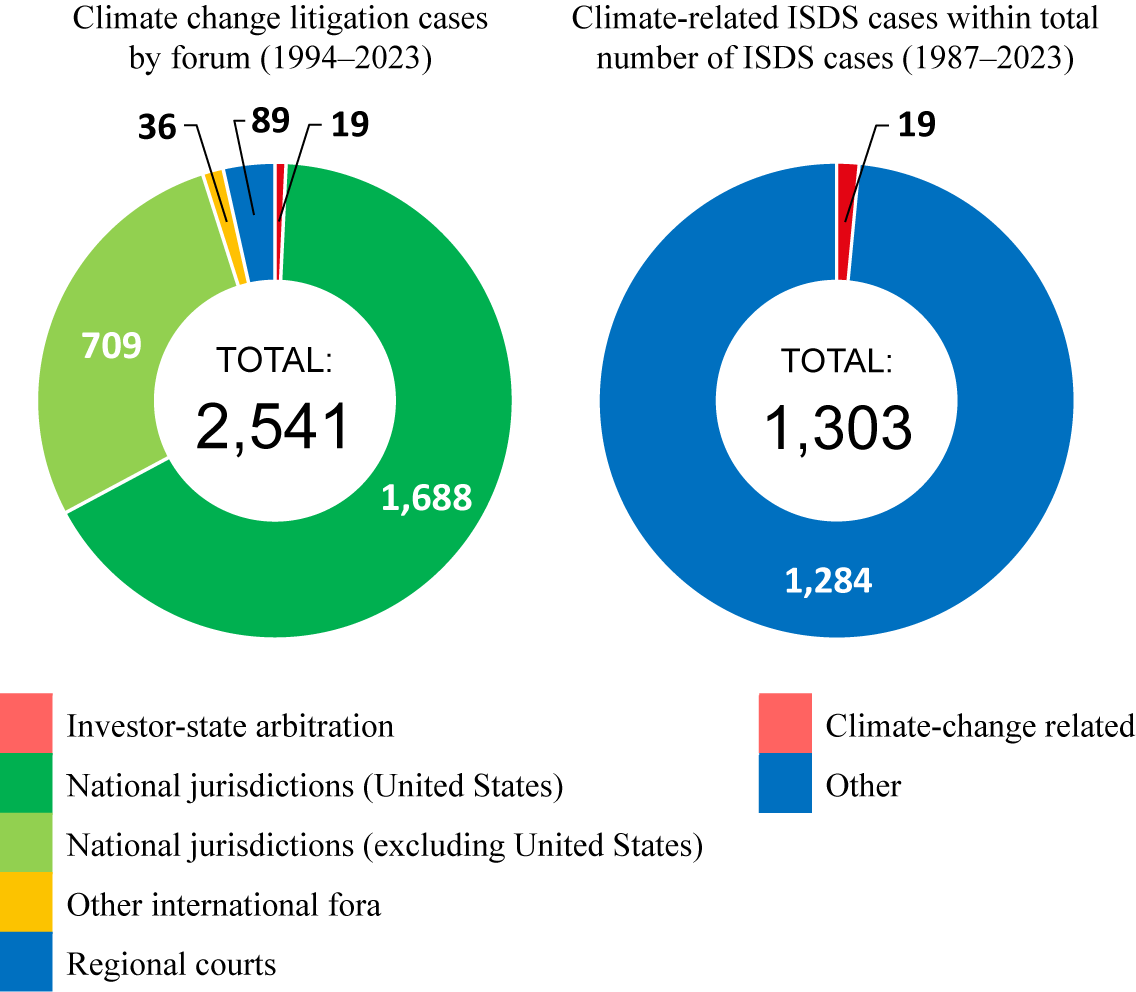
The Sabin Center, through its Global Global Climate Change Litigation Database,Footnote 29 provides a first definition. It identifies nineteen ISDS cases as of February 2024,Footnote 30 fourteen of which were administered by the International Centre for Settlement of Investment Disputes (ICSID). These nineteen cases fall within the broader category of “climate change litigation,” defined as cases that raise “climate change law, policy, or science as a material issue of law or fact in the case.”Footnote 31 The share of ISDS cases meeting this criterion is very low compared with the overall number of climate change disputes, on the one hand, and with the number of ISDS proceedings, on the other. The Sabin Center identified 2,541 climate change litigation proceedings as of 1 January 2024, and, according to UNCTAD, 1,303 ISDS cases were initiated between 1987 and mid-2023 (see Figure 1).Footnote 32
Share of climate-related ISDS proceedings within the total number of climate change litigation proceedings (1994–2023) and ISDS cases (1987–2023).
Source: Created by author, with data from the Sabin Center and the Global Climate Change Litigation Database, online: <climatecasechart.com/> (left) and UNCTAD’s Investment Dispute Settlement Database, online: <investment policy.unctad.org/investment-dispute-settlement> (as of 1 February 2024).
The small number of ISDS cases construed by the Sabin Center as “climate change litigation” suggests that applying the same criterion to identify traditional (court-based) domestic and international climate change litigation cases, on the one hand, and investment arbitration proceedings, on the other hand, is not satisfactory. There are at least two reasons for this finding. First, this definition, based on the invocation of climate change law, policy, or science as a material issue, seems unduly narrow to properly account for climate-related ISDS proceedings.Footnote 33 This is evidenced by the fact that this list of nineteen cases includes only a small fraction of the numerous cases brought against Spain and other EU member states to amend or repeal their support schemes in favour of investors in the renewable energy sector (part of the so-called “renewable energy saga”),Footnote 34 even though they involved similar facts and issues in dispute.Footnote 35 While climate change policy was not a material factual or legal issue in the proceedings,Footnote 36 these disputes nonetheless related to the states’ respective climate change policies — here, their support of domestic and regional energy transition efforts — and should have been counted. This incoherence in the application of the Sabin Center’s definition to all renewable energy ISDS proceedings results in an under-estimation of the significant number of ISDS cases in which climate change actions have been in issue, as will be evidenced below. The risks posed by ISDS with respect to state efforts to address climate change may therefore not have been fully captured so far.Footnote 37
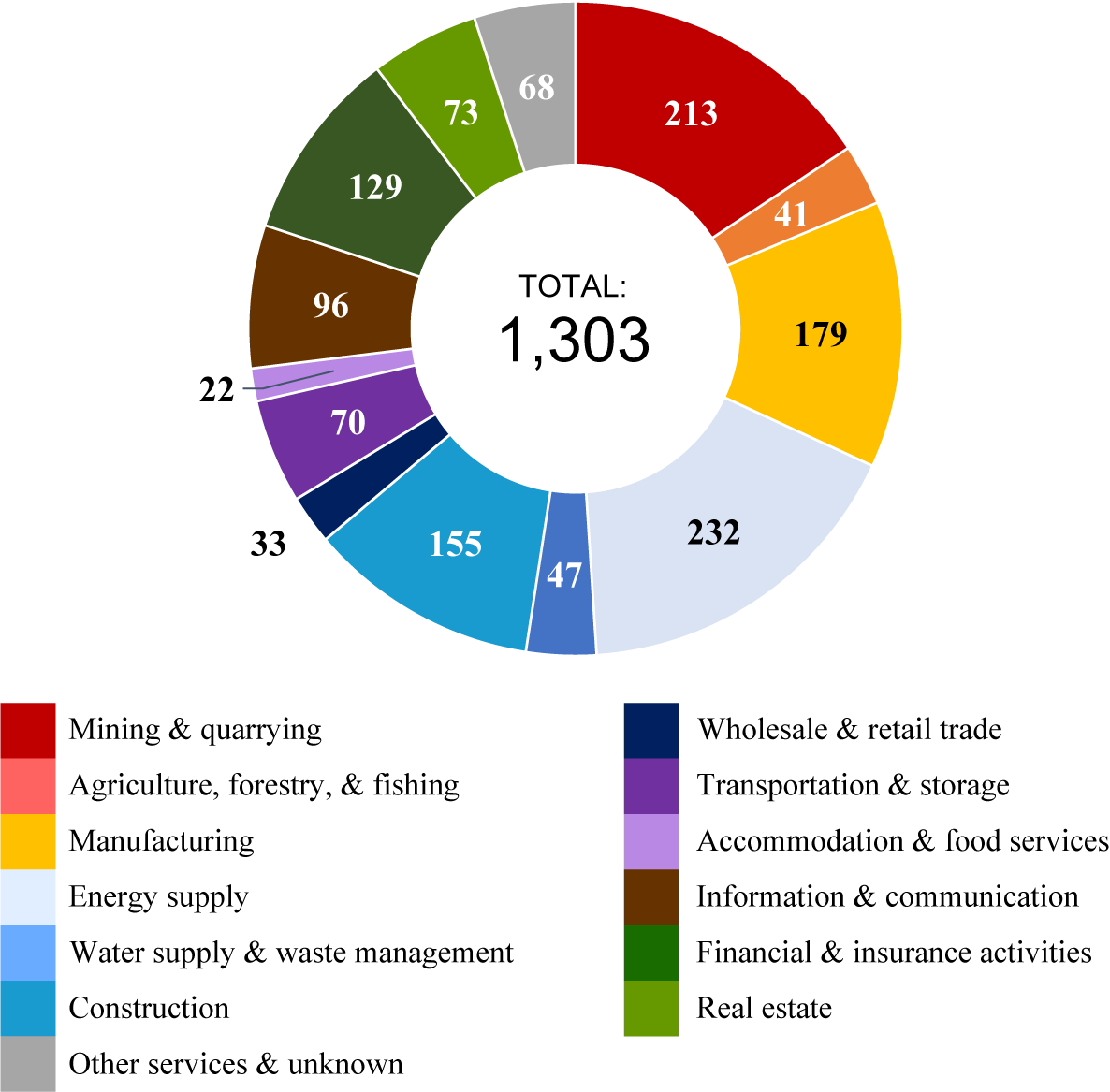
Second, the above-mentioned criterion does not adequately consider several biases of the ISDS system, which are inherent to the legal basis of most investors’ claims. First, since treaty-based ISDS claims can only be based on a breach by the host state of a substantive investor protection obligation in the applicable IIA, claimants in ISDS proceedings rely almost exclusively on the legal standards contained in the applicable BIT or FTA. This means that the parties to such proceedings are unlikely to rely upon domestic or international climate change as a legal basis for their claims or defences, let alone as a material issue in dispute. Second, investors may frame their claims narrowly so as to give states fewer justifications on the merits.Footnote 38 Third, investors rarely seek to bring about broader societal change through their claims, in contrast with most strategic climate litigation cases, which accounts for more than one-third of climate change litigation cases globally.Footnote 39 This partly explains why climate change as fact, law, or science has only been discussed in nineteen ISDS proceedings so far, even though the case might otherwise be related to climate change — for instance, because it involves state measures or sectors directly relevant to climate change mitigation and adaptation, such as mining and quarrying or energy supply (see Figure 2).Footnote 40
Investor-state arbitration proceedings by economic sector (1987–2023).
Source: Created by author, with data from UNCTAD’s Investment Dispute Settlement Database, online: https://investment policy.unctad.org/investment-dispute-settlement (last updated 31 July 2023). The sum of the numbers of cases listed by category is higher than the total amount of reported cases as the categories are not mutually exclusive.
Against this background, UNCTAD published, in the context of the debate on climate finance that took place at COP-27, a report entitled “International Investment in Climate Change Mitigation and Adaptation: Trends and Policy Developments,” which provides for a different methodology for counting cases “related to measures or sectors that are of direct relevance to climate action” commenced between 1987 and 2021.Footnote 41 UNCTAD identified three subcategories of cases of direct relevance to climate action. The first category comprises at least 175 cases related to “measures taken for the protection of the environment,” which UNCTAD deemed relevant to climate action because of the nature or objective of the measure at stake.Footnote 42 Such cases are relevant because the climate crisis is interlinked not only with the phase-out of fossil fuels and energy transition efforts but also with biodiversity loss and the protection, conservation, and restoration of nature and ecosystems.Footnote 43 According to the report, “[s]ome of the challenged measures involved allegations that the claimants’ investment projects were environmentally harmful (causing pollution and degradation of the environment). Several cases, also counted under this category, challenged measures related to regulatory changes for renewable energy production.”Footnote 44 Because some proceedings were kept confidential, UNCTAD noted that the actual number of environmental ISDS disputes was likely higher.Footnote 45
The second category comprises at least 192 cases “related to fossil fuels,” which involve “investment activities in the extraction, processing, distribution, supply, transportation, storage and the power generation from coal, oil, gas.”Footnote 46 Here, UNCTAD focused on the claimant’s industry, rather than on the nature or aim of the measure at issue, to determine the relevance of these cases to climate action. UNCTAD admits that “fossil fuel investors challenged measures that were not necessarily related to climate action or the protection of the environment.”Footnote 47 Yet all ISDS cases involving investors in the fossil fuel industry were deemed relevant because emissions from fossil fuels are the most significant contributor to climate change, and foreign investors in that sector are increasingly affected by new regulations seeking to meet states’ emission-reduction obligations.Footnote 48 UNCTAD stresses, for example, that “challenged measures included changes in regulatory frameworks applicable to the investment and the denial or revocation of permits on other than environmental grounds.”Footnote 49 It further noted that “[a]s fossil fuel investors have frequently resorted to ISDS, they can also be expected to use existing ISDS mechanisms to challenge climate action measures aimed at restricting or phasing out fossil fuels.”Footnote 50
The third category comprises at least eighty cases involving renewable energy,Footnote 51 which UNCTAD identified as a “climate change sector” in an earlier report.Footnote 52 Such cases mostly concern the roll-back of support schemes.Footnote 53 In total, UNCTAD identified 358 ISDS individual pending or concluded ISDS disputes initiated between 1987 and 2021 that are directly relevant to climate change action because of the subject matter of the dispute (either the nature of the investment, its economic sector, or the state policies being challenged and, where applicable, whether such policies or measures were taken in furtherance of international commitments). The categories are not mutually exclusive — in particular, the entire list of renewable energy disputes (eighty cases) is subsumed in the category of environmental cases.Footnote 54 These numbers are consistent with another study in 2019 that found that, in the aggregate, 67 percent of the cases filed with ICSID “potentially involve climate change-related issues.”Footnote 55
Two different institutions, using their own definition of what constitutes climate-related ISDS proceedings, have thus reached contrasting results. According to the Sabin Center, slightly under 1.5 percent of ISDS proceedings initiated to date are climate related, while, according to UNCTAD, this percentage rises to 29.8 percent over the period from 1987 to 2021. The results obtained by the Sabin Center and UNCTAD show that there is a large gap between the number of investor-state disputes directly relevant to climate change action because of their subject matter, on the one hand, and the handful of cases in which climate change was a material factual or legal issue in the proceedings. As evidenced in the following section, the number of cases in which the tribunal made a significant reference to an applicable element of the climate regime is even lower.
3. When ISDS tribunals consider the climate regime, they almost exclusively refer to it as an element of context
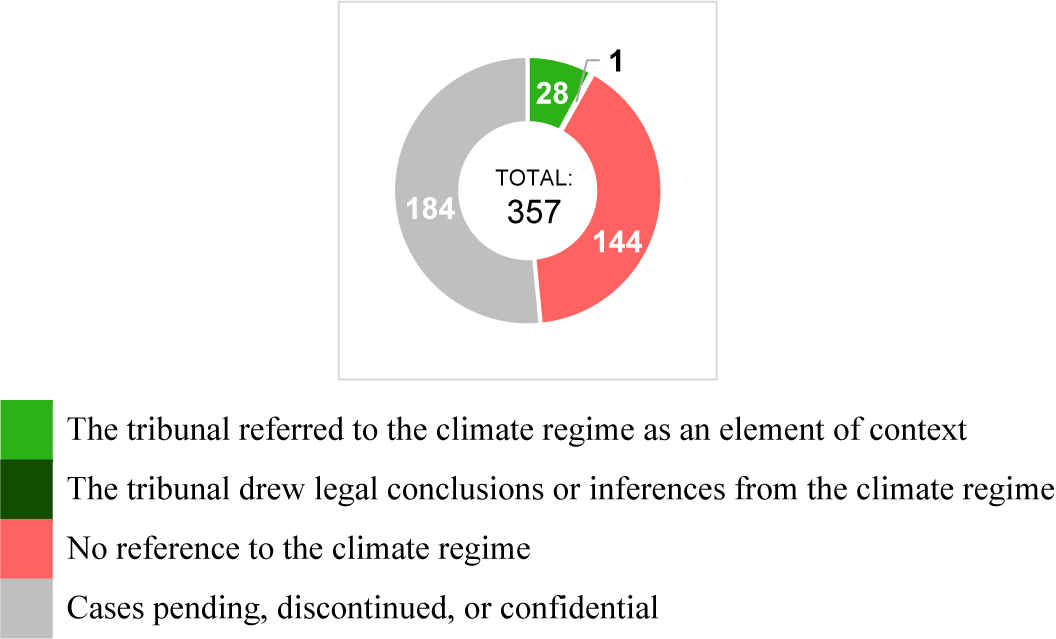
I have reviewed all publicly available decisions and awards on jurisdiction and/or liability originating from the 358 individual cases commenced between 1994 and 2021Footnote 56 that have been identified by UNCTAD as “related to measures or sectors of direct relevance to climate action.”Footnote 57 Because of the direct link of these disputes with climate action, one would expect the parties to at least consider in their pleadings, if not invoke, the rules and policies governing climate change mitigation and adaptation efforts. This is because, on the one hand, states facing ISDS claims could seek to balance such rules and policies against investment treaty protections in order to obtain more “flexibility for the necessary regulatory experimentation leading to climate adaptation” as well as “the necessary policy space … to take urgent climate action.”Footnote 58 On the other hand, investors, where relevant, could also rely on the climate regime to hold a government in breach of its investment treaty obligations due to its actions and inactions on climate change.Footnote 59 However, my analysis shows that the majority of tribunals have not acknowledged or otherwise referred to any element of the climate regime (that is, international climate change treaties and/or related instruments, rules, or practices) in publicly available decisions and awards, which indicates that they have been seldom invoked by the parties to such disputes (see Figure 3). Virtually, none of the ISDS tribunals have engaged in any sort of substantial analysis of international climate change treaties, and only one tribunal has made a legal finding based on an element of the climate regimeFootnote 60 — namely, the fourth national communication of the Czech Republic on the UNFCCC in 2005, which served as evidence of host state conduct.Footnote 61
References to the climate regime in climate-related ISDS cases by category of case (1987–2021).
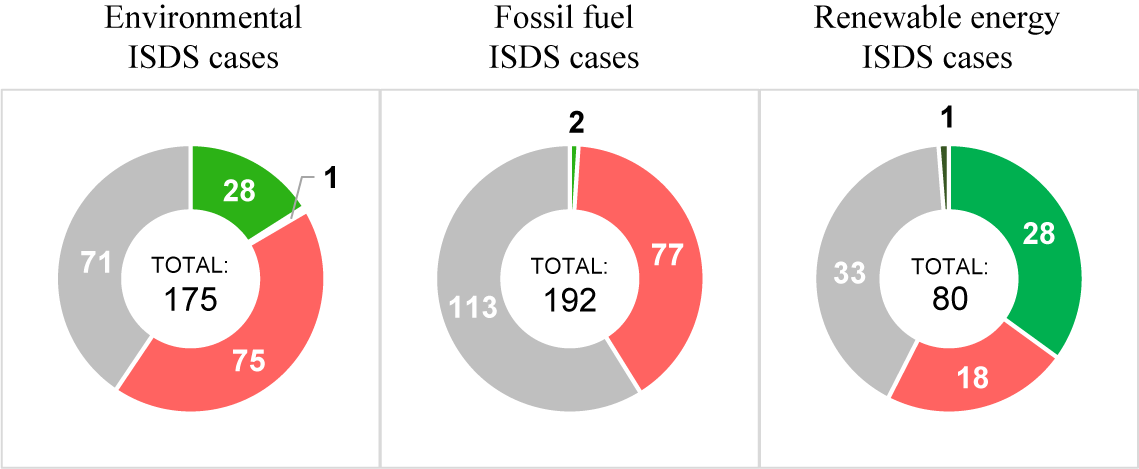
References to the climate regime in climate-related ISDS cases (total number of individual cases) (1987–2021).
Source: Created by author, with list of cases from UNCTAD, “Treaty-based Investor-state Dispute Settlement Cases and Climate Action,” IIA Issues Note 4 (2022), Annex 1, online: https://unctad.org/system/files/official-document/diaepcbinf2022d7_en.pdf.
Most often, decisions and awards rendered by investor-state tribunals in these cases have referred to sub-components of the climate regime in the section relating to the factual background of the dispute, rather than in the discussion of the applicable rules to assess the merits of the investor’s claims as part of the award’s statement of reasons.Footnote 62 It is not uncommon for arbitral tribunals to construe legal norms as contextual information belonging in the “facts” section of their awards when such norms fall outside of what they consider to be the law applicable to the dispute.Footnote 63 The climate regime is no stranger to this phenomenon. In fact, “the potential legal territory where an arbitral tribunal could find itself charged with the task of balancing international investment law … and climate change law, including GHG-curbing ambitions or NDC commitments under the Paris Agreement, remains unchartered.”Footnote 64
In a number of awards arising out of the decision by several EU countries to withdraw or amend their respective national support schemes to incentivize investments in the renewable energy sector, tribunals referred to elements of the climate regime — at the time, the UNFCCC and/or the Kyoto Protocol and related instruments — as procedural facts explaining the context of the support schemes’ introduction rather than as a legal norm relevant to the interpretation of such domestic legislation or to the adjudication of the claims on the merits more generally.Footnote 65 My analysis shows that investor-state tribunals tend to consider the climate regime — most often, the UNFCCC, the Kyoto Protocol, and the Paris Agreement — at best as an element of context, including the very few instances where the climate change emergency was a core driver of the measure in dispute.Footnote 66 The climate regime was cited in only two fossil fuel ISDS cases. In the first case, a tribunal also used the UNFCCC, along with the Treaty on the Non-Proliferation of Nuclear Weapons, as an illustration of treaties in which the parties “consciously and expressly to decide that the burden of right and obligation will fall differently on different treaty parties, or groups of treaty parties.”Footnote 67 In the second case, the tribunal mentioned that “[t]he purpose of the project — apart from obtaining better economic and financial results — was to enhance the sustainable development of Bolivia through the development of state-of-the-art combined cycle technology, in accordance with the United Nations Framework Convention on Climate Change.”Footnote 68
The most notable use of an element of the climate regime is found in Antaris and Göde v Czech Republic. Footnote 69 In this case, which is part of the so-called “renewable energy saga,”Footnote 70 a tribunal constituted under the Permanent Court of Arbitration faced claims by German renewable energy investors that the Czech Republic breached the fair and equitable (FET) and full protection and security (FPS) standards under the Energy Charter Treaty (ECT) and the 1992 Germany-Czechoslovakia BIT by “repealing incentive arrangements to attract investors in photovoltaic power generation contrary to its guarantees.”Footnote 71 In particular, the tribunal was faced with the issue of whether section 6 of Act 180/2005, which was intended to promote the use of renewable energy sources, created a promise of regulatory stability and the expectation that the claimants would maintain feed-in tariffs for renewable energy sources at fixed minimum rates for fifteen years (later amended to twenty years) — that is, over the lifetime of the claimants’ project.Footnote 72 The tribunal rejected the claimants’ argument that, under the applicable treaties, “there [was] a free-standing obligation to provide a stable and predictable investment framework” as well as the respondent’s contention that “no legitimate expectations as to stability can arise in the absence of a legislative or contractual stabilization arrangement.”Footnote 73 The tribunal, however, accepted that “promises or representations to investors may be inferred from domestic legislation in the context of its background, including official statements,” even if such statements do not have legal force.Footnote 74
The tribunal noted, in addition to statements by the Czech Ministry of Industry and Trade, that “the Respondent in the 2005 UN Report described the purpose of Section 6(1)(b)(2) as: ‘providing guarantees to the investors and owners … that … revenue …will be maintained for a period of 15 years’; and the [Energy Regulatory Office] described the Act on Promotion as ‘bringing a guarantee of long-term and stable promotion’ … including a ‘guarantee of revenues … for a period of 15 years.’”Footnote 75 Such statements, even if they were not binding on the State, demonstrate that “both the Respondent and the [Energy Regulatory Office] described the incentive regime in terms of a guarantee or promise of stability, and that the Czech Government actively promoted the new regime at home and abroad, and described its main element in terms of a guarantee.”Footnote 76 The tribunal thus relied on an element of the climate regime — the 2005 fourth national communication of the Czech Republic on the UNFCCC — as evidence of the host state’s conduct in order to determine that the Czech incentive regime amounted to a guarantee or promise of stability. According to the majority of the tribunal, such promise did not give rise, however, to a legitimate and reasonable expectation of stability in light of the claimants’ own lack of due diligence.Footnote 77
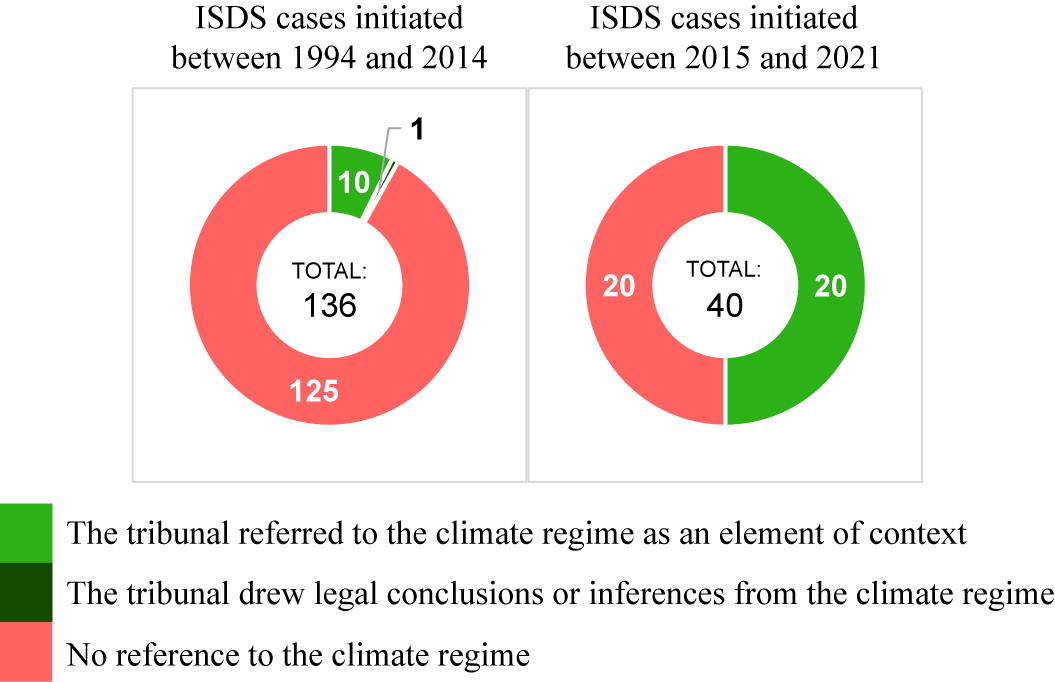
Tribunals have also referred to the climate regime more frequently in decisions and awards rendered in proceedings initiated since 2015 (in 50 percent of publicly available cases), as compared to the period 1994–2014 (in 8 percent of publicly available cases) (see Figure 4). This trend may gain pace in the near futureFootnote 78 since parties have in recent submissions started to rely on, or challenge, domestic regulations arising out of state commitments under the Paris Agreement, including NDCs.Footnote 79 In his 2023 report, the UN special rapporteur noted at least seven additional “examples of ISDS claims launched in response to climate actions” between 2021 and 2023.Footnote 80 While the Paris Agreement has not yet been cited or otherwise referred to in a tribunal’s award or decision, it has been used by parties in at least five ISDS cases, one of which is pending and another suspended.Footnote 81 No tribunal has yet referred to a state’s NDC under the Paris Agreement; however, a small number of investor claims have sought to challenge state measures seeking to mitigate climate change or adapt to its adverse effects in furtherance of the targets of the Paris Agreement.
References to the climate regime in publicly available climate-related ISDS decisions and awards over time (1994–2021).
Source: Created by author, with list of cases from UNCTAD, “Treaty-based Investor-state Dispute Settlement Cases and Climate Action,” IIA Issues Note 4 (2022), Annex 1, online: <unctad.org/system/files/official-document/diaepcbinf2022d7_en.pdf>.
In particular, two cases under the ECT have involved The Netherlands’ 2019 decision to phase out coal-fired power by 2030, which was reportedly drafted “in consideration of international and EU law,” including the EU’s first NDC to reduce GHG emissions by at least 40 percent by 2030, compared to 1990 levels.Footnote 82 In another pending case, a Luxembourg investor filed an ICSID claim against Slovenia under the ECT arising out of the government’s alleged expropriatory and discriminatory treatment of the claimant’s investment in a local coal-mining company.Footnote 83 The claimants in these cases have challenged measures designed to achieve the host states’ respective mitigation goals; however, it is not difficult to imagine a future scenario in which the state’s roll-back of its climate mitigation and adaptation policies, contrary the state’s commitments reflected in its successive NDCs, could amount to a breach of treaty standards,Footnote 84 similar to the claimants’ argument in Antaris v Czech Republic. To date, none of the awards in the solar energy arbitrations contain any factual conclusions or arguments regarding GHG emissions or any international obligations relating to climate change.Footnote 85 Tribunals may however be called upon to interpret and give effect to the international climate obligations arising out of the Paris Agreement, and their interplay with investment treaty protections in the near future, as a result of these pending claims.Footnote 86 In order to better align with states’ obligations stemming from the Paris Agreement, as well as the recent wave of withdrawals from the ECT (particularly from several EU member states), the modernization process of the ECT is likely to have a significant impact on the nature and availability of ISDS to resolve climate change-related investment disputes in the future.Footnote 87
As shown above, only a handful of ISDS proceedings have actually engaged with the climate regime to date, even though they were “directly relevant to climate change policy.” There is thus a tension between the overarching nature of climate change as one of the “greatest challenges of our times,”Footnote 88 on the one hand, and the apparent lack of consideration by investor-state tribunals of the climate regime when called upon to rule on investor-state disputes, on the other hand. While many potential factors can influence a tribunal’s reasoning, including its limited mandate,Footnote 89 it is more than ever necessary to question the limited use by investment tribunals of the climate regime so far, considering the “significant effect” that the Paris Agreement could have “on a wide range of investment relationships.”Footnote 90 This necessity has arisen because “climate change mitigation will be a new arena examined by investor-State tribunals,”Footnote 91 which will be called upon to assess whether states’ domestic climate policies, arising out of their respective NDCs, constitute breaches of applicable treaty protections when they adversely impact foreign investors and their investments. It is also because the protection granted to foreign investors, including ISDS, has the potential to foster compliance by states with their climate mitigation targets under the Paris Agreement and to incentivize investment in the renewable energy sector.Footnote 92 In fact, nothing prevents ISDS proceedings from becoming a suitable mechanism to adjudicate disputes involving environmental and climate change issues — even if such issues are dealt with accessorily to an investment dispute — subject to the introduction of adequate jurisdictional mechanisms to that effect.Footnote 93
In light of the large number of ongoing and forthcoming ISDS climate-change proceedings, whose combined effect could potentially undermine the international community’s efforts to combat climate change or, at the very least, divert a substantial amount of funding from climate mitigation and adaptation efforts,Footnote 94 this article will now answer the following question: how can ISDS tribunals better integrate climate change concerns in future cases? Based on a review of references found in publicly available pleadings, awards, and decisions published to date, it will do so by identifying precedents in which parties and tribunals have successfully used, or otherwise relied on, international environmental treaties and standards and which may be applied mutatis mutandis to the climate regime.
4. Legal pathways to better integrate the climate regime in ISDS
While there is abundant literature offering proposals to reform international investment law, particularly with respect to treaty-making practice,Footnote 95 only a handful of authors have explored ways to safeguard states’ climate change mitigation and adaptation goals in investor-state disputes brought under existing IIAs,Footnote 96 and even fewer have studied the legal basis to do so. In this context, the following section seeks to bridge this existing gap by exploring how tribunals could make more substantial use of the climate regime in investor-state disputes. The previous section demonstrated that a relatively low number of ISDS proceedings (within the total number of climate change disputes) have addressed climate change as a material issue of law or fact, which, in turn, suggests that ISDS parties, counsel, and tribunals have failed to adequately consider the climate regime as a basis for their decisions and arguments.Footnote 97 The practice of investor-state tribunals nonetheless shows that an interplay between international investment law and other areas of public policy, including the protection of the environment, is possible.Footnote 98
This section will explore three strategies or legal bases that could be used to better integrate international treaties and related instruments addressing the climate emergency in ISDS proceedings. The article will argue that the climate regime has the potential to play a more significant role in ISDS proceedings — more than just being used as a “fact” or evoked in passing in the introductory sections of the award. It will do so by analyzing three pathways, each gradually more significant than the other — namely, when the climate regime has been incorporated as part of the domestic laws of the host state and acknowledged as such; when it is construed by the tribunal as part of the legal context of the dispute; and when it is used as applicable law.
A. The climate regime as part of domestic law
A first route to integrate the climate regime in ISDS is to give effect to the domestic norms and regulations aiming at giving effect to the climate regime, including the Paris Agreement. The Paris Agreement has generated an important volume of domestic law, which will likely grow in the near future, particularly with respect to the measures adopted to implement each state’s NDC.Footnote 99 Such legislation, adopted in furtherance of global climate change mitigation and adaptation efforts, is likely to adversely impact foreign investors and their investments, who could turn to ISDS as a means to obtain compensation for their economic loss. In fact, this risk has already materialized, as illustrated by the recent decisions in Uniper v Kingdom of the Netherlands and in RWE v Kingdom of the Netherlands regarding the government’s decision to phase out coal-fired power by 2030 in line with its commitments under the Paris Agreement. Footnote 100
As previously explained, ISDS tribunals adjudicate investor-state disputes on the basis of specific instrument(s) of consent. In this context, ISDS tribunals virtually never apply domestic law as the law applicable to the dispute. Rather, domestic law is a fact considered by ISDS tribunals as part of their assessment of whether certain state actions have been consistent with the international obligations of the state contained in the applicable IIA. The fact that a state operated under the umbrella of another international agreement, such as the Paris Agreement, “does not, in and of itself, preclude the possibility of incurring international responsibility under IIAs.”Footnote 101 Yet ISDS tribunals would be ill-advised to consider the body of domestic law implementing states’ commitments under the Paris Agreement as any other domestic measure used by tribunals as evidence of the host state’s conduct in relation to its commitments under the applicable IIA.Footnote 102
Instead, ISDS tribunals called upon to control the conformity of such laws and regulations, or their enforcement in regard to the investor and investment, should take stock of their international origin when assessing potential violations of the applicable IIA.Footnote 103 They may do so through two avenues. First, ISDS tribunals have developed interpretation techniques in order to balance investors’ protection as granted by the applicable treaty standards and public interest concerns, including the protection of the environment.Footnote 104 For instance, the tribunal in Unglaube v Costa Rica held that a considerable measure of deference to state acts should be accorded when “a valid public policy does exist, and especially where the action or decision taken relates to the State’s responsibility for the protection of public health, safety, morals, or welfare.”Footnote 105 In Chemtura v Canada, the tribunal considered that the international commitments of the state — its obligations under the Aarhus Protocol to the Convention on Long-range Transboundary Air Pollution Footnote 106 — justified the exercise of environmental regulatory powers to restrict the use of lindane, a pesticide deemed dangerous for human health and the environment.Footnote 107 The tribunal held that the review process launched by Canada’s Pest Management Regulatory Agency was undertaken “in pursuance of its mandate and as a result of Canada’s international obligations,” thereby excluding any bad faith on the part of Canada.Footnote 108
When assessing the reasonableness or legitimacy of state action, tribunals should therefore consider whether such action was implemented or was consistent with the state’s international obligations. Moreover, tribunals should give a greater deference to the state in determining its public policies when they are rooted in international law — for instance, if they mirror rules and principles found in international environmental treaties to which the host state is a party. For instance, when assessing the impact on a protected investment of a domestic measure (such as the phase-out of coal-fired power or the conversion of coal-fired power plants) against the rationale behind it (achieving its GHG emissions reduction targets pursuant to its latest NDC under the Paris Agreement), the Paris Agreement could be used to interpret the regulatory framework in which the investment took place. Here, the international climate regime could play a critical role in determining whether the state acted bona fide or in assessing the rationale behind the state measure.Footnote 109 Tribunals could rely on the international origin of domestic measures as context or justification — for instance, to assess whether such measures served a public purposeFootnote 110 or were necessary, proportionate, and foreseeable by a diligent investor.Footnote 111 As reflected in the recent arbitral awards discussed below, international tribunals are in fact regularly called upon to interpret and assess norms and principles of a domestic nature that originate from the international legal framework.
Tribunals may use a second category of entry points in order to consider the consistency of domestic rules arising out of the international climate change law with investor protection obligations — namely, treaty provisions that establish environmental exceptions and obligations to meet international environmental standards. Eco Oro Minerals Corporation v Republic of Colombia provides an illustration, with respect to the precautionary principle as embodied in Colombian law,Footnote 112 in light of the police powers exception contained in Annex 811(2)(b) of the Colombia-Canada FTA. Footnote 113 In this case, the tribunal faced, inter alia, a claim that Colombia’s decision to restrict Eco Oro’s mining activities in an environmentally sensitive area known as Páramo, amounted to an unlawful expropriation under Article 811 of the FTA.Footnote 114 Colombia disputed that any expropriation had taken place and argued that, even if Eco Oro had been deprived of an acquired right by Colombia, such deprivation would be lawful under the police powers doctrine as reflected by Annex 811, in which the parties to the FTA “confirm[ed] their shared understanding” of the situation addressed by Article 811.Footnote 115 The tribunal therefore had to assess whether the measures amounted to a substantial deprivation of Eco Oro’s vested rights and, if so, whether they constituted a legitimate exercise of Colombia’s police powers. The tribunal found that Eco Oro had vested rights capable of being expropriatedFootnote 116 and, due to Colombia’s decision to restrict the investor’s mining activities in spite of a previously acquired permit, that it suffered a “complete deprivation of a potential right to exploit” “capable of being considered to be a substantial deprivation, such as to amount to an indirect expropriation.”Footnote 117 The tribunal then turned to consider whether such deprivation constituted an indirect expropriation or a legitimate exercise by Colombia of its police powers precluding any wrongdoing, pursuant to Annex 811(2)(b) of the FTA.Footnote 118
In order to assess whether Colombia’s exercise of its police powers was legitimate, the tribunal had to determine that the measures at issue were (1) non-discriminatory and designed and applied to protect the environment and (2) did not comprise a rare circumstance such that they constituted indirect expropriation pursuant to Annex 811(2)(b).Footnote 119 The tribunal answered both questions in the affirmative, thereby dismissing Eco Oro’s expropriation claim.Footnote 120 In doing so, it relied extensively on the precautionary principle, “as enshrined into Colombian Law,”Footnote 121 which played a large role in the tribunal’s finding that Colombia’s measures to protect the environment were “bona fide” and “motivated both by a genuine belief in the importance of protecting the páramo ecosystem and pursuant to Colombia’s longstanding legal obligation to protect it.”Footnote 122 It also noted that the “potential applicability of the precautionary principle to the páramo should … have been understood by Eco Oro,” meaning that mining activities in the areas overlapping with the Páramo were at risk of no longer be permitted, which eventually happened.Footnote 123 As a result, the delimitation of the Páramo by Colombia was “not unreasonable” nor “disproportionate” [sic], meaning that it did not amount to a “rare circumstance” constituting indirect expropriation pursuant to Annex 811(2)(a) of the FTA.Footnote 124
In Eco Oro, Colombia’s successful plea for a lack of unlawful expropriation was therefore bolstered by a finding from the tribunal that the precautionary principle, which had constitutional value under Colombian law, originated from international law (here, Principle 15 of the Rio Declaration on Environment and Development).Footnote 125 It also shows that ISDS tribunals, facing arguments to that effect, may give effect to the international origin of domestic legislation by granting them a greater deference, either on the basis of explicit treaty language to that effect or through an interpretation of modernized treaty language that better reflects “the social dimension of international investment”Footnote 126 when assessing the conformity of the state’s actions or inactions with the applicable investment treaty.Footnote 127 However, the practice of ISDS tribunals shows that treaty provisions seeking to mitigate the impact of investment protections on their regulatory powers have led to mixed results thus far. In particular, general exception mechanisms, when used at all,Footnote 128 have failed to justify conduct aimed at the protection of the environment that would otherwise represent a violation of the treaty.Footnote 129 This is illustrated by the Eco Oro award,Footnote 130 in which the tribunal found that Colombia’s actions, aiming at achieving the delimitation of an environmentally sensitive area, were found to be in violation of the minimum standard of treatment, notwithstanding the Colombia-Canada FTA’s exception clause modelled on Article XX of the General Agreement on Tariffs and Trade. Footnote 131 For these reasons, the two following avenues may prove more successful to enhance the interplay between international investment law and climate change law and policy.
B. The climate regime as part of the legal context
Many parties to ISDS proceedings — claimants and respondents alike — have invoked sources of international law external to the applicable IIA in order to advance their interpretation of standards of conduct contained therein.Footnote 132 They have done so on the basis of express provisions in the applicable investment treaty or, in the alternative, on the basis of the principle of “systemic coherence” or “systemic integration” in the interpretation of international treaties under customary international law as reflected by Article 31(3)(c) of the Vienna Convention on the Law of Treaties (VCLT).Footnote 133 Article 31(3)(c) provides that, in the process of interpreting a treaty, “[t]here shall be taken into account, together with the context: … (c) any relevant rules of international law applicable in the relations between the parties.” However, arbitral tribunals have generally been reluctant to uphold such arguments.Footnote 134 Parties’ attempts at invoking the principle of systemic integration in ISDS proceedings have thus led to limited results so far.Footnote 135
Yet it is submitted here that investor-state tribunals are entitled, where relevant, to apply the principles of systemic integration embodied in Article 31(3)(c) of the VCLT to take the climate regime into account in resolving investor-states disputes, even in the absence of treaty language to that effect.Footnote 136 The principle of systemic integration seems particularly relevant to interpret broad or “open-textured” treaty standards like unqualified FET treatment clauses,Footnote 137 especially when the applicable treaty’s entry into force precedes breakthroughs in the climate regime such as the Paris Agreement. Footnote 138 Given “the large membership” of this agreement, as well as of the UNFCCC, it is “highly realistic that Parties to a bilateral or multilateral investment treaty are also bound” by international climate change commitments qualifying as external context for the purposes of Article 31(3)(c) of the VCLT. Footnote 139
There is a strong support in the literature for a greater effort by ISDS parties and tribunals to give effect to the systemic integration obligation in Article 31(3)(c) of the VCLT. Footnote 140 ISDS tribunals generally accept that investment standards should not be considered in isolation of general international law.Footnote 141 Yet very few tribunals have actually relied on Article 31(3)(c) of the VCLT in practice as a legal basis to consider relevant international environmental or climate change obligations applicable to the relations between the parties to the applicable BIT. Notably, in David R. Aven et al. v Costa Rica, a tribunal constituted under the Dominican Republic-Central America-United States FTA (DR-CAFTA)Footnote 142 used Article 31(3)(c) of the VCLT in the context of an environmental dispute.Footnote 143 The tribunal’s reasoning could be applied mutatis mutandis to climate change concerns.Footnote 144 The tribunal in this case was invited to assess the lawfulness of the state’s revocation of an environment viability permit and the termination of the claimants’ construction project, after it determined that the project’s site included wetlands and forest grounds. The claimants alleged that the state had violated the minimum standard of treatment and unlawfully expropriated their investment. The respondent challenged the right of the investors to bring their claim based on jurisdictional grounds and argued that, under the DR-CAFTA, access to investment protection was subordinated to the protection of the environment; that the treaty granted the parties the right to adopt, maintain, and enforce measures to protect their environment; and that the actions of respondent were “entirely supported under applicable local laws.”Footnote 145 In this case, the treaty contained an applicable law clause pursuant to which the tribunal was to decide the issues in dispute “in accordance with this Agreement and applicable rules of international law.”Footnote 146
After finding that the tribunal had jurisdiction to hear the case, the tribunal turned to the determination of the merits. In particular, it noted that the parties did not agree on whether the protections afforded to investors under the investment treaty, including the minimum standard of treatment and the protection against expropriation, were “subordinate to the laws enacted by the Parties to the Treaty seeking the protection of the environment, and under which circumstances a State that is party to DR-CAFTA [could] establish laws, policies and/or adopt measures to that end.”Footnote 147 According to the tribunal, “the rules of treaty interpretation provide[d] the answer.”Footnote 148 The tribunal applied Article 31(1) of the VCLT since the parties were in agreement that “the customary international law rules of treaty interpretation constitute ‘applicable rules of international law’ under DR-CAFTA Article 10.22(1) [the applicable law clause], and that such rules [were] reflected in the VCLT.”Footnote 149 It then concluded that Article 31(3)(c) “provides an additional ground for treaty interpreters, such as the Tribunal, to take into account not only other provisions of the DR-CAFTA, general principles of law, but also custom, in construing in context the proper meaning of DR-CAFTA provisions,” such as the FET and expropriation standards.Footnote 150
This finding had two important consequences on the outcome of the dispute. First, it enabled the tribunal to give full effect to Article 10.11 of the DR-CAFTA, entitled “Investment and Environment,” which provides that “[n]othing in this Chapter shall be construed to prevent a Party from adopting, maintaining, or enforcing any measure otherwise consistent with this Chapter that it considers appropriate to ensure that investment activity in its territory is undertaken in a manner sensitive to environmental concerns.”Footnote 151 According to the tribunal, interpreting the relevant treaty standards in light of Article 10.11 meant “giving preference to the standards of environmental protection that were stated to be of interest to the Treaty Parties at the time it was signed,” so long as the state acted “in line with principles of international law, which require acting in good faith.”Footnote 152 Second, it allowed the tribunal to “undertake a brief review of the key legislation applicable to the investment” (international instruments for the most part) in order to determine whether the state’s enforcement of its own environmental legislation was “proper and lawful.”Footnote 153 After finding that Costa Rica had adopted international conventions and enacted internal legislation in environmental matters that were “not only consistent with most international conventions, but [] at the forefront of most jurisdictions,” the tribunal held, after a thorough analysis of the respondent’s enforcement of such laws, that Costa Rica’s actions were neither arbitrary nor in breach of the DR-CAFTA. Footnote 154 As a consequence, the significant environmental commitments undertook by Costa Rica under international law, taken as an element of context, justified that it enacted equally ambitious domestic regulations in that respect, whose effective enforcement in regard to the investor was proper and lawful under the investment treaty.
Another notable use of the principle of systemic integration in investment arbitration is found in the Philip Morris v Uruguay award.Footnote 155 The tribunal, faced with the claim that Uruguay’s introduction of a tobacco plain-packaging regulation amounted to unlawful expropriation, used Article 31(3)(c) of the VCLT to interpret the applicable treaty standard by reference “to the rules of customary international law as they have evolved.”Footnote 156 Such rules included the police powers doctrine under customary international law,Footnote 157 which the tribunal deemed relevant because “[p]rotecting public health has since long been recognized as an essential manifestation of the State’s police power,” and the regulations at issue had been adopted “in fulfilment of Uruguay’s national and international legal obligations for the protection of public health,”Footnote 158 including the World Health Organization’s Framework Convention on Tobacco Control, dated 21 May 2003.Footnote 159 This convention, as “one of the international conventions to which Uruguay is a party guaranteeing the human rights to health,” was “of particular relevance in the present case, being specifically concerned to regulate tobacco control.”Footnote 160 The tribunal concluded that the plain-packaging regulations constituted a “valid exercise by Uruguay of its police powers for the protection of public health,” which, as such, could not “constitute an expropriation of the Claimants’ investment.”Footnote 161
Both cases illustrate that investment tribunals could rely on the existing rules of treaty interpretation under international law to give effect to international obligations arising out of the climate regime, just like any other relevant rules of public international law,Footnote 162 subject to the specifics of each independent disputeFootnote 163 and the limitations of systemic integration.Footnote 164 Respondent states, facing claims that a domestic measure was contrary to the applicable treaty standards, can therefore invoke the principle of systemic integration to rely on their international climate change commitments as a defence, even in the absence of explicit treaty language to that effect.Footnote 165 However, taking into account relevant rules of international law applicable to the relations between the parties for the purpose of interpreting a treaty standard does not mean that such rules of international law become part of the applicable law.Footnote 166 While systemic integration may assist in interpreting an investment treaty standard, it is ill-suited to serve as the sole basis for applying other rules of international law, including climate change treaties, to resolve ISDS disputes.Footnote 167
C. Invoking the climate regime as applicable law
In some instances, the climate regime may play an even more decisive role as part of the law applicable to the resolution of investor-state disputes.Footnote 168 This is illustrated by at least one arbitral award in which the tribunal accepted to consider a host state’s international environmental obligations in the application of a treaty standard to particular circumstances, without the interplay of Article 31(3)(c) of the VCLT. In Peter A. Allard v Government of Barbados,Footnote 169 the tribunal was called upon to decide whether the state’s failure to enforce environmental protections, which allegedly resulted in the destruction of the investor’s eco-tourism site located in a protected wetland, amounted to a violation of the FET and FPS standards contained in the Canada-Barbados BIT. Footnote 170 The investor, in this case, had claimed that the state had breached its obligations under the BIT by failing to enforce its international environmental obligations, including the Convention on Biological Diversity and the Ramsar Convention, which allegedly heightened the level of diligence required from the state under the FPS standard.Footnote 171 The tribunal held that this standard only required “reasonable action,” which the state had undertaken in that case. It also concluded that “[t]he fact that Barbados is a party to the Convention on Biological Diversity and the Ramsar Convention does not change the standard under the BIT, although consideration of a host State’s international obligations may well be relevant in the application of the standard to particular circumstances.”Footnote 172 The tribunal therefore limited its inquiry as to whether Barbados’s actions were “reasonable” in the circumstances, which required an assessment of whether the government’s approach in addressing the environmental degradation satisfied the due diligence required pursuant to the FPS standard.
While the tribunal did not evaluate whether Barbados had breached any provisions of the two environmental treaties,Footnote 173 it did inquire whether the fact that Barbados was a party to these treaties altered the FPS standard under the BIT (which it did not). To reach this finding, the tribunal did not rely on, nor refer to, the applicable law clause of the Canada-Barbados BIT (in contrast with the Eco Oro v Colombia tribunal, which did so, even if implicitly).Footnote 174 Article XIII(7) of the Canada-Barbados BIT provided that “[a] tribunal established under this Article shall decide the issues in dispute in accordance with this Agreement and applicable rules of international law.”Footnote 175 The tribunal did not engage either in a detailed analysis of the state’s obligations under international environmental law, most likely due to the jurisdictional limitations ratione materiae of Article XIII(1) of the Canada-Barbados BIT. Footnote 176 The tribunal’s assessment was thus limited to potential breaches of the BIT, not of other international agreements.
Even though the Allard v Barbados tribunal made a limited use of the two environmental treaties, this case is significant insofar as the tribunal held that “consideration of a host State’s international obligations may well be relevant in the application of the standard to particular circumstances.”Footnote 177 This reasoning, used here to assess the reasonableness of the government’s action, could be applied to other treaty standards, such as FET.Footnote 178 It also shows that, subject to adequate applicable law clauses contained in the relevant BIT,Footnote 179 tribunals need not rely on the principle of systemic integration to apply or refer to other international treaties, including climate change treaties, in resolving investor-state disputes.Footnote 180
While this has not yet been tested in ISDS proceedings,Footnote 181 investors affected by the roll-back of a support scheme in the renewable energy sector could invoke, for instance, the commitment of a respondent state under the Paris Agreement to “aim to reach global peaking of greenhouse gas emissions as soon as possible … and to undertake rapid reductions thereafter in accordance with best available science.”Footnote 182 This could bolster a claim that the host state, through its NDC, had created legitimate expectations of a stable regulatory regime that it subsequently repudiated.Footnote 183 Such commitment could also be invoked by the state to escape liability, for instance, where the investor did not conduct appropriate due diligence in light of the host state’s strategy as communicated in its NDCFootnote 184 or to reduce the amount of damages awarded.Footnote 185 Similarity, respondent states could refer to their binding obligation to “pursue domestic mitigation measures, with the aim of achieving the objectives of [their nationally determined] contributions” under Article 4(2) of the Paris Agreement in order to justify the enactment of new climate change mitigation measures.Footnote 186 Failure by the host state to communicate progressively more ambitious NDCs every five years reflecting its “highest possible ambition” could also ground a claim by the investor that the host state had failed to enforce its obligations under the Paris Agreement. Footnote 187 However, such a “relation of reciprocal benefit” between international investment law and climate change law remains to be seen.Footnote 188
This is not to say that ISDS tribunals have jurisdiction to consider alleged breaches of climate change treaties in and of themselves, nor can they be entrusted with the enforcement of the climate regime. First, investment treaties usually limit the jurisdiction of investment tribunals to breaches of the standards contained therein,Footnote 189 as illustrated by the Allard award.Footnote 190 Second, applicable IIAs remain the lex specialis that shapes the scope of consent within which investment tribunals adjudicate.Footnote 191 In addition, the lack of rationale for the Allard tribunal’s decision to consider the host state’s international environmental obligations arguably limits the significance and precedential value of this award. As a consequence, clarification on whether a governing law clause similar to Article XIII(7) of the Canada-Barbados BIT could authorize tribunals to consider the international climate regime as applicable law to the dispute will have to await future cases.Footnote 192 As pointed out by one author, both provisions on applicable law included in multilateral treaties and several BITs, on the one hand, and Article 42 of the ICSID Convention as well as other arbitration rules, on the other hand, “pave the way to the application of international law … assuming the parties have not agreed otherwise.”Footnote 193
5. Concluding remarks
The present article has sought to demonstrate that ISDS tribunals and parties should give a greater deference to the climate regime in resolving investor-state disputes in a systemic way. In fact, they have legal pathways to do so, even in the absence of specific treaty language to that effect. Due to constraints of space, I have not explored the wide range of strategies pursuant to which the climate regime could be invoked as a defence by the host state, including at the damage assessment phase.Footnote 194 Such arguments can be treaty based, such as jurisdictional limitations,Footnote 195 general exception mechanisms,Footnote 196 and carve-outs;Footnote 197 consent based, such as counterclaims;Footnote 198 or grounded in general principles of lawFootnote 199 or customary international law, such as the state of necessity defence.Footnote 200
Investment treaties should not be interpreted and applied in isolation from other branches of international law. The extent to which international climate change law can be relied upon by investor-state tribunals in order to give a greener coloration to investment treaty standards, however, is quite complex.Footnote 201 The Paris Agreement, as an international treaty, contains provisions that can be used to inform an ISDS tribunal’s reasoning, even though their contents tend to be “soft” and “flexible.” At the very least, the Paris Agreement and the volume of domestic legislation it generates through NDCs should put investors on notice that future regulations aiming at reducing carbon emissions and phasing out emission-heavy industries are to be expected.Footnote 202 The key issue going forward is not whether ISDS tribunals will be called upon to rule on climate change disputes — they will — but, rather, what the nature and scope of the obligations arising out of the climate regime will be that they will interpret and apply in adjudicating investor-state disputes. In that context, the UN General Assembly’s resolution of 29 March 2023,Footnote 203 which, inter alia, requested an advisory opinion from the International Court of Justice on the obligations of states under international law with respect to climate change, will hopefully provide parties to ISDS proceedings with more clarity regarding the international obligations arising out of the climate regime applicable to cross-border investor-state disputes as well as further arguments to uphold domestic policies aiming at bridging the “significant gap” between the aggregate effect of states’ current NDCs and their respective emission reduction targets.Footnote 204


 Open access

