


Introduction
In 2015, nine Black members of the Emanuel African Methodist Episcopal Church attending a Bible study were shot and killed in a hate crime in Charleston, South Carolina. In response to public pressure, state lawmakers agreed shortly thereafter to remove the Confederate Flag from the grounds of the legislature. In the years since, the City of Charleston has passed a resolution formally apologizing for the city’s role in the slave trade, created a special commission aimed at studying policies to address systemic racism, and conducted a racial bias audit of the local police department (SCEIRC, 2021; Kayanja, Reference Kayanja2023).
Over the past decade, debates have emerged about whether and how to address racial injustice in the United States (Drakulich and Denver, Reference Drakulich and Denver2022; Eligon and Burch, Reference Eligon and Burch2020). The events in South Carolina illustrate that receptive responses to demands for action generally fall into two categories. On the one hand, symbolic changes attempt to redefine how historical narratives and racial identities are reflected in the public domain, with the goal of advancing racial inclusivity. For example, the Confederate Flag and statues, buildings, and street names associated with various legacies of racism have been removed or replaced. On the other hand, redistributive policy reforms have aimed to address inequities in opportunities and outcomes across racial groups. Governments at multiple levels have sought to implement police and criminal justice reforms, address disparities in education, and expand affirmative action programs. These two approaches are neither mutually exclusive nor always co-occurring: governments and institutions have, in some cases, implemented either symbolic or redistributive reforms, and in others, both. Moreover, while redistributive action may be perceived as more costly, symbolic policies are not synonymous with costless or “easy” solutions.
In this research note, we investigate how the public views these two differing approaches to advancing racial justice. Do they see symbolic and redistributive policies as complementary or substitutable? How do recent Confederate statue removals shape support for further racial justice reform? In an original survey, we asked nearly 1,000 American adults about their support for a number of different symbolic and redistributive racial justice policies.
We find that support for each policy type is strongly and positively correlated, even within racial and partisan subgroups. There is not a large group of citizens who strictly want to see redistributive reforms or who will only tolerate symbolic changes. But when we force respondents to choose between the two policy types, there is a definite preference for redistributive reforms, and many believe symbolic changes are a distraction from larger problems.
We then use a pre-registered experimental intervention to assess how policy preferences change when respondents are informed about the recent wave of Confederate statue and place name removals across the United States. While most respondents were unaware of the scale of these symbolic changes, we observe no significant effect of exposure to this information on preferences for other racial justice policies. There are also no detectable heterogeneous responses across racial or partisan subgroups. Using respondents’ qualitative reactions to the treatment, we highlight a plausible explanation for the null results: few citizens see the symbolic changes as connected to a broader racial justice project, and many more view them as unnecessary or contentious. For most respondents, Confederate symbols are associated with a debate over history and the past, not contemporary racial justice. Taken together, our findings suggest that information about symbolic reforms alone may have limited influence on public support for more substantive policy change going forward.
How Citizens Evaluate Racial Justice Policies
After the murder of George Floyd in 2020 and the large-scale removal of symbols associated with racist legacies across the United States, headlines in some prominent national newspapers posed questions like, “statues vs. systemic change: how much of a difference does tearing down monuments really make?” (Moore, Reference Moore2020). Others, by contrast, have argued that symbolic changes are a necessary step toward advancing racial equality (Leary and Moore, Reference Leary and Moore2021). These different framings suggest a trade-off between symbolic and redistributive reforms, with some people arguing that only one type of reform has a meaningful impact and others arguing that both are needed. What are the opinions of everyday citizens on these debates? How does the public evaluate these two different types of racial justice policies?
On the one hand, citizens may support or oppose symbolic and redistributive racial justice policies in tandem, with the two types of policies being viewed in complementary terms. Rahnama (Reference Rahnama2025), for example, finds that Confederate statue removals in the aftermath of the Charleston massacre in 2015 triggered an increase in support for redistributive policies like affirmative action in areas near the symbol removals. One interpretation of these results is that citizens see them as jointly necessary to advance racial justice.
On the other hand, citizens may differentially oppose and support symbolic and redistributive policies, viewing them as substitutes or alternatives to one another. For example, some citizens may believe that symbolic changes do not make a difference, or may even serve as a distraction, when compared to more structural, redistributive racial justice reforms (Jurcevic and Trawalter, Reference Jurcevic and Trawalter2025). This concern informs a view of the two policy types as involving a trade-off. For example, Joshua Mannery, a student activist who campaigned to remove a Confederate statue at the University of Mississippi, argues that “in a perfect world, you could do both … you could address the symbolic representations of the worst parts of our history, and address the fundamental inequities … for me, I would sacrifice one or two symbolic wins if I got six to eight fundamental wins” (quoted in Adams, Reference Adams2020).
Existing research has examined the factors that explain when each type of policy change occurs, as well as their attitudinal consequences (Benjamin et al., Reference Benjamin, Block, Clemons, Laird and Wamble2020; Johnson et al., Reference Johnson, Tipler and Camarillo2019; Rigby and Griffie, Reference Rigby and Griffie2024; Christiani et al., Reference Christiani, Kelly and Morgan2024; Tallent et al., Reference Tallent, Jan and Sattelmayer2024), but this literature largely looks at each policy type separately. No existing survey research has systematically evaluated public opinion toward the two types of racial justice policy in tandem (see Appendix A for a review). By contrast, our study uses a novel survey instrument to assess citizen preferences for a range of policy items and views on how each policy type contributes to a broader racial justice project.
Data on Racial Justice Policy Preferences
In August 2023, we fielded an online survey with 985 participants through Centiment, an online survey recruitment firm.Footnote 1 The sample includes individuals who are (i) 18 years of age or older and (ii) are citizens and residents of the United States. It is broadly representative of the American population in terms of gender, age, race, region, education, and partisanship (see Appendix B.2).
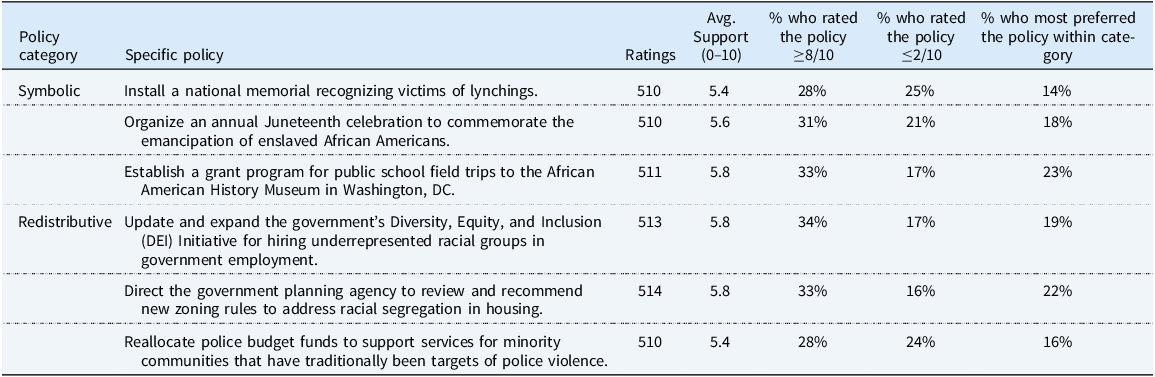
After a demographic questionnaire, we asked respondents about their support for a number of different policies on a 0–10 scale, ranging from “really dislike” to “really like.” These policies include three symbolic and three redistributive policy options. The set of policies, shown in Table 1, was chosen based on a pre-test survey with a convenience sample of academics and non-academics. We developed these items to reflect real-world debates on symbolic and redistributive racial justice reforms, drawing on proposals from prominent racial justice organizations, recent public discourse, and state ballot initiatives (see Appendix B.1 for additional details on item development). Within each policy category, we take respondents’ average rating as a measure of their support for symbolic and redistributive policies. If a respondent did not provide a response for a given item, we took the average of the non-missing items.
Descriptive statistics on symbolic and redistributive policy items

Note: Descriptive statistics based on responses in the control condition.
Note that the policies in Table 1 do not reference Confederate statue removals. This approach allows us to focus on symbolic racial justice reforms that have been less salient in popular discourse and are additive in nature, rather than about removing something (see Appendix B.1 for details on these criteria).Footnote 2 However, we do separately ask about support for banning Confederate symbol removals, which we return to below.
We also asked respondents about their broader views on racial justice in America, including how much progress they believe has been made, whether they see redistributive or symbolic changes as more pressing, and whether symbolic reforms are a distraction. Finally, the survey included an experimental component before these attitudinal and policy support items, which we discuss in detail below. For the descriptive statistics in Table 1 and in the next section, we focus only on responses in the control group, which did not receive any stimuli before offering their policy preferences.
Support for Different Types of Racial Justice Policies
In this section, we investigate how citizens evaluate the different symbolic and redistributive policies in our survey and the extent to which they perceive these policies as complements or substitutes. In Figure 1, we begin by taking the average score across policy categories and plotting them against each other, distinguishing by respondents’ partisanship, race, and racial resentment (see Appendices C.5 and C.9 for details on these measures). Prior research emphasizes stark differences in support for policies to advance racial justice across these variables (Jurcevic and Trawalter, Reference Jurcevic and Trawalter2025; Britt et al., Reference Britt, Wager and Steelman2020; Cooper et al., Reference Cooper, Huffmon, Knotts and McKee2021; Doherty et al., Reference Doherty, Kiley, Nida and Jordan2021).
Support for symbolic and redistributive racial justice policies by partisanship, race, and racial resentment. Plots show the relationship between support for symbolic and redistributive racial justice policies based on respondents’ average score across three policy proposals in each category on a 0–10 scale. Points are scaled by the number of respondents located at each coordinate.

Overall, preferences for redistributive and symbolic racial justice policies are tightly correlated, at $r = 0.79$
. Those who support (oppose) policies that seek to address material inequities across racial groups also support (oppose) policies that would reimagine how race and history are represented in American society. Despite differences in levels of support for racial justice policies, these patterns are consistent across partisan and racial groups. The top row shows, for example, that Democrats tend to support each policy type more than Republicans. Yet for both of these partisan groups, as well as Independents, most respondents fall into the lower left or upper right quadrants of each plot. That is, very few respondents strictly prefer one policy type over the other when asked to rate them individually. In fact, just 13% of respondents have an average score above 5 on one policy type (i.e., “support” that policy) while also having an average score below 5 on the other policy type (i.e., “oppose” it). These patterns also hold when comparing White and Black Americans or looking at those with higher versus lower levels of resentment toward Black Americans. These results clarify that there is not a large group of Democrats or Black Americans who strictly want to see redistributive reforms or, conversely, a set of Republicans or racially resentful citizens who will only tolerate symbolic changes.
$r = 0.79$
. Those who support (oppose) policies that seek to address material inequities across racial groups also support (oppose) policies that would reimagine how race and history are represented in American society. Despite differences in levels of support for racial justice policies, these patterns are consistent across partisan and racial groups. The top row shows, for example, that Democrats tend to support each policy type more than Republicans. Yet for both of these partisan groups, as well as Independents, most respondents fall into the lower left or upper right quadrants of each plot. That is, very few respondents strictly prefer one policy type over the other when asked to rate them individually. In fact, just 13% of respondents have an average score above 5 on one policy type (i.e., “support” that policy) while also having an average score below 5 on the other policy type (i.e., “oppose” it). These patterns also hold when comparing White and Black Americans or looking at those with higher versus lower levels of resentment toward Black Americans. These results clarify that there is not a large group of Democrats or Black Americans who strictly want to see redistributive reforms or, conversely, a set of Republicans or racially resentful citizens who will only tolerate symbolic changes.
Interestingly, the patterns in Figure 1 are less apparent for symbolic policies related specifically to Confederate symbols. In Appendix Figure A1, we show that support for banning changes to Confederate school and street names is essentially uncorrelated with the redistributive and symbolic policies shown here. As we discuss below, one explanation for this pattern is that debates over this particular symbolic policy issue may have become divorced from contemporary debates over racial justice.
Nonetheless, the correlations in Figure 1 show that citizens who support redistributive policies generally also support symbolic policies, and vice versa. Yet these patterns do not necessarily imply that respondents value symbolic and redistributive reforms equally. In Figure 2, we report on whether respondents prefer symbolic, redistributive, or neither type of reform when they are forced to choose only one to address racial injustice.Footnote 3 For this analysis, we split the sample into those who believe that there is “still a lot more to do” versus those who believe that “enough” or “too much” has been done on racial justice. The patterns in this plot present a more nuanced picture: among those who believe there is still more to do on racial justice, there is a clear preference for redistributive reforms. Over half prefer policies like affirmative action, compared with less than a quarter who prefer symbolic acts like statue removals. Among those who do not believe there is more progress to be made on this issue, the vast majority do not support either policy type.
Forced choice policy preferences, by perceived progress on racial justice. Plot summarizes the percentage of respondents that would choose symbolic, redistributive, or neither policy type “if you could only choose one [way] … to address racial injustice in the United States.” Respondents are divided in columns based on whether they believe there is “still more to do on racial justice” or if “enough” or “too much” has been done on this issue.

Figure 3 offers additional insight into how respondents view symbolic reforms. Regardless of their views on the need for further progress on racial justice, a majority of respondents express concern that symbolic acts, at least in the form of Confederate statue removals, are distracting attention away from larger issues of racial justice. Even among those who are especially supportive of action on racial justice, less than one in five pushed back against the idea that these changes were a distraction.
Perceptions of statue removals as a distraction, by perceived progress on racial justice. Plots summarize the percentage of respondents who agree or disagree that “removing statues is distracting Americans from larger racial justice problems.” Respondents are divided in columns based on whether they believe there is “still more to do on racial justice” or if “enough” or “too much” has been done on this issue.

Do Symbolic Changes Motivate Support for Additional Reform?
The preceding analyses indicate that measures of support for the two types of racial justice policies are closely related, but there is a relatively stronger preference for redistributive reforms, and many respondents are concerned that symbolic reforms divert attention from larger goals. Given these competing considerations, what happens when individuals are informed about recent Confederate symbol removals? To test whether and how actual symbolic change may influence support for and opposition to additional reforms, we conducted a pre-registered experiment.Footnote 4 In our survey, respondents were randomly assigned within partisan groups to treatment and control conditions with equal probabilities.
Our intervention informs respondents about recent Confederate symbol removals across the United States. Treated respondents read a multi-page, newspaper article-style vignette describing the number of statues and place names that have been removed since 2015 (see Appendix C.7 for full treatment text). On one page, respondents also engaged with an interactive map created by the authors showing all the locations where Confederate iconography has been removed in recent years. After reading the vignettes and interacting with the map, respondents were asked to offer their opinions on the symbol removals in an open-ended text box. Respondents in the control condition did not receive any information or provide open-ended opinions.
After the vignette, respondents in the treatment condition answered the same questions about their support for racial justice policies that were used in the analyses above. If the information mobilized support for additional action (Grose and Peterson, Reference Grose and Peterson2020; Rahnama, Reference Rahnama2025), we should see higher support for symbolic and redistributive policy preferences in the treated group. If instead it triggered a backlash or a sense that the “problem is solved” (Tesler and Sears, Reference Tesler and Sears2010), then there should be lower levels of support for racial justice policies among the treated group.
Table 2 reports the average treatment effect (ATE) estimates for each policy support index (see Appendix D.3 for ATE estimates separated by item).Footnote 5 These estimates come from an ordinary least squares model in which support for each policy type is regressed on a treatment indicator and a series of pre-treatment covariates specified in our pre-analysis plan (see notes to Table 2).
Average treatment effects in informational experiment
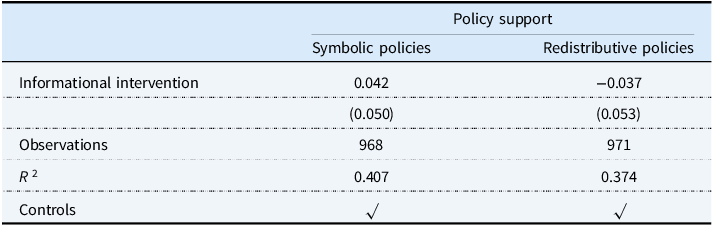
Robust standard errors in parentheses. Coefficients are expressed in terms of control group standard deviations. The following covariates are included but not reported: age, region, gender, race and its interaction with racial identity attachment, left-right self-placement, political interest, political knowledge, party identification, American pride, racial resentment, education, and household income.
Effect sizes are scaled in terms of control group standard deviations (SD) such that, for example, the first estimate implies 4% of an SD stronger support for symbolic policies in the treated group. The effect on support for redistributive policies is of a similar magnitude in the opposite direction. Even if we consider the most extreme values in the confidence intervals around each estimate ( $\sim $
0.15 SD), these effects do not suggest a particularly large or meaningful change in attitudes. On the original 0–10 scale, the coefficients imply a change of just 0.1 points (
$\sim $
0.15 SD), these effects do not suggest a particularly large or meaningful change in attitudes. On the original 0–10 scale, the coefficients imply a change of just 0.1 points ( $ \pm 0.3$
).
$ \pm 0.3$
).
In sum, the treatment produced no statistically or substantively significant average effect on either symbolic or redistributive policy preferences. In Appendices B.5 and D.2, we provide evidence that these null results are unlikely to be driven by a weak treatment or lack of attentiveness. Indeed, many respondents underestimated the true scale of these removals and found the information about Confederate symbol removals surprising.
Another explanation for the null estimates is that the treatment was polarizing. Some respondents may have updated positively on the need for additional policy action, while others updated in a negative direction, thus producing an average effect close to zero. In Appendix D.4, we estimate conditional ATEs within subgroups that theoretically might exhibit differing responses to the intervention. We do not identify substantially different effects among Democrats versus Republicans, Whites versus Black Americans, Southerners versus non-Southerners, or those who were more versus less racially resentful at baseline. To be transparent, our ability to reliably detect meaningful differences in effect sizes across partisan, racial, and other relevant subgroups is constrained by our sample size and statistical power. Future research could use more well-powered designs to capture these quantities, although in the next section, we highlight qualitative reactions to our intervention that contextualize why there may have been minimal effects, even within certain partisan or racial groups.
Do Citizens See Confederate Symbol Removals as Relevant to Racial Justice?
In this section, we investigate how the treatment group felt about the Confederate statue and place name removals using their open-ended, written reactions that were collected after the intervention. A qualitative coding of these responses reveals that, overall, 56% of respondents who answered the open-ended question expressed some form of opposition to the removals (see Appendix D.5 for details on the coding scheme). Two consistent themes emerged in the reactions: respondents either (i) do not see the symbol removals as related to broader racial justice issues or (ii) see them as a distraction from those larger issues.
On the first theme, very few respondents drew a connection between the symbolic changes and debates over contemporary racial justice policy. Among those who opposed the removals, almost two-thirds highlighted concerns about forgetting or “erasing” history. Among the 29% of respondents who expressed support for the statue removals, there was less of a common understanding about why these changes were a positive development (see Appendix Table A9). However, even supporters largely saw the removals as a fight over how to remember the past.
To illustrate this focus on historical memory, we ran a quantitative analysis of the responses, identifying in Figure 4 the most distinctive words used by supporters versus opponents of the Confederate statue removals. Among opponents, there is a clear concern about history and whether it is being “erased,” or “learned” from, or destined to be “repeated.” This led many to express confusion about the rationale for the removals. One White Southerner said, “I honestly think it’s silly to remove our history. Why change the names?” A Republican similarly argued, “those statues are part of history … why in the world are we taking them down? Do these people not have anything better to do?” For supporters, the predominant concerns identified in our qualitative coding and in Figure 4 are around how these symbols “honor,” “celebrate,” and “represent” a past tied to the Confederacy and slavery.
Relative word usage among supporters and opponents of Confederate statue removals. Plot presents keyness scores, which quantify relative differences in word usage across groups, revealing terms that were most distinctive to those who expressed support (to the left of the plot) or opposition (to the right of the plot) to the Confederate monument removals based on the hand-coding scheme described in Appendix D.5. Stopwords are removed, and all terms are lemmatized ( $n = 345$
).
$n = 345$
).

From this analysis, it is clear that the debates around statues are largely backward-looking, with neither side making strong connections to a contemporary racial justice policy agenda. It is not surprising, then, that in our survey data, we find that respondents’ support for banning Confederate statue removals is essentially uncorrelated with the other current symbolic and redistributive racial justice policies used in the earlier analyses ( $r \approx 0.1$
; see Appendix Figure A1).
$r \approx 0.1$
; see Appendix Figure A1).
A second theme in the open-ended responses is that many respondents view statue and place name removals as distracting from larger issues of racial justice. This concern is evident in Figure 3, but it also came through in respondents’ own words. For example, a White Republican noted, “the more we talk and virtue signal about a problem [like removing statues], the less we are actually doing to rectify it.” A Hispanic Democrat felt that “a lot of unnecessary stuff was changed … there’s bigger problems than this in America and we [are] focusing on the wrong things which is why nothing ever [gets] fixed.” In some cases, these concerns bleed into cynicism, even among those who express support for both symbolic and redistributive policies. One White Independent argued that “tearing down and removing Confederate statues will not change anything.” A Black Independent similarly said, “I think it’s a nice gesture to take the statues down. Do I think it helps anything? No.”
In sum, many respondents failed to make a connection between the information about Confederate symbol removals and broader debates over racial justice policy. Either they saw them as a distraction from those debates or as a contentious attack on history, rather than a part of a broader policy agenda. This suggests one plausible explanation for the null results in the previous section: if recent symbol removals are broadly perceived as irrelevant to racial justice, merely informing people about these removals may be insufficient for them to update preferences for related symbolic and redistributive policies.
Discussion
In this research note, we asked two questions: How do everyday citizens view the relationship between symbolic and redistributive racial justice reforms? How does the recent reckoning with historical symbols influence support for broader racial justice reform in America? We found that respondents often express support for or opposition to symbolic and redistributive policies in tandem, regardless of their race or partisanship. However, in an experimental setting, exposure to information about actual symbol removals did not shift support for additional racial justice policies. Many citizens feel that symbolic acts can be distractions that on their own will not translate into material change. This concern is evident even among those who express support for advancing racial justice. In respondents’ own qualitative reactions to the experimental intervention, we found that many citizens simply do not see a strong connection between the past—at least as it is reflected in historical symbols—and contemporary debates around racial justice.
Interestingly, our experimental results contrast with Rahnama (Reference Rahnama2025), who shows that Confederate symbol removals increased support for redistributive policies like affirmative action. That study identifies highly localized effects in the immediate aftermath of specific removal events in 2015 and 2017. Our research finds minimal effects of priming nationwide removals in 2023, suggesting that the attitudinal consequences of symbolic changes may be both geographically and temporally context-specific.
Although our survey was conducted prior to the second Trump term, our findings help contextualize recent debates over racial justice. In particular, disputes over symbolic reforms and anti-DEI initiatives may represent distinct fronts in the broader fight over racial justice, rather than a causal sequence. The disconnect we observe—in which citizens view symbol removals as relevant to historical memory but not contemporary policy—helps clarify that the current wave of backlash policies likely has independent origins from previous waves of Confederate monument removals, even though both reflect broader conflicts over racial justice (Ng et al., Reference Ng, Fitzsimmons, Kulkarni, Ozturk, April, Banerjee and Muhr2025).
Ultimately, our findings suggest that information about symbolic changes on its own is unlikely to generate citizen support and momentum for a broader racial justice policy agenda. Yet symbolic changes hold real, intrinsic value for marginalized communities (Doherty et al., Reference Doherty, Kiley, Nida and Jordan2021; PRRI, 2023). A priority for future research is therefore to design interventions that could overcome the cynicism and contention that often accompany these changes. How can the rationale for symbolic reforms be better articulated to a skeptical public? Can redistributive and symbolic reforms be made more appealing when paired together?
Finally, this paper highlights opportunities for future research on measuring policy preferences. We used rating scales and forced-choice questions to gauge respondents’ relative preferences for policies of different types and measured preferences for “additive” policies. The impact of alternative measurement approaches—such as using subtractive language to describe these reforms—remains an open question. Furthermore, given the extensive public discourse on the trade-offs between symbolic and redistributive actions, mechanisms such as ranking, willingness-to-pay, and fixed-budget allocation could offer valuable new ways to quantify citizen attitudes toward specific policy proposals.
Supplementary material
The supplementary material for this article can be found at https://doi.org/10.1017/rep.2025.10035. The pre-analysis plan for this study was registered with OSF at https://osf.io/5k4xu.
Data availability
Replication data and code are available at the Harvard Dataverse at https://dataverse.harvard.edu/dataset.xhtml?persistentId=doi:10.7910/DVN/XBRBZQ.
Acknowledgments
An earlier version of this paper was presented at the 2023 Annual Meeting of the American Political Science Association. The authors thank the editors and the reviewers of this journal, Geneva Cole, Patrick Egan, Gwyneth McClendon, Cyrus Samii, Tyler Simko, and seminar participants at New York University for helpful feedback and comments at various stages of this research.
Funding statement
This paper was generously supported by the Identities and Ideologies Small Research Grant and approved by New York University Institutional Review Board (IRB-FY2023-07707).
Competing interests
The authors declare no potential conflicts of interest with respect to the research, authorship, and publication of this article.


 Open access

