




Do experiences influence gender representations elicited by the gender star form?
Languages differ in the amount of gender marking that is grammatically inherent (Corbett, Reference Corbett1991; Gygax et al., Reference Gygax, Elmiger, Zufferey, Garnham, Sczesny, von Stockhausen, Braun and Oakhill2019). In grammatical gender languages (which include many Indo-European and Afro-Asiatic languages), all nouns have a grammatical gender. Nouns referring to persons, such as occupational or role nouns, typically come in a masculine and a feminine form; for these, the grammatical gender accords with the referent person’s gender. The obligatoriness of gender marking is especially noticeable in statements that are not gender specific. A sentence like “In case of side effects, consult your physician” refers to physicians in a gender-independent way. Nevertheless, in languages with grammatical gender, either the masculine or the feminine form for physician has to be used. For gender-independent and gender-mixed references, languages with grammatical gender have traditionally employed the masculine form (Hellinger & Bußmann, Reference Hellinger, Bußmann, Hellinger and Motschenbacher2015). In German, for example, the term Köche masc “cooksmasc” can refer to a group of cooks of any gender, while the feminine equivalent Köchinnen fem “cooksfem” can only refer to a group of all-female cooks. Thus, the masculine form is ambiguous; it can refer either to men or to people of all genders (e.g., Diewald, Reference Diewald2018; Hellinger & Bußmann, Reference Hellinger, Bußmann, Hellinger and Motschenbacher2015). In accordance with common usage (e.g., Hegarty & Buechel, Reference Hegarty and Buechel2006; Stahlberg & Sczesny, Reference Stahlberg and Sczesny2001), we refer to a gender-independent or gender-inclusive usage of the masculine form as generic masculine.
Aligning with the ambiguity of the masculine form, the generic masculine has been found to lead to a male bias, that is, to easier and faster processing as well as greater availability of information about men compared to women (Gabriel et al., Reference Gabriel, Gygax and Kuhn2018; Stahlberg et al., Reference Stahlberg, Braun, Irmen, Sczesny and Fiedler2007). In other words, people associate the generic masculine more with men than women. Alternative forms have been proposed to increase associations with women, increase multi-gender associations, or decrease any gender associations (Salwender et al., Reference Salwender, Maschmann, Heinzl, Sczesny and Stahlberg2023). The present research examines the stability or malleability of gender biases elicited by linguistic gender forms. Specifically, we examined the malleability of gender representations elicited by a prominent German alternative to the generic masculine, the gender star form.
Gender biases elicited by linguistic forms
The male bias of the generic masculine has been observed with multiple experimental paradigms. First, in the exemplar task, participants are asked to list celebrities from specified categories, e.g., three actors. In studies with the exemplar task in the generic masculine (vs. alternative forms), fewer female and more male celebrities were listed (Brohmer et al., Reference Brohmer, Hofer, Bauch, Beitner, Berkessel, Corcoran and Jauk2024; Keith et al., Reference Keith, Hartwig and Richter2022; Kurz & De Mulder, Reference Kurz and De Mulder2023; Schunack & Binanzer, Reference Schunack and Binanzer2022; Stahlberg et al., Reference Stahlberg, Sczesny and Braun2001; Tibblin et al., Reference Tibblin, van de Weijer, Granfeldt and Gygax2022). Second, in the sentence evaluation task, participants are asked to classify whether a sentence—containing an anaphoric reference to either men or women—is a sensible continuation of a preceding sentence. For example, in French, participants read, Les assistants sociaux marchaient dans la gare. Du beau temps étant prévu plusieurs femmes/hommes n’avaient pas de veste. (“The social workersmasc were walking through the station. Because of the sunny weather forecast, several of the women/men weren’t wearing a coat”.). In studies presenting the sentence evaluation task using the generic masculine, participants responded more quickly and more accurately to anaphoric references to men than women (Anaya-Ramírez et al., Reference Anaya-Ramírez, Grinstead, Rivera, Melamed and Reig-Alamillo2022; Gygax et al., Reference Gygax, Gabriel, Sarrasin, Oakhill and Garnham2008; Körner et al., Reference Körner, Abraham, Rummer and Strack2022). Other tasks involve, for example, selecting or classifying pictures (Lindqvist et al., Reference Lindqvist, Renström and Gustafsson Sendén2019; van Berlekom et al., Reference van Berlekom, Sczesny and Sendén2024; Weißflog & Grigoryan, Reference Weißflog and Grigoryan2024; Zacharski & Ferstl, Reference Zacharski and Ferstl2023), self-paced reading durations (Irmen & Roßberg, Reference Irmen and Roßberg2004; Stetie & Zunino, Reference Stetie and Zunino2024), or explicit gender ratio judgments (Blake & Klimmt, Reference Blake and Klimmt2010; Braun et al., Reference Braun, Gottburgsen, Sczesny and Stahlberg1998; Yeaton et al., Reference Yeaton, Muelas-Gil and Scontras2023) and yield analogue results, that is, indicating a male bias for the generic masculine.
This male bias elicited by the generic masculine has been observed for several languages, such as Norwegian (Gabriel & Gygax, Reference Gabriel and Gygax2008), French (Garnham et al., Reference Garnham, Gabriel, Sarrasin, Gygax and Oakhill2012), Russian (Garnham & Yakovlev, Reference Garnham and Yakovlev2015), Swedish (Lindqvist et al., Reference Lindqvist, Renström and Gustafsson Sendén2019), Spanish (Stetie & Zunino, Reference Stetie and Zunino2022), and Polish (Szuba et al., Reference Szuba, Redl and De Hoop2022), and also for auditory presentation (Anaya-Ramírez et al., Reference Anaya-Ramírez, Grinstead, Rivera, Melamed and Reig-Alamillo2022; Chalyvidou & Weber, Reference Chalyvidou and Weber2025; Gabriel et al., Reference Gabriel, Behne and Gygax2017; Körner et al., Reference Körner, Glim and Rummer2024). Moreover, besides behavioral measures, eye-tracking (Esaulova et al., Reference Esaulova, Reali and von Stockhausen2014; Irmen, Reference Irmen2007) and electrophysiological markers (Glim et al., Reference Glim, Körner, Härtl and Rummer2023, Reference Glim, Körner and Rummer2024, Reference Glim, Körner and Rummer2025; Mikić Ljubi et al., Reference Mikić Ljubi, Matkovič, Bon and Kanjuo Mrčela2022; Misersky et al., Reference Misersky, Majid and Snijders2019) also yielded a male bias for processing the generic masculine. In sum, multiple studies using different tasks and measuring different aspects relating to gender representation support the general finding that the generic masculine elicits a male bias (for a meta-analysis, see Salwender et al., Reference Salwender, Maschmann, Heinzl, Sczesny and Stahlberg2023).
Several linguistic alternatives to the generic masculine intended to elicit gender-independent or gender-neutral representations have emerged. In the pair form, the masculine and feminine forms are both explicitly stated (e.g., in Spanish: los/las doctores/doctoras; “themasc/thefem physiciansmasc/physiciansfem”). In French, the mid-dot form (e.g., musicien·ne·s) is used as a contracted version of the pair form (e.g., musiciens et musiciennes, “musiciansmasc and musiciansfem’). Other forms are explicitly meant to also represent nonbinary gender identities. In Spanish, a novel morpheme is used instead of gender-specific morphemes (e.g., maestre instead of maestro masc or masestra fem ) both as a generic form and as a specific nonbinary form. Similarly, in German, the gender star form is also used generically and for nonbinary individuals. Here, the (usually feminine) form is complemented by a word-internal asterisk (*)Footnote 1 preceding the gender-specific suffix (e.g., Student*innen, where Studenten is the masculine form and Studentinnen is the feminine form).
These forms have been shown to lead to stronger representations of women compared to the generic masculine or neutralizations (Brohmer et al., Reference Brohmer, Hofer, Bauch, Beitner, Berkessel, Corcoran and Jauk2024; Keith et al., Reference Keith, Hartwig and Richter2022; Spinelli et al., Reference Spinelli, Chevrot and Varnet2023; Tibblin et al., Reference Tibblin, van de Weijer, Granfeldt and Gygax2022; Xiao et al., Reference Xiao, Strickland and Peperkamp2023; however, see Pozniak et al., Reference Pozniak, Corbeau and Burnett2024). For instance, after reading role nouns in the gender star form (vs. the generic masculine), participants were faster and more accurate when classifying associated pictures of women (Zacharski & Ferstl, Reference Zacharski and Ferstl2023). Some studies even observed a female bias, meaning that women were more strongly represented than men (e.g., Glim et al., Reference Glim, Körner and Rummer2025; Körner et al., Reference Körner, Abraham, Rummer and Strack2022; Tibblin et al., Reference Tibblin, Granfeldt, van de Weijer and Gygax2023). For instance, when reading sentence pairs in the gender star form, participants made fewer errors in classifying the second sentence as a possible continuation of the first sentence when the second sentence contained an anaphoric reference to women compared to men (Körner et al., Reference Körner, Abraham, Rummer and Strack2022).
Stability of gender biases
Whereas gender biases in processing the generic masculine and alternative linguistic forms are well documented, the extent to which they are stable or malleable is still debated (Körner, Reference Körner2025). In general, perceived gender ratios can be influenced by linguistic, personal, and social context. Contexts in which the proportion of men is typically high could yield larger male biases. This has been examined for gender stereotypes of role nouns. For example, beautician is an occupation that is stereotypically associated with women and butcher is an occupation that is stereotypically associated with men. In some studies, gender biases were not moderated by stereotypes (e.g., Gygax et al., Reference Gygax, Gabriel, Sarrasin, Oakhill and Garnham2008). However, frequently, the male bias of the generic masculine has been found to be larger for male-stereotyped (vs. balanced) role nouns (e.g., Anaya-Ramírez et al., Reference Anaya-Ramírez, Grinstead, Rivera, Melamed and Reig-Alamillo2022; Blake & Klimmt, Reference Blake and Klimmt2010; Yeaton et al., Reference Yeaton, Muelas-Gil and Scontras2023), indicating that there is some context-dependence of gender biases elicited by gender forms. Analogous results have been observed for sentence context. When the sentence context contained information strongly associated with women (e.g., the target individuals were described as wearing dresses, among other things), the male bias of the generic masculine was reduced (Rothermund & Strack, Reference Rothermund and Strack2024, Experiment 1).
On the other hand, the inclusion (vs. omission) of a disambiguating statement, indicating that the masculine form refers to women and men equally, did not influence gender representations, so that the male bias was unabated (Rothmund & Scheele, Reference Rothmund and Scheele2004; see also Gygax et al., Reference Gygax, Gabriel, Lévy, Pool, Grivel and Pedrazzini2012). A similar result was observed when the generic masculine was amended by an explicit marker of gender-inclusiveness, either as a newly-introduced marker (Rothermund & Strack, Reference Rothermund and Strack2024, Experiment 2) or by well-known gender abbreviations in brackets (m/f/d; Fatfouta & Sczesny, Reference Fatfouta and Sczesny2023); neither strategy ameliorated the male bias of the generic masculine. Thus, whereas strongly gendered semantic context influenced gender biases, merely stating or marking a gender-inclusive meaning of the generic masculine has been found not to reduce gender biases in mental representations.
The present research
We examined whether the size of gender biases can be influenced by factors beyond the immediate linguistic context. Specifically, we employed a manipulation to increase the salience of the gender inclusiveness of a linguistic form—here, the gender star form. The salience of the gender-inclusiveness of the gender star form was increased by texts where it referred to an equal number of women and men.Footnote 2 A salient stimulus feature draws attention and comes easily to a person’s mind (Higgins, Reference Higgins, Higgins and Kruglanski1996); accordingly, we hypothesized that the present salience manipulation would influence gender representations, more specifically, increase representations of men associated with the gender star form, toward a more balanced women–men representation, in later unrelated tasks.
To test gender representations, we used two frequently employed behavioral measures, the exemplar task and the sentence evaluation task. These tasks differ in their automaticity (see, e.g., De Neys, Reference De Neys2021; Strack & Deutsch, Reference Strack and Deutsch2004). In the exemplar task, participants are asked to retrieve and list celebrity names, for which they can take as much time as they wish, facilitating deliberate responses. In the sentence evaluation task, in contrast, the repetitive nature, the high number of trials, and the instruction to respond quickly facilitate fast, partially automatic responses. We hypothesized that the present salience of inclusiveness manipulation would influence deliberate responses more than partially automatic responses because automatic processes have been shown to be more stable and require more extensive training to be changed (e.g., Gregg et al., Reference Gregg, Seibt and Banaji2006; Rydell et al., Reference Rydell, McConnell, Strain, Claypool and Hugenberg2007; however, see Gawronski et al., Reference Gawronski, Morrison, Phills and Galdi2017).
Concerning gender forms, we concentrated on the gender star form because it is comparatively new and little used (for corpus analyses on several forms, confirming that the gender-star form and other nonbinary forms are still little used, see Link, Reference Link2024; Ochs et al., Reference Ochs, Manara and Müller-Spitzer2026; Ochs & Rüdiger, Reference Ochs, Rüdiger, Schmitz, Stein and Schneider2025; Waldendorf, Reference Waldendorf2024; see also the present results on familiarity differences). In principle, we would expect both a reduction of the generic masculine’s male bias and a reduction of the gender star form’s female bias when increasing the salience of their gender inclusiveness. However, this bias reduction might be smaller for the generic masculine. First, the generic masculine is more frequent so that any additional exposure is probably less influential; second, the masculine form is also used in contexts relating to men exclusively, so that generic masculine usages could be mistaken for specific masculine usages, which might be partially responsible for the male bias (Kotthoff & Nübling, Reference Kotthoff and Nübling2018; see Gygax et al., Reference Gygax, Sato, Öttl and Gabriel2021 for a detailed discussion of activating generic and specific interpretations of the masculine form). Thus, we decided to test whether the gender star form’s female bias can be altered by a short salience manipulation where the form is used to refer to women and men equally.
Specifically, participants were asked to read texts, either in the target linguistic form—the gender star form—or a control form—the generic masculine. Otherwise, the texts in both conditions were identical and referred to an equal number of men and women. In the test phase, gender representations were assessed by the exemplar task and the sentence evaluation task in the gender star form (for both conditions). If imbalanced usage (the generic masculine referring more frequently to men and the gender star form referring less frequently to men in everyday language) contributes to biases elicited by gender forms, then balanced references should attenuate gender biases. Accordingly, we examined whether having experienced balanced women–men gender ratios when reading the gender star form can temporarily influence gender representations elicited by the gender star form. Specifically, we hypothesized that experiencing the gender star form as referring to men and women equally would lead to more balanced gender representations, thus an attenuated female bias.
Method
All materials, data, and analyses, as well as a link to the preregistration are available at https://osf.io/e6wsy/.
Participants
285 participants were recruited in 2023 and 2024 on a German university campus. In line with the preregistration, data were excluded if a participant did not complete the study (3 participants) or spent less than 10 minutes on the first task (10 participants). The final sample consisted of 272 participants (167 women, 99 men, 6 other genders; aged 18–68+ years; 79% were in the age range 18–27 with a median of ca. 23 years) whose native language was German. Participants reported being highly familiar with the generic masculine (M = 4.44, SD = 0.80) and moderately familiar with the gender star form (M = 3.67, SD = 1.17) on a scale from 1 (not at all familiar) to 5 (very familiar). Concerning their opinion on gender-fairFootnote 3 language in general (the gender star in particular), 45% (36%) were in favor and 11% (21%) were against its usage (with the remaining participants indicating either no opinion or an opinion to leave it up to each individual). Participants were compensated by receiving 8€.
To determine the sample size, we assumed a bias reduction of d = 0.3 in the experimental compared to the control condition. With α =.05 and a power of.80, the power analysis yields N = 278 in the one-tailed between-participants t-test for the exemplar task. This also yields 80% power for finding f =.084 in the mixed ANOVAs for the sentence evaluation task. Therefore, we set the maximum sample size to 278 participants. We preregistered sequential analyses using adjusted alpha levels (Lakens, Reference Lakens2014), calculated using the “GroupSeq” package in R (Pahl et al., Reference Pahl, Ziegler and König2006; R Core Team, 2022). We performed one interim analysis after approximately 200 participants. Using a spending function of the O’Brien-Feming Type, the p-values for rejecting the null-hypothesis were p <.0209 with 200 participants, p <.0439 for 278 participants. The interim stopping criterion (p <.0209) was not satisfied, so that we continued data collection to the maximum sample size.
Materials
The first task incorporated the salience manipulation. Participants were asked to read two texts that used either the generic masculine or the gender star form as a gender-inclusive forms. One text described workplace bullying (2398 words), contained 39 terms that differed depending on gender form (e.g., Gegner*innen/Gegner, “opponents”), and had 10 references each to specific women and specific men (using their names or the appropriate gender-specific forms e.g., die Arbeitnehmerin/der Arbeitnehmer, “the employeefem”/”the employeemasc ”). The other text described the digitalization of health care data (2469 words), contained also 39 terms that differed depending on gender form (e.g., Dienstleister*innen/Dienstleister, “service provider”), and had 5 references to each specific men and specific women (using their names or the appropriate gender-specific forms e.g., der Nutzer/die Nutzerin, “the usermasc”/“the userfem”). Each text was followed by seven recognition questions, where participants were asked to select one of two answers. These were added to disguise the study’s purpose, to ensure participant attention, and to enforce the manipulation as each question contained at least one additional term in the target gender form. The proportion of gendered words in this task was higher than in most press texts (see Müller-Spitzer et al., Reference Müller-Spitzer, Ochs, Koplenig, Rüdiger and Wolfer2024) to increase the manipulation strength.
The second task was the exemplar task (modeled after Stahlberg et al., Reference Stahlberg, Sczesny and Braun2001 and Schunack & Binanzer, Reference Schunack and Binanzer2022). Embedded in a questionnaire about media usage, participants were asked to list the first three celebrities that came to their minds for each of three categories—actors, politicians, and singers (these categories were chosen because they had shown the most balanced women–men ratio in Schunack & Binanzer, Reference Schunack and Binanzer2022 for the capital I form). This questionnaire used the gender star form for all participants.
The third task was a sentence evaluation task taken from Körner et al. (Reference Körner, Abraham, Rummer and Strack2022, built on Gygax et al., Reference Gygax, Gabriel, Sarrasin, Oakhill and Garnham2008) in the gender star form. Each trial consisted of a sentence pair; the first sentence contained a role noun with an approximately balanced gender stereotype (taken from Gygax et al., Reference Gygax, Gabriel, Sarrasin, Oakhill and Garnham2008; Kennison & Trofe, Reference Kennison and Trofe2003); for example, Die Konzert-Zuhörer*innen waren schon vor Ort. (“The concert attendees were already on site”). The second sentence provided additional information about either a female or a male subset of the group; for example, Man konnte sehen, dass ein Teil der Männer/Frauen gelangweilt war. (“One could see that some of the men/women were bored”). At the beginning of each trial, the first sentence was displayed. When participants pressed the spacebar, the first sentence was replaced by the second sentence. Participants were asked to indicate whether they considered the second sentence a sensible (vs. not a sensible) continuation of the first sentence by pressing the correct response key (the keyboard key J for sensible and F for not sensible; the German word for sensible was sinnvoll). Participants were asked to respond quickly but to prioritize the accuracy of responding. Upon key press, an inter-trial interval of 500 ms elapsed before the next sentence pair ensued.
Participants evaluated 72 sentence pairs, 36 target pairs, and 36 filler pairs (which were similar but contained information that was incompatible between the two sentences; these were not included in the analyses). In the target pairs, 18 anaphors referred to female and 18 to male subgroups. Sentence–gender mapping was balanced across participants, and order was randomized anew for each participant. The task started with a short practice block.
Procedure
After providing written informed consent, participants were randomly assigned to one of two gender forms during the salience manipulation (generic masculine vs. gender star). They were told that the study consisted of several tasks on interacting with media content. After a short description, they started with the first task, reading texts and answering recognition questions in either the gender-star form (experimental condition) or the generic masculine (control condition). Then they performed the exemplar task, followed by the sentence evaluation task, both in the gender star form for all participants. All tasks were self-paced.
Afterward, participants provided demographic information, rated their familiarity with both the gender star form and the generic masculine, their attitude toward usage of gender-fair language in general and the gender star form in particular, and were invited to comment on the study. Finally, they were thanked, debriefed, and compensated for their time.
Results
Using participant responses in both the exemplar task and the sentence evaluation task, we examined the relative availability of conceptual information about women and men depending on which gender form had been experienced as gender-inclusive in the first task. First, we compared the number of female celebrities named in the exemplar task. For this, the gender of the nine participant-provided celebrities was coded by coders blind to condition, and then the number of female celebrities was counted.Footnote 4 As preregistered, data from 11 participants were excluded from this analysis because they provided fewer than seven valid exemplars (frequently, by naming groups instead of individuals in the category singer). We found no influence of the salience manipulation on the number of women provided by participants, t(256) = 0.46, p =.68, d = 0.06, 95% CI [−0.19, 0.30]. Participants who had experienced the gender star as a gender-inclusive form in the salience manipulation provided a similar number of female celebrities (44%, M = 3.84, SD = 1.86) as participants who had experienced the generic masculine in the salience manipulation (43%, M = 3.74, SD = 1.63).Footnote 5
Second, we examined processing ease for groups consisting of men and women (after an initial reference in the gender star form) depending on salience condition. For this, error proportions and response speed were analyzed separately in 2 (gender form during the salience manipulation: generic masculine vs. gender star; between) x 2 (continuation: women vs. men; within) ANOVAs.
For the proportion of errors, the main effect of continuation was significant, F(1, 270) = 35.30, p <.001, $\eta _p^2$
=.116, 90% CI [.062,.178], with fewer errors to sentences about women (M = 19.7%, SE = 1.1%) than sentences about men (M = 25.8%, SE = 1.3%), replicating the female bias observed for the gender star form (Körner et al., Reference Körner, Abraham, Rummer and Strack2022). The main effect of gender form during the salience manipulation was not significant, F(1, 270) = 0.01, p =.927,
$\eta _p^2$
=.116, 90% CI [.062,.178], with fewer errors to sentences about women (M = 19.7%, SE = 1.1%) than sentences about men (M = 25.8%, SE = 1.3%), replicating the female bias observed for the gender star form (Körner et al., Reference Körner, Abraham, Rummer and Strack2022). The main effect of gender form during the salience manipulation was not significant, F(1, 270) = 0.01, p =.927, $\eta _p^2$
=.000, 90% CI [.000,.003], nor was the interaction significant, F(1, 270) = 2.20, p =.140,
$\eta _p^2$
=.000, 90% CI [.000,.003], nor was the interaction significant, F(1, 270) = 2.20, p =.140, $\eta _p^2$
=.008, 90% CI [.000,.035]. Thus, the error analysis did not support our hypothesis of an attenuation of the female bias by previous salience of the gender-inclusiveness of the gender star form.
$\eta _p^2$
=.008, 90% CI [.000,.035]. Thus, the error analysis did not support our hypothesis of an attenuation of the female bias by previous salience of the gender-inclusiveness of the gender star form.
The same analysis was performed to explore response speed. Response times were assessed relative to the beginning of the presentation of the second sentence. In accordance with the preregistration, incorrect responses (22.7% of trials) were excluded as well as response times that exceeded three standard deviations from a participant’s mean (1.2% of trials). Two participants had no trials left in one cell and were therefore not included in this analysis. Again, the main effect of continuation was significant, F(1, 268) = 12.23, p <.001, $\eta _p^2$
=.044, 90% CI [.012,.090], with faster responses to sentences about women (M = 3.36s, SE = 0.06s) than sentences about men (M = 3.49s, SE = 0.06s). The main effect of gender form during the salience manipulation was not significant, F(1, 268) = 0.08, p =.782,
$\eta _p^2$
=.044, 90% CI [.012,.090], with faster responses to sentences about women (M = 3.36s, SE = 0.06s) than sentences about men (M = 3.49s, SE = 0.06s). The main effect of gender form during the salience manipulation was not significant, F(1, 268) = 0.08, p =.782, $\eta _p^2$
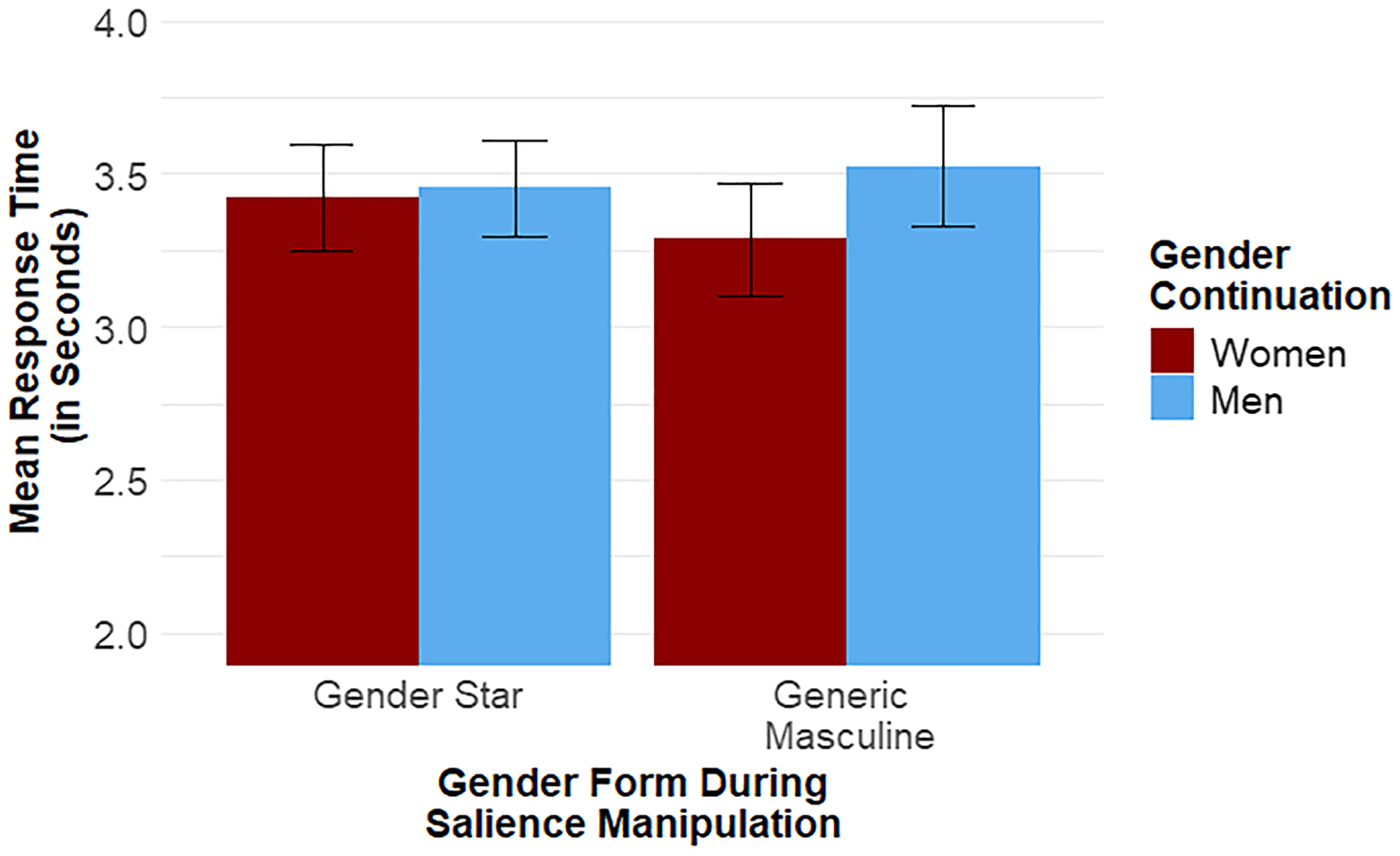
=.000, 90% CI [.000,.011]. As expected, the interaction between gender form during the salience manipulation and continuation was significant, F(1, 268) = 7.60, p =.006,
$\eta _p^2$
=.000, 90% CI [.000,.011]. As expected, the interaction between gender form during the salience manipulation and continuation was significant, F(1, 268) = 7.60, p =.006, $\eta _p^2$
=.028, 90% CI [.004,.068], see Figure 1.
$\eta _p^2$
=.028, 90% CI [.004,.068], see Figure 1.
Mean response times in the sentence evaluation task depending on gender in the continuation sentence and gender form during the salience manipulation.
Note: Error bars indicate confidence intervals around the means. Note that the sentence evaluation task was presented in the gender star form for all participants; the only difference was the gender form that had been experienced as balanced in the first phase of the experiment.

Figure 1. Long description
This bar graph depicts participants’ mean response times in the sentence evaluation task (on the Y-axis) depending on gender form during the salience manipulation (gender star vs. generic masculine) and gender continuation (women vs. men) in the sentence evaluation task (4 bars in total). The two bars depicting mean values of participants who encountered the gender star form during the salience manipulation (as well as the sentence evaluation task) have very similar heights. The two bars depicting mean values of participants who encountered the generic masculine during the salience manipulation (and the gender star form only during the sentence evaluation task) differ significantly in height, with a higher bar for sentences with the gender continuation men and a lower bar for sentences with the gender continuation women.
Specifically, the female bias of the gender star form was significant for participants in the control condition, who had not read the gender star form during the salience manipulation, t(133) = 3.91, p <.001, d z = 0.34, 95% CI [0.18, 0.50]; that is, responses were faster to sentences about women (M = 3.29s, SE = 0.09s) than sentences about men (M = 3.52s, SE = 0.10s). In contrast, the female bias was neutralized for participants who had experienced the gender star form to refer equally to men and women in the salience manipulation, t(135) = 0.63, p =.527, d z = 0.05, 95% CI [−0.11, 0.23]; that is, response times were similar for sentences about women (M = 3.43s, SE = 0.09s) and sentences about men (M = 3.45s, SE = 0.08s).
Linear mixed model analyses (or, in the case of error rates, generalized linear mixed model analyses) instead of the preregistered ANOVAs yield similar results (see https://osf.io/e6wsy/files/d6eku, Chapter 6.1–6.3). Exploratory analyses tested participant gender, age, and attitude toward so-called gender-fair language, attitude toward the gender star form, and familiarity with the gender star form and with the generic masculine as moderators for all three dependent measures. Results indicate main effects for some of these variables, but no interactions between inter-individual difference variables and salience condition.Footnote 6 Moreover, the target interaction for response times remained significant, irrespective of these variables (for more details, see https://osf.io/e6wsy/files/d6eku, Chapter 6.5).
Discussion
The present study tested whether a prior task that made the gender-inclusiveness of the gender star form salient would influence gender representations. In a salience manipulation, participants were asked to engage with two texts where the gender star form (or a control form) was used and referred to an equal number of women and men. To measure subsequent gender representations, we employed two tasks, the exemplar task and the sentence evaluation task, the latter including two measures, error rates and response speed. Our hypothesis was confirmed for one out of three measures. Concerning the number of female celebrities mentioned in the exemplar task and concerning error rates in the sentence evaluation task, there was no influence of the previous salience manipulation. However, concerning the classification speed in the sentence evaluation task, we observed differences depending on previously experienced salience. Specifically, we found the typical female bias for participants who did not read the gender star form in the salience task. However, this female bias was no longer significant for participants who had experienced the gender star form as gender-inclusive in the salience manipulation. Thus, a 20–30 min experience of the gender star form referring to an equal number of men and women led to participants being equally fast to respond to male and female subgroups referred to with the gender star form.
We had hypothesized that the salience manipulation would influence deliberate responses more than spontaneous responses. However, we observed the opposite—no influence of the salience manipulation in the deliberate exemplar taskFootnote 7 but a significant influence on more automatic response speed in the sentence evaluation task (for a meta-analysis on interventions on similar measures, see Forscher et al., Reference Forscher, Lai, Axt, Ebersole, Herman, Devine and Nosek2019). This lack of a transfer effect from the reading to the exemplar task might be caused by features of the employed tasks. Notably, the exemplar task relies predominantly on memory processes; participants are asked to retrieve famous exemplars from memory. Although the salience manipulation also presented specific women and men, these were of unrelated categories. Specifically, in the exemplar task, participants were asked to name famous actors, singers, and politicians, whereas the texts participants had been reading in the salience manipulation concerned none of these categories. Accordingly, information on persons from unrelated categories might not be relevant in the retrieval process. In contrast, responses in the sentence evaluation task arguably rely to a greater degree on the availability of gender-specific information in general. This availability could have been increased by the salience manipulation and thereby influenced later tasks.
In the sentence evaluation task, we observed an influence of the salience manipulation on response speed but not error rates. In previous research, we had observed error rates to be the more sensitive measure (Körner et al., Reference Körner, Abraham, Rummer and Strack2022; Reference Körner, Glim and Rummer2024); therefore, we again considered an influence on error rates, rather than speed, more likely. In general, there is a speed-accuracy trade-off, so that faster (slower) responses typically lead to more (fewer) errors (Heitz, Reference Heitz2014; Woodworth, Reference Woodworth1899). In the present study, participants might have favored speed over accuracy, which typically increases error rates but leads to faster responses (Howell & Kreidler, Reference Howell and Kreidler1963). This might also have shifted the effect of the salience manipulation toward response speed instead of accuracy. As we did not anticipate this result, it needs to be interpreted cautiously.
Note that participants’ tasks in the salience manipulation differed from both gender representation measures. Whereas the manipulation phase required reading comprehension and answering single-choice questions, the first measure consisted in retrieving names and the second measure consisted in determining whether there were inconsistencies between two sentences. Thus, task similarity cannot account for the present findings.
As yet, the time course of the influence of salience manipulations on gender representations is unclear. We assume that any influence of the salience manipulation builds up over the course of the manipulation and afterward declines unless reinforced. Thus, immediate effects will likely be stronger than effects assessed after some delay. In our study, we found an influence on the second measure (the sentence evaluation task) but not the temporally preceding measure (the exemplar task). Finding an influence on the second measure indicates that the influence of the salience manipulation lasted at least some minutes. Conversely, finding no effect on the first measure cannot be explained by a declining effect of the salience manipulation, so that we suspect that task-specific (instead of time-specific) factors determined whether the salience manipulation influenced later measures.
The present research yields some support for the hypothesis that gender representations elicited by linguistic forms are malleable in the sense that they can be altered by experiences. However, we demonstrated this only for the gender star form, so future research needs to address the question whether the biases resulting from other gender forms are malleable, too. As explained in the introduction, we would expect an analogous reduction of the generic masculine’s male bias when increasing the salience of its gender-inclusive usage. However, this reduction might be smaller for the generic masculine compared to the gender star form (see chapter The Present Research). Future research needs to determine whether the male bias of the generic masculine is malleable by prior tasks and whether this influence is indeed smaller.
The present research examined the malleability of gender representations elicited by the gender star form. We observed that a short task where participants read the gender star form referring equally to men and women reduced its female bias for response speed in a later task. In fact, after repeatedly reading about both men and women in the gender star form, participants were equally fast when verifying anaphoric references to women and men.Footnote 8 However, several open questions remain as to why the present manipulation influenced only response times and not error rates in the sentence evaluation task, and why we observed no influence at all in the exemplar task. Moreover, the present results should be replicated using different samples and a wider variety of materials to determine their robustness. Still, we interpret the present results as indicating that, under some conditions, altering experiences with a linguistic form can influence gender representations, so that gender representations elicited by linguistic forms are not fixed but malleable.
Replication package
Data, analysis scripts, and materials can be found at https://osf.io/e6wsy/. The study was pre-registered, see https://osf.io/tkf26/.
Acknowledgments
We would like to thank Marie Behrens, Alec Lewis Heinemann, Luisa Hofmann, Laney Lorentz, Maria Luisa Viceconte, Paul Weidemann, and Hanna Wiebusch for their help with data collection and coding.
Funding statement
This work was supported by the Central Research Fund (ZFF) of the University of Kassel.
Competing interests
The authors declared no potential conflicts of interest with respect to the research, authorship, and/or publication of this article.
Ethical considerations
This research was conducted in line with the principles of the Declaration of Helsinki. Approval was granted by the Ethics Committee of the Faculty of Human Sciences of the University of Kassel (EKFB01-Nr. 202326).
Consent to participate
All participants provided written informed consent.
Consent for publication
All participants provided written informed consent for the publication of their anonymous data.
AI usage disclosure
None to disclose.

 Open access

