

The OECD Case Studies of Bribery
In this issue of JLME, Jillian Kohler, Anaam Khan, and Andrea Bowra publish a detailed account and analysis of international pharmaceutical industry bribery for the first quarter of the twenty-first century, based on Organisation for Economic Co-operation and Development (OECD) case studies.Reference Kohler 1 They analyze all reports on the pharmaceutical firms that were included in 21 OECD studies of cross-border bribery conducted as part of the OECD Convention on Combating Bribery of Foreign Public Officials in International Business Transactions (hereafter “Anti-Bribery Convention” or “Convention”) which took effect in 1999. 2
In this commentary, I place their findings in the context of earlier studies and of anti-corruption legislation, the literature on conflicts of interest and institutional corruption, and the evolution of the US pharmaceutical market.
The OECD case studies that concerned pharmaceutical companies examined 19 companies based in 5 nations, with bribes paid in 29 nations from 1999 to 2025. These only included bribes that involved cross-national transactions. Fourteen of the 21 case studies were from the United States, mainly prosecutions under the Foreign Corrupt Practices Act of 1977, legislation which spurred other countries to enact national anti-corruption legislation as well as the OECD Convention. 3
Kohler et al. summarize data and describe the means used to operate transactions and convey bribes. They suggest that pharmaceutical companies have systemically paid bribes cross-nationally and corrupted marketing, authorization, procurement, prescribing, and practice.
They identify common patterns. Pharmaceutical firms relied on payment from subsidiaries to bypass internal company controls in 75 percent of cases; schemes persisted for 4.75 years and were prosecuted 4.6 years after detection. Company employees at all levels — including corporate officers and directors, middle managers, and personnel in sales and distribution — planned the bribery. Companies often tracked payments made in return for prescriptions or purchases. Managers not directly involved ignored problems flagged by compliance reviews.
Companies made payments to members of parliament, public officials in health ministries, customs agencies, and agencies responsible for drug registration, reimbursement, or procurement, as well as to physicians (both publicly and privately employed), pharmacists, nurses, and other health care workers that could influence prescribing, purchasing, or dispensing.
Company personnel often disguised bribes as payment for legitimate business transactions and generated false invoices. Some bribes were disguised as legitimate commercial transactions where the payment exceeded market rates. These inflated rates served as a vehicle for illegal benefits that remained hidden within the reported terms of the transaction. To disguise who received payments, pharma firms transferred funds to shell companies, misrepresented financial transactions, and falsified documents in records and audits. Companies sometimes offered discounts on products sold to distributors who made payments to obtain regulatory approval or procurement contracts. Companies disguised other bribes as payments for services to third-party vendors, charitable contributions to philanthropic foundations, or funding for clinical research.
Companies characterized bribes to individuals as honoraria; fees for speaking, consulting, or marketing; professional expenses; or loans. In other cases, companies recorded the bribes as a permissible gift, hospitality for professionals as part of marketing, financial support for conferences, or professional education. In addition to cash payment, bribes included luxury goods such as cameras, jewelry, watches, electronics, wine, shopping vouchers, or family vacations.
The OECD case studies, and Kohler and colleagues’ article, offer an alternative narrative to those who contend that bribes are an exception committed by a few bad actors who deviate from the prevailing industry norms. The OECD studies suggest that strong incentives induce individuals and firms to engage in corrupt practices, that corruption is systemic and persists despite countervailing public policies, and that actors disguise their corrupt acts, making detection difficult.
Unfortunately, we don’t know the frequency of undetected bribes and other illegal corruption. Nor can we gauge how much more corruption might occur in the absence of current anti-corruption policies. It remains unclear what strategies offer cures or effective mitigation.
What Role for Transparency?
The parties paying bribes often create bogus receipts, contracts, and statements about the financial transactions. They disguise the real end recipient of funds, what was exchanged for payments, and their purpose. Therefore, transparency policies that require pharmaceutical company disclosure of payments to physicians — policies promoted by the OECD, Kohler et al., and many anti-corruption advocates — are grossly inadequate tools.Reference Fierlbeck, Fierlbeck and Paschke 4 Such policies assume the information reported will be truthful and accurate while parties employing bribes or engaging in other corruption typically falsify data they reveal. For this reason, policies that require pharmaceutical firms to report payments to physicians — such as the Physician Payment Sunshine Act — supply less than meets the eye. 5 We lack verified information regarding what services were performed in exchange for the payments.
Moreover, by publicizing payments, disclosure policies normalize them and enhance their public acceptability, particularly those reported as compensation for research, consulting, serving on an advisory board, or speaker fees. 6 However, the official purposes of disclosed payments don’t reveal much about what physicians actually do in return for the payments, which makes it hard to determine if they are a subterfuge. The key problem is that financial ties create conflicts of interest that compromise choices, and disclosure of information does not cure conflict of interest.Reference Rodwin 7
In addition, contrary to the expectations of reformers who advocate for greater public disclosure, we lack evidence that policies that mandate disclosure of pharmaceutical firm payments to physicians have deterred either companies from making such payments or physicians from seeking them.
A more valuable type of disclosure than those required by the Sunshine Act and similar policies comes from insider accounts of fraud. 8 The U.S. obtains more inside information than other nations because qui tam provisions of the False Claims Act grant the whistleblower (referred to as the “relator”) a share of funds recouped from prosecutions. It also awards attorneys’ fees to lawyers initiating successful false claims act complaint. 9 Without qui tam, much less fraud would be uncovered.
Still, public disclosures of payments to physicians have spurred press coverage and scholarly analysis and reformers have drawn on this data to press for policy changes. Disclosure policies can also facilitate investigations by public officials, once the information is verified or debunked and then interpreted to obtain a clear picture of what is occurring. That typically requires independent investigation by authorities that can detect fraud, subpoena records, conduct searches, and compel testimony.
The SEC Disclosure Program
Disclosure policies have sometimes brought corruption to light and helped spur reforms. In the mid-1970s, Senate investigations into the Watergate scandal revealed the use of corporate bribes and illegal campaign contributions that prompted Securities and Exchange Commission (SEC) inquiries. The SEC noted that companies did not include illegal campaign contributions, bribes, and other questionable payments in their financial accounts, and considered that as securities fraud. Around 1974, the SEC started a voluntary program for companies to disclose such payments, and in 1976 published its first report. 10 In return, for companies reporting the details of bribes and other “questionable foreign payments,” the SEC agreed to defer prosecution or reduce enforcement and sanctions.Reference Braithwaite 11 Many companies disclosed such payments to reduce their liability risk. The SEC found that US companies paid hundreds of millions of dollars in bribes to secure foreign business. 12
The SEC disclosure program spurred Congress to enact the Foreign Corrupt Practices Act (1977), which established criminal penalties for US-based firms that bribed foreign officials. That legislation inspired reforms that led to the 1997 OECD Anti-Bribery Convention, which later led to publication of case studies relied on by Kohler and colleagues.Reference Koehler 13
John Braithwaite analyzed the payments disclosed to the SEC along with interviews with corporate officials for his 1984 book, Corporate Crime in the Pharmaceutical Industry. The SEC data “revealed that [the pharmaceutical industry had] one of the worst records.”Reference Braithwaite 14 Data reported by the 24 largest US pharmaceutical companies and seven others prompted Braithwaite to conclude that “bribery is routine and widespread in the international pharmaceutical industry, and large amounts of money are involved.”Reference Braithwaite 15
Braithwaite found that “almost every type of person who can affect the interests of the industry has been the subject of bribes.… [including] doctors, hospital administrators, cabinet ministers, health inspectors, customs officers, tax assessors, drug registration officials, factory inspectors, pricing officials and political parties.”Reference Braithwaite 16 Typically bribes were disguised as a legitimate expense. For example, companies disguised kickbacks to physicians for prescribing as payments for post-marketing research by asking doctors to provide minimal information on each patient prescribed a drug.
Both SEC data on bribery payments and the OECD bribery case studies document pharmaceutical industry corruption. They complement an array of other data and analysis. I will review three of these: (1) the Public Citizen Health Research Group’s analysis of pharmaceutical company prosecution settlements; (2) studies of conflicts of interest and institutional corruption related to medicine; and (3) the history of efforts to oversee kickbacks, gifts, and other funding through industry and professional ethical codes and legislation.
The Public Citizen Health Research Group’s Analysis of Settlement Agreements Reveals Systemic Corruption
Studies of pharma company settlements with US federal and state prosecutors also reveal longstanding, widespread, and systemic corruption.
The Public Citizen Health Research Group (PCHRG) analyzed pharmaceutical company civil and criminal settlement agreements with US federal and state authorities between 1991 and 2021,Reference Abrams and Wolfe 17 and subsequently updated these with reports though 2025.Reference Steinbrook 18 The illegal conduct included violations of the Anti-Kickback Act (AKA); the False Claims Act (FCA), which criminalizes submitting false claims for government payment; antitrust law; and the Food, Drug, and Cosmetic Act (FDCA) provisions related to concealing of research test data, violating standards for truthful advertising and marketing, and unsafe manufacturing. Most settlements concerned conduct in the US, although some were for violation of the Foreign Corrupt Practices Act (the bribes addressed by the OECD Convention).
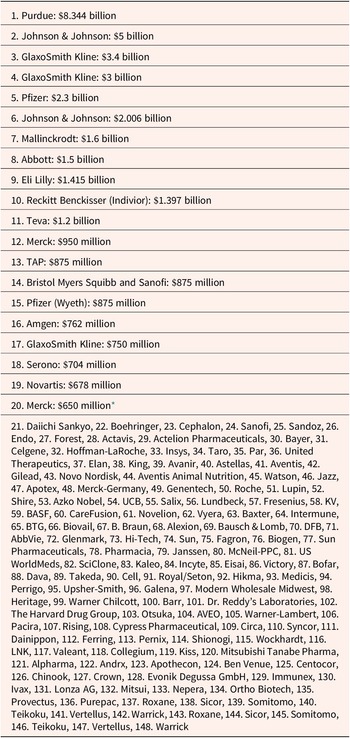
The 2021 PCHRG report found 482 settlement agreements from 1991 to 2021, which yielded over $62 billion in penalties. Corruption involved over 234 companies — virtually all leading firms and many smaller firms. The 21 companies with the largest payouts — some of which had more than one settlement — included Abbott, Amgen, Bristol Myers Squibb, Sanofi, Eli Lilly, GlaxoSmith Kline, Johnson & Johnson, Mallinckrodt, Merck, Novartis, Pfizer (Wyeth), Pfizer, Purdue, Reckitt, Benckisser (Indivior), Serono, TAP, and Teva. For these 21 companies, penalties ranged from a low of $650 million to a high of $8.344 billion. (See Table 1: Pharmaceutical Company Settlement Agreements by Size of Settlements 1991 to 2021.)
Company Settlement Agreements by Settlement Size 1991-2021: Top 20 by Name and Amount. All Others Listed in Order of Penalty Size Without Amount

Table 1. Long description
From the top row downward, the table lists: 1. Purdue 8.344 billion dollars, 2. Johnson and Johnson 5 billion dollars, 3. GlaxoSmithKline 3.4 billion dollars, 4. GlaxoSmithKline 3 billion dollars, 5. Pfizer 2.3 billion dollars, 6. Johnson and Johnson 2.006 billion dollars, 7. Mallinckrodt 1.6 billion dollars, 8. Abbott 1.5 billion dollars, 9. Eli Lilly 1.415 billion dollars, 10. Reckitt Benckisser (Indivior) 1.397 billion dollars, 11. Teva 1.2 billion dollars, 12. Merck 950 million dollars, 13. T A P 875 million dollars, 14. Bristol Myers Squibb and Sanofi 875 million dollars, 15. Pfizer (Wyeth) 875 million dollars, 16. Amgen 762 million dollars, 17. GlaxoSmithKline 750 million dollars, 18. Serono 704 million dollars, 19. Novartis 678 million dollars, 20. Merck 650 million dollars. The next row lists companies 21 through 148 by name only, in descending order of penalty size, without amounts. These include Daiichi Sankyo, Boehringer, Cephalon, Sanofi, Sandoz, Endo, Forest, Actavis, Actelion Pharmaceuticals, Bayer, Celgene, Hoffman-LaRoche, Insys, Taro, Par, United Therapeutics, Elan, King, Avanir, Astellas, Aventis, Gilead, Novo Nordisk, Aventis Animal Nutrition, Watson, Jazz, Apotex, Merck-Germany, Genentech, Roche, Lupin, Shire, Azko Nobel, U C B, Salix, Lundbeck, Fresenius, K V, B A S F, CareFusion, Novelion, Vyera, Baxter, Intermune, B T G, Biovail, B. Braun, Alexion, Bausch and Lomb, D F B, AbbVie, Glenmark, Hi-Tech, Sun, Fagron, Biogen, Sun Pharmaceuticals, Pharmacia, Janssen, McNeil-P P C, U S WorldMeds, SciClone, Kaleo, Incyte, Eisai, Victory, Bofar, Dava, Takeda, Cell, Royal/Seton, Hikma, Medicis, Perrigo, Upsher-Smith, Galena, Modern Wholesale Midwest, Heritage, Warner Chilcott, Barr, Dr. Reddy’s Laboratories, The Harvard Drug Group, Otsuka, A V E O, Warner-Lambert, Pacira, Rising, Cypress Pharmaceutical, Circa, Syncor, Dainippon, Ferring, Pernix, Shionogi, Wockhardt, L N K, Valeant, Collegium, Kiss, Mitsubishi Tanabe Pharma, Alpharma, Andrx, Apothecon, Ben Venue, Centocor, Chinook, Crown, Evonik Degussa G m b H, Immunex, Ivax, Lonza A G, Mitsui, Nepera, Ortho Biotech, Provectus, Purepac, Roxane, Sicor, Somitomo, Teikoku, Vertellus, Warrick. The table footnote cites Public Citizen Health Research Group, Tables 4 and 6, Abrams and Wolfe, Thirty-one years of pharmaceutical industry Criminal and Civil Penalties 1991-2021, Public Citizen Health Research Group, 2024, with a link to the source.
* Source: Public Citizen Health Research Group, Tables 4 and 6, Abrams, Michael, Wolfe, Sidney. Thirty-one years of pharmaceutical industry Criminal and Civil Penalties 1991-2021. Public Citizen Health Research Group,2024. https://www.citizen.org/article/thirty-one-years-of-pharmaceutical-industry-criminal-and-civil-penalties-1991-2021/
Illegal Conduct Continued After Prosecution
Frequently companies continued to engage in illegal conduct after settling civil and criminal prosecutions. That is remarkable because since 2000, in addition to requiring that the company pay substantial penalties, prosecutors have required that they adopt a Corporate Integrity Agreement (CIA) which aims to change the corporate culture and establish an external monitor and controls that make it harder to engage in or hide future illegal conduct. 19
CIAs constitute a kind of detailed regulation and oversight. They typically last five years and require that the company pay for an outside Independent Review Organization (IRO) to monitor its operations, review its financial accounts and communications, and investigate questionable payments and activities. The IRO reports to both the Office of Inspector General (OIG) as well as the company’s management. The IRO also supervises employee ethics training and operates a hotline where employees can report misconduct. CIAs also allow companies to self-report legal violations and take corrective action to reduce new penalties.
However, many companies subject to a CIA were subsequently indicted for engaging in additional illegal conduct and entered into new settlement agreements and CIAs. (See Table 2: Repeat Offenders: Pharmaceutical Company Criminal and Civil Settlement Agreements 1991–2021.) From 1991 to 2021, there were 248 federal settlements for repeat offenders involving 41 companies. Among the 41 companies with two or more settlement agreements, 11 companies had between five and 15 settlement agreements; 11 companies had three or four settlement agreements; and 19 companies had two settlement agreements. An additional 234 companies entered into only one settlement agreement.Reference Freedberg 20 The large number of companies with multiple settlement agreements indicates that prosecutions and CIAs were not sufficient to deter the continuation, or reemergence, of corruption.
Repeat Offenders, Pharmaceutical Company Federal Criminal and Civil Settlement Agreements: 1991–2021Reference Abrams and Wolfe 103
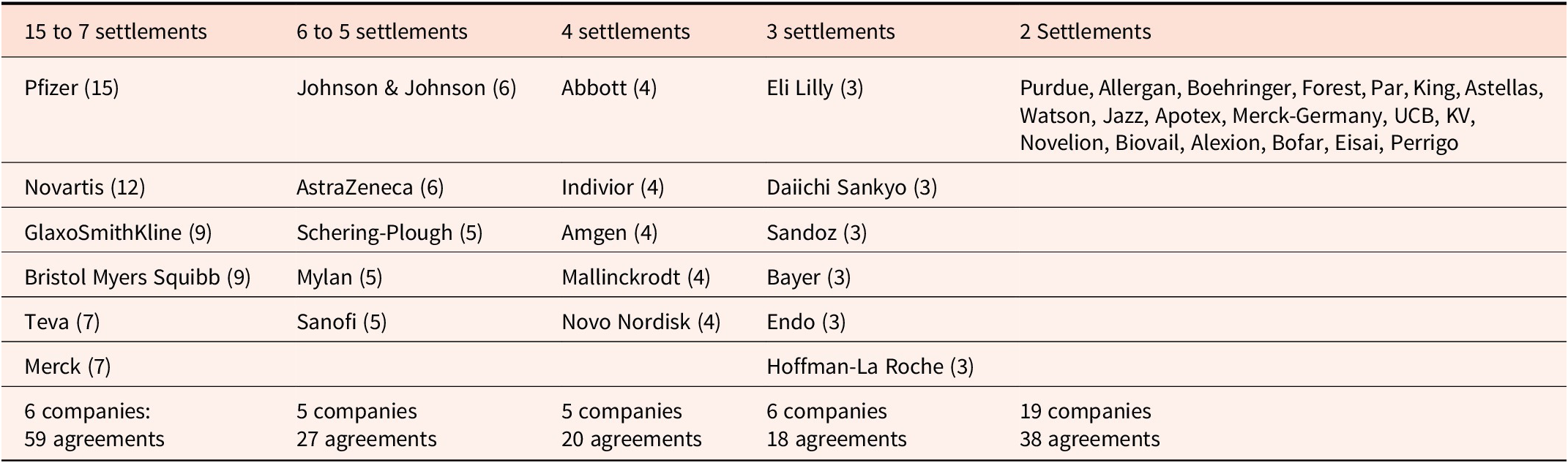
Table 2. Long description
Starting from the leftmost column, companies with 15 to 7 settlements are listed: Pfizer with 15, Novartis with 12, GlaxoSmithKline and Bristol Myers Squibb each with 9, Teva and Merck each with 7. The next column to the right shows companies with 6 to 5 settlements: Johnson and Johnson and AstraZeneca each with 6, Schering-Plough, Mylan, Sanofi each with 5. The middle column lists companies with 4 settlements: Abbott, Indivior, Amgen, Mallinckrodt, Novo Nordisk. The next column shows companies with 3 settlements: Eli Lilly, Daiichi Sankyo, Sandoz, Bayer, Endo, Hoffman-La Roche. The rightmost column lists companies with 2 settlements: Purdue, Allergan, Boehringer, Forest, Par, King, Astellas, Watson, Jazz, Apotex, Merck-Germany, UCB, KV, Novelion, Biovail, Alexion, Bofar, Eisai, Perrigo. The bottom row summarizes the number of companies and agreements per category: 6 companies with 59 agreements for 15 to 7 settlements, 5 companies with 27 agreements for 6 to 5 settlements, 5 companies with 20 agreements for 4 settlements, 6 companies with 18 agreements for 3 settlements, and 19 companies with 38 agreements for 2 settlements.
Source: Michael Abrams and Sidney Wolfe, Thirty-one years of pharmaceutical industry Criminal and Civil Penalties 1991-2021 (Public Citizen Health Research Group, 2024): Table 5, https://www.citizen.org/article/thirty-one-years-of-pharmaceutical-industry-criminal-and-civil-penalties-1991-2021/.
We lack information regarding how CIAs operate because the OIG has not released the IRO reports, or other data, despite Freedom of Information Act requests. The OIG contends that this information is confidential. However, information regarding how IROs perform their work and what they have found could be used to make anticorruption policies more effective. Disclosing such information would be more valuable than much of the information that transparency policies currently disclose.
Can Corporate Integrity Agreements Prevent or Deter Corruption?
Let us speculate why CIAs might not effectively deter misconduct. Companies generally choose their independent review organization and frequently they employ the firm that audits their finances for securities filings. The accounting firm depends on the company that hires them not only for their IRO work but also their auditing work. The IRO/auditor risks losing their employment if the company is displeased with their conduct as an external monitor, a classic conflict of interest written about in the accounting literature.Reference Lynch 21 Companies that hired their auditors as the external monitor include Novartis, GSK, Merck, Sanofi, Allergan, and Pfizer.
Furthermore, settlement agreements typically do not require pharmaceutical companies to remove strong incentives for promotion of sales that can encourage corruption — such as those used in one of the GSK CIAs that prohibited bonus payments for high sales volume.Reference Poplin 22
Some analysts argue that the amount companies earn from corruption is much more than the fines paid so that continued illegal corruption is profitable even after deducting the fines they pay.Reference Rodwin 23 They conclude that fines on individuals or corporations alone are insufficient to deter misconduct. Several analysts argue that the most effective sanction would be to incarcerate corporate officials who engage in fraud or who are the responsible corporate officer — an option that can be used for misdemeanors under the Food, Drug, and Cosmetic Act, even though prosecutors rarely invoke this option.Reference Rodwin 24
Other strong sanctions exist but are difficult to employ. For example, companies convicted of certain fraud can be excluded from participating in federal health care programs or debarred from marketing FDA-approved products. Yet some commentators argue that the social cost of exclusion or debarment of leading pharma companies would be greater than their benefits and so such solutions are not practical. And in any event, it would be politically difficult to implement such policies.Reference Rodwin 25
Conflicts of Interest and Institutional Corruption Augment Classic Corruption
Bribery constitutes an important type of corruption. However, bribes are the tip of the corruption iceberg. Prudent managers and companies can reduce their legal, financial, and reputational risk by employing alternatives to bribes that nevertheless corrupt medical practice and policy. Corruption can flow from conduct that has ambiguous legal status, or that is currently legal.Reference Gagnon, Faintuch and Faintuch 26
To advance corporate goals, pharmaceutical companies weave a web of financial ties to physicians, other professionals, and organizations that engage in research and clinical care. Companies seek to align these actors’ financial interests with their corporate goals, a process that creates: (1) conflicts of interest; and (2) institutional corruption. Both compromise pharmaceutical practice and policy.
Conflicts of Interest
Due to their roles, ethical commitments, and legal obligations, physicians are deemed to be fiduciaries for their patients, which requires that they work exclusively to advance patients’ interests when writing prescriptions and making other clinical choices.Reference Rodwin 27 However, when a physician has financial ties to third parties with interests that diverge from their patients’, they have a conflict of interest; that is, the physician is in a situation that compromises their loyalty to patients and/or their independent judgment regarding their patients’ interests.Reference Rodwin 28
Physicians with conflicts of interest do not necessarily betray their patient’s trust, but conflicts of interest create a risk that they will do so. For this reason, public policy oversees conflicts of interest in various ways. They sometimes prohibit physicians from entering situations that create conflicts of interest. Alternatively, they oversee the conflicted physician to reduce the risk that they will breach their trust.Reference Rodwin 29
I have elsewhere described the various sources of conflicts of interest in the pharmaceutical sector and means available to cure or mitigate them.Reference Rodwin 30 Here, I note that pharmaceutical companies often employ strategies to advance their corporate financial goals in ways that explicitly create or exploit physicians’ and other actors’ conflicts of interest. In so doing they corrupt the aims of medical practice and pharmaceutical policy, even if they do not pay bribes or kickbacks or violate other prohibitions. For example, pharmaceutical companies often make gifts or grants to physicians, expecting that recipients will reciprocate by writing prescriptions (sometimes out of gratitude), even when such prescriptions are not in the patient’s interest.
Today, organized medicine acknowledges that conflicts of interest constitute a problem and has developed ethical codes and guidelines to check them. Still, many recent policy responses to conflicts of interest are ineffective. Current public and private organization policy often takes as its premise that the disclosure of financial ties constitutes an adequate “solution” even though the disclosure of financial ties does not cure conflicts of interest or protect patients and the public.Reference Rodwin 31 Furthermore, some writers have attempted to redefine conflicts of interest in ways that unhinge the concept from the traditional legal concept, which weakens its value as an analytic tool.Reference Rodwin 32 In a similar vein, other writers suggest that bringing together all pharmaceutical stakeholders in an attempt to find common ground and develop public-private partnerships will produce gains for all parties. They ignore the perils of partnerships between organizations or interest groups that have fundamentally different interests.Reference Marks 33
Institutional Corruption
Professor Lawrence Lessig writes that “Institutional corruption is manifest when there is a systemic and strategic influence which is legal, or even currently ethical, that undermines the institution’s effectiveness by diverting it from its purpose or weakening its ability to achieve its purpose, including … either the public’s trust in that institution or the institution’s inherent trustworthiness.”Reference Lessig 34 This definition includes more than classic corruption, such as the bribes that are the focus of the OECD Convention. It draws attention to activities that compromise an institution’s effectiveness or that displace the institution’s purposes and goals. It underscores the importance of an institution’s trustworthiness and public trust in the institution.
There are multiple ways institutions can be corrupted. Lessig focuses on improper dependence, namely an institution (or its key actors’) dependence for money or information on third parties that have fundamentally divergent interests.Reference Lessig 35 Such dependence can weaken the institution’s functioning or divert its mission. Lessig has written mainly about institutional corruption arising from the wealthiest Americans’ financing of election campaigns and its distortion of democracy. However, during the seven years that Lessig directed the Edmond J. Safra Center, its project on institutional corruption investigated multiple other areas, including pharmaceutical policy. 36
Pharmaceutical firms develop and market medications used to cure or mitigate illness or reduce pain and suffering. Yet today, the goals of pharmaceutical and medical policy are compromised by key actors being dependent on pharmaceutical firms. Improper dependence on drug firms systematically distorts important policy choices, starting with setting priorities for the development of new drugs through the monitoring of adverse drug reactions and patient safety after drugs are marketed.Reference Rodwin 37
Today, the public depends on pharmaceutical firms to: (1) conduct clinical trials that test whether drugs are safe and effective; (2) decide what clinical trial data to disclose to the public; (3) publicize information on the risks of drugs once they are marketed; (4) advise physicians regarding optimal use of pharmaceuticals; (5) provide doctors information about drug benefits and risks; (6) finance continuing medical education; and (7) market drugs only for approved uses.
For each of these activities, the financial interests of pharmaceutical companies — particularly in the short-term — diverge from pharmaceutical and health policy goals. For example, pharmaceutical companies have an incentive to design and conduct clinical trials that downplay the risks and exaggerate the benefits of their medications and thereby help increase their sales. However, when deciding if a drug is safe and effective for marketing, drug registration authorities rely on clinical trials financed, designed, and managed by the pharmaceutical company seeking to market the drug, a situation that compromises the integrity of the research. One way to resolve this problem is to require that drug registration authorities rely only on clinical trials that are independent of pharmaceutical company control, an idea often proposed by reformers since 1960.Reference Rodwin 38
The improper dependence extends beyond trials conducted to obtain marketing authorization. More generally, physicians and the public depend on drug firms for the production of knowledge about drugs.Reference Sismondo 39 They rely on corporate funding for pharmaceutical research, a form of dependence that compromises the ideal of independent scientific inquiry.Reference Gray 40 A review of studies finds that there is an association between receiving payments from pharmaceutical companies and physician prescribing.Reference Mitchell 41
Take for example the norm that research should be honestly reported. We have found that in practice, pharmaceutical companies have incentives to publish and report selectively to promote their products and protect their intellectual capital, with the result that they often do not report studies with unfavorable results and publish studies with favorable results multiple times, a phenomenon that creates publication bias.Reference Easterbrook 42 Publication bias was partially lessened by journal policies and legislation that requires public registration of clinical trials before they begin so that the public has access to information regarding trial results even if they remain unpublished. 43 Pharmaceutical companies also have an incentive to manipulate data, and have done so.Reference Brown 44 In addition, companies have an incentive to limit public access to safety data and have argued that such information submitted to the FDA constitutes trade secrets, and seek to block access to others.
Pharmaceutical manufacturers aggressively market their products, and to this end have financed and helped organize accredited continuing medical education (CME) in ways that slant the choice of topics, and sometimes even the course content.Reference Rodwin 45 The result is CME designed to boost sales, rather than educate physicians about best practices or promote drug safety. Pharmaceutical firms sometimes even promote their products for unapproved uses, occasionally explicitly, more often sub rosa.Reference Rodwin 46 To promote sales, pharmaceutical companies have showered physicians with gifts and subsidies. These gifts make physicians psychologically and financially dependent, so they reciprocate by prescribing a particular drug.Reference Sah and Fugh-Berman 47
Of course, physicians and the medical profession play an important role in directing the use of medicines. However, clinicians are guided by practice guidelines and medical literature, and pharmaceutical funding compromises both. Organized psychiatry also has become financially dependent on pharma funding and that has corrupted the development of psychiatric diagnostic categories and practice guidelines.Reference Whitaker and Cosgrove 48
We might hope that patient advocacy organizations will provide a counterweight and effectively represent the interest of patients. However, patient advocacy groups are financially dependent on pharmaceutical firms, which bias their policy stance.Reference Batt 49 For example, patient advocacy groups advocate for the approval of new drugs, often suggesting that they be approved using expedited review that employs less reliable data and more flexible criteria. As a result, drugs are approved when there is little evidence that they work despite higher safety risks.
Mixed and Mutually Reinforcing Forms of Corruption
To effectively counter corruption we need to address both illegal conduct (e.g., bribes and kickbacks) and corruption arising from uncontrolled conflicts of interest and institutional corruption. Legal and illegal sources of corruption often work in tandem.
The prosecution of Pfizer and Parke-Davis — a division of Warner-Lambert — for multiple legal violations in off-label marketing of gabapentin (Neurontin) reveals that legal and illegal acts can together corrupt practice. Off-label marketing itself constitutes corruption because it violates the FDCA authorization rules, which restrict pharma marketing to uses known to be safe and effective — those listed on the label. It compromises patient safety and public health and typically results in submission of false claims for reimbursement under federal health programs.Reference Steinman 50
Dr. Michael Steinman and colleagues reviewed company records made available as part of the settlement agreement in United States of America ex. rel David Franklin vs. Pfizer, Inc., and Parke-Davis, Division of Warner-Lambert Company. Reference Steinman and Steinman 51 Parke-Davis employed illegal kickbacks, gifts, and research as part of a coordinated plan to promote gabapentin (Neurontin) off-label. In 1998, the company planned to spend $40 million on promotion. The illegal marketing yielded $2 billion in sales in 2004 alone, many times more than the $430 million it paid to settle the case.
Five years after Parke-Davis launched gabapentin (Neurontin), up to ninety-five percent of sales were for unapproved uses. This high volume of sales continued for four years following indictment, until it signed the settlement agreement.Reference Kesselheim 52 Dr. Aaron Kesselheim suggests that the company probably continued off-label marketing because managers anticipated it would be profitable despite having to pay the penalties.Reference Kesselheim 53
Parke-Davis’ marketing strategy included multiple elements. It targeted physicians who prescribe anticonvulsant agents, opinion leaders, and doctors who prescribed gabapentin off label or who could potentially do so, as well as hospital residents. To reach them, Parke-Davis funded research that taught physicians to titrate the drug to higher doses. The putative research also served as a means to compensate physicians who prescribed off label. Parke-Davis research also generated publications that suggested off-label uses benefited patients.
Convinced that education drove the markets, Parke-Davis hired medical education and communication companies (MECC) to run programs that suggested off-label uses were beneficial. Some MECC work was to develop accredited CME programs that were supposed to be independent, but in fact, that Parke-Davis controlled. The same MECC companies also were hired for explicit promotion.
Parke-Davis also employed speaker bureaus to train and pay physicians to speak on behalf of Neurontin in peer-to-peer meetings, hospital lectures, and teleconferences. It recruited physicians to attend the meetings, often paying their cost of travel and lodging. Parke-Davis managers employed physicians as consultants and to serve on advisory boards, sometimes seeking their assistance for planning promotion. Parke-Davis often selected high gabapentin prescribers as advisors to compensate their prescriptions. Parke-Davis medical detailers supplied physicians with information about unapproved uses, and more than half reported that they intended to prescribe for those uses.Reference Steinman 54
Steinman and colleagues found that policies employed to prevent commercial interests from influencing clinical choices are ineffective, and that “commercial interests … intrude into the practice of medicine in both visible and hidden ways” despite guidelines that require disclosure of conflicts of interest. They conclude that there are “porous borders between research, education and promotion” and call for “strict sequestration of commercial and scientific activities.”Reference Steinman 55
Kickbacks, Gifts, and Financial Support as Sources of Conflicts of Interest and Corruption
A kickback is an illicit payment made in return for the recipient writing prescriptions, referring patients, or otherwise generating income for the payer. Gifts are typically understood as grants of benefit (often in-kind), freely given, without a requirement that the recipient return the favor. However, gifts lubricate commercial relations.Reference Mauss 56 Businesses make gifts as hospitality, to generate good will, or to promote their reputation and brand.Reference Dana and Loewenstein 57
Yet the line between kickbacks and gifts blurs. Typically, companies make gifts to promote relationships and activities that help them, or when gifts will likely yield return benefits. Companies that offer gifts and other financial support can cease their “beneficence” if the recipient does not reciprocate as the funder would like. Furthermore, companies can pay kickbacks, not report what they received in return, and designate them as gifts.
Both pharmaceutical company kickbacks and gifts to physicians and other actors can be instruments of corruption. The law often prohibits kickbacks, subjecting them to criminal or civil penalties, while typically gifts are legal but sometimes restricted through non-binding ethical codes. In addition, pharmaceutical firms have become a leading source of grants and other financial support for professional activities and patient associations, funding that poses similar problems as kickbacks and gifts, and often becomes a source of conflicts of interest for the recipient of funds. The changing ways in which organized medicine, pharma, and the law coped with these practices over the twentieth century illuminate challenges in addressing corruption.
Professional Ethical Codes on Kickbacks in the Early Twentieth Century
In the first half of the twentieth century the organized medical profession employed ethical codes to regulate the medical economy.Reference Rodwin 58 These were, in part, means to curb activities deemed to compromise medical practice and physician loyalty to patients — and, in part, measures to protect professional prerogative and restrict market competition.Reference Konold and Reich 59 The codes restricted many commercial practices, including: physician ownership of pharmacies, physician dispensing of medicine and appliances, and practices that provided incentives for physicians to prescribe medications and appliances. The codes also restricted physician employment and corporate ownership of medical facilities, 60 practices that restricted certain forms of market competition.
The AMA codes targeted two practices: (1) payment of commissions, by laymen or physicians, for prescribing medicines or appliances; and (2) physician fee splitting — usually surgeons paying a referring general practitioner part of the fees generated by their referral. Today, both practices are described as kickbacks and federal legislation prohibits kickbacks in federal health programs. Pharmaceutical companies and other suppliers pay physicians kickbacks to increase their sales. Other contemporary US laws regulate similar practices, such as physician referrals to medical facilities in which they are passive investors, which create similar incentives and effects as kickbacks. 61
Restrictions on commissions and fee splitting had different effects on various medical practitioners, and that led to divisions in the organized medical profession’s response. The American College of Surgeons (ACS) condemned these practices and required that physicians seeking membership take an oath not to split fees. It criticized the AMA for insufficient action to stop fee splitting.
The interprofessional differences peaked in the 1950s, a period during which the AMA progressively revised its ethical code to allow commercial practices previously condemned so long as practitioners found that they did not to harm patients’ interests; but it failed to guide practitioners by offering criteria as to what constituted harm or the patients’ interests. Over time, the AMA defined fee splitting more narrowly and spoke out about it less frequently. The AMA also dropped code restrictions on physicians dispensing medicine, ownership of pharmacies or drug companies, and accepting gifts.Reference Woodhouse 62 The AMA also dismantled its program to regulate drug marketing and drug advertisements in its medical journals. Subsequently, the AMA then opposed new government drug regulation — most notably the 1962 Food, Drug, and Cosmetic Act Amendments.Reference Rodwin 63
The American College of Surgeons openly challenged the AMA for “recoding” medical ethics. The AMA, in turn, condemned ACS leaders for speaking out against fee splitting in public forums. The Chicago Medical Society even brought disciplinary proceedings against the director of the ACS (also an AMA member) who said, when interviewed by U.S. News and World Report, that fee splitting was prevalent and led to unnecessary surgery.
An AMA Judicial Council Report in 1954 “recommend[ed] a moratorium [on] … discussion of ‘principles’ about fees …”Reference Rodwin 64 Thereafter, there was little discussion of fee splitting, commissions, and other controversial commercial practices in the medical press. However, a few years later journalists started to investigate kickbacks, gifts, and other financial ties as a source of corruption in drug testing and fraud in Medicare and Medicaid.
Gifts in Professional Ethical Codes and Government Regulation
The 1959 AMA ethical code declared unethical any inducement for referrals including gifts. That code provision made clear that gifts were understood as an inducement for referrals in many contexts. However, in 1960 the AMA dropped the condemnation of gifts. Subsequently, industry gift giving increased or at least become more visible. In response, in the 1970s, Senator Edward M. Kennedy (D-MA) chaired several hearings on pharmaceutical industry marketing and also addressed financial relations in his hearing on testing of drugs. 65 The hearings revealed that pharmaceutical company financial influence could corrupt physician prescribing and testing of drugs.
At the 1974 hearings, AMA representatives testified that pharma company gifts to physicians were limited to a handful of manufacturers and physicians.Reference Rodwin 66 But other testimony demonstrated this was false. Pfizer and other firms rewarded doctors with prizes for prescribing drugs. 67 They awarded physicians points, based on the volume of drugs prescribed, which could be redeemed as gifts; and they distributed catalogues of gifts that physicians could claim. 68 Choices included TVs, stereo systems, watches, electronic gadgets, and vacation packages, as well as jewelry, golf clubs, and boats.
Kennedy warned the AMA and the Pharmaceutical Manufacturers Association (PMA) that Congress might prohibit gifts. In response, the AMA and PMA pleaded to be allowed to address the problem through self-regulation rather than legislation. 69 In 1977, Senator Kennedy introduced legislation that would have prohibited pharmaceutical companies from tendering gifts if the purpose was to influence prescribing, but it was not enacted.Reference Rodwin 70 Over the next decade investigations by government agencies, the press, and scholars revealed that pharmaceutical companies continued to employ gifts to market their products.
In 1989, Kennedy announced he would renew hearings on marketing drugs. In response, in 1990 — just before the start of the hearings — the AMA, Council on Ethical and Judicial Affairs, and PMA jointly developed ethical option policies that discouraged companies from paying explicit kickbacks and certain kinds of gifts, while allowing other gifts. 71 The policies did not discourage pharma companies from making grants or otherwise providing funds to support most professional activities. 72
The 1990 AMA code allowed gifts to physicians that had educational benefit for physicians or indirect benefits for patients, but the code confused benefits for patients and benefits for physicians. Assistance to private medical practitioners was seen as providing benefits to patients. Moreover, the guidelines did not place an upper value on gifts that physicians could receive from one source over several transactions. A survey of 16 drug companies made public at the 1990 hearings found that they spent more than $165 million in 1988 on gifts. 73
At the 1990 hearings, Kennedy asked the AMA if it could enforce its code provision on gifts. The AMA replied that it could not, but that it believed doctors would comply with a voluntary code, and they pleaded that Congress allow the AMA and PMA to employ self-regulation rather than be subject to legislation. 74 Subsequently, reporters from the AMA publication, American Medical News, attended professional conferences and found that physicians and pharmaceutical firms ignored the policy.Reference Rodwin 75
Gifts and Kickbacks Compromise Drug Testing and Physician Prescribing
Investigations in the 1960s and 1970s revealed corruption due to pharmaceutical company kickbacks, gifts, and financial dependence of firms conducting drug testing. Typically, the firms pushed for the FDA to approve their products rapidly and sought to avoid conducting rigorous testing because that would slow market access. Companies used kickbacks, gifts, or other financial support to obtain favorable test results. Researchers and companies fabricated some test data while other testing was merely unreliable.
Miriam Ottenberg, a journalist for the Evening Star, exposed a pattern of unqualified researchers being paid to write glowing reports on MER/29, an anti-cholesterol drug that was found to increase death and disability of users.Reference Harris 76 The manufacturers Richardson Merrell relied on fabricated test results in its FDA marketing application. Some doctors did no testing work and merely signed their names to reports written by the company.
Richardson Merrell also conducted what it characterized as post-marketing research studies, but which were programs to pay doctors to prescribe the drug. Richardson Merrell and other firms also distributed gifts to doctors to promote sales. Around this time, the FDA revealed that it had discovered “quite a few cases” of “rigged” research.Reference Harris 77
After investigations found thalidomide caused birth defects, other reporting revealed that the manufacturer, Grünenthal, had obtained favorable reports on the drug from doctors who they supported with payments for travel, conferences, and other activities. Correspondence between the company and clinical investigators showed that the doctors wrote letters thanking the company for their financial support at the same time as they discussed test results, and that they suggested they would try to offer a favorable evaluation.
The journalist Morton Mintz also investigated fraud in drug and medical device testing and marketing in the 1960s through the 1980s, publishing in newspapers and books.Reference Mintz 78 Mintz documented financial conflicts of interest of doctors and researchers testing drugs, as well as lax governmental oversight and a revolving door between the FDA, pharmaceutical industry, and industry lobbying groups. In the 1960s, he found that testing companies fabricated clinical data without conducting studies, changed test results, or paid doctors to produce favorable results for their evaluations of drugs. Other times they conducted studies that lacked sound methodology, failed to oversee the work of labs they hired for toxicological testing, failed to keep records, and made clear to the labs that they wanted them to produce results reporting the drug was safe and effective. Subsequently, Mintz documented corruption in testing of medical devices, most notably intrauterine devices (IUDs) used as contraception. Robbins, the manufacturers of Dalkon Shield, hid evidence of serious side effects. To obtain favorable evaluations and encourage physicians to prescribe the IUD, Robbins showered physicians with gifts to increase their prescribing.
Senate hearings in the 1970s examined fraud in clinical trials conducted by pharmaceutical firms to demonstrate drugs were safe and effective, a condition for receiving FDA marketing authorization.Reference Braithwaite 79 One hearing highlighted problems in the G. D. Searle safety testing program. Managers instructed scientists to write favorable reports. Searle also withheld reports revealing safety problems, and edited pathology reports to make results appear more favorable. For example, Searle hired Biometric Testing Inc. to conduct some toxicological studies. Aiming to reduce its expenses and secure renewed contracts, the lab sometimes simply produced favorable reports without bothering to conduct the tests. Searle lacked any system to identify or counter such fraud.
In addition, in the 1970s Senator Gaylord Nelson (D-WI) held hearings on drug testing required by the FDA to ensure drug safety and effectiveness, and on competitive problems in the pharmaceutical industry. 80 The hearings documented problems in the integrity of the research because pharmaceutical firms financed and oversaw clinical trials, which allowed them to bias the research and distort the findings. Senator Nelson charged that this created conflicts of interest and corrupted the integrity of the test data. He introduced legislation every year from 1976 to 1980 seeking to require that only data from independent clinical trials be used by the FDA to grant marketing approval to avoid conflicts of interest that compromised the integrity of the research. 81
The Anti-Kickback Act
Medicare and Medicaid, the two largest federal health insurance programs, began in 1966. Soon thereafter, congressional hearings, the Government Accountability Office (GAO), and others documented payment of kickbacks for referrals in Medicare and Medicaid for medication and other medical care. Later, the Department of Justice and other government agencies concluded that kickbacks increase the risk that services will be over-used, costs increased, medical decision-making corrupted, and fair competition undermined because prescribers will make decisions based on financial benefit they receive rather than medical care patients need, or the best price for the patient.Reference O’Sullivan 82 And the GAO estimated that kickbacks and other fraud account for 10 percent of US health spending. 83
To counter this corruption, in 1972 Congress enacted the Anti-Kickback Act (AKA). However, companies found multiple ways to disguise kickbacks and avoid legal liability. They disguised quid-pro-quo payments as gifts, grants, business hospitality, or compensation for legitimate activities. Or they concealed payment or made payments through an intermediary.
In response, Congress amended the AKA in 1977 and redefined kickbacks to include indirect, in-kind, and covert payments as well as direct cash transfers. The revised legislation penalized “any remuneration (including any kickback, bribe, or rebate), directly or indirectly, overtly or covertly, in cash or kind” with limited exceptions (emphasis added). 84 Later, the leading judicial decision that interpreted the AKA held that the conduct was illegal “if the payments were intended to induce the physician to use … services,… even if the payments were also intended to compensate for professional services.” 85 That interpretation allowed prosecution of certain transactions on the grounds that payment of higher-than-prevailing market rates constituted payment for referrals rather than the specified service. 86
Anti-Kickback Act Compliance Guidelines, Gifts, and Other Financial Support
In light of the fine line between kickbacks and gifts and because reported gifts can actually be disguised kickbacks, regulators have to examine whether gifts are subterfuge for a kickback.Reference Kusserow 87 In the 1990s journalists and government reports continued to document kickbacks in medicine, and the federal government increased prosecutions. During this time the federal government adopted policies to increase company compliance with the AKA by creating model compliance programs. Companies that implemented an OIG-approved compliance program would receive reduced penalties if any of their personnel violated the AKA. Legal counsel generally advised companies to adopt a compliance program to reduce their risk of liability.
In 2002, the OIG proposed Anti-Kickback Act compliance guidelines, which held that companies must, at a minimum, respect the AMA and Pharmaceutical Research and Manufacturers Association (PhRMA) ethical codes’ rules regarding gifts to avoid AKA prosecution, and said that they would have to also meet other requirements. 88 The AMA, PhRMA (the renamed PMA), and 19 individual drug companies pleaded that the OIG should revise its proposal and hold that the government would not prosecute physicians and pharma companies under the AKA so long as they complied with the AMA and PhRMA codes on gifts. 89 If the OIG did not adopt this position, they argued, PhRMA and the AMA would not create ethical codes on gifts, conflicts of interest, and other financial practices.Reference Chimonas and Rothman 90
The OIG final compliance guidelines, adopted in 2003, largely accepted the organized medicine and pharmaceutical industry request. It declared that compliance with the PhRMA code would “demonstrate good faith efforts” to comply with the Anti-Kickback Act but left open the possibility that prosecutors could consider other factors. 91
The OIG-proposed AKA compliance guidelines had also addressed industry financial support for CME and professional medical activities. The OIG proposal followed the policy that the FDA had developed previously. In the early 1990s, the FDA became aware that some manufacturers controlled CME programs through a combination of financial support and direct management over variables such as the choice of speakers and the text of slides presented. At that time, pharmaceutical company marketing departments frequently made grants to Medical Education and Communication Companies (MECCs) that developed CME programs. Furthermore, some MECCs also worked as pharmaceutical marketing companies. MECCs that developed accredited CME programs sometimes advertised that their programs could help pharma companies increase their sales.Reference Relman 92
The FDA believed that if CME was controlled by a pharmaceutical company, it should be subject to the same rules that prohibited manufacturers from marketing drugs for off-label uses. The FDA declared that it would treat CME that was not independent of pharmaceutical firms in the same way it regulated pharmaceutical company promotion. Most notably, it would review statements on off-label therapeutic uses as prohibited off-label marketing. The Washington Legal Foundation, however, challenged the FDA’s position as a violation of the First Amendment and to preclude an unfavorable court decision, the FDA ceased to enforce its policy. 93
In proposing AKA compliance guidelines, the OIG adopted a position similar to the earlier FDA policy. The OIG said commercial funders risk prosecution for certain CME activity if they control CME. It declared that drug firms should use separate departments for marketing and grant making. In response, organized medicine and PhRMA opposed restrictions on pharmaceutical firms funding CME, research, and other activities in the AKA Compliance Guidelines. Twenty-five major professional medical organizations opposed all restrictions on company funding. 94 Several specialty societies asked the OIG to allow all drug firm grants to medical societies. 95
The OIG adopted the organized-medicine-industry position. Its final guidelines held that “financial support for educational activities sponsored and organized by medical professional organizations raise little risk of fraud or abuse.” However, to comply with the OIG guidelines, today drug companies must use separate departments for marketing and grantmaking. 96
The question of what makes CME independent from pharmaceutical company control remains unresolved. The Accreditation Council for Continuing Medical Education (ACCME), which sets rules for accreditation of CME programs, held in 2005 that if the pharmaceutical company funding a program did not require that it must approve the text of the educational activity, then the program was independent, even if the pharmaceutical company paid most or even all of the expenses. 97
However, the Senate Finance Committee studied the funding of CME and in a 2007 report criticized the ACCME policy. 98 It concluded that even if the pharma company paying for the CME program did not retain explicit authority to direct its content, it could still exert significant influence over the content because it chose what programs and companies to fund both when making grants and subsequently when deciding which MECCs to support in the future. 99 The CME “provider can technically maintain ‘control’ of content … while continuing to accommodate suggestions from the companies that control their funding,” thereby “afford[ing] drug companies the ability to target their grant funding at programs likely to support sales of their products.” The MECC company dependence on pharma financial support allows the funding company to influence the content. This situation is what Lawrence Lessig later would refer to as dependence corruption. In 2020, the ACCME revised its standards to ensure independence of CME activities; however, these revisions do not make substantial changes. 100
Current Scope and Future Prospects of Corruption
Where do things stand today? The US has policies to address explicit corruption, such as bribes and kickbacks, and neither the pharmaceutical industry nor organized medicine defends such practices. Still, those practices persist. Furthermore, there is backsliding on corruption other than bribes and kickbacks strictly defined, and that arises from conflicts of interest, improper dependence, and other forms of institutional corruption.
PhRMA and the AMA oppose what I will call abnormal corruption, explicit bribes and kickbacks in return for prescribing or purchasing, which tarnishes their public image. But they accept and engage in what I call normal corruption, gifts and other financial support that create dependency — arrangements that compromise professional practice and policy.Reference Rodwin 101
Pharmaceutical companies have data which confirm that their grants and gifts yield returns, making them a prudent investment. They support — through gifts and grants — relationships that yield benefits to them. Medical organizations and physicians know that drug companies are an ample source of funds and seek their support, thinking that they can maintain their professional integrity and control despite the risk of dependence.
Public officials tolerate industry funding for professional medical activities, in part to avoid the political conflict that would be required to restrict such funding and in part to avoid having to spend public funds as an alternative. Public officials know that kickbacks corrupt but overlook that pharmaceutical companies can replace kickbacks with gifts, which also compromise prescribing and medical practice.
Conclusion
What people view as acceptable and/or normal changes over time. People looking back at the laissez-faire US pharmaceutical market of the early twentieth century have difficulty imagining that the public then considered it normal and acceptable, because today we view typical practices and the system of those days as corrupt.
At the turn of the twentieth century, companies could sell any product they wanted without restraint, and frequently sold directly to consumers without a prescription — without listing the ingredients or testing the product.Reference Young 102 They could make therapeutic claims without any supporting scientific evidence. Many proprietary drugs then contained mainly water and color with no active ingredients. Others contained alcohol, or narcotics such as heroin, morphine, cocaine, or cannabis without labeling. There was no way patients or other purchasers could know what they were purchasing, make an informed choice about its value, or prudently navigate the risks. There was little or no incentive for pharmaceutical manufacturers to evaluate their products, control their manufacturing, or limit their promotion to truthful claims. No laws or system of oversight precluded marketing a new drug until after public officials authorized doing so, based on a scientific assessment which demonstrated that the medication was safe and effective for its intended use.
Since the early twentieth century, reforms of finance and law and the development of science have vastly improved the pharmaceutical market, yet it remains compromised by conflicts of interest and institutional corruption as well as classic corruption. The current problematic practices are tolerated, but this could change. The market could be reconfigured if there is the political will to do so. With some practical changes that are feasible, in a half-century or century from now the public might well have difficulty believing that in 2025 most people thought that the pharmaceutical market was just the way things have to work, or that it was acceptable.
Acknowledgements
Karen Zheng-Garcia assisted with references and proofing.

 Open access

