


1. Introduction
The transition to new computer-aided design (CAD) and product lifecycle management (PLM) systems remains a significant challenge for industrial organisations (Reference Garetti, Terzi, Bertacci and BrianzaGaretti et al., 2005; Reference Fielding, McCardle, Eynard, Hartman and FraserFielding et al., 2014; Reference StarkStark, 2015). Beyond the technical aspects of system migration, success hinges on users’ ability to acquire new competencies and integrate standardised modelling practices into their daily work (Reference Garetti, Terzi, Bertacci and BrianzaGaretti et al., 2005). Previous research has demonstrated that guideline-based learning can accelerate this process for key users by aligning training with real engineering workflows and enabling experiential learning through authentic design tasks (Reference Ngahane Nana, Arslan, Adamczyk, Ciftcioglu, Cobanoglu, Lobb, Özmen and SalianNgahane Nana et al., 2026). While this approach has been highly effective for a small group of experts, the question remains how to scale up such learning for the wider community of end users without losing its contextual depth or coherence.
Scaling up learning in industrial contexts introduces new complexities. End users can differ widely in terms of their prior experience, exposure to training, and engagement with standardisation initiatives. Traditional top-down instruction and tool-focussed tutorials often prove inadequate for such diverse groups, resulting in uneven adoption and persistent gaps in procedural understanding (Reference Kirschner, Sweller and ClarkKirschner et al., 2006; Reference Salas, Tannenbaum, Kraiger and Smith-JentschSalas et al., 2012). To address these issues, the training provider proposed adapting the guideline-based concept for use in blended learning. The blended learning approach combines the best of two teaching and learning models: traditional face-to-face systems (In the post-coronavirus era, ‘face-to-face’ may also refer to being connected and communicating synchronously via a dedicated platform, rather than being in the same room.) and decentralised learning methods (Reference Bonk and GrahamBonk & Graham, 2006). In this model, participants first study the guidelines independently to establish conceptual and procedural foundations and then attend trainer-led sessions designed to consolidate knowledge through discussion, feedback and hands-on activities.
This pedagogical design is based on theories of experiential and adult learning (Reference KolbKolb, 1984; Reference Knowles, Holton, Robinson and SwansonKnowles et al., 2020) and research on blended learning in professional education (Reference Garrison and KanukaGarrison & Kanuka, 2004; Reference HrastinskiHrastinski, 2019). While decentralised learning activities foster autonomy and self-paced reflection, face-to-face sessions support social interaction, clarification and shared problem-solving, which are all key elements in the internalisation of new practices. Together, these components create an adaptive learning environment that mirrors the dynamics of real design work.
This paper presents a case study from the industrial sector, analysing how a guideline-based blended learning model supported the adoption of CAD/PLM technology by end users on a large scale during a company-wide transition. The study examines pedagogical and organisational outcomes, focusing on how the combination of structured self-learning and interactive sessions enhanced procedural competence, engagement and modelling consistency among distributed teams. Using a mixed-methods evaluation approach, the research combines qualitative evidence from observations, reflections and open survey responses with descriptive quantitative data derived from participant surveys.
Rather than aiming for statistical generalisation, the analysis seeks to provide empirically grounded insights into how a guideline-based blended learning model can facilitate large-scale technology adoption in complex industrial environments. Beyond its industrial relevance, the study contributes to ongoing discussions in design education regarding scalable hybrid learning frameworks that connect professional training and academic teaching within digital engineering contexts.
2. Conceptual foundations of blended guideline-based learning
For those affected by significant change in their working tools, implementing a new CAD/PLM environment requires more than just technical training. It also needs a pedagogical design that links conceptual understanding to procedural practice. In this context, the blended learning model draws on complementary theories of pedagogy that explain how learners acquire, apply and internalise knowledge in a professional context.
2.1. Integrating experiential and adult learning principles
According to Reference KolbKolb’s (1984) experiential learning theory, learning occurs through a cyclical process involving concrete experience, reflective observation, abstract conceptualisation, and active experimentation. In CAD/PLM training, this translates into iterative cycles of modelling, reflection, and iterative refinement within real-world design tasks. End users interact with guidelines in the form of structured instructions that help them to transform abstract principles into practical modelling strategies.
Adult learning theory (Reference Knowles, Holton, Robinson and SwansonKnowles et al., 2020) further emphasises autonomy, relevance, and a focus on solving problems. Adults learn most effectively when training is directly connected to their professional context and allows for self-directed exploration.
The asynchronous phase of the programme supports these principles by enabling learners to engage with the guidelines at their own pace, relate them to their own work situations, and identify any specific challenges they may have before attending trainer-led group sessions.
2.2. Socio- constructivist dimensions of blended learning
Beyond individual experience, the blended format fosters social learning processes. Inspired by socio-constructivist perspectives (Reference VygotskyVygotsky, 1978; Reference WengerWenger, 1998), the synchronous sessions create opportunities for collaborative problem-solving and shared knowledge construction. Through dialogue with trainers and peers, participants refine their guideline interpretations, share contextual examples, and develop a shared understanding of standard modelling practices. This interaction transforms guidelines from static documents into living artefacts that evolve through community use.
Reference Garrison and KanukaGarrison and Kanuka (2004) describe blended learning as a design combining the independence of distance learning with the immediacy of face-to-face interaction to create conditions for deeper cognitive engagement. Subsequent studies (Reference Bonk and GrahamBonk & Graham, 2006; Reference HrastinskiHrastinski, 2019) confirm that this integration enhances flexibility and social presence, which are two particularly important qualities in distributed industrial environments where teams must learn collaboratively across locations.
2.3. Guidelines as boundary objects between tools and reasoning
From a pedagogical standpoint, guidelines act as mediating artefacts, linking the functionalities of tools with design reasoning. They serve as cognitive scaffolds, reducing cognitive load during complex modelling tasks (Reference Sweller, Ayres and KalyugaSweller et al., 2011), and as standardisation instruments, ensuring alignment across teams. In blended learning contexts, these artefacts are introduced during the self-study phase and then contextualised through collective reflection in trainer-led sessions. This dual purpose facilitates the transfer of procedural knowledge from expert trainers to end users, reinforcing organisational learning while allowing for local adaptation.
2.4. Towards adaptive competence development
Combining these theoretical perspectives creates an adaptive learning environment that is well-suited to the large-scale software adoption. Experiential learning provides a basis for practical experience, while adult learning ensures autonomy and relevance. Socio-constructivist principles, meanwhile, sustain collaboration and reflection. The interplay of asynchronous and synchronous components transforms training from a one-off transfer of information into an ongoing process of building competence. This approach supports effective CAD/PLM implementation and offers a replicable model for bridging the gap between industrial upskilling and academic design education.
Taken together, these theoretical perspectives also inform the evaluation of the proposed learning model. Learning outcomes are examined at two levels: individual competence development and organisational alignment. The latter includes the shared interpretation of modelling and data management practices. This dual focus permits an assessment of the contribution of guideline-based blended learning to personal skill acquisition and sustainable organisational learning. The blended, guideline-based model can therefore be considered a designed pedagogical artefact, the effectiveness of which is evaluated in the subsequent sections
3. Implementation of the blended learning programme
Building on the conceptual foundations presented above, the blended learning model was translated into a structured training programme combining decentralised self-learning with interactive, trainer-led sessions. The following section describes how this approach was implemented in practice, detailing the organisational context, learning design, participant roles and observed outcomes.
3.1. Organisational context
The blended training programme was implemented within a multinational company that operates in the food, beverage and pharmaceutical sectors. This initiative was part of a global Computer-Aided Design (CAD)/Product Lifecycle Management (PLM) transition, which aimed to standardise design and data management processes across engineering and manufacturing sites in Europe, North America, and New Zealand.
The CAD/PLM environment involved in the transition comprised a parametric CAD System integrated with an enterprise-level PLM platform. The global rollout spanned multiple sites and organisational units, and was intended for engineers, draftsmen and manufacturing staff who regularly interact with product data and workflows.
The guidelines covered modelling standards, data management rules and workflow conventions that govern interactions between CAD and PLM. The training programme consisted of approximately two (2) months of self-directed learning followed by instructor-led sessions whose length and content varied depending on the organisational units.
To preserve confidentiality and avoid brand promotion, the specific CAD/PLM systems are intentionally not identified. This level of abstraction enables the learning design to be replicated without focusing on tool-specific functionality.
3.2. Learning design overview
The blended model comprises two complementary phases reflecting both pedagogical intent and practical deployment.
-
• Phase 1: Asynchronous learning
End users explored the guideline documents hosted on the company’s internal SharePoint platform independently. They were encouraged to explore how the documented standards related to their own models and workflows. Support was available via a dedicated email channel managed jointly by the project’s lead and editorial teams. Depending on the complexity of the query, responses were provided either in writing or via short, ad hoc online meetings. Issues requiring broader discussion were deferred to the upcoming synchronous sessions.
-
• Phase 2: Synchronous learning
This trainer-led phase provided department-specific sessions designed to translate the guidelines into daily practice. Each department received a customised sequence of five half-day online workshops. The trainers were members of the guideline editorial team to ensure consistent content, and department key users joined as co-facilitators to address domain-specific questions. Using a pre-production instance of the new system, participants applied the guidelines to authentic examples, compared interpretations and discussed how to adapt modelling methods to the needs of their department.
Thus, the overall timeline combined two months of decentralised self-learning with an intensive, interactive, one-week phase, aligning with the adult learning principles of autonomy, reflection and applied experimentation.
Figure 1 illustrates the conceptual model of the blended guideline-based learning structure, showing how self-directed and trainer-led activities are interconnected through continuous feedback and guideline refinement.
Conceptual model of the blended guideline-based learning structure

3.3. Implementation of the asynchronous and synchronous phases
During the asynchronous period, participants had full autonomy over scheduling and workload. No formal monitoring was imposed, as participants were recognised as competent professionals responsible for their own learning. The main objectives were to familiarise users with the structure of the new systems, verify that existing workflows could be mapped within them and identify topics requiring clarification.
The synchronous phase emphasised collaborative modelling practice, Q&A sessions and structured discussions about guideline interpretation. Each session followed a similar pattern involving short demonstration segments by the trainer, guided exercises on departmental models and open exchanges led jointly by the trainer and the key user. This collaborative approach promoted active sense-making and fostered confidence in applying standardised procedures.
3.4. Integration and continuous improvement
Feedback from the synchronous sessions was channelled through the departmental key users, who acted as the initial reviewers of proposed guideline revisions. Revisions followed a three-step validation process:
-
1. The responsible key user will do the initial evaluation.
-
2. Collective discussion with other key users, who are recognised as subject-matter experts.
-
3. The final decision was made by the transition project lead after a discussion with the key users involved.
This iterative process ensured quality control and community ownership of evolving standards. Participants, trainers and project leaders primarily communicated via email, scheduling meetings when deeper discussion was needed.
3.5. Participant roles and experience
A total of 75 end users participated in the blended learning programme, in addition to the key users mentioned in the previous study (Reference Ngahane Nana, Arslan, Adamczyk, Ciftcioglu, Cobanoglu, Lobb, Özmen and SalianNgahane Nana et al., 2026). Of these participants, around 60% were mechanical design engineers and draftsmen while the remaining 40% were manufacturing staff. All these participants regularly worked with both CAD and PLM systems. Participants were distributed across three (3) countries and three (3) continents. A fourth country was initially due to participate but ultimately conducted its instructor-led sessions internationally in the local language and is therefore excluded from the present analysis.
The mechanical design engineers and the draftsmen were experienced users of a previous CAD/PLM environment and can be considered domain experts in design modelling. Although some had limited prior exposure to the new CAD system, all possessed substantial professional experience. By contrast manufacturing staff had greater familiarity with PLM-related activities and typically used CAD for minor modifications or drawing adjustments. This reflects the diversity of prior experience commonly encountered in large-scale industrial CAD/PLM transitions.
During the rollout phase, former key users assumed dual roles, acting as mentors throughout the self-directed learning period and as peer trainers during the synchronous sessions. This structure facilitated continuity of knowledge between the first stage and the rollout stages. Feedback collected through daily reflections and a final survey indicated that participants valued the instructor-led sessions as an essential phase to better understand the written guidelines. Many participants, particularly those from manufacturing departments, reported that the hands-on sessions had significantly enhanced their understanding of and confidence in using the new systems.
3.6. Observed outcomes and challenges
Overall, the blended approach improved understanding of the guidelines, ensured consistency of procedure and increased cross departmental engagement. The asynchronous phase was generally considered suitable and effective in providing an initial overview of the new system and its operating procedures. Participants reported that this phase primarily served to generate questions and points for clarification, rather than causing significant difficulties.
The synchronous phase comprised five (5) full days, or alternatively ten (10) half days for mechanical design engineers and draftsmen and five (5) half days for manufacturing staff. This reflected variations in professional roles and time zone constraints, given that all trainer-led sessions were coordinated from Europe. Active involvement of key users and the opportunity to test the content of the guidelines within authentic workflows contributed to a smoother transition and greater acceptance of the new systems.
Manufacturing teams considered the allocated time sufficient. However, among the mechanical design engineers and the draftsmen, several participants indicated that additional time would have been beneficial. Reflecting on this, many suggested that an extension of approximately ten (10) full days would have enabled more extensive testing of representative parts and a deeper exploration of CAD-PLM interaction functions. More generally, the time allocated for training was not always sufficient to address all departments queries in depth. Differences in learning pace sometimes made it challenging to reconcile adherence to the planned schedule with ensuring that slower participants could consolidate their understanding fully.
Despite these constraints, combining self-directed preparation with structured, interactive sessions proved an effective compromise between scalability and contextual depth.
4. Evaluation and reflections
The evaluation of the blended training programme was structured as an industrial case study, using a mixed-methods approach and following principles of artefacts-oriented evaluation in design science research (Reference Peffers, Tuunanen, Rothenberger and ChatterjeePeffers et al., 2007; Reference Fetters, Curry and CreswellFetters et al., 2013; Reference Creswell and Plano ClarkCreswell & Plano Clark, 2018). The study examined the extent to which the combination of asynchronous and synchronous activities supported competence development, user engagement, and organisational learning during the global CAD/PLM transition.
Qualitative data were collected through participant observation, daily reflections, open-ended survey responses and feedback from trainers and key users. Quantitative data consisted of descriptive statistics derived from post training surveys. This methodological design enables contextualised analysis of learning outcomes, the effectiveness of the blended format as a pedagogy, and the conditions that shaped its impact. Given the applied and industrial nature of the study, the approach does not claim statistical generalisability but instead aims to provide insights into practice that are grounded in analysis.
4.1. Learning outcomes and participant perceptions
Participants from various departments reported a significant improvement in their understanding of the guidelines and how they can be applied in practice within the new systems. The asynchronous phase allowed individuals to familiarise themselves with the terminology, interface logic and workflow structures at their own pace. However, this phase was primarily intended to identify questions and areas requiring clarification, rather than ensuring full procedural mastery. The synchronous workshops then provided structured opportunities to resolve uncertainties and validate interpretations through discussion and guided practical exercises.
The synchronous sessions, which were online instructor-led workshops, were widely regarded as the most valuable part of the programme. Many end users emphasised that applying the guidelines in a realistic working environment, with the support from trainers and key users, significantly accelerated their comprehension. Staff from the manufacturing department, in particular, reported that the trainer-led sessions substantially improved their understanding of CAD-related concepts that were more difficult to grasp through self-study alone. The explanations delivered during the synchronous workshops clarified the rationale behind specific procedures, reducing uncertainty when interacting with the CAD system and strengthening confidence in performing subsequent tasks. Manufacturing department staff especially appreciated how these interactive sessions made the connection between digital standards and physical production processes explicit.
Trainers and key users also observed an overall increase in confidence and willingness to adopt the new systems. Those who were initially apprehensive about the transition developed a more positive attitude once they recognised that the guidelines provided a reliable framework for daily tasks rather than imposing rigid constraints.
4.2. Organisational learning and collaboration
In addition to enhancing individual expertise, the training process fostered a shared understanding of the modelling and data management principles that underlie the new CAD/PLM environment, while also improving interdepartmental communication (Reference WengerWenger, 1998; Reference ErautEraut, 2000). The cross-functional composition of the synchronous sessions encouraged interaction between the design and manufacturing departments, highlighting differences in interpretation that were subsequently resolved through structured clarification and, where necessary, refinement of the guidelines.
The structured feedback loop, in which proposed modifications were reviewed by key users and validated by the project leadership, ensured that learning outcomes were translated directly into improved organisational procedures. Questions about guideline interpretation were answered during the synchronous sessions with the help of a member of the internal CAD/PLM project team who regularly attended the workshops. Any issues that could not be resolved immediately were systematically tracked and clarified following consultation with the relevant key users. The outcomes were then communicated in subsequent plenary sessions or via email to the entire participant group.
This process predominantly resulted in clarifications of terminology or the explicit acknowledgement of parameter-dependent variations, rather than fundamental revisions to the guidelines. Improving interpretive consistency while maintaining stable standards created a virtuous cycle between learning and system refinement through the integration of training and standardisation activities (Reference ArgoteArgote, 2013). This exemplifies a sustainable organisational learning model in which tacit insights are progressively codified into shared standards (Reference Nonaka and TakeuchiNonaka & Takeuchi, 1995).
4.3. Comparative reflection: key users training vs. end users training
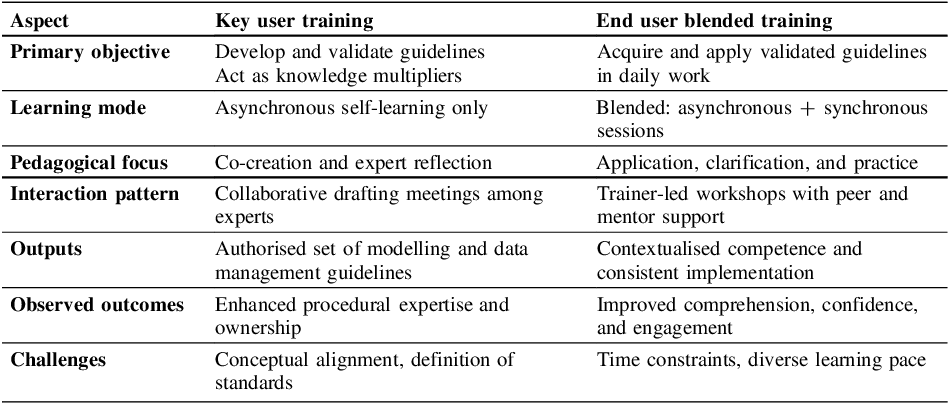
The progression from the key user phase (Reference Ngahane Nana, Arslan, Adamczyk, Ciftcioglu, Cobanoglu, Lobb, Özmen and SalianNgahane Nana et al., 2026) to the end-user stage signified a transition from knowledge creation to dissemination. While key-user training focused on developing expertise and co-authoring guidelines, the end-user phase emphasised broad comprehension and consistent application. Table 1 summarises the main differences and outcomes for both groups.
Comparison of learning outcomes between key-user and end-user training phases

4.4. Reflections on scalability and pedagogical implications
The results confirm that the blended format effectively scales a guideline-based training concept from expert groups to large, diverse user communities, while maintaining contextual relevance. By combining autonomous preparation with structured collaborative sessions, the model achieved a balance between depth of understanding and the ability to accommodate geographical and professional diversity.
However, the findings also highlight the importance of careful time management and flexible pacing in future iterations. Integrating microlearning elements, modular sessions or asynchronous discussion forums could further improve accessibility and learner interaction. From a pedagogical standpoint, the study demonstrates how blended, guideline-based learning can bridge the gap between industrial training and academic education, providing a replicable approach to developing competence in digital engineering contexts.
5. Discussion and outlook
Implementing the blended, guideline-based learning programme shows how structured pedagogical design can speed up the development of skills and strengthen organisational learning during complex digital transitions. Beyond immediate industrial objectives, the findings reveal how training methods grounded in experiential, socio-constructivist and adult learning theories can be systematically scaled up within engineering organisations and adapted for academic settings.
5.1. Interpreting the learning model
The two-phase model, which combined self-directed study of guidelines and trainer-led sessions, proved effective in balancing autonomy and social interaction. Both are essential for sustainable learning. During the asynchronous phase, participants could prepare cognitively at their own pace, allowing them to internalise foundational principles. The synchronous sessions then provided a space for reflection-in-action, testing, sharing and consolidating understanding.
This dual structure reflects the dynamics of experiential learning (Reference KolbKolb, 1984) and communities of practice (Reference WengerWenger, 1998), where knowledge evolves through dialogue and collaborative problem-solving. The iterative design, which links learning outcomes to guideline refinement, mirrors organisational learning processes (Reference ErautEraut, 2000), in which experience and codification reinforce each other. The resulting synergy between individual skill acquisition and collective standardisation is an important step towards developing sustainable digital competence.
From an evaluative perspective, the effectiveness of this blended, guideline-based model can be assessed using the following criteria (Reference Hevner, March, Park and RamHevner et al., 2004): development of procedural competence, increased confidence and autonomy in task execution, improved organisational alignment across departments, and scalability of the learning approach in distributed environments. These criteria align with design-oriented evaluation perspectives and provide a structured basis for interpreting the observed outcomes.
5.2. Implication for industrial practice
From an industrial perspective, the study shows that digital transformation depends as much on learning infrastructures as it does on technology itself (Reference Hess, Matt, Benlian and WiesböckHess et al., 2016). Introducing new software systems requires an accompanying framework to facilitate procedural understanding, knowledge transfer, and cross-departmental dialogue. Clarifying guideline interpretations during the synchronous phase of the training contributes to the consistent application of modelling and data management rules, thereby supporting stability and coherence within the PLM environment. The blended model here offers a scalable method of achieving this balance. It can be applied to large-scale CAD/PLM rollouts and other domains where procedural accuracy and shared conventions are critical, such as manufacturing execution, quality control, and systems engineering.
Furthermore, engaging key users as mentors and co-trainers created a multiplier effect, strengthening engagement and ownership. This collaborative structure reduces dependency on external trainers and enhances long term sustainability. Thus, the findings reinforce the value of integrating peer learning and expert facilitation within corporate training ecosystems.
5.3. Implication for design education
The results of the study suggest that a hybrid model represents a promising approach for design education. This model integrates guideline-based resources and blended instructional formats, thereby bridging the gap between academic theory and industrial practice. Introducing similar frameworks into university courses could familiarise students with procedural thinking, modelling standards and collaborative workflows that are central to professional design environments.
In academic settings, guidelines could serve as technical references and learning artefacts co-created by students and educators. These practices encourage critical reflection, collective authorship and iterative improvement mirroring real-world professional collaboration. Thus, the blended, guideline-based model offers a practical example of how design education can evolve towards more authentic, participatory and competence-oriented learning experiences.
5.4. Future research and development
Further research could explore how digital learning environments and emerging technologies might enhance adaptability and personalisation. Learning analytics, AI-based tutoring and interactive guideline platforms could personalise training pathways while ensuring consistency across teams. Longitudinal studies are also needed to evaluate the long-term impact of blended, guideline-based learning on productivity, design quality and knowledge retention.
Finally, fostering collaborations between universities and industry in the areas of guideline development and blended training could be mutually beneficial: academic programmes would gain authentic learning contexts, and companies could draw upon educational expertise to refine their pedagogical strategies.
6. Conclusion
This study demonstrates the effectiveness of a blended, guideline-based learning model in bridging the gap between technological change and human learning during CAD/PLM transitions. Combining asynchronous self-study with interactive, trainer-led collaboration, the approach promoted procedural understanding, consistency, and engagement throughout the organisation. Integrating key users as mentors ensured knowledge continuity and strengthened organisational learning. This confirms that sustainable digital transformation requires technical systems and pedagogical structures (Reference Garetti, Terzi, Bertacci and BrianzaGaretti et al., 2005).
Beyond its industrial application, the model is also relevant to design education more broadly. Although the specific organisational context and systems depend on the case in question, the learning design and pedagogical principles described in this study can be transferred to comparable CAD/PLM transitions and other domains requiring standardised, procedure-driven digital work. The model offers a transferable framework that connects experiential, socio-constructivist and adult learning principles with authentic engineering practice. Incorporating similar approaches into academic curricula could prepare future engineering designers to work within standardised, collaborative, and evolving digital ecosystems. In this sense, the blended, guideline-based approach supports not only system adoption, but also contributes to shaping the pedagogical foundations of digital engineering competence for the next generation of engineering design professionals.


 Open access

