




Thysanoptera is a cosmopolitan and diverse insect order that comprises approximately 6400 species (De Borbón and Zamar Reference De Borbón, Zamar, Claps, Roig-Juñent and Morrone2023; Mirab-balou Reference Mirab-balou2025). Nine families of thysanopterans have been recognised, with a high variation in the number of species among them. For instance, Thripidae and Phlaeothripidae comprise more than 90% of the species. Uzelothripidae, the smallest family, comprises only one species, namely Uzelothrips scabrosus Hood (Mound and Marullo Reference Mound and Marullo1996). The Uzelothripidae is considered a primitive clade, with the oldest and only thrips fossil, Uzelothrips eocenicus Nel and Nel, known from a 53-million-year-old specimen preserved in a piece of amber that was collected in France (Nel et al. Reference Nel, Schmidt, Bassler and Nel2013). Uzelothripidae has long been considered a phylogenetically enigmatic family of thrips that presents an unusual combination of morphological features (Mound Reference Mound1983), which is essential for understanding the evolution and phylogeny of Thysanoptera (Mound and Marullo Reference Mound and Marullo1996; Nel et al. Reference Nel, Schmidt, Bassler and Nel2013; Macedo et al. Reference Macedo, Alencar, Silva, Silva and Lima2023).
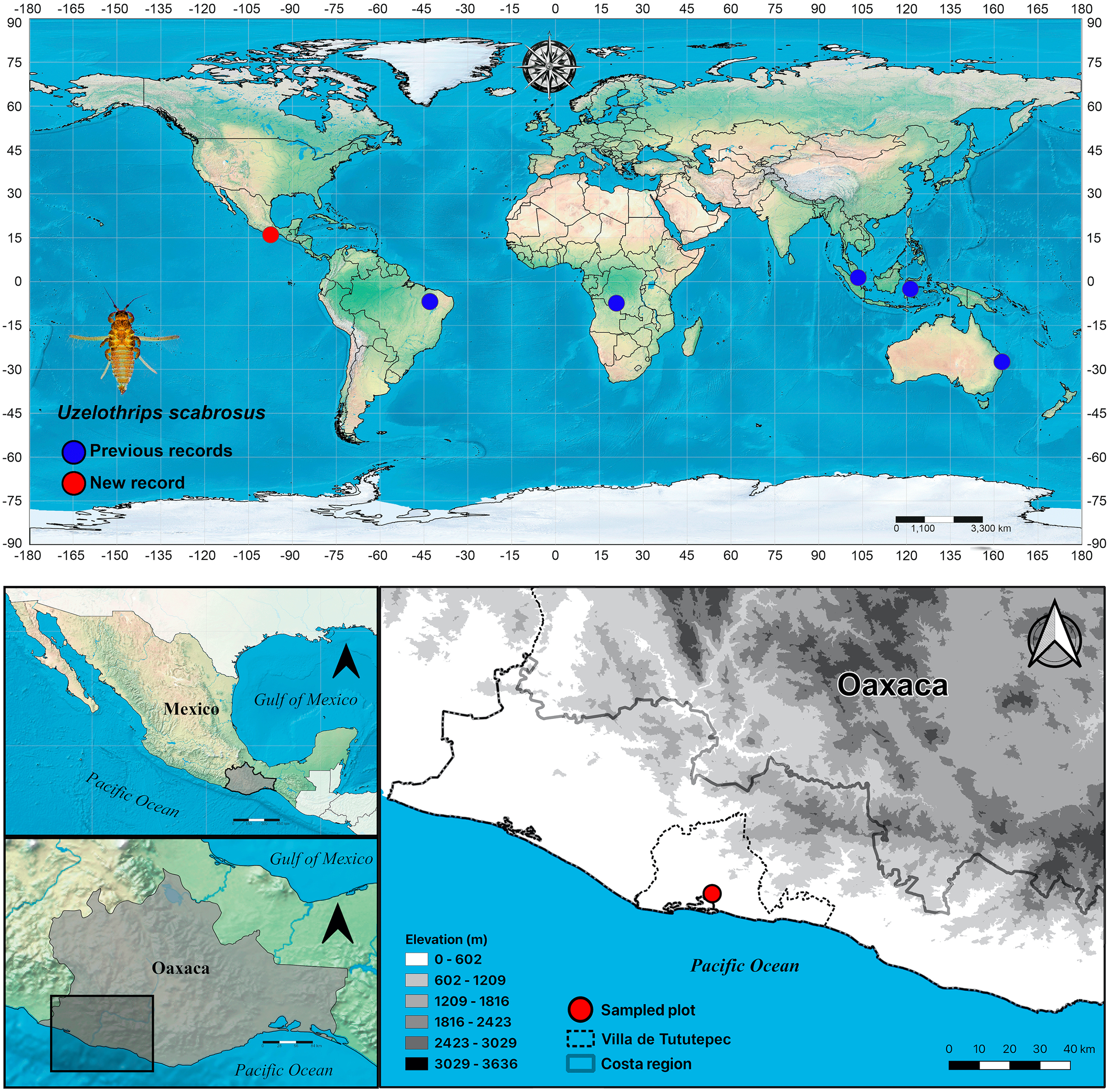
Described from specimens collected in Belem, Pará, Brazil (Hood Reference Hood1952), U. scabrosus was subsequently recorded from Angola, Australia, Indonesia, and Singapore (Mound et al. Reference Mound, Heming and Palmer1980; Tree Reference Tree2009; Macedo et al. Reference Macedo, Alencar, Silva, Silva and Lima2023). The species appears to have a geographic distribution restricted to tropical regions. With no bioecological studies on this species to date, little is known about the habits and biology of U. scabrosus in nature. Preliminary field observations suggest that the species lives on leaf litter and dead twigs and feeds on fungal spores (Hood Reference Hood1952; Mound et al. Reference Mound, Heming and Palmer1980). Uzelothrips scabrosus is not considered a pest of cultivated plants.
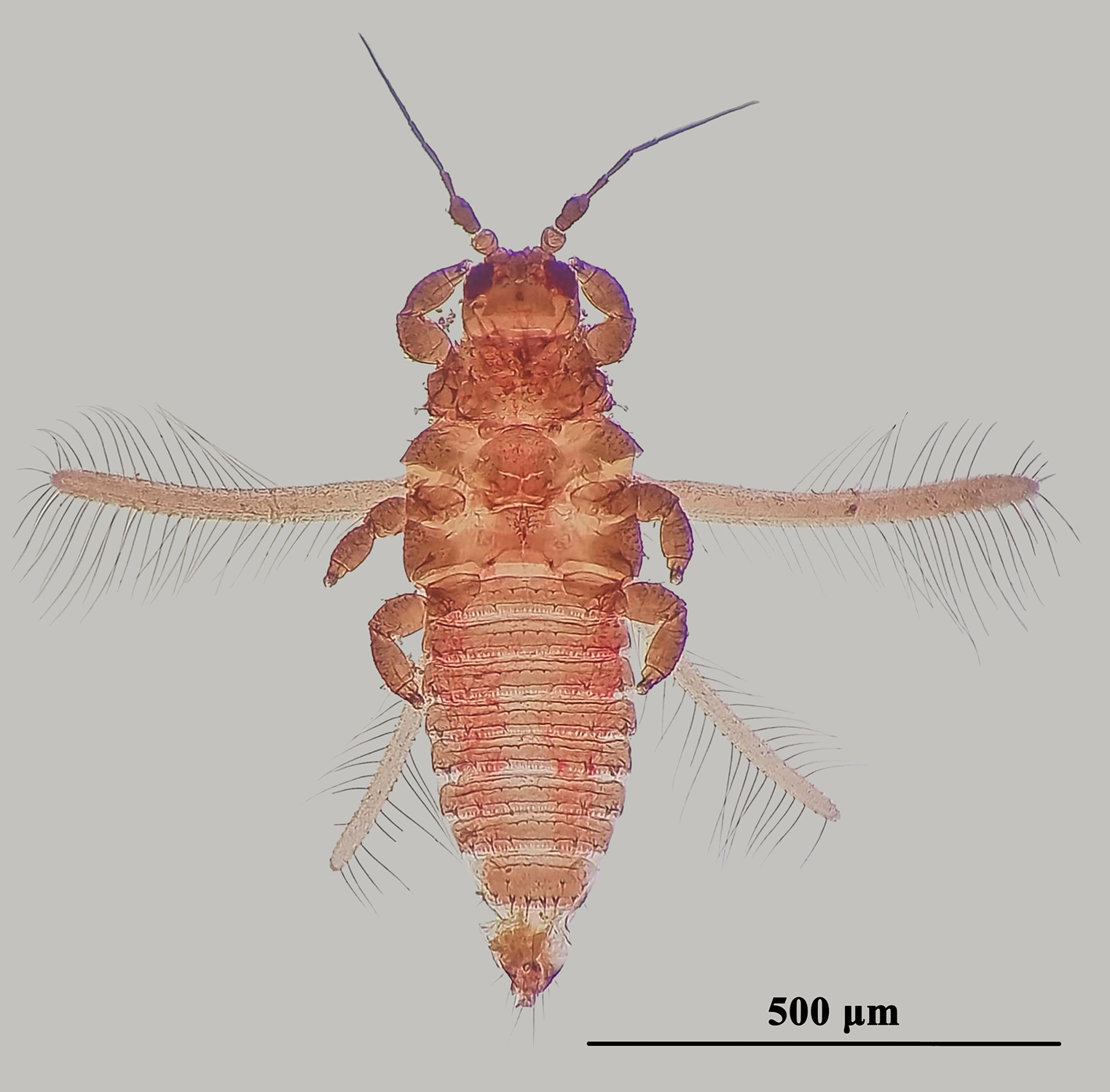
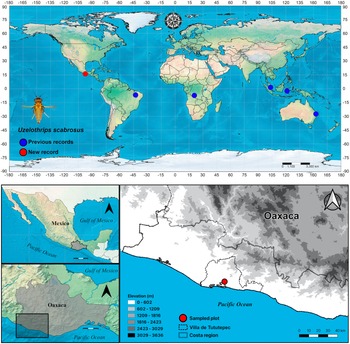
We recovered a single adult specimen of U. scabrosus from mango flowers over the course of an ecological study on mango insect pests (Fig. 1). The specimen was collected in a mango orchard located at Ejido Los Llanos, Villa de Tututepec, Oaxaca, Mexico (16° 01' 23" N, west 97° 33' 19" W, 15 m above sea level; Fig. 2). Because this species has been previously reported as mycophagous, its presence on mango flowers should be considered accidental. The specimen was mounted in Hoyer’s medium for examination.
Slide-mounted specimen of a macropterous adult female of Uzelothrips scabrosus Hood. This is the only known living species in the Uzelothripidae family.
Updated map showing the locations where Uzelothrips scabrosus has been collected worldwide.
Diagnosis. Adult female is very small (0.8 mm). Head is wider than long. Antennae is seven segmented, long, and slender; segment III bears a circular sensorium ventrally at the apex; segment VII is at least 30 times longer than wide. Fully developed wings, forewings with no longitudinal veins and straight cilia. The body surface is strongly sculptured, with a craspedum on the posterior margin of each tergite. Legs short and stout. Pronotum trapezoidal, with two pairs of broadly capitate posteroangular setae. Ovipositor membranous, with valves absent. These taxonomic characteristics matched well with those reported by Hood (Reference Hood1952), Mound and Marullo (Reference Mound and Marullo1996), and Mound et al. (Reference Mound, Heming and Palmer1980). Uzelothrips scabrosus exhibits wing polymorphism, producing both macropterous and apterous adults (Hood Reference Hood1952). To the best of our knowledge, Figure 1 is the first image published for a winged female; other studies have presented only the apterous form. The specimen has been deposited at the entomological collection of El Colegio de la Frontera Sur (ECOSUR; Tapachula, Chiapas, Mexico).
Our discovery expands the known geographic range of U. scabrosus to six countries, with this finding representing the first record of the species in Mexico. After Brazil, this is the second record of this uncommon thysanopteran in the Americas. The new record matches well with the niche modelling prediction for U. scabrosus, which included Mexico as a suitable region for the species’ occurrence (Macedo et al. Reference Macedo, Alencar, Silva, Silva and Lima2023). The discovery also reinforces the importance of surveys in poorly sampled areas to better understand the distribution patterns of Thysanoptera. Many disjunct distributions of thrips may be only artifacts of poor surveys.
Acknowledgements
The authors thank Laurence A. Mound, Commonwealth Scientific and Industrial Research Organisation (CSIRO), Canberra, Australia, for confirming the identity of the species reported herein.
Competing interests
The authors declare that they have no conflicts of interest.

 Open access

