


For some time now there has been a shift towards greater public accountability within the health service and more involvement of patients in discussions about their health (Reference Farrell, Levenson and SnapeFarrell et al, 1998). Under the Health Records Act 1990 and the Data Protection Act 1998 patients have the right to access their medical records and to see what is written about them. The National Health Service (NHS) Plan (Department of Health, 2000) and the Government’s response to the Kennedy report (Reference KennedyKennedy, 2001) (recommendation 17) set out the Government’s intention that patients should receive, as of right, letters about them written from one health professional to another. The objective of this policy is to improve communication with patients and enable them to participate in their care. In response, a working group on copying letters to patients was set up by the Department of Health (Reference MeredithMeredith, 2002). During 2002 the Government established pilot schemes and directed that from April 2004 all patients should receive by right copies of letters written about them from one health professional to another (Reference Chantler and JohnsonChantler & Johnson, 2002). Although successful models for copying letters in general medicine, general practices and genetic and special clinics have been reported, fears about patients who lack insight, might not accept a diagnosis of mental illness or might not cooperate with treatment and care plans have made mental health services an area of particular concern for the implementation of this idea.
A study by Asch et al (Reference Asch, Price and Hawks1991) in a psychiatric out-patient clinic found that patients who received a summary of their consultation were significantly more satisfied with their consultation than those who did not receive one. Similarly, Humfress & Schmidt (Reference Humfress and Schmidt1997) found a greater satisfaction of patients when a personalised summary was sent to them. However, Parrott et al (Reference Parrott, Strathdee and Brown1988) reported considerable problems in a forensic setting as a result of a patient accessing letters. Nandhra et al (Reference Nandhra, Murray and Hymas2004) reported that general adult psychiatric patients found it helpful to receive copies of their assessment letters. Similarly, Lloyd (Reference Lloyd2004) showed that patients approved of receiving copies of their letters, but suggested that a ‘ narrow path’ would have to be followed to maintain trust while avoiding paternalism, complaints and litigation.
In old age psychiatry matters may be even more complicated. Patients may lack capacity for decisions, they may have dementia and information often comes from third parties (e.g. relatives, carers and others involved with the patient). With severe cognitive impairment, sharing of information with carers may be both helpful and good practice, but confidentiality is an inevitable concern (General Medical Council, 2000).
We began sharing letters with patients from 2000 onwards, routinely (for A.T.) from 2001. In this study we wanted to assess the impact of this service on patients and carers and also solicit the views of psychiatrists in our area. Null hypotheses tested were:
-
(a) that patients and carers do not wish to receive and do not like receiving copies of letters about them;
-
(b) that there is no evidence of improved outcomes as a result of this practice;
-
(c) that there is no anxiety about doing this among consultants in old age psychiatry.
Method
The study period was April to July 2003. All patients and carers attending four out-patient clinics (two memory, two functional) in the Oxleas NHS Trust Memorial Hospital during this period were approached once. At that time about half of all patients were receiving copies of letters to their general practitioners. All those attending the clinics were asked to complete semistructured questionnaires while waiting for their appointment. By asking them to fill out the questionnaire while waiting for review appointments, we ensured that respondents could not refer back to letters they had received. To test hypothesis (a), those who had received a letter from their previous attendance were asked how useful and welcome the letter had been, whether it was accurate and whether it had caused any problems or distress. Those who did not receive letters were asked if they would have had any anxieties or concerns receiving such a letter.
To test hypothesis (b), all patients were asked to name the person they would contact at the hospital if a problem arose, and to state how easy it was to find the telephone number of the clinic or doctor’s secretary and what had been decided at the time of their last appointment (care plan). They were also asked if they would like a copy of letters from future appointments.
For hypothesis (c), in a separate part of the overall study, we sent questionnaires to all old age psychiatrists in the former South East Thames Regional Health Authority region asking about their current practice, what concerns they had and what experience of sharing letters they had. Semi-structured questionnaires were sent by post or in electronic form.
Data were analysed with the Statistical Package for the Social Sciences, version 11.5. Chi-squared tests were applied for the three outcome variables (ease of finding the telephone number, whom to contact in case of problems, what was planned in the clinic) between those who had received a letter and those who had not. Only the valid cases were analysed (those who gave answers). If more than 20% of the cells had expected frequencies less than 5 in (row × column) tables, or if any cell had expected frequency less than 5 in 2 × 2 tables, Fisher’s exact test was calculated and reported. Similarly, doctors’ answers were calculated using χ 2 tests. In addition, qualitative data (doctors’ free text responses) were analysed with QRS NVivo qualitative analysis software, version 2. The study was approved by the Greenwich local research ethics committee.
Results
Patients and carers
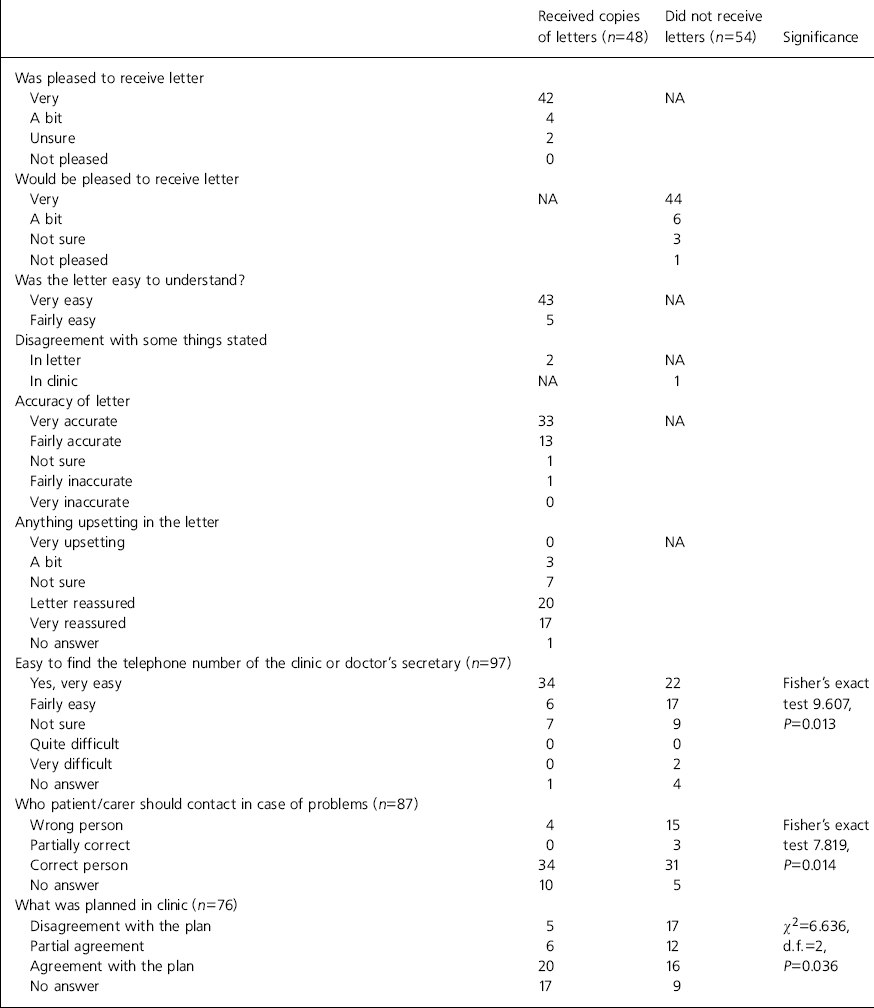
Questionnaires were given to 112 patients and carers and 102 questionnaires were returned completed (response rate 91%). Sixty-two questionnaires were completed by carers, the rest by patients themselves. The primary diagnosis was dementia in 52 cases, and there were 50 cases of non-dementia mental illness. Questionnaires were filled out by carers in 43 cases of dementia. Forty-eight patients had received copies of letters; patients who received letters had better recollection of the care plan, knew better whom to contact in case of emergency and could more easily find the contact number of the clinic or the doctor’s secretary compared with those who did not receive a letter (Table 1).
Results of patient and carer questionnaires
| Received copies of letters (n=48) | Did not receive letters (n=54) | Significance | |
|---|---|---|---|
| Was pleased to receive letter | |||
| Very | 42 | NA | |
| A bit | 4 | ||
| Unsure | 2 | ||
| Not pleased | 0 | ||
| Would be pleased to receive letter | |||
| Very | NA | 44 | |
| A bit | 6 | ||
| Not sure | 3 | ||
| Not pleased | 1 | ||
| Was the letter easy to understand? | |||
| Very easy | 43 | NA | |
| Fairly easy | 5 | ||
| Disagreement with some things stated | |||
| In letter | 2 | NA | |
| In clinic | NA | 1 | |
| Accuracy of letter | |||
| Very accurate | 33 | NA | |
| Fairly accurate | 13 | ||
| Not sure | 1 | ||
| Fairly inaccurate | 1 | ||
| Very inaccurate | 0 | ||
| Anything upsetting in the letter | |||
| Very upsetting | 0 | NA | |
| A bit | 3 | ||
| Not sure | 7 | ||
| Letter reassured | 20 | ||
| Very reassured | 17 | ||
| No answer | 1 | ||
| Easy to find the telephone number of the clinic or doctor’s secretary (n=97) | |||
| Yes, very easy | 34 | 22 | Fisher’s exact test 9.607, P=0.013 |
| Fairly easy | 6 | 17 | |
| Not sure | 7 | 9 | |
| Quite difficult | 0 | 0 | |
| Very difficult | 0 | 2 | |
| No answer | 1 | 4 | |
| Who patient/carer should contact in case of problems (n=87) | |||
| Wrong person | 4 | 15 | Fisher’s exact test 7.819, P=0.014 |
| Partially correct | 0 | 3 | |
| Correct person | 34 | 31 | |
| No answer | 10 | 5 | |
| What was planned in clinic (n=76) | |||
| Disagreement with the plan | 5 | 17 | χ 2=6.636, d.f.=2, P=0.036 |
| Partial agreement | 6 | 12 | |
| Agreement with the plan | 20 | 16 | |
| No answer | 17 | 9 |
Although 81% of those who had not received copies of letters said letters would be ‘very welcome’, there was more anxiety that doing so might cause distress or problems. Where the primary diagnosis was dementia and information was shared with carers, the carers of the patients with dementia who received a copy of the letter had better recollection of the treatment plan (Fisher’s exact test 7.607, P=0.014) and they felt that it was easier to find a contact number (adjusted residual=2.4, overall Fisher’s exact test shows only a trend, P=0.058). However, there was no difference between the groups regarding the outcome variable ‘ whom they would contact if a problem arose’. Using free text responses, three respondents reported distress from the letter and seven respondents described reassurance from the letter in the same question (Box 1).
Doctors
Of 46 consultants identified, we contacted 38 (there were 8 wrong addresses) in the old South East Thames Regional Health Authority area, sent them questionnaires and received 25 answers (66% response rate) without reminders. Only two consultants sent copies of their letters to the patients (one to more than 80% and the other to about 50%); both avoided medical terminology in their letters or tried to explain medical terminology. One had a rate of complaints from patients of about 1% and the other had a rate of about 5%. Both consultants found this procedure helpful, as did their patients.
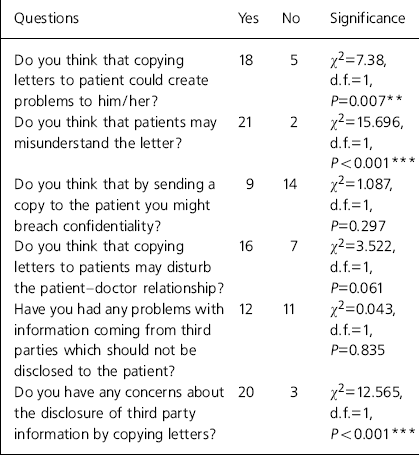
The other 23 consultants did not send copies of letters to their patients; their answers are shown in Table 2. We coded the doctors’ free text responses, and developed them into thematic categories. These are summarised in Box 2. Some consultants expressed anxieties more than once in the same category. The most frequent worries expressed by doctors (expressed in free text, 29 statements) were that sharing the letter would disrupt the therapeutic relationship or offend the patient. The next most frequent concern (n=23) was about third parties not wanting to let patients know what was going on, or having the information they had given about the patient shared with the patient. Confidentiality (n=9), misunderstanding caused by letters (n=7), the need for separate letters specifically for the patient (n=2) and problems of psychosis (n=3) were also mentioned. Content analysis of doctors’ answers highlights the level of worries through the frequency of words with ‘negative’ meaning. These ‘ negative’ words were ‘problems’ (n=7), ‘ concerns’ (n=6), ‘distress’ (n=6), ‘ upset’ (n=5), ‘risk’ (n=3), ‘ conflicts’ (n=3) and ‘censor’ (n=2). Some of the most typical thoughts and anxieties expressed are presented in Box 2.
Results of consultant questionnaires
| Questions | Yes | No | Significance |
|---|---|---|---|
| Do you think that copying letters to patient could create problems to him/her? | 18 | 5 | χ 2=7.38, d.f.=1, P=0.007* * |
| Do you think that patients may misunderstand the letter? | 21 | 2 | χ 2=15.696, d.f.=1, P<0.001* * * |
| Do you think that by sending a copy to the patient you might breach confidentiality? | 9 | 14 | χ 2=1.087, d.f.=1, P=0.297 |
| Do you think that copying letters to patients may disturb the patient—doctor relationship? | 16 | 7 | χ 2=3.522, d.f.=1, P=0.061 |
| Have you had any problems with information coming from third parties which should not be disclosed to the patient? | 12 | 11 | χ 2=0.043, d.f.=1, P=0.835 |
| Do you have any concerns about the disclosure of third party information by copying letters? | 20 | 3 | χ 2=12.565, d.f.=1, P<0.001* * * |
Discussion
This study showed substantial anxiety among consultants in old age psychiatry about the idea of sharing copies of their letters to general practitioners with their patients. This is in marked contrast to the views of patients and carers as well as to the finding of improved outcomes. The study’s limitations were that the patient and carer study was conducted in only one district, and that the consultants survey was conducted in one part of the UK. Although the findings are not therefore automatically generalisable, we are confident that they do reflect the perceptions and feelings of the older patients attending our out-patient and memory clinics.
Old age consultants’ anxieties resembled those of the general adult psychiatrists surveyed by Nandhra et al (Reference Nandhra, Murray and Hymas2004) and suggest that introducing letter-sharing in old age psychiatry would have similar problems. Main areas of concern were disruption of therapeutic relationships, misunderstanding of letters by patients and disclosure of third party information. In complete contrast, our patients and carers welcomed letter-sharing. The responses of patients were similar to those in general adult psychiatry studies (Reference Asch, Price and HawksAsch et al, 1991; Reference LloydLloyd, 2004; Reference Nandhra, Murray and HymasNandhra et al, 2004) and with similar questions our patient group appeared to be even more welcoming of the practice. We also demonstrated improved knowledge outcomes in patients and their carers about what is recommended for the patient medically, and better knowledge about whom to contact if problems arise. It is of particular interest that in this group of patients, where carers have such a central role, concerns about confidentiality did not arise. This suggests that in day-to-day work, confidentiality might be more of a theoretical concern than an actual problem. Stacked up against the benefits of information-sharing for the patient, this is welcome news. It is likely that sharing letters with patients will lead to some alteration of content, most probably towards simpler and more broadly understandable language. This is probably unobjectionable.
Although further practice development in this area is appropriate, we believe that there is no justification for delaying widespread implementation of this practice in our care group.
Box 1. Free text responses from patients and carers who received copies of letters
Upsetting
-
• The situation highlighted in the letter was inaccurate
-
• Upsetting to come to terms with diagnosis (completed by relative)
-
• Nothing positive in it
Reassuring
-
• Felt it was positive
-
• To know that there wasn’t anything that you were telling my doctor but not me
-
• It was reassuring to have an accurate assessment of my illness
-
• I felt that I could see in written words what our family problem was all about and it was a help in that way
-
• It’s good to have confirmation of what has been discussed at the last appointment and reassuring to know that the GP is fully informed
-
• Reassuring to have a record of the visit
-
• It was reassuring that it conveyed to us and X’s GP what had been discussed at that visit
GP, general practitioner.
Box 2. Free text responses from consultants
Concerns that the patient might misunderstand what is said
• They would not understand the jargon
Concerns that patients may be offended or the therapeutic relationship disrupted
-
• Not the majority of times but occasionally people with no insight may lose their trust. Some times it can also be detrimental because the information will distress the patient
-
• Some information might be shocking or harmful. It might exacerbate family conflicts
Problems specific to the presence of psychosis
• For some, not all. Some unable to understand, psychotic that may lack insight. For those letters have to be censored that would make them pointless. For most patients it would probably not cause problems
The need for separate letters to the patient
• The only way this would work is if we wrote a completely different letter for patients
Concerns about confidentiality
-
• Depending on who has access to the letters
-
• Except if it contains information passed on from a third party and we do not have their permission to disclose it
-
• Older patients’ post will be opened by others
Concerns that the patient should not know what relatives or third parties feel he/she should not know
-
• Usually manage to get round the‘don’t say I told you…’ but there is a risk of causing difficulties within families/caring relationships
-
• May be risk of physical/psychological abuse to informant
-
• I would censor my letters
Acknowledgements
We are grateful to Annette Gayson for help with the study and to Dr S. Singh for helpful advice and feedback on earlier drafts of the paper.


 Open access


eLetters
No eLetters have been published for this article.