


Introduction
The coastal marine bivalve mollusc Mya arenaria is considered to have become extinct in northwest Europe during the (late) Pleistocene (Strasser, Reference Strasser1999; Lasota et al., Reference Lasota, Hummel and Wolowicz2004). The species remained present along the Atlantic coasts of North America. Van Benthem Jutting (Reference Van Benthem Jutting1942), however, states that M. arenaria was present during several Holocene periods in the Netherlands. A re-introduction to European coasts did not occur for a long time. The species was not found in Stone Age kitchen middens (‘køkkenmøddinger’) around the North Sea and the Atlantic coast of France (Hessland, Reference Hessland1946; Petersen et al., Reference Petersen, Rasmussen, Heinemeier and Rudd1992; Dupont et al., Reference Dupont, Schulting, Tresset, Milner, Craig and Bailey2007, Reference Dupont, Tresset, Desse-Berset, Gruet, Marchand and Schulting2009), nor in a Bronze Age shell midden in Normandy (France) (Mougne et al., Reference Mougne, Dupont, Giazzon and Quesnel2014). It didn't show up either in Roman and post-Roman middens (Dubois, 1924, in Bernard, Reference Bernard1979). In Rondeletius (Reference Rondeletius1554) no description is given of a Mya-resembling bivalve among his listing of over 70 species from Gallia and Germania superior. The first record in Western Europe of a living specimen was reported in Belgium in 1583 (Raeymaekers, 1898, in Bernard, Reference Bernard1979). The oldest record of living M. arenaria in the Netherlands is from a creek in the southwest Netherlands (Baster, Reference Baster1765). These records were considered the result of transport of the species by early (16th century) French colonisers of the North American Atlantic shores (Petersen et al., Reference Petersen, Rasmussen, Heinemeier and Rudd1992). There are, however, finds of older M. arenaria shells at the Kattegat coast, northern Denmark (dated 1245–1295 AD by Petersen et al., Reference Petersen, Rasmussen, Heinemeier and Rudd1992) and in the Greifswalder Bodden, southern Baltic Sea (dated 1310 + 70 AD by Behrends et al., Reference Behrends, Hertweck, Liebezeit and Goodfriend2005). These finds, clearly predating Columbus’ discovery of America in 1492, support the hypothesis by Petersen et al. (Reference Petersen, Rasmussen, Heinemeier and Rudd1992) of Viking-mediated transport of this species c. 200 years earlier. In this paper we report on the ages of shells of M. arenaria found in old coastal deposits in the Netherlands and answer the question of whether these are pre-Columbian or not.
Materials and methods
Sampling
Samples of M. arenaria were collected at five locations in the Netherlands (Fig. 1). Further sample information is given in Table 1. Location 1 is in the Noordpolder in the northern part of the province of Groningen, where shells were collected by the third author from newly dug polder ditches where the bottom of a filled former tidal creek became visible (Fig. 2). Location 2 is also in the Noordpolder; here, Mya shells were collected by the third author from a dredged polder canal. Location 3 consists of two sites northwest and southwest, respectively, of the fishing village of Zoutkamp. At location 3a (Vierhuizen), a Mya shell was collected by geologist Peter C. Vos during the construction of a natural gas pipeline (Bakker et al., Reference Bakker, la Fèber and Vos2009) just seaward of the old dike of the Lauwerszee. At location 3b (Zoutkamp-SW) a Mya shell was collected by the third author from a newly dug ditch.
A. Locations in the Netherlands where shells of Mya arenaria were found. 1–3, Province of Groningen; 4, Wijker Tunnel; 5, Katwijk aan de Rijn; B. Details of the Groningen area: solid black line indicates the sea dike; thin black line shows roads; dashed line indicates Lake Lauwersmeer. See text for further description of locations and inferred paleo-environment.

Information on the Mya arenaria shells and the results of age determination, calibration and abundance ratios for stable C and O isotopes. For locations see Fig. 1. X and Y: RD (Amersfoort) co-ordinates. The 14C age (1-sigma) and calibrated ages are rounded to the nearest 5. Further explanation in the text.

Cross-section and dimensions of the filled former tidal creek at location 1, Noordpolder, province of Groningen. Rectangle shows the position of shell valves of Mya arenaria. (Photo: Dr K. Essink.)

Location 4 is in the western part of the Netherlands, east of IJmuiden. Here, small articulated shells of M. arenaria were collected by Dr T. Meijer (RGD – Geological Survey of the Netherlands) in 1993 in the building pit for the Wijker Tunnel, which provides an A9 motorway crossing underneath the North Sea Canal between IJmuiden and Amsterdam (Beets et al., Reference Beets, De Groot and Davies2003).
Also in the western part of the Netherlands, shells of M. arenaria were collected in the 1950s near Katwijk aan de Rijn (location 5) by the late Dr E.H.J. Warns, a non-professional resident malacologist. Part of his shell collection came into the possession of the second author in 2013. Unfortunately, the documentation regarding the find location of Mya shells in the historic estuary of the River Rhine (‘Old Rhine’) had been lost. Shells were partially covered with traces of clay, suggesting fairly sheltered sedimentary conditions. Among this shell material was one doublet, indicating that the specimen was found in a living position (in situ). Of this doublet one valve was used for radiocarbon age determination.
Age determination and stable isotopes
All shells were dated at the Centre for Isotope Research (CIO), Groningen. Samples received the standard chemical treatment (Mook & Streurman, Reference Mook, Streurman, Mook and Waterbolk1983). Age determination of the samples from locations 1–3 was done using the conventional 14C method (GrN-code; Mook & Streurman, Reference Mook, Streurman, Mook and Waterbolk1983). The samples from locations 4 and 5 were dated using accelerator mass spectrometry (AMS; GrA-code; Van der Plicht et al., Reference Van der Plicht, Wijma, Aerts, Pertuisot and Meijer2000). The dates are reported in conventional radiocarbon years (BP), i.e. measured relative to the oxalic acid reference, using the conventional half-life value and including normalisation for isotope fractionation using the 13C isotope (Mook & Van der Plicht, Reference Mook and Van der Plicht1999). Shell samples are subject to reservoir effects; these need to be subtracted from the conventional age before transformation to calendar years can be done (see Discussion).
In addition to 14C, the content of the stable isotopes 13C and 18O of the shell carbonates was also measured by isotope ratio mass spectrometry (IRMS) using the international standard VPDB as reference material (Mook, Reference Mook2006).The results are expressed as delta values, i.e. deviations (in ‰) of the rare/abundant isotope ratio from reference materials:
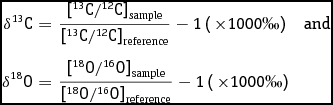 $$\begin{eqnarray*}
\delta {}^{13}{\rm C} = \frac{{{{[{}^{13}{\rm C}/{}^{12}{\rm C}]}_{\rm sample}}}}{{{{[{}^{13}{\rm C}/{}^{12}{\rm C}]}_{\rm reference}}}} - 1\,(\, \times 1000\textperthousand)\quad {\rm{and}}\\
\delta {}^{18}{\rm O} = \frac{{{{[{}^{18}{\rm O}/{}^{16}{\rm O}]}_{\rm sample}}}}{{{{[{}^{18}{\rm O}/{}^{16}{\rm O}]}_{\rm reference}}}} - 1\,(\, \times 1000\textperthousand)
\end{eqnarray*}$$
$$\begin{eqnarray*}
\delta {}^{13}{\rm C} = \frac{{{{[{}^{13}{\rm C}/{}^{12}{\rm C}]}_{\rm sample}}}}{{{{[{}^{13}{\rm C}/{}^{12}{\rm C}]}_{\rm reference}}}} - 1\,(\, \times 1000\textperthousand)\quad {\rm{and}}\\
\delta {}^{18}{\rm O} = \frac{{{{[{}^{18}{\rm O}/{}^{16}{\rm O}]}_{\rm sample}}}}{{{{[{}^{18}{\rm O}/{}^{16}{\rm O}]}_{\rm reference}}}} - 1\,(\, \times 1000\textperthousand)
\end{eqnarray*}$$
Results
All relevant data and results are presented in Table 1. This table contains administrative data such as sampling locations, location co-ordinates, dates of sampling and laboratory codes. For the Mya shells analysed the length is given in millimetres when known. The shells from location 3a (Vierhuizen) were fragments, not an entire valve. Table 1 also shows the stable isotope ratios δ13C and δ18O (in ‰), and the measured (not-normalised) 14C activity ratio 14a (in %). The latter is defined as 14a = 14Asample/14Areference, with 14A being the 14C radioactivity in bequerels per gram of carbon (Mook & Van der Plicht, Reference Mook and Van der Plicht1999).
After normalisation for isotope fractionation, the 14a value provides the conventional 14C age (BP) with 1σ confidence levels. This approach is valid for terrestrial samples that are in equilibrium with the atmosphere. The ocean and rivers, however, contain less 14C than the atmosphere, hence shells show apparent ages: the so-called reservoir effect. This has to be subtracted from the conventional age.
For the North Sea, the reservoir effect is 400 years (e.g. Reimer et al., Reference Reimer, Bard, Bayliss, Beck, Blackwell, Bronk Ramsey, Buck, Edwards, Friedrich, Grootes, Guilderson, Haflidason, Hajdas, Hatté, Heaton, Hoffmann, Hogg, Hughen, Kaiser, Kromer, Manning, Niu, Reimer, Richards, Scott, Southon, Staff, Turney and Van der Plicht2013), certainly for the time range discussed here. For rivers, the reservoir effect is significantly larger, typically 1300 years for the Rhine (Lanting & Van der Plicht, Reference Lanting and Van der Plicht1998). Estuaries, where sea water and river water are mixed, obviously show intermediate values (e.g. Philippsen et al., Reference Philippsen, Olsen, Lewis, Rasmussen, Ryves and Knudsen2013; Reimer, Reference Reimer2014). To obtain absolute dates for shells from the coastal area of the Netherlands, it is therefore necessary to assess the environment these bivalves were living in. This determines the recent activity of the shells during their lifetime. This is lower than the activity for contemporaneous terrestrial organisms, which translates in apparent ages: the reservoir effect.
The samples from locations 1–4 are fully marine, hence the reservoir effect can be taken as 400 years. For the Mya shell from Katwijk, a reservoir effect of 840 years applies (see Discussion). The calibrated ages (1σ and 2σ) of the Mya shells from locations 1–4 are all older than 1492 AD. The possible age of 1600–1615 AD (2σ) for the shell from location 2 should be disregarded because at that time the find location was agricultural land that had been endiked some centuries before. This second date range is caused by a fluctuation in the calibration curve; it has a low probability (c. 1%) and can also mathematically be neglected. The calibrated age of the Mya shell from location 5 is much younger (1485–1800 AD; 2σ).
Paleogeographic setting
The Noordpolder (sampling locations 1 and 2) is a former salt marsh area in the Wadden Sea; it was endiked in 1811. The older subsoil of the Noordpolder consists of marine sediments in which the following bivalve species were found: cockle (Cerastoderma edule), blue mussel (Mytilus edulis), Baltic tellin (Macoma balthica), peppery furrow shell (Scrobicularia plana) and soft-shell clam (M. arenaria). Judging from the age determinations on this material (Streurman & Van der Plicht, Reference Streurman and Van der Plicht2014) the subsoil of the Noordpolder and adjacent polders was an intertidal flat biotope at least between c. 700 and 1500 AD.
The find location 3a (near Vierhuizen) is on the seaward side of the dike of the former Lauwerszee, an embayment of the Wadden Sea, which was endiked in 1969 (see Fig. 1). The Lauwerszee was initially formed by a series of sea intrusions in the coastal peat landscape between 600 and 800 AD, and reached its largest extension between 1000 and 1200 AD. The salt marsh area north of the find location 3a was endiked as late as 1875–1877 (Westpolder) and the area south of it was endiked in 1927 (Kerkvoogdijpolder).
The find location 3b (Zoutkamp-SW) is in the Nieuwe Ruigezandsterpolder on the landward side of the dike that closed the Reitdiep estuary in 1877, after which this polder was embanked (Roeleveld, Reference Roeleveld1974; Hacquebord & Hempenius, Reference Hacquebord and Hempenius1990). At both these locations intertidal flats were present for centuries, as is shown on the much detailed Beckering Chart of the Province of Groningen from 1781. Paleogeographic reconstruction maps for c. 800 AD and c. 1150 AD by P.C. Vos and S. de Vries also indicate intertidal flats present at the find locations 3a and 3b (see Van Beek & Vos, Reference Van Beek and Vos2008).
Find location 4 (Wijker Tunnel) is in the historic Oer-IJ estuary that provided outflow of the small river Vecht (a Rhine tributary) to the North Sea. When the river Vecht connected to Lake Flevo in Roman times, the mouth of the estuary silted up; a small opening may have remained until c. 1100 AD (Roep et al., Reference Roep, Van der Valk and Beets1991; Beets et al., Reference Beets, De Groot and Davies2003). Articulated valves of juvenile M. arenaria and Cerastoderma glaucum were found in a layer of lacustrine (Zuiderzee) clays less than 1 m thick (unit 7). These shells and clay are considered to indicate new brackish conditions that resulted from the north-oriented progressive opening up of the Flevo Lakes to the North Sea, first creating the tidal Almere lagoon (c. 850 AD) and then the brackish tidal embayment of the Zuiderzee that reached its maximum size around 1200 AD (Zagwijn, Reference Zagwijn1971; Lenselink & Koopstra, Reference Lenselink, Koopstra, Rappol and Soonius1994; Vos et al., Reference Vos, De Koning and Van Eerden2015).
Location 5 (Katwijk aan de Rijn) is in the estuary of the historic Rhine river, which once formed the northern border (limes) of the Roman Empire (Van Dinter, Reference Van Dinter2013). From around 250 AD onwards the river branch Lek became increasingly important for discharging via Rotterdam into the North Sea. As a consequence, the discharge through the Old Rhine towards Katwijk decreased, causing silting up of the river mouth (Henderikx, Reference Henderikx1987; Bazelmans et al., Reference Bazelmans, Weerts and Van der Meulen2011). It is assumed that this river mouth was finally closed off from the North Sea after reduction of river discharge and the building of a dam (Zwammerdam) far upstream and the effect of a storm surge in 1163 (Buisman, Reference Buisman1995; Van Dam, Reference Van Dam1999; Parlevliet, Reference Parlevliet2001; Van de Ven, Reference Van de Ven2004). The closure of the river mouth was certainly not much later than 1200 AD (Van Heeringen & Van der Valk, Reference Van Heeringen and Van der Valk1989; Van de Ven, Reference Van de Ven2004).
Discussion
Marine or estuarine lifetime conditions
In our samples we used the stable isotopes 13C and 18O as tracers for their lifetime environment. For the North Sea, shells typically show δ13C and δ18O values of c. 1.5‰ and c. 1.0‰, respectively (Mook, Reference Mook1970). For the river Rhine, the δ13C and δ18O values are typically –10.5‰ and –9.0‰, respectively. For the Rhine/North Sea estuary, these values represent the end values of the mixing line for these water bodies (Mook, Reference Mook1971).
The M. arenaria shells from locations 1–4 show δ18O values that are considered as marine. The δ13C values are lower than the marine value, but the δ13C and δ18O values combined do not plot on the Rhine/North Sea mixing line; there is no apparent riverine component. These negative δ13C values are caused by complex fractionation processes, which are included in the calculation of the conventional 14C age. Based on δ18O, we consider these shells to be 100% marine. It is therefore justified to assume for the shells from locations 1–4 a reservoir effect of 400 years, resulting in the final ages shown in Table 1.
The M. arenaria shell from location 5 (Katwijk) must have lived under different conditions. The δ18O value clearly shows riverine influence. In fact, the δ13C and δ18O values together are exactly on the mixing line of the Rhine/North Sea estuary. For the Rhine, the recent activity 14arecent = 85%, corresponding to the 1300 years reservoir effect mentioned before. Taking this value and the parameters from the mixing line, the recent activity for the Katwijk shell can be calculated (see Mook, Reference Mook2006). The result is 14arecent = 94.24%; from this the final age can be calculated as 270 years. Comparing this with the conventional 14C age (BP), we see that the reservoir effect for this Mya shell is 840 years.
For our Mya shells, we know what their living conditions were: marine or estuarine. This has a significant influence on the reservoir effect that has to be taken into account. Petersen et al. (Reference Petersen, Rasmussen, Heinemeier and Rudd1992) only published the calibrated date; neither the 14C date in BP, nor the δ13C values were reported. It is also very unlikely that they measured δ18O. In the Mya shells dated by Behrends et al. (Reference Behrends, Hertweck, Liebezeit and Goodfriend2005) no stable isotope levels were assessed either. At Greifswalder Bodden the ambient salinity was about 7.3 (Behrends et al., Reference Behrends, Hertweck, Liebezeit and Goodfriend2005). The shells analysed by Petersen et al. (Reference Petersen, Rasmussen, Heinemeier and Rudd1992) originate from the coast of the Kattegat. This is also an area of reduced salinities between the North Sea/Skagerrak and Baltic Sea, although to a lesser extent than in Greifswalder Bodden. Therefore, for these Mya shells vital information is missing in relation to the extent of the reservoir effect to be taken into account.
Calibration procedure
The ages shown as final 14C ages in Table 1 include the necessary reservoir effect corrections to allow for comparison with terrestrial samples. To determine the absolute age of the Mya shells, these ages need to be calibrated to calendar ages. This is done using the presently recommended calibration curve IntCal13 (Reimer et al., Reference Reimer, Bard, Bayliss, Beck, Blackwell, Bronk Ramsey, Buck, Edwards, Friedrich, Grootes, Guilderson, Haflidason, Hajdas, Hatté, Heaton, Hoffmann, Hogg, Hughen, Kaiser, Kromer, Manning, Niu, Reimer, Richards, Scott, Southon, Staff, Turney and Van der Plicht2013). The calibrated age ranges are presented in calendar years AD, at both 1-sigma and 2-sigma confidence levels (Table 1). All ages are rounded to the nearest 5.
As an example, the calibration of sample GrN-26651 (from location 1a) is shown in Fig. 3. The blue curve is the relevant part of the (terrestrial) calibration curve, established by paired dating of wood by 14C and dendrochronology. The 14C date (600 ± 20) is plotted along the vertical 14C axis. It shows a Gaussian probability distribution. The probability distribution of the calibrated date is shown in black along the horizontal axis. This distribution is obviously no longer Gaussian, as this is caused by the fluctuation (‘wiggle’) in the calibration curve. In fact it shows that a 14C date may yield multiple solutions on the calendar. We rounded the numbers to the nearest 5, and ignored the gaps between calibrated ranges when these were not significant compared with the measurement error (see Table 1). In Table 1, the 1-sigma results are presented as 1310–1360 and 1385–1395 calAD, the 2-sigma results as 1300–1405 calAD. For more mathematical details we refer to the literature (Van der Plicht & Mook, Reference Van der Plicht and Mook1989). The calibrated 14C dates are by convention reported in calAD (Mook, Reference Mook1986).
Illustration of the calibration procedure applied for the Mya arenaria shell from location 1a. The IntCal13 calibration curve is shown in blue. See text for further explanation.

Paleo-environmental setting
For the Mya shells found in the province of Groningen (locations 1–3) the datings comply with the inferred paleogeographic setting of coastal intertidal sediments. The same holds for the shell from the Wijker Tunnel (location 4), where an estuarine environment was anticipated.
All shells from locations 1–4 clearly date as pre-Columbian. Whether these datings are really younger than those reported from Denmark is hard to say because Petersen et al. (Reference Petersen, Rasmussen, Heinemeier and Rudd1992) did not report on stable isotopes (see before).
The Mya shells found in the Old Rhine estuary near Katwijk (location 5) are not pre-Columbian, but younger: between 1525 and 1795 AD (1-sigma). The stable isotope values of these shells clearly indicate that estuarine living conditions have been present. This can be explained as follows. After the closure of the mouth of the Old Rhine around 1200 AD serious drainage problems developed in the low-lying areas behind the dune ridges north and south of the Old Rhine. Local communities began the construction of canals discharging in a northerly direction (Parlevliet, Reference Parlevliet2001; Van de Ven, Reference Van de Ven2004), but no solution to the flooding problems was achieved. In 1404, plans to re-open the river mouth were considered, but not carried out. Between 26-3-1571 and 30-11-1571, a new plan (Het Malle Gat) was realised, re-connecting the North Sea and the river Rhine via two sluice-gates. This canal, however, could not be maintained due to enduring war conditions (the Eighty Years’ War against the Spanish king) (Boomgaard, Reference Boomgaard1984). Later on, a new channel was dug and opened in 1807, but locks closed the inland area off from the sea. We hypothesise that the Mya shells dated 1525–1795 AD (1-sigma) were living in the Malle Gat area around 1571 AD under short-term estuarine conditions that may have occurred due to intrusion of saline water through the sluice-gate system.
Dispersal mechanism
Our datings of shells of M. arenaria in the northern and western parts of the Netherlands are in line with the hypothesis of Viking-mediated dispersal of this species across the northern Atlantic Ocean. This hypothesis was first put forward by Petersen et al. (Reference Petersen, Rasmussen, Heinemeier and Rudd1992) and repeated by Behrends et al. (Reference Behrends, Hertweck, Liebezeit and Goodfriend2005) as an explanation for their finds of pre-Columbian Mya shells in northern Denmark and the Greifswalder Bodden. The calibrated ages (with 2σ range) of the shells found in Denmark seem to predate to some extent the ages of shells found in the Netherlands. This, however, cannot be used as a definite clue for a first arrival of North-American clams in Danish coastal waters. It has to be realised that from any site of first introduction of this species, dispersal along the shores of the North Sea would have taken place easily by means of pelagic larvae, as was illustrated for the later Northern American bivalve immigrant Ensis directus (Essink, Reference Essink1985, Reference Essink1986).
Conclusions
The finds of M. arenaria shells at four locations along the North Sea coast of the Netherlands dating to the 13th to 15th centuries AD provide further evidence of the re-introduction of this species from its native range in northeast America into European waters well before the discovery of America by Columbus. As a consequence, it supports the hypothesis of Viking-mediated transfer of this species from northeast America to northwest European waters as put forward by Petersen et al. (Reference Petersen, Rasmussen, Heinemeier and Rudd1992). The M. arenaria shell found at Katwijk (location 4) was dated 1485–1800 AD (2-sigma), with stable isotopes indicating estuarine living conditions. This indicates the existence of estuarine conditions long after the closing of the mouth of the Old Rhine around 1200 AD. Such conditions may have occurred for some time due the digging of a temporary connection (Malle Gat) between the Old Rhine and the North Sea around 1571 AD. For a reliable dating of mollusc shells from (former) coastal and estuarine environments it is essential to also assess the stable isotopes 13C and 18O because this determines the reservoir effect that has to be taken into account.
Acknowledgements
Thanks are due to Dr R. Daan for donating to the second author the Mya shells from Katwijk aan de Rijn, collected by the late Dr E.H.J. Warns. Dating of one of these shells was made possible by the Deltares’ Research Program Coastal and Estuarine Morphodynamics. Information on the historic situation at Katwijk around 1571 AD was kindly provided by Mr D. Parlevliet, Dr B. Voormolen and Dr A.W.E. Wilbers. Fig. 1 was prepared by Mr. Rob Jungcurt.
Dedication
This paper is dedicated to the memory of Prof. Dr W.G. (Wim) Mook, who passed away at the age of 83 on 24 January 2016. Wim Mook was for a long time leader of the Centre for Isotope Research (CIO) in Groningen and played a significant role in the development of radiocarbon dating.



