

1. Introduction
Over the last decade, a broad conversation has emerged about the future of the liberal international order (LIO), debating the intentions and potentials of Beijing as a rising power. Some contend that Beijing is reform-minded (Chin and Thakur, Reference Chin and Thakur2010; Ren, Reference Ren2015; Kim, 2022); some argue that Beijing is challenging the LIO (Yan, Reference Yan2011; Pang and Wang, Reference Pang and Wang2013; Lee, et al., Reference Lee, Heritage and Mao2020), while others claim that Beijing adopts a mixed strategy depending on the issue areas (Johnston, Reference Johnston2019; Kastner et al., Reference Kastner, Pearson and Rector2018).
Financial institutions are important to the LIO as they can shape dependencies and influence by controlling access to credit. For instance, the International Monetary Fund (IMF), the World Bank, and the Organization for Economic Co-operation and Development (OECD) are key building blocks of the LIO (Mearsheimer, Reference Mearsheimer2019). Within the broad debate over the LIO, China’s role in international development finance (IDF) is controversial with the launch of the Belt and Road Initiative (BRI), the Asian Infrastructure Investment Bank (AIIB), and the New Development Bank (NDB). There is burgeoning literature contending that China provides an alternative approach to aid (Chan and Lee, Reference Chan and Lee2017; Guillon and Mathonnat, 2019; Chen, Reference Chen2021). Some countries view this as a threat to the LIO (Gabusi, Reference Gabusi2017). For instance, the US and Japan decided not to join the AIIB (Chow, Reference Chow2021; Wilson, Reference Wilson2019). Some countries consider this an opportunity to socialise China and change the Chinese-led institutions from within (Peaple, Reference Peaple2024). For example, European countries joined the AIIB to ensure that the new bank adopts standards set by existing multilateral development banks (MDBs) (Gabusi, Reference Gabusi2019). Which side does the evidence suggest? To what extent are Chinese development finance institution (DFIs) convergent with/divergent from traditional ones? What are the mechanisms that drive their convergence/divergence?
We draw on the literature on institutional isomorphism to explain the varying similarities between Chinese DFIs and their Western counterparts. We select the AIIB, the NDB, and the Chinese policy banks as the subjects of our investigation, compare their lending compositions, procurement policies, and social and environmental frameworks (SEFs), and explain the variation in the degrees of convergence based on the three mechanisms of institutional isomorphic change (DiMaggio and Powell, Reference DiMaggio and Powell1983). We argue that some Chinese DFIs are convergent with their Western counterparts, while others divergent. The variation is driven by the institutions’ pressures to converge, which works through coercive, mimetic, and normative mechanisms. Since the AIIB and the NDB are newly created, we set the time frame of our analysis from 2016 (the time when both of the institutions had started operation) to the time of writing this article. Our analysis is supported by interviews with AIIB, NDB and Chexim professionals, as well as data from the institutions’ official websites. We find that the AIIB, subject to high pressures from all of the three mechanisms, displays a strong resemblance to its Western counterparts; the NDB, subject to less significant pressures from the three mechanisms, shows a medium level of resemblance; the two Chinese policy banks, the CDB and Chexim, not subject to significant pressures from the three mechanisms, demonstrates a faint resemblance.
We select the AIIB, the NDB, and two Chinese policy banks (the CDB and Chexim) as the subjects of our analysis, because the two policy banks are the most important financiers of China’s overseas development projects, while the AIIB and the NDB are newly created DFIs where Beijing plays a leading role. Admittedly, these institutions differ in their nature and mandates, but that does not dismiss their comparison. The AIIB is an MDB with the mandate of infrastructure development; the NDB, also an MDB, is aimed at infrastructure and sustainable development; the CDB is a policy bank with multiple functions, among which funding projects under the BRI and facilitating Chinese companies to go global are closely related to our discussion of IDF; Chexim, another policy bank, has the mandates of supporting international trade and investment as well as the BRI. Existent research also contends that policy banks are comparable to MDBs in overseas development finance (Chen, Reference Chen2024: 112). Despite these institutions’ slightly different focuses, they are all Chinese institutions investing in overseas projects. Besides, MDBs and national development banks are categorised as DFIs and discussed in this capacity in the existing literature (Goldin Reference Goldin2018: 77–82).
This article examines Chinese DFIs’ convergence with/divergence from Western-led traditional DFIs and offers an isomorphism-based explanation. This significant phenomenon highlights how the international community is reshaping the Chinese DFIs, traditionally operating in a distinct model. By analysing this process, our research provides critical insights into the globalisation of development finance and contributes to the ongoing discussion on Beijing’s leadership in international development. On the theoretical dimension, this article contributes to the literature on institutional isomorphism by extending its application to the context of development finance, where the interplay between normative convergence and institutional diversity has profound implications.
The remainder of this article is structured in four parts. The first section scrutinises alternative explanations, followed by the second section that raises our hypothesis for the divergence/convergence between Chinese and Western DFIs, that is, institutions subject to higher pressures from the three mechanisms are more convergent, while those subject to lower pressures are more divergent. The third section tests our hypothesis on the AIIB, NDB, and the two Chinese policy banks. The last section concludes the article.
2. Alternative explanations and their limitations
Scholars have noticed the similarity/difference between Western and non-Western DFIs. Among them, Mawdsley (Reference Mawdsley2018) identifies the trend of ‘Southernisation of development’, traditional donors adopting practices of emerging donors. Some studies demonstrate how the World Bank is modifying its loan terms and conditionalities as a response to increased Chinese aid and the creation of the AIIB (Hernandez, Reference Hernandez2017; Zeitz, Reference Zeitz2021; Qian et al., Reference Qian, Vreeland and Zhao2023). However, less attention is paid to traditional donors’ influence on China’s development finance. Some contributions find that China is to some degree playing by the rules of OECD-DAC (Kragelund, Reference Kragelund2015; Janus and Tang, Reference Janus, Tang, Chaturvedi, Janus, Klingebiel, Li, e Souza, Sidiropoulos and Wehrmann2021). Zhu and Hu (Reference Zhu and Hu2021) point out the two-way convergence between the AIIB and traditional MDBs. This article focuses on the less-heeded aspect, the convergence of China’s IDF towards that of the West.
The convergence, however, demonstrates different salience in individual Chinese DFIs. Existent research has noticed China’s incoherent governance of MDBs and bilateral development finance (Hameiri and Jones, Reference Hameiri and Jones2018; Wang, Reference Wang2021). There is also a proposition that the AIIB (an MDB in nature) and the BRI (mostly engages in bilateral development finance) relate to the established institutions differently, with the former leading to institutional layering and the latter to institutional displacement (Skålnes, Reference Skålnes2021). Both being new China-led MDBs (Heldt and Schmidtke, Reference Heldt and Schmidtke2019), the AIIB and the NDB still differ in their resemblance to the Western-led MDBs (Chin and Gallagher, Reference Chin and Gallagher2019). What leads to the disparity? In other words, what makes Chinese DFIs more convergent with/divergent from Western development assistance models?
A plausible explanation is the typology of the institutions. Unlike the two MDBs (AIIB and the NDB), the CDB and Chexim are two policy banks under the control of the Chinese government and reflect Beijing’s preferences to a larger degree. Given that China’s development finance is deemed different from traditional donors (Brautigam, Reference Brautigam2011), policy banks are expected to differ more from established DFIs than MDBs. First, this explanation, though partially accounts for the variations in the institutions’ resemblance to traditional donors, does not address the difference between the AIIB and the NDB, both MDBs. Second, Beijing also gained strong influence in the AIIB after years of operation through informal governance, and this weakens the explanation based on institution typology (Liu and Wu, Reference Liu and Wu2023). Third, despite the propensity to be shaped by Beijing’s preferences, the two Chinese policy banks also operate in the same institutional environment as their MDB counterparts and therefore are somehow influenced by the environment. Footnote 1
Another typology-based explanation attributes the difference between the AIIB and the NDB to their membership. Traditional MDBs are led by developed countries. The AIIB’s members include developed and developing countries, while the NDB entirely consists of developing countries. This makes the AIIB more similar to traditional DFIs (Wang, Reference Wang2019). This account offers a plausible answer to the difference between the AIIB and the NDB but does not reveal the mechanism under which membership make-up exerts its influence.
Similar to the explanation of typology, one may also argue that the AIIB, the NDB, and the Chinese policy banks were very different at the stage of their design. Chin and Gallagher (Reference Chin and Gallagher2019) compare the AIIB, the NDB, and the two Chinese policy banks and find that the AIIB and the NDB were designed to be different: the AIIB adopted the voting structure of Western MDBs; the NDB assigned equal voting power to the funding members. The major purpose of this contribution is to present the differences between DFIs rather than account for them.
Besides the explanations of typology and original institutional design, Skålnes (Reference Skålnes2021) draws on principal–agent models and contends that the BRI and the AIIB have different delegation problems that lead to various types of institutional change. He describes the BRI by a multiple-agent model in which China’s central and provincial governments are principals, and the state-owned enterprises (SOEs) are agents. The central and provincial governments have divergent preferences, and ‘this creates agency slack, that is a situation in which the agents are likely to shrink and pursue their own preferences’, which in the case of the SOEs are economic profits. Therefore, the central government has difficulty enforcing the standards advocated by traditional donors. The AIIB is best described by a collective-agent model in which member states are principals and the bank an agent. Preferences of the principals are decided collectively through voting, which leads to ‘a low level of agency slack’. Therefore, the member states have less difficulty upholding international standards in order ‘to raise capital in the international financial market’.
This contribution raises and seeks to answer a new research question, but two points remain debatable. First, the ‘agency slack’ in the BRI may be overestimated. Chinese SOEs often grapple with conflicting roles (Gong, Reference Gong2021). Like Chinese banks that seek profit and more importantly conform to the informal political norms of the country (Gong, Reference Gong2021), the SOEs are restrained by political considerations. The preferences of various BRI actors may be more aligned than assumed by the principal–agent explanation. Second, the principal–agent explanation addresses variation between institutions with different delegation models, and the variation between those with similar delegation models remains unaccounted for. For instance, both the NDB and the AIIB can be represented by a collective-agent model, and their resemblance to traditional development finance regimes varies, however, as is demonstrated later in this article. The existing literature does not explain the variation.
This is where this article sets in. Unlike Skålnes’ (Reference Skålnes2021) contribution that attributes the variation observed in the BRI and the AIIB to interactions between actors, we factor in the possible influence of the institutional environment. Borrowing from the neo-institutionalism literature, we propose an explanation based on the mechanisms of institutional isomorphism to explain the variation among Chinese DFIs in their resemblance to Western development finance regimes. By doing so, we offer a new explanation for institutional change and continuity and broaden the scope where the theoretical framework of institutional isomorphism works.
3. The framework of institutional isomorphism
In their frequently cited paper, DiMaggio and Powell (Reference DiMaggio and Powell1983) put forward three mechanisms of isomorphic change: coercive, mimetic, and normative isomorphism. The coercive mechanism occurs when an organisation is subject to external pressures. For instance, the government exerts coercive pressures on a company by imposing rules and regulations that shape the organisation. The mimetic mechanism stems from uncertainty. An organisation tends to imitate others to gain legitimacy or stability in response to uncertainty. The normative mechanism refers to professionalisation, adopting the industry’s professional standards, norms, and practices. These three mechanisms homogenise organisations in the same organisational field. Therefore, they are used to explain why organisations become more similar over time.
Since pressures from the three mechanisms, our independent variables, are difficult to observe, we use the following proxies. The influence of the coercive mechanism stems from pressures imposed by other organisations. DFIs rely on and compete for the resources of investors and co-financiers, making them susceptible to their influence and aligned with their expectations. The coercive mechanism is especially salient in project-based organisations (Miterev et al., Reference Miterev, Engwall and Jerbrant2017) as projects compete for resources. In this article, we assess a DFI’s coercive pressure by examining its reliance on borrowing and the proportion of co-financing.
Under the mimetic mechanism, imitation occurs if the institutional models ‘are interpreted as attractive institutional solutions’ (Beckert, Reference Beckert2010: 155) to uncertainty, which affects an organisation indirectly and is differentiated from coercive pressures imposed directly by an actor. Based on this assumption, we measure a DFI’s mimetic pressure by its length of history, membership size and diversity, and controversy level, which affect the uncertainty faced by an organisation.
We use an institution’s length of history as a proxy of its mimetic pressure because new institutions face more uncertainty and are thus more inclined to imitate. John Meyer argues that the administrations of newly emerging states are more isomorphic, Footnote 2 and we assume the same of newly created institutions. Just as a novice copies the behaviour of the group for survival under uncertainty (Johnston, Reference Johnston2008: 23–24), new organisations imitate traditional ones for survival and legitimacy (Barreto and Baden-Fuller, Reference Barreto and Baden-Fuller2006). For instance, the AIIB’s initial proposals on governance practices were dropped in 2015 to adopt practices of traditional MDBs, in exchange for a larger membership and international legitimacy (Wilson, Reference Wilson2019).
Membership size and diversity affect an organisation’s difficulty in decision-making, which is a source of uncertainty and thus is selected as a proxy for the mimetic pressure. Mancur Olson (Reference Olson1971: 53) contends that smaller groups are more coherent and efficient in decision-making. Based on this theory and observation, a larger membership is expected to increase the difficulty of decision-making and generate more uncertainty that encourages the mimetic process. Apart from the size, the heterogeneity of the members makes decision-making more difficult by forming divergent preferences and thus generates more uncertainty for an organisation, which encourages imitation for the sake of efficiency (Ordanini et al., Reference Ordanini, Rubera and DeFillippi2008).
The level of controversy is selected as a proxy of the mimetic pressure because controversy over an organisation undermines its legitimacy and constitutes another source of uncertainty that drives imitation. China-led DFIs may provoke controversy as the West remains sceptical of their potential challenge to the LIO (Gabusi, Reference Gabusi2017) and the US global hegemony (Chan and Lee, Reference Chan and Lee2017; Morris et al., Reference Morris, Rockafellow and Rose2021). This provokes rivalry and endangers the Chinese DFIs (Gabusi, Reference Gabusi2017). For instance, in the few years before the AIIB’s formal establishment, there was scepticism about whether the new bank would adhere to high standards, and whether it would undermine existing institutions (Peaple, Reference Peaple2024). Under these circumstances, ‘playing by the global rules became a necessity’ for the AIIB, for Europe will lend support only if the bank adheres to the highest Western standards (Gabusi, Reference Gabusi2017). Therefore, China made concessions on the AIIB’s rules and structure (He and Feng, Reference He and Feng2019), making the bank more similar to a traditional MDB.
Normative pressures stem ‘primarily from professionalisation’ which boils down to university education and professional networks (DiMaggio and Powell, Reference DiMaggio and Powell1983). Staffing policy is crucial to an institution (Gabusi, Reference Gabusi2017). University education makes the staff more alike, so hiring people from similar educational backgrounds makes the staff of organisations almost interchangeable, making organisations more alike. For instance, some researches code professionals of international organisations as neoliberal if they received education from mainstream American economics departments, and in this way assess the organisations’ ideational culture (Nelson, Reference Nelson2014). Apart from education, ‘on-the-job socialisation’ also acts as an ‘isomorphic force’ (DiMaggio and Powell, Reference DiMaggio and Powell1983). Employees’ previous work experience influences their performance in future jobs through the knowledge and skills they acquire. The design and practices of existing institutions shape newly created institutions through international bureaucrats, who are formerly employed by existing institutions and influence new institutions by providing advice or becoming part of the new bureaucracy (Heldt and Schmidtke, Reference Heldt and Schmidtke2019). Moreover, senior officials’ education and work experience are more important as ‘younger staff members have limited ability (and even less incentive) to go against the grain cut by senior officials above them’ (Nelson, Reference Nelson2014: 299). Therefore, we measure normative pressures on a Chinese DFI by its senior management’s formal education and work experience. If a Chinese DFI has more senior managers who have received formal education in Western countries and worked in established DFIs, the DFI is subject to more normative pressures.
In this article, we apply the three mechanisms of coercive, mimetic, and normative isomorphism to our analysis of the AIIB, NDB, and the two Chinese policy banks, organisations within the same organisational field of international development. We hypothesise that a Chinese DFI is more similar to their Western counterparts if it receives higher isomorphic pressures from the coercive, mimetic, and normative mechanisms. We assess the similarity between institutions, the dependent variable of our investigation by their lending composition, procurement policies, and SEFs. These aspects directly influence a borrower’s choice of lender and thus are highly relevant in the discussion on Beijing’s leadership in international development and its challenge to the LIO. We designate lending composition as a dimension for comparison because DFIs’ major function is to extend loans, and project selection is essential to achieving the UN sustainable development goals (SDGs), the objective of international development. It is also the subject of discussion in the existing research (Chin and Gallagher, Reference Chin and Gallagher2019; Tagliapietra, Reference Tagliapietra2024). Procurement policies are intrinsically linked to a DFI’s debt sustainability, a key metric for assessing Chinese development finance (UNDP, 2021). Similarly, Environmental and Social Frameworks (ESFs) have received increasing scholarly attention (Humphrey & Chen, Reference Humphrey and Chen2021; Skålnes, Reference Skålnes2021) and serve as another important criterion for evaluating Chinese development finance (UNDP, 2021).
4. The influence of the three mechanisms of institutional isomorphism
In this section, we assess the extent to which the AIIB, NDB, and the two Chinese policy banks are shaped by coercive, mimetic and normative mechanisms.
4.1. The coercive mechanism
The AIIB’s authorised capital is USD 100 billion (AIIB, 2015), which includes USD 20 billion paid-in capital to be fulfilled by 2024 (Moody’s Investors Service, 2020). By May 26, 2021, USD 18.96 billion of its paid-in capital was received (AIIB, 2021a). As of December 31, 2020, the bank approved lending of USD 22.02 billion and disbursed USD 9.13 billion (AIIB, 2021b). Besides the paid-in capital, the bank raises money in international capital markets by issuing bonds. As of March 31, 2021, its borrowings amounted to USD 14.903 billion (AIIB, 2021a), close to the paid-in capital received.
Since borrowings constitute an important source of the bank’s funds, the AIIB is expected to heed investors’ concerns. The AIIB raises funds in international capital markets and has a diversified investor base. For instance, of its USD billion 5-year Global Sustainable Development Bond, 28% is distributed in the Americas, 39% in Europe, the Middle East and Africa (EMEA), and 33% in Asia (AIIB, 2021a). The bond is purchased by central banks, official institutions, banks, asset managers, pensions, etc. (AIIB, 2021a), who value the safety and return of their investment. These investors are likely influenced by the norms and practices of traditional financial institutions. In its presentation to investors, the AIIB stresses its commitment to sustainable growth and its excellent credit ratings by Standard & Poor’s, Moody’s, and Fitch Ratings (AIIB, 2021a), which implies that the investors care about the environmental, social and governance impacts of the bank’s projects and the bank’s risk management, or at least the AIIB’s management think so. To raise funds, the bank acknowledges investors’ concerns, which in turn constrain the bank’s behaviour and align it with investors’ expectations.
Apart from the investors, the AIIB also works closely with its co-financiers. It signed ‘a co-financing framework agreement’ with the World Bank and the ADB, and Memorandums on cooperation with many MDBs, such as the African Development Bank, the ADB, and the NDB (AIIB, n.d.-b). Shortly after its operation, the AIIB announced its plan to co-finance projects with the World Bank and the ADB. Jin Liqun, President of the AIIB, said that co-financing allowed the three banks to share risks in infrastructure development (Zheng, Reference Zheng2016), and that the large amount of investment required for infrastructure projects speaks for the significance of co-financing (He, Reference He2018). As of the beginning of 2018, 16 out of the 24 AIIB projects were co-financed with other international financial institutions (IFIs), among which 8 were co-financed with the World Bank (He, Reference He2018). The AIIB is now the largest co-financier of the World Bank (Peaple, Reference Peaple2024).
The AIIB is shaped by the co-financing with the World Bank and other existent MDBs. As indicated by its founding documents, the AIIB is ‘designed to cooperate with existing MDBs’ (Heldt and Schmidtke, Reference Heldt and Schmidtke2019). Projects co-financed with the World Bank, for instance, are supervised in accordance with the World Bank’s ‘policies and procedures in areas like procurement, environment and social safeguards’ (Fleming, Reference Fleming2016). In this way, co-financing adds to the isomorphic force.
The AIIB relies on external investors for funding and other DFIs for risk-sharing as well as financing. This put the bank under a high level of influence from the coercive mechanism of institutional isomorphism.
The NDB has authorised capital of USD 100 billion, and USD 50 billion has been subscribed (NDB, n.d.-a), which includes USD 10 billion paid-in capital and USD 40 billion callable (NDB, n.d.-b). As of the end of 2021, the bank received USD 8.088 billion paid-in capital and approved 72 projects amounting to USD 25.703 billion USD, of which USD 6.931 was disbursed (NDB, 2021). Besides its paid-in capital, the NDB raises funds in international markets and the domestic markets of its member countries (NDB, 2021). By the end of 2020, the bank’s borrowings had reached USD 8.4 billion (NDB, 2021), about the same amount of its paid-in capital received. The sources of the NDB’s borrowings, like the AIIB’s, are geographically diversified. For instance, of the USD 2 billion 5-year COVID Response Bond, which is mostly borrowed from central banks and official institutions, 57% is distributed in Asia, 34% in EMEA, and 9% in the Americas (NDB, 2021).
Like the AIIB, the NDB publicises a detailed investor presentation, which includes its credit ratings and environmental and social commitments. The NDB’s credit ratings are slightly lower than the AIIB’s. The AIIB receives the highest ratings from the big three rating agencies for both short-term and long-term credit; the NDB is assigned ‘AA+’ (the second best) for long-term issuer credit rating and ‘A-1+’ (the highest) for short-term by Standard & Poor, ‘AA’ (the third best) and ‘F1+’ (the best) by Fitch (NDB, n.d.-b). Kundapur Vaman Kamath, president of the NDB, said that the bank needs international ratings for capital raising (TASS, 2017).
Therefore, similar to the AIIB, borrowings constitute a large proportion of the NDB’s funding, and that makes investor relations vital to the bank. To attract investors, the bank works on its credit ratings and ESF and highlights them in its presentation to investors.
The NDB also cooperates with partners in lending, but to different extents and in different approaches from the AIIB. The NDB has signed memorandums of understanding with national banks, MDBs (including the ADB and the World Bank), commercial banks, etc. (NDB, n.d.-c), and its founding document also indicates that the bank is ‘designed to cooperate with existing MDBs’ (Heldt and Schmidtke, Reference Heldt and Schmidtke2019). But unlike the AIIB which has two-thirds of its loans co-financed by large development organisations, only 2% of NDB’s loans are co-financed by multilateral agencies (The Economist, 2018), and its cooperation remains mostly at the national level with member states’ national financial institutions (Chin, Reference Chin2024). Kamath said in an interview that the bank’s ‘initial focus is going to be doing projects ourselves and the reason is that this will allow us to learn and improve our own skills’, and co-financing ‘is not going to be a significant part of our [the NDB’s] business’ (TASS, 2017). In the operation of co-financed projects, the NDB adopts its own policies or those accepted by the host countries, without explicitly mentioning the possibility of applying other institutions’ policies (Ye, Reference Ye2019); in contrast, the AIIB explicitly shows the willingness to apply ‘environmental and social policies and procedures of another co-financier’ (AIIB, n.d.-c).
The NDB, like the AIIB, is reliant on external resources for funding, but less on other IDFs for co-financing. This put the bank under less influence from the coercive mechanism than the AIIB.
The CDB’s registered capital is RMB421.248 billion, which approximately equals USD 65.167 billion (CDB, n.d.-a). As of the end of 2020, the bank’s total equity was RMB1480.592 billion (USD 229.048 billion). It also issued RMB10722.092 billion (USD 1658.708 billion) debt securities, borrowed RMB499.052 (USD 77.203) from governments and financial institutions, and took RMB4046.810 billion (USD 626.042 billion) deposits (CDB, 2021). CDB bonds, the largest source of funding for the bank, are mostly sold to domestic investors and only limited amounts are distributed in international capital markets (Chen, Reference Chen2020). Therefore, the CDB is less reliant on international capital markets for fundraising than the AIIB and the NDB. The same is true with the Chexim, being ‘more ‘statist’ than the CDB’ as ‘the official executive agency of China’s government concessional loans, which have interest rates subsidized by the government’ (Chen, Reference Chen2020).
The CDB and Chexim together ‘have provided more financing to emerging market and developing countries (EMDs) than all of the Western-backed development finance institutions combined’ (Chin and Gallagher, Reference Chin and Gallagher2019). But their co-financing with MDBs and international commercial banks has been considered only very recently (Kynge et al., Reference Kynge, Hornby and Weiland2018).
Since the two policy banks are less reliant on international capital markets for funds and their co-financing with other financial institutions is yet to be carried out on a large scale, they are subject to a relatively low level of pressure from the coercive mechanism.
Table 1 summarises the levels of influence the AIIB, the NDB, and the two policy banks are subject to from the coercive mechanism of isomorphic institutional change. On the front of borrowing, the AIIB and the NDB are reliant on international capital markets for fundraising, and the two policy banks mostly raise funds in China’s domestic capital market. With regard to lending, the AIIB is more active in co-financing with other IFIs than the NDB and the two policy banks. This leads to varying levels of influence the four banks experience from the coercive mechanism.
Influence of the coercive mechanism

4.2. The mimetic mechanism
As pointed out earlier in this article, we measure the impact of the mimetic mechanism on a DFI by the institution’s length of history, membership size and diversity, and level of controversy.
The plan to create the AIIB was announced in 2013 by President Xi during his visit to Jakarta, and the bank was expected to work with existing MDBs to promote economic development in Asia (Du and Liu, Reference Du and Liu2013). The bank started operation in 2016 with 57 members, and the membership had reached 103 by the end of 2020 (AIIB, n.d.-a). Its membership is highly heterogeneous in terms of geographic locations, development status, ideology, etc. The AIIB aroused great controversy before its establishment. There were concerns that the bank might become ‘a vehicle for the realization of the Chinese government’s strategic ambitions’, a financing arm of the BRI, or ‘a Chinese attempt to undermine the status of existing MDBs’ (Wilson, Reference Wilson2019). The controversy over the AIIB boils down to the strategic rivalry between the US and China (Callaghan and Hubbard, Reference Callaghan and Hubbard2016), and the potential challenge to the LIO (Stephen and Skidmore, Reference Stephen and Skidmore2019).
To avoid scepticism that the AIIB undercuts established institutions, the AIIB cooperates with the World Bank in funding projects and follows the practice of the World Bank. ‘So the board may question our ability to finance policy lending, budget support, but when we told our board we work with World Bank, ADB, no questions asked (Jin, Reference Jin2021)’, said Jin Linqun, president of the AIIB. His statement shows that as a new DFI, the AIIB gains trust through cooperation with established institutions. He also said, ‘…if this institution does not follow the international best practice, who will believe the Chinese leaders in the future (Kynge, Reference Kynge2017)?’.
The decision to establish the NDB was made in 2013 at the fifth BRICS summit in Durban, and the bank was inaugurated in 2015 with five founding members (NDB, n.d.-a). The membership grew to eight after the accession of three new members. Different from the AIIB, none of the NDB members are OECD countries. The NDB has approximately the same length of history as the AIIB, but much fewer members. The NDB creation was less conspicuous compared to the AIIB, Footnote 3 and hence less controversial. Admittedly, there exists occasional discussion about the controversy raised by the bank jointly with the AIIB (Wang, Reference Wang2019), but the NDB’s smaller membership makes it less exposed to external pressure compared with the AIIB.1
The two Chinese policy banks, both established in 1994, feature a much longer history. As national policy banks, they are not joined by other member states and are hence much smaller in their sizes of membership. Although the two policy banks, as DFIs, are associated with the newly emerged concept of ‘debt-trap diplomacy’ (Brautigam, Reference Brautigam2019) and the earlier ‘rogue aid’ (Naim, Reference Naim2009), the institutions per se did not arouse controversy at the time of their establishment, as national development banks are commonplace worldwide. Despite controversy over China’s international development strategy, CDB and the Chexim are not the main subjects of debate.
As is displayed in Table 2, the AIIB has a short history and a large membership size and is surrounded by great controversy, which leads to a high level of uncertainty and subjects the bank to the strong influence of the mimetic mechanism. The NDB has a short history and a small membership size and provokes less controversy. Therefore, it experiences a medium level of influence from the mimetic mechanism. The two policy banks have a long history and small sizes of membership and have not caused controversy internationally, which predicts relatively weak influence of the mimetic mechanism.
Influence of the mimetic mechanism

4.3. The normative mechanism
In this section, we compare the educational background and work experience of the senior management and professionals of the AIIB, the NDB, and the two policy banks based on their biographies on the institutions’ official website, assuming that all of their major education and work experience are reflected in the biographies.
All members of the senior management of the AIIB have studied and worked outside China. Jin Liqun, president of the AIIB, received his education in the US and had experience working at the Asian Development Bank (ADB) and the World Bank. The other eight members of the senior management are all non-Chinese officials. Seven of them have studied in OECD countries, the largest donors (OECD, n.d.-a), and five of them have experience working at IFIs, of whom four have worked at the World Bank Group (AIIB, n.d.-d). We found profiles of 165 AIIB current employees on LinkedIn, which show that all of them have studied outside the Chinese mainland (except for a profile that does not show educational backgrounds), 21 worked at the World Bank, 3 worked at the IMF, 2 worked at the European Bank for Reconstruction and Development (EBRD), and 3 worked at the ADB.
The senior management of the NDB consists of five people, each being a national of one of the five member countries. Two of them have studied in OECD countries, and two have experience working at IFIs (NDB, n.d.-a). Apart from the senior management, about 30–40% NDB staff have overseas working experience, and among them about 70% have worked for overseas international organisations, according to an interview with an NDB senior professional.1 We found profiles of 230 NDB current employees on LinkedIn. The profiles show that most of them have studied outside the Chinese mainland, three worked at the World Bank, one worked at the IMF, none of them worked at the EBRD, and three worked at the ADB.
No overseas education or work experience is reported in the biographies of the seven members of the CDB’s senior management (CDB, n.d.-b). The same is true with the eight members of Chexim’s management (Chexim, n.d.-a). According to a Chexim professional, many newly recruited employees of the bank have received overseas education, but he hardly knows colleagues who have experience working at international organisations. Footnote 4
As is shown in Table 3, the AIIB has the highest ratio of senior managers who have received education in OECD countries, and the highest ratio of those who have worked at IFIs, so the bank is subject to a high level of influence of the normative mechanism by our proposed measurement. In the same vein, the NDB and the two policy banks respectively experience medium and low levels of that influence.
Influence of the normative mechanism

Source: Authors collected the data from the official websites of the AIIB, NDB, CDB, and Chexim.
In this section, we examine the influence of the three mechanisms on the AIIB, NDB, and the two Chinese policy banks and find that the AIIB and the two policy banks are respectively situated at the two ends of each mechanism’s influence spectrum, while the NDB in between. This, we infer, leads to varying aggregate influence of the three mechanisms on the DFIs, with respectively high, medium, and low levels of aggregate influence on the AIIB, the NDB, and the two policy banks (see Table 4).
Influence of the three mechanisms of institutional isomorphism

5. Comparison of the AIIB, the NDB, and the two policy banks
This section compares lending composition, procurement policies, and the ESFs of the four China-led DFIs with those of their Western counterparts, to see if the empirical evidence agrees with our hypothesis.
5.1. Lending composition
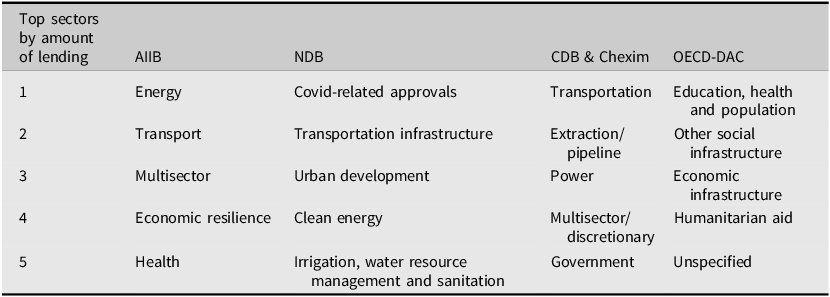
As of the writing of this article, the AIIB has approved 226 projects, of which energy, transport, multisector, economic resilience, and public health are the five sectors that promised the most lending and account for 74% of AIIB loans (AIIB, 2023). By the end of 2021, the NDB had 74 projects in the portfolio, of which COVID-related approvals, transportation infrastructure, urban development, clean energy, and irrigation, water resource management, and sanitation are the top five sectors by approved lending, accounting for 87.8% of total approvals (NDB, 2022). The two Chinese policy banks approved 858 projects from 2008 to 2019, amounting to USD 462 billion, of which transportation, extraction/pipeline, power, multisector/discretionary, and government are the top five sectors by investment (Ray and Simmions, 2020).
We compare the Chinese DFIs’ lending compositions with those of traditional donors, represented by the OECD-DAC, for the OECD claims to set ‘global standards in a number of key areas of development’ (OECD, n.d.-b). Sectors receiving most official development assistance (ODA) commitments from OECD-DAC countries in 2020–2021 are education, health and population (22.8%), other social infrastructure (17.2%), economic infrastructure (15%), humanitarian aid (14.3%), and unspecified (13.3%) (OECD-DAC, n.d.).
Table 5 summarises the lending composition of the selected Chinese and Western DFIs. Although the evidence agrees with the belief that Chinese DFIs tend to prioritise investment in infrastructure and energy, while Western DFIs focus on human capital, health, and environment (Chin and Gallagher, Reference Chin and Gallagher2019), the less tangible sectors, the AIIB distinguishes itself from other Chinese DFIs by investing heavily in health and adopting a more Westernised focus. Also, its focus on economic resilience aligns with the priorities of the OECD-DAC. By contrast, such similarity is absent in the NDB and the policy banks.
Lending composition

The lending priority of a bank is subject to isomorphic pressures. For instance, the AIIB signed a Co-financing Framework Agreement with the World Bank, agreeing that the World Bank will propose a list of projects for cooperation with the AIIB out of the World Bank’s ongoing or potential projects (World Bank, 2016), which means the co-financed projects have been screened before being put on the table for the AIIB. In this case, the World Bank exerts isomorphic pressures on the AIIB.
5.2. Procurement policies
In this section, we compare the Chinese DFIs’ procurement policies with those of the World Bank. During the drafting process of the AIIB’s policies, which include its procurement policies, former World Bank and ADB officials were consulted to produce procurement policies that closely conform to international practice (Wilson, Reference Wilson2019). The bank also made changes to its procurement policies to accommodate the Europeans, who were essential to the bank’s international credibility (Humphrey, Reference Humphrey2020), which demonstrates the bank’s response to isomorphic pressure. As a result, the AIIB’s procurement policies ‘closely mirror the World Bank’s’ (Skålnes, Reference Skålnes2021) and are more permissive than many existing institutions (Ikenberry and Lim, Reference Ikenberry and Lim2017). Article 13-8 of the AIIB’s Articles of Agreement stipulates that ‘the Bank shall place no restriction upon the procurement of goods and services from any country from the proceeds of any financing undertaken in the ordinary or special operations of the Bank’ (AIIB, n.d.-e), ‘not limiting procurement to member states’ (Ikenberry and Lim, Reference Ikenberry and Lim2017), which is said to be borrowed from the EBRD (Gabusi, Reference Gabusi2019).
The NDB adopts more restrictive policies on procurement. It places ‘no restriction upon the procurement of goods and services from any country member from the proceeds of any loan, investment or other financing undertaken in the ordinary or special operations of the Banks’ (NDB, 2014); however, the bank discriminates on the grounds of membership. Article 21, Paragraph VI stipulates that
the proceeds of any loan, investment or other financing undertaken in the ordinary operations of the Bank or with Special Funds established by the Bank shall be used only for procurement in member countries of goods and services produced in member countries, except in any case in which the Board of Directors determines to permit procurement in a non-member country of goods and services produced in a non-member country in special circumstances making such procurement appropriate (NDB 2014).
The NDB also differs from the AIIB and the World Bank by the broader use of recipient country systems. It verifies the procurement system of a new member upon its admission (NDB, 2016) and uses them as long as they meet the NDB’s requirements, making its country system ex ante (Zhu, Reference Zhu2019).
By contrast, the two Chinese policy banks offer loans ‘tied to contracts for Chinese firms’ (Skålnes, Reference Skålnes2021). For instance, both the CDB and Chexim extend export buyer’s credit to support the purchase of products, technology, and services from Chinese firms (Chexim, n.d.-b; CDB, 2023; Jin et al., Reference Jin, Ma and Gallagher2018). Huawei is one of the beneficiaries. The CDB provided loans to a Brazilian landline company named Tele Norte Leste Participacoes SA to purchase network equipment from Huawei and helped Huawei expand its overseas market. Similar lending activities also took place to facilitate Chinese companies going global (Lococo et al., Reference Lococo, Harrison and Forsythe2011).
In this section, we find that the AIIB is the least restrictive on procurement, the NDB places some restrictions, and the two policy banks’ aid is often tied. This makes the AIIB’s procurement policies the most resemblant to the traditional donors’, and the two policy banks’ the least.
5.3. Environmental and Social Framework
This section compares the Chinese DFIs’ ESFs with the World Bank’s. When formulating the AIIB’s policies, including its ESF before its inauguration, former officials from the World Bank and the ADB were consulted in the drafting process (Wilson, Reference Wilson2019). The AIIB adopts an ESF that is based on the highest standards among MDBs (Gabusi, Reference Gabusi2017) and highly resemblant to that of the World Bank, and even ‘explicitly refers to WB conditionality as a source on which the organization has drawn’ (Heldt and Schmidtke, Reference Heldt and Schmidtke2019), as a compromise with its European members to secure a broader membership and higher international credibility (Humphrey, Reference Humphrey2020). The bank also adopts the ESF to establish a good reputation, a source of legitimacy (Radavoi and Bian, Reference Radavoi and Bian2017). This demonstrates the banks’ response to isomorphic pressures. The bank adopted its first ESF in 2016 and updated it several times (AIIB, n.d.-f). It includes an environmental and social policy (ESP), three Environmental and Social Standards (ESSs), and an environmental and social exclusion list (ESEL). The three ESSs are those of environmental and social assessment and management, land acquisition and involuntary resettlement, and indigenous peoples (AIIB, 2021c).
The NDB also has an ESF structured in a very similar way to the AIIB’s, with an ESP, three almost identical ESSs, and an ESEL. However, its ESF was much less detailed than the AIIB’s and was criticised by non-governmental organisations. For instance, the NDB’s ESF adopted in 2016 has only 25 pages compared to the 2016 AIIB ESF which has 54 pages (Wang, Reference Wang2019). Moreover, the NDB’s ESF renders country systems more autonomy, makes some new rules, and is less similar to the World Bank’s ESF (Heldt and Schmidtke, Reference Heldt and Schmidtke2019).
The Chexim is not equipped with an ESF, but it released a White Paper on Green Finance and Social Responsibility in 2019. Compared with the prescriptive ESFs of the AIIB and the NDB, the white paper is more descriptive, laying out some general principles and presenting some specific cases. Also, the Chexim adheres to host counties’ laws and regulations when assessing and managing environmental and social risks of overseas projects (Chexim, 2019), in contrast to the AIIB and the NDB’s compliance with their own ESFs. The CDB does not have an ESF, either. But the bank touches upon the issues of energy conservation, environmental protection, and social development in its official documents (CDB, 2017; CDB, 2020), though in a less detailed way than the Chexim. Together, the two banks ‘have not adopted the international standards set by the World Bank or the International Finance Cooperation’ in sustainability, of which ESF is a key component (Larsen, et al., Reference Larsen, Voituriez and Nedopil2023).
The AIIB adopted an ESF following the practice of the World Bank; the NDB also adopted an ESF, but its ESF is less detailed and more harshly criticised (Wang, Reference Wang2019); while the two Chinese policy banks do not. Apart from the ESFs, there are still other dimensions where the Chinese DFIs borrow from traditional donors that we do not delve into in this article, for instance, the debt sustainability framework (DSF). At the second Belt and Road Forum for International Cooperation, Chinese finance minister Liu Kun released a DSF which he claimed to borrow from the IMF-World Bank DSF (Li et al., Reference Li, Yu and Li2019). The DSF was commended by Christine Lagarde, then managing director of the IMF (Lagarde, Reference Lagarde2019), and deemed identical to the IMF-World Bank DSF (Morris and Plant, Reference Morris and Plant2019).
In this section, we compare the resemblance of the AIIB, the NDB, and the two Chinese policy banks to traditional donors based on their landing composition, procurement policies, and ESFs. The AIIB has more similar lending focuses with traditional donors than the NDB and the two Chinese policy banks. With regard to procurement, the AIIB has the strongest resemblance to traditional donors for not discriminating against non-member countries and for more cautious use of the country system, the two policy banks the slightest resemblance, while the NDB falls between them on the spectrum of resemblance. Like traditional donors, the AIIB and the NDB adopt ESFs, while the two policy banks do not. Based on these observations, we infer that the AIIB has the greatest similarity with traditional donors, the two policy banks the slightest, and the NDB in between (see Table 6). This agrees with Chin and Gallagher’s (2019) finding that the two policy banks and the DNB significantly differ from the Western DFI model, while the AIIB resembles the traditional MDBs. This also agrees with Zhu’s (2019) and Wang’s (2019) findings that the AIIB resembles the Western-led MDBs more than the NDB.
Resemblance

6. Conclusion
In this article, we analyse the extent to which the AIIB, the NDB, and the two Chinese policy banks are subject to the three mechanisms of institutional isomorphism and observe their varied resemblance to traditional donors. We detect in the AIIB, the NDB, and the two policy banks respectively high, medium, and low levels of impact imposed by institutional isomorphism, and respectively high, medium, and low degrees of resemblance to traditional donors. This observation supports our hypothesis that the stronger influence of institutional isomorphism on a Chinese DFI is linked to a stronger resemblance of the DFI to established donors. This article also speaks to the debate over China’s challenge to the LIO, particularly in IDF, demonstrating that China can be socialised to adopt Western norms and practices under sufficient isomorphic pressures. For instance, the AIIB evolves into a Chinese-led DFI highly convergent with its Western peers.
In recent years, the launch of the BRI and the ensuing more conspicuous role of China’s development finance have given rise to intensified debates over the environmental and social problems pertaining to projects funded by the two Chinese policy banks (Gong, Reference Gong2021). Research finds that projects financed by the two banks pose greater risks to biodiversity and indigenous lands than those supported by the World Bank (Yang et al., Reference Yang, Simmons, Ray, Nolte, Gopal, Ma, Ma and Gallagher2021). What implications does the criticism carry for the future of the two policy banks? Will they follow international best practices more closely? The answer to this question is indefinite, though ‘China has demonstrated a strong political will to address the social and environmental concerns over its overseas development finance, as evidenced in a series of recently released guidelines’ whose implementation is uncertain (Yang et al., Reference Yang, Simmons, Ray, Nolte, Gopal, Ma, Ma and Gallagher2021). These questions are to be addressed in our future research.
Acknowledgements
The authors sincerely thank the anonymous reviewers and editors for their helpful comments and suggestions. The authors deeply appreciate our interviewees, Chao Sun and Ju Wu, for their valuable time and insights.
Funding statement
This research was funded by the Center for American Studies at Southwest Jiaotong University in 2024 [Grant Number: ARC2024010].
Yue Xu is an assistant professor in College of Foreign Languages, University of Shanghai for Science and Technology. She earned a PhD in International Relations from Shanghai International Studies University in 2020. Her research interests include global economic governance and China’s participation in global governance.
Hongsong Liu is a professor in School of International and Public Affairs, Shanghai Jiao Tong University. His research is primarily focused on global governance, international organisations as well as Chinese foreign policy. His publications have appeared or will appear in international peer-reviewed journals such as International Affairs, Journal of European Integration, Pacific Review, Comparative European Politics, Mediterranean Politics, Asian Perspective, Policing: A Journal of Policy and Practice, International Journal of Conflict and Violence, Pacific Focus and Global Public Health. He is the author of China’s New Role in Global Governance: Shaping the Rules (Routledge, forthcoming).






 Open access

