

Introduction
The establishment of the International Criminal Court (ICC) in 1998 constitutes a landmark in the development of International Criminal Law (ICL), which gained its first momentum after World War II through the foundation of International Military Tribunals in Nuremberg and Tokyo. ICL is, however, not confined to these most prominent courts or their statutes providing for definitions of international crimes under their respective jurisdiction; rather, ad hoc international, or internationalized and hybrid special tribunals and criminal chambers also contribute to the development and shape of ICL and reflect its diverse legal and institutional basis.Footnote 1 Perceived as another tribunal of “international character,” on August 18, 2020, the Special Tribunal for Lebanon (STL) pronounced its judgment on the merits in the Ayyash case. The long-awaited verdict raises the question of the Tribunal's contribution to the further evolution of ICL.
Background
On February 14, 2005, an unknown suicide bomber caused a car bomb with the equivalent of 2500 to 3000 kilograms of TNT to explode in the center of Beirut. The former Lebanese Prime Minister and electoral candidate, Rafik Hariri, was assassinated by this terrorist attack, twenty-one others were killed, and another 226 people were injured. Afterward, a video falsely claiming responsibility for the attack was published and the person presented is likely to have been abducted and killed. The Lebanese government requested the United Nations (UN) for assistance in investigating the crime. In April 2005, the UN International Independent Investigation Commission (UNIIIC) was established by the UN Security Council (UNSC)Footnote 2 as recommended by a fact-finding mission sent to Lebanon by the UN Secretary General (UNSG) shortly after the attack.Footnote 3 In February 2009, the UNIIIC handed over its results and work to the STL, a tribunal established by the UNSC acting under Chapter VII of the Charter of the UN after the ratification of an agreement between the Lebanese government and the UN failed.Footnote 4 Unlike the Appeal Chamber in Tadić,Footnote 5 the STL rejected its competence to review the decision of the UNSC.Footnote 6
The STL, initiating its work in March 2009, is endowed with jurisdiction over persons responsible for the attack.Footnote 7 Composed of Lebanese and international judges (the latter being the majority), which are appointed by the UNSG,Footnote 8 the Tribunal applies Lebanese substantive criminal law in accordance with international (procedural) standards and has primacy over domestic jurisdiction.Footnote 9 The Tribunal can claim some unique features: it is not only the first internationalized tribunal operating in the delicate political context of the Middle East,Footnote 10 but is also explicitly dedicated to addressing a crime against, though not confined to, a specific person (Hariri),Footnote 11 as well as being the first tribunal to have jurisdiction over terrorism in peacetime as a discrete crime. Furthermore, the special participation of victims is provided for, and an independent ‘Defence Office,’ as well as an autonomous pre-trial judge, have been established. Finally, it is the first tribunal on the international plane—after the international military tribunals—vested with the competence to conduct trials in absentia.
The Trial Chamber's Decision and Its Significance
Even though the STL itself expected the terrorist attack, being part of a broader political plan including unknown persons who might have ordered the assassination,Footnote 12 it was confined to investigating the guilt of four accused persons only (the proceedings against Mustafa Amine Badreddine, a formerly accused senior official of the Hezbollah, were terminated after his presumed death; the case against the accused Hassan Habib Merhi has been joined). It only found Salim Jamil Ayyash guilty beyond reasonable doubt as a co-perpetrator of conspiracy aimed at committing a terrorist act, committing a terrorist act by means of an explosive device, and intentional and attempted homicide with premeditation. It acquitted Hassan Habib Merhi, Hussein Hassan Oneissi, and Assad Hassan Sabra of all charges. On December 11, 2020, the Trial Chamber by its sentencing judgment imposed five concurrent sentences of life imprisonment on Ayyash. Furthermore, the Tribunal issued a renewed arrest warrant and an international arrest warrant, and ordered and requested his transfer and detention, calling additionally on those shielding Ayyash from justice to surrender him to the Tribunal.
Three aspects of the decision deserve further comments. First, international investigations and trials generally face evidence-related problems due, inter alia, to the distance of the judges, be it in fact or in time.Footnote 13 In Ayyash, most evidence was circumstantial, and the STL spent a lot of effort to base the conviction on an intensified analysis of telecommunication data. Technological progress and digitalization can be a blessing and a curse for ICL: on the one hand, they can contribute to the provision and analysis of evidence—for instance, through support of privately generated evidence, including digital evidence,Footnote 14 or by the use of artificial intelligence.Footnote 15 One illustration of such usage offers information that is collected and analyzed by private actors to be submitted as evidence in accountability processes, such as the case of user-generated evidence.Footnote 16 On the other hand, questions concerning the reliability of information, defendants' rights, and general standards of fair trial will become pressing. Scientific research, societal discussions, and future legal amendments are needed to better equip ICL, courts and tribunals, and lawyers to address these opportunities and challenges.
Second, even though terrorist acts can be prosecuted if they amount to one of the core crimes,Footnote 17 the STL is the first internationalized tribunal with jurisdiction over terrorism as a discrete crime. However, it remains doubtful whether the STL actually opens a “new phase in fighting terrorism through the rule of law”Footnote 18 as a blueprint for specific tribunals or even an international tribunal for terrorism.Footnote 19 This tribunal has been established and operated under specific conditions (request by the respective government, prominent victim, condemnation, and sufficient support by the members of the UNSC); it applied domestic criminal law and judged in a clear case in which the conviction of terrorism would hardly meet much opposition. When the STL, though, defined terrorism as an international crime under customary international law,Footnote 20 it provoked severe criticism, in particular due to the lack of a common definition, agreement on the material and mental elements of terrorist crimes, and potential exemptions.Footnote 21 Truly, terrorism has been called a transnational crime,Footnote 22 running contrary to the values of the international community, and a duty to prevent and prosecute terrorism under domestic law can be derived from UN conventions for specific areas and UNSC resolutions.Footnote 23 Nonetheless, the resistance against recognizing it as an international crime under the ICC Statute or even bringing a potential amendment on the agenda of the Kampala Conference—without signs for a significant changing of minds—indicates that claims the STL has advanced the recognition of terrorism as an international crime, which will be introduced to the existing core crimes in the near future,Footnote 24 are rather premature.
Third, the STL conducted the trial and convicted Ayyash in his absence,Footnote 25 as the accused had absconded. Although one might argue that fighting impunity should not happen by chance or be in the hands of the accused, trials in absentia—even though not absolutely banned—raise doubts with regard to human rights and fair trial standards,Footnote 26 which could undermine the legitimacy of, and trust in, international criminal proceedings.Footnote 27 This might explain why the statutes of other international courts—for example, the ICC—do not, in principle, provide for trials in absentia.Footnote 28 In cases such as the present, and particularly before time-bound tribunals, the minimum right of a convicted person to seek a retrialFootnote 29 seems unlikely to be fulfilled following the conclusion of the Tribunal's mandate and raises the corresponding question of which would be the competent organ to retry the case.Footnote 30
Conclusion
“Was it all worth it?” might be the question provoked when reflecting on the work of the STL for over ten years, costs of more than US$970 million, a reasoned judgment of 2641 pages, and the conviction of only one person who does not even appear to be the mastermind behind the attack. From a legal perspective, some institutional features of the STL (victim participation, advanced role and independence of organs) might serve as future benchmarks. With regard to the mentioned skepticism towards trials in absentia and the offence of terrorism as an international crime, the trial might at least have facilitated necessary debates on the development of ICL. From a political perspective, the trial has neither led to a complete clarification of the political background of the attack or the persons behind it, nor finally brought the accused to justice or contributed to societal peace and stability in the region. Rather, it has illustrated the limited capacity of ICL and international tribunals to solve political problems.

THE TRIAL CHAMBER
SPECIAL TRIBUNAL FOR LEBANON
THE PROSECUTOR
v.
SALIM JAMIL AYYASH
HASSAN HABIB MERHI
HUSSEIN HASSAN ONEISSI
ASSAD HASSAN
SABRA
_____________________________________________________________
SUMMARY OF JUDGMENT
_____________________________________________________________
Office of the Prosecutor:
Mr Norman Farrell, Mr Alexander Hugh
Milne & Mr Nigel Povoas
Legal Representatives of Participating Victims:
Mr Peter Haynes, Mr Mohammad F. Mattar & Ms Nada Abdelsater-Abusamra
Counsel for Mr Salim Jamil Ayyash:
Mr Emile Aoun, Mr Thomas Hannis & Mr Chad Mair
Counsel for Mr Hassan Habib Merhi:
Mr Mohamed Aouini & Mr Jad Youssef Khalil
Counsel for Mr Hussein Hassan Oneissi:
Mr Vincent Courcelle-Labrousse, Mr Yasser Hassan & Ms Natalie von Wistinghausen
Counsel for Mr Assad Hassan Sabra:
Mr David Young, Mr Geoffrey Roberts & Ms Sarah Bafadhel

Table of contents
Introduction 8
Summary of findings 8
Witnesses and publicity of the proceedings 11
Assessment of evidence—some principles 12
Cell site evidence 13
Agreed facts or ‘agreements as to evidence’ and judicial notice 13
The historical and political background to the attack 14
The participating victims' case 15
The explosion 17
The investigation and forensic evidence 19
Findings on the management of the crime scene and investigation 20
Findings on the explosives used 21
Suicide bomber 22
Recovery of human remains 23
Reliability of the telecommunications evidence 23
Electronic presentation of evidence 24
Nature and purpose of colour-coded mobile networks and Purple group of mobiles 24
Green network 26
Red network 27
Blue network 28
Yellow network 29
Networks' common mission 29
Purple group of mobiles 30
Attribution of mobile telephones to the FOUR Accused and Mustafa Amine Badreddine 31
Salim Jamil Ayyash—Network mobiles Yellow 294, Blue 233, Red 741, Green 300 32
Hassan Habib Merhi—purple 231 and green 071 39
Hussein Hassan Oneissi—Purple 095 41
Assad Hassan Sabra—Purple 018 42
Mustafa Amine Badreddine—Green 023 43
Chronology of network mobile activity before Mr Hariri's assassination on Monday 14 February 2005 44
Importation and sale of Mitsubishi Canter 50
Claim of responsibility for the attack 51
Making the claim of responsibility for the attack 52
Ahmad Abu Adass 56
Selecting Mr Abu Adass—between Friday 22 December 2004 to Friday 7 January 2005 57
Mr Abu Adass's disappearance and surrounding events 60
Preparing the claim of responsibility—Tuesday 18 January 2005 to Sunday 13 February 2005 61
Whether the claim of responsibility was false 63
The non-covert nature of the use of the Purple mobiles 64
General findings on the false claim of responsibility 65
Applicable law 66
Legal findings on elements of the crimes and Individual criminal responsibility 68
Salim Jamil Ayyash 79
Hussein Hassan Oneissi and Assad Hassan Sabra 80
Hassan Habib Merhi 81
Disposition 82
INTRODUCTION
1. This summary judgment is an authentic and authoritative abbreviated version of the judgment in this case.Footnote 1 Its purpose is to present a version of the judgment that is more accessible to the public than the judgment of 2,641 pages, including six annexesFootnote 2 and more than 13,000 footnotes.
2. This summary judgment is comprised of extracts from the judgment. It is footnoted to the judgment to enable to the reader to find these extracts in the judgment. Where necessary, some introductory joining sentences have been added to provide context, and some extraneous words deleted. The footnotes to the paragraphs extracted from the judgment—as they appear in the judgment—have been omitted. The Trial Chamber's full reasoning and the evidence supporting it is of course in the judgment itself. This summary has been translated into Arabic and French.
SUMMARY OF FINDINGS
3. Just before 13:00 on Monday 14 February 2005, the former prime minister of Lebanon, Mr Rafik Hariri, was travelling in his convoy in Beirut between the Lebanese Parliament and his home, Quraitem Palace. As it approached the St Georges Hotel, near the coast, a massive explosion was detonated. Mr Hariri was killed in the blast. Twenty-one others, including eight members of Mr Hariri's convoy, and innocent bystanders, also died. Three of the victims died after the explosion, two on the following day, and the third, the Lebanese MP, Mr Bassel Fuleihan, succumbed after lying in a coma for two months.Footnote 3
4. Another 226 people were injured, some very seriously. People passing in the street and working in nearby buildings sustained terrible injuries. Many buildings were badly damaged.
5. The explosion was triggered by a suicide bomber in a Mitsubishi Canter—a light tarpaulin covered truck, loaded with more than two tonnes of RDX high-grade explosives—that detonated as Mr Hariri's heavily protected six vehicle convoy passed the St Georges Hotel. The explosives had the equivalent of 2,500 to 3,000 kilograms of TNT. The explosion left a crater in the road that, based on the cone shape, had a diameter of around 11.4 metres with a depth of around 1.9 metres, within a margin of error of several per cent.
6. Mr Hariri and his convoy had been under surveillance for some months before his assassination. Those engaged in the surveillance were communicating in the field using three sets of mobile telephone networks. To distinguish the three networks, the Prosecution labelled them as the Yellow, Blue and Red networks.
7. The Red network was the assassination team. The users of the Blue and Red network mobiles communicated only with each other. Another network, labelled as the Green network, of three mobiles, was alleged to have coordinated and monitored all aspects of the operation targeting Mr Hariri which eventually resulted in his death.
8. In the months before the attack, network mobiles had followed Mr Hariri as he travelled around Lebanon. This included his trips to Beirut Airport, to his villa in Faqra north of Beirut, to his villa at Naameh, south of Beirut, when he visited mosques and churches, when he met Hezbollah's Secretary-General in south Beirut, when he went to the Parliament, and when he had lunch and dinner engagements. The network mobiles were also engaged in static surveillance near Quraitem Palace and along some of the routes he travelled.
9. The aim of this surveillance was to obtain information about Mr Hariri's movements, his security detail, his level of protection and eventually to determine a suitable method to murder him, including finding an appropriate location for the intended attack. Mr Hariri's convoy was equipped with electronic jammers that would have blocked the remote detonation of any explosive. Thus, a vehicular improvised explosive device—in the form of a suicide bomber driving a light truck loaded with explosives that he could safely self-detonate―was chosen for the attack.
10. Shortly after the explosion on the afternoon of Monday 14 February, the Al-Jazeera news network in Beirut received calls claiming responsibility for the attack, and saying that a video with a letter attached was in a nearby tree. Three calls were made, with one menacing call exhorting the immediate broadcast of the video. The callers had also first contacted Reuters. Two of the Accused, Hussein Hassan Oneissi and Assad Hassan Sabra, were alleged to have made these calls and to have observed the collection of the video from the tree.
11. In the video, which Al-Jazeera broadcast later that afternoon, a young Palestinian man, Mr Ahmad Abu Adass, claimed to represent a fundamentalist group called ‘Victory and Jihad in Greater Syria’ and to have executed a ‘resounding martyrdom operation’ against Mr Hariri as an agent of the ‘infidel Saudi regime’. The attached letter claimed that the suicide operation was carried out by ‘the Mujahid, Ahmad Abu-Adass’. The Prosecution termed this as a ‘false claim of responsibility’ for the attack on Mr Hariri. And indeed it was. The group is fictional and Mr Abu Adass did not kill himself in the explosion; he was not the suicide bomber.
12. Mr Abu Adass, a religious 22 year old, disappeared from his home in Beirut on the morning of Sunday 16 January 2005 and his family has not seen him since. Presumably he is no longer alive. Mr Oneissi and Mr Sabra were alleged to have arranged this by recruiting him at a mosque in Beirut.
13. The successful attack on Mr Hariri was carefully planned and implemented. The six core Red network mobile users were responsible for Mr Hariri's murder on 14 February 2005. The Yellow, Blue and Red network mobile users observed Mr Hariri and his convoy's movements in the weeks and months before the attack. Some members of the Red network also used Blue and or Yellow network mobiles. On the day of the attack, the Red mobile users observed Mr Hariri's movements at the Parliament and were present there and near the crime scene shortly before the explosion. They also coordinated the Canter's movement towards the convoy. The Red network users made their final calls in the minutes before the attack and these anonymous mobiles were never used again.
14. The false claim of responsibility video was aimed at diverting attention away from the true perpetrators, namely, Mr Salim Jamil Ayyash and his co-conspirators.
15. The four Accused are Salim Jamil Ayyash, who was born on 10 November 1963 in Harouf, Lebanon, Hassan Habib Merhi, born on 12 December 1965 in Beirut, Hussein Hassan Oneissi, who was born in Beirut on 11 February 1974, and Assad Hassan Sabra, also born in Beirut and whose date of birth is 15 October 1976. A fifth and former Accused, Mustafa Amine Badreddine, who was also known as ‘Sami Issa’—and is alleged to have been a co-conspirator—was born in Beirut on 6 April 1961. All five, the Prosecutor alleged, are supporters of Hezbollah, a Lebanese political and military organisation.
16. The amended consolidated indictment contains nine counts, alleging crimes committed contrary to the Lebanese Criminal Code. The crimes are of conspiracy to commit a terrorist act by means of an explosive device, committing a terrorist act by means of an explosive device, the intentional homicide of Mr Hariri and of the 21 others, the attempted intentional homicide of the 226 people injured in the blast and of being accomplices to these crimes.
17. The Prosecutor alleged that each of the four Accused and Mr Badreddine participated in the conspiracy. They had the following roles in the attack:
i Mustafa Amine Badreddine monitored, and together with Salim Jamil Ayyash, coordinated the surveillance of Mr Hariri in preparation of the attack, including the purchase of the Canter. He also monitored the physical perpetration of the attack, and monitored with Hassan Habib Merhi the coordination of the preparation of the false claim of responsibility;
ii Salim Jamil Ayyash, with Mustafa Amine Badreddine, coordinated the surveillance of Mr Hariri in preparation of the attack, including the purchase of the Canter. He communicated with Hassan Habib Merhi in relation to preparations for the attack, including the false claim of responsibility. He coordinated the physical perpetration of the attack and participated in carrying out the surveillance and assassination;
iii Hussein Hassan Oneissi and Assad Hassan Sabra, under Mr Merhi's coordination, participated in identifying a suitable person to use in a video-taped false claim of responsibility for the attack, namely, Mr Abu Adass. Immediately after the attack, they disseminated statements falsely attributing responsibility for the attack, ensured the delivery of the video and attached letter to Al-Jazeera, and ensured its broadcast. This too was under Mr Merhi's coordination. Mr Oneissi, additionally and again under Mr Merhi's coordination, participated in Mr Abu Adass's disappearance for the purpose of creating a false claim of responsibility; and
iv Hassan Habib Merhi, with Mustafa Badreddine, coordinated the false claim of responsibility and at times was in communication with Assad Sabra for this purpose. He coordinated Mr Oneissi's and Mr Sabra's activities in identifying and effecting the disappearance of a suitable person, Mr Abu Adass, who would be used in the video. Immediately after the attack, he coordinated their activities in disseminating statements falsely attributing responsibility for the attack, ensuring the delivery of the video and attached letter to Al-Jazeera and ensuring its broadcast.
18. Mr Oneissi and Mr Sabra, according to the Prosecutor, used their personal mobiles to communicate with each other and Mr Merhi in relation to the false claim of responsibility. These three mobiles were termed the ‘Purple group’ of mobiles. Mr Badreddine, Mr Ayyash and Mr Merhi were alleged to have communicated in a closed three-mobile Green network, in which Mr Ayyash and Mr Merhi used their Green mobiles only to communicate with Mr Badreddine.
19. The Prosecution attempted to prove that they were using their network mobiles based upon the co-location of the network mobiles with their own personal mobiles. In other words, that the personal and network mobiles made calls and travelled in a manner suggesting that they had a single user.
20. The Prosecution presented a vast quantity of documents and telecommunications evidence, including the call data records of the calls made, and cell site evidence of the cell towers activated, in attempting to prove first, that the Accused and Mr Badreddine were using the personal mobiles alleged. Second, that these were co-locating with the network mobiles and, third, that the network mobiles were engaged in Mr Hariri's surveillance and assassination.
21. The Prosecution proved some but not all of these allegations and mobile telephone attributions to the Accused and Mr Badreddine.
22. The evidence has established that Mr Ayyash conspired with unidentified people to commit a terrorist act by means of an explosive device in order to murder Mr Hariri. Mr Ayyash led the assassination team on Monday 14 February 2005. The Prosecution proved that he was using Yellow, Blue, Red and Green network mobiles and that the first three were engaged in surveillance of Mr Hariri between October 2004 and 14 February 2005. It also proved that he was actively involved in the assassination on the day of the attack.
23. There was insufficient evidence to find what role if any Mr Badreddine had in the conspiracy.Footnote 4 The evidence consisted solely of the records of activations of his Green network mobile in calls to the other two Green network mobiles. One was used by Mr Ayyash. The other the Prosecution attributed to Mr Merhi.
24. The evidence established that much of the surveillance was directed at targeting Mr Hariri for his possible assassination. However, how much was difficult to discern, given that Mr Hariri was under surveillance by more than one group, including the Lebanese Internal Security Forces. The Trial Chamber has found that the final decision to proceed with the plan and hence to murder Mr Hariri was made only sometime in early February 2005 in the weeks before the attack. The surveillance in the weeks preceding the decision was preliminary to a possible attack.
25. Regarding Mr Merhi's, Mr Oneissi's and Mr Sabra's role in the conspiracy and the false claim of responsibility, the Prosecution did not prove its case beyond reasonable doubt.
26. The Prosecution alleged that Mr Oneissi, posing as someone called ‘Mohammed’, approached Mr Abu Adass in a mosque for the purpose of finding someone to use in the false claim video. Mr Oneissi and Mr Sabra were also alleged to have been present around the mosque in Beirut over ten days, in late December 2004 and early January 2005, for this purpose. In court, the Prosecution claimed that Mr Oneissi and Mr Sabra participated in abducting Mr Abu Adass from his home on Sunday 16 January 2005. The Prosecution case on each of these allegations, based almost solely on the cell activations of two personal mobiles around the mosque, failed.
27. The evidence that Mr Oneissi was ‘Mohammed’ was unreliable. It was not probative. There was also, ultimately, no reliable evidence connecting the activations of the two personal Purple mobiles around the mosque with Mr Abu Adass or anything that he did.
28. Similarly, there was no evidence connecting either Accused person with Mr Abu Adass's disappearance and there was no reliable evidence that he was even abducted. Further, the Prosecution did not prove beyond reasonable doubt that Mr Sabra was using his attributed personal Purple mobile. The mobile was jointly used by Mr Sabra and his wife, and there was no reliable evidence establishing that Mr Sabra was the person using it at all relevant pleaded times.
29. In relation to the calls to Reuters and Al-Jazeera on the afternoon of Monday 14 February 2005, the evidence was too weak to connect either Mr Oneissi or Mr Sabra to the calls or the collection of the video from the tree. The cell site evidence was insufficiently reliable in the aftermath of the attack to prove that their attributed mobiles were where they were alleged to be when the calls were made. The Trial Chamber was satisfied beyond reasonable doubt that Mr Oneissi was using his personal Purple mobile, but as noted, could not make the same finding regarding Mr Sabra.
30. Additionally, the evidence did not prove that either Accused joined the conspiracy before the explosion. Nor that even had they made the telephone calls to Reuters and Al-Jazeera as alleged, they knew of the explosion in advance, and that their alleged actions were connected to the attack. Proving their knowledge of this was legally required under the Lebanese Criminal Code.
31. Regarding Mr Merhi, the Prosecution also failed to prove beyond reasonable doubt that he was using his attributed Green mobile, and hence communicating with Mr Badreddine on the false claim of responsibility. There was also no evidence of his communicating with Mr Ayyash in relation to the false claim of responsibility.
32. Mr Merhi was charged with coordinating the activities of Mr Oneissi and Mr Sabra in preparing the false claim of responsibility. However, as the case against them has failed, the case against Mr Merhi also failed, including his participation in the conspiracy. The Trial Chamber was not satisfied beyond reasonable doubt of their guilt.
33. The evidence against all four Accused was circumstantial. The only direct piece of evidence―and one that the Trial Chamber found too unreliable to use against Mr Oneissi―was evidence that the Prosecutor pleaded identified him as the ‘Mohammed’ who met Mr Abu Adass in the mosque, in attempting to find someone to use in the false claim video.
34. The remainder of the evidence against the four Accused, and of Mr Badreddine's pleaded role, came from the cell activations of their attributed personal and network mobiles. The Prosecution led evidence connecting these to Mr Hariri's provable movements and, additionally, in the case of Mr Oneissi and Mr Sabra, to Mr Abu Adass. Ultimately, however, the evidence relating to Mr Abu Adass was insufficiently reliable to use against the Accused.
35. There was no evidence of any of the four Accused or Mr Badreddine meeting, or of the content of any of their mobile telephone conversations. There were no telephone intercepts, relevant text messages or voice mails. There was no reliable evidence of Mr Oneissi or Mr Sabra meeting Mr Abu Adass.
36. To find Mr Ayyash guilty, the Trial Chamber had to connect the activations of his personal and network mobiles with Mr Hariri's movements and other relevant incidents. It did this by analysing the use of a Red mobile, number 741, on the day of the attack and then working backwards to find that he was using it on that and other relevant days when surveillance occurred. Red 741 co-located with Mr Ayyash's personal and other network mobiles in such a manner that the only conclusion reasonably available on the totality of the evidence was that he was its user and its user was heavily involved in the attack.
37. The Trial Chamber, as it must in a case based on circumstantial evidence, has exercised any evidentiary doubt in favour of an Accused person. For these reasons, it has acquitted Mr Merhi, Mr Oneissi and Mr Sabra of all counts charged on the amended consolidated indictment. In Mr Ayyash's case, it has been satisfied that the only inference reasonably available on the evidence is of his guilt beyond reasonable doubt on all counts charged.
WITNESSES AND PUBLICITY OF THE PROCEEDINGSFootnote 5
38. During the Prosecution's case, the Trial Chamber heard evidence from 269 witnesses, 119 of whom gave live testimony in the courtroom or through video-conference link, and it received the evidence of 150 witnesses through their written statements.Footnote 6
39. The Trial Chamber ordered measures to protect the identity of many witnesses— including 46 witnesses who testified in court—due to concerns for their personal safety or that of their families. For these reasons, some witnesses are referred to by a pseudonym rather than by their names. Details that might reveal their identities have been omitted. To ensure the effectiveness of the protective measures ordered by the Trial Chamber, several portions of the hearings in court were exceptionally conducted in ‘private’ or ‘closed’ session, which the public could not follow. The Trial Chamber endeavoured to minimise these sessions.Footnote 7
ASSESSMENT OF EVIDENCE—SOME PRINCIPLESFootnote 8
40. The Prosecution must rebut the presumption of innocence and prove the guilt of the Accused ‘beyond reasonable doubt’. As the Accused are presumed innocent, the Defence need not establish their innocence. The Trial Chamber cannot impose on the Accused a reversal of the burden of proof or an onus to rebut evidence called by the Prosecution.Footnote 9
41. The presumption of innocence is a fundamental principle of international human rights law and international criminal law. It obliges the Trial Chamber to treat the Accused as innocent of the crimes charged until entering a verdict of guilty in a judgment. The Trial Chamber does not—as is sometimes erroneously said—determine whether the Accused are ‘guilty or innocent’, but rather, and consistent with the principles of international human rights law, is only required to determine guilt beyond reasonable doubt.Footnote 10
42. The Trial Chamber has found that the Prosecution must prove beyond reasonable doubt that the alleged accomplices, namely, Mr Merhi, Mr Oneissi and Mr Sabra, knew that Mr Hariri was the target of the crimes charged.Footnote 11
43. The Trial Chamber has considered every crime and charge against each Accused individually, determining for each whether the evidence establishes beyond reasonable doubt all facts indispensable to a conviction. This is consistent with the Trial Chamber's obligation under Rule 148 (B) of the Special Tribunal's Rules of Procedure and Evidence to vote separately on each charge contained in an indictment and to make separate findings as to each Accused.Footnote 12
44. The Trial Chamber has assessed each piece of evidence in the context of all related evidence. Taking this approach is particularly important in evaluating the Prosecution's telecommunications evidence. The evidence against the four Accused is almost completely circumstantial. It is only from reviewing the relevant facts in their entirety that a chamber can see patterns that could potentially emerge from which conclusions could be drawn that they are so striking as to be beyond coincidence. And hence provide proof beyond reasonable doubt of facts indispensable to a conviction.Footnote 13
45. The Trial Chamber has therefore assessed each piece of underlying circumstantial evidence both individually and in its totality with all other pieces of relevant evidence to determine whether the Prosecution has proved each material fact beyond reasonable doubt. Where they appear to lack strength the Trial Chamber has scrutinised them with extra caution, both individually and in their totality.Footnote 14
46. The Trial Chamber is acutely aware of the difficulties inherent in attempting to assess the reliability and credibility of witness testimony—especially in an international setting, through interpretation and many years after the attack on Mr Hariri—and has borne these factors in mind in evaluating the evidence of each witness. A chamber may accept parts of a witness's testimony and reject others, so long as the two are not inextricably linked. In this case, for the most part, there were few explicit challenges to the credibility of Prosecution witnesses; more challenges were made to the reliability of witness recollections and some conclusions or opinions. The Trial Chamber, however, carefully considered the credibility of each witness in determining the weight of their evidence.Footnote 15
47. A witness's association with a party, both actual and apparent, should be considered in finally evaluating their evidence; this is one of a number of potential considerations in that final holistic evaluation, and it is not necessarily determinative.Footnote 16
48. Expert witnesses are those who, by virtue of some specialised knowledge, skill or training, can assist the trier of fact to understand or determine an issue in dispute. During the trial itself, the Prosecution moved to admit into evidence the reports of 20 expert witnesses. The Oneissi Defence also successfully moved to call the evidence of one expert.Footnote 17
CELL SITE EVIDENCEFootnote 18
49. Of central importance to the case is telecommunications evidence, comprising cell site evidence, call data records and call sequence tables. Cell site data includes: the date of the production of the data; name of the person producing the data; a record reference; the cell ID; the name of the cell site; full address of the cell site, including postal code; grid co-ordinates of the cell site; sector number or code; number of sectors and azimuths of all sectors; orientation, azimuth and bearing in degrees from north of all sectors; antenna height; and the date on which a particular cell site was first brought into service.Footnote 19
50. The Trial Chamber admitted cell site evidence, based on information obtained from the Lebanese telecommunications providers, Alfa and Touch, on the locations and names of the cell sites, also called cell towers, comprising their mobile telecommunication networks, and various features of the antennae mounted on these cell towers, such as the direction of the antenna—known as the ‘azimuth’—and its tilt.Footnote 20
51. Call data records provide information about communications, such as the source and destination telephone numbers, the type of communication (voice call or text message), the date and time of the communication, the duration of the voice call, the IMEI number of the handset relevant to the communications, and the cell towers to which the mobiles connected. Call data records are the business records of telecommunication companies generated and retained automatically and legally in the normal course of their business.Footnote 21
52. Instead of receiving billions of incomprehensible call data records in evidence, the Trial Chamber admitted into evidence numerous call sequence tables; this was on theapplication of both Prosecution and the Defence of all four Accused and Mr Badreddine.Footnote 22 These are tables that present chronological sequences of calls relating to a particular, or target, telephone number—mobile or landline—over a specified period. They are extracted from the records of telecommunication operators and combine call data records and cell site information. The tables make these records accessible and capable of presentation and analysis without altering the data.Footnote 23
Excerpt from a combined call sequence table with cell detail removed, extracted from Mr Philips's report ‘An introduction to cell site analysis as applied to GSM networks’ Footnote 24

AGREED FACTS OR ‘AGREEMENTS AS TO EVIDENCE’ AND JUDICIAL NOTICEFootnote 25
53. During the trial, the Trial Chamber recorded a number of facts as being agreed between the Parties, or between some of the Parties. The Trial Chamber took judicial notice of several facts of common knowledge.Footnote 26 The agreements as to evidence included that:
• In addition to killing Mr Rafik Hariri, the explosion killed 21 other persons listed in Schedule A of the Indictment;
• The explosion injured 226 persons listed in Schedule B of the Indictment;
• The video of the claim of responsibility was later broadcast on television; and
• Mr Rafik Hariri was born on 1 November 1944 in the city of Sidon, Lebanon.
THE HISTORICAL AND POLITICAL BACKGROUND TO THE ATTACKFootnote 27
54. The Trial Chamber heard extensive evidence from the Prosecution and the Defence of Mr Oneissi concerning the political and historical background to the attack.Footnote 28 It heard evidence from Mr Marwan Hamade and other politicians and officials about the events leading to Mr Hariri's assassination. These included Mr Walid Jumblatt, Mr Fouad Siniora and Mr Jamil El- Sayyed.Footnote 29
55. The Trial Chamber's role as a first instance trial court is neither to write nor correct any version of history that witnesses or parties may have urged upon it. Its role is confined to adjudicating whether any of the four Accused are guilty beyond reasonable doubt of any of the charges against them. The attack on Mr Hariri, however, did not occur in a political or historical vacuum and the Trial Chamber cannot ignore the background to the attack as providing a possible motive for it. It does this while noting that motive is not an element of any of the crimes charged in the amended consolidated indictment.Footnote 30
56. The assassination by car bombing of a prominent politician—who had recently resigned as the prime minister and was preparing to contest the next parliamentary elections—was undoubtedly a political act. The Trial Chamber should therefore consider whether political motives may be attributed to any of the Accused, or the former accused and named co-conspirator, Mr Mustafa Amine Badreddine. Another important consideration is that of context. Understanding the political background to the attack is necessary to form an understanding of why Mr Hariri was targeted in this manner, but only insofar as it relates to whether or not any of the Accused on trial are guilty of any of the counts charged. Similarly, completeness requires placing the attack within a wider historical setting.Footnote 31
57. The Trial Chamber is satisfied from the evidence that:Footnote 32
• From the end of the civil war Syria had an overwhelming political, military and economic dominance in Lebanon;
• From the Israeli withdrawal from southern Lebanon in 2000, internal Lebanese opposition grew to the continuing presence of Syrian soldiers in Lebanon and to Hezbollah maintaining an armed militia, contrary to the Taif Agreement;
• The opposition was expressed through political allegiances including of Mr Jumblatt's Druze political faction, Christians and members of Mr Hariri's Future Movement;
• Mr Hariri's political allies vocally supported UN Security Council resolution 1559;
• The Syrian government wanted the mandate of President Lahoud—who was a strong supporter of Syria—to be extended by the Lebanese Parliament;
• Mr Hariri and his allies were opposed to this;
• The Syrian Government imposed certain electoral candidates on Mr Hariri, which were known as ‘Syrian deposits’;
• In August 2004, President Al-Assad effectively ordered Mr Hariri to support the extension of President Lahoud's mandate, stating that Syria alone would choose the President of Lebanon;
• Mr Hariri did not publicly support UN Security Council resolution 1559, passed on 2 September 2004, which called for the withdrawal of foreign troops from Lebanon and the disbanding of armed militias. The foreign troops in question were Syrian and the militia was Hezbollah's;
• On 3 September 2004, Mr Hariri and his bloc voted in Parliament to extend the mandate and on 12 September 2004 he announced that his government would resign;
• In the months before his assassination, Mr Hariri's allies were publicly calling for an end to the Syrian political, military and economic dominance over Lebanon;
• Their efforts increased after the passage of resolution 1559, including in the three Bristol meetings, 22 September 2004, 13 December 2004 and 2 February 2005, in which Mr Hariri was represented by his political supporters;
• According to many witnesses, the attempted assassination of Mr Marwan Hamade on 1 October 2004 could be construed as a warning to Mr Hariri and Mr Jumblatt not to cross the line;
• Mr Hariri resigned on 20 October 2004 and was planning to run in the May 2005 elections. He would have been proposing the loosening of Syrian dominance over Lebanon and supporting the immediate withdrawal of Syrian troops;
• A proposed electoral law for the 2005 elections—supported by the Syrian government—was designed to diminish Mr Hariri's chances of having members of his bloc elected to Parliament and hence his prospects of a new term as prime minister;
• The Syrian government was insisting that Mr Hariri accept so-called Syrian ‘deposits’ in his electoral list, and Mr Hariri was opposed to this;
• The Chief of Syrian Military Intelligence in Lebanon, Mr Rustom Ghazaleh received regular monthly cash payments from Mr Hariri through intermediaries from 1993 onwards, including a ‘double’ payment on Sunday 13 February 2005;
• Mr Hariri and Hezbollah's Secretary-General, Mr Hassan Nasrallah had good relations in the years immediately before his death and were meeting regularly;
• Mr Hariri believed that Hezbollah's militia should be disarmed, at the very least, when peace with Israel was achieved;
• Mr Badreddine, Mr Ayyash, Mr Oneissi and Mr Sabra were Hezbollah supporters;
• Mr Mustafa Badreddine was a senior Hezbollah military official;
• The growing opposition to the Syrian presence in Lebanon threatened Syria's interests;
• Syria and Hezbollah may have had motives to eliminate Mr Hariri, and some of his political allies;
• There is no evidence that the Hezbollah leadership had any involvement in Mr Hariri's murder and there is no direct evidence of Syrian involvement in it;
• There is no evidence that either Mr Ayyash or Mr Badreddine were directed by the Hezbollah leadership to arrange logistical support for Mr Hariri's assassination; and
• The attack involved an RDX-based explosive. Some witnesses observed that ‘RDX is so powerful that it is most suitable for military purposes’. From this, it may be concluded that those responsible for co-ordinating the attack had access to what could be described as ‘military-grade explosives’.
THE PARTICIPATING VICTIMS' CASEFootnote 33
58. On the application of the Legal Representatives of Victims, the Trial Chamber heard evidence from six participating victims and a victimologist, Professor Rianne Letschert, and received into evidence 24 witness statements and their associated exhibits, namely documents related to their statements; a total of 45 exhibits. This evidence mainly relates to injuries and deaths of victims relevant to the (attempted) homicide charges.Footnote 34
59. At the request of the Legal Representatives of Victims, the Trial Chamber also admitted into evidence documents—22 exhibits—under Rule 154. One of them was a compilation of 181 documents—the Trial Chamber admitted 175 of them into evidence. They consist of medical records, identification documents, family or individual status extracts, death certificates of people who died in or as a result of the explosion, documents relating to financial expenses and employment, photographs, press clippings and Lebanese court decisions.Footnote 35
60. The Trial Chamber was satisfied that the victims' case, as proposed by the Legal Representatives of Victims, was contained and proportionate. It was also generally unopposed.Footnote 36
61. Seven participating victims who provided written statements were injured in the explosion. The other 17 witnesses are relatives of people who died in, or as a result of, the explosion. These witnesses' evidence provides information on their last contacts with the deceased relatives, their relationship with them, how they learned about the explosion and, in several cases, who identified the bodies. The evidence is also of the material, physical or mental harm they and their family members suffered as a result of their relatives' deaths.Footnote 37
62. The testimony and material presented either by or for the participating victims does not provide direct evidence of the individual criminal responsibility of any Accused. Collectively, however, it goes to proving the elements of the offences charged to the extent that harm to the named victims of the attack, or death, is an element of proof in relation to the charges—for example, intentional homicide with premeditation by using explosive material. The Trial Chamber however was mindful to ensure that the participating victims did not ‘double-up’ on the Prosecution evidence or act as a second Prosecutor.Footnote 38
63. The Trial Chamber cannot order reparations but may identify victims, which may assist them in claiming compensation before a national court or another competent body. The Trial Chamber is satisfied beyond reasonable doubt that direct and indirect victims suffered harm.Footnote 39
64. There is no doubt that terrorism is one of the most serious and heinous crimes and that the attack on 14 February 2005 was very grave.Footnote 40 The gravity of the offence includes the inherent gravity of the crime and the Accused's criminal conduct—their form and degree of participation—and also encompasses the impact of the crimes on the victims.Footnote 41
65. The Legal Representatives of Victims invited the Trial Chamber to remind the Lebanese Government of the terms of the UN Declaration of Basic Principles of Justice for Victims of Crime and Abuse of Power on the matter of ‘compensation’ and the importance of the availability of an adequate compensation scheme for the victims or, alternatively, to recommend the establishment of a voluntary trust fund to compensate the victims in the cases ‘within the Tribunal's jurisdiction’—‘possibly even the HRC itself’ [namely, the Lebanese High Relief Commission]. The Special Tribunal cannot grant compensation or order reparations. Article 25 of the Statute, ‘Compensation to victims’, provides that a victim may bring an action to obtain compensation in a national court or other competent body.Footnote 42
66. The harm suffered by the victims of the attack on 14 February 2005—lost lives, personal injuries or the loss of a family member—cannot be restituted, as restoration of the original situation of the victim, before the violation, is impossible. Nevertheless, the Trial Chamber does not interpret Article 25 as limiting the type of reparations a victim of the attack may seek before a national court or competent body, by narrowing it to ‘compensation’ in its strict sense, as defined in international criminal case law. Victims will be able to seek, pursuant to the relevant legislation, the type of reparations they consider more appropriate, including those with a symbolic value.Footnote 43
67. The Trial Chamber heard about a dramatic disparity in treatment among the participating victims as to ‘compensation’—meaning the pecuniary remedy, for the loss or damage suffered, not depending on prosecutorial charges or judicial accountability, that participating victims received, or not, or applied for after the attack. The Trial Chamber underlines that compensation should be appropriate and proportional to the gravity of the harm suffered. The Trial Chamber notes the sense of injustice perceived by some victims because some were compensated while most, it appears, were not. Compensation should not depend on the circumstances of the victims, their connections, employment relationship or insurance scheme. As a general proposition, the Trial Chamber agrees that victims of crimes should be entitled to receive a form of statutory compensation, such as those mandated by the European Union.Footnote 44
68. As to the Legal Representatives of Victims' request that the Trial Chamber make recommendations on the need for professional psychological support in Beirut in future proceedings, the Trial Chamber endorses any improvement in supporting the participating victims' needs. It refers the matter of Professor Letschert's recommendation—based on the participating victims' views—to the Registrar and the Victims' Participation Unit, for their consideration. This is an ancillary matter, as it is not a formal finding for the purpose of determining whether the Accused are guilty, or for any other purpose accepted by the Trial Chamber to be within its mandate.Footnote 45
THE EXPLOSIONFootnote 46
69. On the morning of Monday 14 February 2005, Mr Hariri left Quraitem Palace to attend a morning session of the Lebanese Parliament. Shortly before 12:00, he left Parliament and went to café Place de l'Étoile, where he stayed for around 45 minutes. At around 12:45, he left the café and asked his security detail to prepare his convoy to go back to the palace to attend a lunch appointment. At around 12:49, he entered his armoured vehicle, accompanied by MP Mr Bassel Fuleihan. At approximately 12:55, as the convoy passed a Mitsubishi Canter on Rue Minet el Hosn outside the St Georges Hotel, the suicide bomber detonated the explosives.Footnote 47
Exhibit P90, p. 397 (Photograph of Mr Hariri after leaving the café Place de l'Étoile) Footnote 48

70. The composition of Mr Hariri's convoy was decided on each occasion by his close protection officers Mr Yahya Al-Arab and Mr Talal Nasser for the civilian side, and his chief of security, Mr Wissam Al-Hassan, for the ISF side (Lebanese Internal Security Force). It usually consisted of six or seven cars. An ISF black or navy blue Toyota Land Cruiser VX-R four wheel drive, with four ISF members, and equipped with a siren and lights, would be in the lead. Its role was to clear the road before the convoy.Footnote 49
71. Behind Mr Hariri's car—fourth and fifth in the convoy—were the other two close protection vehicles. Mr Mohamed Darwiche—one of Mr Hariri's personal bodyguards—was driving the fourth car, and with him were Mr Nasser and Mr Al-Arab, the supervisor of the close protection team. Mr Ziad Tarraf, a bodyguard, was driving the fifth car. Mr Mohammed Ghalayini and Mr Omar Al-Masri were in that vehicle with him. The ambulance was last, with a driver and two paramedics, Mr Rachid Hammoud and Mr Mazen Al-Zahabi.Footnote 50
72. The explosion occurred around 40 or 50 metres behind the lead vehicle in Mr Hariri's convoy. Witnesses described two deep sounds a second apart, a ‘huge roaring sound’ and ‘a wave of hot pressure’, a ‘huge explosion’, ‘the sound of an aircraft going through the sound barrier’ or ‘a missile thrown by a large artillery gun’, and described it as ‘like an earthquake.’ The explosion was heard throughout the city, up to 25 kilometres away. While some could barely remember the ordeal due to the injuries and shock, and described it as ‘dream-like’, many gave a vivid account of the explosion and immediate aftermath.Footnote 51
73. The HSBC Bank is on Minet el Hosn Street, between the Phoenicia Hotel and the attack site.Footnote 52 The HSBC building was a scene of ‘chaos and destruction’. People were screaming. There were ‘fire and flames everywhere,’ dust and smoke, and it was dark. The moment of the explosion was described as ‘hell … like the whole building was collapsing’. The upper floors had no doors, windows or ceiling left. It was described as total chaos.Footnote 53
Exhibit P65 (Photograph of the scene of the explosion) Footnote 54

74. Firefighters arrived and tried to put out the fire. A total of 70 to 80 firefighters were called to assist at the explosion site, in addition to military officers both in plain clothes and in uniform who directed the operations.Footnote 55
75. Mr Fuleihan survived the immediate impact of the explosion. He was transferred from the American University of Beirut Medical Center to France for treatment, where he succumbed to his injuries two months later on 18 April 2005.Footnote 56
Exhibit P18, p. 4 Footnote 57

THE INVESTIGATION AND FORENSIC EVIDENCEFootnote 58
76. The Lebanese Military Intelligence and ISF conducted their own investigation and analyses of the explosion in February and March2005. Following a request from the Lebanese prime minister, the UN Secretary-General dispatched a fact-finding mission to Beirut to inquire into the causes, the circumstances and the consequences of this assassination.Footnote 59
77. Members of the Lebanese security, military, judicial and Civil Defence services, and of the Red Cross, participated in the rescue, evacuation and body recovery operations at the crime scene immediately after the explosion. This included fire stations from different sectors of Beirut, the ISF Central Accidents Bureau, falling under the ISF judicial police, the ISF Explosives Bureau and the ISF Counter-terrorism and Major Crimes Unit.Footnote 60
Aerial photograph of the crime scene with the crater in the middle and the two hotels (exhibit P244) Footnote 61

78. Six vehicles, including five from Mr Hariri's convoy, were removed by the ISF from the inner crime scene to the police headquarters at Helou Barracks during the evening on 14 February 2005.Footnote 62 Critical evidence was removed from the crime scene when the six convoy vehicles were removed and taken to the Helou Barracks ‘under the pretext of preserving them’. Tow trucks and other heavy duty vehicles used to remove the vehicles drove into the crime scene within hours of the explosion to remove the convoy vehicles.Footnote 63
79. The area of the explosion stretched along the main road, Rue Minet el Hosn, for around 250 metres in between the St Georges Hotel to the north, north-east, and Hotel Byblos to the south, south-west.Footnote 64
80. About four days after the explosion, Mr Samir Yazbek, the Head of the Lebanese Civil Defence's Marine Rescue Team, was assigned by the Directorate General to conduct a diving mission in the St Georges area to look for Mr Mohammed Ghalayini who was missing. During the mission, Mr Yazbek recognised vehicle parts and filmed them.Footnote 65
81. A Swiss forensic team arrived in Beirut in March 2005.Footnote 66 A Dutch forensic team started its investigation of the crime scene on 13 August 2005, assisted by other experts and Lebanese officers.Footnote 67 The Dutch forensic team received assistance: from Lebanese ISF officers in searching the crime scene; a team of six British divers and divers from the Lebanese fire brigade in searching underwater in the St Georges marina.Footnote 68 The Spanish government sent a team of experts to Beirut in May 2006 to assist in the investigation.Footnote 69
Exhibit P101 (Photograph of crater and crime scene) Footnote 70

FINDINGS ON THE MANAGEMENT OF THE CRIME SCENE AND INVESTIGATIONFootnote 71
82. The evidence reveals a mismanaged, disorganised and chaotic approach to the crime scene investigation, particularly in the initial period after the explosion. Extensive evidence was received from which the Trial Chamber can conclude that there was little to no coordination between the various responsible Lebanese authorities during this period.Footnote 72
83. While acknowledging the ease of hindsight criticism, it is also evident that many elementary crime scene procedures were either ignored or not followed. The Trial Chamber recognises the inevitability of turmoil in the immediate aftermath of such a terrorist attack—including of course the uncertainty of whether another may follow—and especially where someone as prominent as Mr Hariri was its target. On top of this was the natural concern of friends and family of those who may have been victims of the explosion, who rushed to the scene and were allowed onto it. And into this mix must be added the distrust—that some Lebanese people had towards their state institutions—that some victims testified about. The evidence revealed the frustration that some victims felt in relation to the competence of the investigation, with some even taking investigatory matters into their own hands.Footnote 73
84. The Trial Chamber also recognises that the priority immediately after the explosion was rescue and recovery—with an emphasis on the wounded—and safety in, for example, putting out the fire. This would inevitably contaminate any crime scene. Securing the crime scene was, it appears, very much a secondary issue.Footnote 74
85. But what is perhaps more incomprehensible was the removal of the convoy vehicles from the crime scene immediately after the explosion—by mechanical means, and in some instances not very carefully. Bulldozers and heavy machinery also were used at the crime scene. The removal process allowed for potential damage to the vehicles and the heavy machinery disturbed the crime scene at a crucial time before any forensic experts could search for or analyse evidence. The video of the removal shows a reckless destruction of a crime scene which may have resulted in the loss of crucial forensic evidence. This was completely avoidable. It was done on the evening of Monday 14 February when there was no reason, much less any urgency, in suddenly—and during the night—clearing a live crime scene in this rough and insensitive manner. Although it is possible that the Lebanese authorities, including Judge Mezher,Footnote 75 instructed the immediate removal of the convoy vehicles to preserve them from any interference at the crime scene, the Trial Chamber is not satisfied that this was justified or prudent, at least not in the manner it occurred.Footnote 76
86. Furthermore, the authorities had no coordinated procedure to search for missing persons in the days following the explosion, and some victims' bodies were found weeks after the explosion. This cannot be attributed to the initial panic and chaos at the crime scene immediately after the explosion. As an example, Mr Mohammed Ghalayini's body was found only after repeated attempts by his family to search for him at the crime scene, on their own and on one occasion with search dogs they brought onsite and paid for themselves.Footnote 77
87. In light of the above, the Trial Chamber finds that the mismanagement of the initial investigation could have affected the reliability of some evidence recovered at the crime scene, including aspects of the collection of human remains. This is further considered below in relation to the findings on the human remains recovery and their DNA analysis, and in particular as it relates to an unidentified male.Footnote 78
88. Despite all this, the Trial Chamber is satisfied that Lebanese officers and experts, assisted by multiple international forensic teams, conducted thorough and successful investigations into various aspects of the explosion in very difficult circumstances. This included explosives, ballistics and forensic crime scene investigation—including Lebanese volunteers and international underwater diving teams and experts in identifying vehicle parts— and forensic science and human identification.Footnote 79
89. The Trial Chamber is satisfied that the various investigations resulted in the reliable collection of key evidence at the crime scene, such as the vehicle parts and some of the human remains. The Trial Chamber is not convinced that the gross deficiencies in the initial investigation affected in any material manner the evidence underlying the issues that require deliberation on the guilt of the Accused.Footnote 80
FINDINGS ON THE EXPLOSIVES USEDFootnote 81
90. The Trial Chamber finds beyond a reasonable doubt that the attack consisted of a detonation reaction of high explosives. The damage and destruction to the St Georges and Byblos Hotels demonstrate the nature of the explosion, most notably the bent column and canopy at the St Georges Hotel and the large portion of the Byblos Hotel front wall that slid 60 centimetres. The mangled metal fragments found at the scene of the explosion, and the presence of washout on several of them, further confirms that high explosives were used during the attack.Footnote 82 The fact that a three-and-a-half metre section of the front wall of the Byblos Hotel that was 20 centimetres thick had been pushed back 60 centimetres and severely demolished meant that an ‘enormous explosion’ had taken place.Footnote 83
91. The evidence as to the quantity, height and shape of the explosives is extensive, technical and complex. Nevertheless, the conclusions from this evidence are straightforward. Relying on Professors Ambrosini and Luccioni's analysis,Footnote 84 the Trial Chamber finds that the quantity of explosives used in the attack was in the range of 2,500 to 3,000 kilograms of TNT equivalent, the explosion took place approximately 50 to 80 centimetres above ground level and the explosive charge was rectangular in shape.Footnote 85
92. Professors Ambrosini and Luccioni first estimated the quantity of explosives from the crater size. Accordingly, the Trial Chamber has examined the general evidence regarding craters produced by explosions, the evidence as to the size of the crater resulting from the explosion and finally the two experts' analysis of the quantity of explosives needed to create such a crater.Footnote 86 The size of a crater depends on three factors: the quantity of explosives, the shape of the explosive and the height of the explosive above or below ground. As the quantity of explosives increases, so too does the diameter of the crater. Ground reflection also impacts the size of the crater.Footnote 87
93. Indeed, an explosion in a narrow street with tall buildings with few openings will create higher peak pressure and peak impulse values because of reflections from the nearby walls. Professor Luccioni said that this is known as the canyon effect.Footnote 88
94. The Trial Chamber accepts Mr Bart Hoogeboom's measurement as to the size of the crater.Footnote 89 He is an expert forensic image analyst.Footnote 90 Professors Ambrosini and Luccioni relied upon these measurements. The Trial Chamber therefore finds that the explosion created a crater that, based on the cone shape, had a diameter of around 11.4 metres with a depth of around 1.9 metres, within a margin of error of several per cent.Footnote 91
95. A white truck first appeared in CCTV footage from the Suleiman Frangieh tunnel, around 11:56:57.Footnote 92 The Trial Chamber is unable to find that the white truck seen in CCTV footage exiting from the Suleiman Frangieh tunnel and passing the Phoenicia Hotel and HSBC Bank was a Mitsubishi Canter.Footnote 93
96. A white truck was captured in CCTV footage from the HSBC Bank. This video showed a white truck traveling along Minet el Hosn Street towards the location of the attack from 12:52:36 until 12:53:17. The truck travelled slowly, approximately ten times slower than normal traffic.Footnote 94 Two minutes later, the same HSBC Bank CCTV camera captured Mr Hariri's convoy as it sped towards the St Georges Hotel. The CCTV system recorded the convoy at 12:54:57.Footnote 95
97. The Trial Chamber finds that 41 vehicle parts recovered by the Lebanese and international investigation teams after the explosion came from a Mitsubishi Canter. One part was an engine block, number 4D33-J01926, from a Mitsubishi vehicle with vehicle registration number FE52 CE-0560619.Footnote 96 The Trial Chamber is thus satisfied beyond reasonable doubt that the explosives were situated in the rear of a Mitsubishi Canter with the identifying engine block number 4D33-J01926.Footnote 97
98. The Trial Chamber heard evidence on the functioning of jamming devices, the presence of such devices in Mr Hariri's convoy and the likelihood that the devices were activated when the explosion took place.Footnote 98 The Trial Chamber finds that the jamming device systems were activated at the time of the attack.Footnote 99 The Trial Chamber is satisfied that the convoy witnesses who saw the jammers were functioning were credible and reliable. They had an independent recollection of the events which corroborated each other's accounts.Footnote 100
SUICIDE BOMBERFootnote 101
99. The consensus of the various Lebanese and international investigation teams was that a suicide bomber triggered the explosion.Footnote 102 The Trial Chamber has no reason to disagree with the consensus of the forensic teams that a suicide bomber triggered the explosion. Each team eliminated the other possible means of detonation as inappropriate for targeting a moving convoy of vehicles. This leaves only the possibilities of a remote control device or a suicide bomber.Footnote 103 The Trial Chamber therefore finds beyond a reasonable doubt that a suicide bomber triggered the attack.Footnote 104
100. Based on the DNA evidence found at the scene and the analysis of DNA samples from Mr Abu Adass's family members, the Trial Chamber is satisfied beyond a reasonable doubt that Mr Abu Adass was not the suicide bomber.Footnote 105
101. The Trial Chamber further finds that the attack involved an explosion of high explosives material, specifically RDX, in the quantity of 2,500 to 3,000 kilograms of TNT equivalent, laid out in a rectangular shape, located 50 to 80 centimetres above the ground in the rear of a Mitsubishi Canter truck, and triggered by a suicide bomber. Finally, the Trial Chamber finds that the attack killed 22 people, including Mr Hariri, and injured 226 others and that the unknown suicide bomber died in the explosion.Footnote 106
RECOVERY OF HUMAN REMAINSFootnote 107
102. The Trial Chamber received evidence from members of the ISF police and Lebanese and international experts in forensic science about the recovery of bodies, human remains and the identification of victims following the explosion.Footnote 108 Twenty-three people died in the explosion or in the aftermath of the blast, including the suicide bomber. However, only 20 complete bodies were recovered from the crime scene.Footnote 109
103. Immediately after the explosion, the ISF requested Dr Fouad Ayoub, who the Trial Chamber declared an expert in forensic science specialised in human identification, to assist in identifying the bodies found at the crime scene and which were later transported to several hospitals in Beirut.Footnote 110 Human remains from three members of Mr Hariri's convoy were recovered from the crime scene: Mr Darwiche's mutilated body and smaller body parts from Mr Nasser and Mr Al-Arab. Two bags of unknown human remains were given to Mr Al-Arab's family for burial before any DNA analysis was done on them.Footnote 111 Smaller pieces of tissue and bones belonging to a third unidentified person, the ‘unidentified man’, were also recovered.Footnote 112
104. In total, the experts and investigators recovered and identified 92 human parts belonging to the unidentified man. The total quantity of remains was small, with a combined weight of less than one kilogram.Footnote 113 Dr Issam MansourFootnote 114 identified four samples, including a partially burned tooth, as belonging to the unidentified man. However, none of the samples retrieved at the crime scene matched Mr Abu Adass's DNA profile.Footnote 115
105. The Trial Chamber has considered that Dr Ayoub and the Dutch forensic team reached the same conclusion based on the distribution of the remains at the crime scene—that the unidentified man was very close, within one to two metres to the explosive device when it detonated. The Spanish forensic team's findings on where the remains were found are also consistent with this conclusion. In light of this, the Trial Chamber is satisfied that based on the remains of the unidentified male recovered at the crime scene, he was the closest in proximity—within one to two metres—to the explosive device when it detonated. He was most likely the suicide bomber.Footnote 116
106. Beyond the evidence that the tooth belonged to a young male in his early 20s, there is no further identifying evidence in the human remains analysed by the forensic experts on his identity. The Trial Chamber therefore cannot make a finding on the identity of the ‘unidentified male’.Footnote 117
RELIABILITY OF THE TELECOMMUNICATIONS EVIDENCEFootnote 118
107. The Prosecution's case relies upon expert cell site analysis of the call data records of mobiles it attributed to the four Accused, and Mr Badreddine. Mr John Edward Philips, an expert in cell site analysis and telecommunications, gave extensive opinion evidence on the telecommunications data provided by the two Lebanese telecommunications providers, Alfa and Touch, relating to particular mobiles. This was to identify their approximate geographic location and to track their movements.Footnote 119
108. Mr Philips used the call data records of these mobiles, and the cell site data relating to the cell masts to which they connected. He also used the networks' coverage maps which show where cell sectors provide the predicted best coverage and plotted them onto Google Earth. The Prosecution used its own software, the ‘electronic presentation of evidence’, to illustrate the relevant mobile call and movement patterns by plotting the coverage maps onto it.Footnote 120
109. The Trial Chamber was satisfied that Mr Philips's cell site analysis was sufficiently reliable to use to assess the general locations and movements of these mobiles. The Trial Chamber was also satisfied that Alfa's and Touch's call data records and cell site data were business records created in the normal course of their business. Much of the evidence of the Alfa and Touch representatives, respectively Witnesses 705 and 707, was based on business records mainly produced in the normal course ofbusiness.Footnote 121
110. The Trial Chamber was also satisfied of the reliability of their evidence as suitably qualified corporate witnesses who used a range of data from relevant sources, including information from outside of their own personal knowledge. The Trial Chamber was thus satisfied that the telecommunications data had the necessary probative value to use to determine that specified mobiles were communicating with each other in the four pleaded Red, Yellow, Blue and Green networks, and the Purple group of mobiles, and to approximately locate the mobiles.Footnote 122
111. The evidence is also sufficiently reliable and probative to use to determine whether the four Accused and Mr Badreddine were using the personal mobiles allegedly attributed to each. Hence, the cell site evidence had the probative value needed to determine whether the personal mobiles of Mr Ayyash, Mr Badreddine and Mr Merhi were co-locating with the relevant pleaded Red, Yellow, Blue, and Green network mobiles, and thus whether these mobiles had a single user. In making these findings the Trial Chamber carefully considered the inherent margin of error in Alfa's and Touch's predicted coverage maps, the non-contemporaneous nature of some of the basic cell data the Prosecution was using and the approximation method used to produce the data. Footnote 123
112. In the Trial Chamber's view, Witnesses 705's and 707's accounts as a whole were credible, reliable and internally consistent, despite their lack of contemporaneous personal knowledge relating to discrete parts of Alfa's and Touch's record making practices. The Trial Chamber assessed the quality of their evidence, including the accuracy of their memory, in order to assess its reliability and credibility. The Trial Chamber finds that Witnesses 705 and 707 had sufficient personal knowledge, and consulted suitably qualified personnel at Alfa and Touch as to matters outside of their personal knowledge, such as to allow it to assess and give appropriate weight to the specific telecommunications evidence on which the Prosecution relied to determine mobile users' approximate locations or movements.Footnote 124
113. After carefully considering the totality of the relevant evidence, the Trial Chamber finds that cell site analysis, which also takes into consideration the enlarged range of a mobile's approximate location, is a technique capable of providing sufficiently reliable assessments and results on which the Trial Chamber can rely in reaching a conclusion regarding the relevant mobiles' general locations and movements. Any limitations in the evidence of relevant mobiles' general location and movement are factors that the Trial Chamber must carefully consider in assessing the evidence and determining its weight.Footnote 125
ELECTRONIC PRESENTATION OF EVIDENCEFootnote 126
114. The Prosecution used its own software the ‘electronic presentation of evidence’ to present parts of its case in court.
115. It significantly enhanced the Trial Chamber's understanding of the lengthy and complex evidence, thus ensuring a fair trial. Without it, the Trial Chamber would have had difficulties to understand the masses of technical detail without visual context; this includes the presentation of both Prosecution and Defence cases. And in this respect, the visual aids used by Defence counsel in court, were as useful as the Prosecution's. The Trial Chamber remained the trier of fact, assessing every piece of analysis and conclusion.Footnote 127
NATURE AND PURPOSE OF COLOUR-CODED MOBILE NETWORKS AND PURPLE GROUP OF MOBILESFootnote 128
116. The Prosecutor alleges that the Accused carried out Mr Hariri's assassination by using groups of mobiles that operated as networks, namely mobile groups with a high frequency of contacts within the group.Footnote 129
117. The Green network of three mobiles, allegedly monitored and coordinated the attack and the false claim of responsibility. The Red network of eight mobiles, carried out the assassination of Mr Hariri. The Blue network of 15 mobiles and the Yellow network of 13 mobiles, were used to prepare for the attack, including the surveillance of Mr Hariri. The three mobiles in the fifth group, the Purple mobiles, were used to communicate with each other and others outside the group to coordinate the false claim ofresponsibility.Footnote 130
118. The Trial Chamber also received extensive and detailed evidence from two Prosecution expert witnesses: Mr Philips and Mr Gary Platt.Footnote 131 Mr Philips has more than 30 years of experience as a chartered engineer and many years of experience with cell site analysis.Footnote 132 Mr Platt is a Prosecution investigator who the Trial Chamber declared qualified to give an expert opinion on the identification and organisation of covert communication networks.Footnote 133
119. A mobile network is a group of mobiles that form a communication network. A ‘mission phone’ is a special type of mobile network. Mr Philips defined a ‘mission phone’ as a mobile obtained and dedicated to a specific objective or mission, which is covert and almost always ‘nefarious’. Those involved in the mission do not want to be associated with it, so anonymity in all areas is key and an essential characteristic. These mobiles differ from personal mobiles, which are non-covert mobiles used to call family and friends and are for everyday usage.Footnote 134
120. The chart below is from paragraph 18 of the amended consolidated indictment showing the Prosecutor's pleading of who is alleged to have been using various network and personal mobiles.

GREEN NETWORKFootnote 135
121. The Prosecutor alleges that the Green network mobiles—Green 023, Green 071 and Green 300—were used to monitor and coordinate the preparations for the attack, including the preparation of the false claim of responsibility. Further, the Green network was used to monitor the physical perpetration of the attack. The Green network mobiles were used from at least 30 September 2004 to 14 February 2005. From 13 October 2004 until they ceased all activity on 14 February 2005 about one hour before the attack on Mr Hariri, the Green network mobiles communicated exclusively with each other and had no outgoing text messages.Footnote 136
Figure 1 from John Edward Philips's Green Mission Phones report—exhibit P1116, p. 32 Footnote 137

122. Mr Badreddine is alleged to have been using Green 023, Mr Ayyash using Green 300 and Mr Merhi, Green 071.
123. They were operational on 41 days in total, which includes two days—9 November and 29 December 2004—when Green 071, Green 300 and Green 023 did not make or receive calls, but each received a service text message.Footnote 138 During this period, Green 071, Green 023 and Green 300 operated within an absolute closed user group. They communicated only within this closed user group, with no contact with any other mobile. There were no misdials and no calls to third parties.Footnote 139
124. Green 071 ceased activity on 7 February 2005, after which its handset and SIM card were not used again.Footnote 140 On 14 February 2005, at 11:58, just about one hour before the explosion that killed Mr Hariri, Green 300 called Green 023 from near the marina area in Beirut. This marked the final Green call. According to Mr Platt, this final call is consistent with a coordination and command structure and with the fact that the operation succeeded.Footnote 141
125. The Trial Chamber finds that there was a covert Green network composed of the three Green mobiles—Green 023, Green 300 and Green 071—operating from 13 October 2004 until 14 February 2005. The exclusive communication within the Green network was intentional. The Trial Chamber also relies on the organised setup and financing of the Green mobiles to find that they were part of a network. The SIM cards for Green 023 and Green 300 were purchased from the same dealer on the same date, they were both activated on the same date, and they were first used within a day of each other. All three mobiles were activated in the same location, along with the other mobiles from the larger group of 18 Green mobiles. The monthly invoices for all three mobiles, as well as the larger group of 18 Green mobiles, were all paid in cash at the same time and place.Footnote 142
126. The Trial Chamber finds that the Green network was a covert network due to the anonymity of its users. The evidence shows that the three Green mobiles were purchased using fake identification documents, and the bills were simultaneously paid in cash every month. They avoided sending any text messages and did not use voice mail or call forwarding.Footnote 143
RED NETWORKFootnote 144
127. The Red network is pleaded to be the ‘assassination team’. The Prosecutor alleges that the Red network of eight mobiles was used to observe Mr Hariri and locations connected to him and to carry out his assassination. The mobiles communicated almost exclusively with each other and had no outgoing text messages. They were all pre-paid, purchased without supplying subscriber information and all activated within 30 minutes of each other on 4 January 2005. They were all topped up during a 45-minute period on 2 February 2005. The final call within the network took place at 12:53 on 14 February 2005. After that, the Red mobiles were never used again.Footnote 145
128. The mobiles were: Red 572, Red 636, Red 652, Red 662, Red 678, Red 741, Red 893 and Red 946. Mr Ayyash is alleged to have been using Red 741.
129. Two Red mobiles—Red 572 and Red 662, the ‘spare mobiles’—were shut down on Thursday 3 February 2005. The remaining six mobiles all ceased activity between 12:50 and 12:54 on Monday 14 February 2005, immediately before the attack. Their final calls activated cells close to the crime scene and Parliament.Footnote 146
130. Based on Mr Philips's and Mr Platt's evidence, the Trial Chamber finds that the Red mobiles formed a covert network from Tuesday 4 January 2005 to Monday 14 February 2005.Footnote 147
131. The evidence that all eight Red mobiles operated in a highly organised manner. Ninety- nine percent of communications by the Red mobiles—excluding service numbers—were with each other is compelling. They called one another on only 11 days between Friday 14 January and Monday 14 February 2005. Their periods of inactivity coincided, such as between Tuesday 4 and Friday 14 January 2005. Their primary areas of use were West and Central Beirut. Five handsets used by Red mobiles were purchased from the same store on the same date, 30 December 2004. All their SIM cards were close in sequence and likely bought in the same area. Users swapped handsets within the group of mobiles regularly and multiple times.Footnote 148
132. The Red mobiles were all initialised on the provider network at the same time and place, in the Tripoli area on Tuesday 4 January 2005, within minutes of each other. Similarly, all the mobiles were topped up with additional credit in the Tripoli area on Wednesday 2 February 2005, within a 45-minute period. The principal six Red mobiles all made their last calls at the same time, on Monday 14 February 2005, just before Mr Hariri's assassination. All the Red mobiles were deactivated from operation on the Alfa network on 17 March 2005. Their handsets and SIM cards were never used again.Footnote 149
133. The Trial Chamber notes further evidence—that some Red mobiles displayed sequential patterns for their IMEI numbers, their handsets were basic models, the voice calls between Red mobiles were of short duration and they all operated on the Alfa network—that may be less compelling but nevertheless provides additional support that the Red mobiles were part of a network.Footnote 150
134. Further, the Red mobile users consistently acted in ways designed to preserve their anonymity. The SIM card subscribers for the Red mobiles did not provide their actual identities. The SIM card subscriptions were pre-paid, and only cash was used for transactions where the payment methods could be identified. The Red mobiles sent no text messages to each other and did not use voice mail or call forwarding. Users engaged in various transactions—purchasing handsets and SIM cards, initialising and topping up the mobiles—in the Tripoli area, far from their regular area of use in Beirut. Users also avoided night-time calls that could reveal where they lived. The total remaining credit of approximately USD 500 when the Red mobiles were deactivated is of lesser weight in comparison, but nevertheless provides some additional evidence of covertness.Footnote 151 The Trial Chamber therefore concludes that the eight Red mobiles operated together as a covert network.Footnote 152
Slide 21 of John Edward Philips's PowerPoint presentation – exhibit P1118 Footnote 153

BLUE NETWORKFootnote 154
135. The Prosecutor pleaded that the Blue network of 15 mobiles was used to prepare for the attack, including surveillance of Mr Hariri between 18 October 2004 and Monday 14 February 2005. These Blue mobiles communicated almost exclusively with each other and sent almost no text messages.Footnote 155
136. Seventeen different handsets were used for the 15 Blue mobiles: 16 Nokias and one Motorola. All handsets were basic models. Several handsets were swapped among eight Blue mobiles. Mr Platt noted that, in addition, four Yellow mobiles shared handsets with the Blue ones.Footnote 156 According to Mr Philips, all 15 Blue mobiles formed part of a closed-user group over the period between Wednesday 12 January 2005 and Tuesday 15 February 2005. After Monday 14 February 2005, the level of activity of Blue-to-Blue calls dropped extensively. The Blue mobiles stayed in operation until October 2005, when all except two—Blue 813 and Blue 742—were deactivated by the provider networks.Footnote 157
137. The Trial Chamber finds that at least the six ‘core’ Blue mobiles formed a network and that they operated covertly from some time in December 2004 until Monday 14 February 2005.Footnote 158 The percentages of Blue-to-Blue contacts reflect near exclusive communications among the Blue mobiles.Footnote 159 The recharging process for the seven Alfa Blue mobiles between January 2004 and January 2005—involving the mobiles being topped up together at the same time and location, using sequential charge cards—also weighs in favour of an organisational process. So too does the handset swapping among eight Blue mobiles and the fact that the Blue mobiles were almost always used in Beirut.Footnote 160 In conclusion, the Trial Chamber finds that the virtually exclusive communications within the mobile group, the coordinated activities of the six ‘core’ mobiles and the lack of subscriber details all point to the existence of a covert Blue network of 15 mobiles, or, at the very least, six ‘core’ mobiles.Footnote 161
YELLOW NETWORKFootnote 162
138. The Prosecutor pleads in the amended consolidated indictment that the Yellow network consisted of 13 mobiles used between 1 September 2004 and Friday 7 January 2005. Four of these mobiles were used by members of the assassination team for preparation of the attack, including for surveillance of Mr Hariri. The call activity of these four mobiles involved contact almost exclusively with other Yellow mobiles.Footnote 163
139. The Yellow network ceased operations in a staggered period from 30 December 2004 to Wednesday 12 January 2005.Footnote 164
140. The Trial Chamber finds that at least four Yellow mobiles—Yellow 024, Yellow 294, Yellow 457 and Yellow 933—operated as a network and that they did so in a covert manner from October 2004 until Friday 7 January 2005.Footnote 165
141. During the period considered by Mr Platt—18 October 2004 to Wednesday 12 January 2005—Yellow-to-Yellow mobile contact represented 63 per cent of the communications. This is a relatively high percentage that shows an organisational process behind the mobiles. The call activity of four Yellow mobiles in particular—Yellow 294, Yellow 457, Yellow 933 and Yellow 024—involved nearly exclusive contact with other Yellow mobiles, further demonstrating their coordination.Footnote 166
142. The Yellow network therefore presents the weakest case as a covert network among the four networks, as the Prosecution acknowledges. Nevertheless, given the large percentage of Yellow-to-Yellow calls, the similarity in the locations where they were used, the avoidance of text messages and the lack of subscriber details for some mobiles, the Trial Chamber concludes that at least the four ‘core’ Yellow mobiles operated as a form of covert network between October 2004 and Friday 7 January 2005.Footnote 167
NETWORKS' COMMON MISSIONFootnote 168
143. The Prosecutor pleaded in the amended consolidated indictment that the mobile groups were interconnected. The assassination team used six Blue and Red mobiles, including on the day of the attack. Further, the networks were all operated by the same entity.Footnote 169
144. Mr Philips concluded that the purpose of the Red mobiles was to insulate the mission from their users' area of residence and therefore the identity of the users. Given their high forensic profile, the discovery of the Red mobiles by investigators was inevitable. They were used in the area of the crime scene at the time immediately preceding the crime and ceased use after the crime. Hence, the users of the Red mobiles took extreme care to limit their traceability, which meant that the anonymity of the users of the Red mobiles was protected the most.Footnote 170
145. The limitations on the use of the Red mobiles created a need for the Blue mobiles, which could be used more generally. The characteristics of the Blue mobiles suggest that they were at the bottom of the hierarchy. They provided general support, particularly during the mission set-up phase between 18 and 26 January 2005, and their use may have extended to more than one mission.Footnote 171
146. According to Mr Philips, the Green mobiles were ‘the mission command group’, in particular, Green 023 and Green 300. These two members of the Green group were part of the mission command with a single link, that is, a ‘hotline’ or a dedicated communications link between them.Footnote 172
147. The Trial Chamber finds that the Green, Red, Blue and Yellow networks were interconnected and coordinated with each other.Footnote 173 The Trial Chamber finds that:
• three Green mobiles—Green 023, Green 071 and Green 300—operated as a covert network from 13 October 2004 until Monday 14 February 2005;
• eight Red mobiles—Red 572, Red 636, Red 652, Red 662, Red 678, Red 741, Red 893 and Red 946—operated as a covert network from Tuesday 4 January 2005 until Monday 14 February 2005;
• At least six ‘core’ Blue mobiles—Blue 233, Blue 324, Blue 585, Blue 610, Blue 817 and Blue 864—operated as a covert network from December 2004 until Monday 14 February 2005; and
• At least four ‘core’ Yellow mobiles—Yellow 024, Yellow 294, Yellow 457 and Yellow 933—operated as a type of covert network from October 2004 until Friday 7 January 2005.Footnote 174
Map 23A with top cells from 14 January to 14 February 2005 for Green, Red and Blue networks from Expert report of John Edward Philips—Common Mission Phones – exhibit P1117, p. 47 Footnote 175

PURPLE GROUP OF MOBILESFootnote 176
148. The three Accused, Mr Merhi, Mr Oneissi and Mr Sabra are alleged to have prepared and carried out the false claim of responsibility for the attack on Mr Hariri. They are alleged to have communicated for this purpose via their personal mobiles. The Prosecution termed the three mobiles as the ‘Purple Phones’. This group of three mobiles is additional to the four colour-coded closed networks—the Blue, Red, Yellow and Green networks—that were allegedly involved in different ways in the attack.Footnote 177
149. In the amended consolidated indictment, the Prosecutor pleads that ‘from at least 1 January 2003 until 16 February 2005’ these mobiles ‘were used to communicate amongst each other and to communicate with others outside the group. Purple Phones were used to coordinate the false claim of responsibility’.Footnote 178 It pleads that Mr Oneissi, calling himself ‘Mohammed’, met Mr Abu Adass—the individual selected as suitable for the video-taped false claim of responsibility—at the Arab University Mosque in Beirut in either December 2004 or January 2005.Footnote 179
150. His and Mr Sabra's Purple mobiles were allegedly connecting to Alfa cells around the mosque, named the ‘COLA’ cells. The Prosecution termed this period the ‘COLA phase’.
151. The Trial Chamber received extensive evidence that the Purple mobiles were everyday non-covert mobilesFootnote 180 used for personal purposes such as to call family and friends and for ‘normal’ non-covert communications. They did not have the characteristics of ‘mission phones’ and were not used covertly.Footnote 181
152. The evidence establishes that the users of the three Purple mobiles knew each other. The call data records, as extracted into call sequence tables, show 397 contacts between the three Purple mobiles between 26 December 2002 and 22 December 2004. The latter date is that pleaded for the entry of Mr Merhi, Mr Oneissi and Mr Sabra into the conspiracy charged in count one of the amended consolidated indictment and from which their pleaded role in counts six to nine commences.Footnote 182 In the overall period, there were 170 contacts between Mr Oneissi's Purple 095 and Mr Merhi's Purple 231, 190 between Mr Sabra's attributed Purple 018 and Mr Merhi's Purple 231 and 36 between Mr Oneissi's Purple 095 and Mr Sabra's attributed Purple 018.Footnote 183
153. The cell site and call data records show Purple 018's and Purple 095's areas of usage during the so-called ‘COLA phase’, namely, between 29 December 2004 and 7 January 2005 and the seven preceding days.Footnote 184
154. In this period, Purple 018 connected to one of the sixteen cells near the Arab University Mosque, including the three COLA cells, for about 38.5 per cent of its calls. For Purple 095 this ratio was less, around 14.7 per cent. The connections to the cells near the mosque coincided with an increased frequency in the contacts between the three mobiles.Footnote 185
155. The Trial Chamber, however, underlines that the call data records before August 2004 are incomplete. Until that date there were no records of where Alfa mobiles were when they received calls, meaning that it is impossible to know if or how many times these mobiles connected to the COLA and adjacent cells before then.Footnote 186
156. There were also no end cell records available until 1 October 2004, which signifies that only the cells to which a mobile connected at the start of a call was recorded.Footnote 187
157. The Trial Chamber finds that the users of Purple 018, Purple 095 and Purple 231 knew each other and communicated regularly between 26 December 2002 and 14 February 2005. The 397 contacts between the three mobiles between 26 December 2002 and 21 December 2004, and the 93 in the relevant indictment period, namely, from 22 December 2004 to 14 February 2005, demonstrate this. Twelve of these were on Monday 14 February 2005.Footnote 188
158. To interpret the raw data showing an increase in activations of the COLA and adjacent cells in the relevant indictment period, the calls must be seen in the overall context and connected to provable events.Footnote 189
ATTRIBUTION OF MOBILE TELEPHONES TO THE FOUR ACCUSED AND MUSTAFA AMINE BADREDDINEFootnote 190
159. The case against the four Accused―and proving Mr Badreddine's pleaded role in the conspiracy charged―depends upon the Prosecution successfully proving that they were using specified mobiles. The result of this is termed ‘attribution’. Proving this attribution of specified personal mobiles is the first step towards cell site co-location analysis, which attempts to determine whether they were also simultaneously using certain colour-coded network mobiles and their attributed personal mobiles. If they were, the next step is determining whether they participated in committing the crimes charged.Footnote 191
160. This part of the Prosecution case is factually very complicated. Neither the Accused nor Mr Badreddine had mobile subscriptions in their own names, which could have made the attribution analysis easier. It appears that the Lebanese investigating authorities, and then the UNIIIC and the Prosecution, worked ‘backwards’―as they had to―by first identifying the patterns of mobile use in suspected closed networks that appeared to be connected with the surveillance, and or assassination of Mr Hariri, and then attempting to find mobiles that were co-locating with these identified network mobiles. They then had to identify who was using the mobiles that appeared to be co-locating with the network mobiles.Footnote 192
161. From there, as none of the co-locating non-network mobiles were registered in either Mr Badreddine's or an Accused person's name, the investigators closely examined the circumstances surrounding their use to attempt to find their users. The UNIIIC and the Prosecution engaged in a complex and time-consuming inquiry checking for everything that could be gleaned from the ‘associations’ of a targeted mobile, attempting to determine who was using it, to connect it with a suspect, or to identify a potential new suspect.Footnote 193 This inquiry included analysing each mobile's pattern of use―such as where it was used, who it was in contact with and how often and who its contacts contacted.Footnote 194
162. The Trial Chamber has considered and recognised the general limitations of the telecommunications evidence as set out in chapter VII ‘Reliability of telecommunications evidence’. As single user analysis and co-location analysis depend on its reliability, underlying deficiencies might affect the results of the analysis. The Trial Chamber has been conscious of this in its co-location and single user analysis.Footnote 195
163. The Parties do not disagree that co-location analysis provides only a possibility that multiple mobiles were together or that they had a single user, and hence their attribution to someone. Determining the possibility of co-location is only the first step towards concluding that multiple mobiles had a single user (or, alternatively, not).Footnote 196
164. In this case, the Prosecution's case against the four Accused and its allegations against Mr Badreddine rely solely on circumstantial telecommunications evidence, and connecting these to other provable pleaded events, such as Mr Hariri's movements.Footnote 197 The only evidence of where a mobile may have been comes from the cell site and call data records, as there was no evidence, such as reliable GPS information, placing their pleaded mobiles in any specific location.Footnote 198
165. Since the exact location of a mobile cannot be determined from cell site evidence alone, conclusions as to whether a mobile user can travel the necessary distance between cell coverage areas will be based on approximations. How reliable these approximations are is unknowable in the absence of information of the starting and end point of the travel. But this of course depends upon the time between the calls of interest; a lengthy period over which this occurs can make co-location more likely. Another factor is that mobiles may connect to the same cell mast if they are not both within its best predicted server coverage area. An additional consideration is that determining whether mobiles are co-locating is only possible when they are used, namely, when they make or receive a call or send or receive a text message.Footnote 199
166. The ultimate issue is whether, from examining the patterns of call use of target mobiles over a period, conclusions may be drawn as to co-location. Whether this has been established beyond reasonable doubt in the case of specific mobiles and Accused persons must be assessed on a call-by-call basis but only when the calls—and viewed in the totality of all calls and texts to and from relevant mobiles—are assessed in the light of the totality of the evidence. This includes linking the calls and the location of the mobile to any pleaded and provable events.Footnote 200
167. The Trial Chamber has largely accepted Mr Philips's methodology, while factoring in the limitations of the underlying data. In its view, he carefully and as neutrally as he could set out the factors weighing in favour and against two mobiles having a single user. The Trial Chamber has accepted Mr Philips's cell site expertise and relied on him for certain technical explanations but has made its own decisions in relation to what could in the specific circumstances be inferred from instances of possible co-location.Footnote 201
SALIM JAMIL AYYASH—NETWORK MOBILES YELLOW 294, BLUE 233, RED 741, GREEN 300Footnote 202
168. Salim Jamil Ayyash was born on 10 November 1963 in Nabatiyeh, Lebanon. He married Ms Fatimah Hajj, who was born in 1966, and they had three children. He bought an apartment in Hadath, Beirut in March 2002. He also used a family residence in Harouf in southern Lebanon, near Nabatiyeh. He worked for the Lebanese Civil Defence at the Al-Doueir station, near Harouf, until February 2002, and then until November 2004, was the Head of the Markaba station, before transferring back to Al-Doueir.Footnote 203
169. The Prosecution endeavoured to prove Mr Ayyash's participation in the conspiracy, and in the other four counts charged—including committing a terrorist act by means of an explosive device—through his use of network mobiles and linking their location to Mr Hariri's movements.Footnote 204
170. The Prosecution relies on Mr Ayyash's personal mobiles and the landlines of his two residences to prove that he was using the pleaded network mobiles. The Prosecution led evidence of Mr Ayyash and his family using landlines at an apartment in Hadath in Beirut and at a residence near Nabatiyeh in south Lebanon. The Prosecution has used the contacts of these landlines to argue that they were used by Mr Ayyash.Footnote 205
Landline 696—Ayyash family residence in Hadath, Beirut
171. The Trial Chamber finds that Mr Ayyash owned the Hadath property in Beirut and had a clear association with landline 696 between 14 April 2003 and 20 October 2007.Footnote 206 The Lebanese Land Registry records prove that Mr Ayyash was the registered owner of the apartment.Footnote 207 Combined with the use of the number 696 as a contact for the Ayyash family, this satisfies the Trial Chamber that Mr Ayyash lived there from at least April 2003 until at least 2007. The evidence, however, cannot establish exactly when he was in the apartment.Footnote 208
Landline 851—Ayyash family residence in Harouf, Nabatiyeh
172. In 1997, Mr Ayyash's father became the registered owner of a property in Harouf. Landline 851 was connected to the property in 1992. Documents, including a landline subscription record, Lebanese Civil Defence documents and bank and insurance documents, link Mr Ayyash to landline 851. Landline 851 was also in contact with members and acquaintances of the Ayyash family.Footnote 209
173. The Trial Chamber is satisfied that Mr Ayyash made or received some of the calls involving landline 851. It finds that he used landline 851 from at least 1 September 2004 to 31 December 2005, and therefore—like at Hadath—he was using this property as a residence, and most likely as a second home, during this period.Footnote 210
Personal mobile 165
174. Various documents, including passport applications, medical records and bank documents, link the Ayyash family to mobile 165. Furthermore, the SIM card of mobile 165 was used on three different occasions in Mr Ayyash's BMW. The mobile was in contact with many of Mr Ayyash's family members, his employer and his business associates. Moreover, the mobile frequently activated cell masts covering Mr Ayyash's Harouf and Hadath residences and his work place.Footnote 211
175. The evidence associating this mobile with Mr Ayyash is overwhelming. The documents assessed and reviewed incontrovertibly associate mobile number 165 with the Ayyash family.Footnote 212 The Trial Chamber is therefore satisfied that Mr Ayyash was the principal user of mobile 165 during the attribution period from at least 23 April 2002 to 18 April 2004. However, during the 2004 Hajj, more specifically from at least 29 January to the morning on 8 February 2004, someone other than Mr Ayyash used it.Footnote 213
Personal mobile 170
176. Mobile 170 was used with the same handset throughout its attribution period. It also appeared on documents and made calls after Mr Ayyash's Toyota Camry was involved in an accident.Footnote 214 The number was in contact with a business associate, a family member and an acquaintance of Mr Ayyash. Moreover, the most frequently connected cells of mobile 170 covered Mr Ayyash's Hadath and Harouf residences. Number 170 also connected to a cell covering the location of a service provider on days when Mr Ayyash's wife, Ms Fatima Hajj, had appointments there. Mobile 170 also made calls to Iranian numbers when Ms Hajj and her daughter were in Iran.Footnote 215
177. Under these circumstances, the Trial Chamber is satisfied that mobile 170 was used by Mr Ayyash throughout the attribution period, namely from 7 January to 26 November 2005. Mr Ayyash's wife or close family members may also have occasionally used mobile 170. The evidence, however, does not come close to establishing that it was a common, family mobile. The Trial Chamber is satisfied that Mr Ayyash was its principal user.Footnote 216
Personal mobile 935
178. The attribution of personal mobile 935 to Mr Ayyash between 31 May 2004 and 13 January 2005 comes from documents showing Mr Ayyash's ownership of a BMW vehicle; documentary, witness and telecommunications evidence relating to an accident on 20 November 2004 involving this vehicle; and the mobile number's handset use, contact profile and geographic profile.Footnote 217
179. Mr Ayyash's BMW was involved in an accident late in the evening of 20 November 2004 at Al-Rmeileh, on the highway between Sidon and Beirut. Mr Ayyash, as the insured owner, submitted to his insurer a ‘Car Accident Declaration’ with his insurance claim. The ‘Details of Accident’ are hand-written and state that, ‘As I was trying to negotiate a bend on Al-Rmeileh Road, my vehicle skidded and hit the pavement’. The telephone number given was mobile 935. The insurer's accident expert report listed Mr Ayyash as the BMW's owner and driver.Footnote 218 The evidence that Mr Ayyash was driving his own vehicle when it ‘skidded and hit the pavement’ is overwhelming. The Trial Chamber accordingly finds that he was the driver that night.Footnote 219 Mobile 935 was used in the BMW's fixed handset three times in 2002 and 2003 when Mr Ayyash owned the vehicle. On the night of the accident, mobile 935 called the tow truck driver four times from cells either providing coverage to the scene, or nearby.Footnote 220
180. Based on the totality of the evidence, in particular the cumulative weight of the consistent IMEI use, and consistent contact and geographic profiles, the Trial Chamber is satisfied that the attribution period spans from 31 May 2004 to 13 January 2005.Footnote 221
181. The Trial Chamber has found above that Mr Ayyash was mobile 170's principal user from 7 January to 26 November 2005.Footnote 222 It shared seven days of activity with mobile 935, from 7 to 13 January 2005. Mr Philips analysed six pairs of calls on four days, from 10 to 13 January 2005, and concluded that the two mobiles possibly co-located for five pairs and their co-location would not be precluded for another call pair.Footnote 223
182. The Trial Chamber cannot exclude that Mr Ayyash's wife or close family members may have occasionally used mobile 935. Yet, the evidence shows that any such use did not rise to a level that would make mobile 935 a common, family mobile. The Trial Chamber has examined the totality of the evidence as to who was using mobile 935 and is satisfied that the only reasonable conclusion is that it was Mr Ayyash. The Trial Chamber therefore finds that Mr Ayyash was its principal user.Footnote 224
Personal mobile 091
183. The Prosecution attributes personal mobile 091 to Mr Ayyash in early 2005 for just under two months, from 13 January until 6 March 2005. The evidence of its attribution comes from a bill of lading listing it alongside Mr Ayyash's name, and geographic and contact profiles, including contact with a service provider to Mr Ayyash's wife, Ms Hajj.Footnote 225
184. The Trial Chamber has found that Mr Ayyash was the principal user of mobile 935 from Monday 31 May 2004 to Thursday 13 January 2005. Until 14:42 on 13 January 2005, Mr Ayyash used the SIM for number 935 in a particular mobile handset. Mobile 935 never used that handset again. From two hours later on the same day, from 16:43, mobile 091 was used with the same handset. And this continued until 22:37 on 6 March 2005.Footnote 226 Mobile 935 and mobile 091 consecutively used the same handset, from 13 January 2005.Footnote 227
185. The Trial Chamber finds Mr Philips's evidence on mobile 091's possible co-location and common movement with mobile 170 particularly convincing.Footnote 228 Based on the totality of the evidence the Trial Chamber is therefore satisfied that personal mobile 091 had the same principal user. Footnote 229
Network mobiles—Yellow 669
186. The Prosecution attributes Yellow 669 to Mr Ayyash from 23 December 2003 to 18 April 2004. To prove that Mr Ayyash was using it, the Prosecution relies on cell site evidence to prove its co-location with Mr Ayyash's personal mobile 165, and its SIM card's use in the handset of Mr Ayyash's personal mobile 170.Footnote 230
187. The significance of Yellow 669 to the case is its relevance to the Prosecution's contention that in 2004 Mr Ayyash travelled to perform the Hajj pilgrimage in Mecca, but remained in Lebanon during the 2005 Hajj. Had he been outside of Lebanon in January 2005, he could not have been the single user of the network mobiles used in Lebanon in that period.Footnote 231
188. Mr Ayyash's use of that mobile is not pleaded in the amended consolidated indictment. Nor is it mentioned in the Prosecutor's two final pre-trial briefs.Footnote 232 As a matter of law, and to provide notice to an Accused of the case against them, material facts, not evidence, have to be pleaded. The Trial Chamber considers that Mr Ayyash's potential use of this mobile until April 2004―which is almost seven months before the period pleaded indictment period―which commenced on 11 November that year, was not a material fact that required pleading in an indictment.Footnote 233 However, if the Prosecution was intending to use this fact against Mr Ayyash, even if only to negate that he travelled for the Hajj in January 2005, this should have been set out clearly in the pre-trial briefs and the opening statements.Footnote 234
189. The Trial Chamber finds, based on the preponderance of the evidence, namely the common movement and the number of overlapping cell activations, that it is more likely that Mr Ayyash was Yellow 669's principal user. As set out below, during the 2004 Hajj, more specifically from at least 29 January to the morning of 8 February 2004, for four calls to an Alfa service number someone other than Mr Ayyash used it.Footnote 235
190. The preponderance of evidence establishes that Mr Ayyash was the principal user of Yellow 669 from 23 December 2003 to 18 April 2004, but the Trial Chamber cannot be satisfied of this to the high standard of beyond reasonable doubt.Footnote 236
Yellow 294
191. The Prosecution attributes Yellow 294 to Mr Ayyash from 29 May 2004 to 7 January 2005. This mobile is alleged to have been used in preparations for the attack on Mr Hariri, including surveillance of him.Footnote 237
192. Yellow 294's geographical profile shared common features with that of Mr Ayyash's personal mobile 935.Footnote 238 The calling patterns are also consistent with a single person using Yellow 294 and mobile 935.Footnote 239 The Trial Chamber is therefore satisfied that a single person used Yellow 294 and mobile 935 in their overlapping period of use.Footnote 240
193. The Trial Chamber has found that mobile 935's principal user from Sunday 1 August 2004 to Thursday 13 January 2005 was Mr Ayyash. The number of possible co-locations, especially those that involved calls made within short periods, and or occurred outside Beirut, eliminates the possibility of any coincidence that someone else other than the principal user of mobile 935 used Yellow 294.Footnote 241
194. The Trial Chamber therefore finds that the only reasonable inference based on the evidence is that Mr Ayyash was the user of Yellow 294 from Saturday 29 May 2004 to Friday 7 January 2005. It is therefore satisfied of this beyond reasonable doubt.Footnote 242
Blue 322
195. Blue 322, according to the amended consolidated indictment, was used by Subject 14 for preparations for the attack on Mr Hariri, including some surveillance. The Prosecution's final trial brief, however, states that while Subject 14 was its user as of Thursday 6 January 2005, Mr Ayyash used it between Monday 18 October 2004 and Monday 27 December 2004.Footnote 243 To prove that Mr Ayyash was using it, the Prosecution relied on its co-location with his personal mobile 935 and Yellow 294.Footnote 244
196. The Trial Chamber will therefore proceed to analyse this mobile only because evidence has been presented of its use and its use is pleaded in the amended consolidated indictment, but by Subject 14.Footnote 245
197. The Trial Chamber, ultimately, has been unable to find that the conspiracy pleaded in count one of the amended consolidated indictment was in existence at the time when the Prosecution, at the end of the trial, was arguing that Mr Ayyash was using this mobile. The effect of this is that analysing Blue 322 will not affect the result of the case nor prejudice Mr Ayyash's right to a fair trial through lacking formal notice of a slight, albeit material, change in the Prosecutor's case against him.Footnote 246
198. The evidence reveals that Blue 322 was not used before 18 October 2004, and had a ten-day gap in its activity after 27 December 2004. According to Mr Philips, Blue 322, Yellow 294 and 935 were consistent with having the same user from 18 October to 27 December 2004. From Thursday 6 January 2005 its cell activations were not consistent with that of mobile 935, nor of Mr Ayyash's following personal mobiles, 091 and 170.Footnote 247
199. For these reasons, the Trial Chamber could be satisfied that Mr Ayyash used Blue 322 from Monday 18 October until Monday 27 December 2004. However, as the Prosecutor did not allege in the amended consolidated indictment that Mr Ayyash was using this mobile, the Trial Chamber has not made any findings to this effect against him.Footnote 248
Blue 233
200. The Prosecutor pleads in the amended consolidated indictment that Blue 233 was used for preparations in the attack on Mr Hariri, including surveillance. The Prosecution attributes Blue 233 to Mr Ayyash for a period of eight and half months in 2005, from Monday 10 January to Wednesday 21 September 2005.Footnote 249
201. The Trial Chamber finds that the close-in-time use of Blue 233 with Mr Ayyash's mobiles 170 and 091 provides a sufficient number of examples of possible co-locations—28 with mobile 170 and 29 with mobile 091—to eliminate the possibility that these mobiles did not have a common user. The high frequency of calls also produced a significant number of co-locating call pairs that occurred within five or 15 minutes. This means that the user of the mobiles activated the same cells with different mobiles within a short period, further excluding coincidental call patterns. The common movement of these mobiles further confirms a finding on a single user.Footnote 250
202. Mr Philips's analysis of Blue 233's activity in relation to the activity of mobiles 091 and 170 covered a significant period, namely January and February 2005. It involved a high number of calls and movement of these mobiles throughout Beirut and Lebanon. Mr Philips highlighted these factors as helping to show that multiple mobiles had a single user. The Trial Chamber finds this evidence compelling in proving that Mr Ayyash used Blue 233.Footnote 251
203. Based on this, the Trial Chamber finds that Blue 233 and personal mobile 170 had a single user. Except for the afternoon of Friday 28 January 2005, the same person used Blue 233 and personal mobile 091. On the totality of the evidence, the only reasonable inference available is that the user of these mobiles was Mr Ayyash.Footnote 252 The Trial Chamber is therefore satisfied beyond reasonable doubt that Mr Ayyash was the user of Blue 233 from Monday 10 January to Monday 14 February 2005.Footnote 253
Green 300
204. The Prosecutor pleads that Mr Ayyash was using Green 300, from Thursday 30 September 2004 to Monday 14 February 2005, as one of three mobiles that were used to monitor and coordinate the preparation for the attack on Mr Hariri. This included the preparation of the false claim of responsibility and, on Monday 14 February 2005, monitoring the physical perpetration of the attack.Footnote 254
205. The Prosecution seeks to prove its attribution to Mr Ayyash through its co-location with his personal and network mobiles. Green 300 was only in contact with one other mobile, namely Green 023, which Mr Badreddine was using during the same period.Footnote 255
206. Green 300 made and received 100 calls on 43 days.Footnote 256 The Trial Chamber is satisfied that Green 300 did not change user from 30 September 2004 to 14 February 2005. This is shown in its contact profile in that it called and received calls from only one number, Green 023, and its use of the same handset.Footnote 257
207. It made its final call on 14 February 2005, one hour before the attack on Mr Hariri, using—at the end of that call—PHENMB1, Alfa's temporary relay cell, placed on the back of a truck across the road from the Phoenicia Hotel facing in the hotel's direction and close to the scene of the attack.Footnote 258
208. The Trial Chamber has found that Mr Ayyash was the principal user of personal mobiles 935, 091 and 170. It found that he used network mobiles Yellow 294 and Blue 233. Based on this, the Trial Chamber is satisfied that the cumulative occurrences of possible co-locations between these mobiles and their common movements over a period of four and a half months excludes that Green 300 had a separate user.Footnote 259
209. The totality of the evidence and taking the instances of possible co-locations across the different mobiles that are independently attributed to Mr Ayyash together, the Trial Chamber is satisfied that this pattern is beyond mere coincidence and leads to the only reasonable conclusion available from the evidence that these mobiles had a common user. This user was Mr Ayyash. This does not include the time when mobile 091's cell activations in the area of the Beirut Airport in the afternoon of Friday 28 January 2005 excluded its co-location with mobile 170, Blue 233 and Green 300.Footnote 260
210. The Trial Chamber, for these reasons, is satisfied beyond reasonable doubt that Mr Ayyash was the user of Green 300 from Thursday 30 September 2004 until Monday 14 February 2005.Footnote 261
Red 741
211. Red 741, according to the Prosecutor in the amended consolidated indictment, was one of six Red mobiles used by the ‘assassination team, consisting of AYYASH and five other unidentified individuals (S5, S6, S7, S8 and S9) for carrying out the assassination of HARIRI’.Footnote 262
212. The Prosecution attempted to prove that Mr Ayyash was using it through its co-location with Mr Ayyash's personal mobiles 091 and 170, and the network mobiles Blue 233 and Green 300.Footnote 263
213. The attribution period of Red 741—Friday 14 January until Monday 14 February 2005—does not overlap with the attribution periods of personal mobiles 165 and 935, and network mobiles Yellow 669 and Yellow 294. Nor does it overlap with the attribution period of Blue 322 that was specified in the Prosecution's final trial brief, but not pleaded in the amended consolidated indictment. Accordingly, any co-location analysis was limited to personal mobiles 091 and 170, Blue 233 and Green 300.Footnote 264
214. Red 741 and Green 300 were active together on eight days on which they had 42 pairs of close-in-time calls. On seven days, 28 and 31 January, 3, 8, 9, 11, 12 and 14 February 2005, the two Alfa mobiles' cell activations showed possible co-location 26 times. Based on the combined call sequence table, the mobiles used identical cells 13 times for calls not more than three minutes apart. For the remaining 16 pairs of calls their cell activations would not preclude their co-location, and the two mobiles did not dislocate.Footnote 265
215. Cell activations show that the two mobiles moved together in west Beirut and in the area of Mosbeh. The Trial Chamber finds that the frequency of possible co-locations and the common movement of the mobiles weigh strongly in favour of finding that Green 300 and Red 741 were used by the same person.Footnote 266
216. Mobile 091 also dislocated from Red 741 on Wednesday 2 February 2005. The Trial Chamber has received evidence that on this day the Red network mobiles were topped up in Tripoli. Logically, whoever was topping up a group or network of mobiles took the mobiles from their individual users to Tripoli. That therefore does not exclude that Red 741 and mobile 091 generally had the same single user.Footnote 267
217. With these exceptional periods in mind, the Trial Chamber is satisfied beyond reasonable doubt, based on the totality of the evidence, that Red 741 also had the same user as the other mobiles analysed above. That user was Mr Ayyash from Friday 14 January to Monday 14 February 2005.Footnote 268 The Trial Chamber is therefore satisfied beyond reasonable doubt that Mr Ayyash was the user of Red 741 from Friday 14 January to Monday 14 February 2005.Footnote 269
The 2005 Hajj—whether Mr Ayyash travelled to Saudi Arabia
218. The presence or absence of Mr Ayyash in Lebanon during the Hajj in January 2005 (year 1425 in the Hijri calendar) is central to the attribution of relevant mobile numbers to him.Footnote 270 Had he travelled to the Kingdom of Saudi Arabia, it would exclude him as the single user of mobiles attributed to him at least during that period. The Prosecution concedes this by stating that Mr Ayyash ‘could not have continued normal use in Lebanon of the mobiles’ had he travelled to Mecca in January 2005. In addition, that period—the second half of January 2005—is a significant period in relation to the preparation of the attack on Mr Hariri.Footnote 271
219. The Prosecution alleges that he remained in Lebanon, while the Ayyash Defence argues that he travelled to Saudi Arabia between 15 and 28 January 2005.
220. The Trial Chamber's findings on this include:Footnote 272
• Mr Ayyash and his wife, Ms Fatima Hajj, received Hajj passports to perform the pilgrimage in two consecutive years, 2004 and 2005;
• Bar for the stamp print of the Sûreté Générale running over Mr Ayyash's and Ms Hajj's photographs on their 2005 Hajj passports, these documents were insufficiently safeguarded from falsification. Most commonly, the date of birth was manipulated to meet the age requirement, but photographs were also replaced;
• However, the deficiencies of the Hajj travel document raise doubts with respect to the rigour of the identification process at the Lebanese and Saudi Arabian airports during the 2004 and 2005 Hajj seasons when this was the sole document required for a pilgrim to pass through immigration;
• Additionally, it was common practice that the Sûreté Générale checked and stamped the Hajj passports collectively and merely made a head count. In 2005, 17,000 pilgrims may have travelled from Lebanon to Saudi Arabia within a period of weeks via the direct flights of two approved airlines, MEA and the Saudi Arabian Airlines. This caused a considerable increase in traffic at the Beirut Airport, which meant that the pilgrims were not properly identified by the Sûreté Générale;
• Further, it diminished the reliability of the Lebanese entry and exit records that showed that Mr Ayyash, Ms Fatima Hajj and Ms Zeinab Ayyash left Beirut on 15 January and returned on 28 January 2005;
• The practice in 2004 and 2005 was that the security at the entrance of the Beirut Airport, check-in attendants and the passport check at the boarding gate did not check the pilgrim's identity;
• In 2004 and 2005, check-in attendants commonly checked the pilgrims in as a group for their flights and handed the Hajj passports and the boarding passes back to the moarref as a group;
• Pilgrims' names were therefore entered in the flight manifests on the basis of a collective check-in, as opposed to a thorough passenger-by-passenger review;
• Although the flight manifest of checked-in passengers for the flight on 15 January 2005 from Beirut to Jeddah included the names of Mr Ayyash, Ms Hajj and their daughter, the practice of checking in pilgrims diminishes the reliability of the record to the point that it loses its probative value;
• Saudi Arabian entry and exit records show Mr Ayyash arriving with his wife in Jeddah on 15 January and departing on 28 January 2005. However, the records do not include their daughter, whose name appeared on the Lebanese entry and exit records leaving for Saudi Arabia, and on the flight records of passengers arriving in Jeddah and leaving from Medina on those days;
• The absence of any rigorous identification process at Beirut Airport in the 2004 and 2005 Hajj seasons, the collective check-in procedure, the lack of fingerprinting system for those entering Saudi Arabia and the inconsistencies of the Saudi entry and exit records with Lebanese records diminish their reliability. They are thus insufficient to prove that Mr Ayyash, his wife and daughter travelled to Saudi Arabia from 15 to 28 January 2005;
• On 11 January 2005, Mr Ayyash submitted a leave application, and on 14 January 2005 the Director General of the Civil Defence granted him ten days paid leave starting on 16 January 2005;
• Because he worked—at the Doueir Civil Defence station at that time—for 48 hours and had 96 hours off, rest days also counted when his leave time was calculated and for this period he was not entitled to emergency allowance and commute compensation;
• On 24 January 2005, the Chief of the Nabatiyeh Regional Station informed the General Director of the Civil Defence in writing that Mr Ayyash had not benefited from the authorised leave and had been in service. In a decision, dated 12 February 2005, the General Director cancelled Mr Ayyash's leave;
• The Trial Chamber regards the cancellation of Mr Ayyash's leave and the reimbursement of his commute compensation as evidence which supports the conclusion that Mr Ayyash did not leave Lebanon to perform the Hajj in January 2005;
• Mr Ayyash's name is signed on the attendance sheets of the Doueir station on 18, 24 and 25 January 2005. Volunteers also signed in on these and other days. The Trial Chamber did not find this evidence reliable;
• Lebanese entry and exit records show Mr Ayyash leaving at 16:50 on 28 January 2004 and returning to Lebanon at 08:38 on 8 February 2004, but there are no records for Ms Hajj.
• However, on 29 and 31 January 2004, there were two cash withdrawals at automatic teller machines in Mecca from Mr Ayyash's USD account. This is probative of Mr Ayyash's presence in Mecca, on these two days;
• On 18 January 2004, the Director General of the Civil Defence granted Mr Ayyash 15 days fully paid leave. He resumed work on 10 February 2004. The Trial Chamber finds this evidence reliable;
• Mr Ayyash's personal mobile 165 was used in a different handset from 29 January to 7 February 2004, and with its old handset from 8 February 2004. In this period, mobile 165 had three new contacts, and one unusual cell activation using Jabal Safi_B. These factors are indicative of the mobile having a different user between 29 January and 8 February 2004;
• Contacts with mobile 617, which may have belonged to Mr Ghaleb Jaber's car mechanic shop, and with an unattributed Saudi number in this period do not assist the Trial Chamber's determination as to who was using these mobiles in these 11 days;
• Mr Ayyash's network mobiles, Blue 233 and Green 300 remained active during the 2005 Hajj, and Red 741 started its network activities;
• The mobiles continued to co-locate and move in tandem in the period analysed by Mr Philips, including the 2005 Hajj;
• In contrast with personal mobile 165's handset change during the 2004 Hajj, personal mobiles 170 and 091 continued to use the same handset before and after the 2005 Hajj; and
• These are the factors that satisfied the Trial Chamber that mobiles 091, 170, Blue 233, Green 300 and Red 741 did not have a user other than Mr Ayyash in the period of the 2005 Hajj, except for the duration of mobile 091's separation from the other mobiles on 28 January 2005.
221. The Trial Chamber consequently finds that Mr Ayyash did not leave Lebanon between Saturday 15 and Friday 28 January 2005.Footnote 273
Mr Ayyash's 2005 Hajj passport photograph — extract from exhibit 1D293 Footnote 274

HASSAN HABIB MERHI—PURPLE 231 AND GREEN 071Footnote 275
222. Hassan Habib Merhi was born on 12 December 1965 in Beirut. He married Ms Rima Toufaili on 23 March 1984. They have four sons, Mohamad Merhi, born in 1987, Ali Merhi, in 1991, Hussein Merhi, in 1995, and Habib Al Mahdi Merhi, in 2000.Footnote 276
223. In relation to the Purple mobiles, the Prosecutor, in the amended consolidated indictment, pleads that Mr Merhi was the user of Purple 231, one of the three ‘Purple phones’, ‘used from at least 1 January 2003 until 16 February 2005’. Mr Merhi, and the other two Accused, Mr Oneissi and Mr Sabra used their personal mobiles, respectively Purple 095 and Purple 018, ‘colour-coded “Purple Phones”’, in relation to preparations for the attack'. The three mobiles ‘were used to coordinate the false claim of responsibility’.Footnote 277
224. The Prosecutor alleges that Mr Merhi and Mr Badreddine used their Green network mobiles, respectively Green 071 and Green 023, exclusively to ‘exchange information’ and ‘to coordinate the acts done in furtherance of the conspiracy’.Footnote 278
225. The case that Mr Merhi was using either Purple 231 or Green 071 is circumstantial. The Prosecution at first sought to establish that he was using Purple 231 by adducing evidence that Mr Merhi and his family were using the personal mobile 6091, and then comparing the geographical and contact profiles of the two mobiles. From this, it then sought to demonstrate that Purple 231 and Green 071 were co-locating in a manner proving that the two mobiles had a single user, namely Mr Merhi.Footnote 279
Personal mobile 6091
226. The Prosecution attributes mobile 6091 to Mr Merhi's family from 1 January 2003 until at least 31 December 2007.Footnote 280
227. The evidence linking the Merhi family to mobile 6091 is overwhelming.Footnote 281 The Trial Chamber can therefore safely conclude that mobile 6091 was used by the Merhi family during both the attribution and the pleaded indictment period.Footnote 282
Purple 231
228. Purple 231 was activated as a pre-paid ‘Alfa Active’ subscription on 14 December 2002 and deactivated on 11 March 2005.Footnote 283 Purple 231 and mobile 6091 activated the same cells outside of Beirut on four occasions.Footnote 284 There were four instances of common travel in Lebanon for mobiles Purple 231 and 6091.Footnote 285
229. In November 2004 a mattress was delivered to the Merhi family home. Due to an incorrect size a new one was delivered in its place two days later. Mobile 6091 was used as the contact numbers for the delivery, while Purple 231 twice called the delivery company to arrange the first delivery and the replacement delivery. The delivery was to Hassan Merhi.Footnote 286 The furniture delivery to the Merhi family residence on 24 and 26 November 2004 provides convincing evidence linking Mr Merhi to Purple 231.Footnote 287
Grey mobile
230. The Prosecution's pre-trial briefs outlining its case against Mr Merhi referred only to three mobiles, Purple 231, Green 071 and the personal mobile 6091. They did not refer to the Grey mobile. This mobile came to light only towards the end of the trial when the Merhi Defence itself put the mobile and its call sequence table into evidence, as a mobile that was potentially co-locating with Green 071, and thus providing an alternative user for Green 071.Footnote 288
231. The evidence that Mr Merhi was using the Grey mobile is unequivocal. It was essentially a mobile used by Mr Merhi to contact only one person over a lengthy period, of at least eight years. Mr Merhi was identified from a passport application photograph and numerous texts.Footnote 289 The Trial Chamber finds that Mr Merhi used the Grey mobile from 21 February 2004 to 16 April 2005.Footnote 290
Green 071
232. The attribution of Green 071 to Mr Merhi rests primarily on Mr Philips's analysis of Green 071's co-location with Purple 231 and its co-location with the Grey mobile.Footnote 291
233. On the Prosecution's case, Green 071 is attributed to Mr Merhi from 24 September 2004 until 7 February 2005. Beyond its geographical profile and its apparent co-location with Purple 231 and the Grey mobile, no evidence connects Mr Merhi with Green 071. The fact that Green 071 was contacting Green 023, which in turn was contacting Green 300—a mobile attributed to Mr Ayyash, whose personal mobiles Purple 231 was contacting—cannot be used to prove that Mr Merhi was using Green 071.Footnote 292
Single user analysis—whether Green 071, Purple 231 and the Grey mobile had a single user
234. Mr Philips analysed all calls and cell activations by Green 071, Purple 231 and the Grey mobile between 29 September 2004 and 15 February 2005. There were 1832 calls that were put onto a combined call sequence table of the three mobiles.Footnote 293 Mr Philips's overall conclusion was that the ‘calling characteristics of the three mobiles are such that they very strongly support the proposition that they could be used by a single person’.Footnote 294
235. The Trial Chamber can only find that Mr Merhi was using Green 071 if it is satisfied beyond reasonable doubt that he was also using Purple 231 and or the Grey mobile. This can only be established on the Prosecution's case by its evidence that the three mobiles were co-locating in such a fashion that the only reasonable conclusion available from the evidence is that the mobiles were together with a single user.Footnote 295
236. The Trial Chamber has closely scrutinised the calls involving both mobiles in the indictment period, and a strong pattern emerges of the two mobiles being frequently used in the same cell within a short period of time. When this is considered with the evidence associating Mr Merhi with Purple 231 and the unchallenged evidence that he was exclusively using the Grey mobile, it leads to one conclusion, namely, that Mr Merhi was the single user of both mobiles in that period.Footnote 296
237. The Trial Chamber has carefully examined Purple 231's call sequence table, and has found no usage patterns suggesting that Mr Merhi was not its user. Further, the Trial Chamber has seen no evidence from which it could conclude that someone other than Mr Merhi was using Purple 231 that would displace this conclusion.Footnote 297
238. The Trial Chamber is therefore satisfied beyond reasonable doubt that Mr Merhi was the single user of Purple 231 in the pleaded indictment period, namely from Wednesday 22 December 2004 to Monday 14 February 2005.Footnote 298
239. Whether Mr Merhi was using Green 071 rests solely upon its co-location with Purple 231 and the Grey mobile. There is some reasonable evidence that the three mobiles could be co-locating.Footnote 299
240. The Trial Chamber is of the view that the Prosecution could not establish co-location between Purple 231 and Green 071 without the Grey mobile. Similarly, the Prosecution could not rely only on a combination of the cell activations of Green 071 and the Grey mobile to prove that they were co-locating and had a single user. Only the combination of the Grey mobile and Green 071, and Purple 231 and Green 071, could prove that Mr Merhi's personal mobiles were co-locating with the Green network mobile.Footnote 300
241. On one hand, it is clear that on some days there is a reasonable case that Green 071 co-located with either the Grey mobile or Purple 231 or both. Activations of the same cell within minutes—by the three different mobiles—provide examples of this. But on the other hand the sample size is very small, and over a relatively lengthy period for the number of activations involved, and does not factor in the quantity of mobile connections, numbering in the thousands, in that area of Beirut at the time.Footnote 301
242. In the Trial Chamber's view there is insufficient evidence to make a finding to the high standard of beyond reasonable doubt that Mr Merhi was using Green 071. There were an inadequate number of calls, and significantly, a lack of movement from which it could positively conclude that Green 071 was co-locating with either Purple 231 or the Grey mobile in a manner in which the two personal mobiles, plus Green 071, had a single user. The main distinction between Green 071 on the one hand, and Green 300 and Green 023 on the other, is that these latter two mobiles had far more calls and much greater movement from which conclusions of co-location and thus their having a single user could be drawn.Footnote 302
243. While the Grey mobile and Purple 231 had a single user in Mr Merhi, there is insufficient evidence to reach the high standard of beyond reasonable doubt that Mr Merhi was also using Green 071.Footnote 303
HUSSEIN HASSAN ONEISSI—PURPLE 095Footnote 304
244. Hussein Hassan Oneissi, formerly known as Hussein Hassan Issa, was born on 11 February 1974, and married to Hala Bachir, whose date of birth is 30 November 1976. They entered into a marital contract in June 1999 in Baabda, and as of June 2012 had three children.Footnote 305 The Prosecutor, in the amended consolidated indictment, pleads that Mr Oneissi used one of three ‘Purple phones’, which ‘were used from at least 1 January 2003 until 16 February 2005’.Footnote 306
245. Purple 095 is the SIM used in at least four consecutive handsets between 31 July 2004 and 16 February 2005. It was a pre-paid Alfa Active mobile subscription. It was activated on 28 December 2002 and deactivated on 17 March 2005, after its last use on Wednesday 16 February 2005.Footnote 307
246. Numerous documents, such as applications to open bank accounts and to purchase a Mitsubishi Lancer, listing Purple 095 as Mr Issa's contact, provide consistent and mutually corroborating evidence that Mr Issa/Oneissi was Purple 095's actual user.Footnote 308 Purple 095's contact profile provides strong evidence that he was its user. The call data records demonstrate that a significant number of the top 30 contacts are with numbers attributed to Mr Oneissi's family, in-laws and acquaintances. Most notably, the highest-ranking contact is with a number attributable to his mother, Ms Fatima Darwish, with which Purple 095 had 747 contacts.Footnote 309
247. The Trial Chamber cannot positively find that Mr Oneissi was the only person who ever used Purple 095, but the totality of the evidence points to him as its principal user. The Trial Chamber has carefully considered the underlying evidence that Mr Donaldson relied upon. Its assessment of the evidence leads it to the only conclusion reasonably available from the totality of the evidence, namely that Mr Oneissi was the principal user of Purple 095 from at least 9 January 2003 until 16 February 2005. It is satisfied of this beyond reasonable doubt.Footnote 310
248. However, no call pattern emerges—on any of the days when Mr Oneissi was alleged to have been near the Arab University Mosque, namely 22, 28, 29 and 31 December 2004, and 3 and 7 January 2005—suggesting that someone else was using the mobile. Similarly, on Monday 14 February 2005, Purple 095 made only four calls; three were to Purple 018, between 15:58 and 16:02, and one was to an unknown number, mobile 516, at 12:16, for 104 seconds.Footnote 311 The Trial Chamber is therefore satisfied that nothing points to anyone else using the mobile on those particular days.Footnote 312
ASSAD HASSAN SABRA—PURPLE 018Footnote 313
249. Assad Hassan Sabra was born on 15 October 1976 in Beirut. He married Hala Salloum, in Baabda on 11 November 2000. They lived in Beirut. Between 22 November 2001 and 16 February 2005 a mobile, number 3419018, had numerous contacts with family members of both. That mobile is alleged to be Purple 018 that was used in the false claim of responsibility made after the attack on Mr Hariri's life on Monday 14 February 2005.Footnote 314
250. The Prosecutor pleads that Mr Sabra had one of three ‘Purple phones’, which ‘were used from at least 1 January 2003 until 16 February 2005’. The amended consolidated indictment specifies that Mr Merhi, Mr Oneissi and Mr Sabra used their personal mobiles, ‘colour-coded “Purple Phones”’, in relation to preparations for the attack.Footnote 315
251. The Prosecution also used two other mobiles, numbers 546 and 657 that were used from 24 February and 20 July 2005 respectively, to attribute Purple 018 to Mr Sabra.Footnote 316
252. There is no direct evidence of who Purple 018 ‘belonged’ to. It had no subscriber details and no evidence was presented of it being used as a contact number for anything. The Prosecution relies on its contact profile, the content of six SMS messages, the cells to which it connected and the contact and geographical similarities, including text message content, with two mobiles that were used after this one.Footnote 317
253. The Prosecution evidence seeking to attribute Purple 018 to Mr Sabra is the weakest of any of the attribution evidence led against the four Accused and Mr Badreddine. No conclusive evidence was presented about exactly where Mr Sabra lived during the indictment period, namely from late 2004 to early 2005, nor with whom, nor where he worked, nor what he did. Mr Sabra, on the Prosecution's case, was using Purple 018 until Wednesday 16 February 2005, when it was discarded.Footnote 318
254. The Prosecution, furthermore, presented no evidence of a geographical footprint that could be traced to Mr Sabra by virtue of his home address, place of work and his leisure and social activities including those with his family. Nor was one presented for his wife, who was another potential user of Purple 018. Over the attribution period there were 8,739 contacts, as in calls made and received and texts, for which there are records, over 1,183 days. This is an average of just under 7.4 per day.Footnote 319
255. The evidence attributing Purple 018 to Mr Sabra is weak; without examining mobiles 546 and 657 the Trial Chamber does not believe that it can be attributed to him. Nor that it could conclude that he was its user during the relevant period. Thus, in the Trial Chamber's view, the most logical way of analysing the evidence is to start with mobile 657 and work backwards.Footnote 320 There is clear evidence that mobiles 546 and 657 had the same users. The two SIMs sequentially used the same handset. The SIM for mobile 657 was used in the handset used by mobile SIM 546 until 21 July 2005.Footnote 321
256. The Trial Chamber is satisfied that Mr Sabra and Ms Salloum used both mobiles 546 and 657 although it appears that they were more often used by Ms Salloum. There is clear evidence from the use of this mobile as a business contact number that both members of this couple were using mobile 657. And texts contain their and their daughter's names.Footnote 322
257. The Trial Chamber is satisfied beyond reasonable doubt that Mr Sabra and Ms Salloum were using Purple 018 from 22 November 2001 until 16 February 2005, and then used mobile 546 from 24 February 2005 until 21 July 2005 and mobile 657 from 20 July 2005 until at least 31 December 2006.Footnote 323
258. Based on the striking similarity between the contact and geographic profiles and the content of the several text messages mentioning ‘Hala’ and ‘Assad’ by name, the Trial Chamber is also satisfied that Purple 018 was also used by both Mr Sabra and Ms Salloum during the extended attribution period.Footnote 324
259. The Trial Chamber, however, has been unable to find calling patterns for the user(s) of Purple 018 from which it could discern that it had a single user either in the attribution period or the relevant indictment period. On some days, assuming that Mr Sabra was more likely to contact his relatives than his wife's, and vice versa, either could have been using the mobile and at different times.Footnote 325
260. Most crucially, during the pleaded indictment period of 22 December 2004 to 14 February 2005, the Trial Chamber cannot conclude that Mr Sabra was the sole, main or principal user of Purple 018. The evidence points to shared usership in that period. But even more critically, the Trial Chamber cannot positively conclude from the only evidence it has— namely, that of the mobile's geographic and contact profiles, for there is no relevant text message content—that Mr Sabra was the sole user of the mobile on the days on which it is pleaded that he was using the mobile for false claim of responsibility related activities.Footnote 326
261. The Trial Chamber is therefore unable to conclude beyond reasonable doubt that the only inference reasonably available from the evidence is that Mr Sabra was the single user of the mobile between 22 December 2004 and 14 February 2005.Footnote 327
MUSTAFA AMINE BADREDDINE—GREEN 023Footnote 328
262. Mustafa Amine Badreddine was born on 6 April 1961 in El-Ghobeiri in Beirut. He was twice married, with six children. His late brother in law was Imad Mughniyeh, who was married to Mr Badreddine's sister, Saada. Mr Badreddine was one of the four original accused in this case.Footnote 329
263. In May 2016, Hezbollah announced Mr Badreddine's death in Syria. On 11 July 2016, the Trial Chamber, acting according to a three to two majority Appeals Chamber decision, terminated the case against him. His name, however, remained in the amended consolidated indictment that the Prosecutor filed following this order.Footnote 330
264. The Prosecutor, in the amended consolidated indictment, pleads that Mr Badreddine, who was allegedly also known under the alias ‘Sami Issa’, participated in a conspiracy with the four Accused aimed at committing a terrorist act to assassinate Mr Hariri. Specifically, Mr Badreddine is alleged to have monitored, and, with Mr Ayyash, coordinated the surveillance of Mr Hariri in preparation for the attack and the purchase of the Canter used in the attack. Additionally, he monitored the physical perpetration of the attack. Further, he monitored, and, with Mr Merhi, coordinated the preparation of the false claim of responsibility for the attack.Footnote 331
265. His involvement in the attack, according to the Prosecutor, is shown by his use of a mobile in the Green network of three mobiles that were used for this purpose. Mr Badreddine is alleged to have used his Green network mobile 023 to communicate with Mr Ayyash, who was using his Green mobile 300, and with Mr Merhi who was using Green mobile 071, ‘to exchange information regarding all aspects of the conspiracy and coordinate the acts done in furtherance of the conspiracy’. It was a coordination network used exclusively by these three co-conspirators. Mr Badreddine is also alleged to have been a supporter of Hezbollah, as are the four Accused.Footnote 332
266. To prove that he was using Green 023, the Prosecution led evidence that Mr Badreddine was also using two personal mobiles, numbers 663 and 354, that co-located with Green 023. It led extensive evidence of the use of these two mobiles. Mr Badreddine was alleged to have used mobile 354 from 1 September 1997 to 31 December 2005, and mobile 663 from 26 February 2001 to 31 December 2005.Footnote 333
267. The Prosecutor also pleaded that Mr Badreddine was using five ‘sequential mobile phones’, with numbers ending in 683, 944, 195, 486 and 593. These were ‘used in sequential order, meaning that each phone was used for a period of weeks or months and then replaced by another’.Footnote 334
268. A number of witnesses knew Mr Badreddine under his alias of Sami Issa. Mr Badreddine had attended the Lebanese American University (LAU) as a student between 1997 and 2004. He graduated in 2005 with a Bachelor of Arts in Political Science. Mobile 354 was Mr Badreddine's contact number at the university. From about 2002 to 2005, calling himself Sami Issa, he befriended students at the university and socialised with them. Sami Issa had bodyguards, one or more apartments in Jounieh, which is about 20 or so kilometres north of Beirut, and or Sahel Alma, a boat ‘Samino’ that he moored north of Beirut and owned a jewellery business, Samino Jewellery, that had three branches in Beirut.Footnote 335
269. Three witnesses identified mobile 354, and seven identified mobile 663, as Sami Issa's. Text messages from mobile 663 used the names ‘Sami’ and ‘Samino’. Sami Issa, like Mustafa Badreddine, had a leg injury and walked with a limp. Text messages to both personal mobiles refer to his leg and foot injuries. The two also shared the same birthday, 6 April.Footnote 336
270. Sami Issa travelled with armed bodyguards, used multiple mobiles and took precautionary measures to avoid being photographed, or leaving his fingerprints on objects.Footnote 337
271. Mobile 354 had 855 contacts with one of Mr Badreddine's girlfriends and 128 with another. It also had 2,056 contacts with his sister's mobile and hundreds of contacts with the Samino outlets. Mobile 663 had 21,372 contacts with one girlfriend and 3,151 with another. It had thousands of contacts with the Samino stores and its associates, as well as 1,895 with an employee.Footnote 338
272. The two mobiles had an overlapping geographical profile and use pattern and numerous common contacts.Footnote 339
273. The third mobile, number 944, had hundreds of contacts with the mobiles of Sami Issa's business partner at Samino and its registered owner. It had a smaller circle of contacts—including what were described as Samino ‘insiders’, Hezbollah officials and several Badreddine family members—and a lower volume of traffic.Footnote 340
274. In May 2016, Hezbollah announced Mr Badreddine's death in combat in Syria and released biographical details including photographs and video footage, and stated that he was a senior Hezbollah military commander. Eight witnesses recognised Mr Badreddine as the person they knew as Sami Issa. The evidence that Mr Badreddine was Sami Issa, and was using the three personal mobiles, is overwhelming.Footnote 341
275. The cell site evidence establishes that mobiles 354 and 944 co-located, and that mobiles 944 and 663 co-located. Both had a single user. Green 023 was used on 57 days between 28 September 2004 and 12 February 2005. It moved consistently with the other three mobiles.Footnote 342
276. The evidence establishes that that Mr Badreddine was using personal mobiles 354, 663 and sequential mobile 944 in the periods alleged, either under his own name or his alias Sami Issa. These mobiles co-located with Green 023 in such a manner that the only reasonable conclusion from the evidence is that Mr Badreddine was also using that mobile, as its single user.Footnote 343
CHRONOLOGY OF NETWORK MOBILE ACTIVITY BEFORE MR HARIRI'S ASSASSINATION ON MONDAY 14 FEBRUARY 2005Footnote 344
277. In the months before Mr Hariri's assassination, the Blue, Red and Yellow networks—and specifically the six core Red mobiles, the six core Blue mobiles and the four core Yellow mobiles—conducted observations and surveillance of Mr Hariri and his movements. On 39 days between Wednesday 20 October 2004 and Monday 14 February 2005, there was significant network activity in the area of his home, Quraitem Palace.Footnote 345
278. On fourteen days between Thursday 11 November 2004 and Monday 14 February 2005, network mobiles ‘followed’ Mr Hariri's security detail. This showed an unequivocal pattern of the network mobiles shadowing Mr Hariri. On some of these days, and on others in the same period, network mobiles connected to cells providing coverage to locations relevant to Mr Hariri, such as Quraitem Palace. Some of the surveillance, especially in the weeks before Mr Hariri's death, was clearly connected with the assassination. These network mobiles generally activated cells near Quraitem Palace when Mr Hariri was present there.Footnote 346
279. The Red network, apart from its surveillance activities, also had a crucial role in executing the attack on 14 February 2005. It was, as the Prosecution alleged, the assassination team or network.Footnote 347
280. The Red mobiles were active in the area of Quraitem Palace in the morning and then in the Parliament and crime scene area. In the last two hours before the attack, 33 calls were made between the six Red mobiles. Significantly, between 12:49 and 12:53:42, Mr Ayyash's Red 741, Subject 5's Red 636, Subject 6's Red 678, Subject 7's Red 946, Subject 8's Red 893 and Subject 9's Red 652 were involved in the final seven calls of this network. The explosion that killed Mr Hariri and others occurred at 12:55:05. After the explosion, none of the mobiles in the Red network were ever used again.Footnote 348
281. Some calls between the mobiles in the different networks were ‘sequential’ in the sense that they appeared to follow each other, but whether they can be deemed hierarchical—and if so in which direction—was not established. In addition, there were insufficient Green network calls to allow the Trial Chamber to link them to pleaded events, which would have provided the necessary factual context. The Green network had the appearance of a triangular framework with Mr Merhi's attributed Green 071 and Mr Ayyash's Green 300 never calling each other but only communicating with Green 023, which the Prosecution attributes to Mr Badreddine.Footnote 349
282. Some of the core users of the Red, Yellow, Green and Blue networks had a common mission, namely the assassination of Mr Hariri. The evidence is insufficient to establish that all surveillance by network mobile users in the months preceding Mr Hariri's death was a preparatory act for the assassination and hence connected with it. However, the only conclusion available from the totality of the evidence is that the network mobiles were engaged in surveillance of Mr Hariri in the months prior to the attack, and that a portion of it was preparatory work for his assassination.Footnote 350
283. The Trial Chamber received extensive evidence of four colour-coded mobile networks, Red, Blue, Yellow and Green, that communicated almost exclusively in the networks.Footnote 351
284. There is no direct evidence that the users of the network mobiles were engaged in surveillance of Mr Hariri. The evidence is circumstantial, consisting only of call data and cell site records showing the cell activations—that reveal the calling and cell siting patterns of the network mobiles—and matching these with Mr Hariri's provable known movements. When the two correspond, patterns emerge from which it can be concluded the locations of network mobiles and Mr Hariri coincided in a manner meaning either that they were following or observing him or his security detail.Footnote 352
285. The Red, Blue and Green networks operated completely covertly. Yellow network mobiles swapped handsets between the SIM cards, including between three Blue network mobiles and on Mr Ayyash's personal mobiles 165 and 170. The Blue mobiles operated as a covert network and a core of six operated covertly from some time in December 2004 until Monday 14 February 2005. They communicated almost exclusively with each other.Footnote 353
286. The six Red network mobiles were indisputably involved in Mr Hariri's assassination on Monday 14 February 2005. They were present activating cells that corresponded with Mr Hariri's movements from Quraitem Palace to the Parliament, the crime scene area and the area between it and the Parliament. Significantly, between 12:50:34 and 12:53:42, Mr Ayyash's Red 741, Red 636, Red 678, Red 946, Red 893 and Red 652 were involved in the final seven calls of the Red network. The explosion that killed Mr Hariri and others occurred at 12:55:05. After the explosion, the Red network was never used again. During the last two hours before the attack, 33 calls were made between the six Red mobiles.Footnote 354
287. While clear direct evidence that they were in contact with the Mitsubishi Canter or the suicide bomber is lacking, they were active in the area of Quraitem Palace in the morning and then moved to the Parliament and crime scene area. Their high forensic visibility—meaning that they were easily discoverable in an investigatory cell dump looking for mobiles near to the crime scene, Parliament and Quraitem Palace on the day of the attack—and especially with their closure just before the assassination, made their discovery inevitable. And this indeed occurred. This leaves no room for doubt that the Red mobiles had a significant role in the attack. It is the only reasonable inference available from the totality of the evidence.Footnote 355
288. The days of use of the Green, Blue and Red networks largely overlapped, and between Friday 14 January and Monday 14 February 2005, the Red mobiles were active on 11 days, the Green mobiles on 21 days and the Blue mobiles on all 31 days. It is clear from the patterns of cell activations and the sequences of some calls between network users that the four networks were interconnected and coordinated with each other.Footnote 356
289. The role of the Red network mobiles in the assassination is obvious. To ascertain the role of the other networks, and whether they were engaged in surveillance of Mr Hariri, the Trial Chamber has had to work backwards from Monday 14 February. To do this, it had to examine the Red network's cell activations and calls on the other days in January and February 2005 and any correlation with that of the other networks and Mr Hariri's known movements.Footnote 357
290. The Prosecution alleged both static and mobile surveillance of Mr Hariri. The limitations of the Prosecution's telecommunications evidence are evident in analysing the static surveillance alleged, and specifically in matching cell activations with the other evidence of Mr Hariri's movements. For example, the presence of Blue mobiles in the general area of Quraitem Palace—even the repeated presence—may be difficult to connect to a deliberate surveillance operation, either static or mobile.Footnote 358
291. The cell mast activations of the mobiles used by Mr Hariri's security detail prove his movements; his detail was always with him. Other evidence such as photographs and media reporting also corroborates Mr Hariri's visits to various locations. Additionally, the Trial Chamber received ample evidence from his staff, and palace documents such as its visitor's logbook, and of media releases, of his presence at Quraitem Palace and his absences from Beirut and Lebanon, to prove where Mr Hariri was at all relevant times. This evidence effectively proves Mr Hariri's movements between Wednesday 20 October 2004 and Monday 14 February 2005.Footnote 359
292. The Trial Chamber has also found that the cell site evidence of mobiles connecting to cells is probative of the general area where the mobile was at the time. In this regard, the Trial Chamber emphasises that relying only on the telecommunications evidence—and without any more specific evidence about a mobile's location, such as GPS—can only lead to the conclusion that a mobile connected to a cell which places it in a predicted best server coverage area.Footnote 360
293. The Trial Chamber has accordingly factored in the limitations of cell site evidence in determining where a mobile actually was when connecting to a cell. This includes that cell coverage can overlap, meaning that a mobile could be physically located in the coverage area of a cell neighbouring that to which it is connecting. As an example, and as a further complication in relation to the surveillance evidence, some relevant locations in Beirut are fairly close, such as Quraitem Palace and Mr Marwan Hamade's residence, and the crime scene and the Parliament. This means that a mobile that is ostensibly connecting to a cell providing predicted best server coverage to one of these locations, was actually in a neighbouring cell when it made the call. The networks maps show areas of scattered coverage outside the main cell coverage areas that further complicate this analysis.Footnote 361
294. Generally, however, the cell site evidence is sufficiently probative for the Trial Chamber to discern patterns of cell connections from which it can conclude that surveillance was occurring. The patterns are all important here, for it is the patterns of cell activations, calls, and mobile movements in combination with Mr Hariri's own movements that can determine whether these are beyond coincidence.Footnote 362
295. The Trial Chamber has analysed both the static and mobile surveillance alleged. It has examined the evidence of each alleged incidence and in the light of the evidence of the networks and their connections.Footnote 363
General conclusions on network surveillance of Mr HaririFootnote 364
296. The ultimate issue is whether the various network cell activations and calls, in combination with Mr Hariri's movements, lead to only one inevitable conclusion, namely, that they were engaged in the surveillance, or ‘observations’ of him. The Trial Chamber's conclusion is that this is what occurred.Footnote 365
297. The evidence establishes that on 39 days between Wednesday 20 October 2004 and Monday 14 February 2005 there was significant network activity in the area of Quraitem Palace. This occurred in 2004 on 20 October; 3, 4, 5, 8, 10, 11, 23, 25 and 26 November; and on 21, 22, 23, 24, 27, 28, 30 and 31 December; and, in 2005 on 1, 7, 8, 14, 22, 27, 28, 29, 30, 31 January 2005; and on 1, 2, 3, 4, 7, 8, 9, 10, 11, 12 and 14 February. But it was only at least three days when these activations occurred, namely, Wednesday 3 and Tuesday 23 November 2004 and Friday 7 January 2005, that Mr Hariri was not in Beirut.Footnote 366
298. The Trial Chamber observed an unequivocal pattern of the networks shadowing Mr Hariri. On a number of occasions between Thursday 11 November 2004 and Monday 14 February 2005, it is obvious from the presence of network mobiles connecting to cells near where Mr Hariri's security detail was, that they had ‘followed’ him to where he was. One striking feature is that during Mr Hariri's absences from Lebanon, network activity significantly scaled down, and most ceased around Quraitem Palace. Examples of this are during Mr Hariri's trips abroad between 12 and 22 November 2004, 27 November to 16 December 2004, 17 to 20 December 2004 and 2 to 7 January 2005.Footnote 367
299. The patterns of calls between network mobiles, their presence connecting to cells around Quraitem Palace, the airport, in the Faraya area and in other places where Mr Hariri was such as his visits to churches, his dinners and lunches, is beyond coincidence. There are too many calls and too many instances of network mobiles sharing a locality with Mr Hariri, and over an extended period, for this to be accidental. This happened too often and in too many different places to be spontaneous. The mobile users were communicating in closed networks, and on different days, their users operated in locations where Mr Hariri was.Footnote 368
300. While the static surveillance alleged, based only on cell activations, is more difficult to ascertain, again, clear patterns have emerged of network presence near Quraitem Palace and along the route to Mr Hariri's Faqra Villa, near Faraya. Significantly, there was very little network activity around Quraitem Palace when Mr Hariri was not there. Considering the evidence of the network activity in its totality leads to the inevitable conclusion that much of this must have been connected with surveillance of Mr Hariri. There is no other conclusion reasonably available from the evidence.Footnote 369
301. The Trial Chamber therefore finds that the users the Blue, Red and Yellow networks— and more specifically the six core Red mobiles, the six core Blue mobiles and the four core Yellow mobiles—conducted observations or surveillance of Mr Hariri and his movements on different days from Wednesday 20 October 2004 to Monday 14 February 2005.Footnote 370
302. As examples, maps below represent the surveillance on the electronic presentation of evidence. These are first, on Saturday 25 December 2004, depicting Blue and Yellow network activity near Mr Hariri's Faqra Villa 2004, when he was there. Second, on Friday 31 December 2004, when Mr Hariri travelled there from Quraitem Palace. Third, on Monday 31 January 2005, when he attended the Higher Shiite Council. Fourth, when Mr Hariri visited the Sacré Cœur Church on Saturday 12 February 2005.
Exhibit P1783 (Expert report of Gary Platt – Chronology), p. 101 Footnote 371

Exhibit P1783 (Expert report of Gary Platt – Chronology), p. 134 Footnote 372

Exhibit P1783 (Expert report of Gary Platt – Chronology), p. 254

Ayyash calls ‘S9’ in vicinity of Sacré Cœur Church: 10:49 (prior to Security Detail departure) Footnote 373
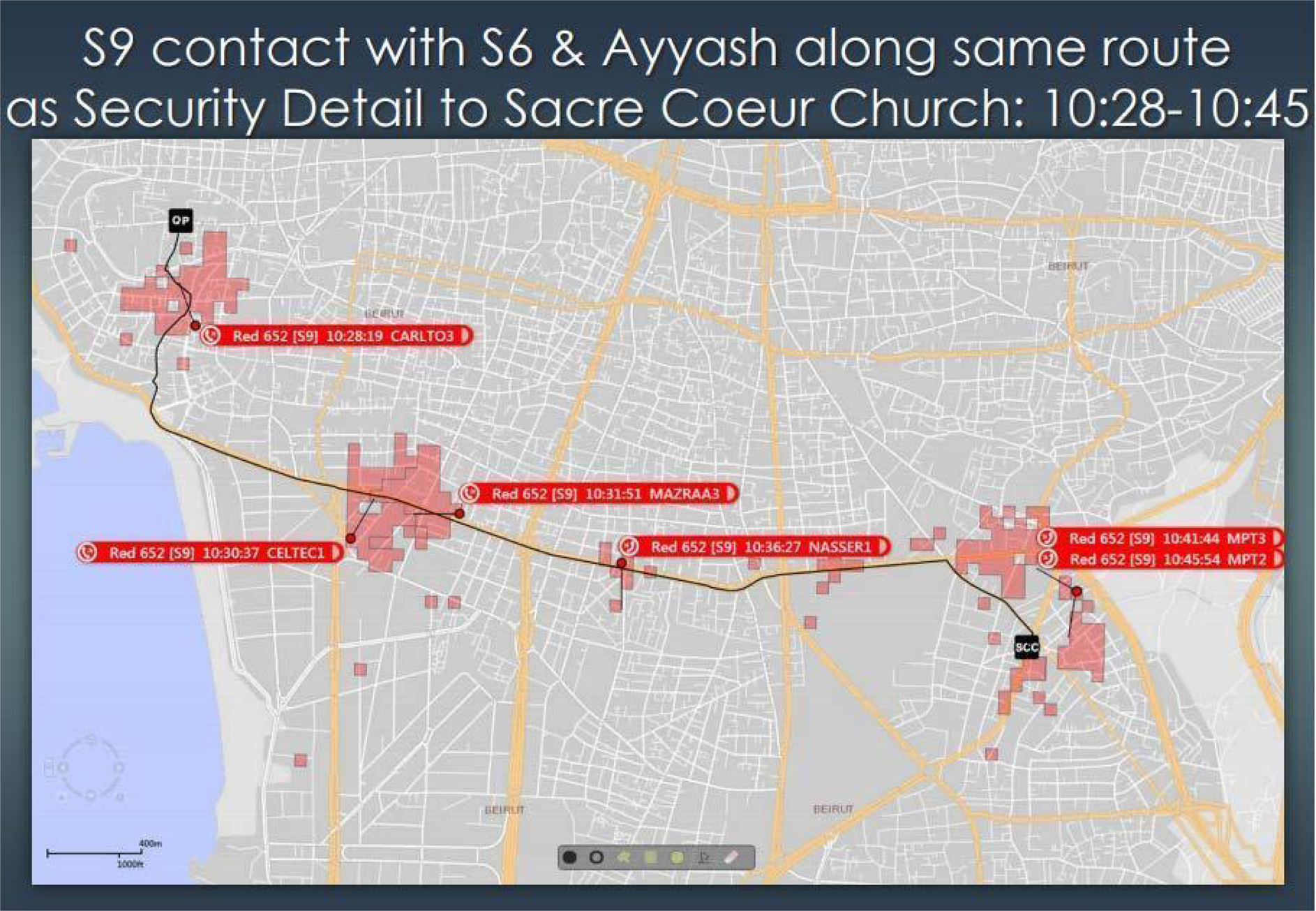
303. The Trial Chamber has identified the following fourteen specific instances of network activity that coincided with Mr Hariri's proven movements. These are bullet-pointed as:Footnote 374
• Thursday 11 November 2004: trip to the airport from Quraitem Palace;
• Tuesday 21 December 2004: evening meeting with Mr Hassan Nasrallah, in Haret Hreik, Dahyieh;
• Monday 27, Thursday 30, Friday 31 December 2004 and Saturday 1 January 2005: trips to or from Mr Hariri's Faqra Villa
• 29 January 2005: trip to Mr Marwan Hamade's residence;
• 29 January 2005: trip to villa at Al-Naameh villa;
• Monday 31 January 2005: trip to the Higher Shiite Council from Quraitem Palace and back to Quraitem Palace;
• Saturday 3 February 2005: trip from St Georges Marina to Quraitem Palace;
• Sunday 4 February 2005: trips to Mr Hamade's residence and to the airport;
• Monday 7 February 2005: trip from airport to Quraitem Palace;
• Tuesday 8 February 2005: trip from Quraitem Palace to Parliament;
• Saturday 12 February 2005: trips to two churches in Badaro and Mazraa; and
• Monday 14 February 2005: trip from Quraitem Palace to Parliament and back.
304. The Trial Chamber is therefore satisfied that the only reasonable conclusion available from the evidence is that Mr Hariri was under surveillance from Wednesday 20 October 2004 to Monday 14 February 2005, with the surveillance in the latter period connected with his possible assassination. The Trial Chamber cannot find that all of it was connected with the plan to assassinate Mr Hariri. In its totality—as is set out in analysing the dates of the conspiracy— the evidence only suffices to establish that the final decision to assassinate Mr Hariri was most probably made sometime in early February 2005. The Trial Chamber, however, cannot positively conclude that the surveillance in October, November and December 2004 and in January 2005 was solely for the purpose of planning his assassination.Footnote 375
305. Undoubtedly, some of it in the latter part of January 2005 was directed at obtaining information about Mr Hariri's movements and convoy if needed to continue with a plan to assassinate him, which had hatched by then. The Trial Chamber is satisfied that at least some of the users of the Red, Yellow, Green and Blue networks had a common mission, namely the assassination of Mr Hariri. However, the fact that these networks were connected and that their existence was linked to Mr Hariri's movements and eventually his assassination, does not mean that every user of every network mobile knew about the mission to assassinate him, either in detail or at all.Footnote 376
Role of the Green networkFootnote 377
306. In relation to the Green network, the Prosecution relies on so-called ‘hierarchical call flows’, namely other network activity just before or shortly after two of the mobiles in the Green network were in contact. Such call flows would be either evidence of ‘reporting from the field’ or the conveying of instructions downwards.Footnote 378
307. According to the Prosecution, the Green network was the mission command, the apex of the operation, with Mr Badreddine at its peak as the coordinator or monitor of the preparations for the assassination and making the false claim of responsibility for the attack. The Trial Chamber has concluded that insufficient evidence exists to draw this conclusion.Footnote 379
308. Mr Platt concluded that telecommunications evidence allowed the conclusion that some network users had meetings. The Trial Chamber accepts that they did meet, as indeed they would have had to. The surveillance of Mr Hariri was obviously not spontaneously arranged in bursts of short mobile calls between various network users in the field. It could have occurred only as a result of planning which would naturally have involved planning meetings. But there is no evidence of when they were, or where or for how long, nor of what was said.Footnote 380
309. The Trial Chamber is not satisfied that there is sufficient evidence from the telecommunications evidence alone, which consists only of metadata, to conclude from this that users of network mobiles met in person at the times and in the areas suggested by the Prosecution. It is a strong possibility, but without more evidence, the Trial Chamber is not prepared to make a positive finding that it occurred.Footnote 381
310. The Trial Chamber is also not satisfied that the Green network functioned as ‘mission command’. The Trial Chamber carefully considered the so-called call flows from the Green to the Blue and Red network. It also considered its findings on the attribution of various mobiles.Footnote 382
311. It is satisfied that there was a connection between these calls and that there was clear sequencing in the sense of calls following each other, even from network to network. However, without the content of any of these calls, or any other evidence, inferring a hierarchy from a few instances of sequencing is speculative. Additionally, the Trial Chamber carefully considered whether the timing of the calls could provide the relevant context, such as to suggest the call content. However, again, the evidence on the timing was inconclusive and inferring that the calls must have related to instructions or reporting goes no higher than conjecture.Footnote 383
312. The Trial Chamber accordingly was of the view that it was not the only reasonable conclusion from the evidence that the Green network acted as mission command. The Trial Chamber allowed for the reasonable possibility that the Green network had another function, not necessarily at the apex of all other networks.Footnote 384
IMPORTATION AND SALE OF MITSUBISHI CANTERFootnote 385
313. In December 2004, Witness PRH075 imported into Lebanon from the United Arab Emirates the white 2002 Mitsubishi Canter right-hand-drive light truck that was used in the explosion on Monday 14 February 2005. He sometimes displayed his imported vehicles for sale at a ‘dealership’ in Tripoli that Witness PRH063 operated with a partner. Its records were inaccurate and or incomplete.Footnote 386
314. The Canter was displayed at Witness 63's ‘showroom’ for a short period before its sale in January 2005 to two men who paid in cash for it and drove it away. During their visit, Witness 63 called Witness 75, regarding price negotiations, twice within five to 15 minutes. No witness could independently recall the sale date, although Witnesses 63, 75 and an office manager, Witness PRH459, concluded that it had been Tuesday 25 January 2005.Footnote 387
315. Neither call data records nor the dealership's records can confirm the sale date. The Prosecution argues that the truck was sold on 25 January 2005 and Mr Ayyash coordinated its purchase. The preponderance of witness evidence supports that date, which is confirmed by the network activity. The Ayyash Defence submits that 17 January 2005 is more likely—indeed that cell coverage records prove it could not have been 25 January 2005—and that the witnesses' conclusion about that date was unpersuasive, given the methods by which they reached it. Furthermore, according to the Ayyash Defence, Mr Ayyash was in Saudi Arabia, not Lebanon, from 15 to 28 January 2005.Footnote 388
316. The Trial Chamber has concluded that the dealership witnesses' evidence on its own cannot establish the date of the sale, but that there is no reason to disbelieve that evidence. Based on the combination of the witnesses' evidence, the call data records for Witnesses 63's and 75's mobiles, the date of Eid and the dealership's receipt stubs, 25 January 2005 is the more likely date.Footnote 389
317. Obtaining the Canter was part of the plot to commit the attack and kill Mr Hariri. It is plausible that the network mobile activity in Tripoli on 11, 12, 14, 15, 22 and 25 January 2005 concerned—and evidenced—this aspect of the plot. However, there is insufficient evidence to determine beyond reasonable doubt either any particular network mobile user's role in the Canter's purchase, or what any of them did afterwards to prepare it for use in the attack.Footnote 390
CLAIM OF RESPONSIBILITY FOR THE ATTACKFootnote 391
318. On the afternoon of Monday 14 February 2005, some hours after the successful attack on Mr Hariri's life, international media outlets broadcast a claim of responsibility for the attack in which a twenty-two year old Palestinian, Mr Ahmad Abu Adass, claimed responsibility for the attack on behalf of an unknown fundamentalist group called El-Nusra-wal-Jihad-fi-Bilad- El-Sham ‘Victory and Jihad in Greater Syria’. His family had reported him missing a month earlier.Footnote 392
319. The Prosecutor's case is that the claim of responsibility was false and that the fundamentalist group is fictional. Rather, Mr Badreddine, Mr Merhi, Mr Oneissi and Mr Sabra were responsible for manufacturing a false claim of responsibility to deflect attention away from the true perpetrators of the attack.Footnote 393
320. Mr Badreddine is alleged to have monitored, and together with Mr Merhi, coordinated the preparation of the false claim of responsibility. Mr Oneissi and Mr Sabra, under Mr Merhi's coordination, are alleged to have participated in Mr Abu Adass's disappearance for the purpose of creating a false claim of responsibility. Before the attack, Mr Merhi is alleged to have coordinated their activities ‘in order to identify and effect the disappearance of a suitable individual’, Mr Abu Adass, ‘who would be used to make the video-taped false claim of responsibility’.Footnote 394
321. Immediately after the attack, and under Mr Merhi's coordination, Mr Oneissi and Mr Sabra are alleged to have participated in disseminating statements falsely attributing responsibility for the attack, ensuring the delivery of the video and a letter to Al-Jazeera, and that the video would be broadcast.Footnote 395
322. Their role in the claim of responsibility is the sole basis for Mr Merhi's, Mr Oneissi's and Mr Sabra's alleged criminal responsibility. The core events of the false claim plot were:
• the conspirators identifying a suitable person to make the false claim—namely Mr Abu Adass, who was a young introverted person with strong religious leanings—in the Arab University Mosque in Beirut. Mr Oneissi befriended Mr Abu Adass by pretending to be ‘Mohammed’, who needed assistance in learning how to pray;
• effecting the disappearance of Mr Abu Adass from his home on Sunday 16 January 2005: ‘Mohammed’ also participated in this;
• creating a video in which Mr Abu Adass falsely claimed responsibility for the attack on Mr Hariri; and
• disseminating and publishing the false claim via media outlets immediately after the assassination on Monday 14 February 2005.Footnote 396
323. The Prosecutor alleges that Mr Merhi and Mr Badreddine used their Green network mobiles, respectively Green 071 and Green 023, exclusively to ‘exchange information’ and ‘to coordinate the acts done in furtherance of the conspiracy’. Mr Merhi coordinated the false claim, and he, Mr Oneissi and Mr Sabra communicated for this purpose on their three personal mobiles. The Prosecution termed these the ‘Purple phones’. These, according to the amended consolidated indictment, were ‘a group of three phones, which were used from at least 1 January 2003 until 16 February 2005’ and ‘were used to communicate amongst each other and to communicate with others outside the group’. Further, they ‘were used to coordinate the false claim of responsibility’.Footnote 397
324. To prove this aspect of its case, the Prosecution led telecommunications and cell site evidence of the movements of the Purple mobiles, namely Mr Merhi's Purple 231, Mr Oneissi's Purple 095 and Mr Sabra's attributed Purple 018; and of communications between Mr Badreddine's Green 023 and Mr Merhi's attributed Green 071. The Prosecution alleges that behavioural patterns of their mobiles show that Mr Oneissi and Mr Sabra coordinated the false claim, and that Mr Merhi coordinated it.Footnote 398
325. It also called evidence of what occurred in the mosque in January 2005, and from Mr Abu Adass's family, friends and associates. Finally, it presented evidence from those who received and broadcast the video on the afternoon of Monday 14 February 2005.Footnote 399
326. The evidence, however, was insufficient to establish that Mr Merhi was using Green 071. For the purposes of analysis here, and to do justice to the Prosecution's case—and even though the Trial Chamber cannot positively find that Mr Sabra was the user of Purple 018—the analysis below proceeds on the assumption that Mr Sabra was Purple 018's single user.Footnote 400
327. The Trial Chamber finds that four telephone calls were made on the afternoon of 14 February 2005 regarding the claim of responsibility for the attack using telecard 6162569. The call data records for this telecard, as for the Reuters and Al-Jazeera landlines, reveal that four calls were made—one to Reuters at 14:11, and three to Al-Jazeera, at 14:19, 15:27 and 17:04.Footnote 401
Rule 158 ‘unavailable’ witnessesFootnote 402
328. Much of the evidence as to Mr Abu Adass's background and the ‘Mohammed’ story comes from witnesses who did not testify in court.Footnote 403
329. They were his father, Mr Taysir Abu Adass, who died in March2005, Witness PRH056 and Mr Ziad Ramadan, who was a friend and former workmate. Mr Taysir Abu Adass was deceased, and neither Witness 56 nor Mr Ramadan appeared in court. The Trial Chamber determined, on the Prosecution's application, and over the objections of Defence counsel, that the latter two were ‘unavailable’ to appear in court and testify, and thus admitted their evidence in statement form under Rule 158.Footnote 404
330. The Rule 158 evidence of these witnesses, on many points, is hearsay. Their statements, which are themselves a form of hearsay as out of court statements, contained other hearsay evidence—primarily as to what Mr Abu Adass had said or done—resulting in several levels of hearsay. In some instances, the source of the information in the statements is unclear. This inevitably affects its reliability and how the Trial Chamber can use the evidence. Hence, and in accordance with the relevant international legal standards on assessing evidence, the Trial Chamber has taken a cautious approach in considering this evidence.Footnote 405
MAKING THE CLAIM OF RESPONSIBILITY FOR THE ATTACKFootnote 406
331. In the immediate aftermath of the explosion on 14 February 2005, Beirut was in a state of chaos and crisis. The Trial Chamber received evidence of an atmosphere of turmoil that included the overloading of the mobile networks and a breakdown in communications.Footnote 407
332. People were desperately trying to obtain information about family and friends. The crime scene was swamped with emergency and security personnel, journalists and many others who should not have been there, including people looking for their loved ones. It was at first unclear whether Mr Hariri had survived the attack. When his death was announced, the obvious question was of ‘who was responsible’. It was in this setting, but before Mr Hariri was officially confirmed dead, that the Beirut offices of Reuters and Al-Jazeera received calls claiming responsibility for the attack.Footnote 408
333. The Beirut Al-Jazeera bureau chief, Mr Ghassan Ben-Jeddo, took three calls relating to this. At around 14:19 someone then called Al-Jazeera's Beirut office. Mr Ben-Jeddo testified that the caller said something very similar to the written text containing the claim of responsibility for the assassination, which the Al-Jazeera office received later.Footnote 409
334. The second call was at 15:39. The caller told Mr Ben-Jeddo that there was a video tape on a tree near the Al-Jazeera building, next to a pink building. He said that it must be retrieved within fifteen minutes or it would not be found.Footnote 410
335. Witness PRH115, a technician working at Al-Jazeera, then volunteered to go and get the tape. He walked around the tree two or three times before he noticed a white box on one of the branches. He climbed about a metre or a metre and a half up the tree and collected the box.Footnote 411
Exhibit 4D161 (Photograph marked by Witness PRH115 showing where on the tree he saw the white box) Footnote 412

336. A third call was made to Al-Jazeera at 17:04. The caller became threatening, and in a sharp voice said that Al-Jazeera would hear a lot in the future about the group claiming responsibility for the attack, and that it was in the company's interest to cooperate.Footnote 413
337. The video was broadcast on Al-Jazeera at 17:30. The video tape contained a footage of Mr Abu Adass, who was seated under a banner purportedly to be that of the group El-Nusra-wal-Jihad-fi-Bilad-El-Sham (Society for Support and Jihad in Greater Syria), reading out the following claim of responsibility: Footnote 414
In the name of Allah, Lord of the Worlds, Blessings and Peace be upon his Beloved Prophet and his family and all his companions.
In support of our brothers, the Mujahedeen in the Land of the Two Holy Mosques, and to avenge their innocent martyrs, who were killed by the security forces of the infidel Saudi regime in the Land of the Two Holy Mosques, we have resolved, having placed our trust in God Almighty, to inflict just punishment upon the agent of that regime and its cheap tool in Greater Syria, the sinner and holder of ill-gotten gains Rafiq Hariri, through the execution of a resounding martyrdom operation; such as to confirm our promise of Victory and ‘jihad’ and to herald numerous martyrdom operations against the infidels, apostates and tyrants in the Greater Syria.
“Praise be to Allah, Lord of the Worlds.”
Exhibit P766 (Still image from video-recorded claim of responsibility featuring Mr Abu Adass aired on Al-Jazeera) Footnote 415

338. The letter accompanying the video tape stated:Footnote 416
Praise be to God Lord of the Worlds, Most Gracious, Most Merciful, Master of the Day of Judgment, and Blessings and Peace be upon his Servant and Prophet and his family and all his companions.
Here is good news for all Muslims and especially the Holy Land of Palestine, Mesopotamia, the Sanctuary of the Two Holy Places, our brothers in Afghanistan, our people in Chechnya and the Blessed Land of Greater Syria; good news raising the banner of oppressed believers and supporting their struggle against arrogant despots.
Praise be to God, the banner of support and jihad was held aloft in Greater Syria and, praise be to God, due punishment was meted out to the agent of infidelity in the Land of the Two Holy Places, Rafic Hariri, through a suicide operation carried out by the
Mujahid, Ahmad Abou-Adass, who raised the banner of support and jihad in Greater Syria on Monday 14 February 2005 AD, 5 Muharram 1426 AH, in Beirut.
God is Great, Praise be to God Lord of the Worlds.
Attached is a film of the martyr Ahmad Abou Adass, who carried out the operation.
The letter was signed El-Nusra-wal-Jihad-fi-Bilad-El-Sham, Abou Hafass El-Chami.Footnote 417
339. The Trial Chamber finds that four telephone calls were made on the afternoon of 14 February 2005 regarding the claim of responsibility for the attack using telecard 6162569. The call data records for this telecard, as for the Reuters and Al-Jazeera landlines, reveal that four calls were made—one to Reuters at 14:11, and three to Al-Jazeera, at 14:19, 15:27 and 17:04.Footnote 418
340. The four calls were made from four payphones. The two maps from the electronic presentation of evidence below show, in the first one, the location of the four payphones, the tree, Al-Jazeera and Reuters. The second shows the cells to which mobiles Purple 018 and Purple 095 connected around the time that the call was made from the fourth payphone to Al- Jazeera, at 17:04 on the afternoon of Monday 14 February.Footnote 419
Exhibit P1923, slide 146 Footnote 420

Exhibit P1783 (Expert report of Gary Platt – Chronology), p. 416
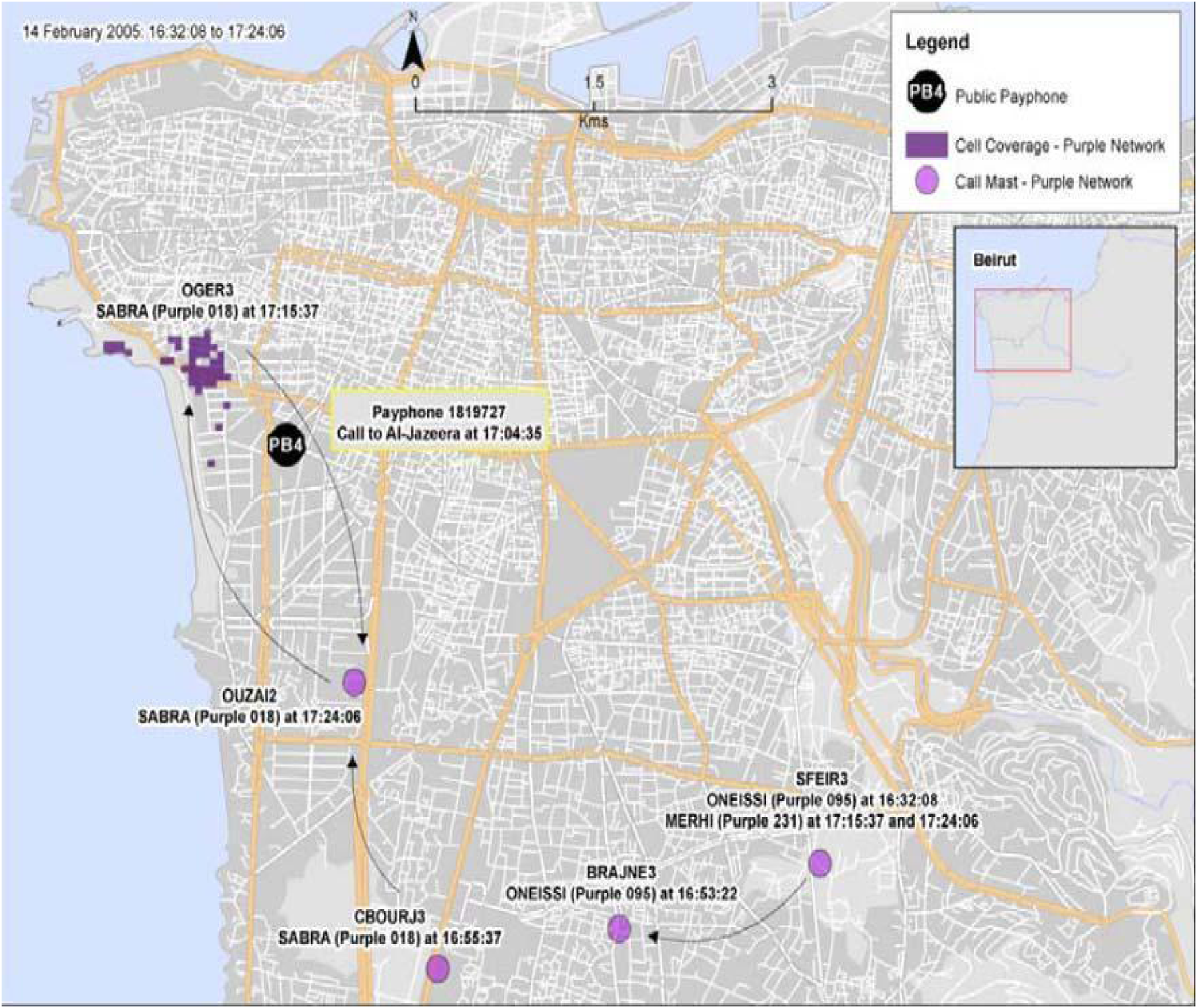
341. The Trial Chamber cannot make any findings from this evidence about who made the calls, nor how many callers there were. Mr Ben-Jeddo testified that three different people called Al-Jazeera regarding the claim of responsibility. It is also possible that another, different person called Reuters. Although it is most likely that the same people made the calls, there is no way of comparing whether the same person(s) called both Reuters and Al-Jazeera.Footnote 421
342. The Trial Chamber also finds that members of Al-Jazeera's Beirut office obtained the false claim video and letter at 15:53 from the tree near their office. The call data records support this finding.Footnote 422
343. However, it cannot determine when the package was placed in the tree; there is no evidence from which the Trial Chamber can make a finding as to whether it was placed there before or after the attack.Footnote 423
AHMAD ABU ADASSFootnote 424
344. The entire false claim plot centres on its subject, Mr Ahmad Abu Adass. The Trial Chamber received evidence about Mr Abu Adass from family and friends who knew him. The evidence goes to proving the Prosecutor's pleading that the claim of responsibility for the attack was false. The gist of the Prosecution case is that because of his personal profile he was deliberately targeted and chosen by those who were responsible for this attack.Footnote 425
345. The Trial Chamber is satisfied that the evidence establishes that Mr Abu Adass was a young man, perhaps with an introverted personality, who in the period before his disappearance was becoming increasingly religious. This included growing a beard and wearing religious clothing. His Lebanese identity card, dated 15 April 2002, shows him with a beard. He was attending the mosque near his home daily and had developed an interest in Islamic literature. Mr Abu Adass also appears to have been disinterested in politics. These factors, in the Trial Chamber's assessment, could have made him susceptible to approaches from groups wishing to recruit young vulnerable people to their religious causes.Footnote 426
346. The Trial Chamber is also satisfied from the uncontested evidence that Mr Abu Adass could not drive. He was interested in computers and had briefly worked in the information technology sector. At the time of his disappearance, like many other young people, he was probably contemplating a married future.Footnote 427
Selecting Mr Abu Adass—between Friday 22 December 2004 to Friday 7 January 2005Footnote 428
347. The Prosecutor, in the amended consolidated indictment, alleges that in late December 2004 to early January 2005, Mr Abu Adass was identified as a likely scapegoat for making the false claim. He alleges that Mr Oneissi, posing as ‘Mohammed’, approached people, including Mr Abu Adass, at the Arab University Mosque, and that telecommunications evidence placed Mr Oneissi and Mr Sabra around the Arab University Mosque in the relevant period.Footnote 429
348. The evidence of Mr Abu Adass's encounters with anyone in the mosque in December 2004 and January 2005 is mostly hearsay and derives from statements admitted into evidence under Rule 158. The thread running through all accounts is of Mr Abu Adass teaching someone to pray in the mosque near his home in the weeks before his disappearance. Only one witness, Witness 87, provided direct evidence of Mr Abu Adass (apparently) teaching anyone to pray in the mosque.Footnote 430
349. Witness 87 testified that he saw Mr Abu Adass with a young man in the mosque shortly before his disappearance. Mr Abu Adass was teaching the young man how to pray.Footnote 431
350. The Trial Chamber also heard evidence from a witness who encountered a ‘Mohammed’ in the mosque. At the beginning of January 2005, on a Monday, during the noon prayer, this witness saw a young man sitting in the corner near the stairs next to the main hall of the mosque. The man said that he did not know how to pray and would like the witness to teach him how. The witness remembered having pointed at Mr Abu Adass as someone who could, and was better suited to teach ‘Mohammed’ how to pray.Footnote 432
351. In mid-2007, the witness assisted the Lebanese investigating authorities in sketching ‘Mohammed’ and, in March 2010, pointed to Mr Oneissi's face on photo boards shown by Prosecution investigators.Footnote 433
352. Witness 87's evidence does not corroborate that Mr Abu Adass met and taught ‘Mohammed’ to pray. It only confirms that Mr Abu Adass may have taught someone to pray in the mosque in January 2005. Further, the other witness's evidence does not corroborate that ‘Mohammed’ approached Mr Abu Adass. It only confirms that a person named ‘Mohammed’ approached that witness. In these circumstances, it is not the only reasonable inference available to the Trial Chamber on the evidence that either Witness 87 or the other witness's evidence corroborates the two Rule 158 witnesses' already somewhat inconsistent hearsay evidence.Footnote 434
353. The Trial Chamber therefore finds that the Prosecution has not established beyond a reasonable doubt that Mr Abu Adass met a person called ‘Mohammed’ at the mosque in late December 2004 or early January 2005 and taught him how to pray.Footnote 435
The ‘identification’ of Mr Oneissi as the ‘Mohammed’ that Mr Abu Adass encountered in the mosqueFootnote 436
354. In the amended consolidated indictment, the Prosecutor alleges that Mr Oneissi posed as ‘Mohammed’ to meet Mr Abu Adass and to convince him to leave his home on 16 January 2005. This is a material fact that the Prosecution must prove beyond reasonable doubt to the extent that a conviction would rely upon it. The Prosecution submitted, in its final trial brief and closing arguments, that the Trial Chamber need not establish the precise identity of the ‘Mohammed’ who lured Mr Abu Adass away from his family. However, it also insisted that there is evidence that Mr Oneissi was ‘Mohammed’.Footnote 437
355. Like all the elements of a crime, the Prosecution must prove the identification of an Accused beyond reasonable doubt. If the Trial Chamber were not satisfied beyond reasonable doubt that Mr Oneissi was ‘Mohammed’, it could still nonetheless convict him of the crimes charged if the Prosecution could prove beyond reasonable doubt other relevant material facts proving the elements of the crimes charged and supporting the charged modes of responsibility.Footnote 438
356. On 10 July 2007, based on the witness's description, a sketch of ‘Mohammed’ was made. On 22 March2010, the witness participated in the identification procedure, administered by the Prosecution investigators, where the witness tapped on Mr Oneissi's photograph.Footnote 439
357. However, having assessed the evidence regarding the purported identification of ‘Mohammed’, including that of Professor Siegfried Sporer, the Trial Chamber is not satisfied that the identification is reliable and therefore probative.Footnote 440
358. There are two primary reasons for this. The first is the more than five-year gap in time between when the witness saw ‘Mohammed’ in the Arab University Mosque in January 2005 and the purported identification of Mr Oneissi as this ‘Mohammed’ to Prosecution investigators in March2010. The second is the flawed manner in which the identification was attempted and about which Professor Sporer provided extensive evidence.Footnote 441
359. The Trial Chamber largely accepts Professor Sporer's mostly unchallenged evidence critiquing the reliability of these procedures. For example, he criticised a number of features. These include the failure to consider the available descriptions of several witnesses in the selection of photographs for the photo boards, and the inclusion of relatives of Mr Oneissi and Mr Sabra who might have been persons ofinterest.Footnote 442
360. The Trial Chamber therefore is not convinced of the reliability of the photo board identification to establish whether Mr Oneissi was the ‘Mohammed’ in the mosque. Accordingly, even if the Trial Chamber had positively found that Mr Abu Adass met a ‘Mohammed’ in the mosque, it would have disregarded the photo board evidence in assessing whether there was any evidence capable of establishing that Mr Oneissi was that ‘Mohammed’.Footnote 443
Activity of Mr Merhi's Purple 231, Mr Oneissi's Purple 095 and Mr Sabra's attributed Purple 018, between December 2004 and Friday 7 January 2005Footnote 444
361. The Prosecution's case alleging Mr Oneissi's and Mr Sabra's involvement in the ‘Mohammed’ story and Mr Abu Adass's disappearance and his subsequent appearance in the broadcast video hinges upon it proving their presence in and near the Arab University Mosque at relevant times. The allegation that Mr Oneissi befriended Mr Abu Adass, pretending to be ‘Mohammed’ and seeking assistance in learning how to pray was central to this part of the case.Footnote 445
362. The evidence led to prove this is the call data records showing Mr Oneissi's personal mobile and Mr Sabra's shared personal mobile connecting to the Alfa network's COLA and adjacent cells at relevant times, and Mr Oneissi's purported identification as the ‘Mohammed’ that a witness saw in the Mosque, and therefore, as the ‘Mohammed’ that Mr Abu Adass allegedly met in the mosque. The Prosecution submitted in its final trial brief, however, that it did not place great weight on this identification but insisted that it still had some evidential value.Footnote 446
363. In examining the call data records, the Trial Chamber has carefully considered the evidence of Mr Oneissi's Purple 095 and Mr Sabra's attributed Purple 018 connecting to cells ‘near’ the mosque before Wednesday 22 December 2004, while also bearing in mind that Alfa's call data records before 1 October 2004 are incomplete. Before 1 August 2004, the Alfa network had cell data records of outgoing calls, but none of incoming calls and inbound and outbound SMS messages; and end cell data was only available from 1 October 2004.Footnote 447
The so-called ‘COLA phase’—Wednesday 29 December 2004 to Friday 7 January 2005Footnote 448
364. The Prosecution used the term, ‘COLA phase’, to refer to the ten-day period between Wednesday 29 December 2004 and Friday 7 January 2005 when Mr Sabra's attributed Purple 018 and Mr Oneissi's Purple 095 were most active connecting to the COLA and adjacent cells near the mosque.Footnote 449
365. The Trial Chamber, as noted, cannot find beyond reasonable doubt either that Mr Abu Adass met a person named ‘Mohammed’ in the Arab University Mosque, nor that the person who claimed to be the ‘Mohammed’ there was Mr Oneissi. The Trial Chamber is not satisfied of the reliability of the Prosecution evidence used to establish that Mr Oneissi was the ‘Mohammed’ encountered in the mosque, and most specifically its intended and pleaded identification evidence. The Trial Chamber has disregarded this in assessing whether there is any evidence capable of proving that material fact. Even if proof beyond reasonable doubt for these facts, however, is not required, the intermediate and ultimate result would remain unchanged.Footnote 450
Whether the Prosecution has proved that Mr Oneissi was ‘Mohammed’Footnote 451
366. To a large extent the Prosecution case theory of Mr Merhi's, Mr Oneissi's and Mr Sabra's involvement in the plot to kill Mr Hariri relied upon proof that Mr Oneissi was ‘Mohammed’ as the lynch pin for proving his and Mr Sabra's involvement in the telephone calls to Al-Jazeera and Reuters on Monday 14 February 2005.Footnote 452
367. The evidence intended to prove this, as is detailed above, was the combination of the presence of Mr Sabra's attributed personal mobile Purple 018 and Mr Oneissi's Purple 095 near the mosque in tandem with testimony from Witness 56, Witness 87, Mr Ziad Ramadan and the witness who met a ‘Mohammed’ in the mosque in early January 2005. The evidence identifying Mr Oneissi as ‘Mohammed’ was supposed to buttress these other pieces of evidence. The Prosecution's pleadings and opening statements reiterated that Mr Oneissi acted as ‘Mohammed’. The Trial Chamber has disregarded the photo board identification as reliable evidence in assessing whether Mr Oneissi was ‘Mohammed’.Footnote 453
368. The combination of this evidence—together with the Purple mobiles' activations on the afternoon of Monday 14 February—might have allowed the Trial Chamber to draw the necessary inferences that they were responsible for making the calls to the news agencies. However, without the evidence of their pleaded participation in the ‘Mohammed’ story—and by extension Mr Abu Adass's disappearance—their only connection to the conspiracy was Mr Oneissi's Purple 095's and Mr Sabra's attributed Purple 018's presence, at various times, at locations ‘near’ the payphones, and the tree, on the afternoon of 14 February 2005. And additionally, ‘near’ the Arab University Mosque in December 2004 and January 2005.Footnote 454
369. Once the main evidence linking Mr Oneissi with ‘Mohammed’ is eliminated from consideration, the Prosecution's case against the three Accused considerably weakens. The obvious question follows of how this diminished evidence could be sufficient to establish proof beyond reasonable doubt that they made the calls, were present near the tree at the relevant time and, additionally, knew that they were to participate in this before the explosion at around 12:55 on 14 February 2005. Their pleaded criminal responsibility requires their awareness of this.Footnote 455
370. The evidence shows that Mr Oneissi's Purple 095 was, to use Mr Platt's terminology, ‘in the vicinity’ of the mosque on Wednesday 29, Thursday 30 and Friday 31 December 2004, and on Monday 3 and Friday 7 January 2005—in the sense of connecting to nearby cells. A witness also described meeting a ‘Mohammed’ in the mosque, either on Monday 3 or Monday 10 January 2005, around the noon prayer time.Footnote 456
371. The mobile Purple 018, used by Mr Sabra and his wife, was ‘near’ the mosque on Thursday 30 and Friday 31 December 2004, and on Saturday 1, Monday 3, Tuesday 4, Wednesday 5, Thursday 6 and Friday 7 January 2005. This mobile was activating cells in this area more often than Mr Oneissi's Purple 095 and for longer periods.Footnote 457
372. In his two opening statements, the Prosecution's lead counsel pointed to the activations by Mr Oneissi's Purple mobile of cells in the mosque area in December 2004 and January 2005. He stated that ‘when all the evidence is considered in its totality’, it proves that Mr Oneissi was ‘Mohammed’.Footnote 458
373. In oral closing arguments, Prosecution counsel similarly submitted that other evidence also provides ‘some indication that Mr. Oneissi was Mohammed’. Counsel argued that his Purple mobile usage patterns ‘to a large extent, match’ Witness 56's evidence on when ‘Mohammed’ appeared in the mosque area and disappeared from it twice, each time for one week, before leaving with Mr Abu Adass. The Prosecution also pointed to Purple 095's ‘heavy COLA cell use’ on Wednesday 22 December 2004, and then ‘again a week later and again on the 7th of January’, with only a ‘two further days’ of use in between.Footnote 459
374. The Trial Chamber has been unable to find that Mr Abu Adass met a person named ‘Mohammed’ in the mosque. It has only concluded that a witness met someone named ‘Mohammed’ there in early January 2005, that this person asked the witness to teach him how to pray and the witness pointed at nearby Mr Abu Adass as someone who was better suited to teach this ‘Mohammed’ how to pray. According to the witness, this occurred either on Monday 3 or 10 January 2005, during the noon prayer.Footnote 460
375. The Trial Chamber finds that Mr Oneissi's Purple 095's presence ‘in the vicinity’ of the mosque on Monday 3 January 2005—which on the evidence is one of the two possible dates for the encounter—after the start of the afternoon prayer, is insufficient, of itself, to establish beyond reasonable doubt that Mr Oneissi was ‘Mohammed’. This is so even when considering this piece of evidence together with the totality of the Purple mobiles' activity during the so- called ‘COLA phase’, on the day of Mr Abu Adass's disappearance, Sunday 16 January—or more precisely their inactivity then—or on Monday 14 February 2005. The evidence does not establish how long Mr Oneissi was there for, and moreover, 32 minutes after activating the CHATIL1/COLA2 cells, he was back in southern Beirut.Footnote 461
376. The Trial Chamber has also found Witness 56's account on Mr Abu Adass's meeting with a ‘Mohammed’, either on its own or when considered with other evidence, insufficiently reliable to be probative.Footnote 462
377. In opening the case against Mr Merhi, the Prosecution argued that the increase in communication between Mr Sabra and Mr Oneissi and the corresponding increase in contact between Mr Merhi and Mr Sabra and Mr Oneissi is evidence that Mr Merhi ‘had taken steps to assemble his team to advance the false claim of responsibility’.Footnote 463
378. The difficulty with this, however, is that there is no evidence connecting these calls with anything related to Mr Abu Adass, the mosque, anyone called ‘Mohammed’, Mr Abu Adass's disappearance, the video or its making or its broadcast. And significantly, the last call between Green 071, attributed to Mr Merhi, and Mr Badreddine on Green 023 was on Monday 7 February 2005, in circumstances which appear to be devoid ofcontext.Footnote 464
Mr Abu Adass's disappearance and surrounding eventsFootnote 465
379. Mr Merhi and Mr Oneissi are alleged, based upon the amended consolidated indictment, to have been involved in Mr Abu Adass's disappearance from his home on the morning of Sunday 16 January 2005.Footnote 466
380. The Prosecution argues that Mr Sabra, Mr Merhi and Mr Oneissi's involvement in Mr Abu Adass's ‘abduction’ on Sunday 16 January 2005 was shown by the following. These are first, the Green and Purple ‘hierarchical’ call flows from Wednesday 12 January to Saturday 15 January 2005. The second is of telephone calls to the Abu Adass home on the evening of Saturday 15 January 2005 from ‘Mohammed’.Footnote 467
381. The third is of the inactivity of the Purple mobiles on Sunday 16 January 2005 when there were no calls between Mr Merhi's Purple 231, Mr Oneissi's Purple 095 and Mr Sabra's attributed Purple 018. The fourth is the activity of the Green mobiles that day, namely, that of Mr Abu Adass's disappearance.Footnote 468
382. The fifth is of telephone calls to the Abu Adass household on Monday 17 January 2005 by ‘Mohammed’. The sixth is of Purple mobile call patterns on Monday 17 January 2005, around when the Abu Adass household received the calls from ‘Mohammed’. The seventh is of Mr Taysir Abu Adass reporting Mr Abu Adass missing on Wednesday 19 January 2005.Footnote 469
383. In the early morning of Sunday 16 January 2005, Mr Abu Adass attended the dawn prayers at the nearby Arab University Mosque and returned home. The dawn prayers that day were at 05:15. Witness 56 stated that Mr Abu Adass then left the house at around 07:00.Footnote 470
384. It appears that on Wednesday 19 January 2005 Mr Taysir Abu Adass filed a complaint with the Public Prosecutor's Office at the Court of Appeal in Beirut, requesting an investigation into the disappearance of his son, Mr Ahmad Abu Adass. Later that same day he made a statement at a police station.Footnote 471
385. The fact of Mr Abu Adass's disappearance from his home on Sunday 16 January 2005 is uncontested. Rather, the issue among the Parties is with whom he left and in what circumstances. The Trial Chamber has no reason to disbelieve the evidence of Mr Abu Adass's father, as contained in the official missing person's report, that this was the day of his disappearance. It therefore finds that that is when he left his home for the last time. Similarly, the uncontested evidence is that he was never seen again. The Trial Chamber, likewise, makes the finding that his family never saw Mr Abu Adass again after he left his home in Beirut on Sunday 16 January 2005.Footnote 472
386. Given its equivocal and untested nature, the evidence that Mr Abu Adass left his home with ‘Mohammed’ is insufficiently reliable to make a finding that this occurred. The evidence is in this respect so lacking that the Trial Chamber could also reasonably consider that Mr Abu Adass left with someone else, or that he had departed alone. In other words, while the evidence cannot establish beyond reasonable doubt that Mr Abu Adass left with ‘Mohammed’, there are alternative possibilities reasonably available from the evidence. The Trial Chamber consequently cannot find that the Prosecution has established beyond a reasonable doubt that Mr Abu Adass left with ‘Mohammed’ on Sunday 16 January 2005. Even if proof beyond reasonable doubt is not required of this fact, there is no probative evidence that this occurred.Footnote 473
387. There is no reliable evidence connecting Mr Merhi's calls on his attributed Green network mobile to Mr Badreddine that morning with the disappearance, notwithstanding their temporal coincidence with his disappearance that day. Therefore, the only conclusion reasonably available from the cell site evidence of the mobile activities is that the Trial Chamber cannot positively find that any of the three Accused were involved in Mr Abu Adass's disappearance on Sunday 16 January 2005.Footnote 474
Preparing the claim of responsibility—Tuesday 18 January 2005 to Sunday 13 February 2005Footnote 475
388. The Prosecution alleges that, first, immediately after his disappearance, probably on Tuesday 18 January 2005, Mr Abu Adass made the video containing the claim of responsibility. Second, on Wednesday 9 or Thursday 10 February 2005, the telecard used to make the calls claiming responsibility on Monday 14 February 2005 was purchased. Third, the mobile activity around these events showed the involvement of Mr Sabra, Mr Oneissi and Mr Merhi in these preparatory events.Footnote 476
389. The Trial Chamber finds that an unknown person purchased a telecard with the number 6162569 on Thursday 10 February 2005 at the Ogero sales office in Nahr Beirut. Ogero's sales records state that this telecard was sold on that date and there is no reason to doubt their accuracy. But in any event whether it was bought on 9 or 10 February 2005 is unimportant as nothing connects any of the Accused with the purchase.Footnote 477
390. The Trial Chamber is unable to make any findings about when the video tape was made beyond the obvious that it was made after Mr Abu Adass's disappearance on Sunday 16 January, and before Mr Hariri's assassination on Monday 14 February 2005. The evidence about his beard's possible growth is unclear and the Trial Chamber can accordingly make no finding about how much it had grown between his disappearance and whenever the video was made. His Lebanese identity card, issued in April 2002, shows him with a beard, but this is inconclusive; there was no evidence about when the photograph was taken, and beard wearing can regularly change.Footnote 478
391. The Trial Chamber received some evidence about Mr Abu Adass's allegedly changed appearance in the video tape. However, this evidence is contested and comes from witnesses whose evidence is challenged and it was admitted under Rule 158 without cross-examination, although the Merhi and Oneissi Defence and the Prosecution used it in their final trial briefs.Footnote 479
392. There is no evidence connecting any of the Accused with the making of the video nor any of the other preparatory acts to making the claim of responsibility on Monday 14 February 2005. The Trial Chamber therefore cannot conclude that the only inference reasonably available from the totality of the evidence is that any of the three Accused were involved in making the video used in the claim of responsibility for the attack.Footnote 480
Activity of Mr Merhi's Purple 231, Mr Oneissi's Purple 095 and Mr Sabra's attributed Purple 018 on the afternoon of Monday 14 February 2005Footnote 481
393. The evidence implicating Mr Merhi, Mr Oneissi and Mr Sabra in participating in the activities relating to making the claim of responsibility—namely, placing the video and letter in a box in the tree, and then calling Reuters and Al-Jazeera—comes from the call data records of their personal mobiles after the attack on the afternoon of Monday 14 February 2005. On the Prosecution's case, this must be considered in combination with the evidence of their alleged involvement in Mr Abu Adass's disappearance in January 2005, including that of his alleged ‘abduction’. The evidence in this respect is completely circumstantial.Footnote 482
394. Another important feature of the case is the stability of the two mobile telecommunications networks on the afternoon of Monday 14 February 2005 in Beirut after the attack on Mr Hariri, from 12:55 onwards, and especially in the area relatively near the crime scene. The Trial Chamber has carefully considered the evidence of network congestion in assessing the reliability of the cell site evidence for that afternoon.Footnote 483
395. The Trial Chamber has found that four telephone calls took place on Monday 14 February 2005. The first was at 14:11 to Reuters, and the remaining three were at 14:19, 15:27 and 17:04 to Al-Jazeera. Further, it is satisfied that the Al-Jazeera staff collected the video and letter from a tree near Al-Jazeera's office at around 15:53. The Trial Chamber has received no evidence about when the video and letter were placed in the tree and thus can make no findings on this. It has also been unable to make any positive findings about who made the calls; it cannot find beyond reasonable doubt, as it must as these are material facts underlying the elements of the charges, that either of Mr Oneissi or Mr Sabra made the calls.Footnote 484
396. The Prosecution argues that the pattern of Purple mobile activity around these events shows that Mr Oneissi and Mr Sabra participated in the delivery and dissemination of the false claim, while Mr Merhi supervised it. The Prosecution positively submitted in its oral final trial submissions, as is alleged in the amended consolidated indictment, that Mr Sabra made the second call (from the third payphone) to Al-Jazeera at 15:27.Footnote 485
397. The Trial Chamber has examined each individual piece of evidence and has carefully scrutinised it for the patterns from which the Prosecution argues it can find that the three Accused were implicated in the conspiracy as alleged. However, the Trial Chamber cannot be satisfied beyond reasonable doubt based on the location or other activity of the Purple mobiles, when taken in their overall context, that the only reasonable conclusion available from the evidence is that Mr Sabra or Mr Oneissi were involved in making the telephone calls in the manner alleged. Nor that Mr Merhi coordinated this—as is pleaded in the amended consolidated indictment—or, as is argued in the final trial brief, that he ‘supervised this integral contribution to the conspiracy.Footnote 486
398. The Alfa ‘trouble data’ extract in exhibit 4D263 reveals that its mobile switching centres, or MSCs, were experiencing congestion caused by the explosion, the result of which would have been numerous directed retries or alternatively a failure to connect. In practical terms, this casts real doubt on the reliability of the cell site evidence for that afternoon. Added to this is the eyewitness testimony of network congestion at the time. Callers across the network in Beirut would have been redirected from the best serving cell to one of its six neighbours— or others—but without Alfa or Touch being able to say which.Footnote 487
399. This means that Purple 018 and Mr Oneissi's Purple 095 may not have been connecting to the best serving cell for any of the calls they made that afternoon; theoretically they could have been in any of the six neighbouring cells—or cells adjacent to these—when they made the calls. Of course, this works both ways as it could also place them exactly where the Prosecution's case wanted them to be, namely, at the payphones or at the tree. That, however, illustrates the problem; the congestion must further detract from the existing sixty to seventy percent accuracy of the coverage maps.Footnote 488
400. The Trial Chamber recognises that it is of course suspicious that the user of Purple 018, and Mr Oneissi as the user of Purple 095 or both were relatively near the four payphones, or the tree containing the video on Monday 14 February 2005. This is in the qualified sense of their being at least within a few kilometres of them at relative times, while recognising the possible patterns that emerge. And that this occurred within a comparatively short period around when the calls to Reuters and Al-Jazeera were made, and the video was collected. The strongest evidence is that the users of the two Purple mobiles were connecting to a cell providing coverage to the tree when the Al-Jazeera employee collected that package, thus potentially allowing them to observe what was happening.Footnote 489
401. The patterns of contacts between Purple 018 and Purple 095, and Purple 018 and Purple 231 also clearly attract suspicion. These mobiles were in contact with each other on Monday 14 February 2005 at times relatively close to the times of the telephone calls and the video collection.Footnote 490
402. Another important factor, however, is that Mr Ben-Jeddo stated that there were three distinct callers. He may well have been mistaken; it is of course possible that one person disguising their voice made all three calls. The caller(s) may not even have been male. And, further, he was testifying many years after the event about receiving calls from unknown callers in what would have been a fairly tense, evolving and uncertain situation. But this is the evidence on the record, and it militates against a finding that either Mr Sabra or Mr Oneissi, or both, made the calls. On Mr Ben-Jeddo's evidence someone is missing, namely that there was a potential third caller, and the Prosecution cannot provide any explanation for this. Additionally, there is no way of determining whether the same person(s) made the initial call to Reuters.Footnote 491
403. However suspicious the Purple mobiles' movements and communications with each other on Monday 14 February 2005 and in the preceding weeks are, they are insufficient to establish the Accused's involvement in the claim of responsibility. These suspicions do not rise to the exacting level of proof beyond a reasonable doubt that Mr Merhi, Mr Oneissi and Mr Sabra must have participated in the dissemination of a false claim of responsibility. There is too much uncertainty surrounding what they were doing. There is no evidence of the content of their calls, their texts, and whether they met, or where and when and what was discussed. Nor does the evidence establish that Mr Sabra was using Purple 018 that afternoon.Footnote 492
404. It must be emphasised again that once the evidence identifying Mr Oneissi as ‘Mohammed’ is eliminated from consideration, the strength of the Prosecution case significantly diminishes.Footnote 493
405. The Trial Chamber therefore finds that the Purple mobile activity highlighted by the Prosecution is too remote in time and distance to demonstrate that the Accused were present at the payphones when the calls were made, were otherwise involved in the calls, or were located at the site of the video collection.Footnote 494
406. The Trial Chamber, it is also stressed here, has factored in its specific concerns about the reliability of the cell site evidence on the afternoon of Monday 14 February 2005, and most particularly because of the network congestion that would have resulted in mobiles connecting to neighbouring cells as a result of directed retries.Footnote 495
Whether the claim of responsibility was falseFootnote 496
407. The heart of the Prosecution's case against Mr Merhi, Mr Oneissi and Mr Sabra is that the claim of responsibility was false. The amended consolidated indictment avers that they participated in making a knowingly false claim of responsibility and the Prosecution's case proceeded on that basis. However, no direct evidence that it was a false claim of responsibility was produced at trial.Footnote 497
408. The Trial Chamber has found that there is no forensic evidence linking Mr Abu Adass to the scene of Mr Hariri's assassination. Neither his remains nor traces of his DNA were recovered from the crime scene. This means that there is no direct evidence linking him with the crime scene. The only evidence is his appearance on the video.Footnote 498
409. The issue therefore is whether the contents of the claim of responsibility—in the letter and video—in combination with the evidence of Mr Abu Adass's background and character, support a finding that the claim of responsibility was false. It is a material fact that must be proved beyond reasonable doubt.Footnote 499
410. In the video, Mr Abu Adass is sitting in front of a banner displaying the name of the group, El-Nusra-wal-Jihad-fi-Bilad-El-Sham. Consistent with this, in both the letter accompanying the video tape and the statements read to the media outlets in the telephone calls, the group claimed responsibility for the attack.Footnote 500
411. The only evidence about the existence or otherwise of this group, as noted, comes from Mr Ben-Jeddo, who testified that it had not been heard of before, or after, the claim of responsibility.Footnote 501
412. Several possibilities arise. They include that Mr Abu Adass voluntarily joined a fictitious jihadi group—or perhaps thought that he had joined a real one—and freely participated in a video claiming responsibility for an attack before it had occurred. Another is that he was lured into making the video, for unknown reasons. Alternatively, he was forced to do so. The evidence is insufficient to allow the Trial Chamber to draw any positive conclusions either way.Footnote 502
413. The Trial Chamber is satisfied beyond reasonable doubt that the claim of responsibility for the attack as shown in the video, letter and telephone calls to Reuters and Al-Jazeera, was a false claim. The most likely explanation is that those responsible for Mr Hariri's assassination attempted to turn attention away from themselves by diverting it to someone claiming a hatred of Mr Hariri based upon his connections with Saudi Arabia, ostensibly to avenge the deaths of those who Saudi security forces had killed.Footnote 503
414. The Trial Chamber, however, cannot positively determine from the totality of the evidence whether Mr Abu Adass was forced to participate in making the video, or alternatively, whether he did so voluntarily. Either is possible. Given that Mr Abu Adass does not claim to be the suicide bomber, he could have been tricked into making the video. On the other hand, he could have agreed to do it without needing to have been duped. The content of the video does not permit the Trial Chamber to draw an inference one way or the other.Footnote 504
415. The Trial Chamber also cannot make any explicit finding about Mr Abu Adass's fate; he is most likely deceased, and most probably, it would appear, from soon after his disappearance. There is no evidence on the record from which the Trial Chamber can make a definite finding about what happened to him, or when.
416. The Trial Chamber finds that Mr Abu Adass was not the suicide bomber and his disappearance is consistent with him being used to set up a false claim of responsibility for the attack by those who perpetrated it. The evidence also suggests that the group El-Nusra-wal-Jihad-fi-Bilad-El-Sham was fictitious, meaning that both aspects of the false claim were indeed false.Footnote 505
417. Even if the conclusion that Mr Abu Adass was not the suicide bomber is incorrect, the findings of criminal responsibility against Mr Merhi, Mr Oneissi and Mr Sabra would not change. Whether or not Mr Abu Adass was the suicide bomber, there is still insufficient evidence to prove beyond reasonable doubt their participation in the counts charged in the amended consolidated indictment.Footnote 506
The non-covert nature of the use of the Purple mobilesFootnote 507
418. Another strand in the Prosecution's case is of Mr Merhi, Mr Oneissi and Mr Sabra using their personal mobiles to communicate—at least by mobile telephone—in executing the false claim of responsibility. The Purple mobiles are thus alleged neither to be ‘network’ mobiles nor covert in nature. This is in contrast to the closed Red, Blue and Green networks, and the ‘semi-covert’ Yellow network.Footnote 508
419. These mobiles differ from personal mobiles, which are non-covert mobiles used to call family and friends and are for everyday usage. The Purple mobiles were used for personal purposes such as to call family and friends and for ‘normal’ non-covert communications. They did not present the characteristics described as pertaining to mission mobiles and were not used in a covert fashion.Footnote 509
420. However, one or two days after Mr Hariri's assassination they were all discarded. The last activity for Mr Merhi's Purple 231 occurred at 11:12 on Tuesday 15 February 2005. Mr Oneissi last used his personal mobile Purple 095 on Wednesday 16 February 2005, after having used it since January 2003. Mr Sabra gave up his shared personal mobile Purple 018 on 16 February 2005 as well, after using it since November 2001.Footnote 510
421. The Trial Chamber accepts that the coincidental cessation in the use of the Purple mobiles over two days, after several years of active use, may indeed suggest that a decision to this effect intervened after a certain event, due to some fear. However, such a decision, when occurring in the context of an alleged conspiracy whose participants otherwise used a covert network for its other operations, seems to be contradictory and difficult to explain.Footnote 511
422. According to Mr Platt, the choice not to use network mobiles for the false claim aspect of the plot—as opposed to the others—was based on the difference between the static and irregular nature of the activity around the Arab University Mosque and the mobile nature of the surveillance of Mr Hariri. These were in unique locations and in close proximity of him, and therefore there was a difference in the related risk of detection. However, Mr Platt also acknowledged that this was an oversight, or a mistake, or that those involved were not aware of the risks. Mr Platt accepted that their non-involvement was also a possible explanation.Footnote 512
423. The Trial Chamber accepts that Mr Platt's opinion explaining why the conspirators may have used network mobiles for tracking Mr Hariri and carrying out the assassination but not for identifying and abducting Mr Abu Adass may be correct. It is, however, harder to accept his explanation for the use of non-network mobiles with regard to the activities on the afternoon of 14 February 2005, although his reasoning could be seen as valid.Footnote 513
424. However, ultimately it is not the only reasonable inference available from the evidence. Another is that they were not involved in the alleged criminal activity or that they were not previously aware of the scope and significance of their call activity. Otherwise, they would not have used their personal mobiles to carry it out.Footnote 514
425. This strand of evidence is being used to buttress a circumstantial case regarding mobile usage. The discarding of the mobiles is being used to help prove that the three Accused were involved in making the false claim of responsibility. Conversely, the mobile activities on Monday 14 February are being used to prove that something occurred that required the three to discard their mobiles over the next few days, namely, that they had a criminal reason to do so. In other words, the two strands of evidence can only be considered together.Footnote 515
426. Hence, even if the Trial Chamber is wrong in not finding that the only inference reasonably available from the evidence is that the discarding of the mobiles soon after the attack means involvement in the attack, such a finding only has context when considered with all the other cell site evidence. But if the Trial Chamber cannot be convinced beyond reasonable doubt that the mobiles' activities on the afternoon of 14 February can only equate to participation in the false claim of responsibility, the discarding of the mobiles cannot persuade the Trial Chamber that the opposite has been proved.Footnote 516
GENERAL FINDINGS ON THE FALSE CLAIM OF RESPONSIBILITYFootnote 517
427. In summary, the Trial Chamber has found that:Footnote 518
• Mr Abu Adass was not the suicide bomber;
• The claim of responsibility for the attack was false;
• Contact occurred on Wednesday 22, Tuesday 28 and Friday 31 December 2004 and Friday 7 January 2005—the period in which Mr Abu Adass was allegedly being identified—between Mr Oneissi on Purple 095 and Mr Merhi on Purple 231. These were calls around the time when Mr Oneissi's mobile was connecting to cells covering an area near the Arab University Mosque in Beirut, where Mr Abu Adass prayed;
• Similarly, on two out of eight days when Mr Sabra's attributed mobile was also connecting to the cell covering the mosque, namely Saturday 1 and Tuesday 4 January 2005, Mr Sabra's attributed Purple 018 was in contact with Mr Merhi on Purple 231;
• Mr Merhi's attributed Green 071 contacted Mr Badreddine on Green 023, on Thursday 23 and Monday 27 December 2004, and Sunday 2 January 2005;
• There were also calls between Mr Badreddine's Green 023 and Mr Merhi's attributed Green 071 between Wednesday 12 and Sunday 16 January 2005, and most particularly five times on the morning of 16 January 2005—the day of Mr Abu Adass's disappearance;
• On Friday 14 and Saturday 15 January 2005, Mr Merhi on Purple 231 called Mr Sabra's attributed Purple 018 three times;
• Mr Abu Adass left his home on Sunday 16 January 2005 and never returned and is most likely deceased;
• On Monday 17 January 2005, Mr Oneissi on Purple 095 called Mr Merhi on Purple 231;
• At an unknown date between Monday 17 January 2005 and Monday 14 February 2005, a video tape was made in which Mr Abu Adass falsely claimed responsibility for the attack;
• Four telephone calls were made on Monday 14 February 2005, to Reuters and Al- Jazeera from those involved in making the false claim, ensuring that the false claim was received and then disseminated to the public;
• A video tape and accompanying letter had been placed in a tree near the Al-Jazeera office at some point before it was collected at 15:53 on Monday 14 February 2005; and
• There were a series of calls between Mr Merhi's Purple 231, Mr Oneissi's Purple 095 and Mr Sabra's attributed Purple 018 on the afternoon of 14 February 2005 from locations near the four payphones and the tree.
428. The Trial Chamber has been unable, however, to find that:Footnote 519
• Mr Abu Adass met a person named ‘Mohammed’ in the Arab University Mosque in late December or early January 2005;
• Mr Oneissi posed as ‘Mohammed’;
• The activity of Mr Merhi's Purple 231, Mr Oneissi's Purple 095 and Mr Sabra's attributed Purple 018 showed that they were involved in the ‘Mohammed deceit’ around the Arab University Mosque in late December 2004 or early January 2005;
• Mr Oneissi called the Abu Adass family home on Saturday 15 January 2005;
• Mr Abu Adass left with ‘Mohammed’ on Sunday 16 January 2005;
• Mr Oneissi called the Abu Adass family home on Monday 17 January 2005;
• The activity of Mr Merhi's Purple 231, Mr Oneissi's Purple 095 and Mr Sabra's attributed Purple 018 showed their participation in the disappearance of Mr Abu Adass;
• The video tape claiming responsibility was placed in the tree before the assassination;
• Either Mr Oneissi or Mr Sabra made the telephone calls to Reuters or Al-Jazeera;
• The Purple mobiles' activity otherwise connected Mr Oneissi, Mr Sabra or Mr Merhi to the attack on 14 February 2005; and
• The cell site evidence, especially given the state of network congestion after the attack on 14 February 2005, was sufficiently reliable to make findings as to precise locations of mobile users as pleaded.
429. The Prosecution has therefore not proved its case beyond reasonable doubt of Mr Merhi's, Mr Oneissi's and Mr Sabra's participation in the false claim of responsibility for the attack on Mr Hariri.Footnote 520
APPLICABLE LAWFootnote 521
430. As a hybrid international criminal tribunal with the presence of international and Lebanese judges, created pursuant to a resolution of the UN Security Council following a request from the Lebanese Government, the Special Tribunal applies mixed sources of law. For what may be termed substantive crimes, namely those charged in an indictment against Accused persons—and except for offences of contempt and obstruction of justice created by the Rules and listed in Rule 60 bis—the Special Tribunal applies the Lebanese Criminal Code.Footnote 522
The elements of committing a terrorist act by means of an explosive device under Article 314 of the Lebanese Criminal Code
431. The Trial Chamber has concluded that under the law applicable in the Special Tribunal, to commit a terrorist act by means of an explosive device, a person must:
1. perform an act using an explosive device that is liable to create a public danger;
2. know that the act is to be committed using an explosive device that is liable to create a public danger; and
3. intend to cause a state of terror.Footnote 523
Conspiracy aimed at committing a terrorist act—Article 270 of the Lebanese Criminal Code
432. The Trial Chamber has concluded that under the law applicable in the Special Tribunal, to commit the crime of conspiracy aimed at committing a terrorist act, two or more people must agree to commit a terrorist act, each of them knowing:
1. that the act will be committed using a means that is liable to create a public danger;
2. which particular means liable to create a public danger will be used; and
3. that that means will be used in a way that is liable to create a state of terror.Footnote 524
433. If the terrorist act is intended to kill a particular person and killing that person would be likely to create a state of terror, each of them must also know:
4. that the act is intended to kill that person.Footnote 525
Intentional homicide—Article 547 of the Lebanese Criminal Code
434. The Trial Chamber has concluded that under the law applicable in the Special Tribunal, to commit an intentional homicide, a person must:
1. perform an act or omission that is a cause of another person's death; and
2. intend to cause the death of another person.Footnote 526
Attempted intentional homicide—Articles 200 and 203 of the Lebanese Criminal Code
435. The Trial Chamber has concluded that under the law applicable in the Special Tribunal, to commit an attempted intentional homicide:
1. a person must perform an act or omission that either:
a. begins the execution of an intentional homicide of another person, or
b. executes completely the act(s) or omission(s) aimed at committing that crime, except that the other person does not die;
2. the first person must intend to cause the death of another person; and
3. circumstances beyond the first person's control must prevent the other person's death.Footnote 527
Accomplice liability—Article 219 of the Lebanese Criminal Code
436. The actus reus of participating in a terrorist act, intentional homicide or attempted intentional homicide as an accomplice is, for Article 219 (4) complicity, an act or omission that assists the perpetrator's or perpetrators' preparation for the crime, and for Article 219 (5) complicity of the kind charged, an act or omission that helps to shield one or more of the participants in the crime from justice. Based on the wording of those Articles, the Trial Chamber has concluded that to fulfil Article 219 (4) the accused accomplice's conduct must occur before the crime is committed, whereas Article 219 (5) covers conduct occurring either before or after the crime's commission.Footnote 528
437. To fulfil Article 219 (5), the person who performed the shielding act or omission must have agreed, before the crime was committed, with either the perpetrator(s) or another accomplice or accomplices, to help to shield one or more of the participants in the crime from justice.Footnote 529
LEGAL FINDINGS ON ELEMENTS OF THE CRIMES AND INDIVIDUAL CRIMINAL RESPONSIBILITYFootnote 530
Committing a terrorist act by means of an explosive device
438. The Trial Chamber finds that the explosion in Beirut on 14 February 2005 was a terrorist act within the meaning of Article 314 of the Lebanese Criminal Code. This defines a terrorist act as one ‘intended to cause a state of terror and committed by means liable to create a public danger such as explosive devices, inflammable materials, toxic or corrosive products and infectious or microbial agents.’Footnote 531
439. Detonating an ‘explosive device’ of 2,500 to 3,000 kilograms of TNT equivalent high explosives, set on the back of a light truck, falls squarely within Article 314 as one ‘committed by means liable to create a public danger’.Footnote 532
440. This particular device was of such a powerful explosive, RDX, and so large that it was inevitably going to kill or injure numerous people who were nearby when it exploded. Detonating a device of that magnitude likewise was inevitably going to destroy or damage proximate buildings and vehicles, and ignite fires. The explosion endangered any property and anyone nearby.Footnote 533
441. The device exploded in a busy city street in the middle of a weekday: it was detonated approximately 50 to 80 centimetres above ground level in a street lined by multi-storey buildings. This created a ‘canyon effect’ that increased its destructive power.Footnote 534
442. Numerous members of the public were bound to be have been inside buildings or passing by in vehicles or on foot, and within the explosion's range, regardless of the fact that the target was Mr Rafik Hariri. And hundreds were, as is shown by the proportion of those killed and injured who were not members of Mr Hariri's convoy. More than half of the 22 killed by the explosion, other than the suicide bomber, and almost all of the 226 others who were injured, had no connection with Mr Hariri's convoy.Footnote 535
443. The Trial Chamber is also satisfied beyond reasonable doubt that the explosion was an act intended to cause a state of terror. It has found the required intention to cause a state of terror from the circumstances of the explosion.Footnote 536
444. The Trial Chamber has relied on the size and power of the explosive device, the manner, time and place of its detonation, and its intended target. Detonating the device in those circumstances obviously had the potential to cause fear and panic among, at least, members of the public in the area of the detonation. The evidence proves that it did. Anyone knowing that the attack was to be committed in this manner must have foreseen these consequences.Footnote 537
445. Additionally, the Trial Chamber is satisfied that the fact that a suicide bomber targeted Mr Hariri shows that the explosion was intended to cause a state of terror.Footnote 538
446. Mr Hariri was a former prime minister of Lebanon and a prominent political figure who, at the time of his death, was preparing for parliamentary elections in May 2005. His murder, or attempted murder, in a huge explosion would attract enormous publicity and cause many Lebanese to experience fear, insecurity and loss. The evidence from participating victims and witnesses proves that this occurred. Anyone who knew that the explosion was to be triggered in the street when Mr Hariri's convoy was passing, must have foreseen that numerous people would be killed or injured, regardless of whether it succeeded in killing him.Footnote 539
447. It was also foreseeable that the public would learn that a suicide bomber triggered the attack and that this too would frighten and horrify them.Footnote 540
448. Lebanese law does not define ‘a state of terror’, but the ordinary meaning of the word ‘terror’ and the Lebanese judicial interpretation of Article 314 convinces the Trial Chamber that these foreseeable consequences amounted to ‘a state of terror’. The Trial Chamber also concludes that the state of terror was not just intended for the immediate area of the attack. The attack was intended to resonate throughout Lebanon and in the region, and its intended effects were not just confined to Mr Hariri's supporters. Rather, the evidence of the political background to the attack shows that it was designed to destabilise Lebanon generally.Footnote 541
Intentional homicide and attempted intentional homicide
449. The Trial Chamber is satisfied beyond reasonable doubt that the objective elements of both intentional homicide and attempted intentional homicide are established, as is the aggravating circumstance of the use of explosive materials.Footnote 542
450. The explosive device triggered that day, both in itself and in the circumstances of its detonation, was likely to kill multiple people when detonated. The Trial Chamber further finds that the device's detonation either was the sole act, or completed fully the acts, required to realise its lethal potential. And that potential was, sadly, realised in the case of 23 people, but was not in that of the 226 other people whom it physically injured—some of them severely, some less so.Footnote 543
451. With so large a group affected, the reasons why the injured did not die were unlikely to be the same for each person. Medical treatment after the attack would likely have saved some people's lives. Others may have avoided serious injury in the first place, by virtue of where they were at the moment of the blast. The Trial Chamber is satisfied on the evidence that these as well as a range of other circumstances prevented the 226 injured people's deaths.Footnote 544
Conspiracy to commit a terrorist act (count 1)Footnote 545
452. Each of the four Accused are charged with participating in a conspiracy, in which it is alleged that they together with Mustafa Amine Badreddine ‘and others as yet unidentified, including the assassination team agreed to commit a terrorist act by means of an explosive device’ in order to assassinate Mr Hariri. The short heading in count one of the amended consolidated indictment is ‘Conspiracy aimed at committing a Terrorist Act’.Footnote 546
453. To assassinate someone as closely guarded and protected as Mr Hariri required much careful planning and preparation in the context of this case. This included:Footnote 547
• obtaining a detailed knowledge of his movements, his convoy, its personnel and his usual position within it;
• establishing closed mobile networks for communications between those having some role in the plot, knowing or otherwise;
• choosing a method of assassination;
• obtaining the Mitsubishi Canter, the vehicle used for the assassination;
• picking a suitable site for an explosion;
• selecting a manner of detonation including recruiting the suicide bomber;
• procuring the explosives; and
• setting up the claim of responsibility, including arranging Mr Abu Adass's role in it.
454. For the conspiracy to exist it was not necessary that everyone having some role in the plot knew that they were part of a conspiracy that involved killing Mr Hariri. For example, the evidence establishes beyond reasonable doubt that at least some users of the Green, Red, Blue and Yellow mobile networks had the common aim of assassinating Mr Hariri, but others may not have. A number of people appear to have been involved in the essential preparatory work, but the number who had to have known of the objective of the plot, namely to kill Mr Hariri, of necessity, would have been smaller.Footnote 548
455. The only inference reasonably available from the totality of the evidence is that there must have been an agreement between two or more people to commit a terrorist act by means of an explosive device in order to assassinate Mr Hariri. That is exactly what occurred. The evidence establishes that many people were involved in the preparatory steps, with numerous different mobile users having conducted surveillance, for instance. Moreover, it would be unreasonable to find that the commission of the crime, that required such a level of planning and coordination, as is set out above, could only have involved one person.Footnote 549
456. The evidence, however, does not permit the Trial Chamber to establish how many knowing participants there were in the overall conspiracy. The Trial Chamber's view is that a conspiracy of this type required some but not necessarily all of the ‘actors’ identified above to know what it was intended to achieve, namely, Mr Hariri's death.Footnote 550
457. Breaking it down by the actions and actors necessary for its success: those involved in the surveillance of Mr Hariri's movements in December 2004 and January and February 2005 must have known that he and his convoy were the targets of the surveillance. This is the only reasonable conclusion available from the totality of the evidence regarding the Red, Blue, Yellow and Green networks.Footnote 551
458. The user of every core Red, Blue and Yellow mobile, including Mr Ayyash, who conducted surveillance of Mr Hariri and his movements, would have known, by virtue of having participated in that activity, that Mr Hariri was the person under watch. Although they did not need to know the precise reason why, they had to have been trusted associates. This could have been through common membership in an organisation.Footnote 552
459. The six core Red mobile users must have known who they were tracking on the day of the attack, both from their actions that day and their role in the surveillance leading to it. As for the claim of responsibility, anyone who was aware of the content of the video tape or its accompanying letter before the attack necessarily knew that Mr Hariri was the intended victim of a ‘martyrdom’, the term used in the video of the claim of responsibility, or a suicide operation. But knowledge of this fact alone does not necessarily extend to awareness that Mr Hariri was going to die in a terrorist attack using an explosive device, as opposed to another manner of attack, for example, by shooting him in a public place. Further, the video does not mention how Mr Hariri was to die, nor when.Footnote 553
460. Whoever triggered the explosive device that was on the Canter knew that they were detonating an explosive device in a public location in a manner intended to spread terror, and that it would kill and injure people. They must have known that they were going to detonate the explosives when Mr Hariri's convoy passed and that it was the target of the attack. The driver of the Canter was required to move towards Mr Hariri's convoy as it passed the St Georges Hotel and to detonate the explosives. After eliminating other possibilities as not reasonably available on the evidence, the Trial Chamber has concluded beyond reasonable doubt that the suicide bomber himself detonated the explosives. The suicide bomber, therefore, at least legally, was a member of the conspiracy.Footnote 554
461. The evidence establishes that two men bought the Mitsubishi Canter, and some Blue and Green mobile users may have known this and participated in the purchase. However, this does not establish that either those men or the Blue and Green mobile users were aware that it was intended to be used in an attack on Mr Hariri or that it was to be loaded with RDX or placed the explosives on it with or without this knowledge.Footnote 555
462. Further, there is no evidence of mobile use directly connecting Mr Ayyash or any other Accused person with its purchase. Mr Ayyash's Green 300 twice connected to a cell covering the truck ‘dealership’ in Tripoli on 11 January 2005, at 14:30 and an adjacent one at 14:55, calling Mr Badreddine's Green 023, which was in Beirut.Footnote 556
463. The Canter, however, was not sold to the two buyers until either Monday 17 or Tuesday 25 January 2005. Mr Ayyash may well have been there looking around for a suitable vehicle to use in the attack; that is one inference available from the evidence.Footnote 557
464. But there are others, such as that he was in Tripoli for some other reason. The evidence as to when the Canter was placed on show for sale at the dealership is vague; it was purchased in December 2004, but the dealers were unable to say with any precision when it was actually displayed for sale. So there is no evidence from which the Trial Chamber could positively conclude that the Canter was on display on Tuesday 11 January 2005 and that Mr Ayyash either saw it, or further, made inquiries about it.Footnote 558
465. There was Blue network activity in Tripoli in January 2005. Blue 817 was in Tripoli on 12, 14, 15 and 22 January, and Subject 6's Blue 610 was there on Tuesday 25 January 2005. On Monday 14 February 2005, Subjects 6 and 8 were using their Red mobiles, respectively Red 678 and Red 893, while near the Parliament, to communicate with Mr Ayyash on Red 741. Subject 6 on Red 678, was also near Quraitem Palace when Mr Hariri departed for Parliament that day.Footnote 559
466. On Tuesday 25 January 2005, Mr Ayyash's Blue 233, in Beirut, and Subject 6's Blue 610, in central Tripoli, exchanged calls at 14:40, 14:54 and 14:59. Mr Ayyash's Green 300 then called Mr Badreddine's Green 023 at 15:10. At 15:37, Subject 6's Blue 610, activating the cell providing coverage to the dealership, called Mr Ayyash's Blue 233, in Beirut. This may have coincided with the Canter's purchase.Footnote 560
467. It is possible that whoever purchased the Canter—or at least one of the two—either knew of or participated in placing the RDX on it. On the other hand, it is equally conceivable that they did not. Both scenarios are plausible. Again, it stands to reason that whoever bought the Canter, or alternatively, provided it to those who loaded the explosives onto it, had to have been trusted. This is for the obvious reason that their involvement in this aspect of the conspiracy may have become evident after the explosion, if an investigation revealed its use in the explosion. As it indeed did. These people had to be relied upon not to reveal their participation—knowing or unknowing—in this. However, at the time of its purchase, they did not need to have known that it was to be used in Mr Hariri's assassination.Footnote 561
468. Logically, those involved in the plot to kill Mr Hariri would have participated in some way in the Canter's purchase and employed a certain discipline while doing so. They most probably selected this particular truck yard in Tripoli because it sold trucks for cash, with little documentation and without verifying buyers' identities. Its location in Tripoli also, as the Prosecution contends, moved the purchasers away from Beirut where the explosion was to occur. Nevertheless, those who actually bought the Canter did not need to have been aware of the objective of the conspiracy.Footnote 562
469. The Trial Chamber has examined the evidence holistically, in its totality, by examining each piece of evidence separately; it has also connected these pieces together and re-examined them as a whole.Footnote 563
470. However, it cannot conclude from the combination of calls made in Tripoli on Tuesday 11, Wednesday 12, Friday 14, Saturday 15, Saturday 22 and Tuesday 25 January 2005—when combined with the other relevant evidence—that the only reasonable inference available is that the two men who bought the Canter knew that it was intended to be used in a terrorist attack on Mr Hariri. It is equally plausible that whoever bought it did not know the purpose of its purchase.Footnote 564
471. There is no firm evidence about who bought the vehicle, or where it went thereafter. There is a gap in the evidence between its purchase and its reappearance in the explosion several weeks later. It is highly probable that Subject 6, using Blue 610 in Tripoli on Tuesday 25 January 2005 at a relevant time and location was involved in its purchase, especially given his role in the wider surveillance and his use of Red 678, and hence his knowing involvement in the attack, on Monday 14 February 2005.Footnote 565
472. The Trial Chamber, however, cannot conclusively determine that Subject 6 was one of the two men who physically purchased the vehicle, as opposed to being someone who was nearby and possibly supervising its acquisition, or watching while it happened. It would appear from the activities of Red 678 and Blue 610, both attributed to Subject 6—who was clearly involved in both the surveillance of and attack against Mr Hariri—that this person was involved in some way in the Canter's purchase.Footnote 566
473. It is indeed possible—based upon the call data records showing the movement of Blue 610 between Tripoli and Beirut—that the user of Blue 610 was driving the Canter from Tripoli to Beirut, if it had in fact been purchased on Tuesday 25 January. However, this is not the only inference available from the call data records as it is likewise conceivable that the user of Blue 610 was travelling to Beirut in another vehicle. There is no evidence outside of the call data records as to what Blue 610 was doing, nor of that person's identity.Footnote 567
474. So who, then could have been in the conspiracy? In the Trial Chamber's view, from the evidence, there are two equally reasonable possibilities, namely, a tight conspiracy restricted to a handful of participants, or one with a broader but still restricted membership, possibly limited to the ten or so suggested by the Prosecution.Footnote 568
A broader conspiracy?
475. From the evidence, it could appear that the conspiracy involved, as the Prosecution argued, as many as ten or more participants. In this scenario, the participants had varying roles, but each part was sufficiently important to the plan's success that, before the attack on 14 February 2005, each of them knew its essential elements. That is, not just that their operation focused on Mr Hariri, but also that the aim was to kill him, and how this was to be done.Footnote 569
476. The members of such a conspiracy would have included some or all of those who executed the terrorist attack, including the six core Red mobile users on 14 February 2005 and, at least legally, the suicide bomber. They may also have included the two men who purchased the Canter and the person(s) who loaded the explosives onto it. In addition, such a conspiracy could also have included those who persuaded or directed others to do the acts needed to prepare for and execute the attack, even if they did not themselves participate directly in any of those acts; and those who prepared the false claim of responsibility for the attack.Footnote 570
477. The dissemination of the claim of responsibility was clearly meant to divert attention away from the attackers and to avoid detection and apprehension, but the conspirators may also have intended to foster a state of terror by broadcasting a claim by an unknown, fictitious militant group.Footnote 571
478. Preparing the false claim involved committing serious criminal acts including the possible abduction and murder of Mr Abu Adass, who disappeared in mid-January 2005. The planning of and propagating the claim of responsibility—including preparing Mr Abu Adass for the video and then filming him—required strict secrecy and particular skills. Evidently, at least one person who participated in it knew of its connection with Mr Hariri's intended assassination before it occurred. The video, however, does not say how Mr Hariri was to be murdered; there is no mention of an explosion.Footnote 572
479. Whoever made the video must have known of its connection with Mr Hariri's intended death. Logic dictates that more than one person would have been involved in making the video and preparing Mr Abu Adass for his role in it. However, there is no evidence of when this occurred; the video must have been made between Sunday 16 January 2005 when Mr Abu Adass left his home, and the time when the attack occurred on Monday 14 February 2005. But exactly when is a matter of speculation, as nothing connects any of the Accused with anything related to making the video, including when, where and how it was made.Footnote 573
480. Whoever called Al-Jazeera and Reuters on Monday 14 February 2005, after the attack, must have known at the time that they were participating in activities related to it. In this respect, at least, they were legally accessories to the terrorist act under Article 219 (5) of the Lebanese Criminal Code if they were aware that it was a false claim of responsibility for the attack and had entered into the agreement to do so before the attack occurred.Footnote 574
481. If, however, they were unaware that the calls related to a false claim, the caller(s) could not have been legal accessories under Article 219 (5) as alleged. Its actus reus requires that they ‘helped to eliminate the traces, to conceal or dispose of items resulting therefrom, or to shield one or more of the participants from justice’, or, as alleged in this case ‘to shield one or more of the participants from justice’. The Prosecution alleges only the third kind of assistance, help in shielding participant(s) in the crimes from justice.Footnote 575
482. If the caller(s) believed that the real culprit, as the letter accompanying the video claimed, was the El-Nusra-wal-Jihad-fi-Bilad-El-Sham ‘Society for Support and Jihad in Greater Syria’, Abou Hafass El-Chami, they could not have thought that they were ‘shielding the participants from justice’. Rather, they would have thought that they were publicising the atrocity, as opposed to diverting attention away from the true perpetrators and thus helping to cover up the crime. Their criminal liability would have been different.Footnote 576
483. However, on the facts found—namely that the Trial Chamber is not satisfied beyond reasonable doubt of either Mr Oneissi's or Mr Sabra's involvement in any aspect of making the false claim—the Trial Chamber does not have to explore whether this is an inference reasonably available from the evidence.Footnote 577
484. Apart from the six core Red mobile users, the suicide bomber, those who purchased the Canter or loaded the explosives, those who prepared the false claim and those who directed them, unknown others may have helped to prepare the attack and, legally, participated in the conspiracy.Footnote 578
A tighter conspiracy?
485. However, another alternative inference, namely that only a much smaller subset had the necessary knowledge to be conspirators, is also available on the evidence. The conspiracy plausibly could have comprised only those who definitely had to know the assassination operation's aim in order to fulfil their role in it.Footnote 579
486. Thus, it is equally conceivable that the conspirators deliberately kept that aim secret from as many people involved as possible—by doing key tasks themselves, such as assembling the explosive device—or restricting the information flow between their operatives, or both. The networks' hierarchical and compartmentalised communication structure would have facilitated this.Footnote 580
487. If membership of the conspiracy was on a ‘need-to-know’ basis, this eliminates several potential conspirators. First, someone tasked only with conducting surveillance before the day of the attack did not need to know that its objective was to murder Mr Hariri. Indeed this may not have been the sole purpose of much of the surveillance.Footnote 581
488. The Trial Chamber could therefore not conclude that all of those involved in the surveillance were knowingly participating in the conspiracy alleged. Rather, because of Mr Hariri's status and the prevailing political environment, they could reasonably have thought they were just engaged in routine monitoring of his movements. The evidence that Mr Hariri thought that he was under surveillance also supports this possible inference. His security detail certainly believed this, and must have factored this into the measures they adopted to protect him in the months before his death.Footnote 582
489. Mr Hariri also thought that his telephones were bugged, and the evidence shows that he sometimes used this fact to convey messages to those he believed were monitoring his communications. The Trial Chamber also heard evidence that Lebanese state agencies such as the ISF had Mr Hariri under active surveillance. From the evidence—given the extent of their penetration into Lebanese life and their apprehension about Mr Hariri at the time—a logical inference is available that the Syrian agencies operating in Lebanon were also actively monitoring Mr Hariri. It is similarly highly probable that other State and non-State actors with an interest in Mr Hariri and Lebanon were also interested in his movements, his communications and his contacts, although to what extent and in what manner, is a matter of speculation.Footnote 583
490. Naturally, whoever was engaged in the surveillance would have had to have been trusted enough not to have revealed their roles in the enterprise which would have become evident after the attack. In other words, anyone who had been involved in the surveillance of Mr Hariri before 14 February 2005, using mobiles that they were instructed either to discard or to return to someone afterwards for collection, would have realised at least after the explosion that their surveillance activities were connected with the attack. Only trusted associates could have been assigned such a task. But this does not mean that all of them must also have been entrusted, before the attack, with the information that it would happen, nor how, nor when, nor that they agreed to commit it.Footnote 584
491. Similarly, while those whose role was confined to preparing either the claim of responsibility or the explosive device—if there were any such people—may have been fully aware of the conspiracy's aim, the evidence does not establish that they had to be.Footnote 585
492. Rather, it is also reasonably conceivable that someone involved in the plot met Mr Abu Adass in the Arab University Mosque and lured him from his home, but did not know that these actions were connected with Mr Hariri's intended assassination, nor that he was to be killed specifically by a large explosive device. Contrary to the Prosecutor's pleading in the amended consolidated indictment and to the Prosecution's submissions, merely knowingly participating in the false claim of responsibility does not lead to the inevitable conclusion that the participants knew that they were engaged in agreeing to commit a terrorist act to assassinate Mr Hariri and with an explosive device.Footnote 586
493. The Trial Chamber received no evidence from which it could conclude when, where and how the explosives came to be on the Canter. The evidence can only establish that it must have been between Monday 17 January and Monday 14 February 2005. For operational security and safety reasons, it can probably safely be assumed that the explosives were loaded onto the light truck only after firm decisions had been made to use the Canter, and when.Footnote 587
494. Moreover, whoever put the explosives on the Canter did not have to have known why, namely, that a suicide bomber was to drive it into Mr Hariri's convoy, nor even that it was to be detonated in a public place. Placing explosives on a truck and their detonation at a later point are not necessarily connected activities, especially as it is unknown when the explosives were put on the Canter. However, it is far more likely that whoever did this was involved in the conspiracy. It was a core activity in the conspiracy and, of necessity, such an action should have been restricted to those in on the plot.Footnote 588
495. This is for the obvious reason that once the explosion occurred anyone who had unknowingly assisted would have realised what they had done, thus potentially compromising the secrecy of the operation.Footnote 589
496. However, this also goes two ways as a trusted operative could have been tasked with putting the explosives on the Canter without being informed of precisely why—but nonetheless still sufficiently trusted not to reveal this afterwards. The expert evidence the Trial Chamber received suggests that even if the device used the smallest amount of RDX possible on the evidence, that is, 2,500 kilograms of TNT equivalent, the explosives would still have had a volume of around 1.3 cubic metres and weighed close to two tonnes. Thus, the mere fact of placing or loading this quantity of RDX onto the Canter would have been inherently suspicious.Footnote 590
497. This too points to the involvement in the conspiracy of people with a commonality such as membership of an organisation, namely a tight-knit organisation in which trusted operatives are delegated particular sensitive tasks. The Trial Chamber therefore believes that the most logical inference available from the evidence is that whoever put the explosives on the Canter was either part of the conspiracy or was trusted enough not to reveal their role in it. But it cannot be satisfied which, if either, occurred. It simply has no direct evidence one way or another as to what occurred. Additionally, there is no circumstantial evidence from which it could draw an inference establishing how the RDX came to be on the Canter, or who put it there.Footnote 591
498. Of those known to have been involved in the assassination operation, this leaves as possible conspirators, with the unidentified suicide bomber, the users of the six core Red mobiles who participated in executing the attack on 14 February 2005, and the users of Green mobiles one of whom—Green 300's user (Mr Ayyash)—was also a core Red mobile user.Footnote 592
499. The evidence does not rule out the possibility that one person alone procured the RDX explosives, wired or prepared them for detonation and put them in the Canter. It is intrinsically unlikely that this was the suicide bomber himself. However, theoretically at least, one Red and or Green mobile user who had oversight of the whole assassination plot could have carried it out with the suicide bomber, coordinating the surveillance and other necessary activities before and on 14 February 2005, without anyone else knowing what that person and the bomber aimed to do.Footnote 593
500. Whether the conspiracy was thus restricted to two, or was larger, its members might have decided together to assassinate Mr Hariri, in a large explosion in a public place, before the Red, Blue and Yellow mobiles' surveillance or any other preparation began.Footnote 594
501. However, the conspirators may also have reached that decision later; perhaps as late as mid-January 2005, which is the earliest time on the evidence when the Canter could have begun to have been fitted for the attack. Alternatively, if it were a larger conspiracy some members, such as some of the Red mobile users, may have joined that conspiracy well after it was formed, possibly even learning the full or real objective only on the morning of the attack. All of these scenarios are possible on the evidence and any of them would fulfil the definition of a conspiracy, namely an agreement to commit the pleaded crime.Footnote 595
502. The Trial Chamber does not believe that the assassination of the former Lebanese prime minister occurred in a vacuum, nor that it was organised by the six core users of the Red network. The extensive political and background evidence points to it being a political act directed by those whose activities Mr Hariri's were threatening. There is no evidence that Mr Ayyash or the other five core Red users fell into this category. The evidence is of their involvement in the conspiracy at least on 14 February 2005 and the immediate period leading to it, but the evidence does not establish affirmatively who directed them to murder Mr Hariri and thus eliminate him as a political opponent.Footnote 596
Salim Jamil Ayyash and the other core Red mobiles users were conspiratorsFootnote 597
503. The Trial Chamber has concluded that the conspiracy must have included at least Mr Ayyash as the user of Red 741, Blue 233 and Green 300, and it has found that he was using these and other mobiles at the relevant time.Footnote 598
504. The Trial Chamber, after carefully reviewing the evidence, is of the view that Subject 6, using Red 678 and Blue 610 was a conspirator. Overall, it is also satisfied, by virtue of their activities on 14 February 2005 and their surveillance of Mr Hariri in the preceding weeks, that the six core Red mobile users had the role the Prosecution alleged of an ‘assassination team’. Accordingly, they all knowingly agreed to murder Mr Hariri using an explosive device; they are thus conspirators.Footnote 599
505. The Trial Chamber is also satisfied that even if the conspiracy was deliberately kept ‘tight’, the users of the six core Red mobiles were participants, as the Prosecution alleged. Some of those mobiles made significantly more calls than others did on 14 February 2005. The evidence of their activity that day has shown that all six played a crucial role in executing the attack.Footnote 600
506. It also suggests that each Red mobile user also knew beforehand that the aim behind their tracking of Mr Hariri that day was his murder using an explosive device in a public place. Besides the times and places that day at which they made and received calls, it is particularly relevant that every core Red mobile user then stopped using that mobile, forever, shortly before the attack. It is improbable that all of them would do this, if some of them did not know that the attack was going to happen.Footnote 601
507. In the Trial Chamber's view, a mobile user in any of the covert networks who had a supervision role, meaning someone who not only reported on developments but also coordinated, directed and or supervised others, must have known more about the mission than the users under their direction. And the more extensive the contact that user had with other network mobile users and with the acts needed to prepare for and then execute the terrorist attack to kill Mr Hariri, the more likely they would know that the mission's overall aim was the attack.Footnote 602
508. My Ayyash as Red 741's user fits this profile. That mobile's call activity in the hours before the attack on 14 February 2005, in itself, makes it inconceivable that its user did not know the aim of the conspiracy by then.Footnote 603
509. Red 741's calls to three other core Red mobiles—Subject 6's Red 678, Subject 8's Red 893 and Subject 9's 652—between 11:33:33 and 11:35:05 that day triggered their users' relocation to the Parliament area and by doing so, launched the beginning of the operation. The Trial Chamber is satisfied that this is the only reasonable inference available from the evidence.Footnote 604
510. This evidence also supports the inference that Red 741's user coordinated at least some of the acts that executed the attack. Red 741's contact within the Red network on the day of the attack was also uniquely extensive; only Red 741 had calls with every other core Red mobile. Moreover, on four different days before 14 February 2005, Red 741 had had calls with various other Red mobile users at the same time that they were conducting mobile surveillance.Footnote 605
511. The Trial Chamber for these and other reasons is therefore convinced beyond reasonable doubt of Mr Ayyash's participation in the conspiracy alleged. It is the only reasonable inference available from the totality of the evidence.Footnote 606
512. Regarding the date of the commencement of the conspiracy, it is not possible to find a definite date on which those responsible for organising the conspiracy agreed that Mr Hariri was to be assassinated. They may have initially formed the intention to murder him in late 2004, given the volatile political environment and events at that time, following President Lahoud's mandate extension. Among other political developments that the Trial Chamber has described, by that time the first two Bristol group meetings had occurred—on 22 September and 13 December 2004—Mr Hariri was planning to run for office again and was known to wish to loosen Syrian dominance over Lebanon.Footnote 607
513. Factually, the following demonstrates that the planning for a possible attack on Mr Hariri must have started from at least mid-January 2005: the Red network handsets and SIM cards were purchased in Tripoli in late December 2004/early January 2005, and were initialised on 4 January 2005. The Red network—the assassination team, of which Mr Ayyash was a member—began surveillance of Mr Hariri's movements from Friday 14 January and continued doing so until his death. Mr Abu Adass disappeared on Sunday 16 January, and the video was made between then and the attack. The Canter was purchased on either 17 or 25 January, but most probably on 25 January.Footnote 608
514. It is highly probable that those responsible for organising Mr Hariri's assassination decided to murder him only if he continued on his foreshadowed political path away from Syria, and had commenced their preparations for this by at least January 2005. Assassinating the former, and probable, future prime minister was an act that those responsible must have known would have had significant regional and international consequences. They could only have decided to go through with it after having made a careful cost-benefit analysis in which they judged that the advantages of eliminating Mr Hariri would significantly outweigh the disadvantages.Footnote 609
515. Despite the implementation of these preparatory steps outlined above none, either individually or collectively, inevitably led to Mr Hariri's assassination. The video could have been made and never used, as Mr Abu Adass was clearly dispensable; the Canter could have been purchased and then used for some other purpose, or sold; and, the information gained from the surveillance could have been stored for future use. The intended possible attack could have been aborted at any time. It is most likely that those responsible were prepared either way, namely, to continue to the attack if necessary, or to call it off.Footnote 610
516. This decision to kill Mr Hariri, and in an enormous explosion in a public place, would not have been taken lightly. Mr Hariri had numerous powerful regional and international allies and connections, including in the United States, France, Saudi Arabia and the United Nations. It is thus highly likely that the decision to give the go ahead only occurred in February 2005 after the third Bristol Group meeting on Wednesday 2 February 2005. Mr Hariri had sent his delegates to the meeting. It was at this third meeting that its participants had agreed to call for the immediate and total withdrawal of Syrian forces from Lebanon, a position that Mr Hariri, according to his confidantes, had by then adopted. They had also called for the dismantling of the Syrian security apparatus in Lebanon, with Mr Hariri's tacit support.Footnote 611
517. Significantly, the meeting had occurred the day after the Syrian Deputy Foreign Minister, Mr El-Moallem, had visited Mr Hariri at his home, for the final time, on Tuesday 1 February 2005. The transcript of its audio recording reveals that Mr Hariri had told Mr El-Moallem that ‘Lebanon will not be ruled by Syria forever’, as it was ‘unacceptable’, that he could ‘bear no more orders’ from Syria, that ‘three quarters of me is already on the opposition side’ and that there was ‘interference in every small detail in the country’.Footnote 612
518. Despite Mr El-Moallem's approach to Mr Hariri, the Bristol Group's public statement, reported on Thursday 3 February 2005, went much further in relation to Syria's involvement in Lebanon than in its previous statements. A significant cross-section of the Lebanese political class was by then publicly advocating the full implementation of the Taif Agreement, and Syria's political, security and military redeployment from Lebanon.Footnote 613
519. The Trial Chamber is therefore satisfied, based on the confluence of these events, that the final decision to commit the terrorist act was made only in the two weeks preceding Mr Hariri's death. This is the only inference reasonably available from the evidence.Footnote 614
520. Because of his role in the conspiracy, Mr Ayyash as the user of Red 741, Blue 233 and Green 300 must have known its aim, whether conditional or final, for some time before the attack. This was most likely by mid to late January 2005 at the latest, on the basis that the Canter was most probably purchased on 25 January, and preparations for its use in the attack could have begun. From the available evidence, the Trial Chamber cannot determine whether Mr Ayyash as the user of Red 741, Blue 233 and Green 300 did anything in relation to either the claim of responsibility, or the preparation of the Canter and the explosive device. In any event, it need not do this in order to determine his criminal responsibility.Footnote 615
521. For the purposes of Mr Ayyash's criminal responsibility it is legally sufficient for the Trial Chamber to find that the evidence establishes beyond reasonable doubt that he had agreed to commit the crimes charged by the day of the attack, namely Monday 14 February 2005. The Trial Chamber therefore finds that Mr Ayyash was a member of the conspiracy in having agreed to commit the terrorist act charged from at least sometime in early February and at the very latest by Monday 14 February 2005. It is satisfied that this is the only inference reasonably available from the totality of the evidence.Footnote 616
Whether Hassan Habib Merhi had a role in the conspiracyFootnote 617
522. Mr Merhi's sole pleaded role in the conspiracy is as the coordinator of the false claim of responsibility. In relation to the actual disappearance of Mr Abu Adass, the only reliable evidence supporting it is of mobile calls between the three Accused over two separate periods. The evidence against him is in two strands. Both aspects derive solely from the call data records of two mobiles that he was using in 2004 and 2005, namely, his personal mobile Purple 231 and the Green network mobile, 071.Footnote 618
523. Crucial to the pleaded allegation that Mr Merhi was coordinating the false claim of responsibility, which included identifying Mr Abu Adass and his subsequent abduction to make the video, the Prosecution is using what it termed as a series of ‘hierarchical’ calls between Mr Badreddine and Mr Merhi to prove this. The Prosecution alleges that there were three hierarchical calls between the relevant Green and Purple mobiles on Wednesday 12, Friday 14 and Saturday 15 January 2005.Footnote 619
524. The first call, on Wednesday 12 January 2005, in the Trial Chamber's view is not an example of a ‘hierarchal’ call flow. There is no reliable evidence of anything relevant to the case regarding the making of the claim of responsibility, including its preparatory activities involving Mr Abu Adass, occurring on either Wednesday 12 or Friday 14 January 2005.Footnote 620
525. Without these connections, however, these three calls between Green 071, attributed to Mr Merhi, and Mr Badreddine on Green 023, made on Wednesday 12, Friday 14 and Saturday 15 January 2005, are devoid ofcontext.Footnote 621
526. The Trial Chamber therefore cannot determine from the context why the calls were made. It cannot find that they were hierarchical call flows between Mr Merhi and Mr Badreddine in which either Mr Merhi reported information to Mr Badreddine or Mr Badreddine issued coordination instructions, which in turn were passed on. The Trial Chamber has insufficient evidence to connect these calls to Mr Abu Adass's disappearance.Footnote 622
527. Analysing the totality of the calls between the two Green mobiles leads to the same conclusion concerning the absence of context with any other evidence. There were eighteen calls between Green 071 and Green 023 between 13 October 2004 and Monday 7 February 2005.Footnote 623
528. When the pleading regarding ‘Mohammed’ is taken from the equation—as a consequence of the finding that the evidence does not prove that Mr Oneissi was ‘Mohammed’—all that remains are the calls between Mr Merhi and Mr Oneissi and Mr Sabra's shared mobile in the weeks before Mr Abu Adass's disappearance. Of itself, no matter how holistically the evidence is viewed, this cannot provide sufficient proof of their involvement in the alleged abduction of Mr Abu Adass, and certainly not for the pleaded purpose, namely of finding someone suitable to make a false claim of responsibility.Footnote 624
529. Further, the Trial Chamber has concluded that the general reliability of the cell site evidence for the afternoon of Monday 14 February 2005 had been undermined as a result of the network congestion that occurred after the attack on Mr Hariri. This has diminished the overall strength of the Prosecution's evidence in relation to inferences that could be drawn from the Purple mobile activity that afternoon.Footnote 625
530. Again, Mr Merhi's sole role in the conspiracy is connected with the false claim of responsibility and coordinating Mr Oneissi and Mr Sabra. As the Trial Chamber is not satisfied beyond reasonable doubt that that pair did any of the pleaded activities—namely, those connected with Mr Abu Adass's alleged grooming, luring, disappearance, alleged ‘abduction’ and subsequent appearance on the broadcast video—it likewise follows that Mr Merhi cannot be found guilty of coordinating those activities.Footnote 626
531. Essential to this finding is the absence of context to the calls between Mr Merhi and Mr Oneissi and Mr Sabra's shared mobile on those days in December 2004 and January 2005 when their mobiles were in contact. In light of these findings in relation to Mr Oneissi and Mr Sabra, the Trial Chamber cannot be satisfied beyond reasonable doubt that Mr Merhi had the role alleged in relation to Mr Abu Adass's disappearance.Footnote 627
532. The Trial Chamber therefore cannot find that Mr Merhi—or Mr Oneissi or Mr Sabra—were conspirators under Article 270, nor, as the underlying evidence is the same, as accessories under either Article 219 (4) or Article 219 (5), of the Lebanese Criminal Code.Footnote 628
533. It follows that without such evidence, the Trial Chamber cannot find beyond reasonable doubt that Green 071's and Mr Badreddine's calls related to Mr Abu Adass or the claim of responsibility for the attack. Even if the Trial Chamber has incorrectly not found that Mr Merhi was using Green 071, the result would be the same.Footnote 629
Whether Mustafa Amine Badreddine had a role in the conspiracyFootnote 630
534. To connect Mr Badreddine to the conspiracy to commit the terrorist act and to murder Mr Hariri, the Trial Chamber must be satisfied beyond reasonable doubt that the only conclusion available from the evidence is that Mr Badreddine had both the mens rea and the actus reus to commit the crimes charged. Such a finding would not of course be one of finding Mr Badreddine's guilt beyond reasonable doubt as he is no longer an accused person.Footnote 631
535. The core Prosecution allegation is that the Green network operated as a command mission network with Mr Badreddine at its peak; that in effect he was the main conspirator. On one hand, the case is that Mr Badreddine is directing the three-part operation, namely the purchase of the Canter, the assassination of Mr Hariri and the claim of responsibility. While conversely, the other two are using their Green mobiles to communicate relevant information to him about these strands of the case, thus presumably permitting him to make informed decisions about directing the operation.Footnote 632
536. Thus, to be satisfied beyond reasonable doubt that that was indeed what was occurring— and that no other reasonable conclusion is available from the evidence—the Trial Chamber must connect each of the calls, individually and together, to evidence of what was occurring when the calls were made. The Trial Chamber must do this to provide context and hence a reason—and in the absence of any call content—for the calls. The Trial Chamber cannot speculate; the inference must be the only one reasonably available from the evidence.Footnote 633
537. Despite the volume of the calls—namely, eighty Green network calls between 13 October 2004 and Monday 14 February 2005, 78 of which were made between 20 October 2004 and Monday 14 February 2005, into which must be factored their brevity in lasting only between five and 248 seconds—it is difficult to reconcile their timing and the location of the callers with the Prosecution's pleaded allegation that Mr Badreddine was at the peak of a conspiracy to commit a terrorist act in murdering Mr Hariri.Footnote 634
538. The call on 14 February 2005 appears connected to the attack on Mr Hariri. The remaining calls, however, cannot be linked to anything directly connecting to Mr Hariri, his movements or any other evidence relating to the conspiracy pleaded.Footnote 635
539. The Trial Chamber has already found that it is not satisfied from the evidence that the Green network functioned as ‘mission command’. It considered the numerous instances of call flows from the Green to the Blue and Red network and the attribution of various mobiles, and was satisfied that there was a connection between these calls and, further that there was clear sequencing. In the absence, however, of any content of any of these calls, or any other evidence, the finding is that it would be too speculative to infer a hierarchy from mere call ‘sequencing’. Accordingly, it was not the only reasonable conclusion from the evidence that the Green network acted as mission command to coordinate Mr Hariri's assassination.Footnote 636
540. This finding, however, does not alter the Trial Chamber's conclusion in relation to Mr Ayyash. It is not necessary that the Trial Chamber find that Mr Badreddine had the pleaded role alleged by the Prosecutor to find that Mr Ayyash participated in the conspiracy.Footnote 637
541. The Trial Chamber has carefully examined the inferences that are reasonably available from the totality of the evidence. From the combination of calls and events it can only find that Mr Badreddine could have been aware that Mr Hariri was under surveillance on certain dates and that he was informed just before the assassination that something was happening, and hence inferentially, of the assassination. This means that there are competing inferences available as to what he was doing in making and receiving calls on his Green network mobile.Footnote 638
542. The Trial Chamber— with Judge Braidy dissenting on whether it should have analysed this issue at all—is also not convinced that Mr Badreddine had the role pleaded in the amended consolidated indictment. The evidence of the Green network consisted only of calls between Mr Badreddine and Mr Ayyash, and between Mr Badreddine and Mr Merhi's attributed Green 071. His pleaded role was of coordinating and monitoring the surveillance of Mr Hariri in preparation for the attack, purchasing the Canter and monitoring the physical perpetration of the attack and coordinating the false claim of responsibility. The Trial Chamber is not satisfied that he ‘masterminded’ the attack, as the Prosecution alleged.Footnote 639
SALIM JAMIL AYYASHFootnote 640
543. The evidence connecting Mr Ayyash with the attack on Mr Hariri stems from his use of mobile Red 741. Without this there would be no evidence linking him with the explosion on 14 February 2005.Footnote 641
544. The Red network undoubtedly was used in the assassination. It functioned as a closed network that ceased operation immediately before the attack, after having been used in the previous month in the surveillance of Mr Hariri and his convoy's movements.Footnote 642
545. It operated extensively on the day of the attack. Red network mobile users were near or in the area of Quraitem Palace just after Mr Hariri had left for the Parliament and they were active in monitoring him at the Parliament, when he was in the Parliament area. They must also have assisted in preparing the Canter for the attack at the crime scene. The Trial Chamber agrees with the Prosecution's description of the Red network in the amended consolidated indictment and its final trial brief as the ‘assassination team’.Footnote 643
546. The question here is not whether Mr Ayyash detonated the explosive with his own hands—which he did not—but whether his actions directly contributed to the execution of the crime, thereby satisfying the actus reus for co-perpetration of a terrorist act.Footnote 644
547. The Trial Chamber has analysed the evidence proving Mr Ayyash's actions and intention, namely, his mens rea and actus reus, in its findings above concerning count two, with committing a terrorist act by means of an explosive device.Footnote 645
548. The evidence supporting all counts is the same. The terrorist act was aimed at killing Mr Hariri in a public place with an explosive device. The only real difference in the legal elements required to satisfy the crimes charged in counts two (the terrorist act) and three and four (intentional homicide) is that for count two the Prosecution must prove a specific intention in relation to the terrorist act. Count five (attempted intentional homicide) has a separate legal element of dolus eventualis, or an acceptance of a probable outcome, here being the likely death of people other than Mr Hariri. In the circumstances of this case, the same evidence establishes the legal mens rea for counts two to five. That is, detonating a large explosion—aimed at a motor convoy—in a public place that was crowded withpeople.Footnote 646
549. Mr Ayyash was the user of Green 300, Red 741, Blue 233 and Yellow 294 during the relevant periods. The Red, Yellow, Green and Blue networks were connected and at least some of the users of the Red, Yellow, Green and Blue networks had a common mission, namely the assassination of Mr Hariri. The Red network played a crucial role in executing the attack on 14 February 2005.Footnote 647
550. The only reasonable conclusion available from the evidence is that, on Monday 14 February 2005, the Red mobiles tracked the movement of Mr Hariri and his convoy, alerted the others involved of his location and prepared for surveillance and for the execution of the attack along the route that he was expected to take. This must have also aimed at ensuring that the explosive detonated at the exact time the convoy would pass. The users of the Red mobiles had prepared the attack through repeated operations of surveillance and reconnaissance in previous days.Footnote 648
551. The Trial Chamber can infer from Mr Ayyash's actions that he must have been aware of what he was doing. This is the only conclusion reasonably available on the evidence. The evidence establishes that Mr Ayyash had a central role in the execution of the attack. The mission was to assassinate Mr Hariri. Mr Ayyash participated in the preparations for the attack from at least early February 2005 until four minutes before its completion. His last call occurred at 12:50:55 and lasted ten seconds.Footnote 649
552. By these actions, the conduct of the Red mobiles' users directly contributed to the execution of the crime and therefore establishes the actus reus for co-perpetration of intentional homicide. The Trial Chamber is therefore satisfied that Mr Ayyash, on his Red 741, directly contributed to the execution of the intentional homicide of Mr Hariri by directly participating in it from the Parliament and the crime scene areas on 14 February 2005 and by contributing to its preparation in previous days.Footnote 650
553. Accordingly, the Trial Chamber also finds that Mr Ayyash's actions directly contributed to the execution of the crime of intentional homicide of Mr Rafik Hariri through his central and leading role in the execution of the attack. Again, the legal issue is whether he knowingly did so and with the requisite intention to commit premeditated intentional homicide with explosive materials.Footnote 651
554. The Trial Chamber is therefore satisfied beyond reasonable doubt that Mr Ayyash possessed the requisite knowledge that the explosive device was liable to create a public danger. That is the only conclusion that is reasonably available from the evidence. The Trial Chamber therefore concludes that Mr Ayyash possessed the mens rea to commit a terrorist act.Footnote 652
555. For the same reasons set out above in analysing Mr Ayyash's mens rea for count two, the same evidence establishes beyond reasonable doubt his knowledge and his intention to murder Mr Hariri with explosive materials.Footnote 653
556. In light of the findings above, the Trial Chamber finds Mr Ayyash guilty beyond reasonable doubt, as a co-perpetrator, of the intentional homicide of Mr Rafik Hariri (count three) under Articles 188, 212, 213 and 547 of the Lebanese Criminal Code and Article 3 (1) (a) of the Statute of the Special Tribunal.Footnote 654
557. A perpetrator of attempted intentional homicide must have the mens rea to commit the crime of intentional homicide. Based on the same reasoning applied in relation to count four above, the Trial Chamber is satisfied beyond reasonable doubt that Mr Ayyash intended to kill the members of Mr Hariri's convoy and the members of the public who were injured in the attack. Or, alternatively, he at least foresaw that deaths would occur and accepted that risk.Footnote 655
558. There is no other conclusion reasonably available from the evidence. Detonating a truckload of explosives in a busy street near occupied buildings will inevitably kill many people. Some may not die but instead sustain injury. Some injuries will be severe. However, whether or not these people died from their injuries the act of participating in the detonation of the explosion was an act likely to cause death. In this respect the conduct amounted to an attempted intentional homicide with premeditation by using explosive materials. Mr Ayyash did not act alone; he had an important role in the operation against Mr Hariri.Footnote 656
559. Accordingly, the Trial Chamber finds Mr Ayyash guilty, as a co-perpetrator, of the attempted intentional homicide of the 226 people listed in schedule B of the amended consolidated indictment (count five) under Articles 188, 189, 201, 212, 213 and 547 of the Lebanese Criminal Code and Article 3 (1) (a) of the Statute of the Special Tribunal.Footnote 657
560. Mr Ayyash had a central role in the execution of the attack and directly contributed to it. Mr Ayyash intended to kill Mr Hariri and had the required knowledge about the circumstances of the assassination mission, including that explosives were the ‘means’ to be used.Footnote 658
561. The Trial Chamber is satisfied beyond reasonable doubt that the Prosecution has proved the guilt of Salim Jamil Ayyash on all counts charged in the amended consolidated indictment.Footnote 659
HUSSEIN HASSAN ONEISSI AND ASSAD HASSAN SABRAFootnote 660
562. During the amended consolidated indictment period—as noted above—Mr Sabra's attributed mobile Purple 018 and Mr Oneissi using his personal mobile Purple 095 called each other, and Mr Merhi on Purple 231. Their mobiles were present in the area of locations where false claim-related activities took place, such as the Arab University Mosque in late December 2004 and early January 2005. The two personal mobiles were used near relevant payphones on 14 February 2005, and the tree from which the video was collected. Their personal mobiles stopped use shortly after the attack.Footnote 661
563. This conduct is insufficient either to prove conduct that assisted the perpetrators' preparation for the attack or that helped to shield the perpetrators or accomplices from justice. Their actions, in Mr Oneissi being in these locations and Mr Sabra's attributed mobile Purple 018 also being there therefore do not satisfy the actus reus for accomplice liability.Footnote 662
564. Similarly, the Prosecution has failed to establish the mental element, or mens rea, of accomplice liability for either Accused. Using or not using a mobile, calling each other and being somewhere in the area of locations where false claim-related activities took place is likewise insufficient to demonstrate beyond a reasonable doubt that Mr Oneissi or Mr Sabra knew and accepted that the perpetrators would carry out an attack using an explosive device that was likely to kill people and spread terror. This is assuming that Mr Sabra was using his attributed mobile at all relevant times.Footnote 663
565. Moreover, there is no evidence from which the Trial Chamber could conclude beyond reasonable doubt—even if it was found proved that they did participate in calling the news agencies after the attack on 14 February 2005—that they were aware in advance of the attack, which occurred at around 12:55, that calling Al-Jazeera and Reuters later that afternoon was connected with the attack. This is an essential requirement under Articles 219 (4) and (5).Footnote 664
566. The Trial Chamber accepts that if they indeed participated in making the calls to either news outlet—by virtue of the content of the letter that was read during the call—they would have known then that their actions were connected with the attack. However, this would not of itself prove their knowledge of this before the attack, as is required by Article 219 of the Lebanese Criminal Code, to incur criminal liability as an accomplice.Footnote 665
567. The Trial Chamber's conclusion as to the lack of evidence that Mr Oneissi or Mr Sabra participated in the ‘Mohammed deceit’, the abduction of Mr Abu Adass or the dissemination of the false claim therefore precludes their liability as accomplices.Footnote 666
568. Accordingly, the Trial Chamber finds that Mr Oneissi's and Mr Sabra's liability as accomplices for the crimes of committing a terrorist act (count six), the intentional homicide of Mr Hariri (count seven), the intentional homicide of 21 other persons (count eight) and the attempted intentional homicide of 226 persons (count nine) has not been proven beyond a reasonable doubt.Footnote 667
569. The same underlying facts and conduct are used to prove Mr Oneissi's and Mr Sabra's alleged participation in the conspiracy to commit a terrorist act by means of an explosive device in order to assassinate Mr Hariri. To find them guilty of participating in the conspiracy charged in count one, the Trial Chamber must be satisfied beyond reasonable doubt of the same facts that would have proved their criminal liability as accomplices as charged in counts six to nine of the amended consolidated indictment.Footnote 668
570. The Trial Chamber's determination that the Prosecution failed to prove the two Accused did take part in the false claim is fatal to the charge of conspiracy. Accordingly, the Trial Chamber finds that Mr Oneissi and Mr Sabra cannot be found responsible for conspiracy to commit a terrorist act as charged in count one.Footnote 669
HASSAN HABIB MERHIFootnote 670
571. According to the amended consolidated indictment, Mr Merhi, together with Mr Badreddine, coordinated the preparation of the false claim of responsibility. He specifically co-ordinated the activities of Mr Oneissi and Mr Sabra in the lead-up and aftermath of the attack.Footnote 671
572. Mr Merhi's alleged contributions to the crimes are solely related to the false claim of responsibility. For the Trial Chamber to assess whether his actions amount to criminally relevant contributions to crimes, it must be established factually what exactly he did. Evidence of Mr Merhi's actions is generally lacking. Mr Merhi's call activity on Purple 231 may link him to Mr Oneissi and Mr Sabra. However, even if the Trial Chamber were to be satisfied that Mr Merhi—on Purple 231—supervised Mr Oneissi and Mr Sabra, the Trial Chamber found that it was unable to link Mr Oneissi and Mr Sabra to the false claim of responsibility. Accordingly, the link between Mr Merhi and the false claim of responsibility is missing.Footnote 672
DISPOSITIONFootnote 673
FOR THE REASONS ABOVE and having considered the Parties' submissions, and pursuant to Article 23 of the Statute of the Special Tribunal for Lebanon and Rule 168 of the Rules of Procedure and Evidence, the Trial Chamber finds the Accused:
SALIM JAMIL AYYASH
GUILTY, pursuant to Articles 2 and 3 (1) (a) of the Statute of the Special Tribunal for Lebanon, and Article 212 of the Lebanese Criminal Code, of the following counts charged on the amended consolidated indictment, as a co-perpetrator of:
COUNT 1—Conspiracy aimed at committing a terrorist act (Articles 270 and 314 of the Lebanese Criminal Code);
COUNT 2—Committing a terrorist act by means of an explosive device (Article 314 of the Lebanese Criminal Code);
COUNT 3—Intentional homicide of Rafik Hariri with premeditation by using explosive materials (Articles 547 and 549 (1) and (7) of the Lebanese Criminal Code);
COUNT 4—Intentional homicide (of 21 persons in addition to the intentional homicide of Rafik Hariri) with premeditation by using explosive materials (Articles 547 and 549 (1) and (7) of the Lebanese Criminal Code); and
COUNT 5—Attempted intentional homicide (of 226 persons in addition to the intentional homicide of Rafik Hariri) with premeditation by using explosive materials (Articles 200, 547 and 549 (1) and (7) of the Lebanese Criminal Code).
AND
HASSAN HABIB MERHI
HUSSEIN HASSAN ONEISSI
ASSAD HASSAN SABRA
NOT GUILTY of all counts charged in the amended consolidated indictment, namely counts one, six, seven, eight and nine.
Done in Arabic, English, and French, the English version being authoritative.
Leidschendam,
The Netherlands
18 August 2020


 Open access

